
A complete issue · 16 pages · 1888
Judge — October 20, 1888
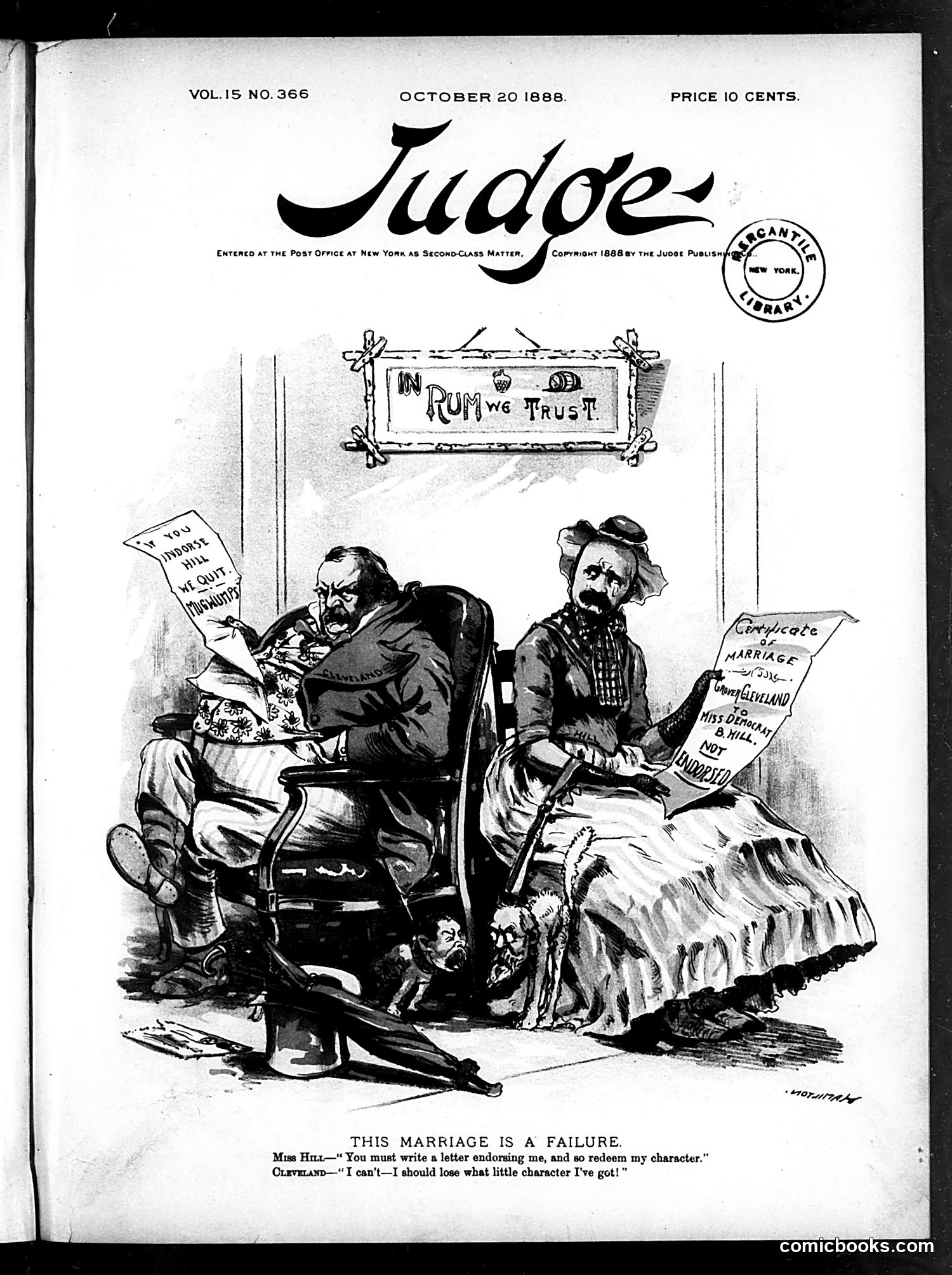
This 1888 *Judge* cartoon satirizes a marital dispute, likely referencing a contemporary scandal. Two figures sit in chairs beneath a sign reading "In Rum We Trust"—a satirical riff on "In God We Trust," suggesting alcohol fuels their relationship. The woman (labeled "Miss Hill") demands her husband write a letter redeeming her character; the man (labeled "Cleveland") refuses, fearing he'd lose "what little character I've got." The cartoon likely references President Grover Cleveland and a specific controversy, though the exact biographical details are unclear from the image alone. The satire targets both figures' compromised moral standing and suggests their "marriage" (perhaps their political relationship or alliance) is fundamentally broken and untrustworthy.
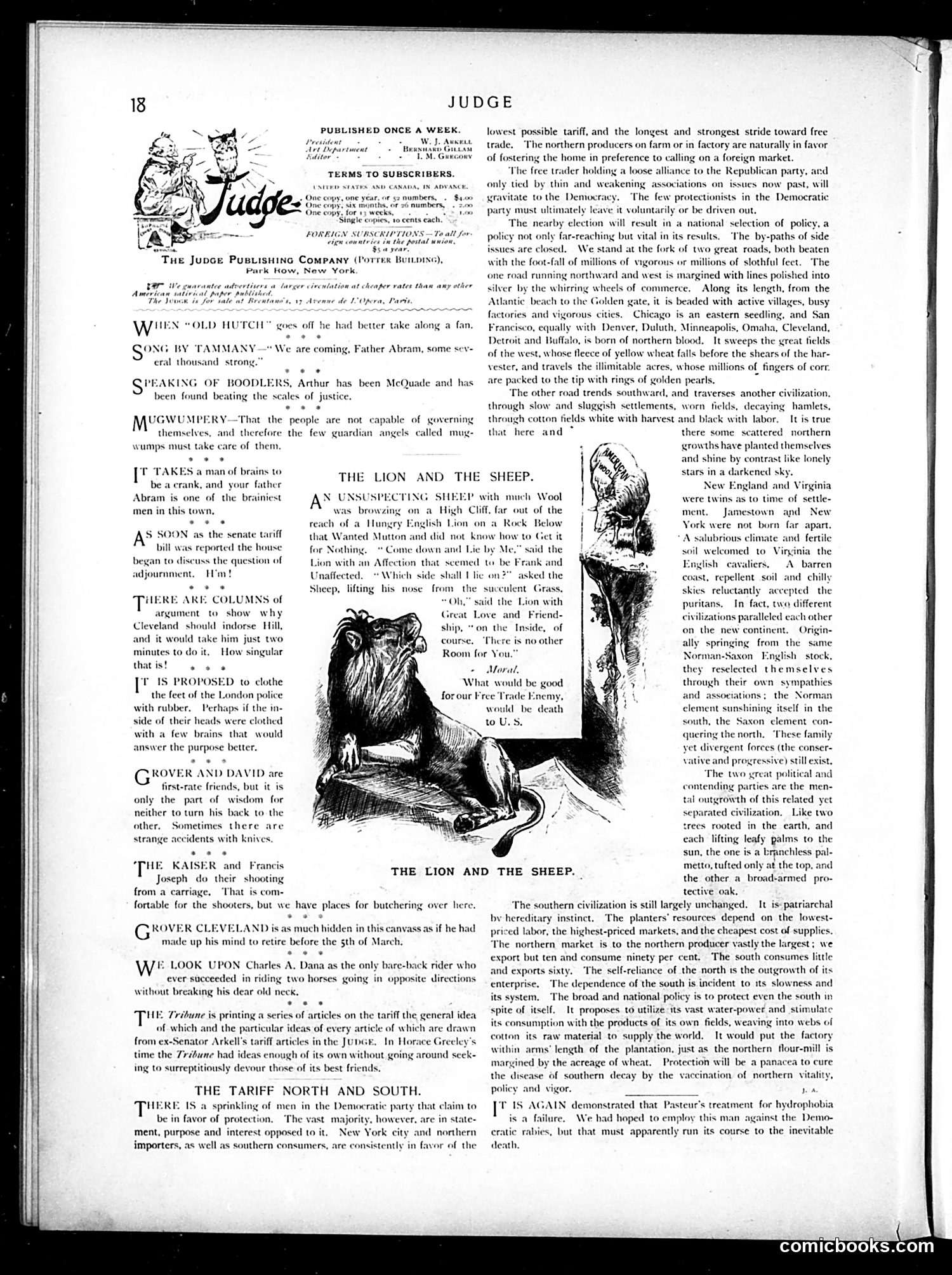
This political allegory depicts a **lion (representing a powerful force, likely protectionism or Northern industrial interests)** confronting a **sheep (representing the South or agricultural interests)**. The lion claims the sheep owes it something, while the sheep protests innocence. The accompanying article discusses the **tariff debate dividing North and South**: Northern manufacturers favored protective tariffs; Southern agricultural producers opposed them as economically harmful. The text references how these regions represent fundamentally different civilizations with incompatible economic systems. The cartoon satirizes this sectional conflict, suggesting the North's aggressive economic demands on the South resemble predatory behavior. The piece critiques how tariff policy perpetuates regional hostility rather than national unity.
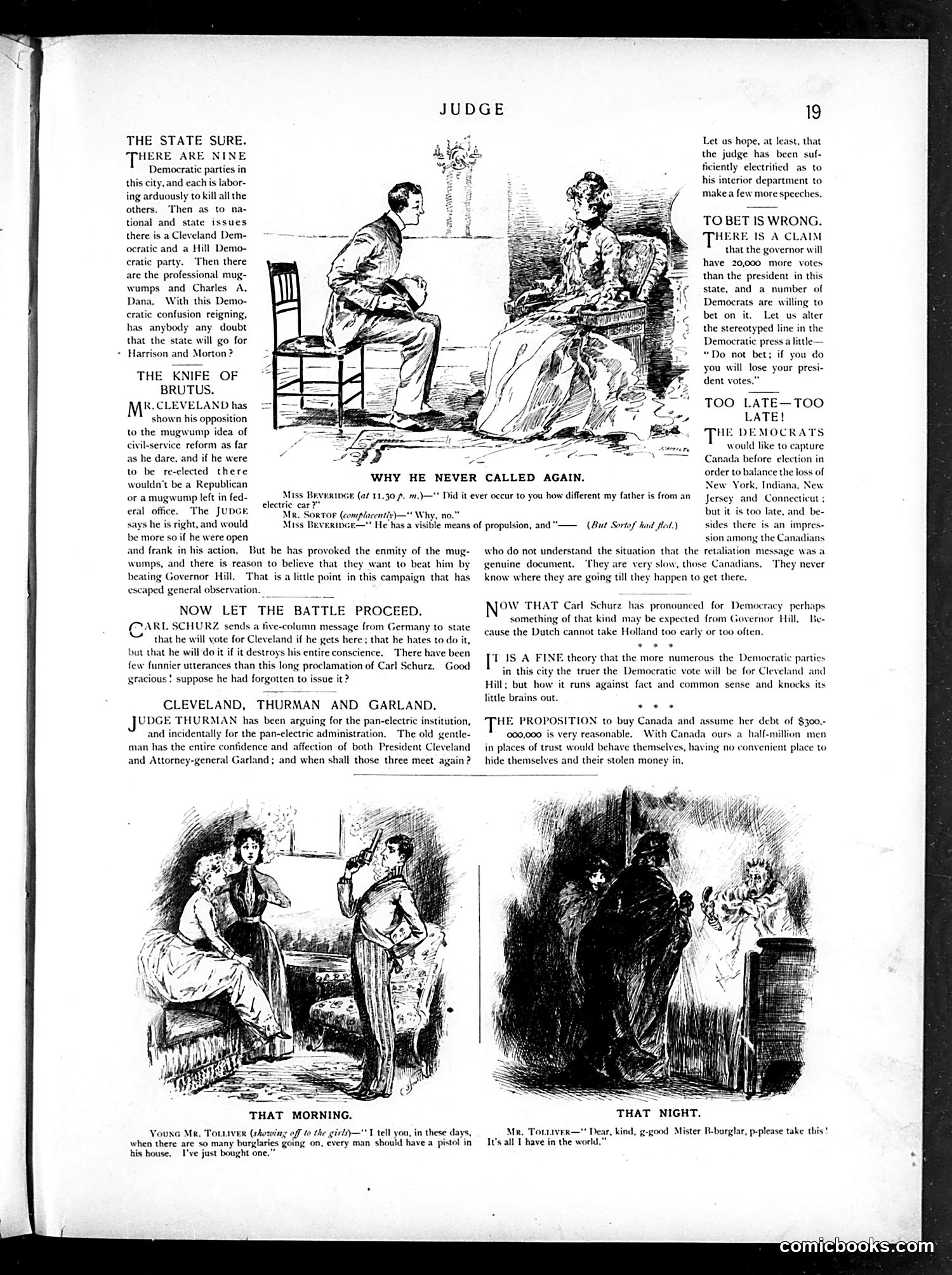
This page satirizes Democratic Party chaos during what appears to be the 1888 presidential election cycle. Key targets include: **"The State Sure"**: Mocks the fragmented Democratic Party—split into Cleveland and Hill factions, plus mugwumps (reform Republicans) and editor Charles Dana—predicting Republicans Harrison and Morton will win. **"The Knife of Brutus"**: Attacks Cleveland's inconsistency on civil-service reform, suggesting mugwumps secretly prefer defeating Governor Hill to support Cleveland. **Carl Schurz reference**: Ridicules the prominent German-American Republican's dramatic announcement that he'll vote Cleveland despite moral objections—mocking his self-importance. **Canadian jokes**: Satirizes Democratic fantasies about conquering Canada to offset expected electoral losses in New York and New Jersey. **Minor cartoons**: Sketch humor about young suitors carrying pistols during burglaries and a young man's father's "visible means of propulsion" (unclear reference). The overall thrust: Democratic Party disunity guarantees Republican victory.
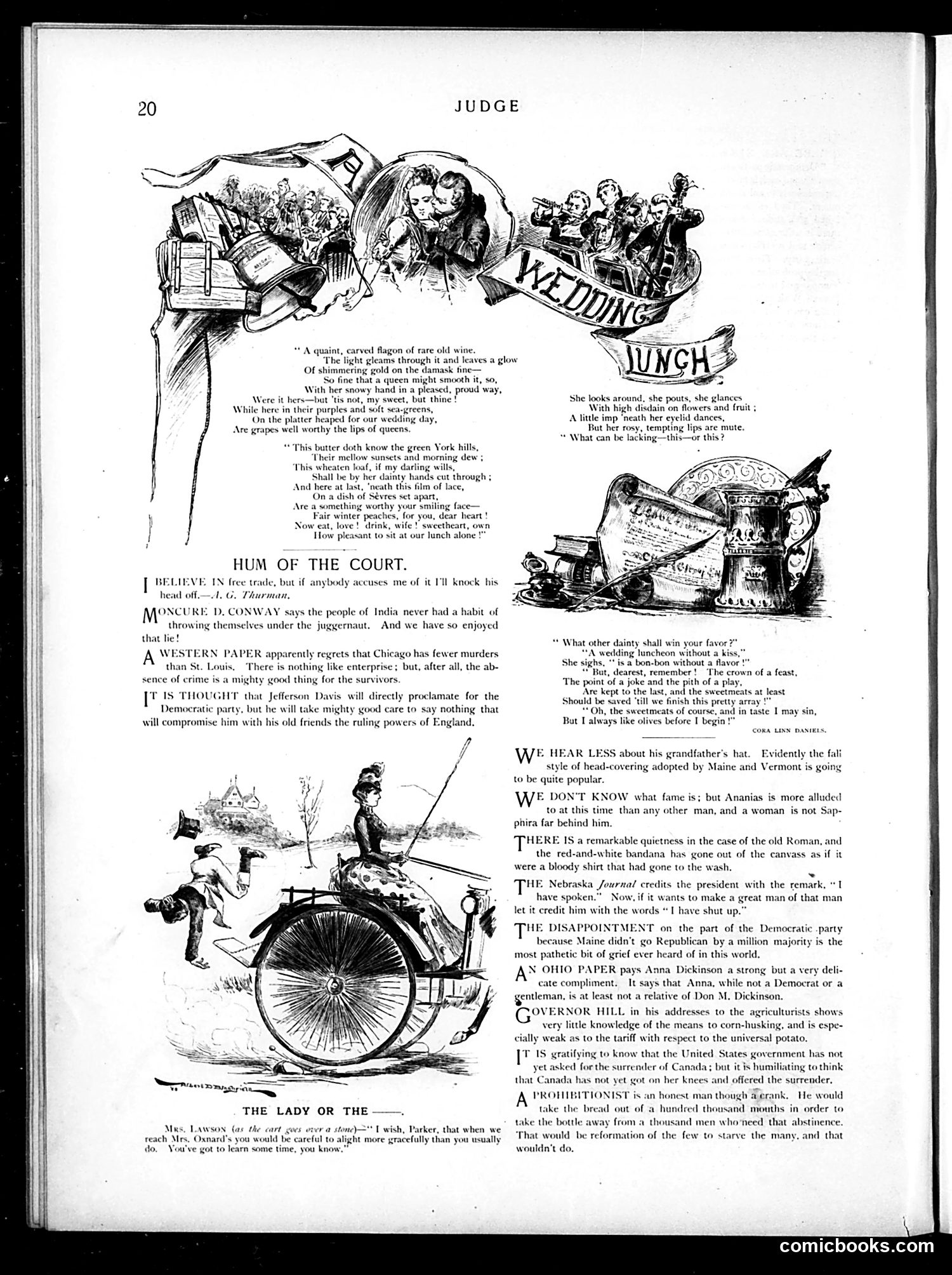
This page from Judge combines romantic poetry with political commentary typical of late 19th-century American satire. **Main Content:** The "Wedding Lunch" poem celebrates domestic bliss with detailed imagery of fine food and wine—a bride's contentment at a modest but elegant meal. It's sentimental Victorian verse about finding joy in togetherness rather than luxury. **Political Section ("Hum of the Court"):** The satirical notes mock contemporary figures and events: - **Jefferson Davis**: References the former Confederate president's potential Democratic party involvement - **Chicago crime rates**: Sardonic comment on the city's violence - **Maine/Vermont hat style**: Appears to reference Republican political influence from these states - **Anna Dickinson**: A contemporary political figure receiving backhanded praise - **Governor Hill and tariffs**: Criticism of political ignorance on agricultural policy, particularly regarding potatoes and protectionist trade The page reflects Judge's Republican leanings while poking fun at Democratic failings and public figures of the era.
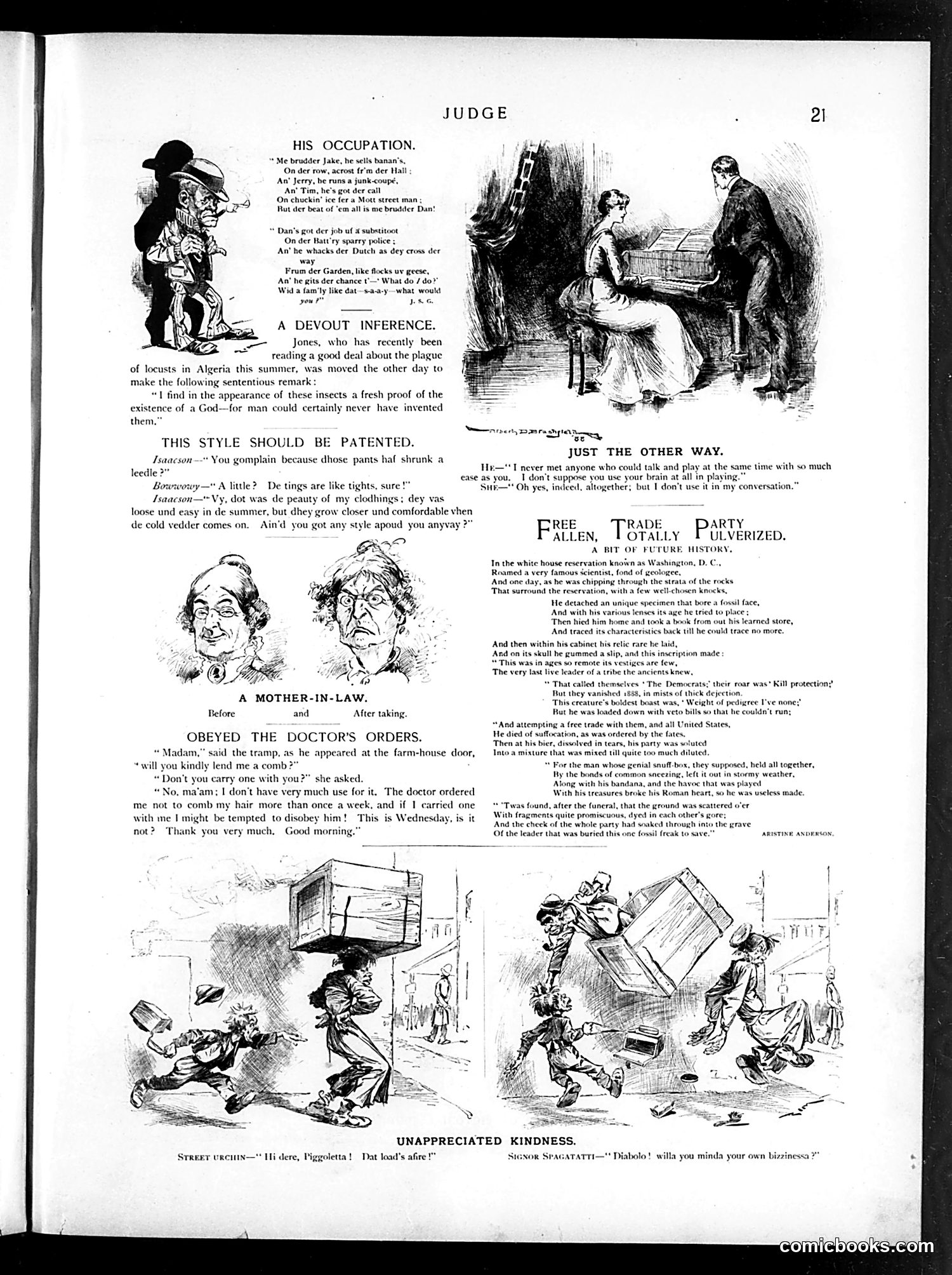
This 1888 *Judge* page satirizes contemporary American politics and social issues. The main attraction is "A Bit of Future History"—a mock-scientific satire depicting a paleontologist in Washington, D.C. discovering a fossil of "the very last live leader of a tribe the ancients knew"—specifically, a Democrat from the 1888 election era. The satire mocks Democrats (particularly Grover Cleveland) for their "free trade" positions and internal disunity. References to "veto bills" and the party dissolving into useless fragments target Cleveland's leadership. The fossil's "weight of pedigree" jab suggests weak lineage or credentials. Other content includes ethnic humor (Irish immigrant dialogue) common to the period, gender-based jokes about married life, and working-class street scenes. The overall tone reflects *Judge*'s Republican editorial stance during a contentious election year, using mock-serious scientific language to ridicule Democratic political positions as extinct and obsolete.
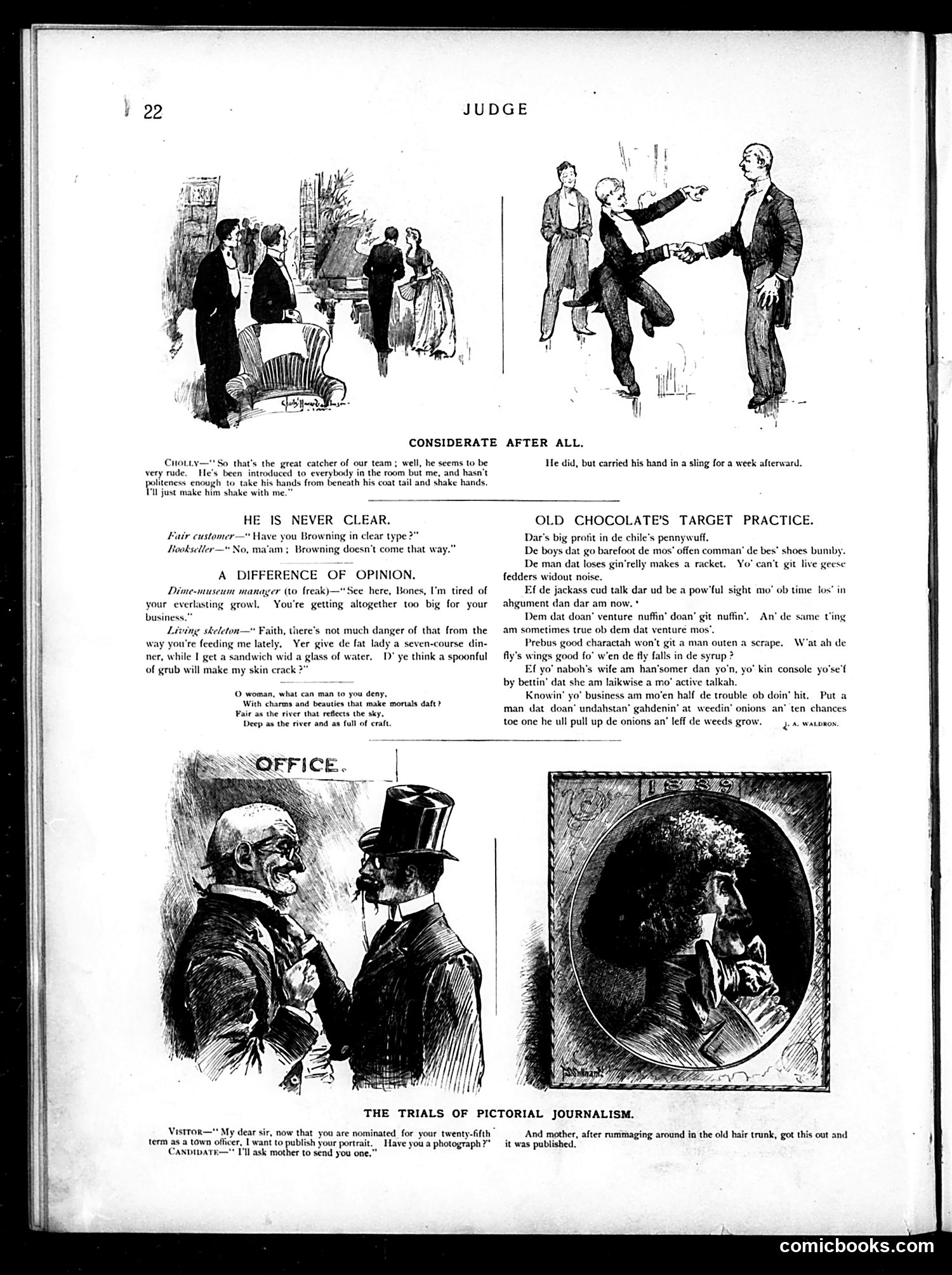
This page contains multiple satirical sketches mocking various social situations: **"Considerate After All"** shows a rude baseball player who refuses to shake hands; when forced, he breaks his arm—satirizing false politeness masking genuine rudeness. **"He Is Never Clear"** jokes about a bookstore customer asking for "clear type" editions of Browning poetry, then complaining the text is unclear anyway—mocking indecisive customers. **"A Difference of Opinion"** depicts a dime-museum manager complaining about a "living skeleton" exhibit, while the skeleton counters that poor feeding makes him look worse—dark humor about exploitation in freak shows. **"Old Chocolate's Target Practice"** consists of folk aphorisms in dialect, likely mocking or parodying contemporary advice columns or folk wisdom. **"The Trials of Pictorial Journalism"** satirizes a town politician providing an ancient, unflattering portrait for publication because he has no better one—lampooning vanity and poor political PR. The page showcases Judge's typical humor: social commentary through exaggeration and irony.
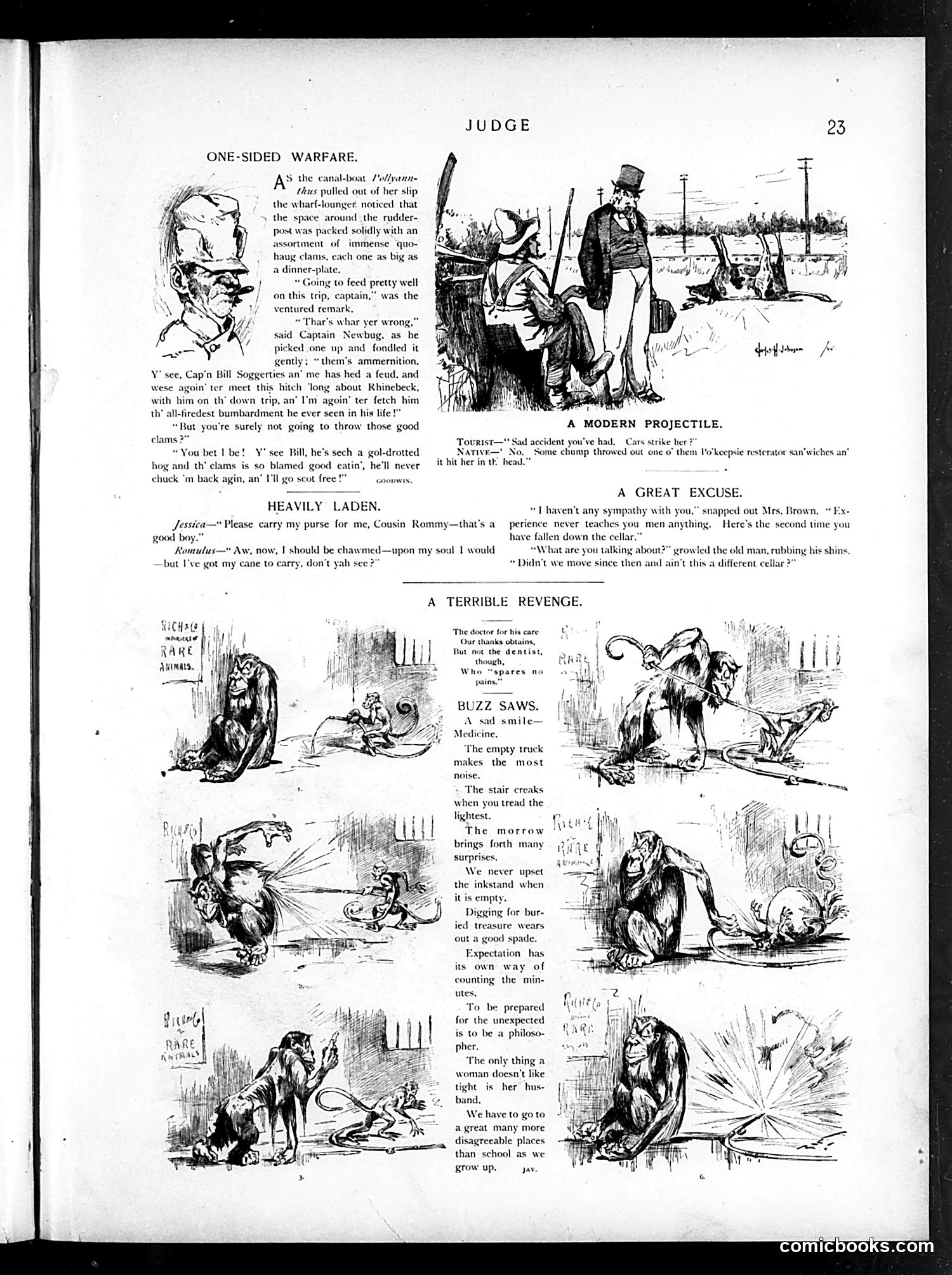
This page contains several unrelated humorous sketches typical of Judge's satirical style: **"One-Sided Warfare"** mocks rural dialect and feuding. Two canal captains plan revenge using giant clams as ammunition—absurdist humor playing on the notion of "ammunition" and working-class speech patterns. **"Heavily Laden"** jokes about masculine vanity: a woman asks her cousin to carry her purse, but he refuses because carrying a cane is more important to his appearance. **"A Modern Projectile"** satirizes urban rudeness: a sandwich thrown from a Poughkeepsie restaurant car strikes a car below—commentary on careless behavior and crowded travel. **"A Great Excuse"** depicts marital discord: a husband uses "different cellar" as an excuse after repeatedly falling down the stairs, mocking both male clumsiness and transparent lies. **"A Terrible Revenge"** and **"Buzz Saws"** are collections of observational jokes about everyday annoyances (creaky stairs, empty trucks making noise), not political satire—typical filler humor for the era.
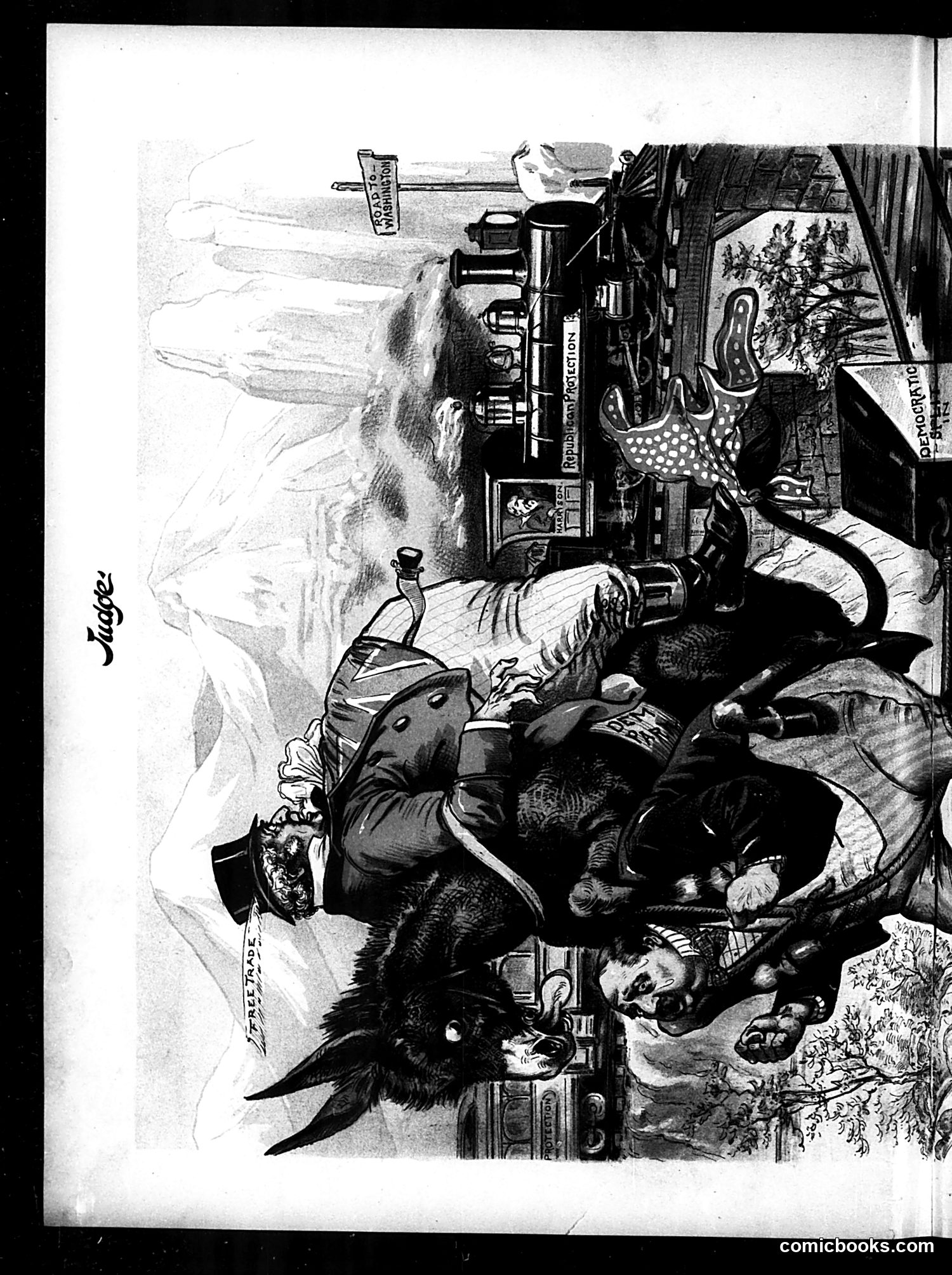
I can see this is a page from *Judge* magazine, but the OCR text provided is largely illegible (appears to be encoding errors). The image itself, when rotated properly, shows a satirical cartoon depicting what appears to be anthropomorphized animals or caricatured figures in a domestic or social scene. There's a fireplace, furniture, and what looks like period clothing suggesting late 19th or early 20th century American setting. However, without legible text identifying the specific figures, political figures being mocked, or the cartoon's title, I cannot reliably explain the satire's specific meaning or targets for a modern reader. The illustration quality is clear, but the context needed to interpret the political or social commentary is not sufficiently visible in the materials provided.
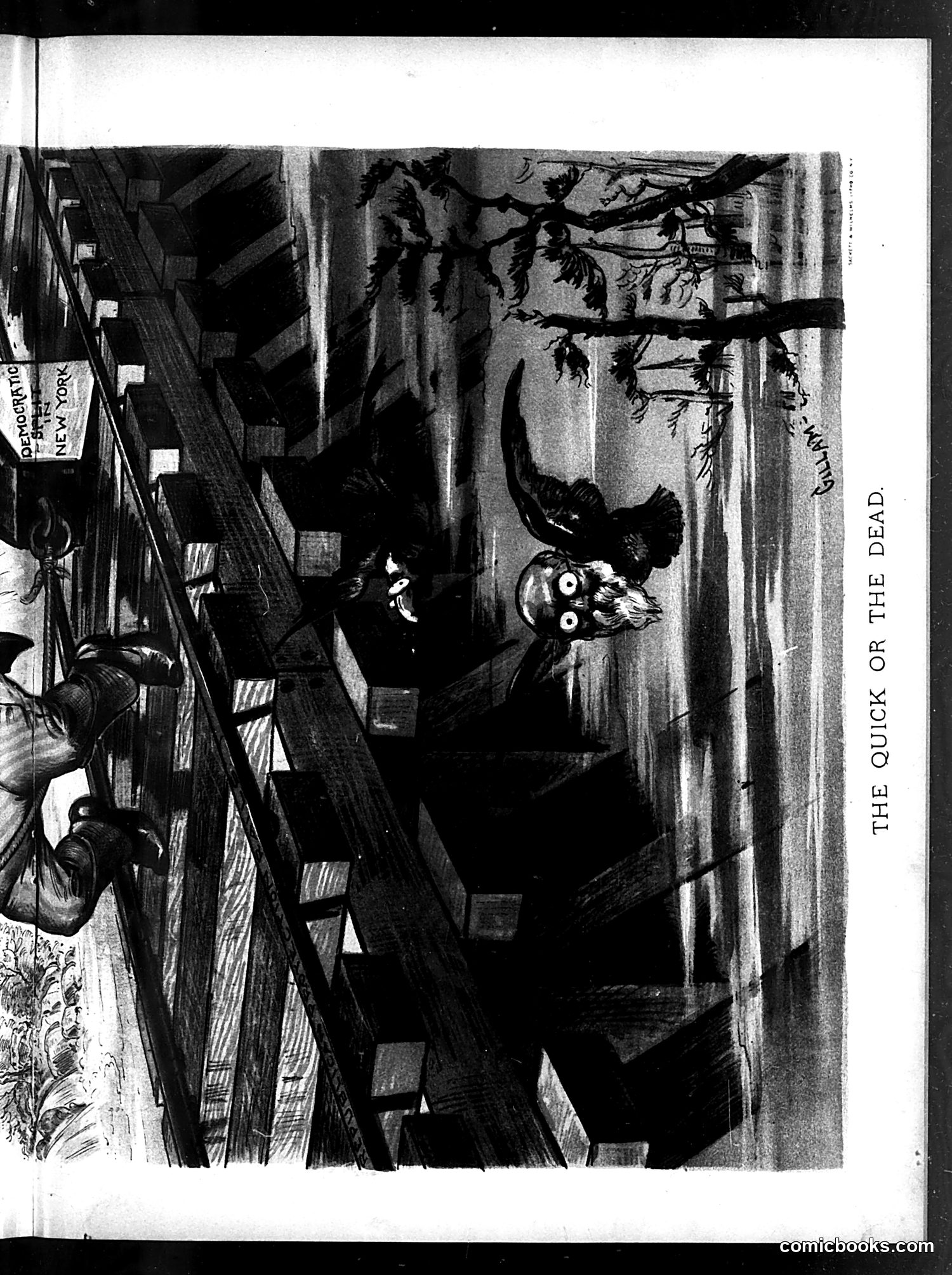
The OCR text is too corrupted to read reliably. However, the image shows a black and white illustration titled "THE QUICK OR THE DEAD" (visible on the right margin). The cartoon depicts what appears to be a figure in formal dress (possibly a politician or public figure) in an interior setting with architectural elements like stairs and doorways. The style is characteristic of late 19th or early 20th-century American political satire from Judge magazine. Without legible text identifying the specific figures or historical event referenced, I cannot determine which political situation or individual this satirizes. The title suggests a moral dilemma or choice between speed/action versus inaction, but the specific commentary remains unclear from this page alone.
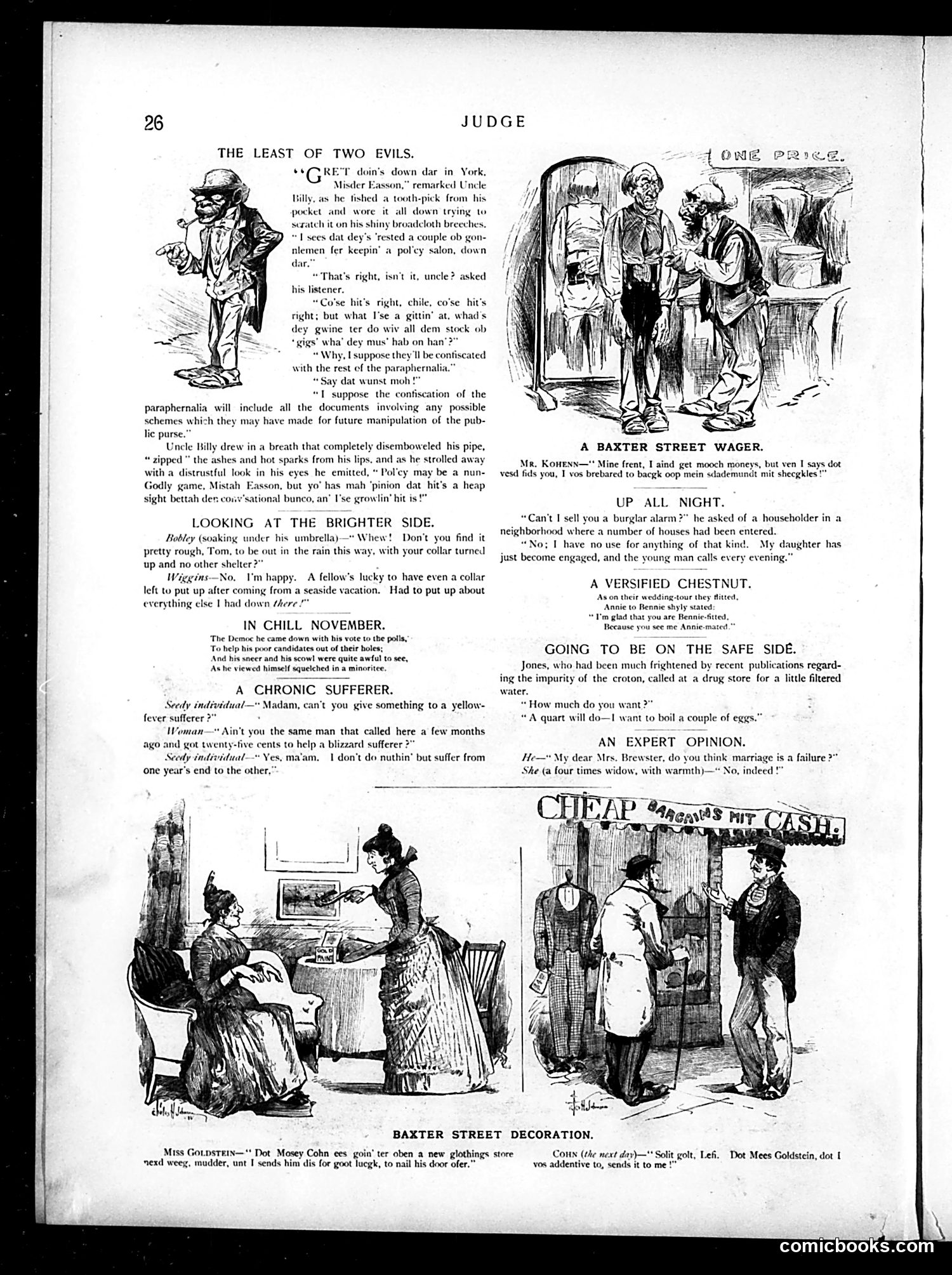
This page contains multiple satirical sketches typical of 1880s-90s Judge magazine: **"The Least of Two Evils"** depicts an African American dialogue about policy gambling (numbers racket). Uncle Billy discusses the arrest of policy-salon operators, expressing that while policy gambling is "ungodly," it's preferable to other vices—satirizing moral hypocrisy about vice enforcement. **Other sketches** include: - A homeless man chronically panhandling for different disasters - A burglar-alarm salesman losing business to an engaged couple's constant visits - Jokes about water purity (referencing Croton water contamination concerns) - "Baxter Street" sketches featuring working-class Jewish immigrants with thick dialect humor, depicting small business dealings The page exemplifies Judge's formula: social commentary mixed with ethnic/class-based caricature humor. The Yiddish-dialect "Baxter Street" sections reflect late-Victorian attitudes toward immigrant communities, using exaggerated speech patterns for comedic effect in ways considered acceptable then but offensive today.
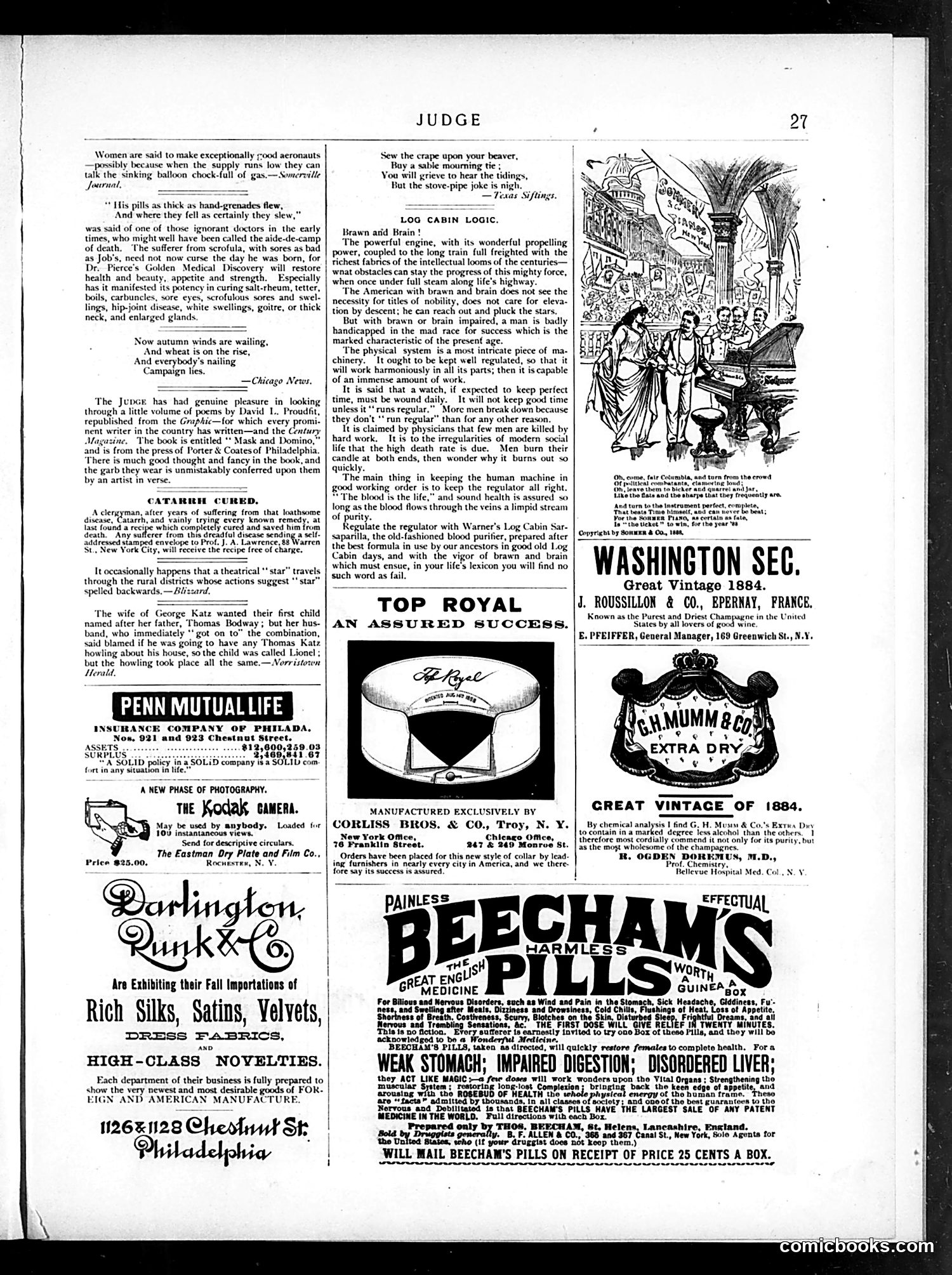
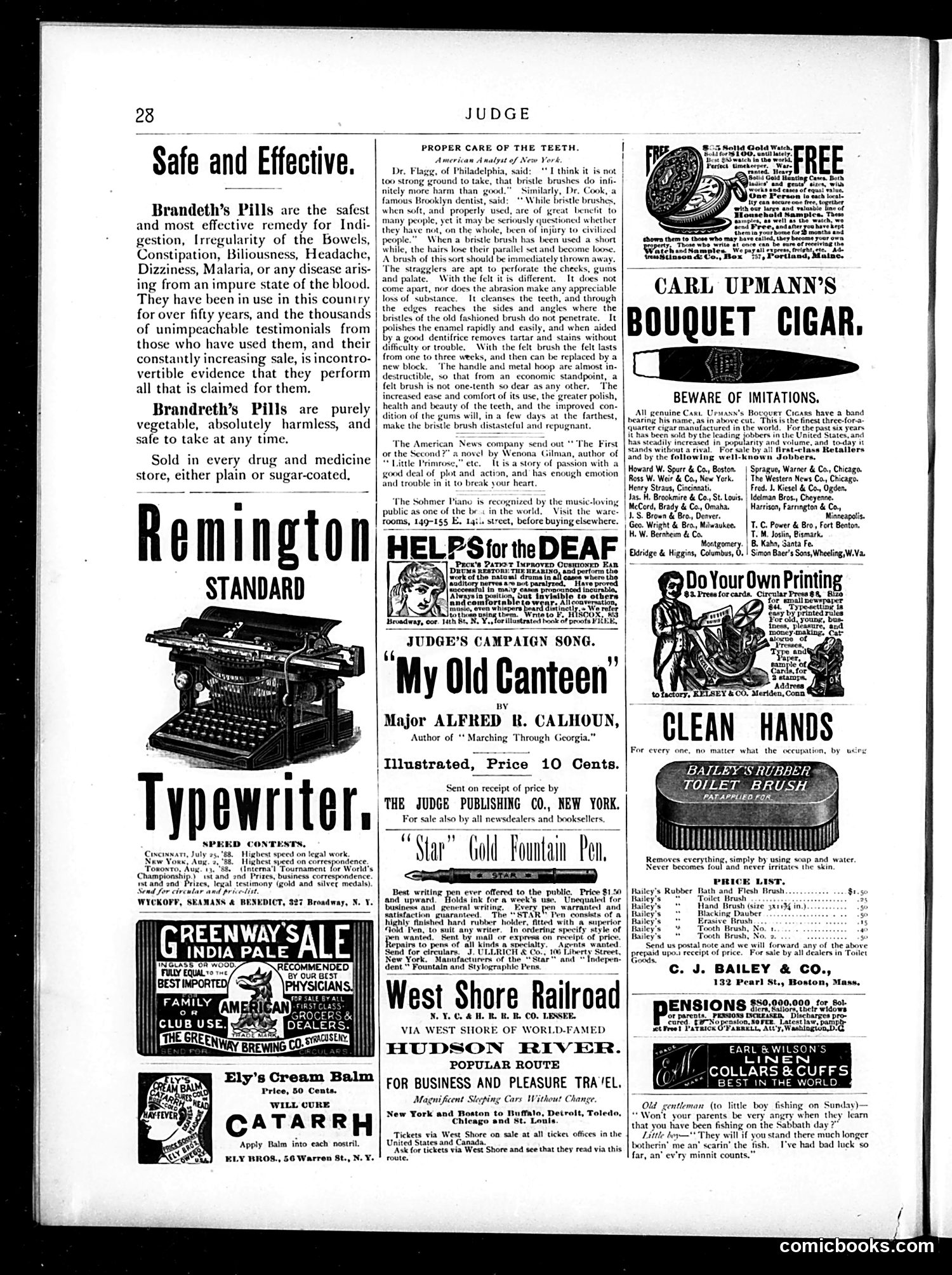
This page is primarily **advertisements and promotional content** rather than political cartoons or satirical commentary. It represents typical late-19th/early-20th century magazine advertising. Notable elements include: **Products advertised:** Brandeth's Pills (patent medicine for digestive complaints), Remington typewriter, dental care advice, Ely's Cream Balm (for catarrh), fountain pens, railroad service, and various other goods typical of the era. **"Judge's Campaign Song"** promotes a book titled "My Old Canteen" by Major Alfred R. Calhoun—likely referencing Civil War nostalgia, a popular theme in post-war America. **The dental care article** discusses bristle versus felt toothbrushes, representing contemporary debates about personal hygiene and consumer products. **No clear political satire is visible** on this page. It appears to be a standard advertising section of *Judge*, the prominent American humor and satire magazine. The page demonstrates how such publications supported themselves through commercial advertising rather than editorial content alone.
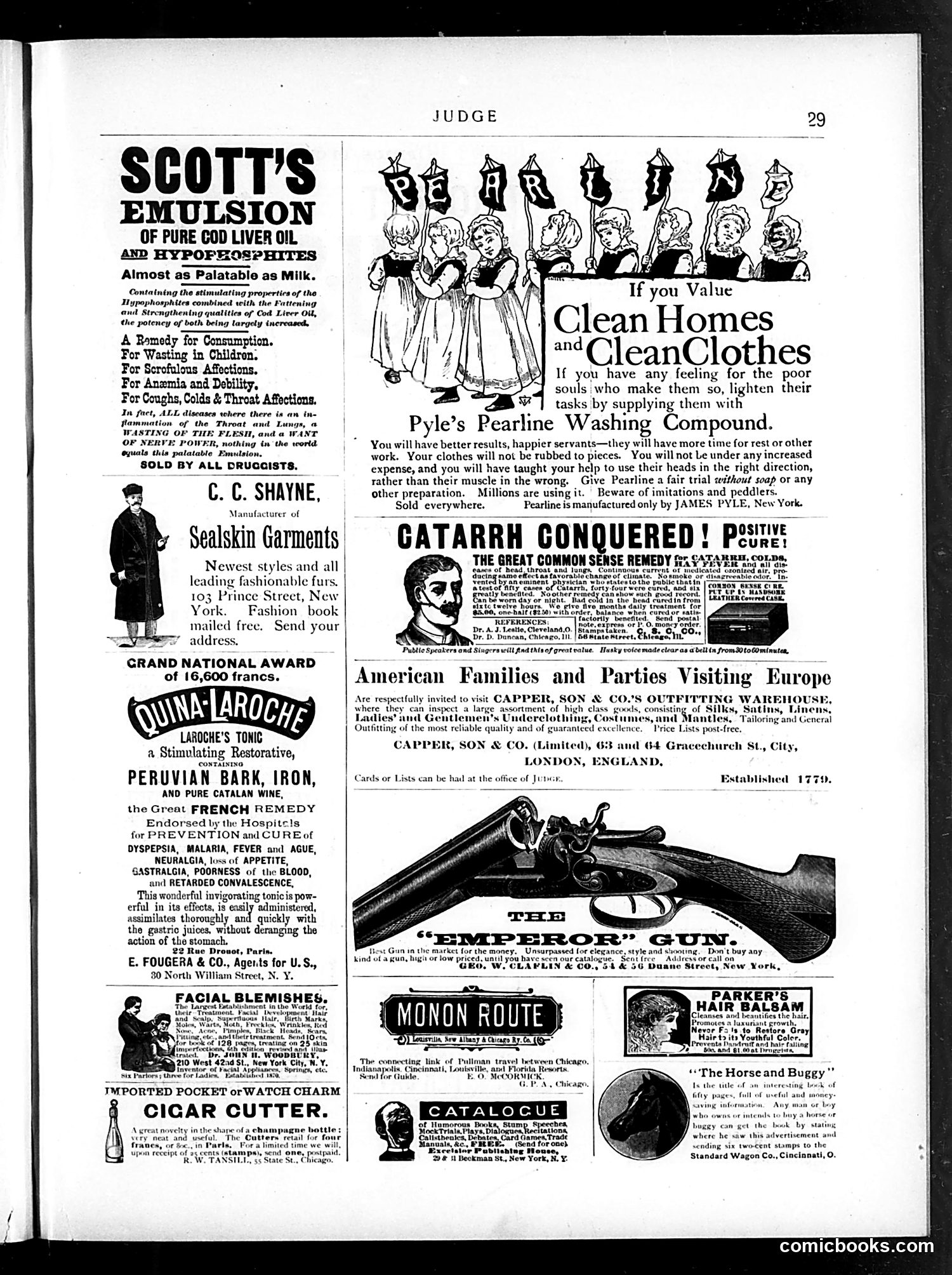
This page is primarily **advertisements** rather than editorial cartoons. It showcases late 19th-century patent medicines and consumer goods typical of the era. Notable products include Scott's Emulsion (cod liver oil marketed as cure-all), Pyle's Pearline washing compound (with paternalistic messaging about "helping the poor"), and Laroche's Tonic (a French "cure" for numerous ailments). The **satirical angle**—if any—lies in Judge's implicit endorsement of these dubious remedies through placement in a humor magazine. The page reflects the period's unregulated medicine market where virtually any substance claimed miraculous healing powers. The language ("Catarrh Conquered!") and vague efficacy claims now read as obviously fraudulent, but were standard marketing then. A small illustrated section shows women with the Pearline ad, emphasizing domestic servitude themes common in Victorian advertising. The layout mixes editorial space with paid advertising, standard for 19th-century magazines seeking revenue.
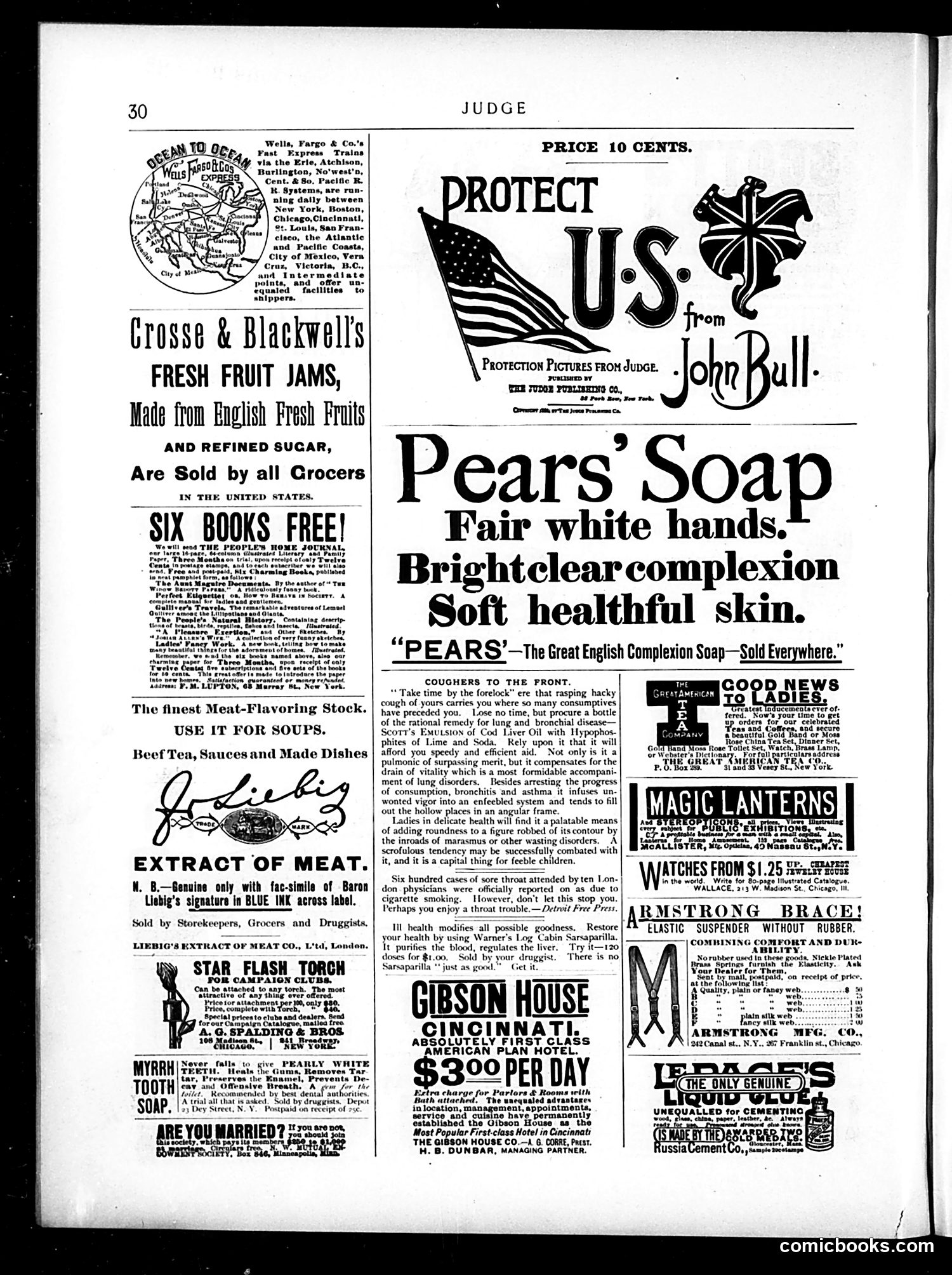
This is primarily an **advertising page** from Judge magazine, with one small political cartoon at the top. The main cartoon, titled "PROTECT U.S. from John Bull," depicts the American flag and a cross shield protecting against what appears to be a British lion—a common symbol for Britain. This reflects **late 19th-century American protectionism**: the debate over tariffs and trade policy. "John Bull" is the traditional personification of Britain. The cartoon advocates for protective tariffs to shield American commerce from British competition—a significant political issue of the era. The remainder of the page consists of period advertisements for consumer goods (Pears' Soap, Scott's Emulsion cough remedy, Gibson House Hotel, watches, etc.). These ads are typical of Judge's revenue model and reveal period attitudes toward health, beauty, and consumerism. The page reflects American economic nationalism and emerging consumer culture of the Gilded Age.
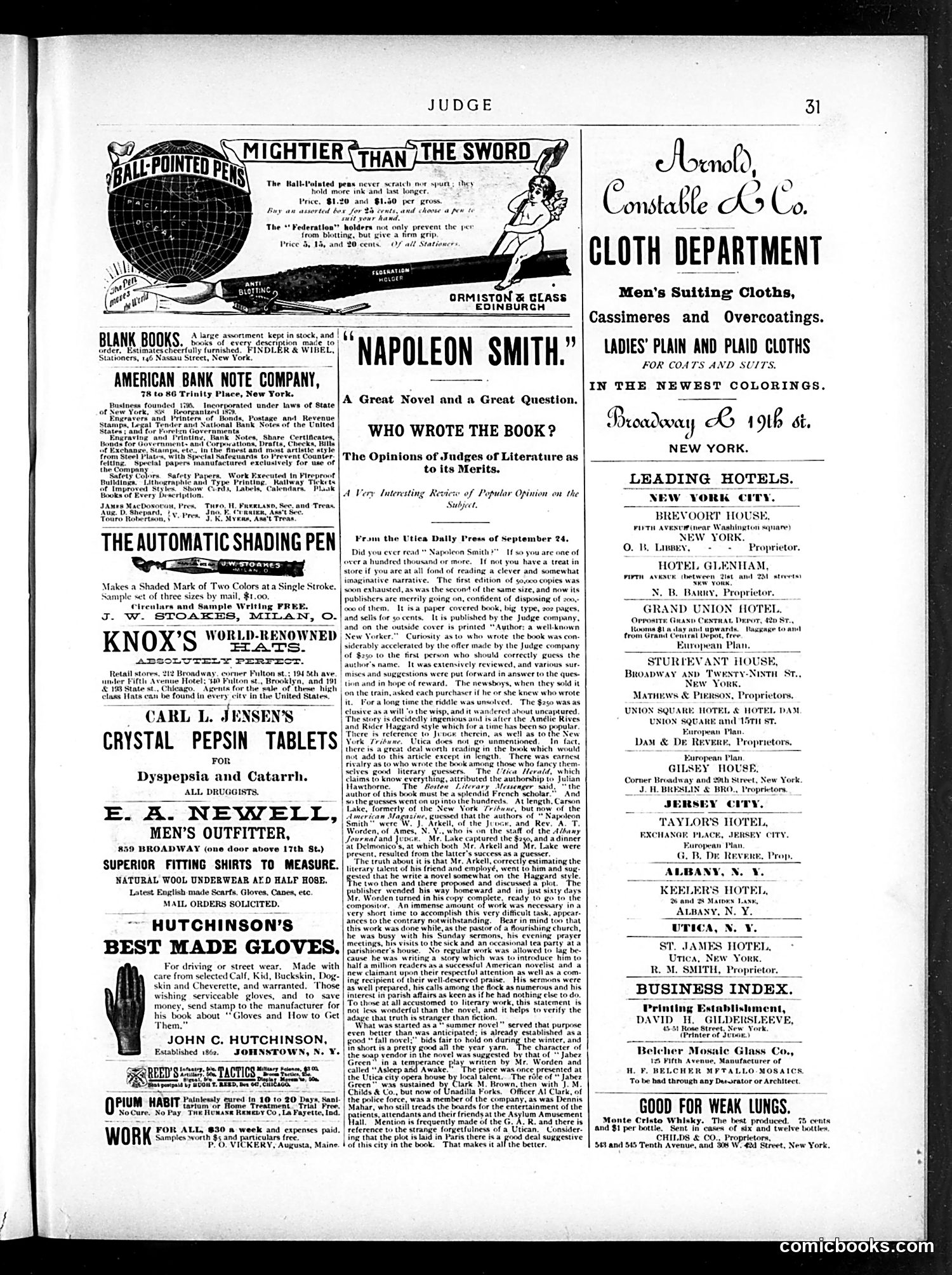
This page announces **"Napoleon Smith,"** a novel published by Judge magazine as a commercial puzzle-game. The book's authorship was deliberately concealed, and Judge offered a $250 prize to whoever correctly guessed who wrote it. The text indicates the strategy worked: the mystery generated enormous sales (over 100,000 copies) and widespread public speculation. Newspapers reviewed it, newsboys asked purchasers if they knew the author, and literary circles debated the identity. The novel apparently references real figures like Amelie Rives (a known American novelist), suggesting the authorship puzzle had genuine intrigue for contemporary readers invested in literary culture. This was essentially a **marketing gimmick**—Judge leveraged curiosity and competition to drive book sales, a strategy that clearly succeeded in capturing public attention during this era. The rest of the page is standard magazine advertising (pens, hats, medicines, hotels).
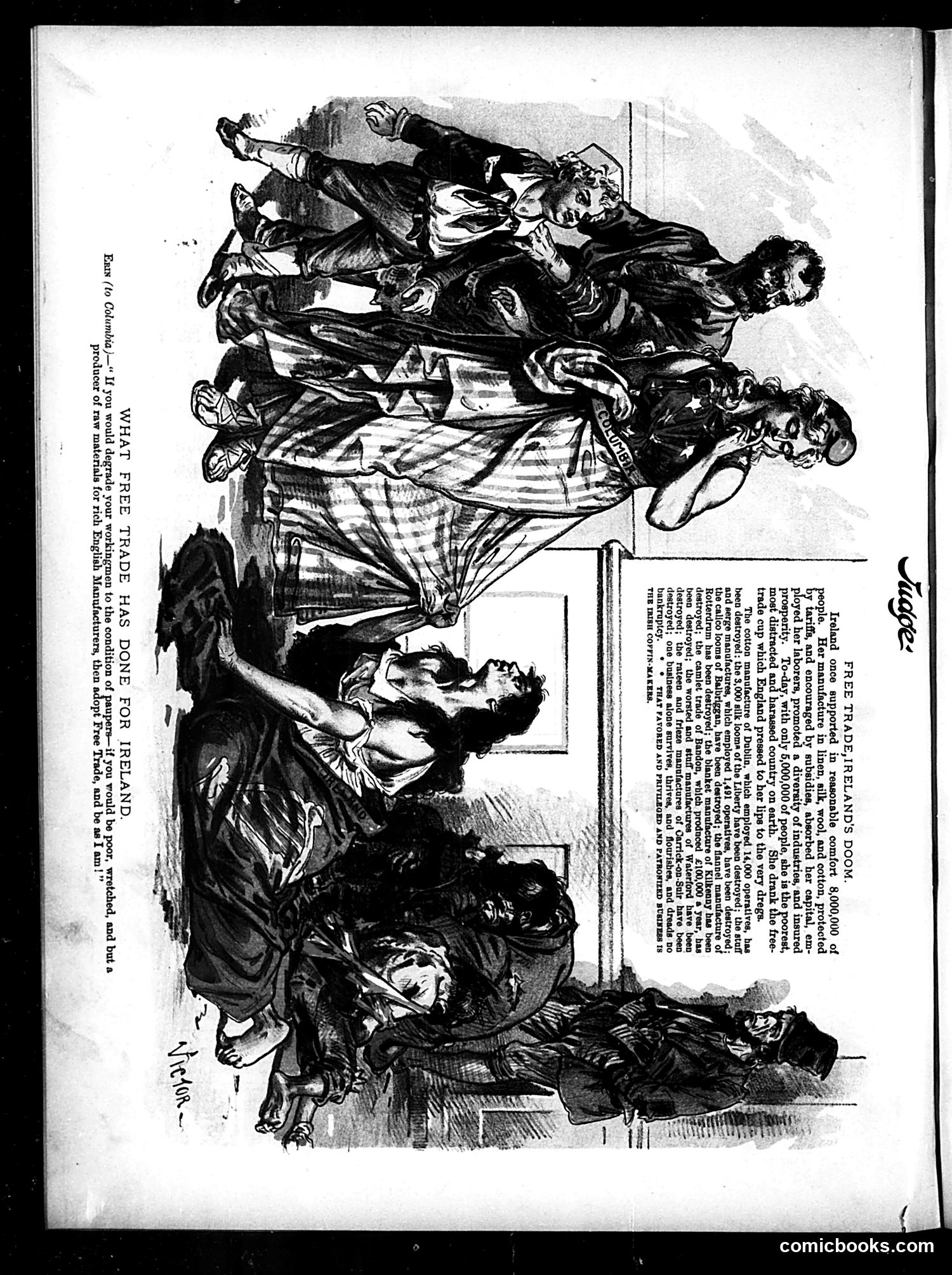
This Judge magazine cartoon satirizes free trade's devastating effects on Ireland. The upper panel shows Britannia (England, personified as a woman) offering Ireland a poisoned "free trade cup," while the lower depicts Ireland as a coffin-maker—suggesting the policy killed Irish manufacturing. The text argues that protective tariffs once sustained Ireland's 8 million people through textile industries (linen, silk, wool, cotton). Under British-imposed free trade, Ireland's population halved to 5 million, industries collapsed (Dublin's cotton trade lost 14,000 jobs), and the country became impoverished, reduced to exporting raw materials. The caption warns America (Columbia) against adopting similar free-trade policies, predicting worker degradation and economic ruin. This reflects late-19th-century American protectionist debate: opponents of free trade used Ireland as a cautionary example of how unrestricted British trade destroyed local manufacturing and reduced nations to colonial suppliers.