
A complete issue · 16 pages · 1888
Judge — June 16, 1888
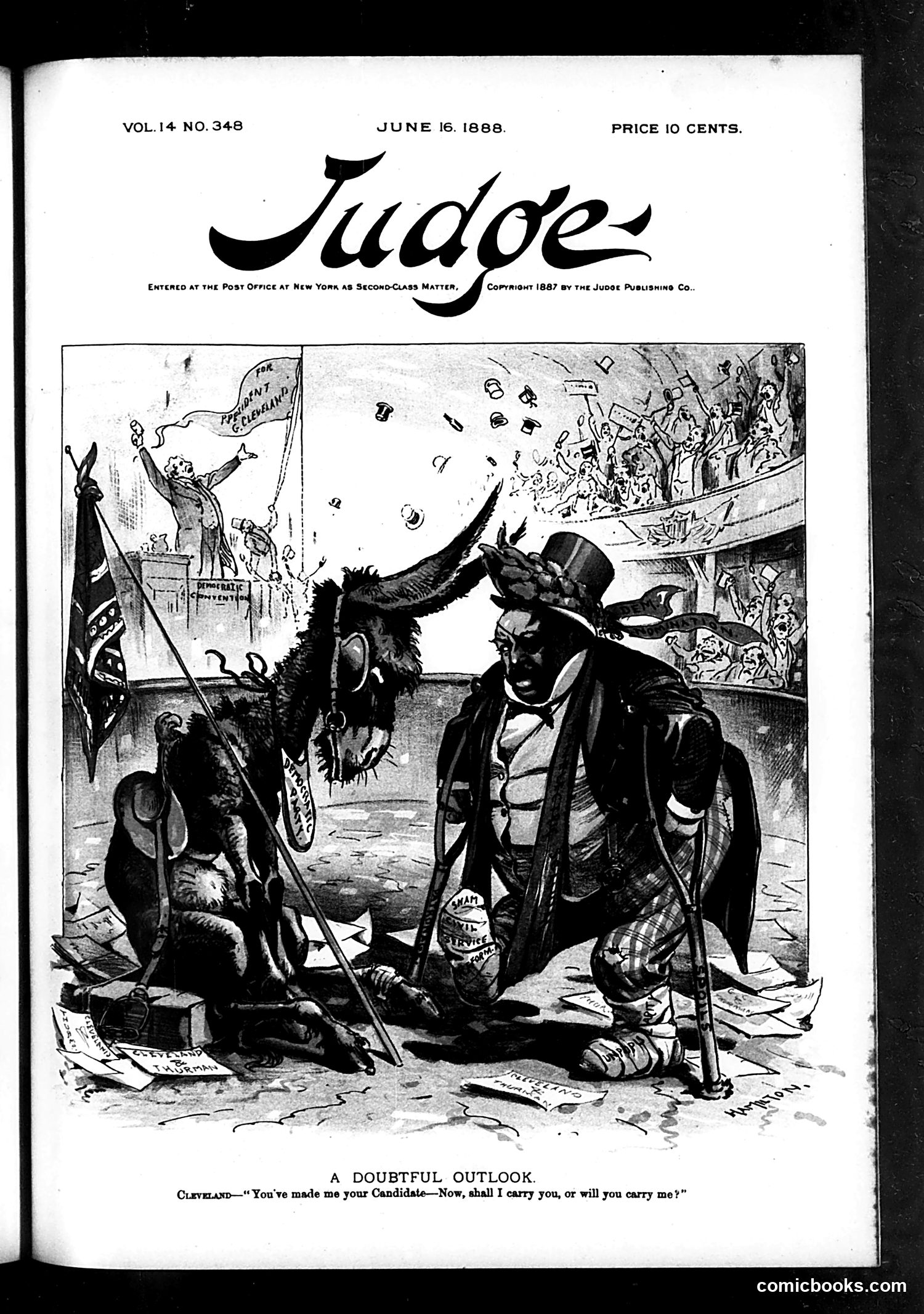
This June 1888 Judge cartoon satirizes the 1888 U.S. presidential election. The caption identifies the figure on the left as "Cleveland," referring to incumbent President Grover Cleveland. The cartoon depicts Cleveland as a devil or demonic creature being carried by what appears to be a political operative or supporter. The caption's question—"Now, shall I carry you, or will you carry me?"—suggests uncertainty about who controls the political outcome: whether Cleveland will be reelected or his supporter will determine the result. The chaotic scene with crowds in the background and scattered papers reinforces themes of political instability and backroom dealing. The satire mocks the murky nature of electoral politics and questions Cleveland's viability as a candidate heading into the general election against Republican Benjamin Harrison.
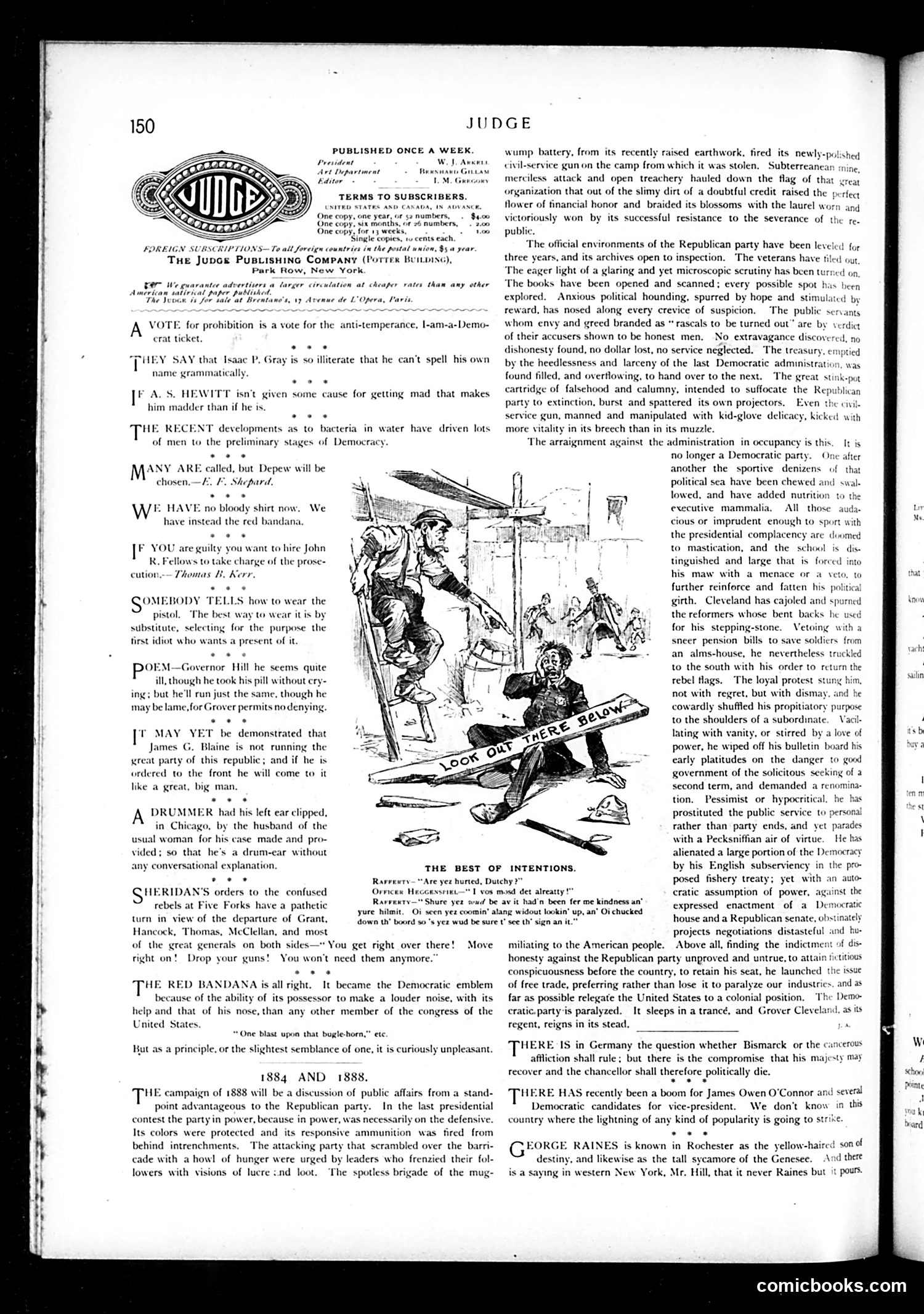
The central cartoon titled "THE BEST OF INTENTIONS" depicts a figure labeled "LOCK OUT HERE" appearing to fall or tumble, likely satirizing labor disputes of the 1880s era. The accompanying dialogue references disputes between employers and workers, with mentions of "Share yer load" and warnings about "kickin' up, or I'll bounce yer board as yer wad be sure I set it right on it." The page's text discusses 1888 presidential campaign strategy, attacking Republican tactics while defending Democratic positions. References to the "Red Bandana" as a Democratic emblem suggest partisan symbolism of the period. Without clearer visual identification of specific figures, the cartoon appears to mock workplace conflict resolution or labor negotiation tactics during the Gilded Age industrial disputes.
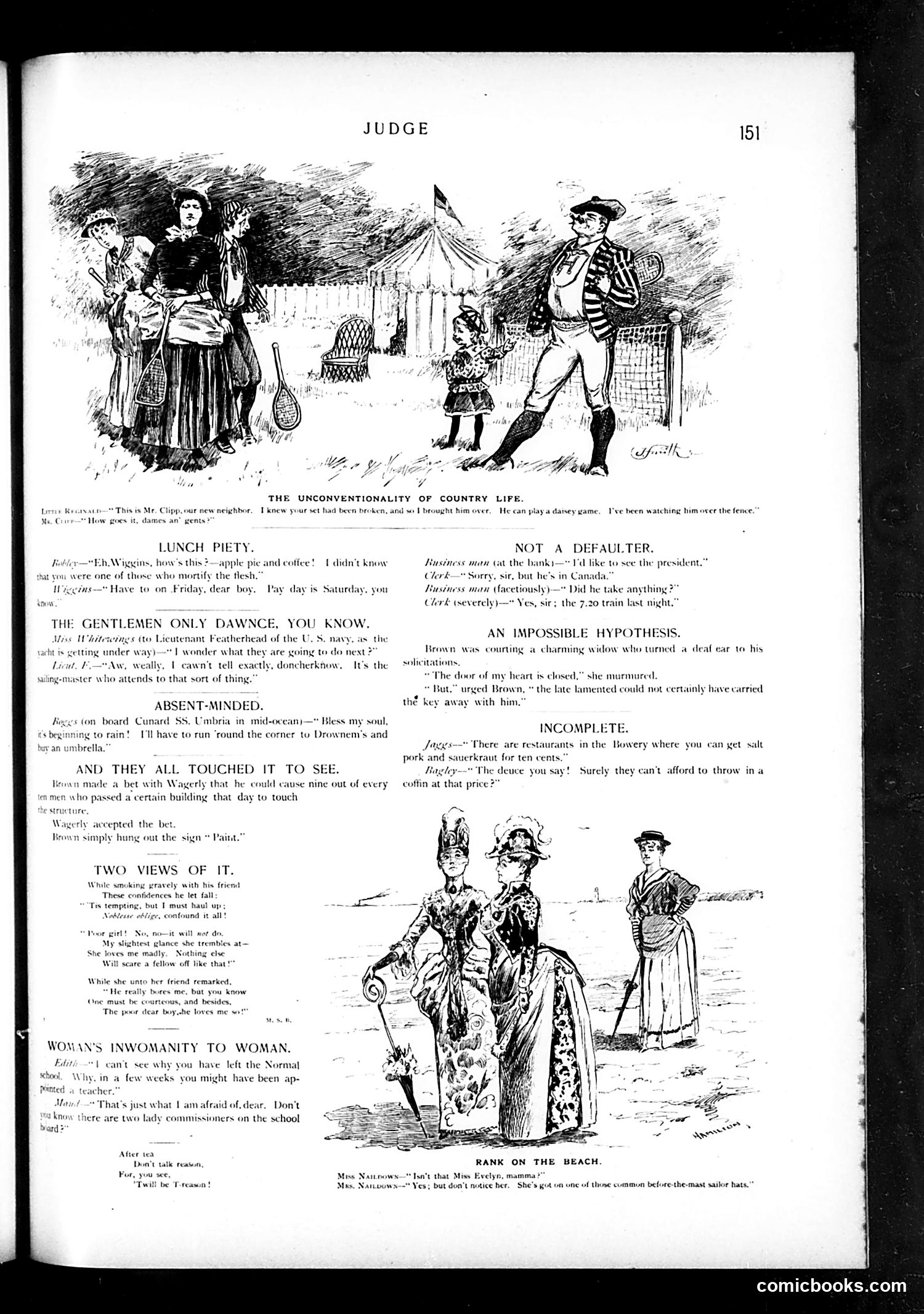
This page from Judge magazine (date unclear) contains multiple short satirical sketches typical of the era's humor style: **Key Content:** - **"The Unconventionality of Country Life"**: A wealthy neighbor brings an escaped prisoner to a friend, noting he can "play a dansey game"—satirizing rural social awkwardness and class pretension. - **"The Gentlemen Only Dance"**: A naval officer wonders what to do next at a social event, mocking military gentlemen's social inadequacy. - **"Lunch Piety"** and **"Two Views of It"**: Satirize Victorian moral hypocrisy—characters claim piety while behaving inconsistently. - **"Not a Defaulter"**: A banker's clerk absent in Canada—humor about business irresponsibility. - **"An Impossible Hypothesis"**: A widow refuses a suitor's advances with dark irony about a deceased husband's missing heart-key. The page exemplifies Judge's satirical targets: social pretension, moral hypocrisy, class anxiety, and Victorian courtship conventions. The style is genteel drawing-room satire aimed at educated urban readers.
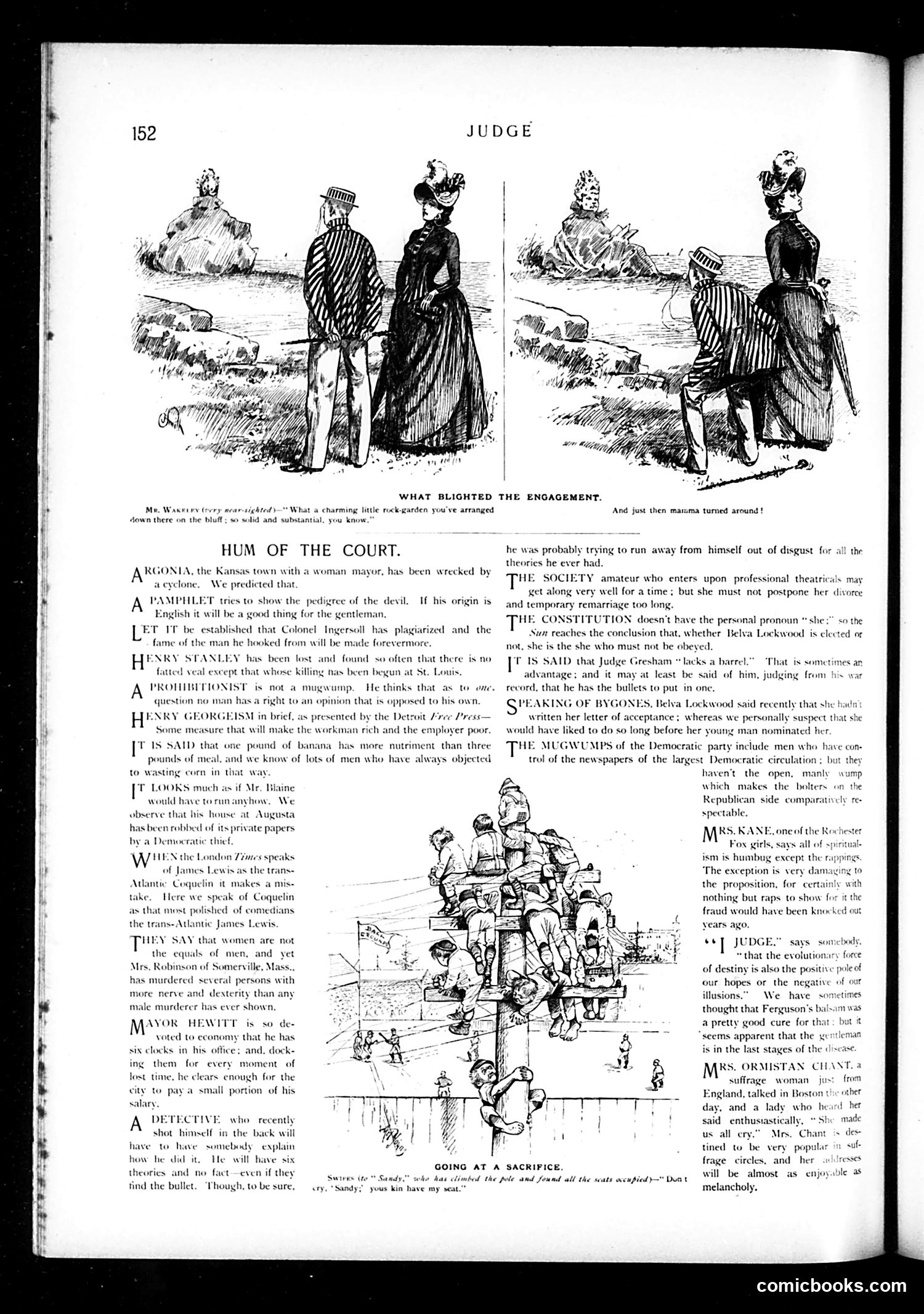
This page contains brief political commentary satirizing 1880s American politics and society. Key targets include: **Political figures**: References to Colonel Ingersoll (plagiarism accusation), Henry Stanley (explorer repeatedly lost/found), Judge Gresham, and Belva Lockwood—a women's rights advocate running for president, mocked for her divorce and remarriage. **Social commentary**: "Argonia's" female mayor (Kansas town) wrecked by cyclone; Henry George's economic theories; Mayor Hewitt's time-obsession; a woman murderer (Mrs. Robinson) cited to counter claims of female inferiority. **The cartoons**: Top illustration shows a couple discussing a "rock garden" (unclear reference); bottom shows people climbing a pole for seats—possibly satirizing competitive scrambling for advantage or political positions. The satire mocks reformers, prohibitionists, women in politics, and contemporary figures with characteristic 1880s Judge magazine irreverence and wordplay.
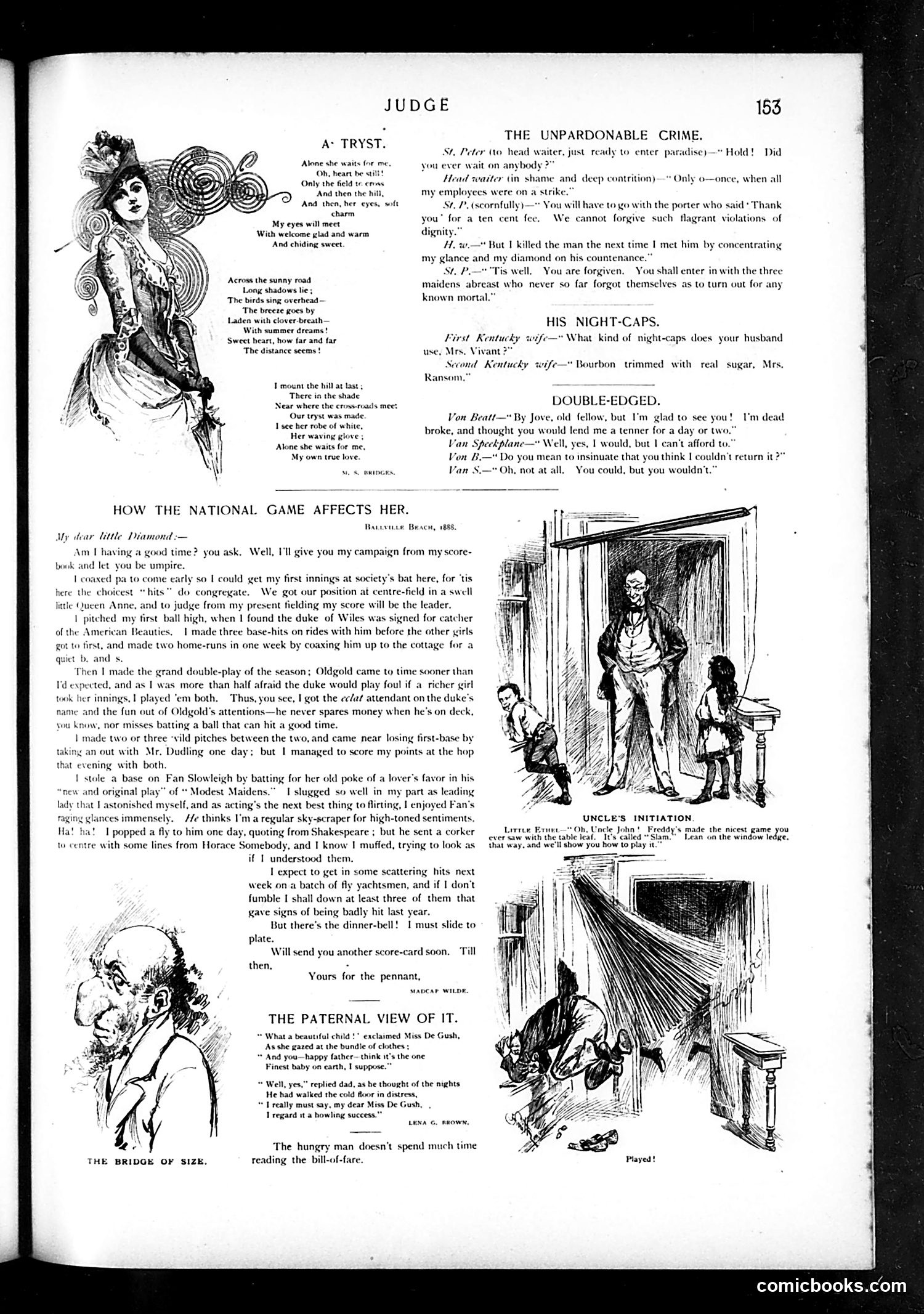
This page from Judge contains several satirical pieces mocking social pretensions and romantic behavior of the Gilded Age elite. **"The Unpardonable Crime"** presents St. Peter at heaven's gate rejecting a head waiter—not for murder, but for failing to enforce labor discipline during a strike. The satire skewers both labor unrest and institutional priorities, suggesting that violating class order matters more to the establishment than actual crimes. **"How the National Game Affects Her"** uses baseball metaphors to mock a young woman's predatory courtship strategy. "Little Diamond" manipulates multiple wealthy suitors (including a duke and "Oldgold") simultaneously, treating romance as a competitive sport where she scores "runs" and "hits" through calculated flirtation. The satire criticizes both her mercenary marriage-hunting and the shallow materialism of high society. The minor pieces ("His Night-Caps," "Double-Edged") contain wordplay jokes about bourbon and lending money—typical magazine filler. The accompanying illustrations (showing a woman in period dress, and an uncle teaching children a game) support these themes of social climbing and genteel deception.
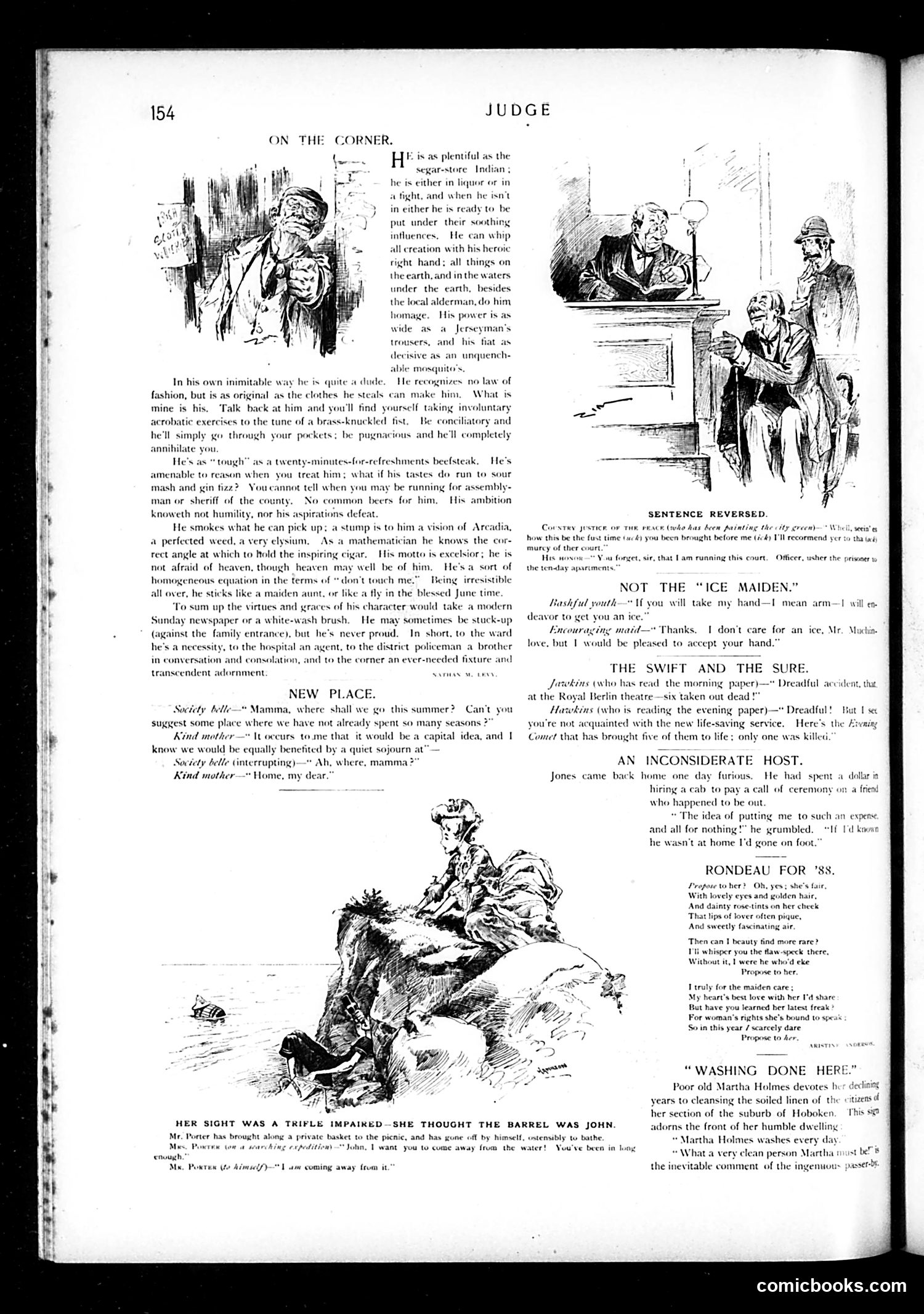
This page satirizes working-class street characters and social pretension in late 19th-century America. **"On the Corner"** ridicules the stereotypical tough, boisterous street corner loafer—a figure "as plentiful as the cigar-store Indian." The text mocks his paradoxical nature: simultaneously violent (ready to fight anyone), destitute (steals clothes), and politically influential in the ward. The satire targets his outsized self-regard despite his lowly status. **Lower cartoons** include domestic humor: a society woman suggesting a vacation retreat ("Home, my dear") and a bathing incident where a woman mistakes a barrel for a person named John. **"Sentence Reversed"** jokes about court corruption—a judge's authority undermined by a criminal defendant who claims to "run this court." The page reflects Judge's typical mockery of urban corruption, class pretension, and the disorder of American city life in the Gilded Age, targeting both street-level toughs and their enablers in city government.
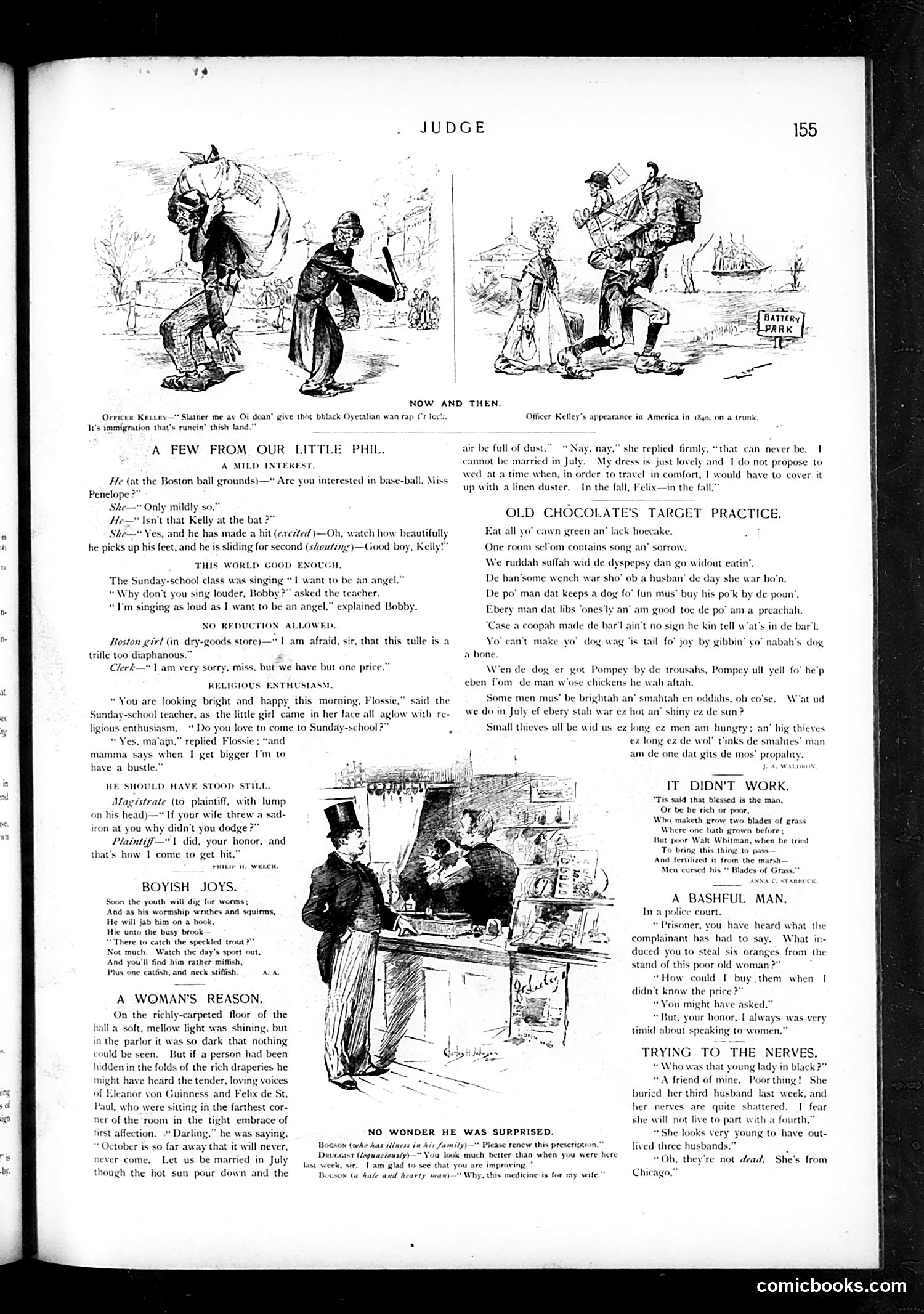
This page contains several satirical sketches typical of late 19th-century American humor: **"Now and Then"** contrasts Officer Kelley's arrival in America (depicted arriving by trunk in 1840) with his current status, satirizing Irish immigration and the stereotype of Irish police officers. **Various domestic humor sketches** mock courtship rituals and gender relations—a woman at a baseball game suddenly becoming animated about player "Kelly," a couple delaying their July wedding because the bride refuses to cover her dress with a "linen duster" (travel protection), and marital violence played for laughs. **"Old Chocolate's Target Practice"** features dialect humor attributed to a Black character offering folk wisdom in exaggerated speech patterns—common but now-offensive stereotyping of the era. The page reflects period attitudes: casual acceptance of domestic violence, ethnic stereotyping of Irish immigrants, and dehumanizing caricature of Black Americans. These were standard Judge fare, representing mainstream 1880s-90s entertainment values that modern readers would find offensive.
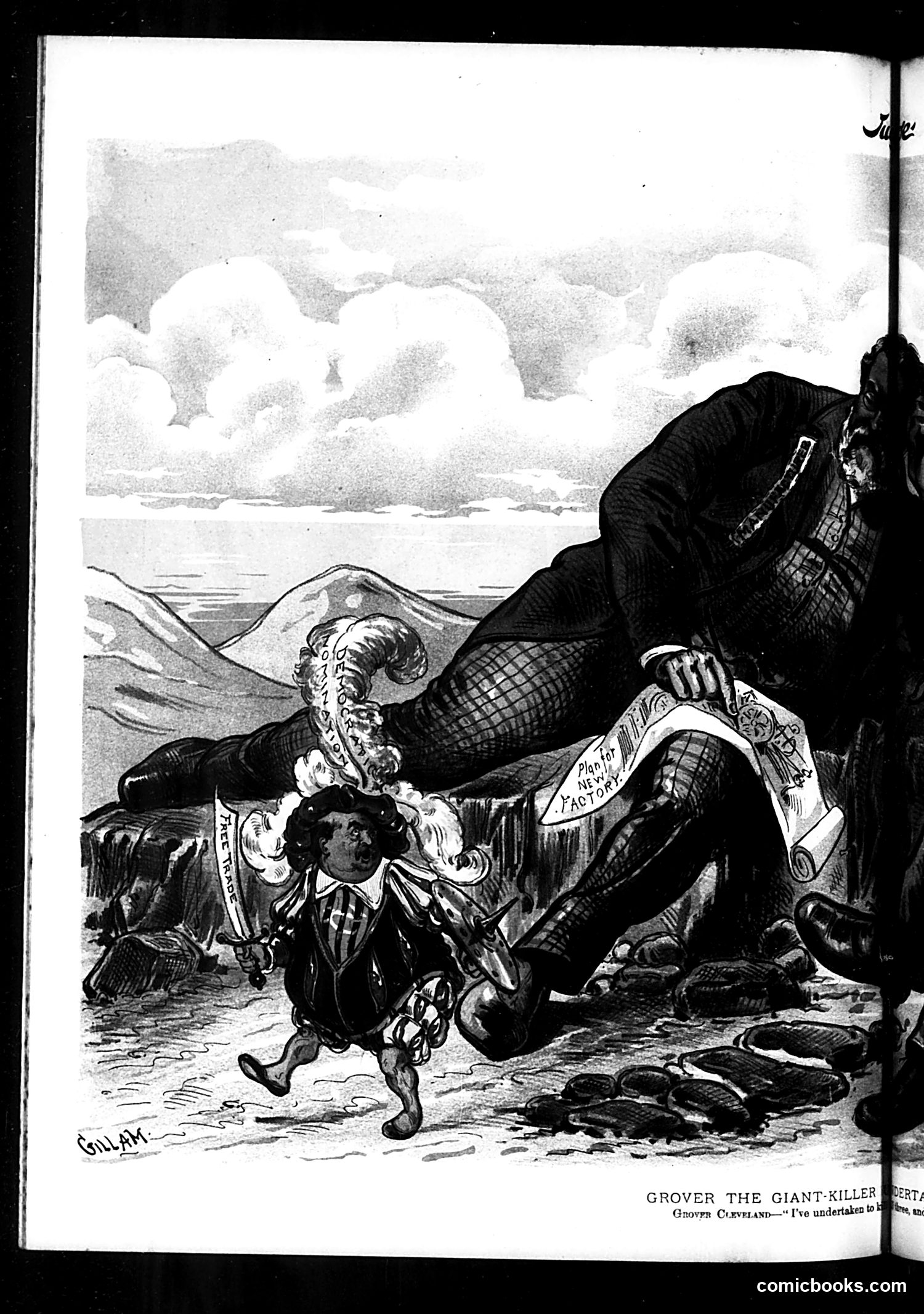
This cartoon depicts **Grover Cleveland** as "Grover the Giant-Killer," referencing the biblical David and Goliath story. Cleveland is portrayed as a small figure confronting a massive giant, suggesting he's taking on powerful opponents or forces much larger than himself. The giant appears to represent either political corruption, monopolies, or another major adversary of Cleveland's presidency. The biblical allusion frames Cleveland as a courageous underdog fighting for justice against overwhelming odds. The cartoon's incomplete caption ("I've undertaken...") suggests Cleveland is declaring his intention to battle this "giant," likely commenting on a specific policy initiative or political challenge during his administration. The satirical intent appears favorable toward Cleveland, celebrating his willingness to confront powerful interests despite being vastly outmatched.
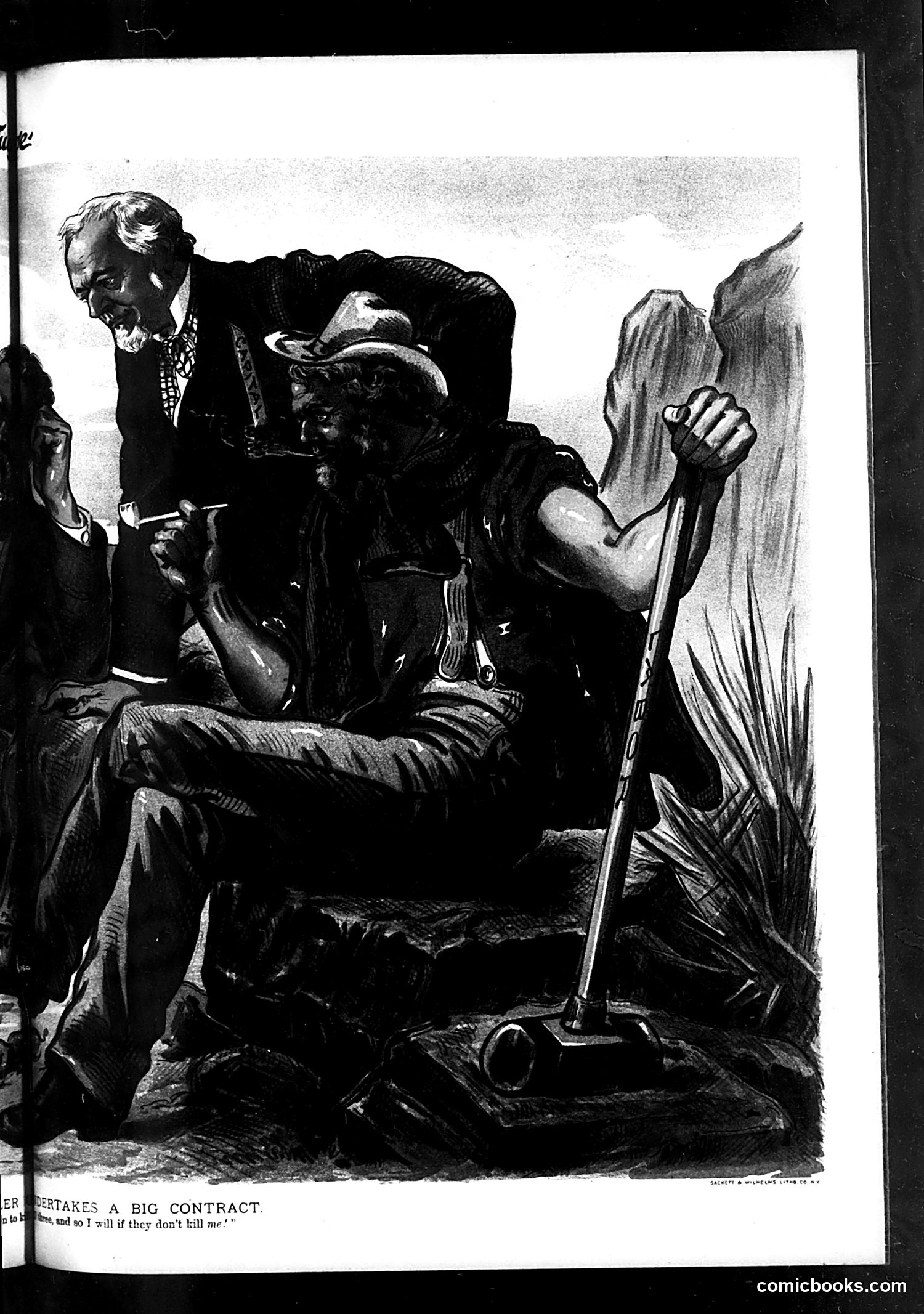
This Judge magazine cartoon depicts a wealthy gentleman (left) negotiating with what appears to be a working-class laborer or contractor (center, wearing a hat). The laborer holds a shovel and appears to be in a ditch or excavation site. The caption reads: "He's got to dig, and so I will if they don't kill me!" The satire appears to critique labor exploitation—likely commenting on dangerous working conditions, low wages, or unfair contracts imposed on working-class men. The gentleman's composed demeanor contrasts with the laborer's apparent desperation and mortality concerns, highlighting class inequality and the power imbalance in labor negotiations during the Gilded Age or Progressive Era.
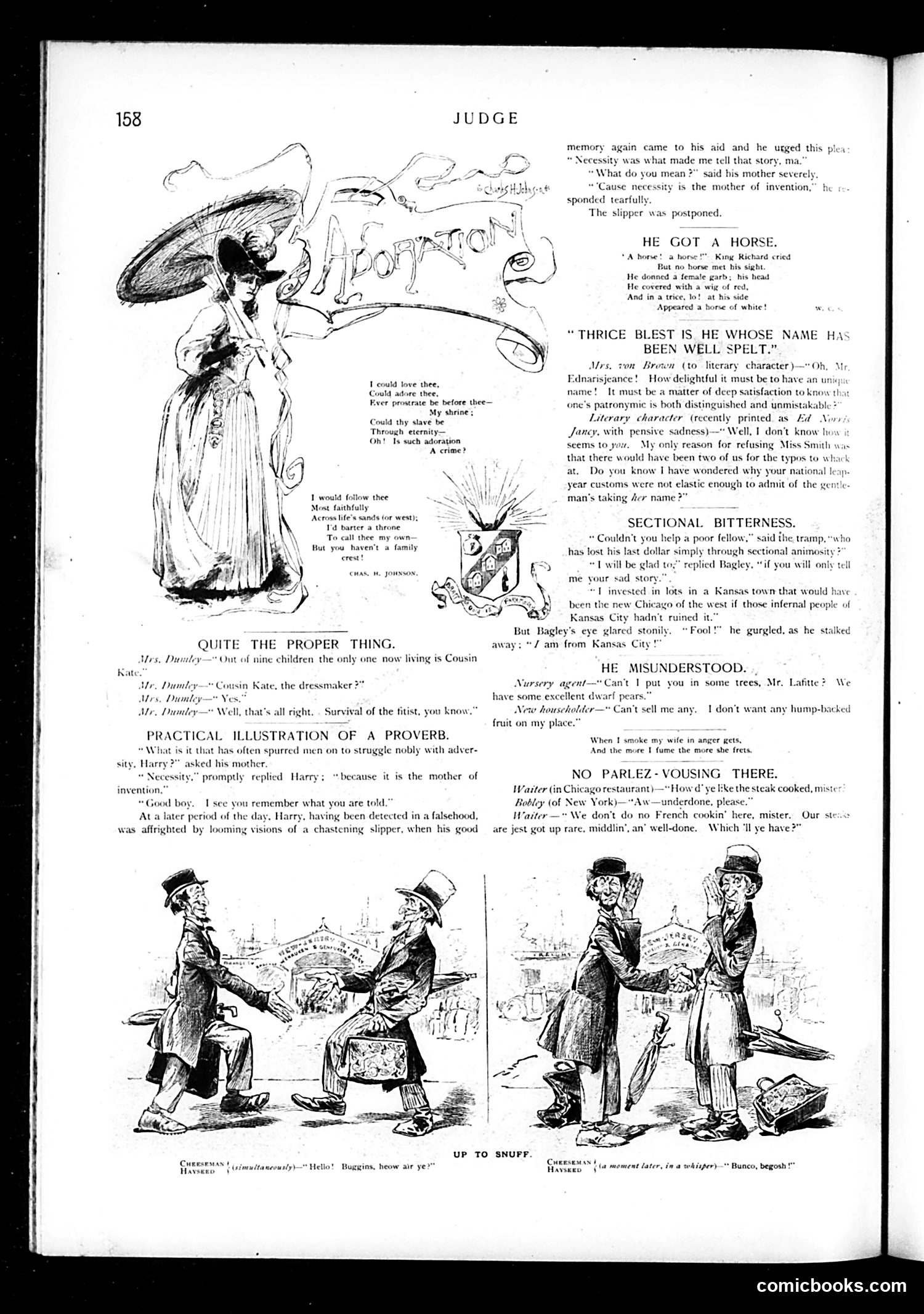
This page contains several satirical sketches typical of late-19th-century American humor: **"Quite the Proper Thing"** mocks class pretensions—a man finds it acceptable that his wife's only living relative is a dressmaker, viewing this as "survival of the fittest," exposing snobbish attitudes about working-class occupations. **"Illustration of a Proverb"** shows a boy using the phrase "necessity is the mother of invention" to justify lying, then repeating it to escape punishment—humor based on children misapplying adult wisdom. **"He Got a Horse"** appears to reference King Richard III's famous cry "A horse, a horse, my kingdom for a horse," reimagined absurdly with cross-dressing. **"Sectional Bitterness"** satirizes regional American animosity—a Kansas City businessman refuses to help a tramp after learning the man lost money to Kansas City's competition with Chicago, showing how spite overrides charity. **"No Parlez-Vousing There"** mocks American restaurant pretension—a Chicago waiter rejects "French cooking" terminology, insisting on plain American terms for meat doneness. The sketches collectively target American social hypocrisy, class anxiety, and regional rivalries of the era.
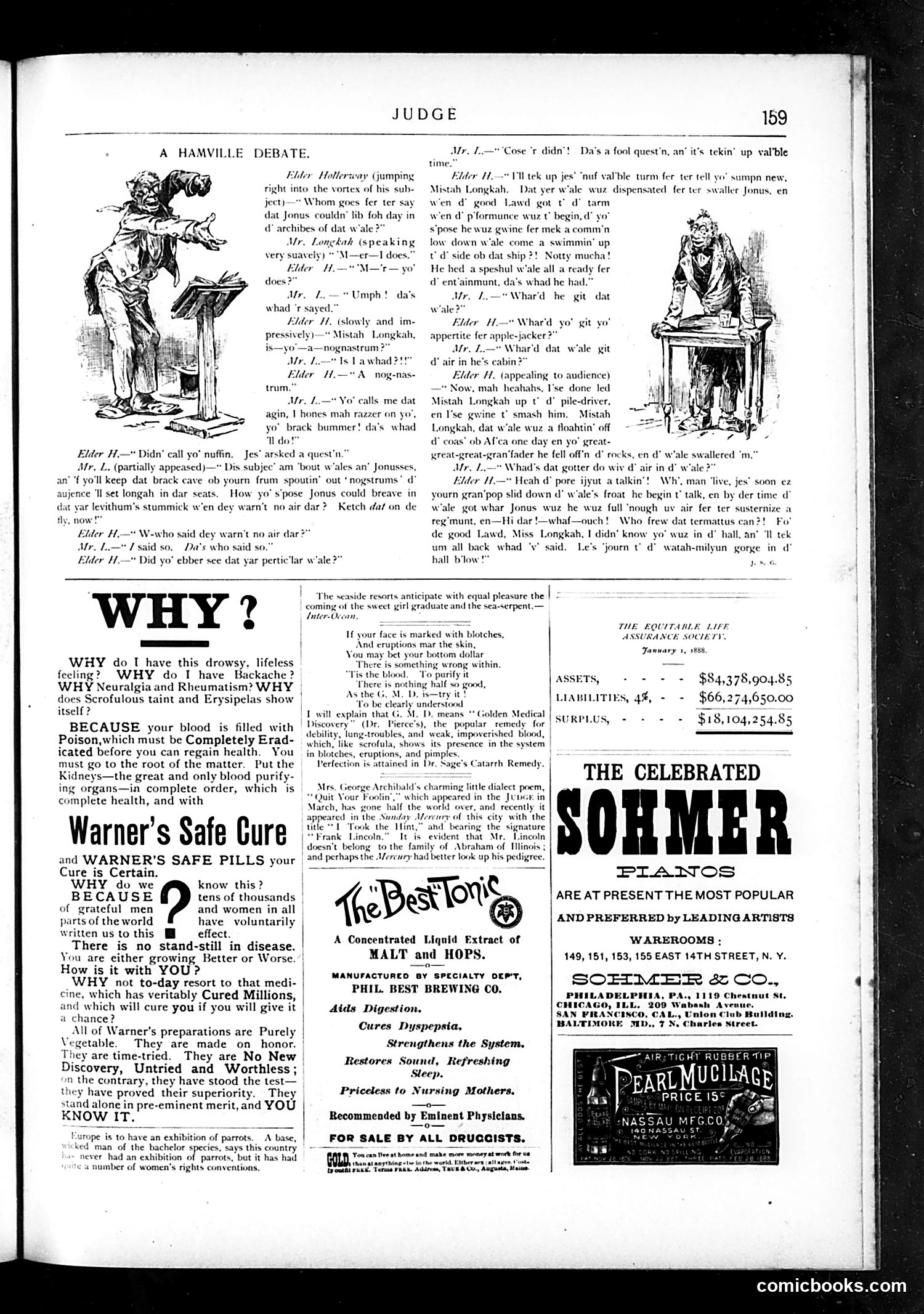
This is a racist minstrel-style dialogue between two Black characters, "Elder Hollerway" and "Mistah Longkah," debating whether the biblical whale that swallowed Jonah could have provided air in its cabin. The humor relies on exaggerated dialect, malapropisms ("nognastrum" for "ignorant"), and absurdist logic typical of late-19th-century minstrelsy. The "debate" is nonsensical—Elder Hollerway argues the whale had air because Jonah survived; Longkah questions how, leading to increasingly ridiculous explanations involving a great-great-grandfather falling into rocks. The satire targets the performers themselves as foolish rather than any political issue. This reflects Judge magazine's reliance on racist caricature as entertainment for white audiences, standard in 1888 popular culture. The page is primarily advertising (patent medicines, pianos) with this cartoon as filler content.
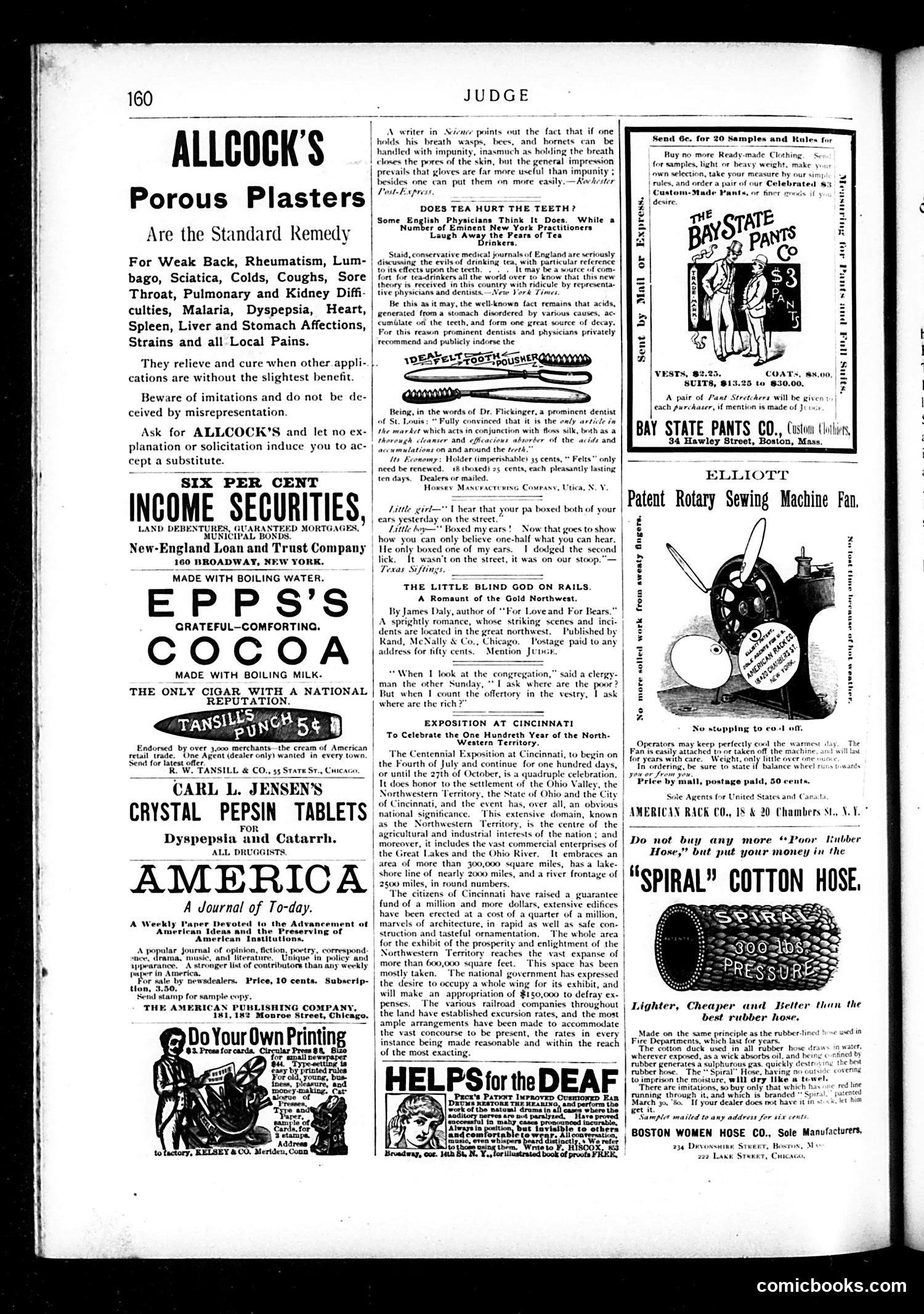
This page is primarily an **advertising section** of Judge magazine, filled with product advertisements rather than political cartoons or satirical content. The visible ads promote patent medicines and consumer goods typical of the era—Allcock's Porous Plasters (pain relief), Epps's Cocoa, Tansill cigars, Jensen's Pepsin tablets, and Boston Women's Hose—alongside financial services and newspapers. The only satirical content is a small humor column discussing whether tea damages teeth (English physicians say yes; American doctors ridicule the idea) and brief jokes about breath-holding around insects and a child dodging an ear-boxing. There's a small advertisement for the Elliott Patent Rotary Sewing Machine Fan on the right side. The page offers **no political commentary or caricature**—it's a commercial/filler page typical of period magazine publishing.
This page is primarily **advertising and miscellaneous content** rather than political satire or comics. It contains: **Travel Advertisement**: A Burlington Route railroad ad promoting Colorado resorts as summer destinations, reachable from New York in 58 hours. **Poetry**: "Courtship and Matrimony" — a sentimental Boston Courier poem contrasting romantic courtship with the mundane married reality of managing twins and taking solitary walks. **Product Advertisements**: Multiple ads for consumer goods (Pears' Soap, violin outfits, Piso's Cure cough syrup, piano-fortes by Sohmer & Co., tailor services, paper warehouses, and hats). **No identifiable political cartoons or satire** appear on this page. The content reflects late 19th-century commercial advertising and light domestic verse typical of Judge magazine's miscellaneous content sections. The "Courtship and Matrimony" poem offers gentle social commentary on marriage's transformation from romance to routine, but this is conventional sentiment rather than satirical critique.
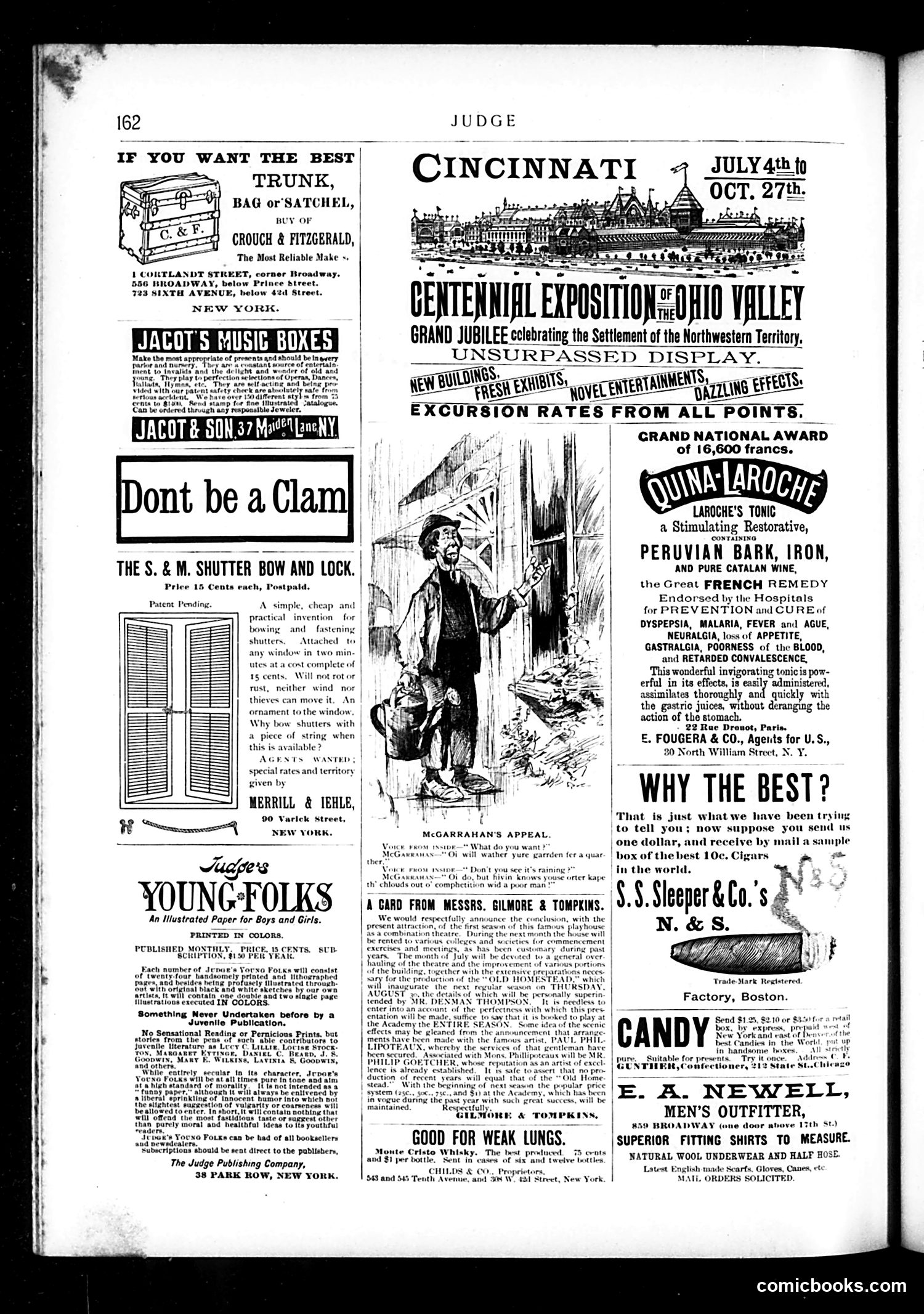
This is primarily an **advertising page** with one significant political cartoon. The main satirical content is "**McGarrah's Appeal**" — a cartoon depicting a shabby, downcast man asking a well-dressed figure "What do you want?" The figure responds he'll "wather yure garrden fer a quarter," illustrating the economic desperation of the era. The cartoon satirizes **poverty and unemployment**, likely referencing post-Civil War economic hardship or labor struggles of the Gilded Age. The beggar's willingness to perform menial labor for pittance critiques both working-class desperation and societal inequality. The remainder of the page consists of period advertisements: trunk makers, music boxes, window locks, children's publications, medical tonics (Quina-Laroche, Monte Cristo Whisky), cigars, and men's clothing — typical commercial content for Judge, which relied on advertising revenue alongside satirical commentary.
This satirical piece presents a father advising his son about reform movements. The central argument: **effective reformers must be fanatics who refuse compromise**. The satirist argues paradoxically that while prohibitionists and reformers are "rather apt to be fanatics," this fanaticism is necessary and praiseworthy—they must "smash things" to accomplish anything. The piece contrasts this with "Reform & Compromise," dismissed as a failed business venture. Historical examples support this: Luther, Cromwell, Washington, Adams, and abolitionists all succeeded through violent upheaval, not moderation. **The satire's target**: likely Progressive Era reformers of the 1890s-1900s who claimed moral superiority while making pragmatic political deals. By praising *only* uncompromising fanatics and ridiculing moderate reformers, Judge ironically exposes reformism's contradiction—claiming moral clarity while inevitably negotiating with power. This reflects Judge magazine's skeptical stance toward reform movements popular during this period.
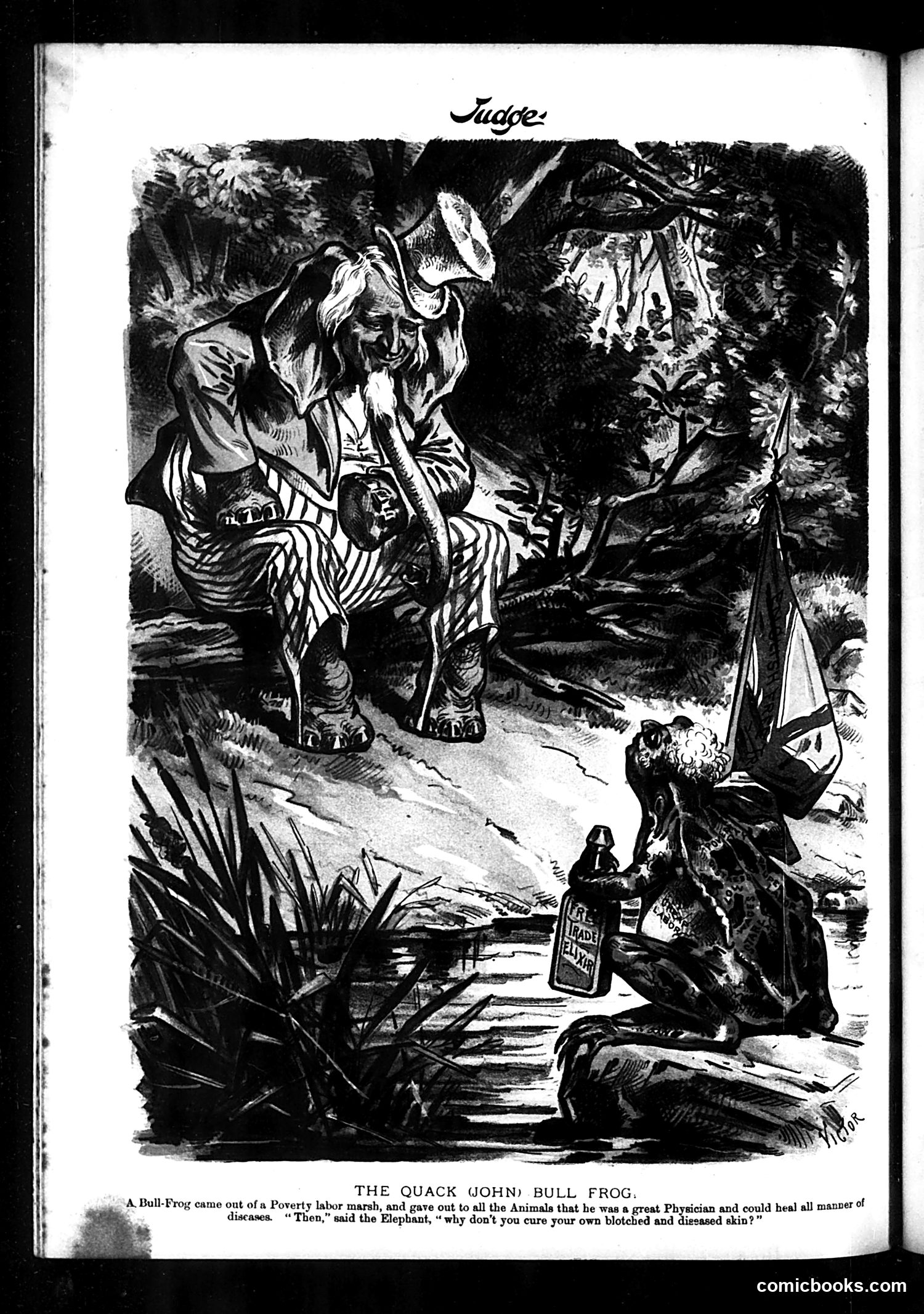
This is Aesop's fable-based political satire identifying Britain ("John Bull," traditionally represented as a bull) as a fraudulent physician. The cartoon depicts a large frog in human clothing emerging from a marsh, claiming medical expertise to other animals. The elephant challenges the frog's credibility by pointing out its own diseased, blotched appearance—a visual metaphor for Britain's internal problems. The satire suggests British claims of superior civilization or governance ring hollow given Britain's own social/political ailments (likely poverty, labor unrest, or colonial exploitation). By framing Britain as a "quack" doctor, Judge ridicules British pretensions to moral or practical superiority while addressing issues affecting working animals ("poverty labor marsh"). The fable format makes the critique both pointed and accessible.