
A complete issue · 16 pages · 1888
Judge — May 19, 1888
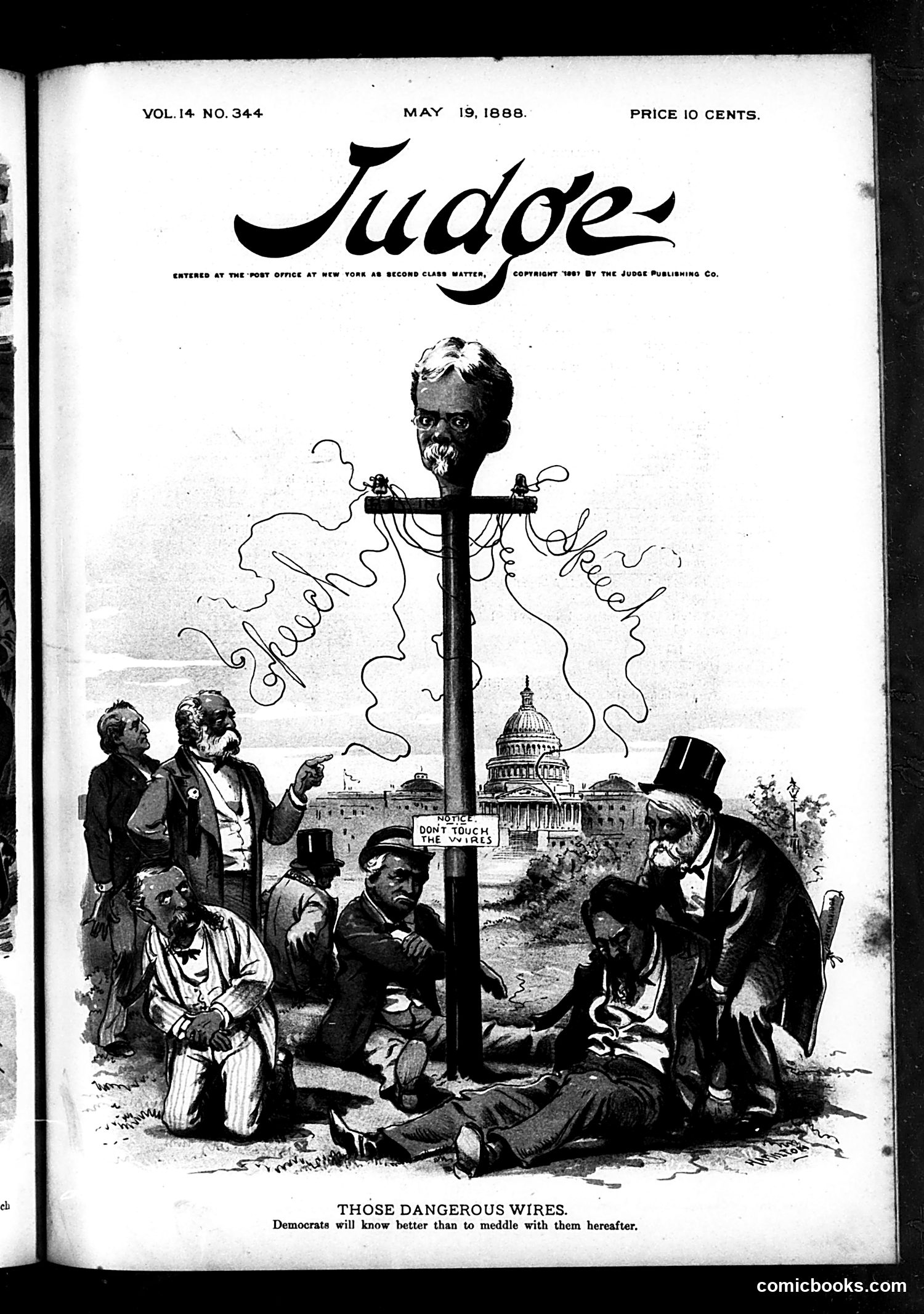
This *Judge* cartoon from May 19, 1888 appears to critique Democratic Party interference with electrical wiring or telegraph infrastructure near the U.S. Capitol. The severed head on the pole labeled "Boodle" and "Breck" (likely referencing political corruption) emits "Shock" and "Wreck" as warnings. Various figures—including what appear to be politicians and laborers—gather around the dangerous setup. A sign reads "DON'T TOUCH THE WIRES," suggesting Democrats are recklessly tampering with important systems. The satire likely comments on Democratic manipulation of federal infrastructure or telegraph/electrical monopolies during this era. The "dangerous wires" metaphor suggests their political interference poses risks to the nation. The cartoon's partisan Republican perspective (Judge was Republican-leaning) frames Democratic actions as hazardous meddling.
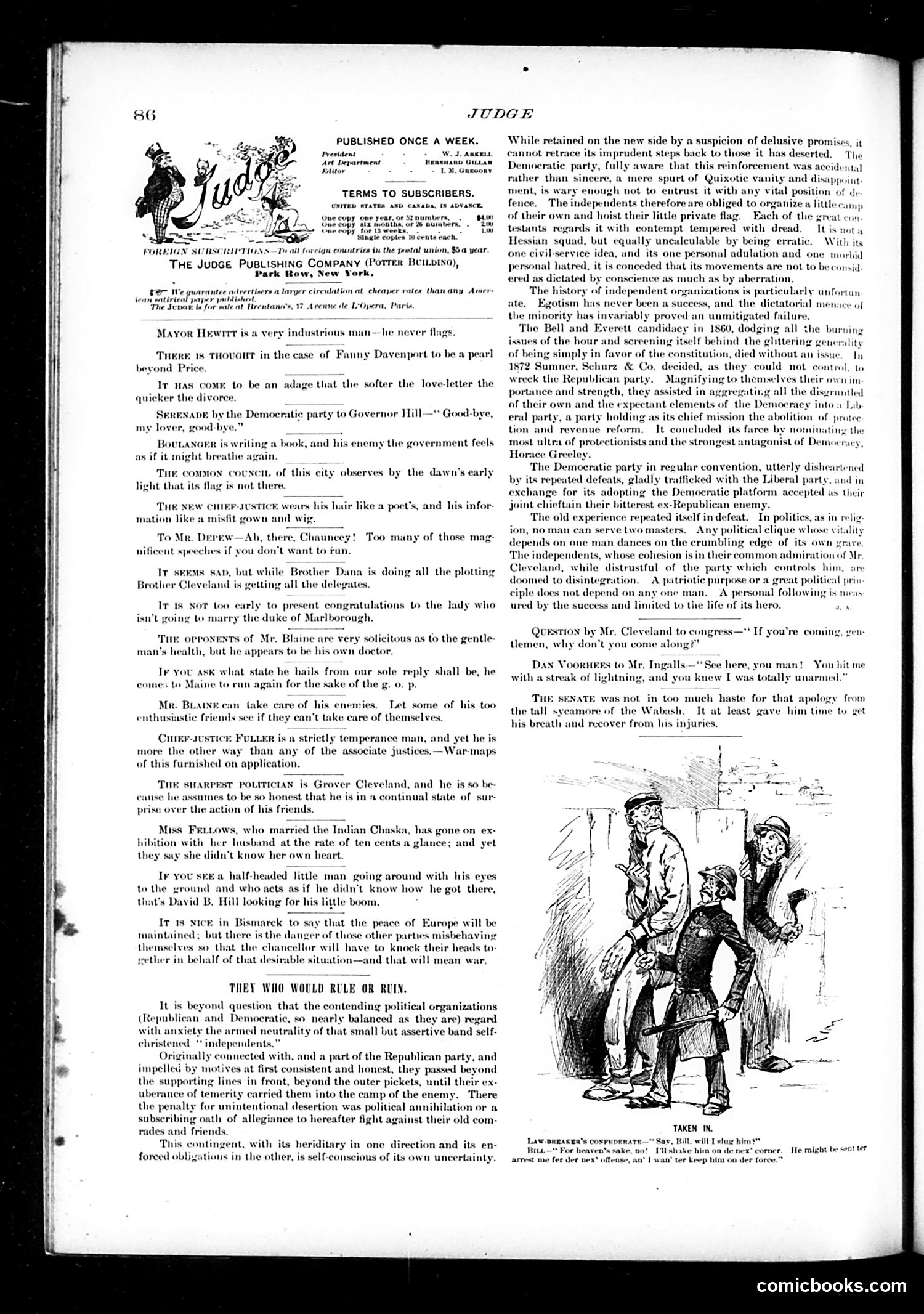
This page satirizes American political divisions of the 1870s-1880s era. The main article "They Who Would Rule or Ruin" criticizes both Republican and Democratic parties as self-serving "independents" who prioritize their own interests over governance. The cartoon illustration titled "Taken In" depicts what appears to be a street confrontation, likely referencing political corruption or deception. The dialogue ("Say, Bill, will take him?" / "For heaven's sake, no! I'll shove him on de next corner") suggests exploitation or passing off unwanted political figures or problems. The page mocks how political parties "forced obligatious on the other" through manipulation rather than honest governance, reflecting Judge's skepticism toward Gilded Age politics and party machines.
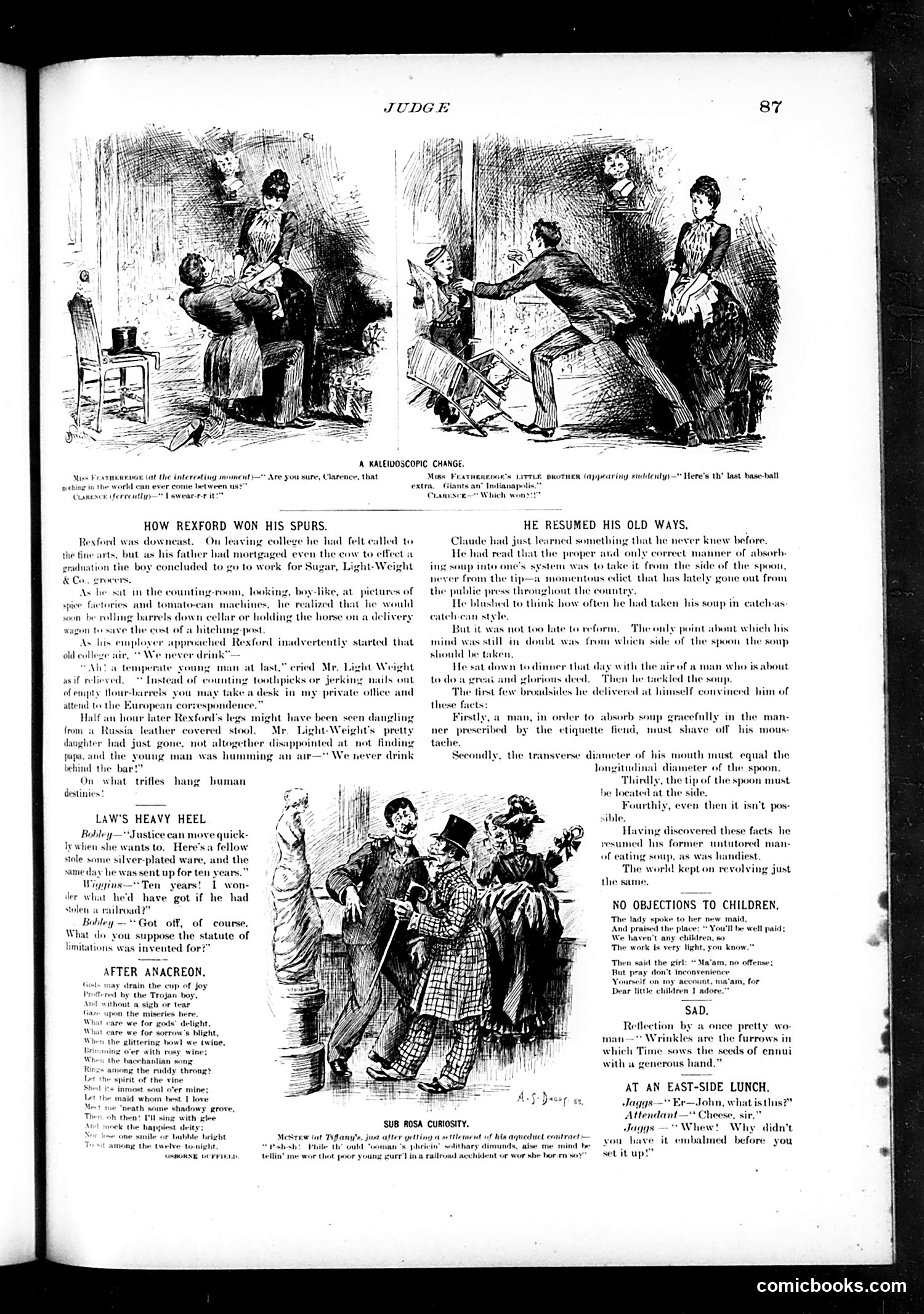
This page contains several unrelated satirical pieces typical of Judge's humor: **"How Rexford Won His Spurs"** mocks social climbing. A young man named Rexford rises from manual labor to becoming a correspondent by impressing his boss's daughter—suggesting that advancement depends on charm and luck rather than merit. **"He Resumed His Old Ways"** ridicules etiquette obsession. Claude learns elaborate rules about eating soup "properly" (from the side of the spoon, requiring a shaved mustache), then sensibly ignores them—satirizing upper-class pretension. **"Law's Heavy Heel"** critiques judicial inequality: a poor man stealing silverware gets ten years, while someone stealing a railroad would escape justice—commentary on class-based legal disparities. Other pieces include light verse and brief comedic dialogues about various social situations. The cartoons throughout use exaggerated character drawings typical of 19th-century satirical illustration. Overall, the page targets social hypocrisy, class privilege, and absurd fashionable conventions.
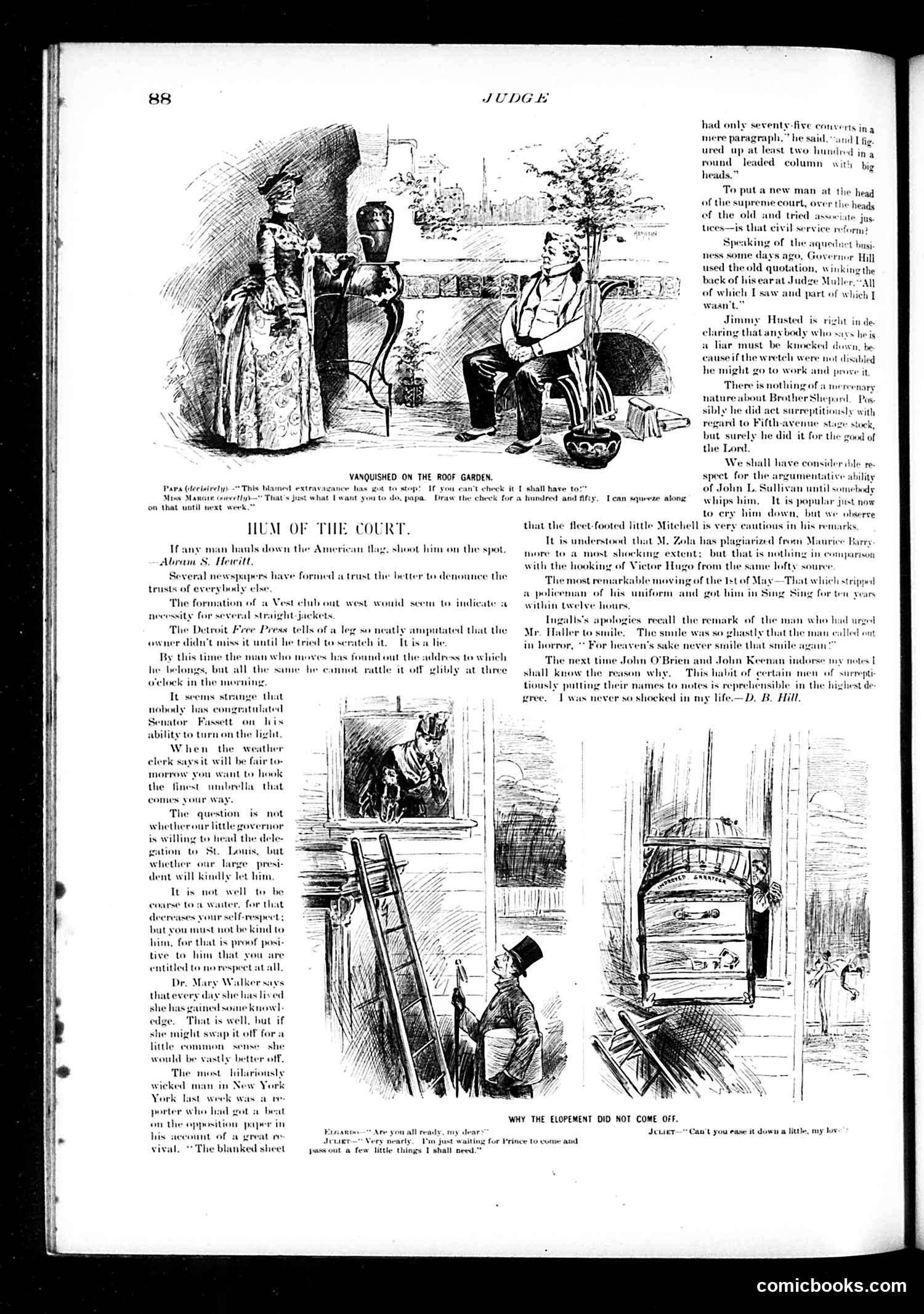
This page contains two distinct satirical sections from the American humor magazine *Judge*: **"Hum of the Court"** mocks various contemporary political and social figures through brief anecdotes. References include: - Abram S. Hewitt's inflammatory statement about shooting flag-burners - Senator Fassett's ability to "turn on the light" (unclear reference) - Dr. Mary Walker's claim of daily self-improvement - Judge Muller and Governor Hill (likely New York officials) - John L. Sullivan and a boxer named Mitchell (boxing rivalry) - References to Émile Zola's plagiarism scandal and Victor Hugo **"Why the Elopement Did Not Come Off"** (illustrated bottom right) depicts a couple attempting to elope through a window, with dialogue suggesting practical obstacles to their romantic escape. The satire targets pompous public figures, questionable morality among the powerful, and absurd human behavior generally. Without publication dates visible, precise identification of some figures remains unclear, though the tone suggests 1890s American political and social commentary.
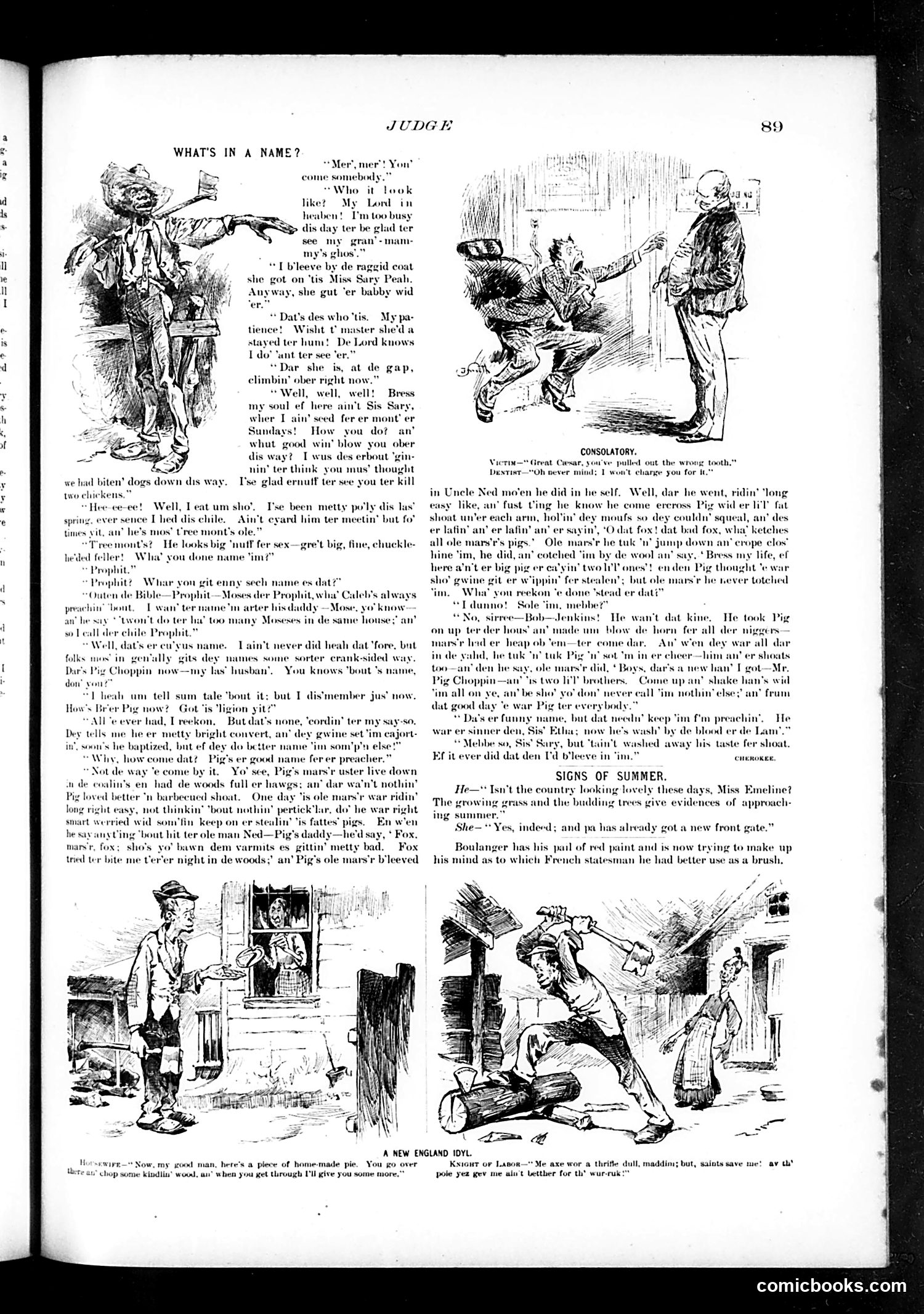
This page satirizes Black dialect and rural Southern life through minstrelsy-style humor common to late 19th-century American magazines. The main comic feature depicts enslaved or formerly enslaved people using heavily stereotyped speech patterns, discussing naming conventions and farm life. Characters debate whether to name a child "Prophet" or "Pig Choppin'" based on family precedent—the satire mocking both the supposed ignorance of naming practices and crude humor about pig theft. The "Consolatory" cartoon shows a dentist extracting the wrong tooth, a simple visual gag. Below, "A New England Idyl" presents a rural scene with presumably Irish immigrant characters, using dialect humor. The "Signs of Summer" section features mild social commentary about summer weather and a reference to Boulanger (likely French General Boulanger), suggesting political satire in other portions of the magazine. The heavy reliance on minstrelsy-style caricature reflects Judge's racist editorial stance typical of the era.
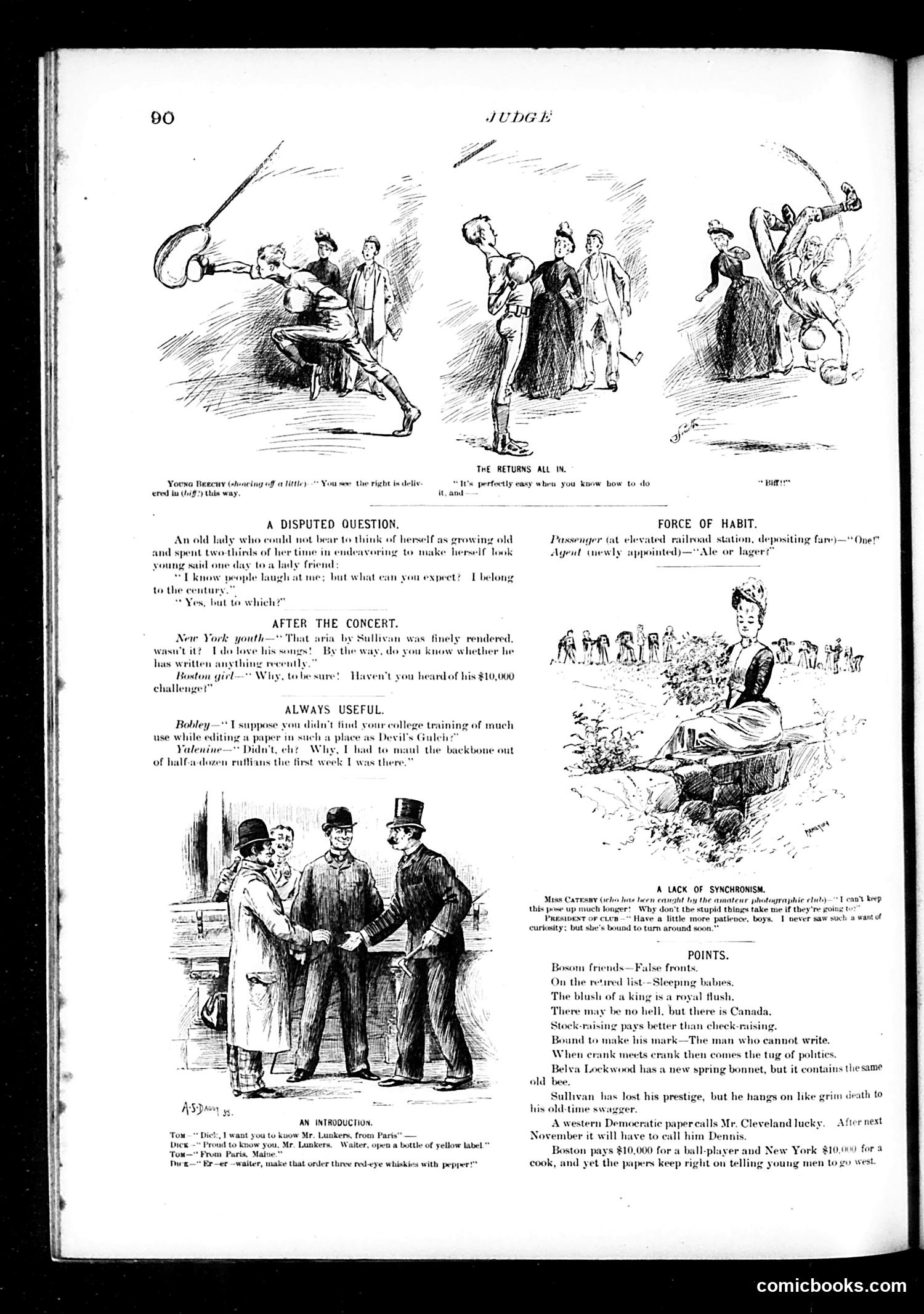
This page contains multiple satirical cartoons and humorous snippets typical of 1880s-90s Judge magazine. The cartoons mock social pretensions and current events: **"The Returns All In"**: Young Beecuy demonstrates acrobatic prowess, likely satirizing athletic or performance culture of the era. **"A Disputed Question"**: An old woman's vanity about aging is mocked—she claims to belong to "the century" rather than admit her actual age. **"After the Concert"**: New Yorkers discuss a Sullivan opera performance and his reported $10,000 challenge (likely referring to boxer John L. Sullivan's famous prize purses), contrasting refined cultural appreciation with tabloid gossip. **"Always Useful"**: A joke about a Yale graduate's impractical education, useless except for editing and brawling. **Other vignettes** mock photography (amateur clubs), railroad conductors, and political figures including Cleveland and Belva Lockwood (women's rights activist and 1884 presidential candidate). The "Points" section offers brief satirical observations on contemporary issues—false fronts, stock-raising, and salaries for athletes versus cooks. Overall, the page satirizes American social climbing, gender politics, and the gap between cultural pretension and crude reality.
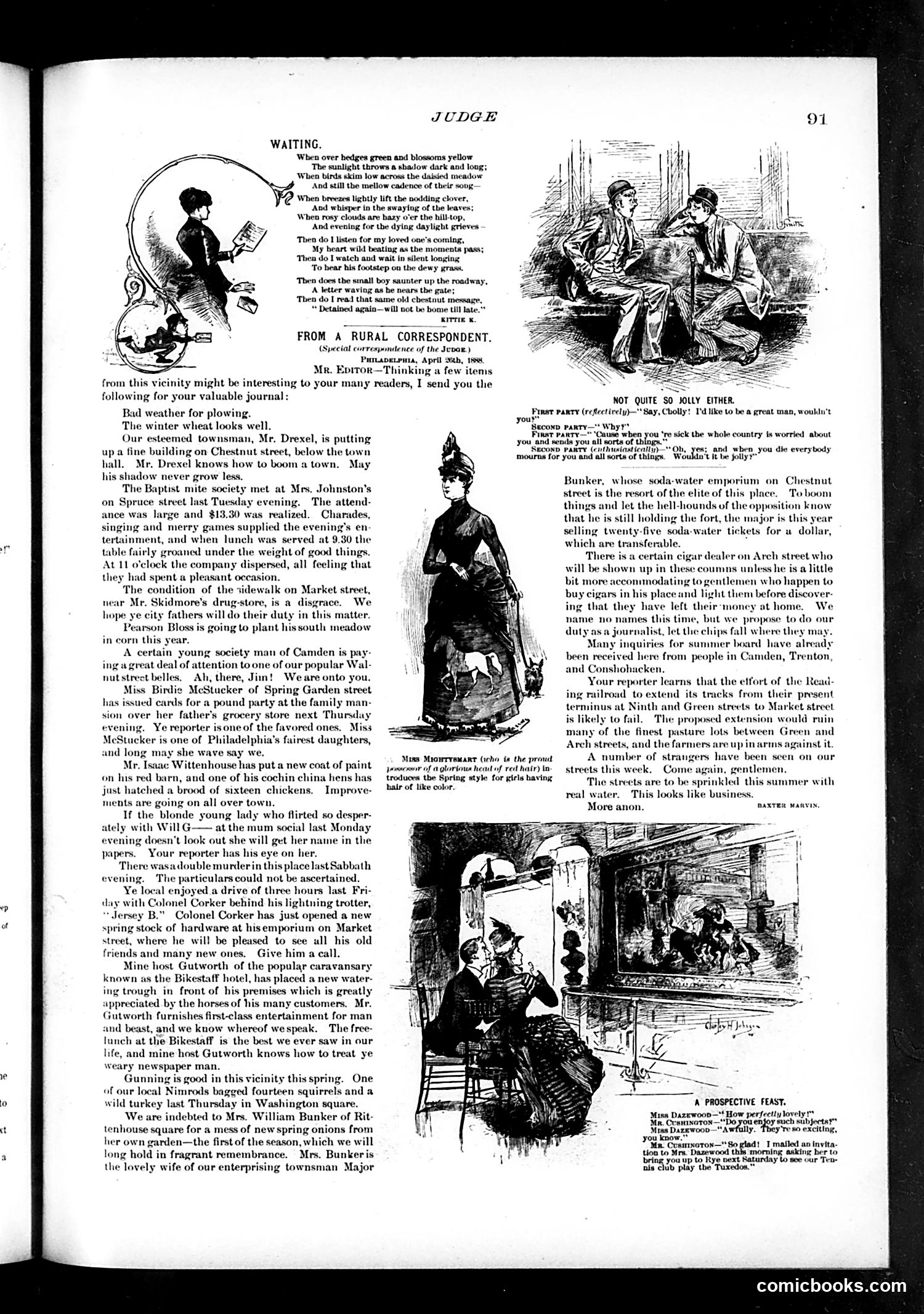
This page from Judge magazine contains satirical commentary on turn-of-the-century American life. **The Poetry ("Waiting"):** A sentimental poem about a woman awaiting her lover's return, only to repeatedly receive messages that he's "detained again—will not be home till late." The satire mocks sentimental Victorian romance literature while gently ribbing unreliable suitors. **"Rural Correspondent" Section:** Mock-earnest small-town gossip presented as news—Baptist society meetings, sidewalk conditions, hardware store openings, and social scandals. This satirizes both provincial newspapers' breathless coverage of trivial matters and the pretentiousness of rural correspondents. **"Not Quite So Jolly Either" Dialogue:** Two men discuss the burdens of fame—one wants greatness; the other notes the exhausting attention it brings. This satirizes contemporary celebrity culture and its hollow appeal. The illustrations appear to show fashionable figures of the era, likely reinforcing the class-conscious humor. The overall tone mocks small-town life, romantic conventions, and social pretension common to 1890s-1900s America.
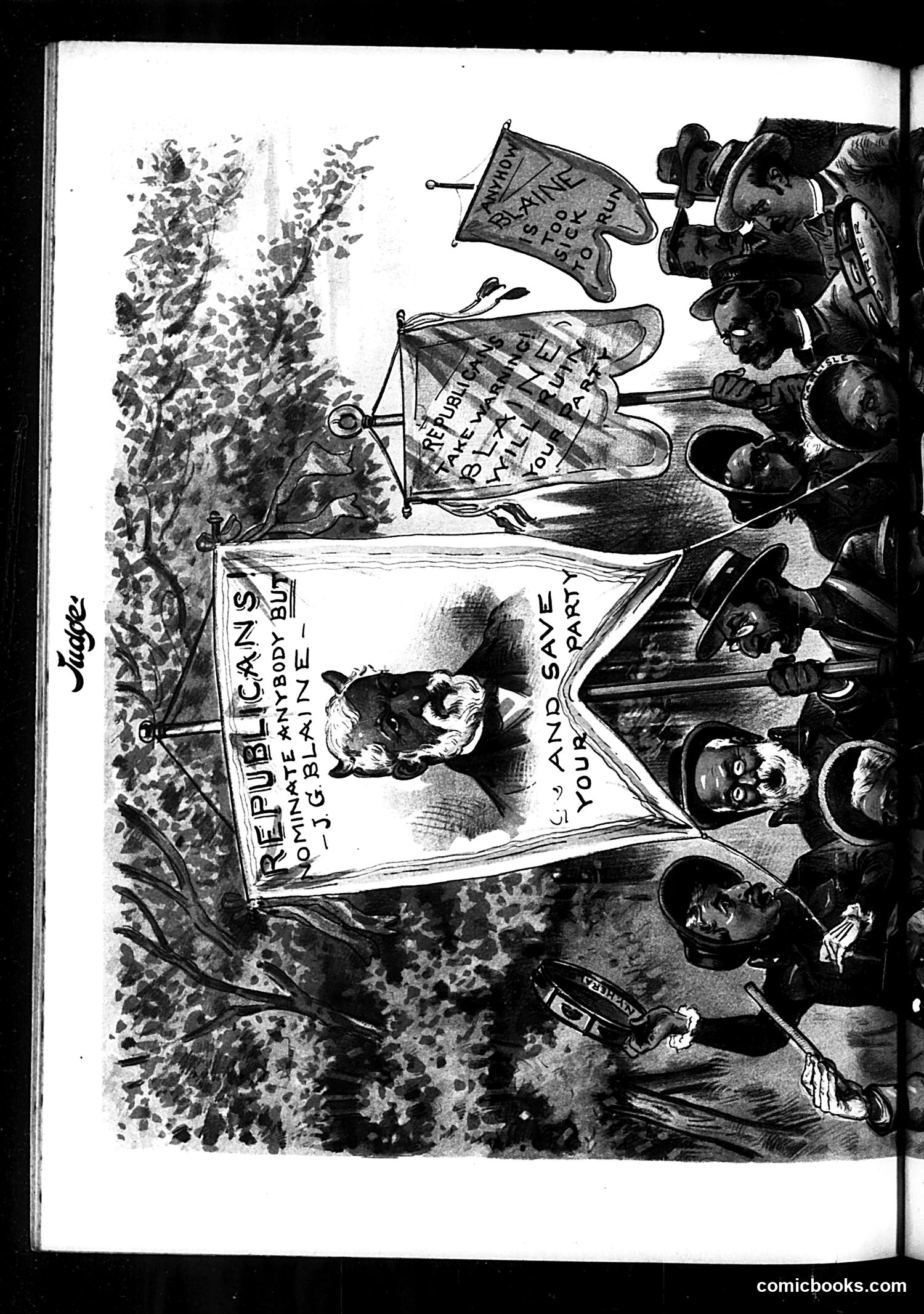
This appears to be a satirical cartoon from *Judge* magazine showing a central figure in formal dress standing on a platform labeled "REPUBLICANS COME EVERYBODY BUY" with banners reading "SAVE YOUR PARTY" visible. The figure is surrounded by what appear to be wealthy or influential men in top hats, depicted in a caricatured style typical of late 19th/early 20th-century political satire. The cartoon likely satirizes Republican Party fundraising or political messaging, suggesting the party is essentially "selling" itself to wealthy donors or interests. The crowd of top-hatted figures represents the wealthy establishment. Without a visible date or clearer identification of the central figure, the specific political event referenced remains unclear, though it appears critical of how Republicans courted financial support from the elite class.
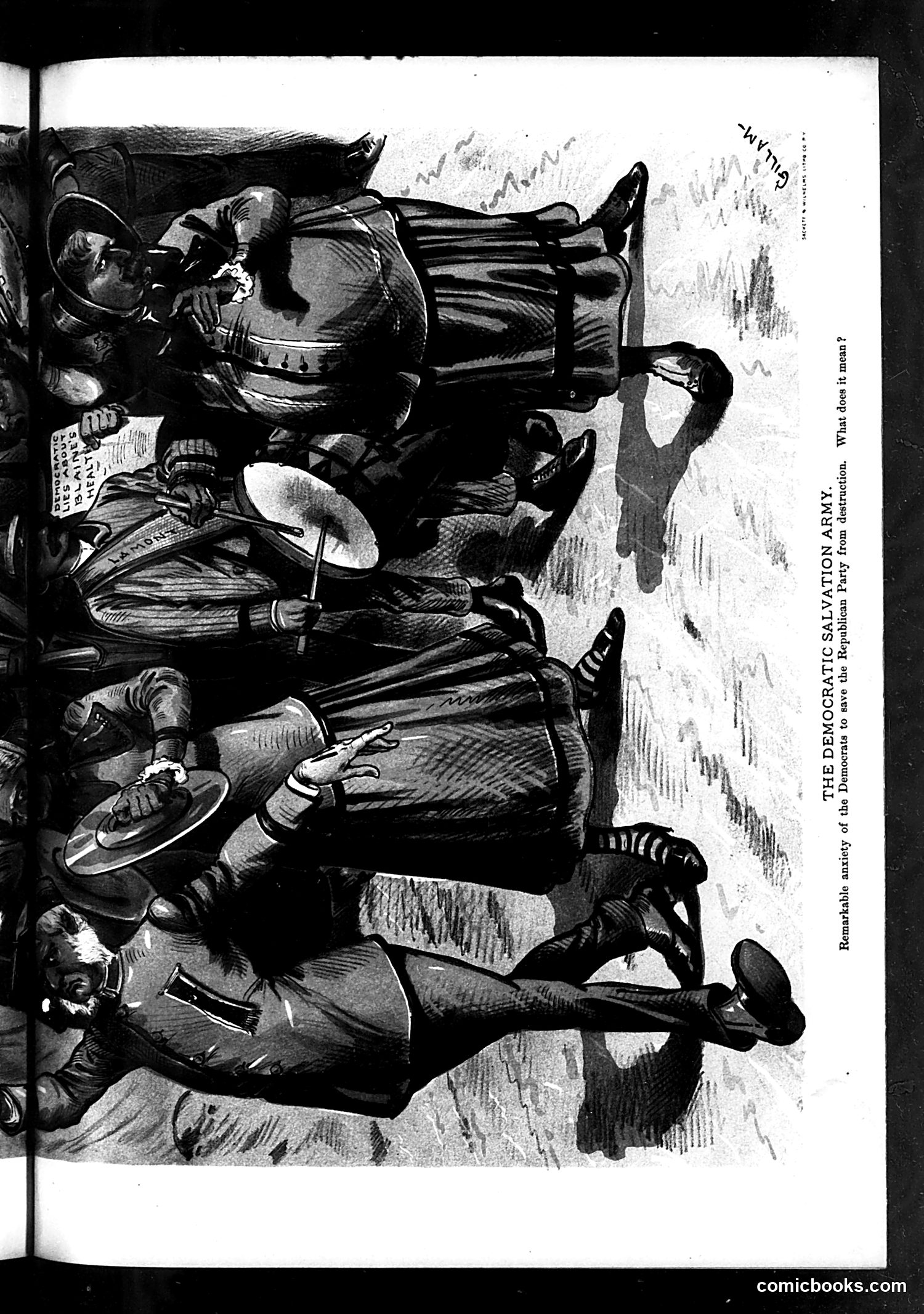
This political cartoon satirizes the Democratic Party's response to the Populist movement of the 1890s. The image depicts Democratic figures as members of a "Salvation Army," suggesting they're scrambling to salvage their political position by adopting populist rhetoric and causes to compete with the rising Populist Party. The caricatured figures appear to represent Democratic leadership attempting to co-opt or "rescue" working-class support through superficial gestures—hence the "salvation army" metaphor. The satire mocks Democrats for seemingly inauthentic adoption of Populist positions out of electoral desperation rather than genuine conviction. This reflects the actual historical tension of the 1890s when the Democratic Party faced erosion of working-class support to the Populist Party and had to strategically realign politically.
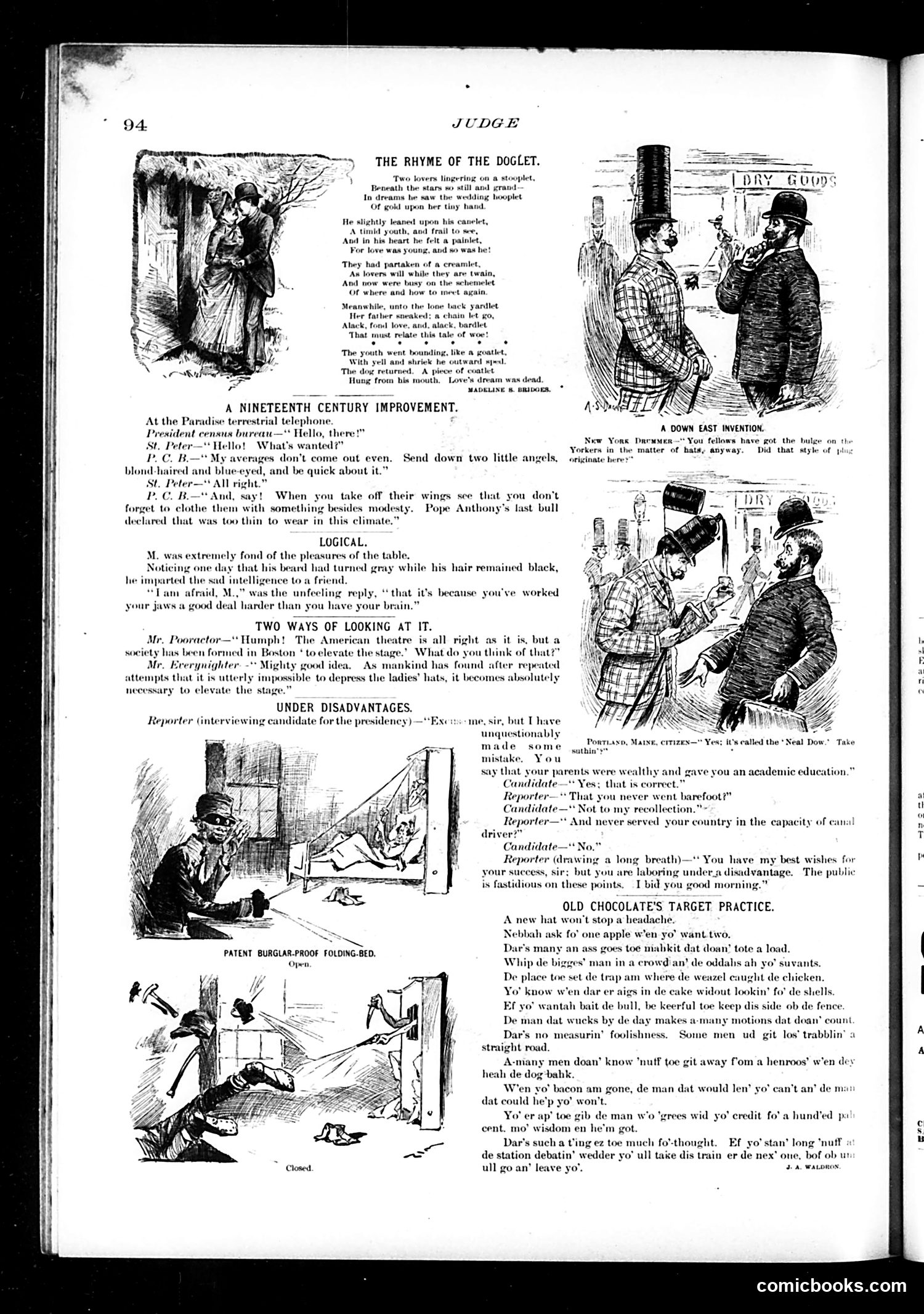
This page contains several satirical pieces typical of 1890s American humor: **"The Rhyme of the Doglet"** parodies sentimental Victorian poetry by using diminutive "-let" suffixes, mocking the overwrought romantic verse of the era. A dog ruins a lovers' embrace by tearing the suitor's coat. **"A Nineteenth Century Improvement"** satirizes the recent invention of the telephone through a heavenly conversation, joking about angel logistics and Pope Anthony's concerns about modest dress—typical period social anxieties. **"Two Ways of Looking at It"** pokes fun at theatrical "improvement" societies, with the joke being that ladies' enormous hats are now considered a greater obstacle than the stage's quality. **"Under Disadvantages"** interviews a presidential candidate whose *lack* of hardship (wealthy parents, education, never barefooted, never served) actually disqualifies him in voters' eyes—satirizing American populist mythology that leaders should be self-made men. **"Old Chocolate's Target Practice"** presents dialect-heavy folk wisdom presented as shooting-range targets, reflecting period attitudes toward African American vernacular humor.
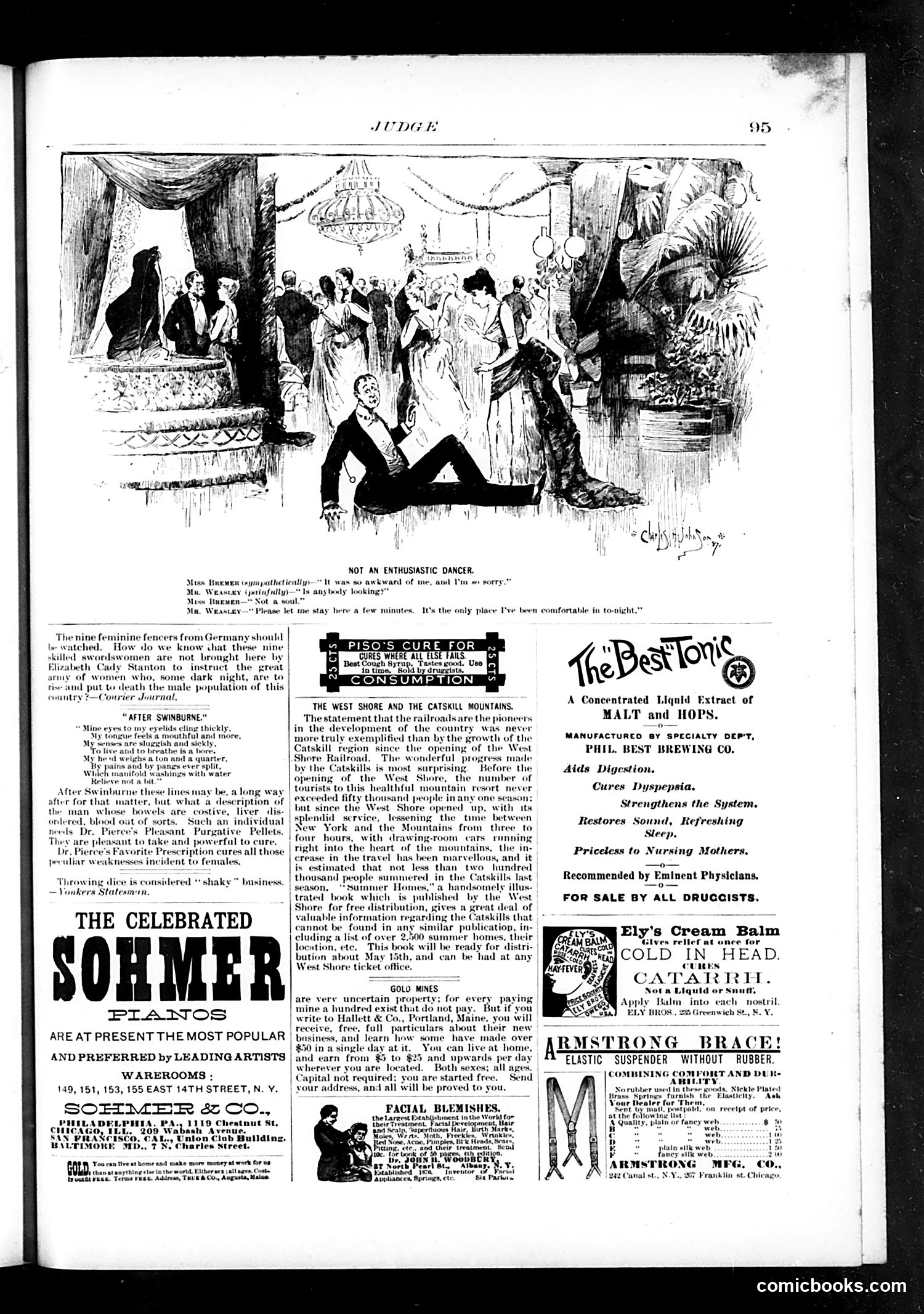
This cartoon satirizes awkward social dancing at what appears to be a formal ball or reception. The sketch shows a well-dressed man collapsed or sprawled on the floor in an ungraceful position while formally-dressed guests dance in the background. The caption presents a humorous dialogue: Miss B. apologizes for being "awkward," Mr. Weasley asks if she's looking well, and Dr. Wrastey responds that dancing at this venue is "the only place I've been comfortable in to-night"—implying the man on the floor has finally found a comfortable position by abandoning conventional posture entirely. The joke targets Victorian-era social dancing conventions and physical awkwardness, mocking both the formality of upper-class entertainments and the desperation of uncomfortable attendees. It's gentle satire of social pretension rather than political commentary.
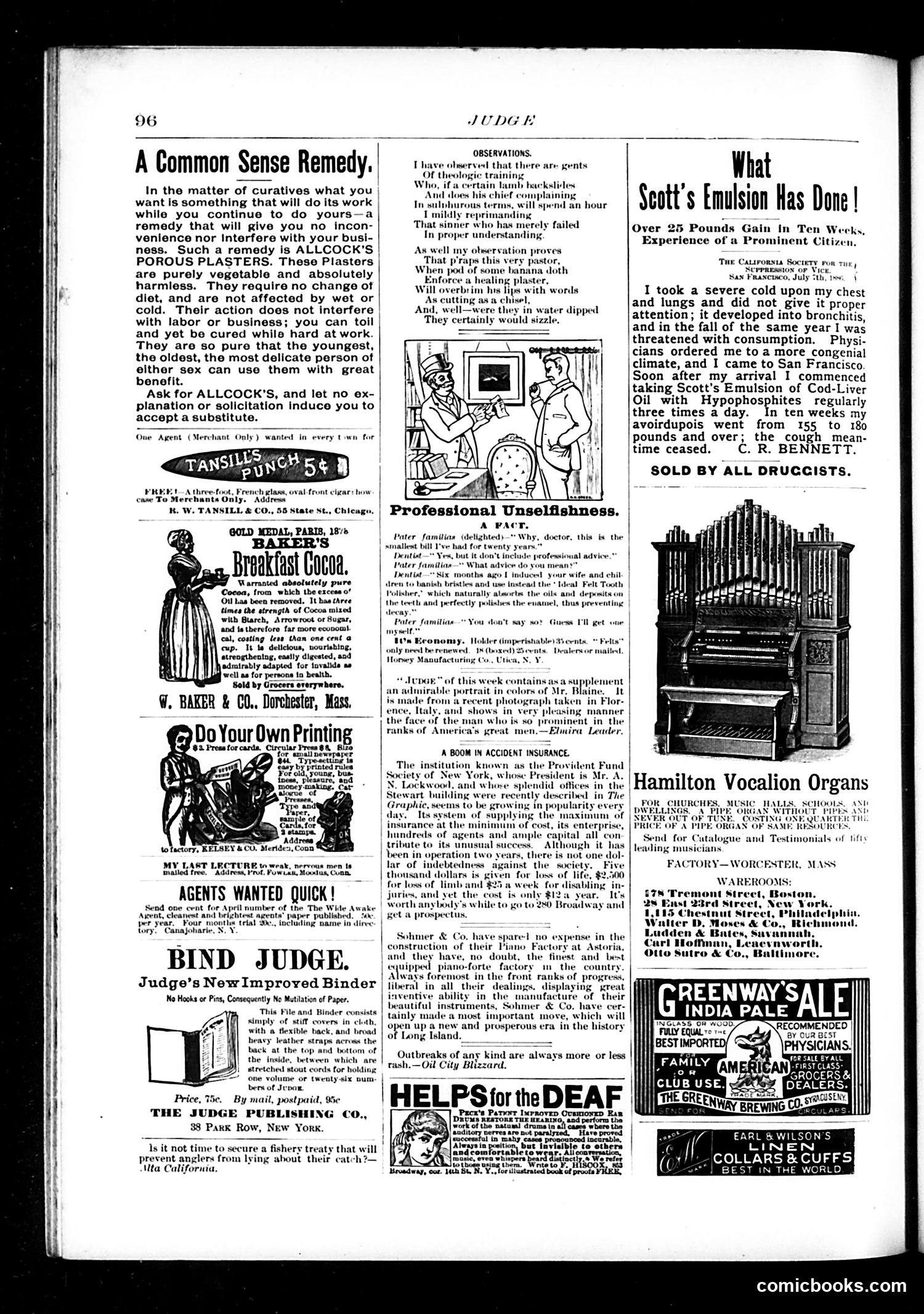
This page is primarily **advertisements and filler content** rather than political satire. The main cartoon—titled "Professional Unselfishness"—depicts a domestic scene where a father (Pater familias) is pleased about a doctor's bill, and the doctor claims he'll refuse payment. The joke appears to be satirizing false modesty or insincere gestures of generosity in professional dealings. The rest of the page consists almost entirely of **product advertisements**: porous plasters (Allcock's), Baker's Cocoa, printing services, the Judge magazine binder, and piano factories. There's a brief reference to James G. Blaine's portrait, suggesting this is from the 1880s-1890s era. **For modern readers**: This reflects how 19th-century magazines subsidized content through advertising. The "satire" here is mild domestic humor rather than sharp political commentary—typical of Judge's lighter pieces between more pointed satirical articles.
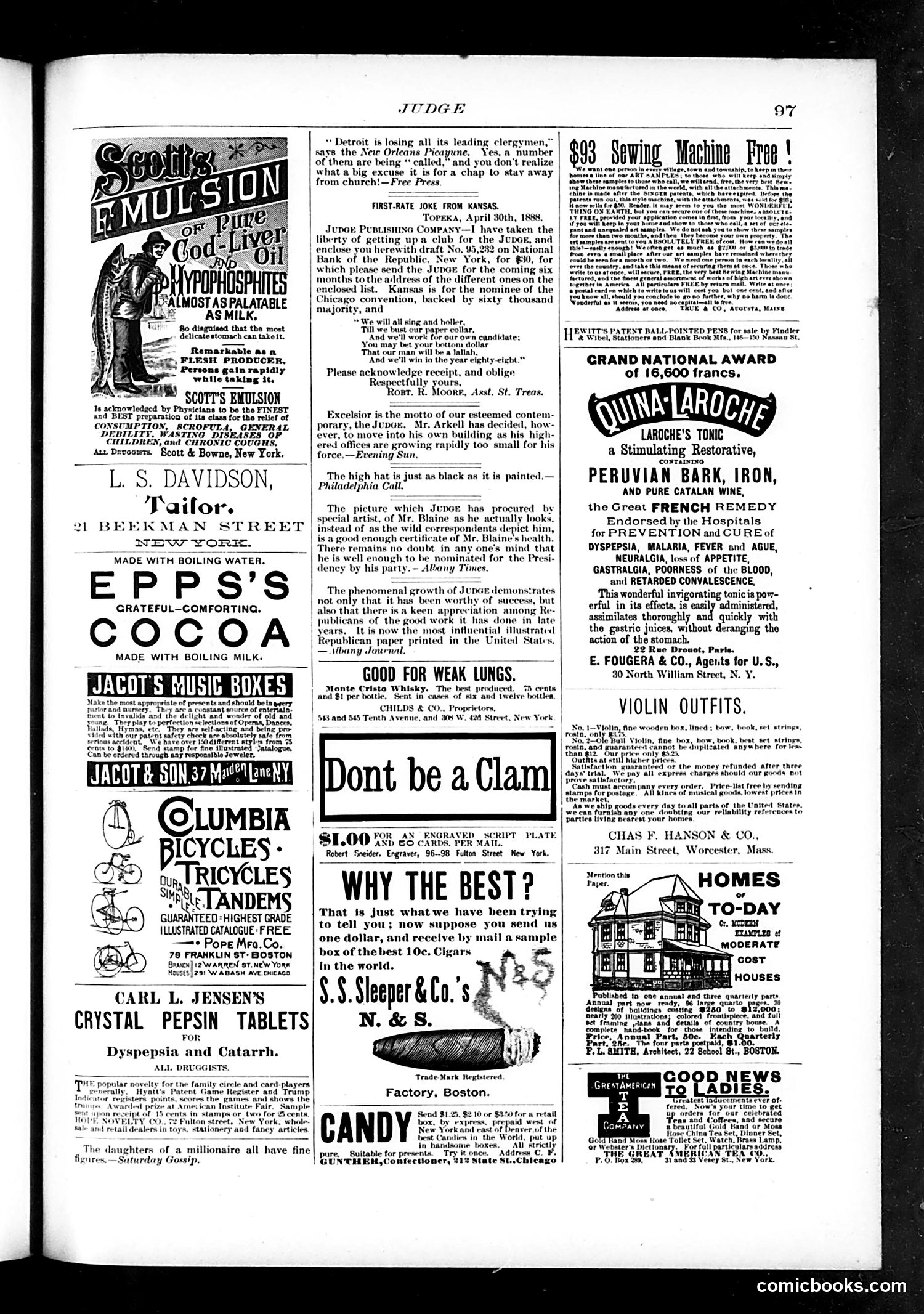
This is primarily an **advertising page** with minimal political content. The only substantive editorial piece is a brief letter from Kansas (April 30, 1888) announcing a local subscription club for Judge magazine, signed by "R. M. Moore." The letter's humor is mild—the writer promises Kansas supporters will "sing and holler / Till we bust our paper collar" and work for "our own candidate" in the 1888 election. This appears to reference the upcoming presidential campaign, likely supporting the Republican nominee (references suggest support for the GOP platform). The remaining content consists entirely of **product advertisements**: Scott's Emulsion cod liver oil, Epp's Cocoa, Jacot's Music Boxes, Columbia Bicycles, Crystal Pepsin Tablets, Sleeper & Co. cigars, violin outfits, and real estate offers. The page reflects Judge's business model: satirical commentary subsidized by commercial advertising. No specific political cartoons or caricatures are visible on this particular page.
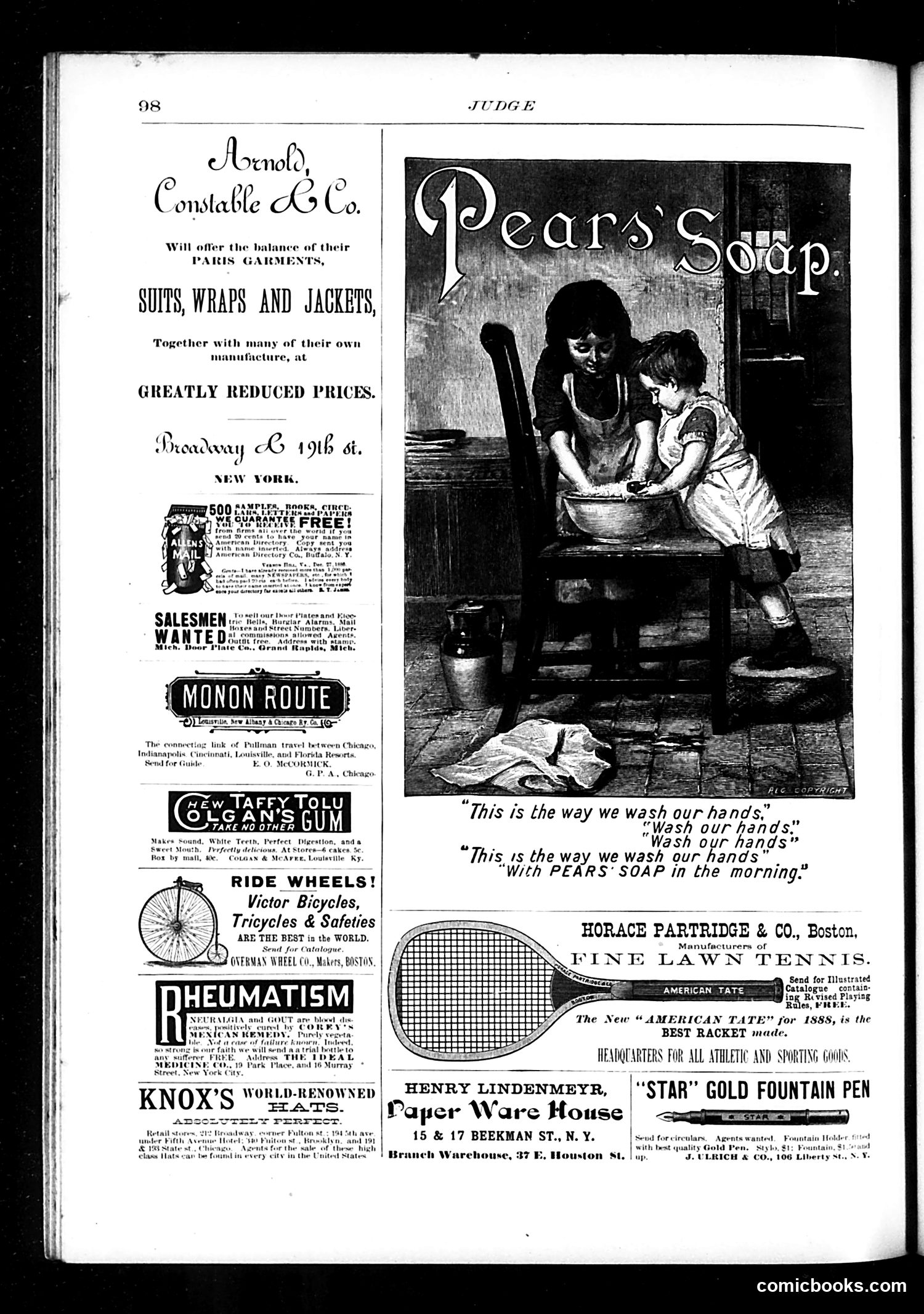
This page is primarily **advertising content** rather than editorial satire. The dominant visual element is a **Pears' Soap advertisement** featuring an illustration of a woman and child washing hands together, accompanied by a jingle: "This is the way we wash our hands / With Pears' Soap in the morning." The advertisement represents typical Victorian-era marketing emphasizing cleanliness and domestic virtue. The imagery and message reflect late 19th-century values linking soap use to moral and physical hygiene. The page is otherwise filled with commercial advertisements for various products (bicycles, hats, fountain pens, sporting goods) typical of Judge magazine's revenue model. There is **no apparent political cartoon or satirical commentary** on this particular page—it functions as a standard advertising section within the publication, demonstrating how magazines of this era relied heavily on paid advertisements to support operations.
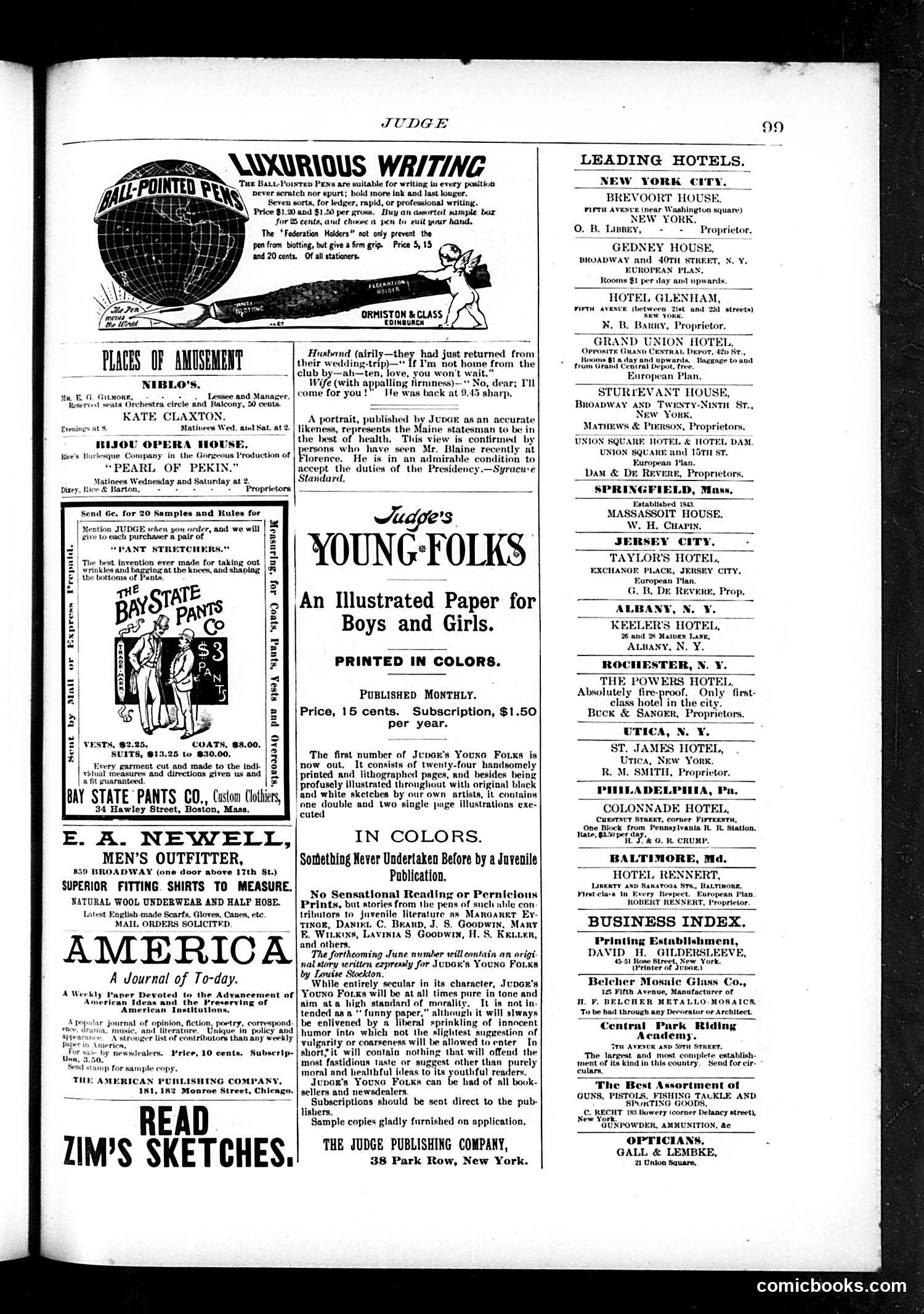
This page is primarily **advertising and announcements** rather than editorial cartoon content. The page advertises: - Writing implements (Ball-Pointed Pens) - Theater performances (Niblo's, Bijou Opera House) - Men's clothing (Bay State Pants Co., E.A. Newell) - A new children's magazine called *Judge's Young Folks* The only editorial content appears to be a **brief humorous domestic anecdote** about a husband and wife ("Husband [airily]..."). There is also a **short political note** mentioning James G. Blaine, the Maine statesman, being in "admirable condition to accept the duties of the Presidency"—likely a reference to contemporary speculation about his political future (Blaine was a prominent Republican who ran for president in 1884). The page demonstrates how 19th-century magazines mixed editorial content with extensive paid advertising to sustain operations.
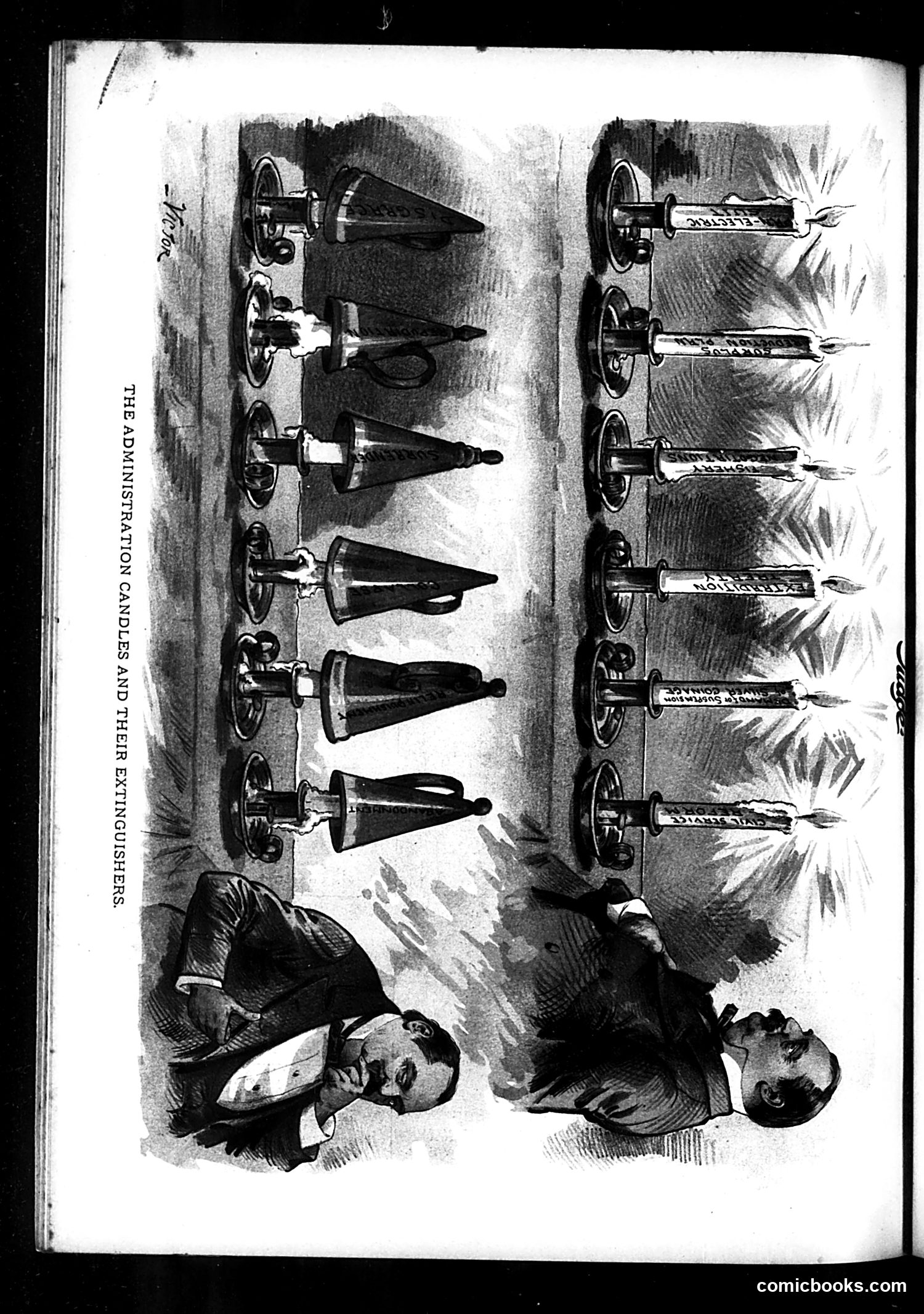
This page appears to be rotated 90 degrees, making it difficult to read clearly. The OCR text is largely garbled single letters, suggesting the scanning/OCR process failed on this particular page. **What's visible in the image:** Two men in Victorian-era formal dress are shown at the bottom, with two vertical columns of what appear to be syringes or medical implements above them. The left margin text reads "THE ADMINISTRATION GUARDS AND THEIR EXTINGUISHERS." **The likely satirical point:** This appears to be political commentary on government officials ("administration") and their tools or methods, possibly critiquing how they "extinguish" or suppress something—though without legible text or clearer dating, the specific target remains unclear. A higher-quality source document would be needed for accurate interpretation.