
Judge, 1888-05-19 · page 2 of 16
Judge — May 19, 1888 — page 2: what you’re looking at
What you’re looking at
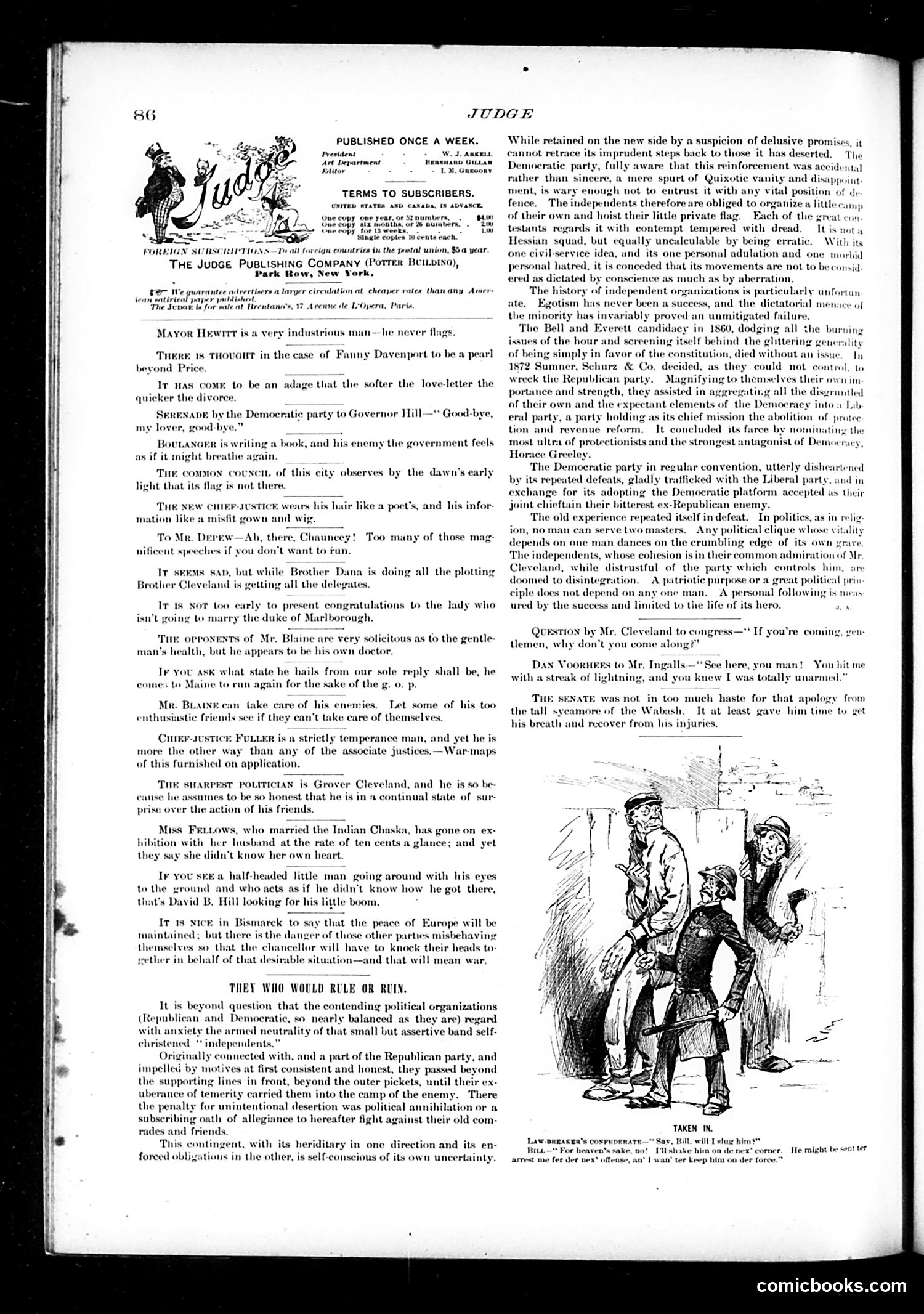
This page satirizes American political divisions of the 1870s-1880s era. The main article "They Who Would Rule or Ruin" criticizes both Republican and Democratic parties as self-serving "independents" who prioritize their own interests over governance. The cartoon illustration titled "Taken In" depicts what appears to be a street confrontation, likely referencing political corruption or deception. The dialogue ("Say, Bill, will take him?" / "For heaven's sake, no! I'll shove him on de next corner") suggests exploitation or passing off unwanted political figures or problems. The page mocks how political parties "forced obligatious on the other" through manipulation rather than honest governance, reflecting Judge's skepticism toward Gilded Age politics and party machines.
📄 Transcribed text from this page (OCR, searchable)
Machine-transcribed from the original scan — historical spelling and the odd misread are preserved.
JUDGE PUBLISHED ONCE A WEEK. President Art Department Paitor W. J. Awe Benswano Gttam TERMS TO SUBSCRIBERS. ONITED RTATES AND CANADA, IN ADVANCE, Prey erry cw FOREIGN SUBSCRIPTIONS To all foreign countries 1 the pratal union, % THE JUDGE PUBLISHING COMPANY (PoTTER But.visa), Park & w York, @ year. F27 We guarantee atvertisers a larger ei tirteal paper pnldie ‘The Jepor. t for uate at Hrenta: tion at cheaper rates than any Amer= 17 Arenne ile L’Opera, Paris Mayor Hew!r is a very industrious man—he never flags. THERE 18 THOUGHT in the case of beyond Price. ‘anny Davenport to be a pearl ze that the softer the loveletter the If Has CoME to be an er the divorce. : by the Democratic party to Governor Hill —" Good-bye, my Ie BovLaNGer is writing a book, and his enemy the government feels as if it night breathe Tur ComMON COUNCIL of this city observes by the daw light that its f arly wf is not there, ts his hair like a poct's, and his infor- mation like a misfit gown and wig. To Mr. Devew—Ah, there, Chauncey! Too many of those mag- nificent speeches if you don’t want to run. Ir skeMs sap, but while Brother Cle It 18 NOT too isn’t ge arly to present congratulations to the lady who i to marry the duke of Marlborough. Tue opposests of Mr. Blain man’s health, but he appe » very solicitous as to the gentle- rs to be his own doctor, Ir You ask what state he hails from our sole reply shall be, he comes to Maine to run again for the sake of the g. 0. p. Mr. BLINK can take care of his enemi enthusiastic friends see if they can’ Let some of his too care of themselves. Ciier-sustice Ful more the other way th of this furnished on appli is a strictly tempe ny of the nee man, and yet he is THE SHARPEST POLITICIAN is Grover Cleveland. and he is so be- assumes to be so honest that he is in a continual state of sur- r the action of his friends. cause bi prise 0 Miss FELLows, who married the Indian Chaska, has gone on ex- hibition with her husband at the rate of ten cents a glance; and yet they she didn’t know her own heart. Ir you half-headed little man going around with his eyes to the round and who acts as if he didn't know how he got there, that's David B, Hill looking for his little boom. It ts Nick in Bismarck to say At the peace of Europe will be «1; but there is th dan; THEY WHO WOULD RULE OR RUIN. It is beyond question that the contending political organizations (Republi with an and Democratic, so nearly balanced as they are) regard y the «| neutrality of that small but assertive band self- chri independents.” Originally connected with, and a part of the Republican party, and impelled by motives at first consistent and honest, they passed beyond the supporting lines in front, beyond the outer pickets, until their ex- uberance of temerity carried them into the camp of the enemy. There the penalty for unintentional desertion was political annihilation or a subscribing oath of allegiance to hereafter fight against their old com- rades and friends. This ¢ foreed obi, mtingent, with its heriditary in one direction and its en- sin the other, is self-conscious of its own uncertainty. While retained on the new side by a suspicion of delusive promises, it cannot retrace its imprudent steps back to those it has deserted, The Democratic party, fully aware that this reinforcement was accide:tal rather than sincere, a mere spurt of Quixotic vani ment, is wary enough not to entrust it with fence. nd disappoint: y vital position of The independents therefore are obliged to organize a litt and hoist their little private f Each of the g aards it with contempt tempered with dread, Hessian squad, but equally uncalculable by being. erratic. civil-service idea, and its one personal adulation . it pceded that, dictated by The history of independent org ate, Egotism has never been a su the minority has invariably proved an unmitigated failure. The Bell and andidacy in 1860, dodging all the burning issues of the hour and screening itself behind the glittering generality of being simply in favor of the constitution, died without an issue. In 1872 Sumr Schurz & Co. des s they could not control wreck the Republican party. Magnifying to themselves th nd strength, they assisted in a of their own and the expectant elements eral party, a party holding as its chief mission the abolition of protec jon and revenue reform, It concluded its farce by nominating the most ultra of protectionists and the strongest antagonist of Democracy, Horace Greeley The Democratic party in regular convention, utterly disheartened by its repeated defeats, gladly trafficked with the Liberal party, and in nge for its adopting the Democratic platform accepted as their joint chieftain their bitterest ex-Republican enemy. The old experience repeated itself in defeat. ion, no man can serve two masters. ny politica depends on one man dances on the crumbling edge of its own The independents, whose cohesion is in their common admiration of Mr nd, while distrustful of the party wh controls him, are dl to disintegration. A patriotic purpose or a great political prin ciple does not depend on any one man. A personal following is mess ured by tl nd limited to the life of its hero, ay success Question by Mr. Cleve tlemen, why don't you come and to congress—"* If you're coming, gen long?” Dan Voor with a streak of es to Mr, Ingalls. here, you man! itning, and you knew I was totally unart uu hit me ed.” Tuk SENATE was not in too much haste for that apology from the tall syeamore of the Wabash. It at least gave him time to t his breath and recover from his injuries. He might be sent ter comicbooks.com