
A complete issue · 16 pages · 1888
Judge — March 10, 1888
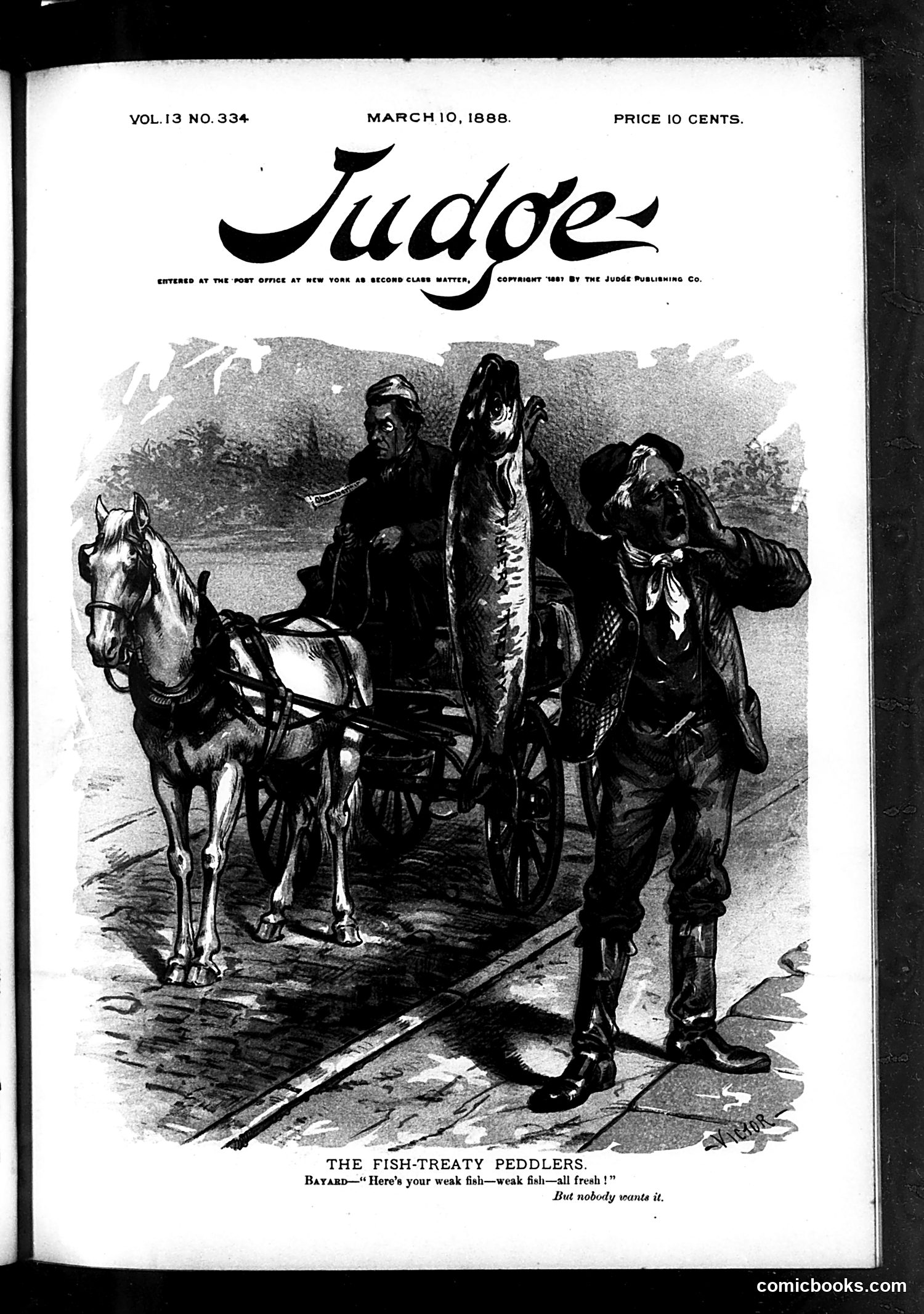
This political cartoon satirizes figures promoting a fish treaty—likely referring to negotiations over fishing rights, possibly between the U.S. and Canada, which were contentious issues in the 1880s. The caption's dialogue mocks the treaty's value: a street peddler hawking "weak fish" that "nobody wants" serves as a metaphor. The figures appear to be politicians or diplomats trying to sell an unpopular agreement to the public. The satire suggests the treaty was weak, unwanted, and being aggressively marketed despite lacking genuine support or benefit. The "peddler" comparison implies the deal was being pushed dishonestly, like cheap goods from a cart. Without identifying specific individuals, the cartoon criticizes diplomatic efforts as cynical salesmanship of a bad deal.
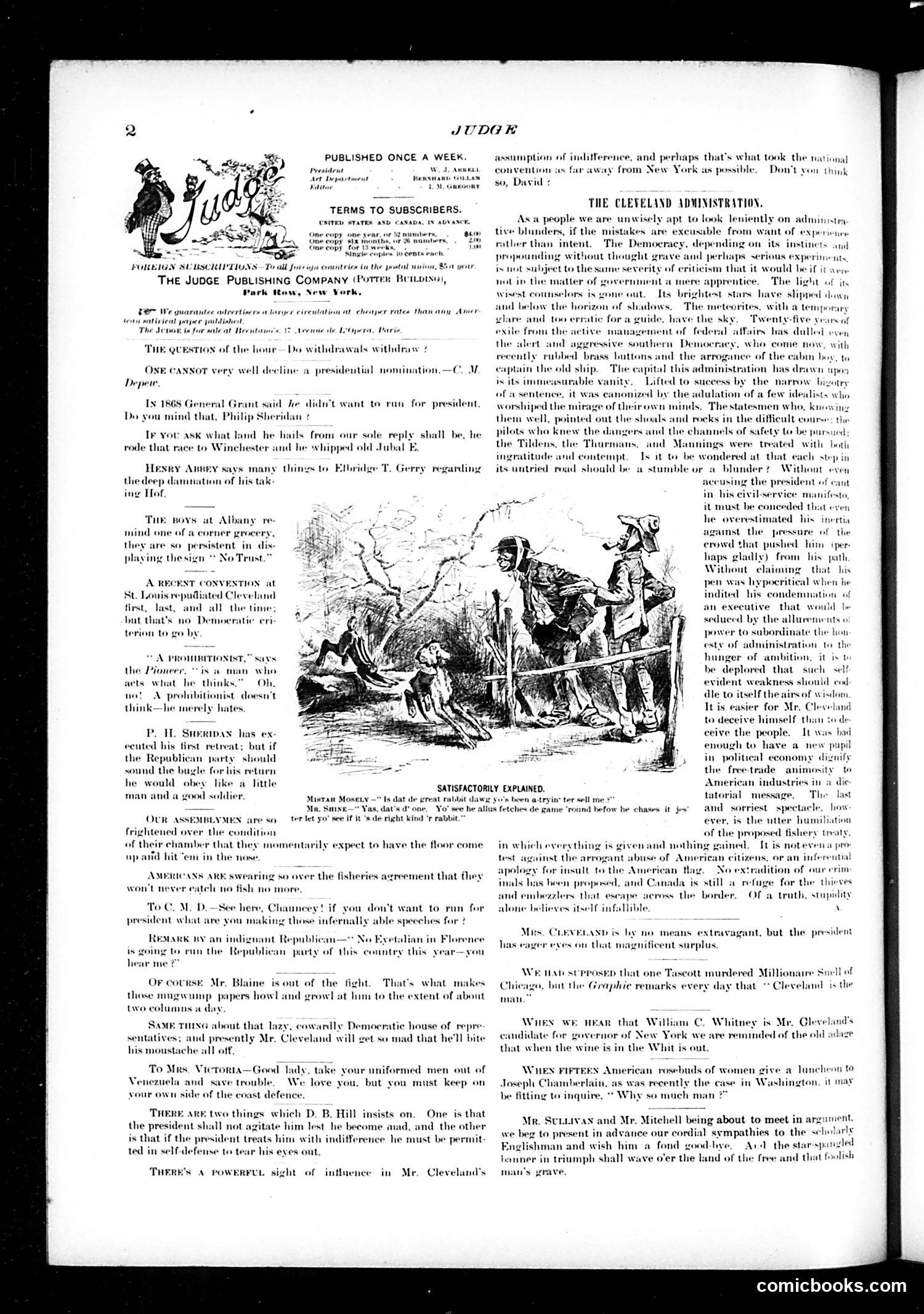
This page contains political commentary about President Cleveland's administration. The central cartoon, titled "SATISFACTORILY EXPLAINED," depicts two figures in conversation—likely representing Cleveland and a critic or constituent. The cartoon appears to satirize the administration's explanations for its policies or failures. The surrounding text discusses Cleveland's handling of various issues: the fisheries agreement, tariff policy, and political appointments. References to "Democratic house of representatives" and complaints about the administration suggest this criticizes Cleveland's executive decisions as inadequately justified to the public. The satire mocks the administration's tendency to offer explanations that satisfy neither critics nor supporters, implying Cleveland's explanations for controversial policies were unconvincing or evasive.
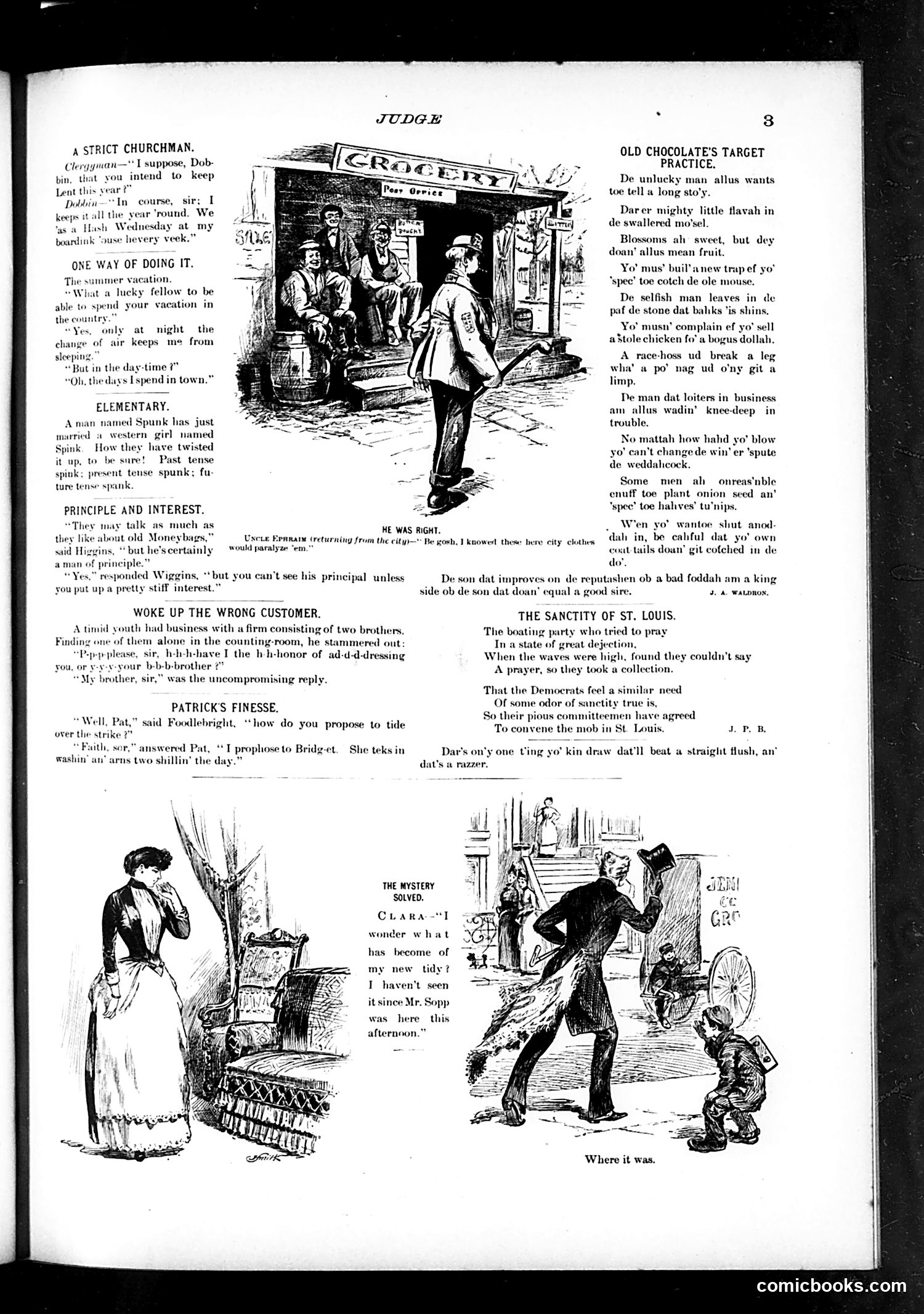
This page contains multiple short humor pieces typical of Judge's satirical format: **"A Strict Churchman"**: A clergyman questions a man about keeping Lent, establishing hypocrisy as the theme. **"One Way of Doing It"**: A joke about spending summer vacation in the country for fresh air, then admitting one actually stays in town during daylight. **"Elementary"** and **"Principle and Interest"**: Brief wordplay jokes about names and financial terms. **"Woke Up the Wrong Customer"**: A timid youth mistakes which brother to address; gets a stern reply—humor from social awkwardness. **"Patrick's Finesse"**: An Irishman (stereotyped dialect) proposes having his fiancée do laundry to help during a strike—crude labor-class humor. **"The Sanctity of St. Louis"** and **"The Mystery Solved"**: Political/social commentary on Democratic gatherings in St. Louis, and a domestic joke about a missing item. The page emphasizes **character stereotypes** (Irish immigrant, timid youth) and **class-based humor** typical of 1880s-90s American satire.
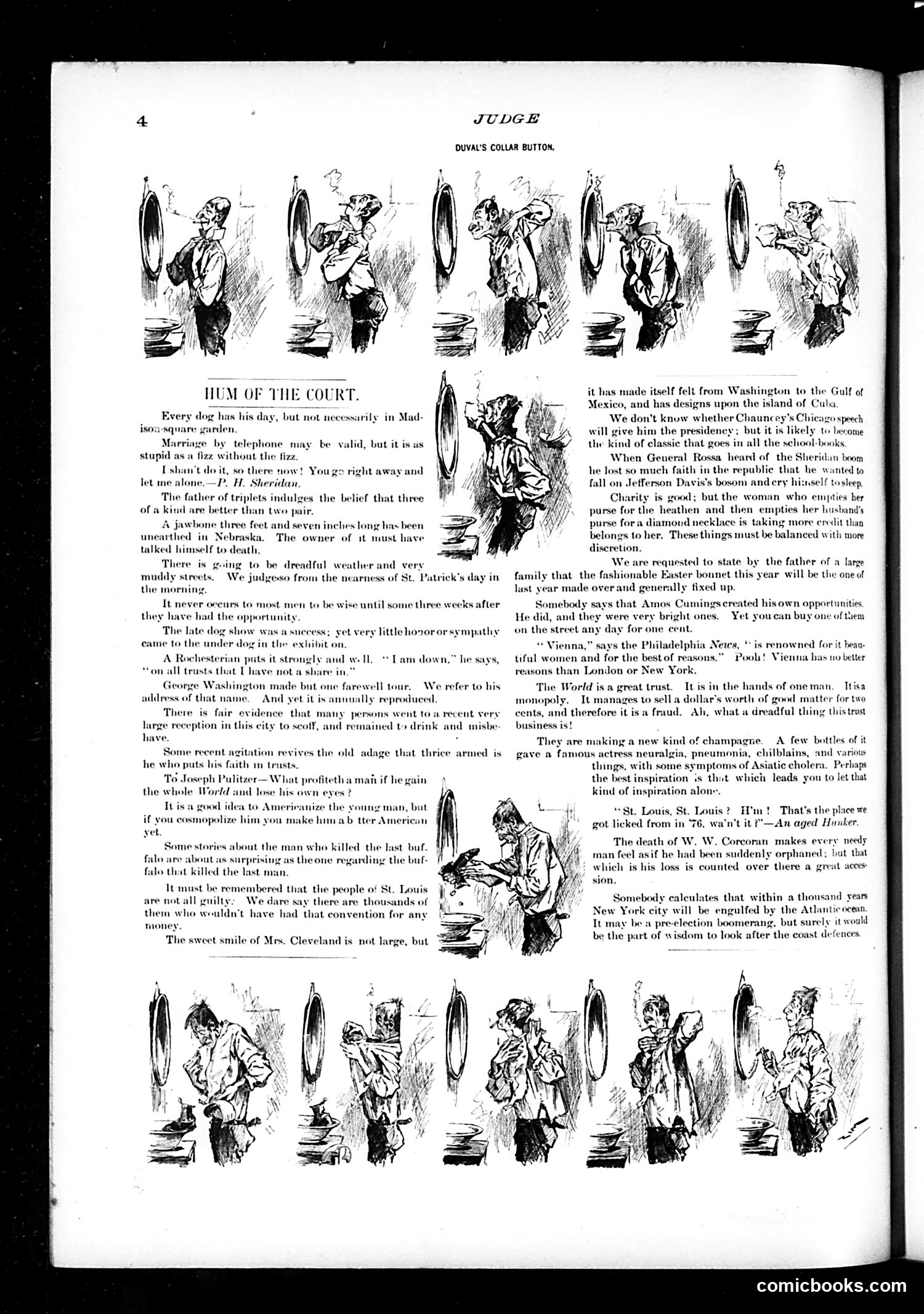
This page from *Judge* magazine presents a series of satirical vignettes (the repeated collar-button imagery frames each joke). The text mocks various contemporary figures and events, likely from the 1880s-90s. Key references include: - **General Sheridan** and **Jefferson Davis**: Satirizes political faith after a Sheridan presidential boom fizzles - **Joseph Pulitzer**: Criticized for profiting from "the World" newspaper while claiming it serves the public good - **Mrs. Cleveland**: Jokes about the First Lady's fashionable influence - **St. Louis convention**: References apparent political scandal or corruption - **General Rossa**: An Irish nationalist whose hopes for American political support are mocked The satire targets political hypocrisy, newspaper monopolies, fashion excess, and the gap between charitable rhetoric and actual behavior. The cartoon's title likely references something trivial (a collar button) to underscore how minor concerns distract from serious issues—a classic *Judge* rhetorical device.
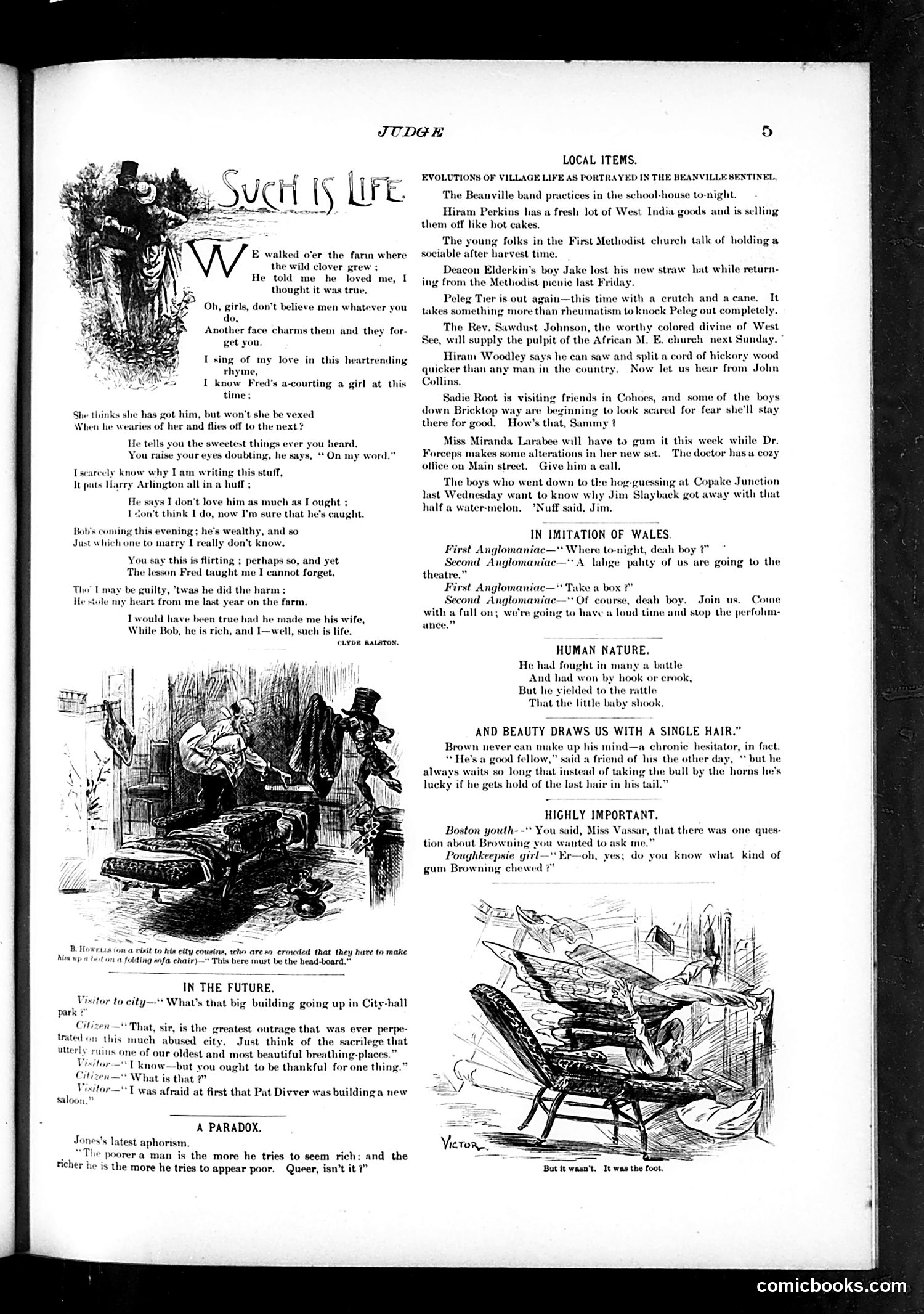
This page from the satirical magazine *Judge* contains mostly humorous local-interest content rather than political satire. **Main Content:** The page features "Such is Life," a poem about a flirtatious young woman juggling multiple suitors (Fred, Harry Arlington, and Bob), satirizing romantic fickleness and women's conflicting desires for love versus financial security. **Notable Sections:** - **"Local Items"** parodies small-town newspaper gossip from fictional "Beanville," poking fun at provincial life, including a dentist pulling teeth and boys stealing watermelon. - **"In Imitation of Wales"** mocks pretentious Americans aping British affectations, with characters using exaggerated pseudo-English pronunciations ("deah boy," "lahge pahty"). - **Cartoons** include domestic humor: a man mistaking a folding sofa's headboard for furniture, and another showing a messy chair. - **"A Paradox"** presents a witty observation about class performance: poor men pretend wealth; rich men pretend poverty. The page's humor targets romantic dishonesty, social pretension, and small-town life—typical *Judge* content of the era.
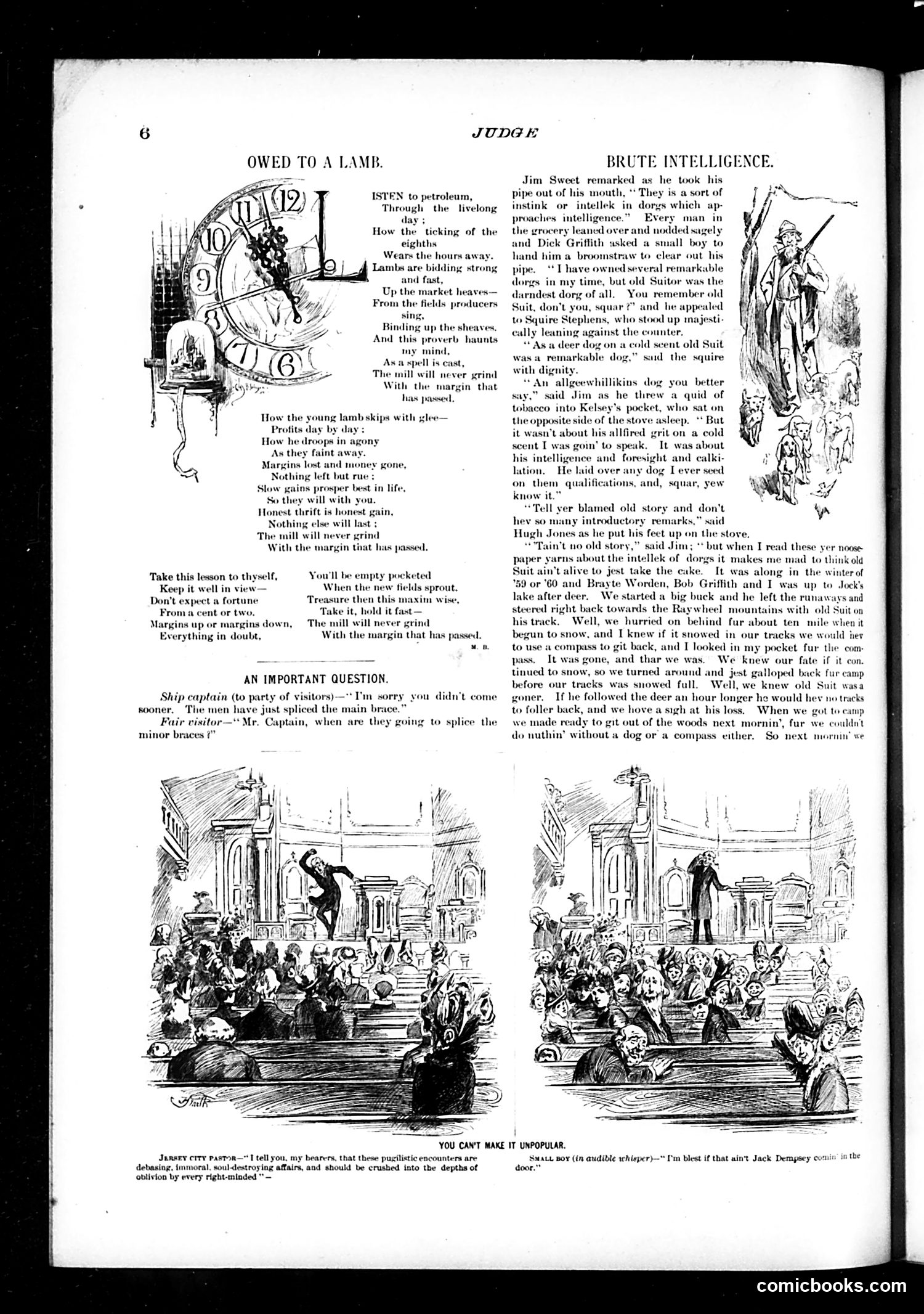
This page from *Judge* contains three distinct satirical pieces: **"Owed to a Lamb"** (top left): A poem with illustration mocking agricultural speculation and commodity trading. It warns against expecting profits from minimal investment ("a cent or two"), cautioning that "the mill will never grind / With the margin that has passed"—satirizing farmers and speculators who gamble on market movements. **"An Important Question"** (middle): A brief joke about naval terminology. A visitor asks when sailors will "splice the minor braces," misunderstanding nautical jargon. ("Splice the main brace" is naval slang for taking a drink.) **"Brute Intelligence"** (top right): A humorous tall tale about an exceptionally intelligent hunting dog named "Suit" who navigated hunters back to camp during a snowstorm without compass or instructions. The piece satirizes rural storytelling conventions and exaggerated claims about animal cleverness. **"You Can't Make It Unpopular"** (bottom): A minister condemns prizefighting as immoral while Jack Dempsey (boxer) enters—mocking public hypocrisy about boxing's popularity despite moral condemnation.
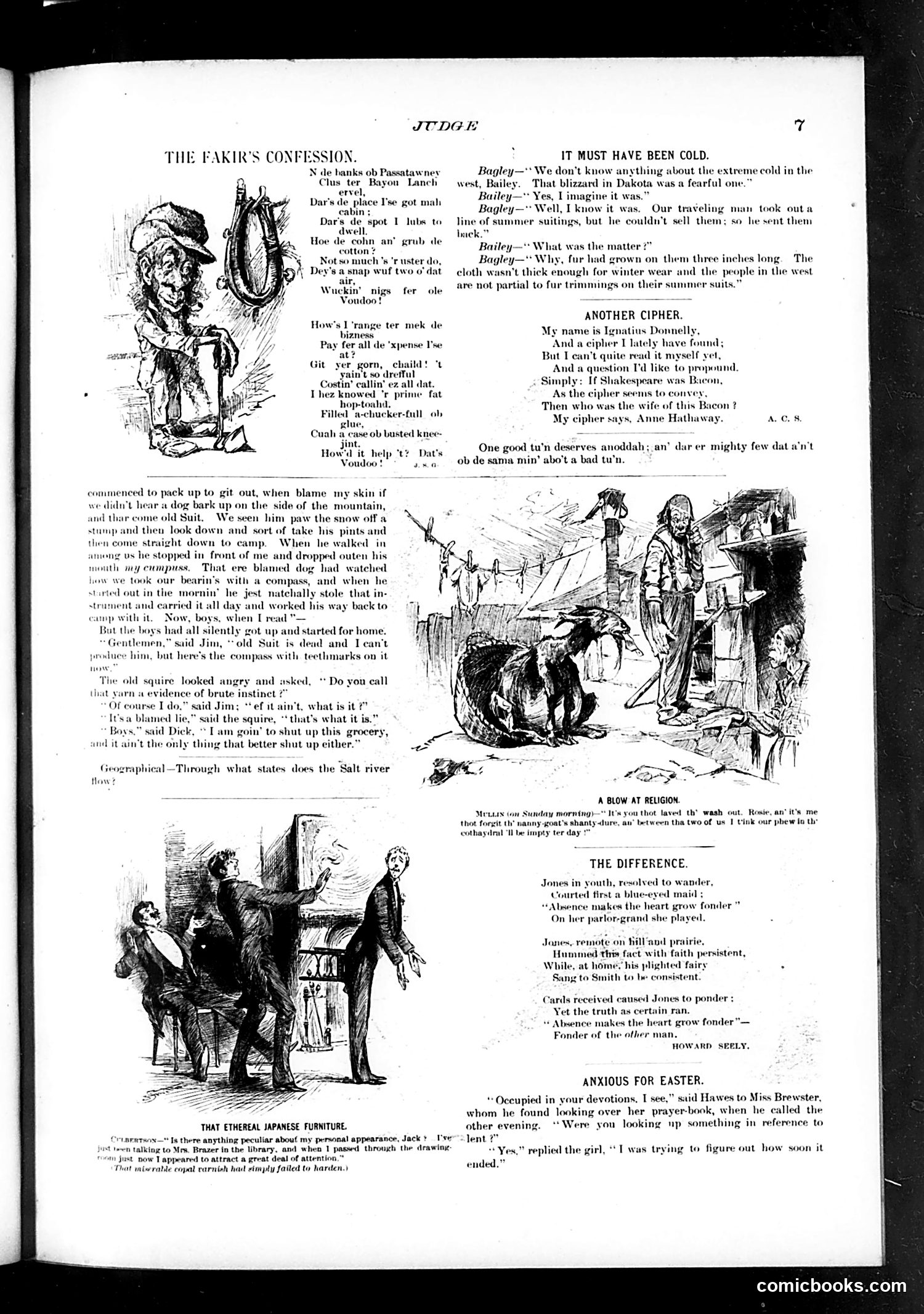
This page contains several satirical pieces typical of late 19th-century American humor: **"The Fakir's Confession"** uses a racist dialect narrative mocking a character claiming supernatural powers ("Voodoo"), satirizing both fraudulent spiritualism and period stereotypes. **"It Must Have Been Cold"** jokes about a traveling salesman's failed attempt to sell summer clothing in Dakota during extreme winter—absurdist humor about regional climate differences. **"Another Cipher"** mocks the contemporary obsession with finding "hidden ciphers" in Shakespeare's works supposedly revealing Francis Bacon as the true author. The joke proposes equally ridiculous cipher logic about Anne Hathaway. **"A Blow at Religion"** makes a mild critique of hypocrisy regarding religious charity. **"The Difference"** contrasts a man's romantic idealism in youth with domestic reality in marriage. **"Anxious for Easter"** is a light joke about anticipating Easter's arrival, likely for secular rather than religious reasons. The page reflects Judge's mix of social commentary, literary satire, and domestic humor aimed at educated, middle-class readers.
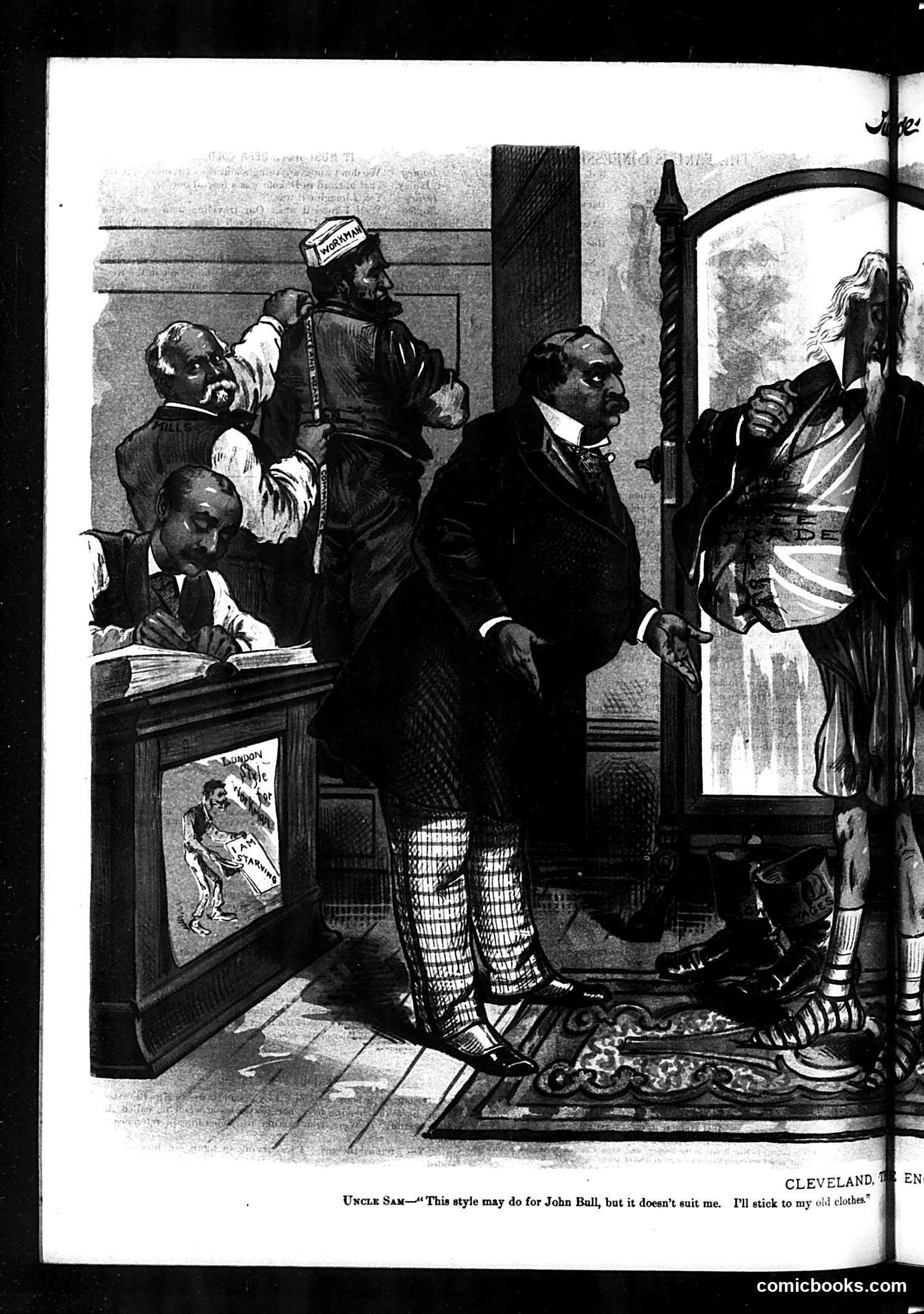
This is a satirical cartoon from *Judge* magazine featuring Uncle Sam (personified America) rejecting fashionable clothing. The cartoon appears to reference debates about American versus European (particularly British) styles and customs during the late 19th century. "John Bull" is the traditional personification of Britain. Uncle Sam is refusing to adopt British fashions or mannerisms, declaring he'll "stick to my old clothes"—a statement about American cultural independence and resistance to foreign influence. The figures at the counter appear to be tailors or merchants promoting European styles. The satire suggests Americans shouldn't blindly imitate British fashion or customs, preferring authentic American character and traditions instead. This reflects contemporary tensions about American cultural identity versus European sophistication during a period of growing American national confidence.
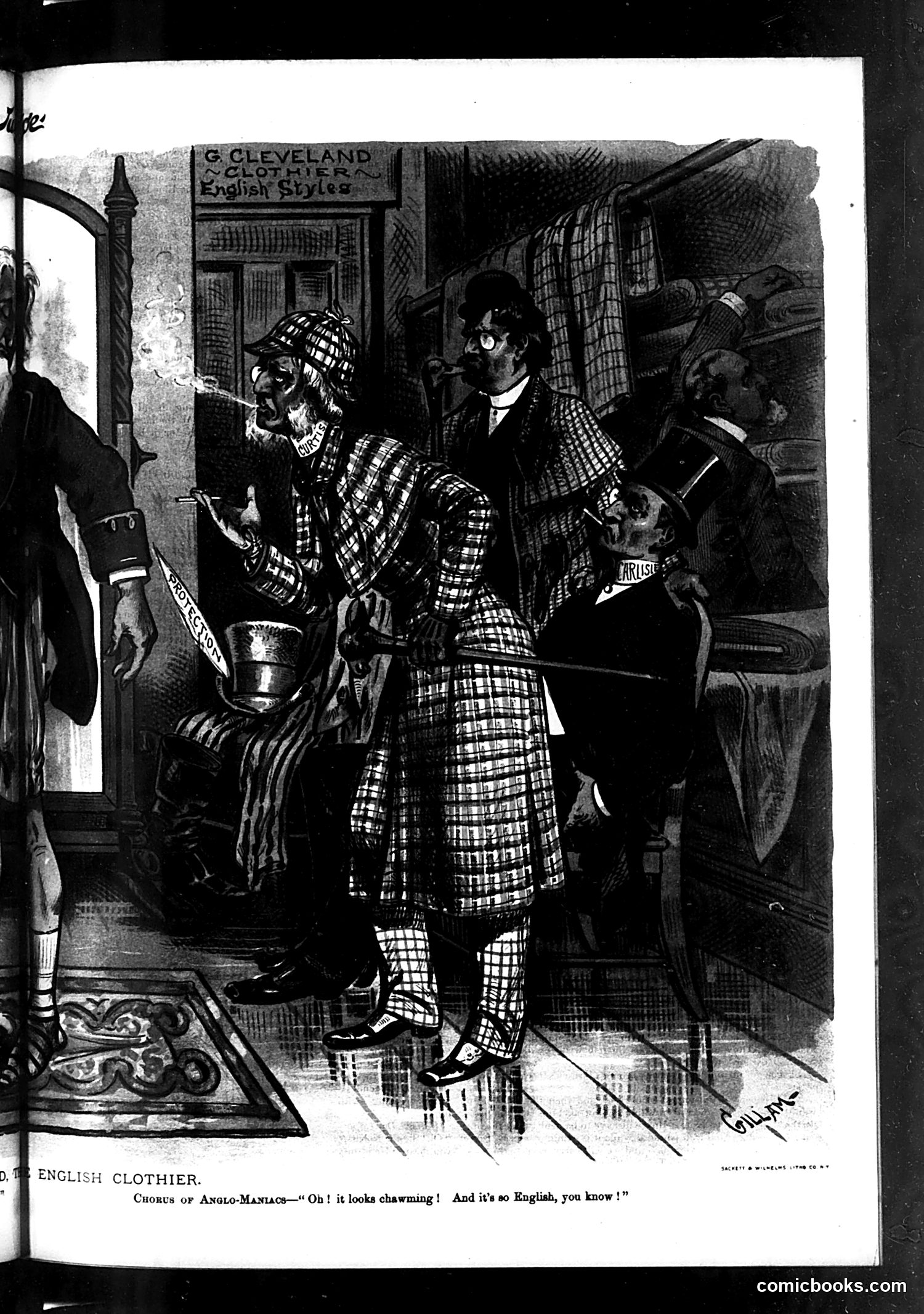
This cartoon satirizes Anglo-Mania—the fashionable British affectation among wealthy Americans. The central figure wears an exaggerated plaid suit in the latest English style, striking a pompous pose outside "G. Cleveland Clothier." The surrounding figures appear to be admiring customers or society types, seemingly entranced by the outfit's "Englishness." The satire targets the pretentiousness of Americans who adopted British fashions and mannerisms as markers of sophistication and class status. The chorus line's vapid commentary—praising something simply because it's "English"—mocks this blind cultural snobbery. The caricatured clothing and exaggerated poses emphasize the absurdity of slavishly following foreign trends regardless of actual merit or appropriateness.
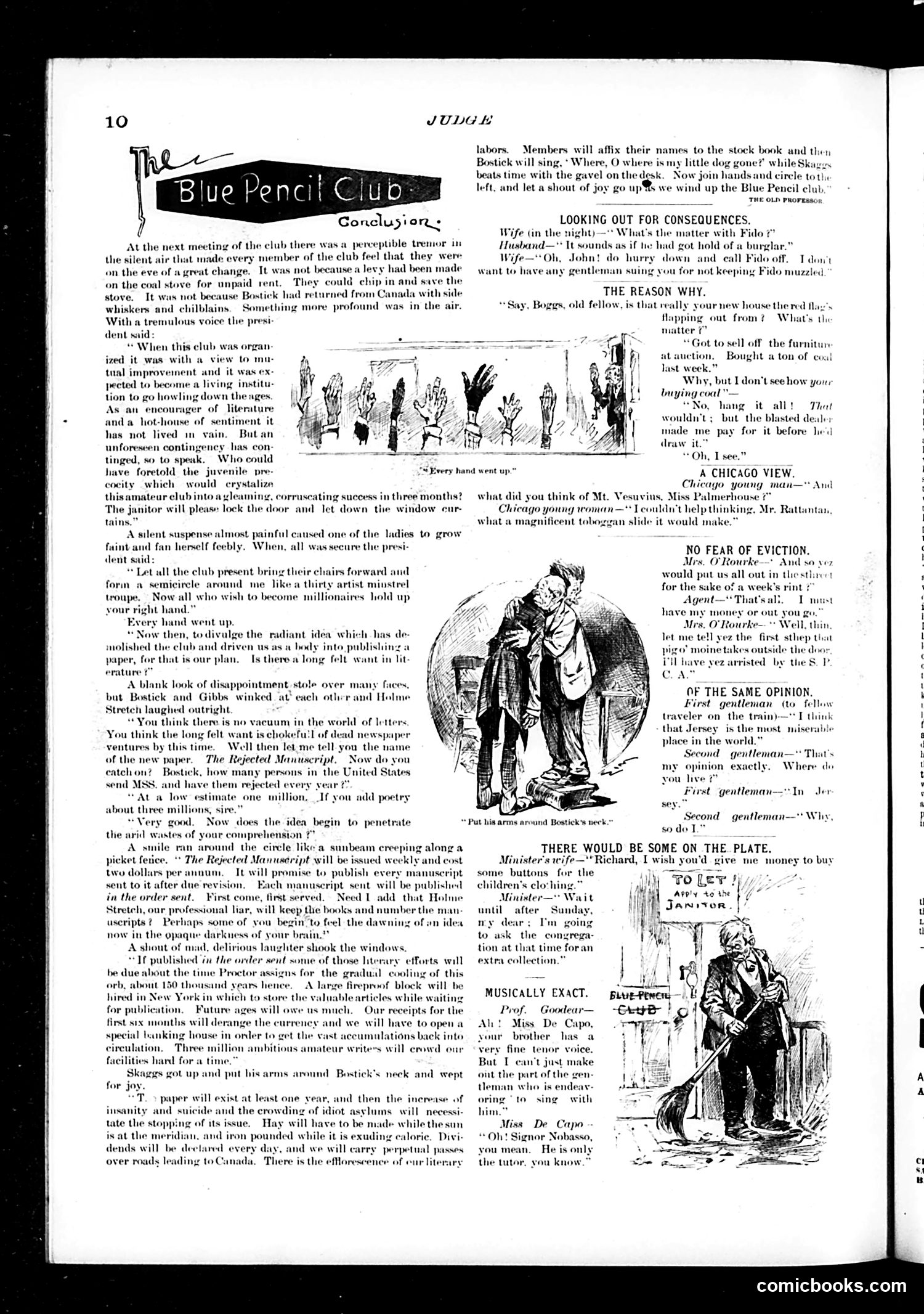
This page concludes a serialized story about an amateur literary club. The "Blue Pencil Club" members—aspiring writers and artists—decide to launch *The Rejected Manuscript*, a satirical weekly publication that will print every unsolicited manuscript in the order received, no matter the quality. The satire targets the era's abundance of mediocre literary submissions. The club president projects humorously that publishing at this rate will take "about a thousand years" and necessitate multiple printing facilities. The joke rests on mocking both rejected writers' persistence and the absurdity of guaranteeing publication to all comers. The illustrations show the club members celebrating their scheme with handshakes and emotional reactions. The referenced character "Bostick" had previously returned from Canada, apparently providing comic relief throughout the series. This reflects late-19th/early-20th-century anxieties about amateur publishing and the flood of unsolicited work editors received.
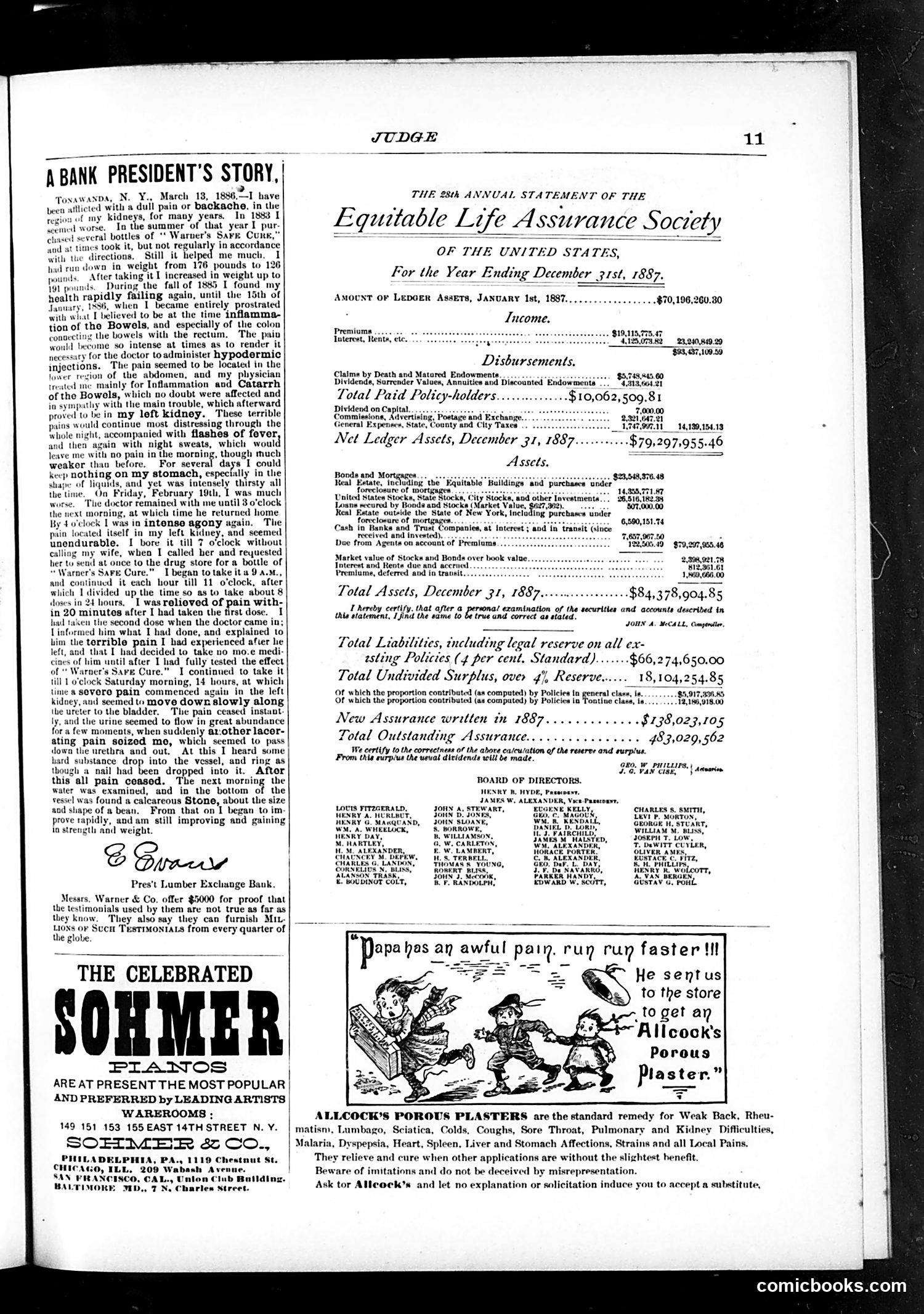
This page is primarily **financial statements and advertisements**, not satirical content. The main feature is the 28th annual statement of the Equitable Life Assurance Society, showing assets of approximately $84 million and new assurance written of $93 million. The page also contains two testimonial/advertisement pieces: one from a bank president praising "Warner's Safe Cure" for kidney ailments (he claims the remedy caused him to expel a kidney stone), and promotions for Sohmer Pianos and Allcock's Porous Plasters. **The satirical element** appears subtle: Judge was a humor magazine, yet this page reads like a financial/medical journal. This incongruity itself may be the joke—the juxtaposition of serious institutional statements with patent medicine testimonials suggests mild mockery of medical advertisement claims and testimonial culture of the 1880s. No identifiable political figures or specific events are referenced on this page.
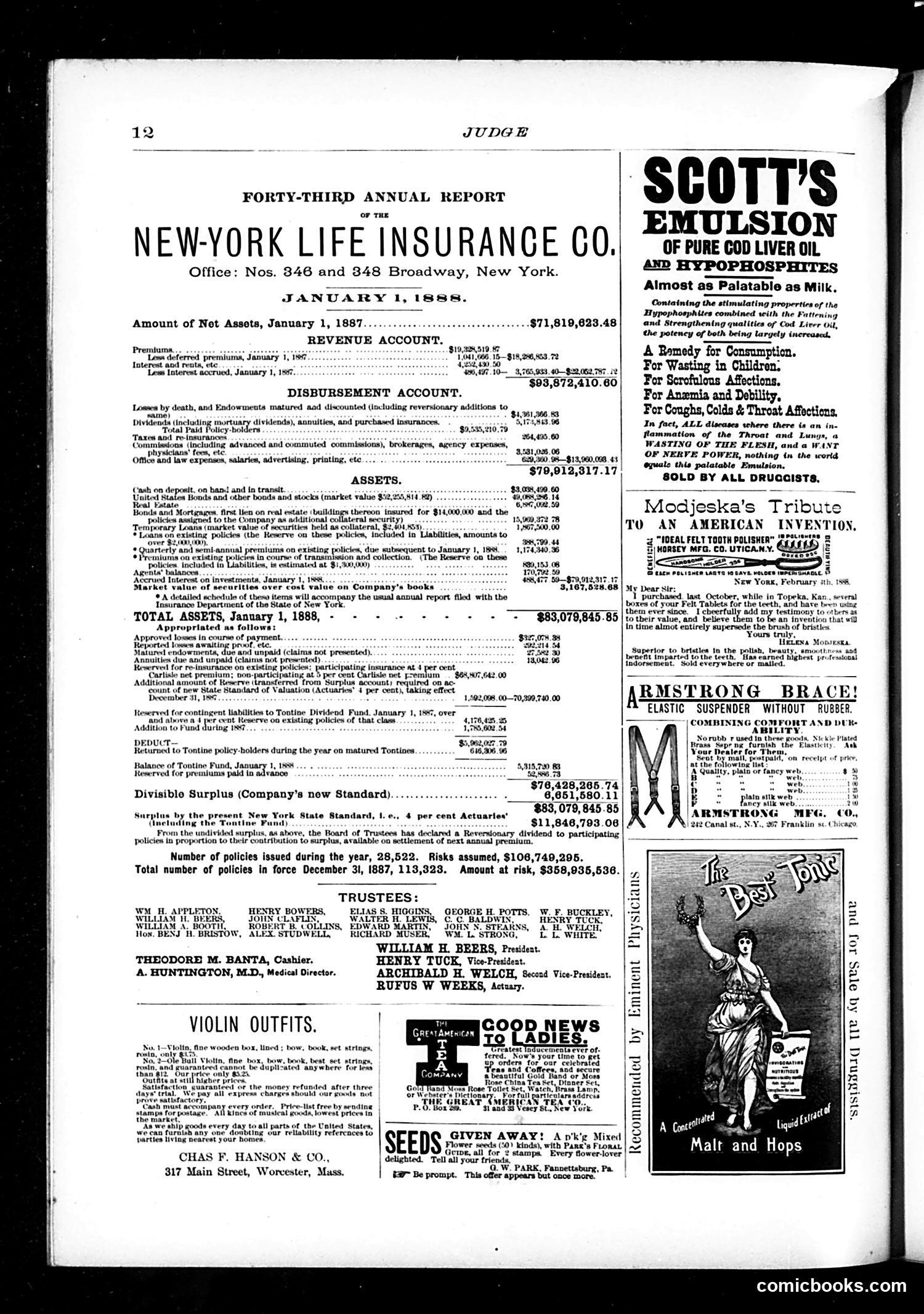
This page is primarily a financial statement—the 43rd Annual Report of the New York Life Insurance Company for January 1, 1888—rather than satirical content. The page header identifies it as appearing in *Judge*, a satirical magazine, but the actual document is legitimate corporate reporting showing assets, revenues, disbursements, and policy information. The surrounding advertisements (Scott's Emulsion, Armstrong Brace, Modjaska's Tribute) and smaller illustrations are typical magazine filler. There is no discernible political cartoon or social satire on this particular page—it appears *Judge* simply reprinted this insurance company report as part of its editorial content, which was common practice for American magazines of this era including financial and business news.
This page is primarily **advertising**, not political satire. It contains numerous commercial advertisements for patent medicines, luxury goods, and travel services typical of the late 19th century. The only editorial content is brief promotional write-ups for books and travel features. One mentions **"Chip's" Unnatural History** by Frank P. W. Bellew (a Judge cartoonist), and another discusses **Colonel Charles L. MacArthur**, described as a modern traveler writing for the Troy Budget. There's a playful morality tale about "The Merry Maiden and the Tar"—a pun advertising Dr. Pierce's Feminine Prescription for women's ailments. The advertisements reflect period obsessions: cod liver oil tonics, fountain pens, fur garments, steamship travel, and medicinal remedies for vague complaints like "female weaknesses." **No significant political cartoon or satire appears on this page.**
This page is primarily **advertising and business listings**, not satirical content. The main elements are: **Header Editorial Note**: A brief commentary on international copyright readings, suggesting Washington needs "judicious lobbying" more than literary events—mild satire on political ineffectiveness. **Major Advertisement**: "Don't be a Clam"—a prominent boxed ad for an engraved script plate by Robert Saeider. The phrase is an idiom meaning "don't be silent/uncommunicative," likely selling the engraving service as a way to make announcements or communications. **Other Ads**: Standard late-19th-century products including: - Gold watches (imitation) - K-Wren patent remedies (claiming to cure colds, coughs, asthma—typical patent medicine claims) - Music boxes - Cigarettes - Crystal Pepsin tablets - Monte Cristo Whisky - Hotels and accommodations The page reflects **Judge's** primary function as a revenue generator through advertising, with minimal editorial satire present. The ads themselves are period artifacts showing common commercial claims and products of the era.
This page is primarily **advertising**, not satirical content. It's page 15 of Judge magazine featuring numerous commercial advertisements from the late 19th century. The top section advertises **ball-pointed pens**, a then-recent innovation, emphasizing they work in any writing position without scratching or blotting—a significant improvement over traditional steel nibs that required careful handling. Below are typical period advertisements for: - **S.S. Sleeper & Co.'s cigars** and collar/cuff products - **Knox hats** (a major American hat maker) - **Baker's Breakfast Cocoa** (established brand, gold medal winner) - **Henry Lindenmeyer's paper warehouse** - Fashion items like tennis clothing and tailoring services - Patent medicines including **Quinine-Wine** (marketed for weakness, anemia, and general debility—typical of era quack remedies) - **Gunther's candy** from Chicago - An organ manufacturer The page reflects consumer goods and commercial culture of the Gilded Age, with little or no satirical content visible.
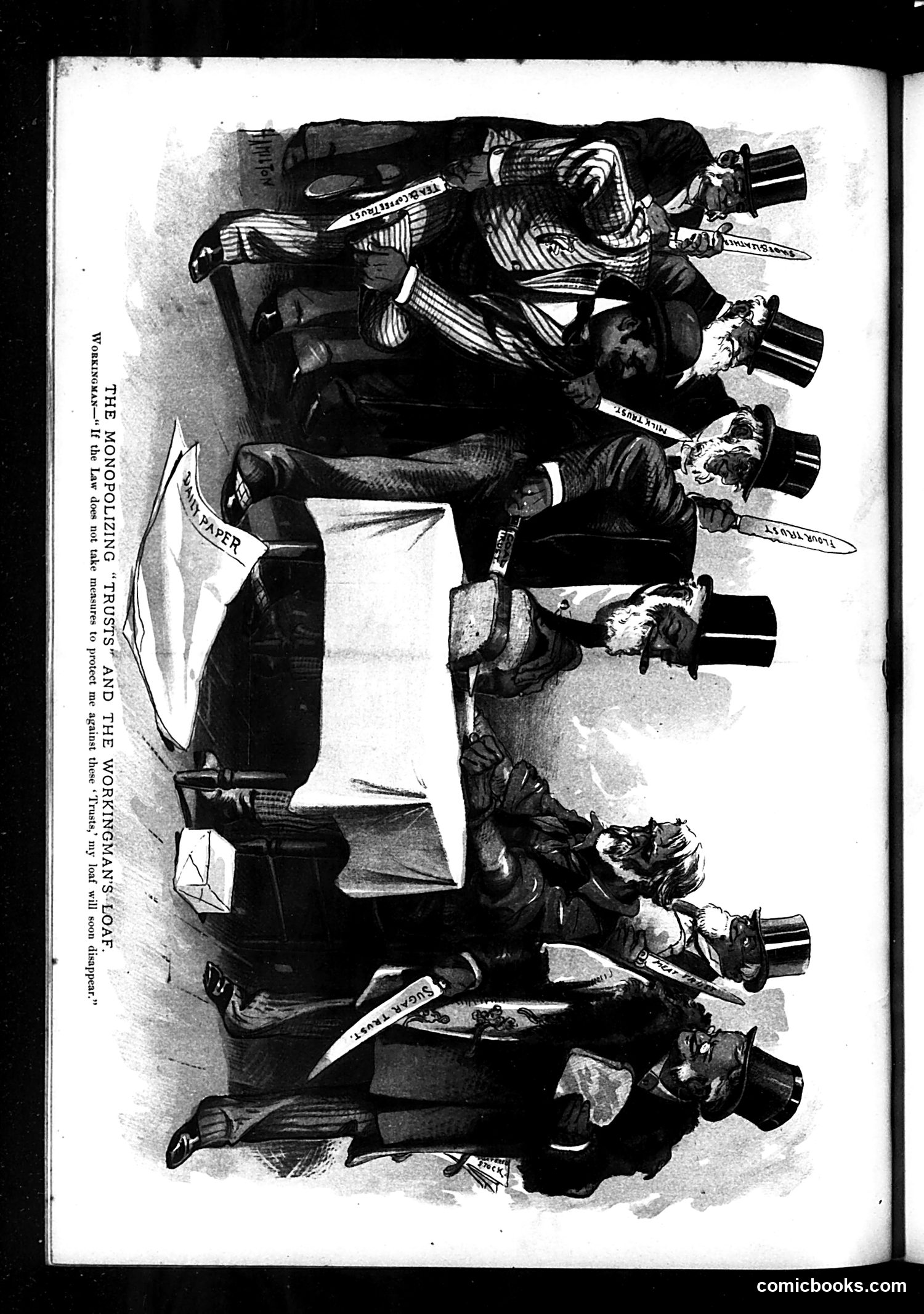
This page appears to be from *Judge* magazine and shows a political cartoon titled "The Monopolizing Trust and the Workingman's Loaf" (visible in the left margin text, though partially obscured). The cartoon depicts a large, well-dressed monopolist figure at the top crushing or controlling smaller figures below—representing workers or common people. The imagery suggests labor exploitation: the wealthy industrialist towers over diminished workingmen, with the central focus on a loaf of bread, symbolizing basic sustenance and workers' ability to afford food. This reflects late 19th/early 20th-century anxieties about monopolistic business practices and their impact on working-class livelihoods. The satire critiques how corporate trusts concentrated wealth while workers struggled to meet basic needs—a common *Judge* theme during the Progressive Era.