
A complete issue · 16 pages · 1888
Judge — January 28, 1888
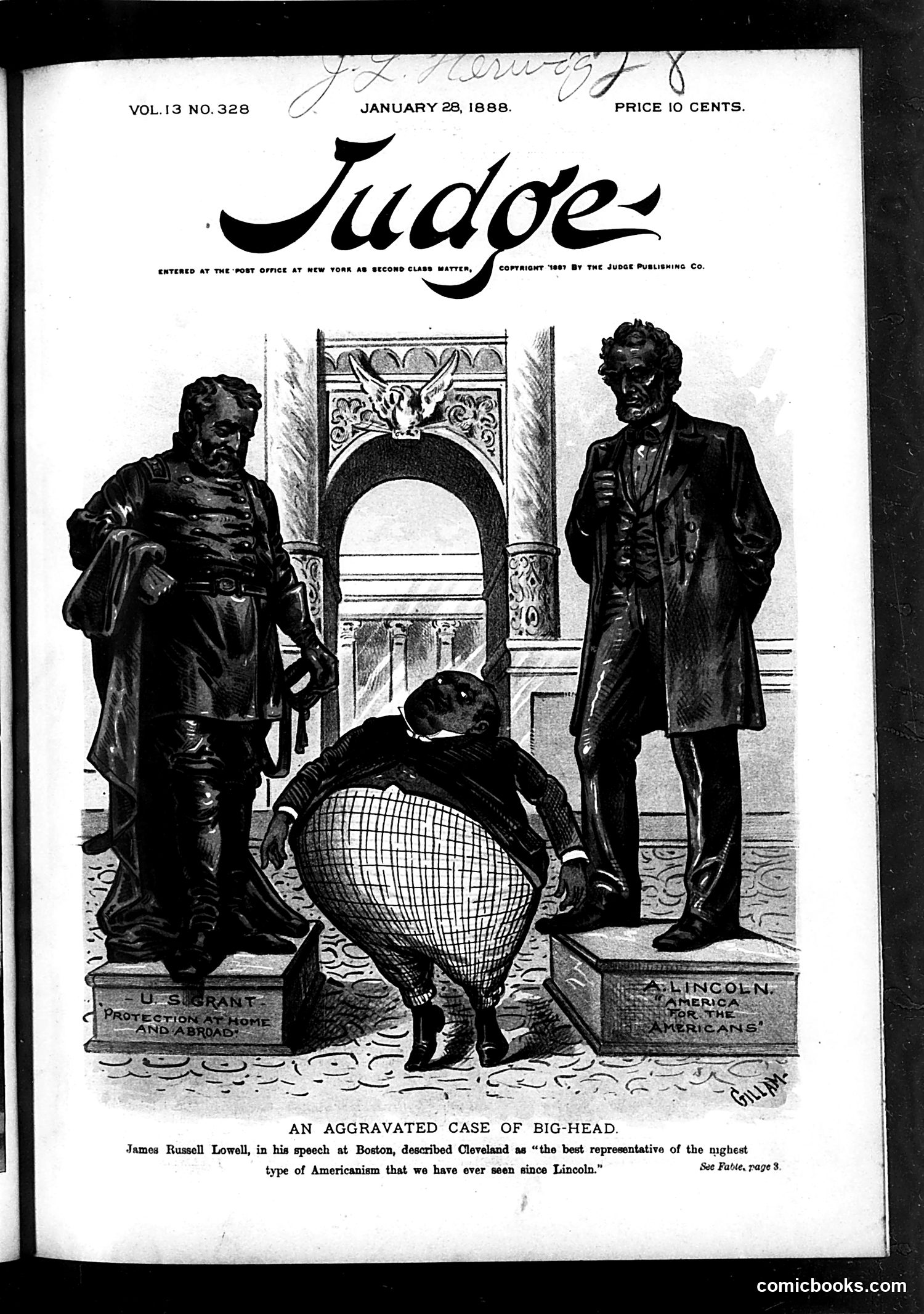
This political cartoon from Judge (January 28, 1888) satirizes Grover Cleveland's political ambitions and ego. The central figure, depicted with an enormously enlarged head, appears to be Cleveland—labeled with references to "Protection at Home" and "America's" policies. Two statues flank him, appearing to represent U.S. Grant (left) and Lincoln (right). The caption references James Russell Lowell's Boston speech describing Cleveland as "the best representative of the highest type of Americanism that we have ever seen since Lincoln." The cartoon mocks this comparison as absurd flattery, suggesting Cleveland's ego has swollen from such praise. The "big-head" metaphor criticizes both his inflated self-regard and the hyperbolic comparisons being made to Lincoln and Grant.
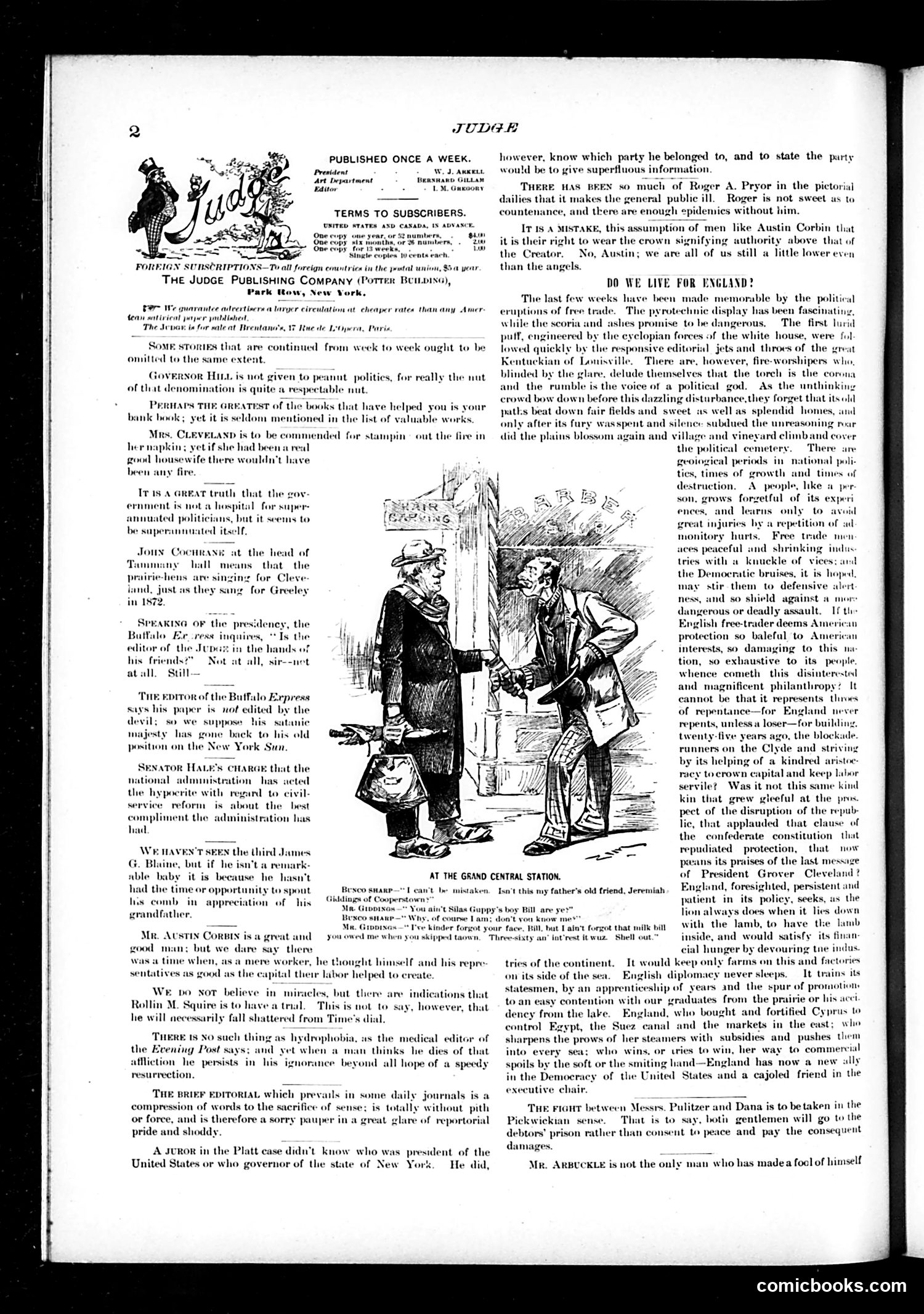
This page from Judge magazine contains editorial commentary and a cartoon titled "AT THE GRAND CENTRAL STATION." The cartoon depicts what appears to be a working-class man with children encountering a well-dressed gentleman, with dialogue about "cooperation" and bills/wages. The surrounding text discusses political corruption, free trade policy, and criticism of government inefficiency. References include Governor Hill's connection to politics, Senator Hale's charges regarding civil-service reform, and commentary on President Cleveland's administration. The cartoon likely satirizes the gap between wealthy elites' professed "cooperation" with working people and their actual economic impact on laborers' wages and living conditions—a common Judge theme addressing labor disputes and class conflict of the 1880s-1890s era.
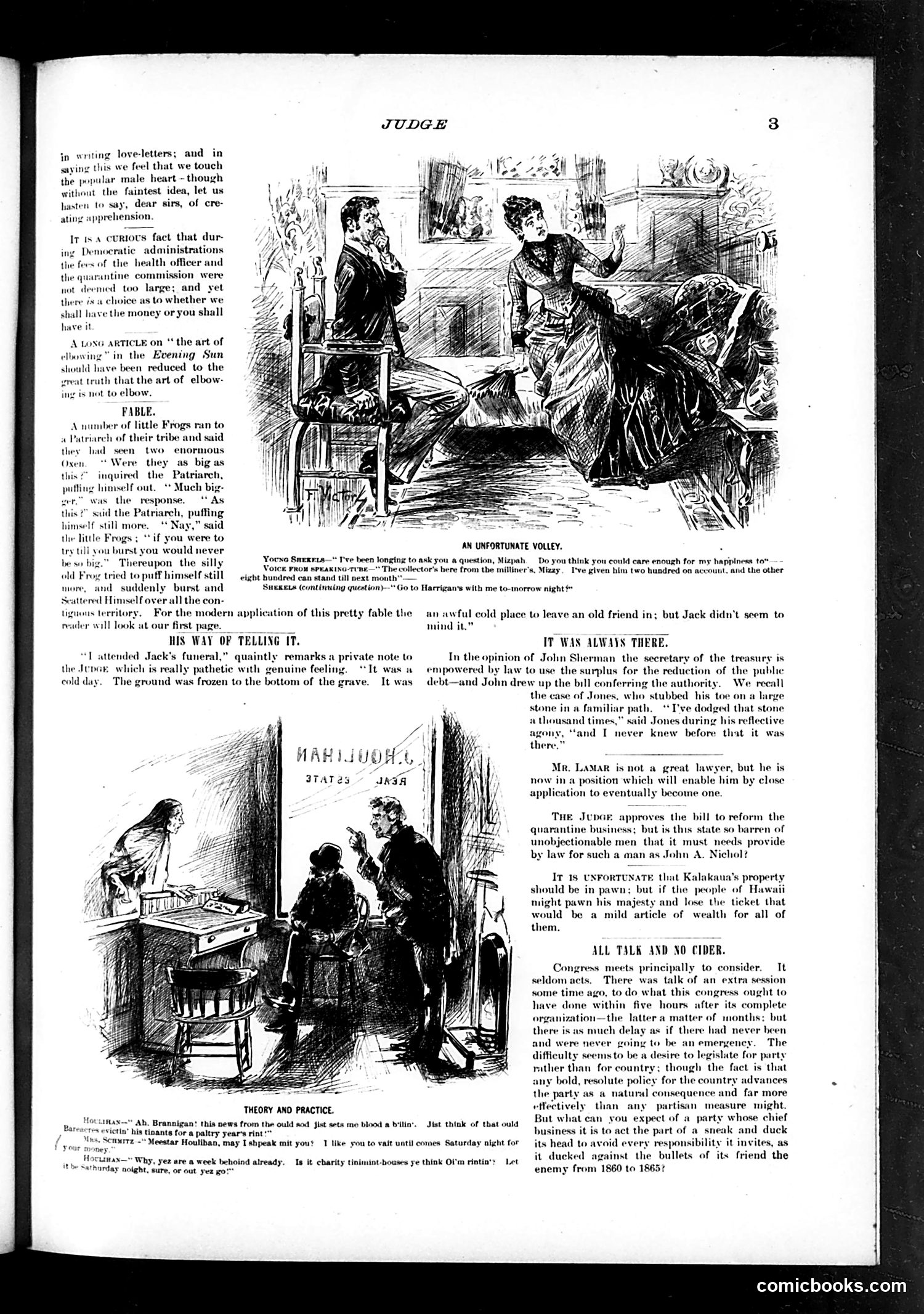
This *Judge* magazine page contains several satirical pieces typical of 1880s American political humor. The cartoons mock contemporary figures and situations: **"An Unfortunate Volley"** depicts a young suitor's romantic proposal interrupted by a milliner's bill collector—satirizing the financial burdens of courtship and women's spending habits, a common Victorian-era joke. **"It Was Always There"** references Secretary of the Treasury John Sherman's bill regarding surplus funds and debt reduction, suggesting the solution was obvious all along—a jab at politicians claiming credit for obvious solutions. **"Theory and Practice"** (bottom) features Irish and German immigrant characters discussing evictions, highlighting class tensions and immigrant concerns during this period. The fables and commentary satirize political indecision, particularly Congress's inability to act decisively rather than merely discuss policy. The overall tone is typical of *Judge*'s mix of social commentary, class satire, and partisan humor targeting late-19th-century American political and social figures.
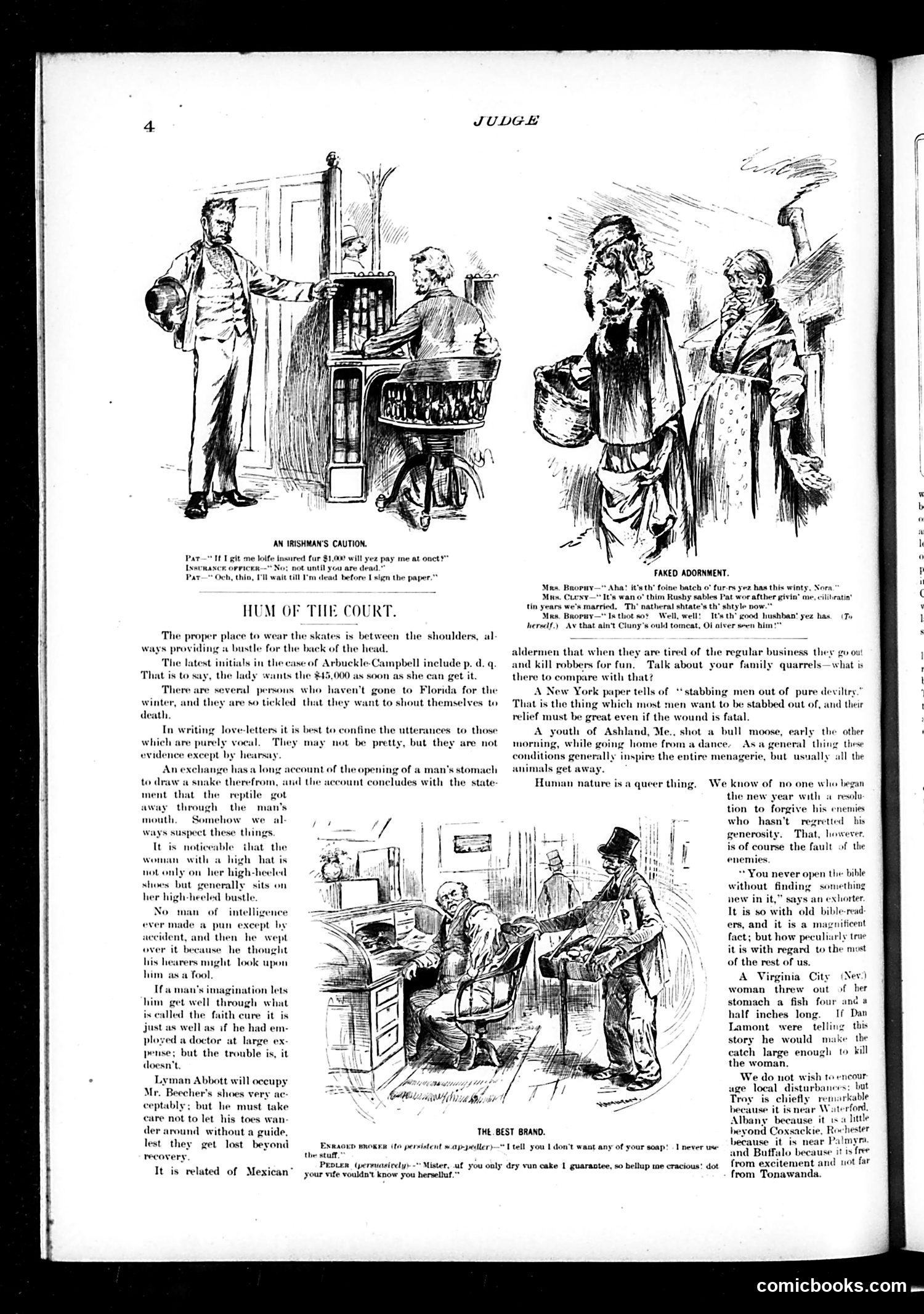
This page contains three satirical cartoons and accompanying commentary from Judge magazine, targeting social absurdities of the era: **"An Irishman's Caution"** mocks Irish immigrants' supposed distrust of insurance, depicting a man refusing to sign a life insurance policy until after death—an obvious logical impossibility used to stereotype Irish-American attitudes toward modern financial instruments. **"Hum of the Court"** offers miscellaneous social commentary, including jabs at wealthy women (one lady eager to collect $45,000 insurance), the pretentiousness of educated speech, and references to religious figures like Lyman Abbott succeeding Henry Ward Beecher. **"Faked Adornment"** satirizes women passing off cheap cat fur as expensive Russian sable—showing Irish immigrant characters' malapropisms while criticizing female vanity and deception in fashion. The page exemplifies Judge's typical targets: immigrant stereotypes (Irish and German), wealthy women's materialism and dishonesty, and social hypocrisy. The humor relies on ethnic caricature and gender-based ridicule common to 19th-century American satire.
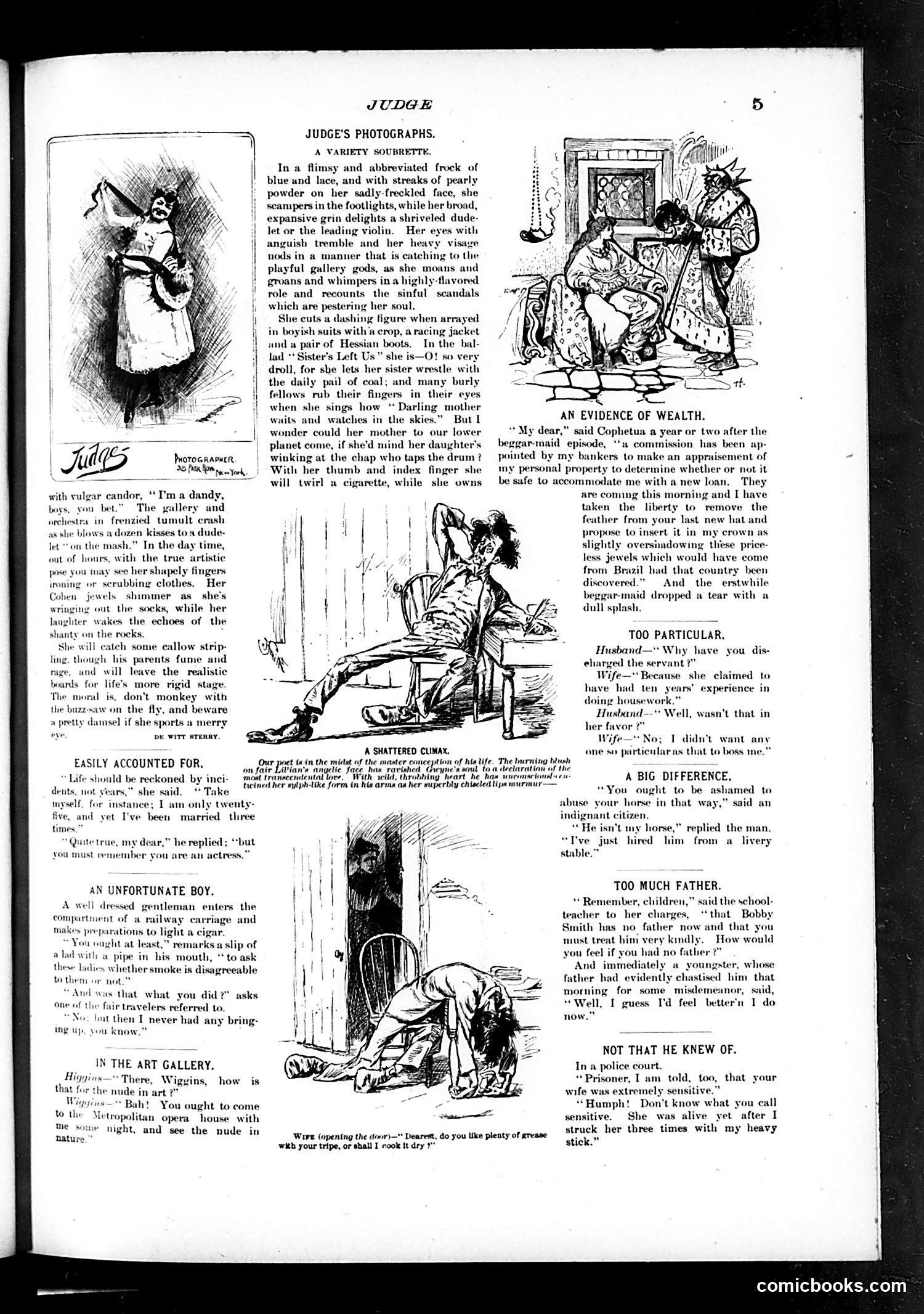
This page from *Judge* magazine contains several short satirical sketches mocking Victorian-era social pretensions and gender relations. **"Judge's Photographs"** features a "variety soubrette" (chorus girl)—a caricature of theatrical performers who adopt affected manners on stage while living modest lives offstage. The satire targets the gap between their glamorous stage personas and mundane reality. **The other sketches** ("Easily Accounted For," "Too Particular," "A Big Difference," etc.) are brief jokes about marriage, infidelity, and class. They ridicule wives' theatrical behavior, husbands' indifference to servants, and the pretensions of the newly wealthy. **"An Evidence of Wealth"** specifically mocks nouveaux riches who flaunt minor luxuries (a feather from Brazil) as status symbols—suggesting that true wealth is invisible or that such ostentatious display reveals insecurity. The overall tone reflects *Judge's* satirical stance toward urban middle-class hypocrisy, theatrical culture, and marital discord—common targets for American humor magazines of this era.
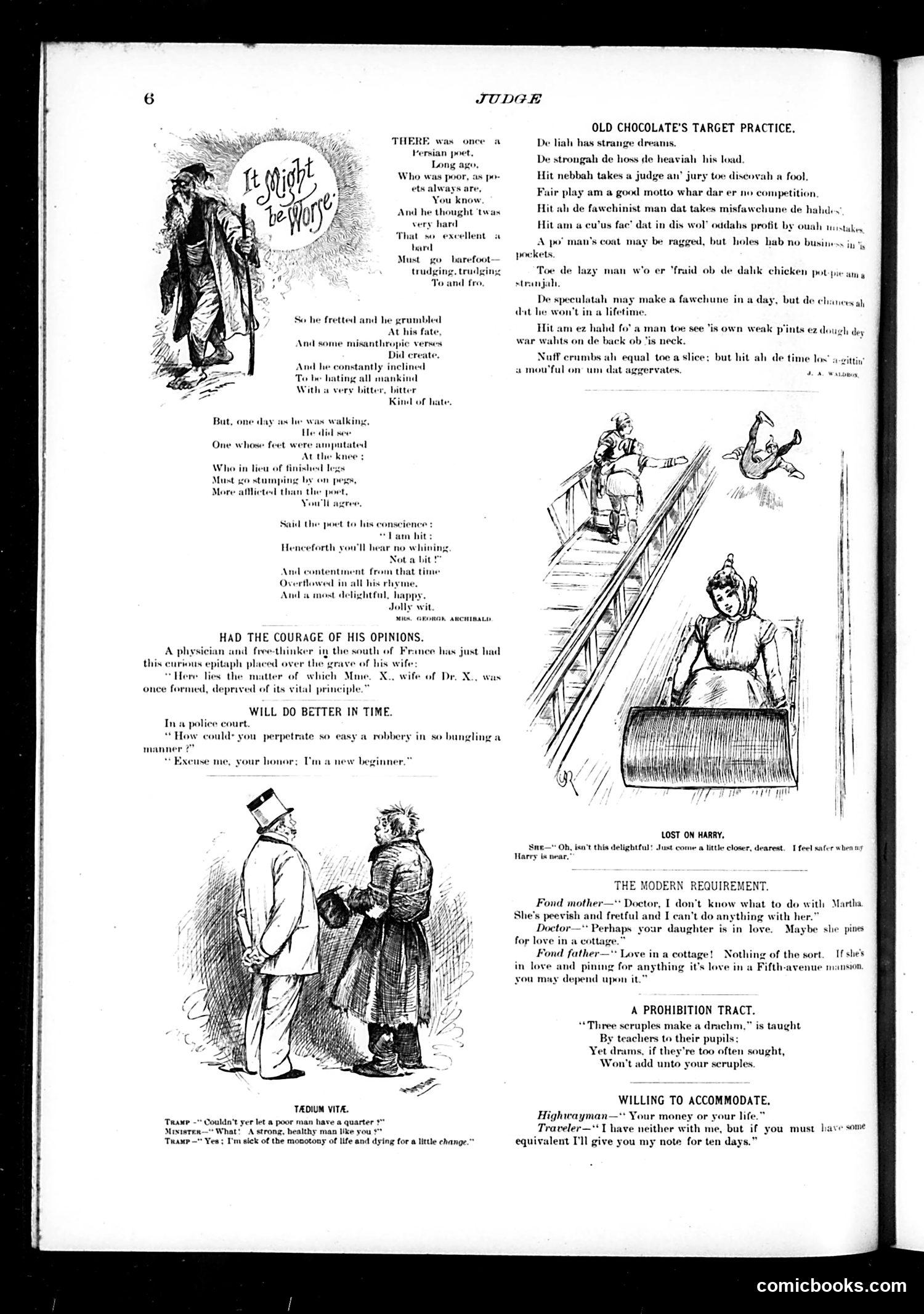
This page contains several unrelated satirical pieces typical of Judge magazine's format: **"It Might Be Worse"** (top left): A poem about a poor Persian poet who complains about barefoot poverty, then encounters someone even more miserable, teaching him gratitude. Standard Victorian moral humor. **"Old Chocolate's Target Practice"** (right): Dialect humor featuring an African American character ("De liah," "nebbah") dispensing folk wisdom in stereotypical speech. This reflects the era's offensive but common racial caricature humor in mainstream publications. **"Tadium Vitae"** (bottom left): A tramp asks a wealthy man for money, claiming life's monotony. Social commentary on class and work attitudes. **"The Modern Requirement"** and other brief sketches below present domestic and social satire on contemporary issues like courtship and prohibition. The overall page demonstrates Judge's mix of moral lessons, class commentary, and—notably—casual racial stereotyping that was normalized in early 20th-century American humor publications.
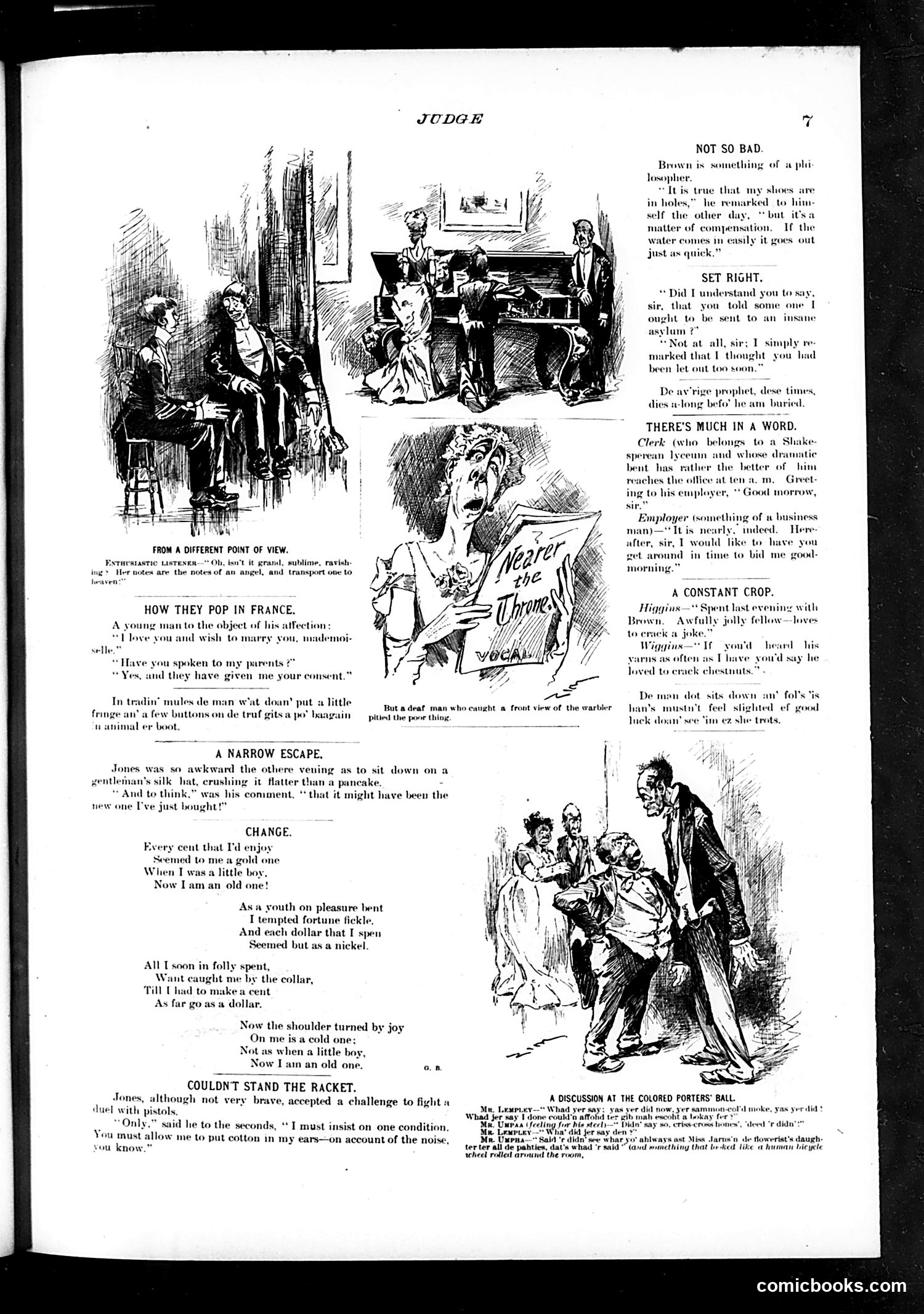
This page from *Judge* contains multiple satirical sketches and humorous anecdotes typical of late 19th-century American humor: **Main cartoons:** - "From a Different Point of View" mocks pretentious music appreciation - "How They Pop in France" uses dialect humor to stereotype French courtship customs - "A Narrow Escape" depicts slapstick mishap with a crushed hat - "Couldn't Stand the Racket" jokes about a cowardly duel participant requesting earplugs to avoid noise **Short pieces** include philosophical observations ("Not So Bad," "Change") and workplace/social comedy featuring recurring character types. **"A Discussion at the Colored Porters' Ball"** (bottom) uses heavy racial dialect stereotypes common to period humor, reflecting the era's casual racist conventions in mainstream publications. The overall tone reflects *Judge's* mix of gentle social satire, physical comedy, and ethnic humor—entertainment standards of the era that modern readers should understand as products of their time, not contemporary values.
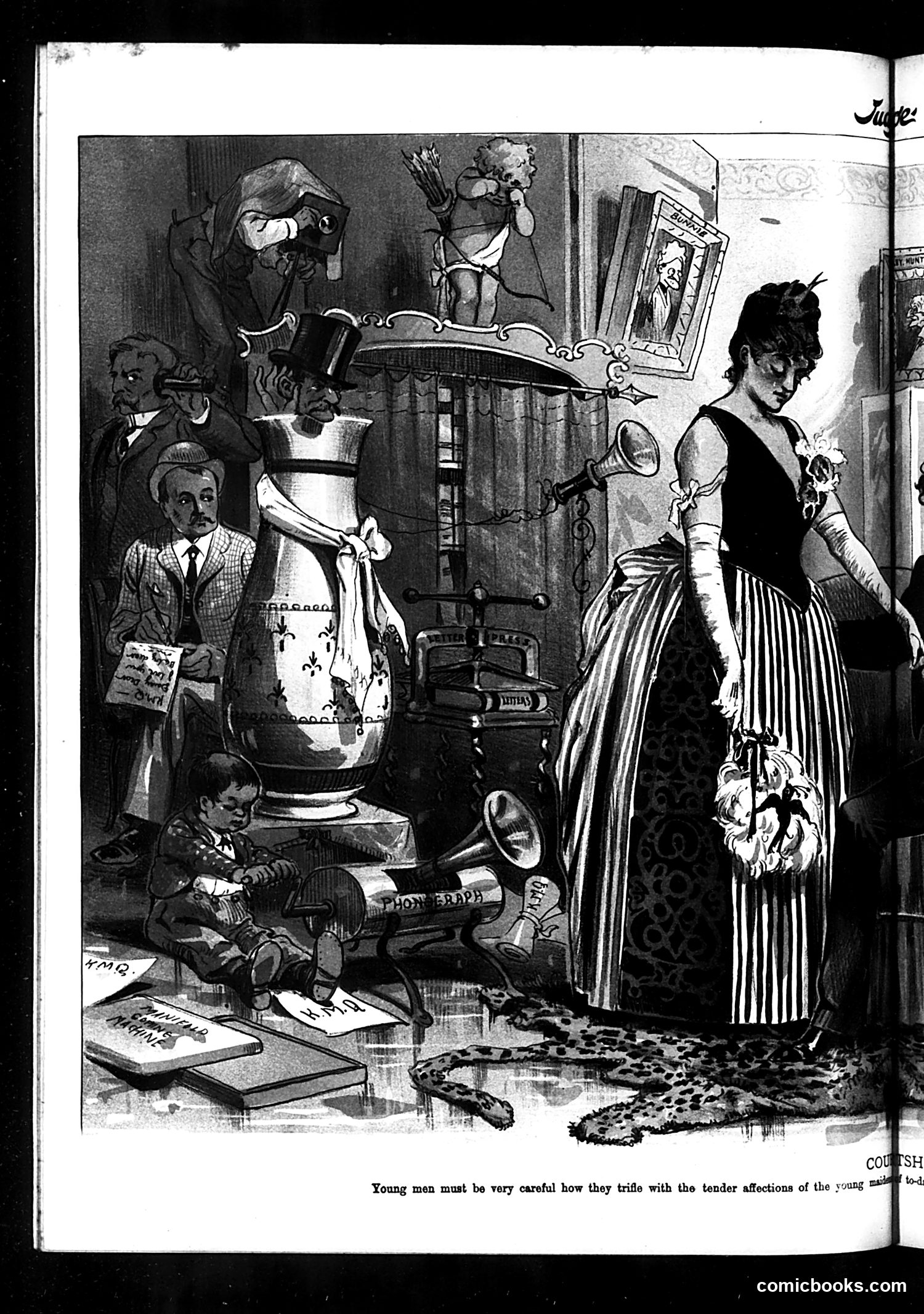
This is a satirical illustration about courtship and romantic relationships. The caption warns young men to be careful with young women's feelings, suggesting the cartoon critiques men who toy with women's affections without serious intent. The scene depicts a domestic interior where a well-dressed woman on the right holds a fan and appears distressed or angry, while a young man to her left seems defensive or dismissive. Several male observers in the background watch the interaction. The woman's elaborate dress and the formal setting suggest upper-class courtship. The satire appears to target men who pursue romantic dalliances without commitment, mocking both their behavior and the social consequences—public embarrassment and the woman's justified anger. This reflects late 19th/early 20th-century anxieties about proper courtship conduct and gender relations among the leisure class.
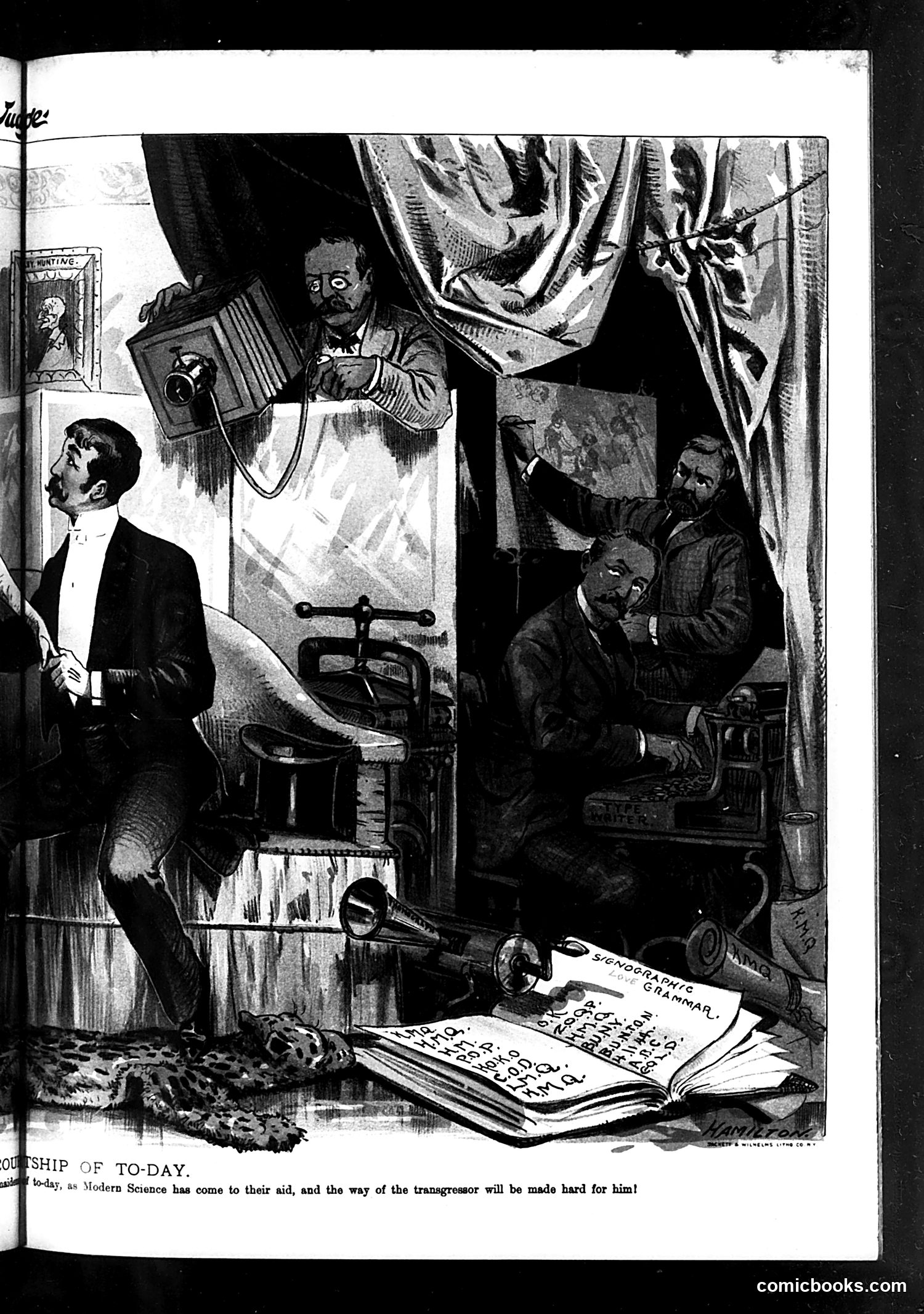
This political cartoon satirizes criminal detection using modern scientific methods. The scene depicts what appears to be a police investigation or crime lab, with three men examining evidence at a desk (including what looks like a stenograph device and an open ledger or record book). Above them, a ghostly or spectral figure holds scientific equipment, representing how modern forensic science—emerging in the early 20th century—has become an invisible aid to law enforcement. The caption's religious reference ("the way of the transgressor will be made hard for him") suggests the cartoon celebrates technology's role in making crime detection more effective and inevitable. This reflects contemporary optimism about scientific progress solving social problems like criminal activity. The "ship" metaphor in the title likely refers to society's vessel sailing forward into a modern, scientifically-equipped future.
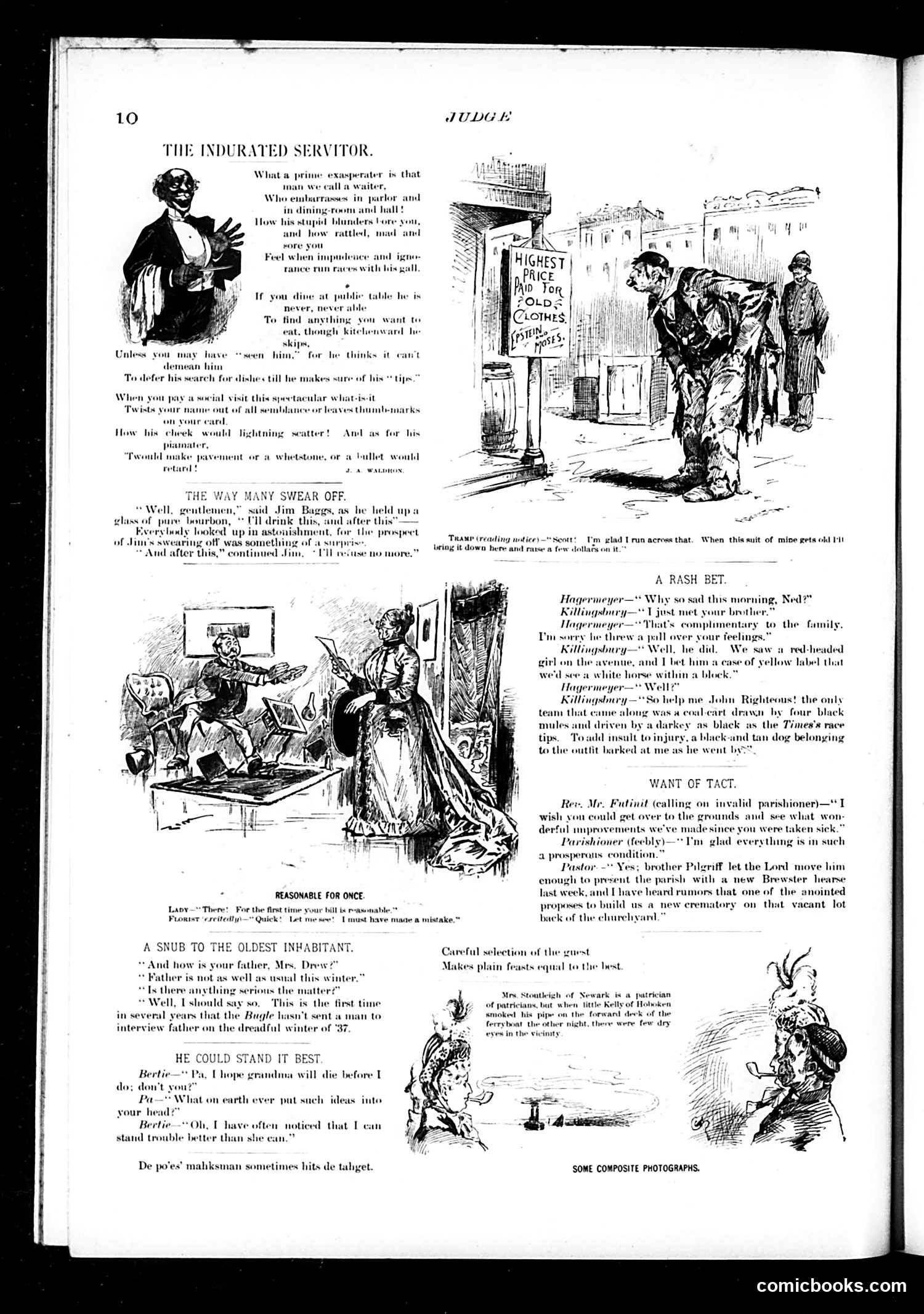
This page from the satirical magazine *Judge* contains multiple short humorous pieces mocking American social pretension and poor manners of the late 19th century. **"The Indurated Servitor"** ridicules pretentious diners who treat waiters poorly—demanding service while being rude, failing to tip adequately, and expecting servants to anticipate their needs. **"The Way Many Swear Off"** lampoons men's empty promises about quitting alcohol; Jim Baggs declares he'll never drink again while holding a glass of bourbon, an obvious contradiction the text presents as typical masculine bluster. **"A Rash Bet"** jokes about a foolish wager: Killingsbury bets he'll see a white horse within a block, then immediately encounters a hearse (drawn by black horses with a white horse/coffin), losing the bet through semantic technicality. The remaining pieces similarly target social awkwardness, tactlessness among the wealthy, and class pretension. The cartoons accompany these texts with period-appropriate illustrations of the described scenarios.
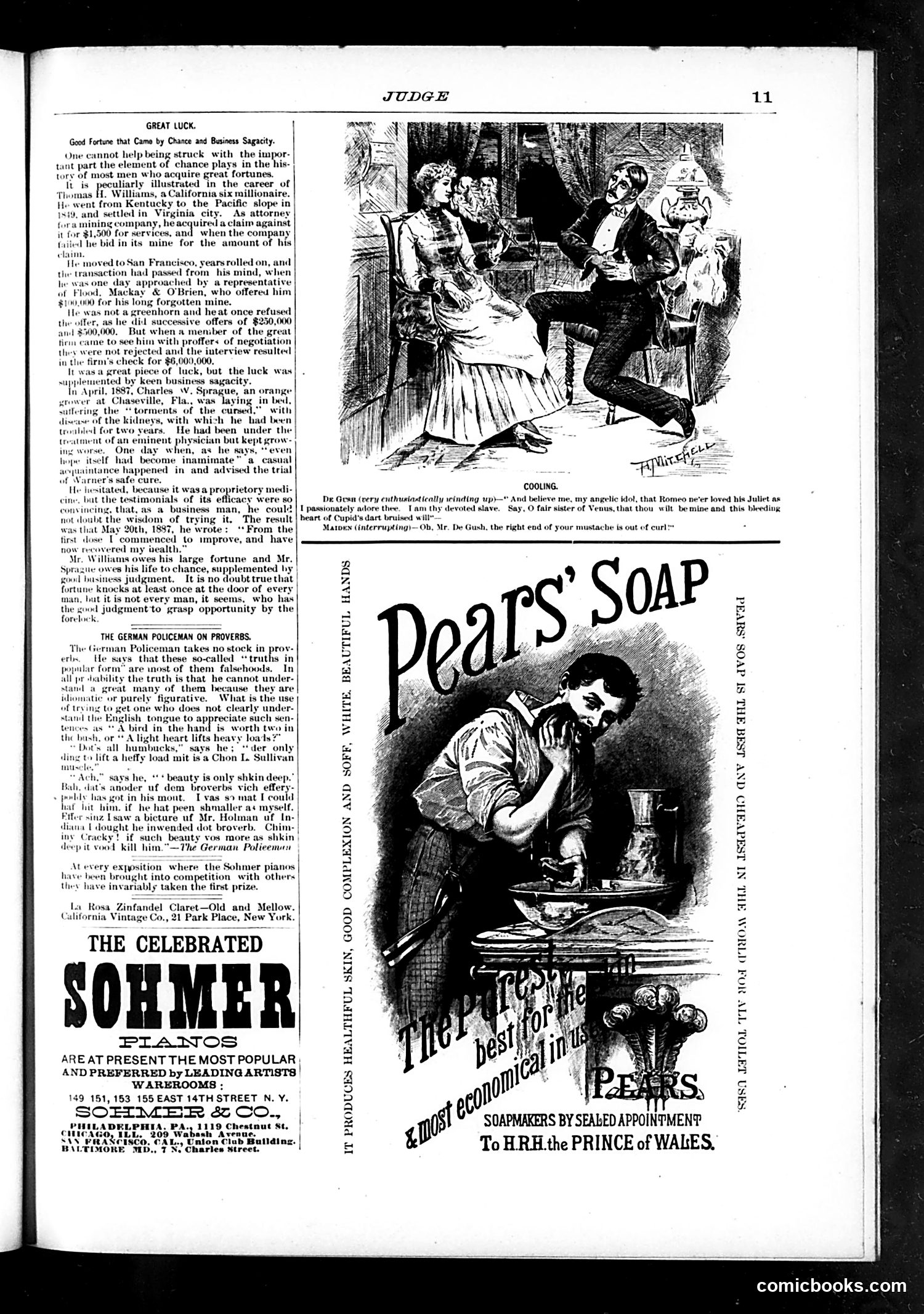
This page contains three main elements: **"Great Luck"** (top left): A biographical article celebrating James Flood, a California silver millionaire. The narrative illustrates how fortune combines chance and business acumen—Flood acquired a mining claim for $1,500 in wages, later sold it for $101,000. The piece exemplifies the 19th-century American rags-to-riches ideal. **"Cooling" (cartoon, top right)**: A romantic scene where De Gean delivers passionate declarations to a woman, but she interrupts him with a practical complaint about his mustache being out of curl—deflating his romantic pretensions with mundane reality. **"The German Policeman on Proverbs"** (left column): Satirizes a German immigrant who dismisses English proverbs as nonsensical falsehoods, unable to grasp their idioms. His fractured English and literal interpretations ("beauty is only skin deep" misunderstood as commentary on physical size) mock both immigrant incomprehension and ethnic stereotypes common to period satire. The page also features advertisements for Sohmer pianos and Pears' Soap.
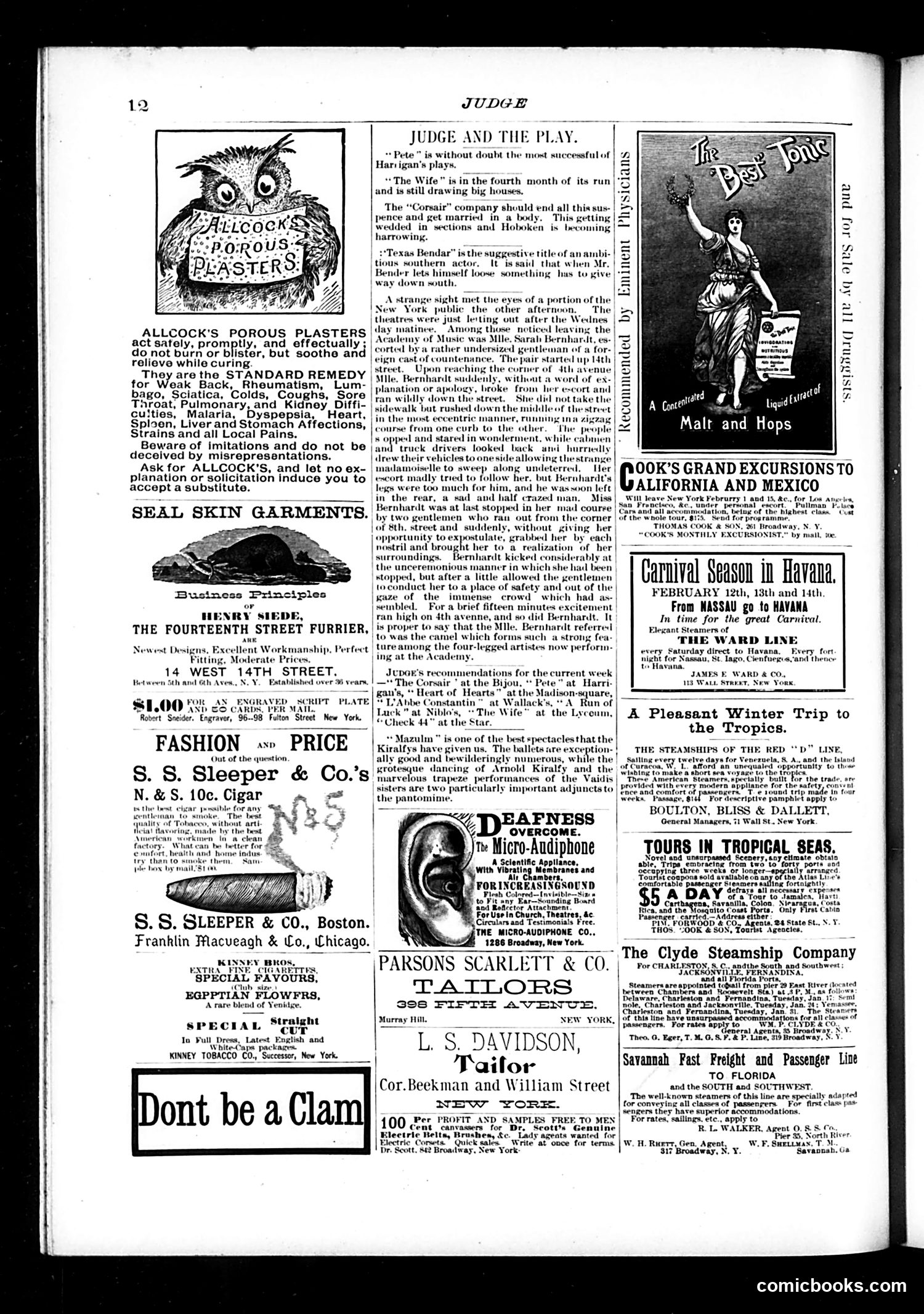
This page is primarily **advertisements and theatrical notices** rather than political cartoons. The main satirical content appears in a brief theater review section titled "JUDGE AND THE PLAY." The review discusses current Broadway productions, including mockingly dismissive comments about "The Corsair" company and praise for a southern actor's performance. Most notably, there's a humorous anecdote about **Sarah Bernhardt** (the famous French actress) during a street encounter: apparently a camel (part of a theatrical production she was involved with) bolted down a Manhattan street, causing chaos. The passage suggests Bernhardt herself was swept along by the animal's momentum in "the most eccentric manner," creating a brief sensation among onlookers. The satire here gently mocks both theatrical excess and the absurdity of a celebrated actress being unexpectedly dragged down the street by a camel—a ridiculous visual that Judge's readers would have found amusing given Bernhardt's legendary status and dramatic pretensions. The rest of the page consists of period advertisements for medical remedies, tailors, cigars, and travel excursions.
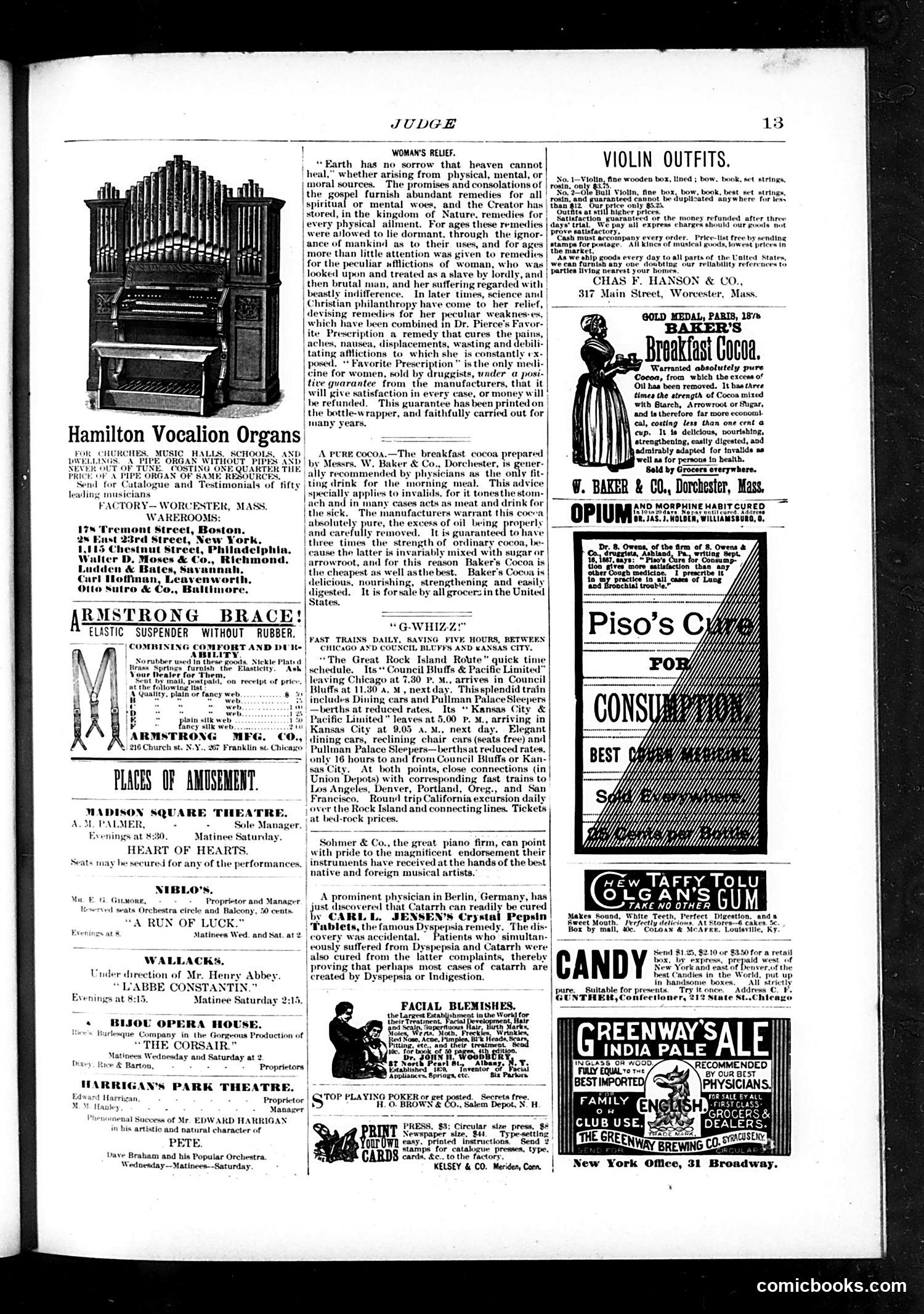
This page is primarily **advertising**, not political satire or cartooning. It contains commercial advertisements for various late 19th-century products and services: organs, suspenders, theatrical productions, medical remedies, cocoa, and railroad services. The one substantive editorial content is a brief essay titled "Woman's Relief" that discusses women's health issues and promotes Dr. Pierce's "Favorite Prescription" as a cure-all remedy. The text reflects paternalistic Victorian attitudes—describing women as historically treated as "slaves by lordly" men—while paradoxically marketing a patent medicine as the solution to "peculiar afflictions of woman." The advertising reflects the magazine's function as a revenue source, mixing legitimate products (Baker's Cocoa, railroad service) with dubious medical claims typical of the period. There are no political cartoons or satirical illustrations visible on this page.
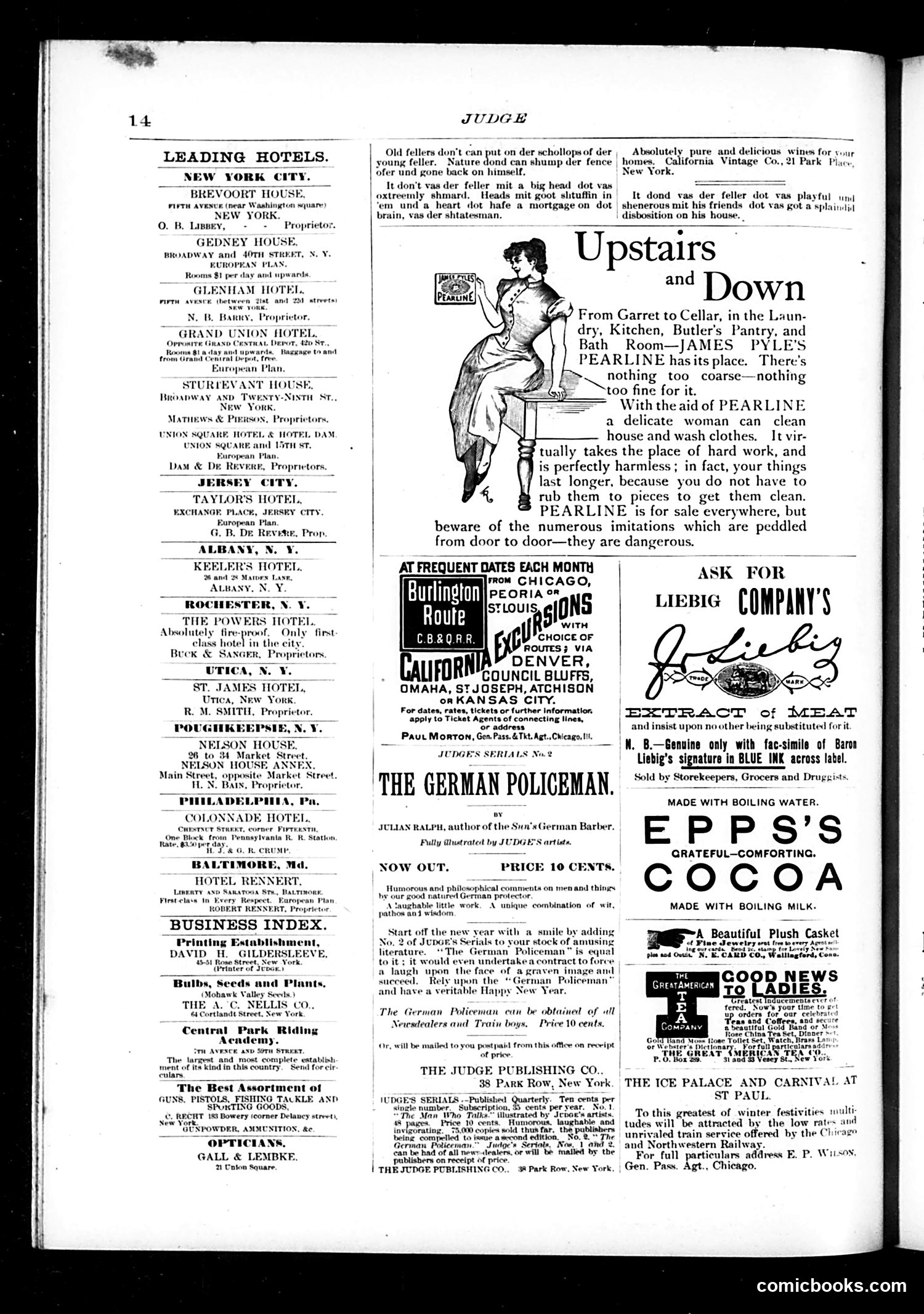
This page is primarily **advertising and promotional material** for Judge magazine and various products/services, with minimal satirical content visible. The only cartoon element is a small illustration labeled **"Upstairs and Down"** advertising James Pyle's Pearline (a cleaning product). It depicts a woman at household work, with accompanying text claiming the product eliminates hard labor for "delicate women" doing laundry and housework. The page also features: - Hotel listings for New York City - A promoted serial: *"The German Policeman"* by Julian Ralph (10 cents) - Advertisements for Liebig's Extract of Meat, Epps's Cocoa, and railroad excursions to St. Paul's Ice Palace **No identifiable political figures or satirical commentary** appears on this page. The content reflects late 19th-century commercial advertising and product promotion typical of Judge magazine's revenue model.
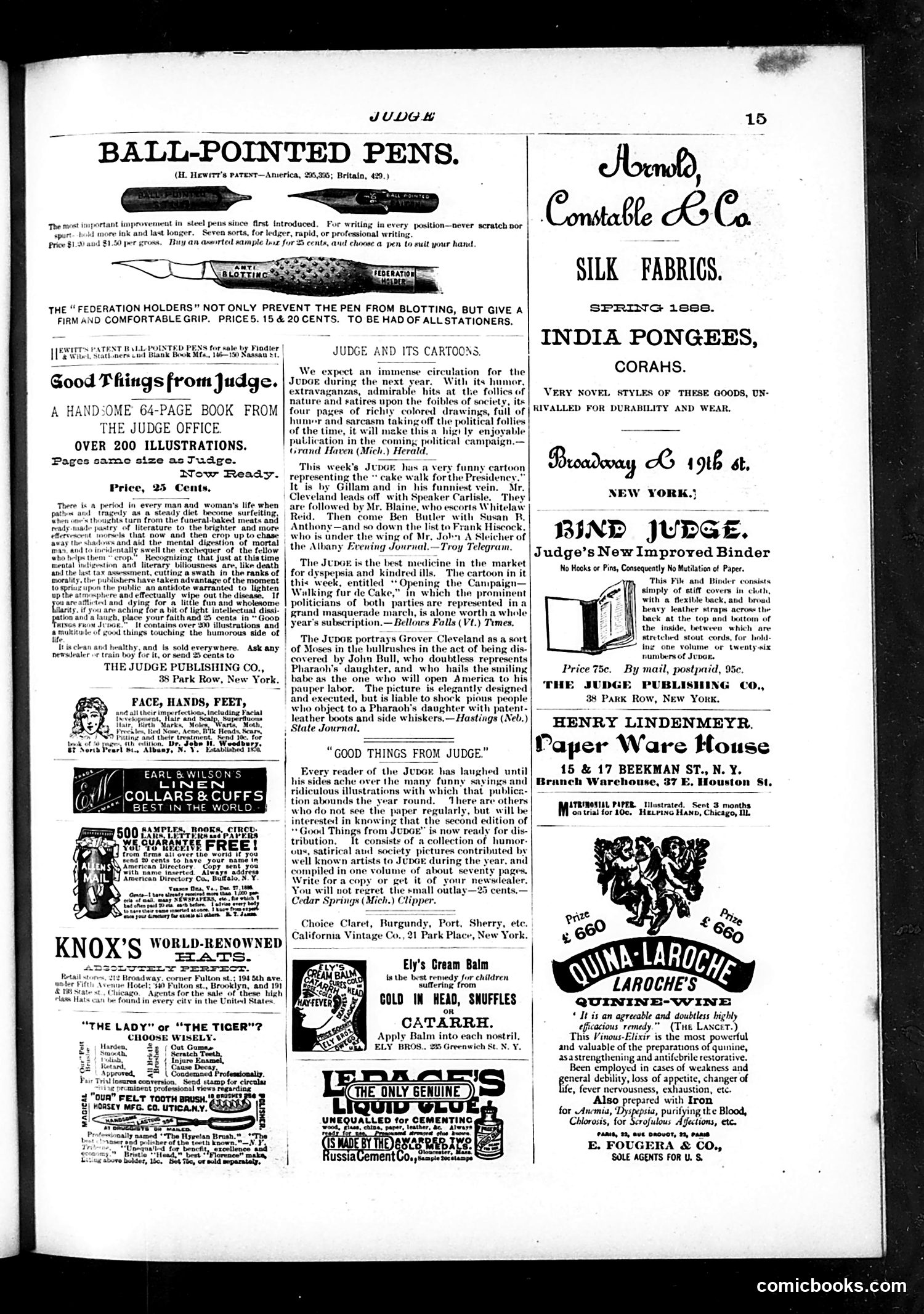
This page is primarily **advertising and self-promotion** rather than political satire. The main content includes: 1. **Ball-pointed pens advertisement** — promoting an improved pen design that doesn't blot, marketed as superior to existing options. 2. **"Good Things from Judge" book promotion** — Judge magazine is advertising a 64-page collection of cartoons and humorous content from their publication, priced at 25 cents. 3. **Judge cartoons section** — mentions upcoming political cartoons by artist Gillam featuring "cake walk" humor and references to figures like Grover Cleveland, Ben Butler, and Anthony. One cartoon apparently depicts Cleveland as a Moses-like baby found in bulrushes by John Bull (representing Britain), a whimsical take on international relations. 4. **Various product advertisements** — silk fabrics, paper warehouse, hats, collars, cuffs, and medicinal products (Ely's Cream Balm for catarrh). The page reflects late 1880s consumer culture and Judge's role as both satirical publication and commercial venture.
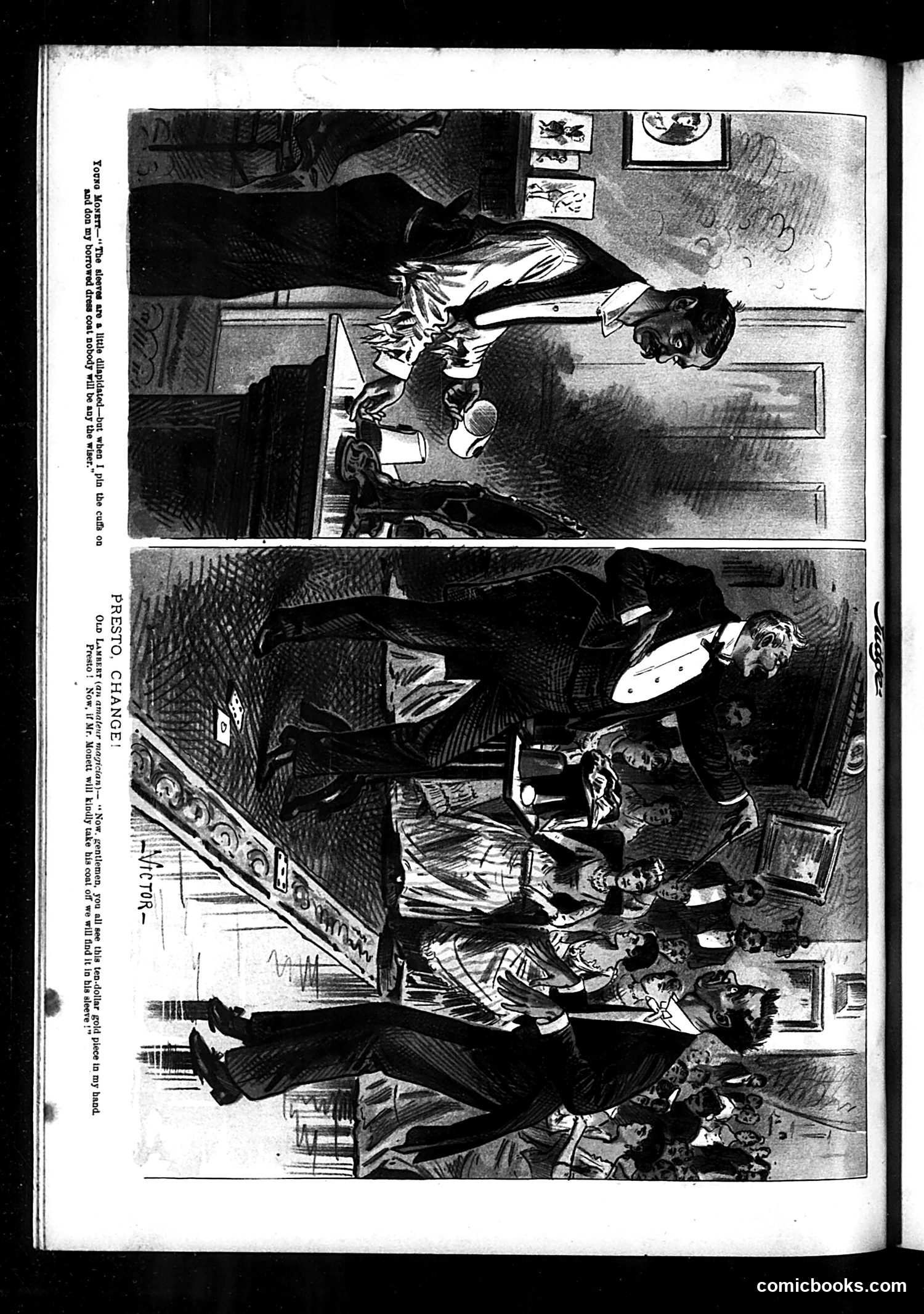
This two-panel satirical cartoon depicts a young man preparing for social deception. In the top panel, he acknowledges his worn clothing ("sleeves are a little dilapidated") but plans to disguise himself by pinning on cuffs and borrowing a dress coat. The bottom panel shows the "transformation"—he now appears respectable to observers. The satire targets class pretension and social fraud common in the Gilded Age. The "presto, change" magic trick framing mocks how superficial appearances (borrowed finery, pinned cuffs) allow poor or working-class individuals to deceive "gentlemen" into thinking them respectable. The joke suggests that respectability is merely costume—a critique of both the shallow class system and those who rely on deception to climb socially. Judge magazine frequently satirized such social climbing and appearance-based status anxiety.