
A complete issue · 16 pages · 1887
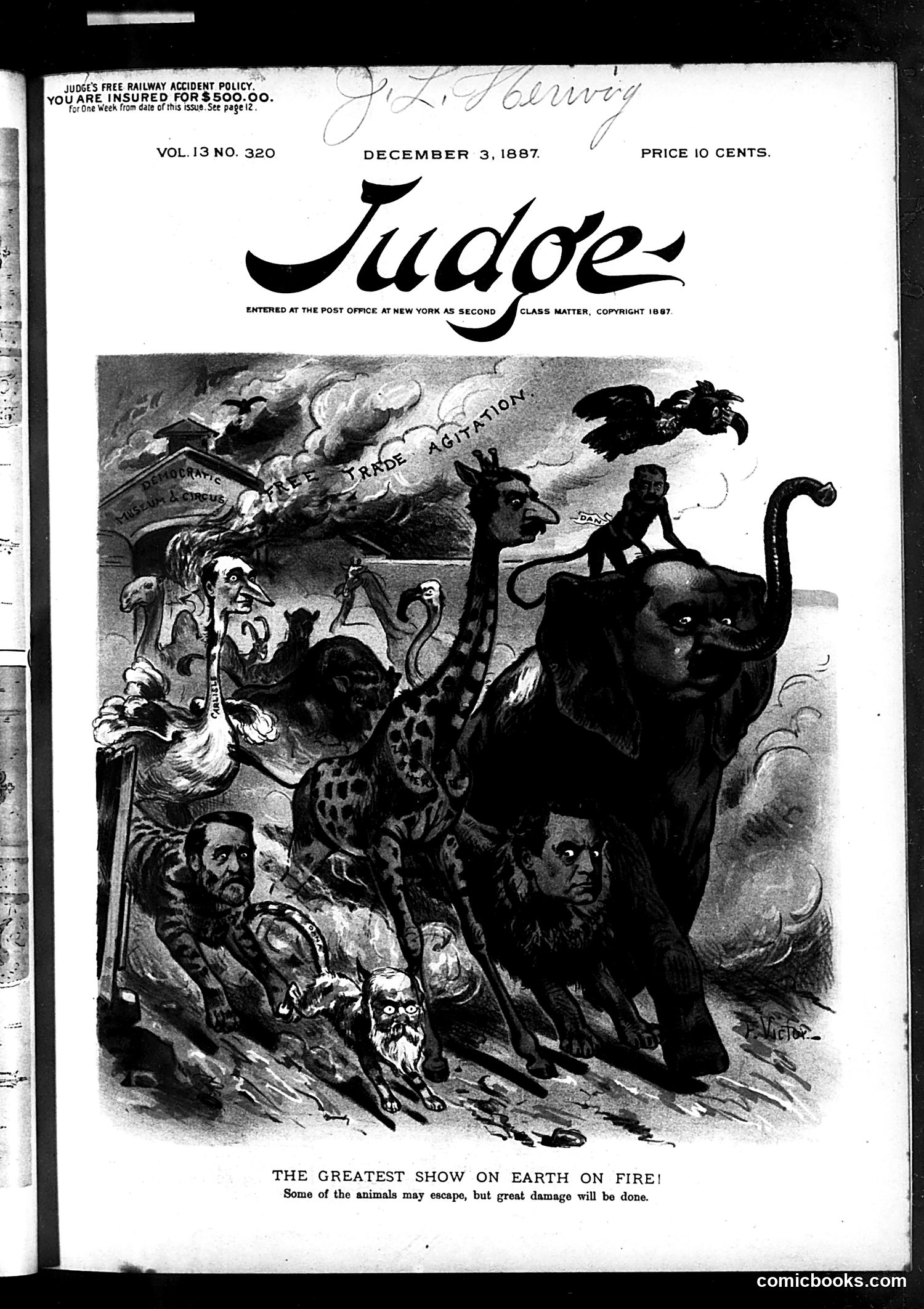
Judge — December 3, 1887
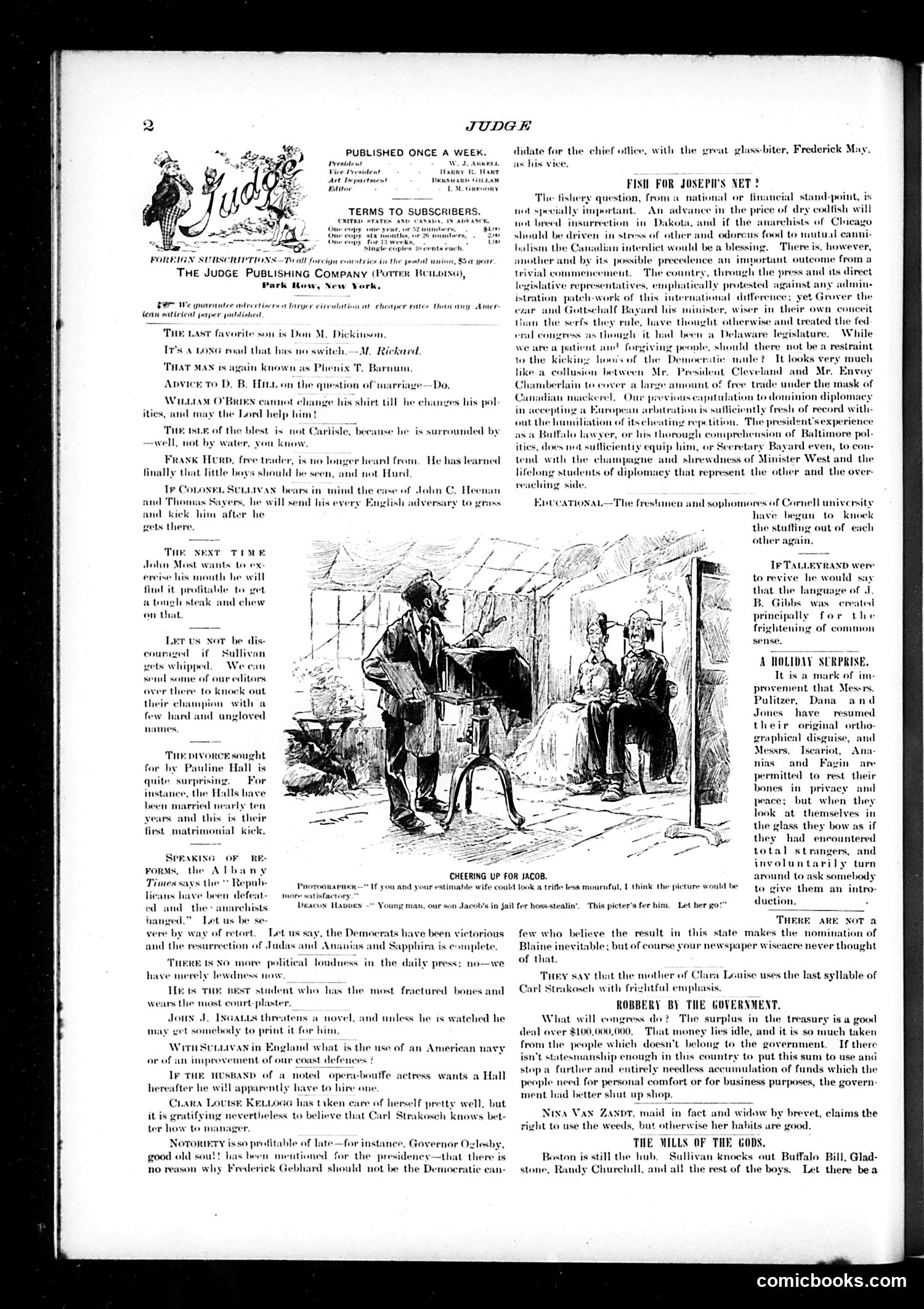
The main cartoon, titled "Cheering Up for Jacob," depicts two men in what appears to be a prison or confined space. The caption reads: "Photographs—'If you and your cellmate's wife could look a trifle less mournful, I think the picture would be more satisfactory.' Officer's Remark—'Young man, our son Jacob's in jail for bootleggin'. This pic'ture's for him. Let her go!'" The satire references Prohibition-era bootlegging. The joke plays on the tension between a jailer's request for a cheerful photograph and the subjects' understandable grief over a family member imprisoned for illegal alcohol production. It mocks both Prohibition enforcement and the absurdity of requesting smiling photos under such circumstances. The surrounding text discusses various political and social topics typical of Judge's satirical commentary on American affairs.
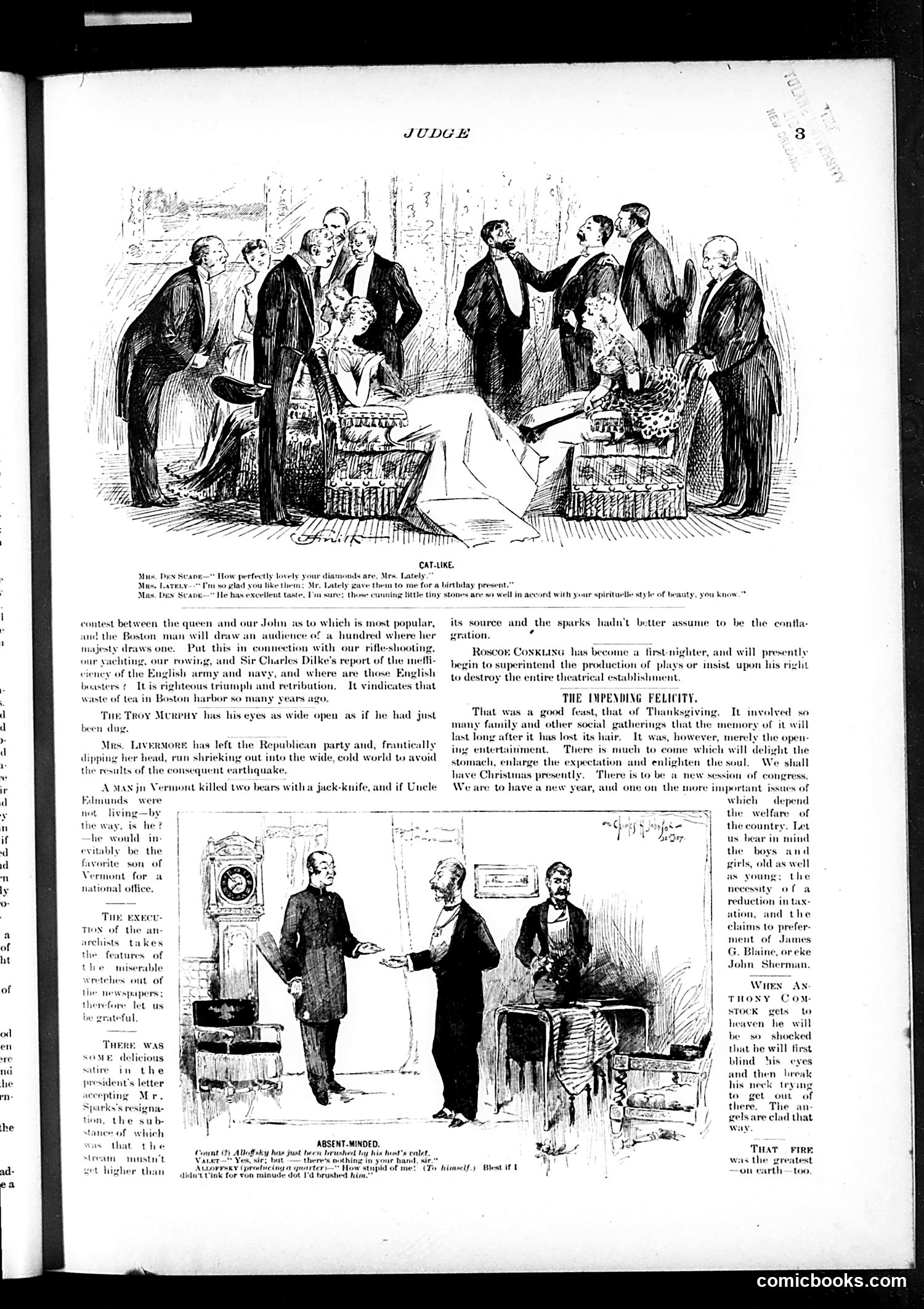
This page contains several political cartoons mocking 1880s American political figures and events. **Top cartoon ("Cat-Like")**: Shows a society scene where Mrs. Des Snare boasts her diamonds are superior to Mrs. Lately's. The satire appears to mock upper-class women's vanity and competitive materialism during the Gilded Age. **Political references in text**: - **Roscoe Conkling**: A prominent Republican senator ridiculed for becoming a "first-nighter" (theater-goer) and threatening to "destroy the entire theatrical establishment" - **Livermore leaving Republicans**: References a political defection - **Charles Dilke**: A British politician mentioned in some scandal context - References to tax reduction and claims by James G. Blaine and John Sherman suggest 1880s electoral politics **Bottom cartoon ("Absent-Minded")**: Shows a man with a servant, making a joke about forgetfulness or absent-mindedness (caption unclear from OCR). **Anthony Comstock reference**: A jab at the famous morality crusader, joking he'd be shocked by heaven and injure himself escaping. The overall tone mocks both political figures and social pretension typical of Gilded Age satire.
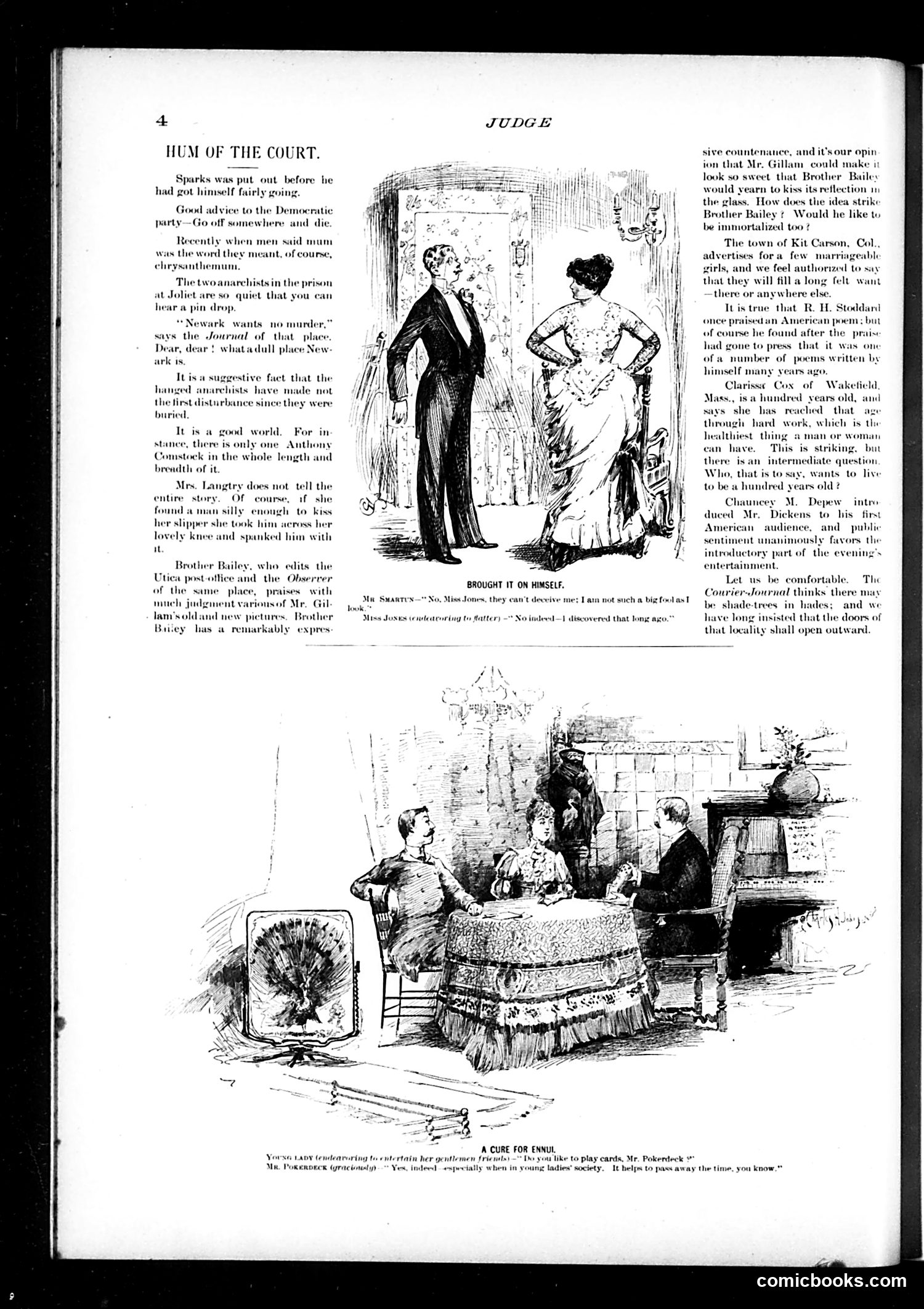
This page contains **satirical social commentary** rather than explicit political cartoons. The top cartoon, "Brought It On Himself," depicts a domestic dispute where a man and woman argue about deception—likely satirizing contemporary marital conflicts and gender relations. The text below consists of **brief witticisms** mocking various public figures and social trends: Democratic Party incompetence, anarchist prisoners (referencing late-19th-century anarchist concerns), actress Lillie Langtry's romantic life, poet R.H. Stoddard's legacy, and a 100-year-old woman named Clarisse Cox. The bottom cartoon, "A Cure for Ennui," depicts a young woman suggesting card-playing to entertain gentlemen—satirizing upper-class leisure activities and the social pretense of young ladies' society gatherings. **Overall context**: This reflects **Gilded Age American concerns**—anxiety about anarchism, fascination with celebrities, gender dynamics, and the perceived emptiness of wealthy society life. The humor targets both public figures and middle/upper-class social conventions.
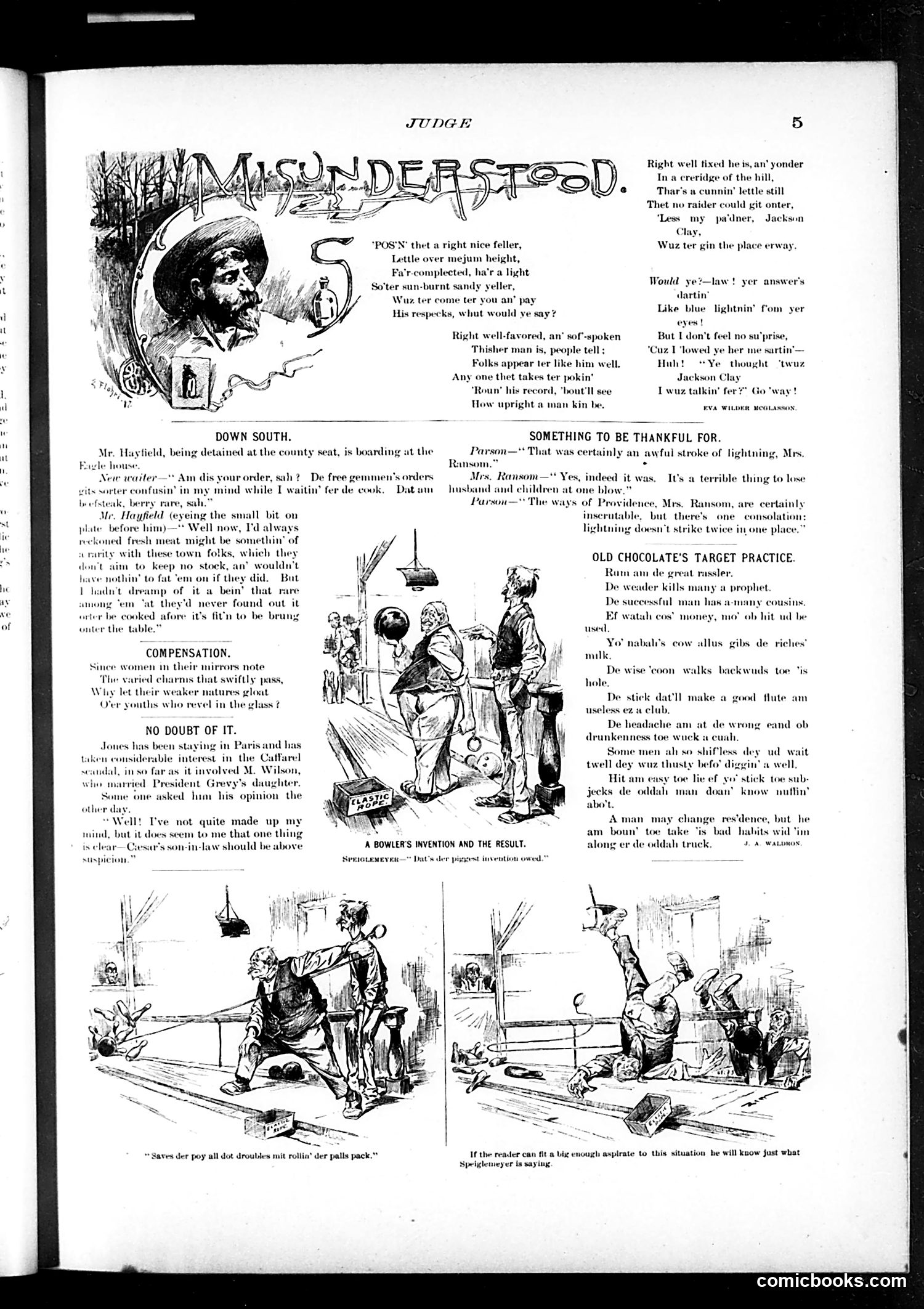
This page contains dialect humor and social commentary typical of late 19th-century American satire. **"Misunderstood"** presents a rural courtship dialogue in exaggerated Southern dialect, where a suitor seeks approval to marry. The joke relies on stereotypical "hillbilly" speech patterns and portrays rural Southerners as simple but honest. **"Down South"** depicts a Northern man (Hayfield) confused by Southern hospitality customs regarding food and livestock—satirizing perceived cultural differences between regions. **"A Bowler's Invention"** shows a mechanical bowling device creating comedic chaos, typical of turn-of-the-century humor about industrial contraptions. **"Something to be Thankful For"** is dark humor: a woman is grateful lightning killed her entire family because "lightning doesn't strike twice." **"Old Chocolate's Target Practice"** and scattered aphorisms use racist dialect attributed to a Black character offering folk wisdom—reflecting period attitudes that are deeply offensive by modern standards. The page emphasizes regional, class, and racial stereotypes presented as entertainment, characteristic of Judge's satirical approach to American society.
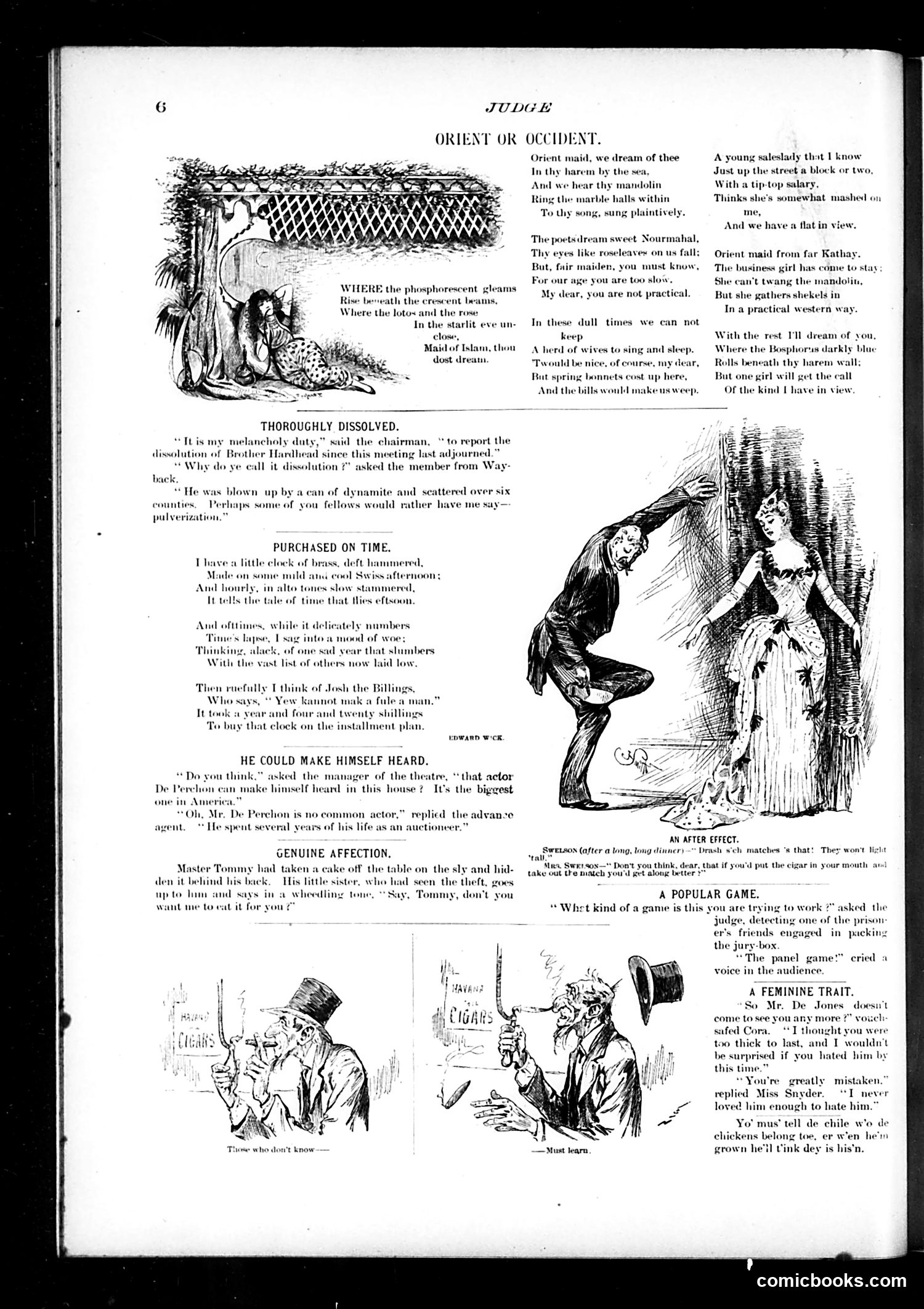
This page from the American satirical magazine *Judge* contains several humorous sketches and poems mocking contemporary society and human nature. The main content includes: **"Orient or Occident"** — A poem contrasting romantic fantasies of Eastern women with pragmatic American reality. A man dreams of exotic Oriental maidens but settles for a practical salesgirl "up the street" who earns good wages—satirizing both orientalism and materialistic courtship. **"Thoroughly Dissolved"** — A brief joke about a politician reporting a colleague's dissolution (likely political or literal death), with a dark quip about dynamite. **"Purchased on Time"** — Verse about buying a clock on installment, poking fun at consumer debt culture. **Multiple short anecdotes** with accompanying Edward Wick illustrations satirizing: an auctioneer's loud voice, a child's manipulation of adults, cigar etiquette, and feminine inconsistency in romance. The cartoons are gentle social satire typical of *Judge*'s humor—targeting Victorian-era consumer culture, gender relations, and middle-class pretension rather than specific political figures. The tone is lighthearted mockery of universal human foibles.
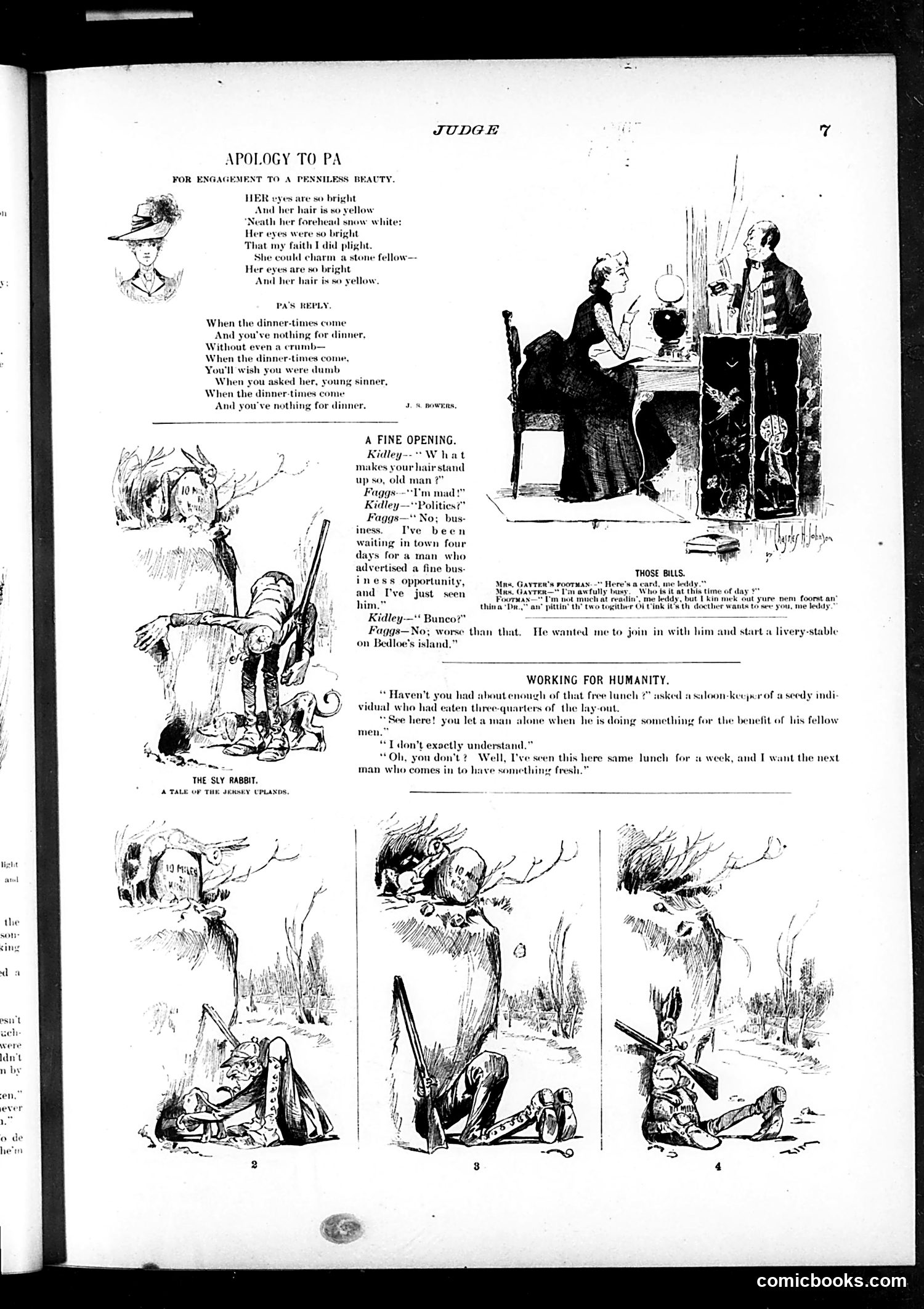
This page contains three separate satirical pieces: **"Apology to PA"** mocks a young man's engagement to a beautiful but poor woman. The father's reply uses dark humor: beauty won't feed you when there's no money for dinner—a critique of marrying for looks alone without financial security. **"A Fine Opening"** satirizes fraudulent "business opportunity" schemes. A man waits four days for a supposed business prospect, only to discover it's a scam: starting a livery stable on Bedloe's Island (where the Statue of Liberty sits—impractical and absurd). **"Those Bills"** and **"Working for Humanity"** are brief dialogue pieces. The latter jokes about a saloon keeper's "free lunch" (a common bar practice)—he sarcastically claims providing it benefits humanity while actually hoping customers will buy drinks. **"The Sly Rabbit"** appears to be an illustrated fable, though the narrative isn't fully visible. Overall, the page targets financial schemes, impractical business ventures, and working-class struggles—typical Judge magazine themes from the Gilded Age.
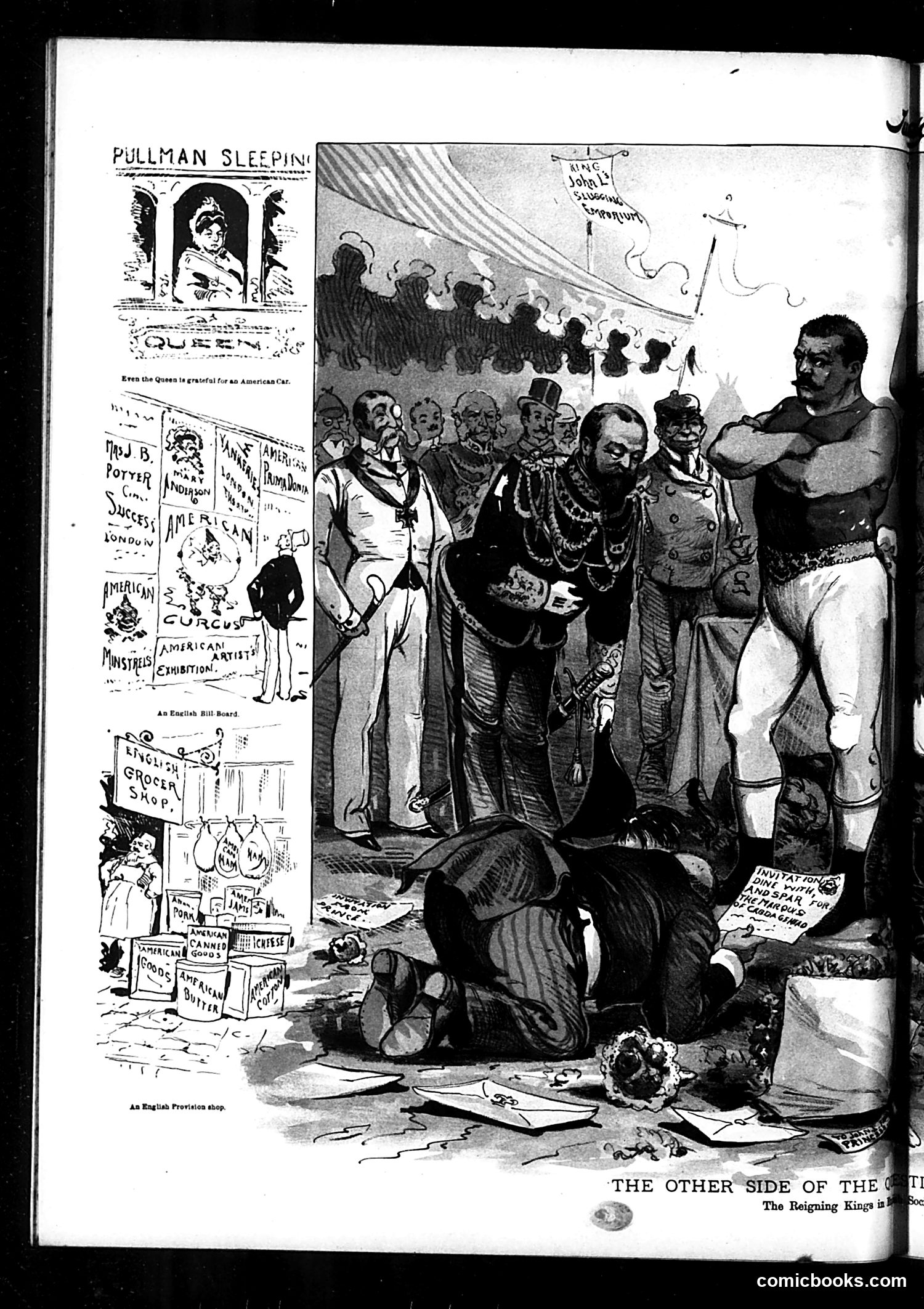
This page contains **advertisements and satirical illustrations** rather than a single unified cartoon. The left side shows various promotional materials for American entertainments and products (Pullman sleeping cars, circuses, minstrel shows, candy), styled as a British shop window display. The right side depicts **"The Other Side of the Coin"** — a scene showing European royalty and dignitaries observing what appears to be American cultural exports or entertainments, with a partially-clothed figure (possibly representing American vulgarity or commercialism). The satire appears to contrast **American commercial showmanship with European aristocratic refinement**, suggesting how Old World elites view New World entertainment and consumerism. The specific figures depicted are unclear from this image alone, though the composition critiques the contrast between American marketing excess and European cultural sophistication during what appears to be the Gilded Age.
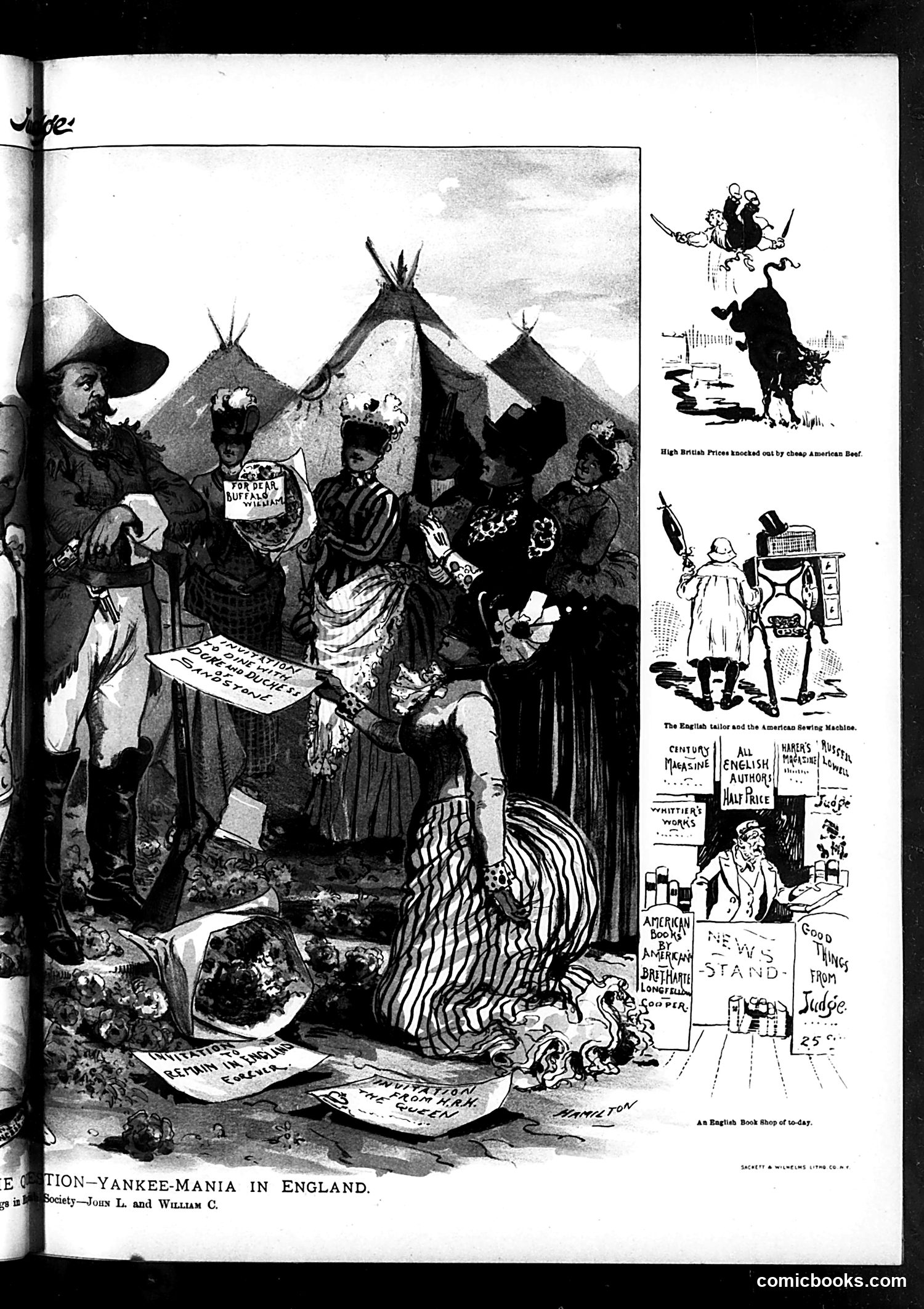
This satirical cartoon depicts English high society's fascination with American Wild West culture. A wealthy British woman in fashionable dress examines what appears to be Native American artifacts or Buffalo Bill Wild West Show memorabilia inside a tipi, while a cowboy figure (left) displays items for sale. The satire mocks how English elites eagerly consumed and romanticized American frontier imagery as exotic entertainment. The right panel shows small vignettes of English commercial exploitation of this "Yankee-mania"—booksellers, tailors, and merchants capitalizing on American-themed products marketed to British consumers hungry for Western novelties. The cartoon ridicules both American self-promotion and English snobbish enthusiasm for American popular culture as mere fashionable trend-chasing among the upper classes.
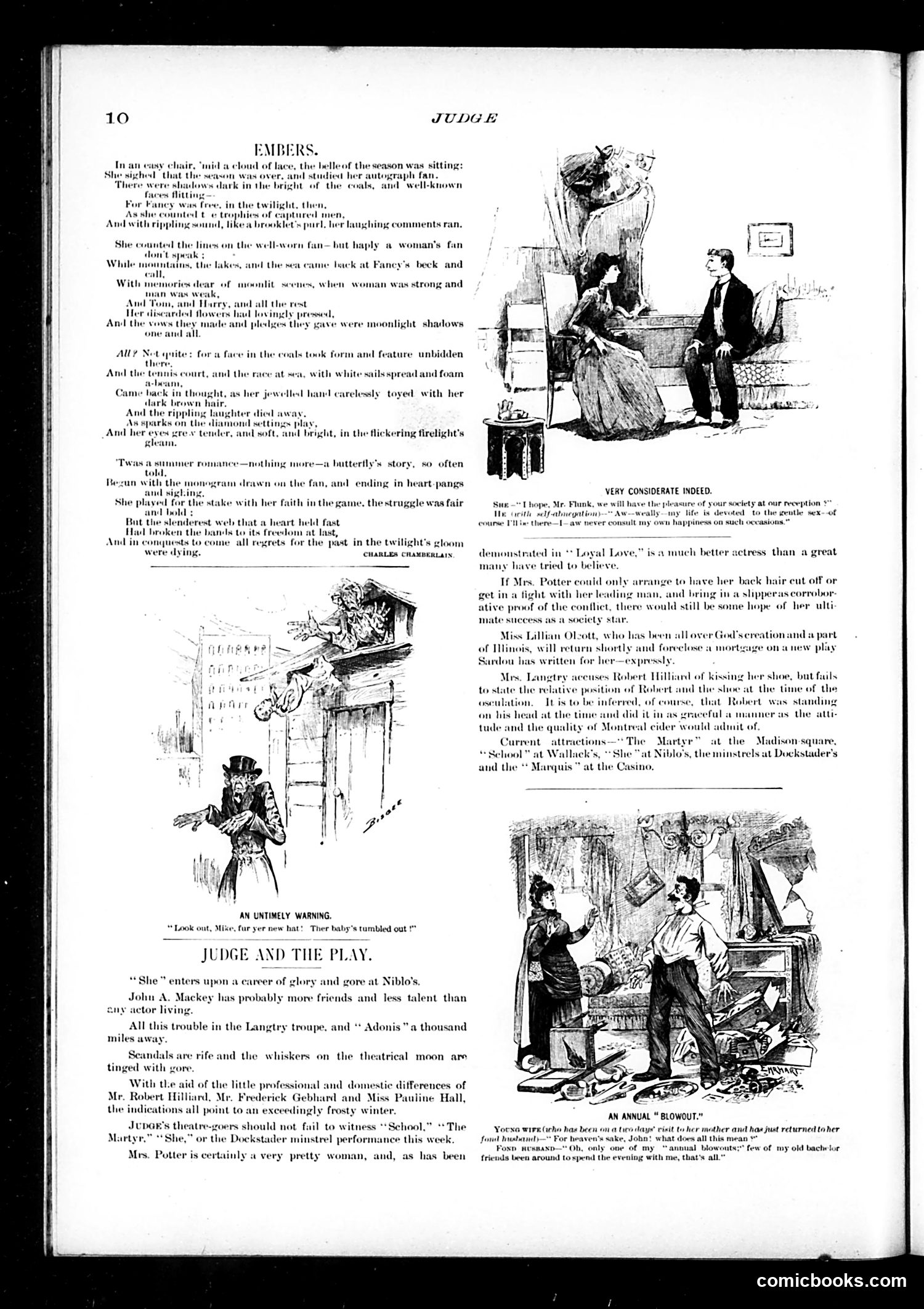
This page contains theatrical criticism and social satire typical of the 1880s-90s Judge magazine. **"Embers"** is a sentimental poem about a woman gazing into a fireplace, remembering a past summer romance—a stock romantic narrative of the era. **"Judge and the Play"** reviews current theater, mocking the "Langtry troupe" (likely Lillie Langtry's theatrical company) and commenting on various actors' talents and scandals. References to "Adonis" (a popular burlesque) and performers like Robert Hilliard suggest this critiques the New York theatrical scene's quality. **The cartoons** satirize domestic life: "An Untimely Warning" shows a child falling, while "An Annual Blowout" depicts a husband returning from visiting his mother-in-law, using the phrase "blowout" to suggest marital discord. The overall tone is gossipy and comedic about theater world personalities and middle-class domestic tensions—standard Judge fare mixing entertainment criticism with humor about social manners.
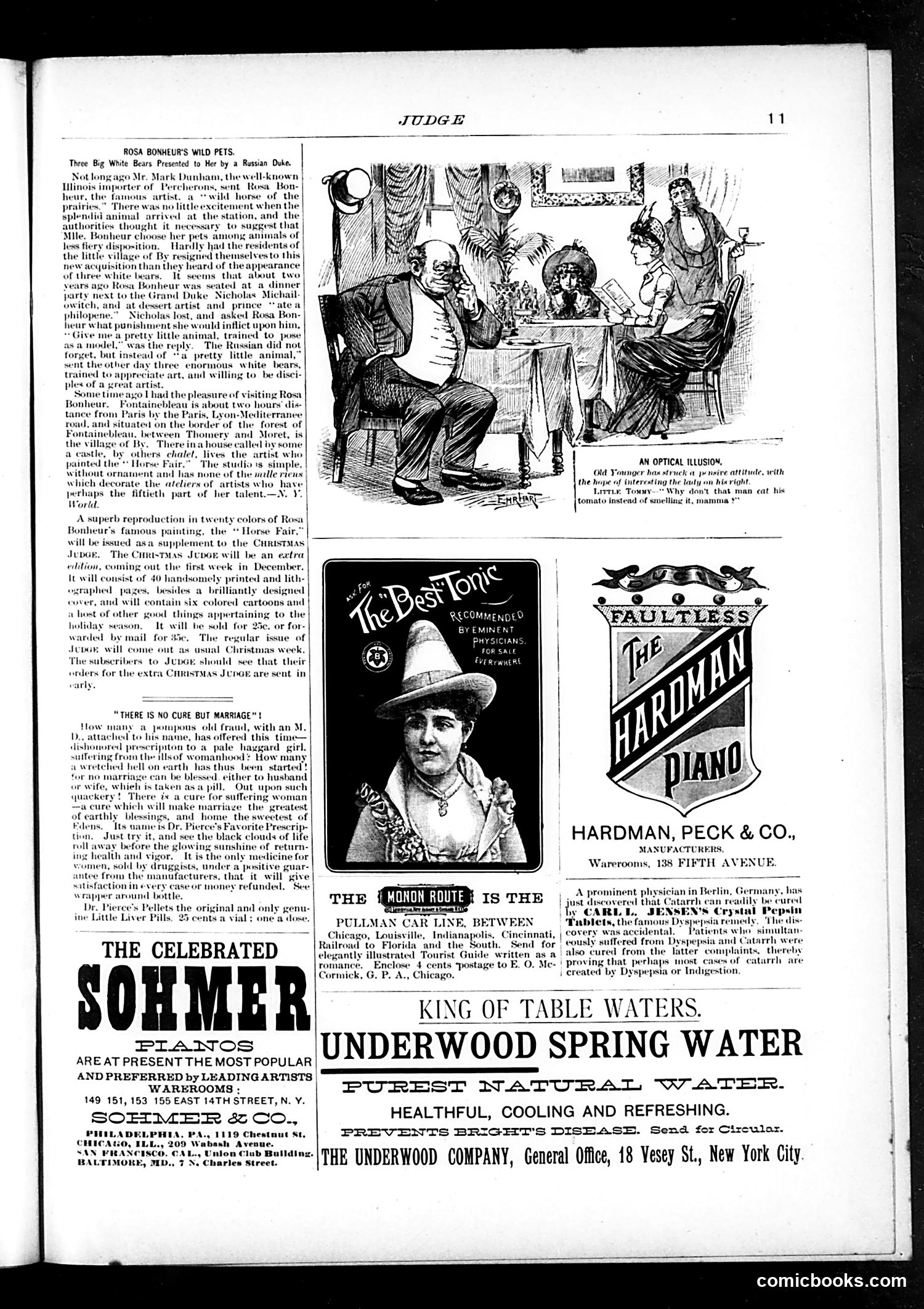
This single-panel cartoon depicts a young man ("Old Younger") striking an exaggerated, overly theatrical "pensive attitude" while seated. The joke plays on the phrase "optical illusion"—the man is trying to look contemplative and impress "the lady on his right," but he's so transparently affected and unnatural that it becomes absurd rather than romantic. The caption's punchline—"Why don't that man eat his tomato instead of smelling it?"—suggests his pretentious pose is so ridiculous that he's even forgotten basic table manners. The humor mocks affectation and vanity: young men attempting to appear sophisticated or intellectual for romantic purposes often come across as foolish instead. The satire targets performative masculinity and courtship rituals of the era, where men felt pressure to affect refined sensibilities to attract women. The "optical illusion" is that he thinks he looks impressive when he actually looks ridiculous.
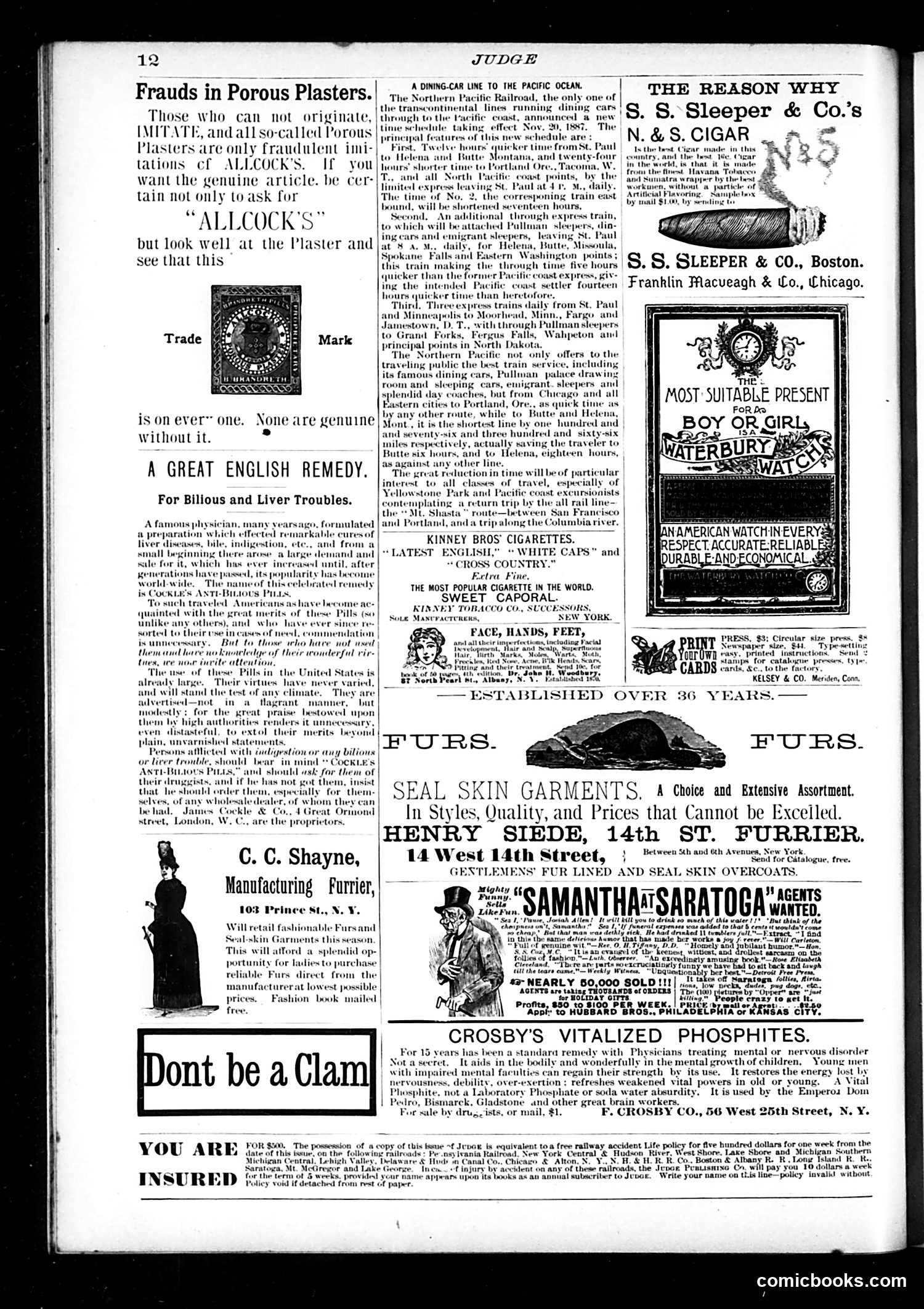
This page is primarily **advertising**, with minimal editorial cartoon content. The advertisements showcase consumer products and services typical of late 19th-century America: patent medicines (Cockle's Anti-Bilious Pills, Crosby's Vitalized Phosphites), fashion items (fur garments, porous plasters), and railroad services. The only clearly satirical element appears to be the small cartoon labeled **"Don't be a Clam"** (bottom left), though its specific meaning is unclear from the image quality and context provided. The dominant content reflects Judge's business model: generating revenue through paid advertisements while maintaining a veneer of consumer protection (warnings against "frauds in porous plasters"). The patent medicine advertisements are particularly notable—these were common in this era before modern FDA regulations, and Judge's apparent endorsement lent credibility to products whose efficacy was often dubious or unstated. The page reveals more about Gilded Age commerce and consumer culture than satire or political commentary.
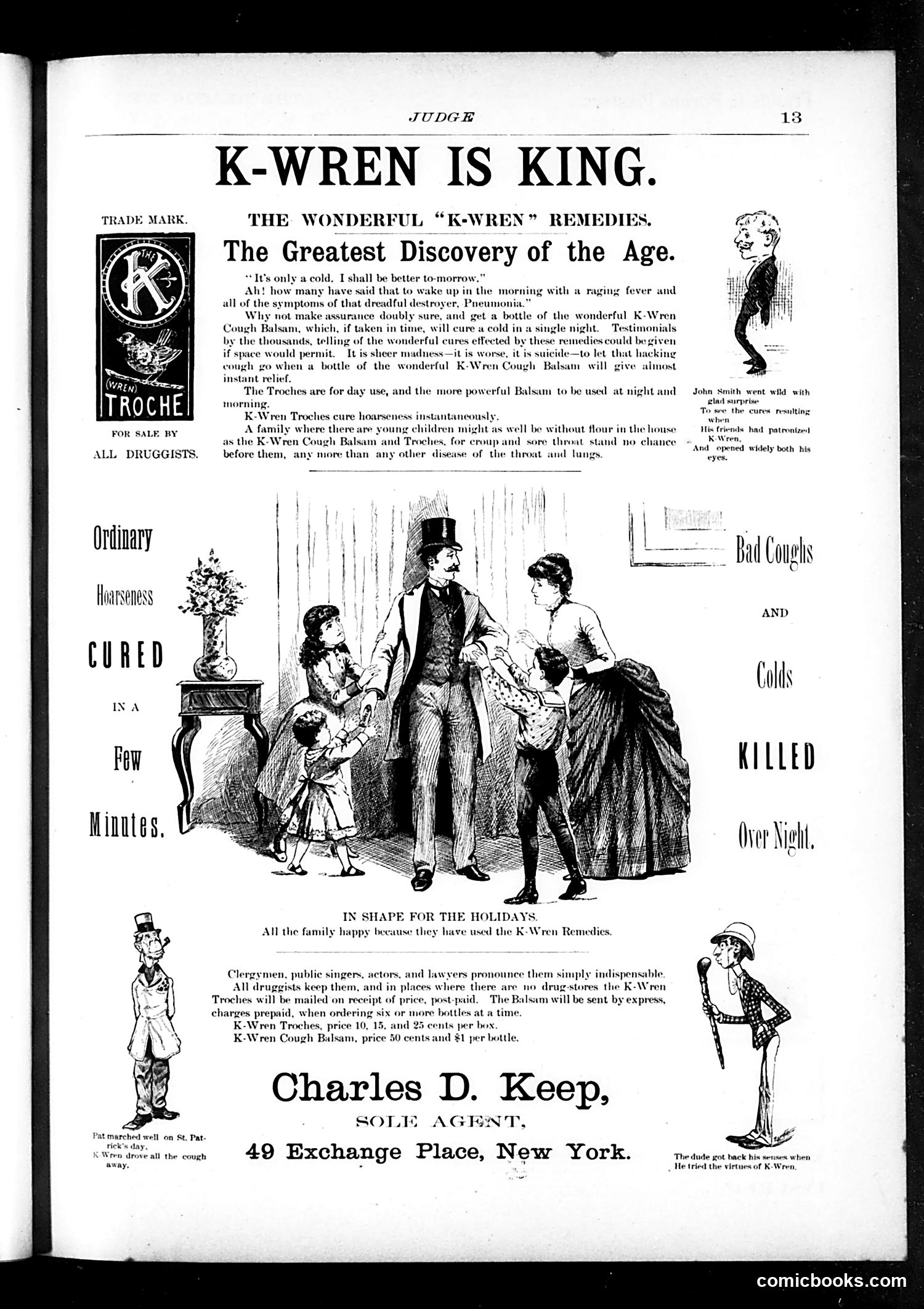
This page is primarily a **patent medicine advertisement**, not political satire. It promotes "K-Wren" cough remedies as a miraculous cure for colds, pneumonia, and throat ailments. The small illustrated vignettes around the border are humorous testimonials showing everyday people (a Irishman, a dude, a soldier) supposedly cured by K-Wren products. The central family scene depicts a well-dressed gentleman with children and a woman, all "in shape for the holidays" thanks to the remedy. **Historical context:** This reflects the late 19th/early 20th-century era when unregulated patent medicines made extravagant health claims without scientific evidence. Judge magazine, while satirical about politics and society, also carried such advertisements. The term "K-Wren is King" mimics contemporary advertising hyperbole rather than making a political point. Charles D. Keep is identified as the "sole agent" in New York.
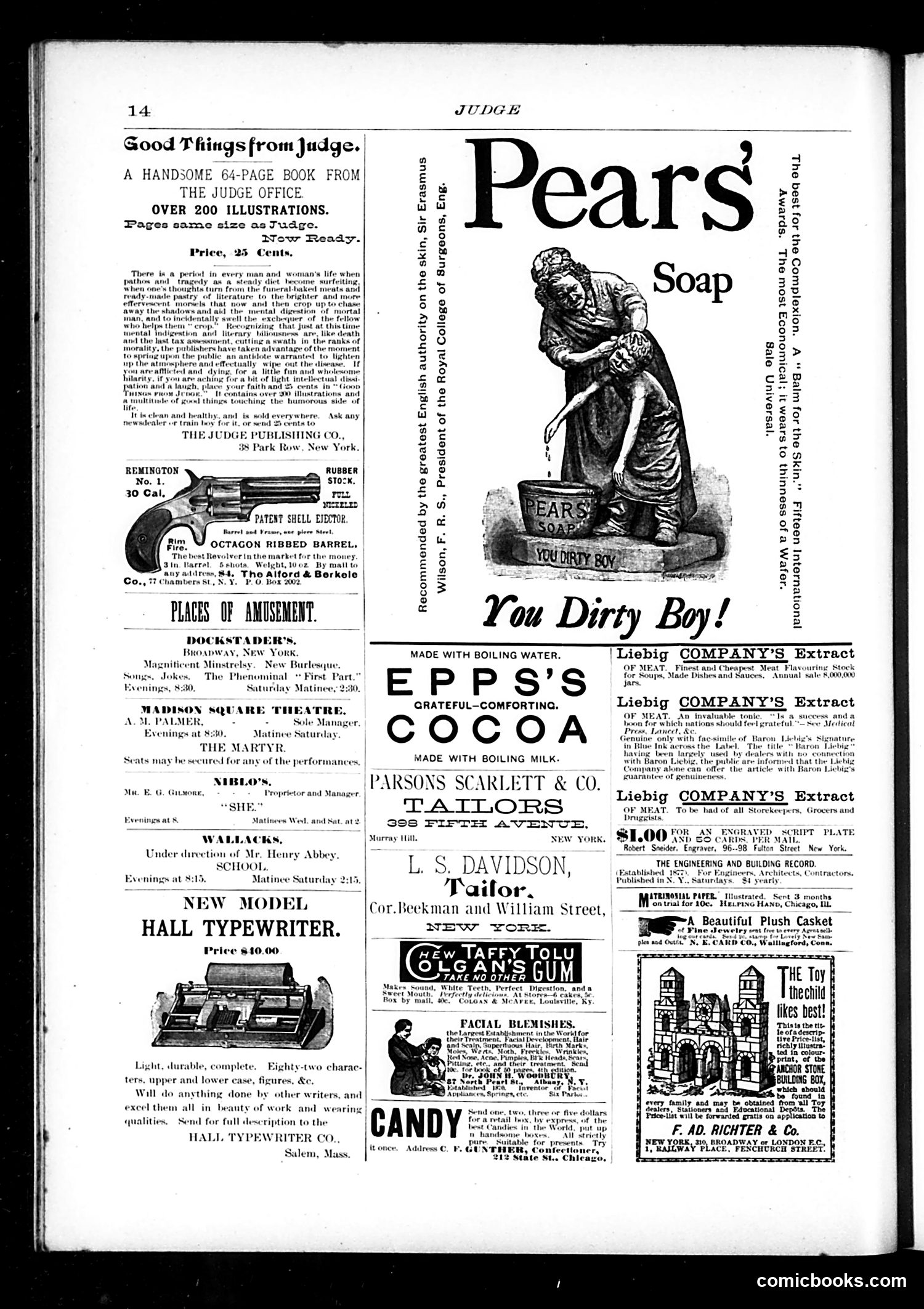
This page is primarily **advertising content** rather than editorial cartoons. The dominant image is a **Pear's Soap advertisement** featuring a Victorian-era illustration of a young boy (appearing disheveled or dirty) with the caption "You Dirty Boy!" — a playful appeal to parents' sensibilities about cleanliness. The satire is implicit: Pear's Soap's marketing strategy targets middle-class anxieties about children's hygiene. The "dirty boy" serves as a gentle rebuke and sales pitch simultaneously. This reflects late-19th-century advertising's emerging reliance on moral messaging and emotional persuasion rather than pure product description. The surrounding advertisements (Liebig's Extract, typewriters, candy, tailoring services, etc.) indicate this is a **commercial issue** — Judge magazine subsidized its satirical content through paid advertising, blending editorial and commercial content in ways modern readers might find unconventional.
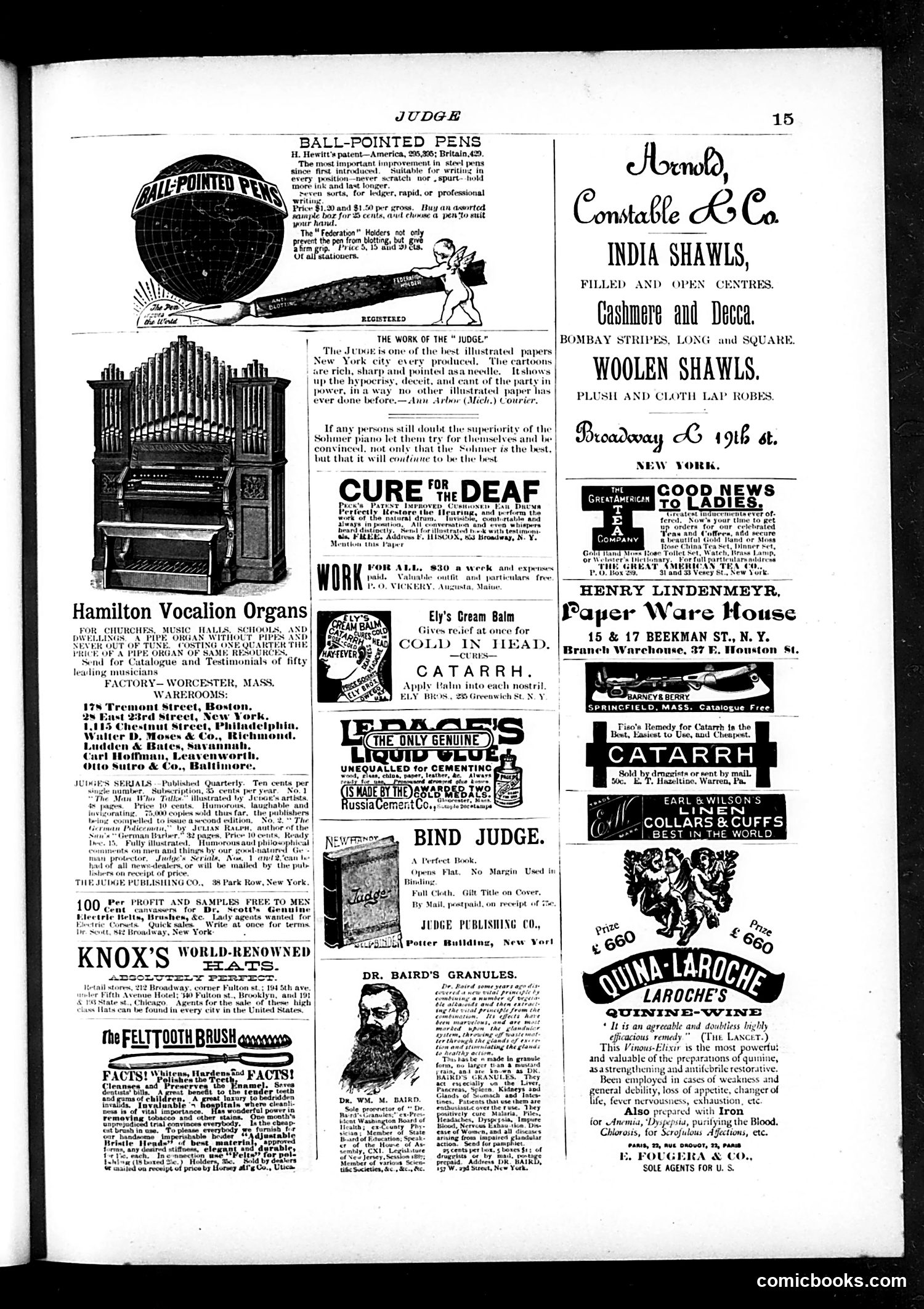
This page is primarily **advertising**, not political satire. It's from Judge, a satirical magazine, but this particular issue contains mostly commercial notices for late-19th/early-20th century products. Notable advertisements include: - **Ball-pointed pens** (Hewitt's patent)—presented as a major innovation in writing instruments - **Hamilton Vocational Organs**—musical instruments - **"Cure for the Deaf"** and **catarrh remedies** (Ely's Cream Balm, Piso's Remedy)—patent medicines, common in this era - **Knox hats** and **Earl & Wilson collars/cuffs** - **Quina-Laroche** (a quinine-wine tonic) - Fashion items like shawls and lap robes The single cartoon visible shows a figure struggling with a large globe labeled "Ball-Pointed Pen"—likely illustrating the pen's revolutionary significance to contemporary readers. The satire here is gentle advertising humor rather than political commentary.
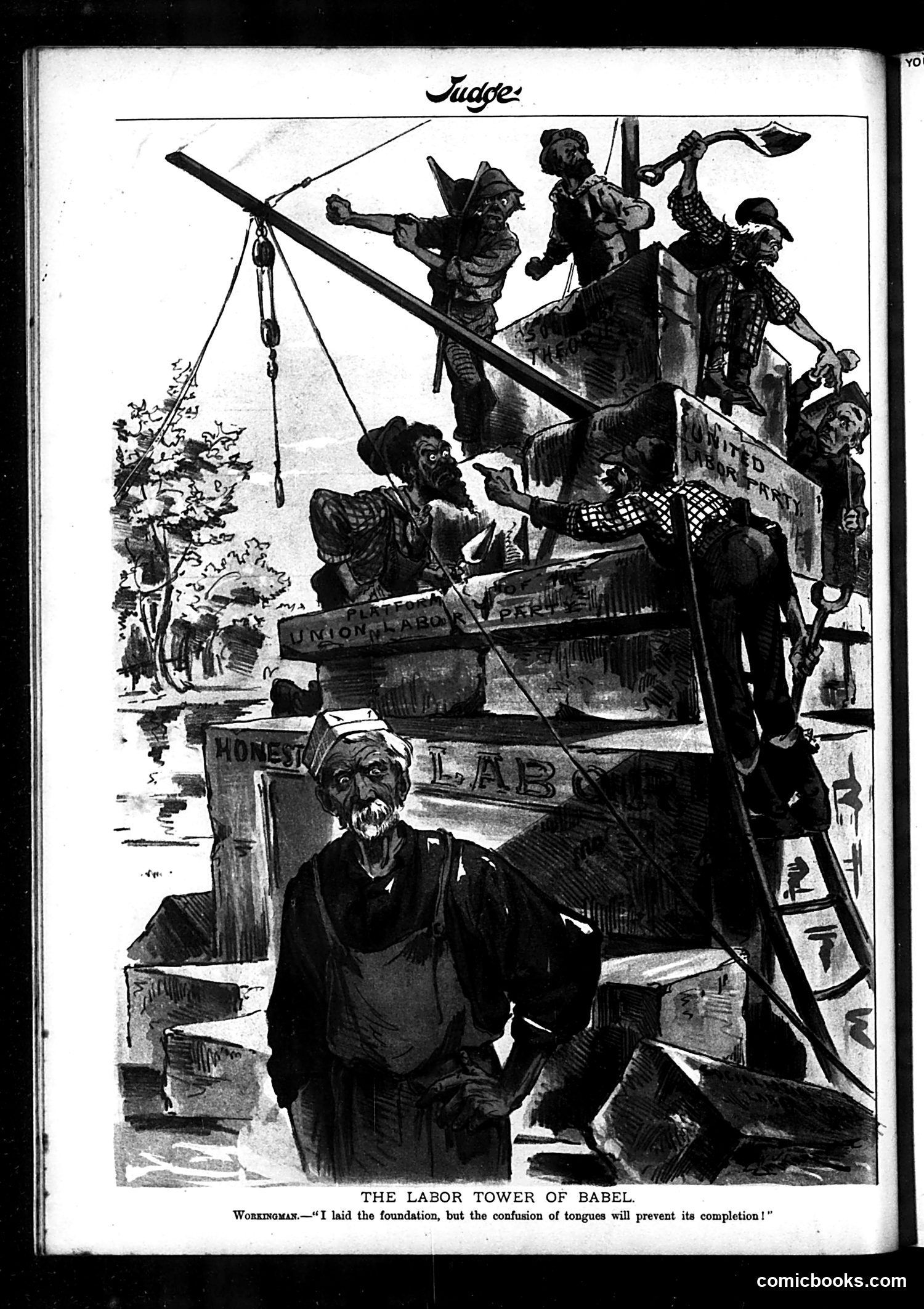
This political cartoon satirizes labor movement fragmentation using the biblical Tower of Babel metaphor. A workwoman stands in the foreground, despondent, stating she "laid the foundation, but the confusion of tongues will prevent its completion." Above her, various laborers work chaotically on an unfinished tower, some appearing to work at cross-purposes. Visible labels include "UNION LABOR" and "HONEST LABOR," suggesting different factions within the labor movement. The cartoon criticizes how competing labor organizations and philosophies—the "confusion of tongues"—prevent unified labor progress, just as God's curse confused languages at Babel. Rather than advancing collective worker interests, internal divisions undermine the movement's ability to build something meaningful. The satire suggests labor solidarity is impossible given these fractious groups.