
A complete issue · 17 pages · 1887
Judge — October 8, 1887
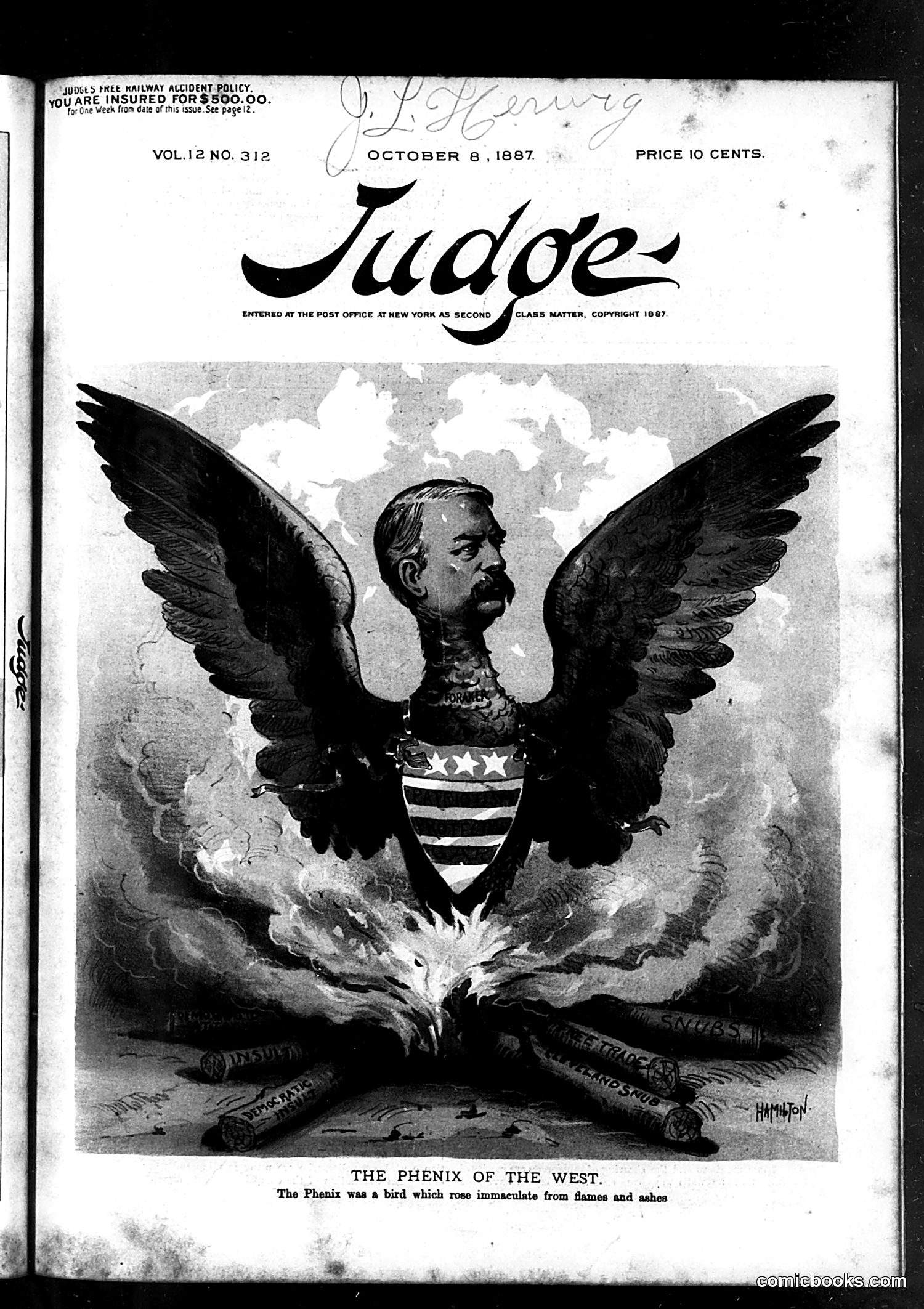
This political cartoon depicts a male figure with a prominent mustache, emerging phoenix-like from flames, wearing an American shield breastplate. The caption reads: "The Phenix was a bird which rose immaculate from flame and ashes." **What this means:** The image appears to reference a prominent Western political figure who experienced a dramatic fall from power but staged a comeback or rehabilitation. The phoenix symbolism suggests resurrection and renewal. Without additional context identifying the specific figure, the cartoon likely satirizes either his alleged vindication after scandal or his self-aggrandizing claims of restoration to power. The American shield imagery emphasizes his nationalist appeal to Western voters. The work exemplifies Judge magazine's use of classical mythology for political commentary.
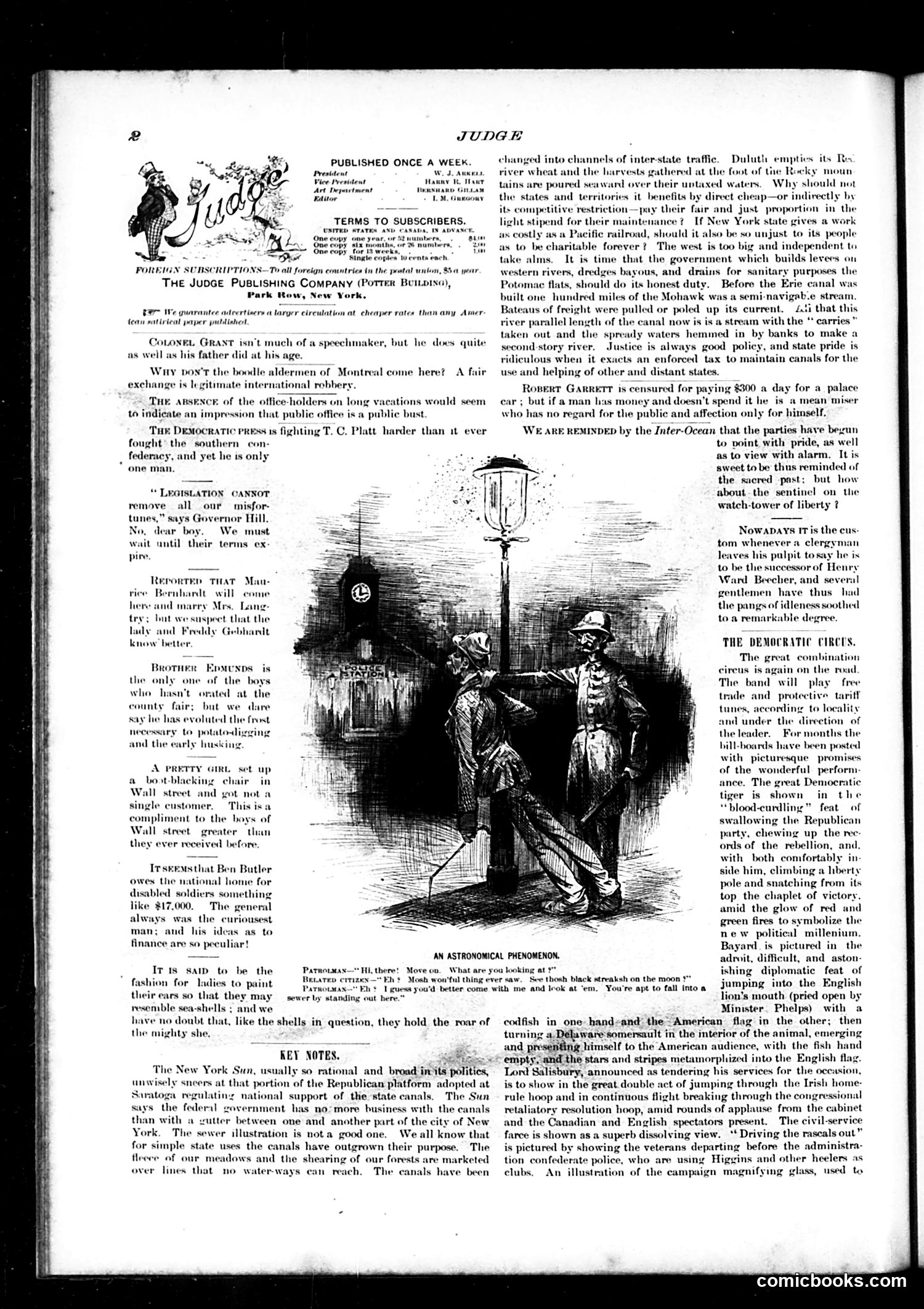
The central illustration depicts an allegorical figure of Liberty (identifiable by the liberty pole and lamp) confronting what appears to be a menacing urban scene. The caption "AN ASTRONOMICAL PHENOMENON" suggests satirical commentary on contemporary politics. The visible text discusses Republican party politics, mentioning a "blood-curdling feat of swallowing the Republican party" and references to civil service. The cartoon appears to critique political figures or movements of the era, though the specific individuals aren't clearly identified in the readable portions. Without clearer visibility of all figures or access to the publication date, I cannot definitively name the politicians being caricatured or specify which political crisis is referenced. The satire appears to concern Republican party divisions and civil service reform debates typical of late 19th-century American politics.
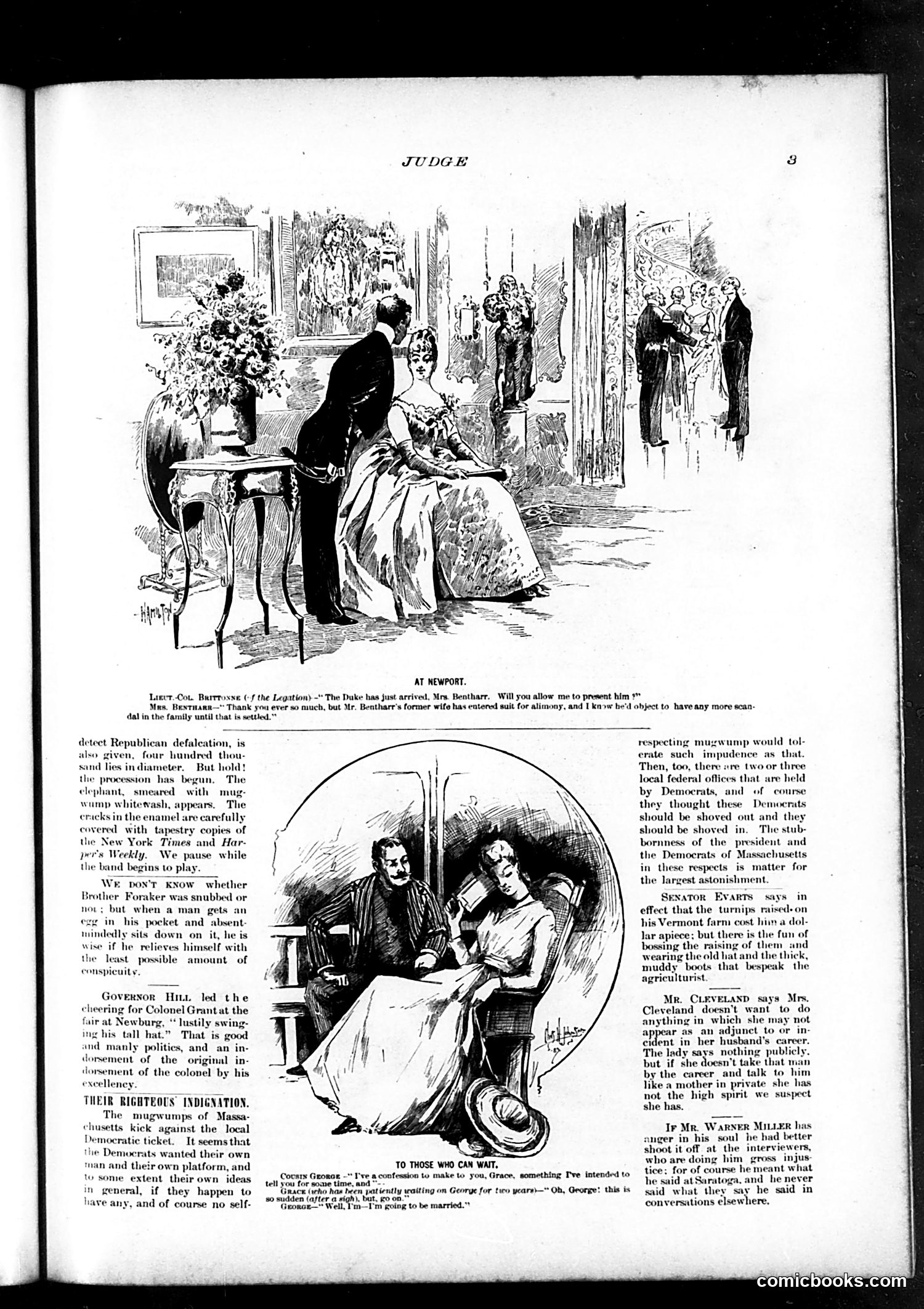
**Top Cartoon ("At Newport"):** A social satire about a Duke's arrival at a Newport social gathering. Mrs. Bentham declines an introduction, explaining that the Duke's ex-wife has filed an alimony suit and she wishes to avoid additional scandal for her own family. This mocks both aristocratic pretension and the messy divorce litigations of the wealthy elite. **Bottom Cartoon ("To Those Who Can Wait"):** A romantic entanglement joke where a woman (Grace) has waited two years for George to marry her. When they finally meet, George announces he's getting married—to someone else. The humor lies in her wasted patience. **Text Commentary:** The "Mugwumps" section ridicules Massachusetts Republicans ("mugwumps"—independent Republicans) who oppose the Democratic ticket solely because federal offices are held by Democrats rather than themselves. The passage mocks their self-interested hypocrisy, contrasting it with Senator Evarts's genuine farming interests and criticizing Mrs. Cleveland for remaining silent about her husband's political career.
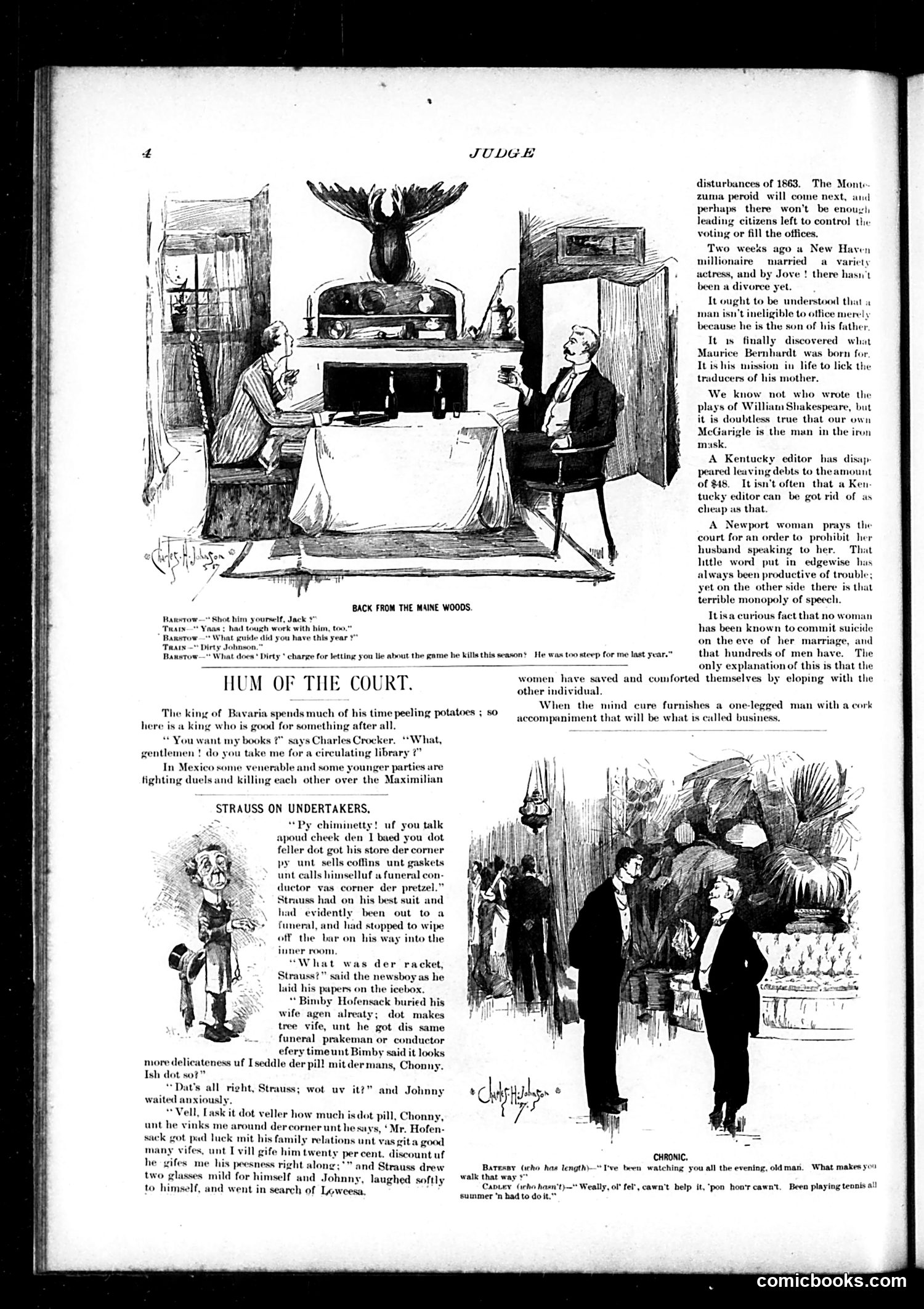
This page from Judge contains satirical commentary and humor typical of late-19th-century American periodicals. **"Back from the Hunts Woods"** (top cartoon) depicts a hunting party returning with game. The dialogue suggests mockery of leisure-class hunting expeditions and their outcomes. **"Hum of the Court"** section offers brief satirical observations on contemporary social issues: political incompetence, divorce scandals (referencing a New Haven actress), and commentary on women's legal rights—notably a Newport woman seeking a court order to silence her husband, which Judge uses to joke about women's traditional exclusion from public speech. **"Strauss on Undertakers"** (bottom section) is a dialect humor piece featuring a German character discussing a funeral director's business practices with dark comedy—specifically how one undertaker profits repeatedly from a man's multiple marriages and his wives' deaths. The page reflects Judge's satirical approach to marriage, class, gender dynamics, and immigrant characters (rendered in exaggerated dialect), typical of Gilded Age humor magazines.
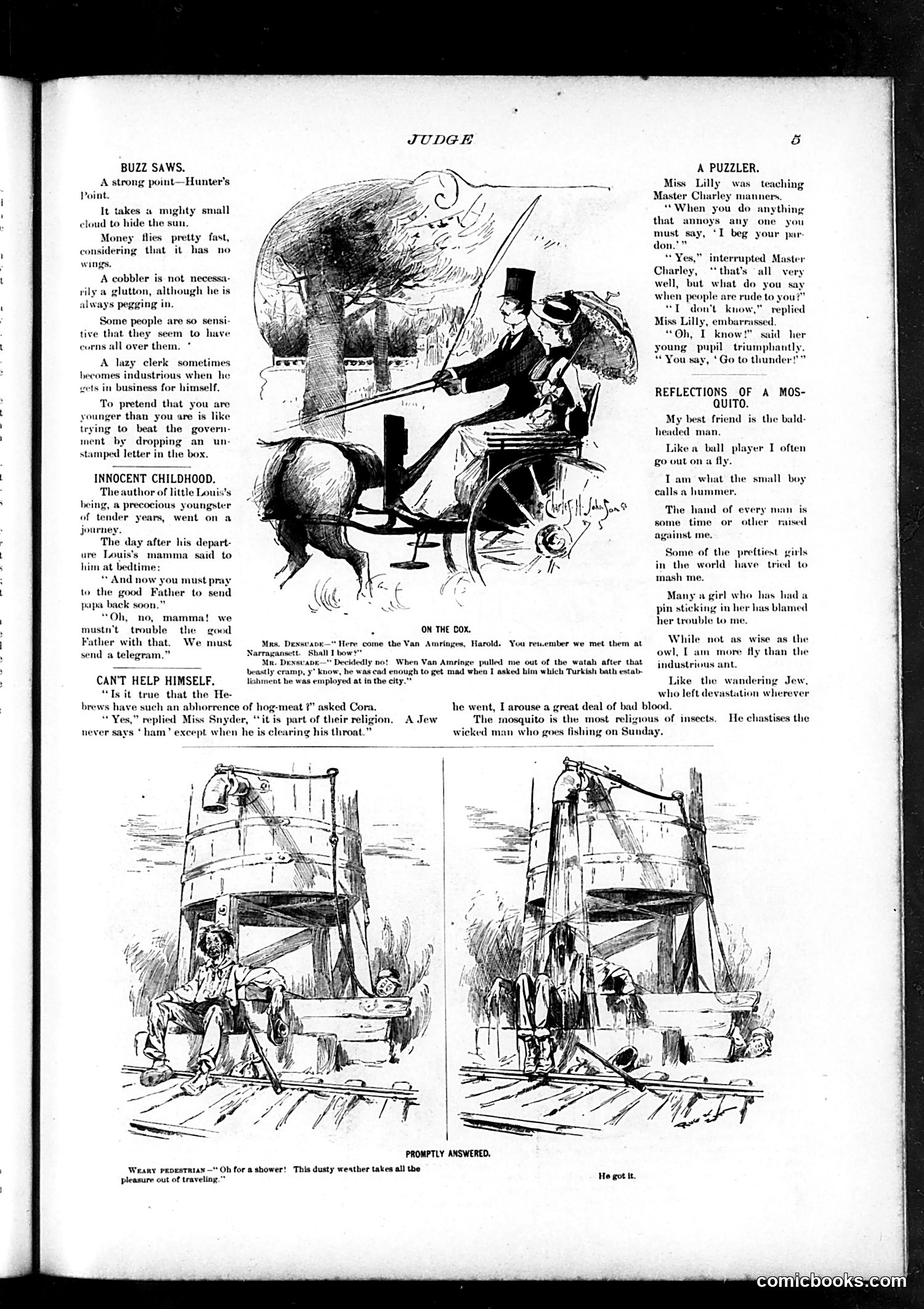
This page contains **short humorous pieces and satirical cartoons** typical of Judge's format: **"BUZZ SAWS"** — Brief witticisms poking fun at everyday absurdities: lazy clerks, vain people, and religious/ethnic stereotypes (a dated joke about Jewish dietary laws). **"INNOCENT CHILDHOOD"** — A child's logic joke: when told to pray for his father's return, the boy suggests sending a telegram instead—mocking both childhood innocence and the modern telegraph as a superior alternative to prayer. **"ON THE COX"** — Social satire about class pretension. A man rescued from drowning by Van Amringe later insulted him by asking which "Turkish bath establishment" he worked at—implying the rescuer was a servant. The humor targets nouveau-riche rudeness and class anxiety. **"CAN'T HELP HIMSELF"** — A Jewish man cannot eat ham "except when he is clearing his throat"—an ethnic stereotype joke about hypocrisy. **Bottom illustrations and remaining items** include practical jokes and observations ("A Puzzler," "Reflections of a Mosquito") representing the magazine's mix of wordplay and social commentary. The page reflects 19th-century humor conventions, including casual ethnic stereotyping now considered offensive.
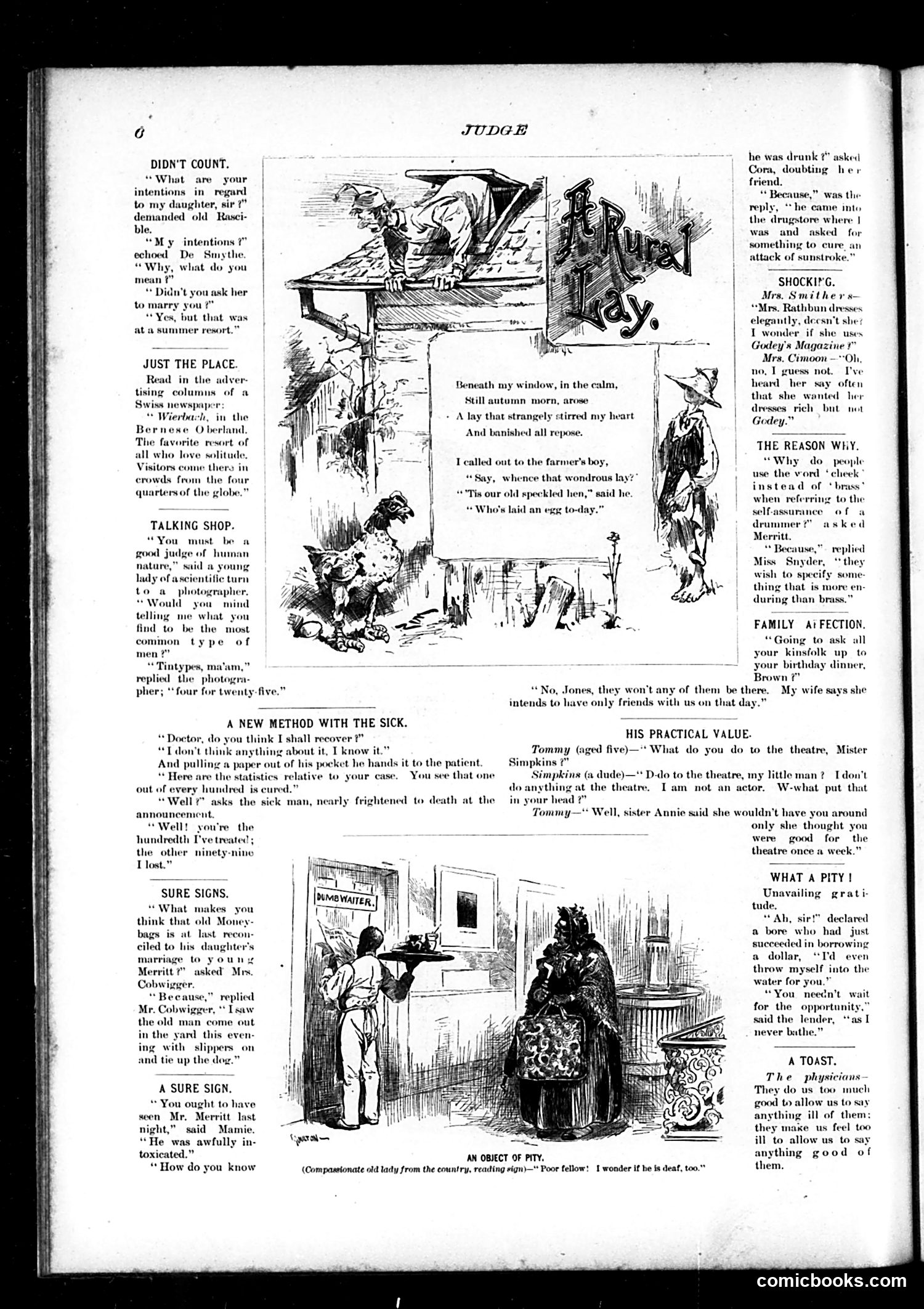
This page from *Judge* contains several short humorous sketches satirizing American social conventions of the late 19th century. **"Didn't Count"** mocks pretentious courtship rituals—a suitor claims noble intentions toward a woman, but admits he merely wanted her company at a summer resort. **"Just the Place"** presents a sentimental rural scene where a farmer's boy's "wondrous lay" turns out to be from their speckled hen—deflating romantic expectations with mundane reality. **"Talking Shop"** jokes that a photographer finds the most common human "type" is the statistical average—commenting on the era's growing obsession with quantifying human characteristics. **"A New Method with the Sick"** satirizes overconfident doctors wielding statistics to reassure patients, presenting grim survival rates (1 in 100 cured) as encouraging. **"A Pity!" and "Sure Sign"** ridicule misers and social pretension—a cheapskate won't bathe if kindness is expected; an old man finally accepts his daughter's marriage only when she's already wed. The cartoons share common themes: deflating pretension, exposing human selfishness, and mocking emerging modern anxieties about statistics and professionalism.
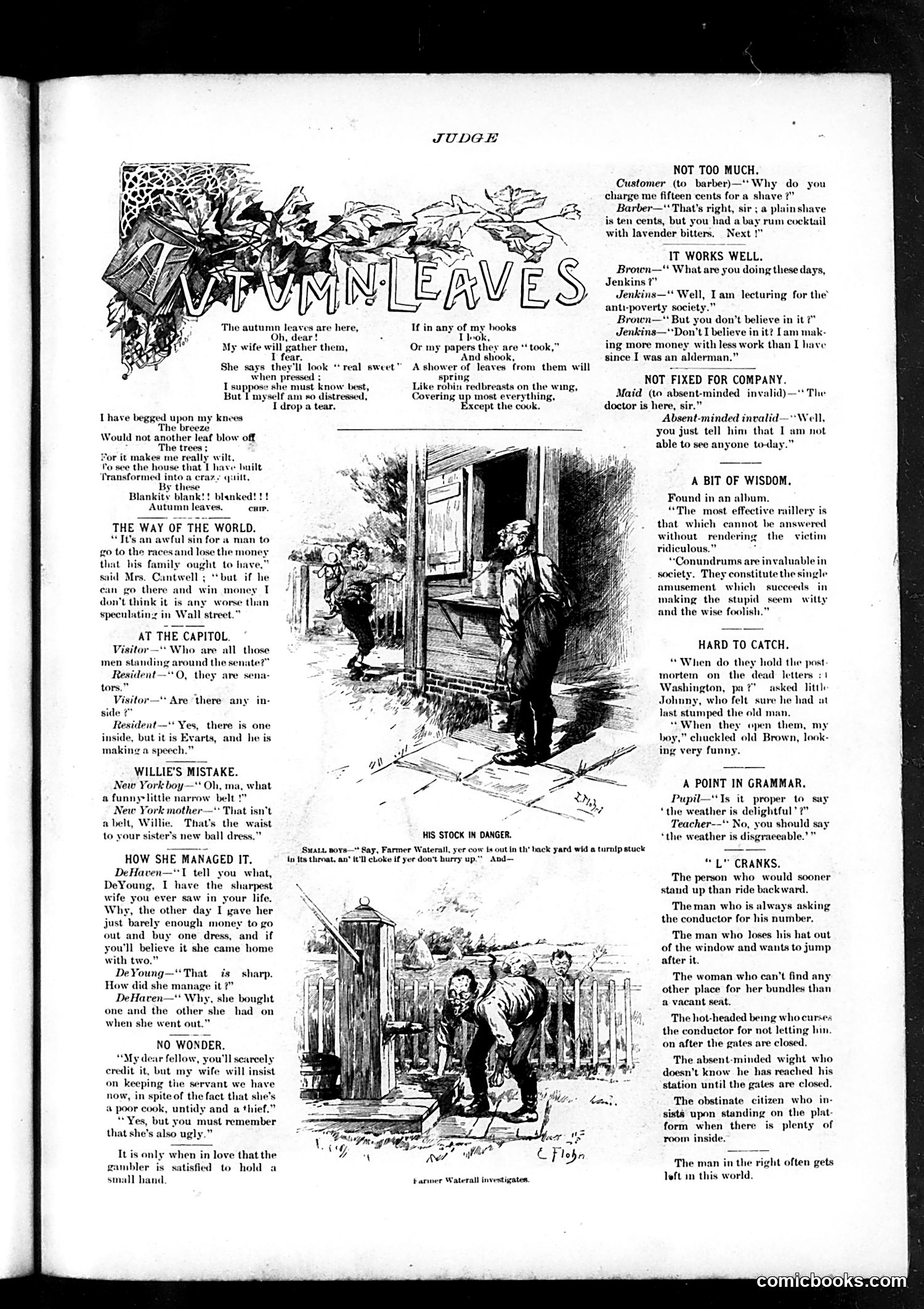
This page from the satirical magazine *Judge* contains multiple short humor pieces typical of late 19th-century American comedy, reflecting contemporary social attitudes and urban life. **The cartoons and jokes mock:** - **Domestic life**: A wife's autumn leaf-collecting hobby annoys her husband; a wife's cleverness in acquiring two dresses on a meager budget; servants who are ugly but reliable despite being poor cooks and thieves. - **Urban occupations**: A barber adding expensive extras (bay rum cocktail, lavender bitters) to a simple shave; an "anti-poverty lecturer" making money through the work itself—satirizing reformers as self-serving. - **Politics/Social Commentary**: A comment on Wall Street speculation being morally equivalent to gambling; the Capitol joke suggests senators are largely absent. - **Generic absurdities**: Inconsequential observations about passenger behavior, grammar pedantry. The overall tone reflects *Judge*'s genteel, class-conscious humor aimed at middle and upper-class readers, with gentle ribbing of servants, immigrants ("Swat Noys"), and social pretension rather than biting political critique.
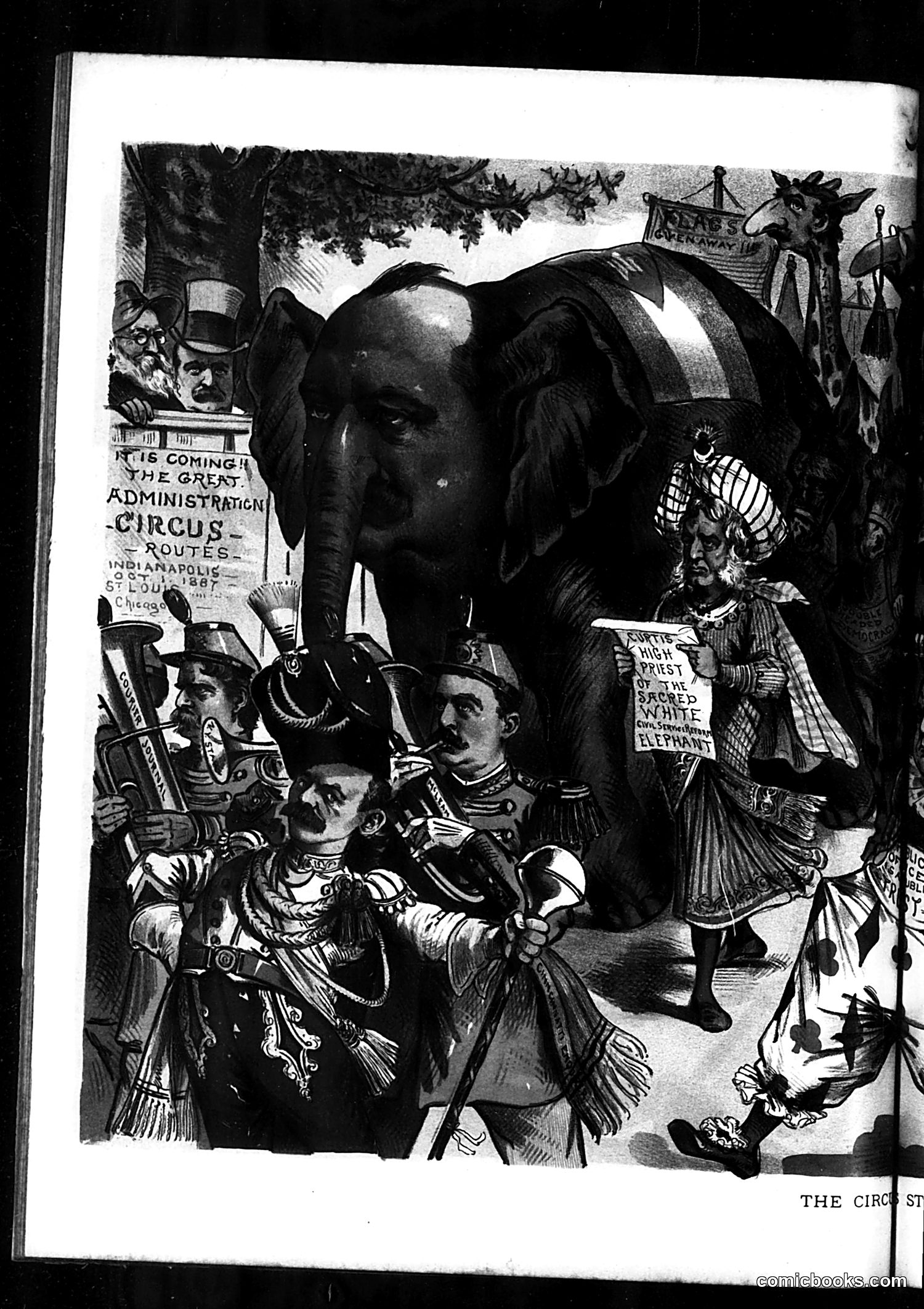
This is a satirical cartoon depicting an administration as a circus. The central image shows an enormous elephant head (the Republican Party symbol) with tiny uniformed military or political figures around it, some holding signs advertising "The Great Administration Circus" with routes to Indianapolis and Chicago (likely referencing an 1887 political tour). The satire suggests the administration is a frivolous spectacle—a "circus"—rather than serious governance. The tiny figures dwarfed by the elephant emphasize how small individual politicians appear compared to party machinery. The military uniforms on the figures suggest this mocks militaristic or authoritarian posturing during what appears to be the late 19th-century Republican administration. The overall message critiques the administration as theatrical showmanship rather than substantive leadership.
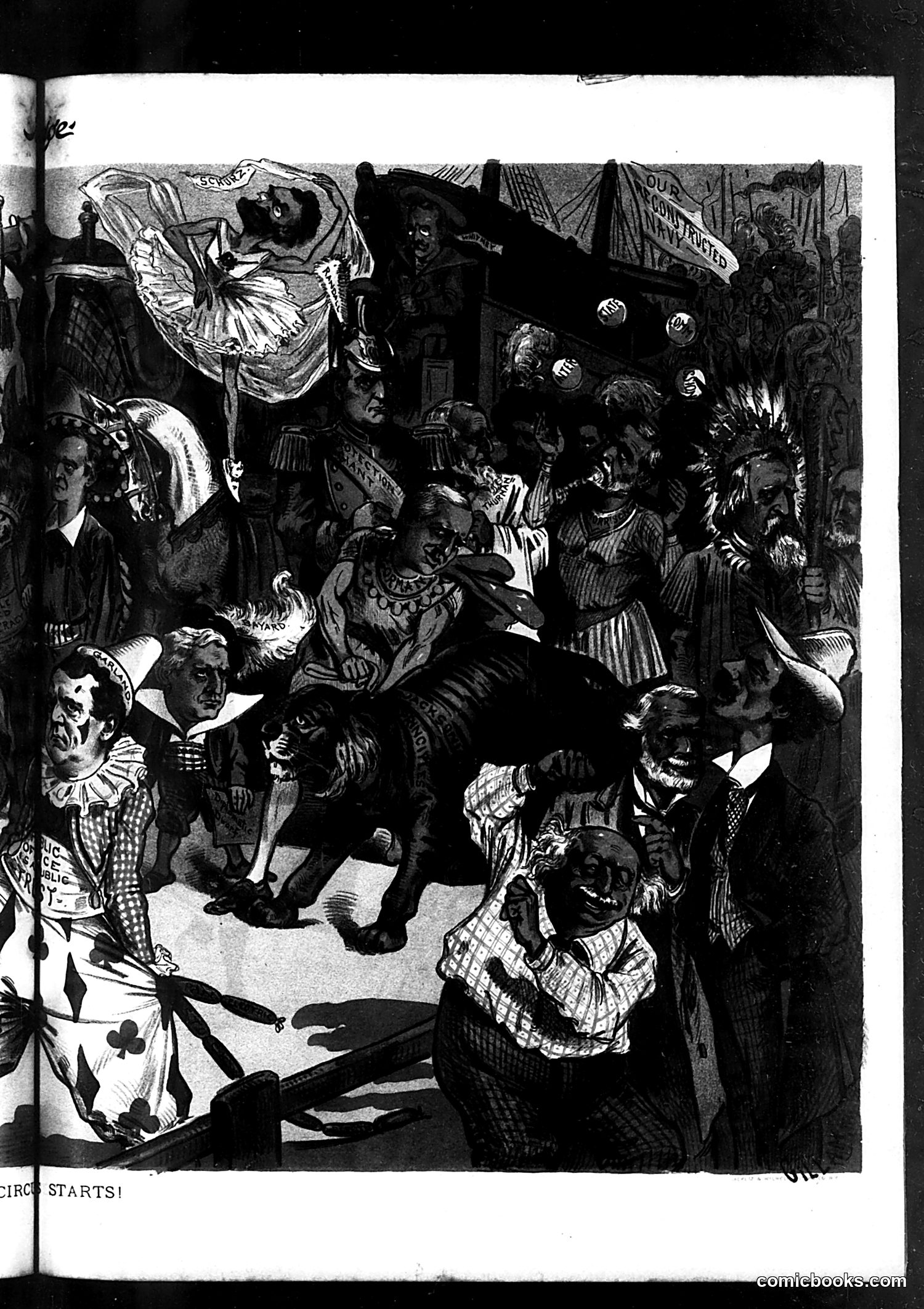
This appears to be a satirical circus scene from *Judge* magazine. The text "CIRCO STARTS!" (likely "CIRCUS STARTS!") anchors the cartoon's theme. The image depicts an elaborate carnival or circus gathering with numerous figures in military dress, ornate costumes, and formal attire mingling chaotically. The style suggests late 19th or early 20th century. Without clearer identifying labels visible in the image, I cannot definitively name specific political figures depicted. However, the satire appears to mock either political leadership or military/governmental institutions by presenting them as a circus—suggesting incompetence, chaos, or performative spectacle rather than serious governance. The elaborate costumes and crowded composition emphasize the disorder and artificiality of the scene, typical of *Judge's* political commentary. More specific context about the publication date would clarify which political events this references.
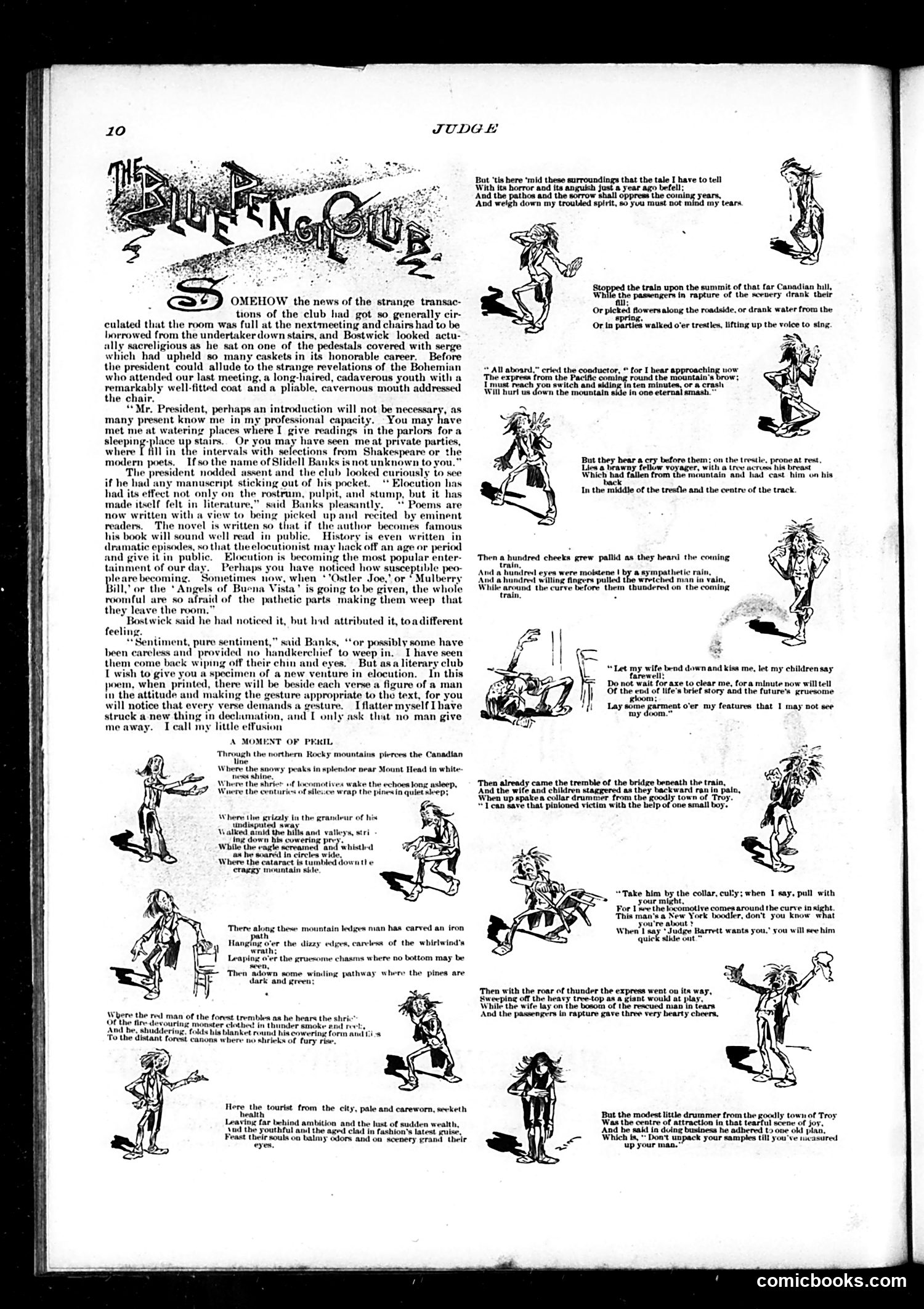
This page satirizes the pretentious literary and performance culture of late 19th-century American clubs. A character named Slidell Banks, a professional elocutionist (dramatic reader), addresses a club meeting, boasting that his "new venture" combines poetry with illustrated gestures—each verse accompanied by a figure showing the appropriate dramatic pose. The satire targets several things: the overwrought emotionalism of Victorian elocution performances (Banks notes audiences weep so easily they leave rooms), the absurdity of designing literature specifically to be "picked up and recited by eminent readers" rather than read, and the self-important pretension of literary figures. The accompanying poem "A Moment of Peril" appears deliberately overwrought—grandiose Rocky Mountain imagery with melodramatic language—likely meant as parody of the overwrought Romantic verse popular for elocution performance. The joke: these clubs have become temples to artificial dramatic performance rather than genuine literary appreciation.
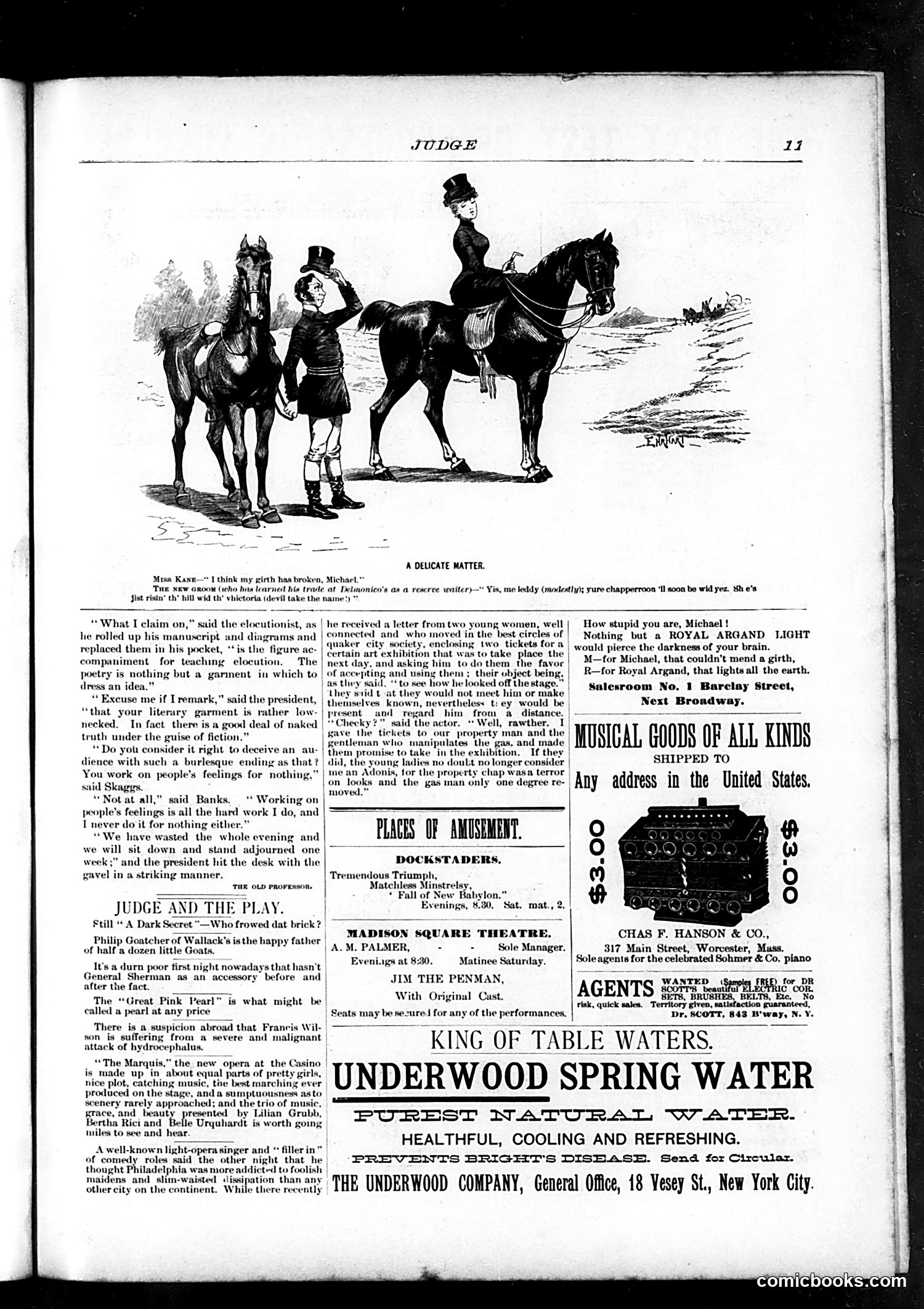
The cartoon depicts a social embarrassment typical of Gilded Age satire. A well-dressed woman on horseback (likely named Kane, based on the caption) complains to her carriage driver that her girth (saddle strap) has broken—a mildly scandalous admission involving her horse's equipment and her own physical body. The humor hinges on the awkwardness of discussing bodily/physical matters with servants. The driver's response—assuring her the "chaperone" (a female companion required for respectability) will arrive—suggests the woman worries her candid remark compromises her dignity. This exemplifies Judge's satire of Victorian propriety: the elaborate rules governing what respectable people could discuss publicly, particularly regarding women's bodies. The joke isn't that the girth broke, but that openly discussing it violates social conventions about delicate matters. The page is otherwise filled with theater advertisements and gossip columns typical of the era.
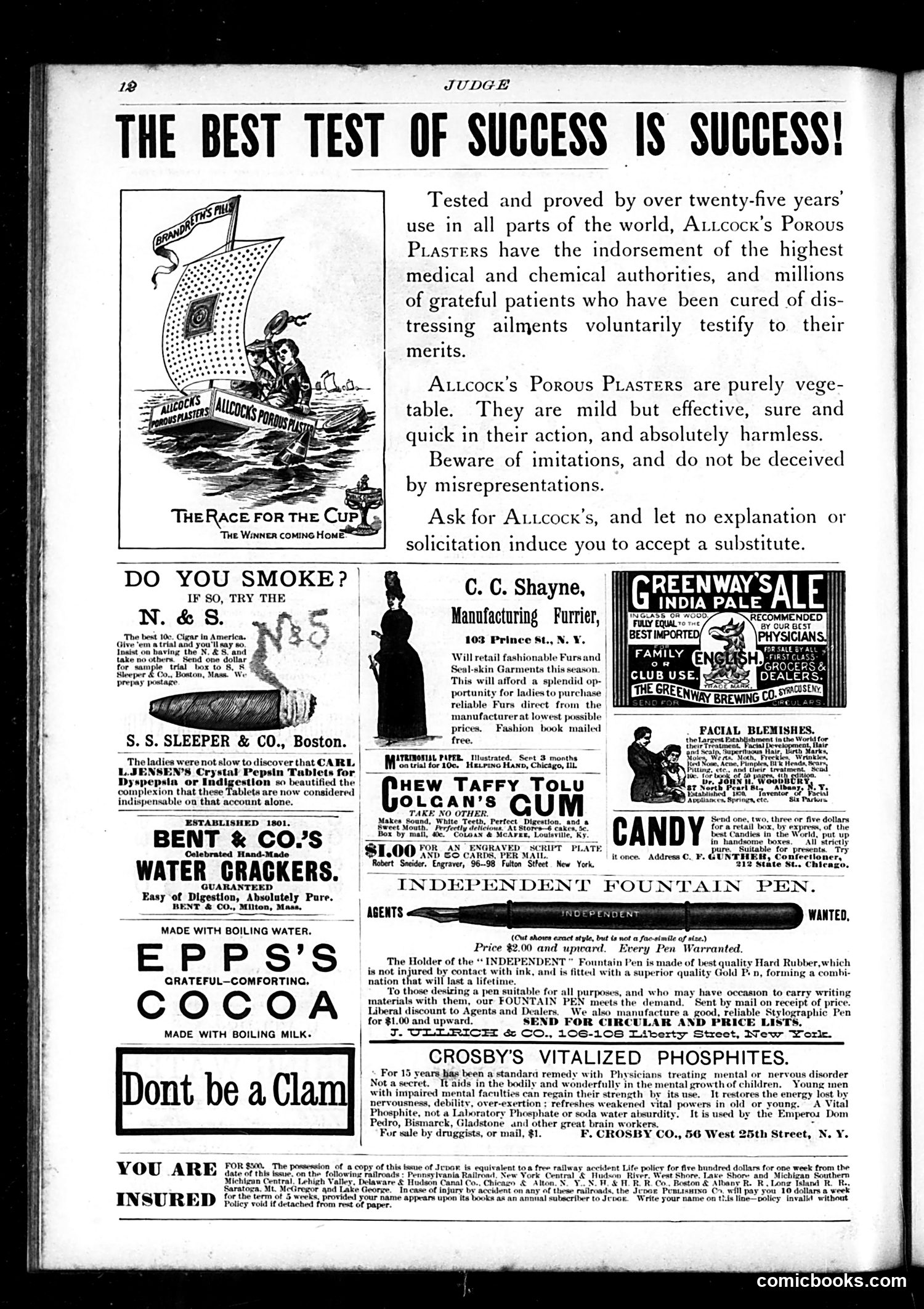
This is primarily an **advertising page** from Judge magazine, not a satirical cartoon section. The page contains numerous product advertisements typical of late 19th-century American publications. The only cartoon element is a small illustration labeled "The Race for the Cup / The Winner Coming Home," depicting a sailing vessel—likely a reference to America's Cup yacht racing, a prestigious sporting competition. This appears to be decorative rather than satirical. The bulk of the page advertises patent medicines, consumer goods, and services: Allcock's Porous Plasters (medicinal), N&S cigars, various digestive aids and tonics (Epps's Cocoa, Bent & Co.'s Water Crackers, Crosby's Phosphites), beauty treatments, and a fountain pen. **For modern readers**: This reflects an era when magazines relied heavily on advertising revenue and when unregulated patent medicines claimed cure-all properties. The repeated warnings to avoid imitations suggest widespread counterfeiting. The page also includes an unusual "free insurance" offer—possession of that issue allegedly provided accident coverage on specific railroads.
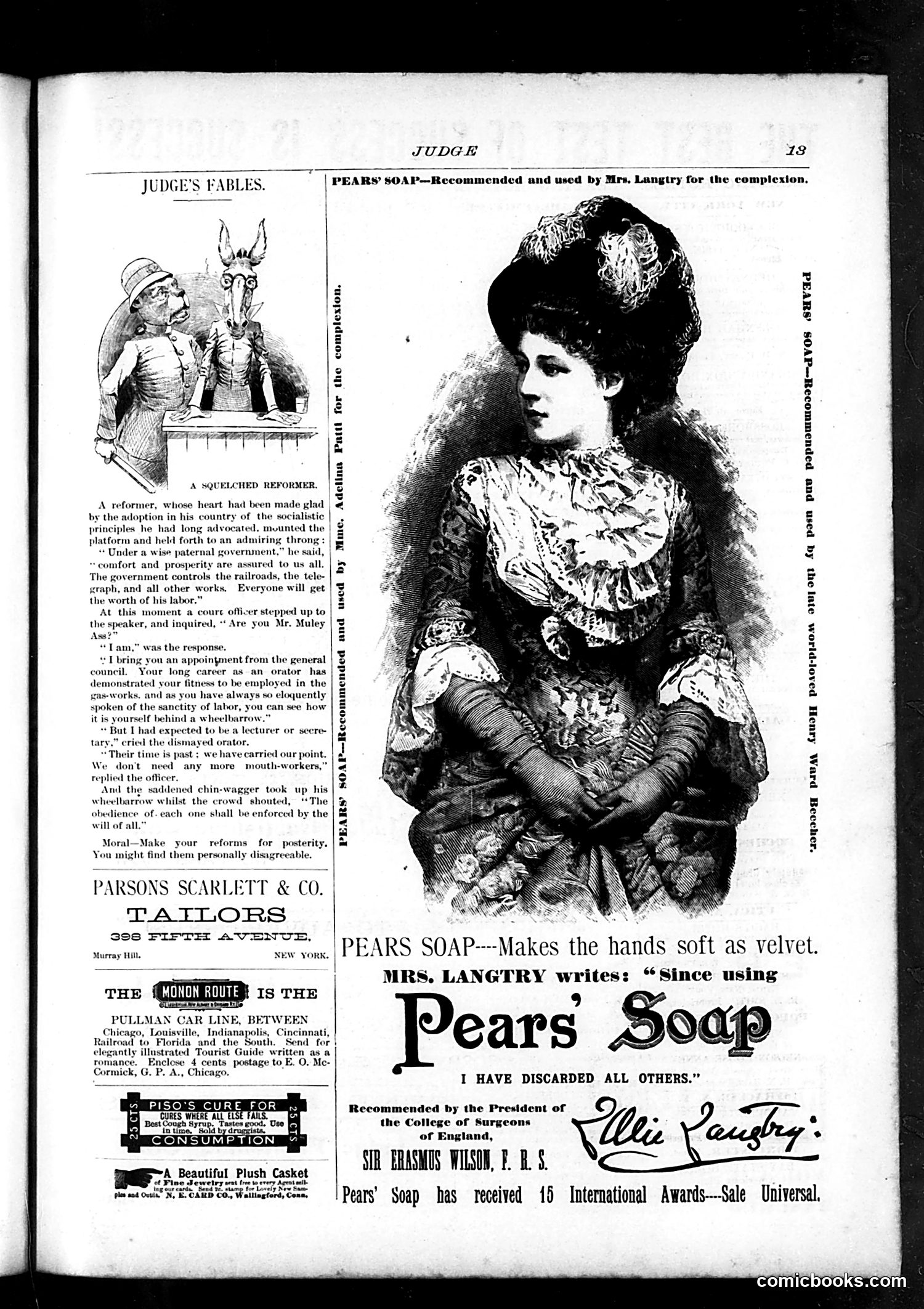
This page contains **political satire** and period advertising. The main cartoon, "A Squelched Reformer," mocks socialist or labor-reform rhetoric of the era. **The Satire:** A reformer named Mr. Muley Ass delivers passionate speeches about government control ensuring "comfort and prosperity" and fair labor treatment. However, when authorities take him at his word and assign him to manual labor (wheelbarrow work), he protests—revealing his hypocrisy. He wanted *others* to embrace labor's "sanctity," not himself. The joke: reformers advocating social change often don't want personal consequences. **The Moral** explicitly states: support reforms only if you'd accept them personally, or don't propose them. **Context:** This reflects late-19th-century skepticism toward labor reformers and socialism, common in Judge magazine's satirical approach. The page also features extensive **Pears' Soap advertisements** using celebrity endorsements (Mrs. Langtry, Adelina Patti, Sir Erasmus Wilson), typical of Victorian-era marketing tactics.
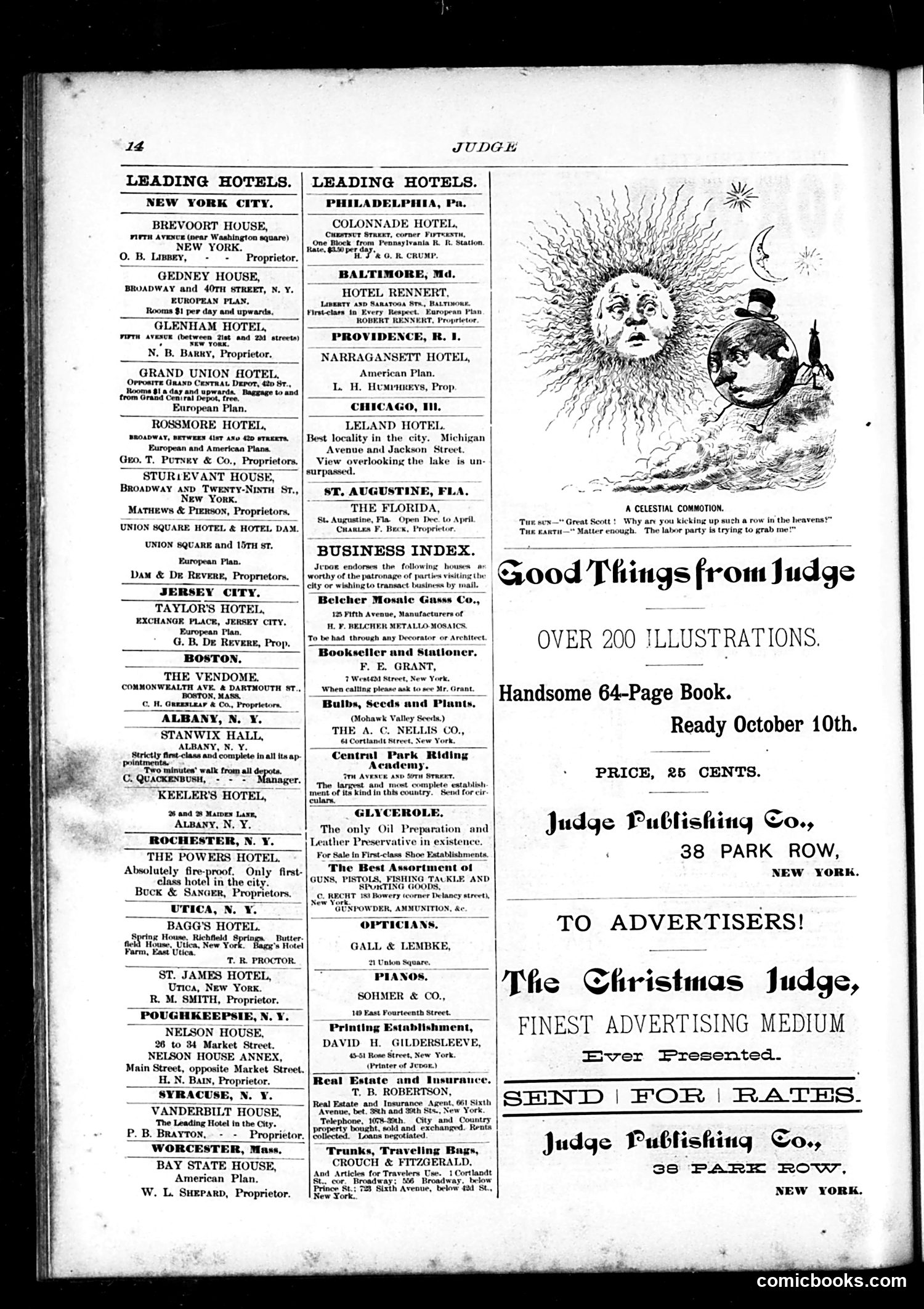
This page is primarily **advertising content** from Judge magazine, displaying hotel listings, business services, and a publication announcement. The only cartoon appears in the upper right: a celestial scene showing the sun and moon as personified faces amid stars and clouds. The sun complains to the moon about labor agitation—"The labor party is trying to grab me!" **Context**: This references late 19th-century American labor unrest and socialist movements gaining visibility. The joke sarcastically portrays labor activism as so pervasive and threatening that even celestial bodies fear it. By placing this anxiety in the heavens (the sun being attacked), Judge ridicules what it likely saw as excessive fears about labor organizing among the wealthy class. The rest of the page consists of typical period advertisements for hotels across American cities, a "Business Index" of commercial services, and a promotion for an upcoming 64-page Judge publication selling for 25 cents—reflecting the magazine's mixed editorial and advertising content model.
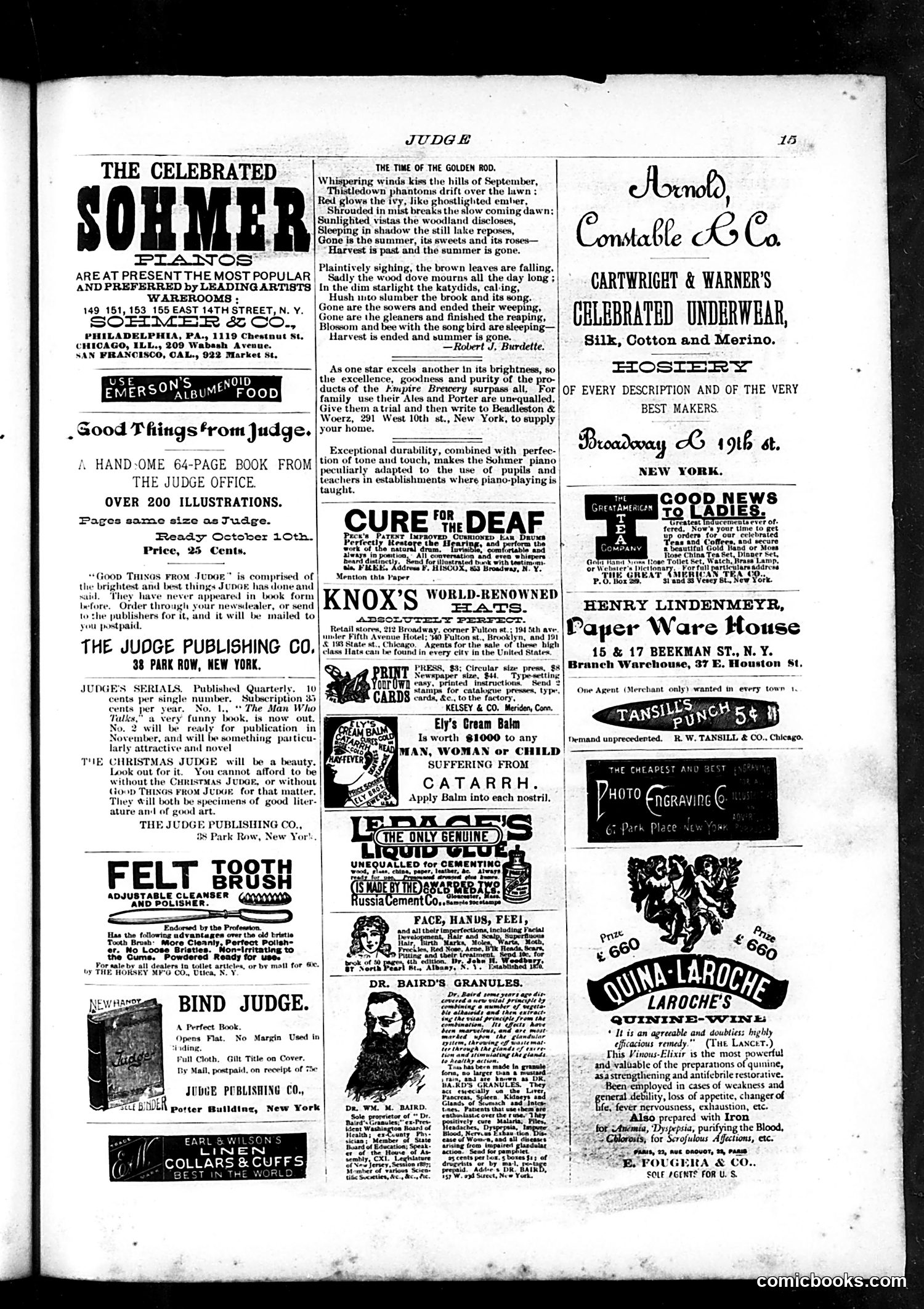
This is primarily an **advertising page** from Judge magazine, with minimal editorial cartooning. The page is dominated by commercial advertisements for various products typical of the era (late 19th/early 20th century): pianos, tooth brushes, linen collars, patent medicines, and printing supplies. The only substantive editorial content is a **poem titled "The Time of the Golden Rod"** by Robert J. Burdette, which romanticizes the autumn season in sentimental Victorian language—describing September's natural beauty fading into winter. This is characteristic of Judge's mix of satirical humor with genteel literary content. The advertisements themselves reveal period concerns: teeth-cleaning technology, remedies for deafness, and hair restoration products suggest contemporary anxieties. A notable ad for "Quina-Laroche" promotes a quinine-based patent medicine claiming to treat various ailments. Without visible political cartoons on this particular page, there is **no satire or social commentary to decode**—it represents Judge functioning as a general-interest magazine balancing literary content with commercial revenue.
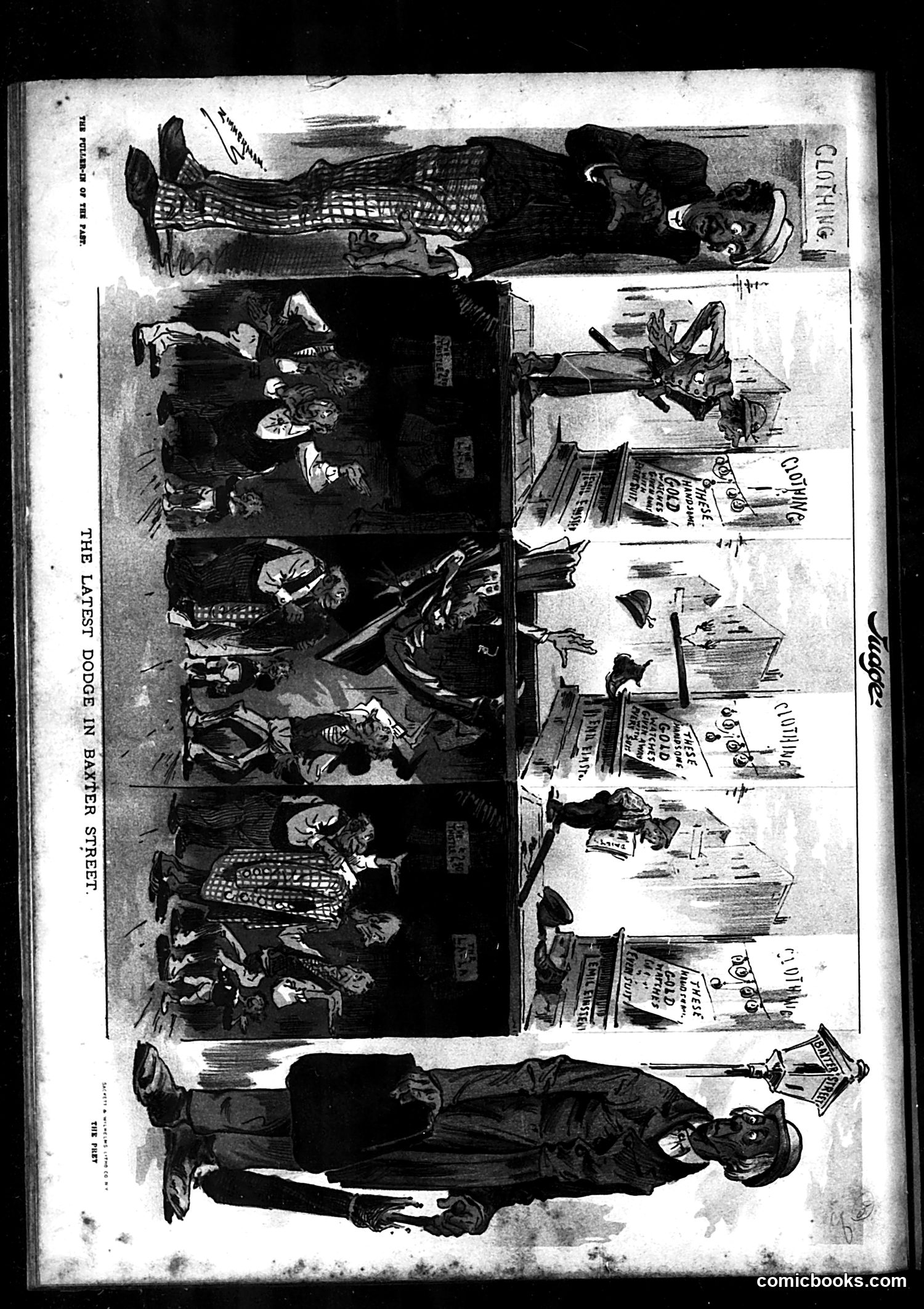
This page appears to be primarily **advertising content** rather than political satire. The visible text references "CLOTHING" and what seems to be product advertisements arranged vertically down the right side of the page. The left side contains what appears to be a detailed illustration or scene, but the image quality and orientation make it difficult to discern specific satirical content or identify particular figures with certainty. Without clearer text or more legible captions identifying specific political figures or contemporary events, I cannot confidently explain the satirical point or social commentary this page intended. The page layout suggests it mixes editorial content with commercial advertising, which was common in Judge magazine.

I cannot reliably analyze this page. The image is almost entirely black with only thin white borders visible on the left and right edges, making the actual cartoon content indecipherable. The OCR text appears to be garbled or corrupted ("REN BEET NETL PACD IE I"), providing no coherent information about the content. To properly identify the figures, political references, and satirical intent of this Judge magazine page, I would need a clearer image where the cartoon artwork and any text are legible. As it stands, I cannot responsibly identify specific caricatures or explain the satire without being able to see the actual content.