
A complete issue · 16 pages · 1887
Judge — September 24, 1887
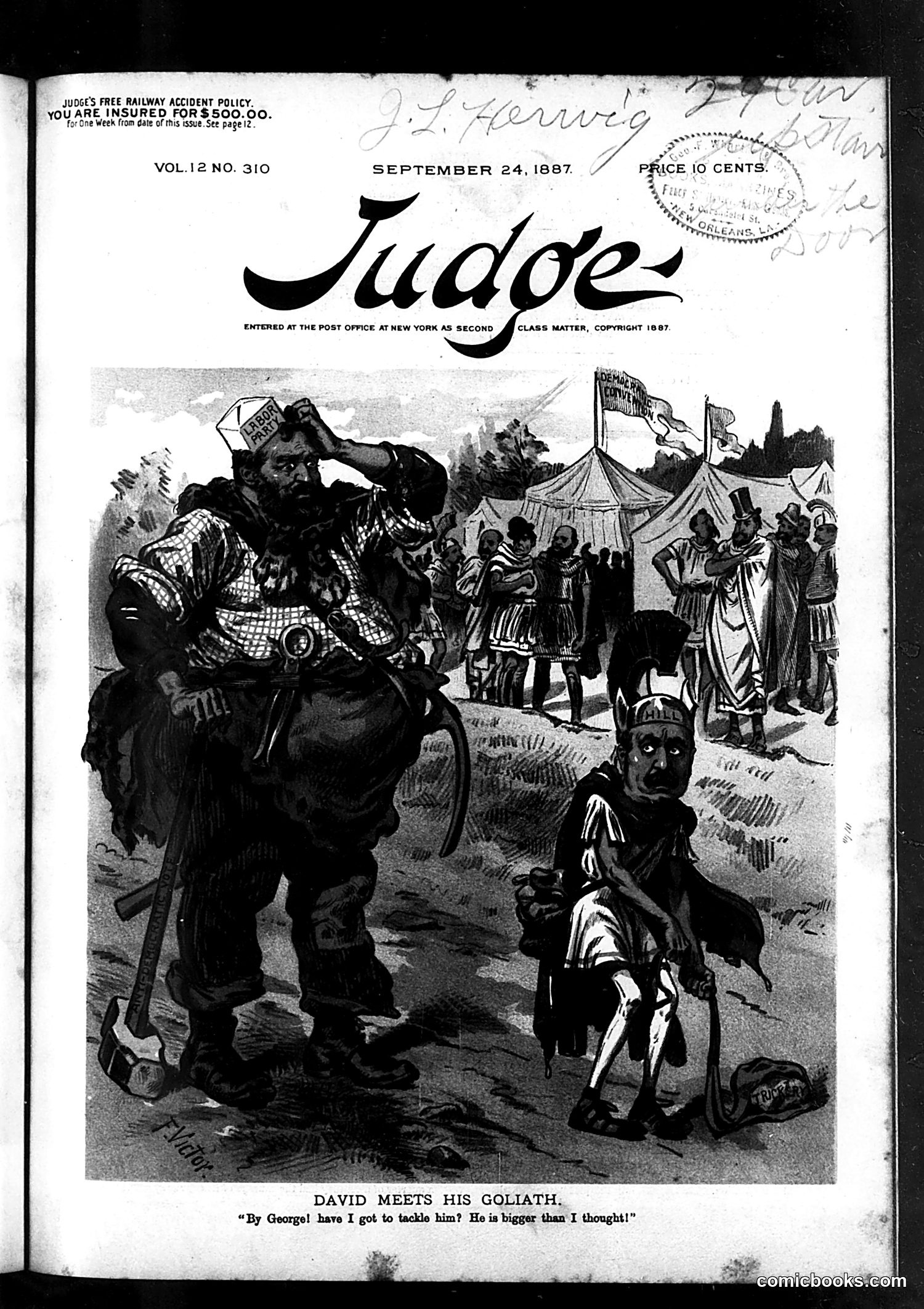
This cartoon depicts a figure labeled "By George! have I got to tackle him? He is bigger than I thought!" The illustration references the biblical David and Goliath story as a metaphor for an underdog confrontation. The context suggests this is political satire from September 1887, likely commenting on a contemporary political or social challenge. The large armored figure represents a formidable opponent, while the smaller figure (David) appears daunted by the disparity in size and power. Without additional context about 1887 events, the specific political figures or issues referenced remain unclear. However, the biblical allusion indicates Judge magazine was using familiar cultural mythology to satirize what readers would recognize as a significant contemporary power imbalance or political struggle.
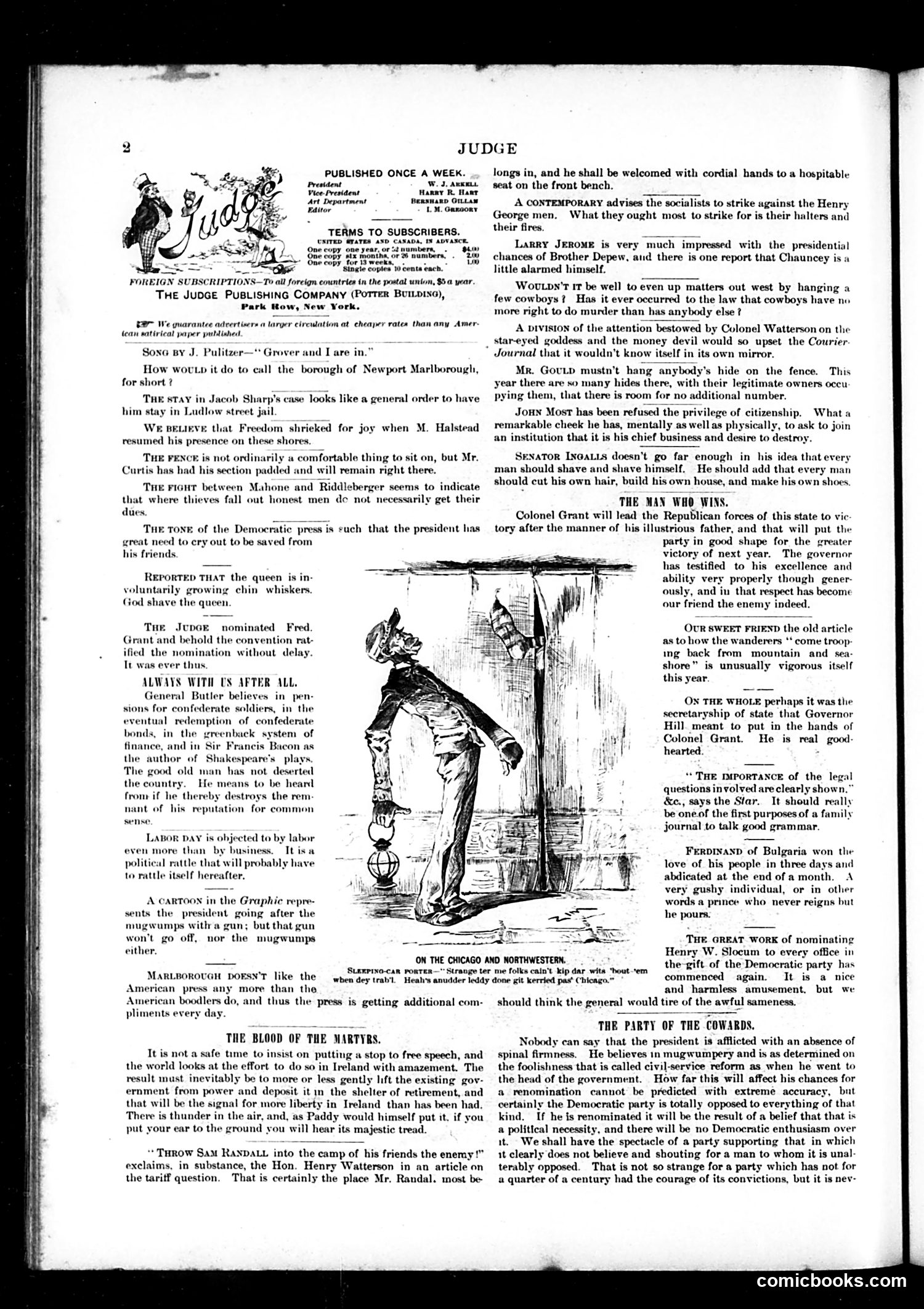
The main cartoon, titled "On the Chicago and Northwestern," depicts a thin, ragged man (labeled as a tramp) examining a lantern beside railroad tracks. The caption reads: "Sleeping car porter—'Strange ter me folks can't big der wuz 'bout wen de trakt. Hank's smeller body done git ketched past Chicago.'" This is a crude ethnic/class humor cartoon mocking working-class speech patterns and suggesting a tramp has died or disappeared near Chicago. The joke relies on dialect humor and the audience's presumed superiority to both the porter and the transient. The surrounding text contains political commentary critical of Democratic policies, Republican candidates, and various social issues of the era. Without knowing the specific publication date, the precise historical context remains unclear.
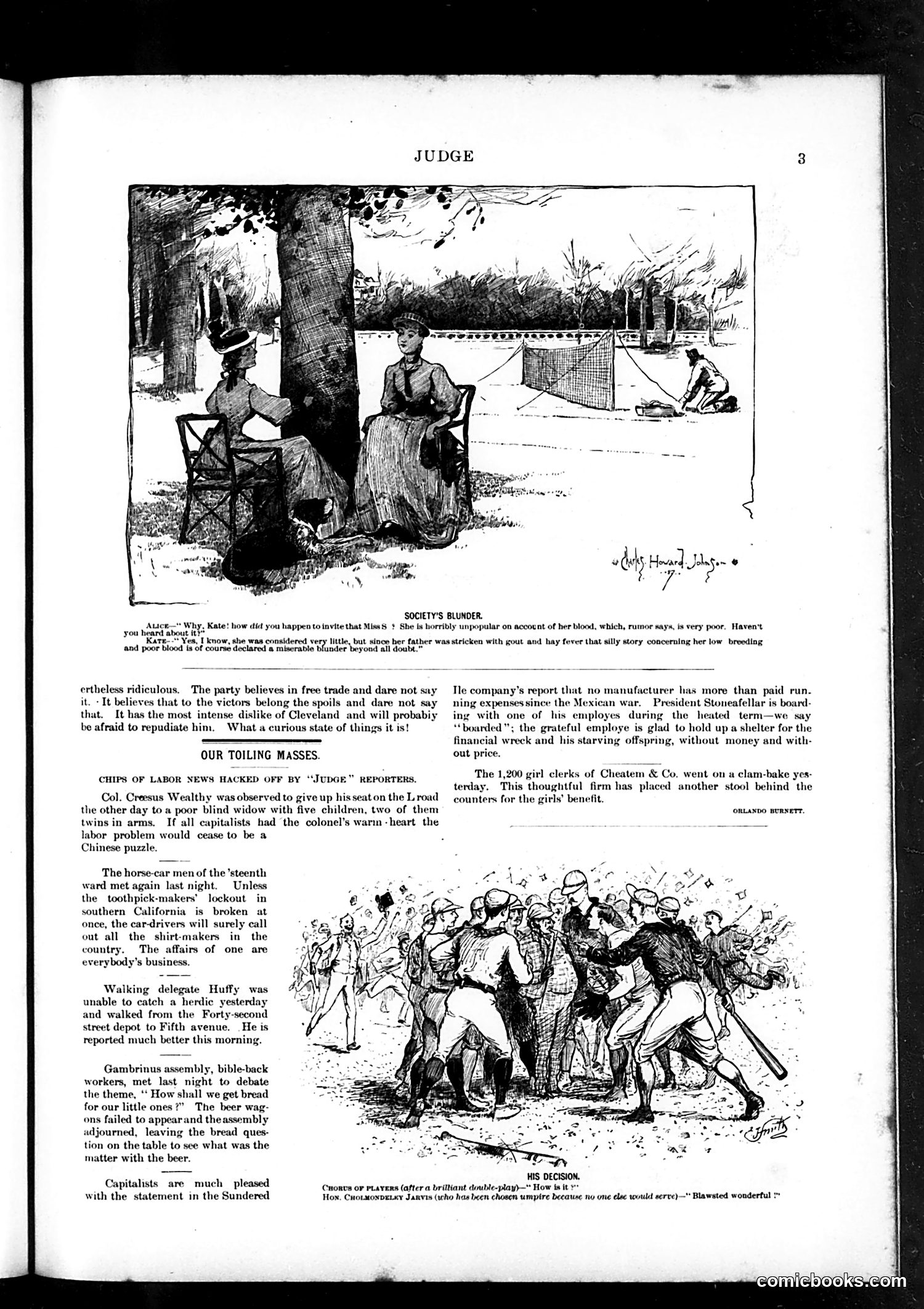
This *Judge* page contains three satirical pieces mocking late 19th-century American hypocrisy and labor issues. **"Society's Blunder"** (top cartoon): Ridicules wealthy socialites who ostracize a woman for "poor blood" due to her father's illness, while the speaker simultaneously claims to know she was "considered very little" socially. The satire targets snobbish class consciousness and gossip among the elite. **"Our Toiling Masses"** (text section): Employs heavy irony to mock labor activism and working-class solidarity. Examples include a railroad magnate's token charity, interconnected labor disputes over trivial grievances, and a workers' assembly debating bread while beer wagons disappear—suggesting labor movements lack coherent purpose or genuine concern for workers' welfare. **"His Decision"** (bottom cartoon): Depicts baseball players celebrating a brilliant play while an umpire declares it "wonderful"—likely satirizing either incompetent or biased officiating in contemporary sports. The overall tone suggests *Judge* viewed both wealthy society and organized labor as ridiculous and self-serving.
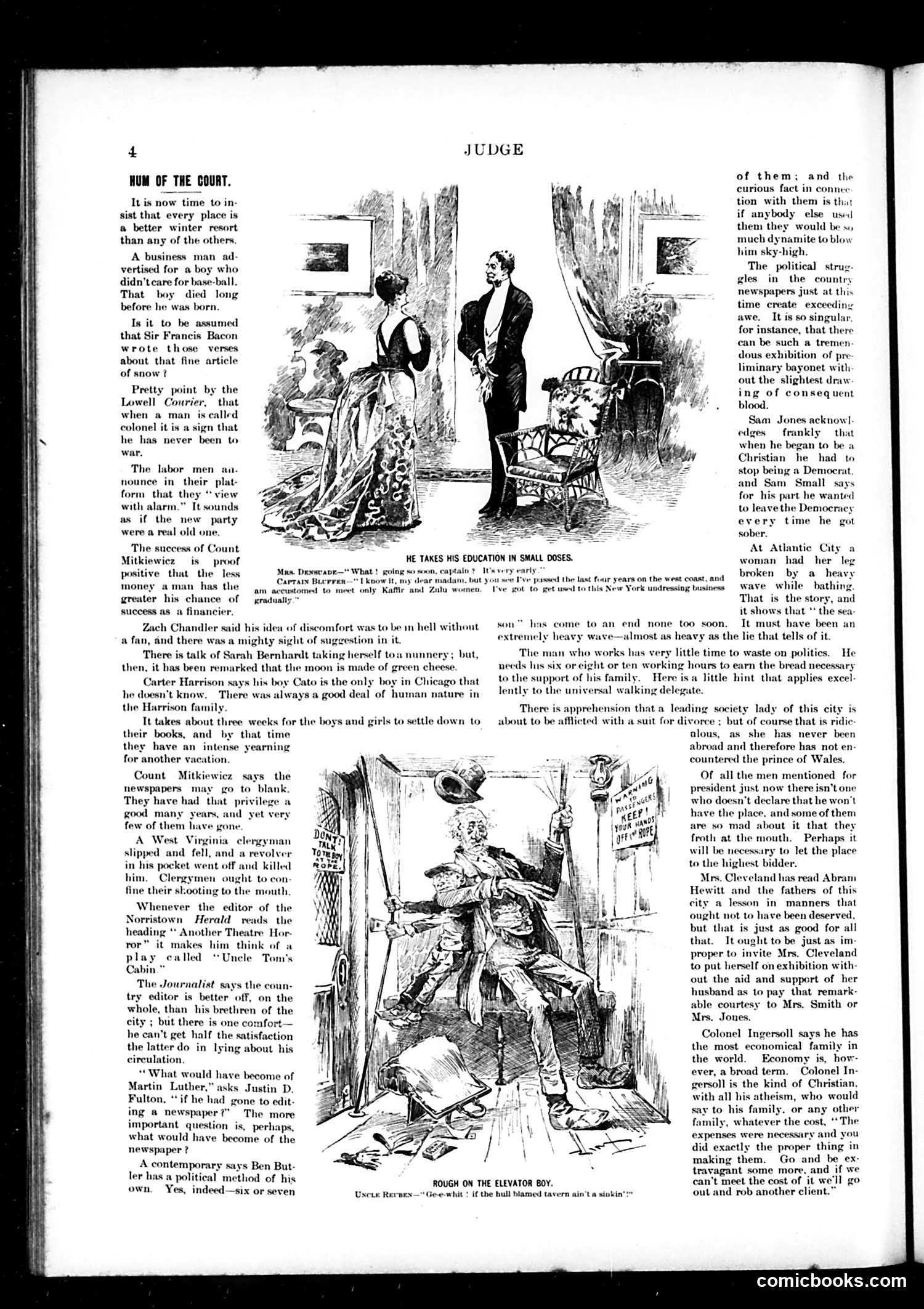
This page from Judge satirizes American social and political life through brief witticisms and two cartoon illustrations. The upper cartoon depicts a fashionable woman dismissing a military captain, joking she's only "accustomed to meet only Kaffer and Zulu women"—mocking her pretentious cosmopolitanism while referencing contemporary colonial attitudes. The lower cartoon shows a rough scene labeled "Rough on the Elevator Boy," depicting chaos with a man exclaiming about a sinking tavern, satirizing urban working-class life and safety hazards. The text column includes scattered jokes: mocking political labor movements as derivative ("old"), poking fun at wealthy Polish financier Count Mitkiewicz, criticizing newspaper editors for inflating circulation figures, and quipping that Martin Luther entering newspaper editing would have ruined journalism. References to figures like Zach Chandler (Republican politician) and Carter Harrison (Chicago mayor) suggest contemporary political targets. The overall tone is dismissive of pretension, labor activism, and urban chaos while assuming upper-class reader superiority.
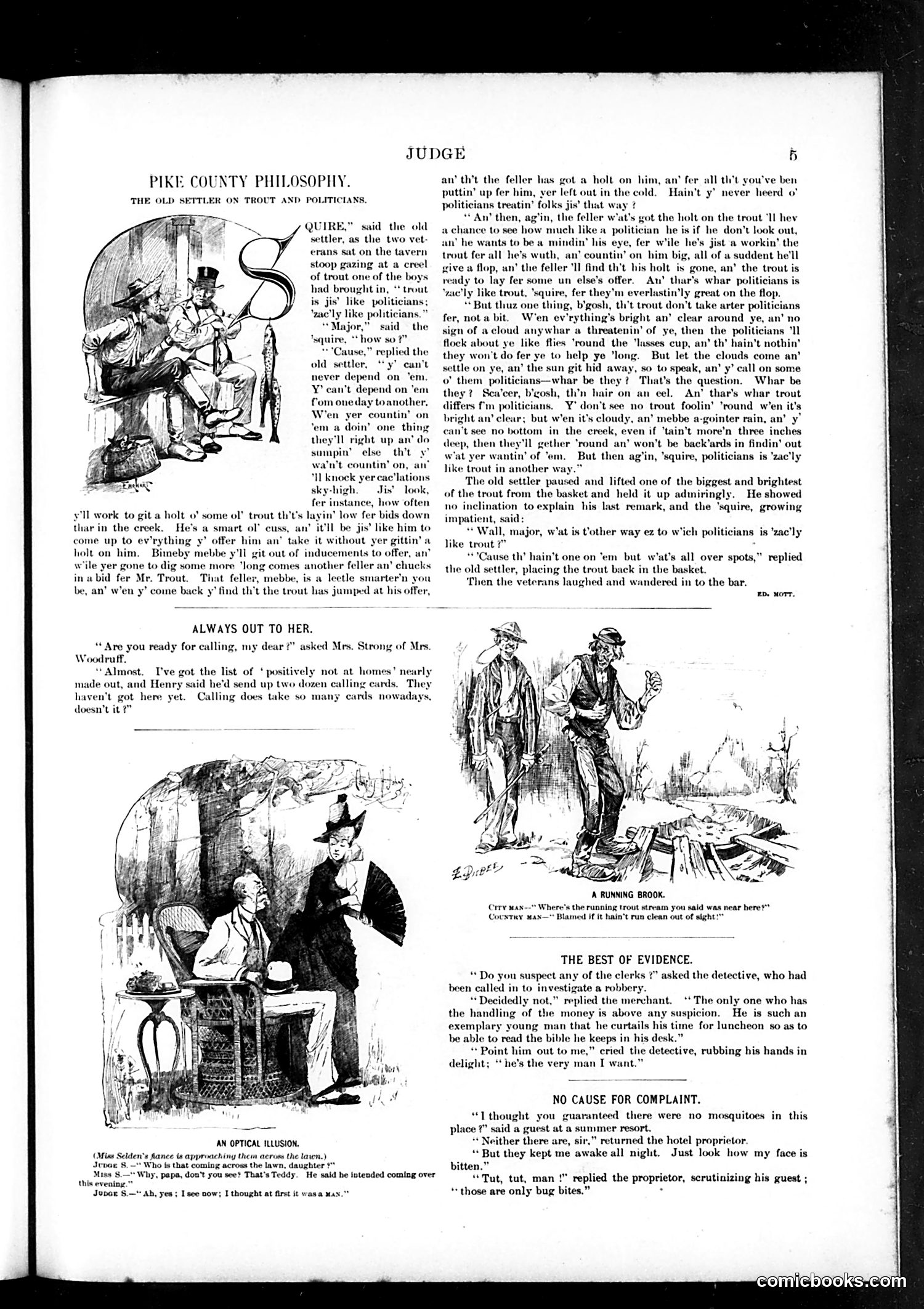
This page contains satirical commentary on American politics using rustic dialect humor, characteristic of late-19th-century American satire. **Main Cartoon: "Pike County Philosophy"** An old settler compares politicians to trout fish—unreliable, unpredictable creatures. The analogy suggests politicians: abandon their supporters when conditions worsen ("when clouds come"), flock around only during prosperous times, and change their behavior unexpectedly. The humor derives from vernacular speech ("'zac'ly like politicians") comparing the behavior of cunning fish to political opportunism and fickleness. **Secondary Items:** - "Always Out to Her" mocks social calling customs among wealthy women - "The Best of Evidence" concerns a robbery investigation - "No Cause for Complaint" jokes about mosquitoes at resorts - "An Optical Illusion" appears to be a brief visual gag The page satirizes political untrustworthiness through folksy wisdom, a popular Judge magazine format that used rural characters to critique urban sophistication and political hypocrisy.
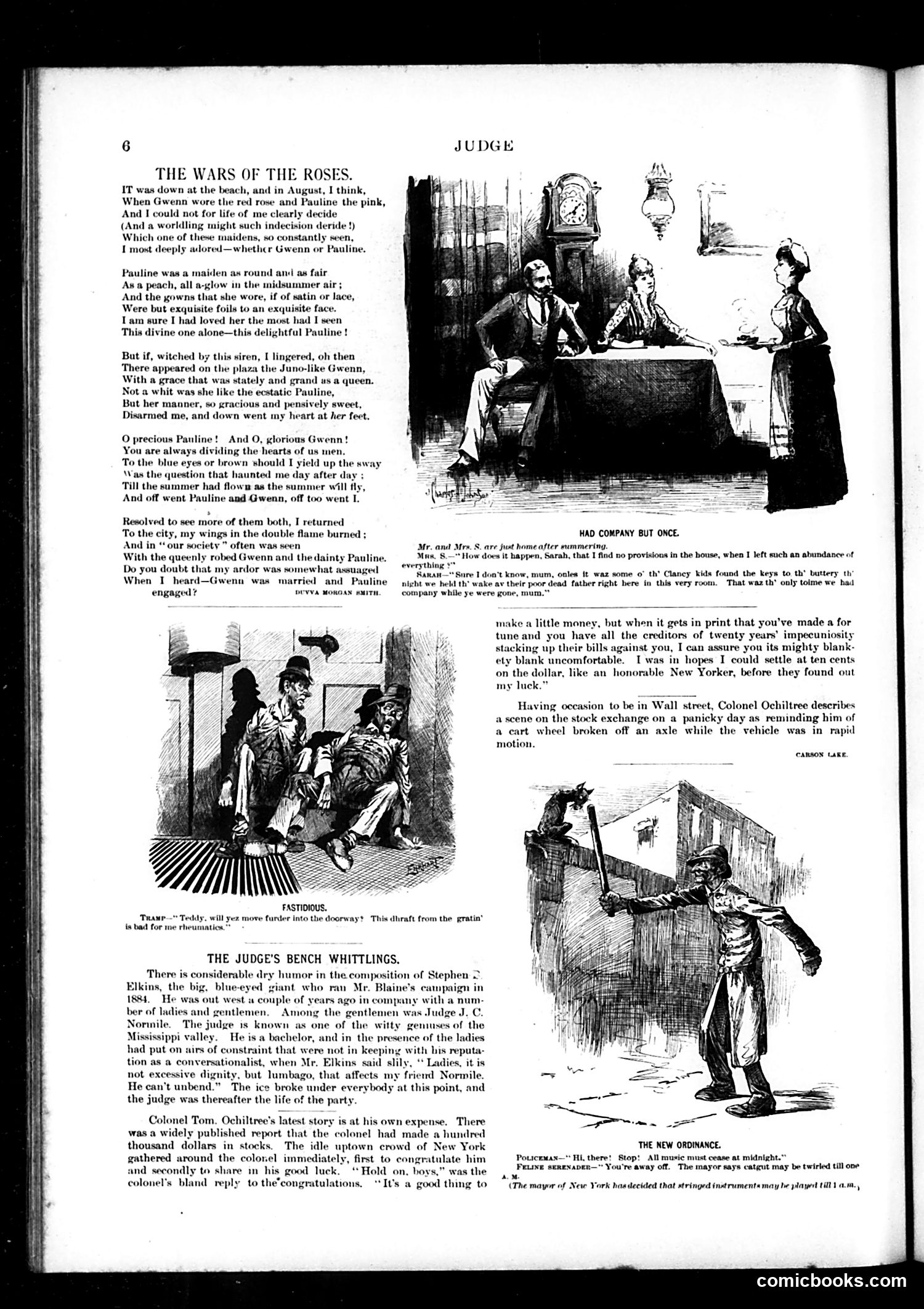
**Upper section:** A humorous poem about a man romantically torn between two women—Pauline (round, peachy, vibrant) and Gwenn (stately, gracious, queenly)—both wearing symbolic roses. The joke is the speaker's indecision between two equally appealing suitors until both marry others and he pursues them both anyway. It's a lighthearted satire of romantic fickleness. **"Bad Company But Once":** A domestic humor sketch where a servant explains that the household provisions vanished because poor neighbors gathered to wake a deceased relative—"the only time we had company while ye were gone." The satire mocks both the servant's indirect explanation and working-class mourning customs. **Lower sections:** Brief anecdotes about Judge J.C. Normile (known for wit, initially constrained around ladies until Mr. Elkins humorously attributes his stiffness to lumbago) and Colonel Tom Ochiltree's stock-market gains. These illustrate social awkwardness and financial gossip among gentlemen's circles. The page targets romantic indecision, class pretensions, and masculine social dynamics—typical Judge magazine fare from the Gilded Age.
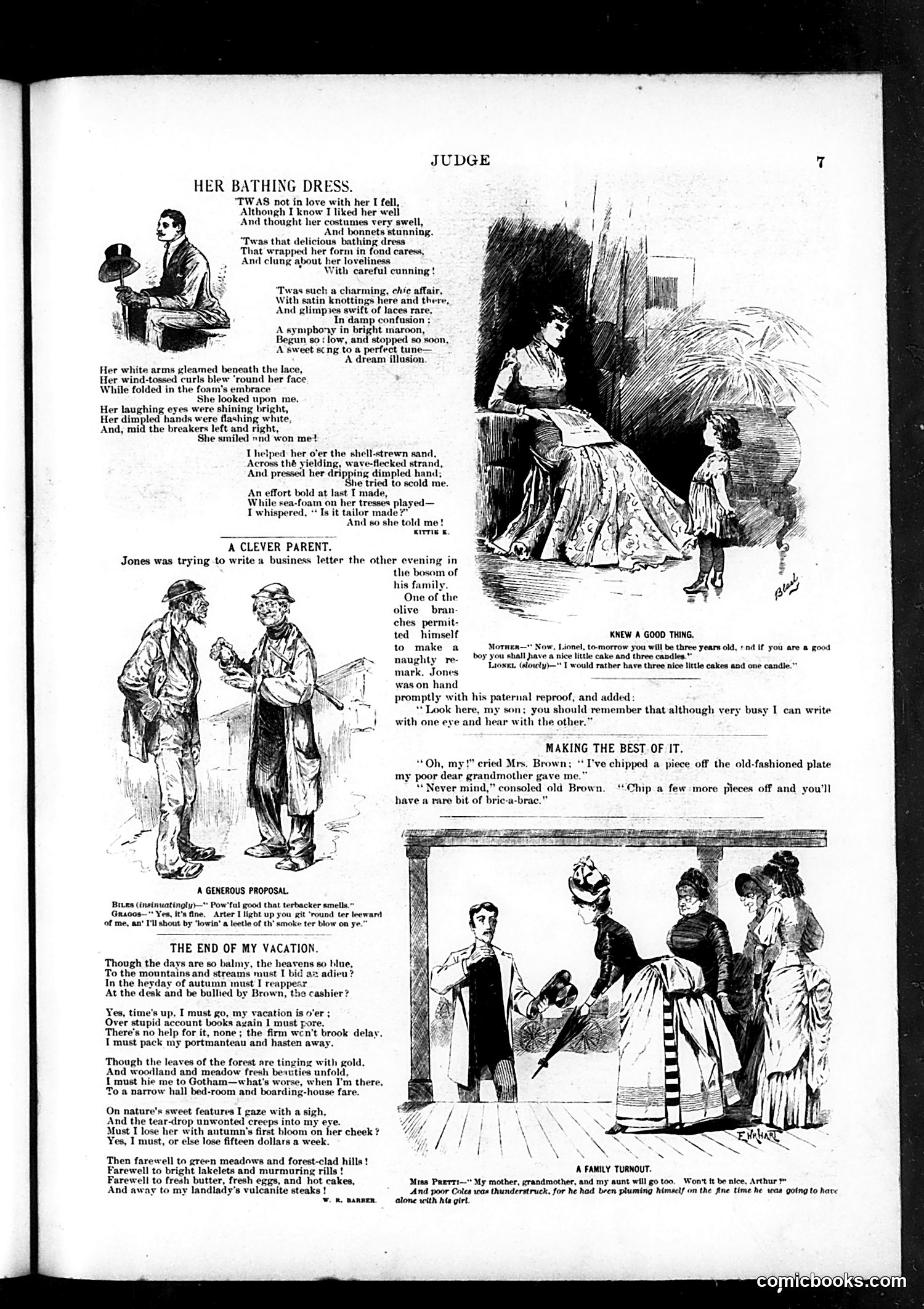
This page from the satirical magazine *Judge* contains several humorous pieces mocking Victorian-era social conventions and domestic life. **"Her Bathing Dress"** is a comedic poem satirizing male obsession with women's fashions. The narrator initially believes he's fallen for a woman, but reveals his attraction is entirely to her carefully constructed bathing outfit—the poem's ironic punchline occurs when he asks if the dress is "tailor made," deflating romantic pretense with practical materialism. **"A Clever Parent"** mocks parental hypocrisy: Jones scolds his young son for being naughty while simultaneously admitting he's distracted writing business correspondence—he can't actually supervise properly while working. **"The End of My Vacation"** depicts an office worker's melodramatic lament at returning from holiday to his tedious job and boarding-house life, contrasting natural beauty with urban drudgery and poor food. The minor sketches ("Making the Best of It," "A Generous Proposal," "A Family Turnout") offer quick domestic and social jokes typical of the era's light humor magazines, focusing on marriage, class distinctions, and courtship anxieties.
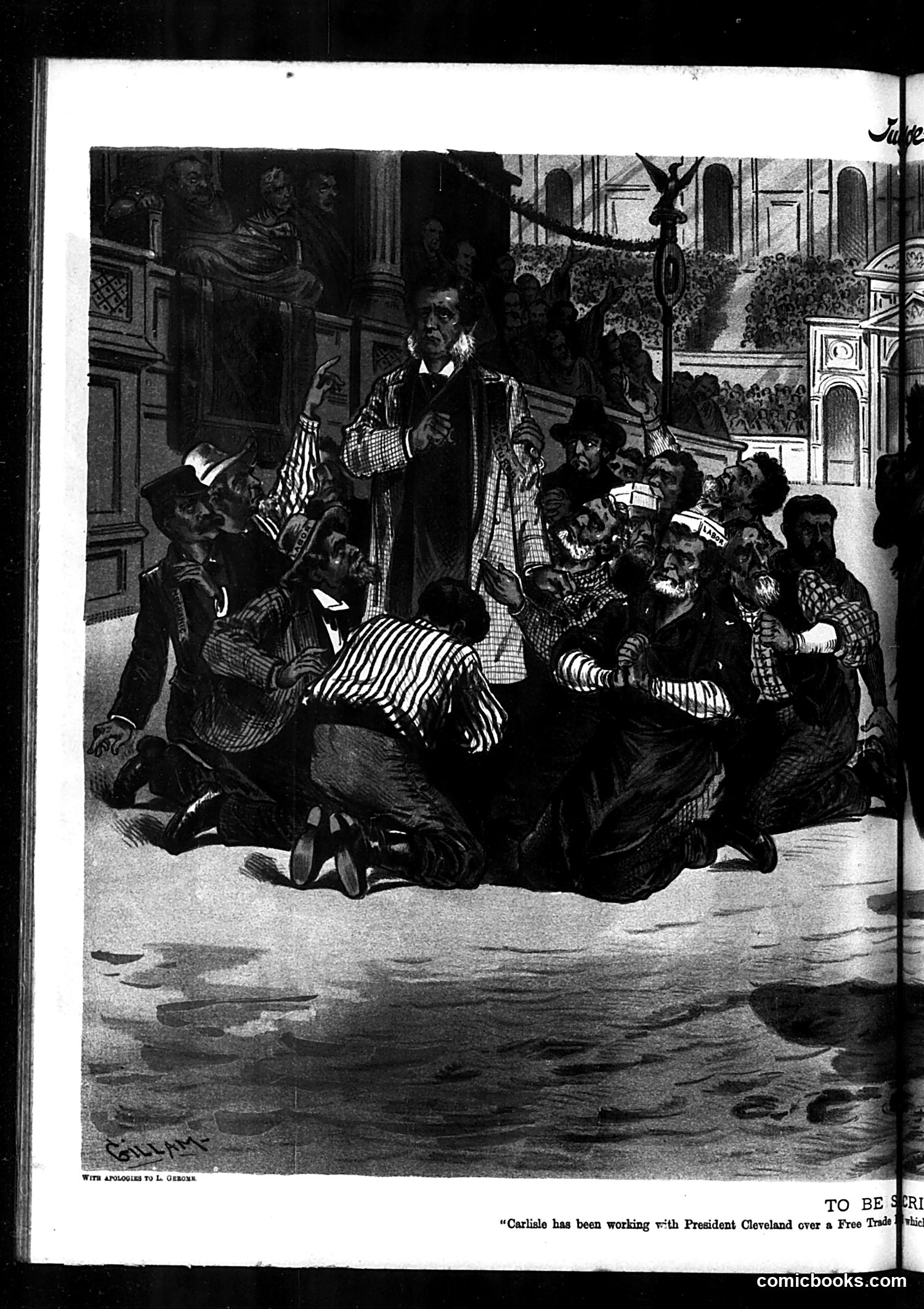
This Judge magazine cartoon satirizes Secretary of the Treasury John G. Carlisle's collaboration with President Grover Cleveland on free trade policy. The image depicts figures in striped clothing (suggesting prisoners or convicts) gathered in what appears to be an official setting, suggesting the cartoon equates free trade advocacy with criminal or disreputable activity. The satire mocks Carlisle and Cleveland's push for tariff reduction and free trade, which was economically controversial during the 1890s. Protectionists opposed free trade as harmful to American industry and workers. By depicting the participants as criminals or captives, Judge ridicules the policy as illegitimate or dangerous to the nation's interests.
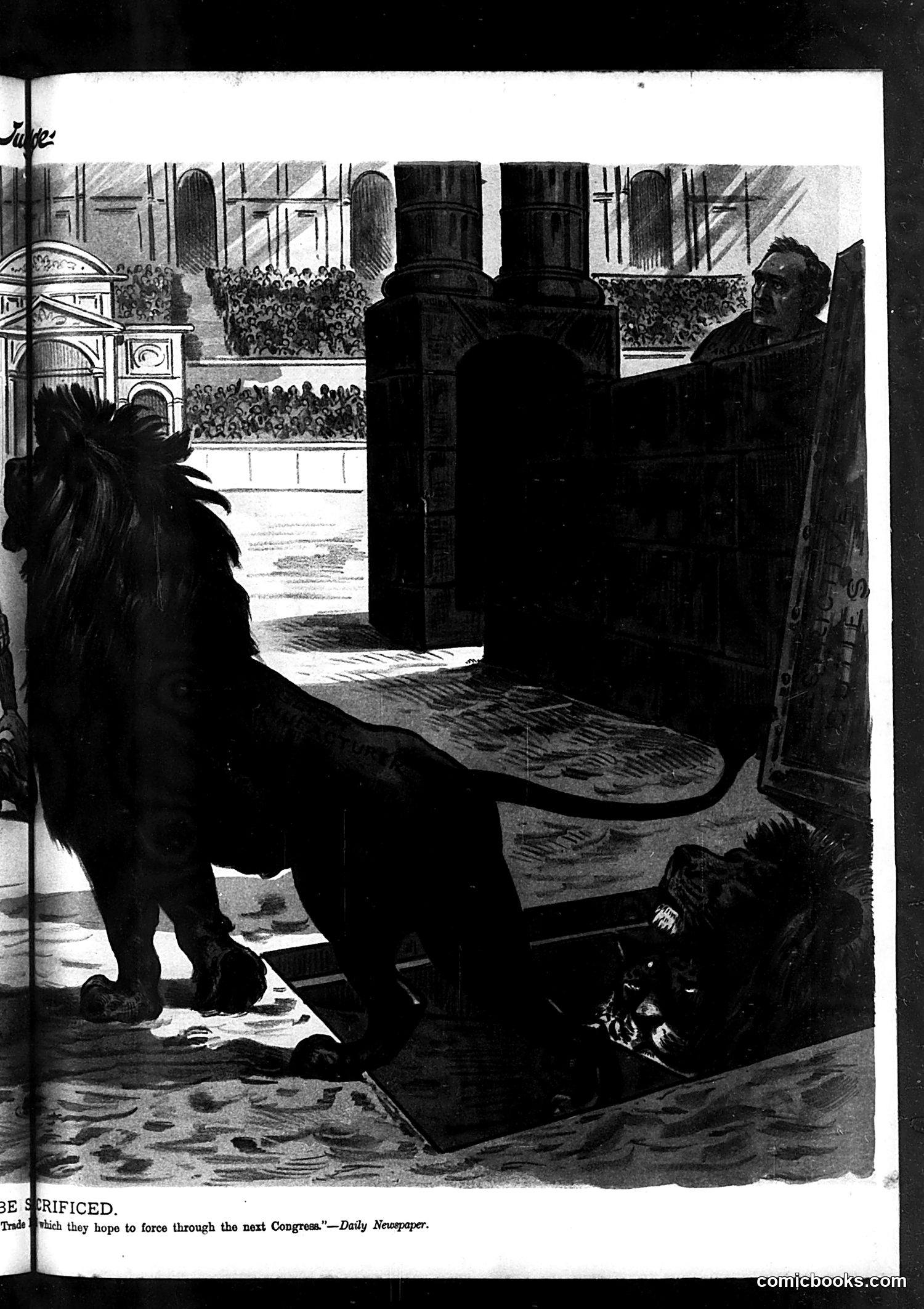
This political cartoon depicts a gladiatorial scene set in an ancient Roman arena with spectators in the background. A figure in the foreground (left) appears to be a Christian or martyr about to be executed, while another figure (right) observes from above, possibly representing political authority or an emperor. The caption references forcing something "through the next Congress," suggesting the cartoon satirizes a controversial legislative proposal the cartoonist views as sacrificial or destructive. The gladiatorial imagery implies the political process will result in someone's "sacrifice"—likely the defeat or harm of a particular cause, group, or person the cartoon's creator opposed. Without knowing the specific Congress referenced, the exact issue remains unclear, though the tone indicates strong disapproval of anticipated legislation.
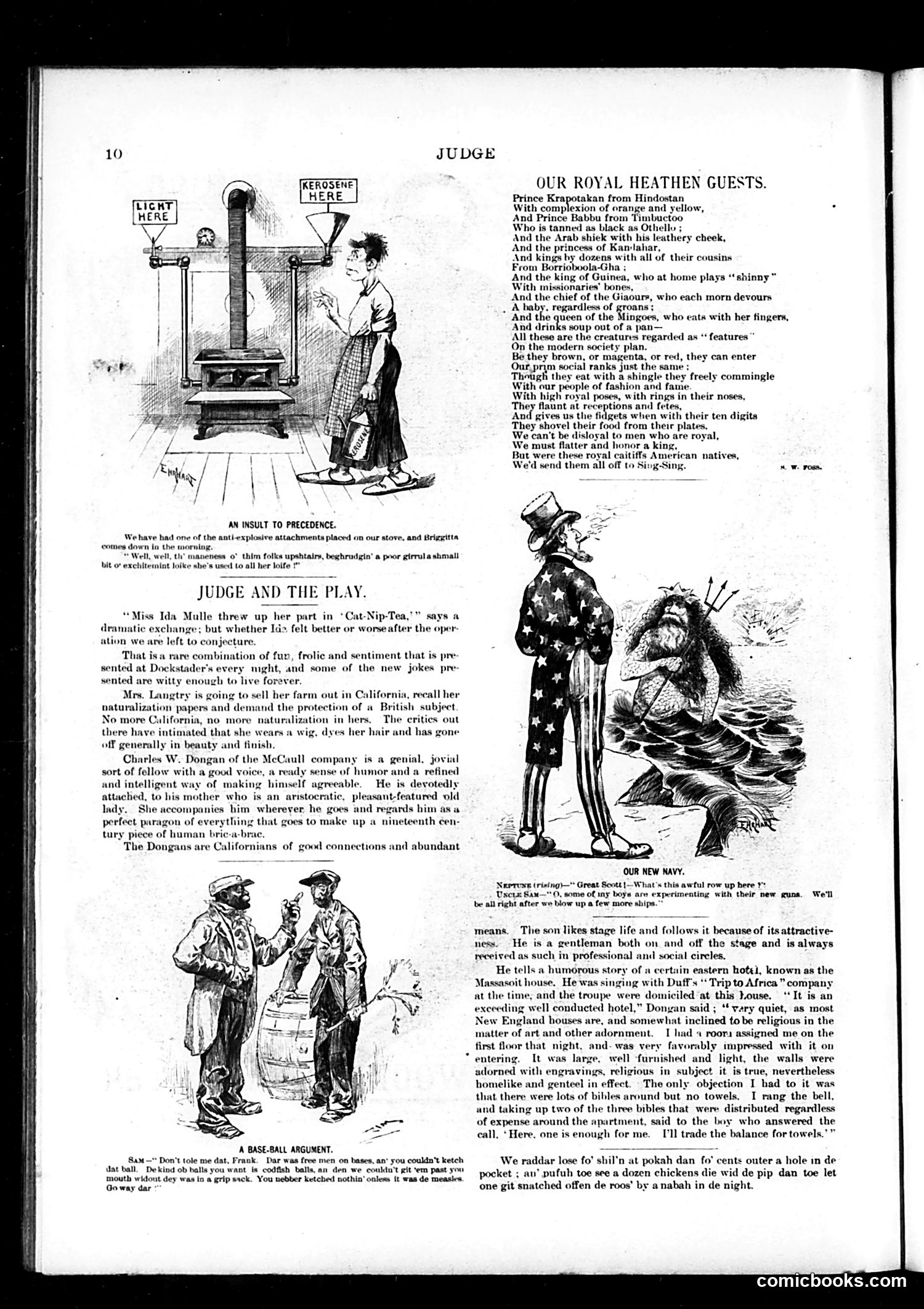
This page contains three distinct satirical pieces: **"Our Royal Heathen Guests"** (top right): A poem mocking the contemporary trend of elite American society entertaining visiting foreign dignitaries and royalty from Asia and Africa. The satire targets the hypocrisy of treating non-white foreign nobles with deference while American society would criminalize similar behavior from American racial minorities—the poem concludes that if these were "American natives" rather than foreign royalty, they'd be sent to Sing Sing (prison). This reflects late-19th-century anxieties about race, class, and social hierarchy. **"Judge and the Play"** (center): Theater criticism discussing performances and actors, including commentary on actress Lillie Langtry and theatrical productions like "Cat-Nip-Tea." **"Baseball Argument"** and **"Our New Navy"** (bottom): Brief comedic dialogues using dialect humor and military satire. The page exemplifies Judge's satirical approach: exposing social contradictions, particularly regarding race and class prejudice in Gilded Age America.
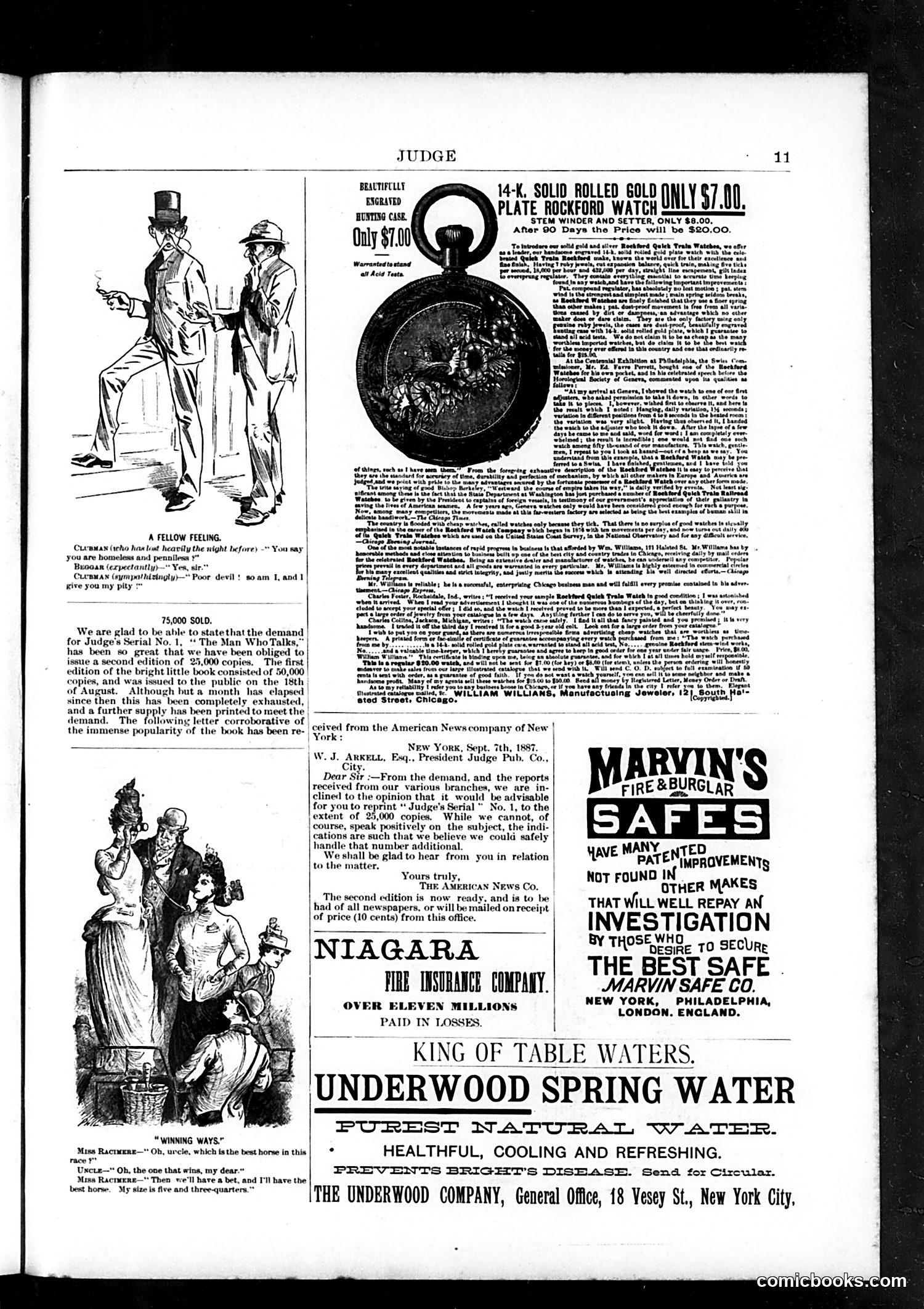
This cartoon presents a class-commentary joke typical of Judge magazine's satirical humor. Two men encounter each other at night: a wealthy gentleman (Clubman) who admits he's "homeless and penniless," and a beggar (Broker) in similar straits. The satire targets economic instability and class hypocrisy of the Gilded Age. The "fellow feeling" refers to their shared misery, but the joke's bite comes from the Clubman's patronizing pity toward someone in identical circumstances—suggesting wealthy men could temporarily experience poverty and still maintain their sense of superiority. The caption indicates both men are broke, but the gentleman's sympathy toward the beggar is ironic given their equal desperation. This likely comments on how even financial ruin doesn't humble the wealthy or create genuine class solidarity; condescension persists regardless of actual circumstance. The cartoon reflects Judge's satirical examination of American society's class pretensions.
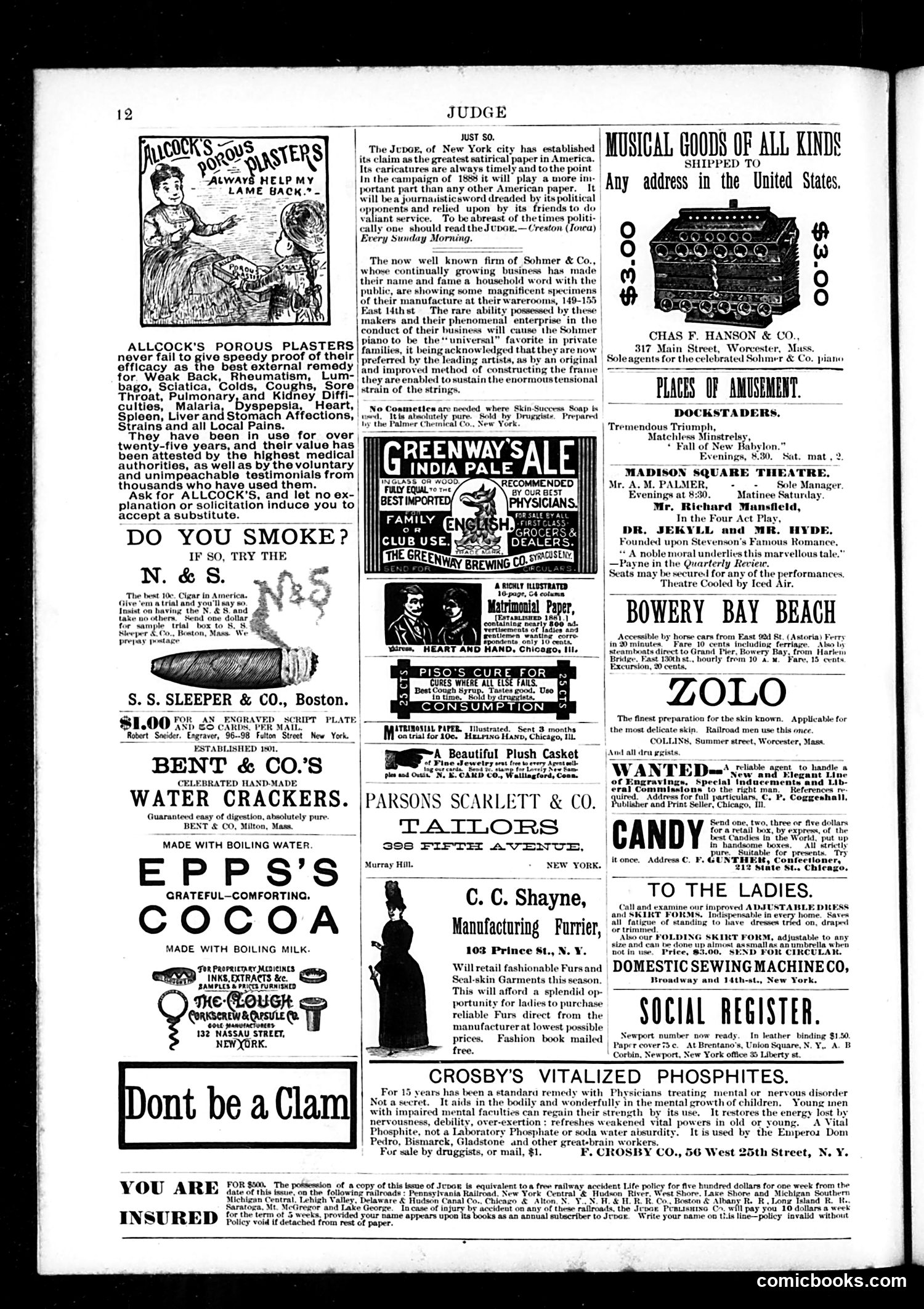
This is primarily an **advertising page** from Judge magazine, a satirical publication. The only substantive editorial content is a brief prefatory note praising Judge's political cartoons and influence during the 1888 election campaign, positioning it as essential reading for staying "abreast of the times politically." The remainder of the page consists entirely of advertisements for patent medicines, musical instruments, theatrical productions, and consumer goods typical of the 1880s era—including Allcock's Porous Plasters, Epps's Cocoa, Bent & Co.'s Water Crackers, and various stage performances at venues like Madison Square Theatre. There are no political cartoons visible on this particular page. The satirical character of Judge is referenced editorially but not demonstrated through imagery here.
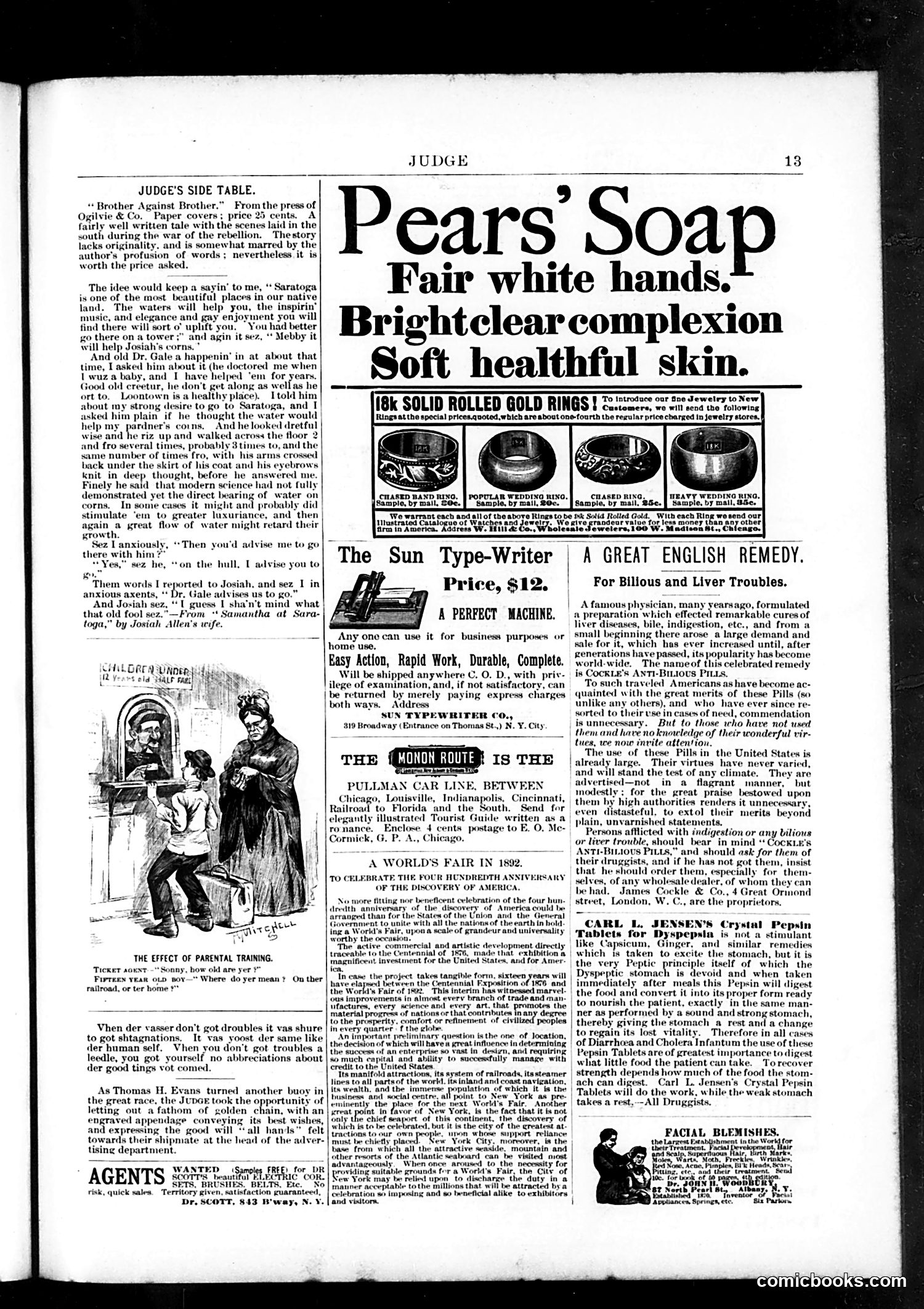
This page is primarily **advertising and lighter editorial content** rather than hard-hitting political satire. The main cartoon, "The Effect of Parental Training," depicts a street urchin claiming different ages depending on context—suggesting child labor exploitation. A ticket agent asks his age; the boy replies differently for railroad work versus home life, implying children were working multiple jobs under false ages during the Gilded Age. The editorial sidebar discusses Saratoga Springs as a health resort, reflecting late-19th-century faith in mineral waters as medical cure-alls—now understood as pseudoscience. Most of the page consists of advertisements: Pears' Soap (promoting beauty standards), typewriters, railroad tourism, and medical remedies claiming to cure liver disease. These ads reflect contemporary consumer culture and dubious health claims typical of the 1890s era. The cartoon's subtle point: parental negligence or necessity forcing children into deceptive labor practices.
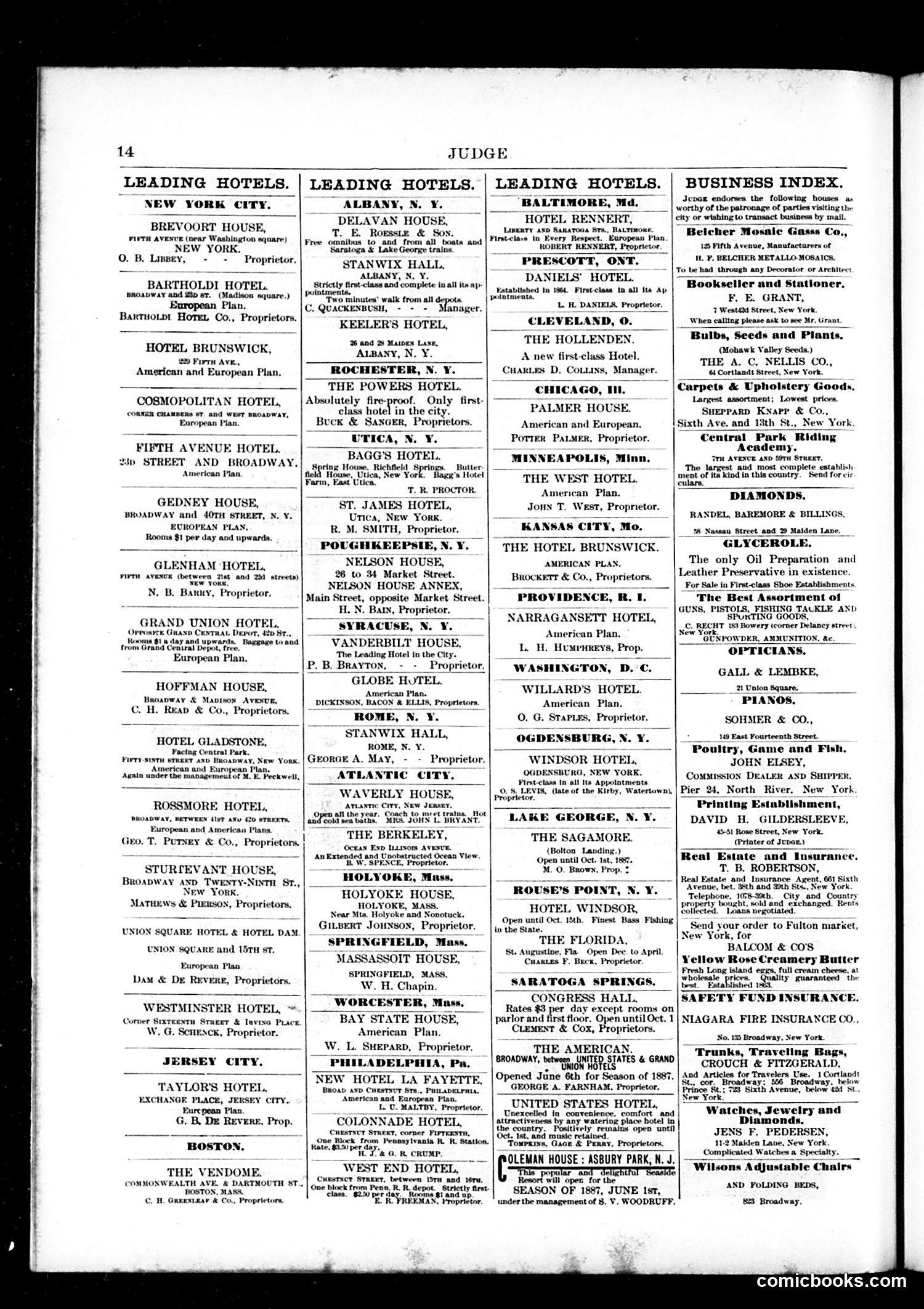
This page is primarily a **business directory of leading hotels** across major American cities in the late 19th century, arranged in columns by location (New York City, Albany, Baltimore, Chicago, etc.). There are **no cartoons visible** on this page—it consists entirely of hotel advertisements listing proprietors, addresses, amenities (European Plan, American Plan, fire-proof construction), and contact information. The page represents **Judge magazine's commercial content**, showing how such publications supplemented satirical editorial material with paid advertising. The prominence of hotel listings reflects the era's booming hospitality industry catering to business travelers and tourists. This is a standard advertising page with no political or social satire to decode—a practical business resource for contemporary readers seeking accommodations while traveling America's major cities.
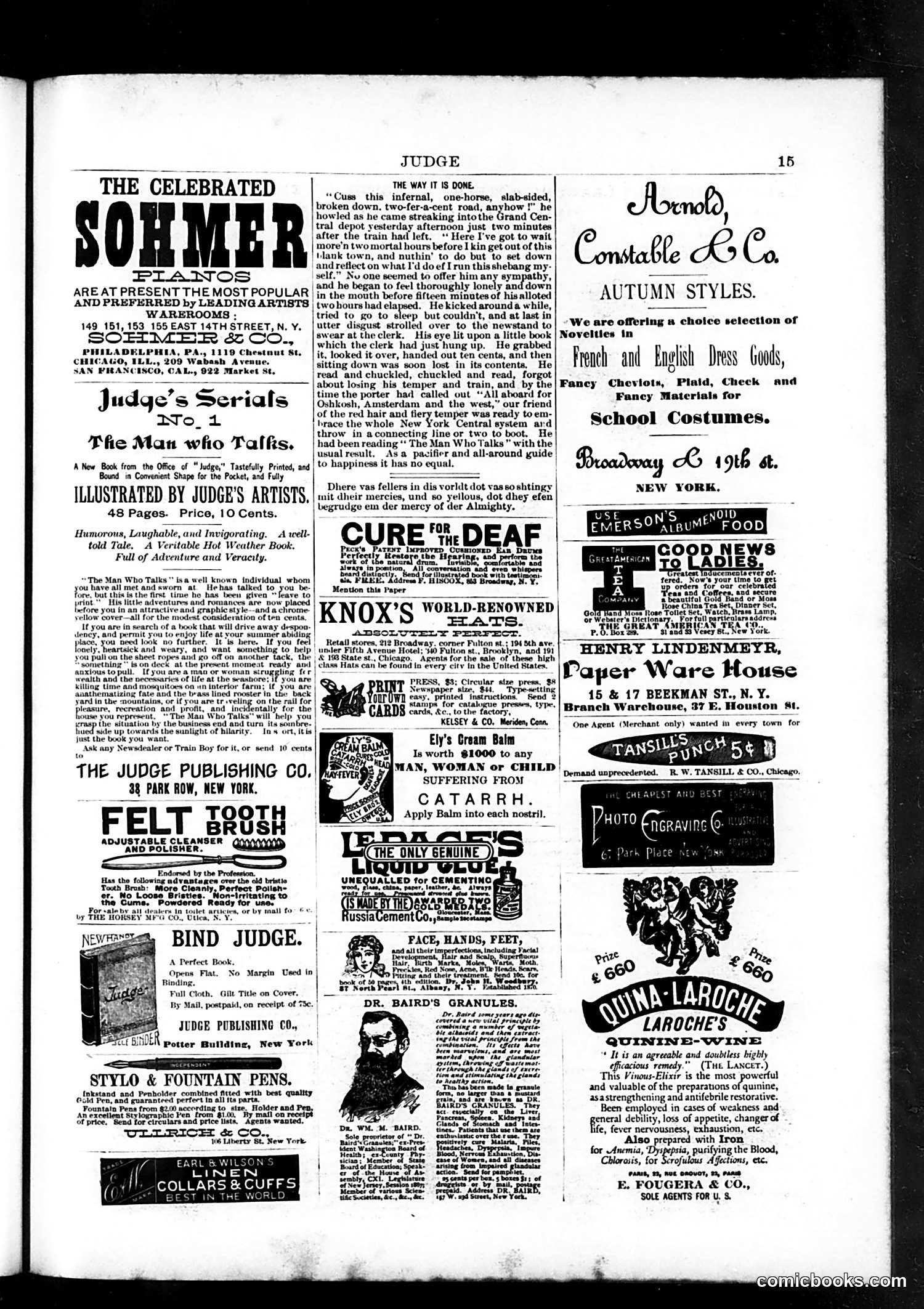
This page is primarily **advertising and promotional material**, not political satire. The advertisements include piano manufacturers, dental products, fountain pens, and other consumer goods typical of the era. The only editorial content is a promotion for Judge Publishing's own product: **"The Man Who Talks,"** a 48-page humorous book (10 cents) advertised as featuring entertaining stories about a recognizable character type—the talkative bore everyone encounters. The accompanying narrative excerpt describes an impatient traveler stuck at Grand Central Station who, frustrated and lonely after missing his train, purchases the book at a newsstand to pass time. The satire is mild and self-referential: Judge is essentially advertising its own humor book by depicting how its content solves everyday boredom. There are no identifiable political figures or significant social commentary visible on this page—it's primarily a **commercial product catalog** masquerading as editorial content, common in period magazines.
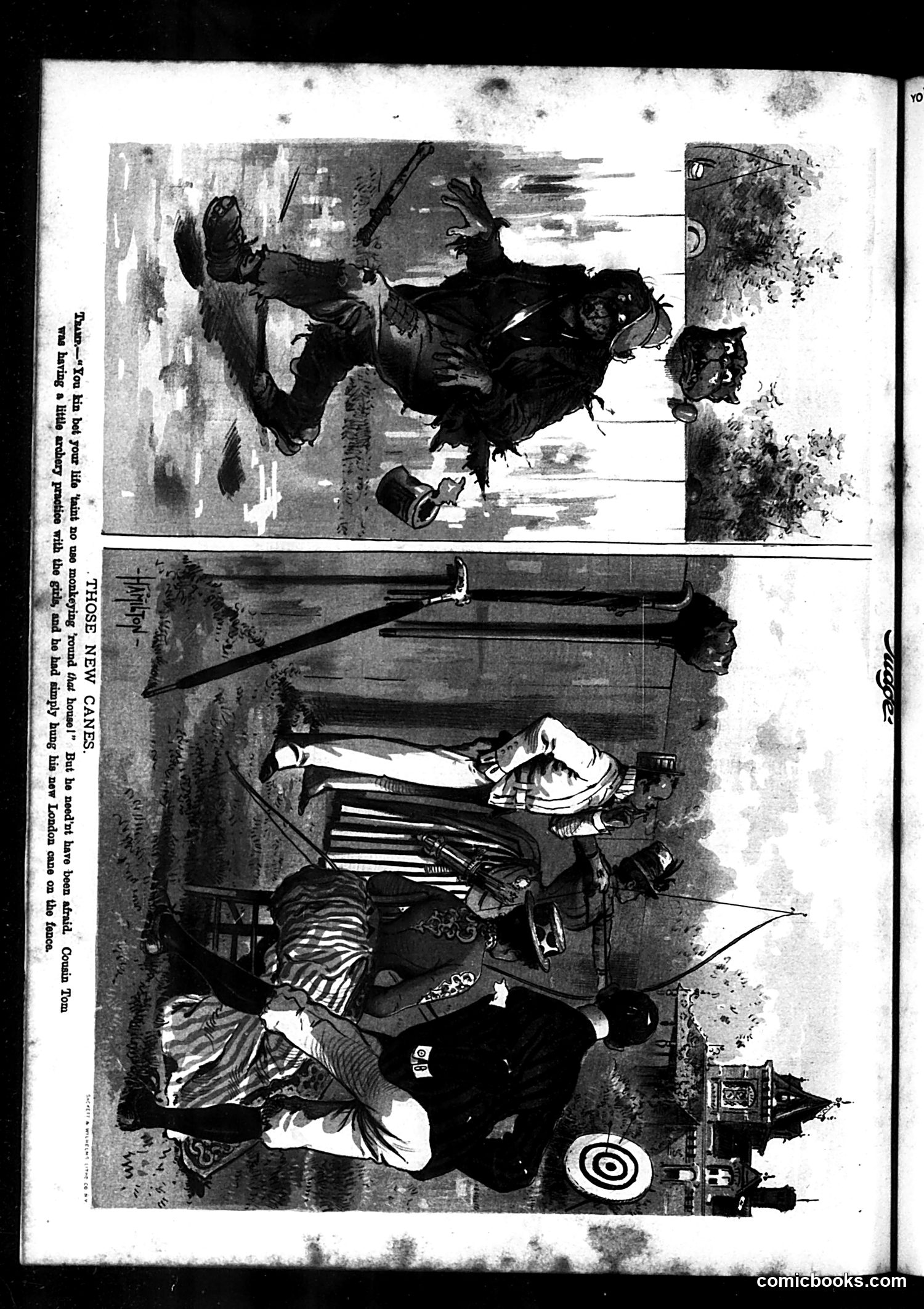
This appears to be a humorous domestic scene rather than political satire. The cartoon depicts a misunderstanding: a man (labeled "Tauc") warns someone against approaching a house, believing there's danger. However, the actual situation shows a man named "Cousin Tom" engaged in innocent archery practice with young women, having simply hung his new fashionable London cane on a fence. The joke relies on the visual gag of the cane's position resembling something threatening at first glance, creating comic irony. The satire is social rather than political—mocking genteel Victorian courtship customs and the fashionable obsession with imported "London" goods among American leisure classes. The caption's vernacular ("You kin bet") suggests class-based humor about rural versus urban sensibilities.