
A complete issue · 16 pages · 1887
Judge — September 3, 1887
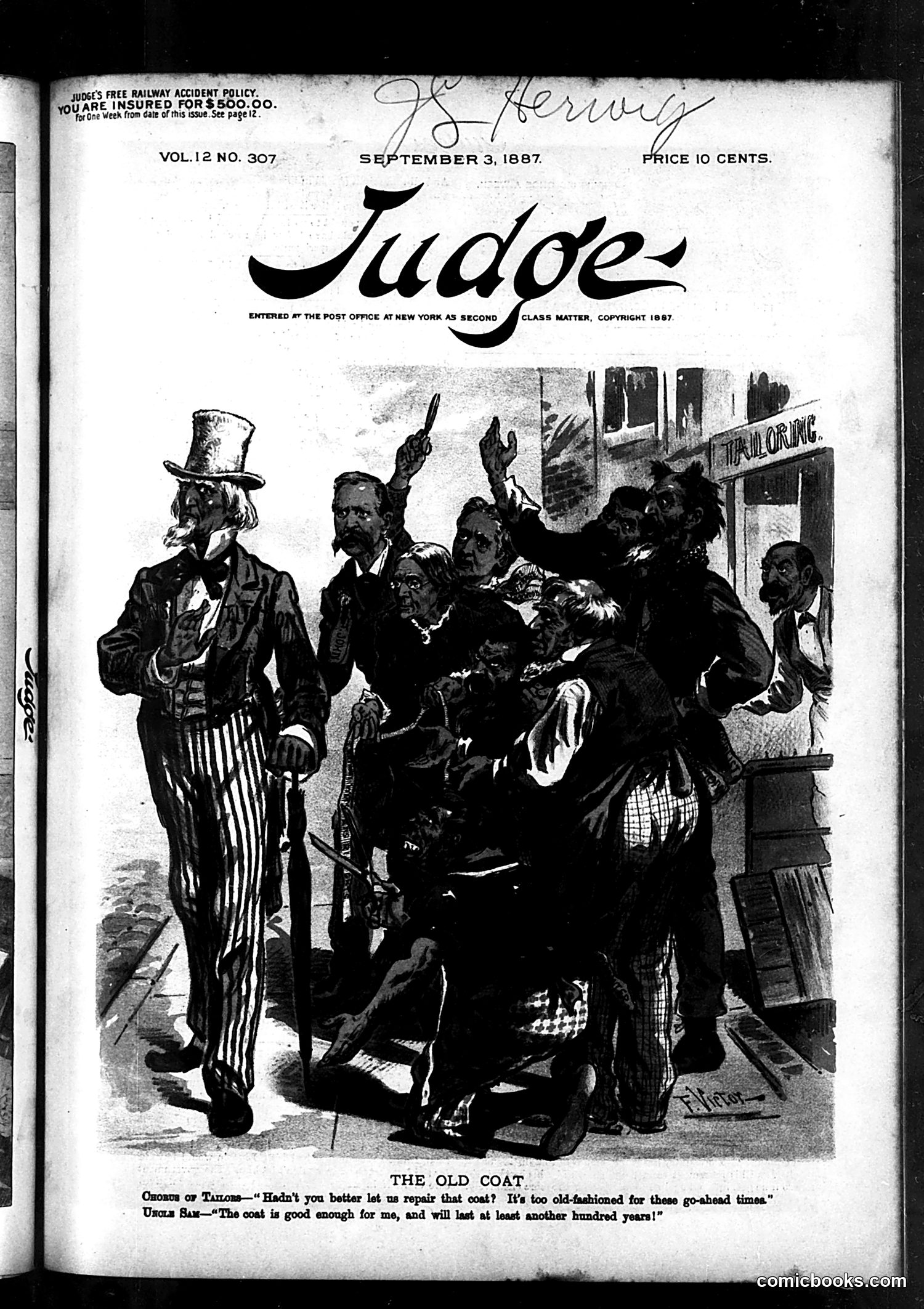
This cartoon satirizes disagreement over tariff policy. The figure on the left, labeled "Grocer of Tailors," appears to represent a merchant or tradesman advocating for coat repair. Uncle Sam (right, in striped pants) responds that his old coat is "good enough" and will last "another hundred years." The satire likely concerns American protectionist tariff debates of the 1880s. The "old coat" represents existing tariff policy; one faction wants it modernized ("repaired"), while another—represented by Uncle Sam—insists the current system remains adequate despite its age. The cartoon mocks resistance to tariff reform, suggesting opponents cling stubbornly to outdated economic policies rather than address contemporary commercial needs.
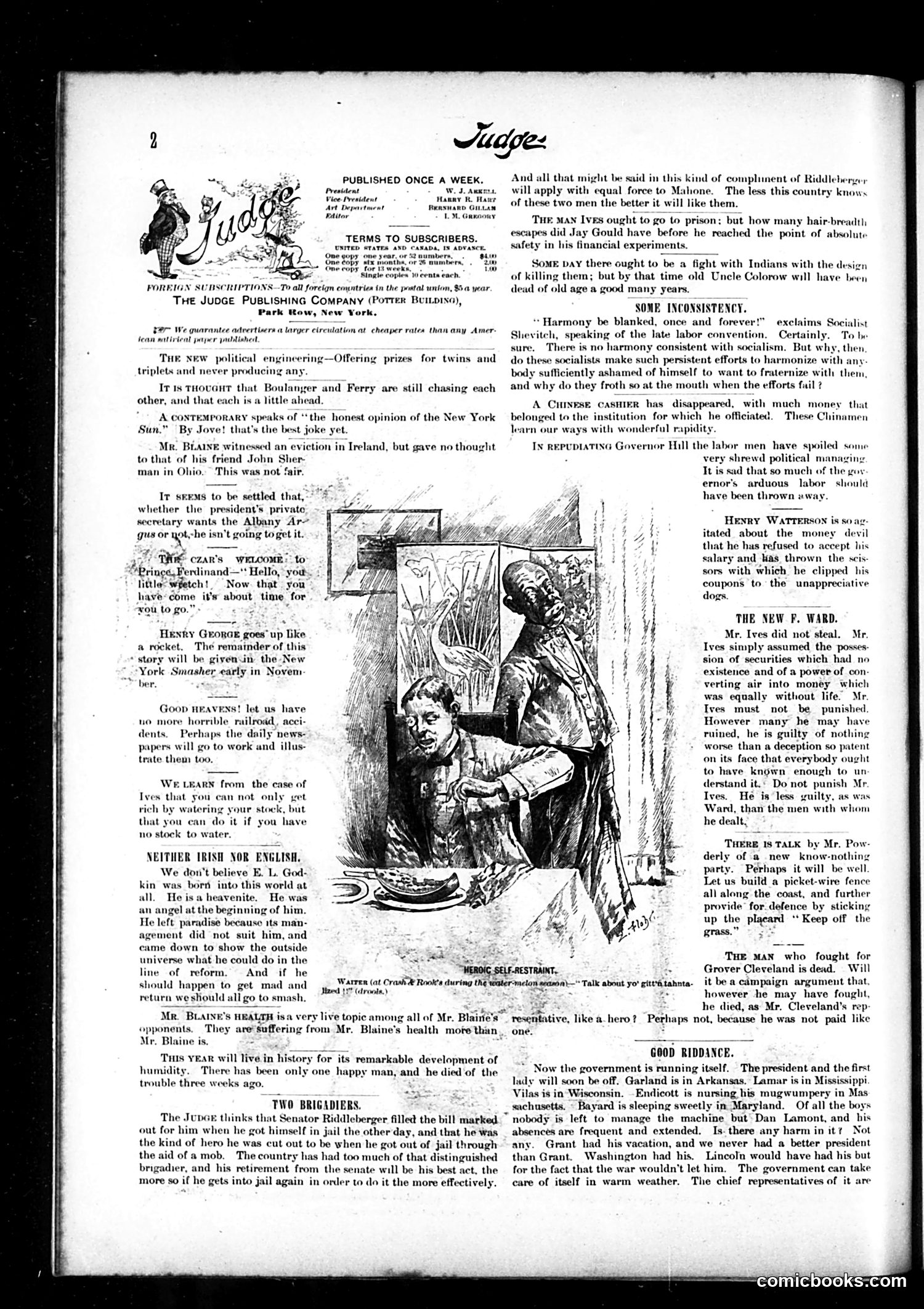
The central cartoon, titled "Heroic Self-Restraint," depicts two figures—labeled as "Walter (of Tammany Hall's during the winter-budget season)" and an unnamed companion—apparently engaged in a financial transaction or discussion involving money and documents. The satire targets **Tammany Hall**, New York City's notoriously corrupt Democratic political machine. The cartoon suggests that despite having opportunities for theft or embezzlement, these political figures are showing "heroic self-restraint" by not stealing—a sardonic commentary on the endemic corruption associated with Tammany Hall politics. Without the specific historical date visible, the exact political moment remains unclear, but the satire mocks Tammany's reputation for graft and patronage.
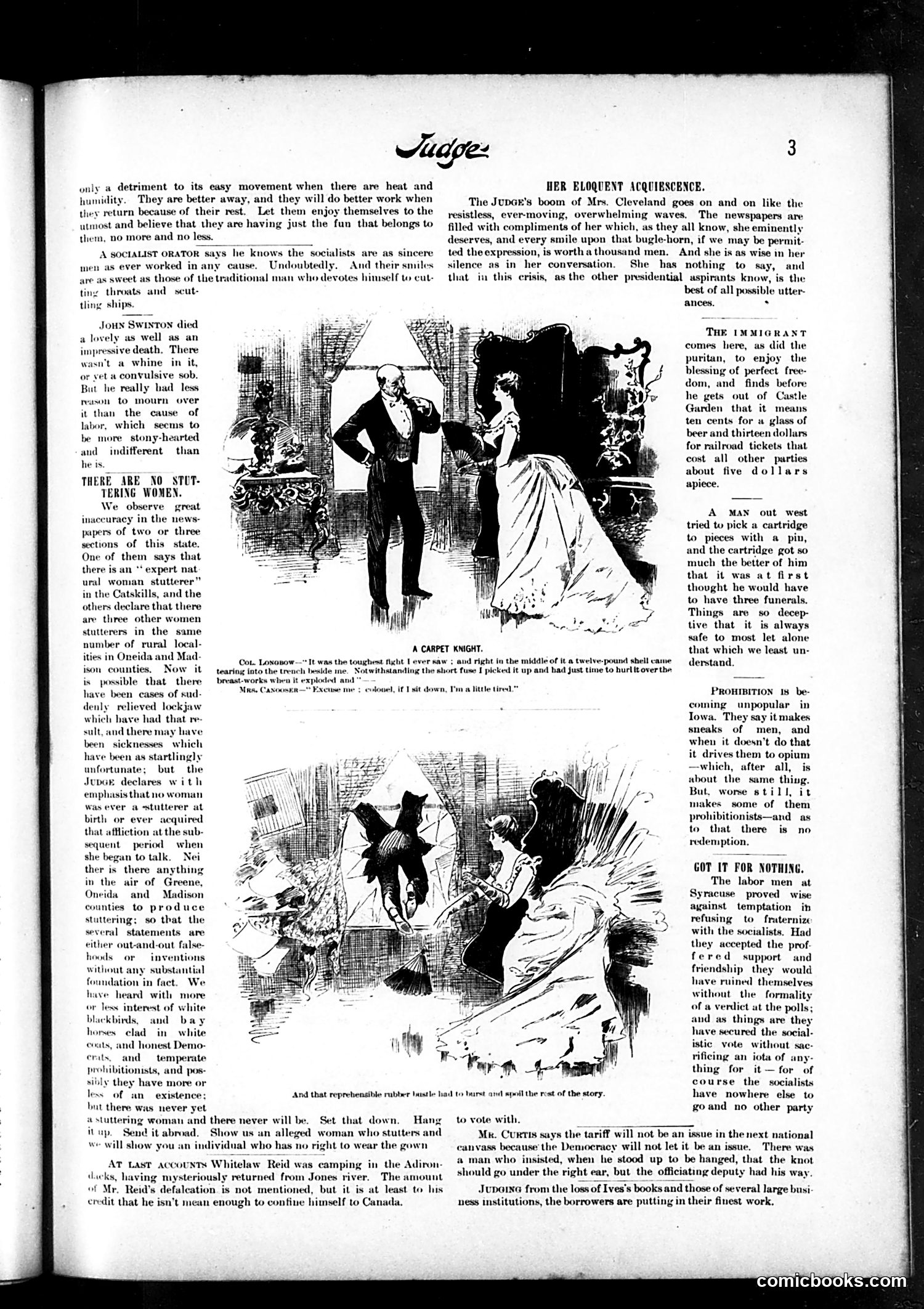
This page contains several satirical pieces attacking political and social figures: **"A Carpet Knight"** cartoon mocks a man recounting a fight, interrupted when a woman's "rubber bustle" bursts—suggesting his story is as insubstantial as ladies' fashion. **"Her Eloquent Acquiescence"** praises Mrs. Cleveland (wife of President Grover Cleveland) for her silence during the political crisis, sarcastically suggesting her saying nothing is worth "a thousand men." The satire implies women's value lies in quiet compliance rather than meaningful contribution. **Anti-Socialist commentary** dismisses socialist orators as insincere and dangerous, comparing them to those who "cut throats and scuttle ships"—reflecting the era's fierce opposition to labor movements. **Other pieces** ridicule claims of female stutterers (asserting women never stutter), mock Whitelaw Reid's alleged financial misconduct, and criticize prohibition advocates—typical of Judge's conservative, anti-reform stance during the Gilded Age. The tone throughout is smugly elitist, mocking both progressive movements and ordinary people's experiences.
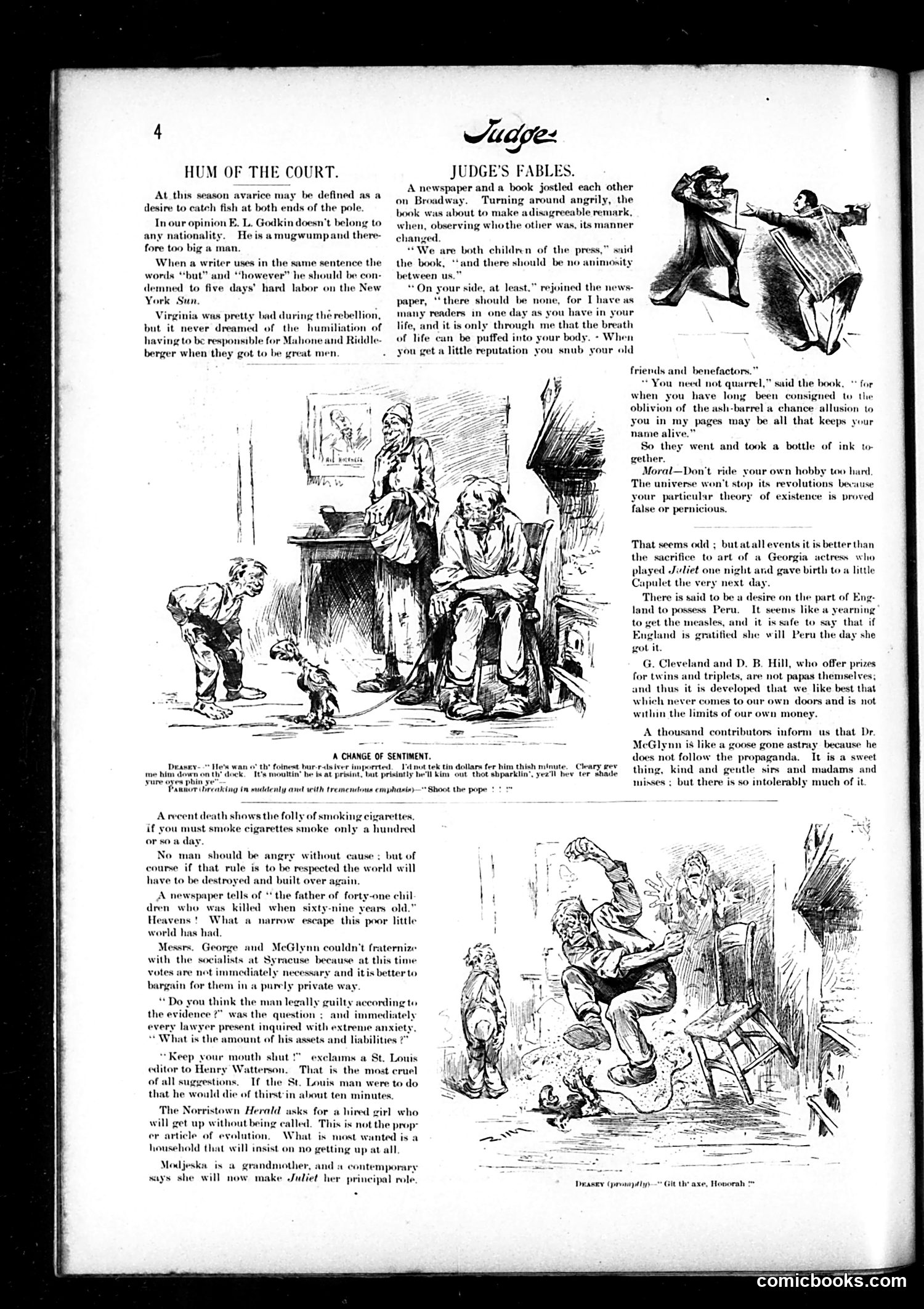
This page contains multiple satirical pieces typical of late-19th-century American humor journalism. **"Judge's Fables"** presents an anthropomorphic dialogue between a Newspaper and a Book encountered on Broadway. The moral critiques intellectuals who obsess over narrow theories while ignoring practical reality—likely targeting academic or philosophical disputes of the era. The newspaper condescends to the book as yesterday's medium; the book claims the newspaper will eventually become trash. Their reconciliation suggests both media serve purposes. **"A Change of Sentiment"** (lower section) appears to mock shifting political allegiances, showing a figure who previously valued something now dismissing it—possibly referencing unstable voter behavior or political opportunism common in Gilded Age American politics. The scattered editorial commentary mocks various contemporary figures and social trends: E.L. Godkin (a famous editor), Virginia politicians Mahone and Riddleberger, Dr. McGlynn (a controversial priest), and actress Modjeska—typical targets of Judge's satirical commentary on American public life.
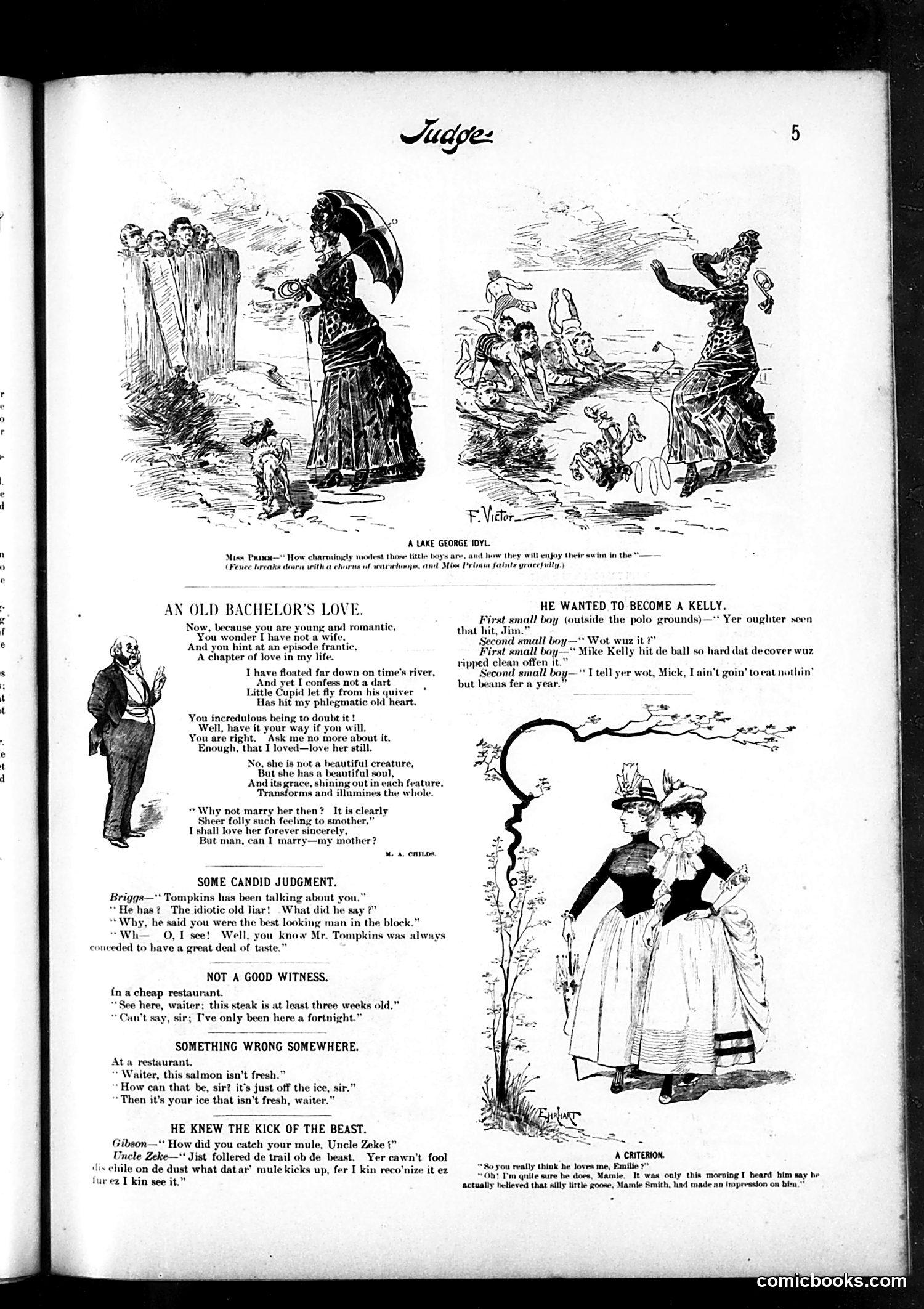
This page contains several standalone humor pieces typical of Judge's satirical content: **"An Old Bachelor's Love"** presents a sentimental poem where an elderly man explains why he won't marry, despite loving a woman—because she's his mother. The joke relies on Victorian sentimentality undercut by an absurd revelation. **"Some Candid Judgment"** satirizes insincere flattery: a man takes a backhanded compliment (being "best looking" in his block) as genuine praise, assuming the complimenter has good taste. **"Not a Good Witness" and "Something Wrong Somewhere"** mock restaurant workers deflecting blame through circular logic—the waiter can't judge the steak's age because he's new; the restaurant's ice problem, not the fish, explains spoilage. **"He Wanted to Become a Kelly"** jokes about baseball, referencing Mike Kelly (a famous 19th-century player). Boys admire Kelly's power hitting. **"A Criterion"** satirizes shallow male attention: a man's sincere romantic declaration is actually just absent-minded praise of any woman present. These pieces reflect Judge's humor formula: social observation, wordplay, and deflated expectations.
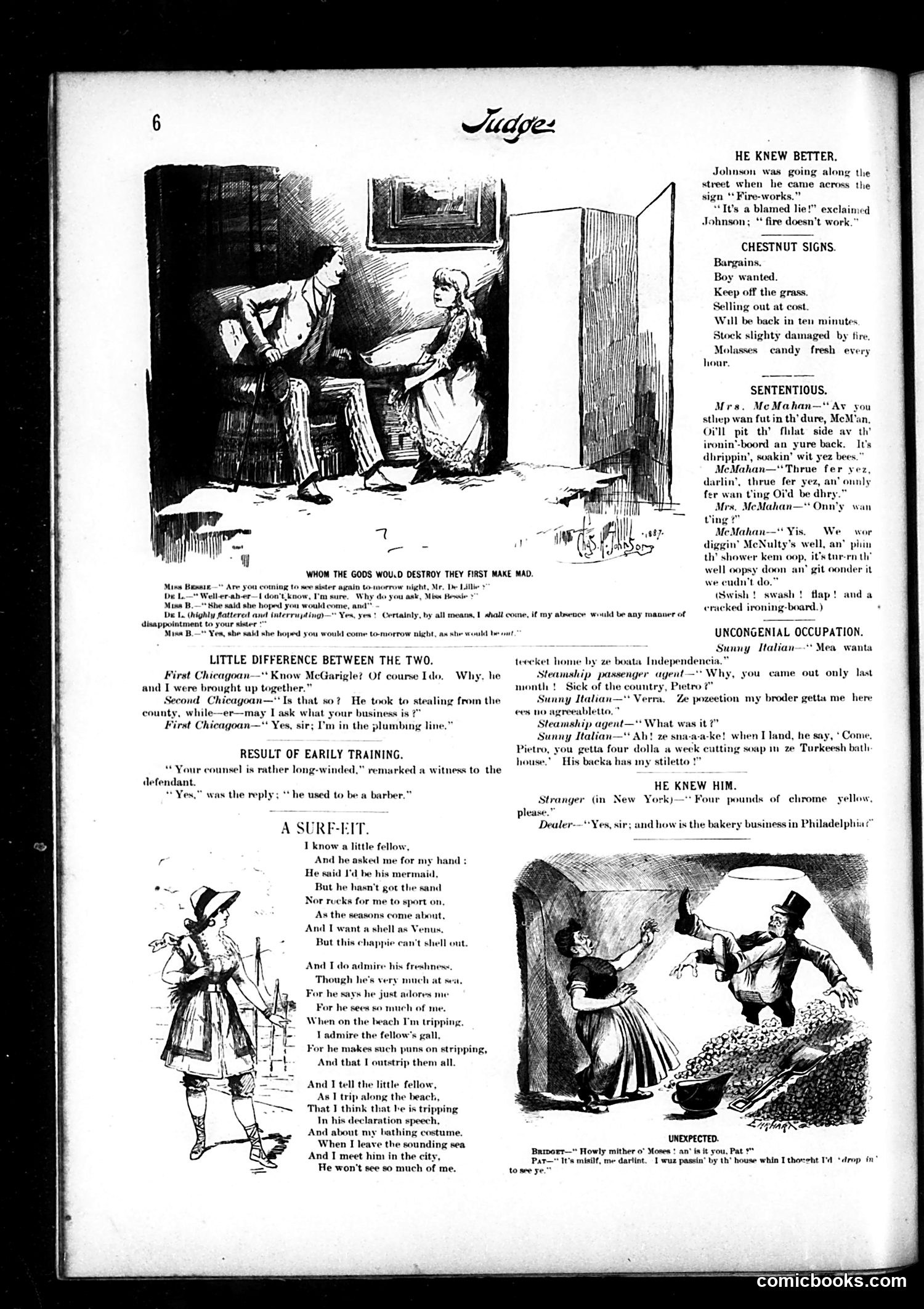
This page contains several short satirical pieces typical of Judge's humor: **"Whom the Gods Would Destroy"** mocks romantic miscommunication—a man misinterprets a woman's polite invitation, flattering himself that she's eager to see him when she merely hoped he'd visit her sister. **"Little Difference Between Two"** satirizes Chicago corruption. Two men boast of knowing a politician named McGargle; one mentions they grew up together, the other reveals McGargle stole from the county. The joke: there's little moral difference between a common thief and a corrupt politician—both are criminals, just operating in different spheres. **"Uncongenial Occupation"** stereotypes Italian immigrants. A newly-arrived Italian wants to return home after his brother secures him work cutting soap in a Turkish bath—supposedly dangerous or unpleasant labor, played for ethnic humor. **"A Surf-Fit"** is a lighthearted poem about a woman rejecting a poor suitor who can't "shell out" money—puns on beaches and shells throughout. The remaining pieces are brief jokes and puns, typical filler content for the magazine.
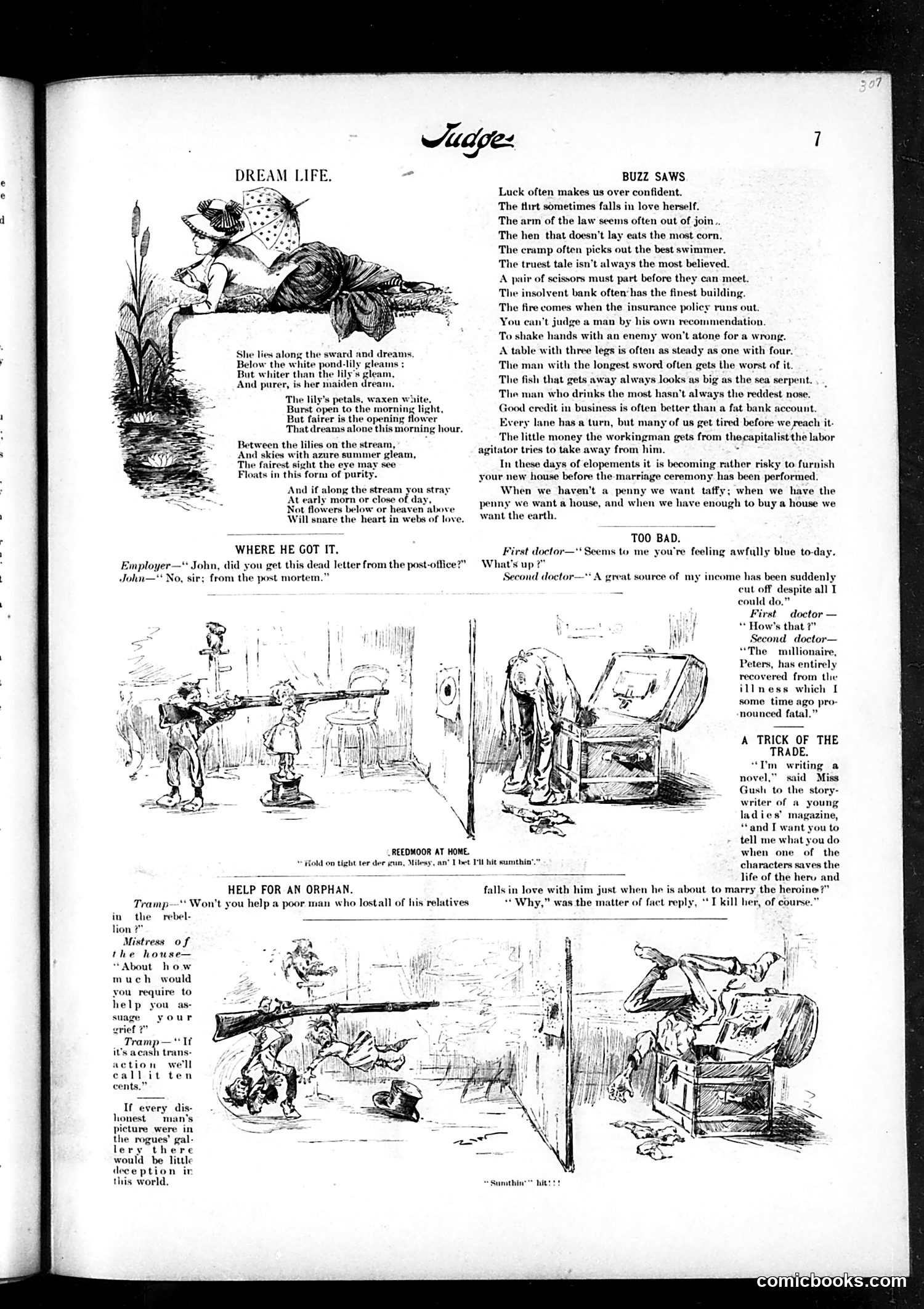
This page contains miscellaneous humor typical of Judge's satirical style, rather than unified political commentary. **"Dream Life"** is sentimental poetry about a woman dreaming by a stream—likely gentle parody of Victorian romantic verse. **"Where He Got It"** is a workplace joke: an employer asks if an employee retrieved a "dead letter" from the post office; the employee replies he got it from the "post mortem" (a pun playing on death). **"Buzz Saws"** is a column of aphorisms mocking common assumptions—luck breeds overconfidence, appearances deceive, etc. These satirize folk wisdom and self-help platitudes. **The cartoons** show working-class scenes: "Reedmoor at Home" depicts someone hunting, "Help for an Orphan" shows a tramp's conversation, and others depict daily life scenarios with accompanying jokes. **"A Trick of the Trade"** mocks popular romance fiction: when a character saves the heroine's life, writers predictably kill off that character to prevent their marriage to the protagonist. Overall, this page emphasizes satire of everyday life, sentimental literature, and common human foolishness rather than specific political figures.
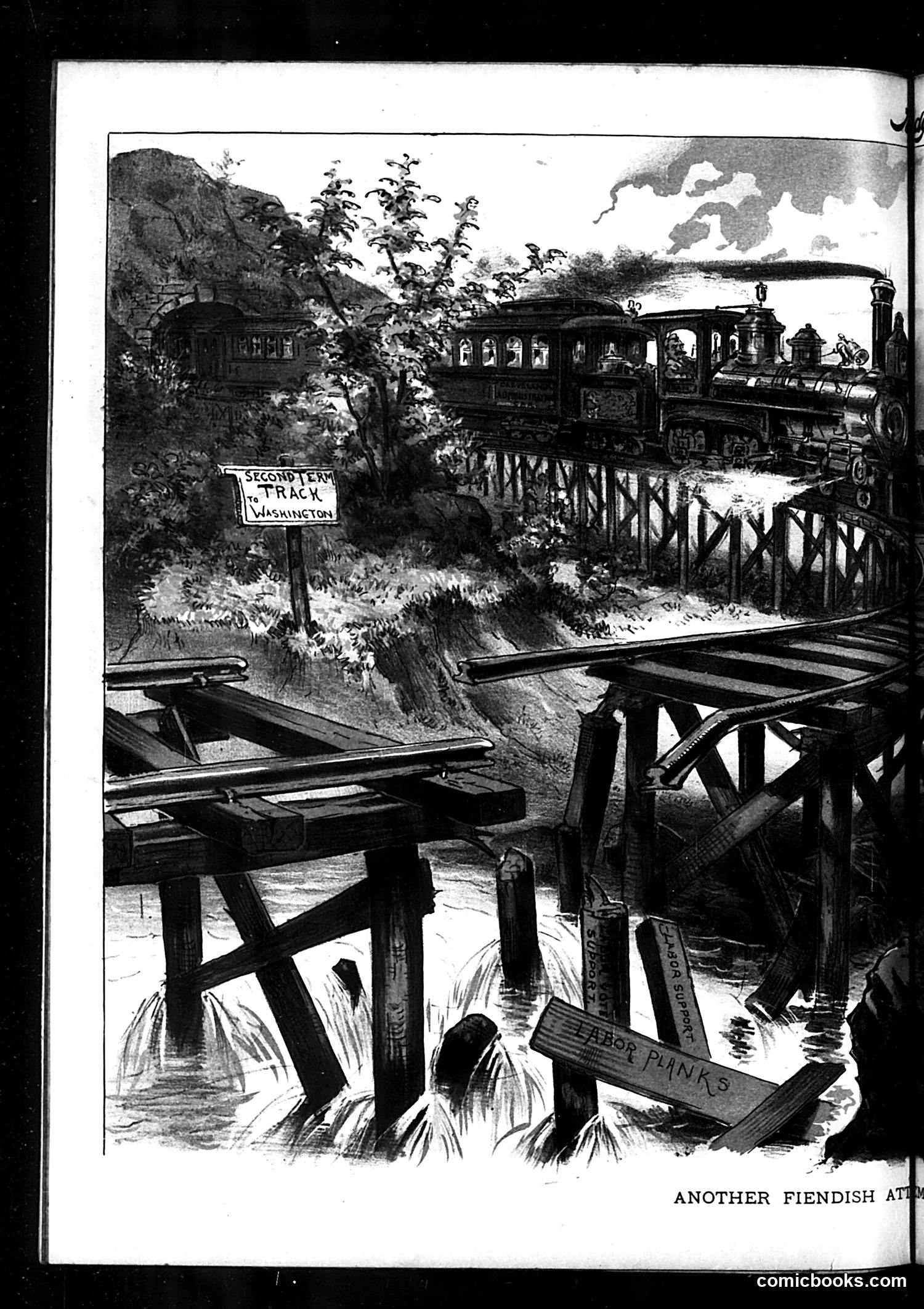
This appears to be a satirical illustration from *Judge* magazine depicting a railway accident or disaster scenario. A steam locomotive crosses a wooden trestle bridge while another train car sits abandoned below. A sign reading "SECOND TERM LIMIT, WASHINGTON" is prominently displayed. The cartoon likely satirizes political corruption or dangerous governance during a president's second term, using the precarious railway crossing as metaphor for political instability. The "fiendish" threat referenced in the caption suggests the cartoon critiques a specific political figure or policy of the era, though without a date or author attribution visible, the exact target remains unclear. The railway disaster imagery was common satirical shorthand for political catastrophe.
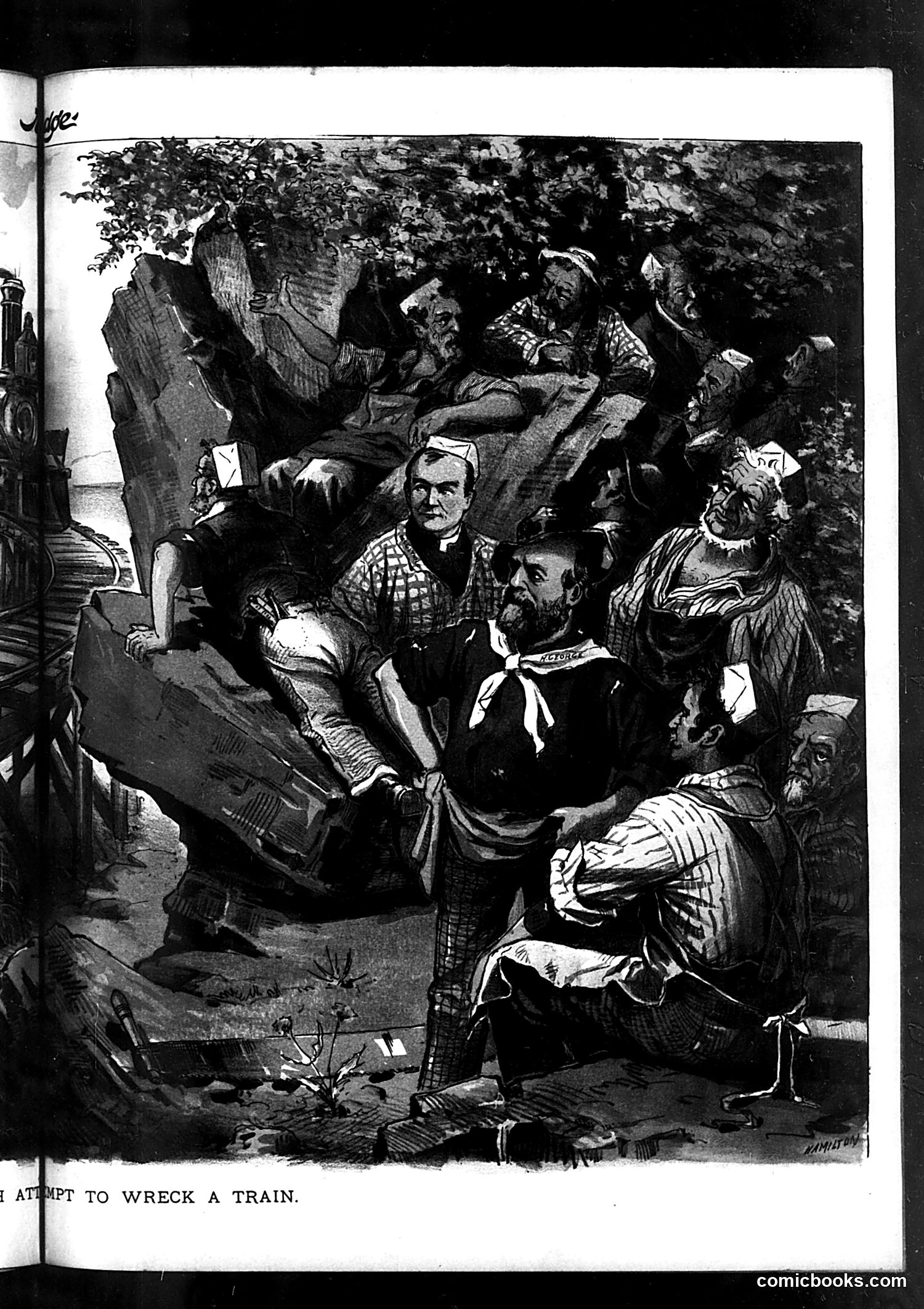
This engraving depicts a conspiratorial group planning sabotage. The caption indicates they're plotting to derail a train, likely representing a political allegory rather than literal terrorism. The figures appear to be caricatured as various types—some wearing working-class clothing, others in formal dress with military or official insignia. The style suggests this is satirizing a specific historical plot or political conspiracy, possibly related to labor unrest, anarchist concerns, or industrial conflict common in late 19th-century America. The mixed dress of the conspirators may suggest collaboration between different social classes or political factions. Without additional context or byline visible, I cannot identify the specific historical event or targets being referenced, but the engraving's dramatic composition emphasizes the danger and illegality of the alleged conspiracy.
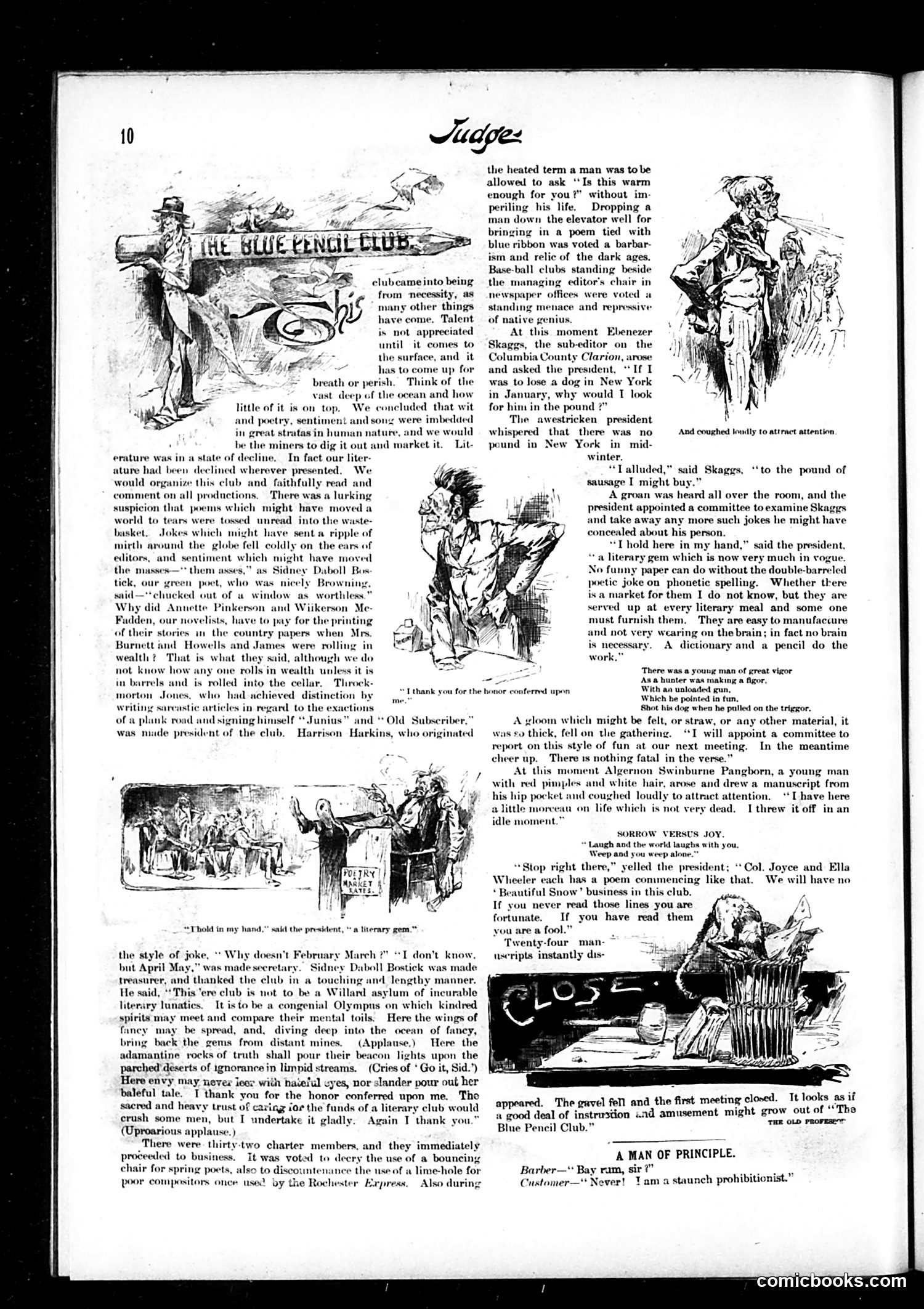
This is a satirical piece mocking a literary club founded to rescue neglected talent from obscurity. The club's members—poorly named amateur writers and journalists—earnestly believe they'll discover buried literary genius, comparing themselves to miners extracting gems from ocean depths. The satire targets their pretentiousness: they use grandiose language about "adamantine rocks of truth" while remaining mediocre. The punchline arrives when sub-editor Ebenezer Skaggs makes a terrible pun about a "pound of sausage," prompting the horrified president to appoint a committee to prevent Skaggs from making more jokes. The cartoon mocks both small-town literary aspirations and the gap between artistic ambition and actual talent. The illustrated characters emphasize their comic absurdity. Judge's message: these earnest amateurs mistake themselves for serious writers, unaware their work belongs in the waste basket—not on bookshelves.
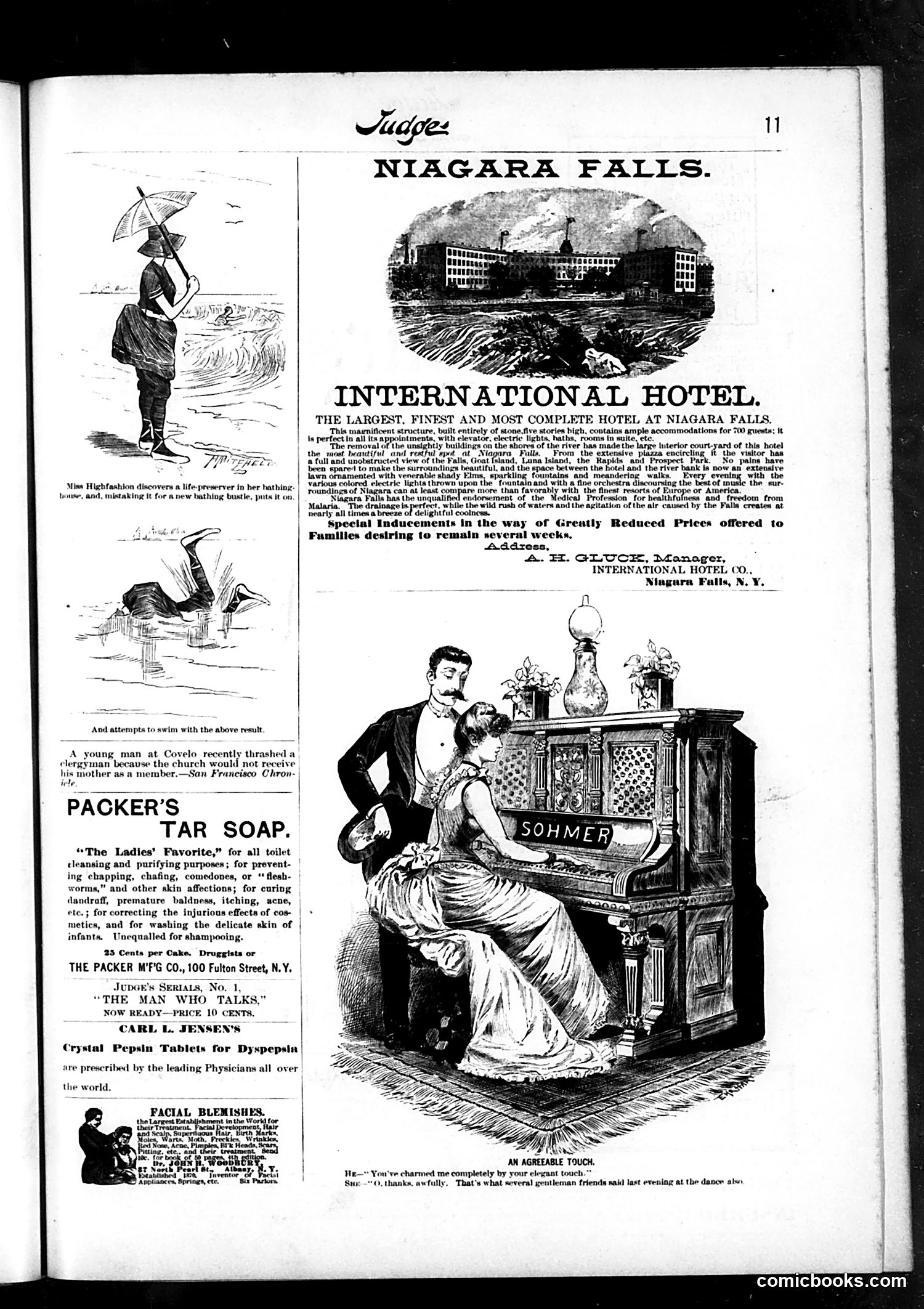
This page is primarily **advertising**, with two small satirical cartoons as secondary content. The main cartoons mock Victorian-era bathing customs: A fashionable woman mistakes a life-preserver for a "bathing bustle" (a fashionable undergarment accessory), and attempts to swim with absurd results. This satire targets the impracticality of women's elaborate Victorian fashion even in water. A news item below mocks a clergyman who was beaten by a parishioner over church membership rules—satirizing rigid ecclesiastical bureaucracy. The dominant content comprises advertisements for the International Hotel at Niagara Falls (a luxury resort), Packer's Tar Soap ("Ladies' Favorite"), Crystal Pepsin Tablets, and facial blemish treatments. The final cartoon shows an elegant couple at a piano, captioned "An Agreeable Touch," depicting genteel domestic courtship. Overall, this is a typical Judge issue mixing social satire with period advertising targeting middle and upper-class readers.
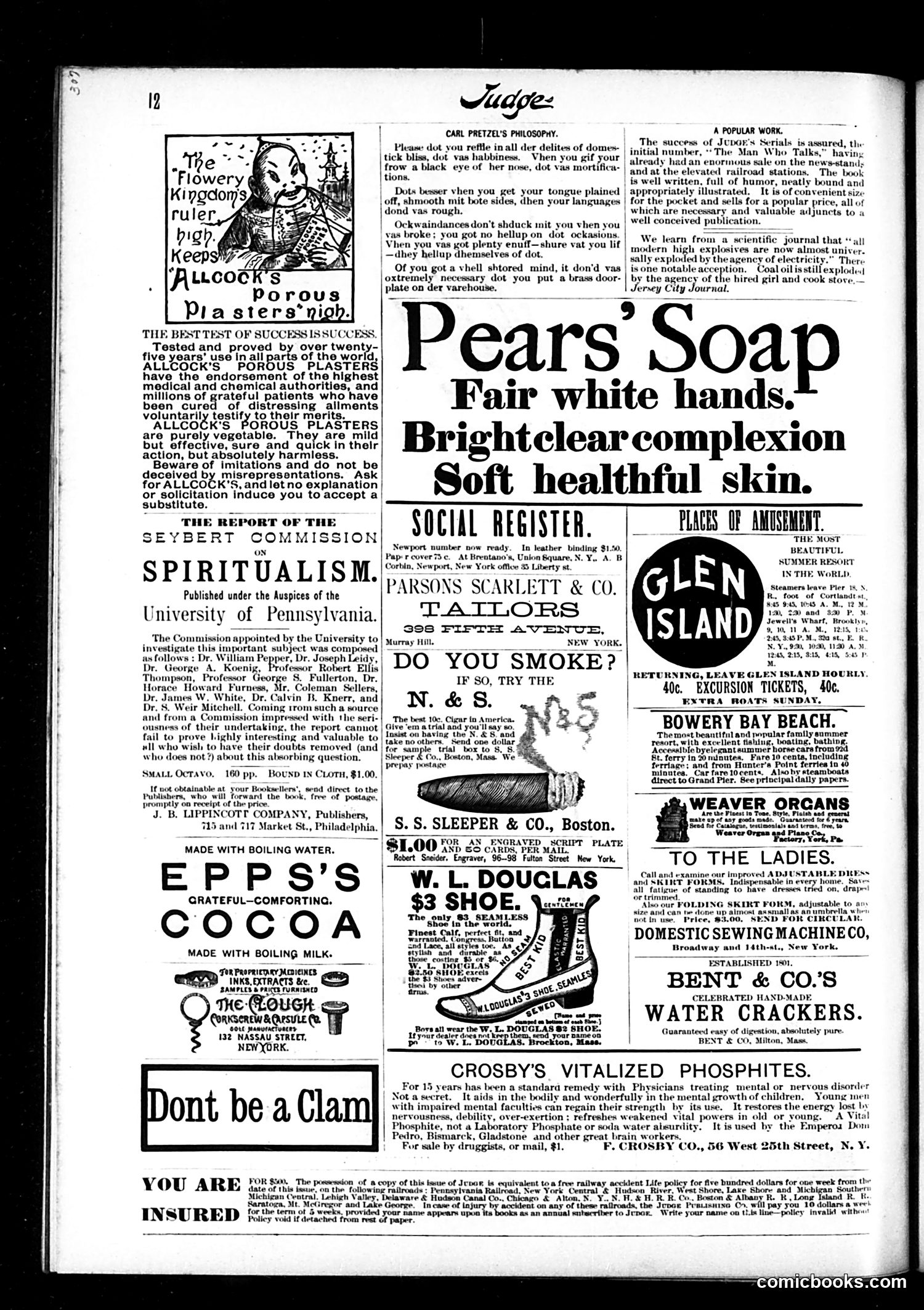
This page is primarily **advertising-driven**, typical of Judge's business model in the late 19th/early 20th century. However, it contains one notable satirical element: ## "Carl Pretzel's Philosophy" The cartoon features a German immigrant character (identifiable by his dialect writing: "dot," "vas," "dhey") offering folksy, nonsensical advice. The humor derives from **ethnic stereotyping** of Germanic immigrants—a common Judge target. Pretzel's observations are intentionally illogical ("it don'd vas extremely necessary") disguised as wisdom, mocking both the character's broken English and the tendency to treat immigrants as sources of comic relief. ## Surrounding Content The rest is straightforward period advertising: patent medicines (Allcock's plasters), soap, cocoa, shoes, sewing machines—all common Judge revenue sources. A brief mention of a **Seybert Commission report on spiritualism** from the University of Pennsylvania represents serious intellectual content, providing balance to the satirical material. The page reflects Judge's mixed approach: satirical commentary alongside practical commercialism.
This page is almost entirely **advertising**—a business directory featuring hotel listings from major American cities (New York, Albany, Baltimore, Boston, Philadelphia, etc.) and a small "Business Index" promoting various commercial services. There is **no political cartoon or satirical content** visible in the image. The page represents standard commercial advertising space that 19th-century magazines used to generate revenue. The hotels advertised range from luxury establishments (like the Grand Central-adjacent Grand Union Hotel) to budget options ("Rooms $1 per day"), reflecting different economic classes. The "Business Index" section briefly endorses select merchants—a mosaic tile company, a bookseller, and seed suppliers—adding credibility through Judge's editorial endorsement. This appears to be a typical interior advertising page rather than editorial content, making it historically useful primarily for understanding 1880s-90s American hospitality infrastructure and commercial practices.
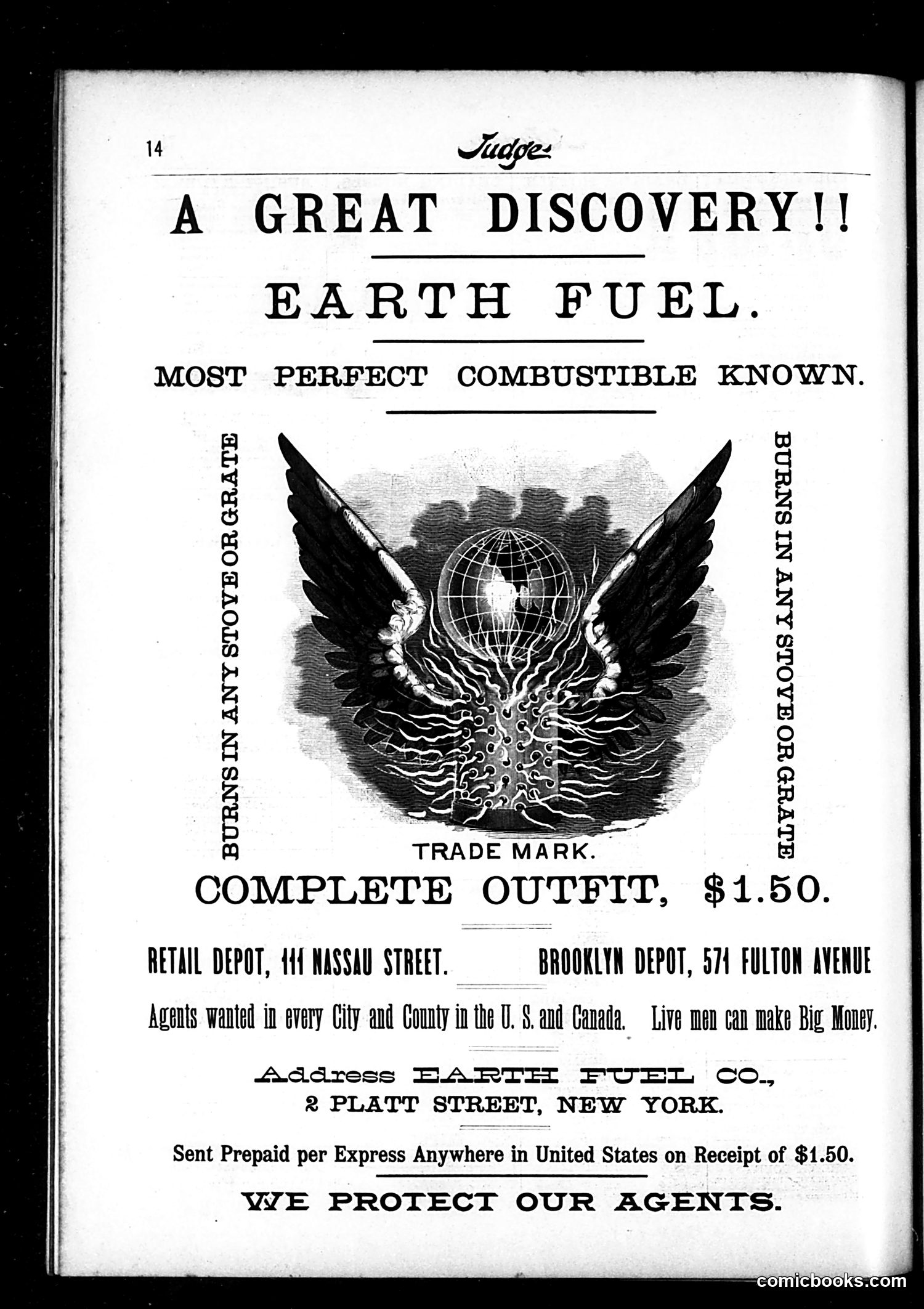
This is primarily **advertising content**, not political satire. The page promotes "Earth Fuel," a commercial product marketed as a superior combustible fuel for stoves and fireplaces. The central image shows a winged globe with root-like structures beneath it—a trade mark designed to suggest the product's natural, earth-derived origin. The winged globe symbolizes universality and commerce. The advertisement uses hyperbolic language ("GREAT DISCOVERY," "MOST PERFECT COMBUSTIBLE KNOWN") typical of 19th-century marketing. It offers a "complete outfit" for $1.50, lists retail locations in New York and Brooklyn, and explicitly recruits agents with promises of profit ("Live men can make Big Money"). The phrase "WE PROTECT OUR AGENTS" suggests this operated as a franchise or MLM-style sales system. There is **no political cartoon or satire visible**—this is straightforward commercial promotion appearing in *Judge* magazine, which accepted paid advertising alongside its satirical content.
This page is **primarily advertisements** interspersed with brief satirical observations typical of *Judge* magazine's format. The visible satirical content includes short, punchy jokes rather than full cartoons: - **Rochester girl with two tongues**: A quip suggesting that as she matures, her boasting abilities will improve—implying women talk excessively. - **General Garland gossip**: References gossips attempting to damage Attorney-General Garland's reputation through schemes; *Judge* disapproves. - **"Man will not submit to being called a puppy"**: Absurdist humor about masculine pride—a man accepts being called "a sad dog" but not other animal names. - **The self-aggrandizing man**: Satirizes men who pompously predict America's decline while positioning themselves as authorities. The page lacks identified political figures or detailed visual cartoons. Instead, it showcases *Judge*'s style of brief, observational humor targeting contemporary social behaviors—particularly masculine vanity, gossip, and bombastic rhetoric—alongside commercial advertisements for pianos, patent medicines, and publishing products.
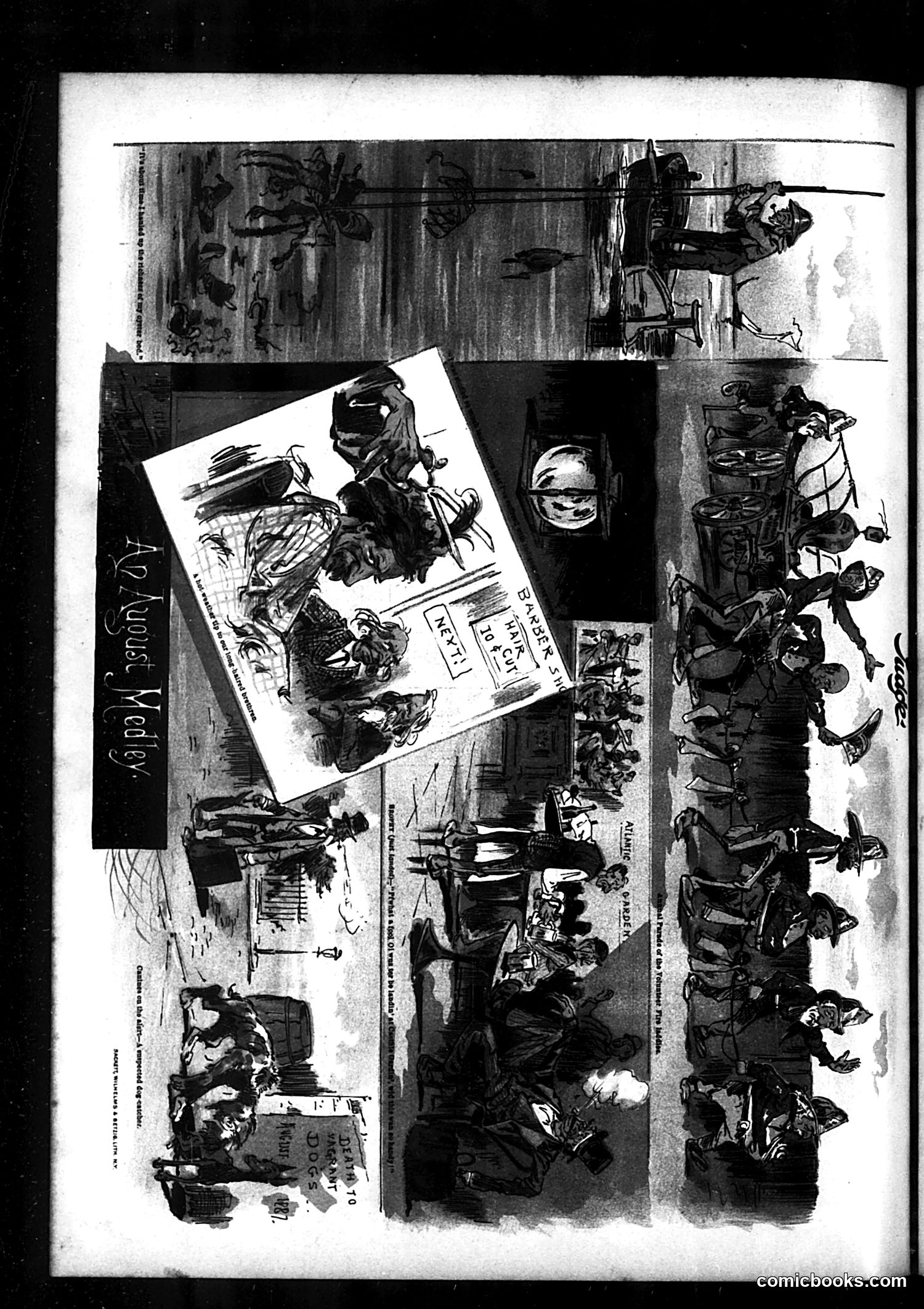
I can see this is a page from *Judge* magazine, but the image quality and orientation make it difficult to read the OCR text clearly or identify specific figures with confidence. The page appears to contain multiple comic panels or illustrations arranged vertically, with what looks like a sketch or artwork in the upper left portion. There's text along the left margin that may be a title or caption. Without being able to reliably read the text or clearly identify the depicted figures and their captions, I cannot accurately explain the satirical content or political/social references to a modern reader. To provide accurate historical context rather than speculation, I would need a clearer image or legible OCR text identifying the subjects and dates referenced.