
A complete issue · 16 pages · 1887
Judge — July 2, 1887
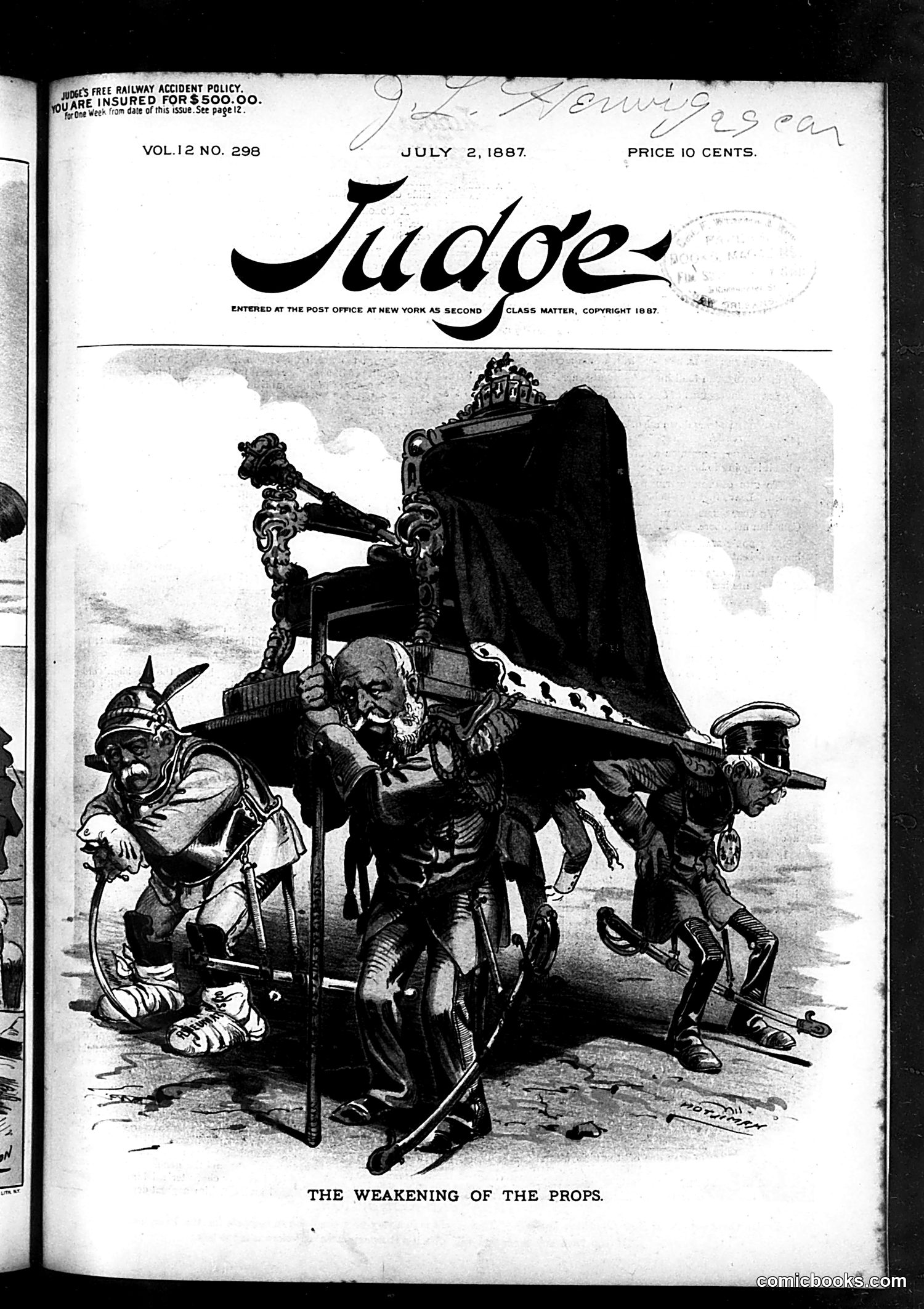
This July 1887 *Judge* cartoon satirizes the decline of monarchical power in Europe. The central elderly figure appears to be a weakened European monarch (likely representing traditional monarchy generally), seated in an ornate throne that's visibly deteriorating. He's surrounded by caricatured figures in military dress—appearing to be representatives of various European powers or political factions. The title "The Weakening of the Props" suggests the supporting structures of absolute monarchy are crumbling. The cartoon likely comments on late-19th-century political movements toward democracy and constitutional reform that were undermining traditional autocratic rule across Europe during this period. The ornate but unstable throne symbolizes how monarchical authority, once seemingly permanent, faced growing instability from modernizing forces.
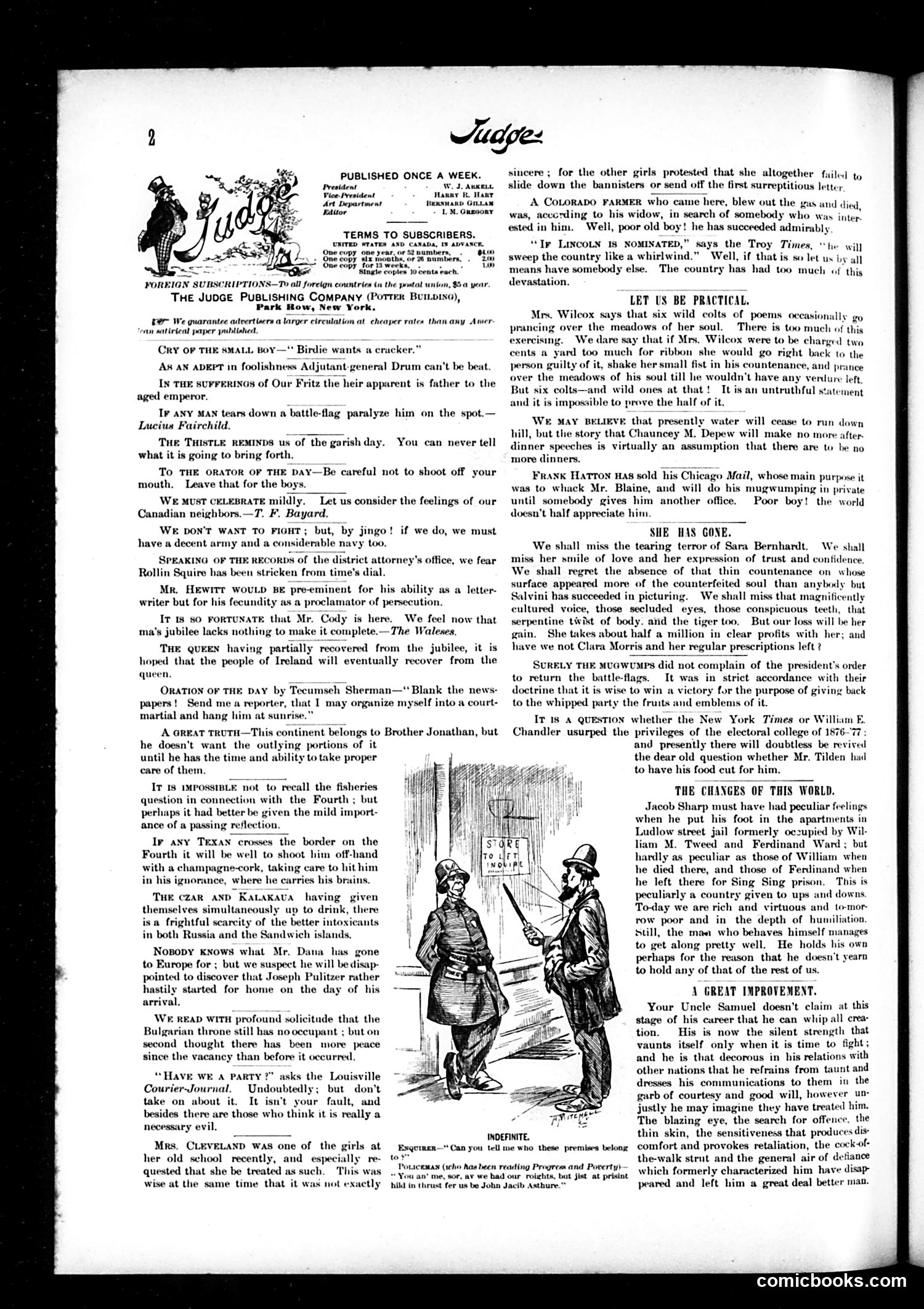
The main cartoon depicts two men in 19th-century military uniforms examining a posted notice or sign. Based on the text column "Indefinite," which discusses unclear property ownership and refers to "Poujavax (who has been reading Progress and Property)," this appears to satirize confusion over land claims or territorial disputes—possibly related to colonial or frontier disputes of the period. The accompanying editorial content includes various brief satirical items mocking political figures and social issues, including references to military matters, Chicago journalism, and social customs. Without clearer visual identification of specific individuals or a dated masthead visible, the exact political figures or events referenced remain uncertain, though the overall tone critiques contemporary American politics and society.
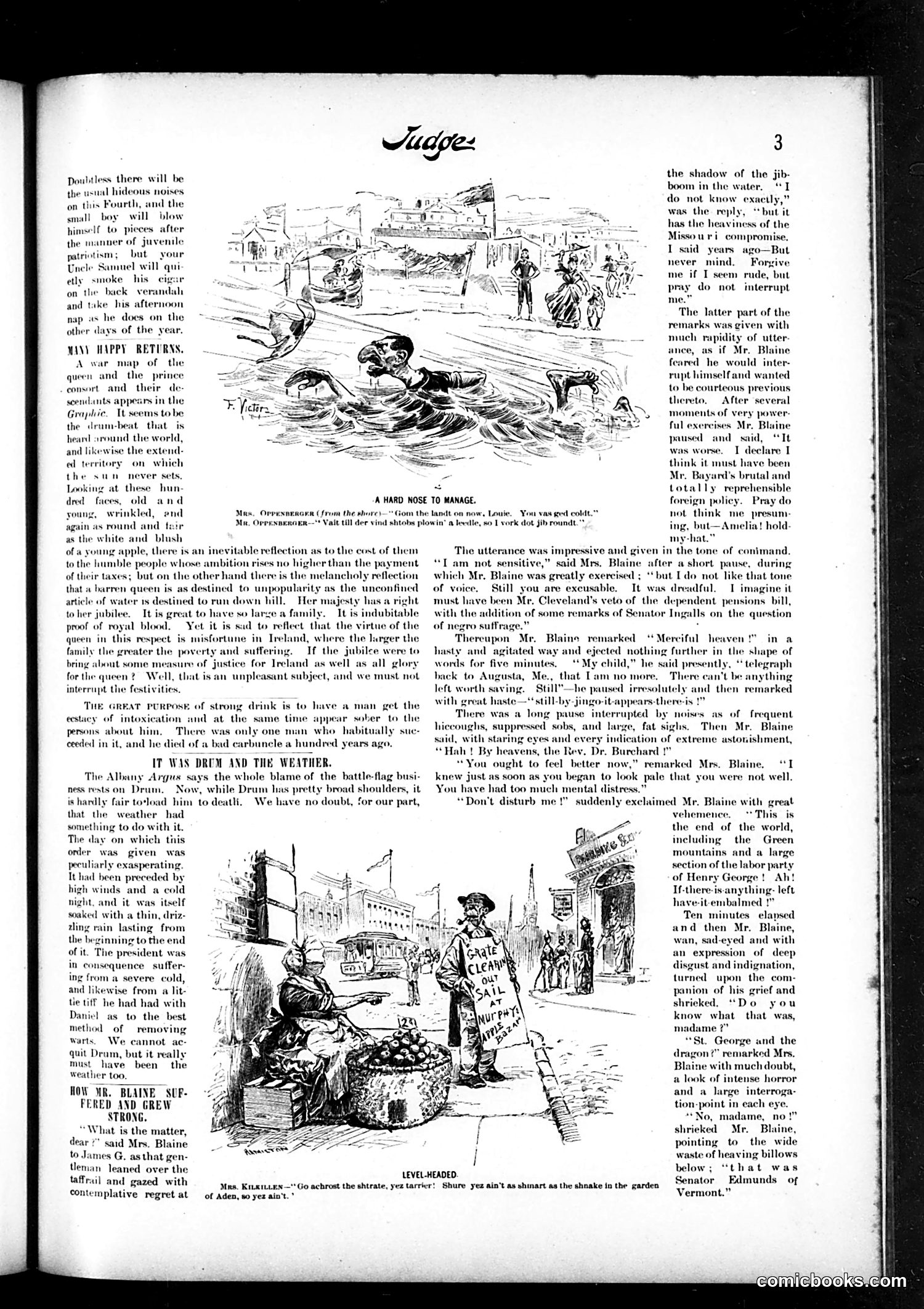
This page contains multiple satirical pieces mocking political and social figures of the era (appears to be 1880s based on references). **"A Hard Nose to Manage"** depicts an Irish laborer ("Mrs. Opendenauer") confronting someone, likely satirizing Irish-American tensions or labor disputes. **"How Mr. Blaine Suffered and Grew Strong"** ridicules James G. Blaine (prominent Republican politician), showing him melodramatically brooding over past political failures—particularly the Missouri Compromise and "the question of negro suffrage"—while his wife tries to console him. The satire mocks his self-pitying theatricality and his tortured relationship with these divisive political issues. **"It Was Drum and the Weather"** humorously blames bad weather rather than Secretary of War Daniel Drum for a "battle-flag business" controversy, suggesting both the absurdity of deflecting responsibility and the incompetence involved. The cartoons employ exaggerated characterization and ironic understatement typical of Judge's style to critique political figures and social pretenses.
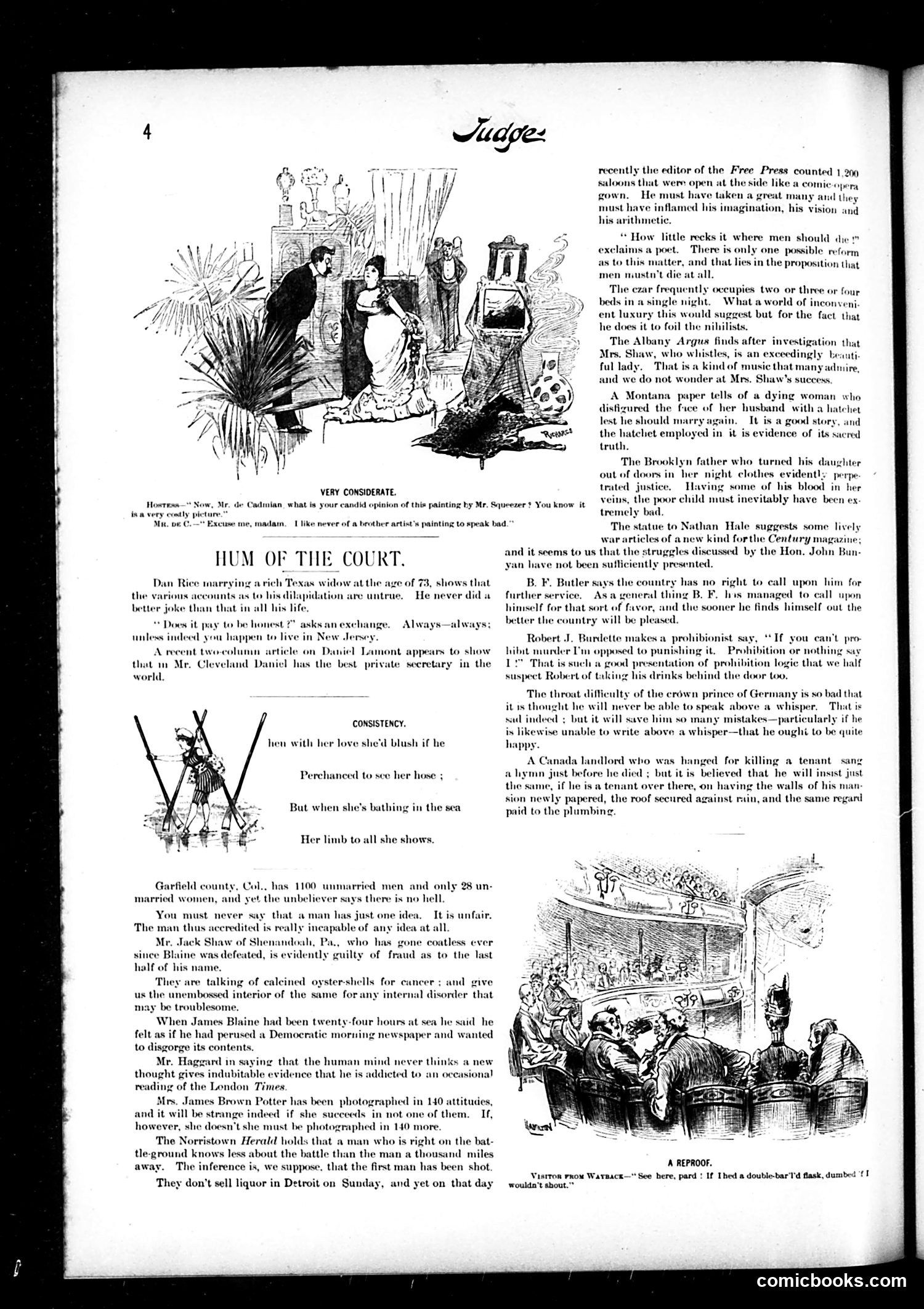
This page contains several short satirical items typical of late-19th-century Judge magazine. The main cartoon, "Very Considerate," depicts a society gathering where someone asks a critic's opinion of a painting by "Mr. Squeezer"—likely a jab at affected artistic pretension. The "Hum of the Court" section collects brief social and political jabs, including: - **Dan Rice** (a famous circus performer/politician) courting a wealthy Texas widow - **Daniel Lamont** (Cleveland's secretary) receiving praise - References to **James Blaine** (prominent Republican politician) feeling ill at sea, compared to reading Democratic newspapers - Mockery of **Mrs. James Brown Potter** (a society figure obsessed with being photographed) - **B.F. Butler** (Civil War general/politician) and prohibition debates The humor relies on readers recognizing contemporary public figures and current social debates—particularly around prohibition and Victorian-era propriety. The "Consistency" verse jokes about a woman's modesty changing based on context. Without knowing these specific figures and 1880s-90s contexts, modern readers miss the immediate topical punch.
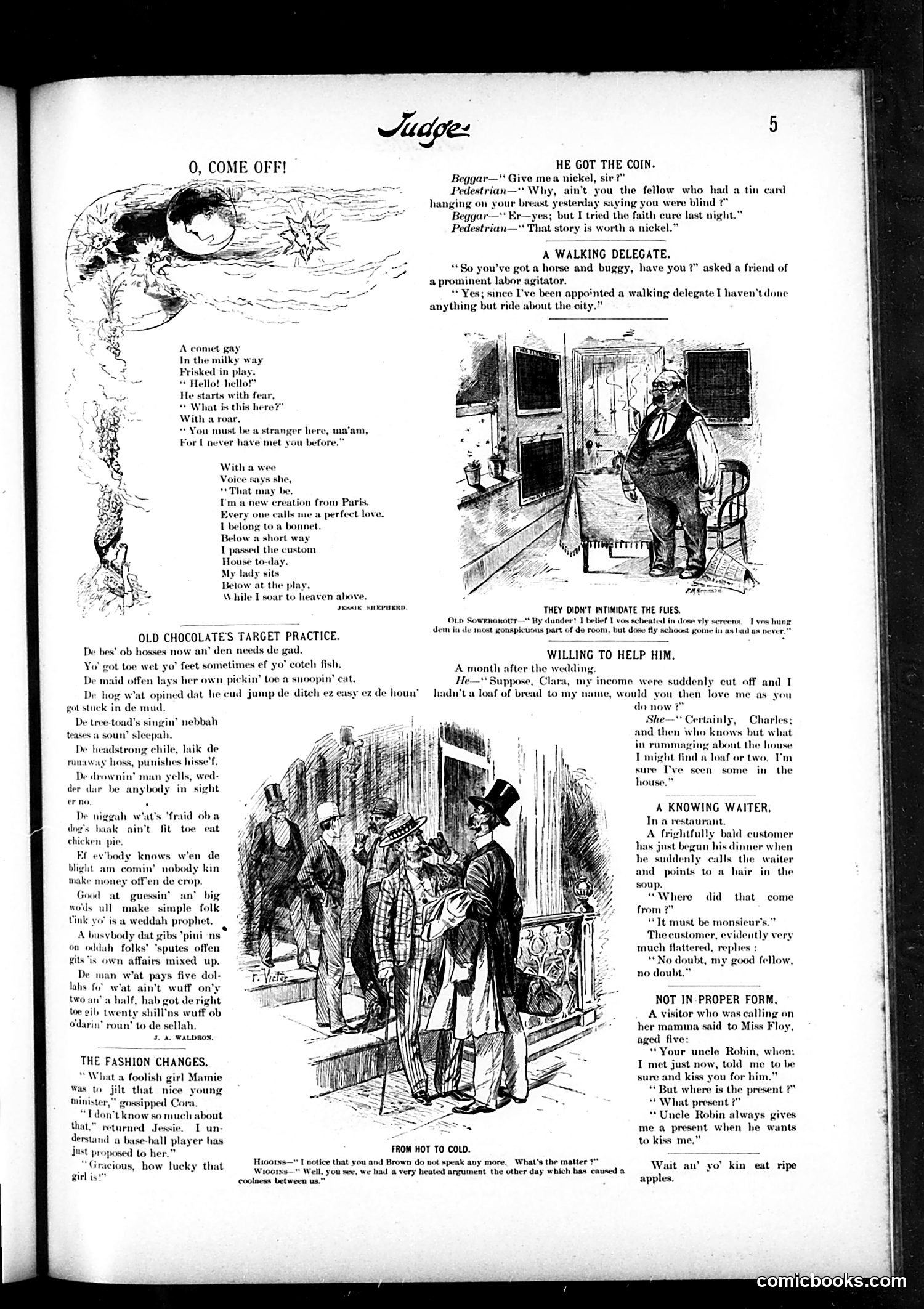
This page contains multiple short satirical pieces typical of Judge's humor circa early 1900s: **"A Walking Delegate"** mocks labor union organizers, depicting one who now rides around the city in a horse and buggy rather than doing actual work—satirizing union officials as self-serving bureaucrats disconnected from laborers. **"Old Chocolate's Target Practice"** is written in exaggerated African American dialect, presenting homespun advice. This reflects the period's racist caricature humor, where Black characters dispensed folksy wisdom for white amusement. **"The Fashion Changes"** jokes about a woman who jilted a "nice young minister" for a baseball player—mocking women's supposedly fickle romantic preferences and the era's fascination with professional athletes. **"A Knowing Waiter"** features a waiter's cheeky implication that the customer's own hair ended up in the soup—suggesting vanity about baldness. **"Not in Proper Form"** jokes about a five-year-old girl expecting gifts for allowing relatives to kiss her, implying mercenary behavior. The humor is period-specific, relying on class stereotypes, gender mockery, and offensive racial caricature conventions.
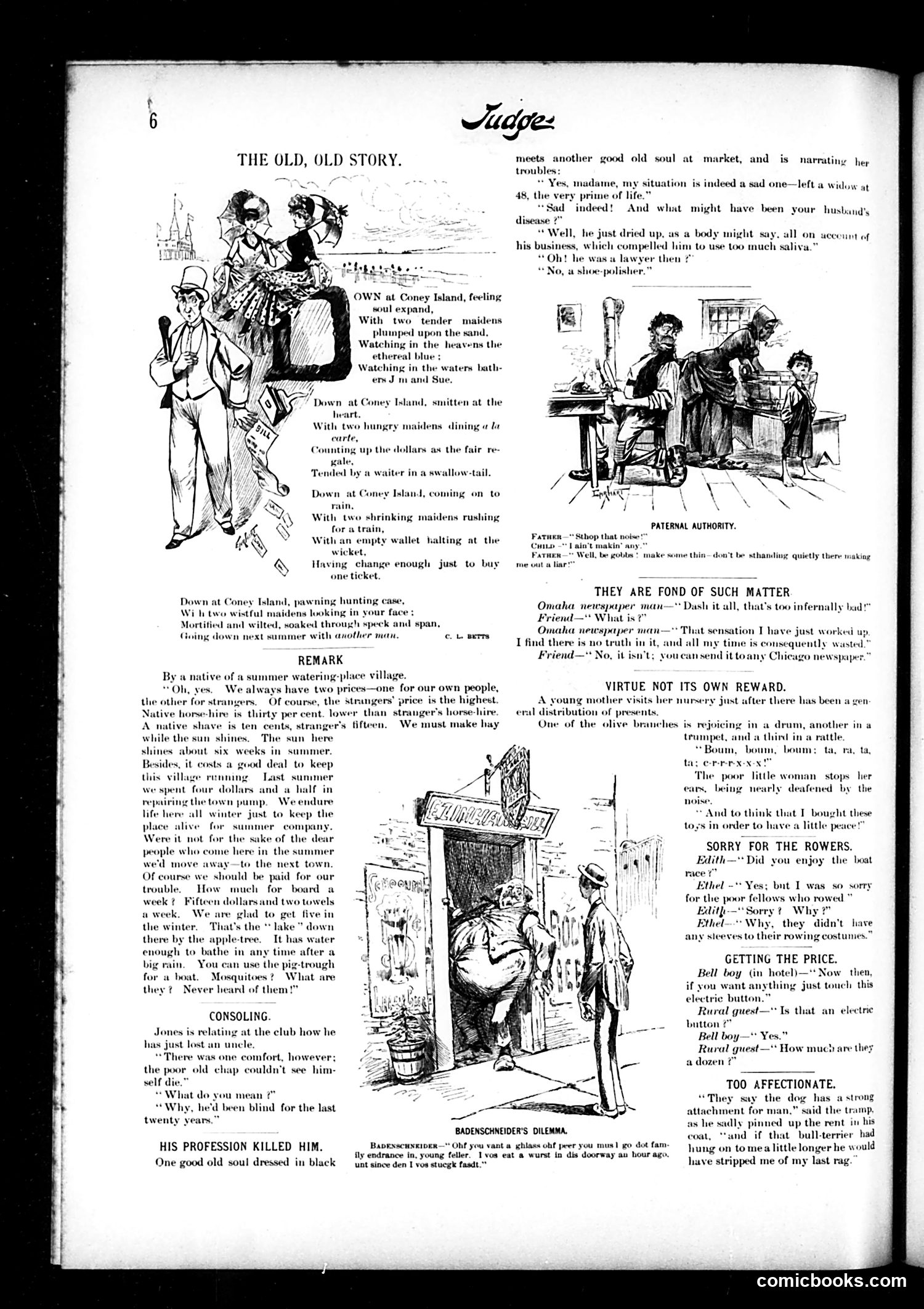
This page contains multiple short comic anecdotes satirizing American social life circa early 1900s. Key pieces: **"The Old, Old Story"** depicts a man's romantic misadventure at Coney Island (a popular beach resort). He arrives prosperous with two women, progresses to a modest dinner, ends broke catching a train alone—then returns next summer with a different woman. The satire mocks predictable male behavior and the cyclical nature of foolish romantic spending. **"Remark"** jokes about resort towns' economic exploitation, suggesting locals charge tourists inflated prices (15 dollars vs. locals' rates) while pretending to barely tolerate summer visitors. It's social commentary on commercialized hospitality. Other vignettes include jokes about: a man consoled that his blind uncle couldn't see him; a German immigrant's digestive misfortune; journalism's indifference to truth if a story is sensational; and overindulgent parenting with noisy toys. The humor targets greed, hypocrisy, immigrant stereotypes, and middle-class excess—typical Judge magazine fare mocking contemporary society's pretensions and absurdities.
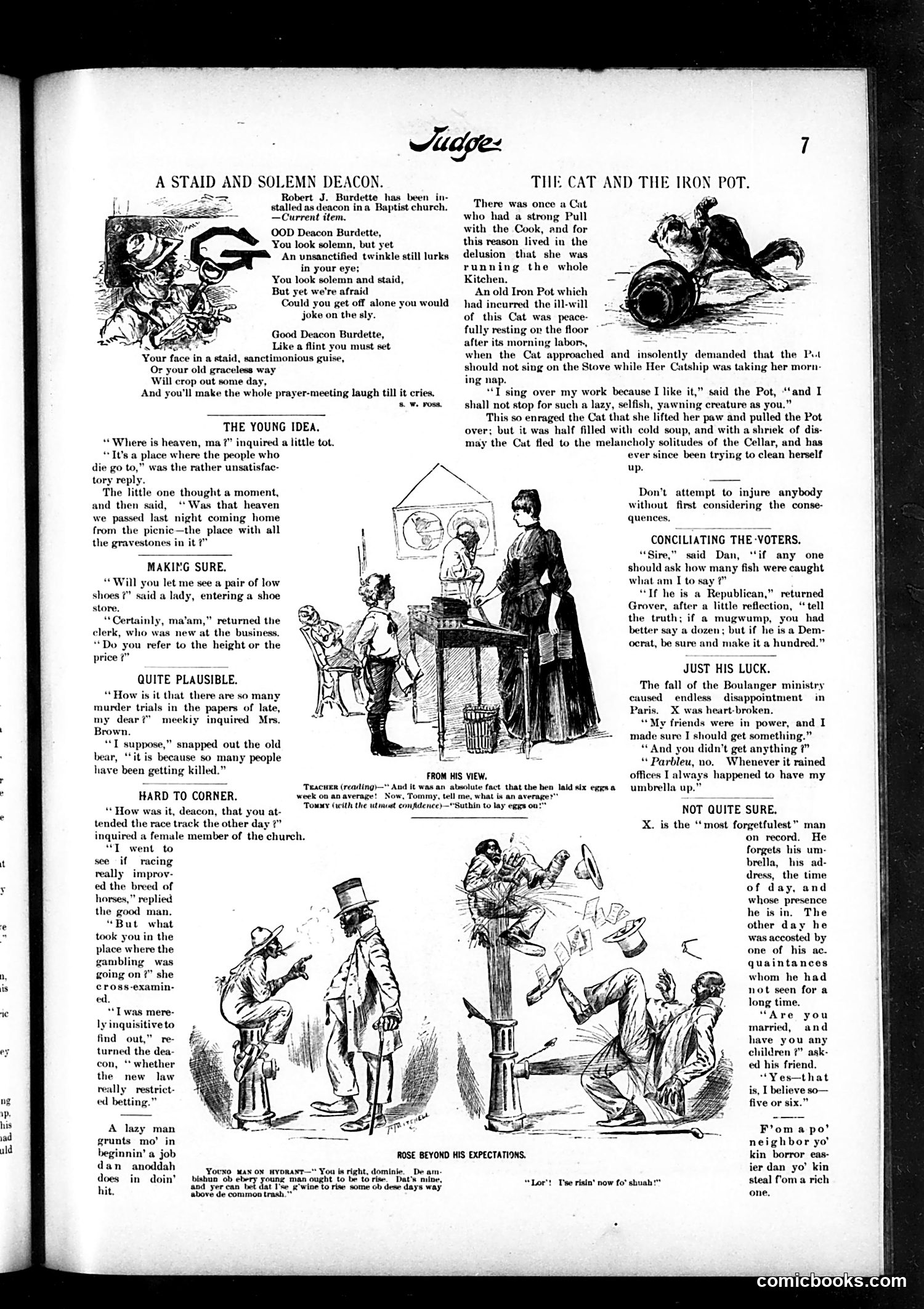
This page from *Judge* contains several satirical pieces typical of late 19th-century American humor: **"A Staid and Solemn Deacon"** mocks Robert J. Burdette, a humorist recently installed as a Baptist deacon, suggesting his naturally comic temperament ill-suits his solemn new role. **"Hard to Corner"** satirizes a deacon caught attending a racetrack, who unconvincingly claims he was studying horse breeding and new gambling laws—poking fun at religious hypocrisy. **"Conciliating the Voters"** references President Grover Cleveland, satirizing political dishonesty: advising different answers about fish catches depending on the listener's party affiliation (Republican=truth, Democrat=exaggeration). This reflects post-Civil War partisan divisions and Cleveland's reputation for honesty. **"The Cat and the Iron Pot"** offers a moral fable about consequences of unprovoked aggression. The remaining pieces are brief jokes about class, gender, and child logic, typical of the era's light satirical content.
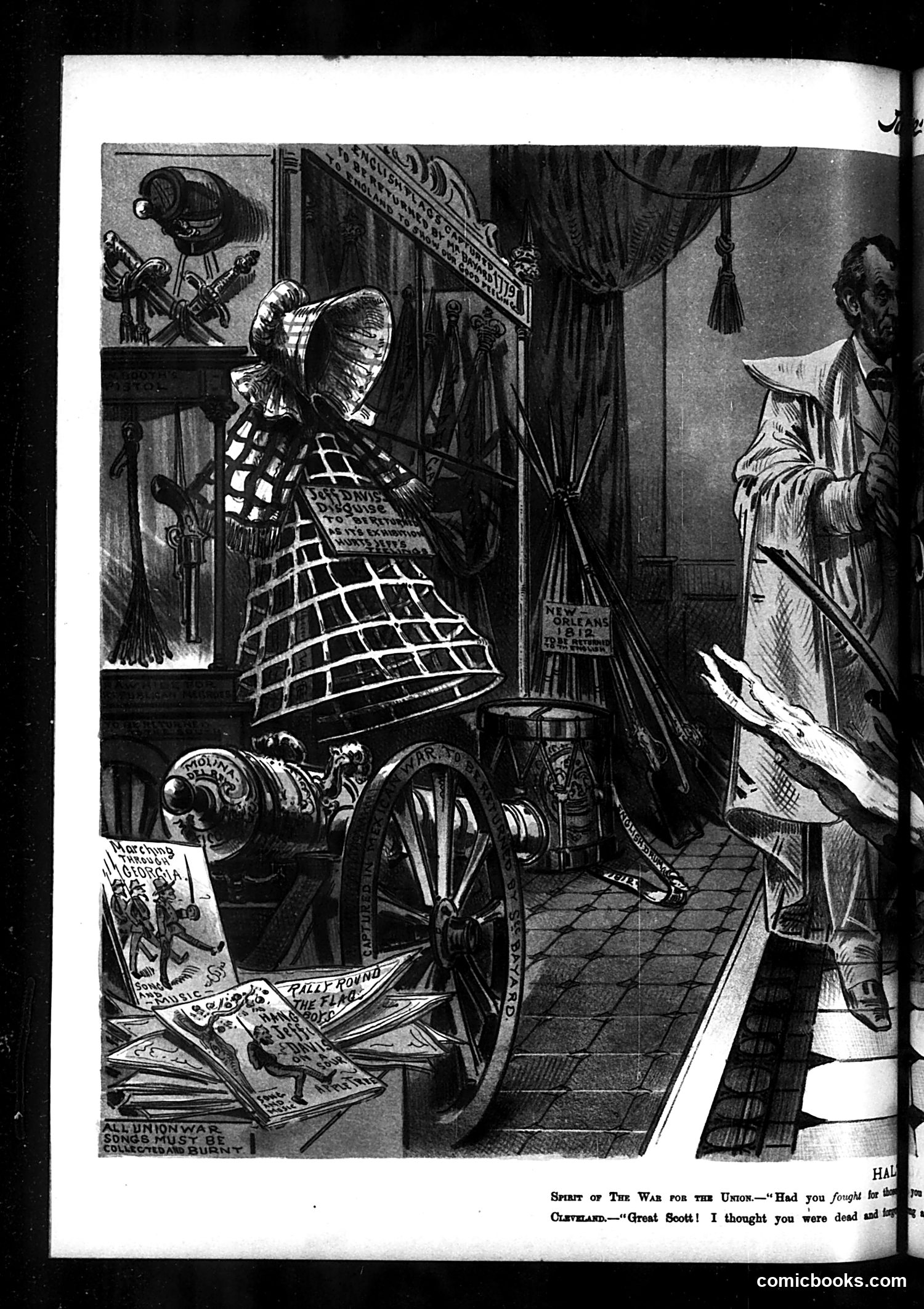
This satirical cartoon depicts a shop or warehouse filled with Civil War memorabilia and merchandise. A woman in an elaborate crinoline dress (labeled "Spirit of the War for the Union") dominates the center, seemingly commercialized and commodified. A man on the right (identified as Cleveland, likely President Grover Cleveland) expresses shock at her survival. The satire targets the commercialization of Civil War memory and, likely, Cleveland's political relationship to Reconstruction-era issues. The shop's cluttered goods—visible documents and promotional materials—suggest the war has become a commercial product rather than a serious historical matter. The cartoon critiques how politicians and merchants profited from or trivialized the conflict's legacy, particularly during the Gilded Age when such nostalgia was heavily marketed.
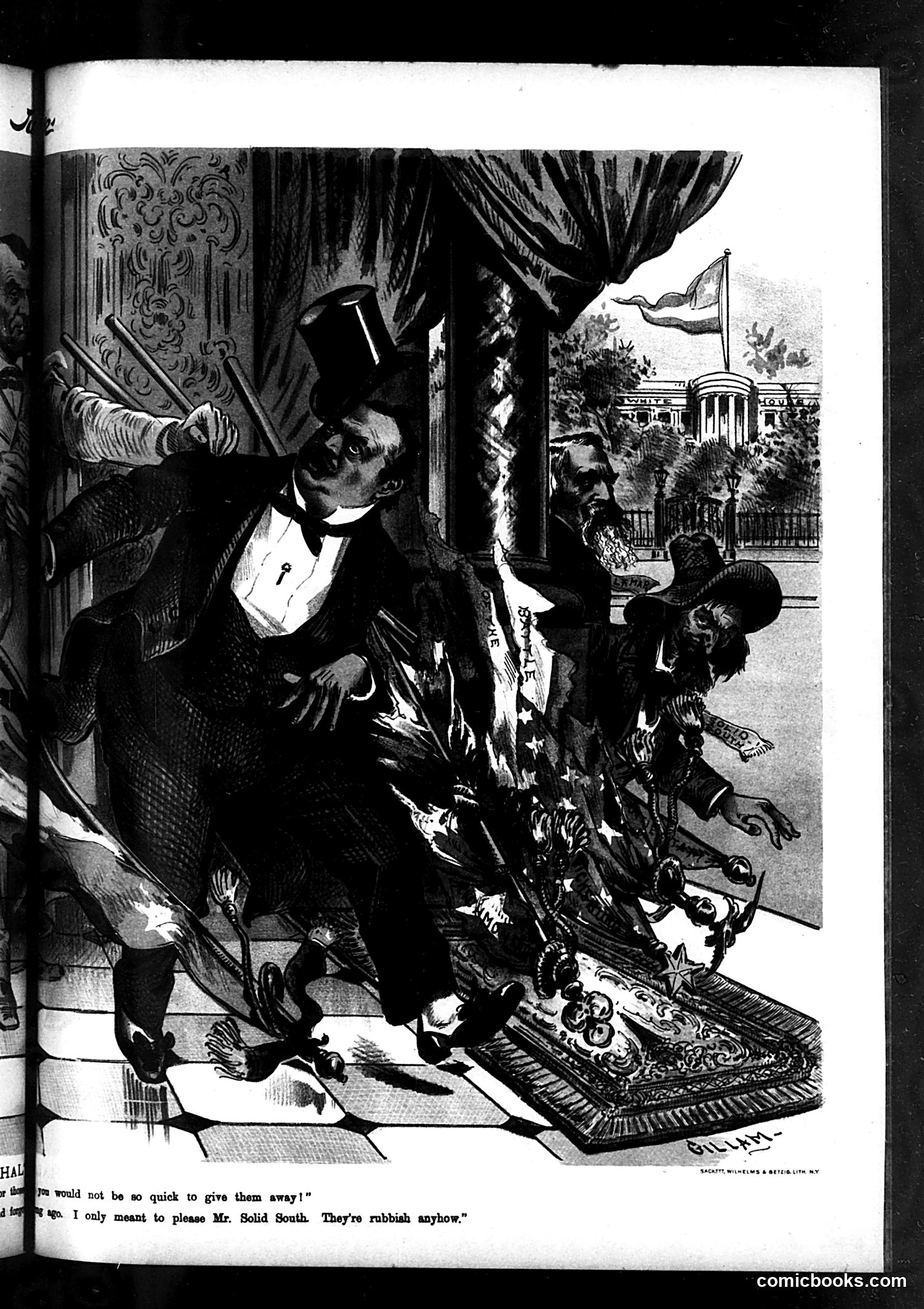
This Judge magazine cartoon satirizes American political dynamics regarding the American South ("Mr. Solid South"). A well-dressed gentleman in formal attire appears distressed, gesturing dramatically while speaking with another figure. The dialogue suggests tension over giving something away to the South—likely referencing political concessions or favors. "The Solid South" was a political term for the Democratic-dominated South's voting bloc during the Reconstruction era and beyond. The cartoon mocks either Northern politicians making unwanted compromises with Southern political interests, or disputes over what constitutes acceptable political trade-offs. The ornate interior setting and formal dress emphasize the high-stakes political nature of the discussion. Without a clear date, the specific historical moment remains uncertain, but the satire targets North-South political tensions common to late 19th/early 20th-century American politics.
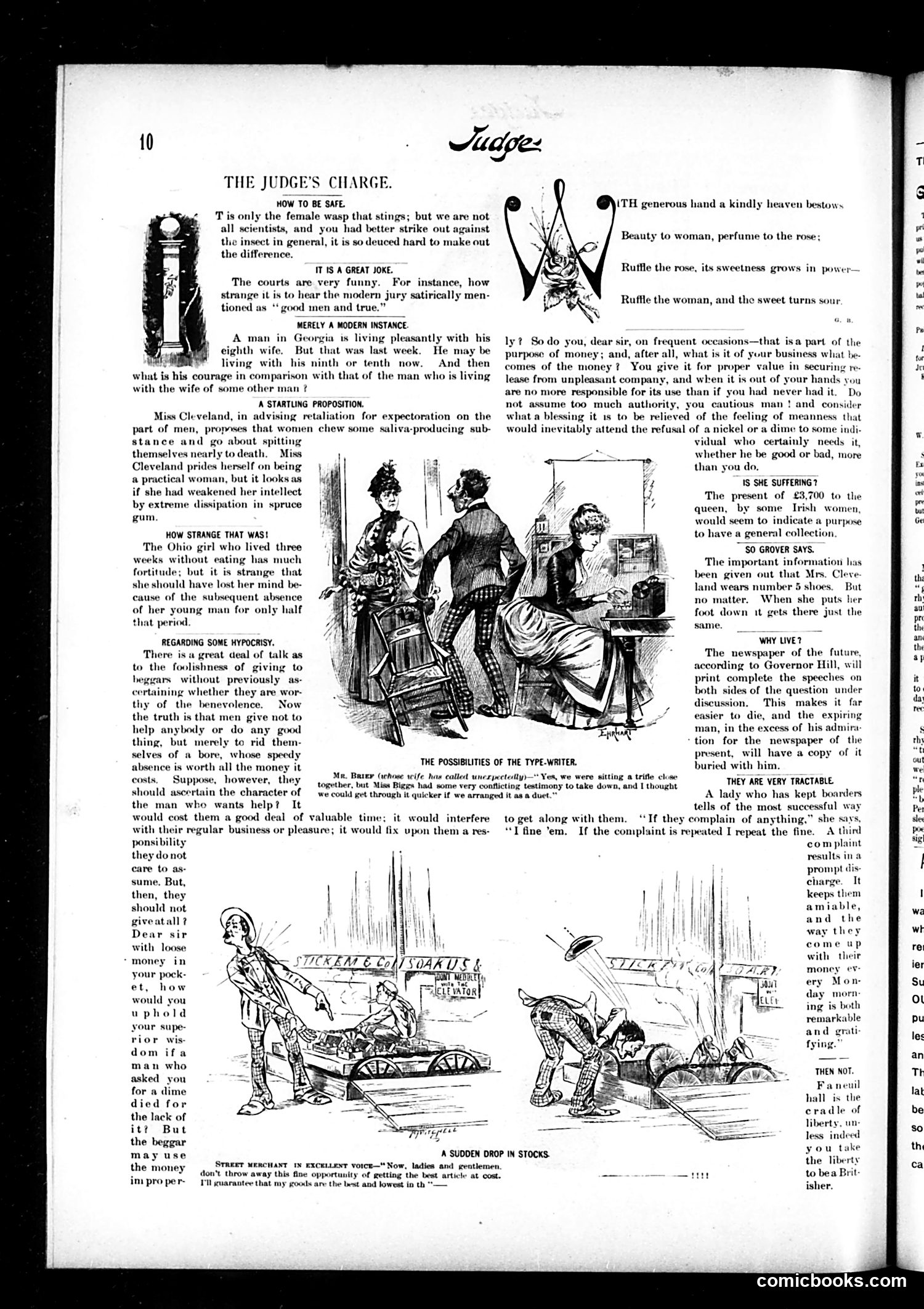
This page from *Judge* magazine contains several satirical pieces mocking contemporary social issues and absurdities: **"The Judge's Charge"** opens with commentary on courtroom humor and modern marriage, including a jab at a Georgia man with multiple wives—likely referencing actual bigamy scandals of the era. **"A Startling Proposition"** ridicules a woman named Cleveland's suggestion that women spit in retaliation for male spitting, calling it impractical and evidence of intellectual deterioration. The illustrations include street vendors and business scenes, with one captioned "A Sudden Drop in Stocks" showing economic satire. **"The Possibilities of the Type-Writer"** depicts a man caught in a compromising position with a woman, claiming they were transcribing testimony together—a transparent excuse satirizing workplace impropriety and the new technology's use. Overall, the page satirizes marriage customs, gender relations, begging, and modern urban business practices typical of late 19th-century American social commentary.
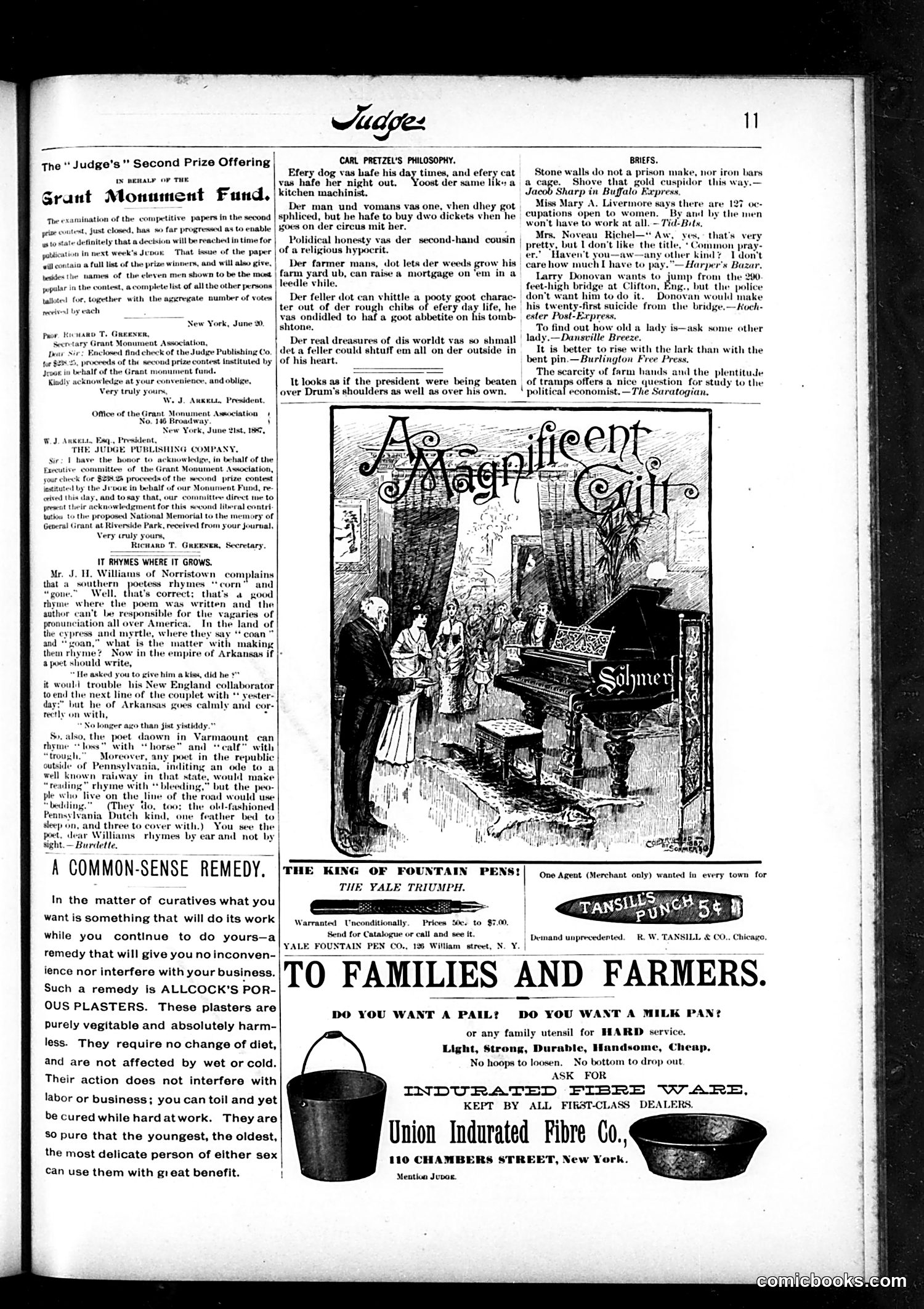
This page from *Judge* magazine contains several distinct elements: **The Main Cartoon** (titled "A Sufficient Call"): Shows two women at a piano where a man appears trapped or pinned beneath it. The satire likely comments on domestic entrapment through courtship/marriage rituals—the piano being a Victorian symbol of female accomplishment, now weaponized to trap the suitor. **Carl Pretzel's Philosophy**: A column of German-accented aphorisms offering social commentary in broken English. These are cynical observations about marriage (requiring two tickets instead of one), political hypocrisy, and hidden virtue, reflecting *Judge*'s satirical voice. **Supporting Content**: The page also includes fundraising notices for the Grant Monument Fund and advertisements for household products (porous plasters, fountain pens, indurated fiber ware). The "Rhymes Where It Grows" section ridicules American regional accents and dialect poetry. **Overall Context**: This represents typical *Judge* content—mixing domestic humor, social satire, and advertising while maintaining an irreverent tone toward contemporary American life and manners.
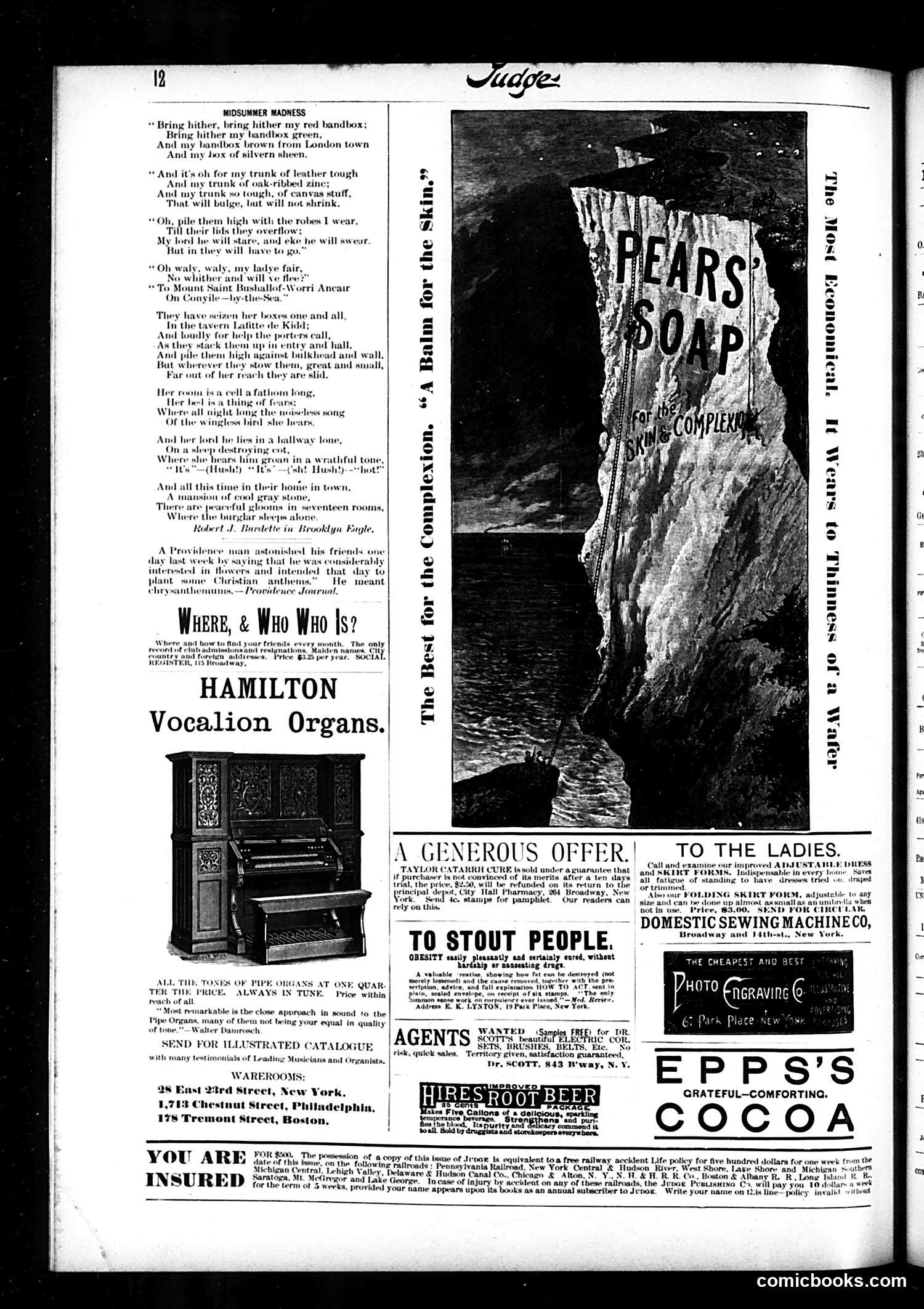
This page is primarily **advertising**, not political satire. The dominant content consists of commercial advertisements typical of late 19th/early 20th-century magazines. The small poetic text at top ("Midsummer Madness") appears to be light verse about summer travel preparations—packing trunks and boxes for trips—likely reflecting contemporary leisure habits of the era's middle and upper classes. The advertisements reveal period concerns: organ manufacturers, sewing machines, medical "cures" (a Taylor Catarrh Cure, obesity treatments), photo engraving services, and notably, **railroad accident insurance**—reflecting both the dangers of rail travel and the emerging insurance industry. The "You Are Insured" section at bottom explains that possession of a Judge magazine copy provided free accident life insurance on specified railroads, a promotional gimmick to boost subscriptions. Overall, this is a **commercial page** rather than satirical content, documenting Gilded Age consumer culture and anxieties.
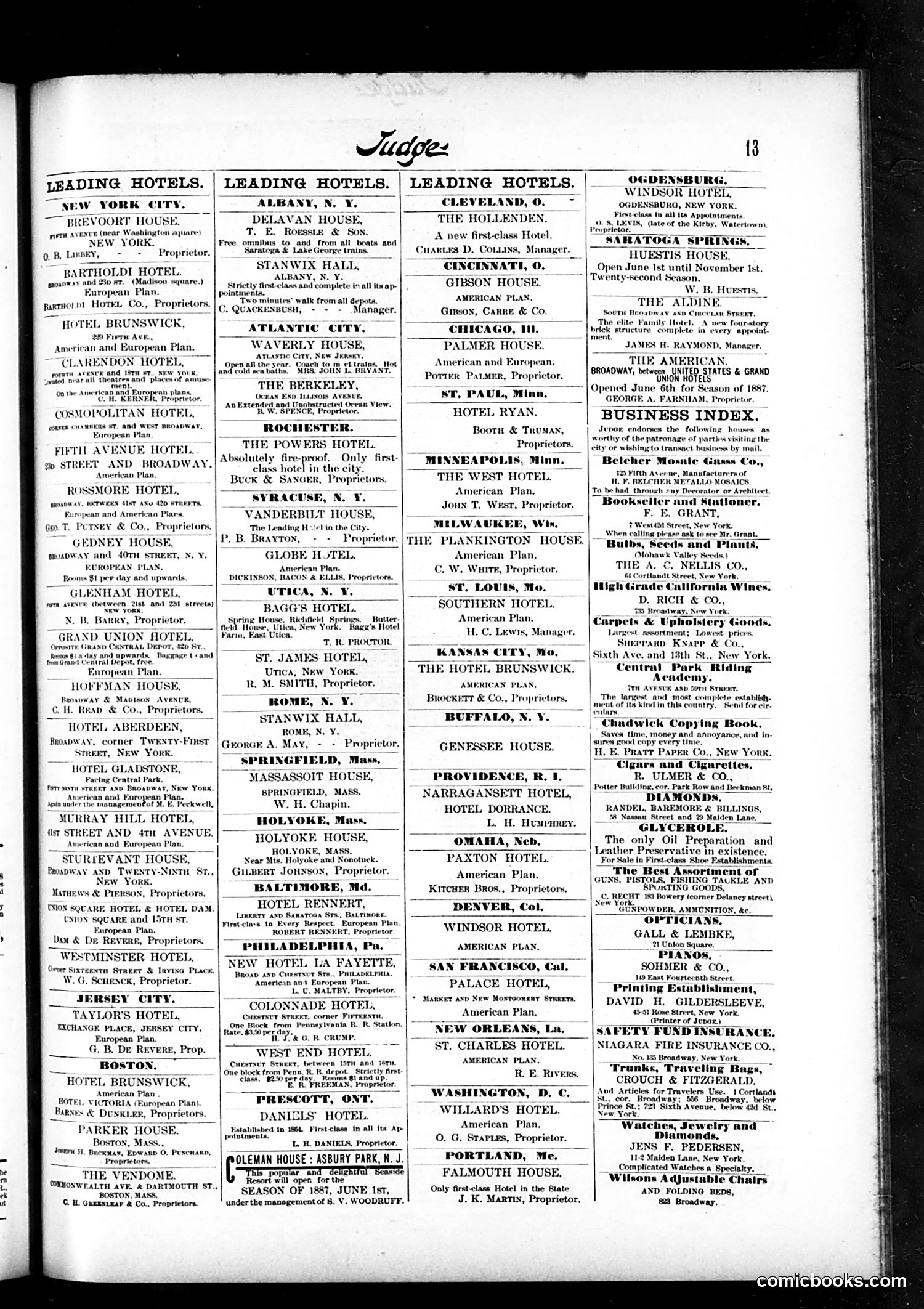
This page from *Judge* is not a satirical cartoon or political commentary—it's a directory of "Leading Hotels" across America, organized by city (New York, Albany, Cleveland, Chicago, etc.). The page contains hotel names, proprietors, brief descriptions of amenities, and contact information. Below the hotel listings are advertisements for various businesses: wine merchants, carpet/upholstery goods, cigars and cigarettes, leather preservation products, pianos, insurance companies, and jewelry. There is no visible political satire, caricature, or cartoon content on this page. It represents the commercial advertising that *Judge* magazine sold to support itself—standard business directory material typical of late 19th-century publications.
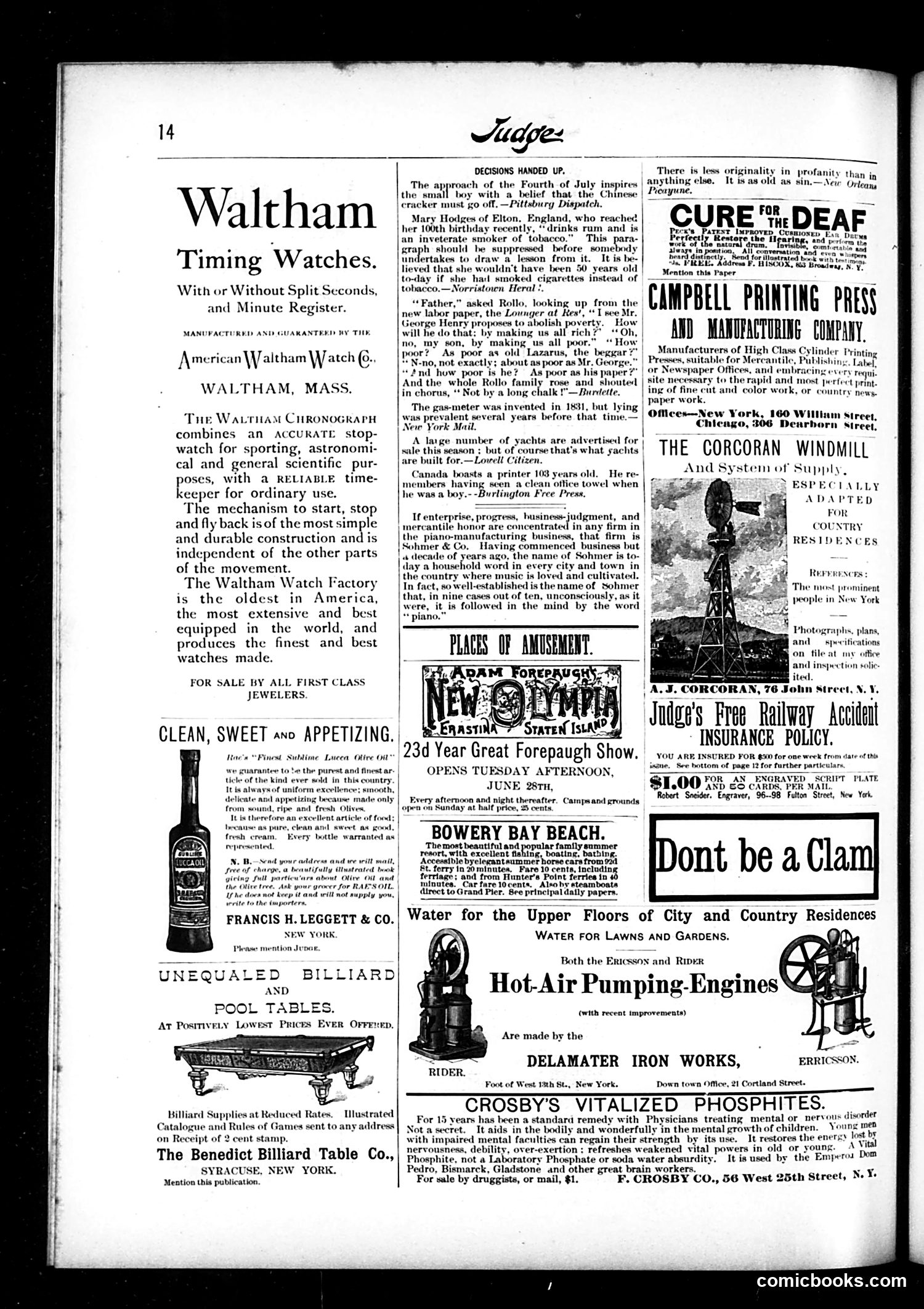
This is primarily an **advertising page** from Judge magazine with minimal editorial content. The small satirical pieces are standard "humor filler": **The "Decisions Handed Up" column** contains brief joke-comments on news items, typical of Judge's format. Notable references include: - **Mary Hodes (age 100, smoker)**: A joke implying that smoking and drinking *extend* life rather than harm it—satire mocking temperance advocates who would cite her as a cautionary tale. - **Rollo dialogue**: A mock-serious conversation where "Father" proposes abolishing poverty by making everyone poor—satirizing radical labor proposals (note the reference to "new labor paper") as impractical. The page is dominated by **legitimate advertisements** for Waltham watches, billiard tables, printing presses, and various products. The "Cure for Deaf" and "Judge's Free Railway Accident Insurance Policy" ads are period marketing rather than satire. Overall, this is a **routine advertising/filler page** with light satirical commentary on contemporary labor movements and social reform, not a major political cartoon.
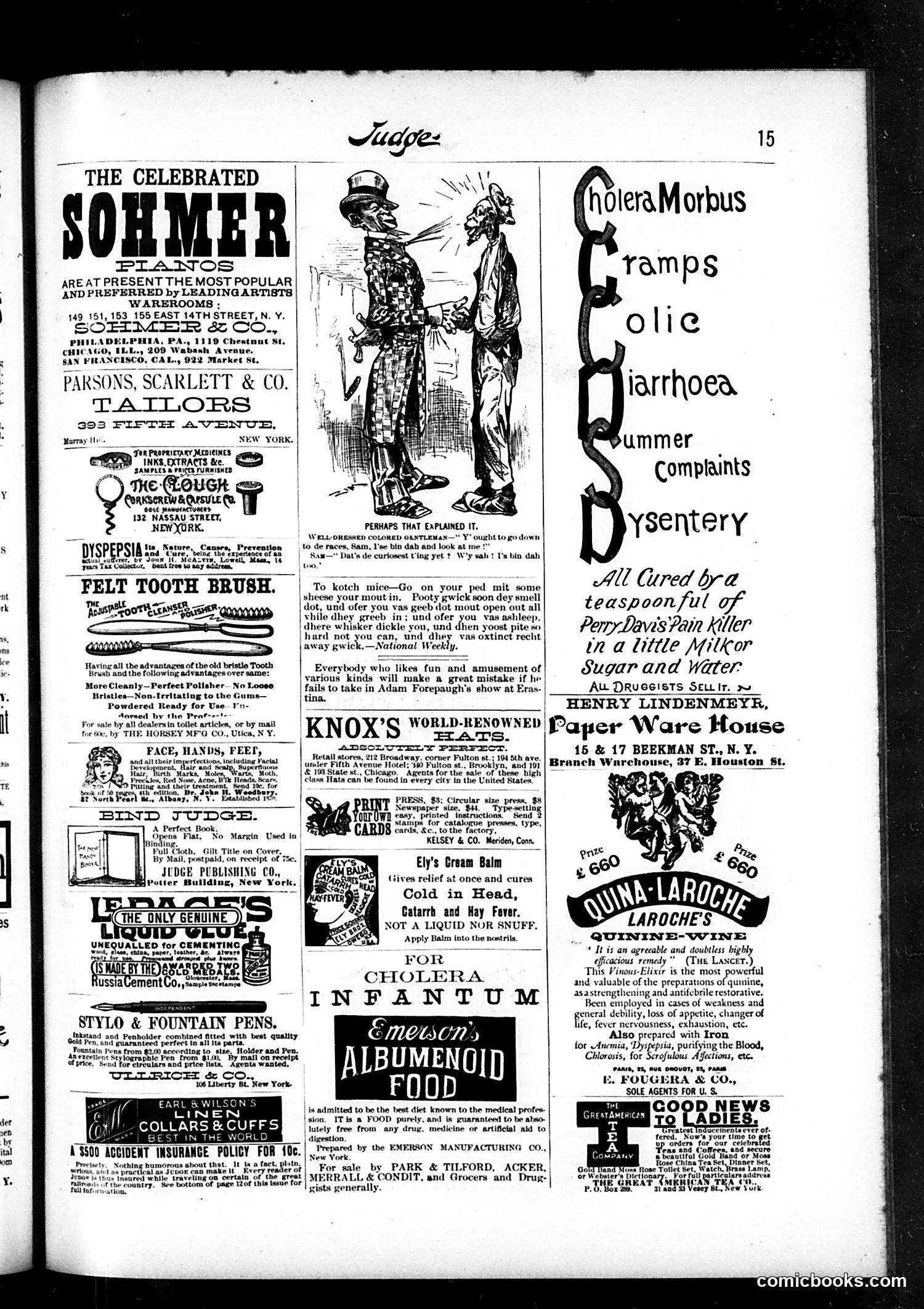
This page is primarily **advertising**, typical of Judge magazine's revenue model. The single cartoon titled "PERHAPS THAT EXPLAINED IT" depicts two Black men in dialect-heavy conversation about visiting the races (horse racing). One claims he's been there and "look at me," while the other expresses puzzlement—the joke apparently playing on stereotypical assumptions about gambling and poverty. The rest of the page features period patent medicines and consumer goods (piano warerooms, tailors, tooth brushes, fountain pens, etc.). Of note: several ads hawk dubious medicinal products—"Emerson's Albumenoid Food" for cholera infantum, Perry Davis Pain Killer, and various remedies for diarrhea and dysentery. These reflect late-19th-century medical quackery before FDA regulation. The cartoon's humor relies on racist caricature and dialect that would be offensive today, while the ads reveal how unregulated and often dangerous "medicines" were marketed to the public.
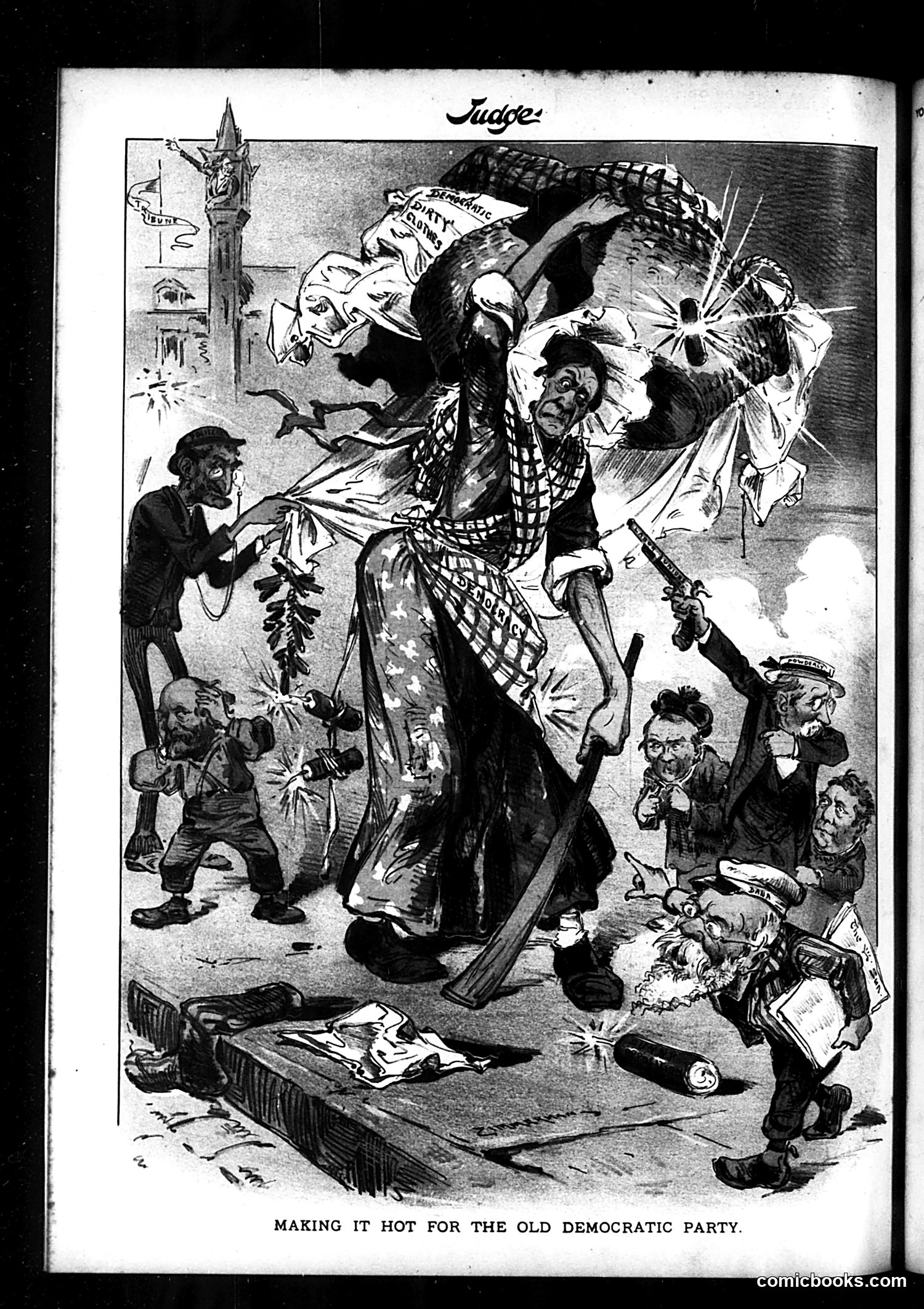
This Judge magazine cartoon, titled "Making It Hot for the Old Democratic Party," depicts a tall figure (likely representing a political opponent or reform movement) being attacked by smaller caricatured figures wielding various weapons and tools. The central figure appears menacing, while surrounding figures—drawn in exaggerated style typical of 19th-century satirical art—assault it from below. The satire critiques internal conflict within the Democratic Party, suggesting either factional infighting or external pressure destabilizing the organization. The "heat" metaphor indicates intensifying political pressure or scandal. Without a visible date or clearer contextual labels, the specific historical moment remains unclear, though the artistic style suggests late 19th century American politics.