A complete issue · 16 pages · 1887
Judge — June 18, 1887
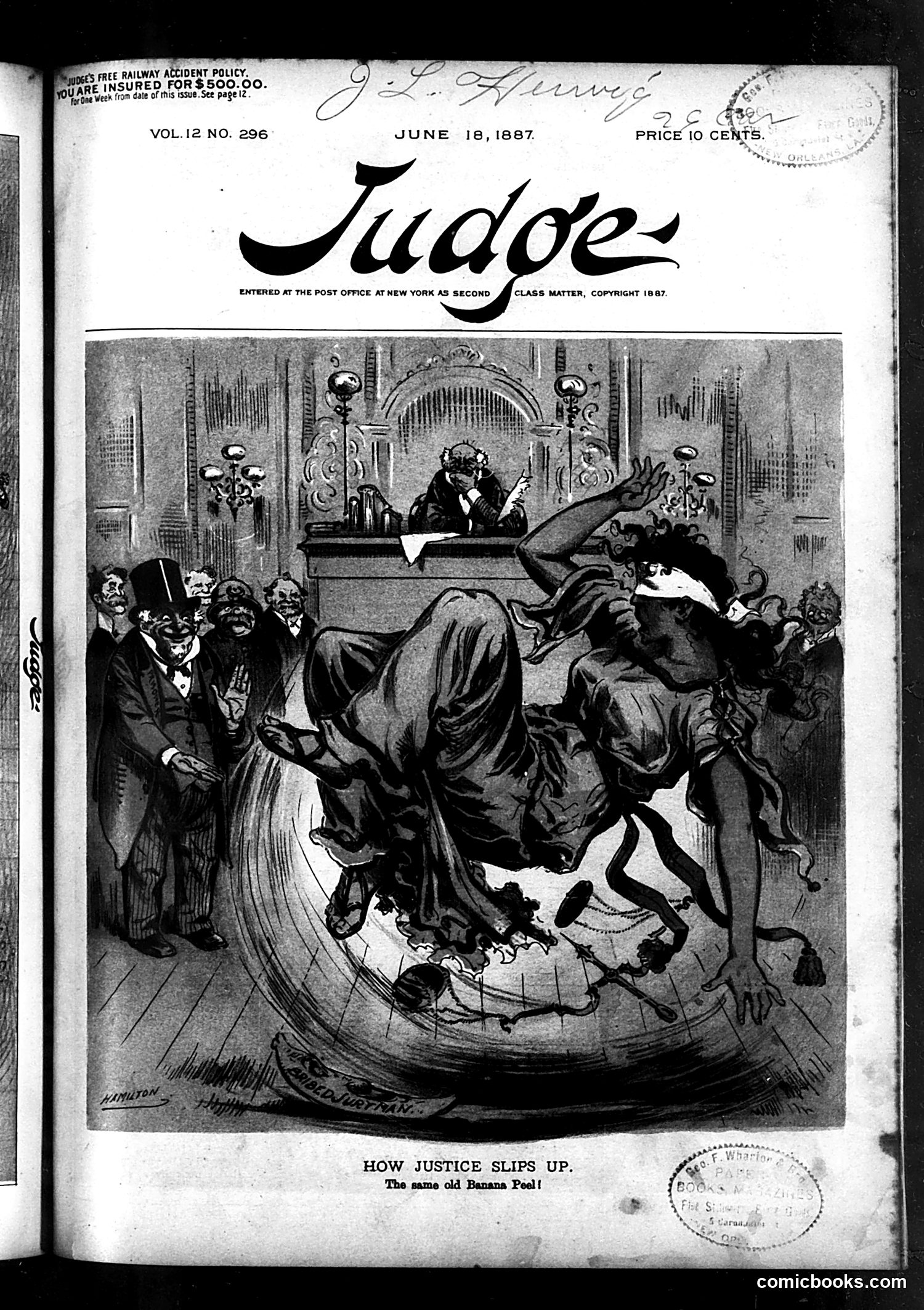
This June 1887 *Judge* cartoon satirizes judicial incompetence through the metaphor of a banana peel. The title—"The same old Banana Peel!"—suggests justice repeatedly stumbles through preventable foolishness. The scene depicts a courtroom where a figure (likely representing the judiciary or legal system) has slipped on a banana peel, sprawling undignified across the floor while a judge presides unmoved from the bench. Onlookers in formal dress observe the mishap. The satire mocks how the justice system fails through carelessness or avoidable errors rather than principled difficulty. By portraying justice's downfall as comedic and self-inflicted—slipping on something trivial—the cartoon criticizes the legal establishment's bungling and suggests systemic problems stem from negligence rather than circumstance.
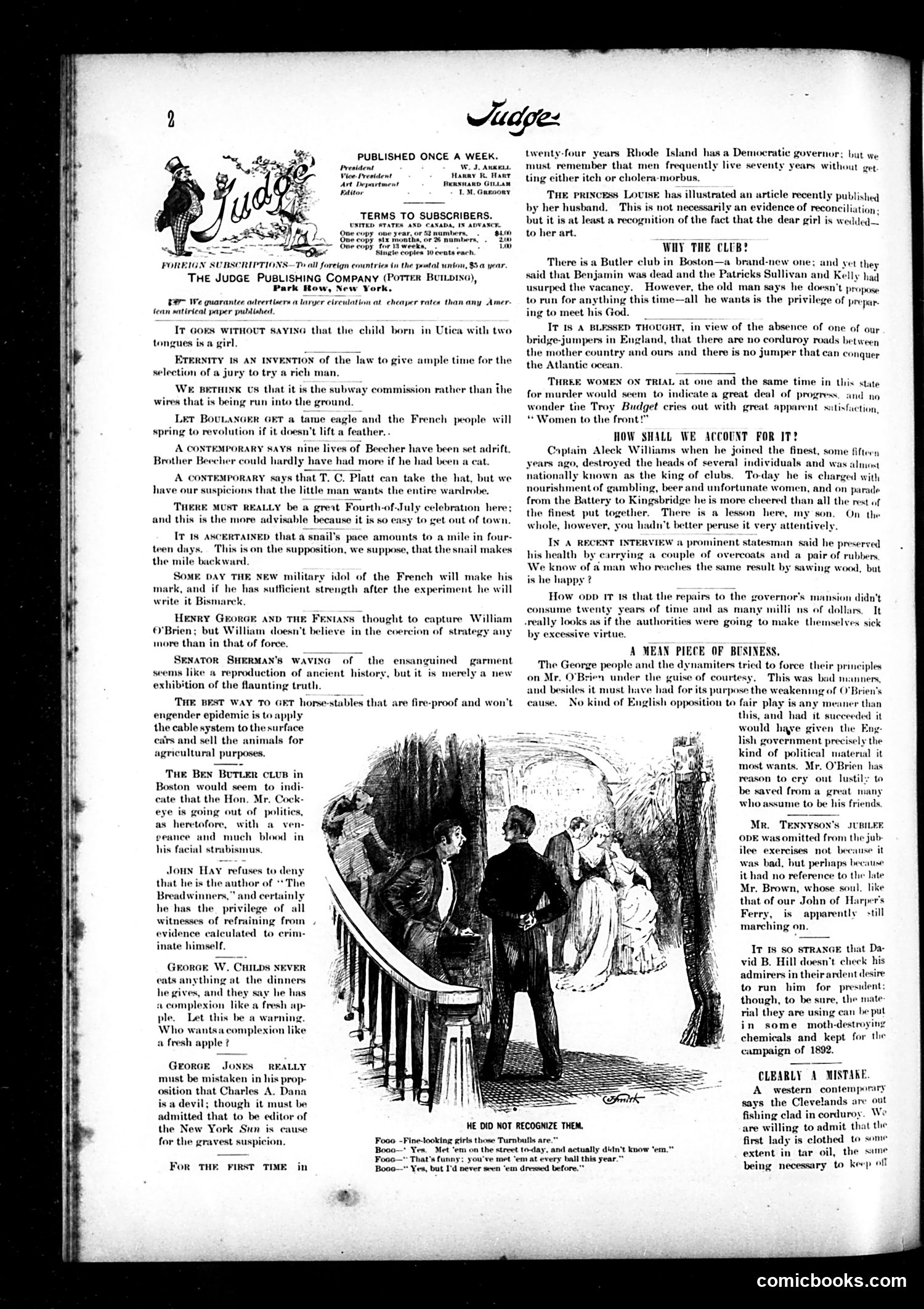
This page contains satirical commentary typical of Judge's political humor. The main cartoon, captioned "HE DID NOT RECOGNIZE THEM," depicts what appears to be a social encounter where characters fail to identify each other despite previous acquaintance. The text includes brief satirical items mocking various public figures and social issues of the era. References include criticism of politicians' behavior, commentary on society figures, and social commentary. One item discusses a Butler Club in Boston and mentions "Benjamin" (likely Benjamin Harrison, president during the 1890s). Without clearer identification of specific individuals or dates visible in the image, precise political references remain uncertain. The humor relies on contemporary recognizability of figures and events now obscure to modern readers. The overall tone is typical Judge satire: mocking pretension, hypocrisy, and social absurdity.
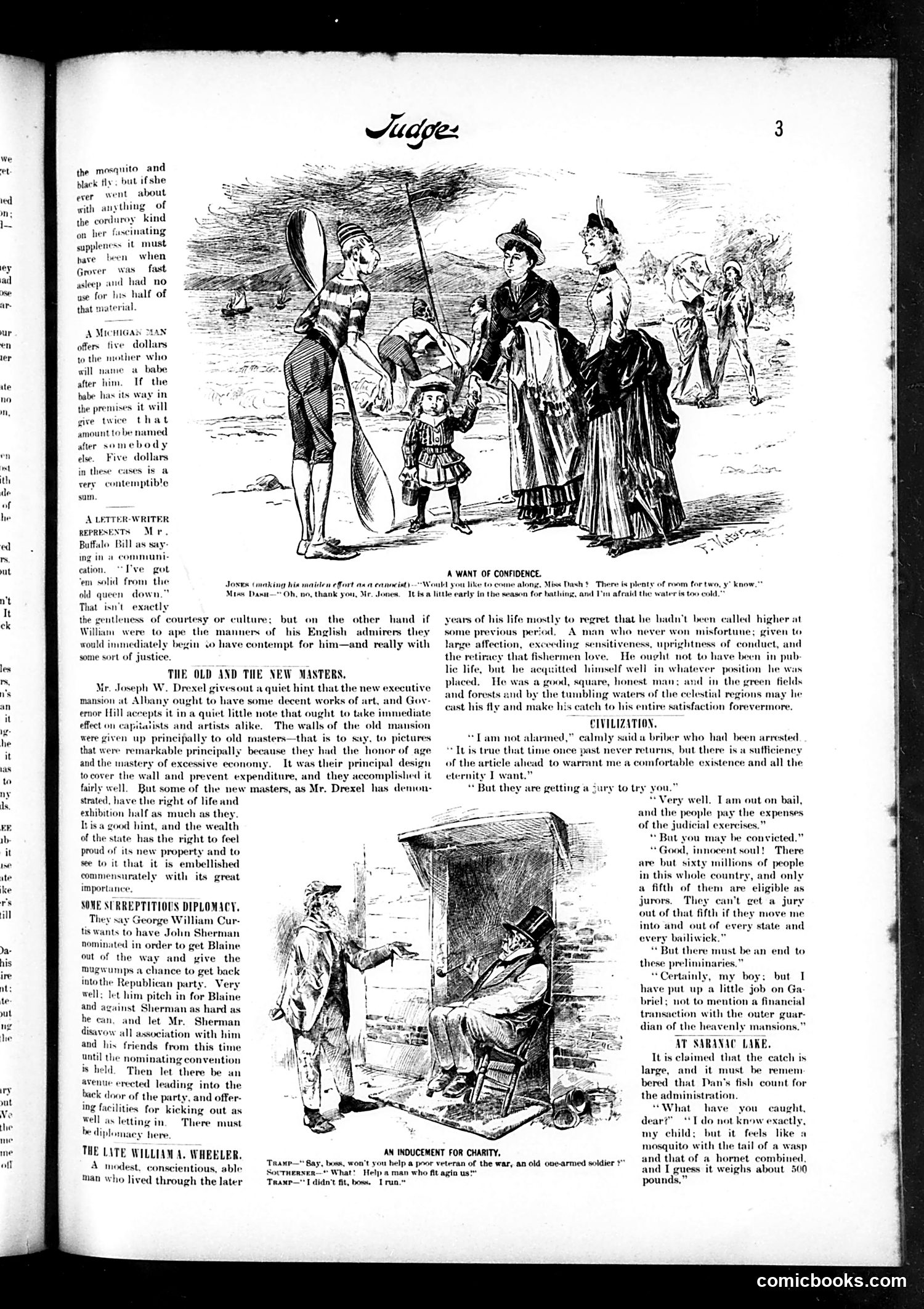
This page from *Judge* contains several satirical pieces typical of late-19th-century American political humor: **"A Want of Confidence"** (top cartoon): Shows a bathing scene where Miss Dash declines Mr. Jones's invitation, citing the water is too cold and it's early in the season. The satire appears to mock social pretense and flimsy excuses. **"The Old and the New Masters"**: Critiques New York's executive mansion decoration. Governor Hill and patron Drexel advocate replacing old masters (valuable paintings kept for age and economy) with contemporary art. This satirizes wealthy patrons' responsibility to support living artists rather than merely preserve old works. **"Some Surreptitious Diplomacy"**: References political maneuvering around presidential nominations, mentioning George William Curtis, John Sherman, and James G. Blaine—suggesting backroom dealing within Republican party politics. **"An Inducement for Charity"** (bottom cartoon): A Civil War veteran requests alms; a bystander refuses, unwilling to help someone who "fit agin us" (fought against the Union). The page mixes social commentary with political satire characteristic of the era's partisan magazine humor.
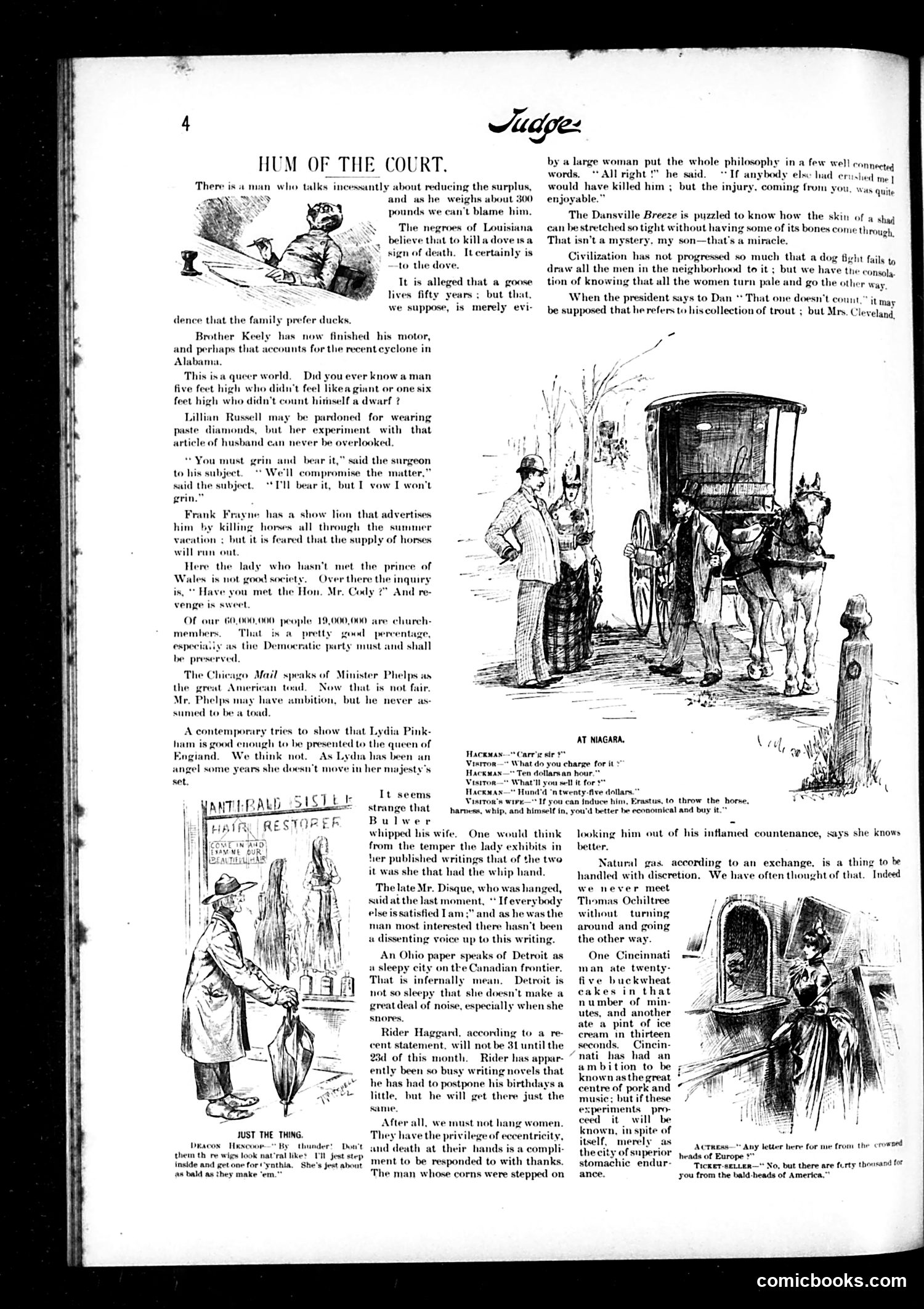
This page from Judge contains satirical commentary on contemporary American figures and social issues, circa 1880s-1890s. **Key Targets:** The "Hum of the Court" section ridicules various public figures: a man obsessing over budget surplus while overweight; Louisiana's approach to capital punishment; Brother Keely's motor invention; and Frank Frayne's horse-dependent show business. **Social Satire:** The magazine mocks class pretensions (the lady unacquainted with the Prince of Wales), gender dynamics (the Lydia Pinkham patent medicine advertisement controversy), and political figures including what appears to be President Cleveland and his wife Mrs. Cleveland (referenced in a joke about counting "trout"). **The Cartoons:** Illustrations accompany anecdotes about everyday absurdities—a carriage scene labeled "At Niagara" with dialogue about hackman fees, and a domestic interior scene. The overall tone is lighthearted mockery of American society's vanities, pretensions, and notable personalities, typical of Judge's satirical approach to Gilded Age America.
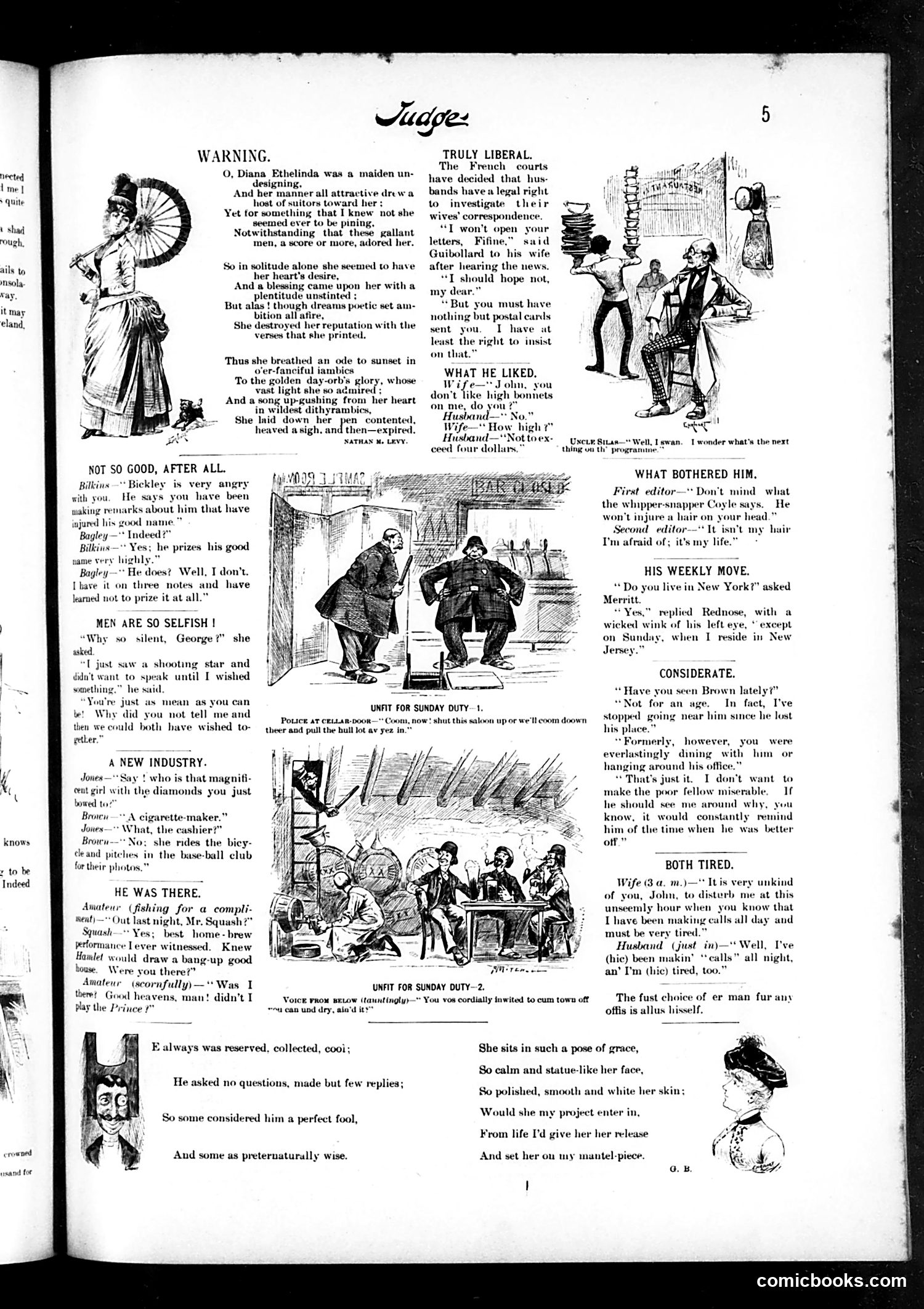
This page contains multiple short satirical pieces typical of late-19th/early-20th century humor: **"Truly Liberal"** mocks a French court decision allowing husbands to read wives' correspondence—a progressive ruling that the cartoon presents as husbands abusing the right to control their spouses. **"Unfit for Sunday Duty"** (two panels) satirizes police officers who close down saloons on Sundays but operate them themselves other days—commenting on official hypocrisy and selective enforcement of Prohibition-era laws. **Various brief comedic exchanges** mock domestic tensions (wives' bonnets and spending, husbands' infidelities and drinking), workplace relationships, and social pretenses. **"A New Industry"** jokes about women entering non-traditional work (cigarette manufacturing, baseball). The overall tone reflects class-conscious Victorian humor about marriage dynamics, official corruption, and changing gender roles. The illustrations use exaggerated facial features typical of period caricature.
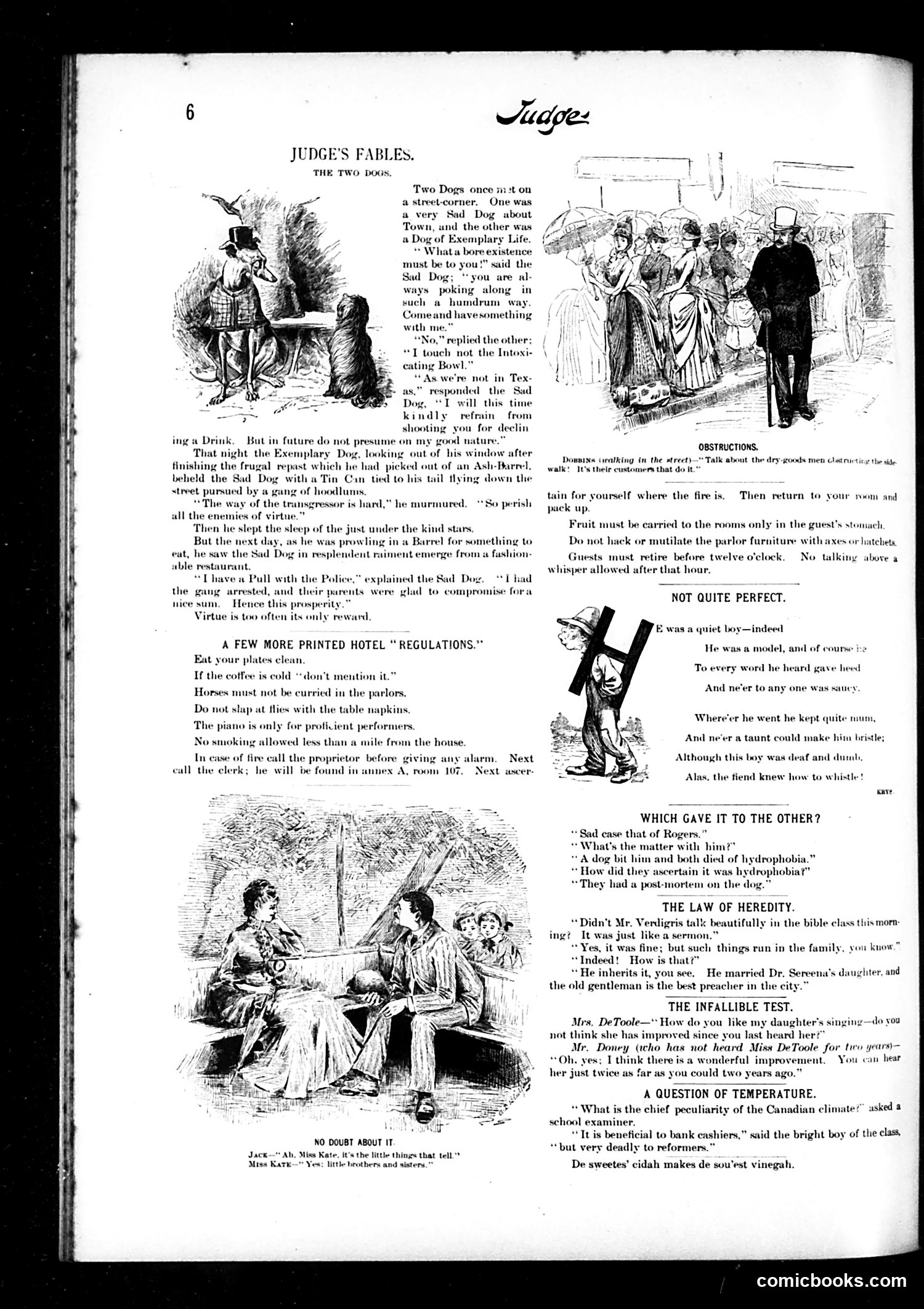
This page contains satirical fables and humorous anecdotes typical of late-19th-century American humor magazine *Judge*. **"The Two Dogs"** fable mocks temperance advocates. A "Sad Dog" drinks and gambles, ending up prosperous through compromise with wealthy patrons, while the virtuous "Exemplary Dog" remains poor—satirizing the era's tension between moral reform movements and practical success. **Hotel "Regulations"** parodies absurdly strict Victorian hotel rules (no cursing in parlors, no smoking within a mile), poking fun at pompous proprietors and their ridiculous pretensions. **Remaining items** are brief jokes about: - Courtship ("little things that tell") - A deaf-mute boy whose virtue is somewhat undermined by his disabilities - Hereditary talent and family traits - Apparent mockery of African American dialect ("sou'est vinegah") The page reflects Gilded Age concerns: temperance debates, class mobility, and social hypocrisy. The humor is often mean-spirited by modern standards, particularly regarding disability and race.
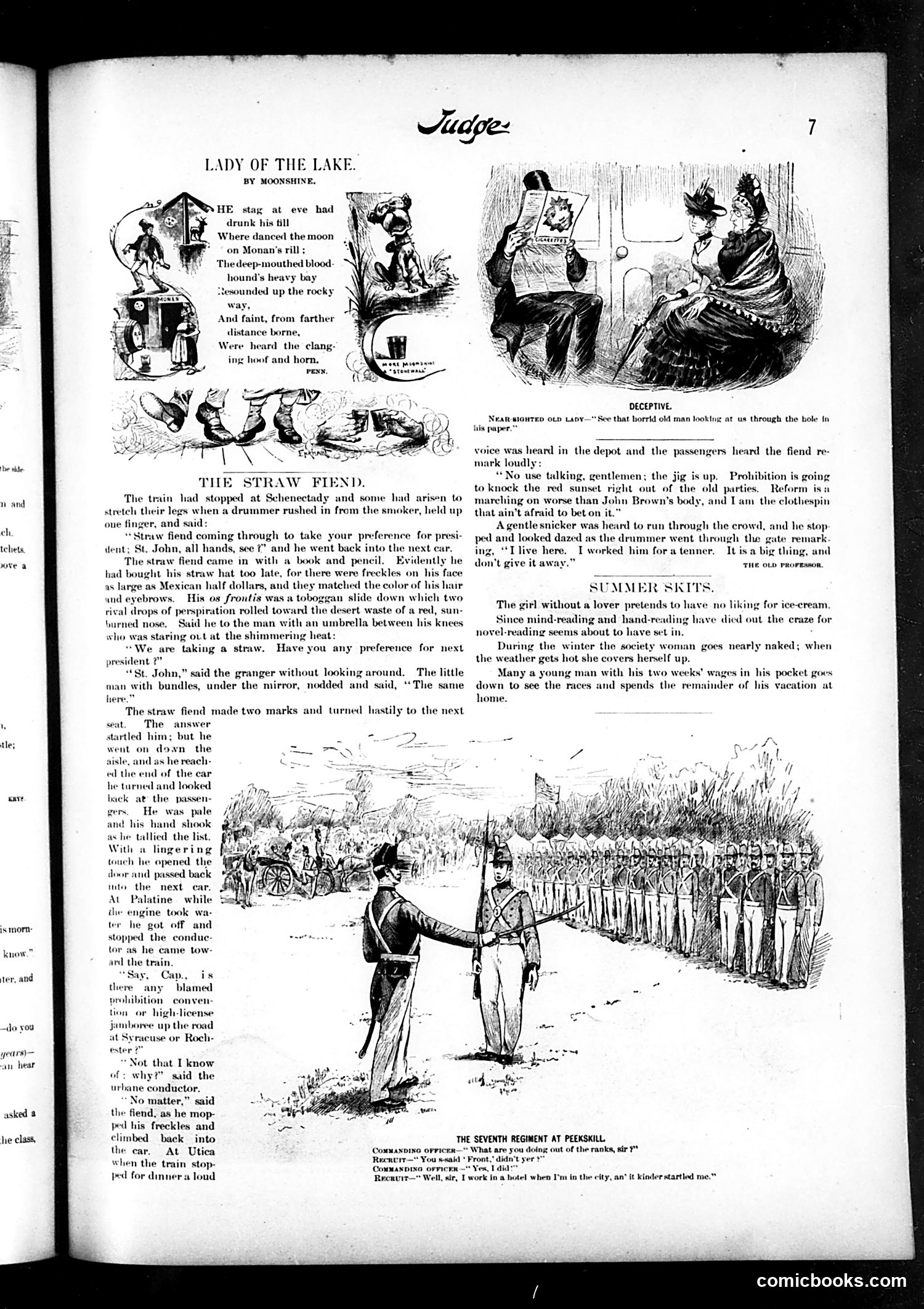
This page satirizes a traveling political operative—"the straw fiend"—who conducts informal polling to gauge presidential preferences among ordinary citizens. The freckled drummer with his notebook travels a train route asking passengers who they support for the next election. The satire targets the absurdity of straw polls and political canvassing: when he discovers a granger and others support "St. John" (likely referring to a prohibition candidate), he becomes distressed, realizing the reform movement is stronger than expected. By journey's end, he admits he was duped by the granger—revealing the unreliability of such casual polling methods. The joke exposes how easily political operatives could be manipulated and how little their informal surveys actually revealed about genuine public opinion. The other brief comedic pieces on the page are unrelated humorous observations about social life.
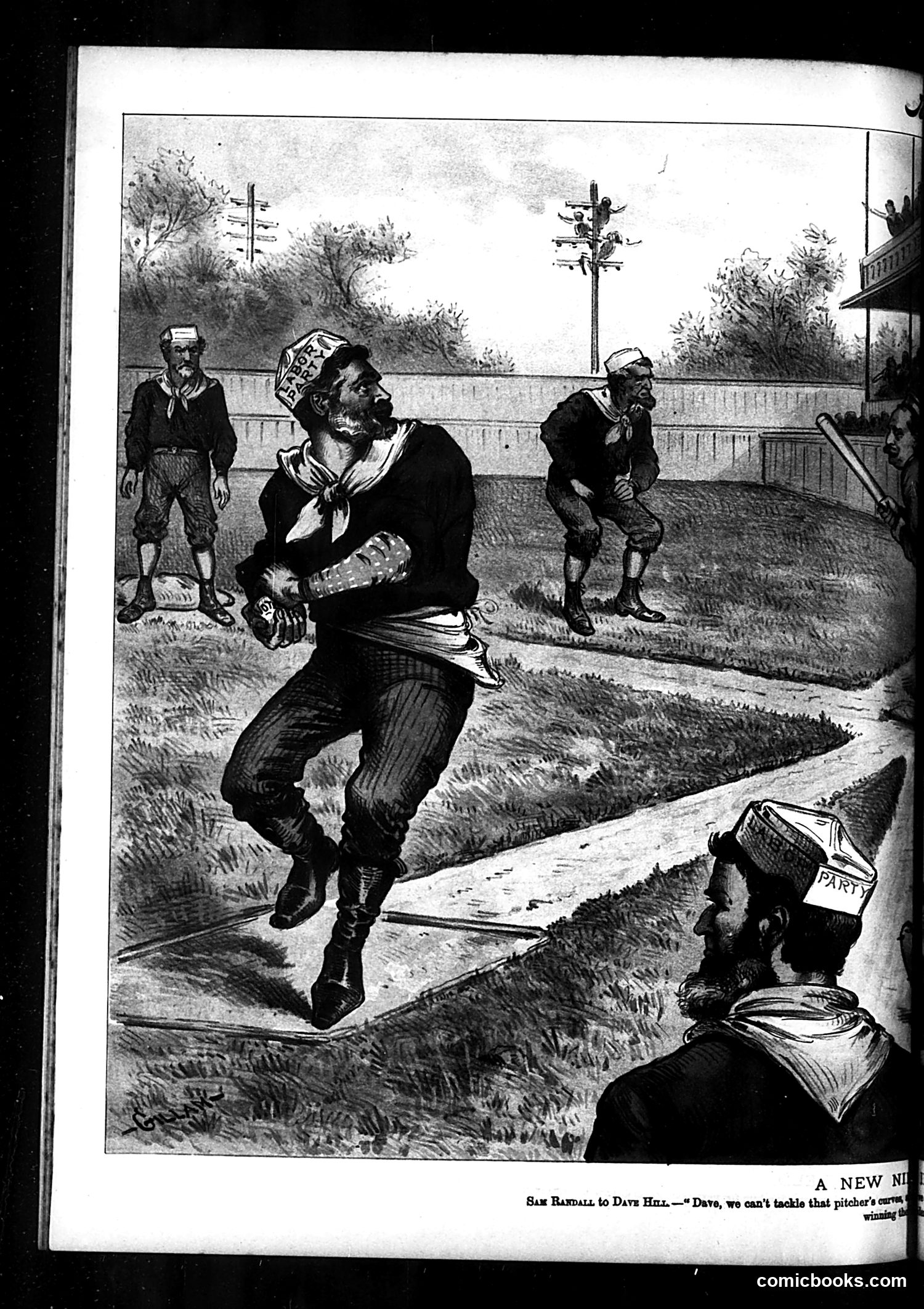
This is a baseball cartoon titled "Sam Randall to Dave Hill," with the caption about being unable to "tackle that pitcher's curves." The image shows a baseball player in mid-pitch or swing, surrounded by other figures in what appears to be a ballpark setting, with a wooden fence and utility pole visible. The humor appears to be a play on words—"tackle" and "curves" mixing football/wrestling terminology with baseball. The caricatured figures and exaggerated style are typical of Judge magazine's satirical approach, though the specific historical baseball reference is unclear without additional context about the players or date. The "PARTY" label visible on one figure suggests possible political satire layered into the sports scene, but the exact meaning remains unclear from this page alone.
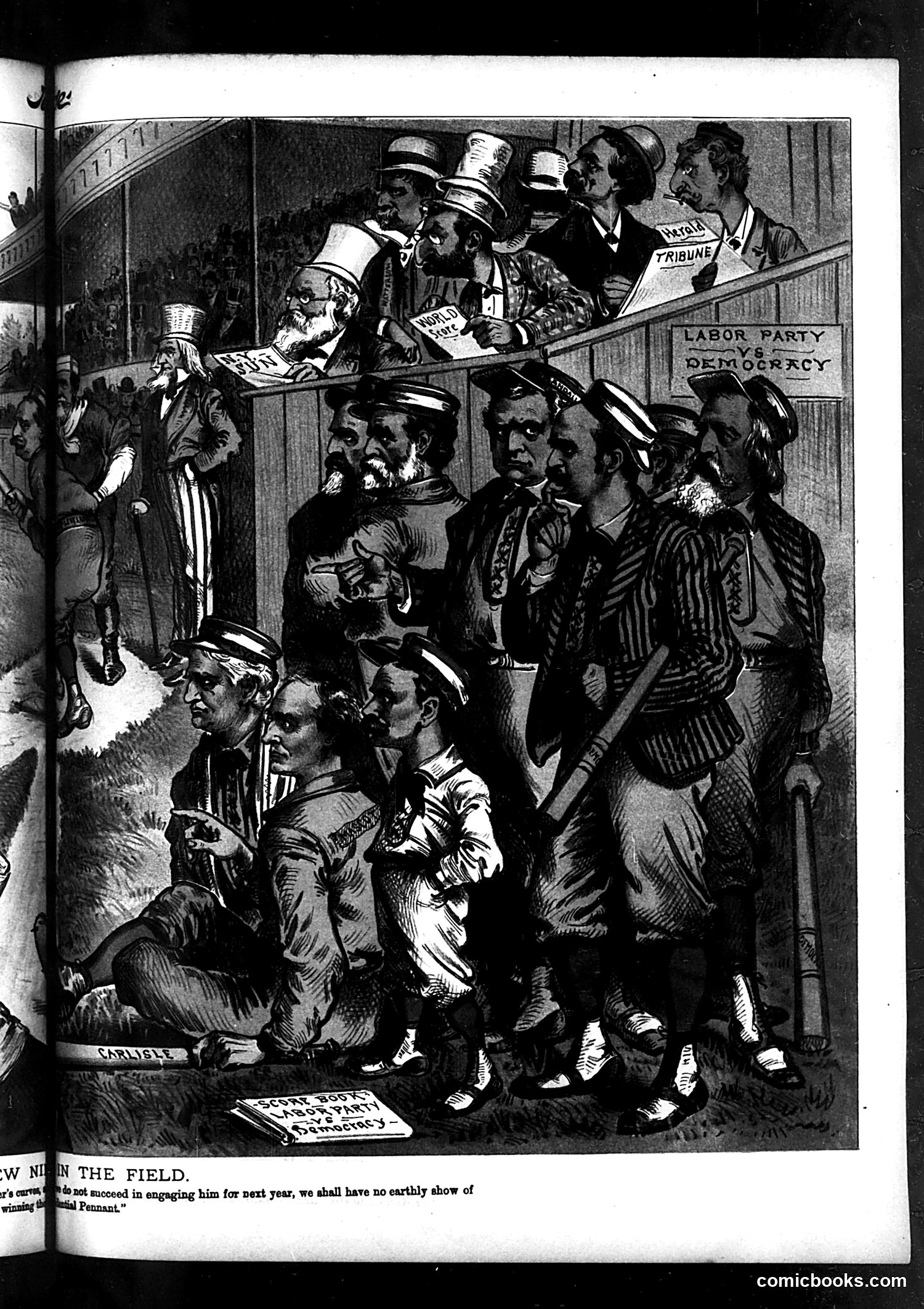
This appears to be a satirical cartoon from *Judge* magazine depicting a political struggle. The upper level shows figures labeled with newspapers ("Tribune," "Italia") and political parties ("Labor Party," "Democracy"), suggesting media and political factions. Below, working-class figures and what appear to be labor representatives confront or negotiate with establishment figures in top hats. The caption references "engaging him for next year" and "no earthly show of...Pennant," suggesting this depicts political maneuvering around electoral competition—possibly depicting tensions between labor movements and established political parties circa the Progressive Era. The satire critiques either: labor's leverage in politics, or conversely, the establishment's control despite working-class organizing. Without a date or clearer text, the specific election or figure referenced remains unclear, though the visual hierarchy emphasizes class tensions in American political life.
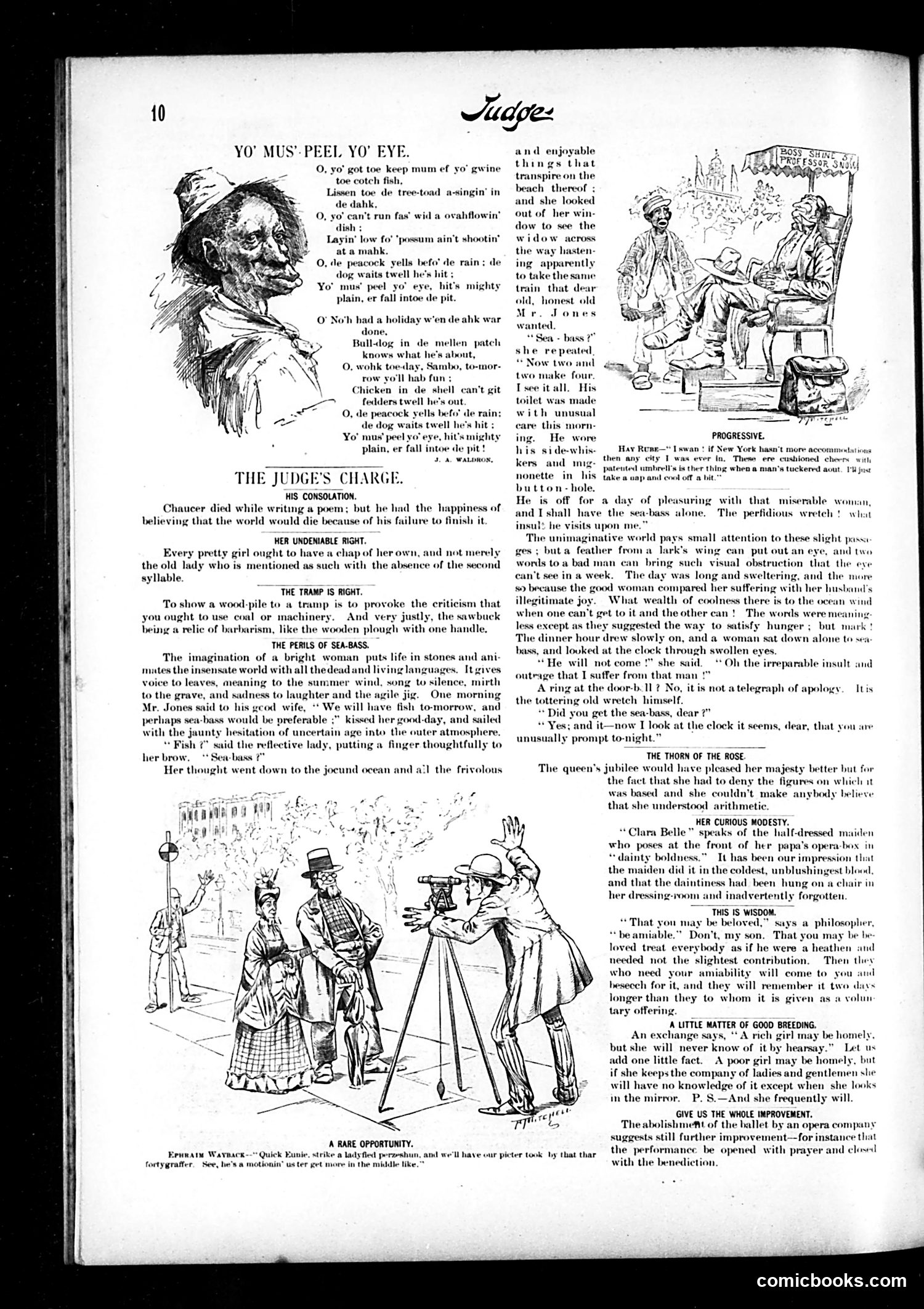
This page from the satirical magazine Judge contains humor targeting domestic life and social pretension of the era. **"Yo' Mus' Peel Yo' Eye"** uses exaggerated dialect humor (common in late 19th-century satire, though offensive by modern standards) to present folk wisdom about patience and observation—essentially proverbs about waiting for opportunity rather than rushing. **"The Judge's Charge"** section offers brief satirical observations: mocking Chaucer's self-importance, critiquing women's romantic expectations, and comparing modern progress unfavorably to older ways. **"The Perils of Sea-Bass"** is the main narrative cartoon: Mrs. Jones's imaginative mind creates drama when her husband Mr. Jones announces he'll catch sea-bass. She worries he's actually meeting the widow across the street. The satire targets women's tendency to create emotional turmoil from innocent events, and the gap between imaginative anxiety and boring reality. **"A Rare Opportunity"** (bottom) humorously depicts rural figures attempting to use a photographer's newfangled equipment, satirizing technological bewilderment among unsophisticated people.
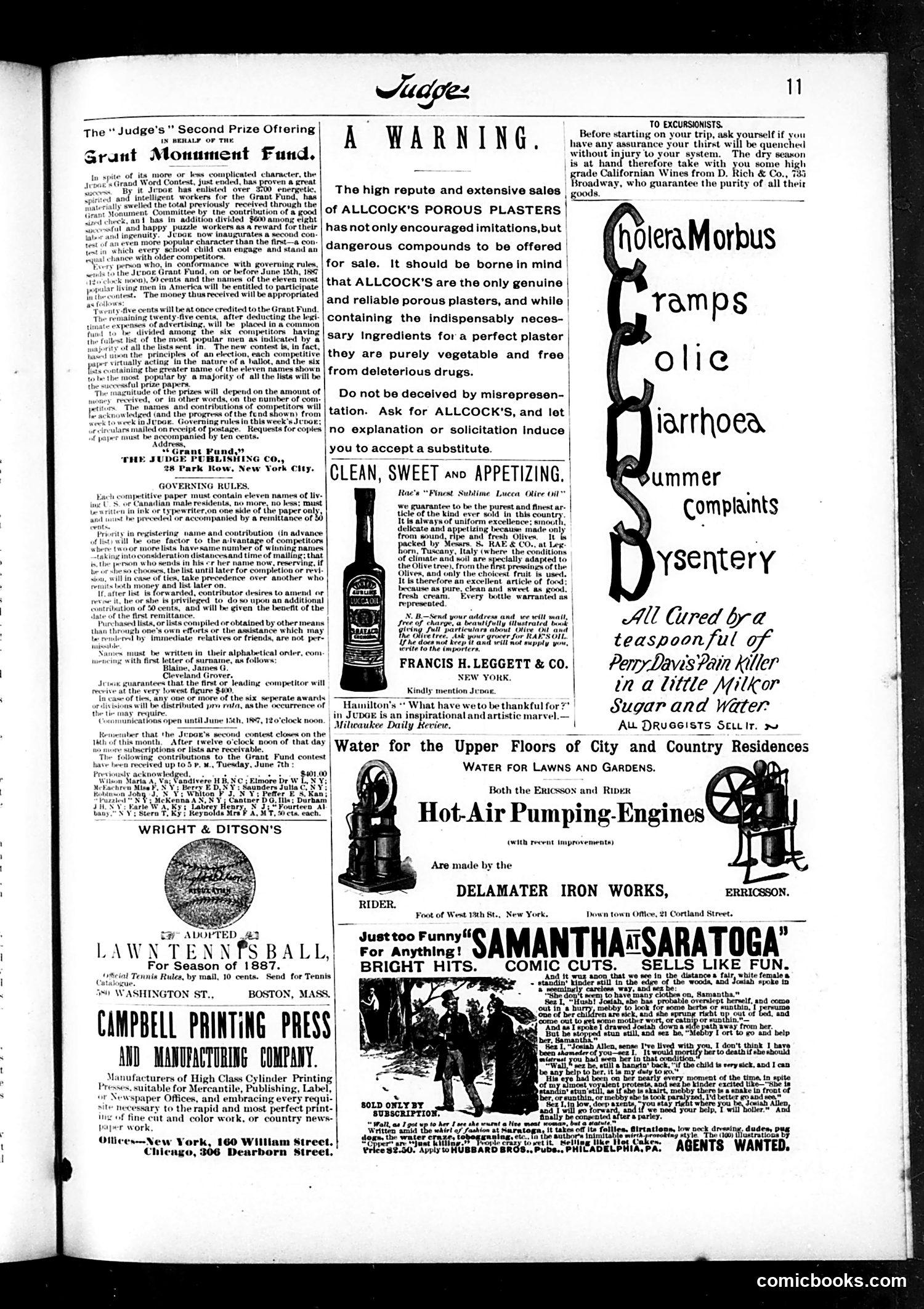
This page is primarily **advertising and administrative content** rather than political cartoons or satire. The main elements include: **The "Judge's" Second Prize Offering**: An announcement of a contest to raise funds for the Grant Monument Fund. Readers submit lists of eleven "most popular" living male American residents; proceeds go to the monument. **"A Warning"** advertisement: Allcock's Porous Plasters warns against counterfeit medical products—a common 19th-century consumer issue when patent medicines and remedies were largely unregulated. **Other ads**: Products typical of the 1880s era (olive oil, water pumps, printing services, lawn equipment). **"Samantha at Saratoga"**: An advertisement for what appears to be a comedic publication or serial. The page reflects Judge's dual function as satirical magazine and advertising vehicle. No significant political satire or cartoon commentary is evident here—it's primarily a business/commerce page with period-specific consumer concerns about product authenticity and fraud.
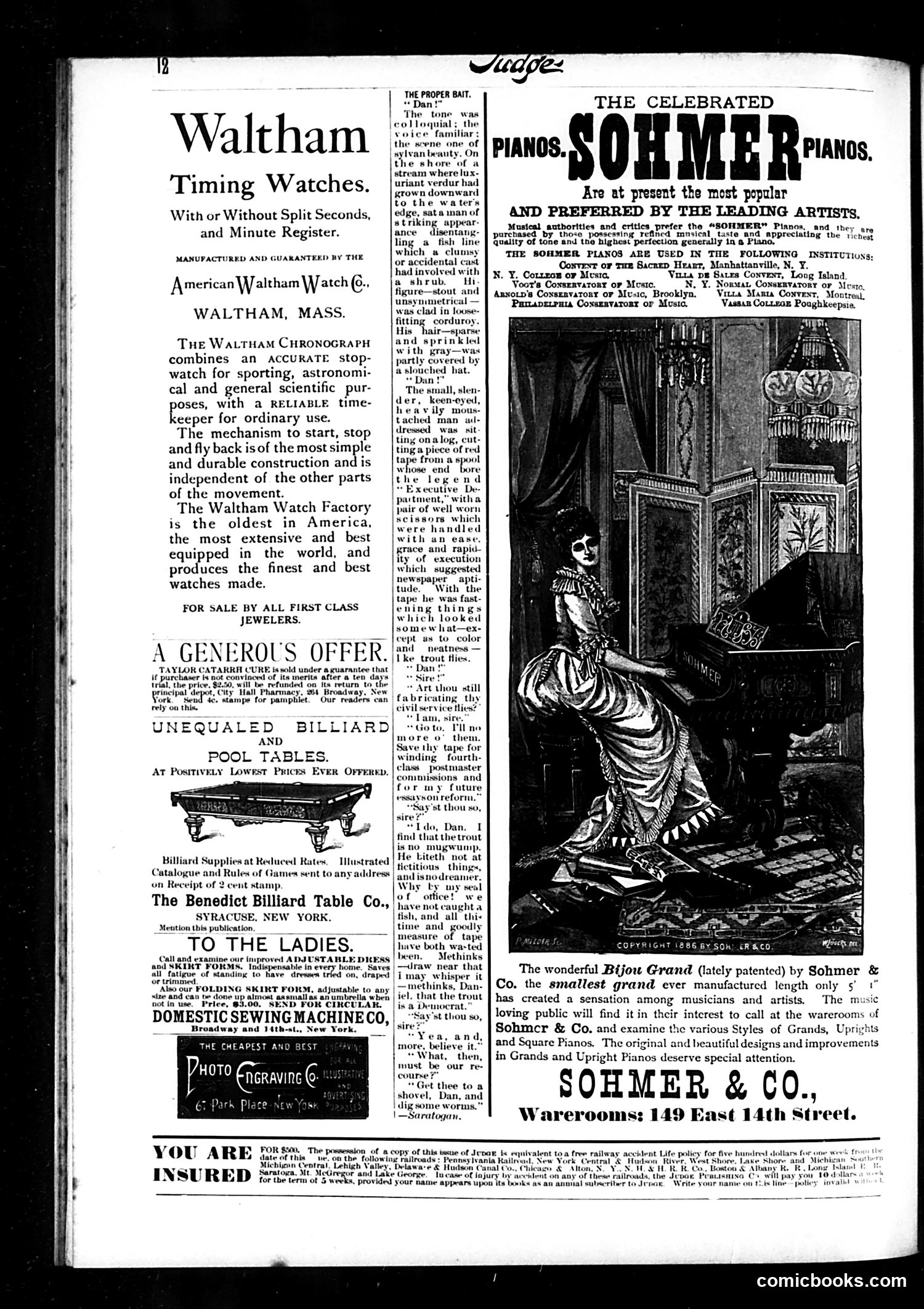
This page is primarily **advertising**, not political satire. It contains multiple product advertisements: Waltham timing watches, Sohmer pianos (the largest ad), billiard tables, a dress form for ladies, and a sewing machine. The only narrative content appears to be "The Proper Bait," a fishing story dialogue printed in the center column. It depicts two men—apparently named Dan and Ian—discussing fishing techniques, with one recounting an anecdote about catching a trout using unconventional bait (described vaguely in the OCR'd text). The large engraving on the right shows a Victorian-era woman in period dress, likely illustrating the fishing story's narrative. **There is no political cartoon or satire visible here.** Judge magazine, despite its satirical reputation, regularly published mixed content including straightforward advertisements and entertainment pieces alongside political commentary on other pages.
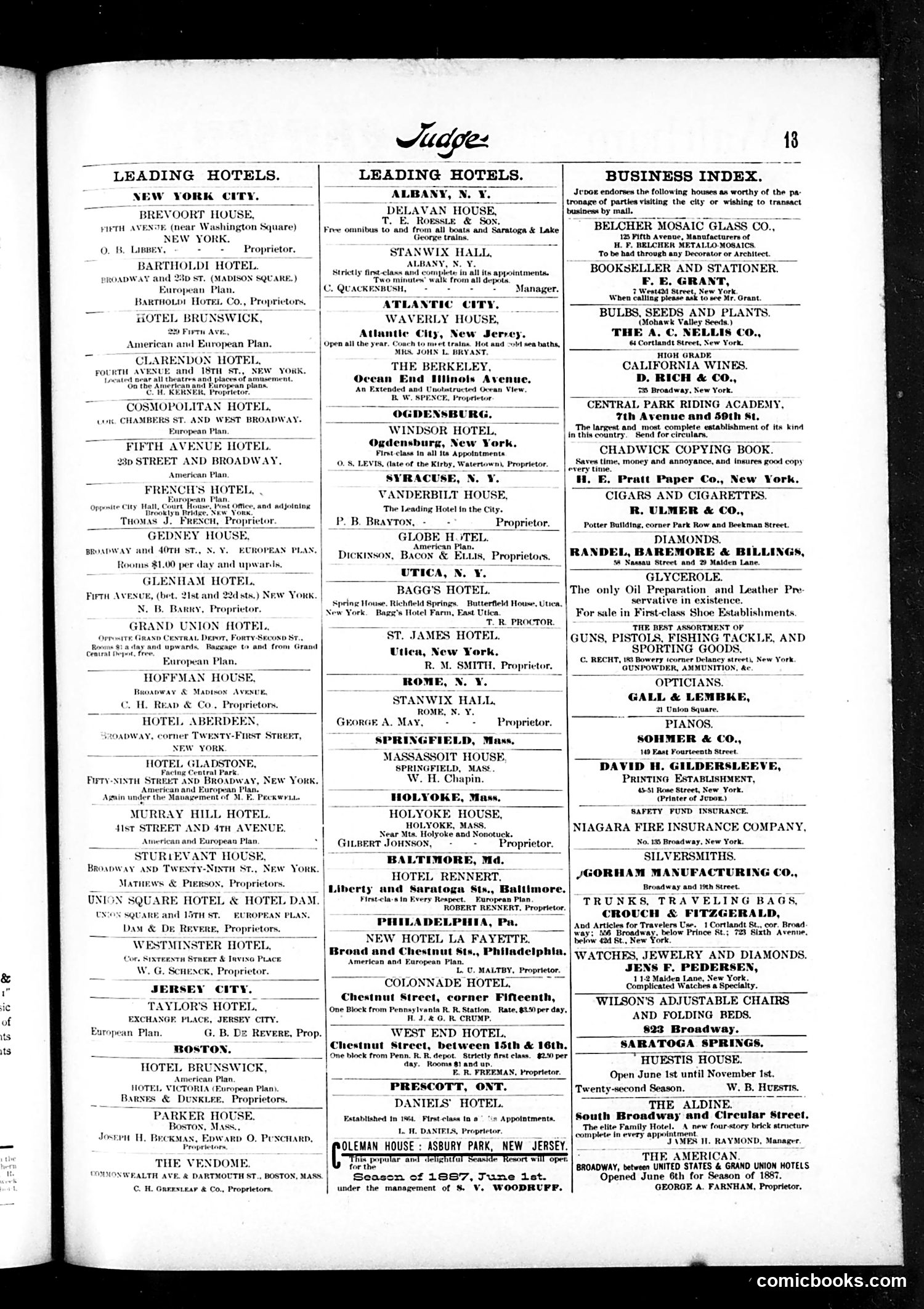
This page is primarily a **directory of leading hotels** across major American cities—New York, Albany, Atlantic City, Syracuse, and Philadelphia—with their proprietors and amenities listed. There is **no visible cartoon or satirical content** on this page. The page also includes a **"Business Index"** section advertising local merchants and services (mosaic glass, bookellers, seeds, wines, riding academy) to potential visitors. This appears to be a typical **advertising page** from *Judge* magazine, likely from the 1880s based on the hotel names and dates visible (one entry mentions "Season of 1887"). Rather than satire or political commentary, it serves a commercial function—promoting hospitality establishments and businesses to the magazine's readership.
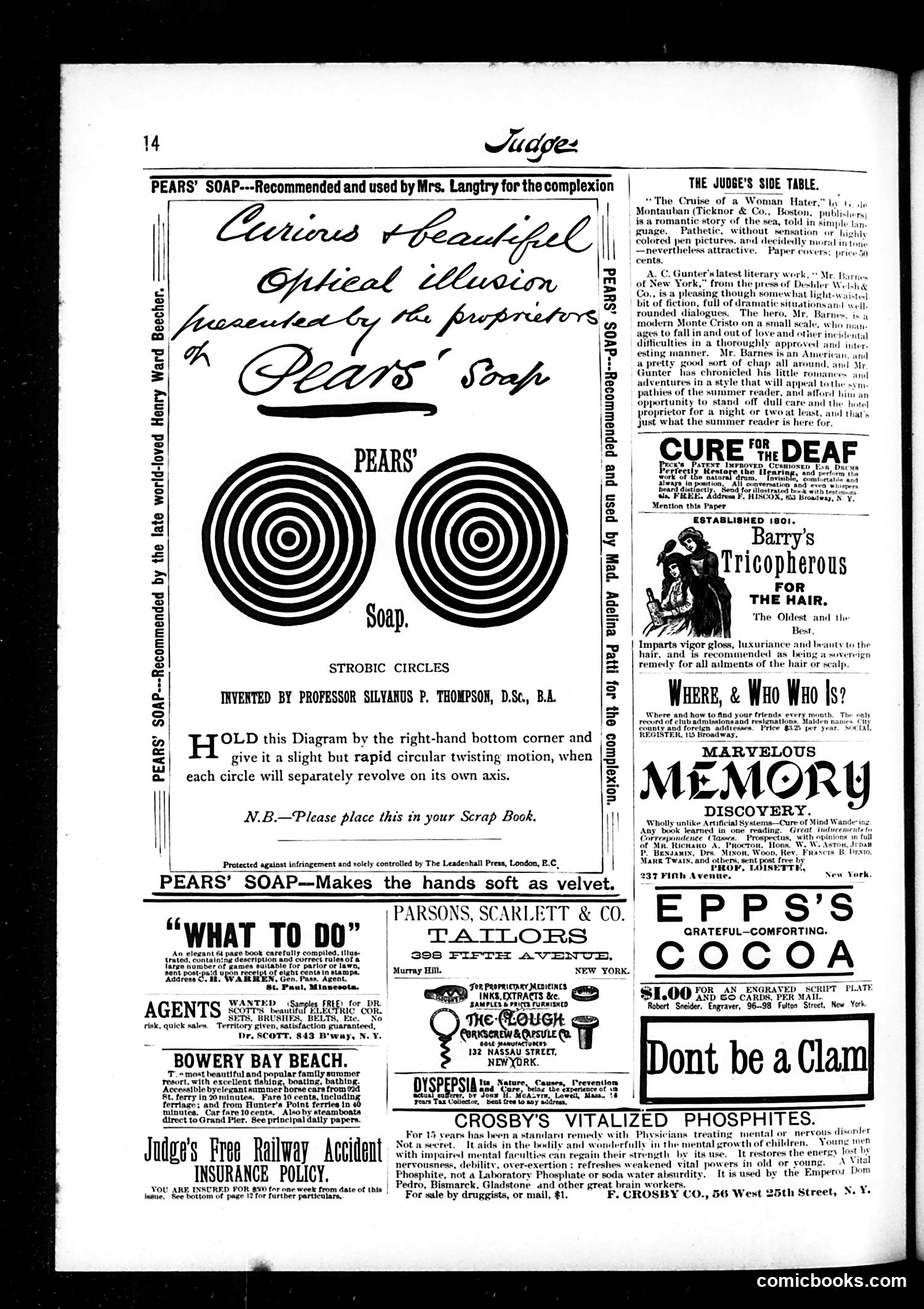
This page is **primarily advertising** with minimal editorial content. The notable elements: **Main Feature:** "Strobic Circles," an optical illusion device invented by Professor Silvanus P. Thompson. Readers are instructed to hold the diagram by its corner and twist it rapidly—each concentric circle will appear to rotate independently on its own axis. This is a genuine optical novelty from the period, included for readers to cut out and keep ("N.B.—Please place this in your Scrap Book"). **The Satire/Editorial Content:** Minimal. "The Judge's Side Table" reviews three books in conventional literary fashion with no apparent satirical intent. **Advertising:** The bulk of the page consists of period product advertisements—Pears' Soap, Barry's Tricopherous hair tonic, Epps's Cocoa, Crosby's Vitalized Phosphites (a patent medicine claiming to restore mental faculties), and various other nostrums and services typical of 1880s-era magazine advertising. **Notable:** One ad references Mrs. Langtry, the famous actress, as endorsing Pears' Soap—an early example of celebrity product endorsement.
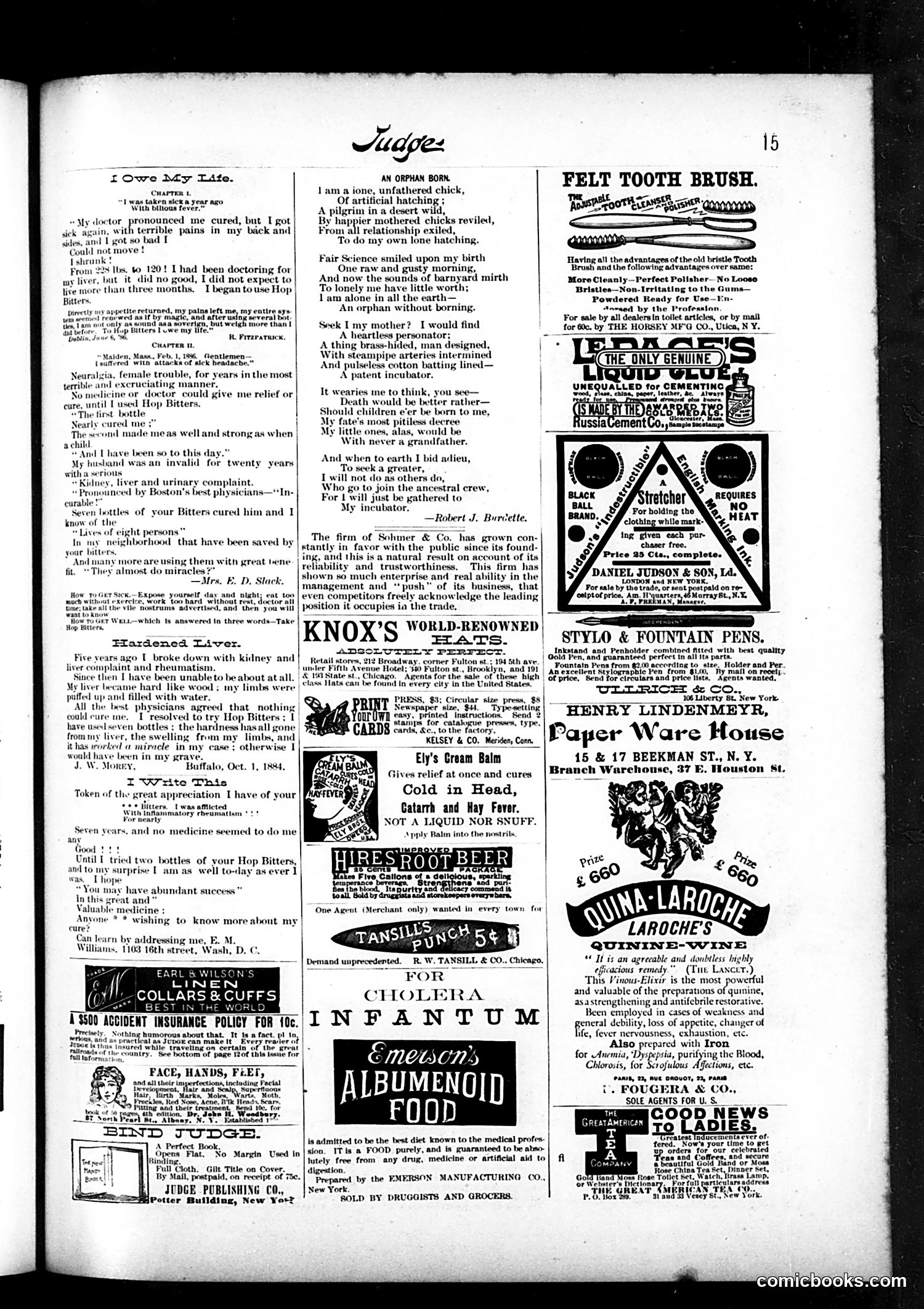
This page is primarily **advertisements and light verse**, not political cartoons. The main content includes: **"An Orphan Born"** — a humorous poem by Robert J. Burdette about a chick hatched by an artificial incubator rather than a mother hen. The satire mocks scientific progress and mechanization, portraying the incubator as a soulless "brass-hided" contraption with "steampipe arteries." It's gentle social commentary on industrial technology replacing natural processes—a common late-19th-century anxiety. **Testimonial advertisements** for Hop Bitters (a patent medicine) dominate the page, featuring alleged cures for kidney disease, liver problems, and rheumatism. These represent the era's widespread medical quackery that Judge's satire typically targeted, though here they're presented as genuine endorsements. The page also advertises felt tooth brushes, fountain pens, and other commercial products typical of 1880s Judge issues. The overall tone is commercial rather than explicitly satirical.