
A complete issue · 16 pages · 1887
Judge — June 11, 1887
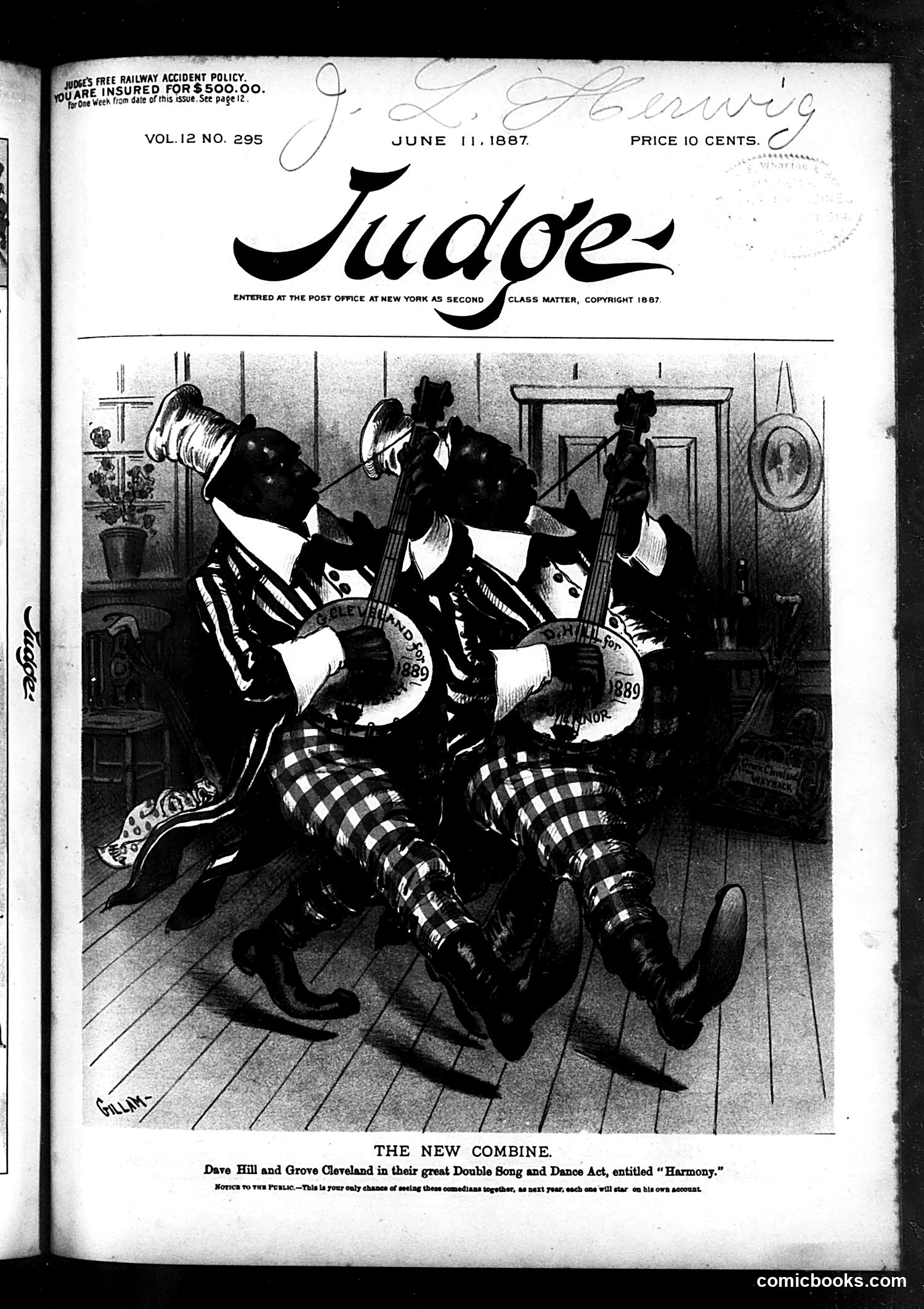
**The Cartoon:** The cover depicts two figures with exaggerated features performing as musicians with banjos, labeled "THE NEW COMBINE." The caption identifies them as "Dave Hill and Grove Cleveland in their great Double Song and Dance Act, entitled 'Harmony.'" **Context:** This appears to reference Grover Cleveland (the sitting president) paired with Dave Hill in a political satire. The "combine" suggests an unlikely or forced political alliance. The musical performance imagery—specifically the "Double Song and Dance Act"—mocks their supposed harmony, implying their partnership is mere theater or performance rather than genuine agreement. The joke targets political cooperation as hollow spectacle, using the vaudeville imagery popular in 1887 entertainment to suggest their partnership lacks authenticity.
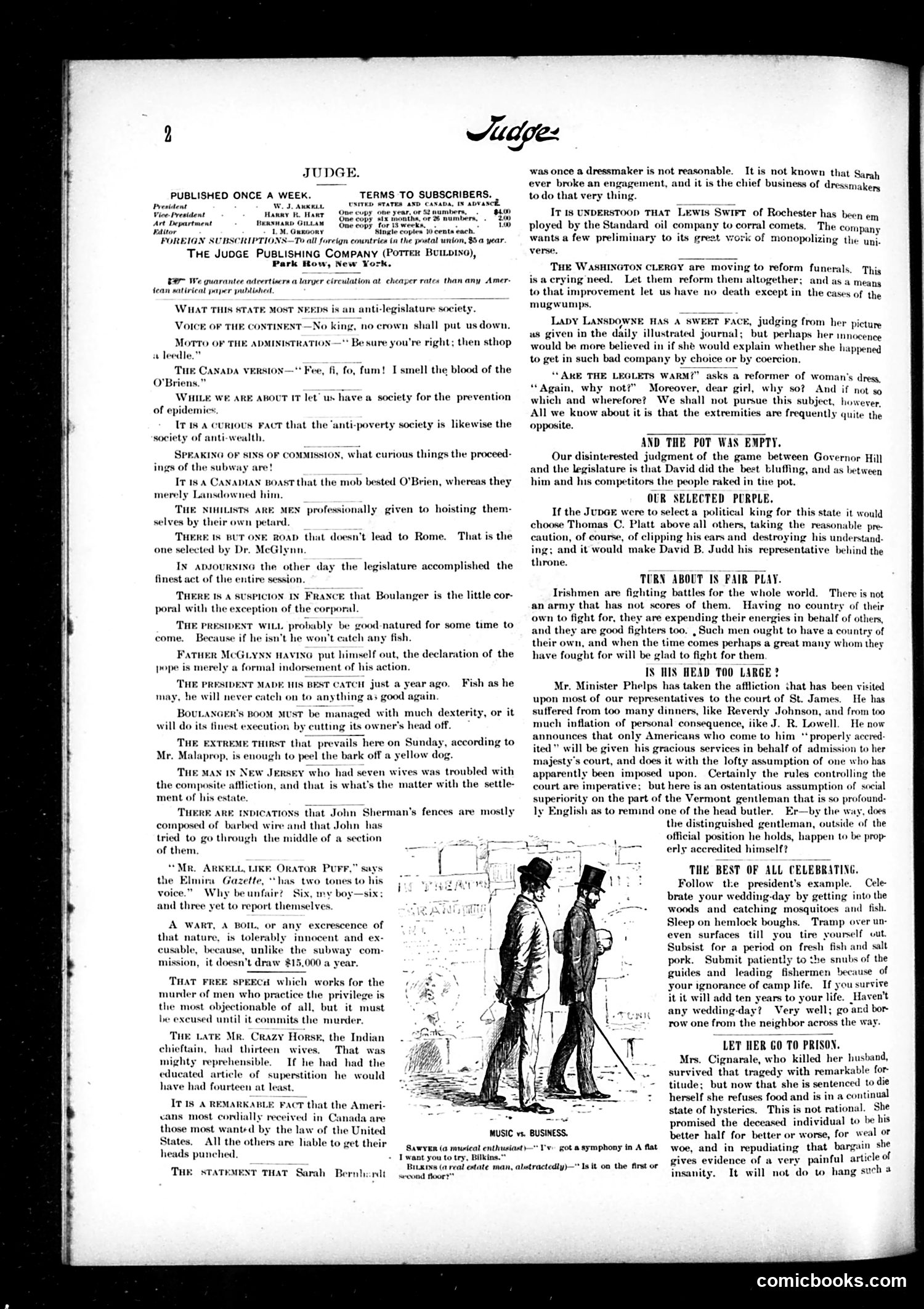
The page contains multiple editorial sections typical of Judge magazine's satirical format. The main illustration shows two well-dressed gentlemen in conversation, captioned "MUSIC vs. BUSINESS," with dialogue about a symphony and a flat. The text sections critique various political and social issues of the era, including: - Anti-legislature sentiment regarding state needs - Commentary on poverty societies and administrative inefficiency - References to specific political figures (Governor Hill, David B. Judd, Thomas C. Acton) - Critiques of Irish immigration and O'Brien - Comments on President Cleveland and political patronage The satire targets 19th-century American political corruption, bureaucratic incompetence, and social pretension. However, **without knowing the specific publication date, I cannot identify the exact political context or confirm which individuals are referenced beyond those named in the OCR text.**
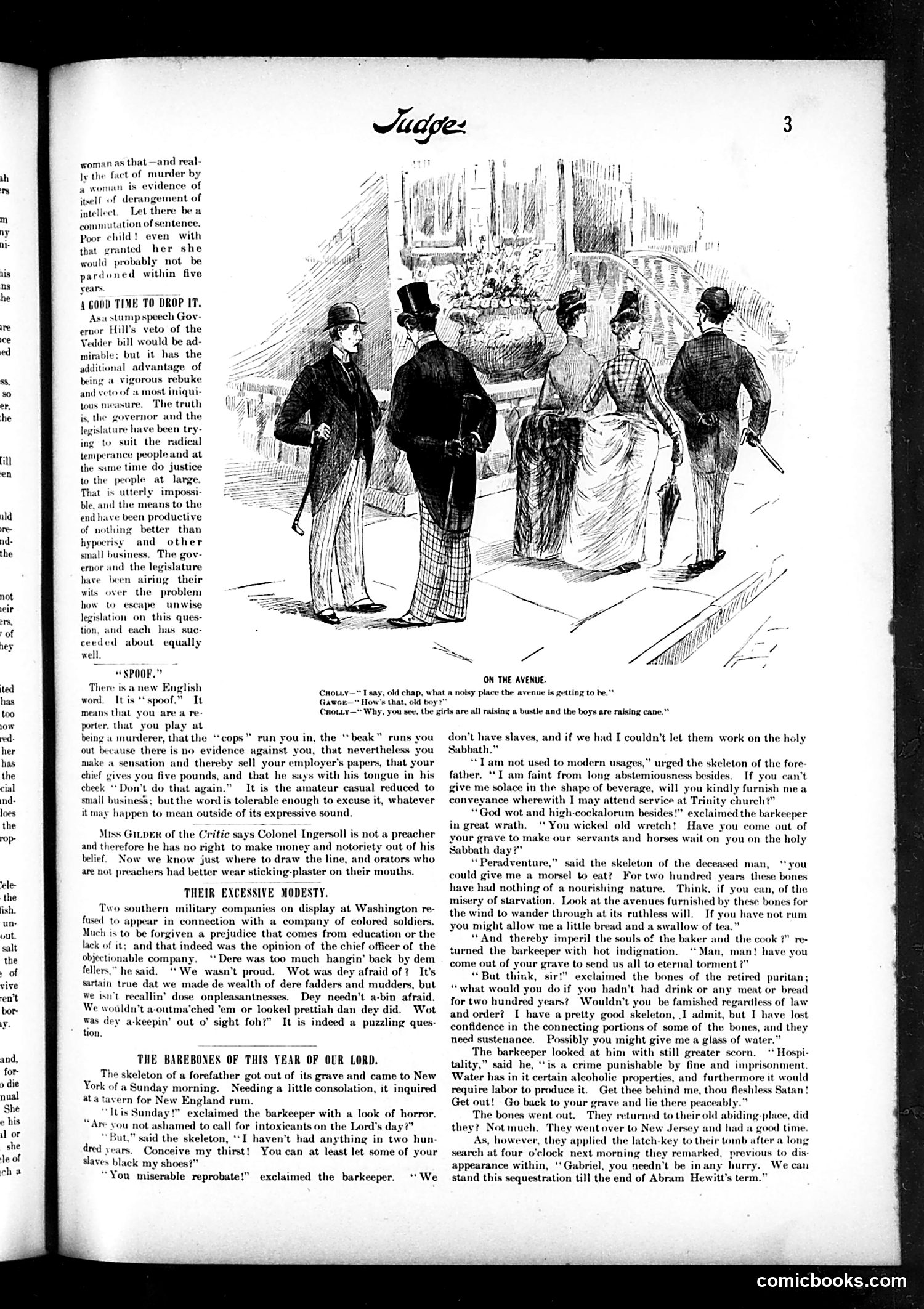
This page contains multiple satirical pieces mocking 1880s American social attitudes and hypocrisy: **Main cartoon ("On the Avenue")**: Shows well-dressed men discussing noise on the street—girls causing a "bustle" (both the garment and commotion) and boys "raising cane" (causing trouble). The joke plays on double meanings of fashion and misbehavior. **"Spoor" section**: Satirizes sensationalist journalism—reporters who stage crimes to generate newspaper stories, creating false scandals for profit and their employers' circulation gains. **"Their Excessive Modesty"**: Mocks Southern military units refusing to appear alongside Black soldiers at a Washington event. The barkeeper's ironic dialect speech undercuts their false pride, pointing out the absurdity of their racial prejudice. **"Barebones" sketch**: A colonial-era skeleton visiting modern New York is shocked by contemporary Sunday restrictions (no alcohol, no slave labor on the Sabbath), satirizing both Puritan rigidity and how much—and how little—American values had actually changed. The overall thrust: attacking hypocrisy, racial prejudice, sensationalism, and moral self-righteousness.
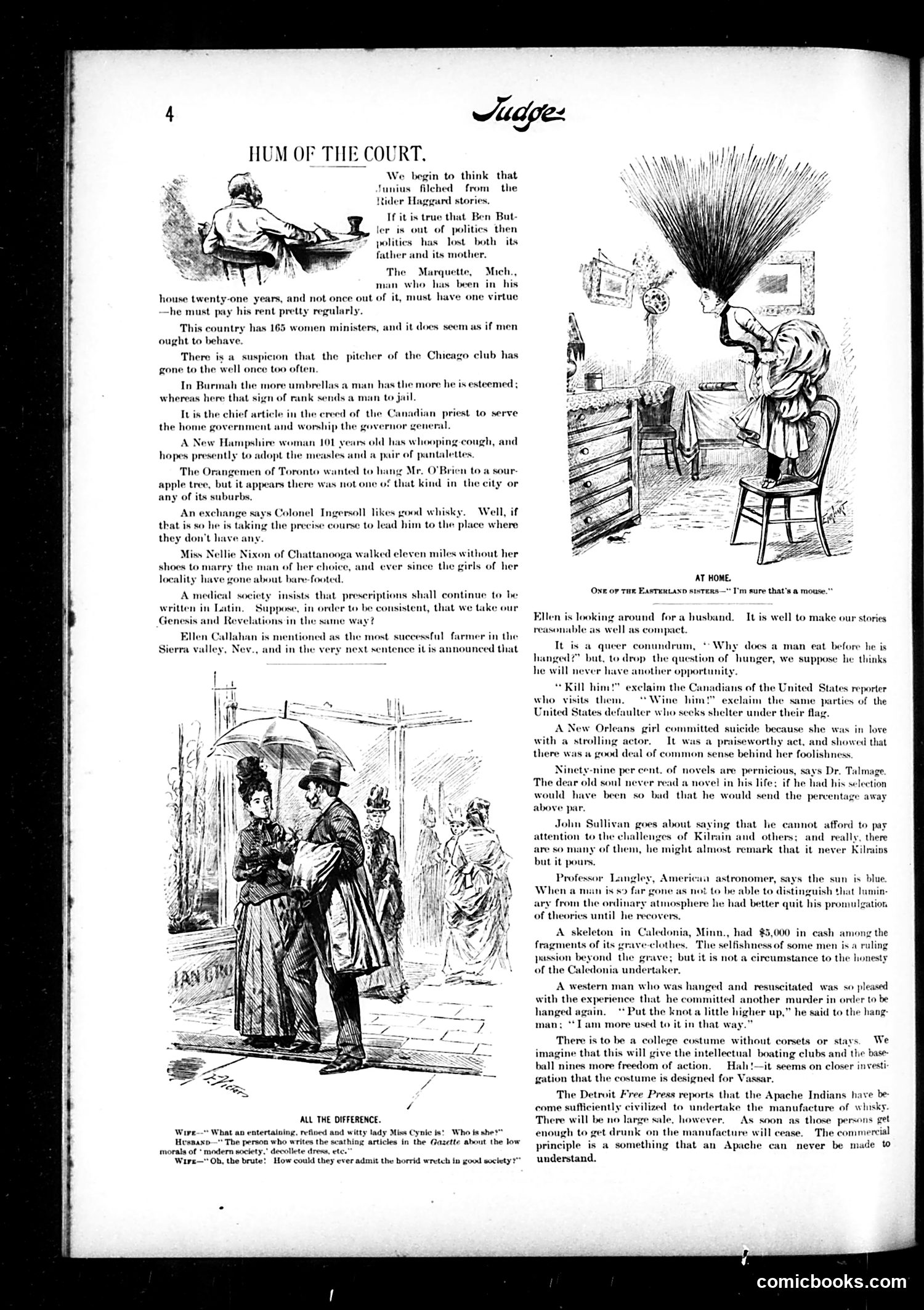
This page contains brief satirical commentary on contemporary social and political issues, rather than single unified cartoons. The cartoons shown illustrate specific jokes: **"At Home"** (right): A woman brushes her exaggerated hair while her husband reads. The caption—"I'm sure that's a mouse"—satirizes women's elaborate Victorian hairstyles, suggesting they're so voluminous they could hide rodents. **"Wire" (bottom left)**: Two figures discuss newspaper writing, mocking sensationalist journalism and moral hypocrisy in reporting. The text snippets mock various targets: political figures like Ben Butler, religious hypocrisy (Canadian priests), gender contradictions (umbrellas signifying rank but causing arrest), and social absurdities. References to boxers like John Sullivan and Kilrain, astronomer Langley, and Colonel Ingersoll appear contemporary. The satire consistently targets **Victorian social pretension, journalistic excess, and political corruption**—common Judge magazine concerns of the 1880s-90s era.
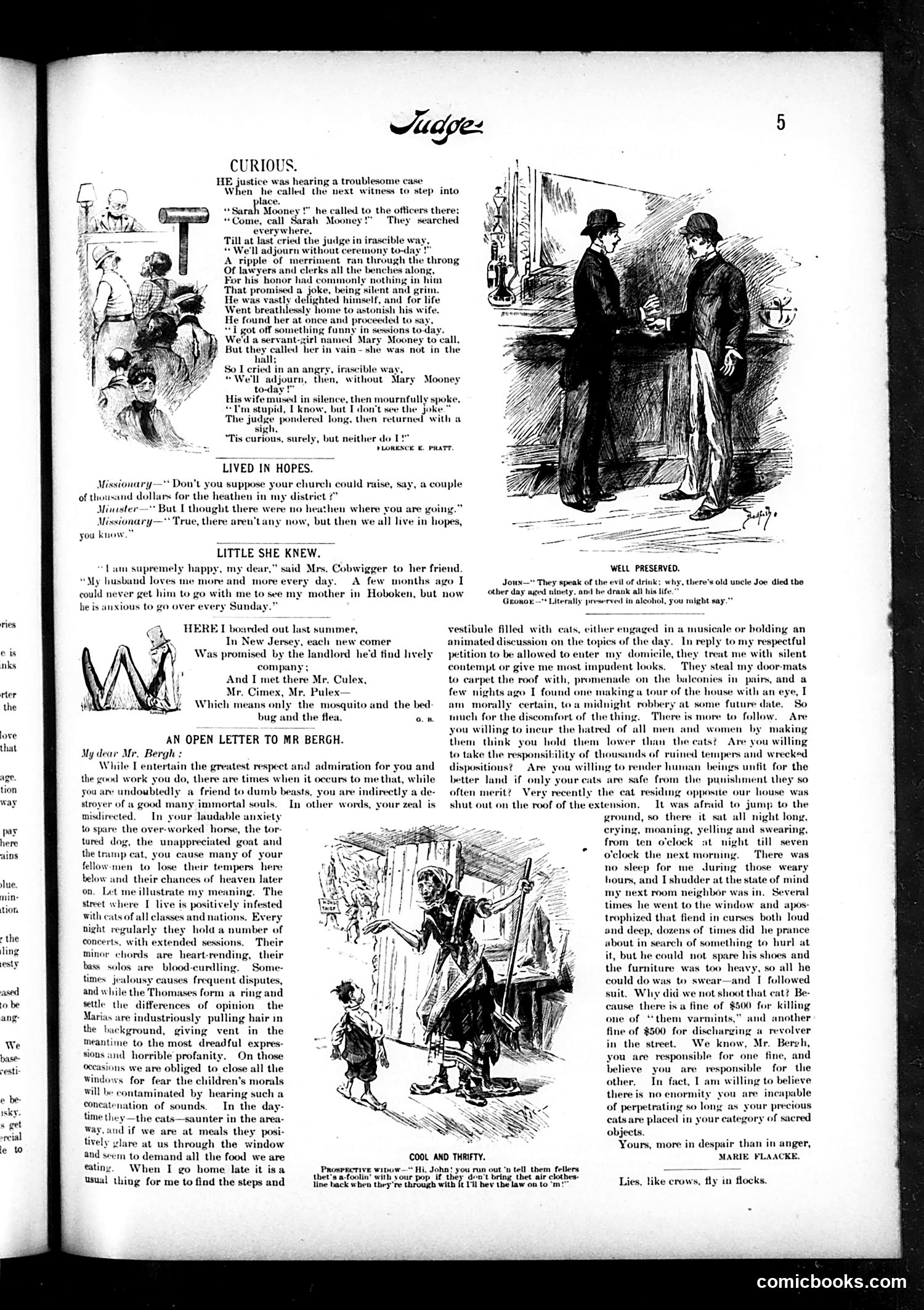
This page contains several satirical pieces mocking various social situations: **"Curious"** depicts a judge who makes a pun about an absent witness named "Mary Mooney" (likely playing on "moony"/absent-minded), then spends the day proudly retelling it—only to admit to his wife that he doesn't actually understand his own joke. The satire targets judicial pomposity and self-satisfaction. **"Lived in Hopes"** mocks missionary fundraising efforts with dark irony: a minister asks for donations to convert "heathen," then admits there are currently no heathens in the target area—they're merely hopeful some will exist eventually. **"Well Preserved"** jokes that an elderly uncle who drank heavily his entire life reached age ninety, so alcohol "preserved" him like formaldehyde. **"An Open Letter to Mr. Bergh"** criticizes animal welfare advocate Henry Bergh (founder of the ASPCA) for protecting animals while ignoring human suffering—specifically complaining that neighborhood cats kept the writer awake with their nocturnal concerts and fighting. The page satirizes hypocrisy, self-delusion, and misplaced priorities among respectable citizens.
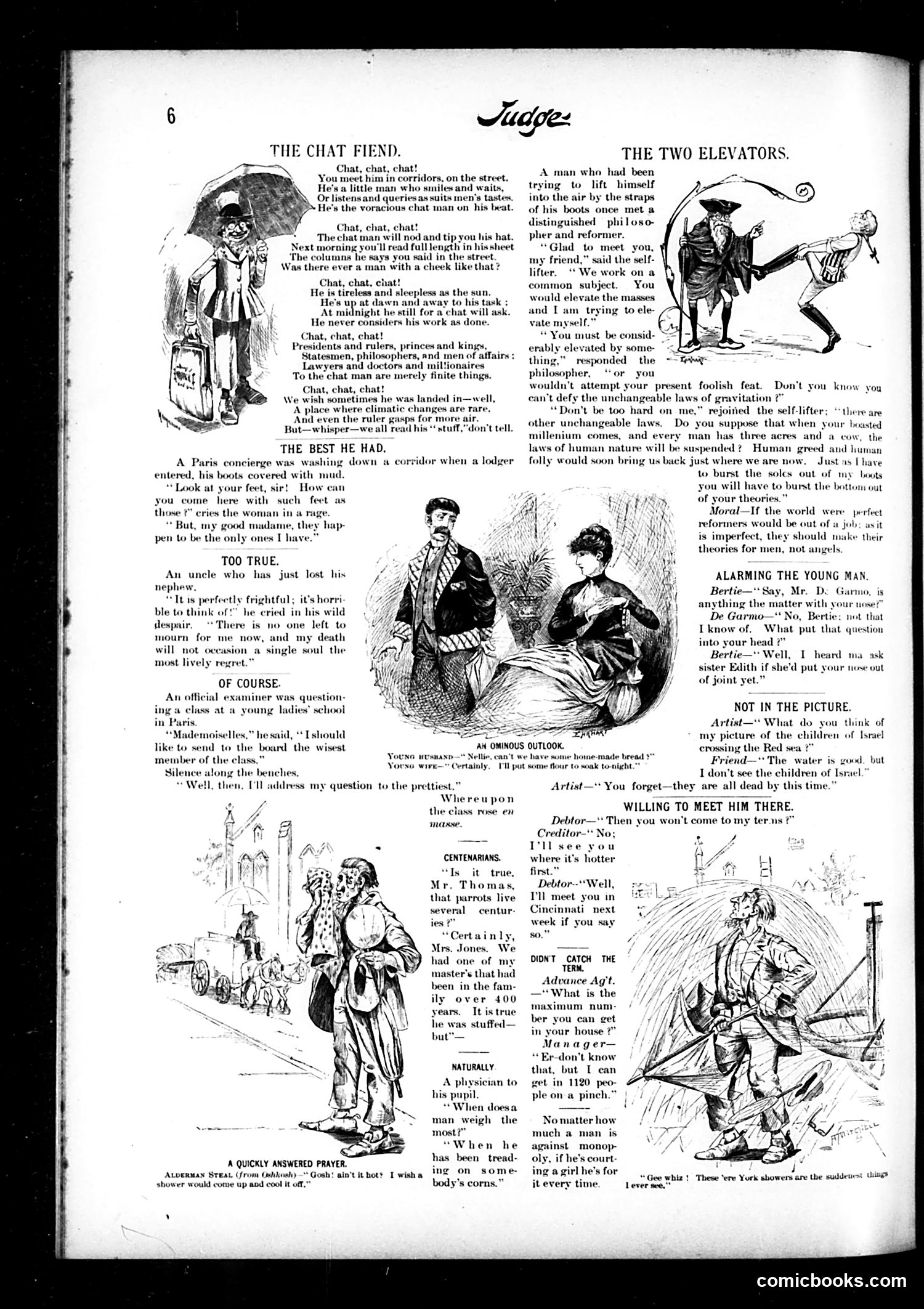
This page contains multiple brief satirical sketches typical of *Judge* magazine's humor: **"The Chat Fiend"** mocks people obsessed with gossip and small talk who buttonhole everyone. **"The Two Elevators"** presents a philosophical debate: a man literally trying to lift himself by his boot straps meets a social reformer. The joke critiques utopian reformers—the self-lifter argues that even if reformers "elevate the masses" through their ideals, human nature (greed, folly) will prevent real progress. It's a satirical attack on naive social reform movements popular in the era. **"The Best He Had"** shows a Parisian concierge complaining about muddy boots; her only defense is that they're the only ones she has—mild class humor. Other brief sketches mock pretension, romantic misunderstandings, and absurd logic (like the centenarian parrot or the crowded theater manager). The overall tone is genteel, Victorian-era satire targeting middle-class affectations and social pretense rather than sharp political commentary.
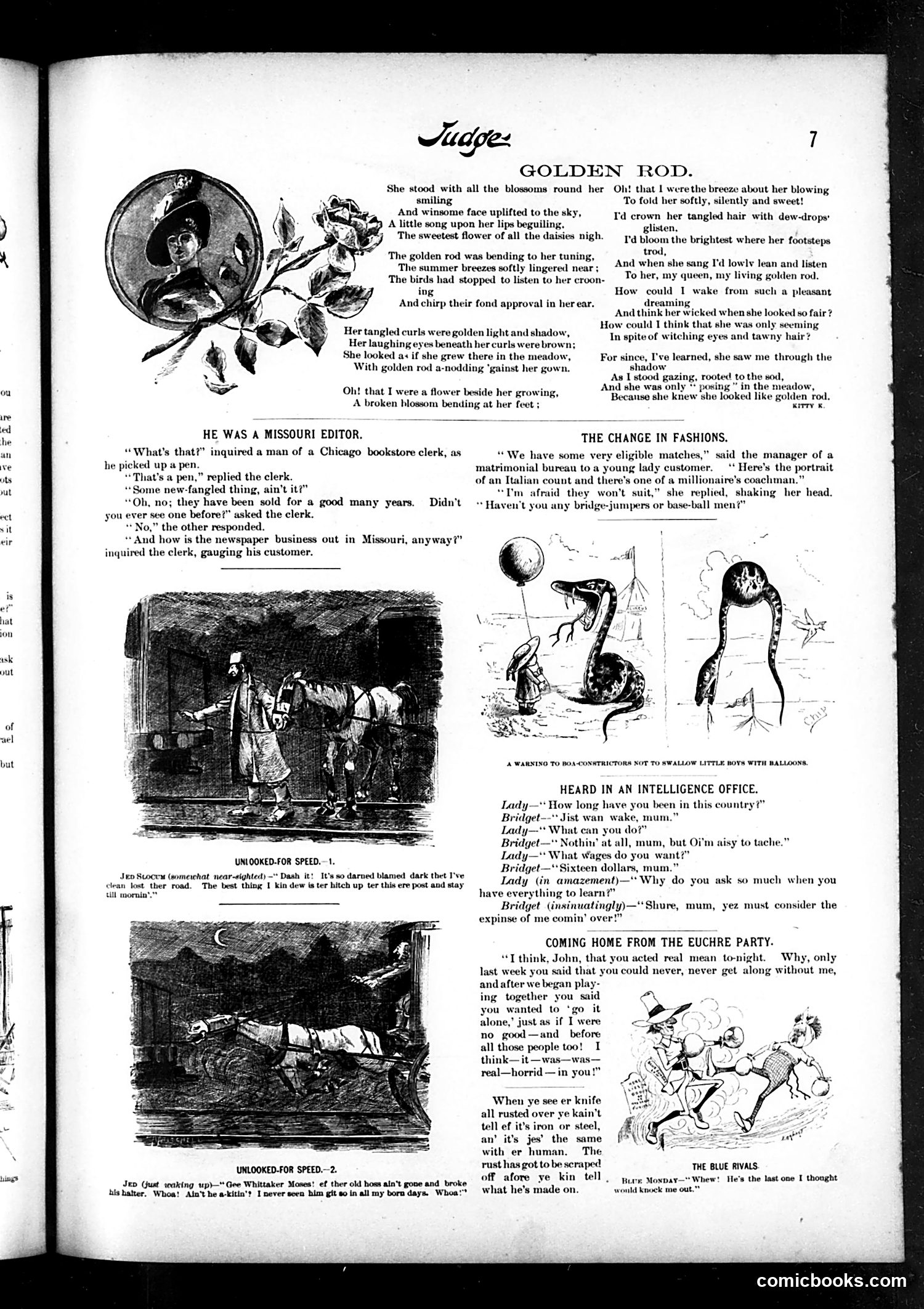
This page contains several satirical pieces typical of early 20th-century American humor: **"Golden Rod"** is a sentimental poem mocking romantic idealization of women. The twist ending reveals the subject was "only posing"—satirizing how men romanticize women's appearances while women perform femininity strategically. **"He Was a Missouri Editor"** jokes about rural ignorance, portraying a Missouri newspaper editor unfamiliar with pens as hopelessly backward—reflecting urban Eastern condescension toward the Midwest. **"The Change in Fashions"** satirizes women's changing marital preferences, showing a matrimonial bureau client rejecting aristocrats for "bridge-jumpers or base-ball men"—suggesting women now prefer athletes and entertainers over traditional status symbols. **"Heard in an Intelligence Office"** ridicules Irish immigrant servants through dialect comedy, with "Bridget" speaking broken English and demanding high wages despite having no skills—a common ethnic stereotype of the era. The remaining pieces use similar period humor: domestic squabbles, slapstick illustrations, and working-class comedy. The page exemplifies Judge's formula: satirizing social pretension, gender relations, immigration, and regional differences through caricature and dialect humor.
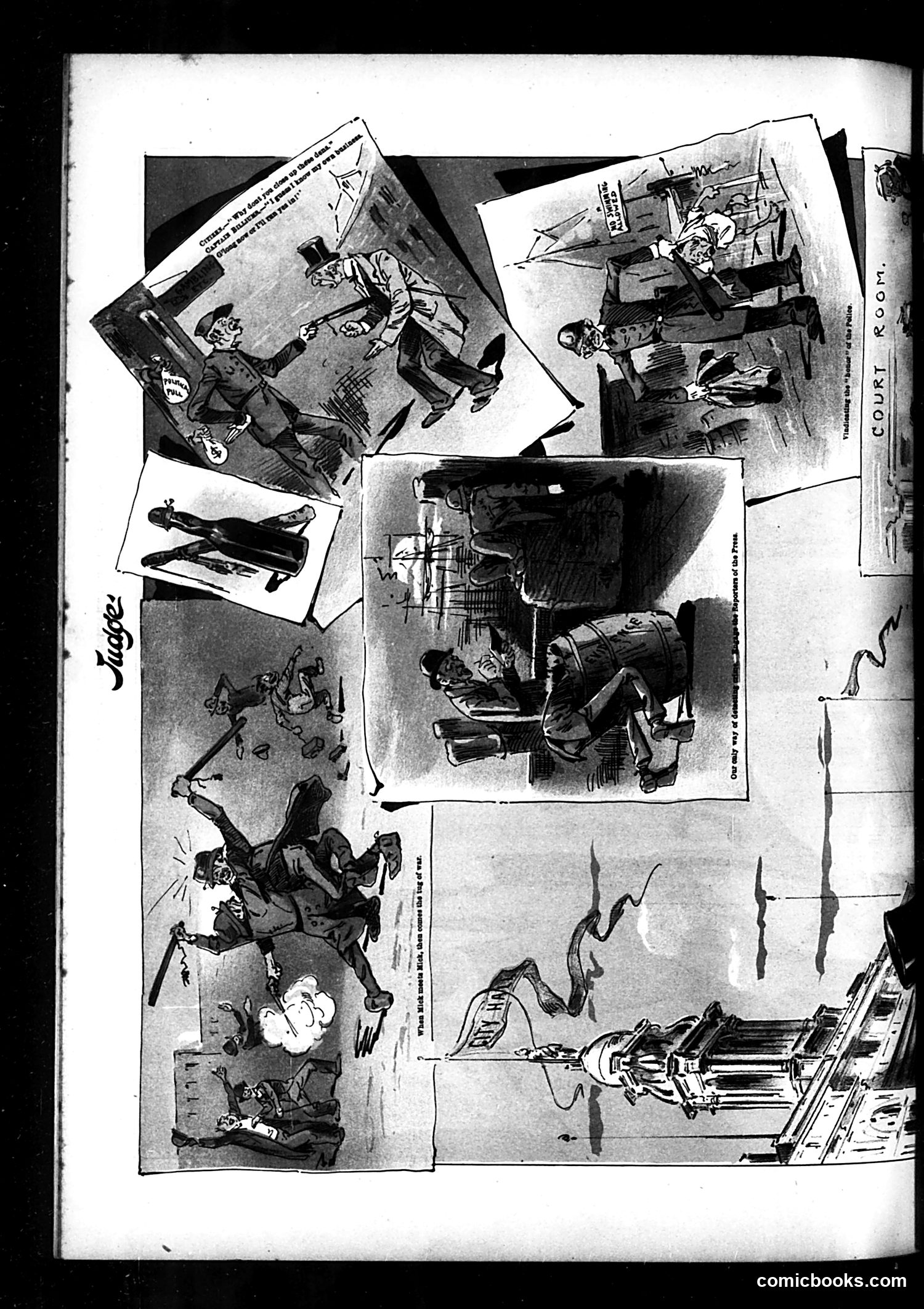
The OCR text appears to be corrupted or unreadable, making it difficult to identify specific captions or titles for these cartoons. From the **images alone**, this appears to be a multi-panel satirical page from *Judge* featuring slapstick and physical comedy scenarios. The panels show various figures in exaggerated, comedic situations—some appearing to involve falling, struggle, or absurd predicaments typical of early 20th-century humor. Without legible text identifying the subjects, specific political figures, or events being referenced, I cannot reliably explain what social commentary or political satire these particular cartoons intend. The style suggests humor about everyday situations or possibly labor/workplace issues, but asserting more specific meanings would require clearer source material. A legible version of the captions would be necessary for accurate historical interpretation.
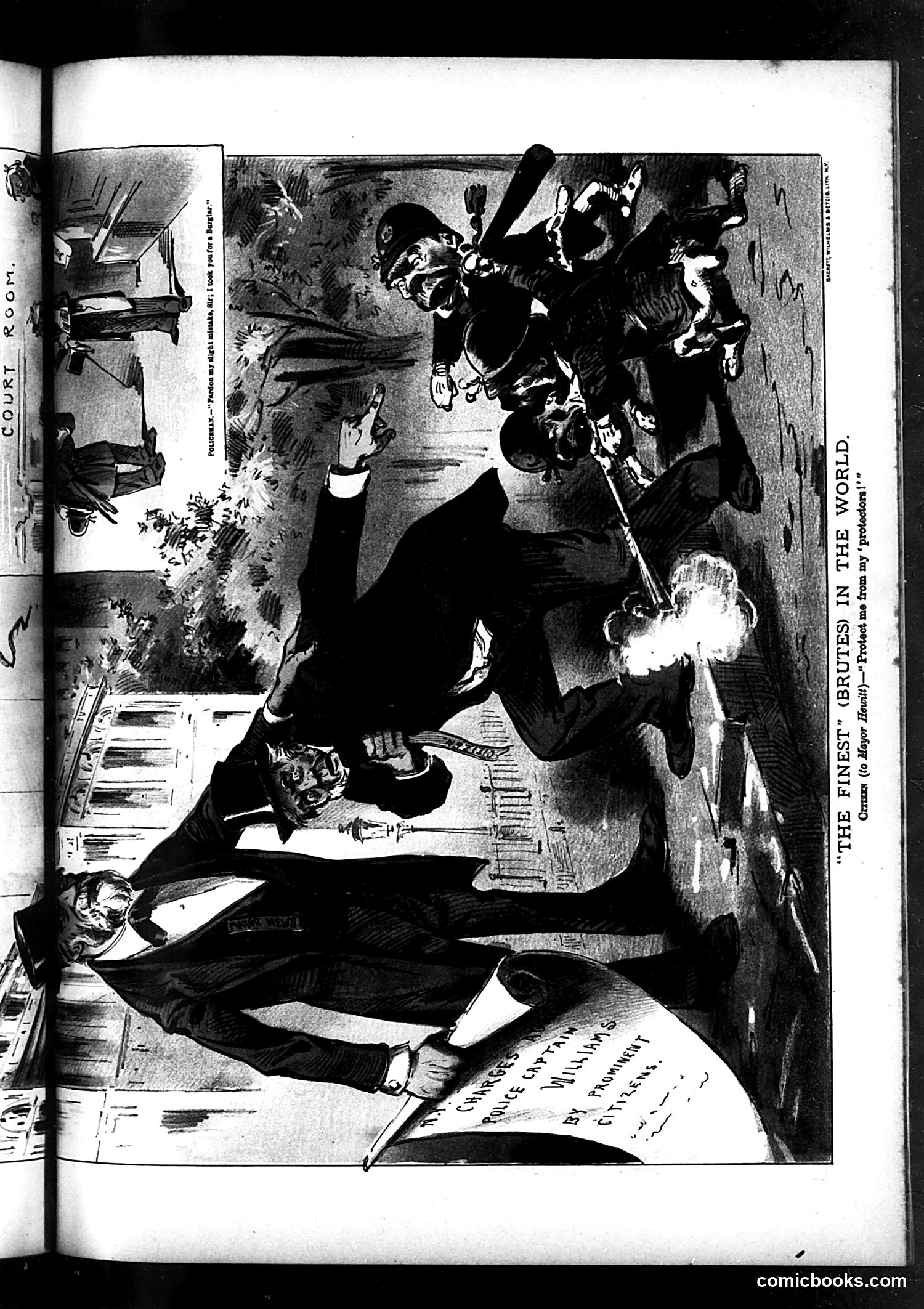
This satirical cartoon depicts a chaotic scene of what appears to be British military or political figures in disarray. The title suggests ironic commentary on British superiority or pride. The figures are shown in undignified positions—some falling, others in combat or confusion—suggesting incompetence or failure despite claims of excellence. The scattered papers and general mayhem indicate criticism of British institutions or leadership, likely referencing a specific political or military bungling of the period. The caricatured style is typical of *Judge* magazine's satirical approach to mocking public figures and national pretensions. However, the OCR text is too corrupted to identify specific individuals or the exact historical event being lampooned. Without clearer text, I cannot definitively state which figures or situation are depicted.
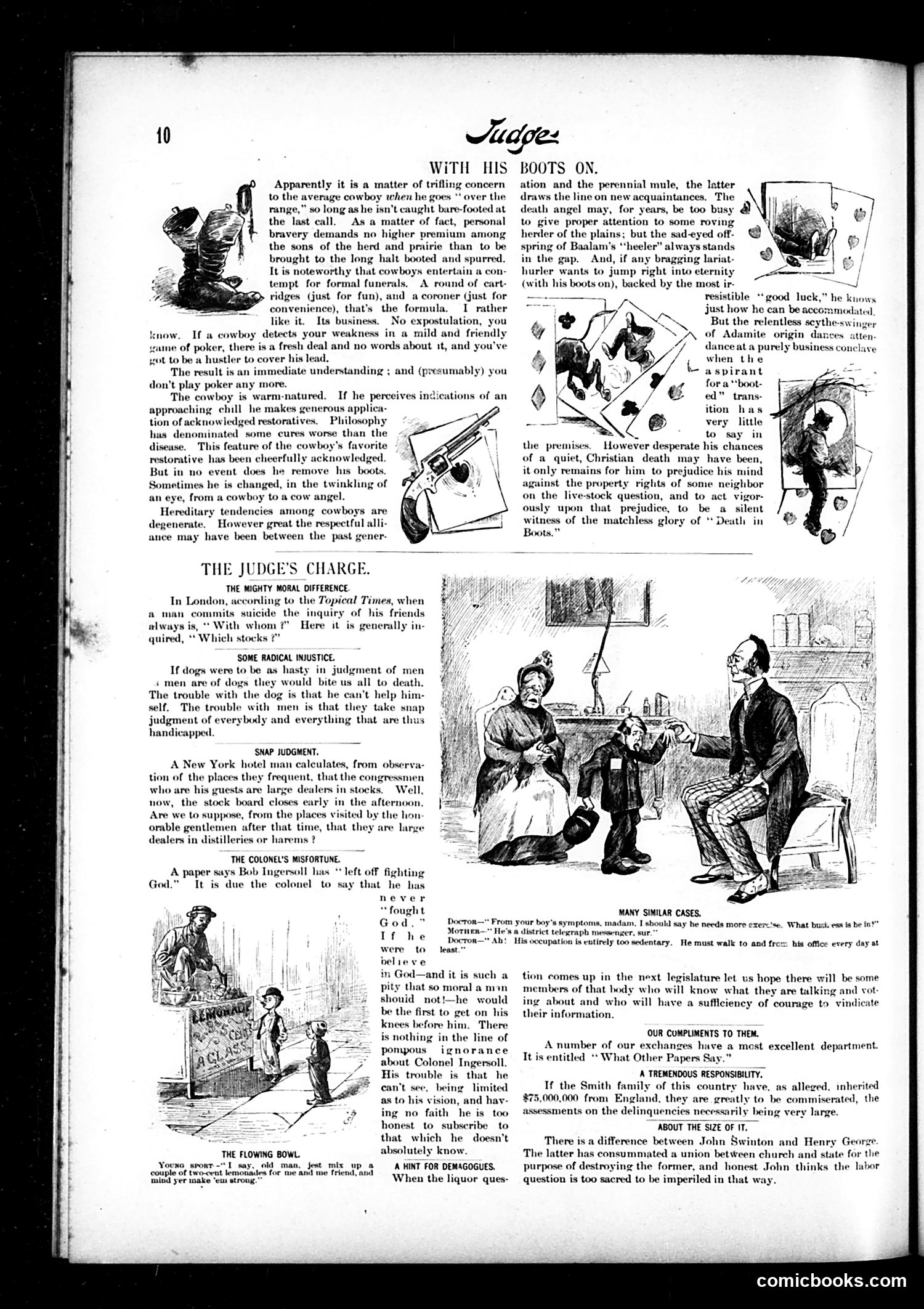
This page from the satirical magazine *Judge* contains several short pieces mocking contemporary American society: **"With His Boots On"** satirizes Western cowboy culture, noting their indifference to formal funerals and obsession with dying "with boots on"—suggesting they prioritize appearance and bravado over genuine morality. **"The Judge's Charge"** section includes multiple brief jabs: - Contrasts British and American suicide inquiries (morality vs. materialism) - Mocks snap judgments and hypocrisy - References **Bob Ingersoll**, a famous atheist/freethinker, sarcastically suggesting his moral consistency would compel him to believe in God if he could - Questions congressmen's after-hours activities, implying corruption or vice The cartoons accompanying these pieces depict ordinary scenes—a woman visiting, a child speaking to an adult—illustrating the text's commentary on human folly and moral inconsistency. The overall tone is cynical about American character and judgment.
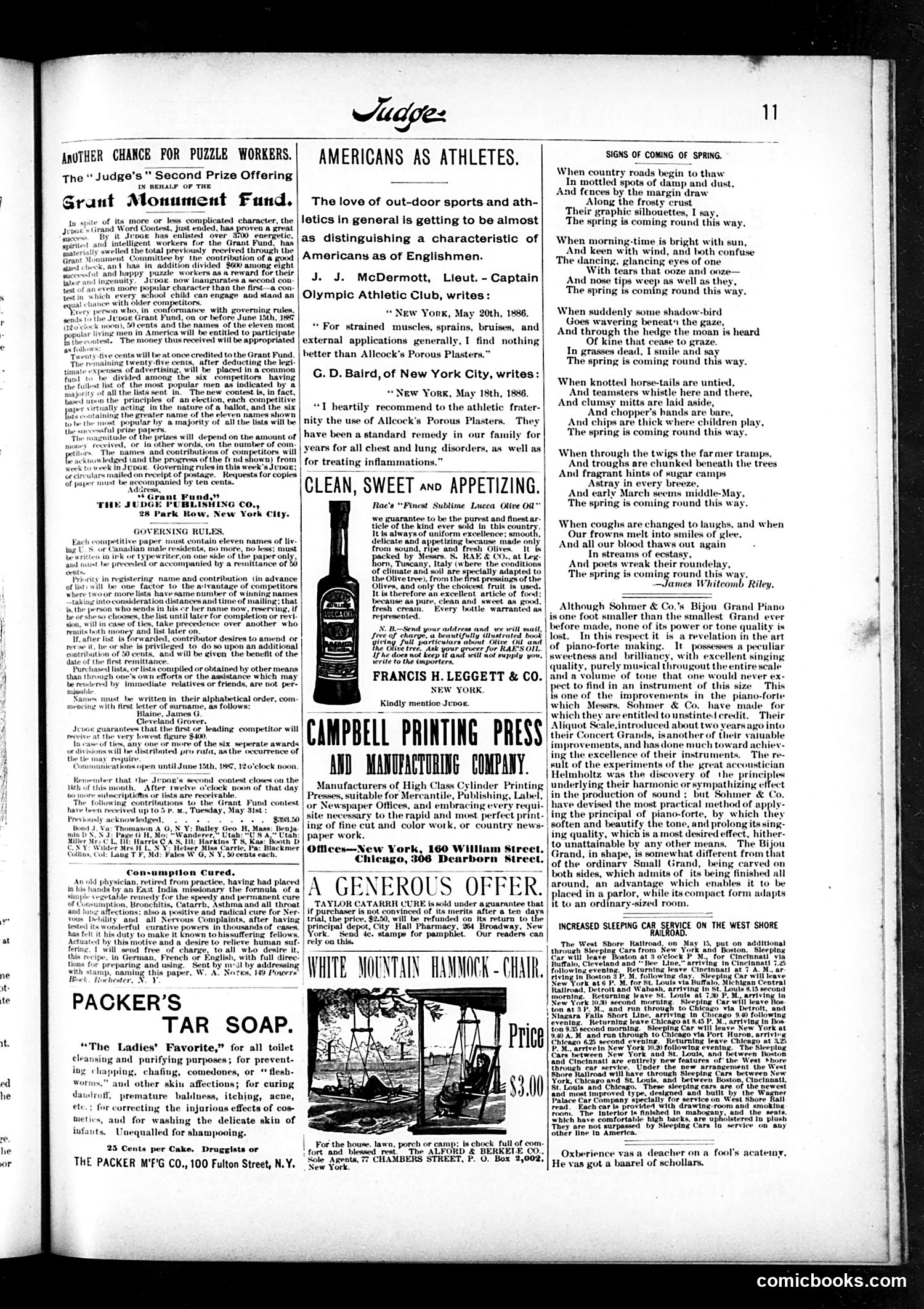
This page is primarily **advertising and announcements** rather than satirical content. The main feature is a contest announcement for the **Grant Monument Fund**—a fundraising effort for a Civil War general's memorial. Judge magazine is running a puzzle competition where participants submit lists of "the most popular men" by June 15th, 1886. Entry costs 25 cents; the fund receives proceeds after advertising costs. The page also contains advertisements typical of 1886: patent medicines (consumption/tuberculosis cure), Packer's Tar Soap ("The Ladies' Favorite"), Allcock's Porous Plasters, and Campbell Printing Press services. These ads reflect period commercial culture. The only editorial content is a brief poem titled "Signs of Coming of Spring" describing seasonal changes. **Context**: The Grant Monument Fund references the recent death of General Ulysses S. Grant (1885), whose tomb was under construction in New York. Judge used contest mechanics to fundraise while boosting circulation—a common 19th-century magazine practice combining commerce with public commemoration.
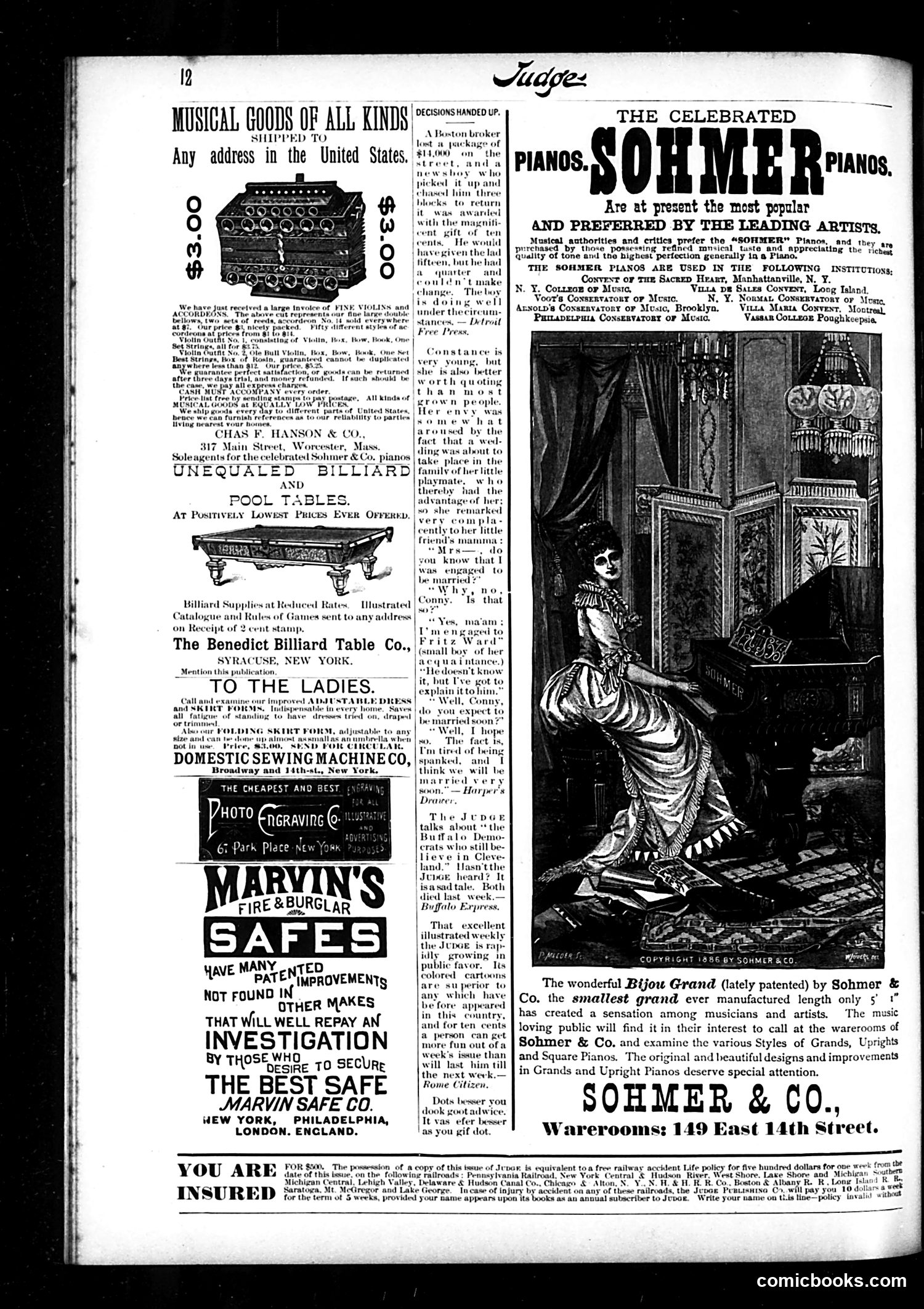
This page is **primarily advertising** with minimal editorial content. The main cartoon element is a large illustration of an elegantly dressed woman at a Sohmer piano, gazing contemplatively—a typical Victorian-era advertisement romanticizing the instrument as a marker of refined taste and culture. The page's satirical content is limited to small **"Judge Talks"** snippets in the text columns: - A joke about a young girl named Constance who, though young, is "better worth quoting than most grown people"—mocking adults' pretension - A quip about "Buffalo Democrats who still believe in Cleveland," likely referencing Grover Cleveland's political standing - A brief jab at the *Judge* magazine itself The bulk of the page consists of **advertisements** for pianos, billiard tables, safes, sewing machines, and photo engraving—typical of late 19th-century magazine monetization. The Sohmer piano ad emphasizes endorsements from prestigious music conservatories to signal cultural legitimacy, a marketing strategy targeting aspiring middle-class households.
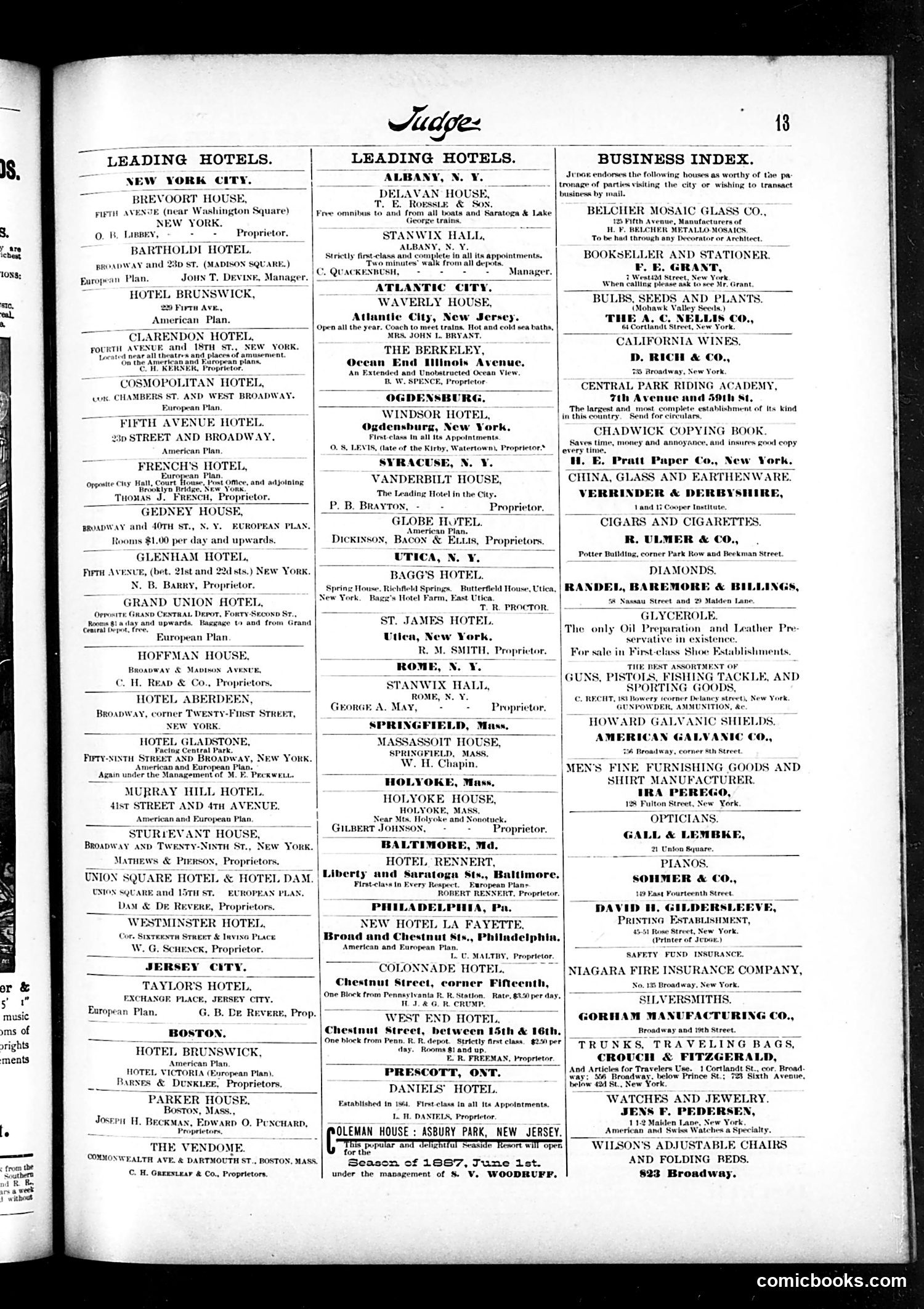
This page is **primarily advertisements** — a business index and hotel directory typical of Judge magazine's revenue model. The left and center columns list prominent hotels across major American cities (New York, Albany, Atlantic City, Syracuse, Utica, Rome, Springfield, Baltimore, Philadelphia, Boston, and Prescott, Ontario). The right column is a business index advertising various goods and services (mosaics, books, seeds, wines, riding academies, glassware, cigars, diamonds, firearms, and jewelry). **There is no discernible political cartoon or satirical content visible on this page.** It appears to be a straightforward commercial section designed to generate advertising revenue. Judge, while primarily a satirical publication, regularly included such practical directories and ads to fund operations and serve as a useful reference for readers visiting major cities or seeking specific merchandise.
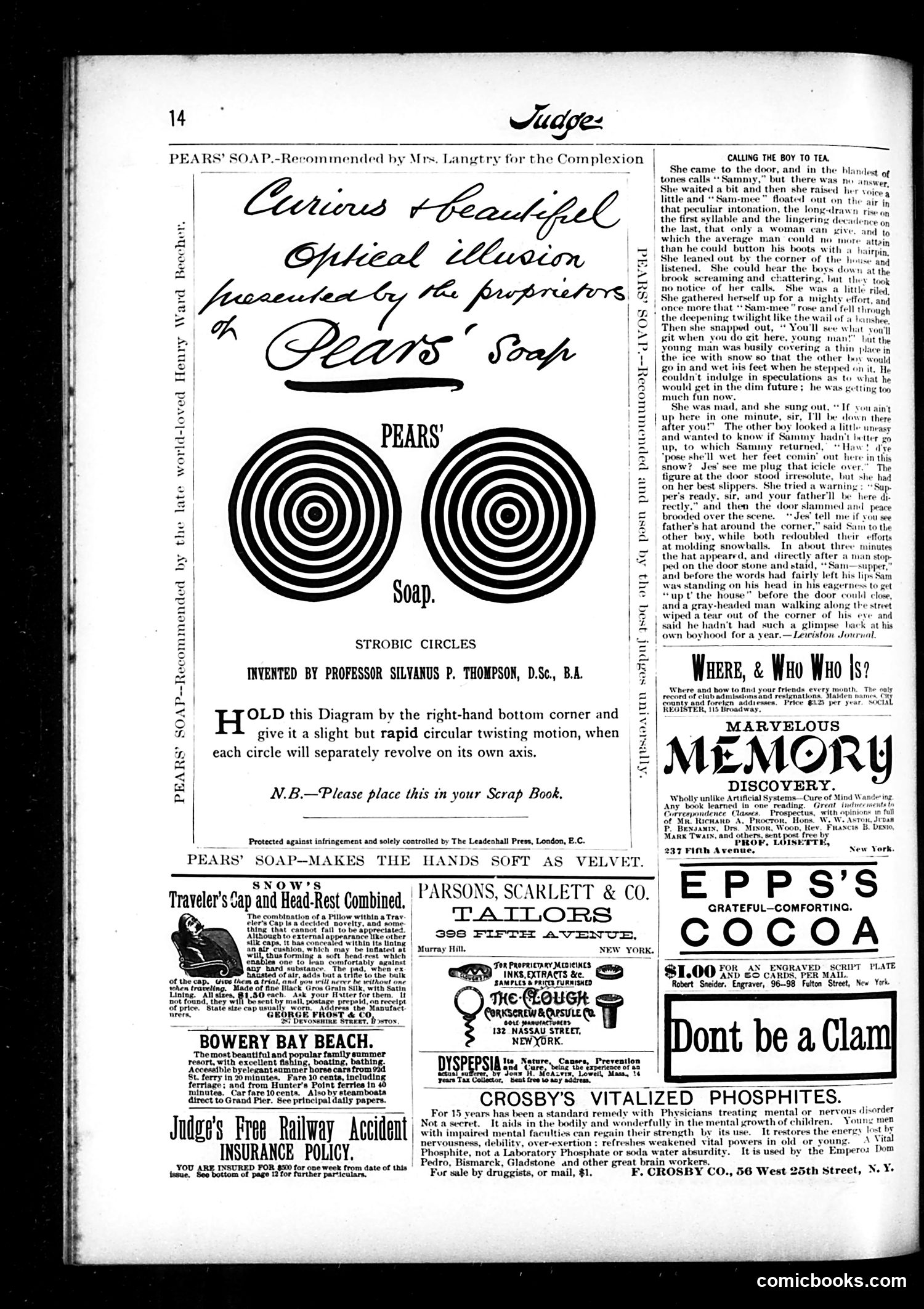
This page is primarily **advertising**, typical of Judge magazine's revenue model. The main content consists of product advertisements interspersed with small editorial pieces. The notable satirical content is minimal: 1. **"Calling the Boy to Tea"** (right column): A humorous domestic sketch about a mother calling children to dinner, depicting period middle-class life. No political satire is apparent. 2. **"Strobic Circles"** (center): An optical illusion diagram credited to Professor Silvanus P. Thompson, presented as a novelty for readers to cut out and use—a common Judge feature. This is instructional rather than satirical. The page largely showcases period advertisements: Pears' Soap (featuring celebrity endorsement), tailoring services, cocoa, railroad travel, remedies for digestive complaints and coughs, and various patent medicines. These ads reflect late-19th-century consumer culture rather than political commentary. The page demonstrates how Judge funded itself through advertising while maintaining modest satirical content.
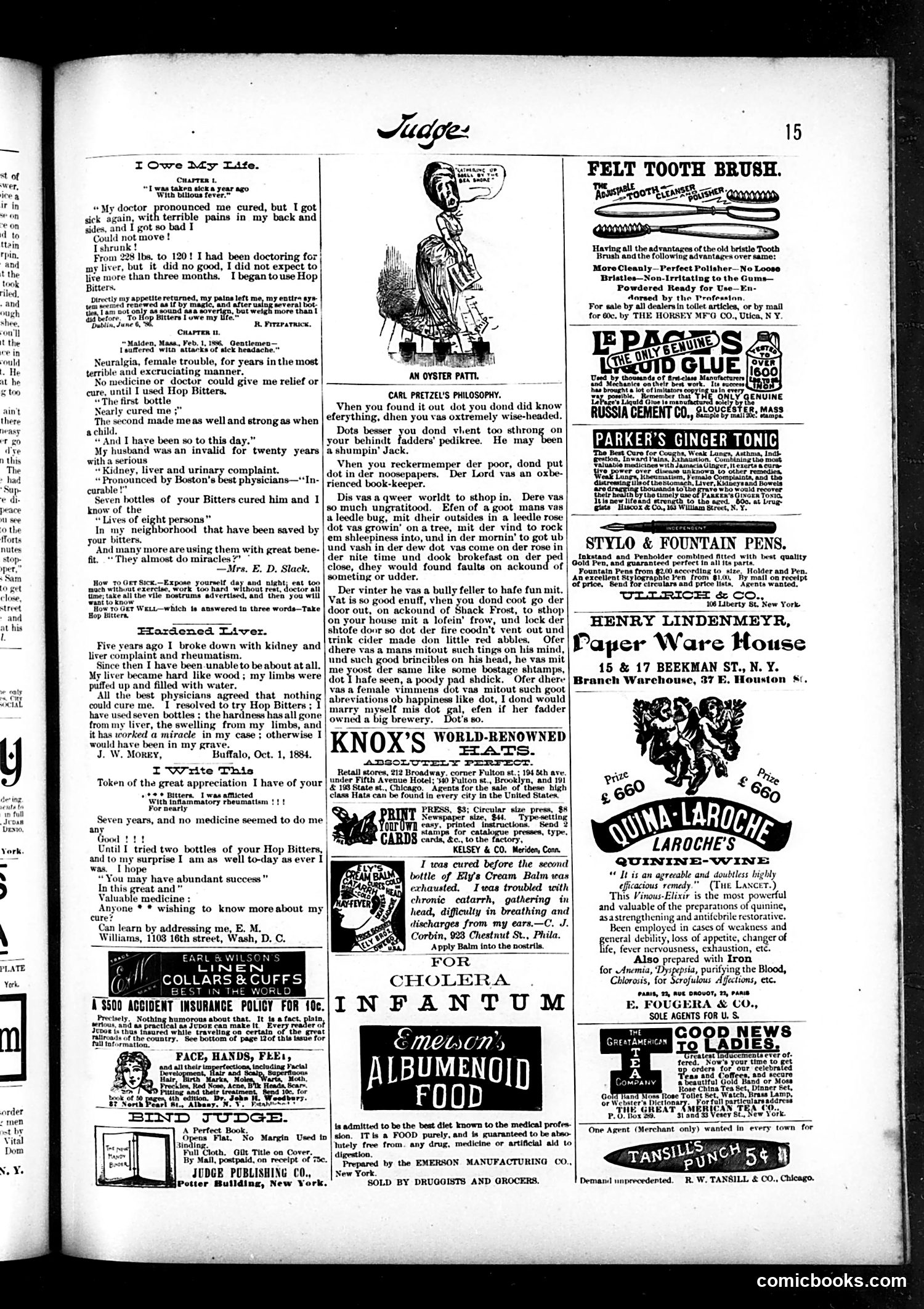
This page is primarily **advertising**, featuring testimonial ads for Hop Bitters patent medicine dominating the left column. The testimonials follow a standard late-19th-century format: individuals claim the product cured serious ailments (kidney disease, liver problems, rheumatism, headaches) after doctors failed. These were common marketing tactics exploiting public desperation before modern medicine. The only cartoon appears upper-right: "AN OYSTER PATE," showing a caricatured figure (likely German or Eastern European immigrant, based on exaggerated features) wearing formal dress. This references German immigrant stereotypes common in Judge's satirical humor of this era. Below the cartoon is "CARL PRETZEL'S PHILOSOPHY"—dialect humor attributed to a German character offering folksy observations ("When you found it out dot you dond did know eferyting..."). This represents Judge's casual ethnic stereotyping through broken-English humor, typical of 1880s American satire. The remaining page contains various patent medicine ads and product advertisements typical of period publications.
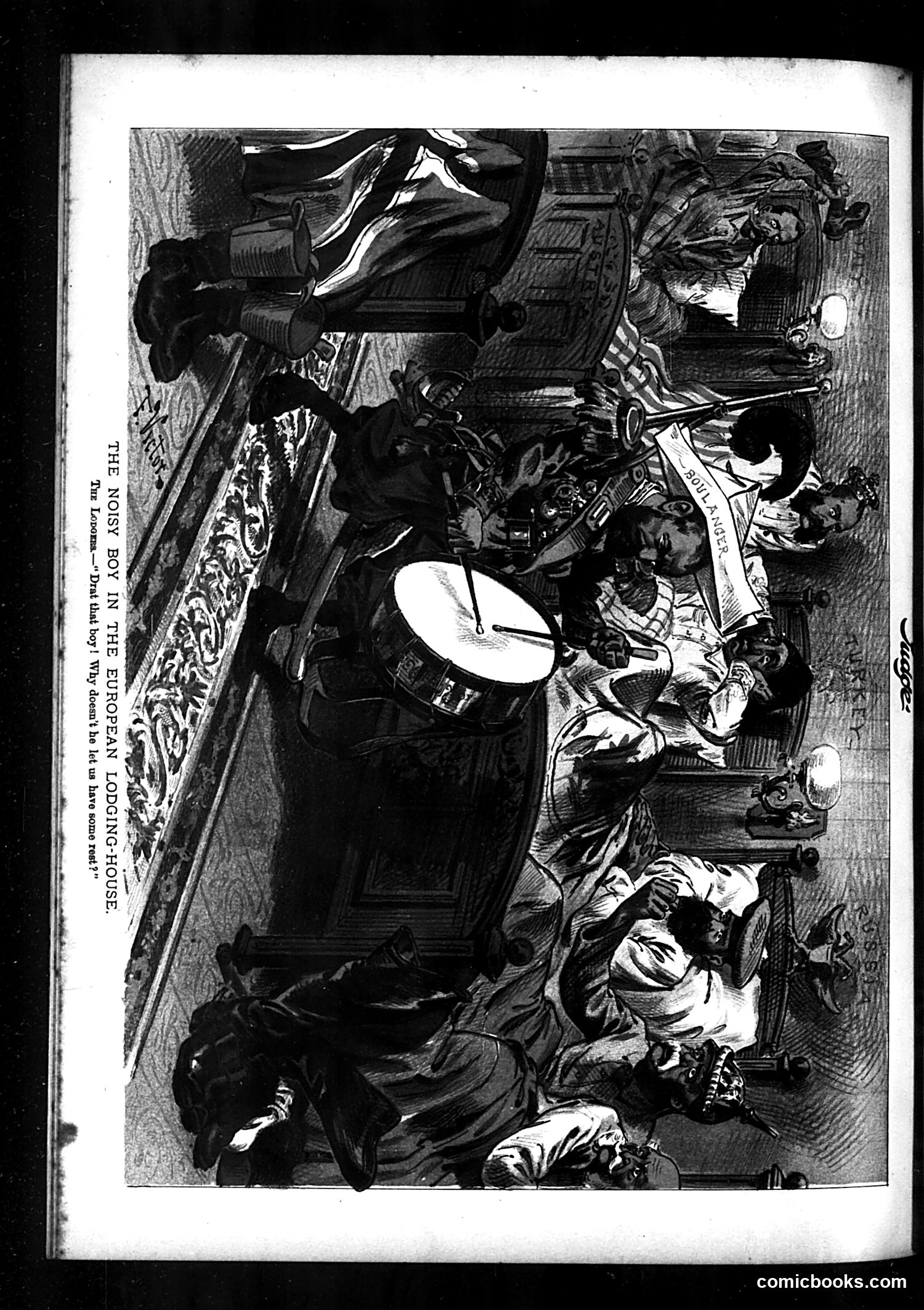
This appears to be a satirical illustration from *Judge* magazine showing a chaotic European domestic scene, viewed upside-down on the page. The caption suggests frustration with "that boy" disrupting peace in a "European lodging house." The image likely comments on European political instability or a specific troublemaker disrupting Continental affairs—possibly referencing a young ruler, revolutionary figure, or destabilizing power during the late 19th or early 20th century. Without a visible date or clearer caption, the specific historical figure remains unclear, though the setup suggests commentary on how one disruptive actor prevents stability and rest for established European powers sharing the same "house." The crowded, tumultuous composition reinforces the theme of chaos and frustration.