
A complete issue · 16 pages · 1887
Judge — April 30, 1887
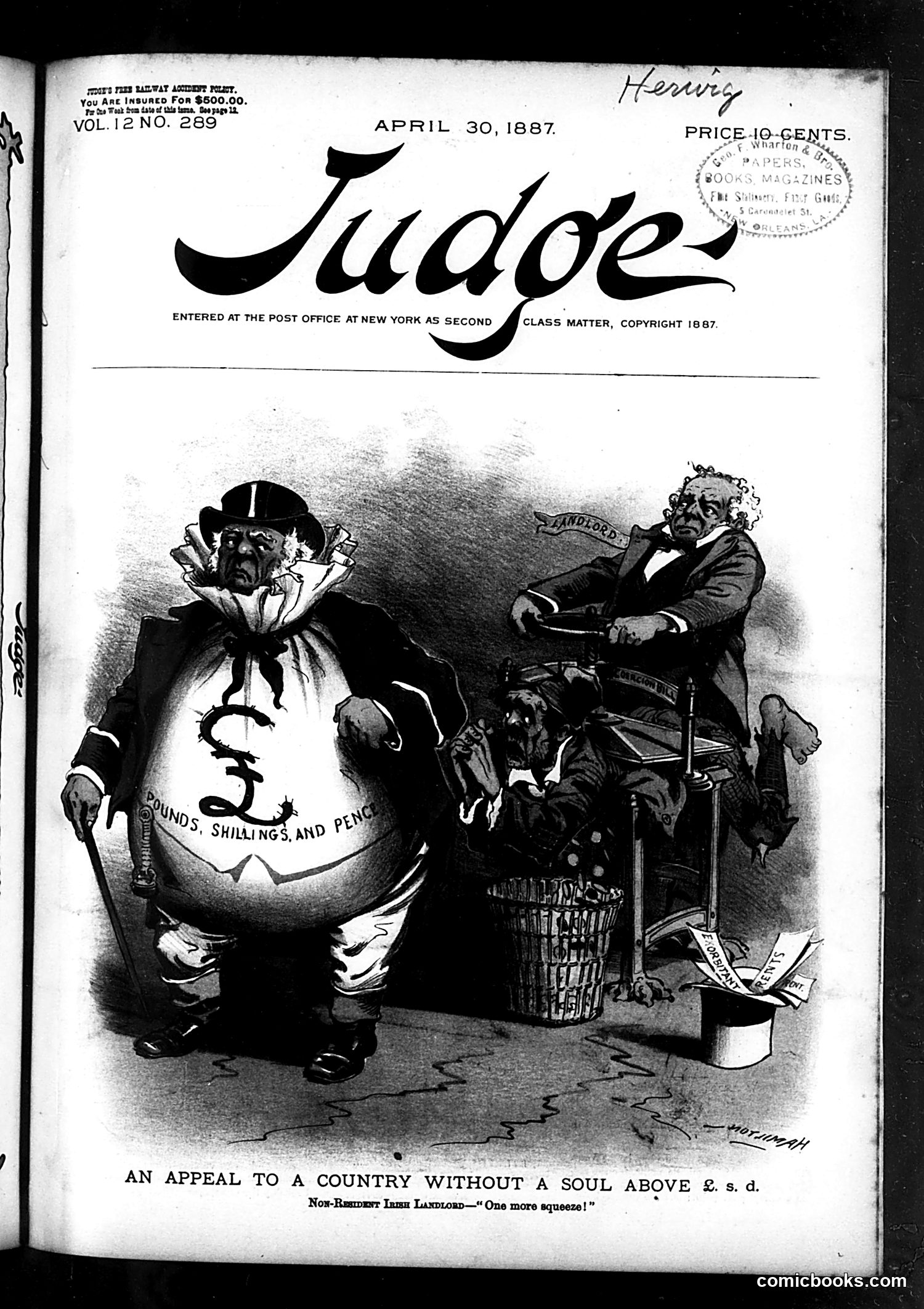
This political cartoon satirizes Irish landlord exploitation. The figure on the left, bloated and labeled "POUNDS, SHILLINGS, AND PENCE," represents a wealthy landlord gorged on rental income from Irish tenants. The well-dressed man on the right appears to be an Irish landlord or politician, depicted as a vulture hovering over a basket of evicted tenants' possessions. The caption—"AN APPEAL TO A COUNTRY WITHOUT A SOUL ABOVE 2 s. d."—uses the abbreviation for shillings and pence to mock Irish landlords as motivated purely by profit, lacking moral conscience. The subtitle references "Non-Resident Irish Landlord," criticizing absentee landlords who extracted wealth from Ireland without reinvesting locally. This reflects 1880s Irish land reform debates and tenant suffering under exploitative rental systems.
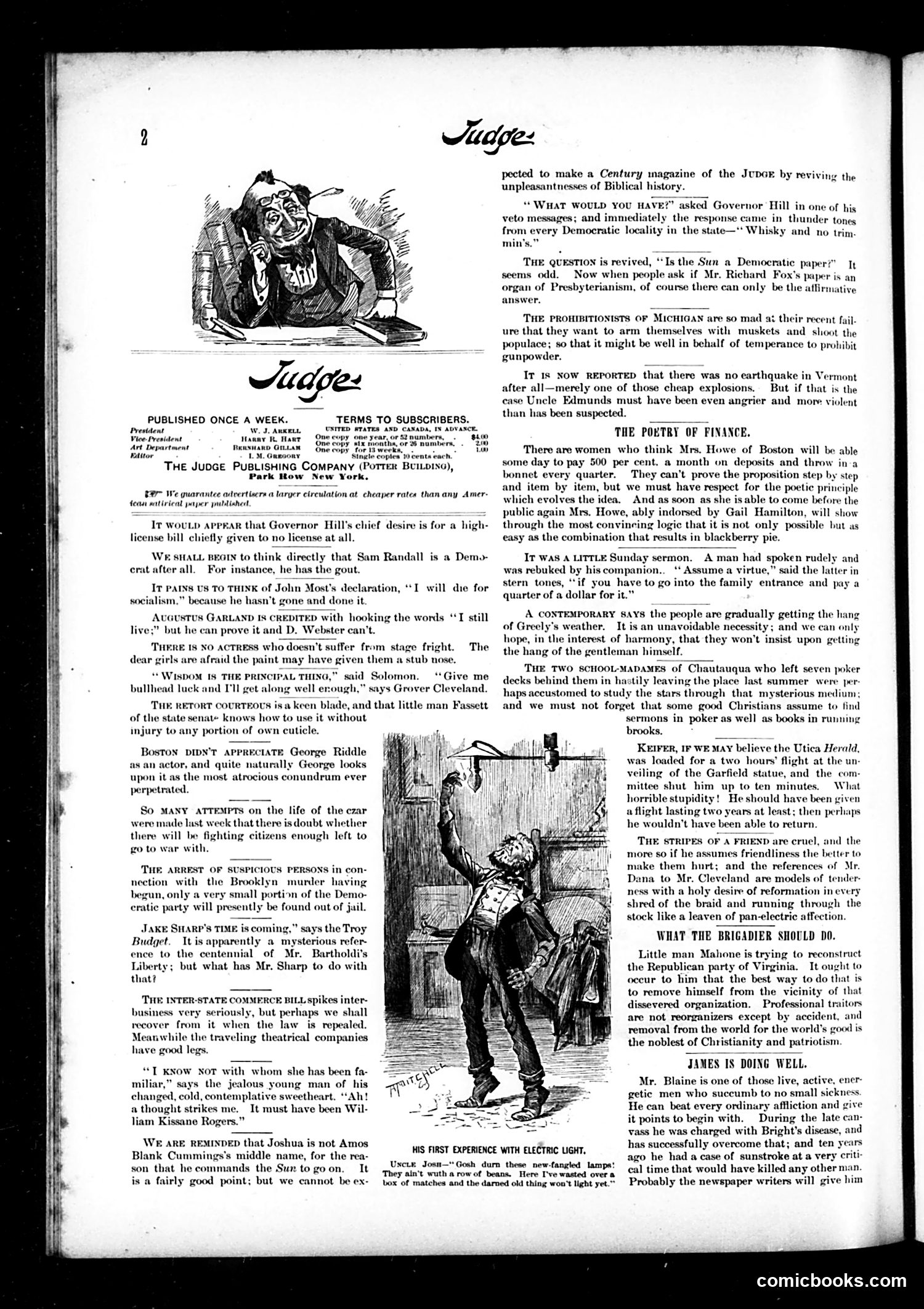
This page contains satirical commentary on contemporary political and social issues. The upper cartoon depicts a grotesque figure, likely caricaturing a political opponent, though the specific identity isn't clear from the image alone. The text discusses several topics including: - **Governor Hill's veto** on a liquor bill—criticizing Democratic leadership - **Democratic Party politics** in Michigan and Vermont - **Mrs. Howe of Boston**—apparently a society figure involved in charitable work - **Stage fright and theater incidents**—mocking various public figures - **The Interstate Commerce Bill**—a significant legislative matter The lower illustration shows a figure with an electric lamp, captioned "His First Experience with Electric Light," suggesting humor about the novelty of electrical technology. The overall tone is typical Judge magazine satire: attacking Democratic politicians while commenting on contemporary social absurdities and technological wonder.
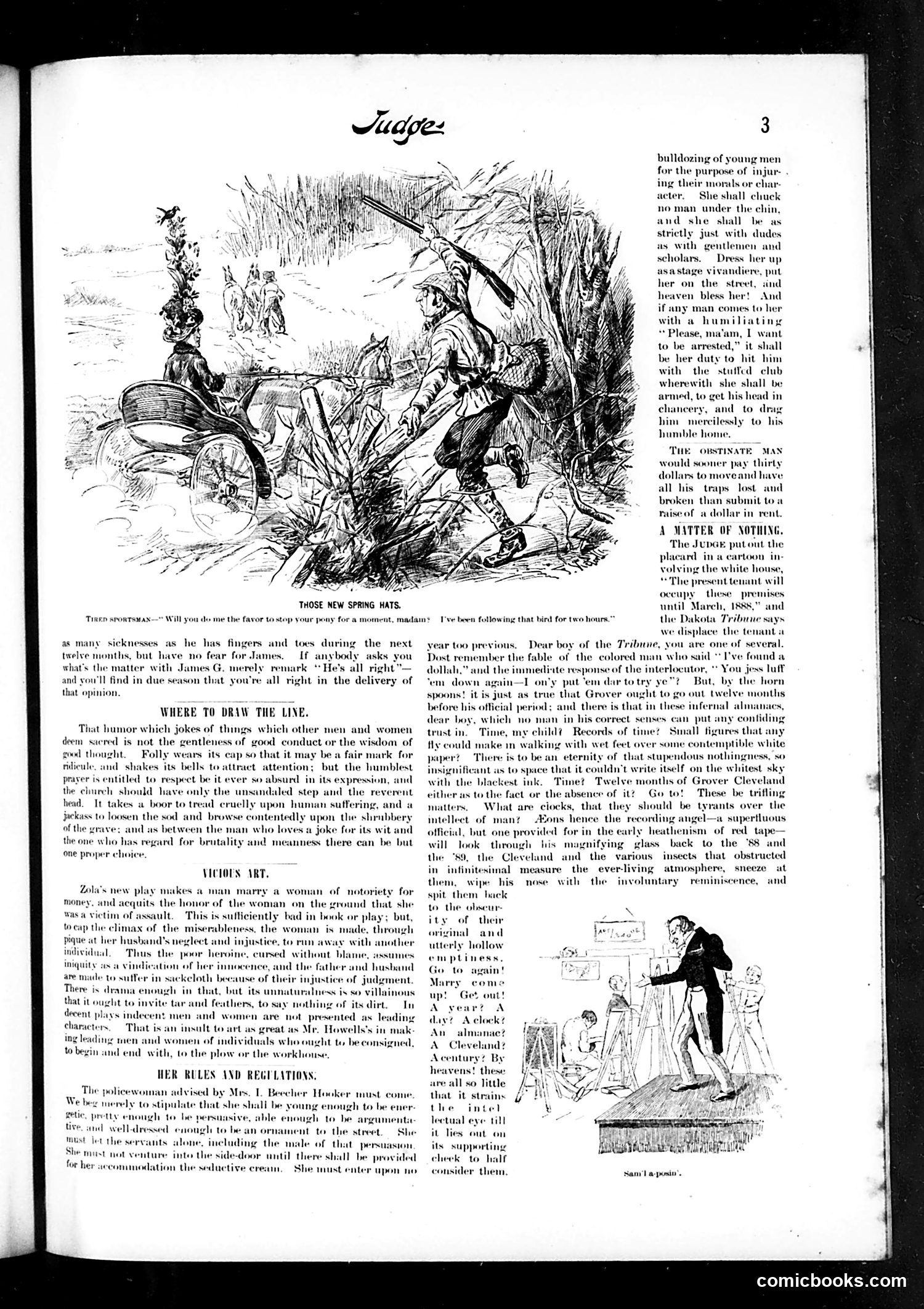
This page from *Judge* magazine contains satirical commentary on contemporary issues circa 1888. **The Main Cartoon** ("Those New Spring Hats") depicts a tired hunter pursuing a bird for two hours—a visual metaphor for the futility of chasing fashionable trends. The joke satirizes women's obsession with fashionable spring hats. **"Where to Draw the Line"** argues that humor mocking sacred things lacks wisdom, contrasting folly's visibility with humility's worthiness of respect. It critiques indecent theatrical plays that portray misconduct without moral consequence. **"A Matter of Nothing"** references President Grover Cleveland's lease of the White House until March 1888. The satire mocks obsessive focus on trivial details (like exact move-out dates) while ignoring larger philosophical questions about time and significance—a tongue-in-cheek jab at political fixation on minor procedural matters rather than substantive governance. The text emphasizes that satirists should punch up at power, not down at the vulnerable.
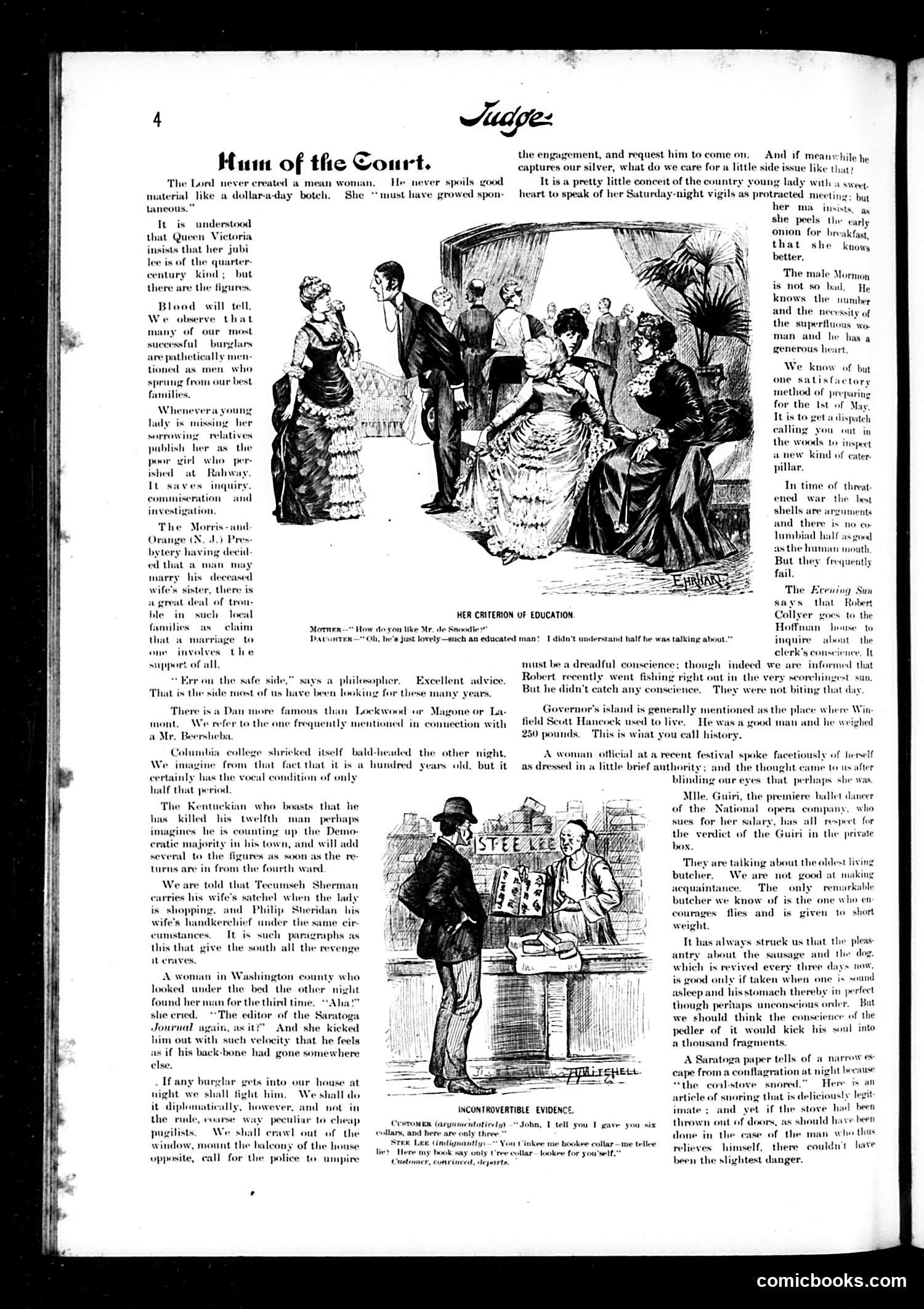
This page contains two satirical cartoons and accompanying commentary typical of Judge's social satire. **"Hum of the Court"** (top) mocks high society's pretensions. The illustration shows well-dressed people at what appears to be a formal gathering. The text satirizes Queen Victoria and the British aristocracy, suggesting that despite claims of noble breeding, many successful burglars come from "best families"—undercutting the notion that social class guarantees moral character. **"Her Criterion of Education"** (bottom) ridicules young women's romantic judgment. The cartoon shows a woman praising her suitor as "educated," while the dialogue reveals he's merely well-dressed and says nothing of substance. The satire targets the superficiality of courtship standards among the leisure classes. Throughout, Judge employs its characteristic approach: mockingly defending absurd social conventions (like Saturday night vigils and sausage etiquette) while actually exposing class hypocrisy and shallow values among the wealthy.
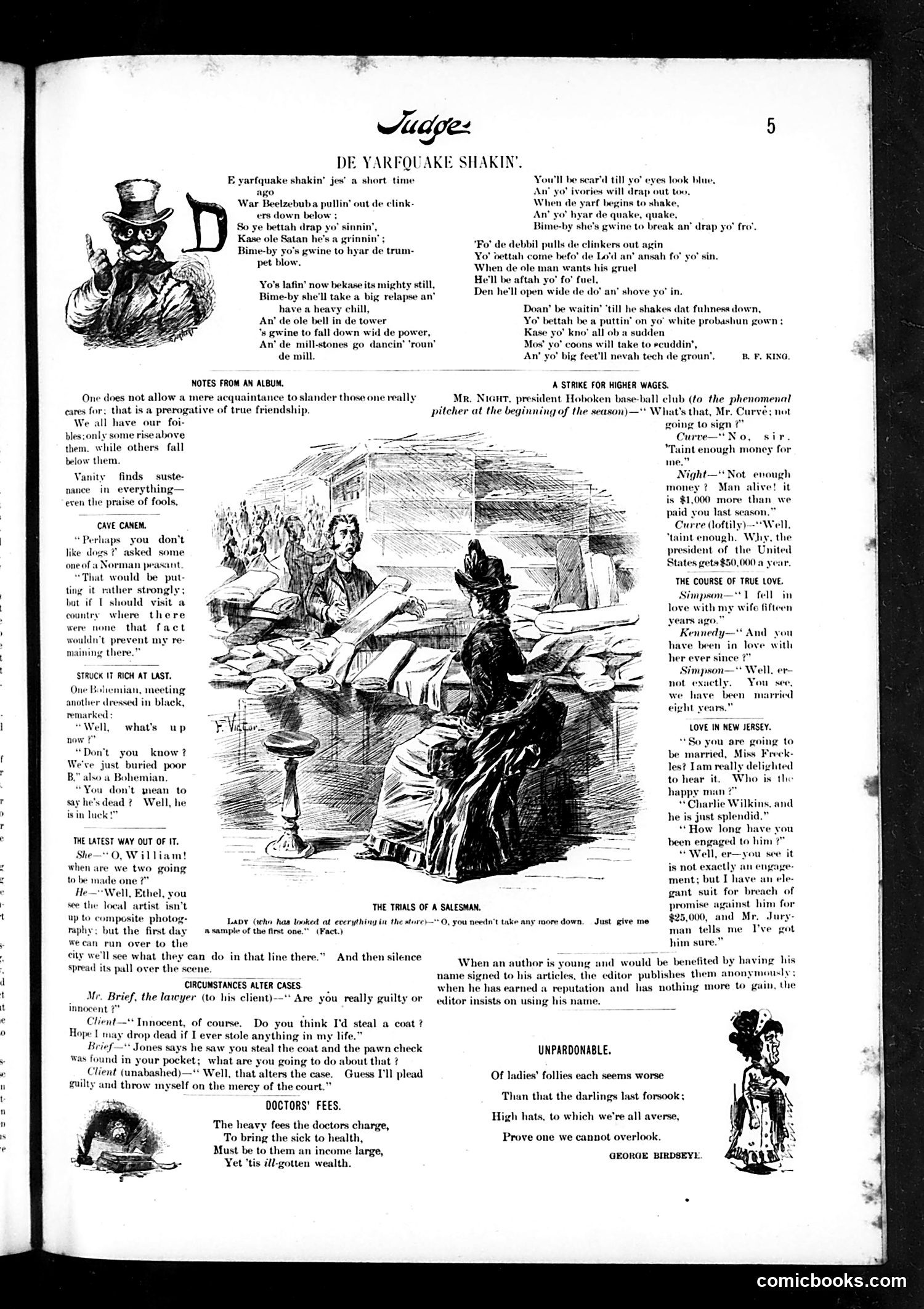
This page contains multiple satirical pieces typical of late 19th-century American humor: **"De Yarfquake Shakin'"** (top): A dialect poem in racist caricature, using exaggerated African American vernacular to humorously describe an earthquake as divine punishment. The theological framing—Satan, the devil, divine retribution—was common in period humor. **"A Strike for Higher Wages"**: A baseball cartoon mocking a pitcher demanding $1,000 more annually, arguing the U.S. President earns only $50,000. The joke satirizes wage demands as absurdly greedy. **Scattered brief anecdotes**: Short comic dialogues about human foibles—vanity, hypocrisy, awkward social situations—presented without illustrations. **"The Trials of a Salesman"**: A salesman shown with exhausted customers, illustrating commercial persistence. **"Circumstances Alter Cases"**: A lawyer discovers his supposedly innocent client actually stole the coat in question, but claims this "alters the case"—wordplay on moral flexibility. The page reflects Judge's blend of social commentary, workplace satire, and crude ethnic humor typical of Gilded Age publications.
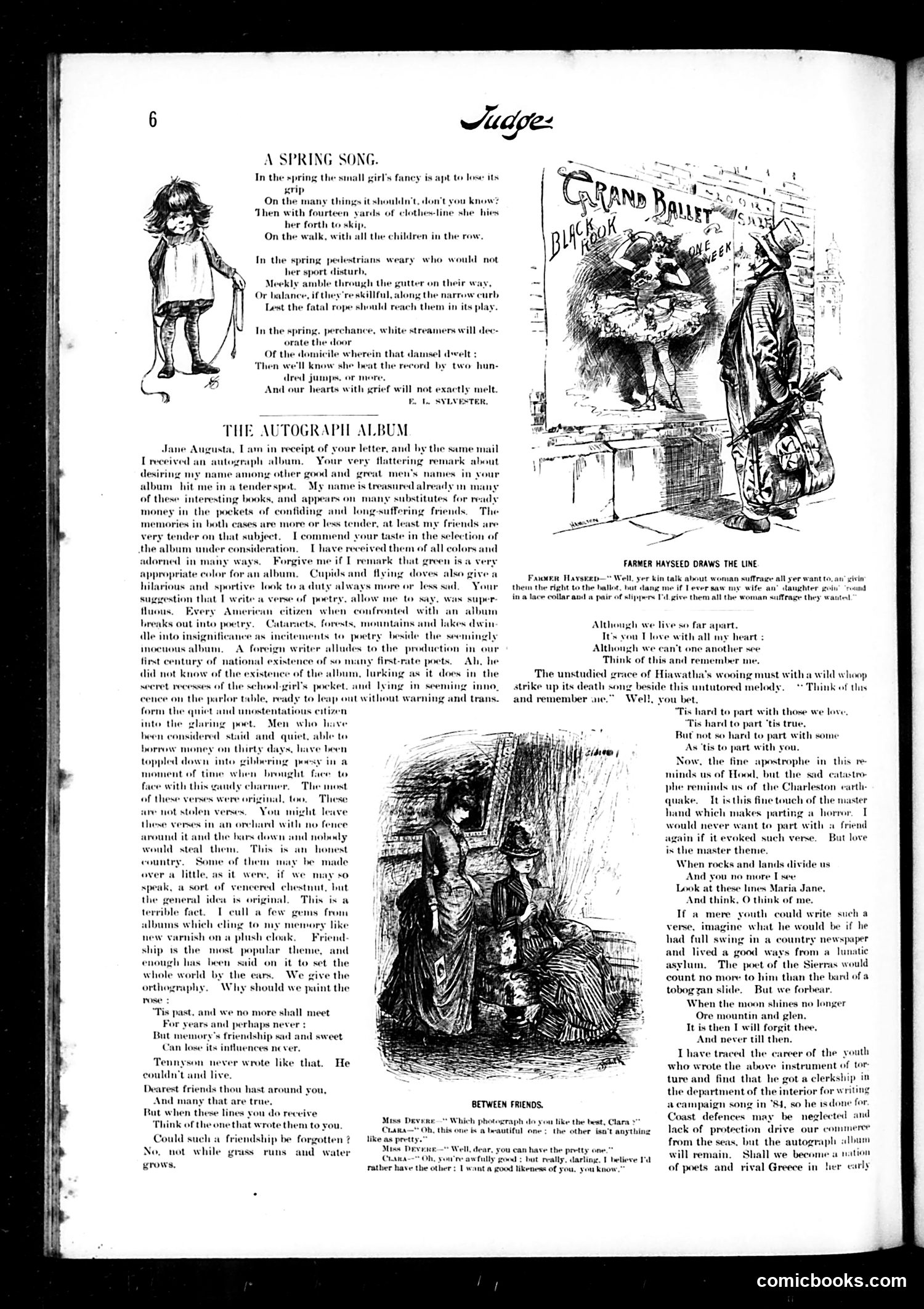
This page from the satirical magazine *Judge* contains several pieces mocking American social conventions of the era: **"A Spring Song"** (top left): Humorously describes spring activities—girls' fashion excess, pedestrians navigating around jump-rope games—typical seasonal observations treated as absurdities. **"The Autograph Album"** (center): Satirizes the popular Victorian custom of inscribing sentimental verses in friends' autograph books. The piece mocks both the pretentious poetry contributors write and the clichéd, often plagiarized nature of album inscriptions. It suggests even "serious" poets sometimes contribute banality to these books. **"Between Friends"** (bottom): A brief dialogue gently mocking women's vanity regarding photographs. **"Farmer Hayseed Draws the Line"** (right): The farmer character opposes women's suffrage while acknowledging his wife and daughter deserve consideration—a contradiction highlighting rural resistance to progressive causes, rendered through dialect humor typical of the era. The illustrations are period sketches supporting each text. The overall tone is light mockery of middle-class social rituals and rural attitudes.
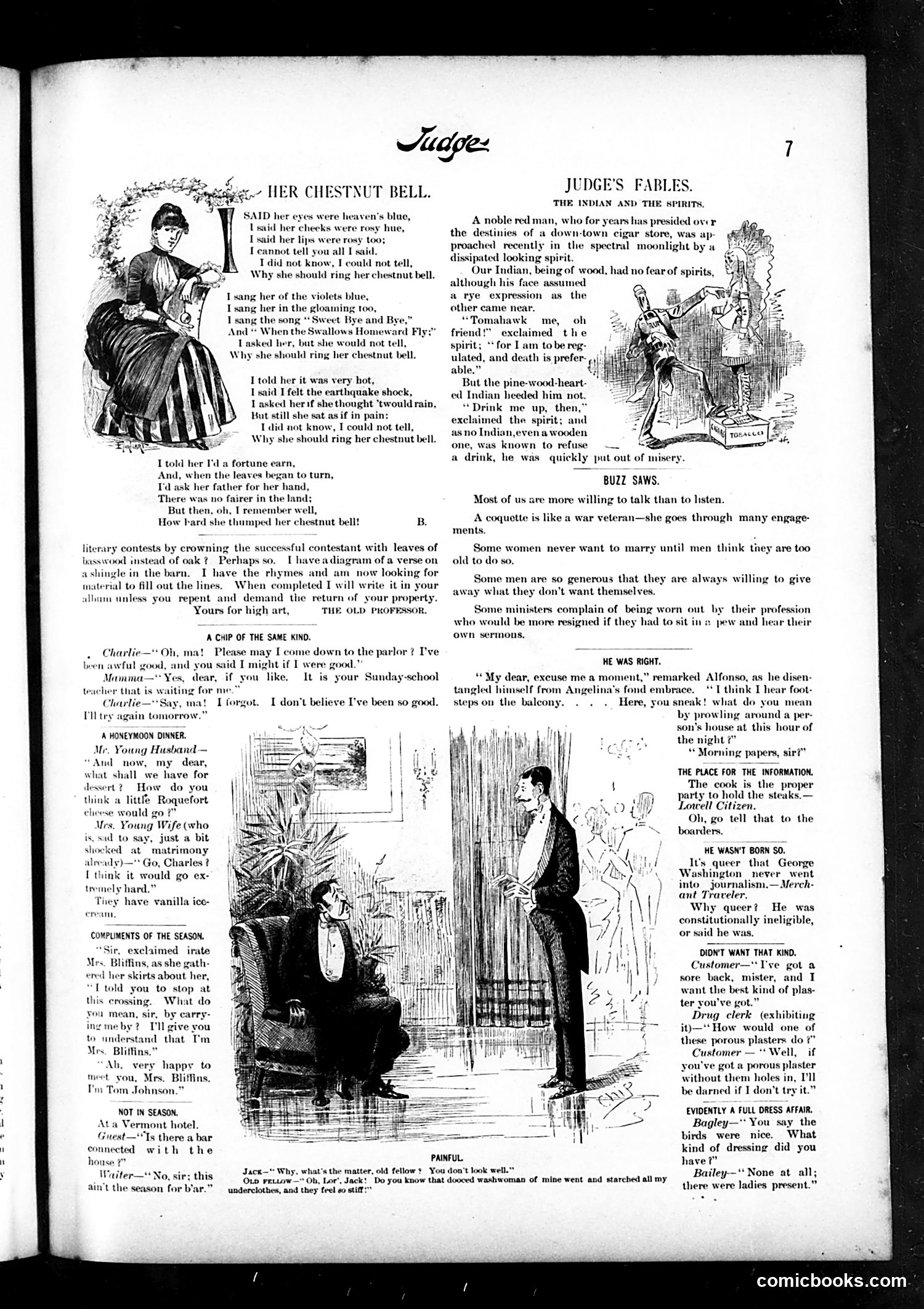
This page from *Judge* (a late 19th-century satirical weekly) contains multiple unrelated humorous pieces typical of the magazine's format. **"Her Chestnut Bell"** is a sentimental poem about a suitor's failed courtship—a gentle parody of Victorian love poetry's overwrought attempts to woo an unresponsive woman. **The fables and "Buzz Saws"** section offers brief satirical observations on gender and social behavior: women's marriage tactics, men's generosity with unwanted items, and ministers' hypocrisy (complaining about work while avoiding pews). **The illustrated vignettes** mock domestic situations: a child negotiating parlor privileges, newlyweds discussing food, a woman scolding a careless driver, and a husband interrupting romance to chase away an intruder. **"The Indian and the Spirits"** appears to be a crude racial caricature mocking Native Americans, depicting a wooden cigar-store Indian statue literally unable to refuse alcohol—reflecting period stereotypes about Indigenous peoples and substance abuse. The page reflects *Judge*'s satirical approach to American middle-class life, marriage, and social pretension, though some content reflects deeply offensive period attitudes.
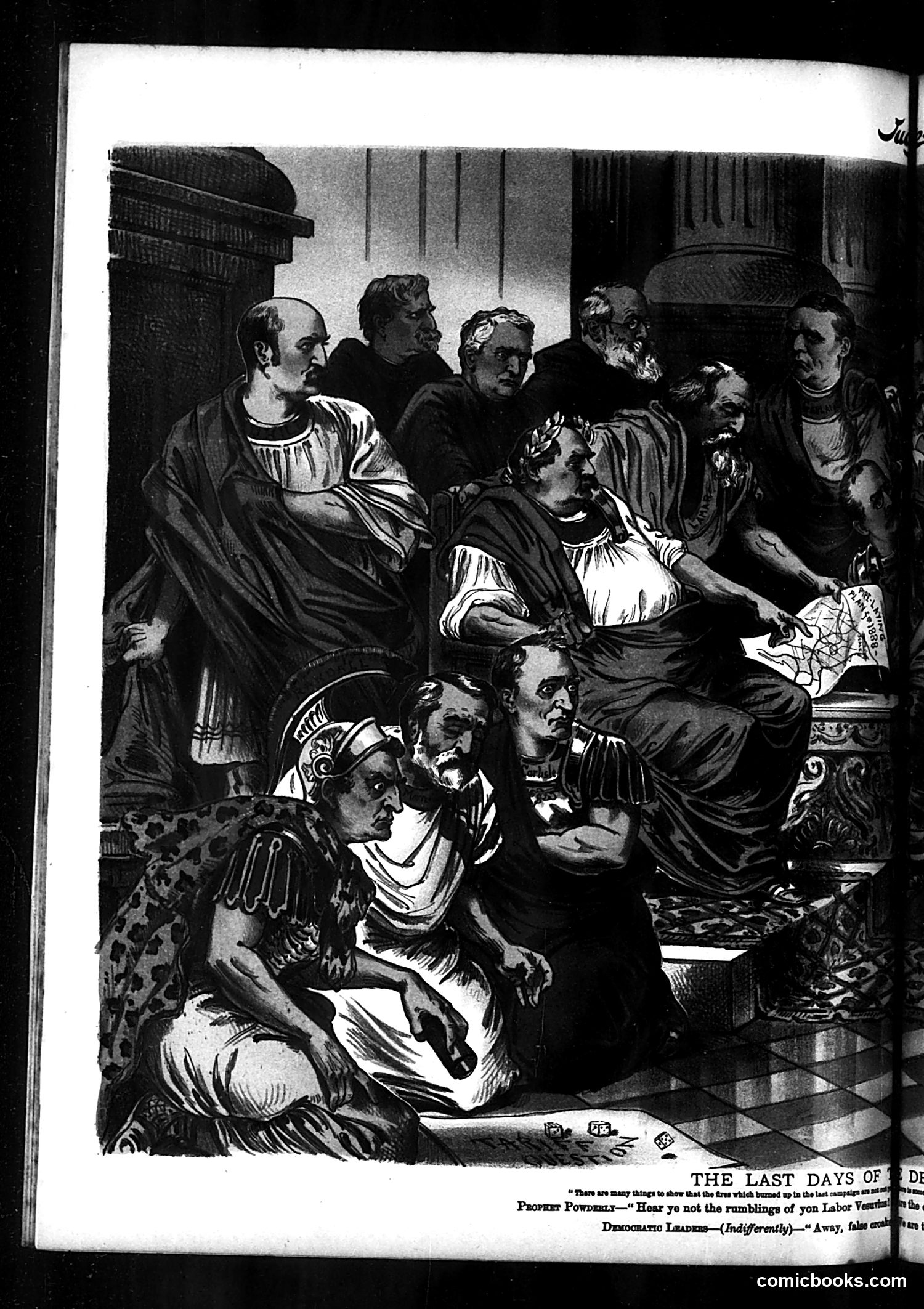
This appears to be a political cartoon from *Judge* magazine satirizing late 19th-century American politics. The title "The Last Days Of" (incomplete) and the quoted dialogue suggest it depicts a scene of political decline or failure. The references to "Prophet Populery" and "Democratic Leaders" indicate the cartoon targets the Populist and Democratic parties, likely during or after an election campaign. The mention of "fires which burned up in the last campaign" suggests a failed political movement or electoral defeat. The crowd scene with figures in classical Roman dress suggests the cartoonist is comparing contemporary political figures to ancient Rome—perhaps implying moral decay or the fall of a political order. The Democratic leaders' dismissive "Away, false" response indicates ridicule of their indifference to populist concerns about "Labor." The exact historical event remains unclear without the complete caption, but this appears to be anti-Populist satire from the 1890s era.
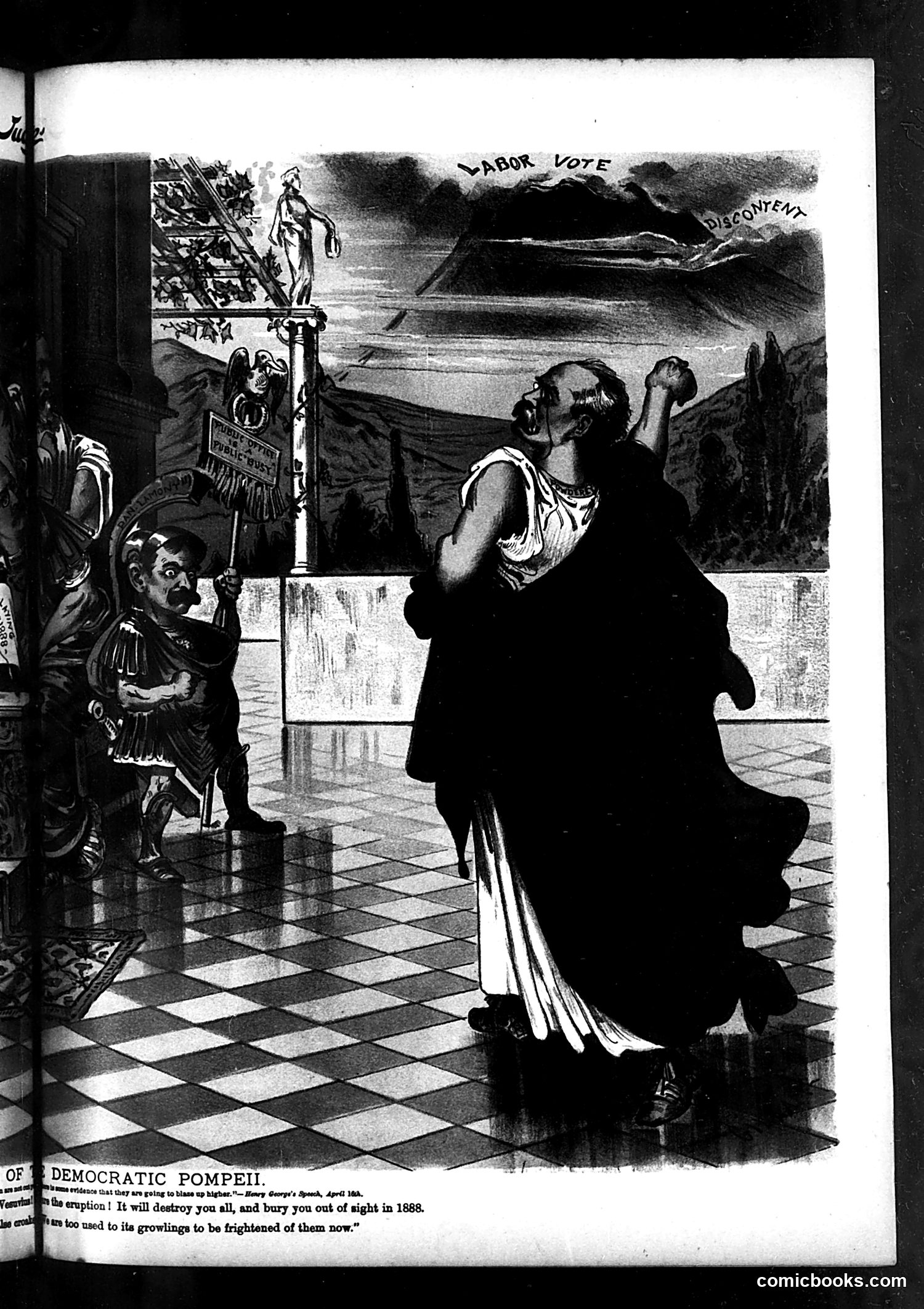
This political cartoon satirizes the Democratic Party by comparing it to Pompeii before Mount Vesuvius's eruption. The figure in the foreground appears to be a Democratic politician or voter, oblivious to the volcano labeled "LABOR VOTE" and "DISCONTENT" erupting in the background—representing growing labor unrest and social discontent. The caption references Henry George's April 1888 speech, warning that an eruption will "destroy you all, and bury you out of sight in 1888." The satire criticizes Democrats for ignoring warning signs of volcanic upheaval in labor politics, suggesting they're complacently dismissing serious threats to their political future, much like Pompeii's residents ignored the volcano until catastrophe struck.
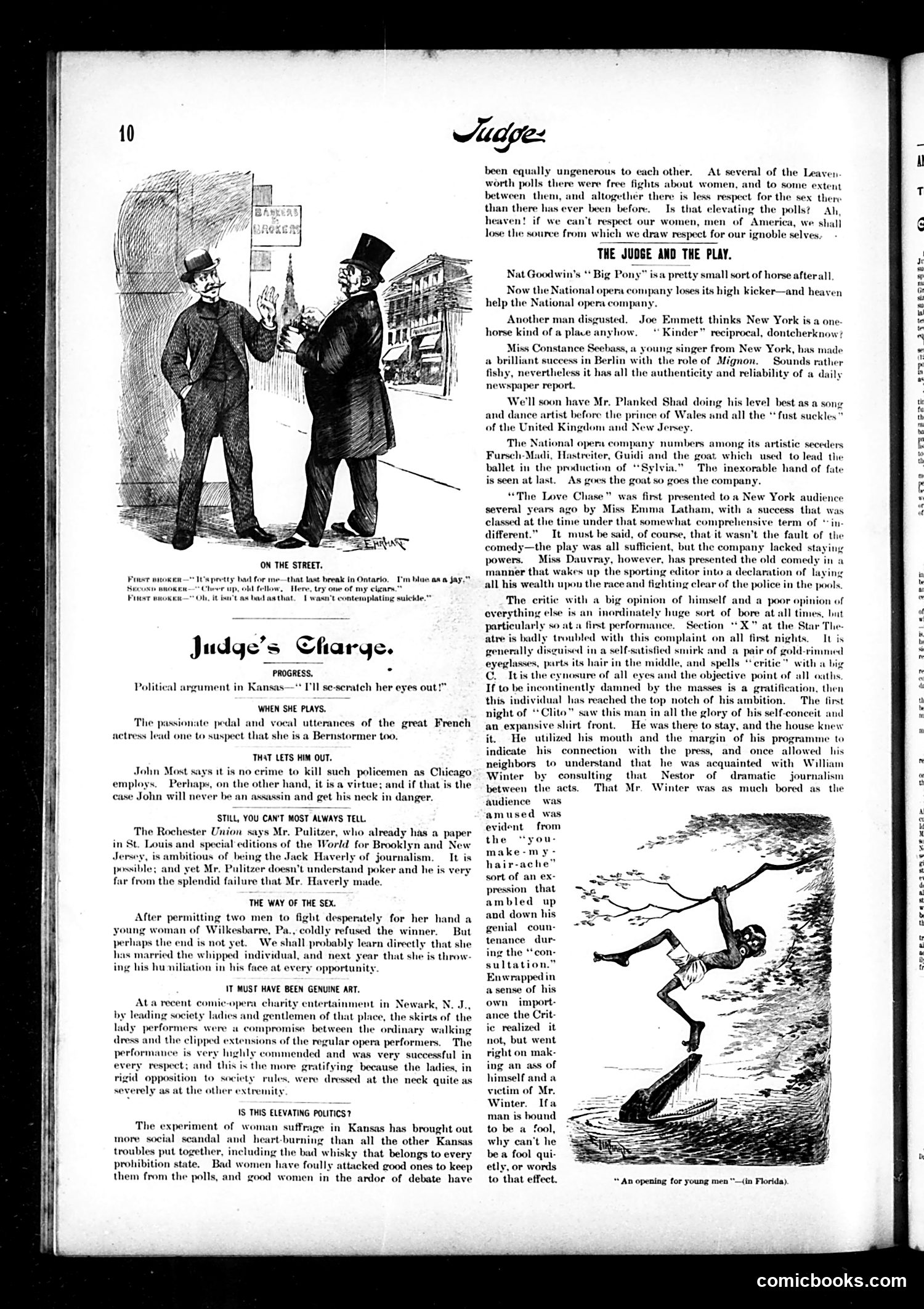
This page from Judge magazine contains several satirical short pieces mocking contemporary figures and social issues: **"On the Street" cartoon**: Two well-dressed men discuss suicide contemplation—likely satirizing the frequency of such references in casual conversation among the era's urban middle class. **Political commentary**: References to Kansas women's suffrage highlight Judge's skepticism about voting rights for women, claiming it caused social scandal and reduced respect for women at polling places—a common anti-suffrage argument of the period. **Theater criticism**: Multiple brief items mock theatrical personalities and productions, including derisive comments about performers like Nat Goodwin and criticisms of the National opera company's artistic standards. **"Judge and the Play" section**: Contains sarcastic commentary on contemporary theatrical performances and performers, suggesting poor quality despite public enthusiasm. The overall tone is dismissive and mocking toward progressive causes (women's suffrage) while ridiculing popular entertainment and public figures—typical of Judge's satirical approach to Gilded Age American society.
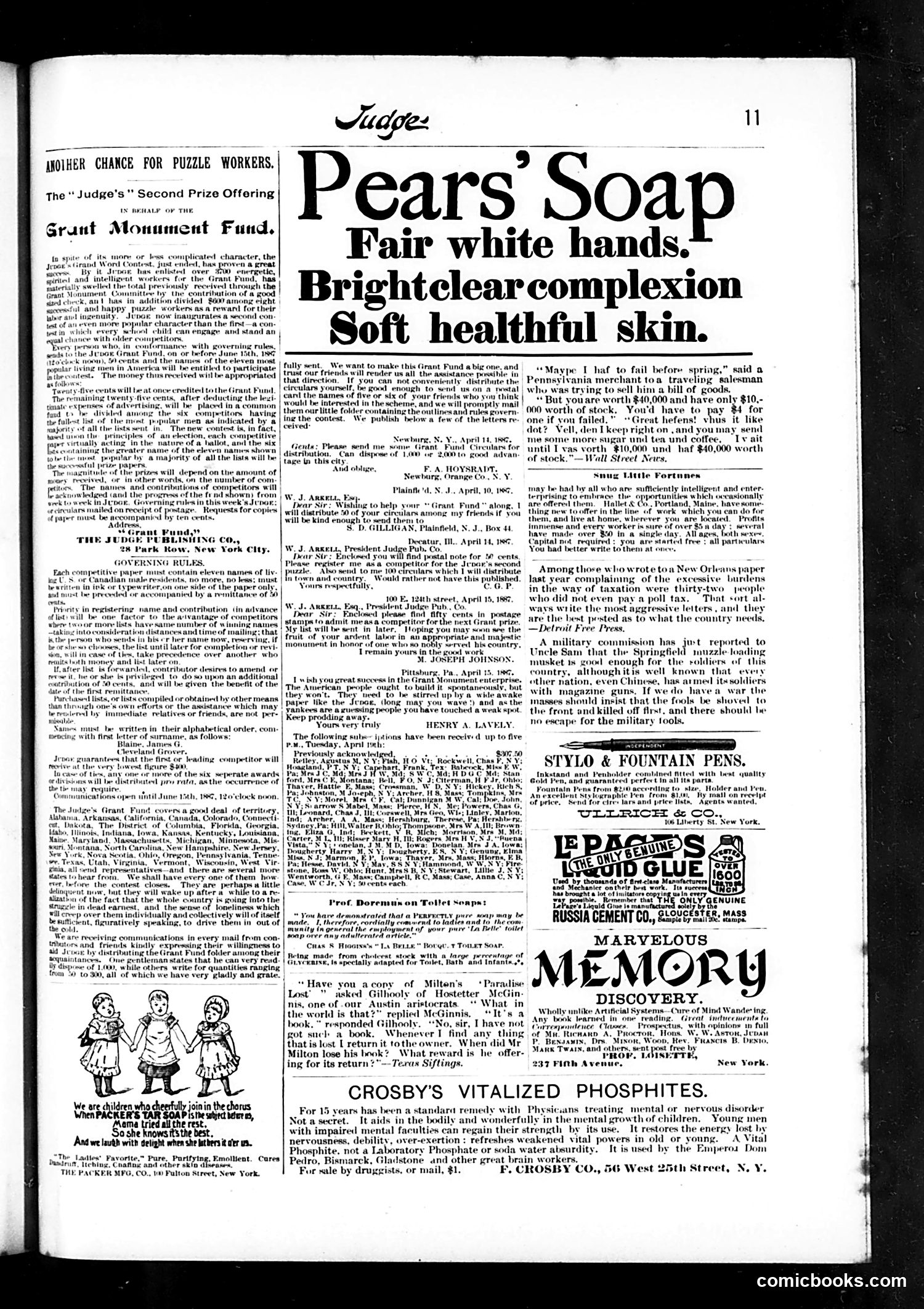
This page is primarily **advertising and contest announcements**, not political satire. The main content includes: **The Grant Monument Fund Contest**: Judge magazine is promoting a puzzle competition to raise money for a Grant Monument Fund. Competitors submit lists of eleven names of "live US or Canadian male residents" following specific rules. Winners receive monetary prizes distributed from contributions. **Pears' Soap Advertisement**: The large display ad dominates the page, promoting soap with period beauty standards ("fair white hands," "bright clear complexion"). This reflects late-19th/early-20th-century advertising conventions emphasizing skin whiteness. **Other Advertisements**: The page includes ads for fountain pens, liquid glue, a "Marvelous Memory Discovery," and Crosby's Vitalized Phosphites (a medicinal tonic). The cartoon referenced in the upper left appears to show three children, likely related to Pears' Soap's marketing, though details are unclear from this reproduction. This is essentially a **commercial page** rather than political commentary—typical of Judge's mixed content format.
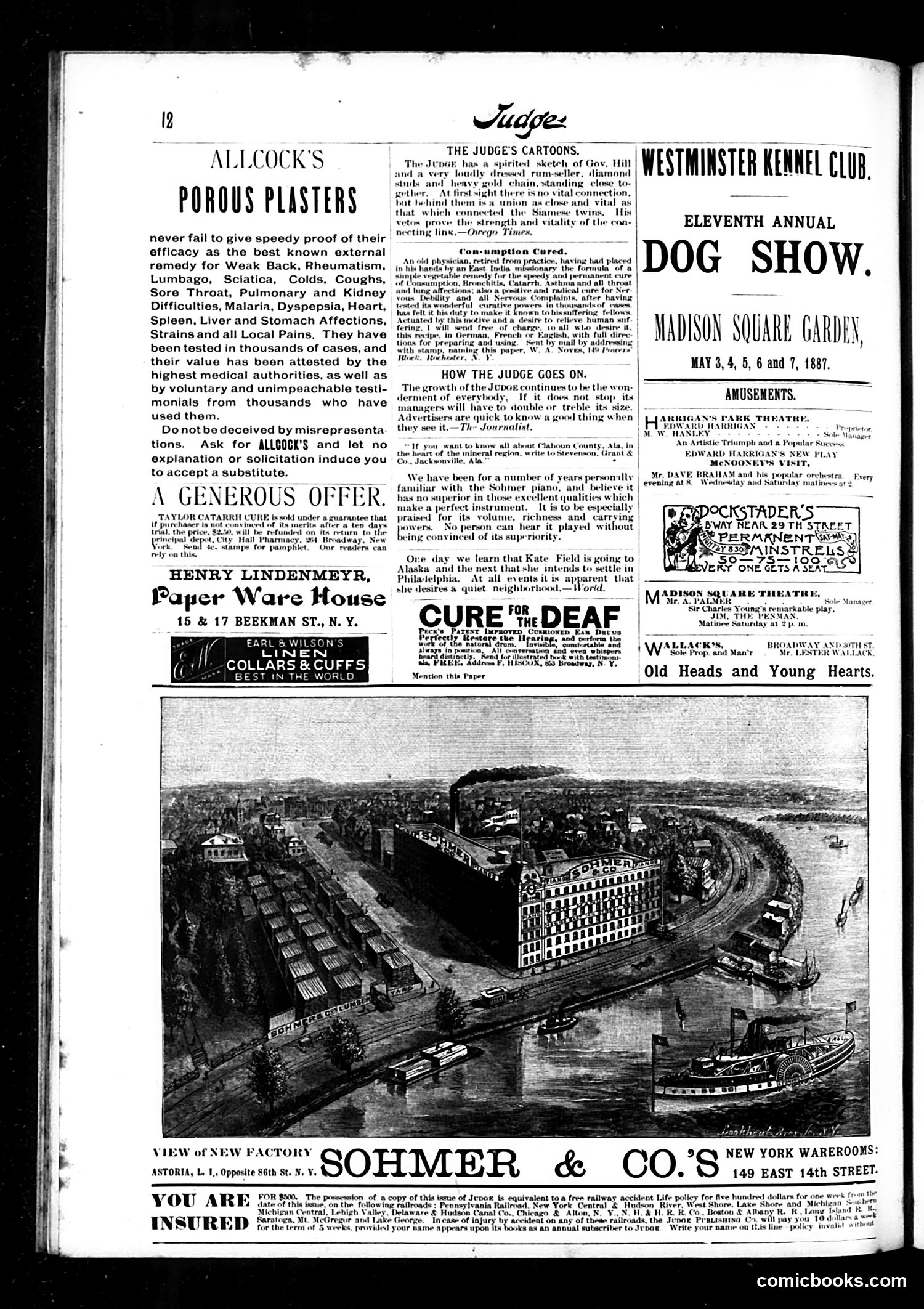
This page is primarily **advertising and announcements**, not political satire. The OCR'd "Judge's Cartoons" section appears truncated—only fragments remain about Governor Hill and Kate Field's travel plans (the latter likely social gossip rather than substantive satire). The page features: - **Patent medicine ads** (Allcock's Porous Plasters, Taylor Catarrh Cure, "Cure for the Deaf")—typical of 1880s magazines - **Business advertisements** (Henry Lindenmeyer's paper warehouse, Sohmer pianos) - **Entertainment listings** for 1887 New York: Westminster Kennel Club Dog Show, various theater productions - **An industrial engraving** of Sohmer & Co.'s Astoria factory - **An unusual life insurance offer**: Judge subscribers were automatically covered for railway accident death while reading the magazine The life insurance claim is the most satirically interesting element—it's either a genuine promotional gimmick or sly commentary on the magazine's importance to readers' daily lives. Otherwise, this is a mundane commercial/entertainment page typical of late-Victorian publications.
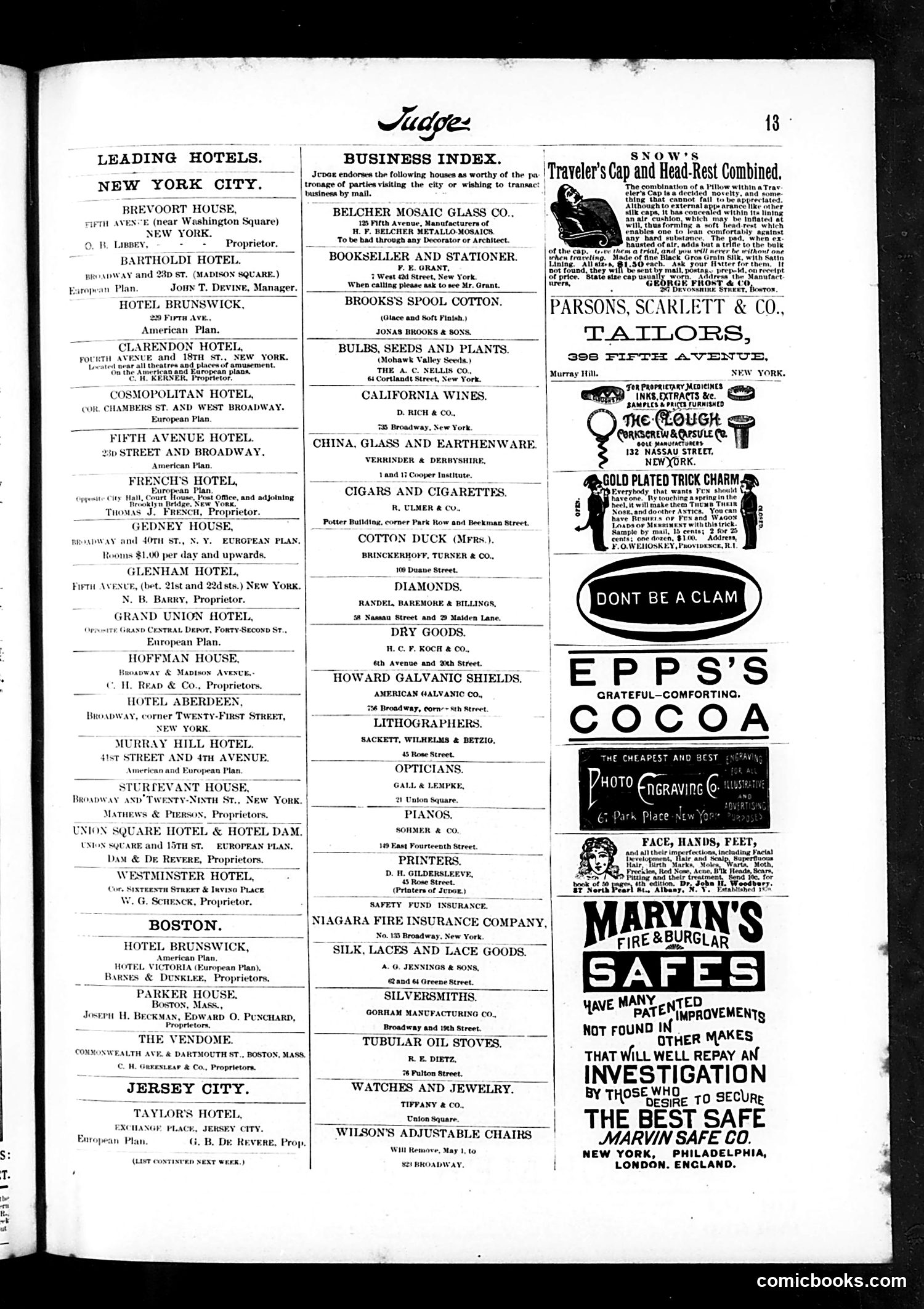
This page is primarily a business directory and hotel listing for Judge magazine, with advertisements rather than satirical content. The left column lists leading hotels in New York City and Boston with proprietor information. The center section is a "Business Index" directing readers to various New York commercial establishments—from glass manufacturers to diamond dealers to insurance companies. The right side contains advertisements, including what appears to be a traveler's cap product, tailoring services, patent medicines, a "trick charm" novelty item, and Epps's Cocoa. Most notably, there's a circular "DONT BE A CLAM" advertisement and Marvin's Fire & Burglar Safes promoting their security features. This is a commercial/reference page rather than satirical content—typical of Judge's hybrid format combining humor magazine with business directory and advertising revenue.
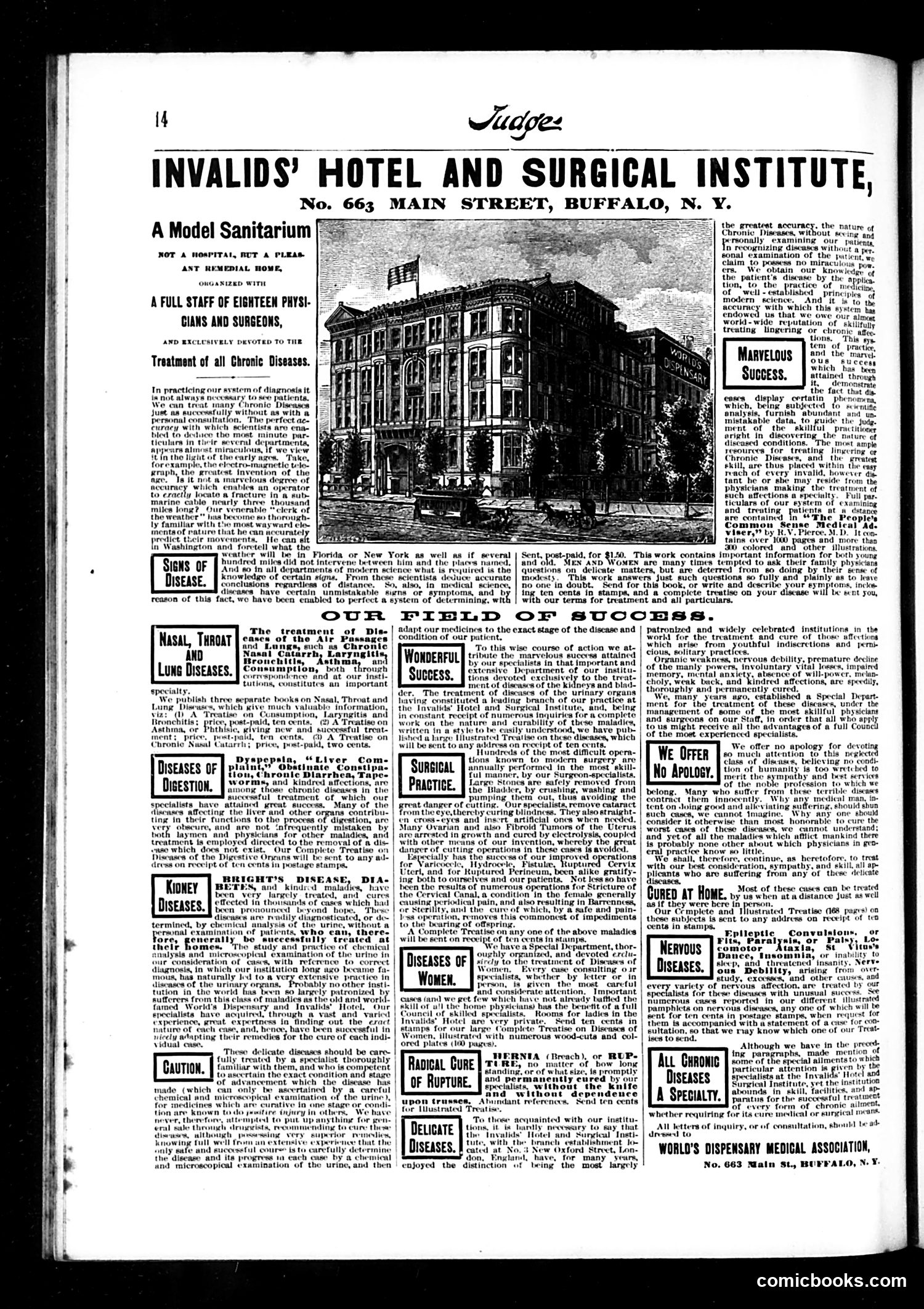
This page is **primarily advertising**, not satire. It promotes the Invalids' Hotel and Surgical Institute in Buffalo, New York—a mail-order medical practice claiming to diagnose and treat chronic diseases *without seeing patients in person*. The pitch exploits a pseudo-scientific analogy: just as meteorologists predict weather from distance, their physicians can diagnose illness from descriptions alone. Patients could pay for treatment, receive medical literature, and correspond by mail. By modern standards, this is clearly fraudulent medicine. However, in the late 1800s (when this likely appeared), such "distance diagnosis" was a recognized—if controversial—practice. The advertisement targets desperate chronic-disease sufferers with promises of expert treatment without travel burden. The surrounding smaller ads tout similar services: treatments for nasal diseases, digestion problems, kidney ailments—typical patent-medicine marketing of the era. Judge magazine published such ads for revenue, though the magazine itself was primarily satirical.
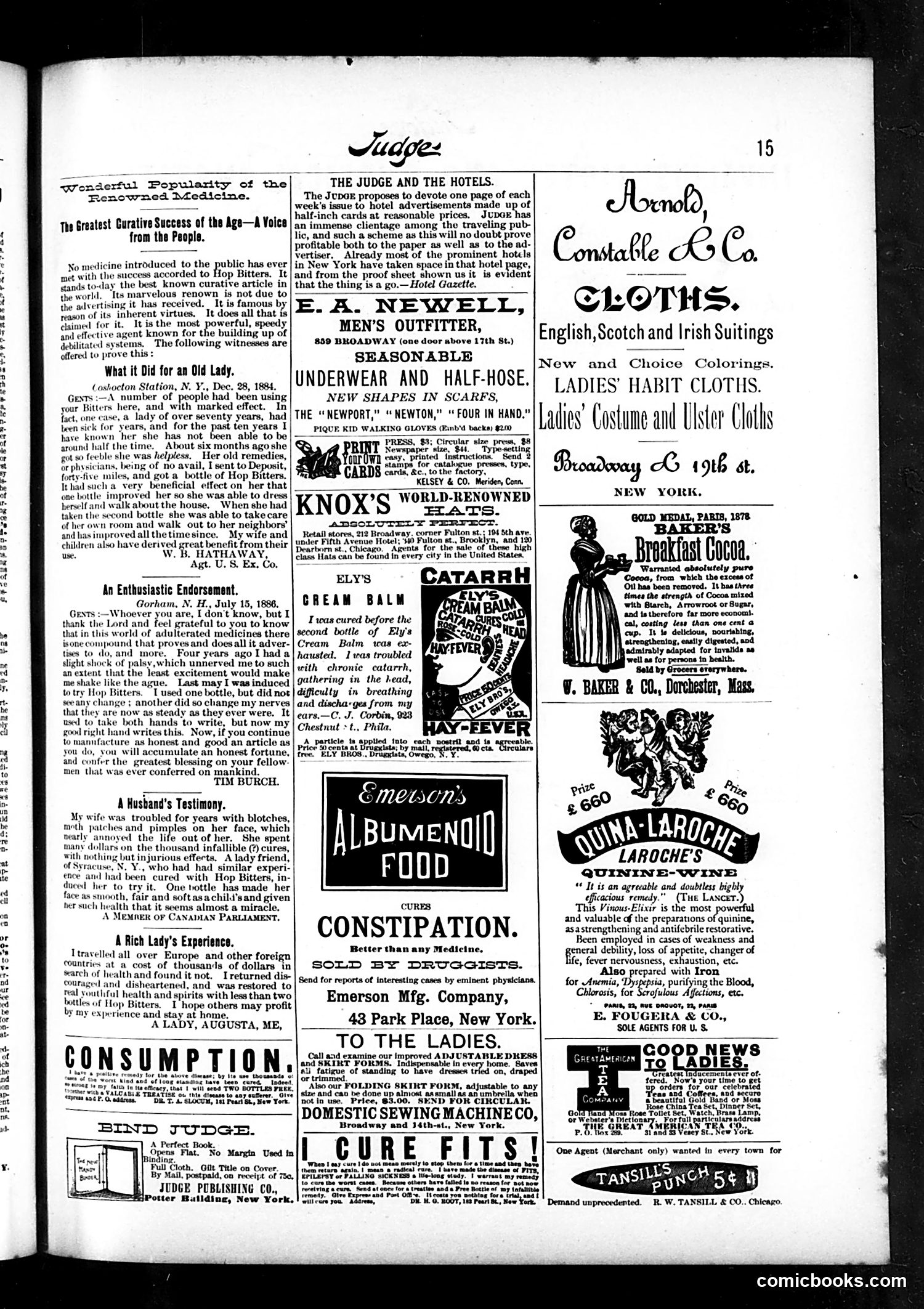
This page is primarily **advertising**, not satirical content. It features testimonial advertisements for Hop Bitters (a patent medicine), alongside various product advertisements for clothes, hats, cocoa, and patent medicines. The Hop Bitters ads present "testimonies" from supposed real users—an elderly woman restored to health, a man whose wife's skin condition improved, a Canadian politician, and a wealthy woman cured of consumption (tuberculosis)—all claiming miraculous recoveries. These endorsements, while presented as genuine letters, exemplify the fraudulent patent medicine marketing of the 1880s. For modern readers: such testimonials were typically fabricated or exaggerated to sell ineffective (often dangerous) tonics containing alcohol and questionable ingredients. The page demonstrates how *Judge* magazine monetized its readership by accepting paid testimonial advertisements from patent medicine companies—a common and largely unregulated practice of the era that preyed on genuine public health concerns.
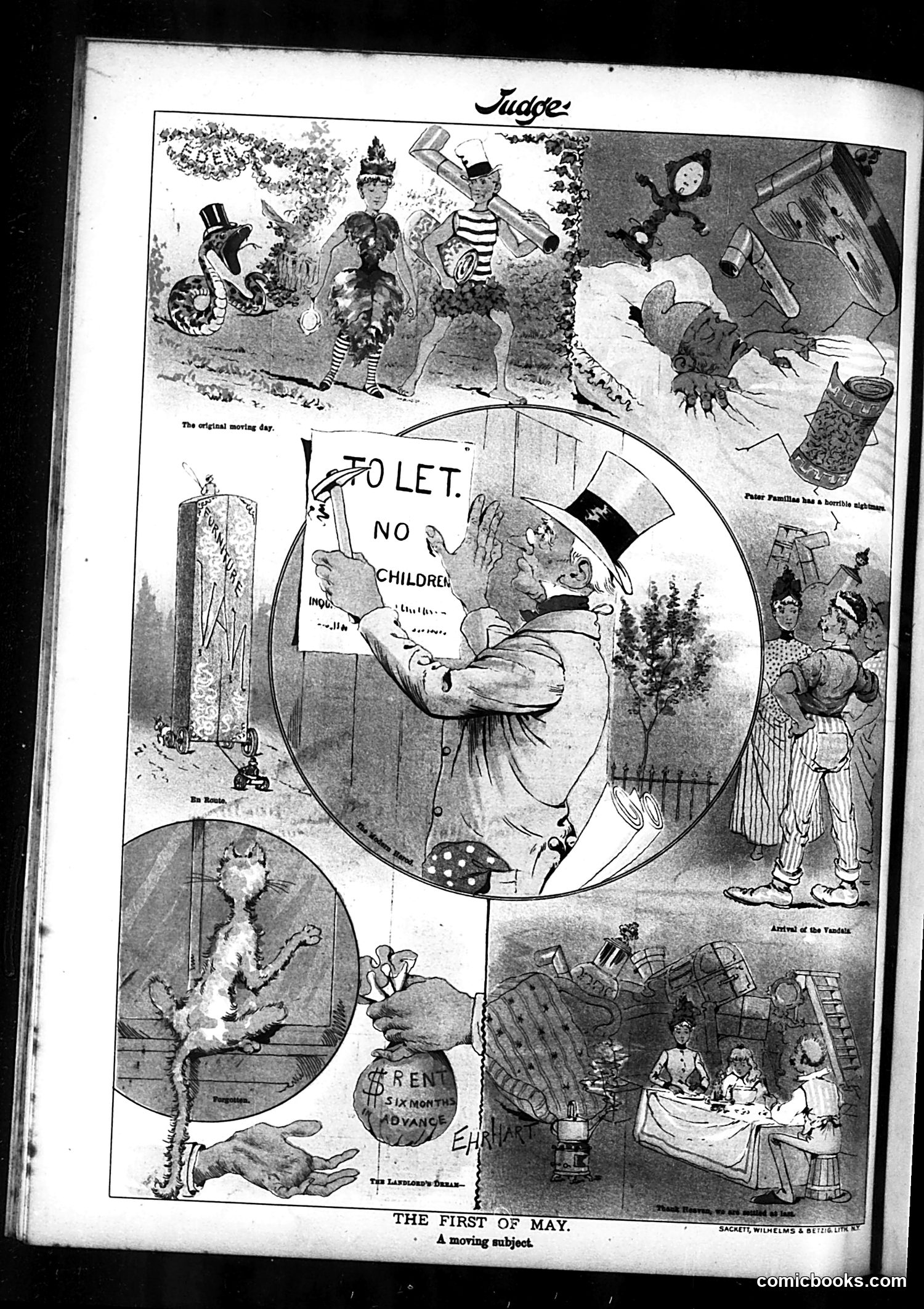
This Judge magazine page satirizes May 1st as moving day in America. The central circular illustration shows a landlord with a "TO LET / NO CHILDREN" sign evicting tenants. Surrounding vignettes depict the chaos of moving day: families with possessions, children being displaced, landlords collecting rent advances, and the general mayhem of relocation. The satire targets the exploitative landlord-tenant system, particularly how landlords used "no children" restrictions to exclude families while profiting from frequent turnover. The phrase "moving subject" puns on both the literal moving of households and the emotionally charged nature of the practice. The caricatured landlord appears greedy and indifferent to families' hardship, highlighting class tensions and housing instability in early 20th-century America—issues that remain relevant today.