
Judge, 1887-04-30 · page 7 of 16
Judge — April 30, 1887 — page 7: what you’re looking at
What you’re looking at
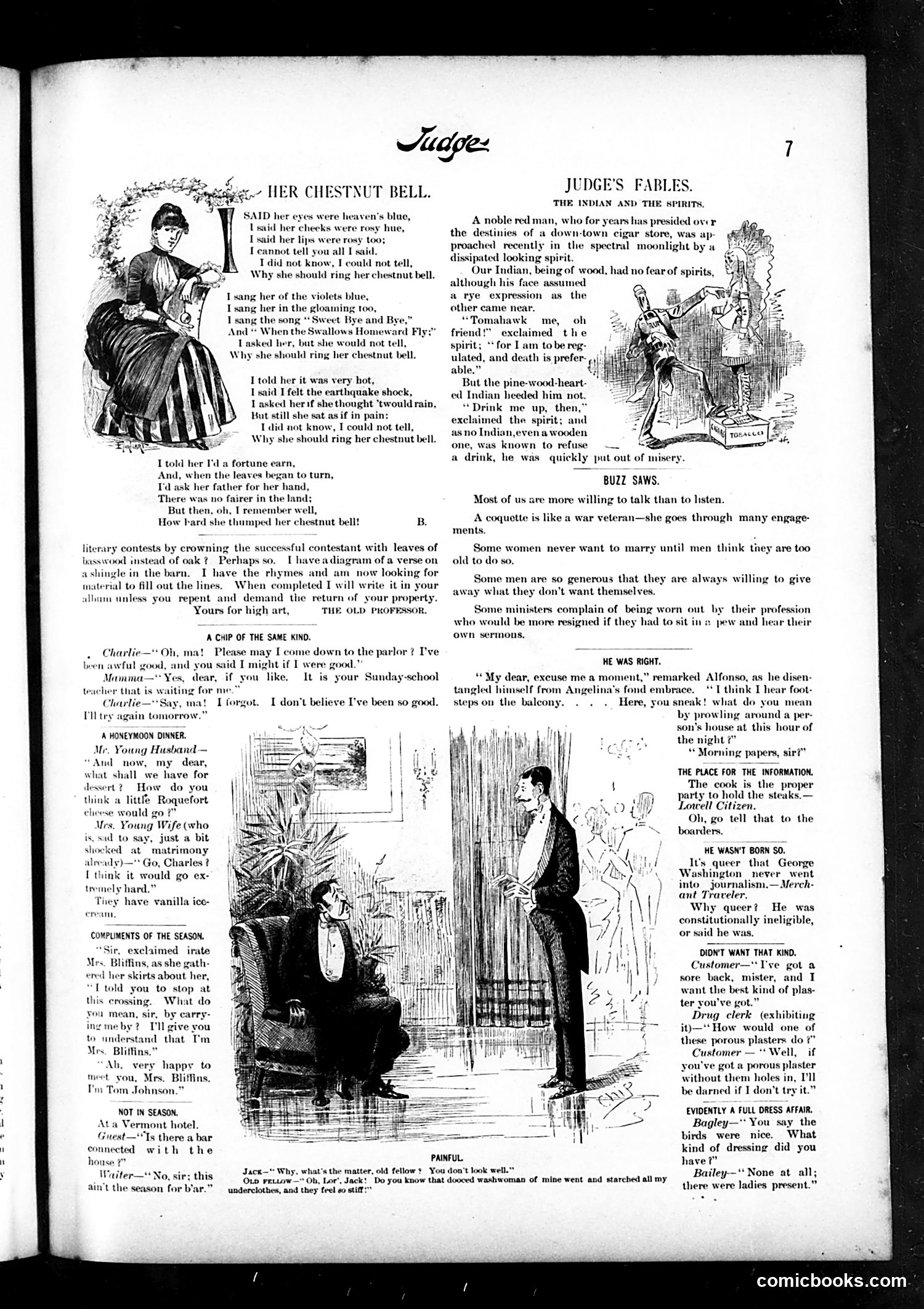
This page from *Judge* (a late 19th-century satirical weekly) contains multiple unrelated humorous pieces typical of the magazine's format. **"Her Chestnut Bell"** is a sentimental poem about a suitor's failed courtship—a gentle parody of Victorian love poetry's overwrought attempts to woo an unresponsive woman. **The fables and "Buzz Saws"** section offers brief satirical observations on gender and social behavior: women's marriage tactics, men's generosity with unwanted items, and ministers' hypocrisy (complaining about work while avoiding pews). **The illustrated vignettes** mock domestic situations: a child negotiating parlor privileges, newlyweds discussing food, a woman scolding a careless driver, and a husband interrupting romance to chase away an intruder. **"The Indian and the Spirits"** appears to be a crude racial caricature mocking Native Americans, depicting a wooden cigar-store Indian statue literally unable to refuse alcohol—reflecting period stereotypes about Indigenous peoples and substance abuse. The page reflects *Judge*'s satirical approach to American middle-class life, marriage, and social pretension, though some content reflects deeply offensive period attitudes.
📄 Transcribed text from this page (OCR, searchable)
Machine-transcribed from the original scan — historical spelling and the odd misread are preserved.
's blue, hue, I said her lips were rosy too; I cannot tell you all I ss T did not know, I could not tell, Why she should ring her chestnut bell. T sang her of the violets blue, I sang her in the gloamin, I sang the song “Sweet Bye and Bye,” And * When the Swallows Homew Tasked her, but she would not tell, Why she should ring her chestnut bell. I told her it was very hot, I said I felt the earthquake shock, L asked her if she thought ‘twould rain, But still she sat as if in pain: Tdid not know, I could not tell, Why she should ring her chestnut bell. I told her I'd a fortune earn, And, when the leaves began to turn, I'd ask her father for her hand, was no fairer in the land; But then, oh, T remember well, How bard she thumped her chestnut bell! B. literary contests by crowning the successful contestant with leaves of basswood instead of oak? Perhaps so. I have adiagram of a verse on ashingle in the barn, I have the rhymes and am now looking for material to fill out the line When completed I will write it in your album unless you repent and demand the return of your property. Yours for high art, THE OLD PROFESSOR. ‘A CHIP OF THE SAME KIND. Charlie— Oh, mat Please may I come down to the parlor ? I've wen awful good, and you said I might if I were good.’ Mamma dear, if you like. It is your Sunday-school for ni ay, ma! I forgot. ‘y again tomorrow.” I don't believe I've been so good. A HONEYMOON DINNER. “And now, my dea what shall we have for dessert? How do you think a little Roquefort cheese would go Mrs. Young Wife (who is, sud to say, just a bit shocked at” matrimony already)—* Go, Charles ? I think it would go ex- Tiey have vanilla ice- cream, COMPLMENTS OF THE SEASON. aimed irate Mrs. Bliffins, as she gath- ered her skirts about her, “T told you to stop at this crossing. What do you mean, sir, by meby? Tl to understand tha Mrs. Bliffins,” Ah, very happy to meet you, Mrs. Bliffins, I'm Tom Johnson.” “Sir, € NOT IN SEASON. Ata Vermont hotel. Guest—“Ts there a bar connected with the es PAINFUL. hat’s the matter, old fellow You don’t look well.” Ob, Lor’, Jack! ‘Do you know that dooced washwoman of mine went and starched all my Jack—" Why. OLD rriiow underclothes, and they feel eo stiff! JUDGE'S FABL THE INDIAN AND THE SPIRITS, A noble red man, who for years has presided the destinies of a down-town cigar store, was a proached recently in the spectral moonlight by a dissipated looking spirit. Our Indian, being of wood, had no fear of spirits, although his face assumed rye expression as the other came near. “Tomahawk me, oh friend exclaimed the ‘for Iam to be reg: But the pine-wood-heart- ed Indian heeded him not. “Drink me up, then,” exclaimed the spirit; and n,even a wooden one, was known to refuse a drink, he was quickly put out of misery. BUZZ SAWS. Most of us are more willing to talk than to listen. A coquette is like a war veteran—she goes through many engage- ments. Some women never want to marry until men think they are too old to do so. Some men are so generous that they are always willing to give away what they don’t want themselves. Some ministers complain of being worn out by their profession who would be more resigned if they had to sit in» pew and hear their own sermons, HE WAS RIGHT. “My dear, excuse me a moment,” remarked Alfonso, as he disen- tangled himself from Angelina's fond embrace. steps on the balcony. “T think I hear foot- Here, you sneak! what do you mean by prowling around a per son's house at this hour of the night ¢ “ Morning papers, sir?” THE PLACE FOR THE INFORMATION, The cook is the proper party to hold the steaks,— Lowell Citizen. Oh, go tell that to the boarders. HE WASN'T BORN SO, Its queer that George Washi never went into lism. —Mere constitutionally ineligible, or said he was, DIDN'T WANT THAT KIND, Customer—“T've got a sore back, mister, and I want the best kind of plas- ter you've got.” Drug clerk (exhibiting it)—‘t How would one of these porous plasters do ¢” Customer — “* Well, if you've got a porous plaster without them holes in, I'll be darned if I don't try it.” EVIDENTLY A FULL DRESS AFFAIR. Bagley—* You say the birds were nice. What kind of dressing did you have?” Bailey—‘ None at all; there were ladies present.” comicbooks.com