
A complete issue · 16 pages · 1887
Judge — March 19, 1887
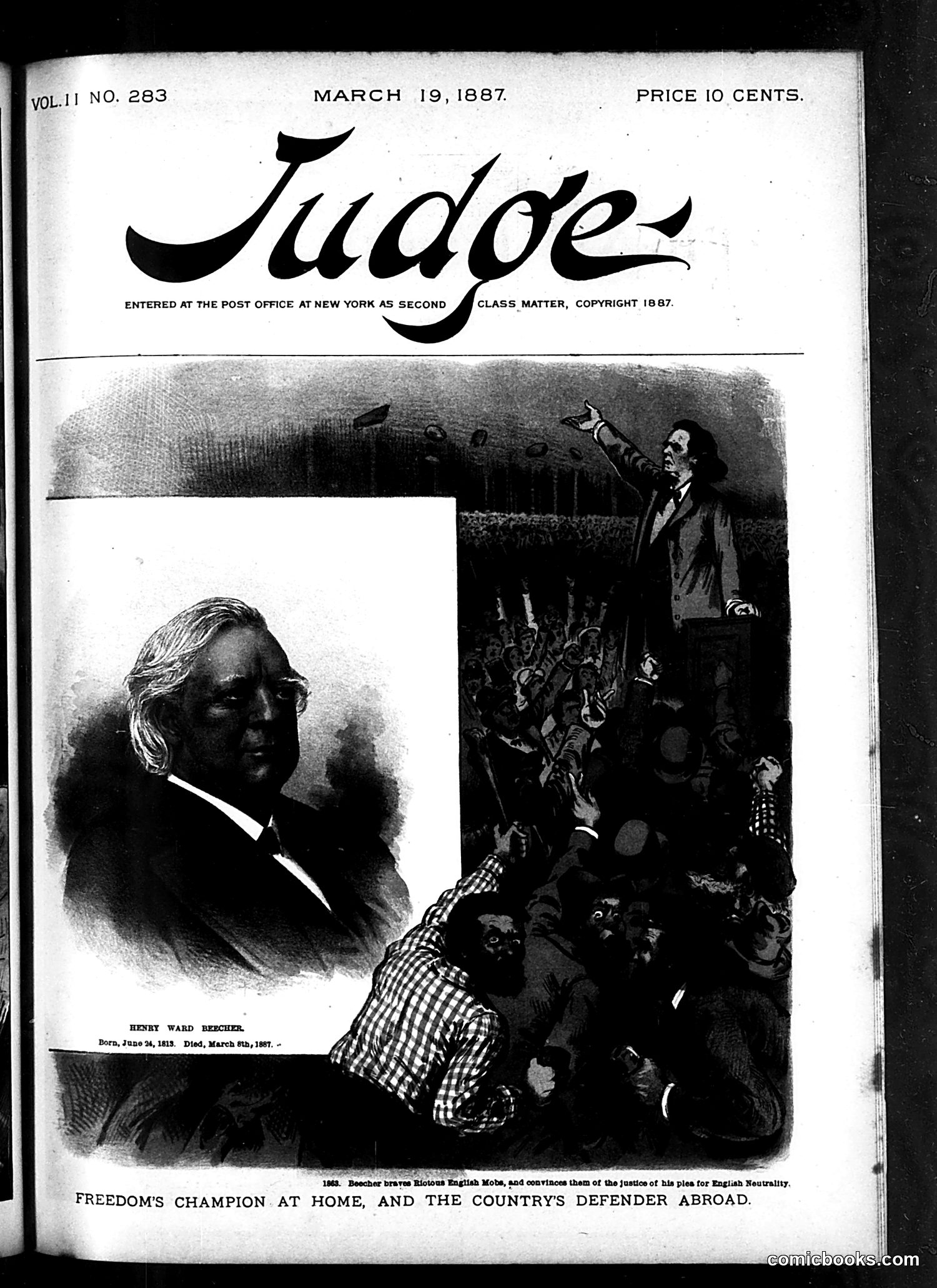
This cover memorializes **Henry Ward Beecher** (1813-1887), a prominent Protestant minister and abolitionist who died March 8, 1887. The left panel shows his portrait; the right depicts him addressing a large crowd, likely referencing his famous public speaking and activism. The caption describes Beecher as "Freedom's Champion at Home, and the Country's Defender Abroad," emphasizing his dual roles as an advocate for American liberty and international causes. The 1863 reference appears to note his Civil War-era stance. This is a respectful tribute rather than satire—Judge was honoring an influential public figure whose moral authority shaped 19th-century American discourse on slavery, religion, and national identity.
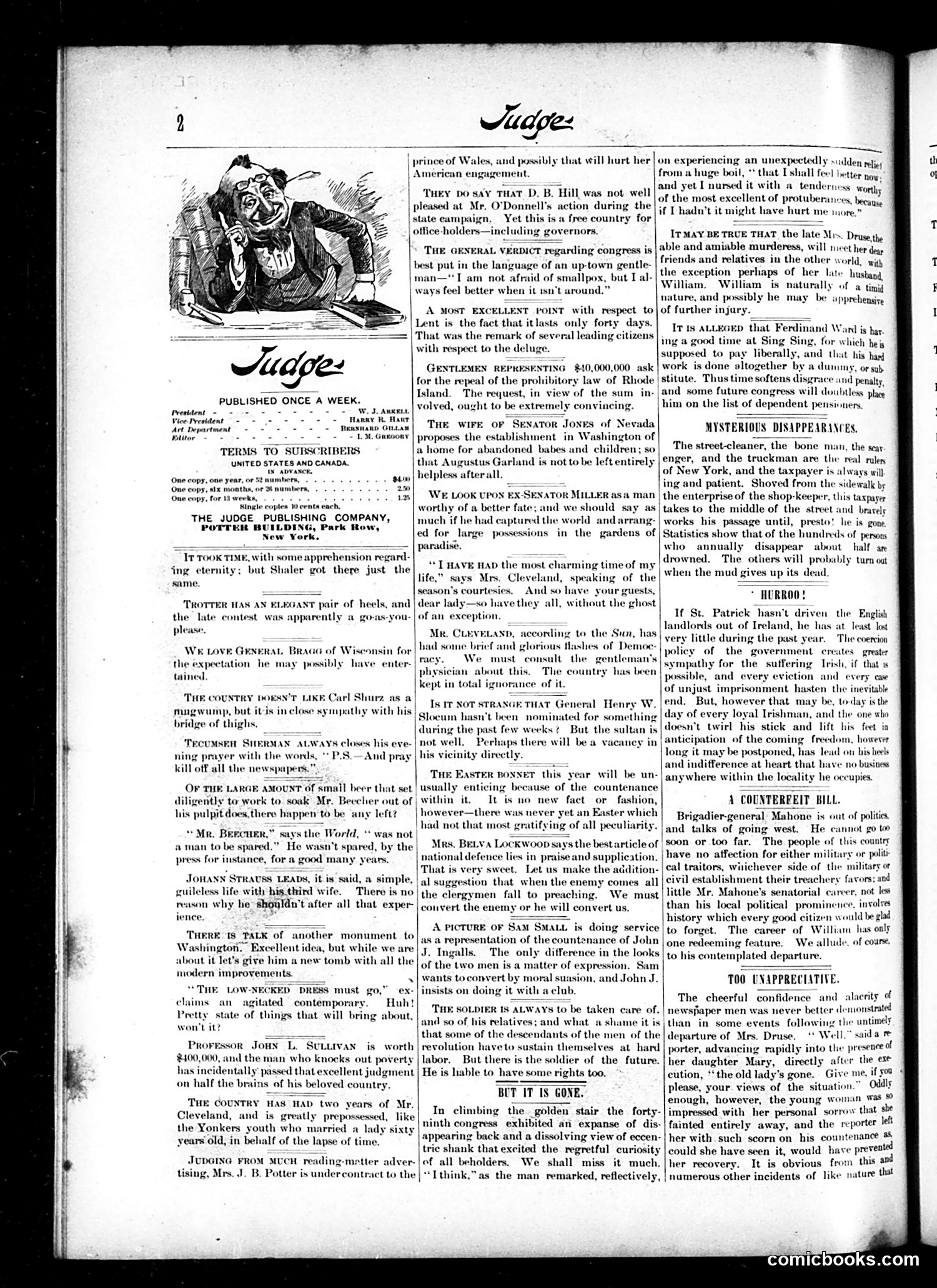
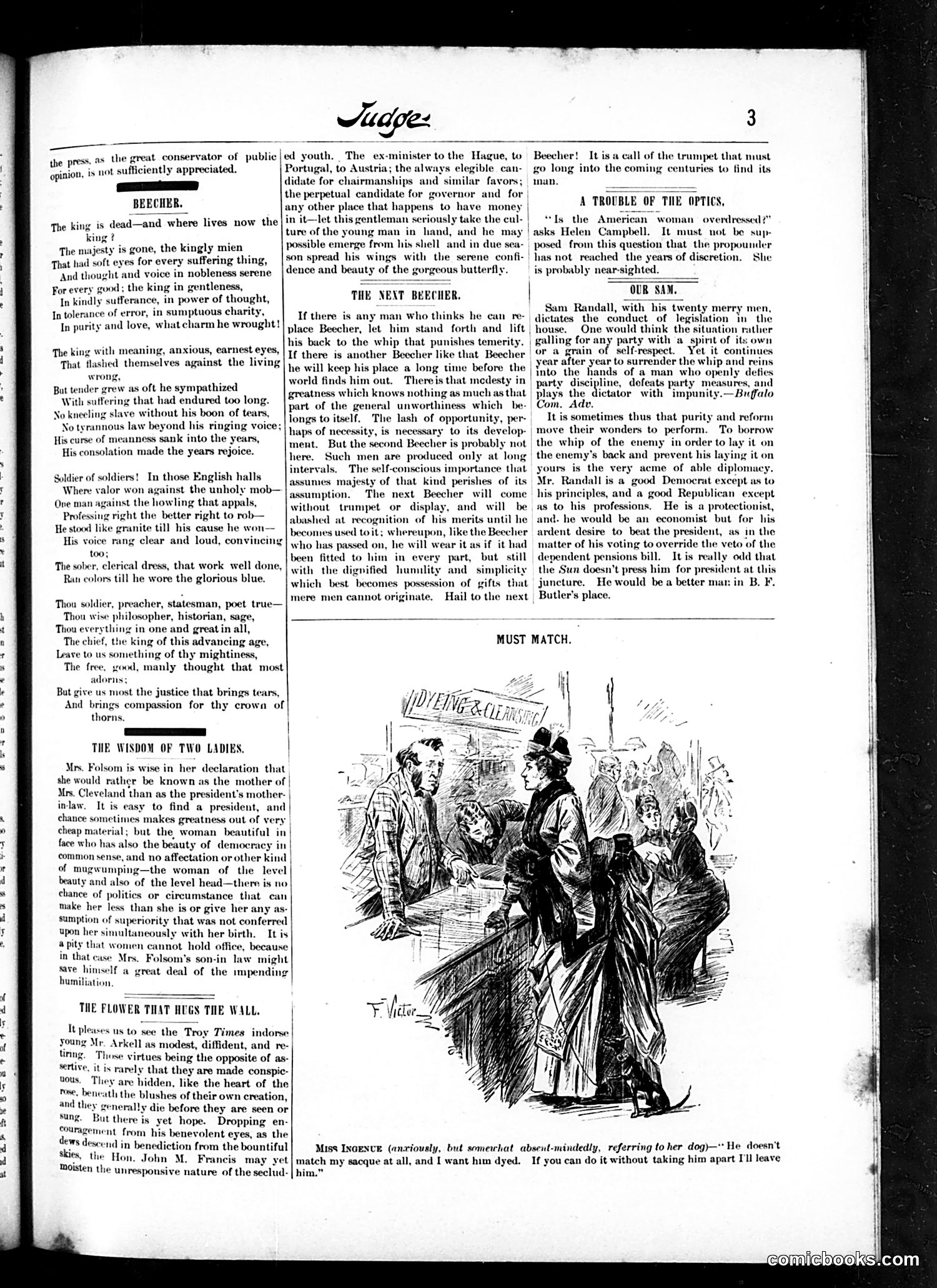
This page is primarily a **tribute to Henry Ward Beecher**, the famous 19th-century preacher who recently died. The lengthy poem praises his moral authority, eloquence, and leadership—describing him as a "king" of justice, compassion, and reform who fought against tyranny and suffering. The accompanying articles discuss Beecher's legacy and irreplaceability. "The Next Beecher" argues that truly great moral leaders cannot simply be replaced or manufactured; such figures emerge only at rare intervals and possess natural humility alongside their gifts. The cartoon titled "**Must Match**" (bottom right) appears to satirize **Miss Innocence**, likely commenting on women's political or social roles—though the specific reference is unclear without more historical context. The page also includes brief commentary on **Mrs. Folsom** (mother of Frances Cleveland, wife of President Grover Cleveland), praising her wisdom in preferring to be known as a mother rather than claiming status through marriage to power. Overall, this is primarily **memorial/editorial content** rather than hard political satire.
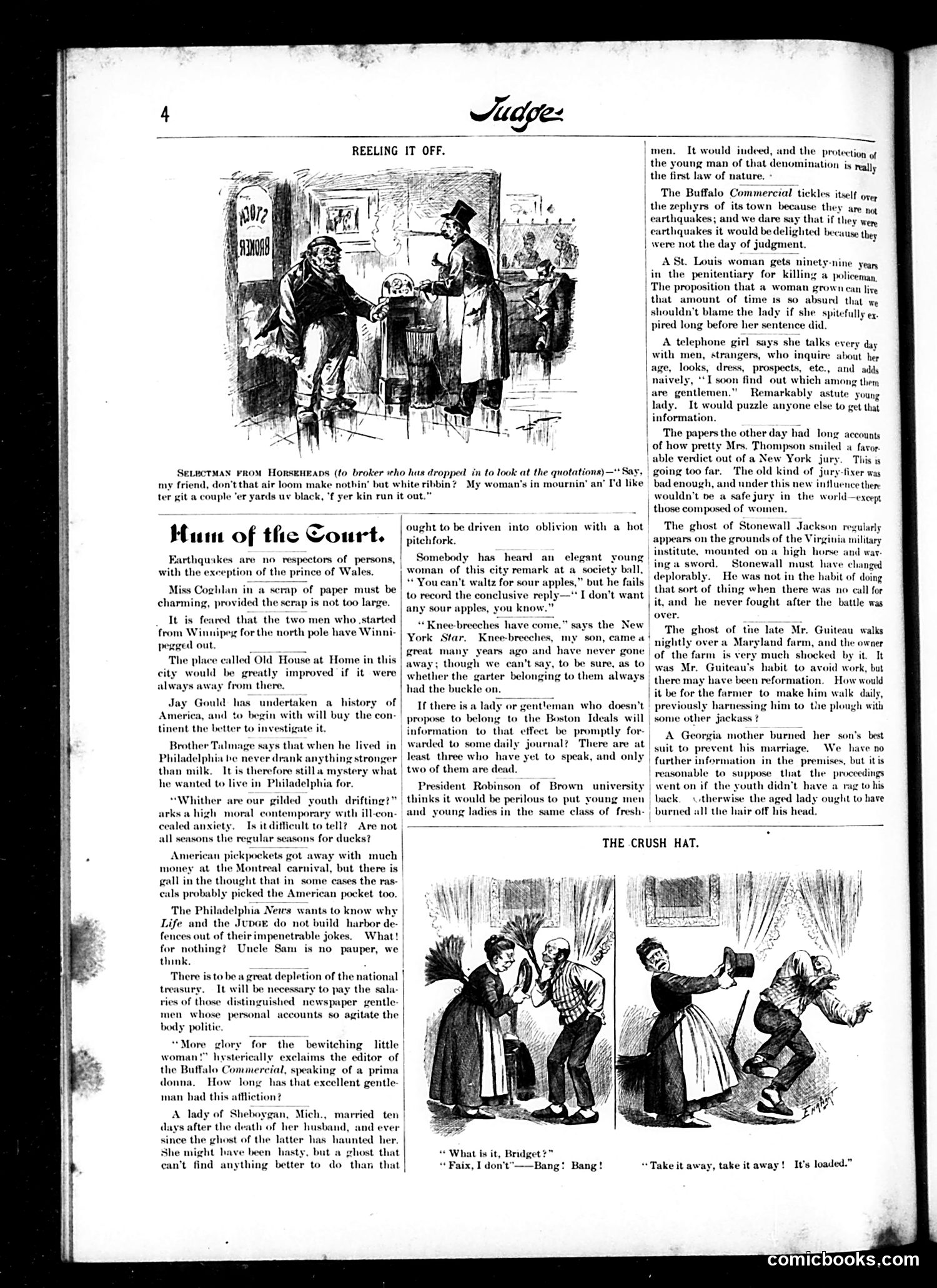
This page from the satirical magazine *Judge* contains several short humorous commentaries and two cartoon sections: **"Reeling It Off"** (top): A rural selectman asks a cotton broker for black ribbon instead of white, explaining his wife is in mourning. The joke mocks rural simplicity—he misunderstands the broker's business. **"Hum of the Court"** (middle): A series of brief satirical observations on contemporary society, including jabs at high society affectations, earthquakes (referencing recent natural disasters), newspaper pretensions, and moral hypocrisy among the wealthy and prominent. **"The Crush Hat"** (bottom): Four cartoon panels depicting the comedic chaos of a fashionable hat being crushed or destroyed, with dialogue emphasizing the hat's destruction. The humor derives from the exaggerated concern over a fashionable accessory and the slapstick consequences. Overall, the page targets American social pretension, gender roles, and contemporary fads through wit and visual comedy typical of 1880s-90s satirical journalism.
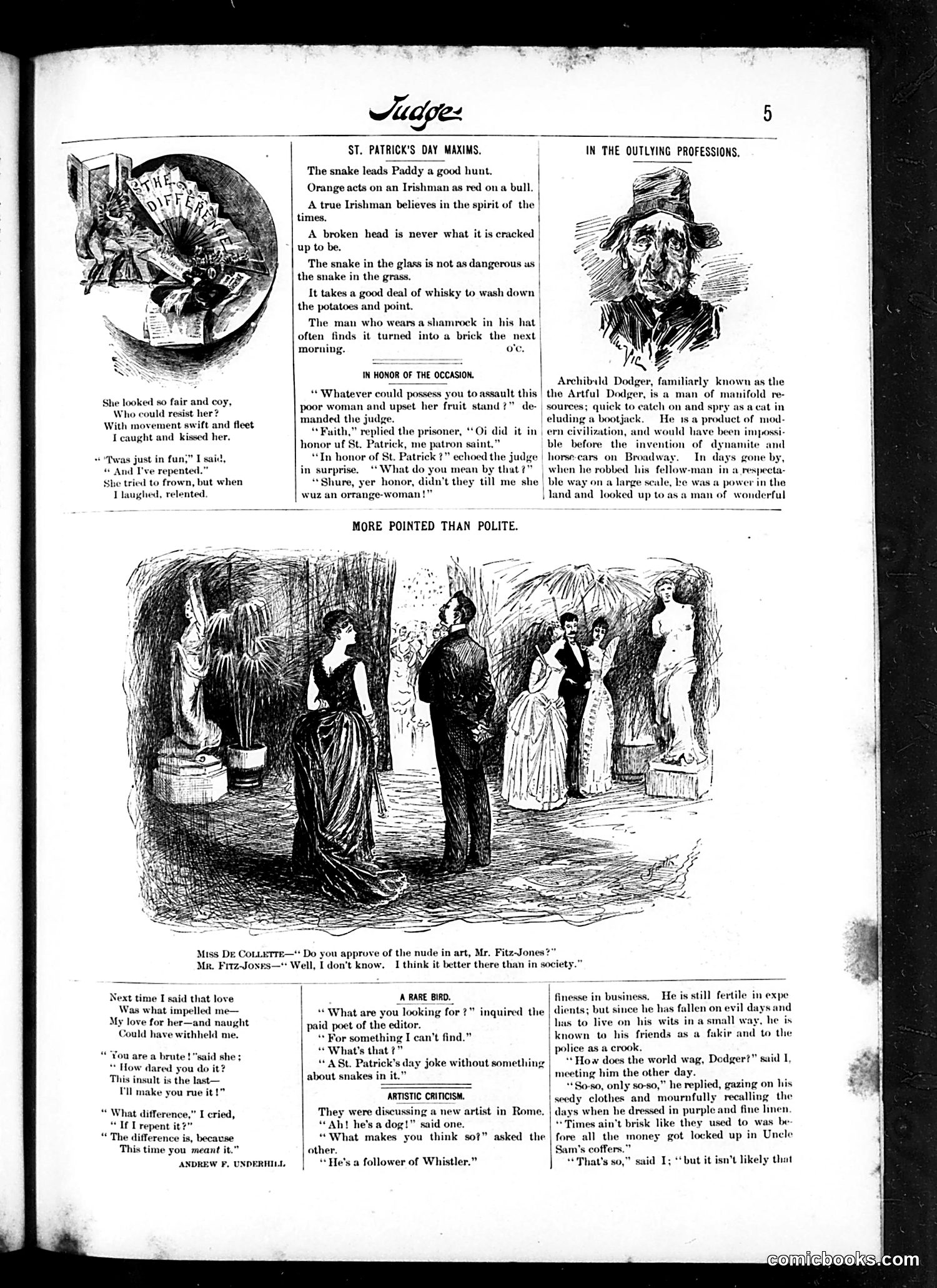
This page from Judge (an American satirical weekly) contains several St. Patrick's Day-themed jokes and satirical pieces, circa late 19th century. **Main Content:** The "St. Patrick's Day Maxims" section mocks Irish stereotypes through aphorisms about drinking ("whisky to wash down potatoes"), violence ("broken head"), and ethnic conflict (references to "Orange" and Irish antagonism). **Key Cartoon:** "In Honor of the Occasion" depicts a prisoner explaining he assaulted an "orange-woman" (a fruit vendor, but "orange" also references Protestant/Orange Order identity in Irish sectarian politics). He claims this was patriotic homage to St. Patrick—a crude joke about anti-Catholic violence disguised as holiday spirit. **Other Sketches:** Include mild romance humor and artistic criticism. "A Rare Bird" jokes about a St. Patrick's Day without snake references. "The Artful Dodger" portrait discusses a Broadway con-man. **Context:** The satire trades in period Irish-American stereotypes—drinking, fighting, superstition—presented as humorous national character traits. The orange-woman joke exploits real sectarian tensions for laughs.
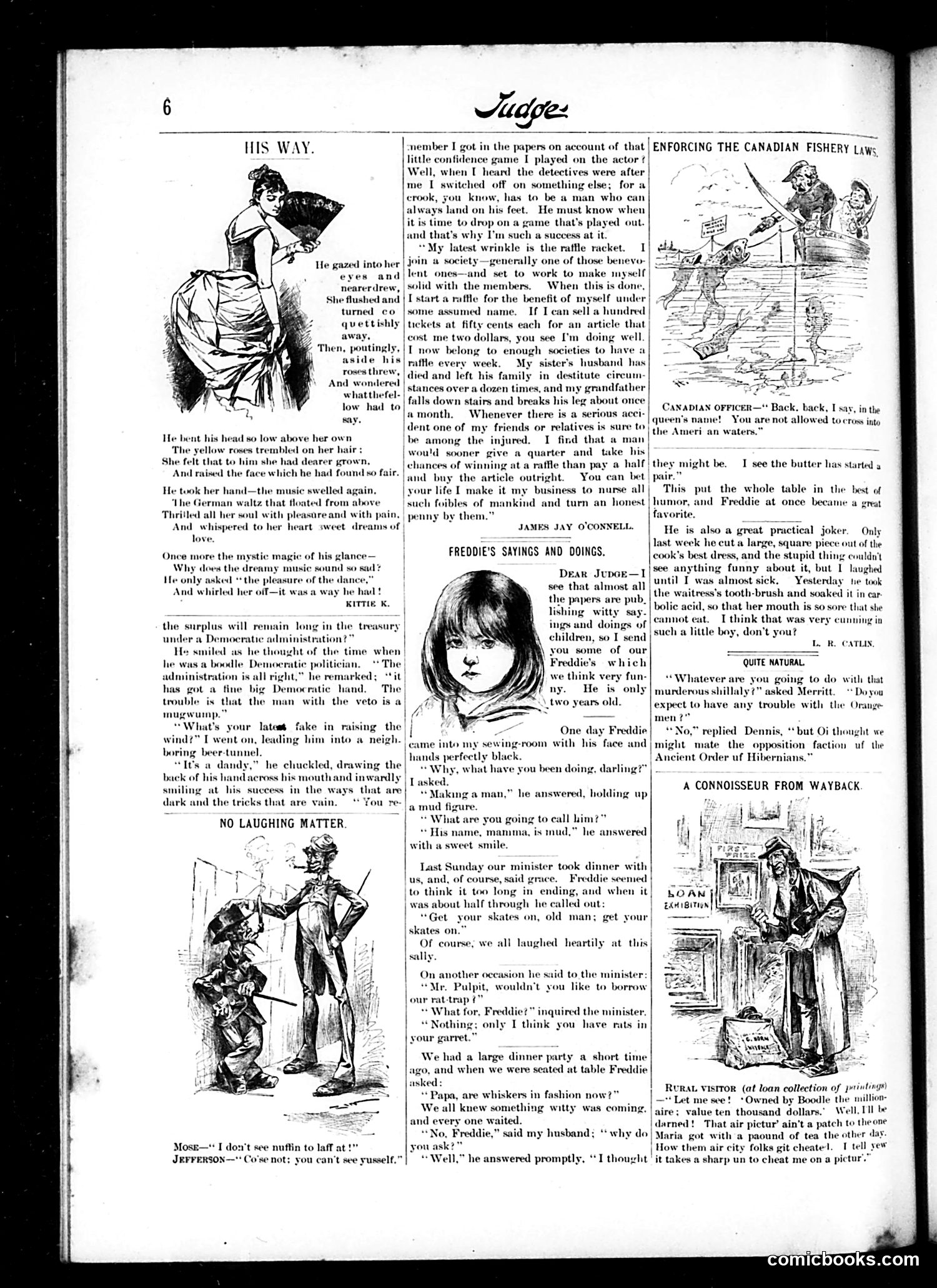
This page from *Judge* contains three distinct pieces of satire: **"His Way"** (left): A romantic poem mocking sentimental literature and Democratic politicians. The final stanza reveals the "dreamy" romantic hero is actually a "boodle Democratic politician" obsessed with embezzling public funds—satirizing corruption in Democratic administrations of the era. **"No Laughing Matter"** (lower left): A dialogue between Mose and Jefferson about raffles. One character explains running confidence schemes through charitable societies, using fake raffles to profit from gullible members. The final exchange mocks both men's inability to recognize obvious truths about themselves. **"Freddie's Sayings and Doings"** (center): Humorous anecdotes about a two-year-old child. The jokes exploit innocent malapropisms ("His name, mamma, is mud") and childish irreverence (interrupting a minister's grace with "Get your skates on"). **"Enforcing the Canadian Fishery Laws"** (top right): A cartoon about Canadian enforcement, featuring officers addressing violations. The page represents typical *Judge* content: political mockery mixed with domestic humor and social satire targeting Democratic corruption and urban con artists.
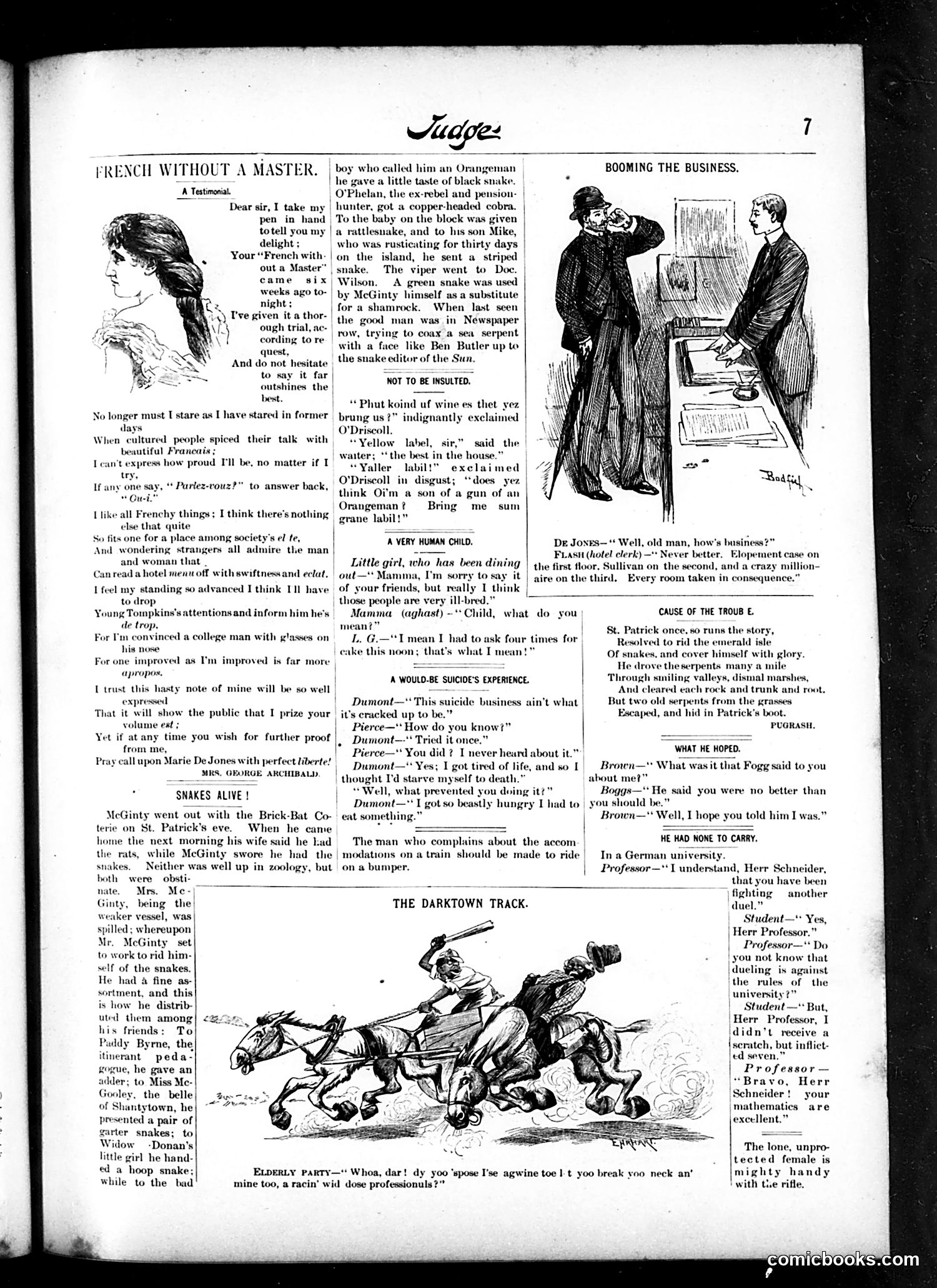
This page contains three distinct satirical pieces typical of late-19th-century American humor magazines: **"French Without a Master"** mocks the genteel pretension of middle-class Americans eager to appear cultured. The testimonial satirizes both the self-satisfied language-learner and advertising claims, using broken French phrases to underscore that genuine sophistication cannot be purchased through mail-order courses. **"Snakes Alive!"** is an Irish-immigrant ethnic joke. McGinty, drunk on St. Patrick's Day, distributes snakes (from his drunken hallucinations) to various acquaintances—each assignment a satirical commentary on the recipient's character or status. The humor relies on Irish dialect stereotypes and contemporary urban Irish-American life. **"The Darktown Track"** uses racist caricature common to the era, mocking African American speech and betting culture. The dialect and imagery reflect deeply prejudiced entertainment conventions of the period. The smaller items ("Not to be Insulted," "A Very Human Child," "Would-be Suicide's Experience") are brief comedic sketches on vanity, children's frankness, and suicide.
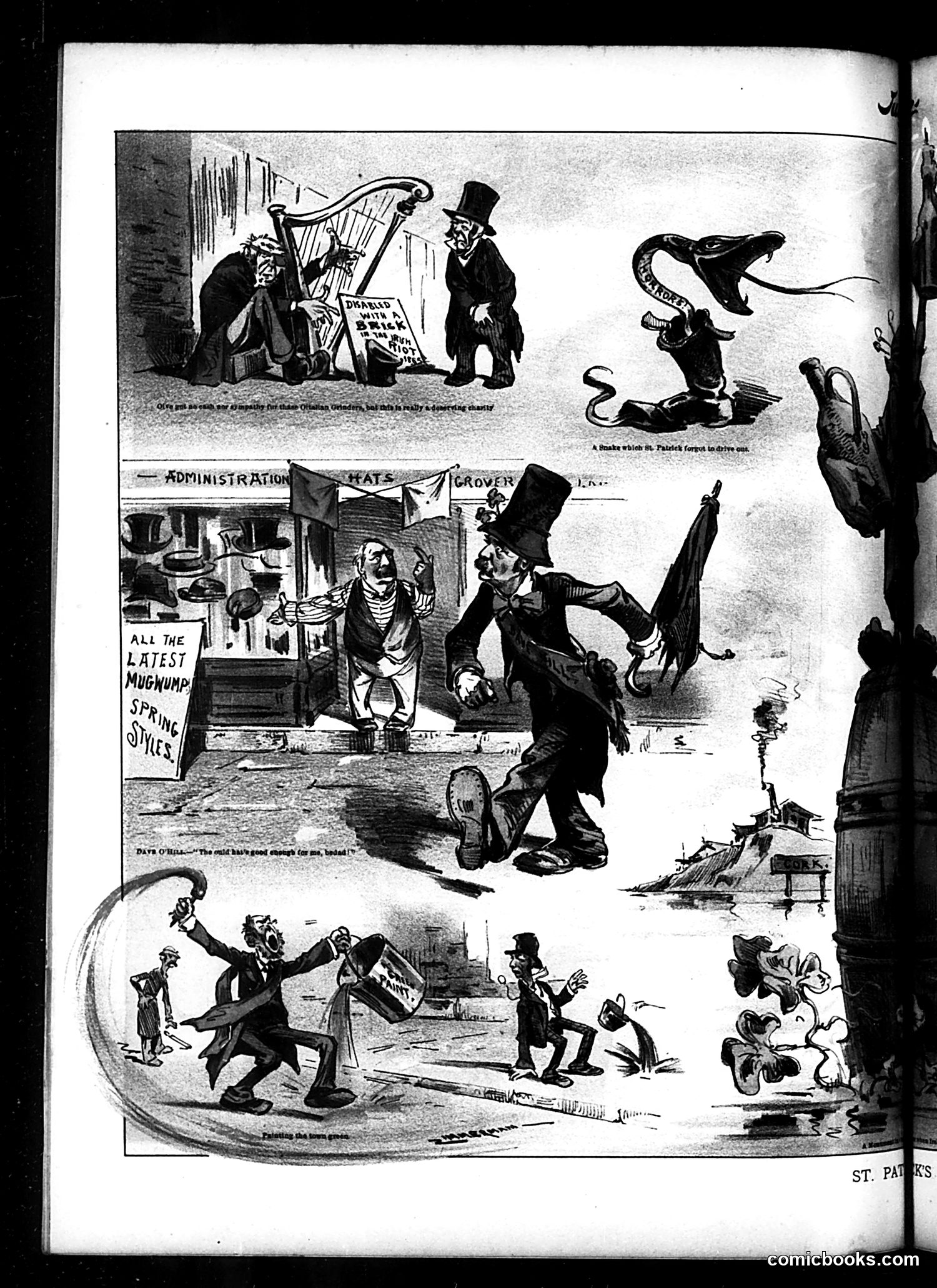
This page contains multiple satirical cartoons mocking American politics and society, likely from the late 19th or early 20th century based on the style and references. The central cartoon shows figures at an "Administration Hats" shop labeled "Grover" (likely President Grover Cleveland), advertising "Latest Mugwump Spring Styles." The "Mugwumps" were Republican defectors who supported Cleveland in 1884—the satire ridicules them as fashion-followers or inconsistent politicians. Other panels employ exaggerated caricature and absurdist humor typical of Judge's satirical approach. One panel references "St. Parks" (visible at page bottom). Without clearer OCR text and specific dates visible, precise identification of all figures and references is difficult. The overall tone mocks political opportunism, inconsistency, and the sometimes-ridiculous nature of partisan politics of the era.
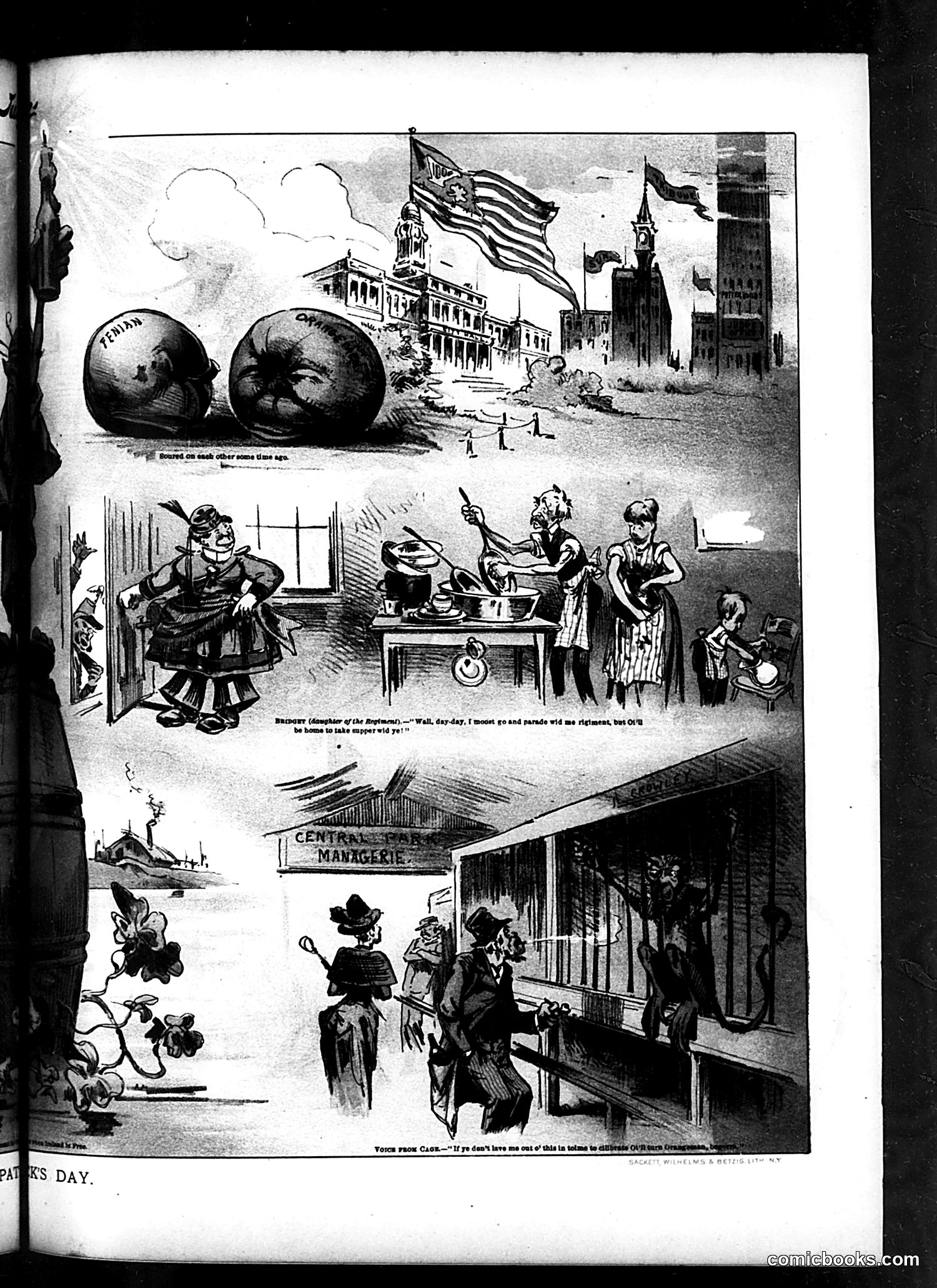
This page contains three political cartoons satirizing American life, likely from the early 1900s. The **top panel** depicts two large spheres labeled "TRUSTS" crushing buildings and American flags—representing monopolistic corporations threatening civic institutions and national ideals. The **middle panel**, titled "Bumpart (Daughter of the Regiment)," shows a woman in military-style dress telling her family she must parade with her regiment but will return for supper. This appears to satirize women's increasing public activism or military involvement while maintaining domestic duties. The **bottom panel** shows people outside a "Central Managerie" (likely a misspelling), suggesting commentary on public spectacles or managed institutions. The overall theme appears critical of corporate power, changing gender roles, and institutional control in American society.
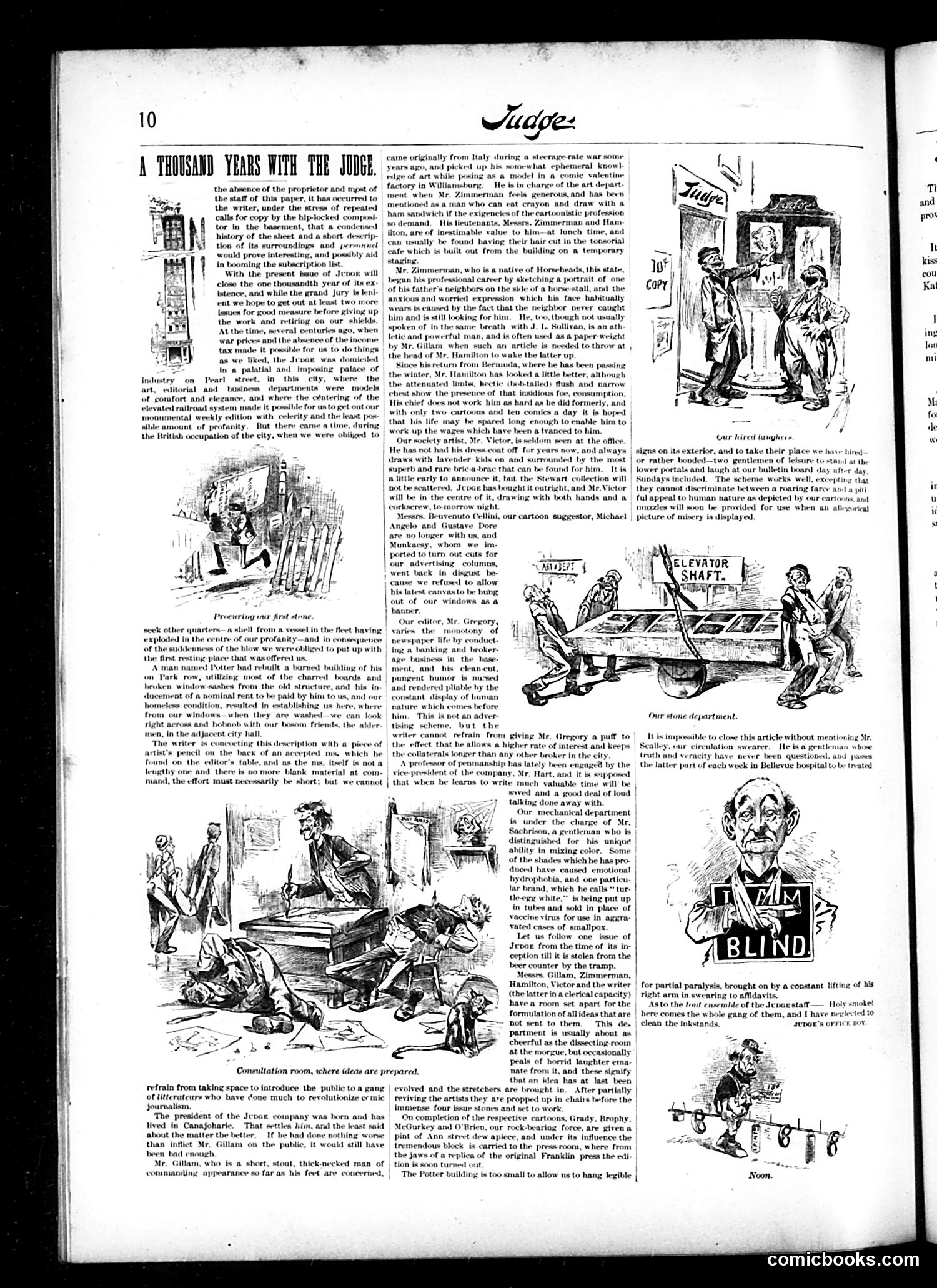
This is a nostalgic retrospective celebrating Judge magazine's longevity and staff. The article traces the publication's history from a "palatial palace of industry" on Pearl Street through various relocations, including displacement during British occupation (likely the Revolutionary War era, though unclear which conflict). The cartoons illustrate the magazine's departments: editorial staff sketching ideas, the composition/printing room, and the "clime department" (likely climate-controlled storage). Character sketches describe the editor Mr. Gregory, artist Mr. Victor (drawn as "Blind"), and other contributors. The tone is self-congratulatory and whimsical, poking gentle fun at staff eccentricities—the editor hasn't changed clothes in years, one artist went to "disgust," another is compared to Old Masters. The piece appears designed to boost reader loyalty by humanizing the magazine as a long-established, quirky institution with colorful personalities—a common magazine marketing technique.
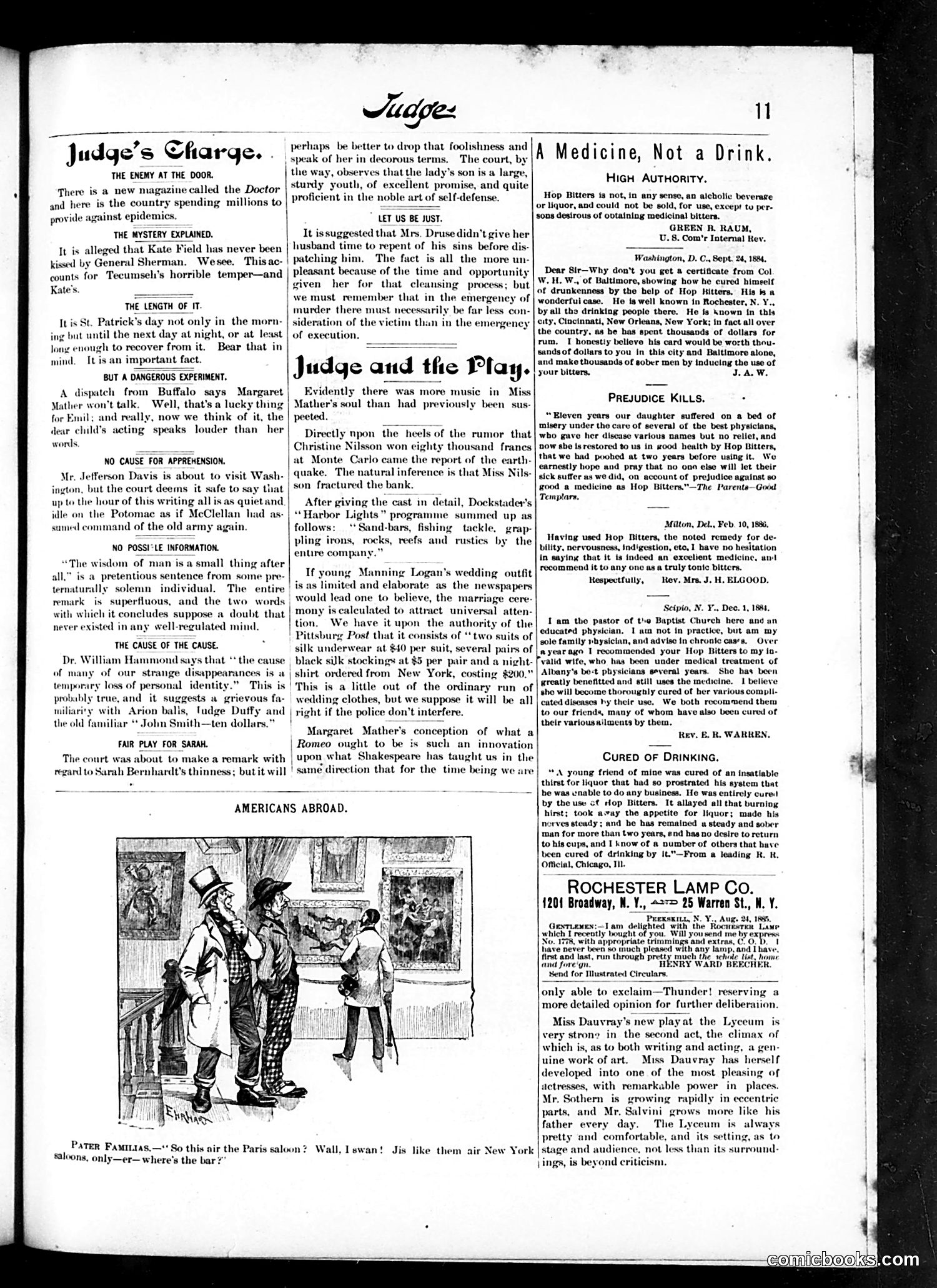
This page contains short satirical pieces and a cartoon typical of Judge magazine's humor. The main cartoon, captioned "Pater Familias," shows American tourists abroad asking about bars, with the joke being that foreigners stereotype Americans as only interested in drinking establishments. The written pieces are brief, punchy commentaries on contemporary scandals and public figures: - References to Kate Field (a real journalist/activist) and General Sherman's rumored non-romantic relationship - Commentary on Margaret Mather (an actress whose personal life apparently fascinated readers) - Jokes about murder cases and questionable court rulings - Theater reviews, particularly about actress Christine Nilsson and a play's elaborate costumes The humor relies on knowing who these now-obscure figures were and what scandals surrounded them. The overall tone is gossipy and irreverent—typical of Judge's satirical approach to American celebrity and social absurdity.
This page is primarily **advertising and notices**, not political satire. The masthead shows "Judge," a satirical magazine, but the content is dominated by commercial advertisements and classified notices typical of late-19th/early-20th century publications. The few humorous items present are mild social jokes: - A quip about Mme. Patti (likely the famous opera singer) avoiding water on her face to prevent wrinkles, sardonically suggesting anarchists have smooth cheeks because they don't wash. - A brief exchange mocking a tramp who claims to be a "lawn sprinkler" rather than a "snow shoveler"—social commentary on working-class pretense. The page's main feature is **"The Judge's Cash Puzzle"** for the Grant Monument Fund—a word-hunt competition where examiners are selecting four winners. This was apparently a genuine fundraising contest, not satire. The rest consists of advertisements for soaps, bonds, medicines, theaters, and hotels—standard period marketing with dubious health claims (consumption cures, phosphites for mental disorders).
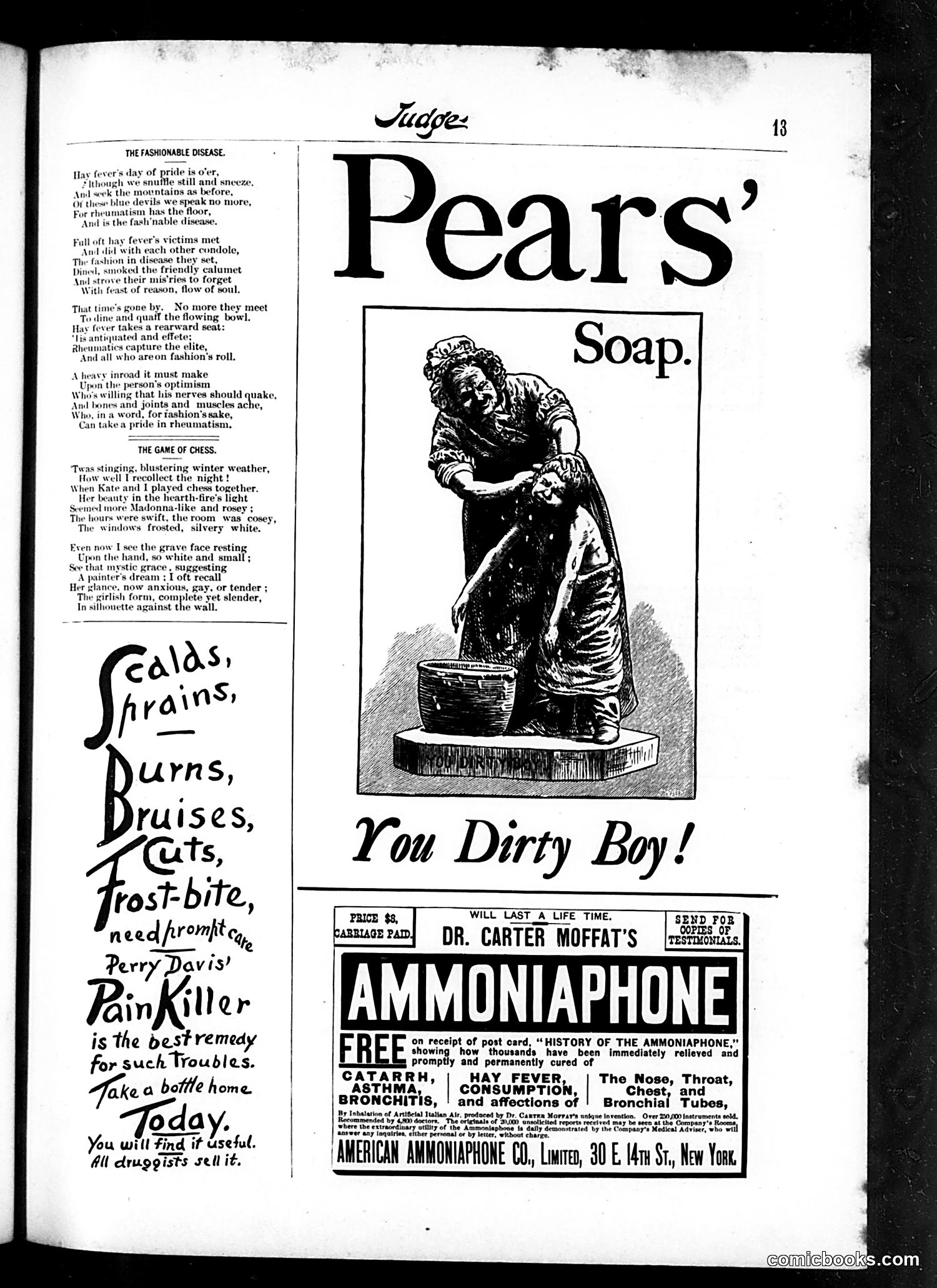
This page satirizes **"fashionable diseases"**—medical conditions that become socially trendy among the wealthy elite. The left column's poem mocks how rheumatism has replaced hay fever as the disease of choice among the fashionable set, suggesting that affluent people adopt illnesses as status symbols and topics of conversation. The main illustration shows a dirty child being told "You Dirty Boy!" in reference to **Pears' Soap**, a commercial product. This appears to contrast sharply with the fashionable disease theme—implying that common people need soap for actual cleanliness, while the rich manufacture imaginary ailments. The advertisements below (Perry Davis' Pain Killer and Dr. Carter Moffat's Ammoniaphore) represent patent medicines claiming to cure these fashionable conditions. The satire suggests these products exploit wealthy hypochondriacs' anxieties about status and health. Overall, Judge ridicules upper-class pretension: manufacturing diseases to maintain social standing while ignoring real hygiene needs.
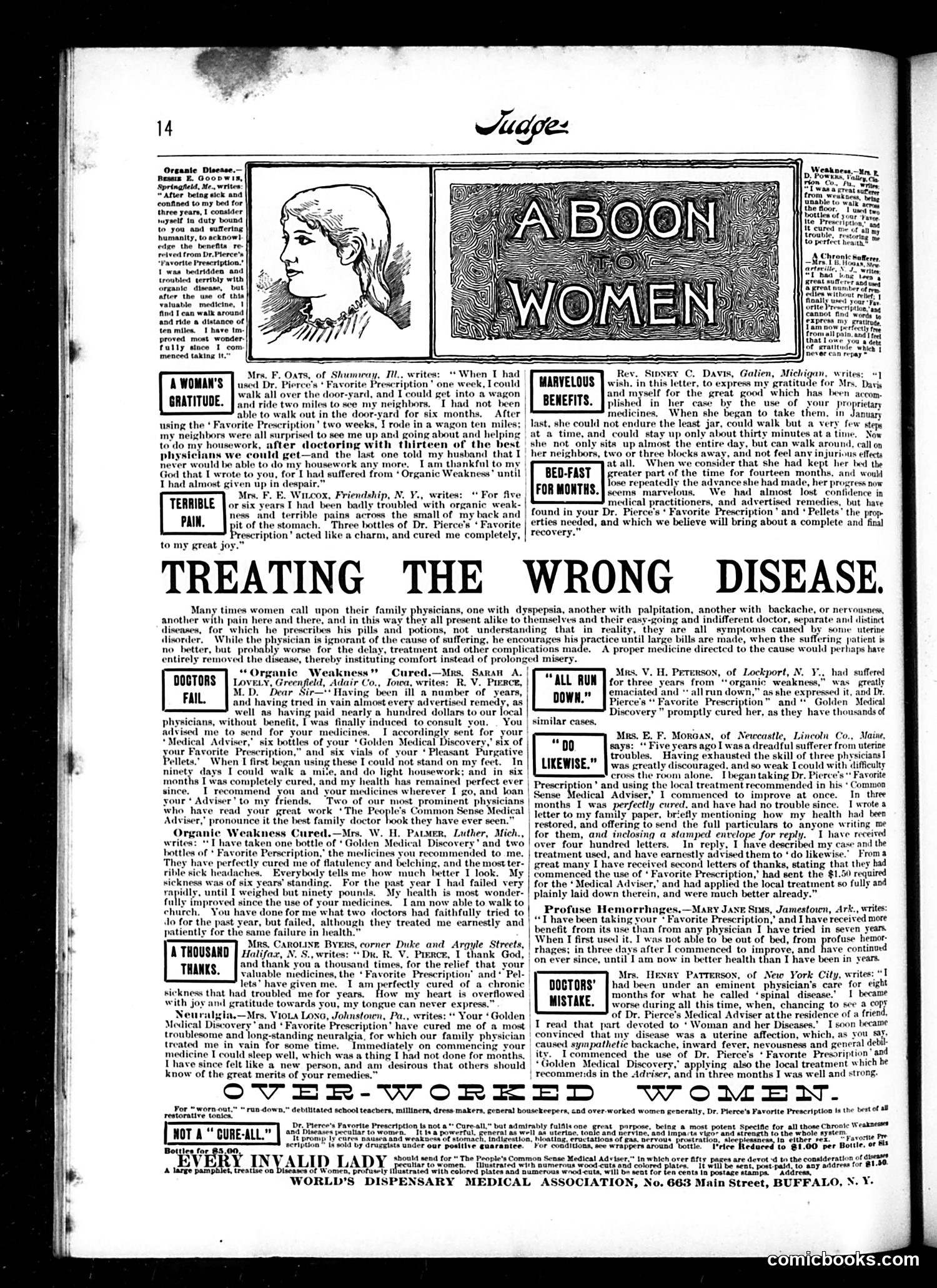
This page is primarily **patent medicine advertising**, not political satire. The dominant content promotes Dr. Pierce's "Favorite Prescription"—a heavily marketed nostrum claiming to cure "organic weakness" and various female ailments. The page features testimonials from women describing ailments (backache, nervousness, inability to walk) allegedly cured by the product. A key section titled "Treating the Wrong Disease" argues that family physicians misdiagnose women's complaints as separate conditions when they're actually symptoms of uterine disorders—only Dr. Pierce's remedy addresses the "real" cause. This reflects late-19th/early-20th-century medical quackery targeting women. The advertisement exploits both genuine suffering and the era's poor understanding of women's health, using emotional testimonials to sell an unregulated patent medicine. Judge's inclusion of such ads was standard for the era, though the magazine also satirized similar medical fraud elsewhere.
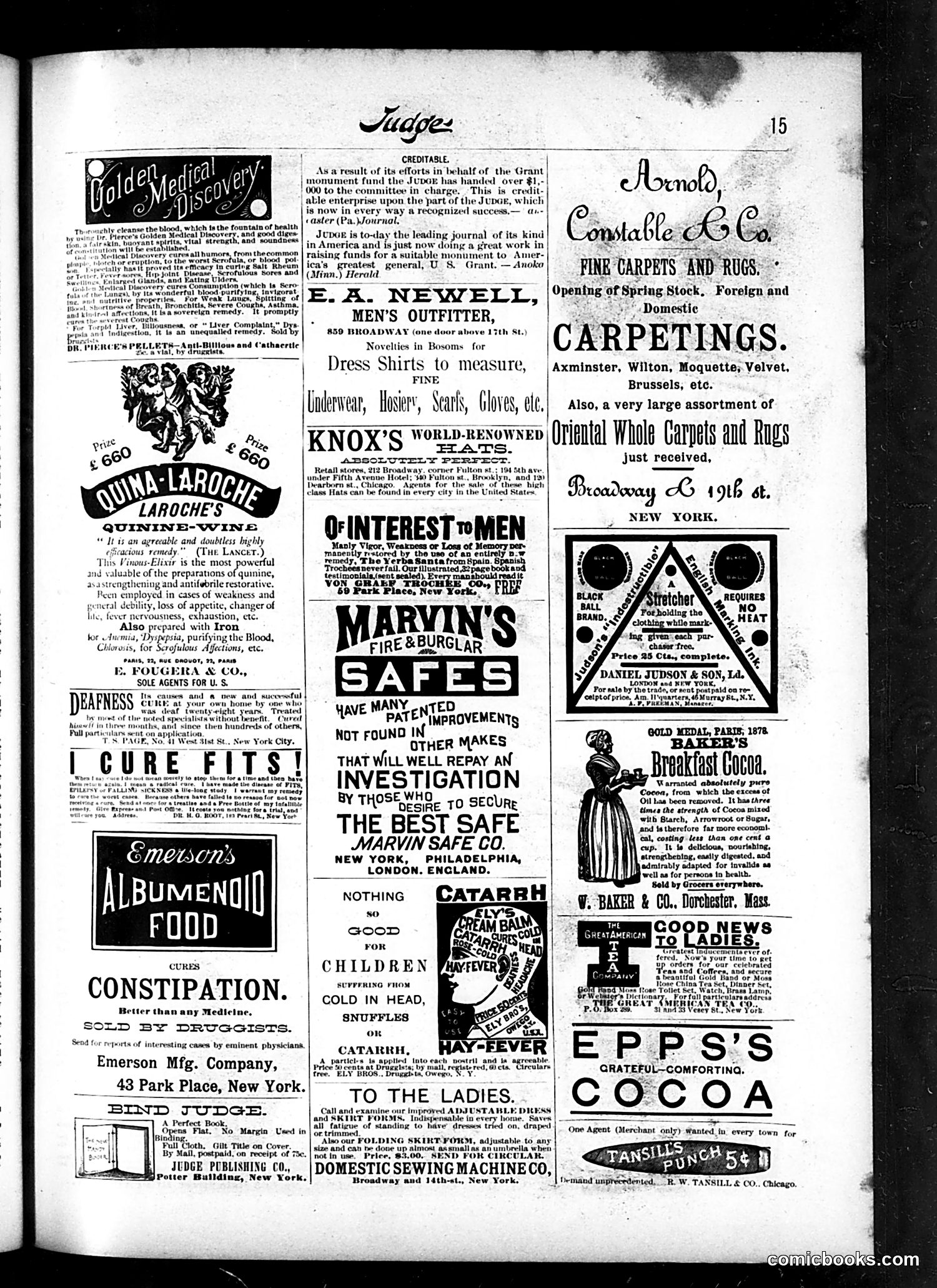
This is primarily an **advertising page** from Judge magazine (circa 1870s-1880s based on styling). While it opens with a brief credit to Judge for fundraising toward a **Grant Monument** (likely the post-Civil War commemoration of General Ulysses S. Grant), the page is dominated by commercial advertisements. The ads reflect period concerns: medical "cure-alls" for constipation, catarrh, deafness, and epilepsy—products now recognized as quackery; patent medicines containing quinine and various tonics; and legitimate goods like carpets, safes, and breakfast cocoa. There are **no visible political cartoons** on this page. The historical interest lies in the advertising itself: it reveals what late-19th-century Americans anxiously sought (remedies for ailments), what they'd purchase (dubious patent medicines), and consumer products available. The page demonstrates Judge's dual purpose: satirical commentary (promised by the masthead) mixed with revenue-generating advertisements—a common magazine model of the era.
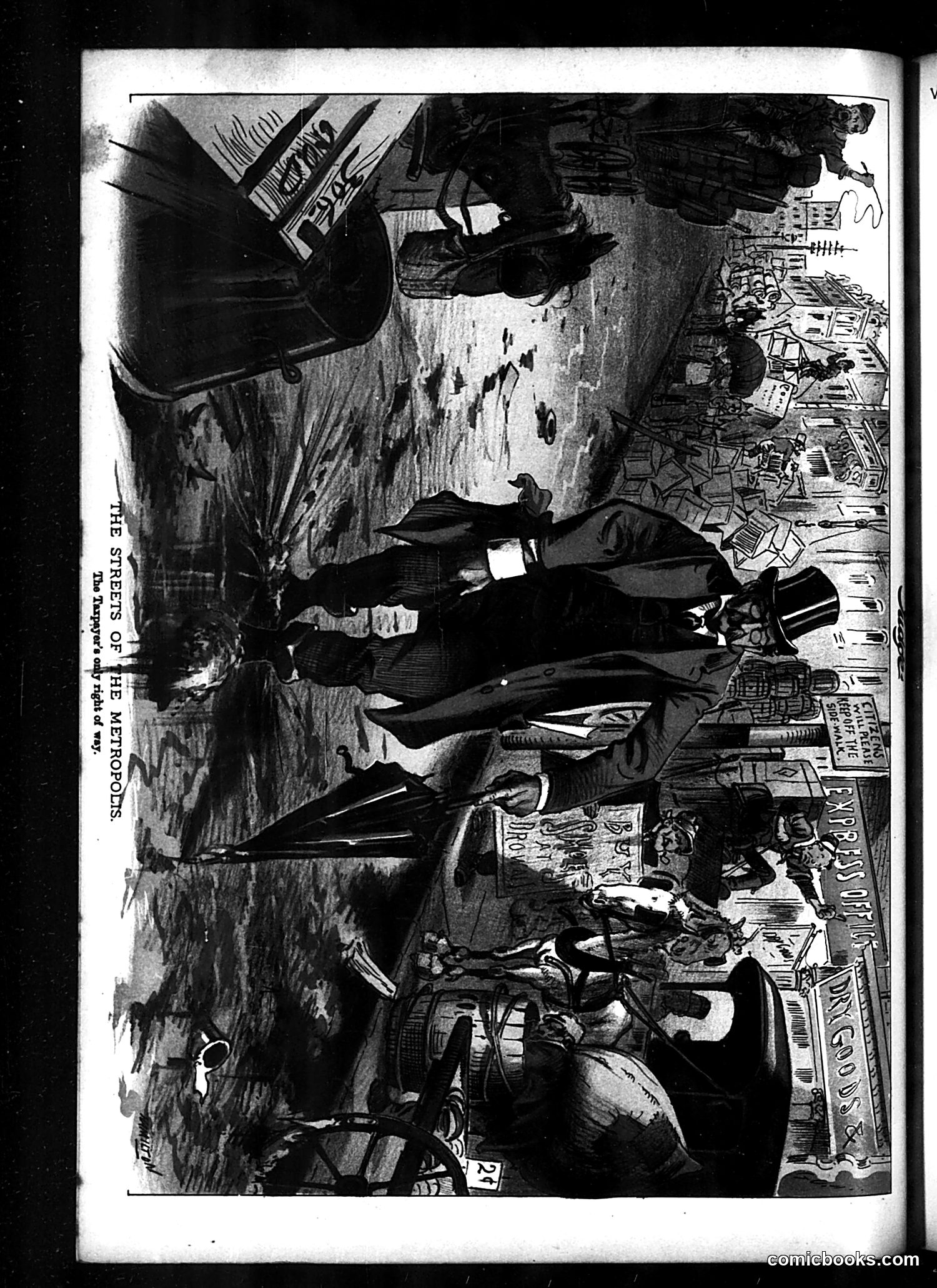
I can see this is a page from *Judge* magazine, but the image is rotated 90 degrees, making it difficult to read clearly. The OCR text provided contains only partial fragments that don't form coherent sentences. From what's visible in the rotated photograph, there appear to be figures in formal dress (possibly top hats) on what looks like a city street with storefronts. The caption on the left margin references "THE STREETS OF THE METROPOLIS," suggesting urban social commentary. However, without being able to reliably read the headlines, captions, or fully decipher the cartoon's specific details and text in this orientation, I cannot accurately identify the figures, date, or political references with confidence. To provide accurate analysis per your guidelines, I would need a properly oriented image with legible text.