
Judge, 1887-03-19 · page 3 of 16
Judge — March 19, 1887 — page 3: what you’re looking at
What you’re looking at
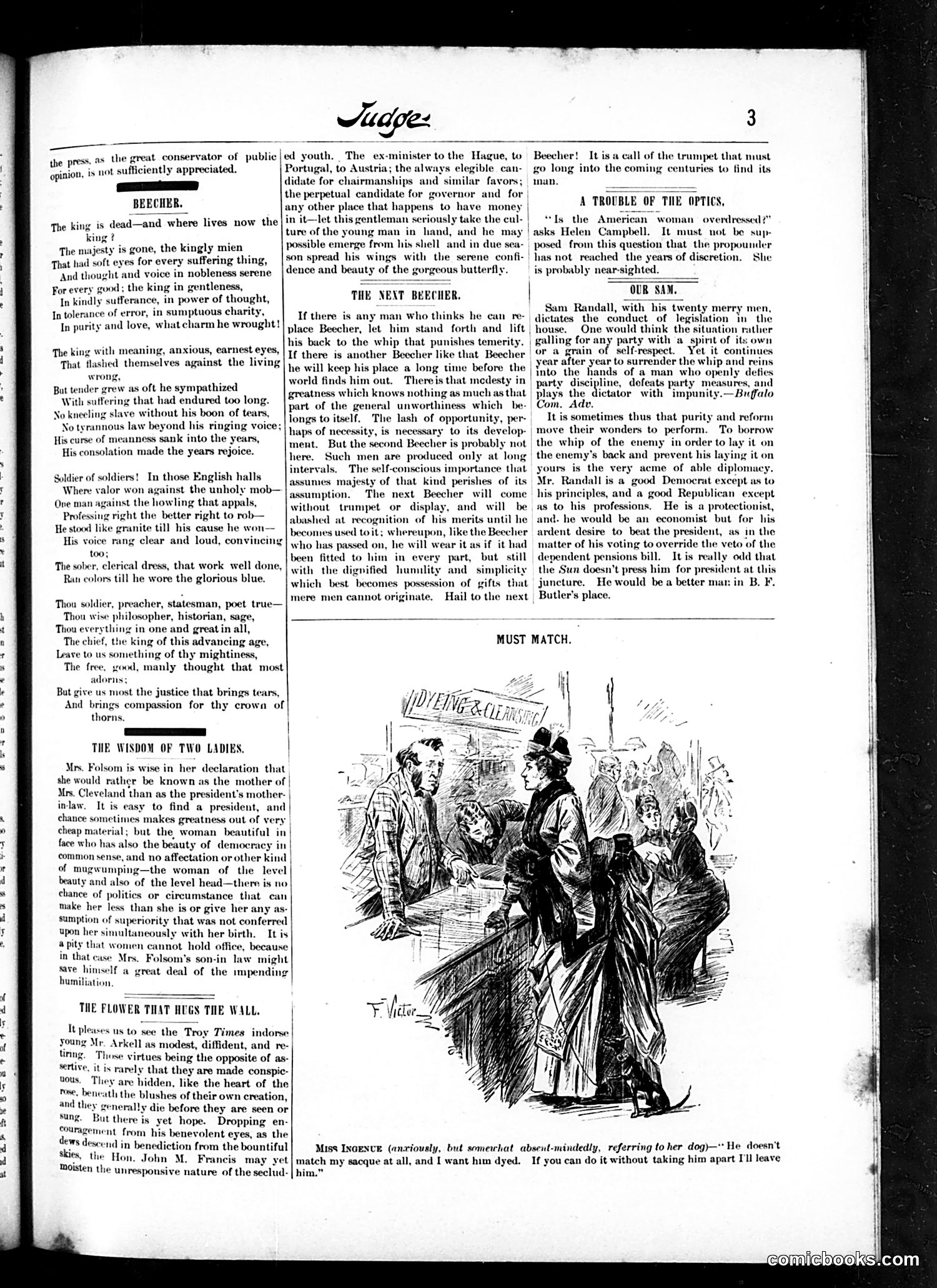
This page is primarily a **tribute to Henry Ward Beecher**, the famous 19th-century preacher who recently died. The lengthy poem praises his moral authority, eloquence, and leadership—describing him as a "king" of justice, compassion, and reform who fought against tyranny and suffering. The accompanying articles discuss Beecher's legacy and irreplaceability. "The Next Beecher" argues that truly great moral leaders cannot simply be replaced or manufactured; such figures emerge only at rare intervals and possess natural humility alongside their gifts. The cartoon titled "**Must Match**" (bottom right) appears to satirize **Miss Innocence**, likely commenting on women's political or social roles—though the specific reference is unclear without more historical context. The page also includes brief commentary on **Mrs. Folsom** (mother of Frances Cleveland, wife of President Grover Cleveland), praising her wisdom in preferring to be known as a mother rather than claiming status through marriage to power. Overall, this is primarily **memorial/editorial content** rather than hard political satire.
📄 Transcribed text from this page (OCR, searchable)
Machine-transcribed from the original scan — historical spelling and the odd misread are preserved.
iape: _ the press, as the great conservator of public spinion, snot suliciently appreciated, — BEECHER. The king is dead—and where lives now the king ? The majesty is gone, the kingly mien That had soft eyes for every suffering thing, ‘And thought and voice in nobleness serene For every good; the king in gentleness, In kindly sufferance, in power of thought, In tolerance of error, in sumptuous charity, In purity and love, what charm he wrought! The king with meaning, anxious, earnest eyes, That flashed themselves against the living wrong, But tender grew as oft he sympathized With suffering that had endured too long. No kneeling slave without his boon of tears, No tyrannous law beyond his ringing voice; His curse of meanness sank into the years, His consolation made the years rejoice. Soldier of soldiers! In those English halls Where valor won against the unholy mob— One man against the howling that appals, Professing right the better right to rob— He stood like granite till his cause he won His voice rang clear and loud, convincing too; The sober, clerical dress, that work well done, Ran colors till he wore the glorious blue. Thou soldier, preacher, statesman, poet true— Thou wise philosopher, historian, sage, Thou everything in one and great in all, The chief, the king of this advancing age, Leave to us something of thy mightiness, The free, ood, manly thought that most adorns; But give us most the justice that brings tears, And brings compassion for thy crowa of thorns. i 3 ed youth, The ex-minister to the Hague, to Portugal, to Austria; the always elegible can- didate for chairmanships and similar favors; the perpetual candidate for governor and for any other place that happens to have money in it—let this gentleman seriously take the cul- ture of the young man in hand, and he may | possible emerge from his shell and in due sea- son spread his wings with the serene confi- dence and beauty of the gorgeous butterfly. THE NEXT BEECHER. If there is any man who thinks he can re- place Beecher, let him stand forth and lift his back to the whip that punishes temerity. If there is another Beecher like that Beecher he will keep his place a long time before the world finds him out. Thereis that medesty in greatness which knows nothing as much as that part of the general unworthiness which be- longs to itself. The lash of opportunity, per- haps of necessity, is necessary to its develop: ment. But the second Beecher is probably not here. Such men are produced only at long intervals. The self-conscious importance that assumes majesty of that kind perishes of its sumption. The next Beecher will come without trumpet or disp! and will be abashed at recognition of his merits until he becomes used to it; whereupon, like the Beecher who has passed on, he will wear it as if it had been fitted to him in every part, but. still with the dignified hunulity and simplicity which best becomes possession of gifts that mere men cannot originate. Hail to the next —a THE WISDOM OF TWO LADIES. Mrs. Folsom is wise in her declaration that she would rather be known as the mother of | Mrs. Cleveland than as the president's mother- | inlaw. It is easy to find a president, and | chance sometimes makes greatness out of very cheap material; but the, woman beautiful in | face who has also the beauty of pracy i common sense, and no affectation or other kind | of mugwumping—the woman of the level beauty and also of the level head—there is no chance of politics or circumstance that can make her less than she is or give her any as- sumption of superiority that was not conferred upon her simultaneously with her birth. It is 4pity that women cannot hold office, because in that case Mrs. Folsom’s son-in law might sive himself a great deal of the impending humiliation THE FLOWER THAT HUGS THE WALL. | sus to see the Troy Times indorse Mr. Arkell as modest, diffident, and re- Those virtues being the opposite of as- itis rarely that they are made conspic- They are hidden, like the heart of the “uth the blushes of their own creation, and they generally die before they are seen or Sung. But there is yet hope. Dropping en- ut from his benevolent eyes, as the qr deseend in benediction from the bountiful rag Hon. John M. Francis may yet oisten the unresponsive nature of the seclud- him.” Beecher! It is a call of the trumpet that must go long into the coming centuries to find its man. A TROUBLE OF THE OPTICS, “Is the American woman overdressed?” asks Helen Campbell. It must not be sup posed from this question that the propounder has not hed the years of discretic She is probably near-sighted. m Randall, with his twenty merry men, tates the conduct of legisl: in tl house. One would think the ny rather galling for sey party with a spirit of its own or a grain of self-respect. Yet it continues year after year to surrender the whip and reins into the hands of a man who openly defies party discipline, defeats party plays the dictator with Com. Adv. It is sometimes thus that purity and reform move their wonders to perform. To borrow the whip of the enemy in order to lay it on the very acme of able diplomacy. all is a good Democrat except as to ciples, and a good Republican except as to his professions. He is a protectionist, and. he would be an economist but for his ardent desire to beat the president, as in the matter of his voting to override the veto of the dependent pensions bill. It is really odd that the Sun doesn’t press him for president at this juncture. He would be a better mar in B. F. Butler's place. Miss INGENUE (anxiously, but somewhat abseut-mindedly, referring to her dog)—"* He doesn't match my sacque at all, and I want him dyed. If you can do it without taking him apart I'll leave