
A complete issue · 16 pages · 1887
Judge — February 26, 1887
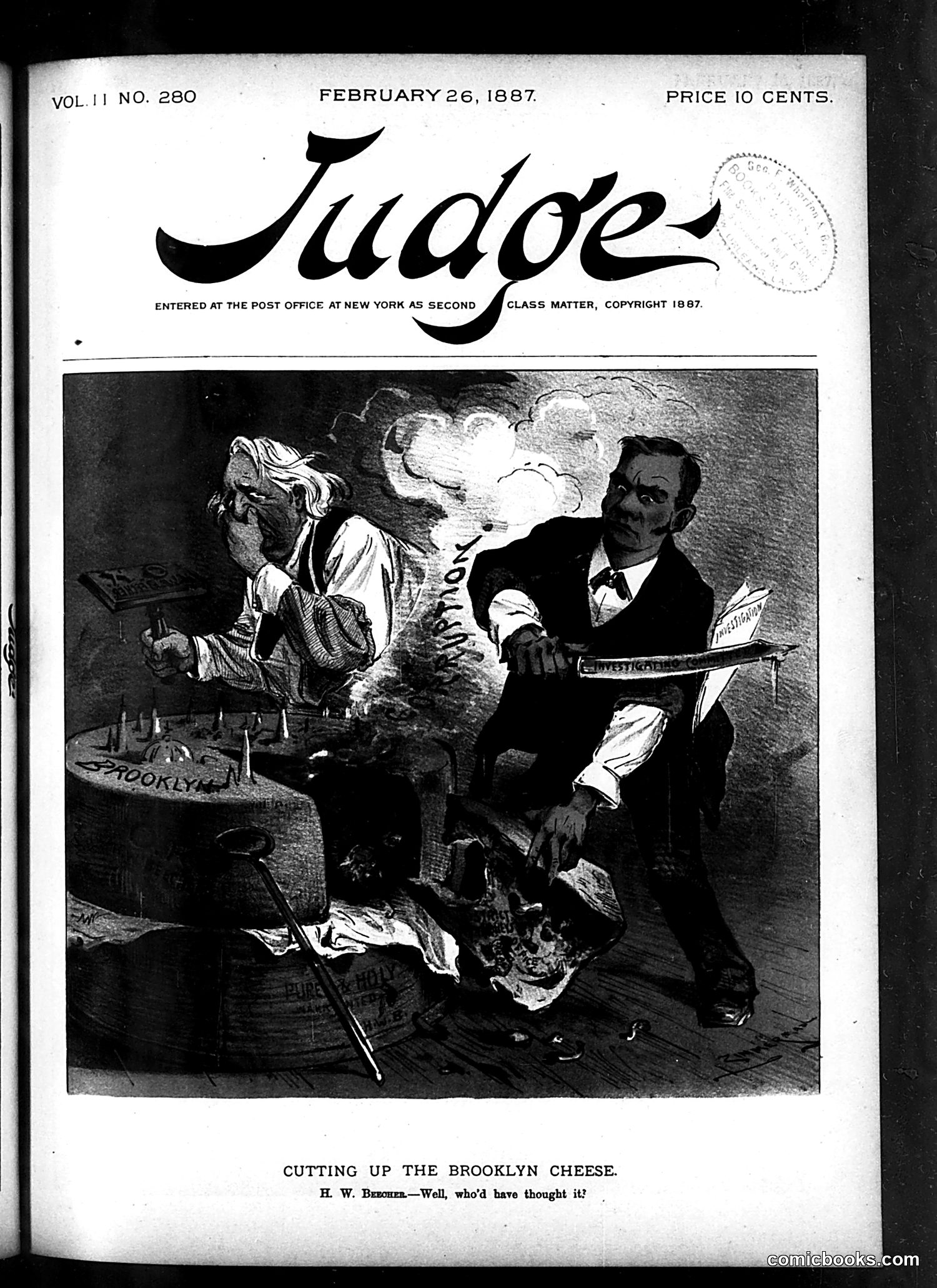
This **Judge** cartoon from February 26, 1887 uses the metaphor of carving cheese to satirize political division over Brooklyn. The figure on the left labeled "BROOKLYN" appears as a large wheel of cheese, while a well-dressed man on the right (identified as "H. W. Beecher" in the caption) wields a knife to cut it up. The joke plays on a contemporary political dispute: Brooklyn's potential annexation or division. Beecher's caption—"Well, who'd have thought it?"—suggests ironic surprise at the prospect of fragmenting Brooklyn. The caricatured figure and the "cheese" metaphor mock the political maneuvering and self-interest involved in Brooklyn's governance debates of the 1880s.
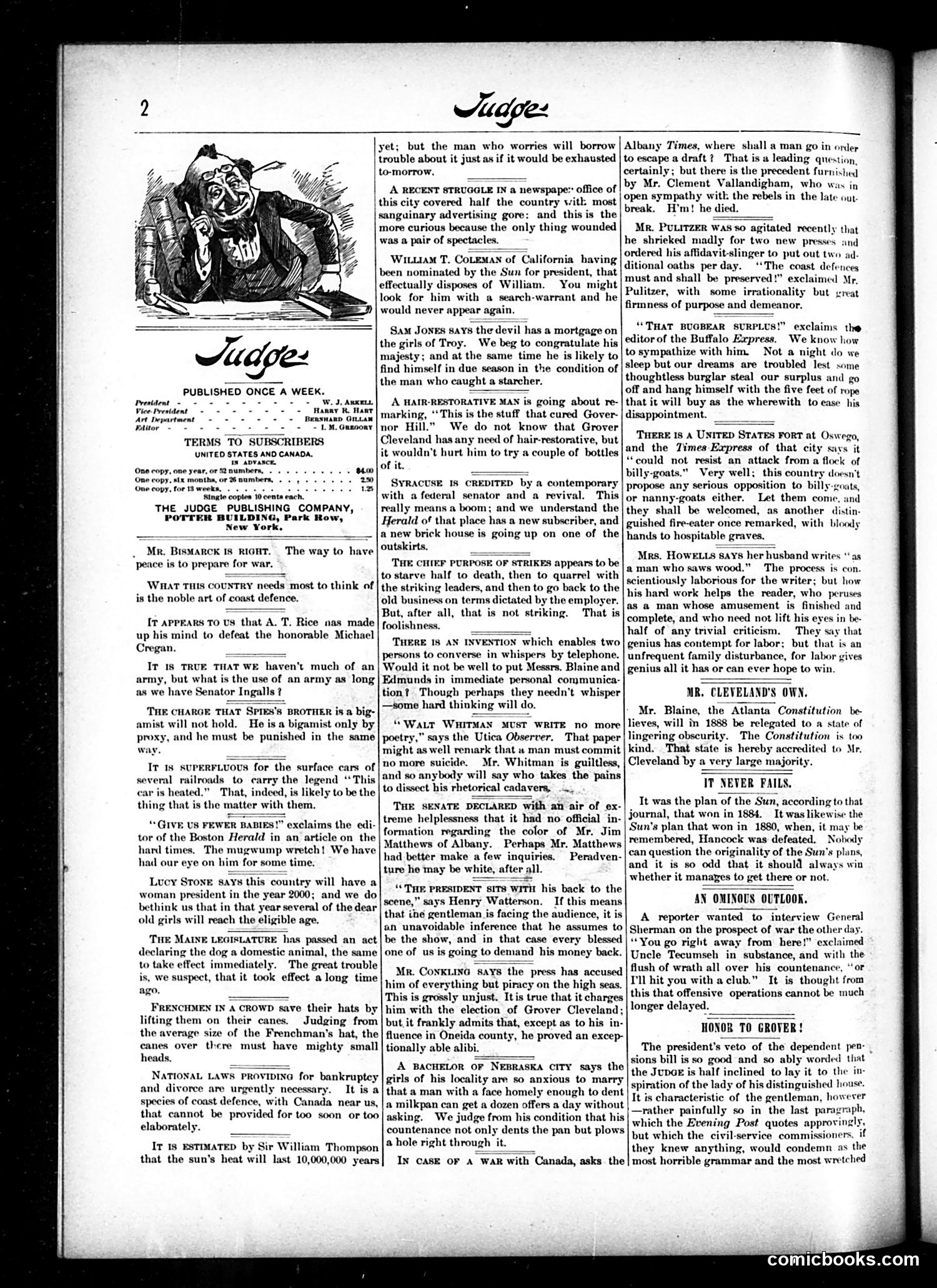
This page contains a large cartoon at the top left and multiple brief satirical commentary pieces. The cartoon depicts a figure in distress, though the specific identity isn't entirely clear from the image alone. The text sections mock various contemporary issues: a newspaper office struggling financially; William T. Coleman of California and the *San Francisco Sun*; property mortgages in Troy; hair-restoration products; and strikes' destructive effects. There's commentary on Syracuse's brick industry and a U.S. fort at Oswego. The satire targets common late-19th-century concerns: failing businesses, dubious medical products, labor unrest, and military preparedness. The tone is characteristically *Judge*—acerbic political and social criticism aimed at readers familiar with current events, politicians, and commercial scandals of the period.
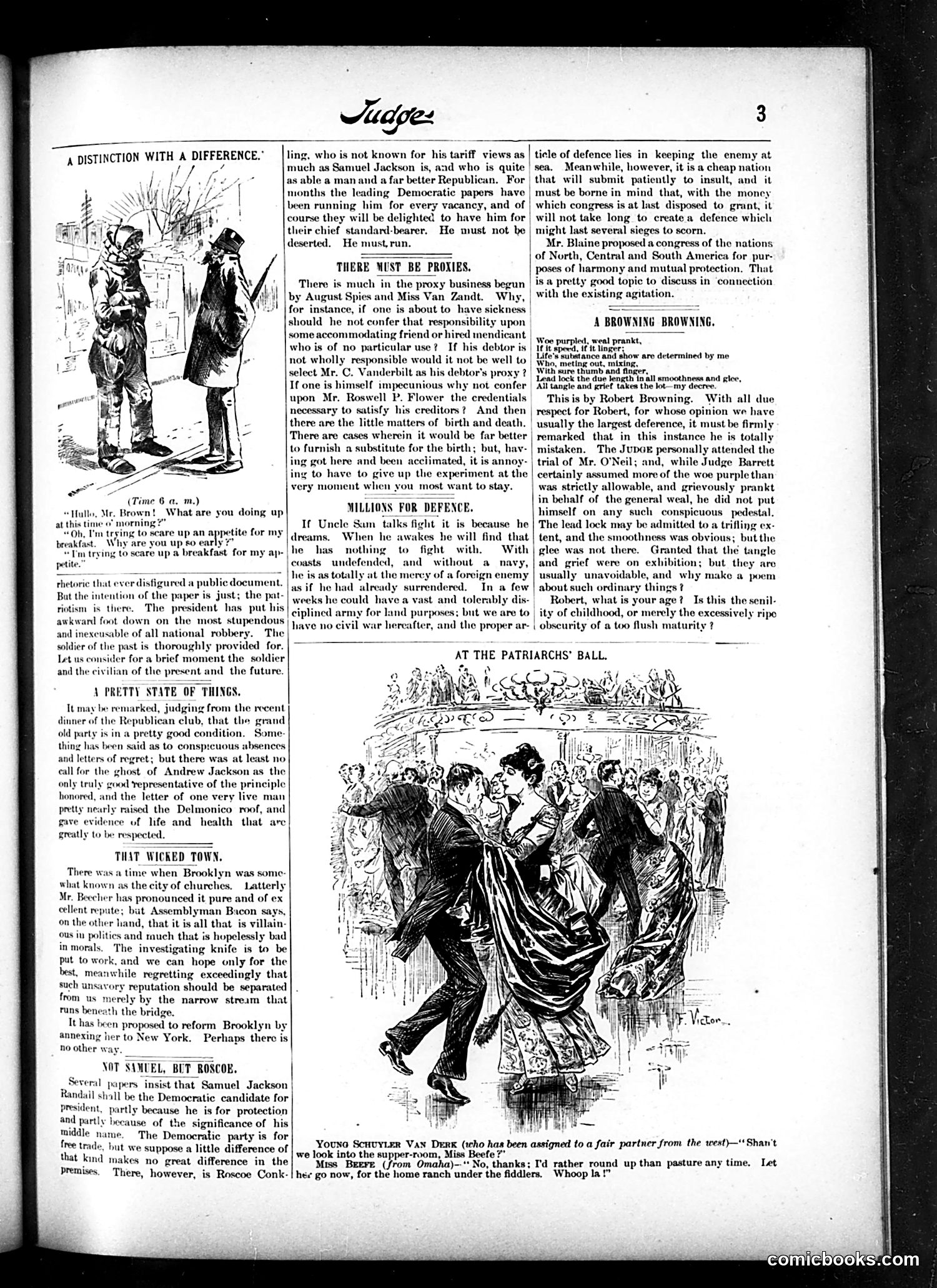
This page contains several political commentaries typical of 1880s-90s satirical journalism: **"A Distinction with a Difference"** (top cartoon): A dialogue joke about someone claiming to wake early for "breakfast" when actually seeking a job—satirizing employment desperation or job-seeking pretense. **"That Wicked Town"**: Critiques Brooklyn's moral reputation, referencing Assemblyman Bacon's charges of corruption versus Henry Ward Beecher's defense. It jokes about annexing Brooklyn to New York as "reform." **"Not Samuel, but Roscoe"**: Argues Samuel Randall shouldn't be the Democratic presidential candidate merely for his middle name's significance, preferring another candidate instead. **"At the Patriarchs' Ball"** (bottom illustration): A society scene satirizing wealthy elite behavior, with the caption suggesting pretentious social climbing among the wealthy. **"Millions for Defence"**: Criticizes inadequate military preparedness, arguing the U.S. lacks naval defense despite national wealth. The page exemplifies Judge's role lampooning politics, society, and civic institutions through cartoons and commentary.
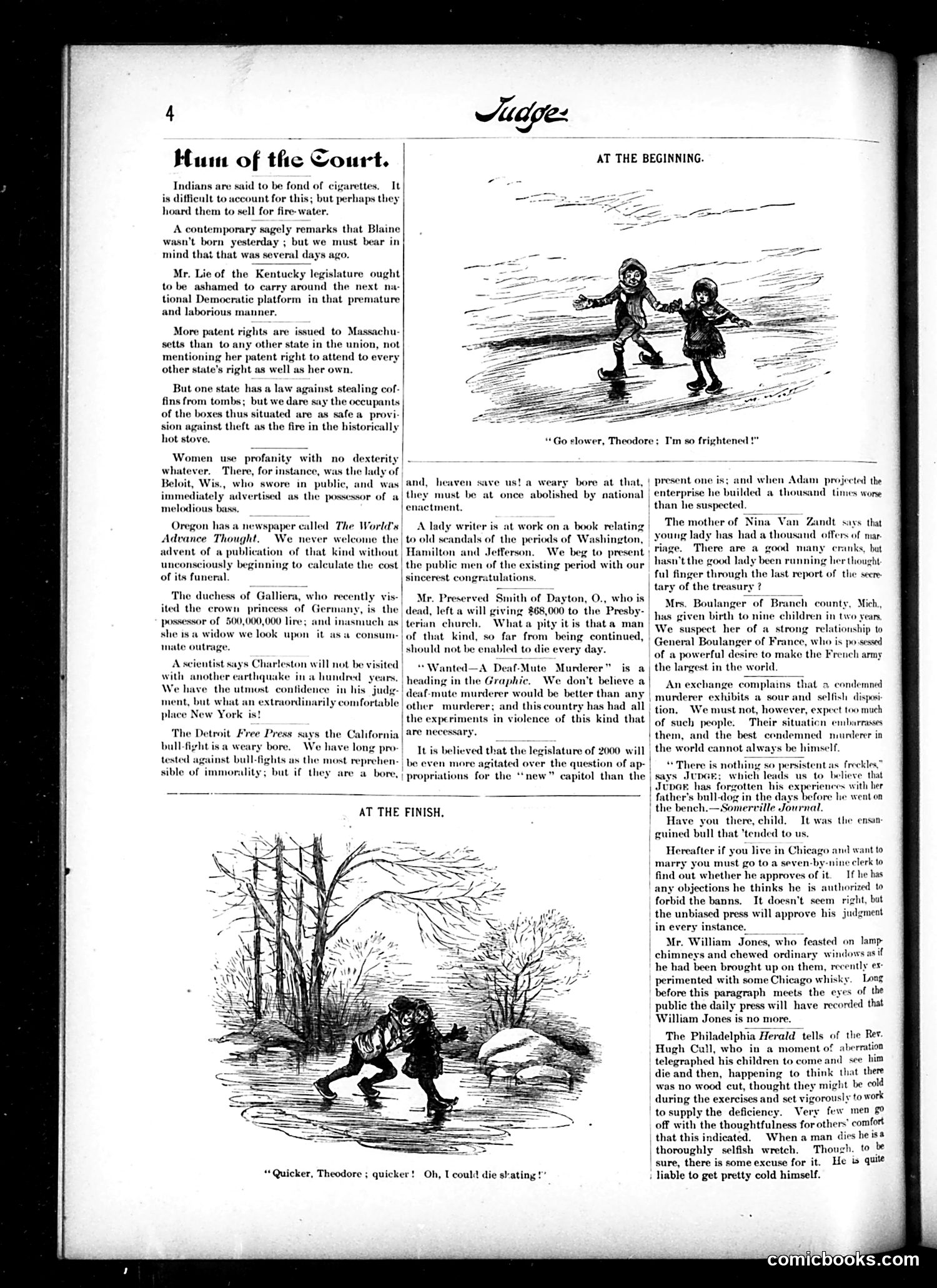
This page from *Judge* magazine contains satirical commentary on contemporary issues and figures, primarily through short editorial quips rather than integrated political cartoons. **Key targets:** - **James G. Blaine** (Kentucky legislator): mocked for being aged ("wasn't born yesterday") - **Democratic platform**: ridiculed as cumbersome - **Massachusetts**: satirized for patent arrogance - **Women's profanity**: a lady from Beloit, Wisconsin is criticized for swearing publicly - **Nina Van Zandt**: a young woman receiving numerous marriage proposals, likely related to contemporary scandal **The two illustration captions** employ dark humor: children skating with dialogue suggesting danger ("I'm so frightened!"), and a figure in water pleading for speed while drowning ("I could die skating!"). The overall tone is acerbic commentary on politics, social behavior, and news items of the era. Without specific date information visible, the precise events referenced remain unclear, though the magazine's satirical mission—mocking public figures and social foibles—is evident throughout.
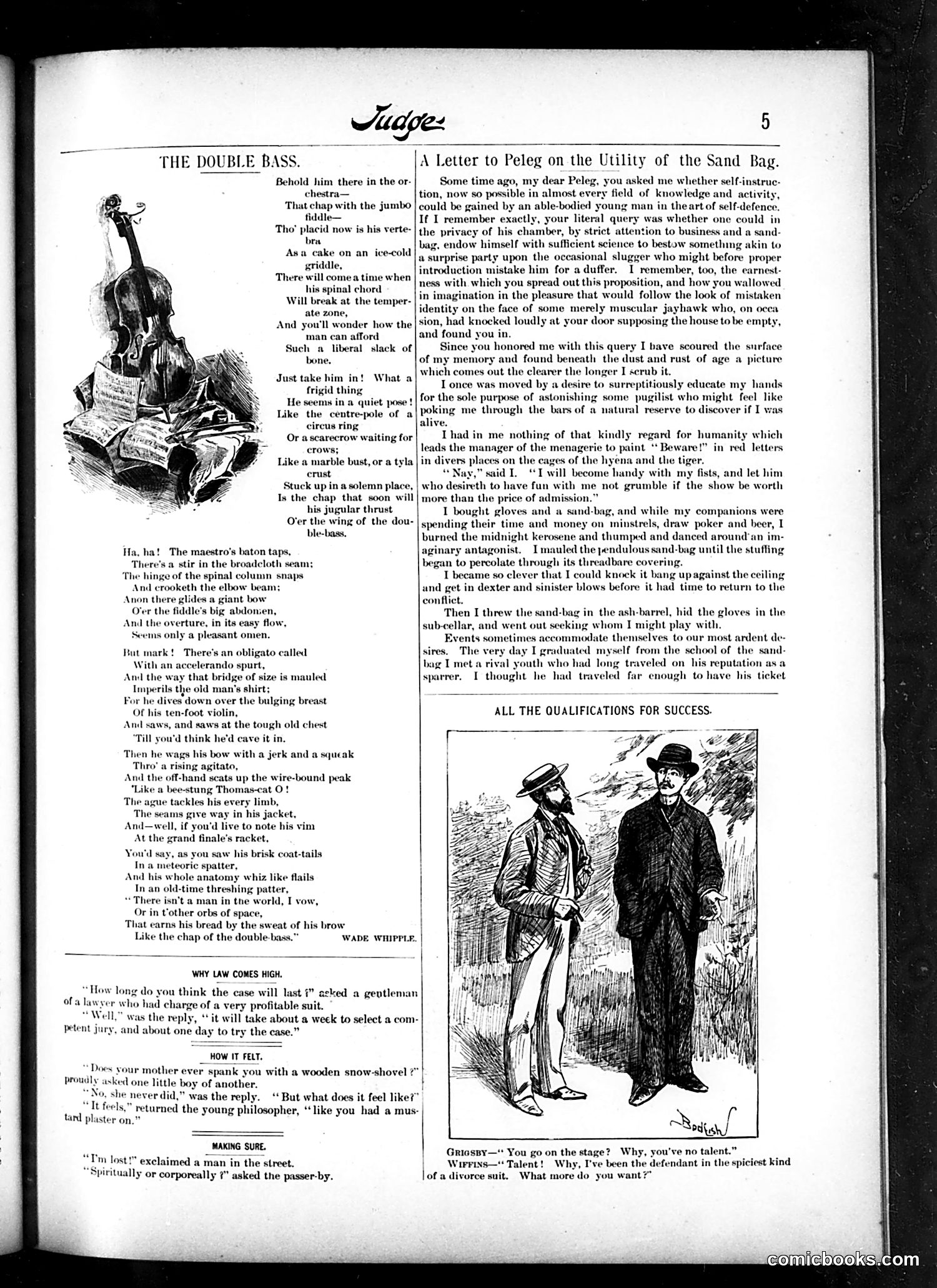
This page contains satirical humor typical of early 20th-century Judge magazine. **"The Double Bass"** (left column): A humorous poem mocking orchestral musicians, specifically double bass players. The satire targets the physical contortions required to play the instrument—the player must bend and strain his body dramatically over the massive fiddle. The poem exaggerates this into a comic image of a man contorting himself so severely that his "spinal chord will break." It's gentle workplace humor about occupational hazards of musicians. **The cartoon** (center-right): Titled "All the Qualifications for Success," it depicts two men in conversation. The caption suggests one is being told he lacks talent for stage work but would be suited for divorce law—implying divorce cases are less about skill and more about opportunistic business. This satirizes the legal profession's reputation for profiting from personal misery. **Short humor pieces** ("Why Law Comes High," "How It Felt," "Making Sure"): These are brief joke items poking fun at lawyers' fees, childhood punishments, and parental oversight—standard vaudeville-style humor of the era. The page demonstrates Judge's mix of literary satire, visual cartooning, and quick jokes targeting professional classes and social institutions.
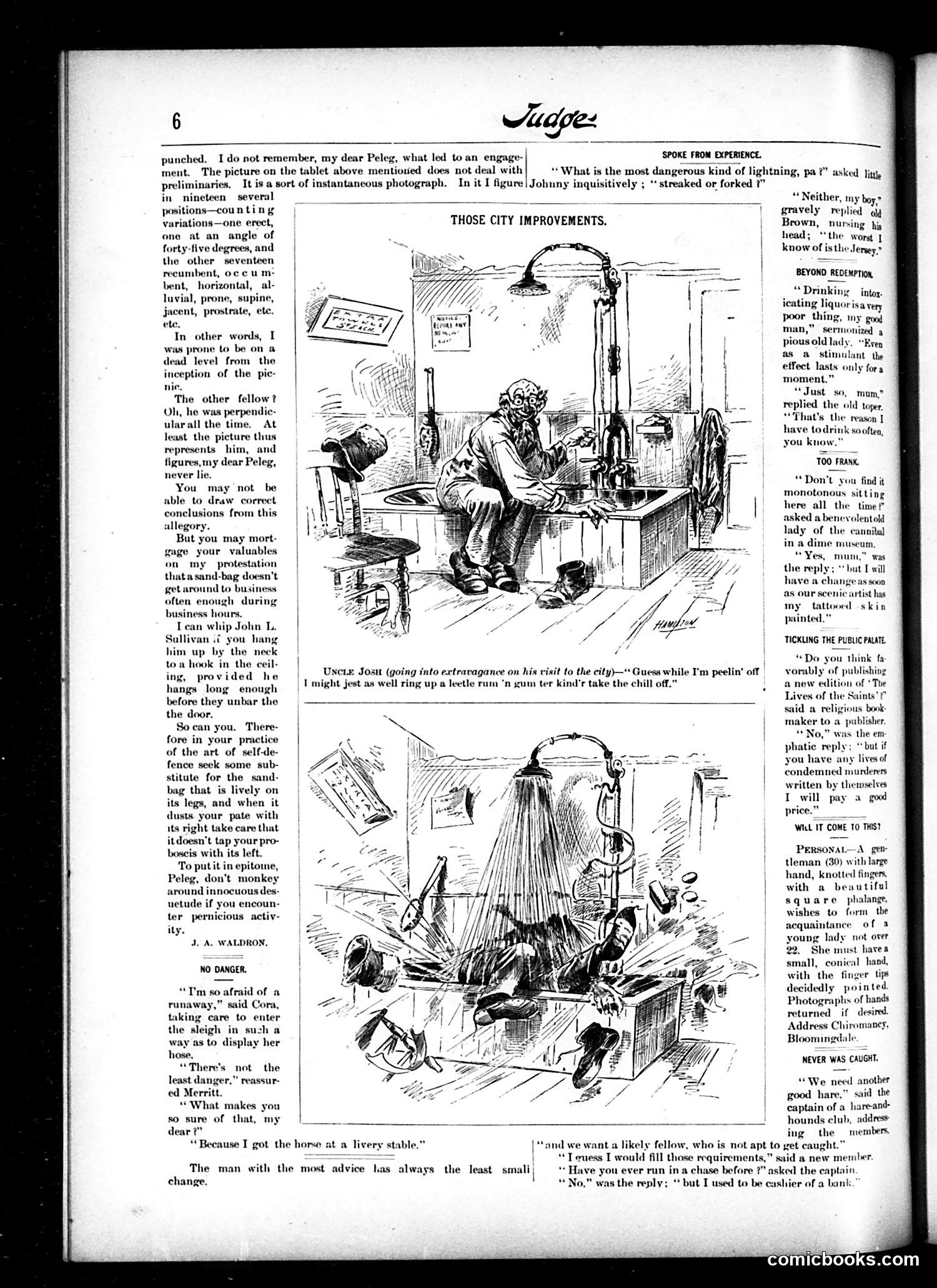
This page contains multiple satirical sections typical of Judge magazine's format: **"Those City Improvements"** (top cartoon): Shows a man in an urban setting surrounded by pipes and infrastructure. The caption suggests city construction/utilities are creating chaos—likely mocking poorly-executed municipal projects common in late 19th/early 20th-century American cities. **"Spoke from Experience"** (right column): A dialogue joke where "Old Brown" says the worst lightning is "the Jersey"—a regional insult suggesting New Jersey's dangers or undesirability. **"Beyond Redemption"** and other brief jokes: These are short quips about drinking, museum exhibits, and courtship—typical period humor targeting immigrants, the poor, and social stereotypes. **"Personal" advertisement (bottom right)**: A humorous matrimonial ad seeking a woman with specific hand features—satirizing the era's pseudoscientific belief in palmistry/phrenology. The overall page mixes political-social commentary with period-appropriate jokes about urban life, regional prejudice, and pseudo-science, reflecting Judge's satirical take on contemporary American society.
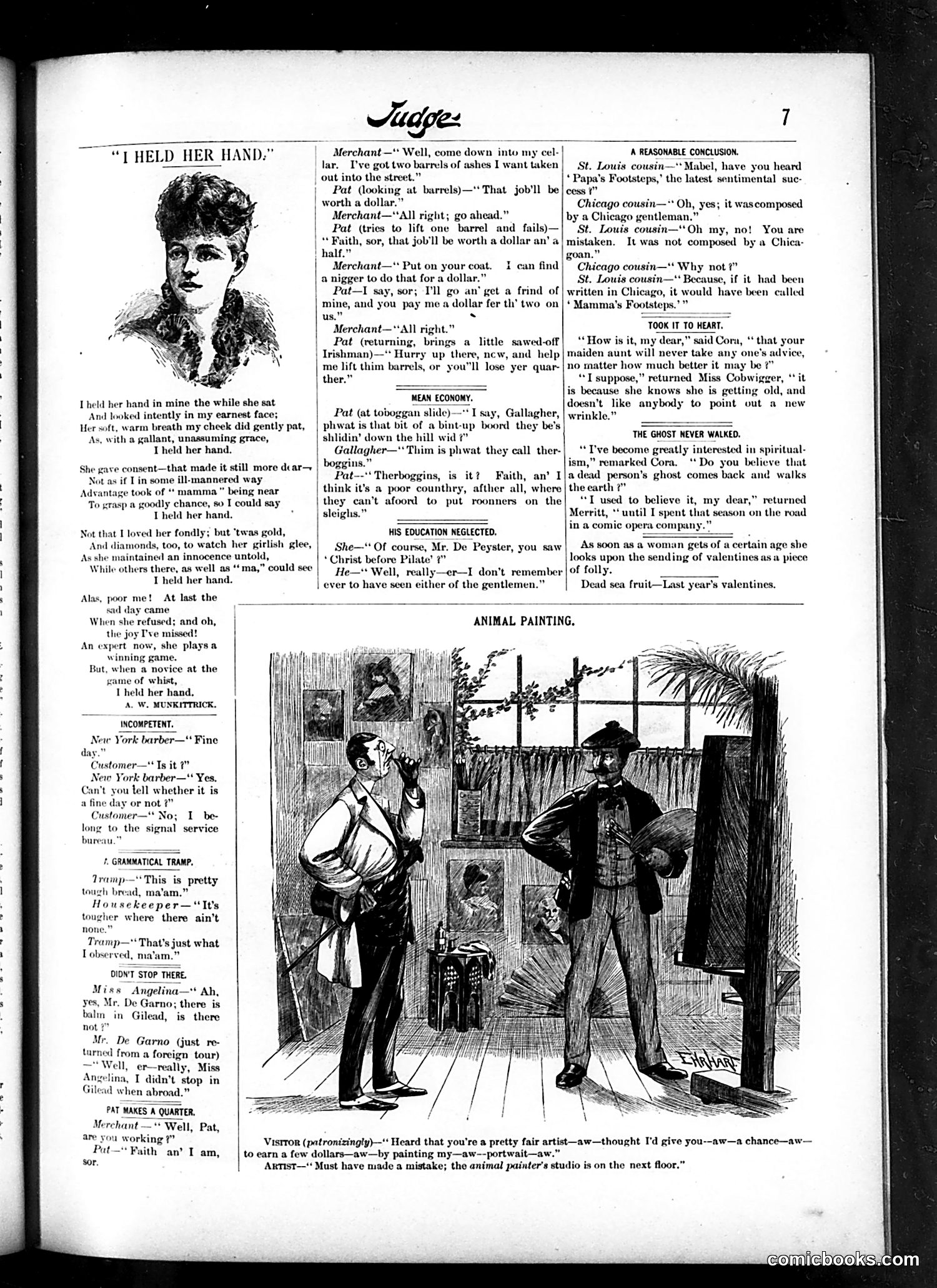
This page contains multiple short satirical pieces typical of Judge's humor: **"I Held Her Hand"** is a sentimental poem mocking romantic poetry—the narrator claims to have held a woman's hand, but reveals his actual motivation was financial gain and social status, not genuine affection. **Irish labor jokes** ("Mean Economy," "A Poor Country") rely on period stereotypes, depicting Irish workers (Pat, Gallagher) as simple-minded and economical to the point of absurdity. **"Animal Painting"** cartoon shows a visitor to an artist's studio, misunderstanding the term "animal painter"—likely expecting portraits of animals but finding the artist paints human subjects, playing on the double meaning. The remaining brief jokes mock courtship customs, spiritualism fads, women aging, theatrical life, and regional American differences (Chicago vs. St. Louis attitudes). The humor is gentle, domestic, and relies on wordplay and social observation rather than political commentary. This represents typical Judge fare: middle-class American life gently ridiculed.
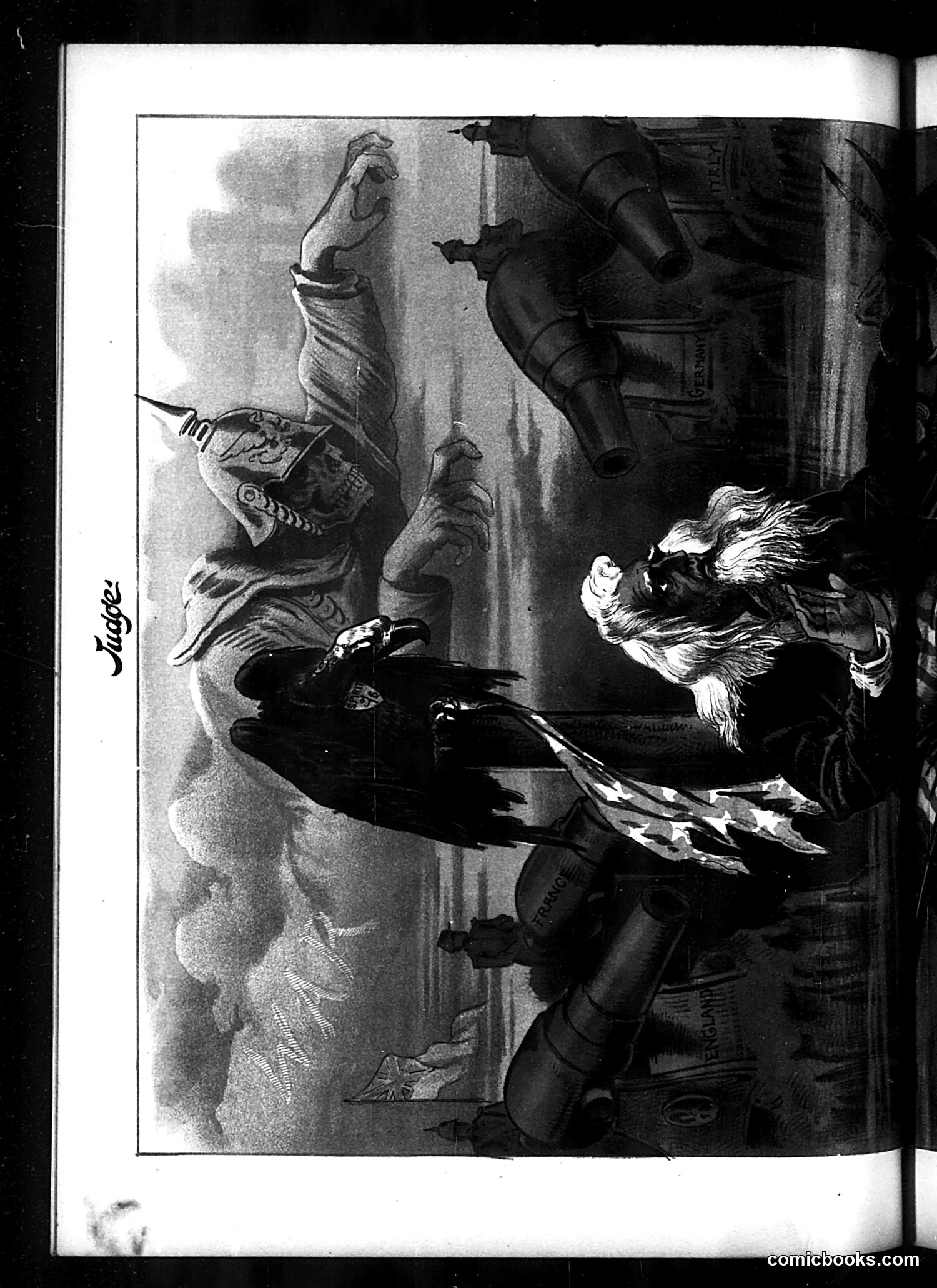
I can see this is a black and white illustration from *Judge* magazine, but the image quality and orientation make it difficult to read clearly. The page appears to show a figure in period military dress (possibly 18th or 19th century based on the uniform style) in what seems to be a dramatic or satirical scene. However, without being able to reliably identify the specific individuals depicted, the political context being referenced, or read any accompanying caption text clearly, I cannot accurately explain what this cartoon satirizes or who it represents. To provide an accurate historical interpretation, I would need either a clearer image or visible text identifying the figures and context. I apologize that I cannot be more specific without risking inaccuracy.
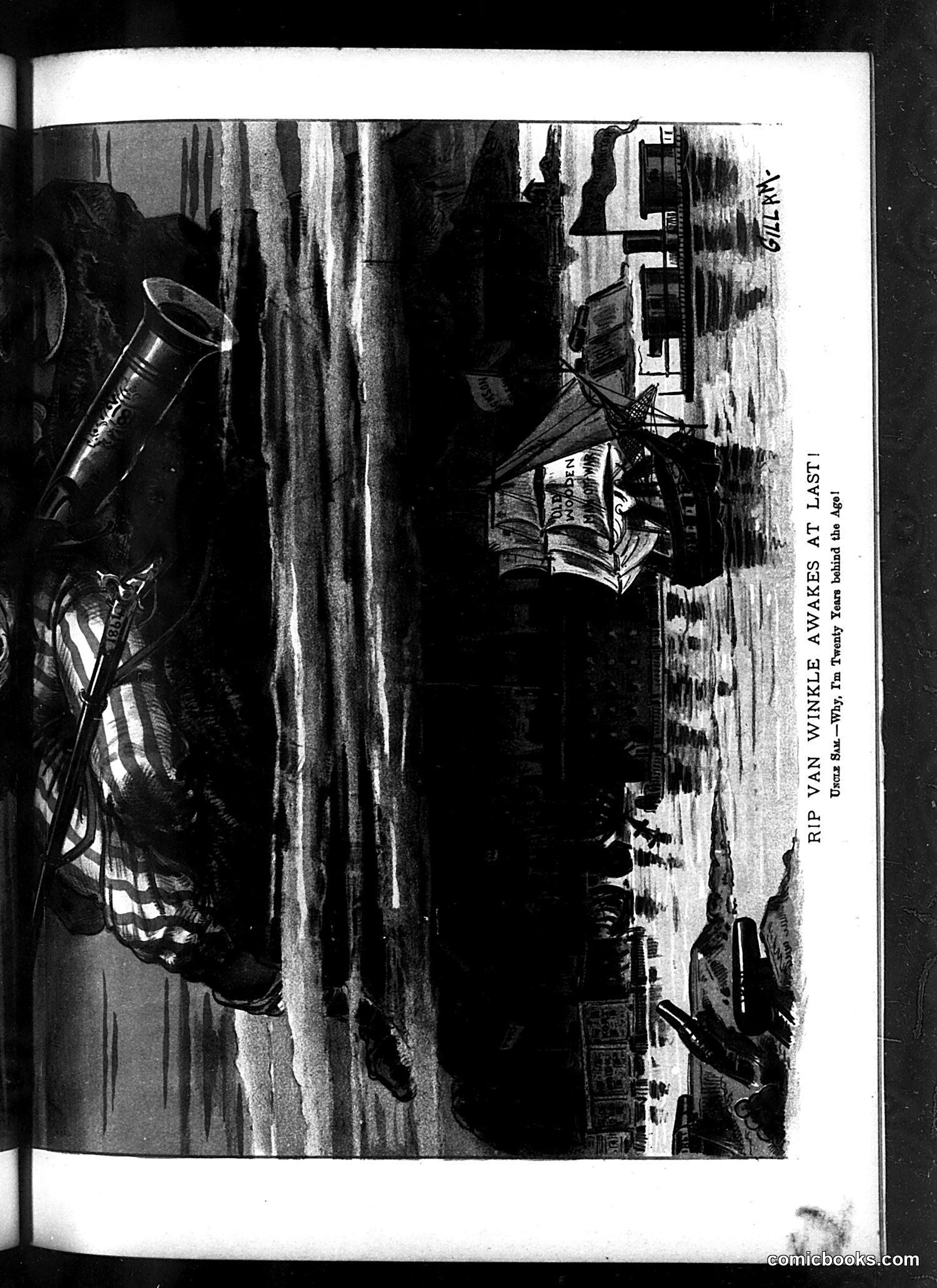
I can see this is a page from *Judge* magazine oriented sideways, showing what appears to be a satirical illustration. However, the OCR text is severely garbled and unreadable—it appears to be corrupted or inverted. The image itself, when rotated to proper orientation, shows what looks like an interior scene with figures and period details, but without legible text or clear caption, I cannot confidently identify the specific political or social reference, the figures depicted, or the satirical point being made. To provide an accurate explanation for a modern reader, I would need either clearer text or additional context about the issue date and subject matter.
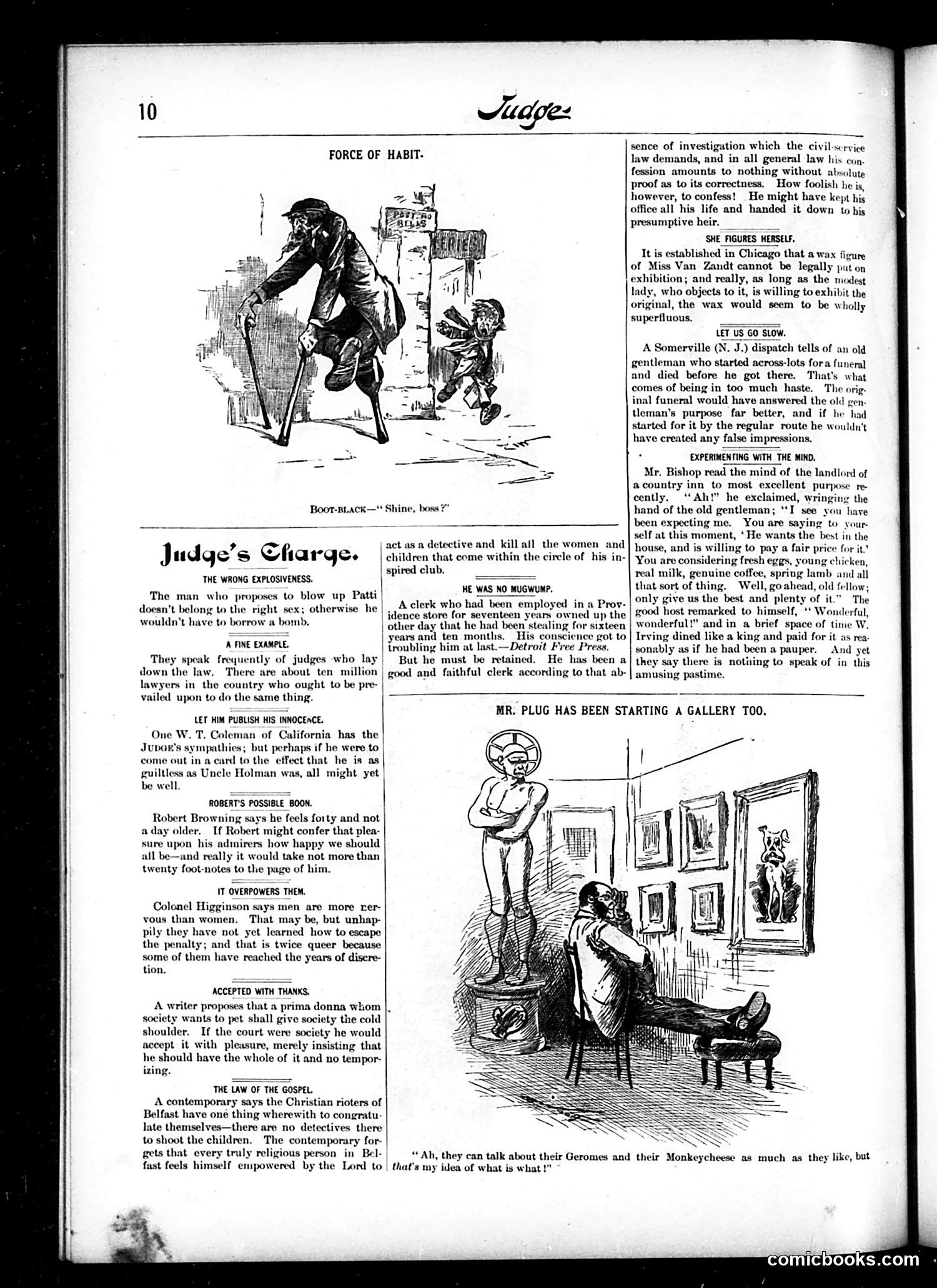
This page from the satirical magazine *Judge* contains multiple short editorial commentary pieces with accompanying illustrations mocking contemporary figures and social issues. The top cartoon "Force of Habit" depicts a bootblack approaching a well-dressed man, satirizing class dynamics and servile behavior patterns. The text pieces below target various public figures and social absurdities: references to "Patti" (likely Adelina Patti, the famous opera singer), criticism of judges and lawyers, commentary on Robert Browning's poetry being overly footnoted, and religious hypocrisy in Belfast. The bottom cartoon "Mr. Plug Has Been Starting a Gallery Too" shows a man admiring artwork on a wall—likely satirizing pretentious art appreciation or someone named Plug's amateur collecting efforts. Overall, the page exemplifies *Judge's* approach: brief, biting social and political satire targeting celebrities, public figures, and contemporary manners through both text and illustration. The humor relies on topical knowledge now largely obscure to modern readers.
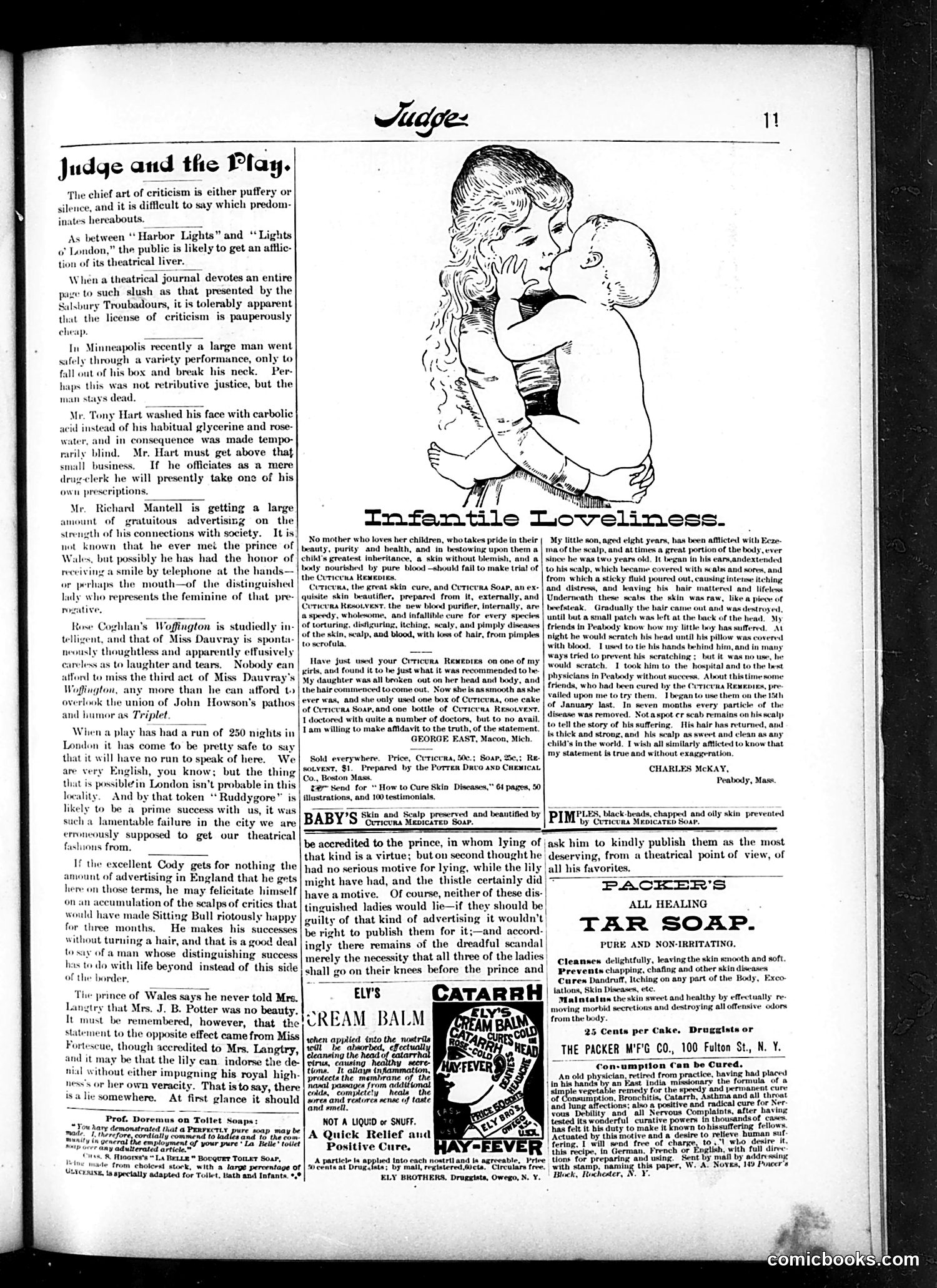
This page contains theater criticism and advertisements, primarily focused on dismissing contemporary plays as inferior to successful London productions. **The Criticism Section ("Judge and the Play"):** The anonymous critic sarcastically attacks theatrical productions and performers of the era. Key targets include the "Salsbury Troubadours" (presented as mediocre), actors Tony Hart and Richard Mantell (criticized for relying on gimmicks and social connections rather than talent), and Miss Dauvray's performance in *Woffington* (deemed thoughtless). The central joke: London's theatrical successes paradoxically become failures in America—the critic suggests American audiences wrongly assume they should copy London fashions, when actually London's failures (like *Ruddygore*) would succeed here. A gossipy aside mocks the Prince of Wales for supposedly commenting on Mrs. J.B. Potter's appearance, suggesting palace intrigue. **The Advertisements:** The remainder consists of period medical ads, notably Cuticura products (soap and remedies for skin conditions), and various patent medicines—typical Judge fare of the 1880s-90s. No specific political satire appears; this is primarily theatrical and social commentary.
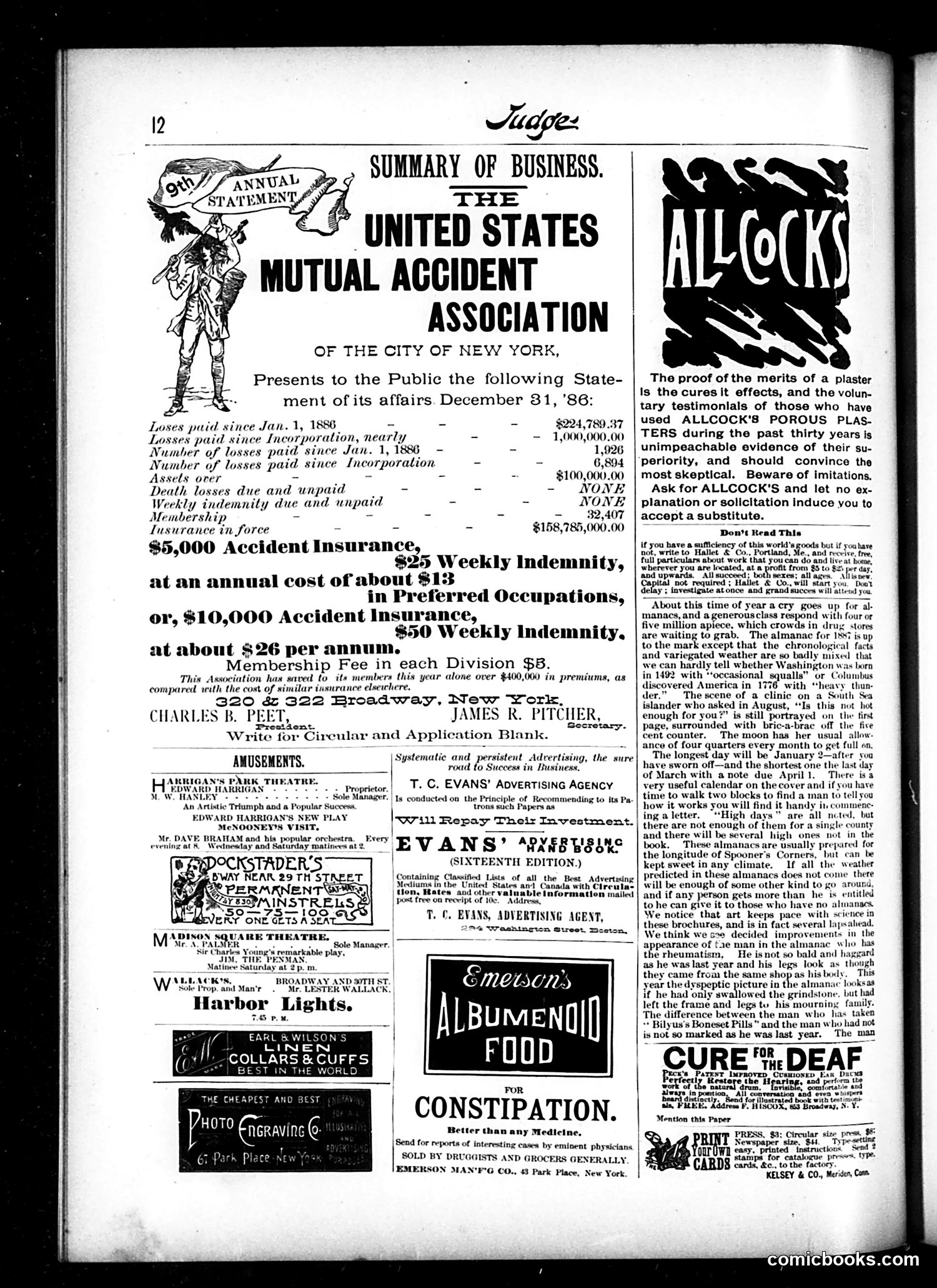
This is primarily a **business and advertising page**, not a satirical cartoon page. The dominant content is a financial statement from the United States Mutual Accident Association of New York, showcasing their 1886 insurance business results—losses paid, assets, membership fees, and coverage options. The page is otherwise filled with period advertisements for theatrical performances, printing services, medical products (Allcock's Porous Plasters for pain relief, Emerson's Albumenoid Food for constipation), and collar manufacturers. The only satirical content appears to be a **brief commentary** mocking almanacs—those annual publications that mixed calendars with weather predictions and illustrations. The writer jokes that people buy millions of them despite their inaccuracy regarding dates and weather forecasts. This appears to be a **revenue-generating page** rather than editorial content, typical of 19th-century magazines that relied heavily on advertising for income.
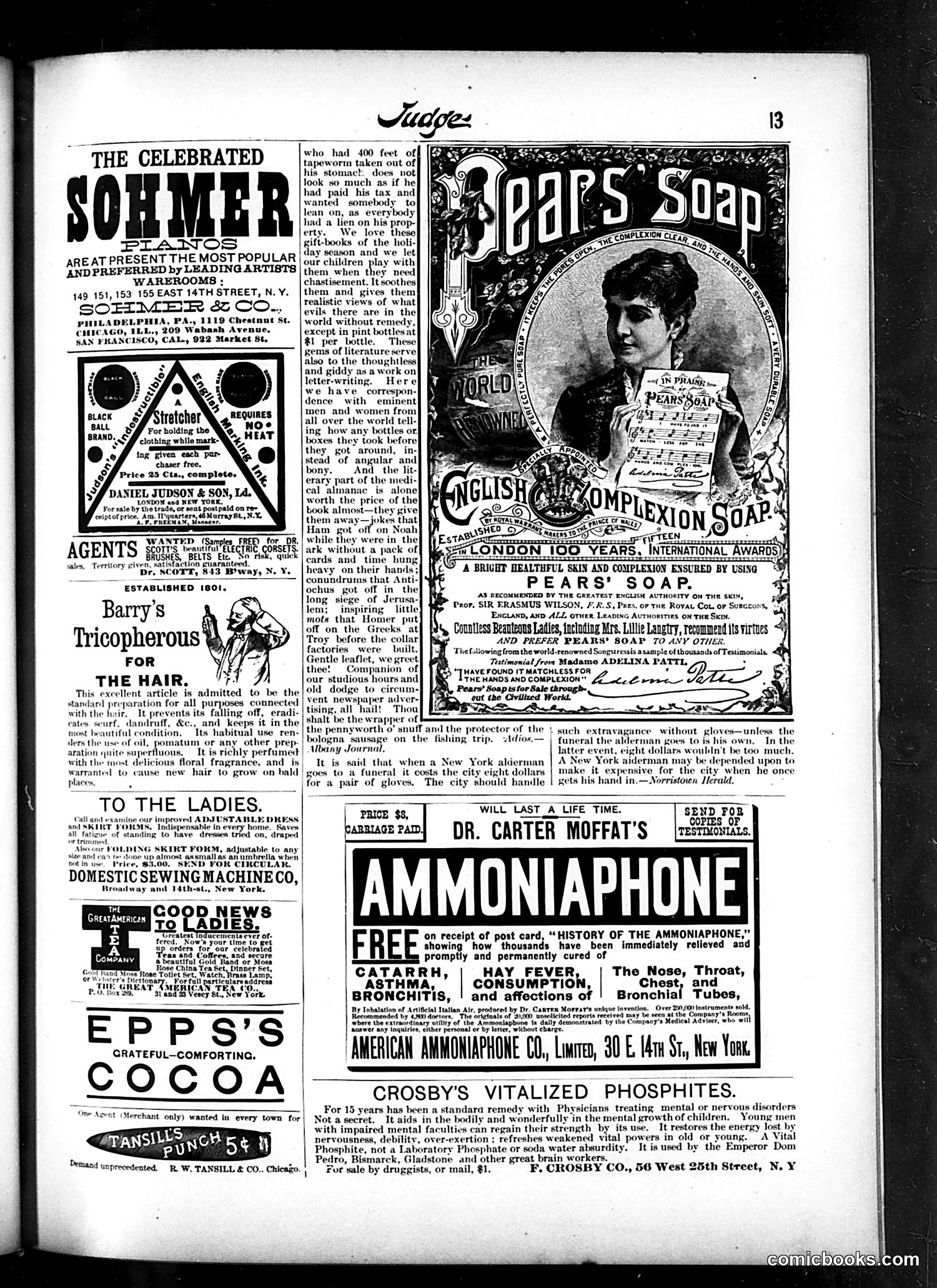
This page is primarily **advertising**, not political satire. It contains multiple product advertisements typical of late 19th-century American magazines. The notable content includes: **Pears' Soap Advertisement** (center-right): Features an endorsement from opera singer **Adelina Patti**, a celebrated international star of the era. The ad claims the soap ensures "a bright healthful skin" and references Sir Erasmus Wilson, a real medical authority on dermatology. This represents typical Victorian-era celebrity endorsement marketing. **Other Products Advertised**: Sohmer pianos, Tricopherous hair treatment, Domestic sewing machines, Epps's cocoa, and Dr. Carter Moffat's "Ammoniaphone" (a dubious medical device claiming to cure catarrh, asthma, and consumption). **Context**: The page reflects Gilded Age consumer culture and the proliferation of patent medicines and questionable health products marketed with pseudoscientific claims and celebrity testimonials—practices that would later prompt the FDA's creation. The brief editorial snippets are satirical commentary on mundane urban life rather than political critique.
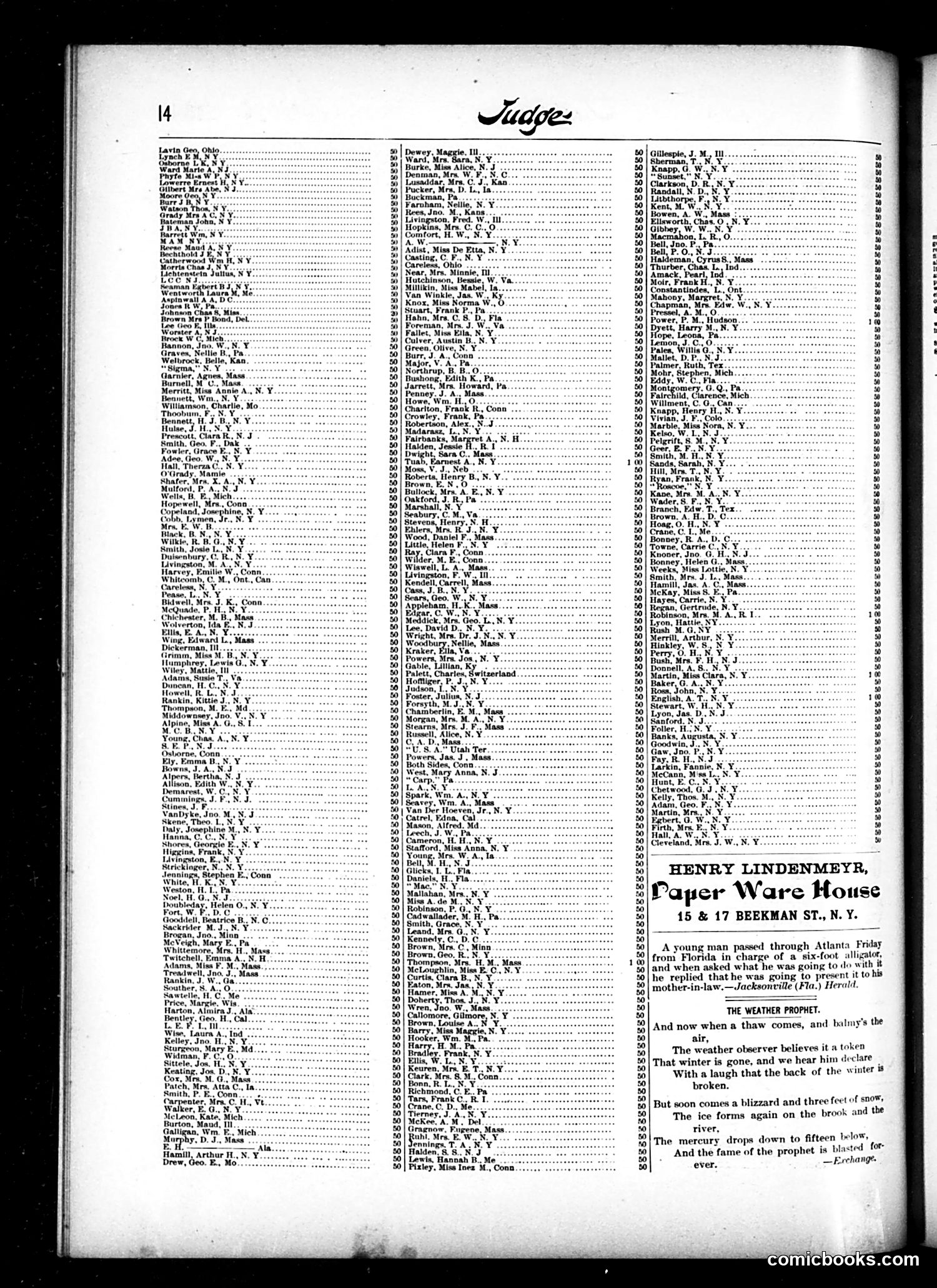
This page is primarily a **subscriber or contributor list** — essentially an index of names with locations and page numbers, likely indicating where their letters, submissions, or advertisements appear in the magazine. The OCR text shows hundreds of names organized alphabetically with states/regions (N.Y., Mass., Conn., etc.) and corresponding page references (mostly "50"). At the bottom of the page is an advertisement for **Henry Lindenmeyer's Paper Ware House** in New York, featuring a brief humorous piece titled "THE WEATHER PROPHET" — a satirical poem about unpredictable weather forecasting, mocking meteorologists' inability to predict winter storms accurately. The page contains **no political cartoons or significant satirical commentary** visible. It serves as an administrative/directory function for the magazine, allowing readers to locate content by contributor and linking advertisements to the publication's audience base.
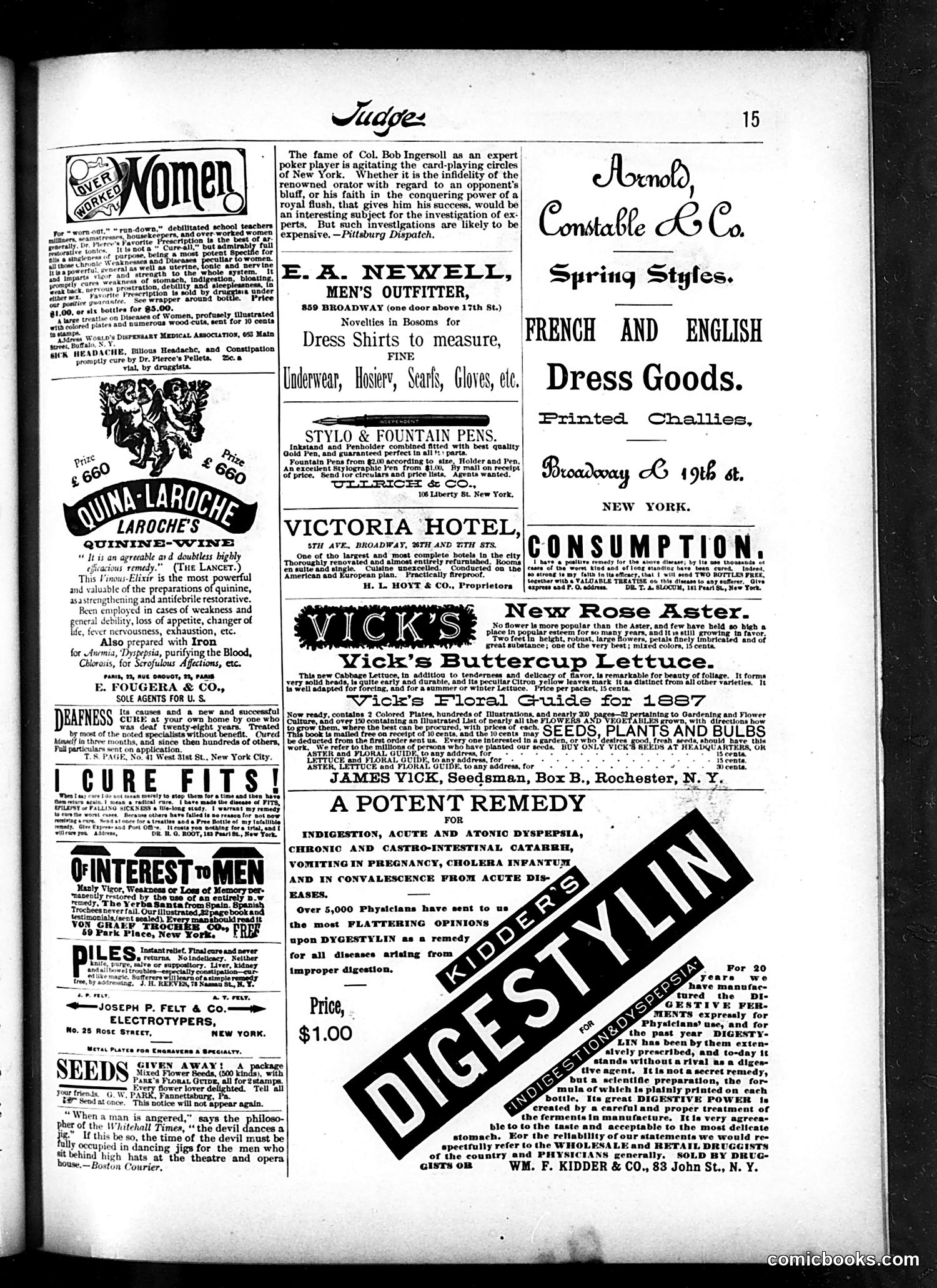
This page is primarily **advertising**, not editorial content or political cartoons. Judge magazine's back pages featured commercial advertisements alongside brief satirical notes. The only satirical content is a short paragraph about **Colonel Robert G. Ingersoll**, a famous 19th-century orator and freethinker, referencing his reputation as a skilled poker player in New York card-playing circles. The joke is mild: the writer humorously speculates whether Ingersoll's poker success comes from his ability to read bluffs or his confidence in winning hands—and notes that investigating such matters would be "expensive" (implying Ingersoll would win money from curious researchers). The rest of the page contains period advertisements for dress goods, hotels, medical tonics, seeds, and various products typical of 1880s Judge magazine. The large "Digestylin" advertisement promotes a patent medicine for digestive ailments—common in this era before FDA regulation of medical claims.
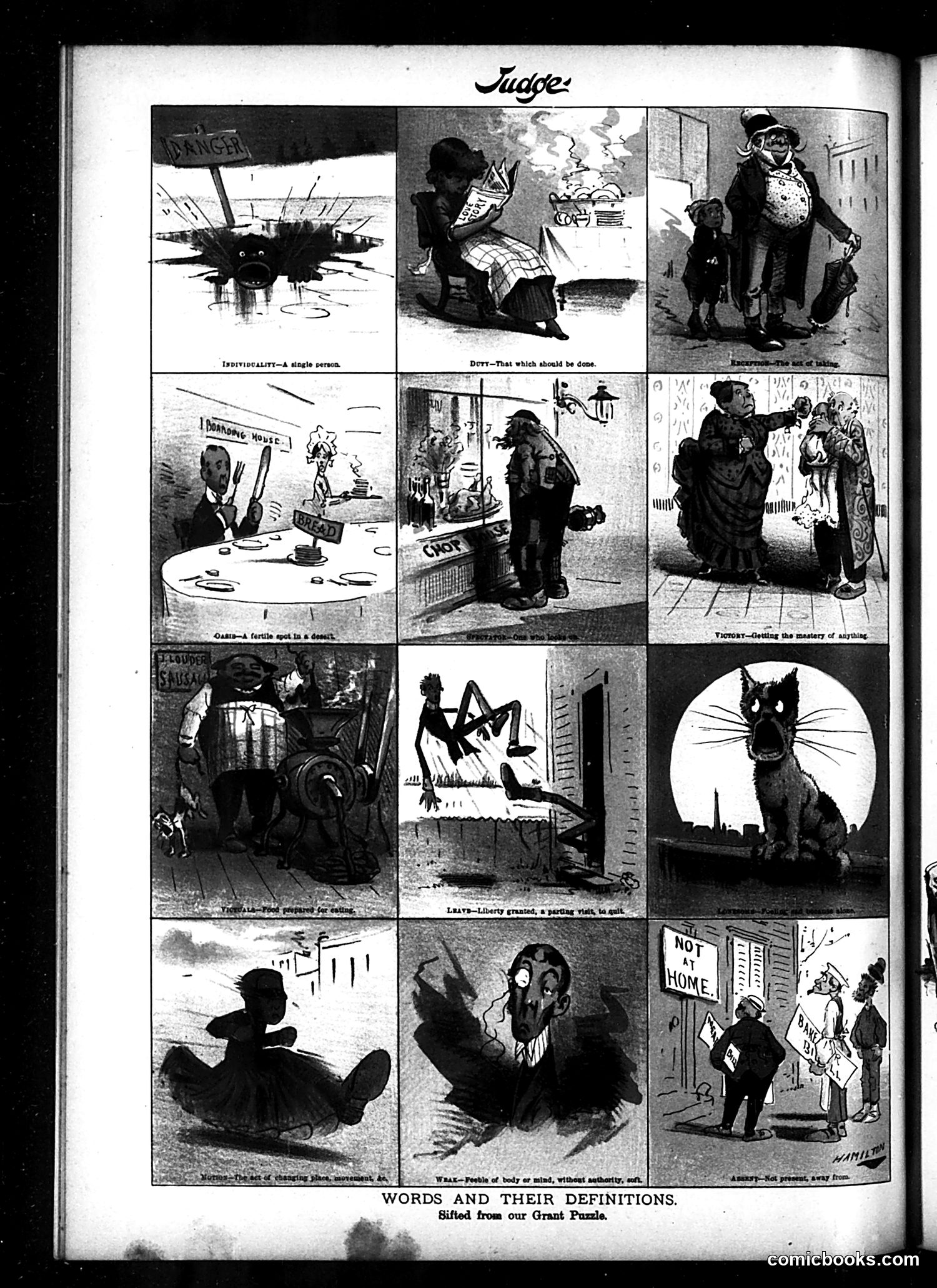
This page from *Judge* presents a humorous "definitions" feature titled "Words and Their Definitions, Sifted from our Grant Puzzle." The cartoons appear to satirize concepts through visual puns and exaggerated character types typical of Gilded Age humor. The panels depict various scenarios—a person at a desk, figures in doorways, a man not at home, and animal imagery—illustrating abstract concepts through concrete situations. The humor relies on visual wordplay and social commentary, though without visible date or clearer context, the specific "Grant Puzzle" referenced remains unclear. It likely refers to political or social issues contemporary to the magazine's publication, using caricature and situational comedy to mock public figures or prevailing attitudes.