
Judge, 1887-02-26 · page 7 of 16
Judge — February 26, 1887 — page 7: what you’re looking at
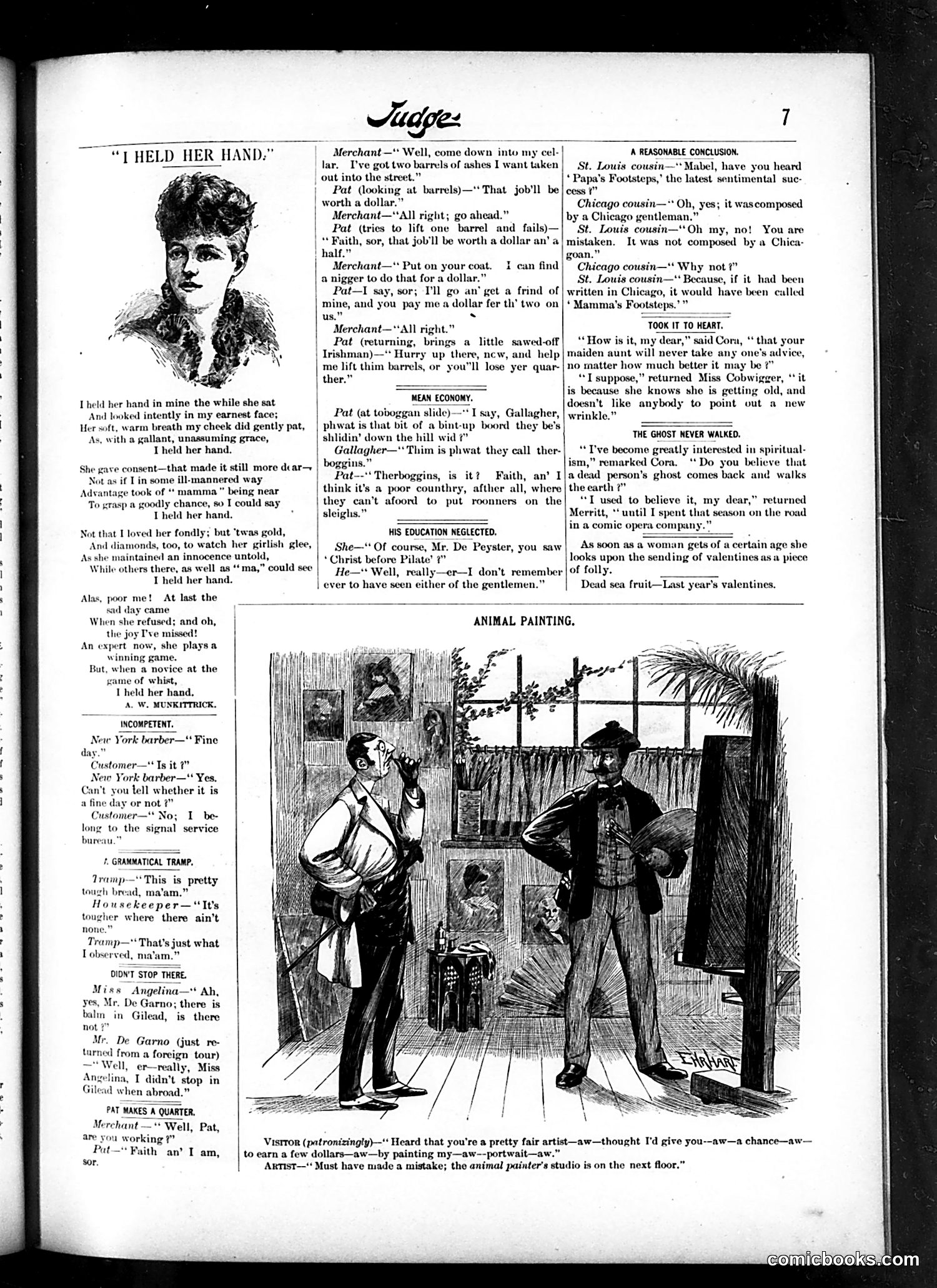
What you’re looking at
This page contains multiple short satirical pieces typical of Judge's humor: **"I Held Her Hand"** is a sentimental poem mocking romantic poetry—the narrator claims to have held a woman's hand, but reveals his actual motivation was financial gain and social status, not genuine affection. **Irish labor jokes** ("Mean Economy," "A Poor Country") rely on period stereotypes, depicting Irish workers (Pat, Gallagher) as simple-minded and economical to the point of absurdity. **"Animal Painting"** cartoon shows a visitor to an artist's studio, misunderstanding the term "animal painter"—likely expecting portraits of animals but finding the artist paints human subjects, playing on the double meaning. The remaining brief jokes mock courtship customs, spiritualism fads, women aging, theatrical life, and regional American differences (Chicago vs. St. Louis attitudes). The humor is gentle, domestic, and relies on wordplay and social observation rather than political commentary. This represents typical Judge fare: middle-class American life gently ridiculed.
📄 Transcribed text from this page (OCR, searchable)
Machine-transcribed from the original scan — historical spelling and the odd misread are preserved.
Siape: I held her hand in mine the while she sat And looked intently in my earnest face; Her soft, warm breath my cheek did gently pat, As, with a gallant, unassuming grace, I held her hand. She gave consent—that made it still more dcar—+ tas if I in some ill-mannered way Advantage took of “ mamma” being near To grasp a goodly chance, so I could say T held her hand. Not that I loved her fondly; but ‘twas gold, And nonds, too, to watch her girlish glee, As she maintained an innocence untold, While others there, as well as ma,” could sec I held her hand. Alas, poor me! At last the Merchant —* Well, come down into my cel- | lar. Pye got two barrels of ashes I want taken | out into the street.” Pat (looking at barrels)—"‘ That job'll_ be worth a dollai Merchant—“All right; go ahead.” | Pat (tries to lift one barrel and fails)— “Faith, sor, that job'll be worth a dollar an’ | half.” Merchant—" Put on your coat. I a nigger to do that for a dollar.” | Pat—I say, sor; Tl go an’ get a frind of mine, and you pay me a dollar fer th’ two on us.” * Merchant—“‘All right.” | Pat (returning, brings a little sawed-off | Irishman)—* Hurry up there, new, and help me lift thim barrels, or you"ll lose yer quar- ther.” can find | MEAN ECONOMY, Pat (at toboggan slide)—"' I say, Gallagher, phwat is that bit of a bint-up boord they be's | shlidin’ down the hill wid ¢” | Gallagher—" Thim is phwat they call ther- | boggins.” ‘Therboggins, is it? | think it's a poor counthry, afther | they can’t afoord to put roonners on the sleighs.” HIS EDUCATION NEGLECTED. She—“ Of course, Mr. De Peyster, you saw | He—** Well, really—er—I don't remember ‘A REASONABLE CONCLUSION. St. Louis cousin—** Mabel, have you heard * Papa's Footsteps,’ the latest sentimental suc- cess ¢” Chicago cousin—** Oh, yes; it wascomposed by a Chicago gentleman.” St. Louis cousin—"Oh my, no! mistaken. goan.” Chicago cousin—* Why not?” St. Louis cousin—‘ Because, if it had been written in Chicago, it would have been called *Mamma’s Footsteps.’ You are It was not composed by a Chica- TOOK IT TO HEART. “* How is it, my dear,” said Cora, “ that your maiden aunt will never take any one's i no matter how much better it may be ¢” “T suppose,” returned Miss Cobwigger, * it is because she knows she is getting old, and doesn't like anybody to point out a new wrinkle.” THE GHOST NEVER WALKED, “T've become greatly interested in spiritual- ism,” remarked Cora. ‘Do you believe that adead person's ghost comes back and walks the earth ?” “I used to believe it, my dear,” returned Merritt, * until I spent that season on the road in a comic opera company.” As soon as a woman gets of a certain age she looks upon the sending of valentines as a piece of folly. | ‘Christ before Pilate’ ¢” | ever to have seen either of the gentlemen.” Dead sea fruit—Last year’s valentines. sad day came n she refused; and oh, oy T've missed! An expert now, she plays a winning game. But, when a novice at the game of whist, 1 held her hand, A. W. MUNKITTRICK. INCOMPETENT. New York barber—“ Fine Customer—" Is it 1” New York barber—“‘ Yes, "t you tell whether it is fine day or not ?” Customer— No; 1 be- the signal service bureau.” 1, GRAMMATICAL TRAMP, Tramp-—This is pretty tough bread, ma’am,” Housekeeper—“It's tougher where there ain't none.” Tramp—" That's m. just what Tobserved, ma'am.” DIDN'T STOP THERE. Miss Angelina—* Ah, yes, Mr. De Garno; there is balm in Gilead, is there not?” Mr. De Garno (just re- turned from a foreign tour) Well, er—really, Miss ina, I didn’t stop in Gilead when abroad.” PAT MAKES A QUARTER, Merchant ell, Pat, ANIMAL PAINTING. Visrtor (patronizingly)—“ Heard that you're a pretty fair artist—aw—thought I'd give you--aw—a chance—aw— to earn a few dollars—aw—by painting my—aw--portwait—aw Arnist— Must have made a mistake; the animal painter's studio is on the next floor.”