
A complete issue · 16 pages · 1887
Judge — February 19, 1887
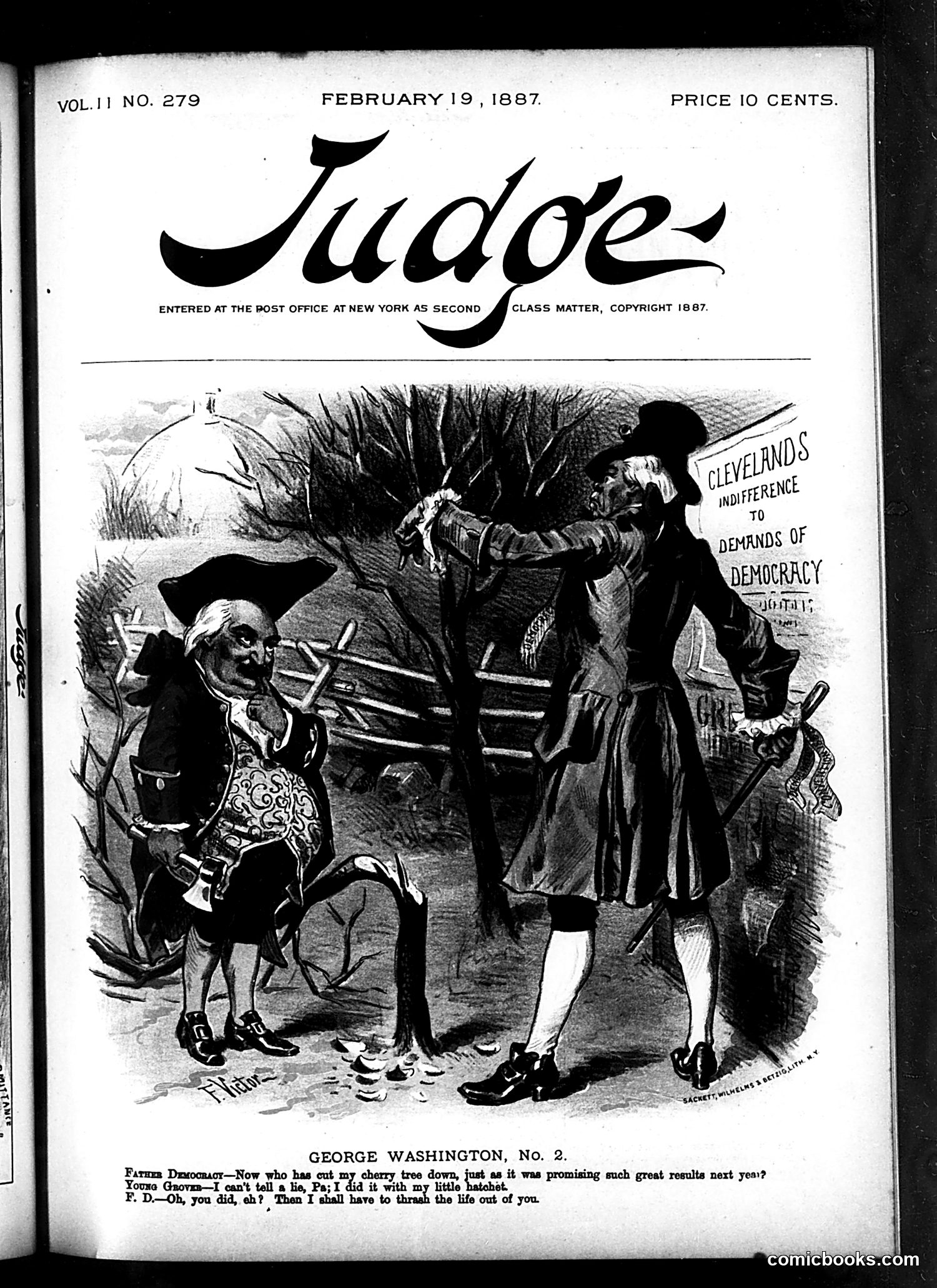
This satirical cartoon critiques President Cleveland's handling of Democratic Party demands. The speech bubble identifies "Young George" (Cleveland) as the central figure being addressed by what appears to be a personification of Democratic Party interests or faction leaders. The caption's dialogue suggests Cleveland promised great results but failed to deliver—the speakers mock him for making false promises ("I can't tell a lie, Pa") and threaten consequences ("Then I shall have to thrash the life out of you"). The reference to George Washington and his cherry tree legend (the "can't tell a lie" allusion) invokes American mythology to satirize Cleveland's perceived dishonesty or broken commitments to party demands. The cartoon mocks his political weakness or hypocrisy regarding Democratic Party expectations.
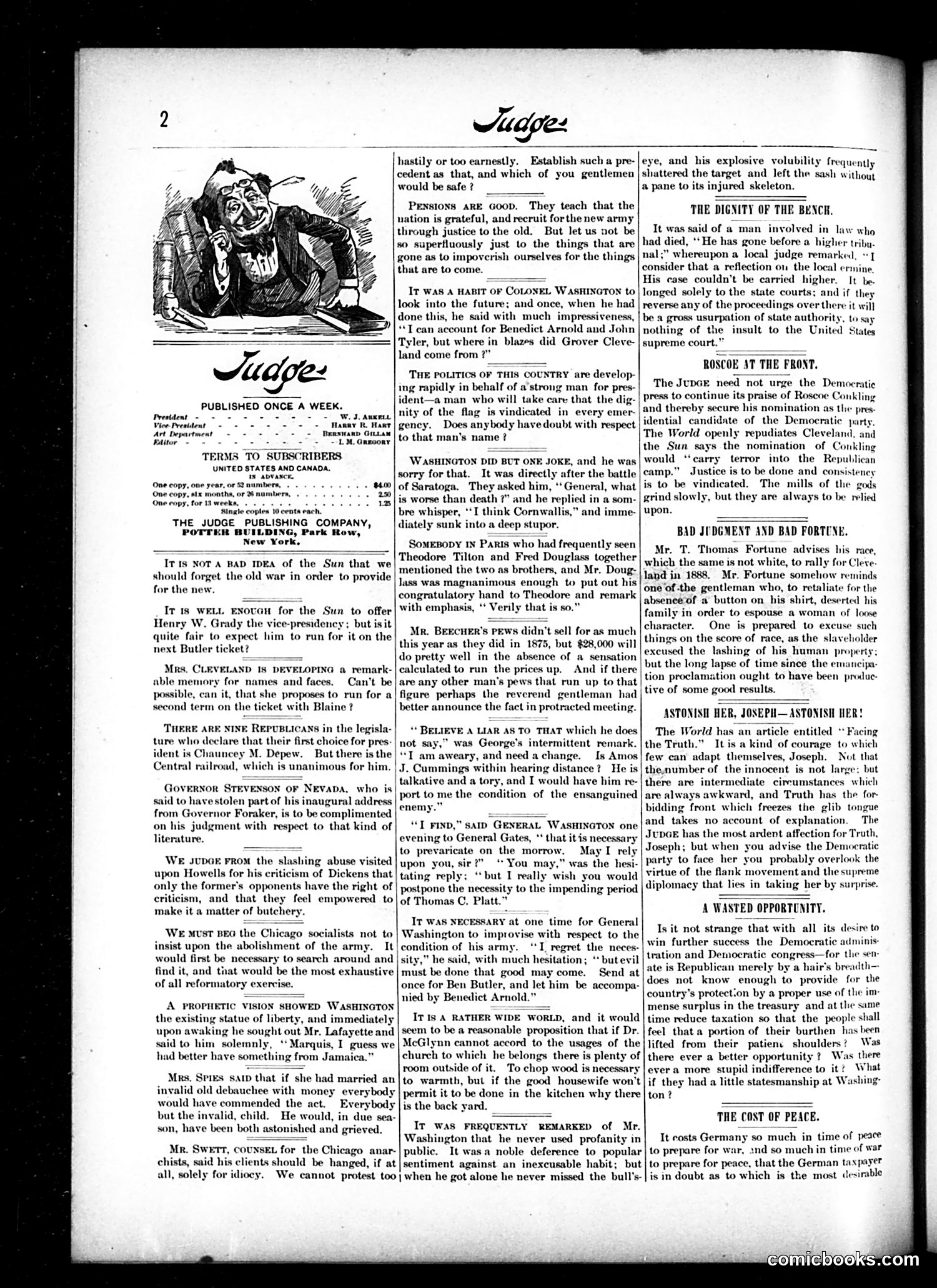
This page contains two political cartoons and satirical commentary. The upper cartoon depicts a portly figure in formal dress, likely a politician or public figure of the era, shown in an exaggerated, unflattering style typical of Judge's approach. The text references include commentary on Colonel Washington, General Grover Cleveland, and discussions of Democratic politics and candidacy. There are also references to Roscoe Conkling, suggesting this dates to the 1880s political era. The cartoons appear to satirize political figures through physical caricature and exaggerated portrayal—a standard Judge technique. Without clearer identification in the image itself, I cannot definitively name all figures, but the content clearly targets prominent politicians and their perceived character flaws or hypocrisies during this period of American politics.
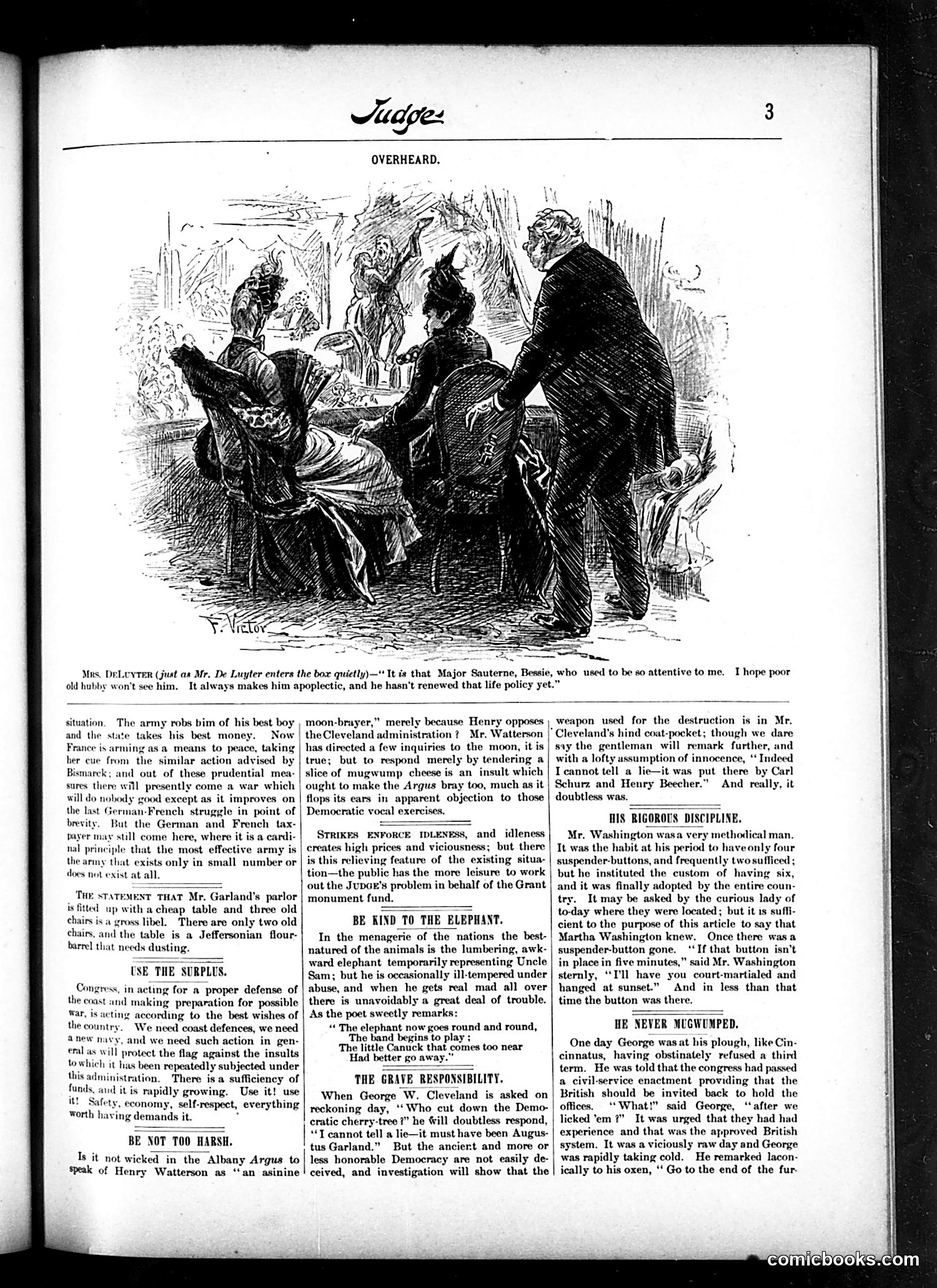
The main cartoon depicts a woman (Mrs. DeLuyter) gossiping to her daughter "Bessie" about spotting an old suitor, Major Sauterne, in what appears to be a theater box. She hopes her husband won't notice the Major's presence because it will upset him so much he might have a stroke—and conveniently, he hasn't renewed his life insurance policy yet. The joke is a dark one about marital jealousy and financial motive: the wife would benefit from her husband's death, making the Major's reappearance potentially profitable. The cartoon satirizes both domestic hypocrisy and the mercenary calculations underlying seemingly respectable marriages in gilded-age society. The surrounding political commentary discusses military preparedness, the Cleveland administration's policies, and various Democratic figures like Henry Watterson and Augustus Garland—typical Judge magazine fare mocking contemporary politics.
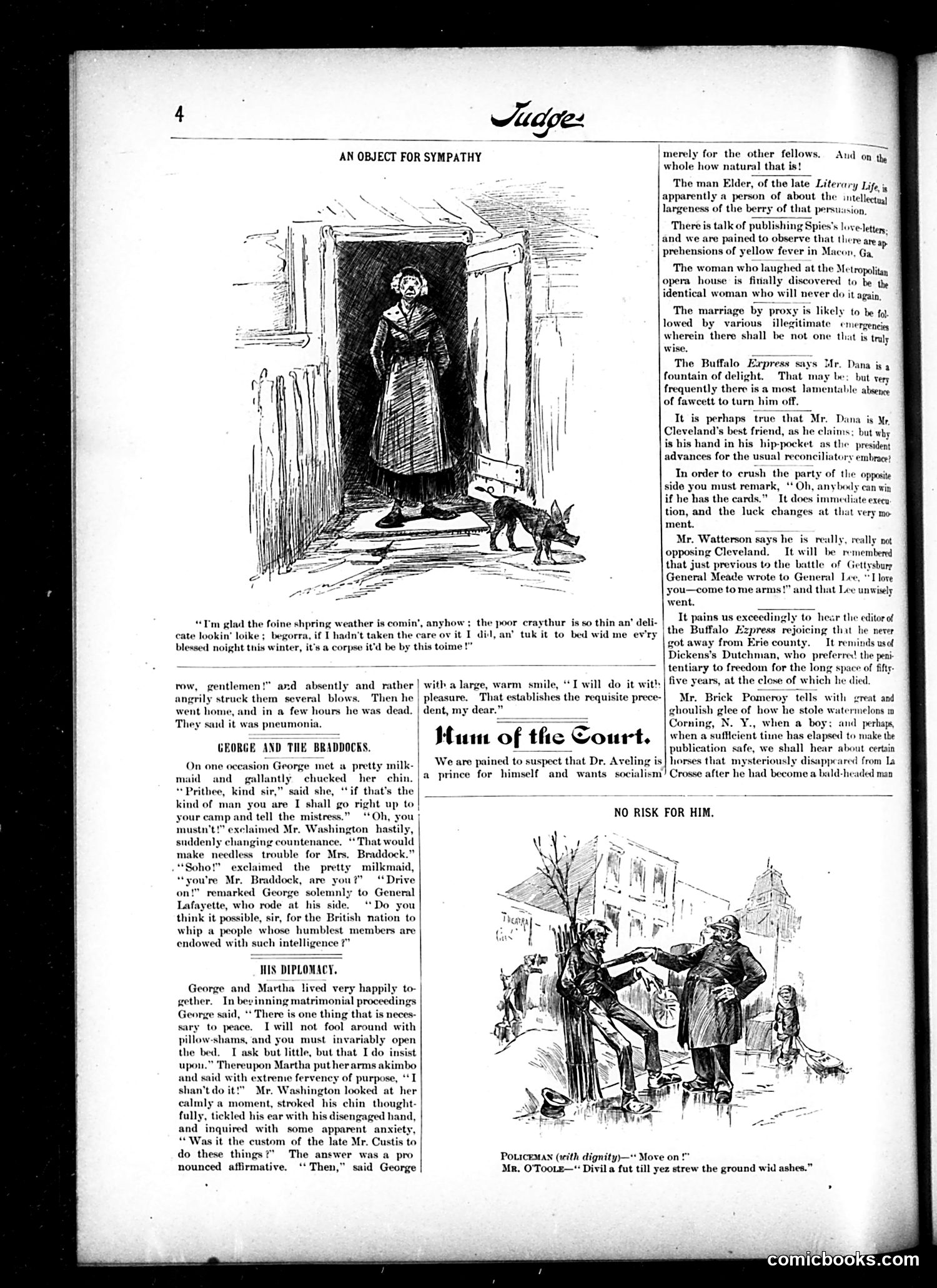
This page contains humorous anecdotes about **George Washington**, presented as satirical character sketches rather than historical fact. ## The Cartoons/Stories: **"An Object for Sympathy"** (top): An Irish servant tends a sickly person, establishing a sympathetic domestic scene. **"George and the Braddocks"** and **"His Diplomacy"**: Fictional tales portraying Washington as a somewhat bumbling, socially awkward figure. One anecdote mocks his interaction with a milkmaid (suggesting impropriety he must deny); another depicts his awkward marriage negotiations with Martha, where he demands she open the bed daily—she refuses, forcing him to invoke her previous husband's customs to get compliance. ## The Satire: The humor relies on **debunking Washington's dignified historical image** by presenting him as ordinary, petty, and comically inept at both romance and domestic life. The exaggerated Irish dialect in the first illustration adds period-typical ethnic humor. The "Humors of the Court" section contains brief satirical jabs at contemporary figures (Dr. Aveling, editor Dana) unrelated to Washington. **Overall**: This represents 19th-century irreverent satire humanizing—and mocking—American historical figures.
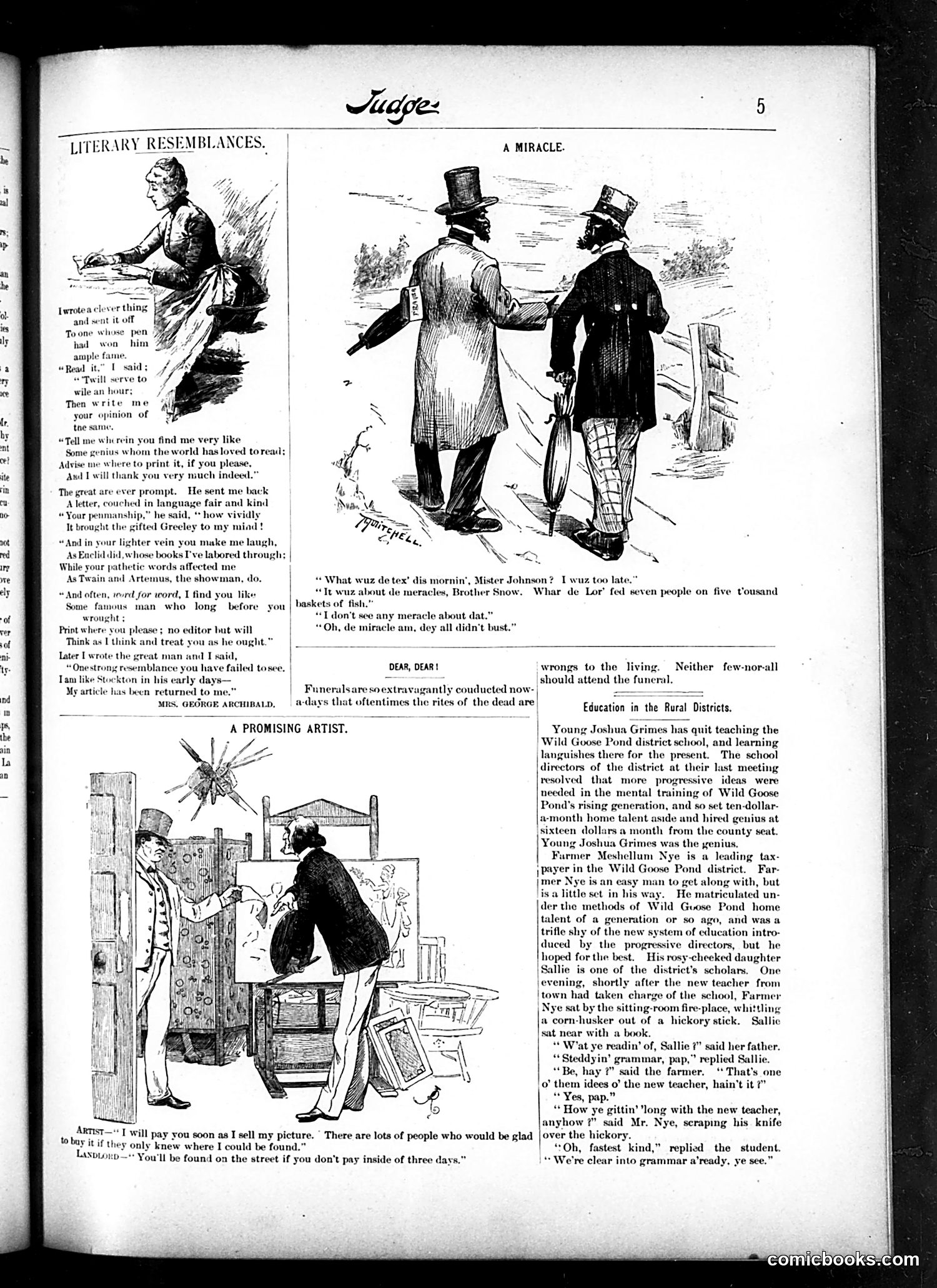
This page contains three satirical pieces typical of 19th-century American humor journalism: **"Literary Resemblances"** mocks aspiring writers who seek validation from famous authors, only to discover their work merely echoes existing genius rather than breaking new ground. **"A Promising Artist"** depicts the classic scenario of a struggling artist promising payment he cannot deliver—satirizing both artistic pretension and urban poverty. **"A Miracle"** presents a dialect-heavy joke featuring African American characters discussing biblical miracles. The "miracle" is that baskets of fish didn't break when feeding thousands—a play on the loaves-and-fishes story. This reflects period stereotypes through exaggerated dialect. **"Education in the Rural Districts"** satirizes tension between old and new educational methods. A rural district hires an expensive "progressive" teacher, but the girl's father (farmer Nye) remains skeptical of modern grammar instruction, preferring traditional methods. The satire targets both rural conservatism and urban educational pretension. The page reflects Gilded Age themes: literary ambition, economic struggle, racial caricature, and rural-versus-urban cultural conflict.
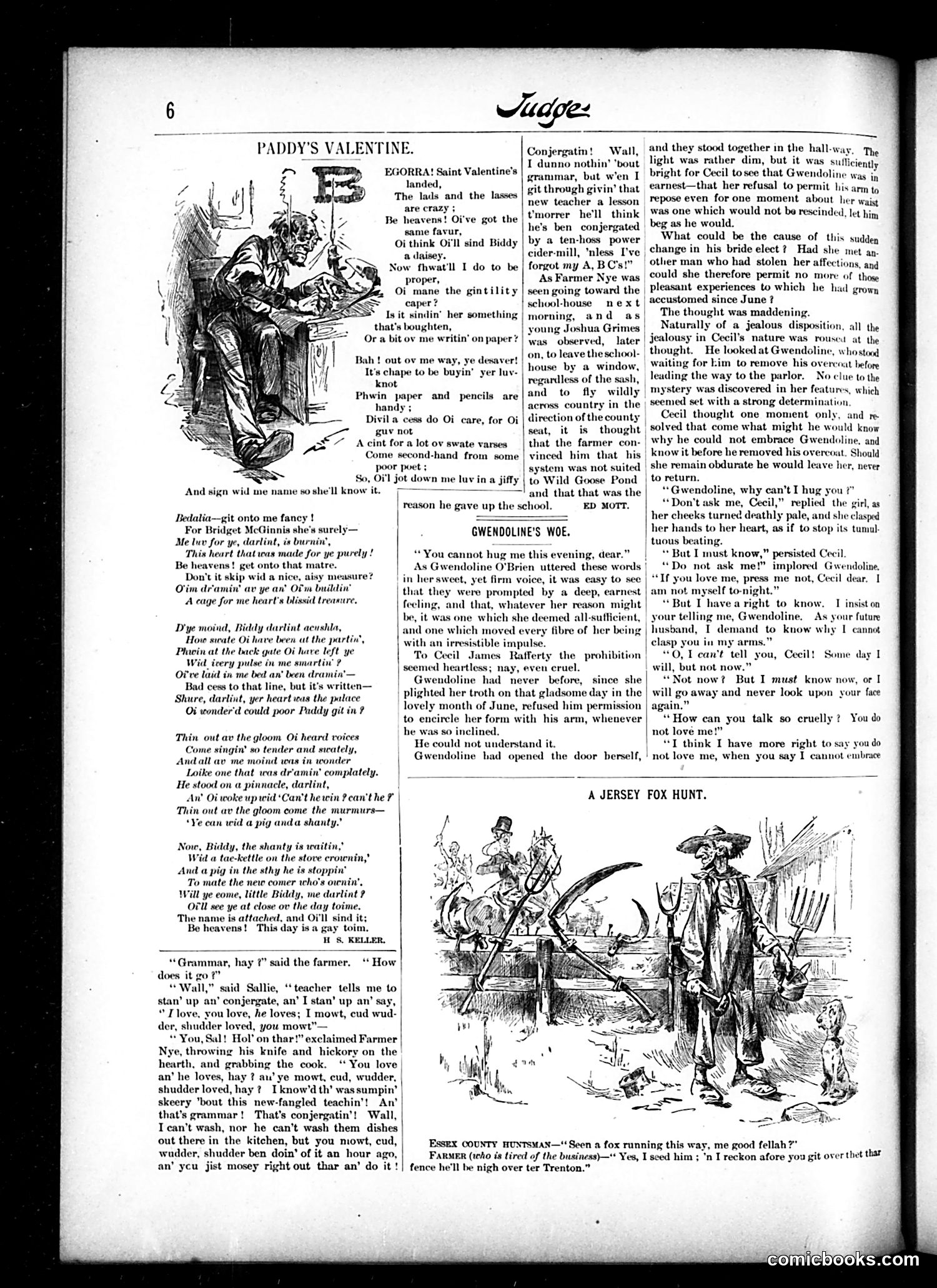
This page contains three distinct pieces of content: **"Paddy's Valentine"** (left): A satirical poem mocking Irish immigrants through exaggerated dialect and stereotypes. The humor relies on caricaturing "Paddy" as an illiterate working-class Irishman composing an awkward Valentine to "Bridget," with misspellings and broken English. The punchline suggests he can only offer her a pig and a shanty—playing on stereotypes of Irish poverty and rusticity. This reflects 19th-century anti-Irish sentiment common in American humor publications. **"Gwendoline's Woe"** (right): A serialized melodramatic romance story excerpt about a couple's relationship trouble—Cecil cannot understand why his fiancée Gwendoline won't let him embrace her. **"A Jersey Fox Hunt"** (bottom right): A cartoon depicting a fox hunt, with accompanying rural dialect humor about a farmer spotting a fox. The page exemplifies Judge's mix of ethnic stereotyping, sentimental serialized fiction, and rural Americana humor typical of late 19th-century American satire magazines.
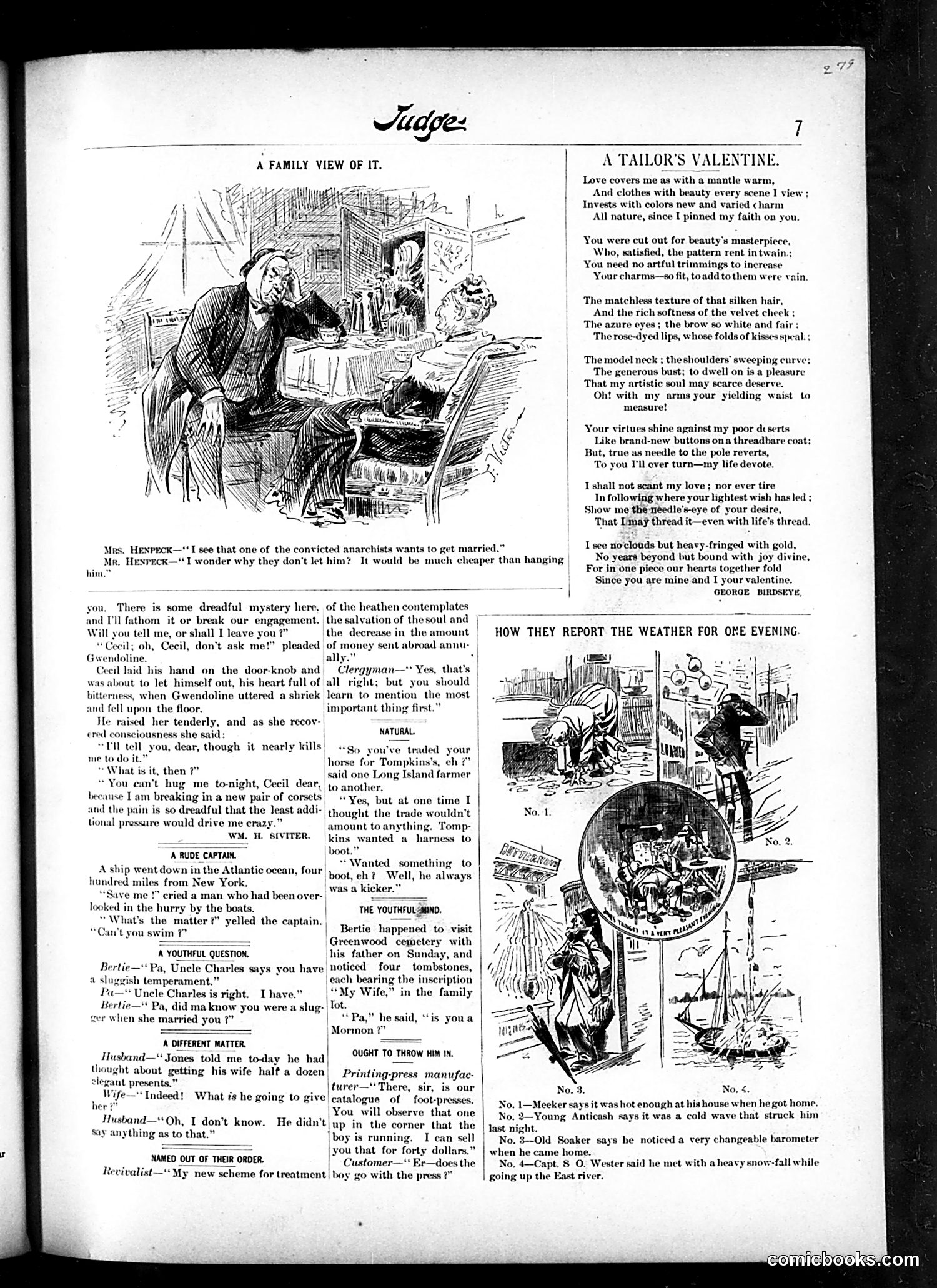
This page contains various humorous short pieces typical of late 19th-century satirical magazines. The main items include: **"A Tailor's Valentine"** — A romantic poem from a tailor's perspective, using sewing/tailoring metaphors throughout ("cut out for beauty's masterpiece," "needle to the pole," etc.). It's sentimental verse playing on the profession. **Short Jokes** — Various one-liners about marriage and domestic life, including Mrs. and Mr. Henpeck discussing anarchists, a woman unable to be hugged due to new corsets, and jokes about sluggish temperaments and Mormon wives. These reflect period attitudes about women's fashion constraints and marital dynamics. **Anecdotes** — Stories about a drowning man, a clergyman's priorities, and a boy confused about Mormonism at a cemetery. **"How They Report the Weather"** — Illustrations (right side) showing humorous weather observations by different people—seemingly a visual joke series. The page largely reflects Victorian-era domestic humor and gentle satire about marriage, fashion, and social observations rather than serious political commentary.
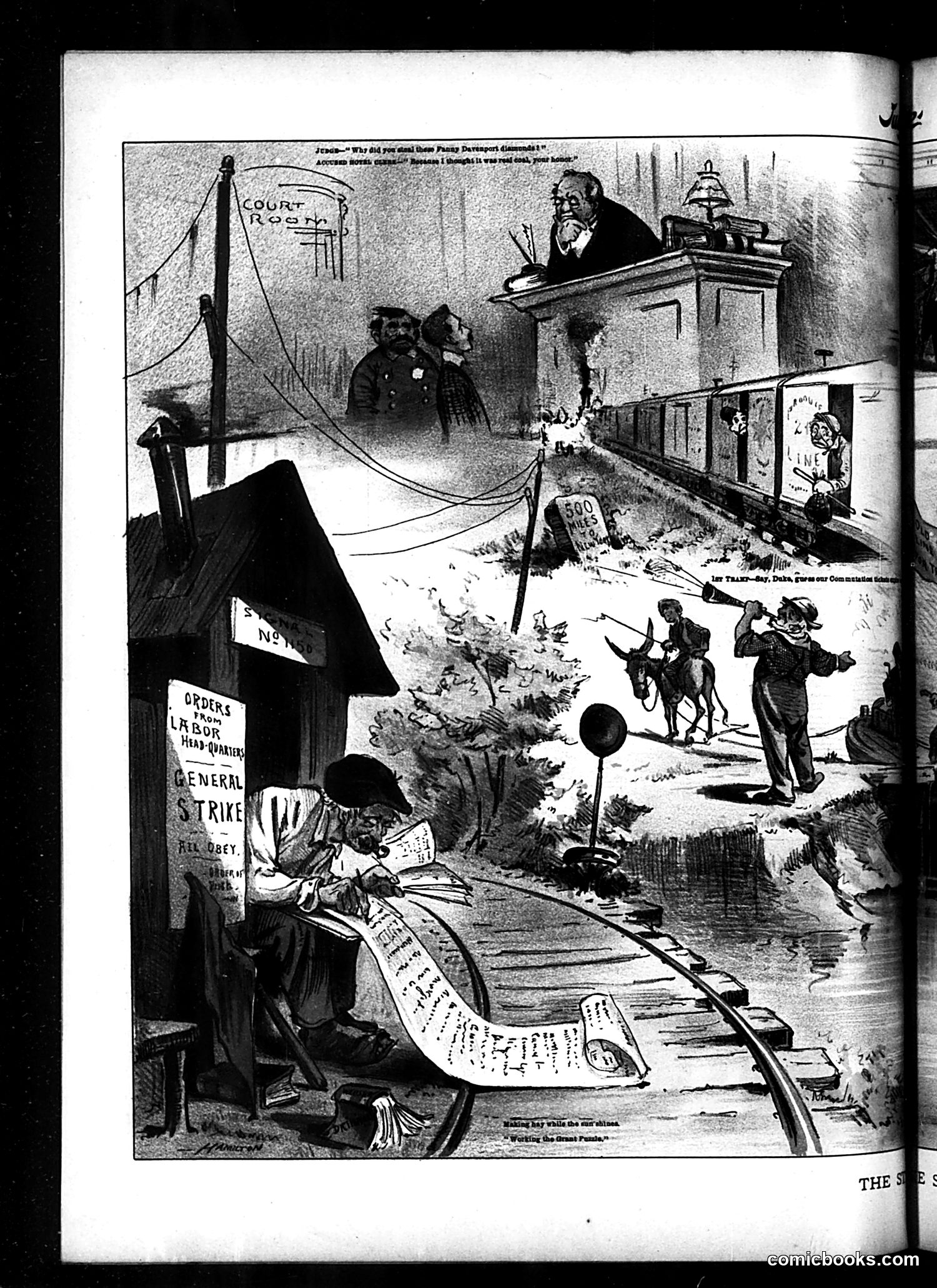
This appears to be a satirical cartoon about a labor strike, likely from the late 19th or early 20th century. The image shows: - A figure labeled "GENERAL STRIKE" emerging from a sign reading "ORDERS FOR LABOR" with "OBEY" underneath - A judge or authority figure presiding from an elevated court position - Workers or strikers in various poses below - Railroad tracks and what appears to be a "500" marker, suggesting this references a specific industrial dispute The satire seems to critique either the strike itself or the judicial/governmental response to labor unrest. The composition suggests tension between labor organizing and legal/governmental authority attempting to control or suppress it. The specific historical event referenced remains unclear without additional context, though the imagery invokes late-19th-century American labor conflicts.
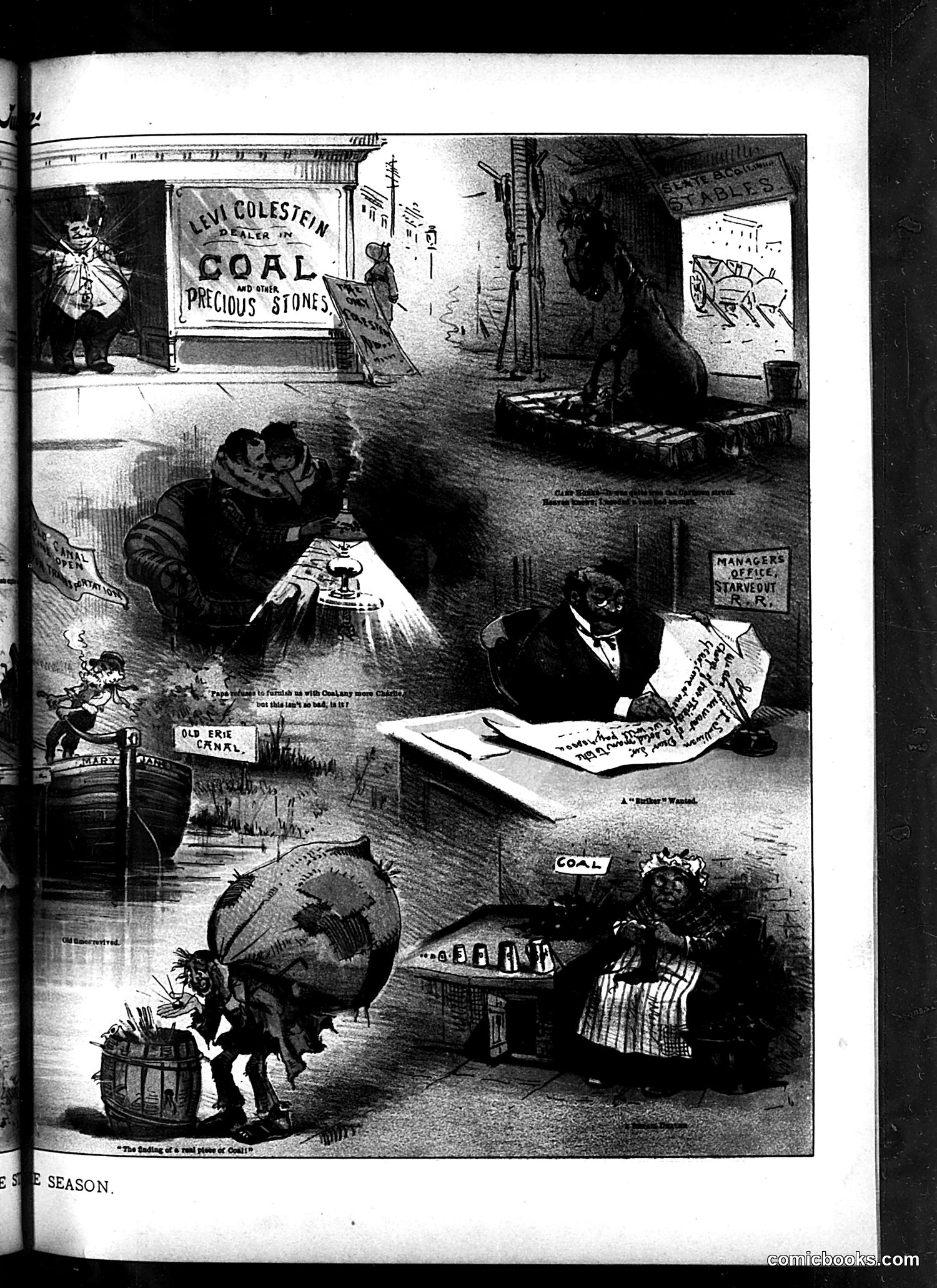
This appears to be a multi-panel cartoon satirizing the coal industry and labor conditions. The top panel shows a coal dealer's storefront ("Levi Colesterin, Dealer in Coal and other Precious Stones"), while subsequent panels depict what appears to be labor disputes or working conditions at coal operations. The imagery includes figures struggling with coal transport, a manager's office, and what appears to be commentary on industrial labor practices. References to "Old Erie Canal" and various coal-related operations suggest this critiques 19th-century coal industry practices. The cartoon's overall tone appears critical of either monopolistic coal practices, worker exploitation, or unsafe industrial conditions—common subjects for Judge magazine's satirical commentary during the industrial era. The exact historical event referenced remains unclear without additional context or clearer OCR text.
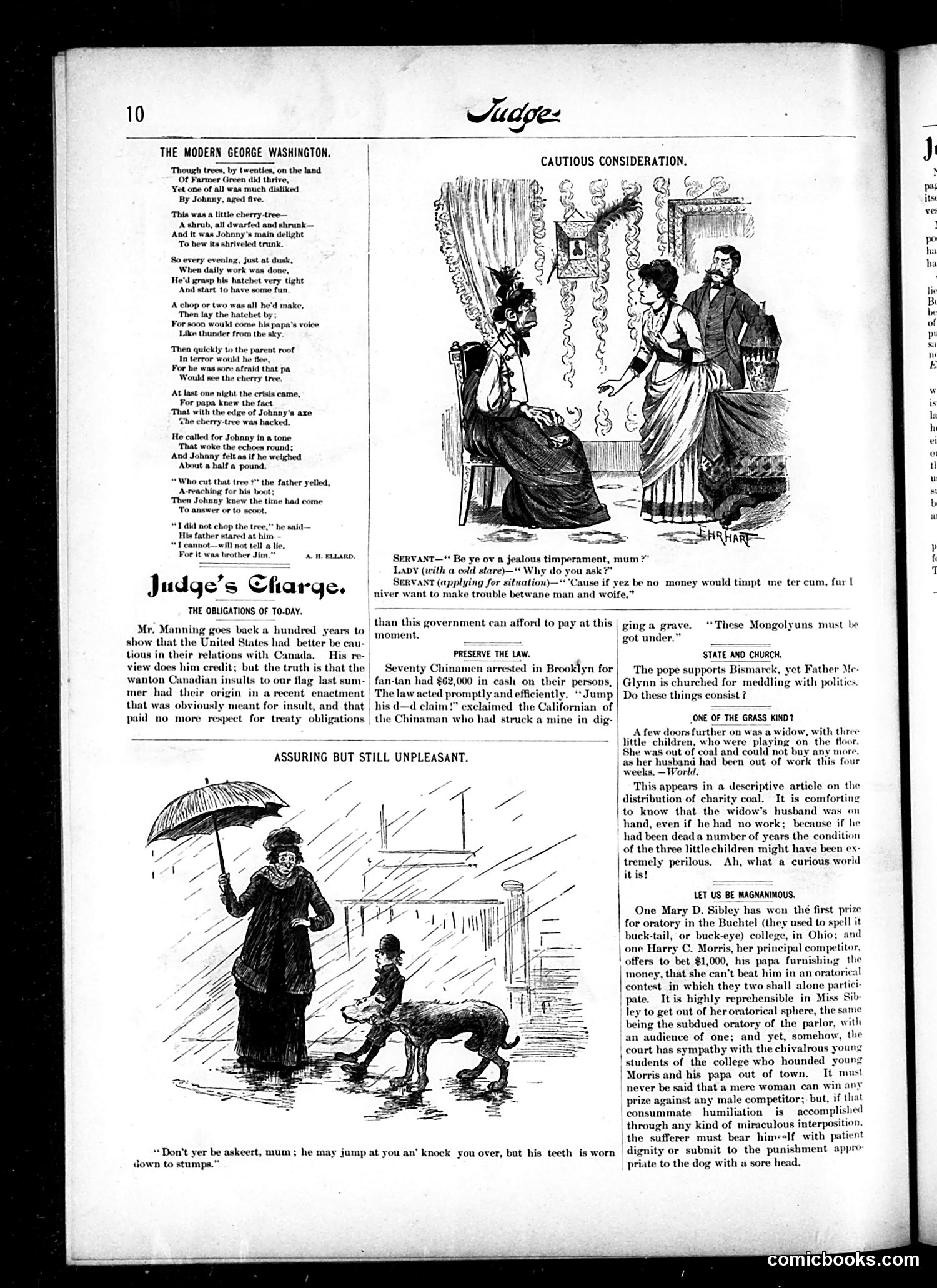
**"The Modern George Washington"** is a humorous poem mocking the famous (likely apocryphal) story of young George Washington confessing to chopping down his father's cherry tree. Here, a boy named Johnny destroys a cherry tree but then lies about it—inverting the moral lesson. The satire critiques false patriotic mythology by showing what actually happens when children *don't* confess truthfully. **"Cautious Consideration"** depicts a servant interviewing for a position, explaining he won't take the job if the employer has no money because he "never want[s] to make trouble between man and wife"—satirizing servants' awareness of domestic quarrels over finances. The page also contains brief commentary on contemporary issues: Canadian-American tensions, Chinese gambling arrests in Brooklyn, and a college oratory contest where a woman (Mary D. Sibley) outperformed a male competitor, prompting outrage that the magazine mocks as absurdly ungenerous.
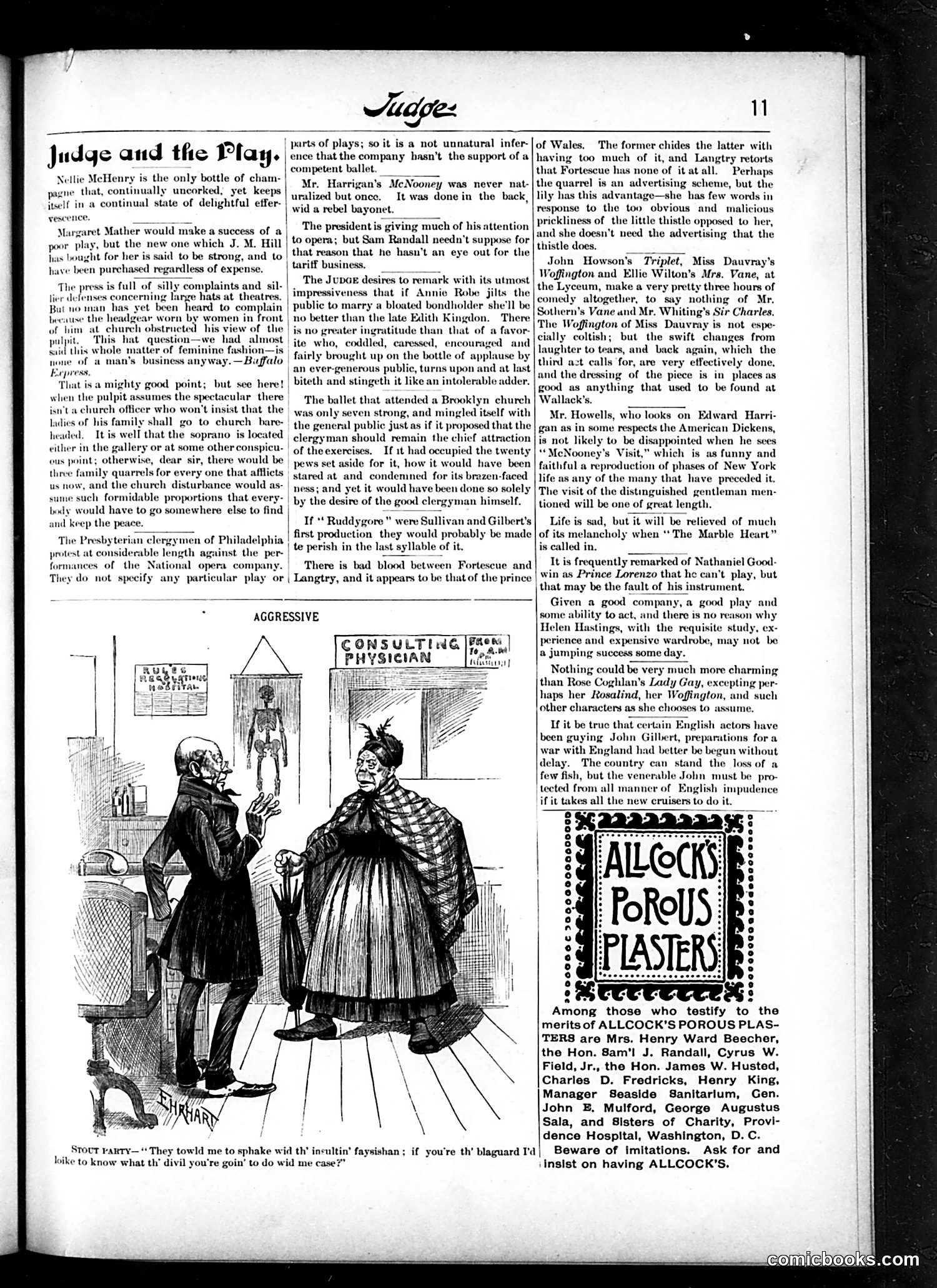
This page from *Judge* magazine contains theater criticism and one political cartoon. The main cartoon depicts a "Stout Party" (working-class Irishman, identifiable by dialect and appearance) consulting with an aggressive "Consulting Physician." The joke plays on the phrase "what the devil you're going to do with my case"—the doctor's aggressive demeanor suggests he might literally fight the patient rather than treat him. The surrounding text reviews contemporary theatrical performances and performers (Nellie McHenry, Margaret Mather, Annie Reobe), critiques theater etiquette (large hats blocking views), and discusses opera company politics. References to "Ruddygore" (a Gilbert & Sullivan opera) and various stage actresses provide period context. The satire targets both theatrical pretension and working-class Irish stereotypes, typical of 1880s-90s American humor.
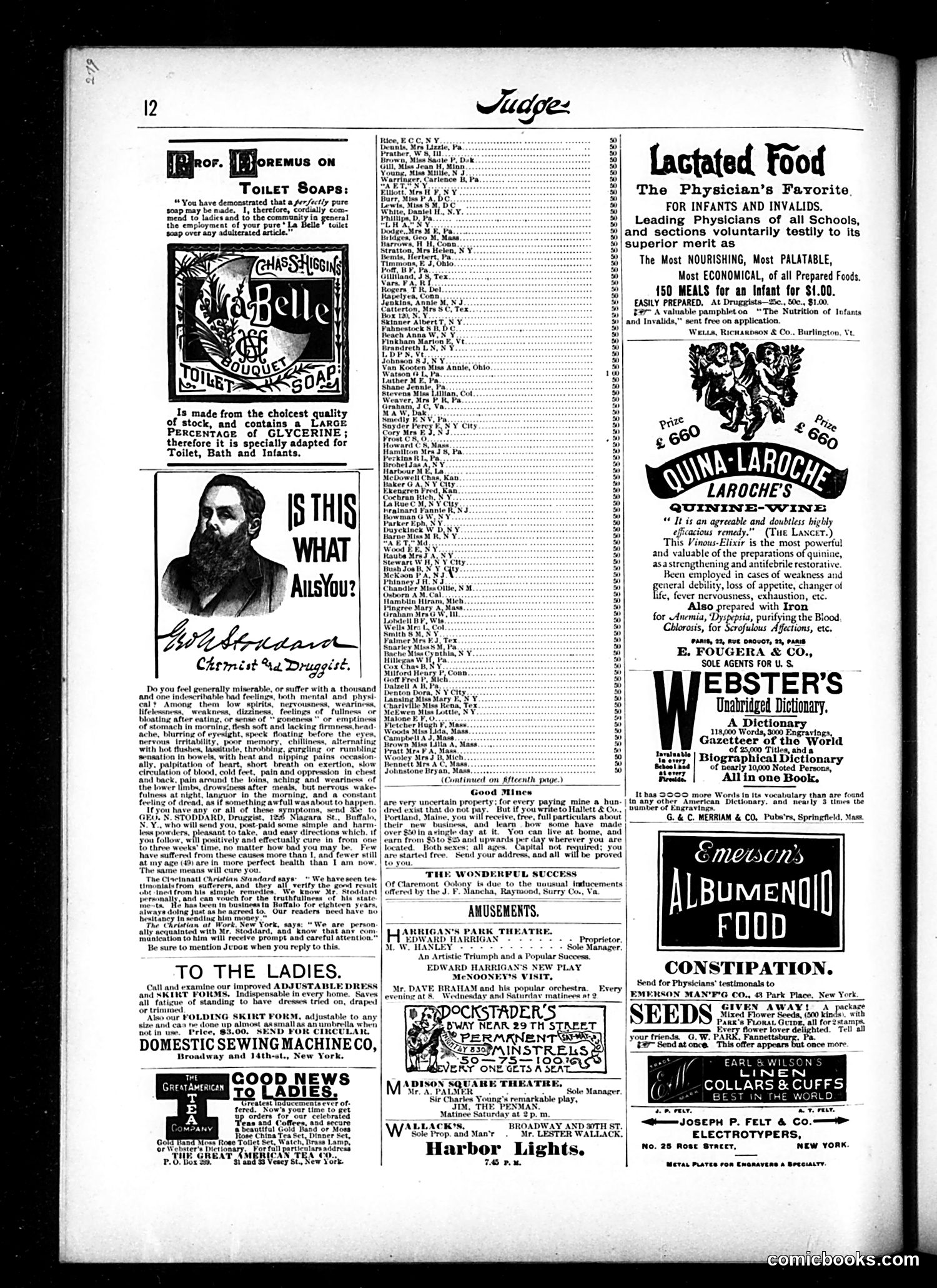
This page is primarily **advertising** with limited satirical content. The key cartoons are: 1. **"Is This What Ails You?"** - Shows a man's face with a list of symptoms (fatigue, nervousness, poor memory, palpitations, etc.). This advertises Dr. N. Stoddard's mail-order "cure powders" for vague ailments. Modern readers should know: in the 1880s-90s, such dubious patent medicines exploited real but poorly understood health complaints, often profiting from hypochondria and using testimonials (like the fake "Cincinnati Christian Standard" quote) to build credibility. This was common quackery pre-FDA. 2. Various **product endorsements** from celebrities and "leading physicians" are scattered throughout—standard advertising that claimed medical authority. The page exemplifies **Gilded Age consumer culture and medical fraud**: Judge satirized such scams by running these ads alongside legitimate content, letting their absurdity speak for itself. Modern readers might compare this to today's supplement and wellness industry claims.
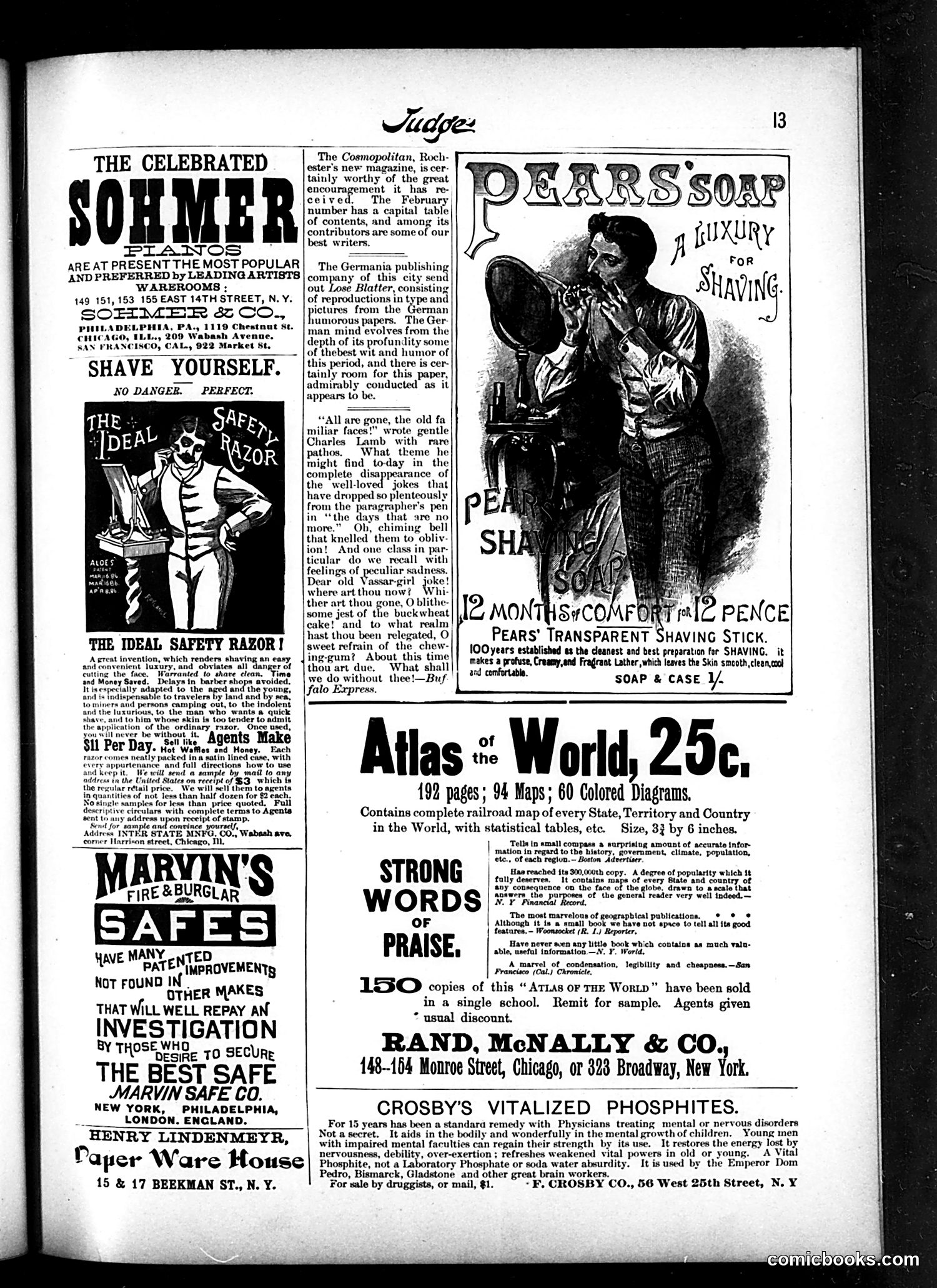
This is primarily an **advertising page** from Judge magazine, not a satirical cartoon page. The bulk consists of product advertisements typical of the era. The editorial content is minimal—brief commentary on recent magazine publications (The Cosmopolitan, a German humor paper called Lose Blatter) and a nostalgic lament about vanishing joke subjects. The author mourns the disappearance of familiar comedic themes, particularly **Vassar-girl jokes and buckwheat-cake jokes**—apparently well-worn humor from an earlier era that had fallen out of fashion. This reflects changing tastes in American humor around this period. The advertisements reflect period concerns: safety razors, safes, soap, and "vitalized phosphites" (a patent medicine claiming benefits for mental and physical vigor). The ads themselves contain no political content—they're purely commercial.
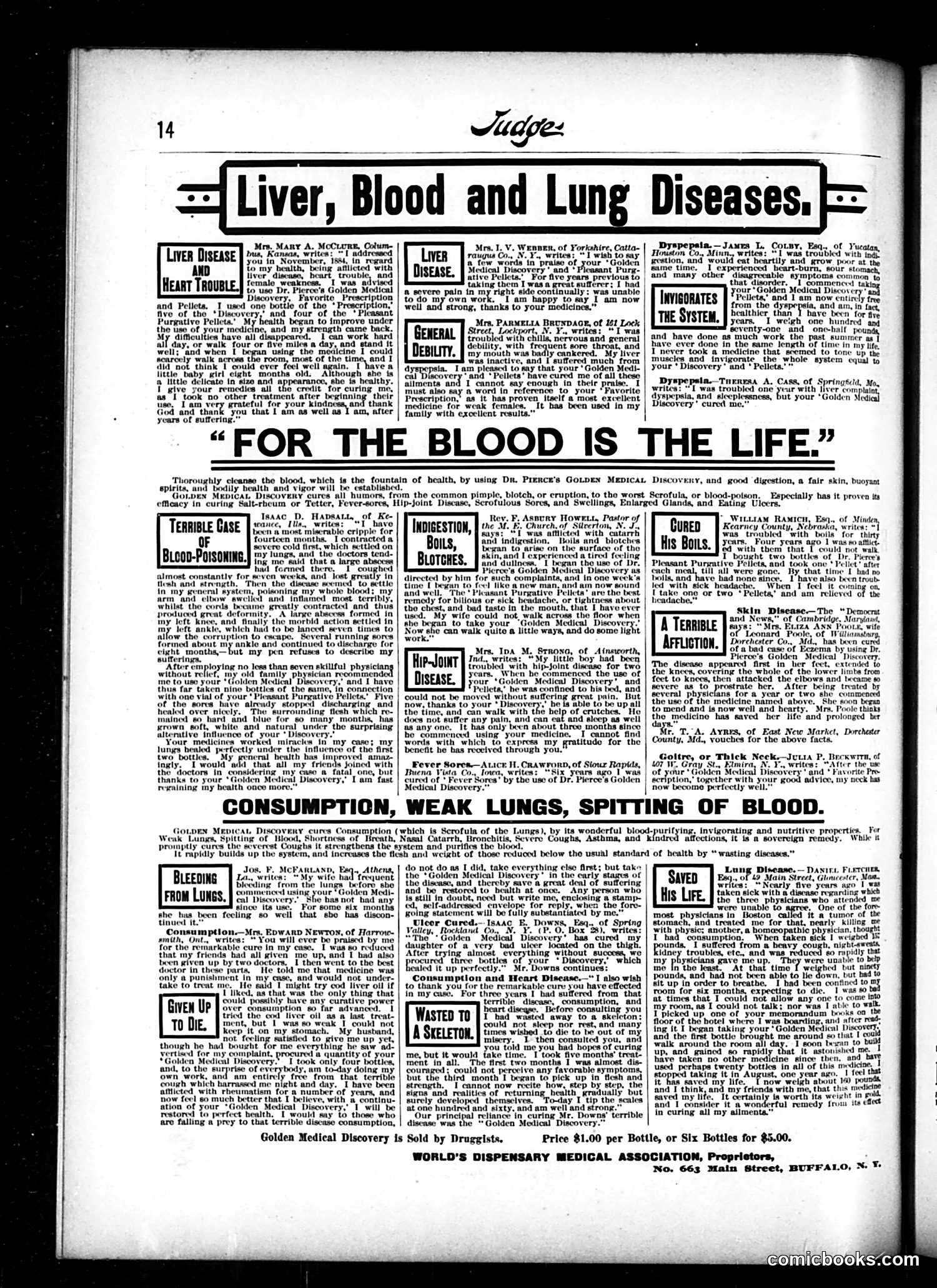
This page is primarily **advertising disguised as editorial content** — a common deceptive practice in 19th-century magazines. It contains testimonial letters praising Dr. Pierce's "Golden Medical Discovery," a patent medicine claiming to cure liver disease, blood disorders, lung problems, dyspepsia, and various other ailments. **The satire/critique:** Judge magazine was satirizing **medical quackery and false advertising**. The exaggerated testimonials (miraculous recoveries from multiple serious conditions) and the grandiose claims ("FOR THE BLOOD IS THE LIFE") mock the era's patent medicine industry, which made unfounded health claims to desperate, suffering people. **Key context:** Patent medicines were largely unregulated in the 1880s-1890s. Such products often contained harmful ingredients (sometimes opium or alcohol) and no proven efficacy. By publishing these testimonials alongside other content, Judge was highlighting how credulous consumers and irresponsible publishers enabled medical fraud. The page represents **early consumer skepticism** toward pharmaceutical marketing.
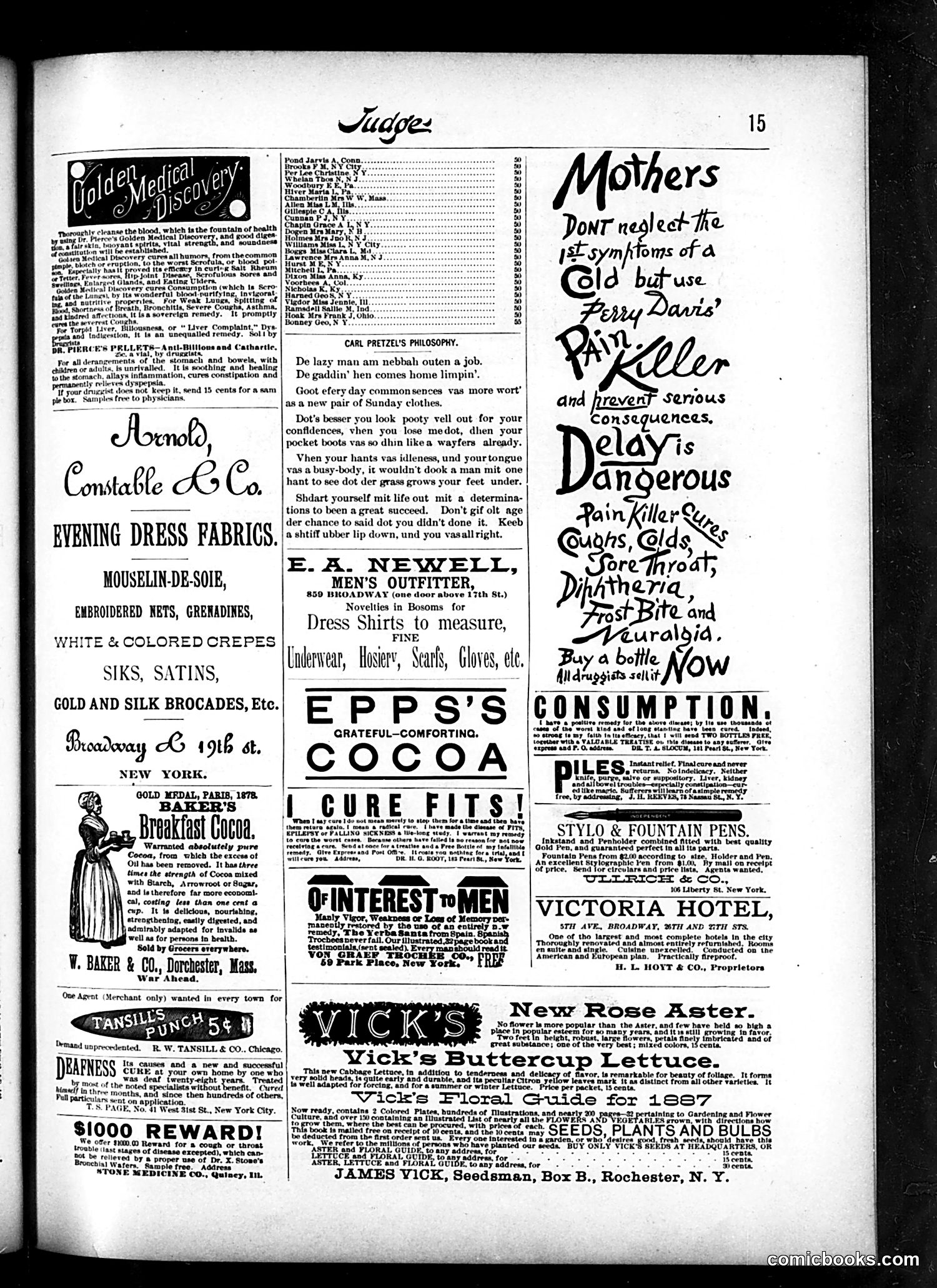
This page is primarily **advertising**, not political satire. It contains commercial notices for late 19th-century products and services typical of the period. Notable content includes: **"Carl Pretzel's Philosophy"** — A humorous column featuring deliberately broken English ("De lazy man am nebbah outen a job"). This reflects the period's common ethnic humor stereotype of German immigrants, rendered through exaggerated dialect. **Patent medicine ads** — Including "Golden Medical Discovery," "Perry Davis' Pain Killer," and treatments for consumption (tuberculosis). These represent the largely unregulated medical marketplace of the era, when such products made expansive health claims without scientific backing. **Product advertisements** — Evening dress fabrics, cocoa, fountain pens, and hotels reflect the commercial interests of Judge's upper-middle-class readership. The page demonstrates how satirical magazines financed themselves through advertising while reflecting period attitudes toward ethnicity, unproven medical treatments, and consumer culture.
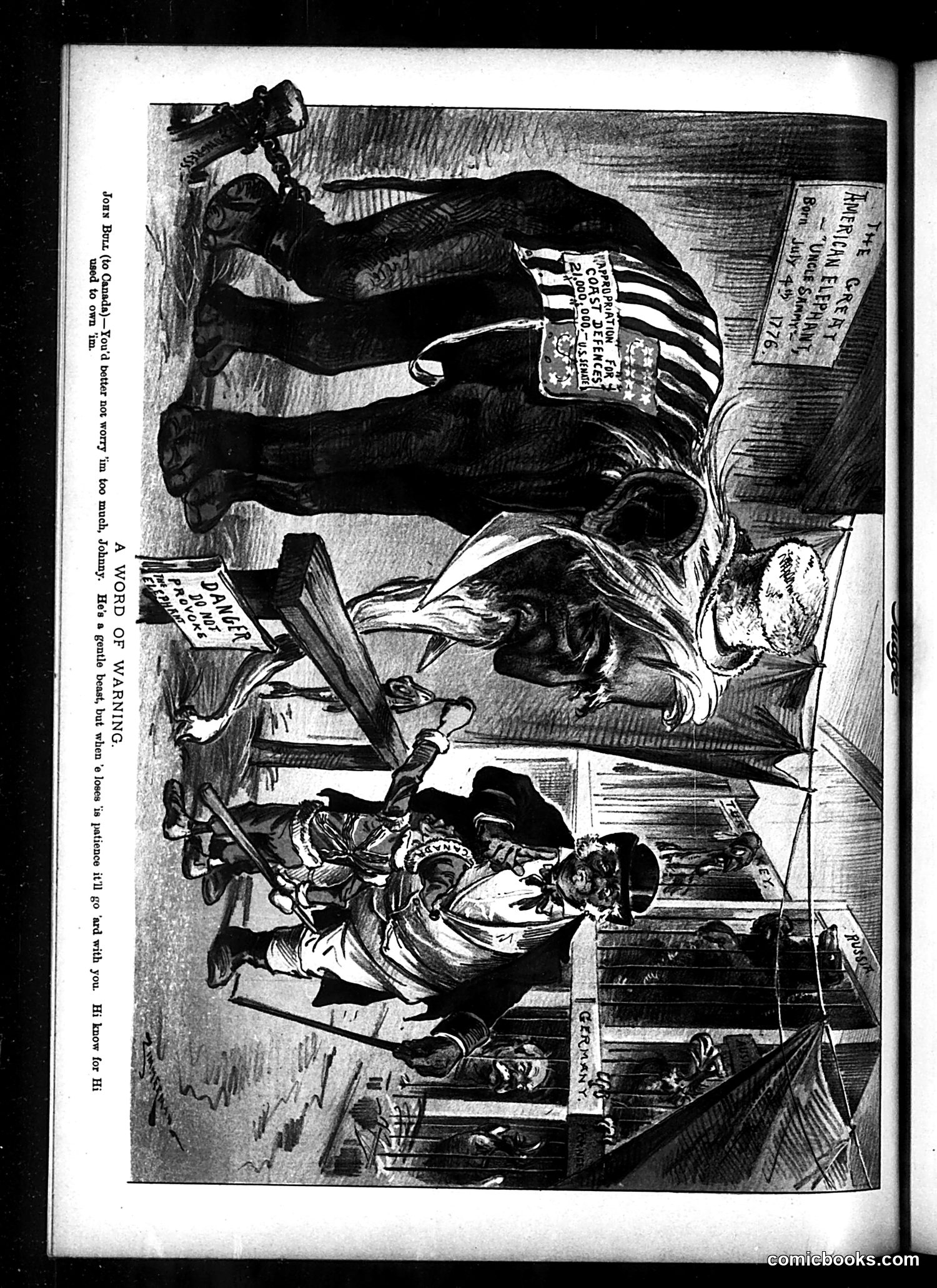
This is a satirical cartoon titled "A Word of Warning" depicting international relations. The figure labeled "John Bull" (personification of Britain) addresses "Canada," warning about a third party—likely the United States, depicted as a donkey or mule. The satire warns Canada against provoking America, with John Bull claiming former ownership/control and knowledge of the beast's dangerous temperament when angered. This reflects late 19th-century tensions: Britain's declining influence over its dominion Canada, America's growing power, and anxieties about potential conflict between North American neighbors. The cartoon uses the "John Bull" stereotype and animal metaphor to comment on shifting imperial relationships and the delicate balance between these nations.