
A complete issue · 16 pages · 1886
Judge — October 30, 1886
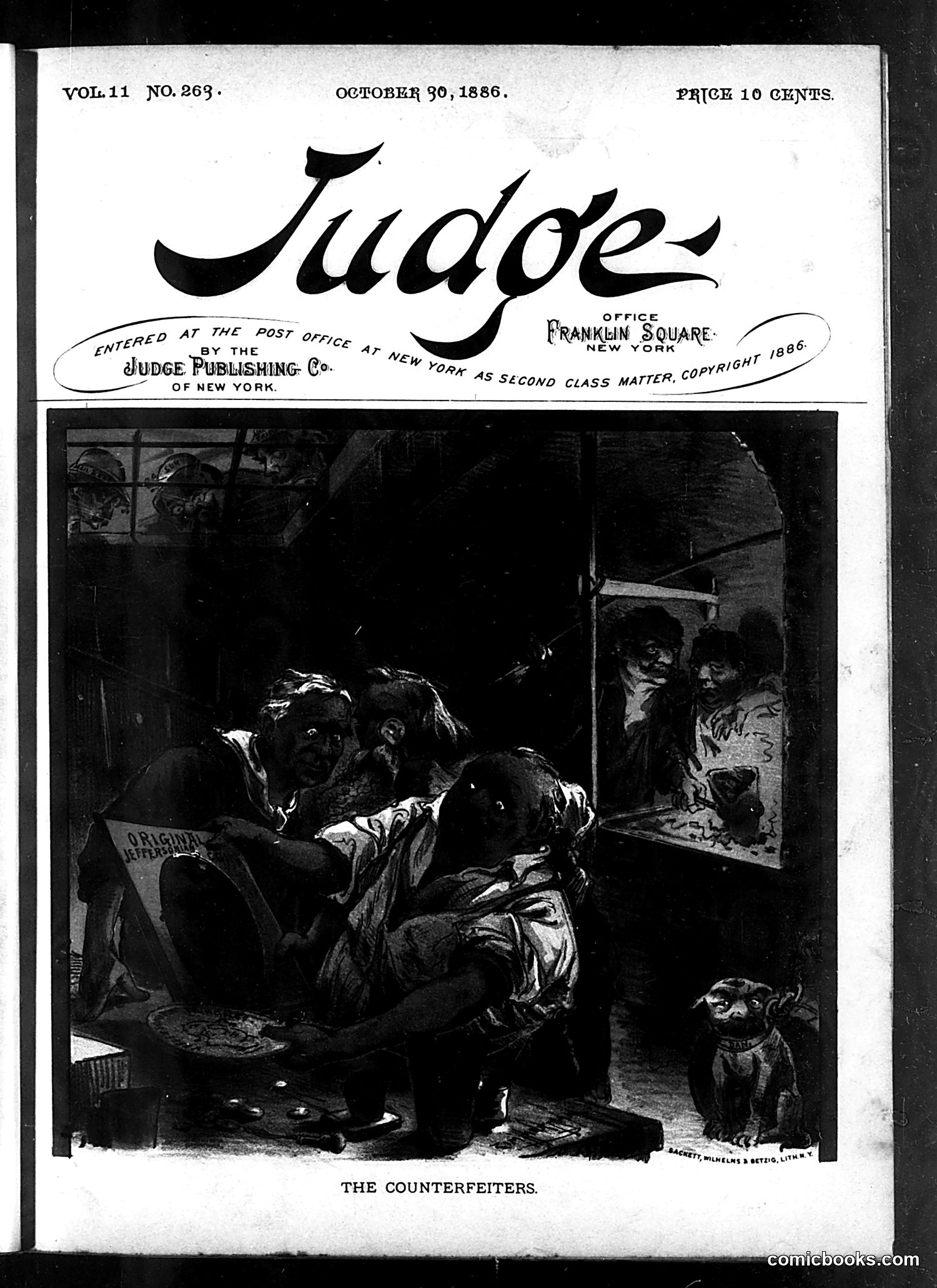
This illustration depicts a group of poorly-dressed men examining counterfeit currency or documents by lamplight, while two figures observe from a window above. A dog is present in the scene. The title "The Counterfeiters" suggests this is satirizing illegal currency counterfeiting, which was a significant crime problem in late 19th-century America. The dark, clandestine setting emphasizes the criminal nature of the operation. Without additional context from accompanying text on this page, the specific political or social target of the satire is unclear. It may reference actual counterfeiting rings operating in 1886, or metaphorically comment on financial fraud or deception in business or politics during the Gilded Age. The crude conditions depicted suggest commentary on working-class criminality.
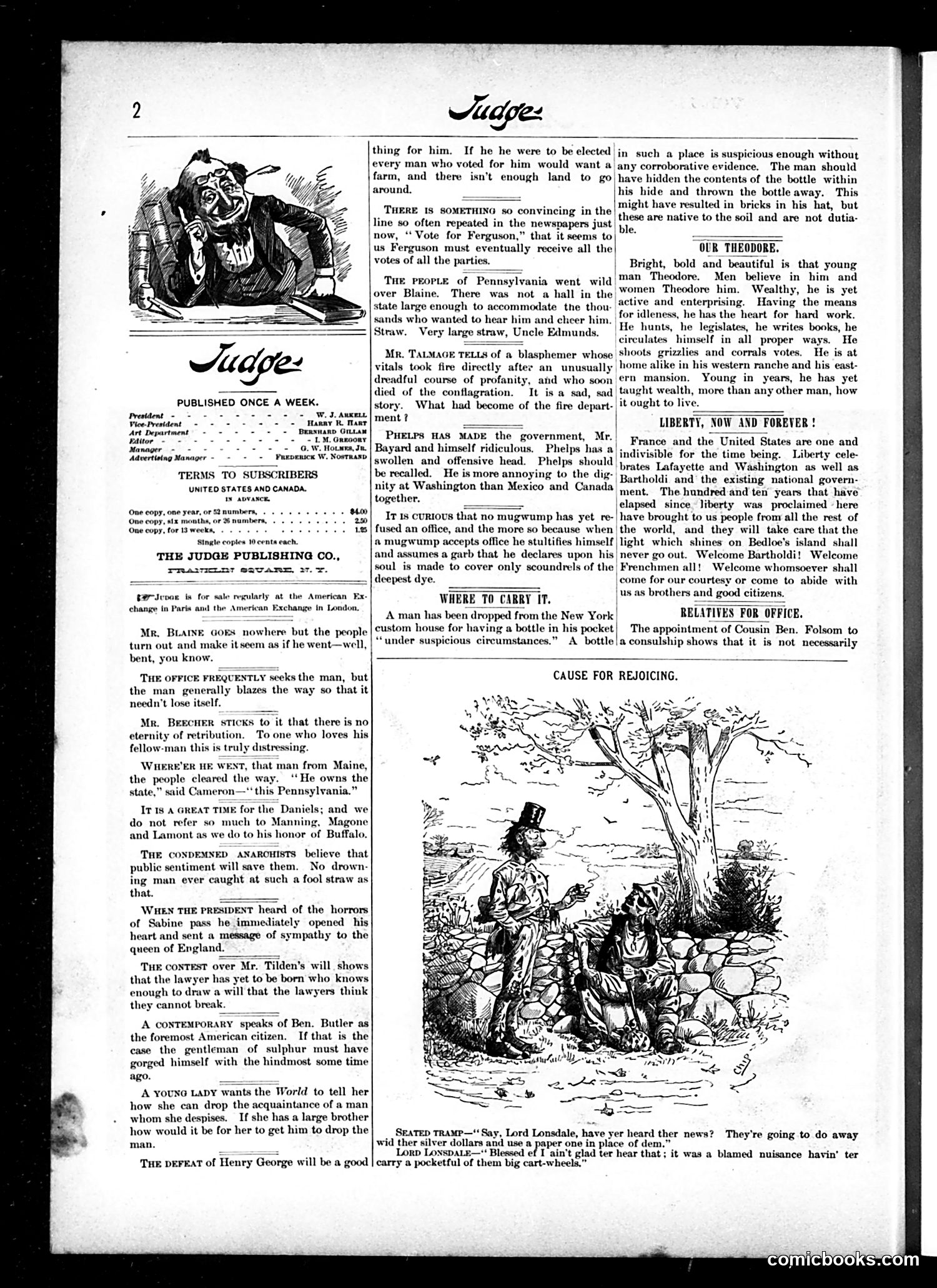
The page contains multiple political commentary pieces rather than a single cartoon. Key items include: **"Our Theodore"** - A favorable profile of Theodore Roosevelt, praising his youth, wealth, work ethic, and "proper ways." This appears supportive of Roosevelt's political standing. **"Liberty, Now and Forever!"** - Commentary celebrating Franco-American friendship and comparing Liberty's proclamation in America to French republicanism. **"Cause for Rejoicing"** - A cartoon showing what appears to be wealthy or upper-class figures discussing silver dollars and currency policy, likely satirizing debates over monetary standards during this era. The text references various political figures and issues (Blaine, Phelps, Butler) suggesting this addresses late 19th-century American politics, though specific dates and contexts aren't clearly marked on this page fragment.
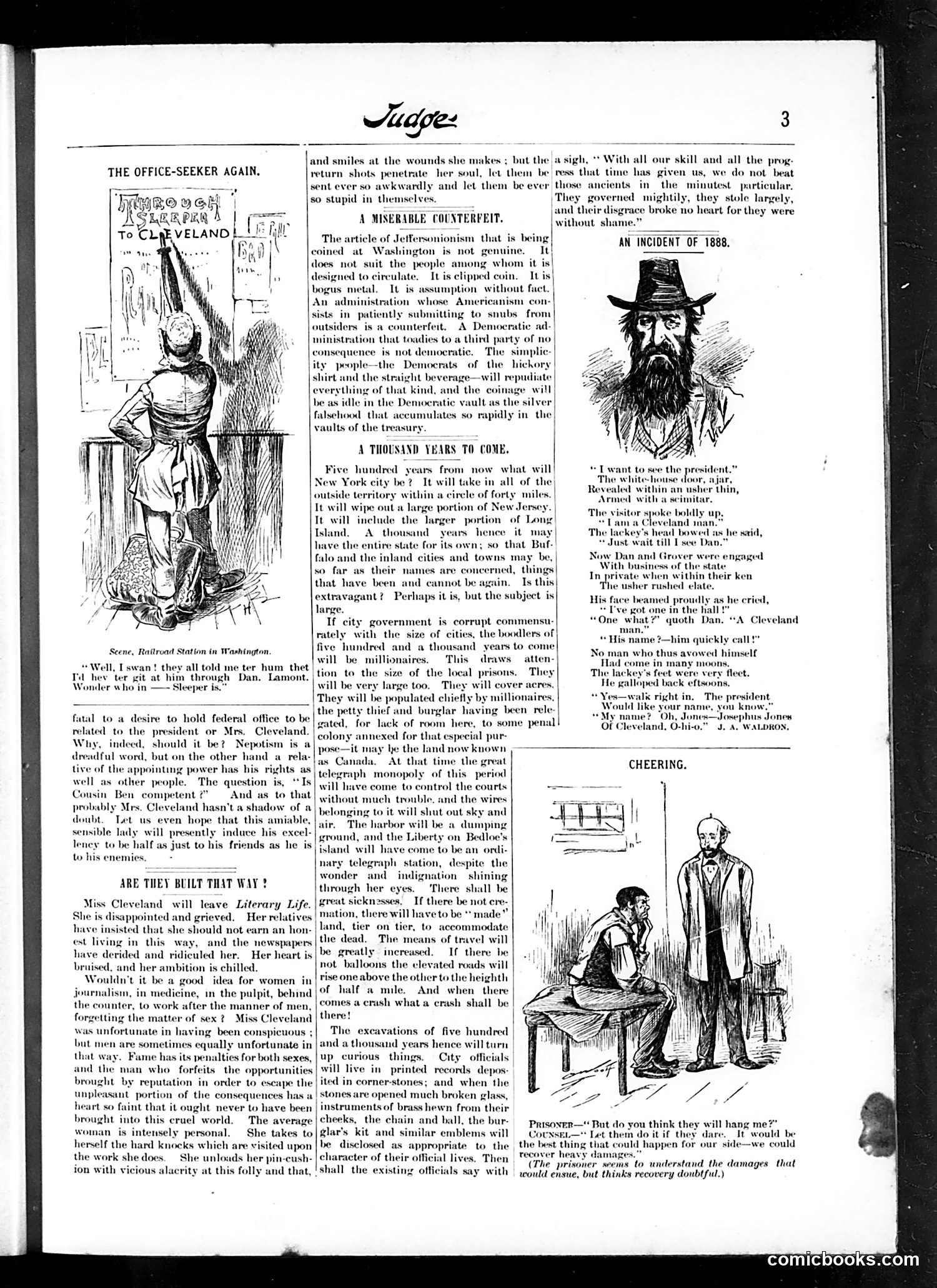
## Main Cartoons: **"The Office-Seeker Again"** depicts a woman in classical dress (Lady Liberty) at a railroad station in Washington, being importuned by a man seeking federal employment. The satire criticizes office-seekers pursuing political patronage regardless of qualifications. **"An Incident of 1888"** shows a visitor attempting to see President Cleveland at the White House. The dialogue humorously portrays bureaucratic runaround—the visitor is sent back and forth, finally told "walk right in" only to discover he's been deceived. This mocks Cleveland administration inefficiency or deception. ## Political Context: The articles criticize the Cleveland administration for "counterfeiting" Democratic principles by submitting to outside pressure and political compromise. References to "Jeffersonionism" invoke idealized Democratic values supposedly abandoned by Cleveland's policies. The satire targets federal patronage systems, administrative corruption, and perceived hypocrisy of Democratic leadership—suggesting gap between stated principles and actual governance during Cleveland's presidency (1885-1889).
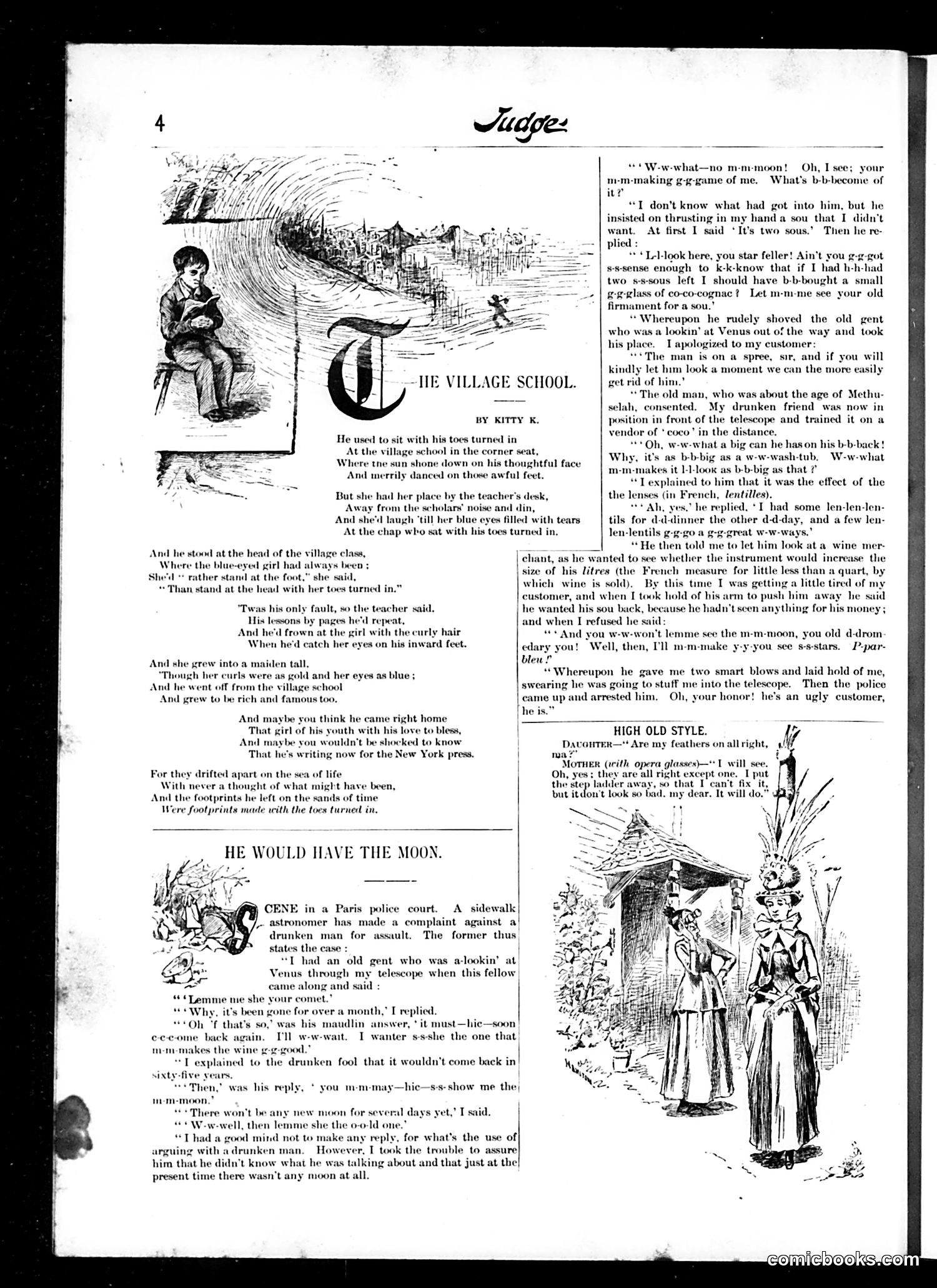
This page contains two humorous stories typical of late-19th-century satirical magazines: **"The Village School"** (left): A sentimental poem about a boy with pigeon-toed posture who becomes successful as a journalist despite a schoolgirl's initial mockery of his "toes turned in." The irony is that his physical peculiarity didn't prevent achievement—the girl who scorned him is left behind while he writes for the prestigious *New York press*. **"He Would Have the Moon"** (right): A comic anecdote about a Parisian sidewalk astronomer's confrontation with a drunk man. The drunk insists on seeing the moon through a telescope (there is none), mistakes the magnified image of a wine merchant's storefront for the moon, and becomes enraged when denied a refund. He's arrested after threatening to "stuff" the astronomer into the telescope. Both pieces mock human folly—vanity and drunken obstinacy—common Judge themes. No specific political figures are caricatured; instead, these are genre sketches satirizing everyday social types.
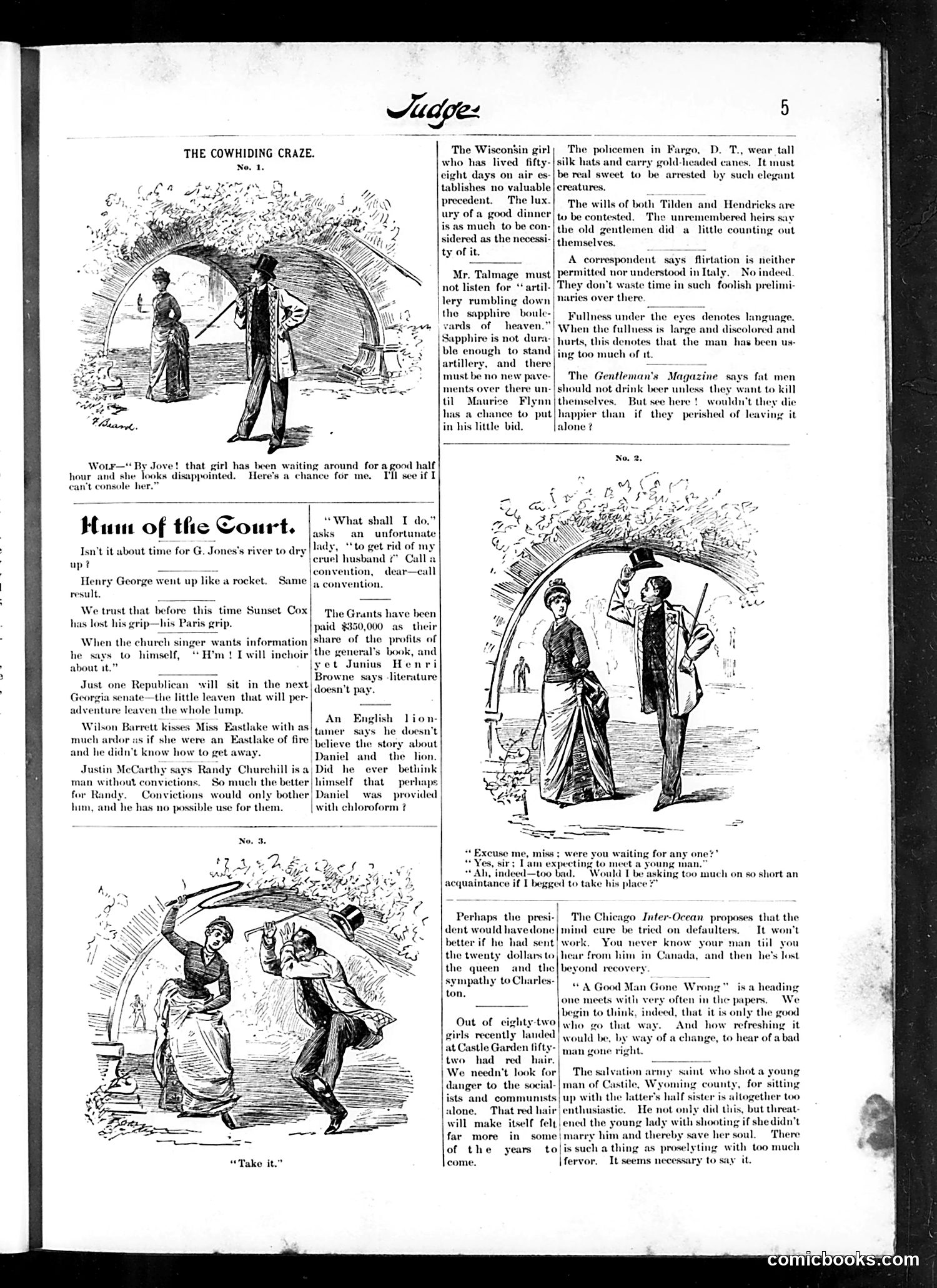
This page from Judge contains several brief satirical items mocking contemporary figures and events, centered on "The Cowhiding Craze"—likely referencing incidents of physical assault that were apparently newsworthy at the time. The cartoons illustrate romantic or social encounters with humorous captions. The text items below ridicule various public figures: Henry George (political reformer), Sunset Cox (politician), and references to church singers, Republicans, and actors. Notably, one item mocks a Wisconsin woman who survived eight days without food, another critiques fat men, and several jab at politicians' scandals—including Grant's book profits and contested wills of Tilden and Hendricks (likely 1884 election figures). The satire employs wordplay and ironic observations about contemporary manners, religion, and politics. Without specific dates visible, the exact historical context remains somewhat unclear, though references suggest post-Civil War American political turbulence and social commentary typical of Judge's irreverent style.
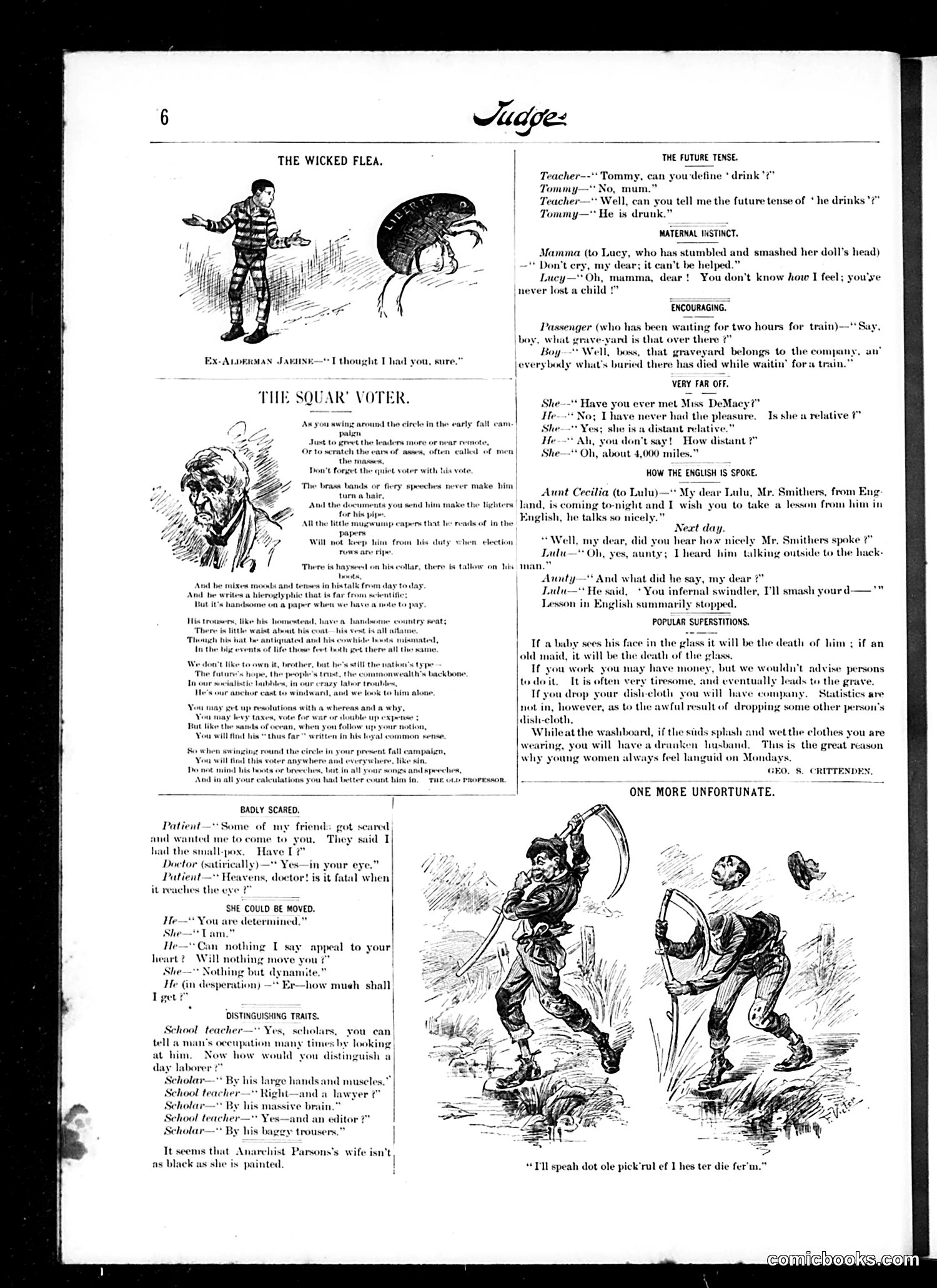
This page contains multiple short comedic pieces and cartoons typical of Judge's satirical humor: **"The Wicked Flea"** shows an ex-alderman chasing a flea—likely satirizing political corruption ("I thought I had you") slipping away from justice. **"The Squar' Voter"** depicts a working-class farmer immune to political speeches and manipulation, loyal only to his duty to vote—celebrating ordinary citizens' independence from rhetorical persuasion. **"One More Unfortunate"** cartoon shows someone falling or drowning, suggesting social tragedy or misfortune. The remaining pieces are brief humorous dialogues on domestic and social topics: medical quackery, romantic stubbornness, occupational distinction, grammar lessons with Irish immigrants, and folk superstitions. The "How the English is Spoke" section mocks both Irish and immigrant speech patterns common in period satire. Overall, this reflects 1880s-90s American concerns: political corruption, working-class virtue, immigration, and social anxieties presented through gentle ridicule.
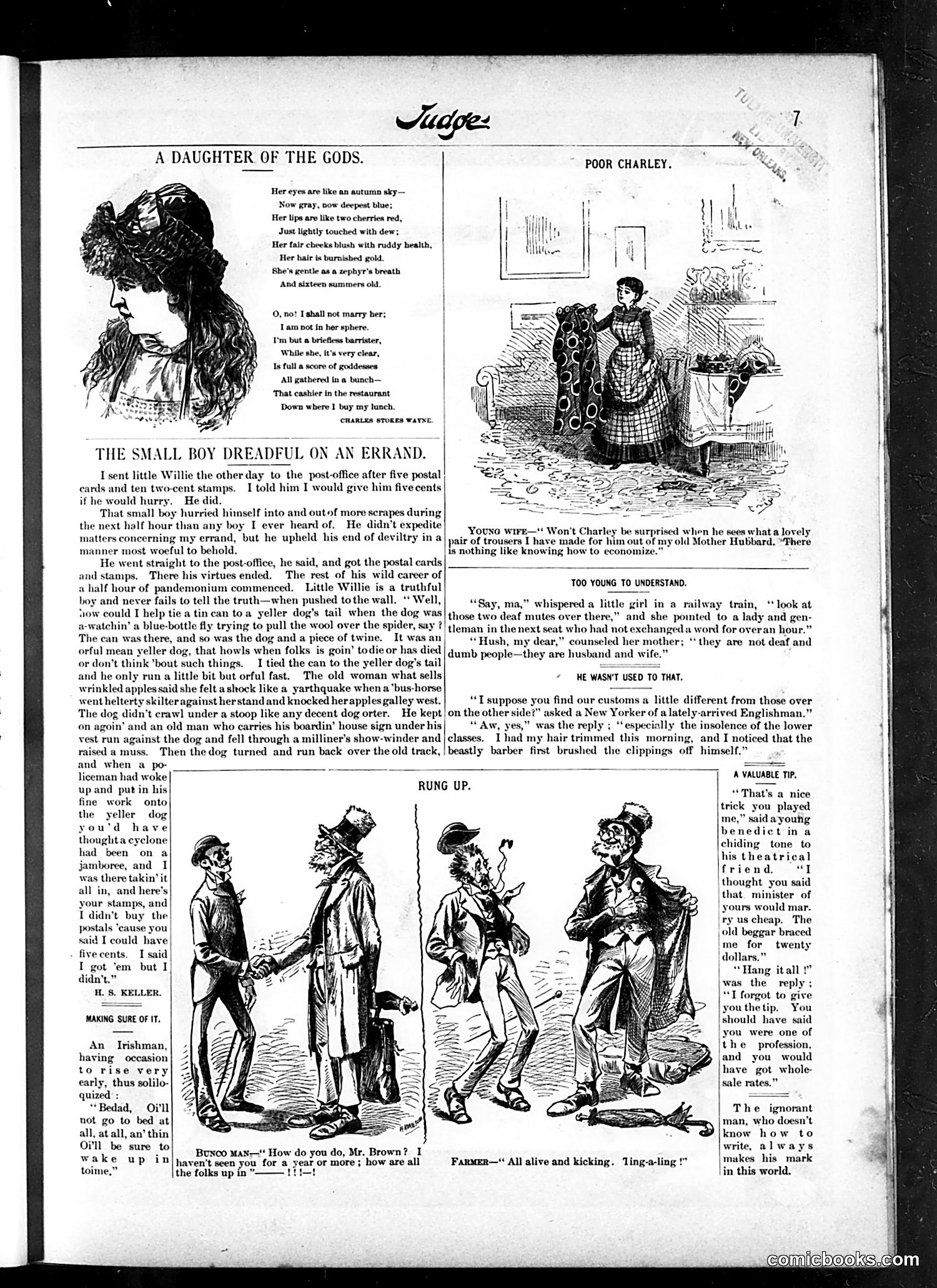
This page from Judge contains several satirical pieces targeting social conventions and human nature: **"A Daughter of the Gods"** mocks romantic idealization. A bachelor admires a beautiful young woman but won't marry her—she's merely the restaurant cashier where he eats lunch, socially beneath his status as a "briefless barrister." The satire exposes class pretension: he worships her from afar while dismissing her as unsuitable. **"The Small Boy Dreadful on an Errand"** satirizes childhood mischief. Young Willie completes his errand but causes chaos: tying a can to a dog's tail that crashes through a milliner's window and disturbs a policeman. The humor lies in his literal truthfulness—he did get the stamps, but caused mayhem. **"Too Young to Understand"** jokes about silent married couples, implying long marriages kill conversation. **"He Wasn't Used to That"** mocks English snobbery: a newly-arrived Englishman complains about American "insolence," specifically that a barber brushed hair clippings off himself rather than waiting for the customer to do so—absurd upper-class expectation.
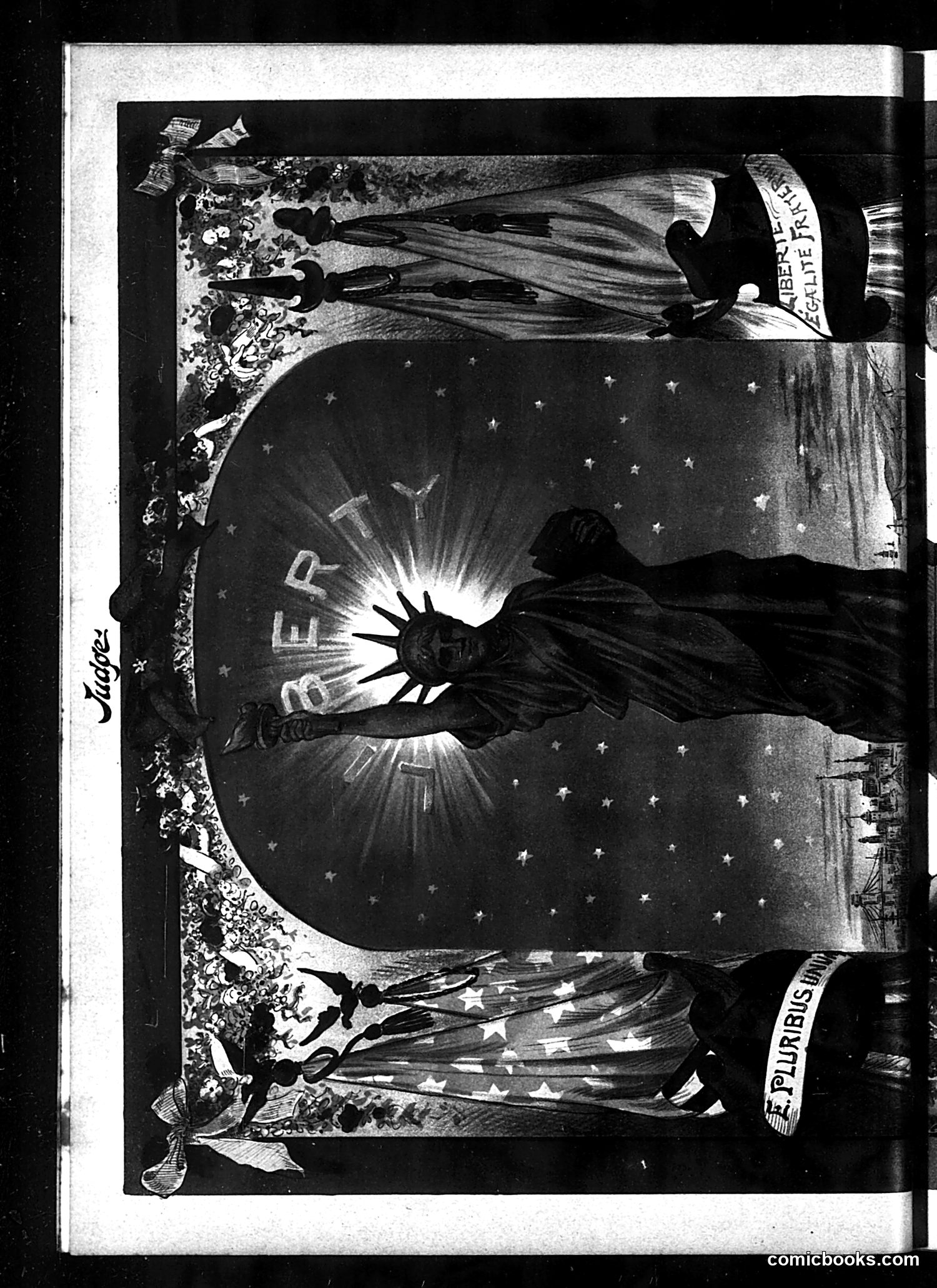
This page from *Judge* magazine appears to be a patriotic illustration rather than a political cartoon. The image shows a silhouetted figure in classical dress reaching toward or embracing the Statue of Liberty, which glows brightly at the center. Stars scatter across a dark sky, and decorative borders with floral and patriotic motifs frame the composition. The text fragments visible ("PLURIBUS UNUM" and references to "REPUBLIC") suggest this celebrates American ideals and democratic principles. The reaching figure likely represents either Liberty herself or an allegorical representation of the American people or nation embracing these ideals. Without clearer OCR text or a visible date, the specific satirical point remains unclear, though the overall message appears patriotic rather than sharply critical.
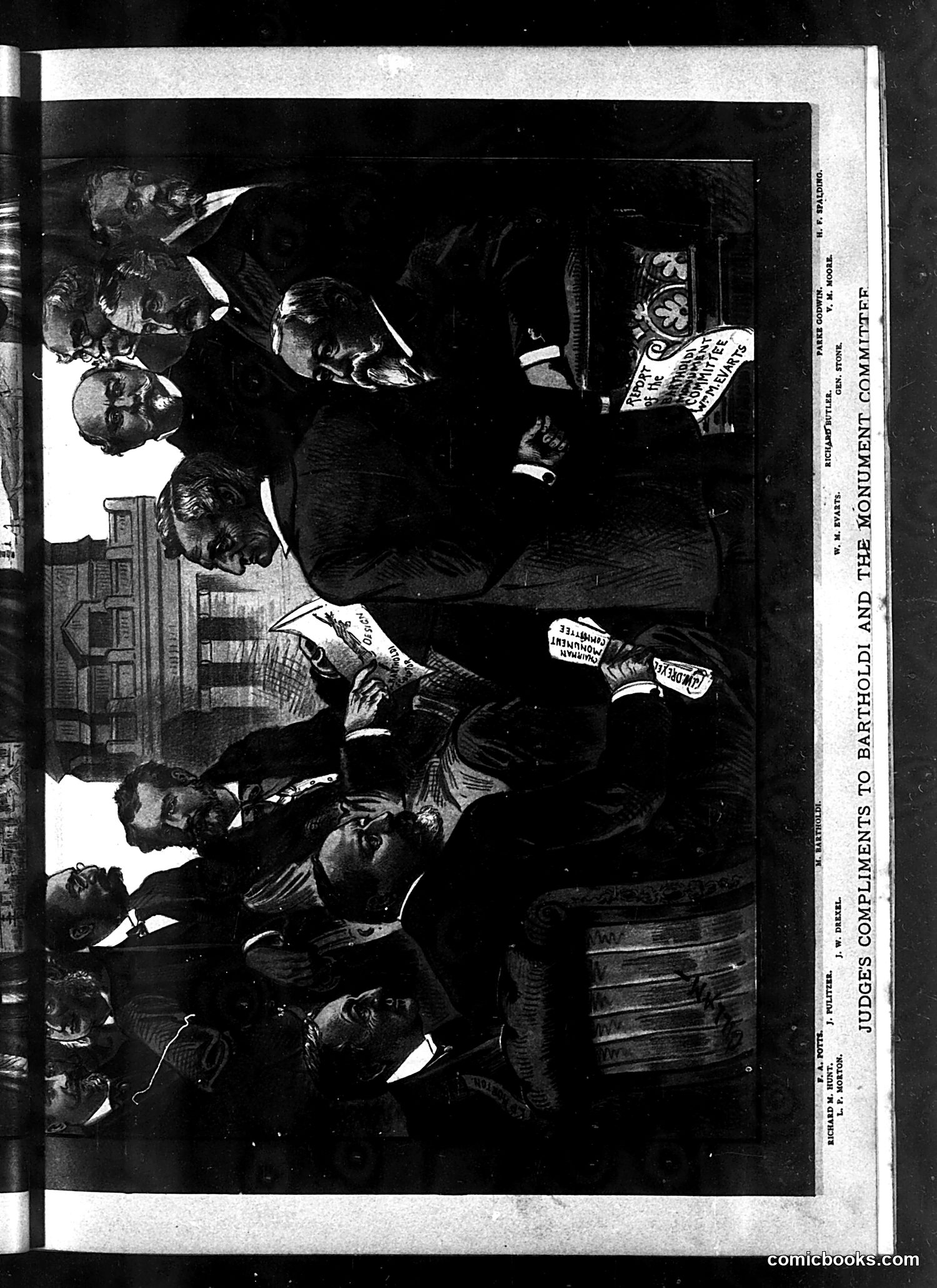
This page appears to be rotated 90 degrees, making the image difficult to interpret with certainty. The caption reads "JUDGES COMPLIMENTS TO BAREHOLD AND THE MONUMENT COMMITTEE," suggesting the cartoon satirizes judges offering congratulations to someone named Barehold and a monument committee. The figures appear to be caricatured men in formal dress, possibly judges or officials, presenting what looks like a document or certificate. The architectural element on the left suggests a building or monument structure. However, the OCR text is heavily corrupted and unreadable, and the image's rotation and quality make specific identification of the figures and the precise satirical point unclear. Without being able to read the caption properly or identify the historical context of "Barehold" and the specific monument committee referenced, I cannot reliably explain the joke or political reference to a modern reader. More context would be needed.
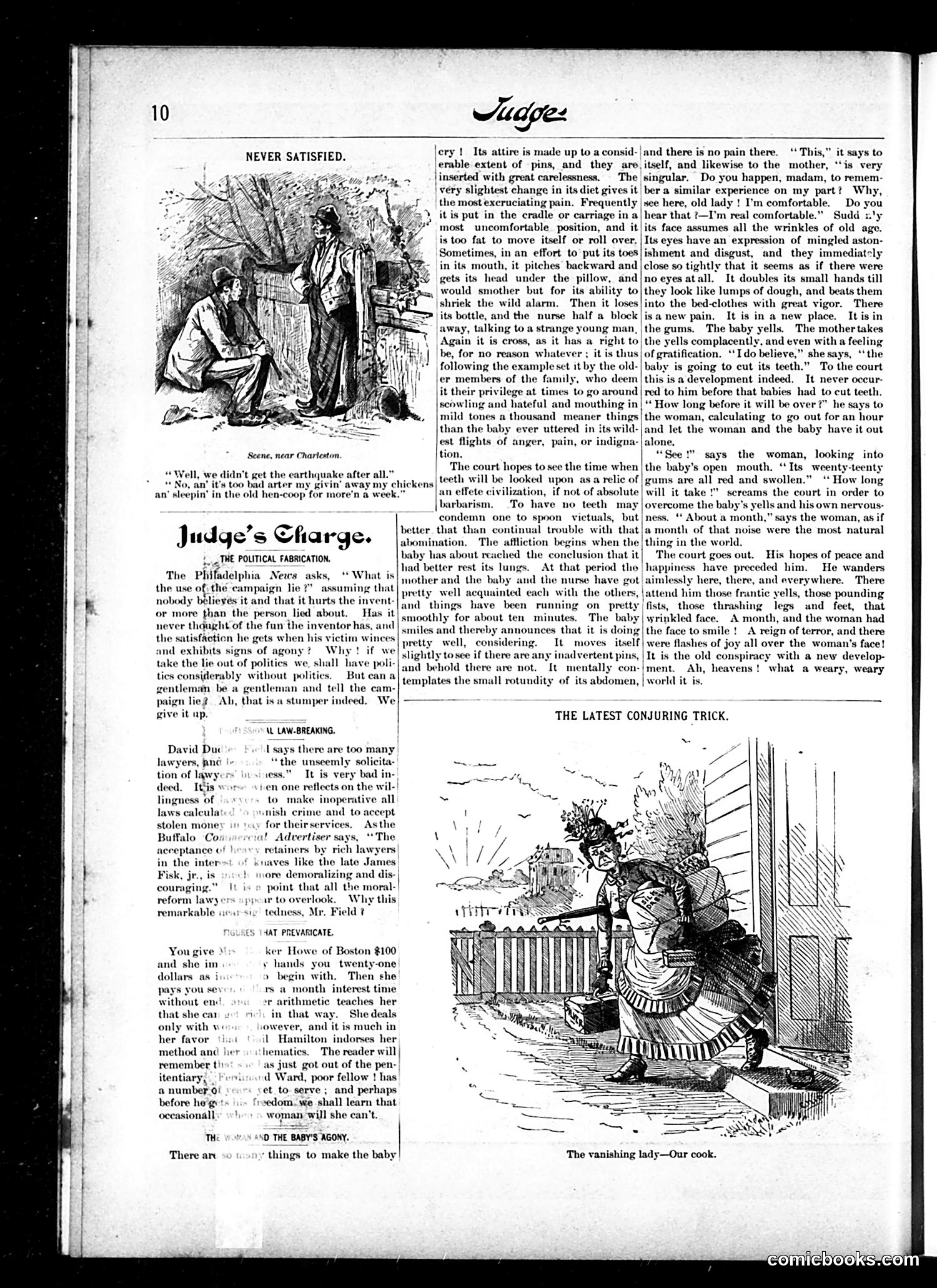
This page contains satirical commentary on American politics and social issues circa the Gilded Age. **"Judge's Charge: The Political Fabrication"** mocks the normalization of campaign lies in politics. Judge argues that removing lies from politics would eliminate politics itself—suggesting political dishonesty is fundamental to the system. **"A Law-Breaking"** criticizes wealthy lawyers who defend criminals and enable moral corruption. It references James Fisk Jr. (a notorious 1870s financier/robber baron), arguing that rich lawyers demoralizing the legal profession deserve blame for undermining reform. **"The Latest Conjuring Trick"** (bottom illustration) shows a magician making a cook disappear—likely satirizing either labor disputes, servant shortages, or immigration issues of the era. The opening scene "near Charleston" appears to mock Southern expectations following an earthquake, possibly referencing post-Civil War regional tensions. Throughout, Judge adopts a moralistic tone criticizing corruption, legal malfeasance, and political dishonesty while reflecting era-typical social anxieties.
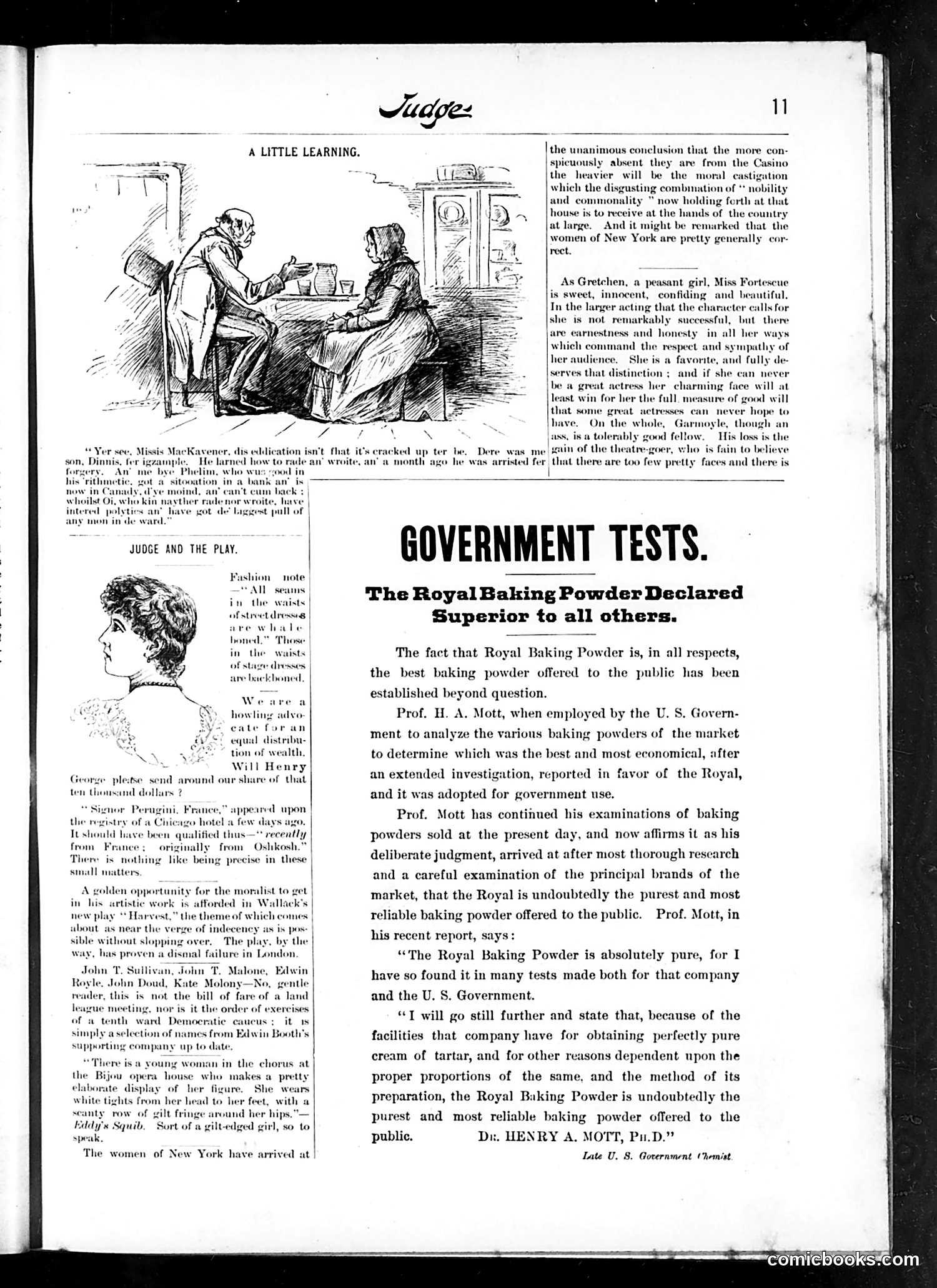
The top cartoon depicts a working-class Irish immigrant (identifiable by dialect in the caption) discussing his son's "education"—he learned to read, write, and arithmetic a month ago but was arrested for forgery. The satire mocks both the father's pride in minimal learning and the suggestion that basic education without moral development produces criminals. The political point: education alone doesn't reform the working poor; character matters. The second section, "Judge and the Play," reviews an actress (Miss Fortescue) playing Gretchen. The commentary praises her earnestness and "charming face" while noting she lacks the skill for larger dramatic roles—a gentle critique of her limitations as a performer. Both pieces reflect Judge magazine's skeptical, class-conscious humor about Irish immigrants and entertainment industry pretensions.
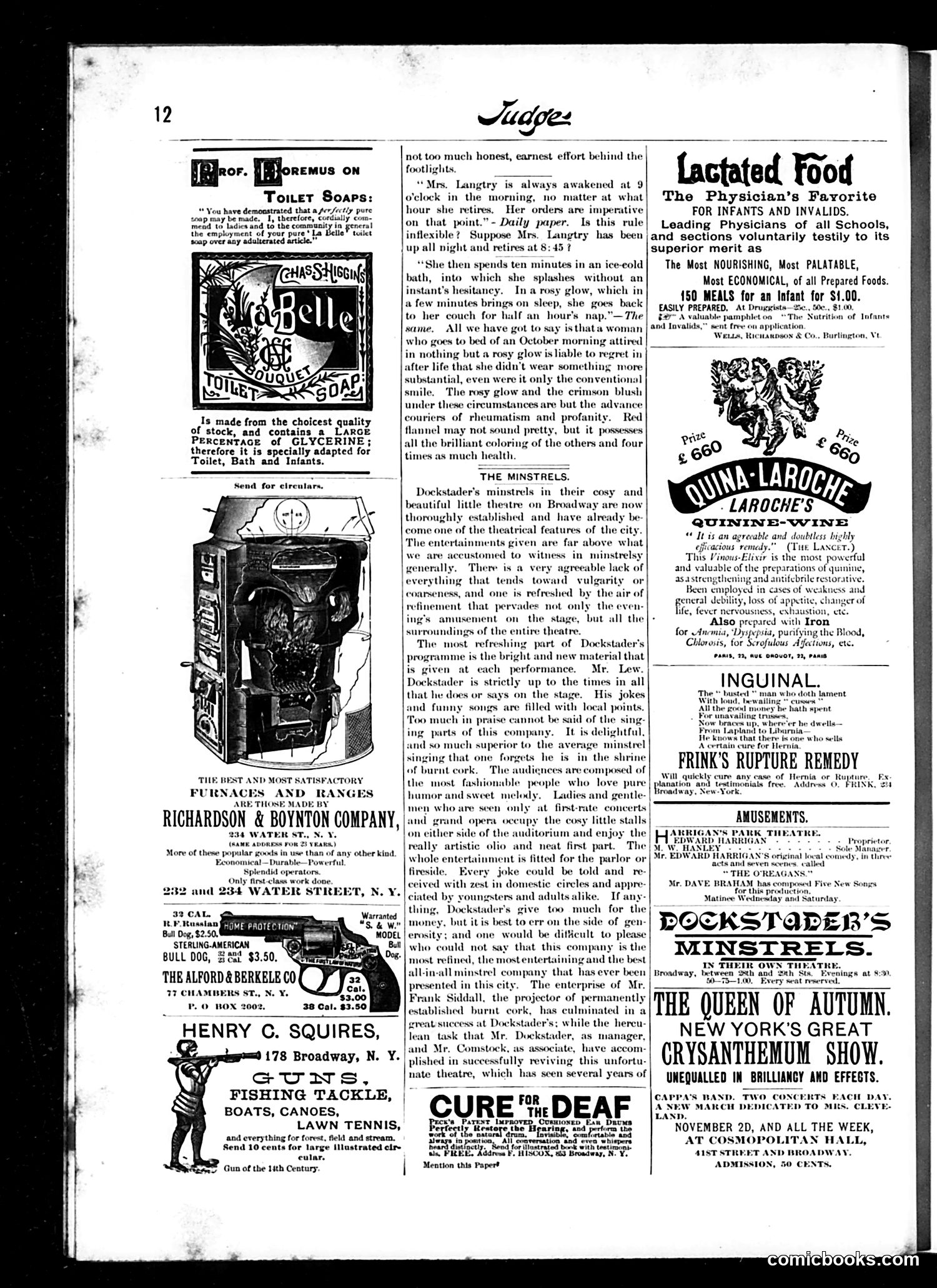
This page is primarily **advertisements and entertainment reviews**, not political satire. The main content includes: **Reviews:** A favorable critique of Dockstader's Minstrels (a popular theatrical entertainment featuring performers in blackface). The reviewer praises their "refined" humor, "local points," and superior quality compared to typical minstrelsy—though modern readers should note this celebrates what we now recognize as racist entertainment normalized in the 19th century. A separate humorous piece about **Mrs. Langtry** (likely the famous actress Lillie Langtry), mocking her reported disciplined morning routine of ice baths and rigid wake times, suggesting her "rosy glow" without proper clothing risks catching cold. **Advertisements:** Numerous product ads including toilet soaps, furnaces, firearms, fishing tackle, and patent medicines—typical of Judge's revenue model. No discernible political cartoons appear on this page. It reflects period attitudes toward entertainment and consumer goods.
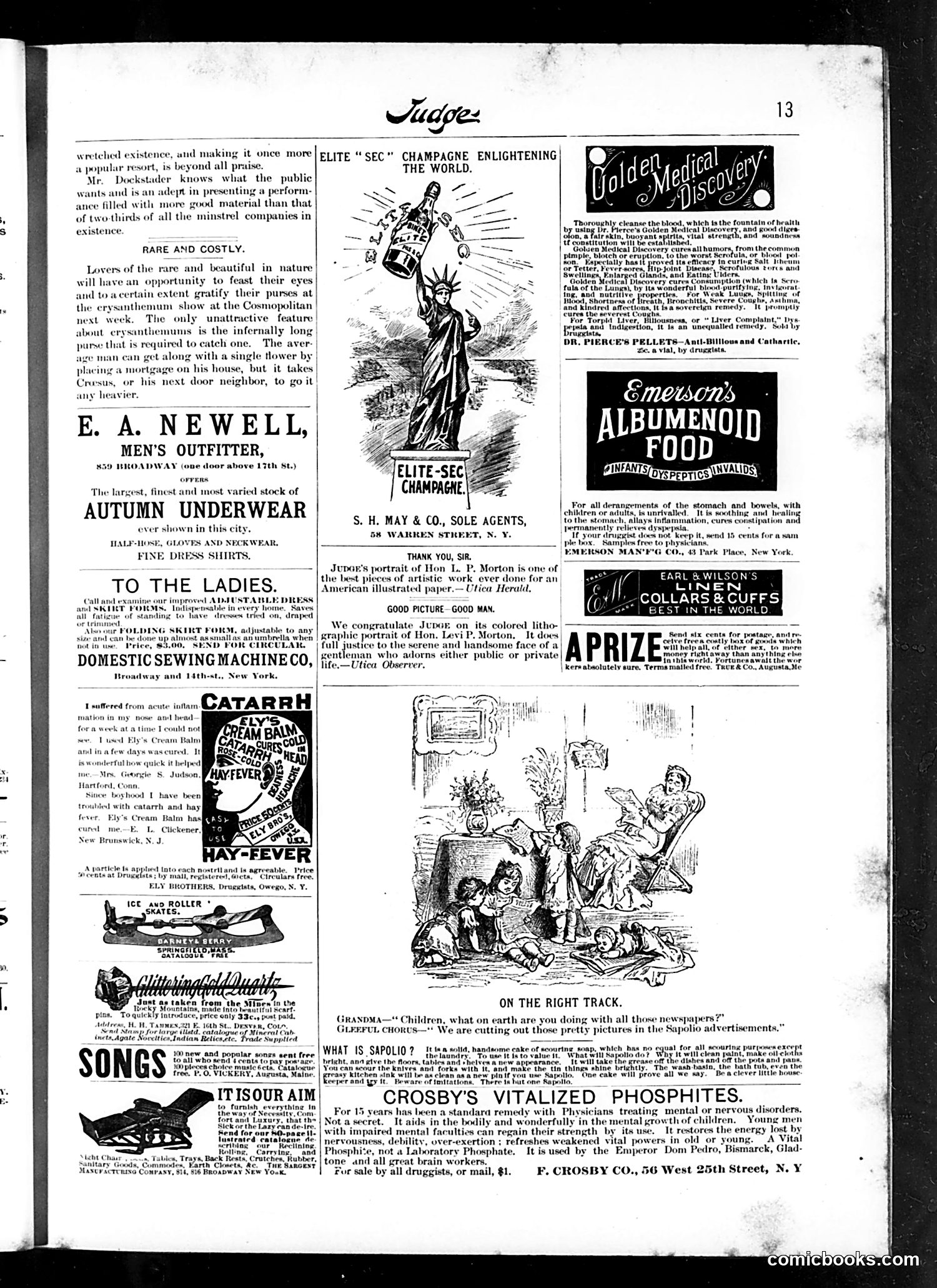
This page is primarily **advertising**, typical of late-19th-century magazines. However, it contains one notable editorial cartoon worth discussing: ## "On the Right Track" Cartoon The large central illustration shows children playing with newspapers and cutting out pictures—likely from Judge magazine itself, based on the caption's setup where a grandmother asks what they're doing with "all these newspapers." The joke appears to be **self-promotional**: it depicts families actively engaging with Judge's content (cutting out illustrations and advertisements), presenting this engagement as wholesome children's activity. It's a gentle, humorous pitch for the magazine's value to households. ## Context The page is surrounded by patent medicine ads (Ely's Cream Balm, Sapolio soap, Dr. Pierce's remedies, Crosby's Phosphites)—standard for the era. A reference to **Levi P. Morton** (likely Vice President at this time) appears in congratulatory text about Judge's portrait illustration of him. The overall effect is a magazine asserting its cultural importance while monetizing advertising space—nothing particularly satirical by modern standards, mostly commercial promotion dressed in light humor.
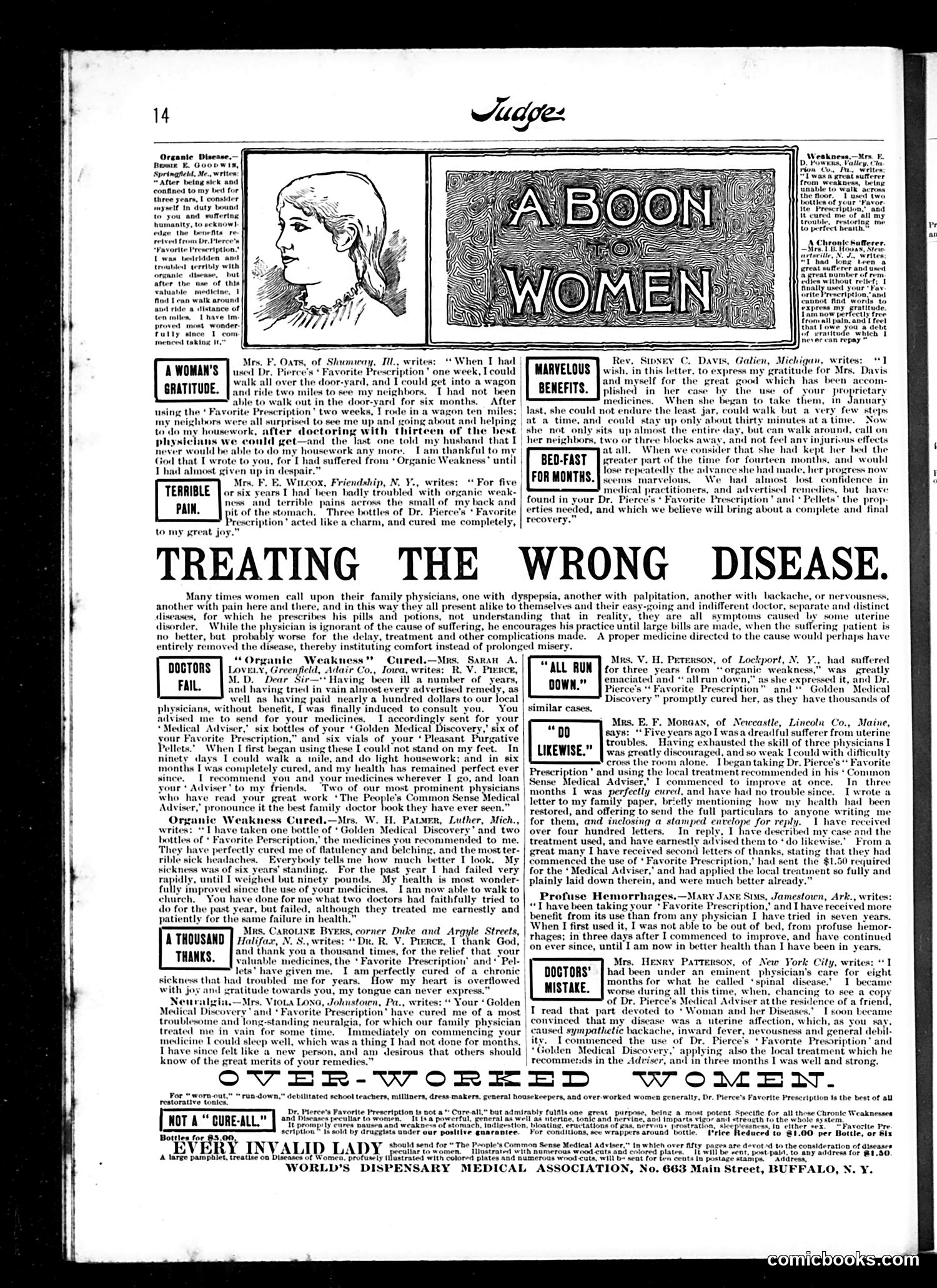
This page is primarily a patent medicine advertisement for Dr. Pierce's "Favorite Prescription," disguised as editorial content and testimonials. The cartoon depicts **a woman's face in profile**, likely representing the typical female patient. The satire's central point—expressed in the headline "TREATING THE WRONG DISEASE"—critiques how family doctors misdiagnose women's ailments. Rather than identifying the actual root cause (implied to be gynecological/"uterine disorder"), physicians prescribe generic treatments for surface symptoms like dyspepsia, palpitation, or backache, prolonging suffering and generating unnecessary bills. The testimonials claiming miraculous cures after using Pierce's remedy exploit this gap in medical knowledge. The advertisement ironically positions itself as *correcting* doctors' failures, while the "Doctors Fail" and "Thousand Thanks" sections reinforce distrust of conventional medicine. This represents exploitative patent medicine marketing of the late 19th/early 20th century, targeting women's health anxieties with unregulated, likely ineffective products.
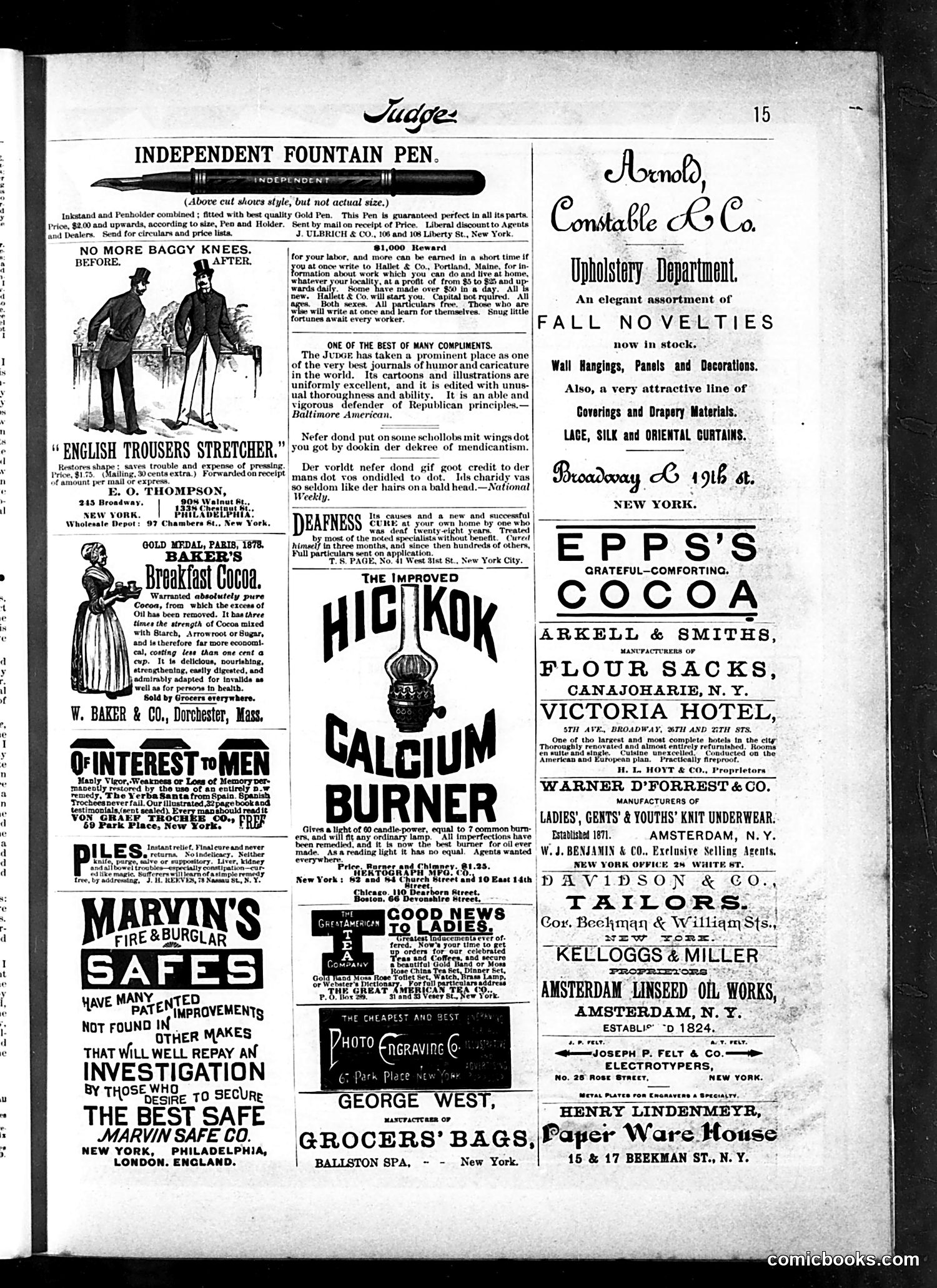
This is primarily an **advertising page** from Judge magazine with minimal editorial content beyond one cartoon. The single cartoon, "NO MORE BAGGY KNEES," shows two men demonstrating before/after results of the "English Trousers Stretcher," a $1.75 device. The joke appears straightforward: it mocks a trivial consumer product claiming to solve the petty problem of baggy knees in men's trousers. This satirizes the era's proliferation of questionable gadgets and miracle products heavily marketed to consumers. The page is otherwise dominated by paid advertisements typical of late-19th-century magazines: patent medicines (Von Graefe Troches for weakness), safes (Marvin's Fire & Burglar Safes), cocoa (Baker's), gas lamps (Hickok Calcium Burner), and various other commercial products. The ad copy emphasizes reliability, patent status, and testimonials—marketing strategies of the period.
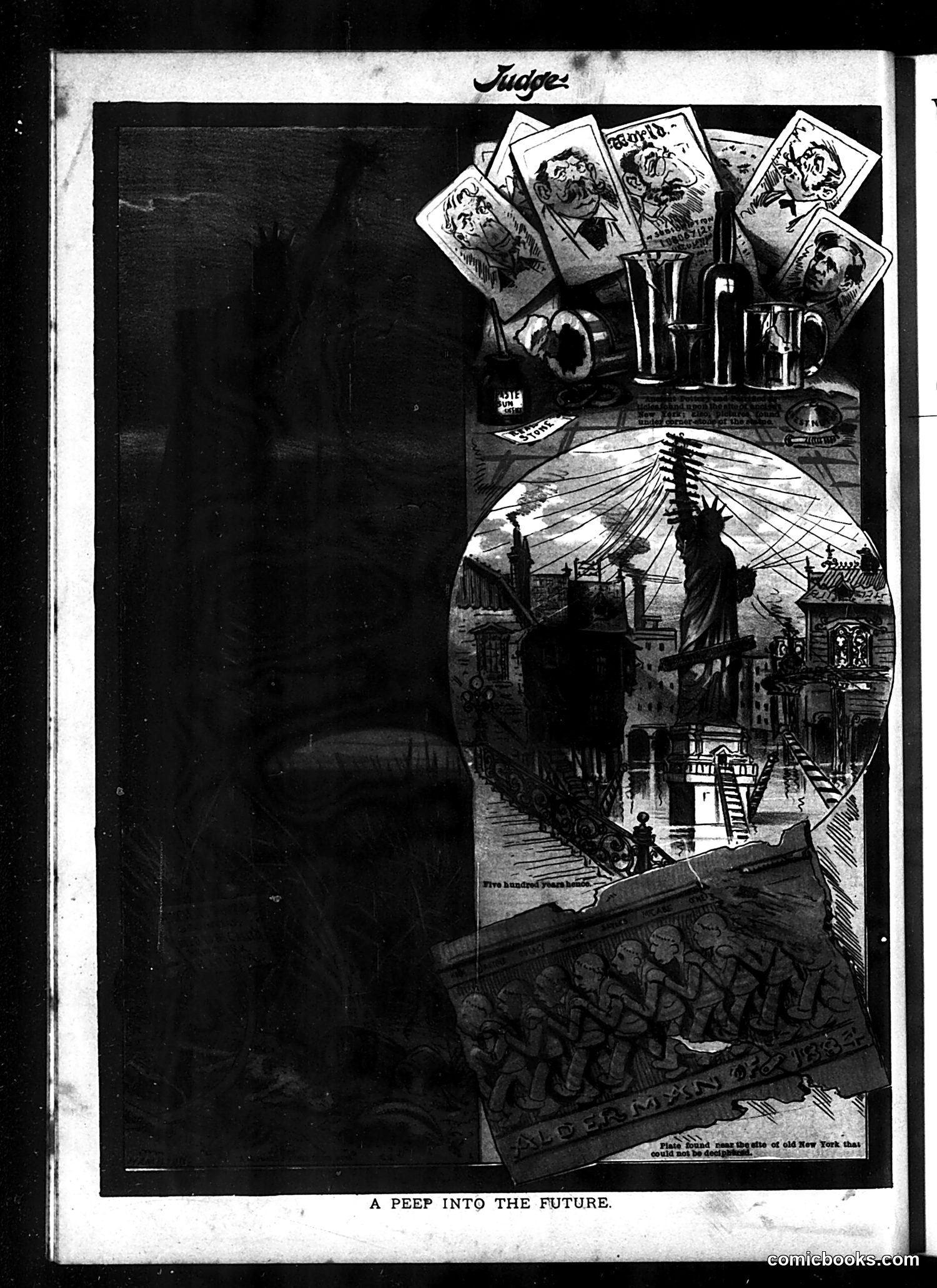
This Judge magazine cartoon satirizes anxieties about New York's future development. The composition uses a crystal ball or fortune-teller's device—a common satirical framing for speculative commentary. The image depicts an imagined future New York skyline dominated by towering buildings and the Statue of Liberty, with what appears to be airships or aircraft overhead. The surrounding tarot-like cards at the top suggest fortune-telling or prediction. The satirical point likely critiques rapid urbanization, technological change, and speculative building projects transforming the city landscape. The fortune-teller conceit mocks those making bold predictions about New York's development while expressing anxiety about whether such radical transformation could actually be "desirable." The cartoon reflects early 20th-century ambivalence about American progress and modernization.