
Judge, 1886-10-30 · page 4 of 16
Judge — October 30, 1886 — page 4: what you’re looking at
What you’re looking at
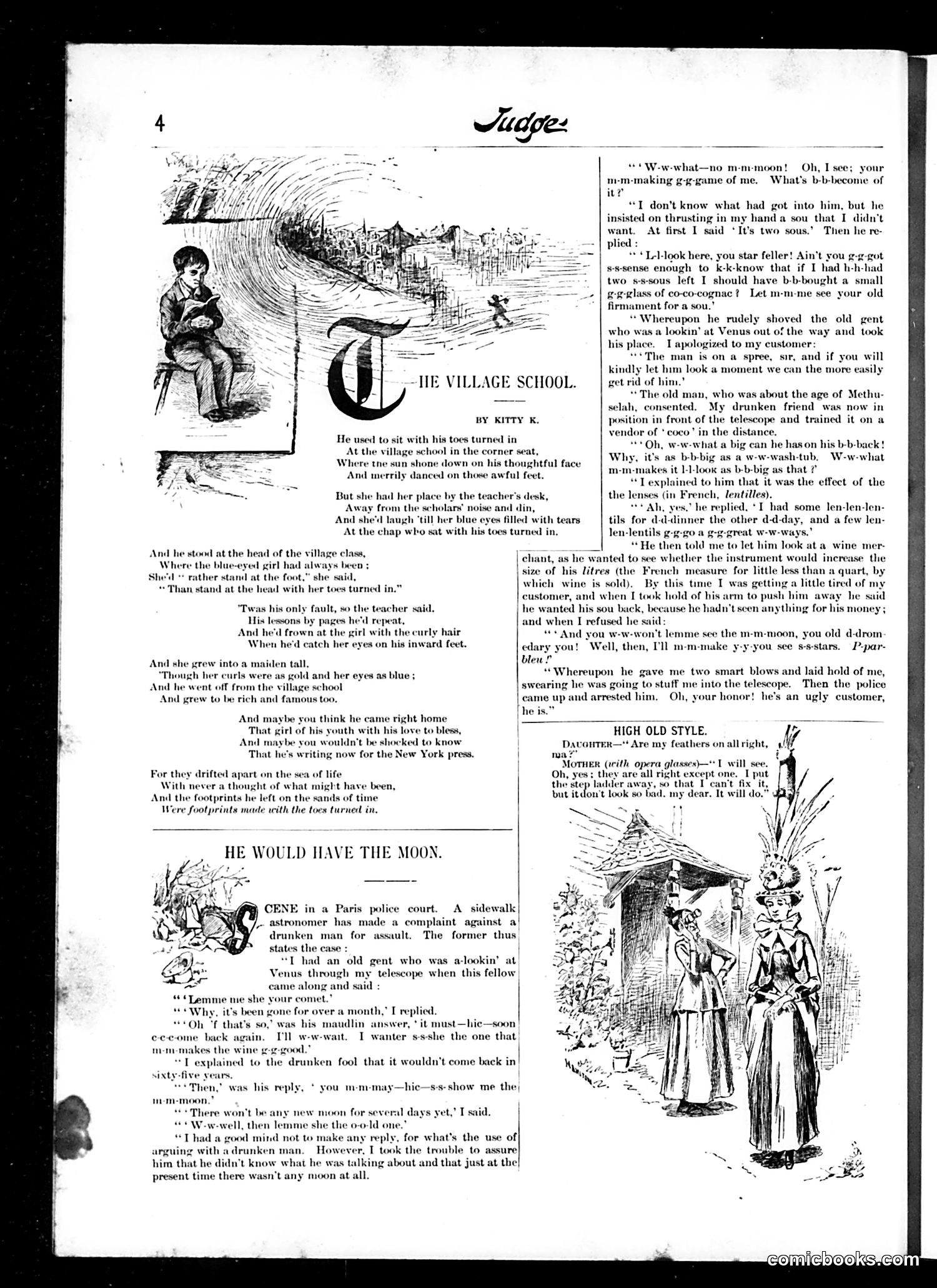
This page contains two humorous stories typical of late-19th-century satirical magazines: **"The Village School"** (left): A sentimental poem about a boy with pigeon-toed posture who becomes successful as a journalist despite a schoolgirl's initial mockery of his "toes turned in." The irony is that his physical peculiarity didn't prevent achievement—the girl who scorned him is left behind while he writes for the prestigious *New York press*. **"He Would Have the Moon"** (right): A comic anecdote about a Parisian sidewalk astronomer's confrontation with a drunk man. The drunk insists on seeing the moon through a telescope (there is none), mistakes the magnified image of a wine merchant's storefront for the moon, and becomes enraged when denied a refund. He's arrested after threatening to "stuff" the astronomer into the telescope. Both pieces mock human folly—vanity and drunken obstinacy—common Judge themes. No specific political figures are caricatured; instead, these are genre sketches satirizing everyday social types.
📄 Transcribed text from this page (OCR, searchable)
Machine-transcribed from the original scan — historical spelling and the odd misread are preserved.
-HE VILLAGE BY KITT’ He used to sit with his toes turned in At the village school in the corner Where tne sun shone down on his the And merrily danced on those awful But she had her pla Away fr And she'd and vex fill At the chap who sat with his toes turned in, And he stood at the head of the village class, ved girl had always been ; foot,” she Than stand at the head with her toes turned in.” “Twas his only fault, so the teacher said, pages he'd repeat And he'd frown at the girl with th When he'd curly hair nt off from the village school y to be rich and famous too, And maybe you think he came right home girl of his youth with his love to bless, be you wouldn't be shocked to know he's writing now for the New York press. For they drifted apart on the sea of life With never a thought of what might have been, And the footprints he left on the sands of time Were footprints mare with the toes turned in, HE WOULD HAVE THE MOON. } CENE in a Paris police court. A. sidewalk astronomer has made a complaint against a drunken man for assault, The former thus states “ASE > “ an old gent who was a-lookin’ at us through my telescope when this fellow slong a : Ve cam “Lemme me she your c “Why, it's been gone for over a month,’ I replied. “Oh “f that’s so,” was udlin answer, * it must—hie—soon nter ss-she the one that nd sa “Ars. was his reply, * you m-m-may—hic—s-s-show me the moon.” There won't be W-w-well, th good mind not to mi ay new moon for sev n lemme she the 0-0-ld on e any reply, for what's the use of drunken 0 I took the trouble to assure} he didn’t know w king about and that just at the’ present time there wasn’t any moon at all. days yet,’ T said. “°W-w-what—no m-m-moon! Oh, I see; m-m-making g-g-game of me. What's b-b-beco! in? “T don’t know what had got into him, but he sisted on thrusting in my hand a sou that I didn't At first I said ‘It’s two sous.’ Then he re- ** “L-l-look here, you star feller! Ain't you g-g-got s-s-sense enough to k-k-know that if I had h-h-had two s-s-sous left I should have b-b-bought a small g-g-glass of co-co-cognac? Let m-n-me see your old firmament for a sou,’ ‘Whereupon he rudely shoved the old gent who was a lookin’ at Venus out of the way and took his place. I apologized to my customer: “©The man is on a spree, sir, and if you will kindly let him look a moment we can the more easily get rid of hin * The old man, who was about the age of Methu- selah, consented. My drunken friend was now in position in front of the telescope and trained it on a vendor of * coco’ in the d w-w-what a big it's as b-b-big as ay bok as b-b-big as th: “T explained to him that it was the effect of the the lenses (in French, lentilles). “Ah, yes.’ he replied, ‘I ha tils for d-d-dinner the other d-d-d len-lentils g-g-go a great W-W: 5 “He then told me to let him look at a wine mer- | chant, as he wanted to see whether the instrument would increase the | size of his litres (the French measure for little less than : which wine is sold), By this time I was getting a little tired of my customer, and when I took hold of his arm to push him aw he said he wanted his sou back, because he hadn't seen anything for his money ; and when I refused he said: “And you w-w-won't lemme see the m-m-moon, you old d-drom edary you! Well, then, I'l m-m-make y-y-you see s-s-stars. P-par- blew! ““Whereupon he gave me two smart blows and laid hold of me, | swearing he was going to stuff me into the telescope. Then the police | came up and arrested him. Oh, your honor! he’s an ugly customer, | he is.” a allright, WY th opera glasses)—* | will see. I right except one. I put so that T can't fix. it, SCHOOL. YK, n he has on his b-b-back ! ash-tub, W-w-what seat, pughtful face 1 feet. some len-len-len- y, and a few len- din, led with tears HIGH OLD STYLE. /GNTER— Are my feathers on dear. It will do.”