
A complete issue · 16 pages · 1886
Judge — May 29, 1886
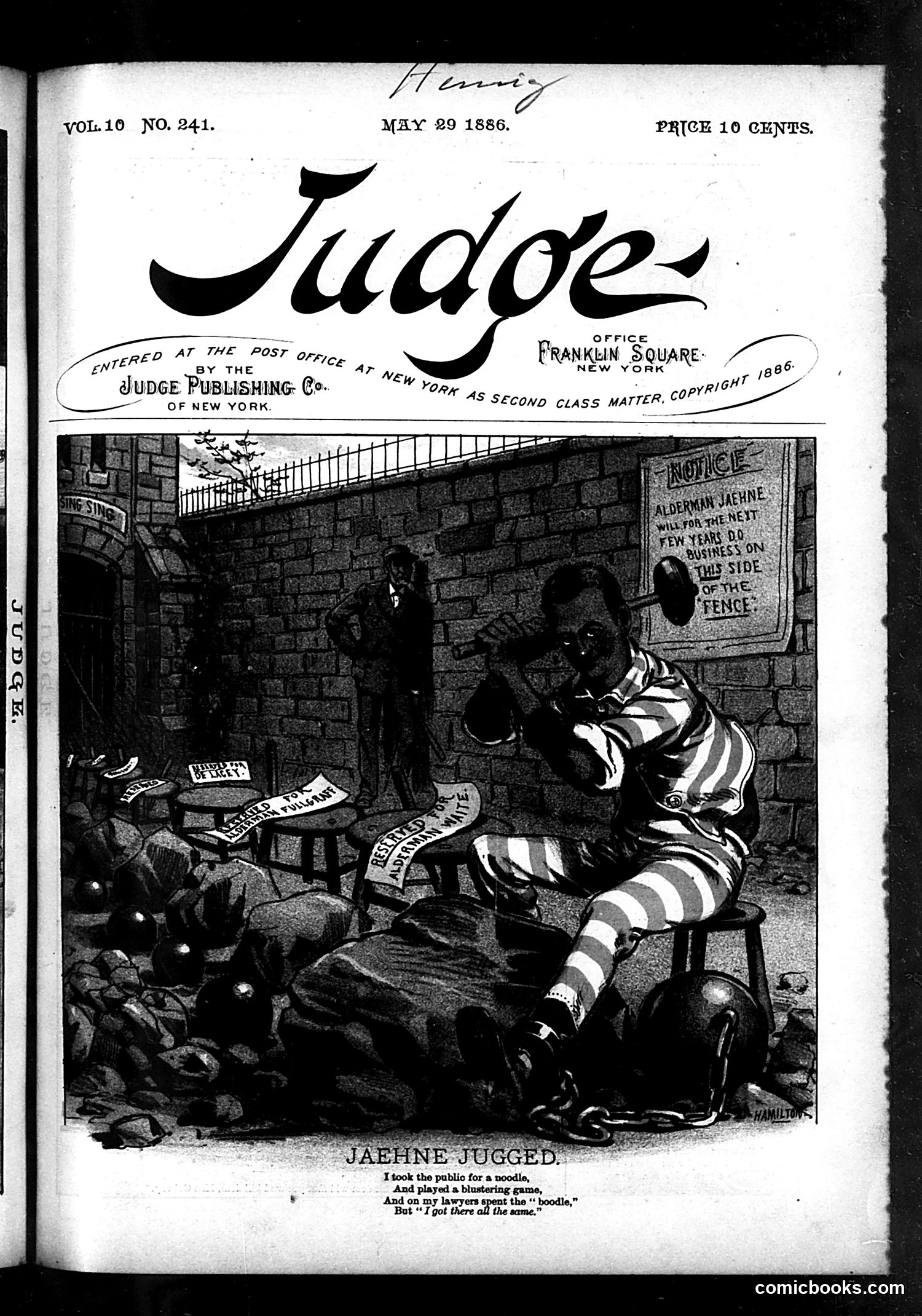
This Judge magazine cover from May 29, 1886 depicts a figure in striped prison garb (suggesting recent incarceration) sitting in what appears to be a prison yard or alley. The caption reads "Jaehne Jugged" with a verse: "I took the public for a noodle, / And played a blustering game, / And thought myself a great big boodle— / But I got nailed the same." The satire mocks someone named Jaehne who apparently attempted public deception through confidence schemes ("played a blustering game") but faced legal consequences ("jugged" = imprisoned). The striped prisoner outfit and prison setting emphasize his downfall. Without additional historical context, the specific individual and scandal referenced remain unclear, though the cartoon celebrates the exposure of fraudulent or corrupt behavior through criminal conviction.
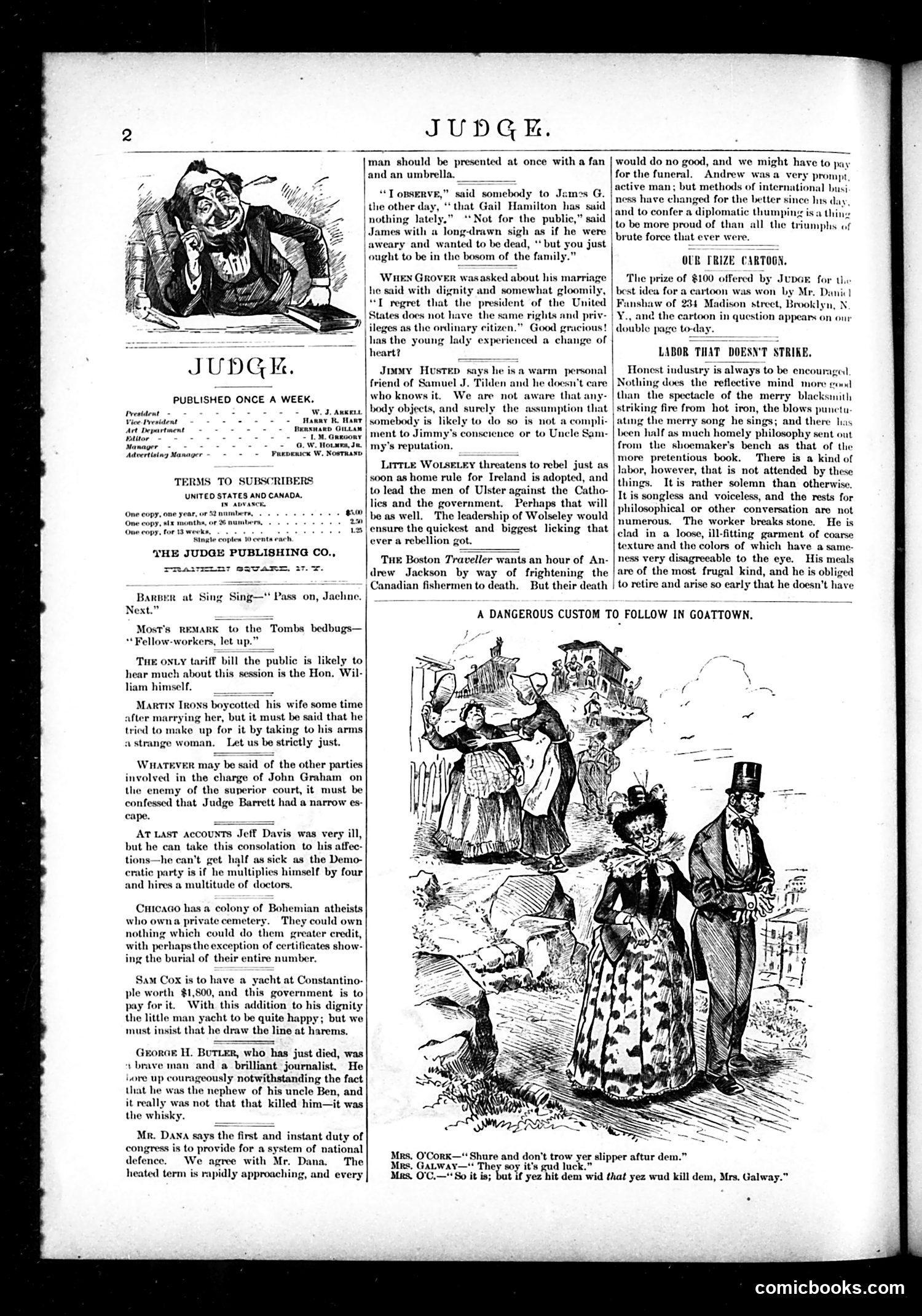
This page contains satirical commentary and two cartoons. The text includes brief political jabs at various figures, including criticism of President [name unclear from OCR] regarding tariff bills and congressional duties. The main cartoon, "A Dangerous Custom to Follow in Goattown," depicts what appears to be an Irish immigrant scenario with period dress and dialect. The caption suggests satirical commentary on Irish cultural practices or behaviors in America, playing on period stereotypes. The figures appear to be engaged in some form of social interaction or conflict. The page reflects late 19th/early 20th-century American satirical humor, targeting political figures, immigrants, and social customs. Without clearer historical context, specific identifications of the political figures referenced remain uncertain from the image alone.
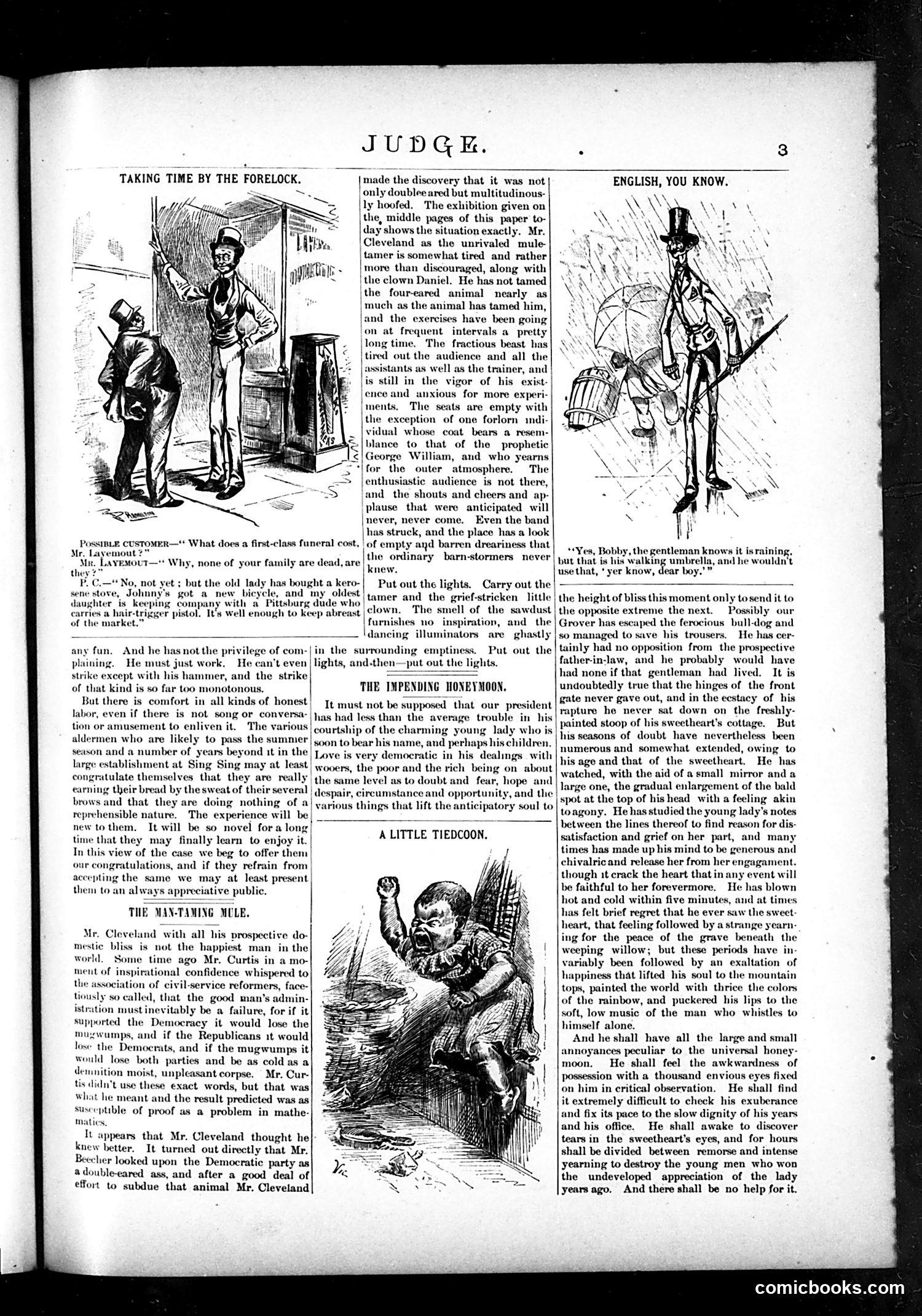
This page satirizes President Grover Cleveland's political struggles using circus metaphors. The top cartoon "Taking Time by the Forelock" depicts a man checking a large clock—likely criticizing Cleveland's time management or political timing. The main satire, "The Man-Taming Mule," compares Cleveland to a circus performer attempting to tame a fractious mule (representing political opposition or the Democratic Party). The text explains that Cleveland, like a tired tamer, struggles unsuccessfully while the audience loses interest and leaves. The mule—"doubleeared" and "multitudinously hoofed"—appears to reference the party's internal divisions. References to "Mr. Curtis" (likely George William Curtis, a prominent mugwump reformer) and tensions between Democrats, Republicans, and mugwumps (independent reformers) suggest Cleveland cannot satisfy all factions simultaneously. The lower section, "The Impending Honeymoon," shifts to Cleveland's personal life, apparently mocking his courtship difficulties alongside political failures. The satire's central point: Cleveland's presidency—like a failed circus act—has exhausted audiences and performers alike.
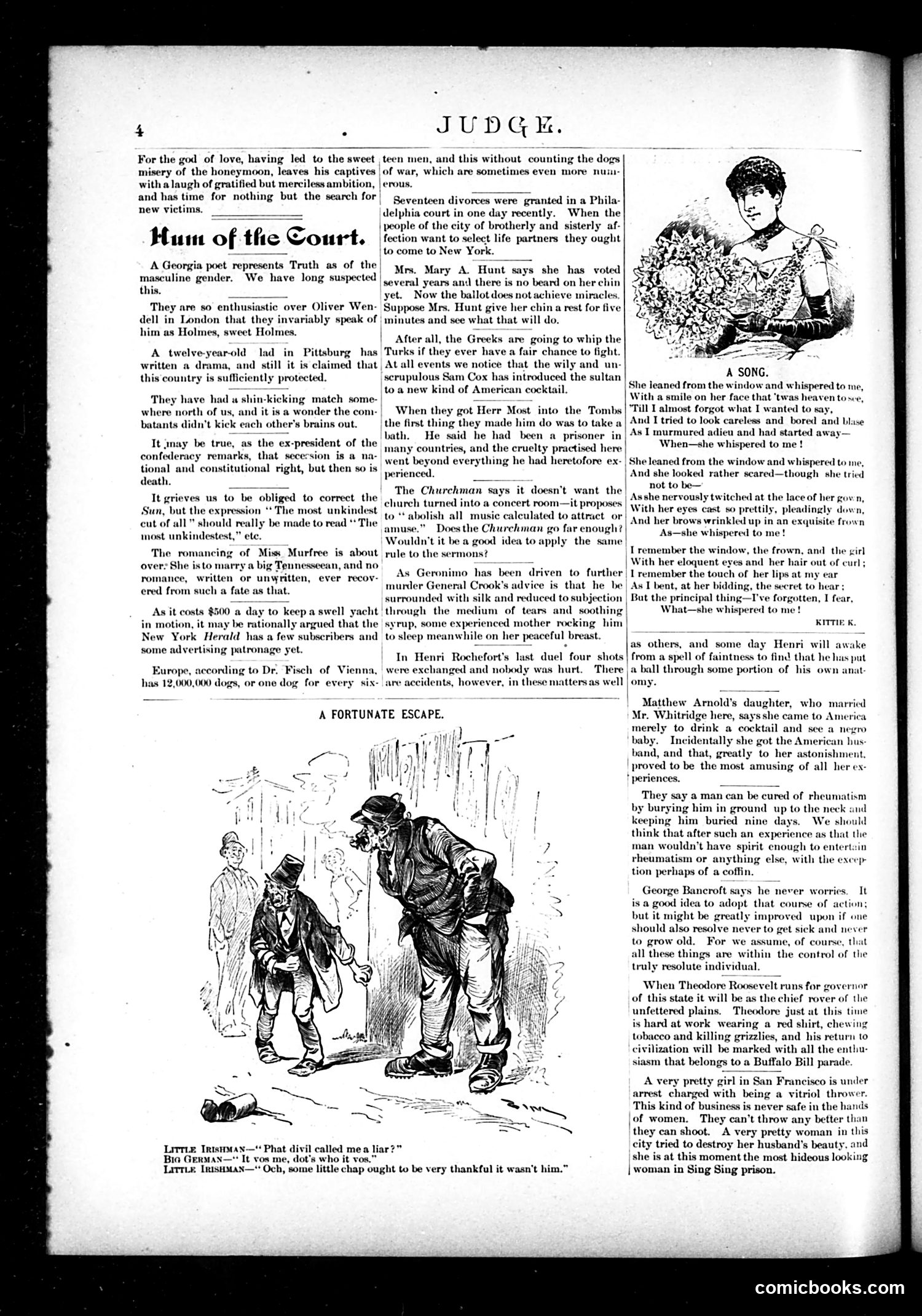
This page from the satirical magazine **Judge** contains brief social and political commentary typical of late-19th-century American humor. The main cartoon, titled "A Fortunate Escape," depicts what appears to be a street encounter between two figures—likely representing a con artist or questionable character and an innocent party. The caption suggests someone escaped being defrauded or misled. The surrounding text includes short satirical quips mocking contemporary figures and issues: Oliver Wendell Holmes (called "Holmes, sweet Holmes" in London), the philosopher's name confusion; references to Geronimo and the Apache conflicts; Henri Rochefort's famous duel; and social commentary on divorce rates in Philadelphia versus New York. The page also features a sentimental poem "A Song" about romantic attraction—contrasting with the cynical "Hum of the Court" opener about love's transient nature. The humor relies on readers recognizing contemporary public figures, recent events, and social debates of the era—most now obscure without historical context.
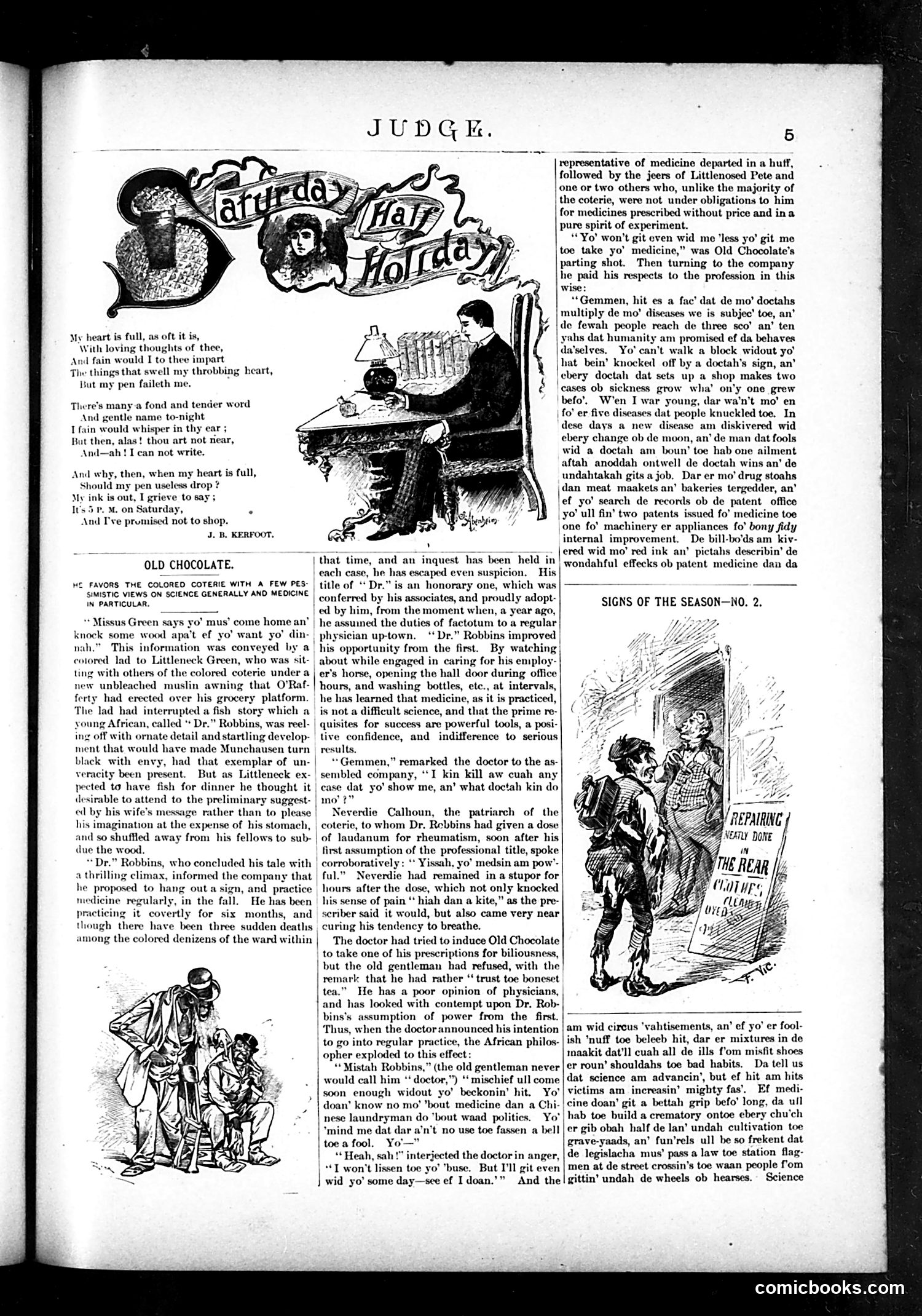
This page satirizes a self-taught African American "doctor" named Dr. Robbins who practices medicine without formal training in a colored neighborhood. The satire targets both the charlatan doctor and the gullible community members who trust him. Dr. Robbins gained his "medical knowledge" by working as a factotum (errand boy) for a legitimate physician—merely watching, opening doors, and washing bottles. He concludes medicine requires only "powerful tools, positive confidence, and indifference to serious results." The humor relies on racial stereotypes: the dialect-heavy speech, the doctor's dangerous incompetence (a patient nearly stops breathing), and the community's naive testimonials. A patient named Neverdie Calhoun endorses the "medicine" despite nearly fatal consequences, not recognizing the danger. The satire likely reflects period anxieties about unlicensed practitioners in poor communities, though it employs deeply offensive racial caricature typical of Judge's era.
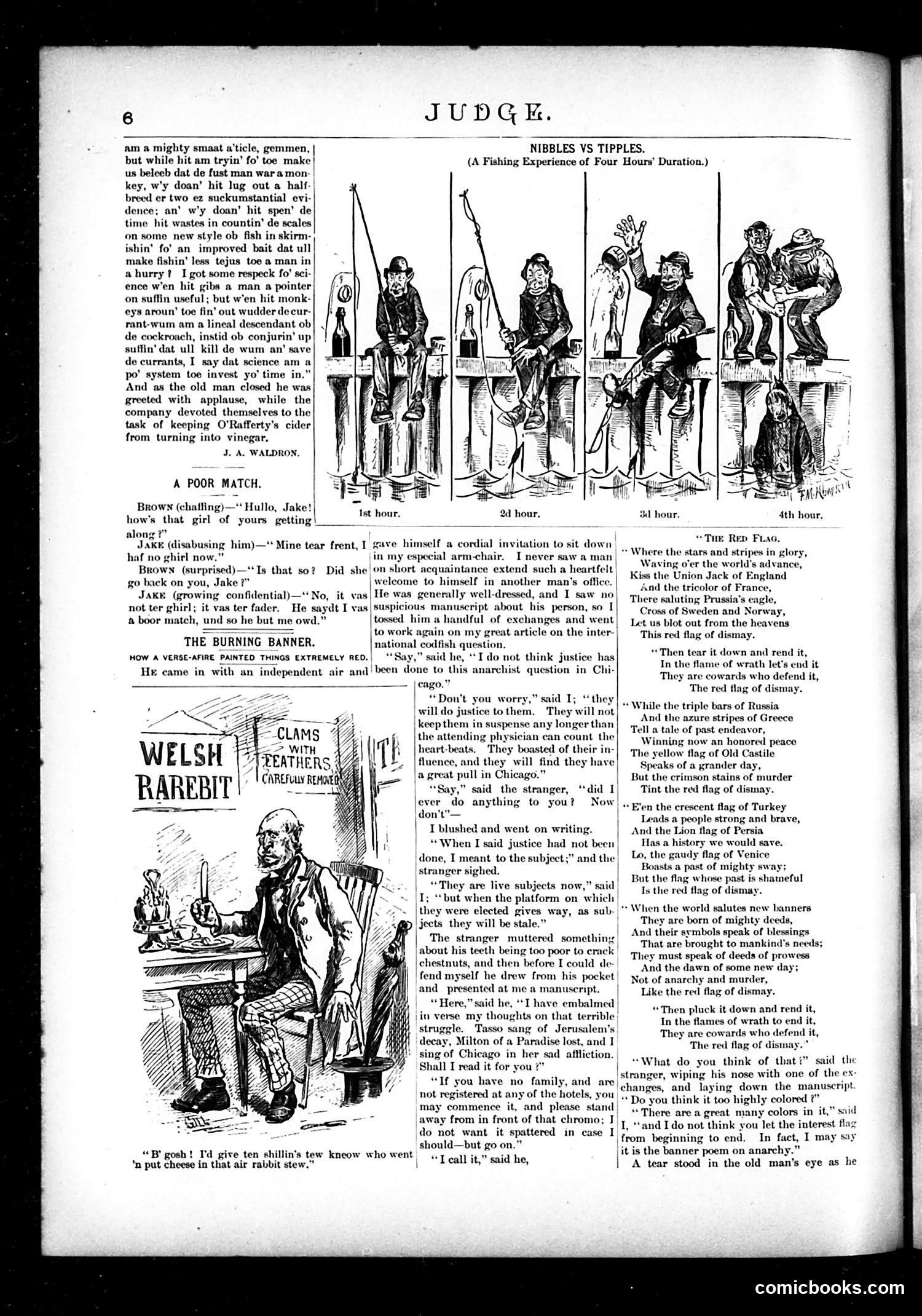
This page contains three satirical pieces from *Judge* magazine: **"A Poor Match"**: A brief joke about a man named Jake whose girlfriend's father rejected him as unsuitable—a class-based dismissal common in the era. **"The Burning Banner"**: A longer piece mocking an anarchist poet who visits a newspaper office seeking to publish his revolutionary verse about the Chicago anarchists (likely referencing the Haymarket affair aftermath). The editor humors him while being dismissive, suggesting the anarchists will face swift execution. The poem itself—praising various flags while condemning "the red flag of dismay"—is satirized as overwrought, melodramatic political verse. **"Welsh Rarebit"**: A cartoon showing a Welsh character at a tavern complaining that scientific pursuits (evolution, obscure fish research) lack practical value compared to useful inventions. It's a working-class critique of academic impracticality. The page satirizes anarchism as theatrical and absurd, mocks pretentious poetry, and presents class-based humor typical of the era.
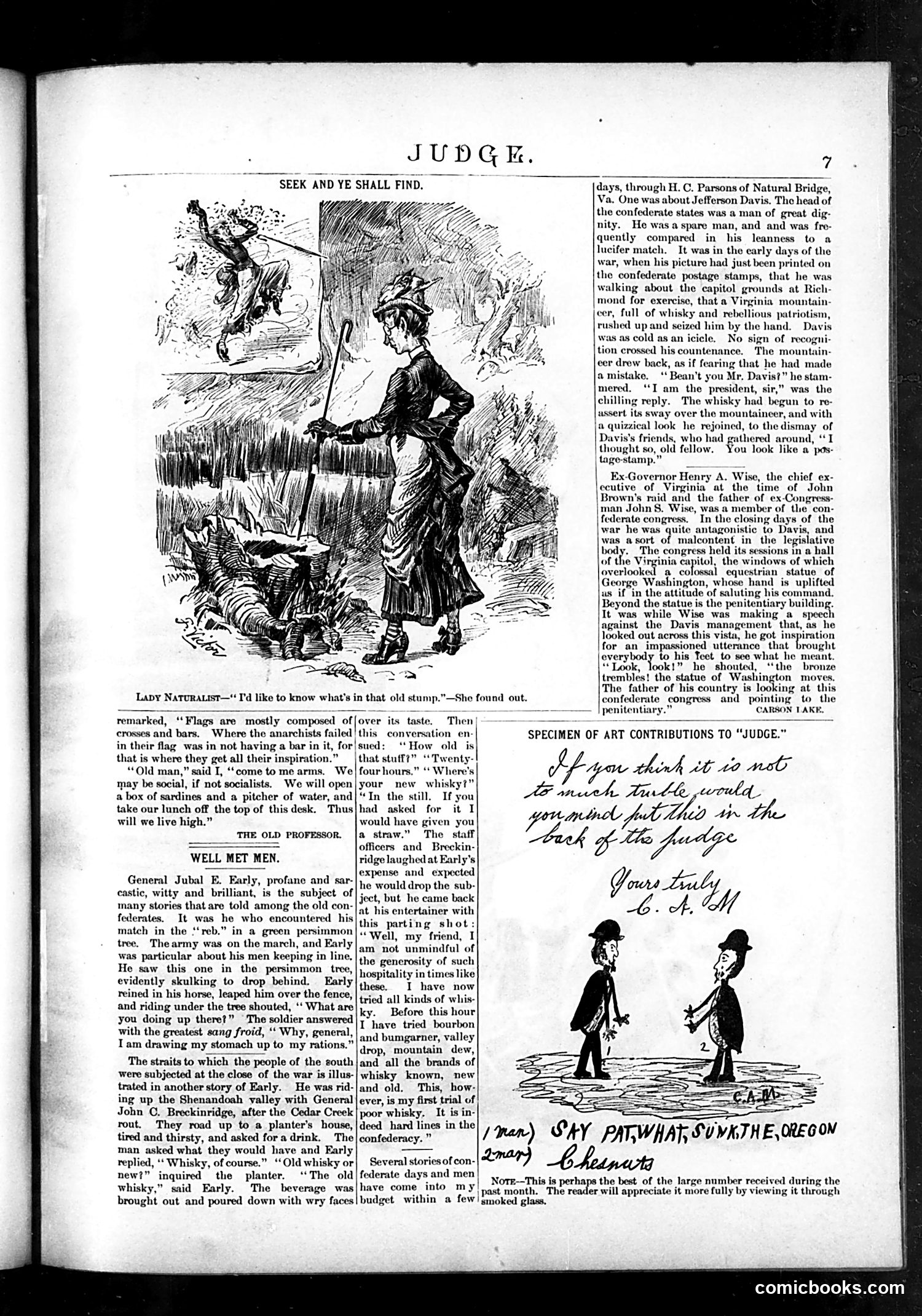
This page from Judge (a 19th-century American satirical magazine) contains three distinct anecdotes about Confederate figures, presented as humorous "war stories": **Main Content:** - A story about Jefferson Davis, Confederate president, being compared to a "postage stamp" by a drunk Virginia mountaineer—mocking Davis's thin appearance and rigid dignity - An anecdote about Virginia Governor Henry Wise, during Confederate Congress, dramatically gesturing toward a George Washington statue while condemning Davis's management, implying even Washington disapproves - General Jubal E. Early's witty exchange with a host about whiskey varieties **The Satire's Point:** These stories ridicule Confederate leadership—Davis for coldness and ineffectiveness, Wise for melodramatic opposition, and Early for his sharp tongue. The humor depends on post-Civil War Northern audiences finding Confederate dignity deflatable and their internal conflicts amusing. The page also includes unrelated content: a naturalist joke, a professor anecdote, and reader-submitted artwork.
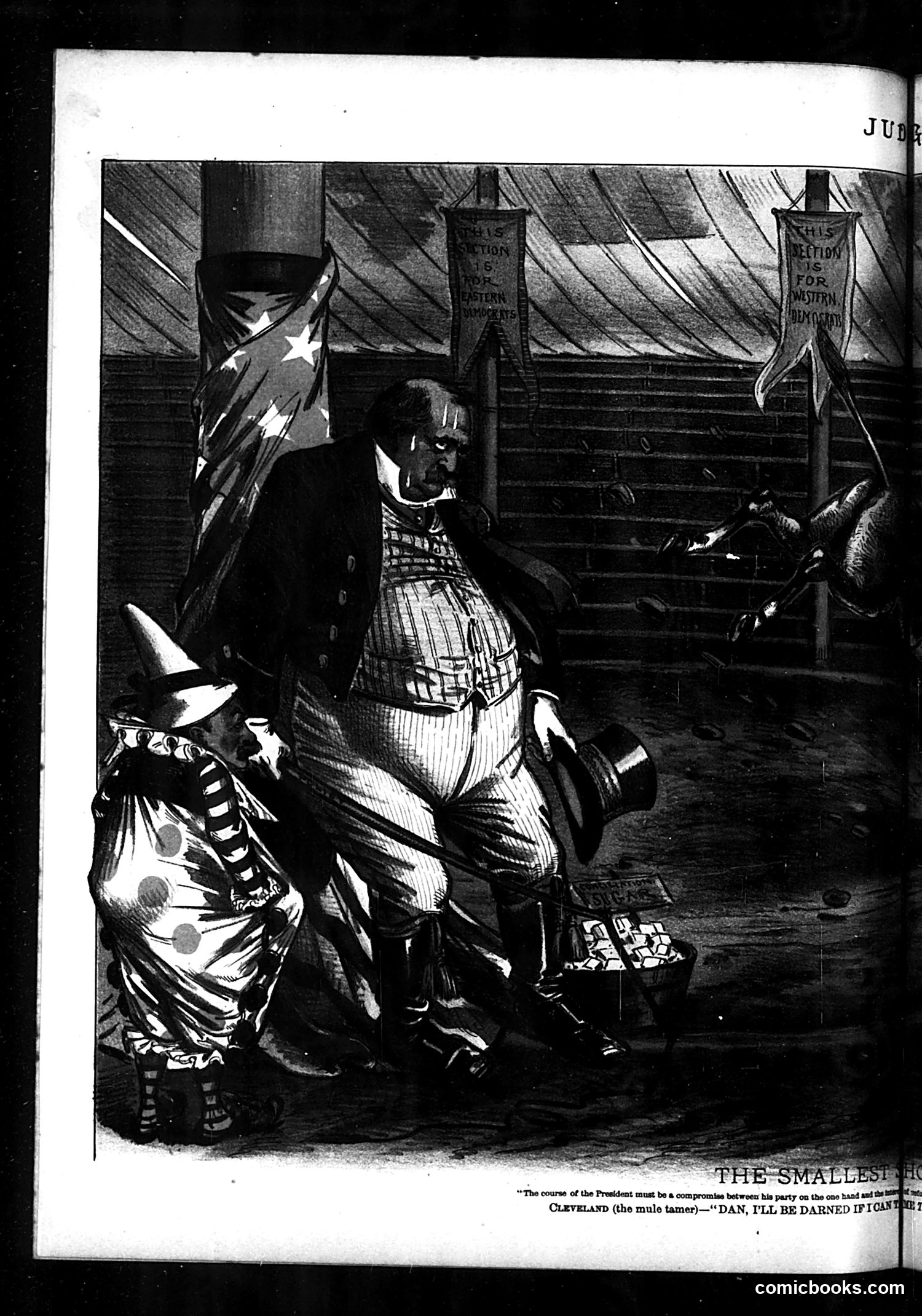
This political cartoon depicts President Cleveland as a "mule tamer" struggling to control a donkey, which represents the Democratic Party. The incomplete caption suggests Cleveland must navigate between his party's demands and other pressures—a compromise he finds frustrating, as indicated by his exasperated exclamation. The mule is a visual pun: donkeys symbolize the Democratic Party, and Cleveland is literally portrayed as taming one, suggesting his difficulty managing party factions or expectations. The starred flag and formal tent setting indicate the presidency's dignity, which contrasts with the undignified struggle depicted. The satire mocks Cleveland's leadership challenges, suggesting he cannot fully control his own party despite holding the nation's highest office.
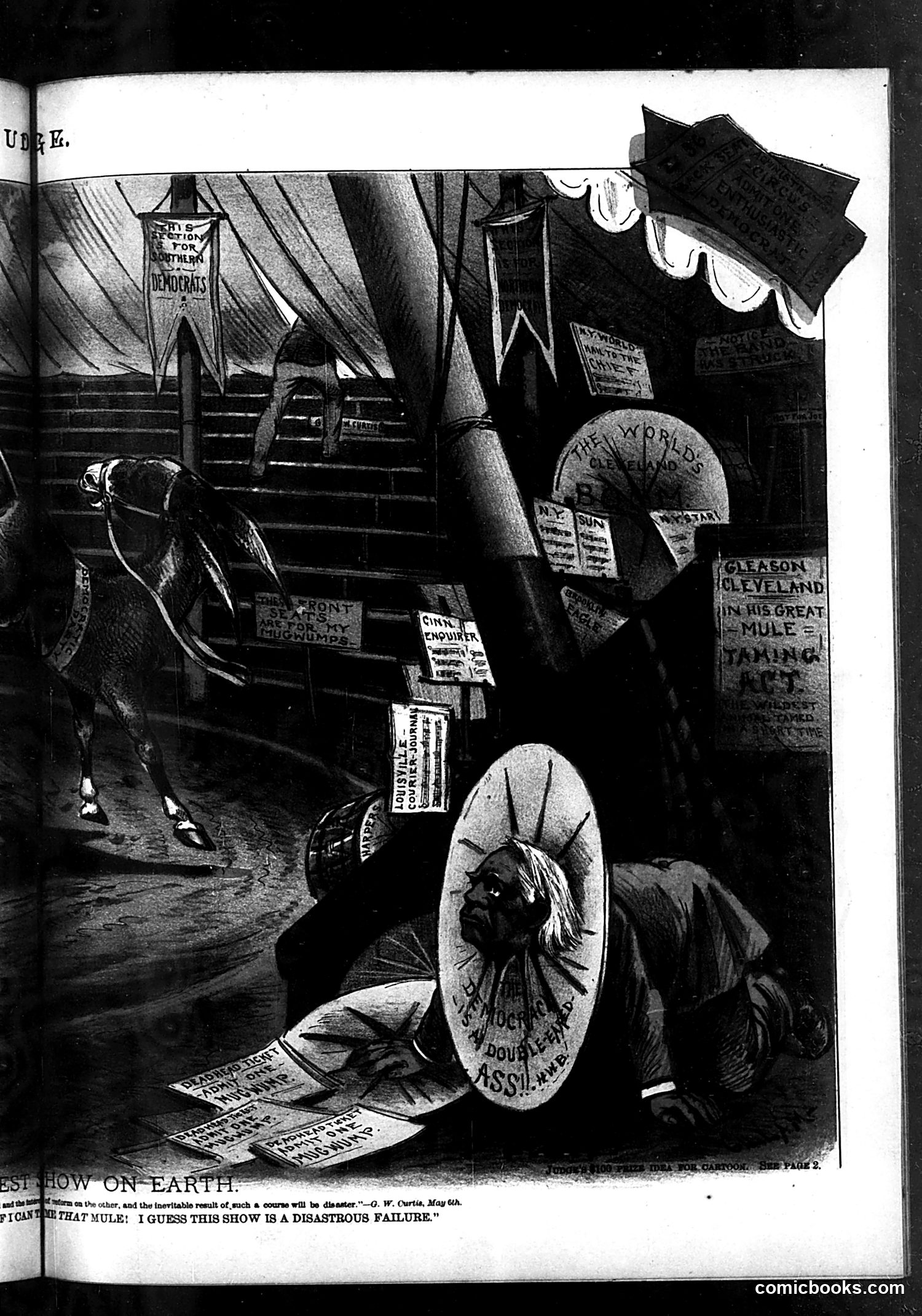
This Judge magazine cartoon satirizes the 1896 Democratic National Convention and William Jennings Bryan's presidential campaign. The central image depicts a mule—traditionally a symbol of stubbornness—wearing a political button, surrounded by campaign signs and banners for various Democratic candidates and causes. The caption "THAT MULE: I GUESS THIS SHOW IS A DISASTROUS FAILURE" suggests the cartoon mocks the Democratic Party as obstinate and chaotic during the convention process. The competing signs (including references to Cleveland and other figures) represent factional infighting within the party. The satire criticizes Democratic disorganization and lack of unified direction—portrayed through the bewildered mule amid conflicting messages—as the party struggled to choose its nominee and platform during this pivotal election year.
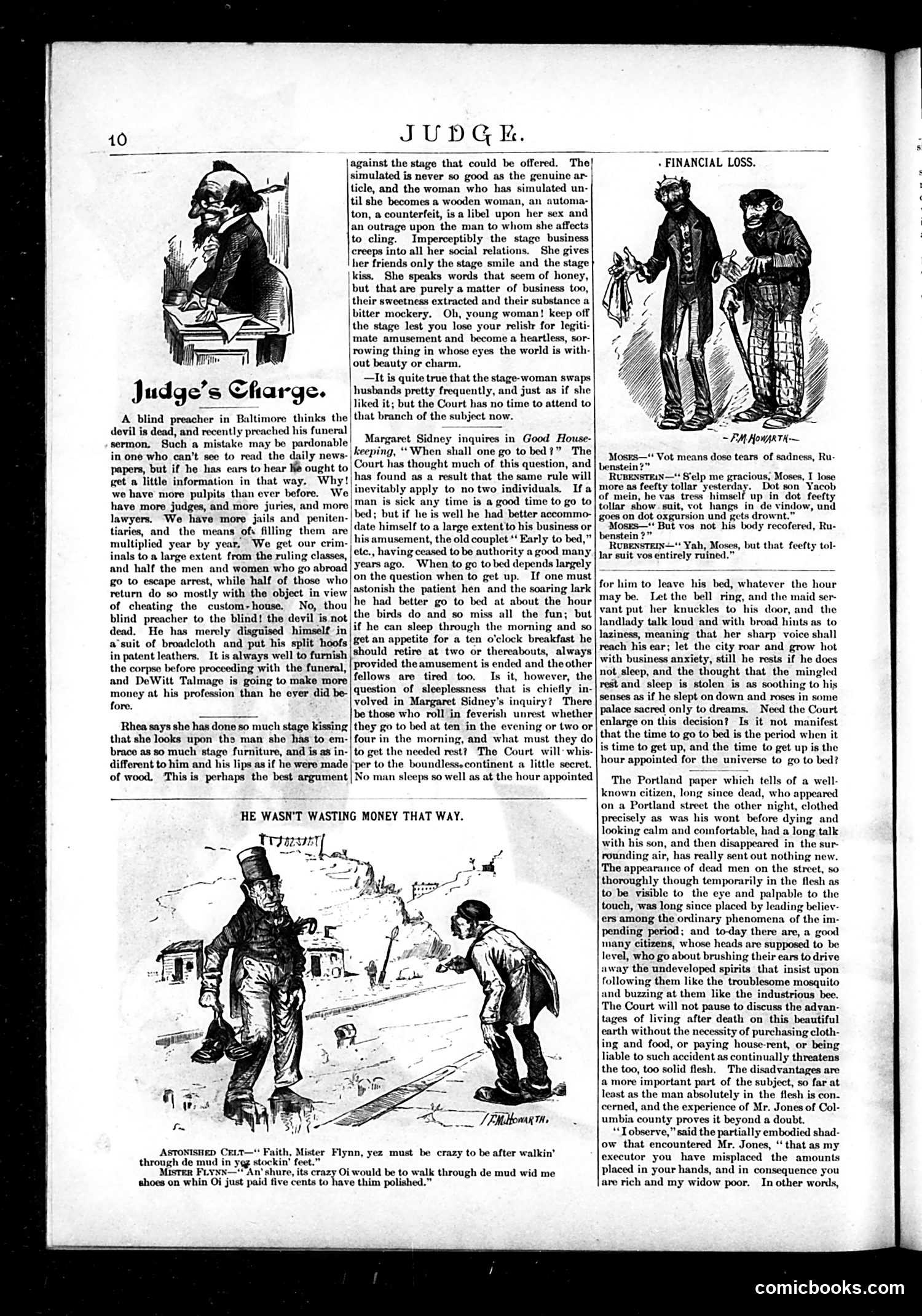
This page from *Judge* magazine contains social commentary and satirical cartoons critiquing American morality and hypocrisy. **"Judge's Charge"** (main editorial) attacks clergy hypocrisy—a blind Baltimore preacher claims the devil is dead, but the author argues this is absurd given rising crime, judges, juries, and lawyers, suggesting the devil merely disguises himself as respectable society ("a suit of broadcloth"). **The stage-woman critique** warns that actresses who perform fake emotions professionally become emotionally hollow in real life, swapping husbands casually and losing capacity for genuine feeling. **"He Wasn't Wasting Money That Way"** (cartoon) shows a wealthy man in top hat, apparently throwing money away while a poor man watches—likely satirizing class disparity and the poor man's observation that the rich waste resources the needy desperately require. The page reflects *Judge*'s recurring theme: American institutions and upper classes harbor moral corruption beneath respectable facades, contradicting claims of Christian virtue.
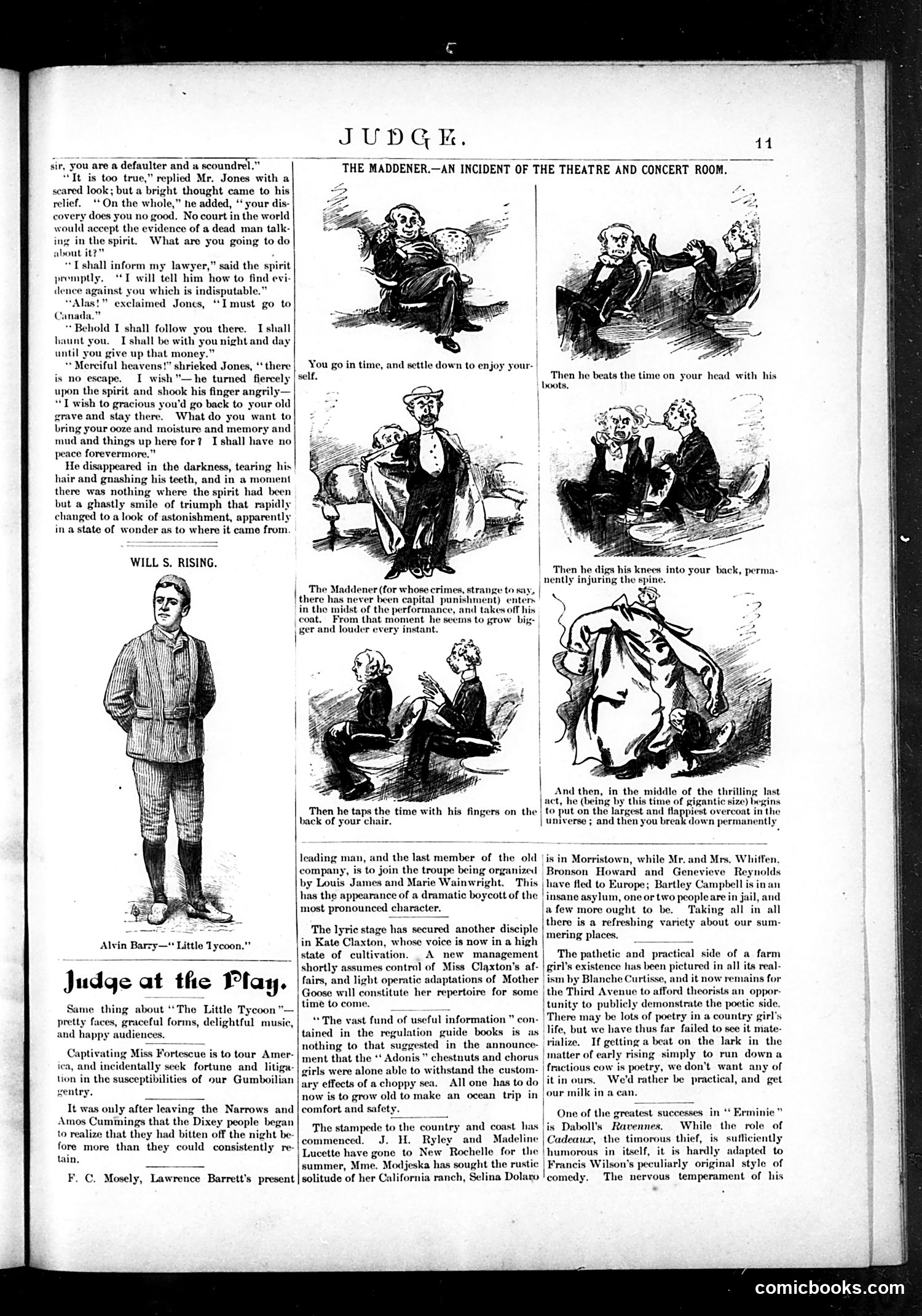
This page satirizes **theatrical annoyances**, specifically "The Maddener"—a type of audience member who disrupts performances. The comic sequence (center-right) depicts this figure progressively growing larger and more obstructive during a show: tapping fingers on chairs, beating time on patrons' heads with boots, driving knees into spines, and finally donning an enormous overcoat that blocks everyone's view. The satire targets inconsiderate theater-goers whose disruptive behavior ruins performances for others. The exaggerated visual progression—the figure literally expanding in size—humorously emphasizes how such people seem to dominate and ruin the experience. The page also includes theatrical gossip about actors joining various companies and some experiencing legal troubles or institutionalization, reflecting Judge's regular coverage of the theater world and its scandals. The overall tone mixes social criticism with entertainment-world commentary typical of the period's satirical magazines.
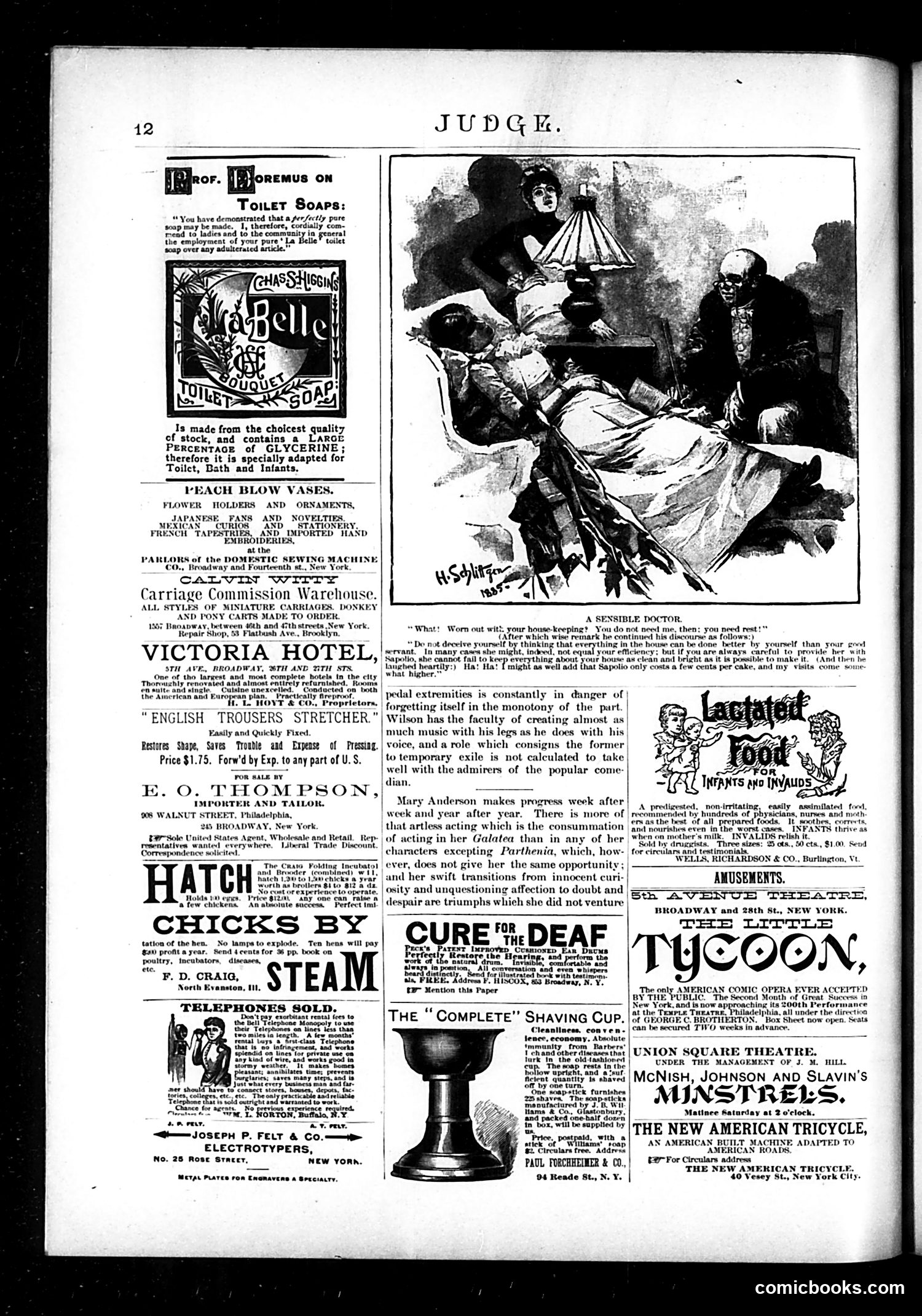
This page is primarily **advertising and entertainment listings** rather than political satire. The main content includes: **The Central Cartoon ("A Sensible Doctor"):** Shows a physician advising an exhausted housewife that her fatigue stems from overwork keeping house, not illness. He recommends Sapolio (a cleaning product advertised on the page). This is **product-driven satire** mocking hypochondriac women, while promoting cleaning supplies as the solution to female complaints—reflecting Victorian attitudes dismissing women's health concerns. **Surrounding Content:** The page features numerous advertisements for household products (soaps, shaving cups), theatrical amusements (including "The Little Tycoon" opera and minstrel shows), and various services. **Social Context:** The humor depends on period assumptions: that housekeeping exhaustion was psychological rather than real labor, and that cleanliness products could solve domestic problems. The minstrel show advertisements reflect the era's entertainment norms, now considered offensive. This is typical Judge content—mixing gentle social commentary with commercial interests targeting middle-class readers.
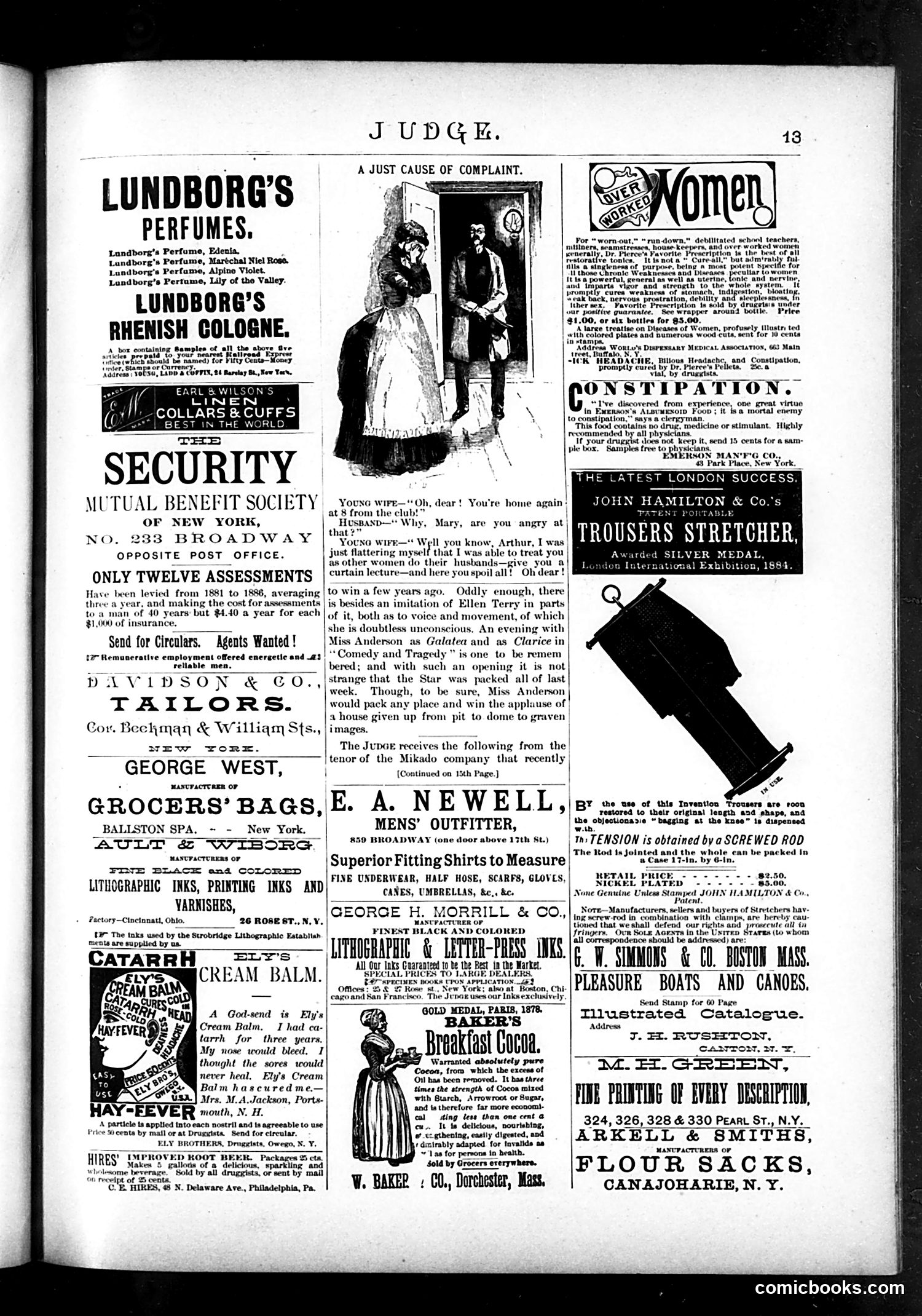
The central cartoon depicts a domestic scene where a husband returns home to find his wife apparently angry. She references preparing a "curtain lecture" (a scolding delivered behind closed curtains—a period term for nagging). The husband, relieved, says she's "spoiled" his pleasure by revealing her complaint prematurely. The satire targets the era's marital dynamics and female frustration: wives were expected to manage households while husbands enjoyed leisure (the club). The cartoon mocks both the wife's restrained anger and the husband's assumption that her complaints are trivial entertainment rather than legitimate grievances. This reflects Judge magazine's satirical commentary on gender relations and middle-class domestic life in the 1880s. The surrounding advertisements for "women's tonics" and remedies underscore the period's medicalization of female dissatisfaction, treating women's justified complaints as hysteria requiring treatment rather than reasonable responses to subordinate status.
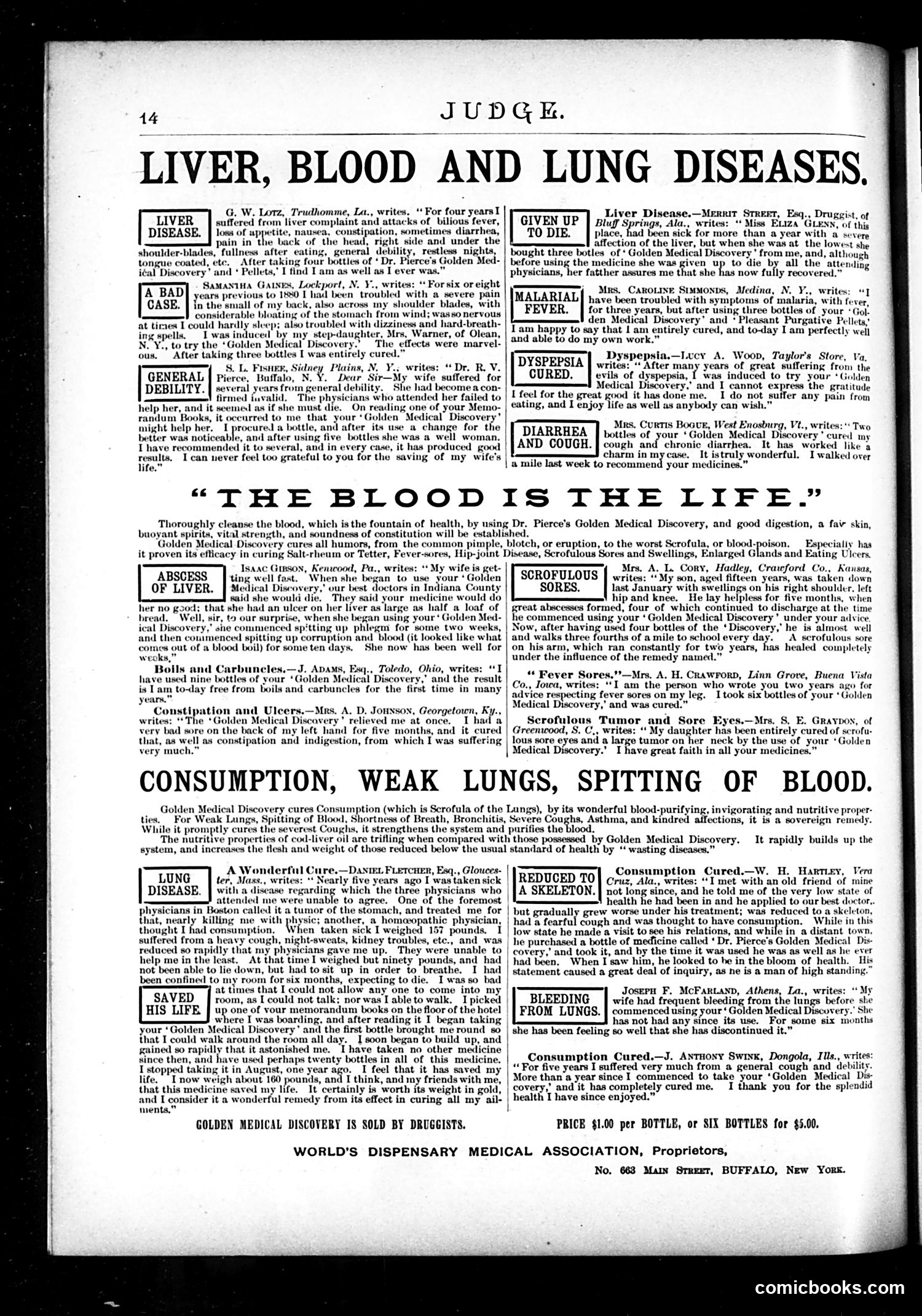
This page is **entirely advertisement**, not satire or political commentary. It promotes "Dr. Pierce's Golden Medical Discovery," a patent medicine marketed for liver, blood, and lung diseases. The content consists of testimonial letters from purported patients claiming miraculous cures for conditions like liver disease, malaria, dyspepsia, and consumption. The page uses the headline "THE BLOOD IS THE LIFE" and emphasizes the product's ability to "cleanse the blood." **Context for modern readers:** This represents the patent medicine era (late 19th/early 20th century) when largely unregulated, often ineffective or dangerous tonics were heavily advertised in magazines using emotional testimonials. These products typically contained alcohol, opiates, or other addictive substances. Judge magazine, though satirical elsewhere, accepted such advertisements. The scientific claims are unsupported, and such ads were eventually curtailed by the FDA after the 1906 Pure Food and Drug Act. The ad costs $1.00 per bottle or $5.00 for six bottles.
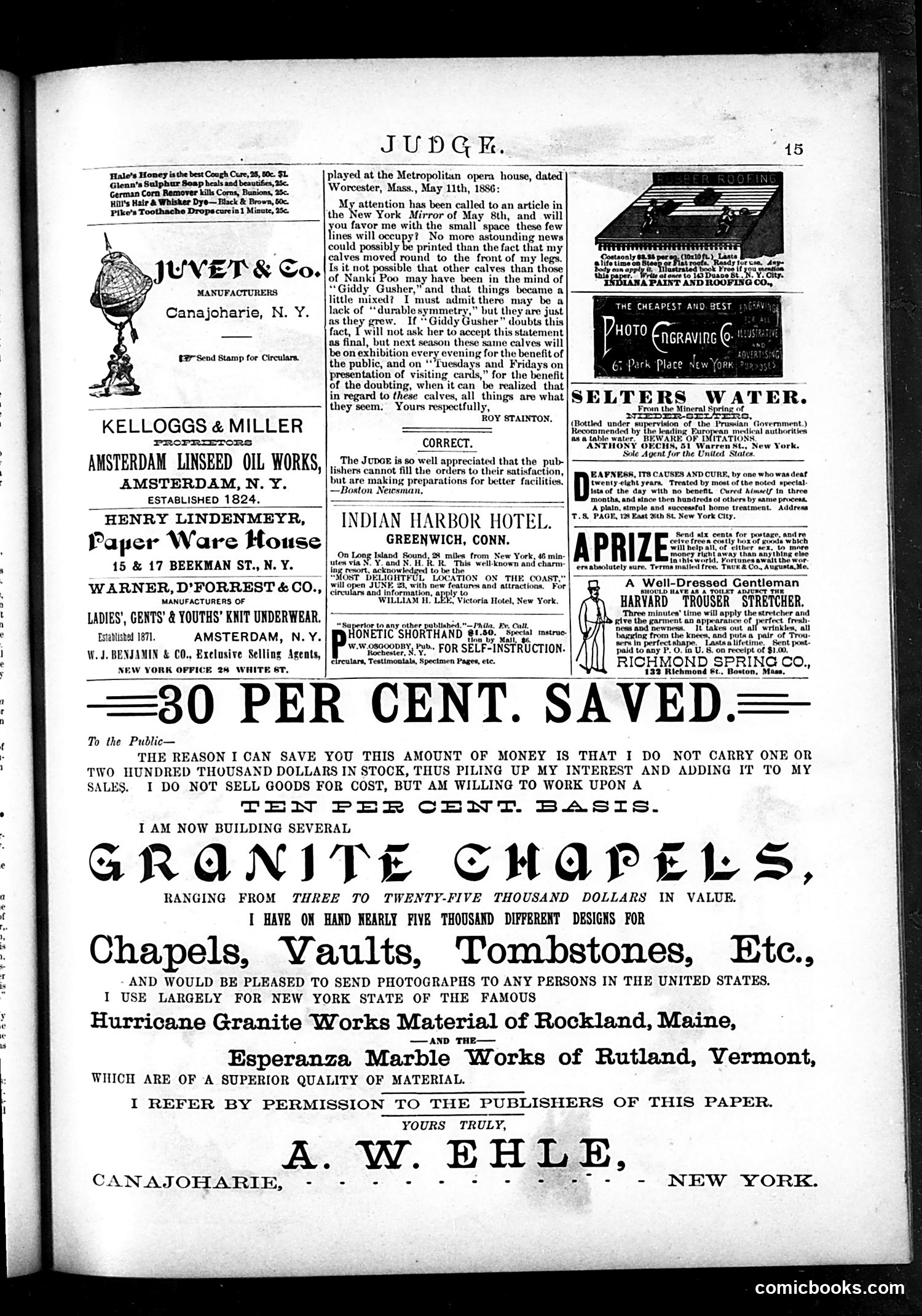
This page is primarily **advertisements and reader correspondence**, not political satire. The notable content is a letter from "Roy Stainton" responding to gossip published in the New York Mirror. Stainton defends himself against a "Giddy Gusher" who apparently mocked his leg anatomy—specifically claiming his calves are oddly positioned—after he performed in *The Mikado* at the Metropolitan Opera House. Stainton insists his calves are natural and offers to display them publicly next season "for the benefit of the doubting." The exchange appears to reflect 1880s theatrical society gossip and body-shaming rather than political commentary. The largest advertisement promotes A.W. Ehle's granite chapels and tombstones, emphasizing his cost savings and superior materials from Maine and Vermont. The page captures *Judge*'s mix of satirical commentary with period advertising and reader letters.
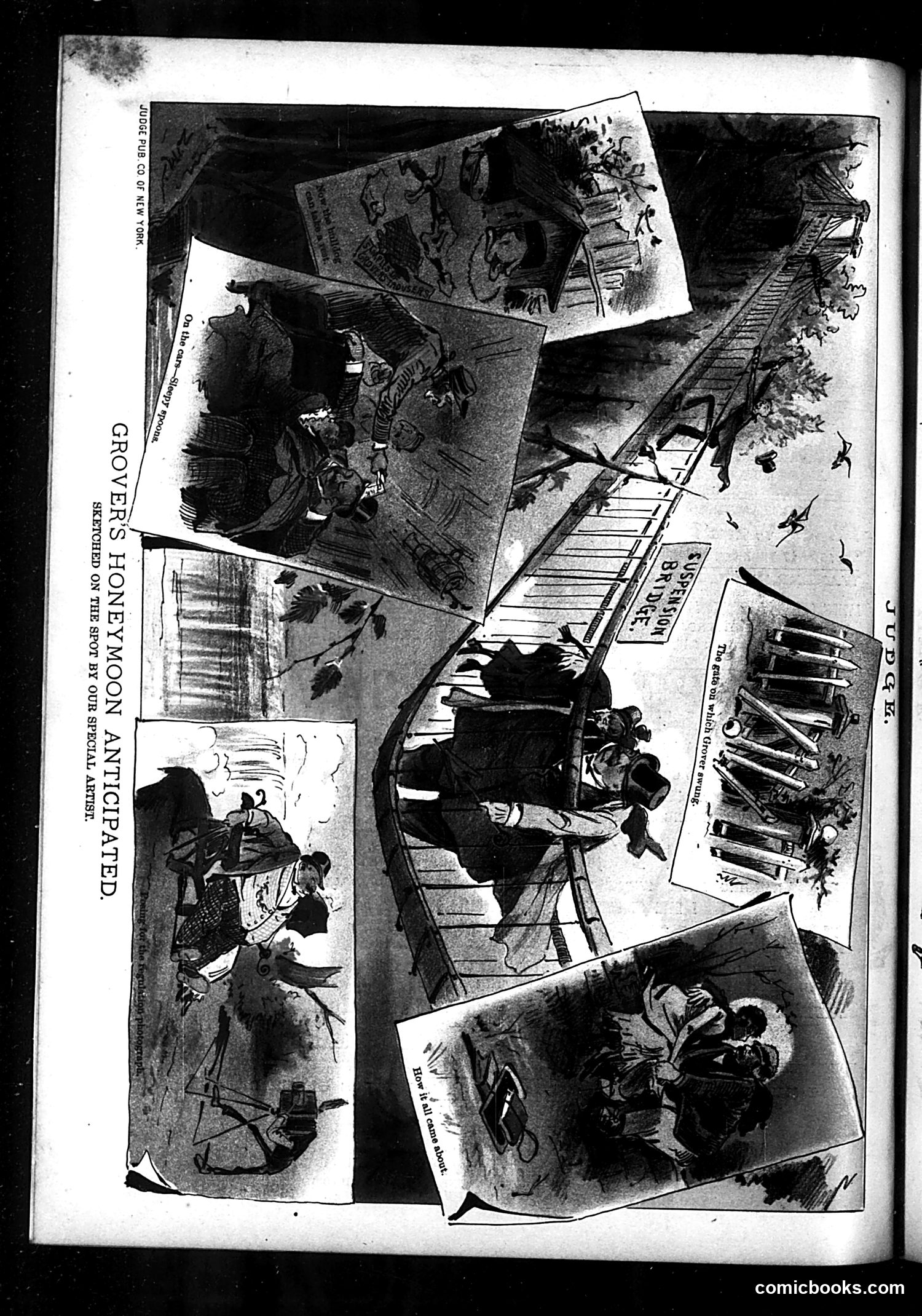
This page from *Judge* magazine satirizes President Grover Cleveland's anticipated honeymoon. The cartoon shows multiple sketched scenes depicting Cleveland in romantic or domestic situations with his bride—likely a humorous visual commentary on the president's personal life becoming public spectacle. The title "Grover's Honeymoon Anticipated" indicates these are imagined scenarios rather than actual events. The "sketched on the spot by our special artist" credit suggests the cartoonist is humorously pretending to have depicted real moments. The satire exploits the public's fascination with Cleveland's private life, particularly his 1886 marriage to Frances Folsom—a notable event that drew significant press attention. By imagining various honeymoon scenarios, the cartoon mocks both the media's intrusive interest in presidential affairs and the public's appetite for such gossip.