
Judge, 1886-05-29 · page 10 of 16
Judge — May 29, 1886 — page 10: what you’re looking at
What you’re looking at
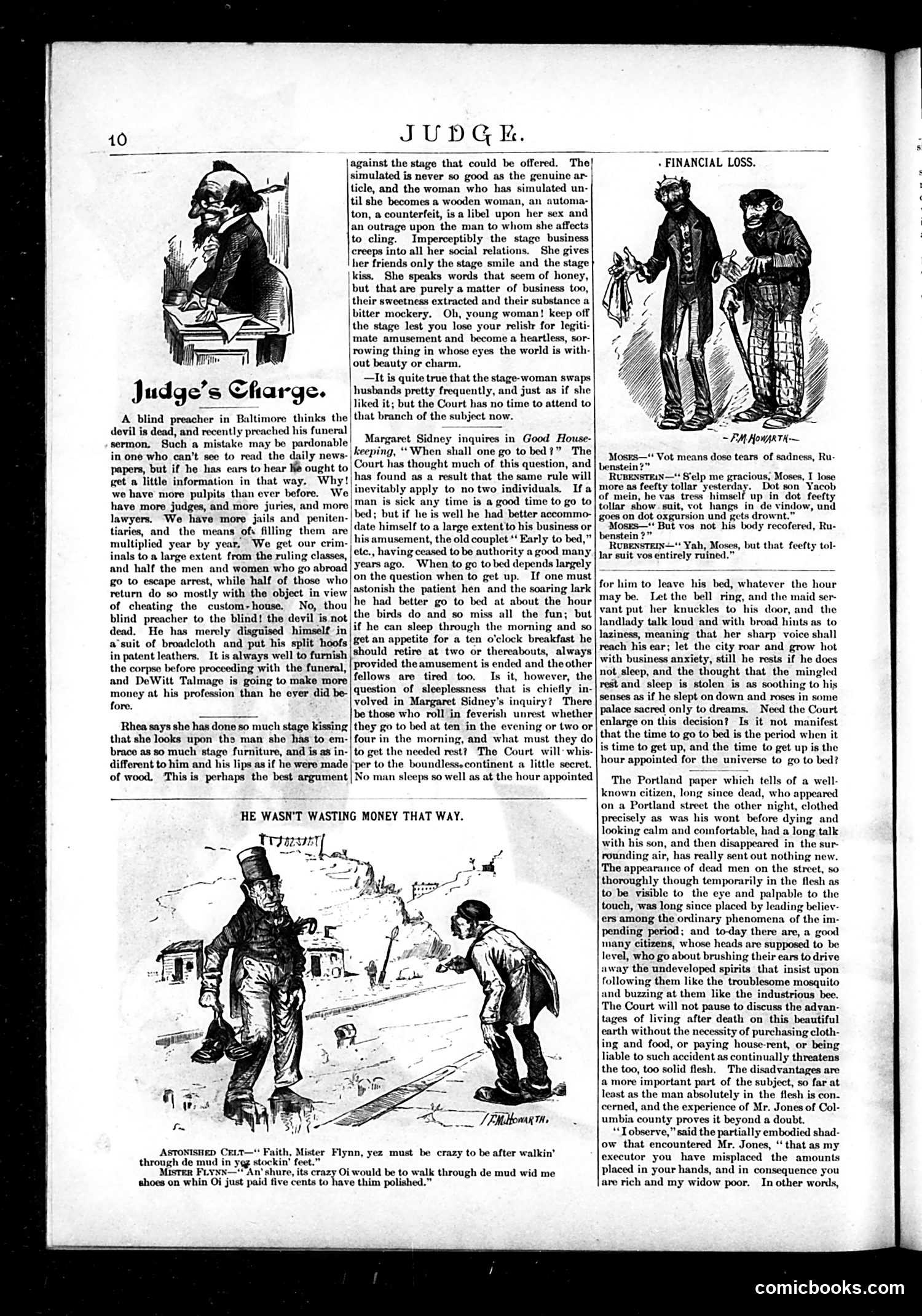
This page from *Judge* magazine contains social commentary and satirical cartoons critiquing American morality and hypocrisy. **"Judge's Charge"** (main editorial) attacks clergy hypocrisy—a blind Baltimore preacher claims the devil is dead, but the author argues this is absurd given rising crime, judges, juries, and lawyers, suggesting the devil merely disguises himself as respectable society ("a suit of broadcloth"). **The stage-woman critique** warns that actresses who perform fake emotions professionally become emotionally hollow in real life, swapping husbands casually and losing capacity for genuine feeling. **"He Wasn't Wasting Money That Way"** (cartoon) shows a wealthy man in top hat, apparently throwing money away while a poor man watches—likely satirizing class disparity and the poor man's observation that the rich waste resources the needy desperately require. The page reflects *Judge*'s recurring theme: American institutions and upper classes harbor moral corruption beneath respectable facades, contradicting claims of Christian virtue.
📄 Transcribed text from this page (OCR, searchable)
Machine-transcribed from the original scan — historical spelling and the odd misread are preserved.
JUDGE. Judge’s Charge. A blind preacher in Baltimore thinks the devil is dead, and recently preached his funeral sermon. Such a mistake may be pardonable in one who can’t see to read the daily news-| papers, but if he has ears to hear lie ought to Why! we have more pulpits than ever before. We have more judges, and more juries, and more lawyers, We have more jails and peniten- tiaries, and the means oft filling them are get a little information in that way, multiplied year by year. We get our crim- inals to a large extent from the ruling classes, and half the men and women who go abroad go to escape arrest, while half of those who return do so mostly with the object in view ticle, and the woman who has simulated un- til she becomes a wooden woman, an automa- ton, a counterfeit, is a libel upon her sex and an outrage upon the man to whom she affects to cling. Imperceptibly the stage business creeps into all her social relations. She gives her friends only the stage smile and the stage kiss, She speaks words that seem of honey, but that are purely a matter of business too, their sweetness extracted and their substance a bitter mockery, Oh, young woman! keep off the stage lest you lose your relist for legiti- mate amusement and become a heartless, sor- rowing thing in whose eyes the world is with- out beauty or charm. —It is quite true that the stage-woman swaps |husbands pretty frequently, and just as if she liked it; but the Court has no time to attend to that branch of the subject now. Margaret Sidney inquires in Good House- keeping, ‘When shall one go to bed?” The Court has thought much of this question, and jhas found as a result that the same rule will inevitably apply to no two individuals, If a |man is sick any time is a good time to go to bed; but if he is well he had better accommo- date himself to a large extent to his business or his amusement, the old couplet * Early to bed,” etc., having ceased to be authority a good many years ago. When to go to bed depends largely on the question when to get up. If one must astonish the patient hen and the soaring lark of cheating the custom-house, No, thou|he had better go to bed at about the hour blind preacher to the blind! the devil is not) dead. He has merely disguised himself in a‘suit of broadcloth and put his split hoofs in patent leathers. It is always well to furnish the corpse before proceeding with the funeral, and DeWitt Talmage is going to make more money at his profession than he ever did be- fore. Rhea says she has done so much stage kissing that she looks upon the man she has to em- brace as so much stage furniture, and is as in- different to him and his lips as if he were made of wood. ‘This is perhaps the best argument HE WASN'T WASTING MONEY THAT WAY. the birds do and so miss all the fun; but if he can sleep through the morning and so get an appetite for a ten o'clock breakfast he should retire at two or thereabouts, always provided the amusement is ended and the other fellows are tired too, Is it, however, the question of sleeplessness that is chiefly in- volved in Margaret Sidney’s inquiry? There be those who roll in feverish unrest whether they go to bed at ten in the evening or two or four in the morning, and what must they do | to get the needed rest? The Court will: whis- per to the boundlessecontinent a little secret. No man sleeps so well as at the hour appointed Mister Flynn, yez must be crazy to be after walkin’ through de mud in yg stockin’ feet.” ‘An’ shure, its boy! shoes on whin Oi just paid five cents to hi Oi would be to walk through de mud wid me ave thim polished. against the stage that could be offered. The] simulated is never so good as the genuine ar | FINANCIAL LOSS. dlgses* Vot means dose tears of sadness, Ru. pet RUBENSTELN—“ S'elp me gracious, Moses, I lose more as feefty tollar yesterday. Dot son Yacob of mein, he vas tress himself up in dot feefty tollar show suit, vot hangs in de vindow, und goes on dot oxgursion und gets drownt.” Mosres—‘‘ But vos not his body recofered, Ru- benstein ?” Rupenstein—‘‘ Yah, Moses, but that feefty tol- lar suit vos entirely ruined.” for him to leave his bed, whatever the hour may be. Let the bell ring, and the maid ser vant put her knuckles to his door, and the landlady talk loud and with broad hints as to laziness, meaning that her sharp voice shall reach his ear; let the city roar and grow hot with business anxiety, still he rests if he does not sleep, and the thought that the mingled rest and sleep is stolen is as soothing to his senses as if he slept on down and roses in some palace sacred only to dreams. Need the Court enlarge on this decision? Is it not manifest that the time to go to bed is the period when it is time to get up, and the time to get up is the hour appointed for the universe to go to bed? The Portland paper which tells of a well- known citizen, long since dead, who appeared on a Portland street the other night, clothed precisely as was his wont before dying and looking calm and comfortable, had a long talk with his son, and then disappeared in the sur- rounding air, has really sent out nothing new. The appearance of dead men on the street, so thoroughly though temporarily in the flesh as to be visible to the eye and palpable to the touch, was long since placed by leading believ- ers among the ordinary phenomena of the im- pending period; and to-day there are, a good many citizens, whose heads are supposed to be level, who go about brushing their ears to drive ay the undeveloped spirits that insist upon following them like the troublesome mosquito and buzzing at them like the industrious bee. The Court will not pause to discuss the advan- tages of living after death on this beautiful earth without the necessity of purchasing cloth- ing and food, or paying house-rent, or being liable to such accident as continually threatens the too, too solid flesh. The disadvantages are a more important part of the subject, so far at least as the man absolutely in the flesh is con. cerned, and the experience of Mr. Jones of Col- umbia county proves it beyond a doubt. “ Tobserve,” said the partially embodied shad- ow that encountered Mr. Jones, “that as my executor you have misplaced the amounts placed in your hands, and in consequence you are rich and my widow poor. In other words, comicbooks.com