
A complete issue · 20 pages · 1886
Judge — March 20, 1886
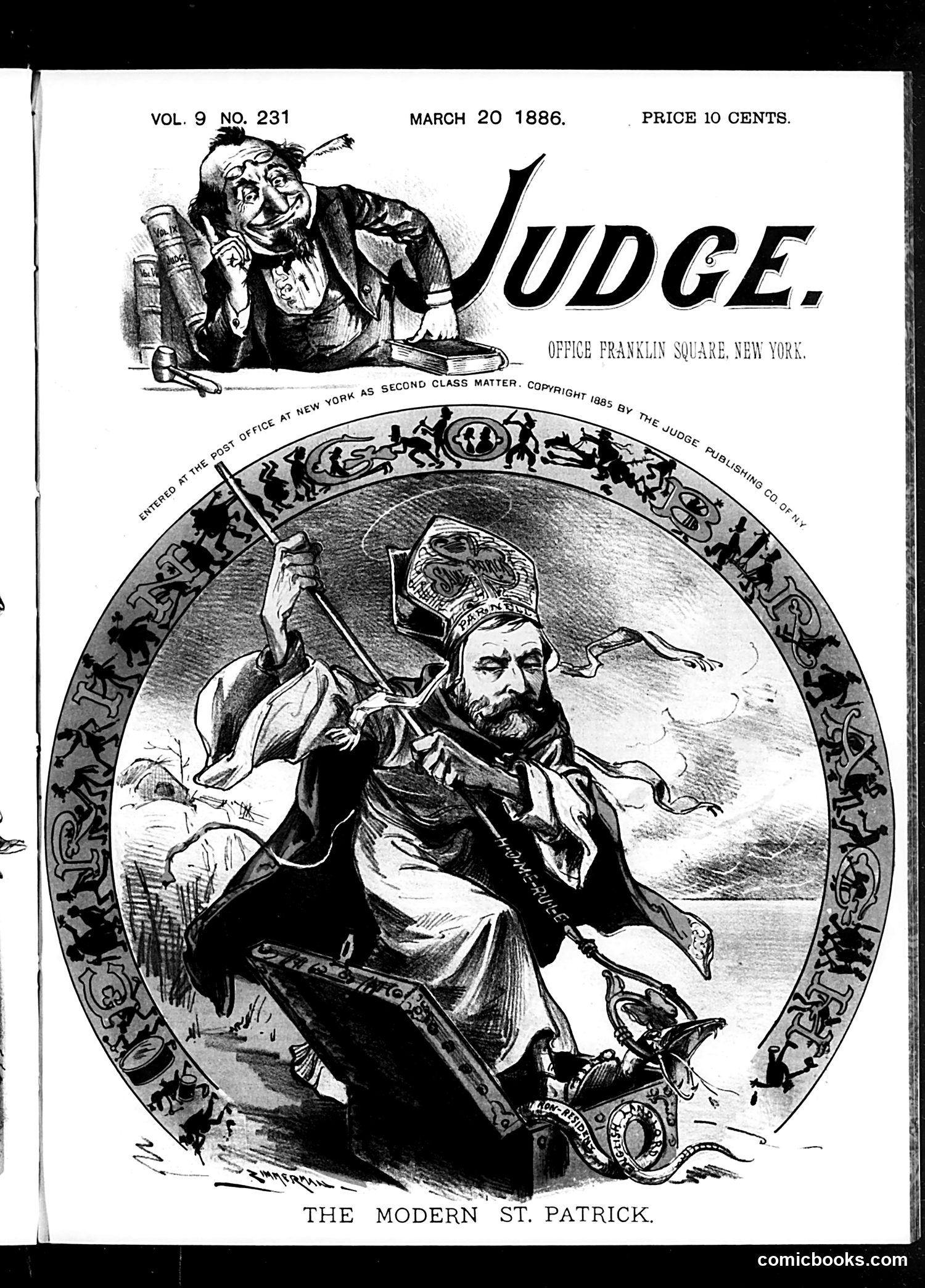
This cartoon satirizes a contemporary figure (identity unclear from image alone) as a "modern St. Patrick." The central illustration depicts a bearded man in period costume wielding a sword or staff, surrounded by decorative Irish imagery and mythological references. The satire likely critiques someone claiming Irish leadership or championing Irish causes during the 1880s—a period of intense Irish-American political activity and the Home Rule movement. The "modern St. Patrick" framing suggests either mockery of exaggerated Irish nationalism or, conversely, praise for driving out "snakes" (enemies of Irish interests). The caricatured head in the upper left appears to be the magazine's editorial commentary. Without additional context, the specific target and intended message remain unclear.
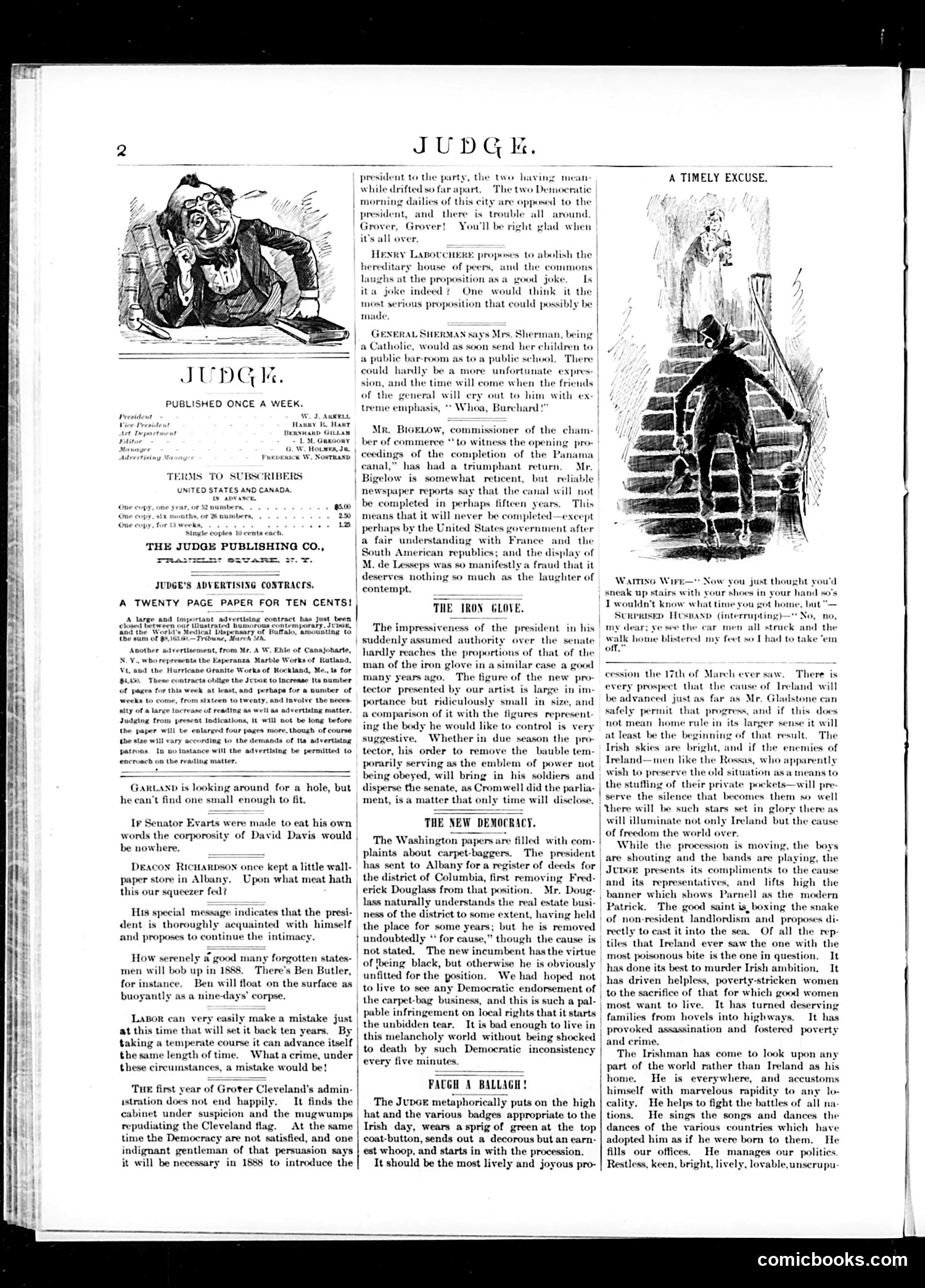
The main cartoon titled "JUDGE" depicts a disheveled, aggressive figure—likely a political opponent or critic—in a confrontational pose. This appears to satirize partisan conflict of the era. The text references several contemporary political figures and issues: Henry Labouchère's proposal to abolish hereditary peerages, General Sheridan's remarks about Catholics and public schools, Mr. Bigelow's work on the Panama Canal, and Senator Evarts's composure during Democratic disputes. The section "A TIMELY EXCUSE" (right) shows a figure on stairs—possibly satirizing someone using a pretense to avoid responsibility, though the specific reference is unclear. The overall page mixes political commentary on governance, Irish-American issues, and Democratic Party inconsistencies typical of 1880s American satire.
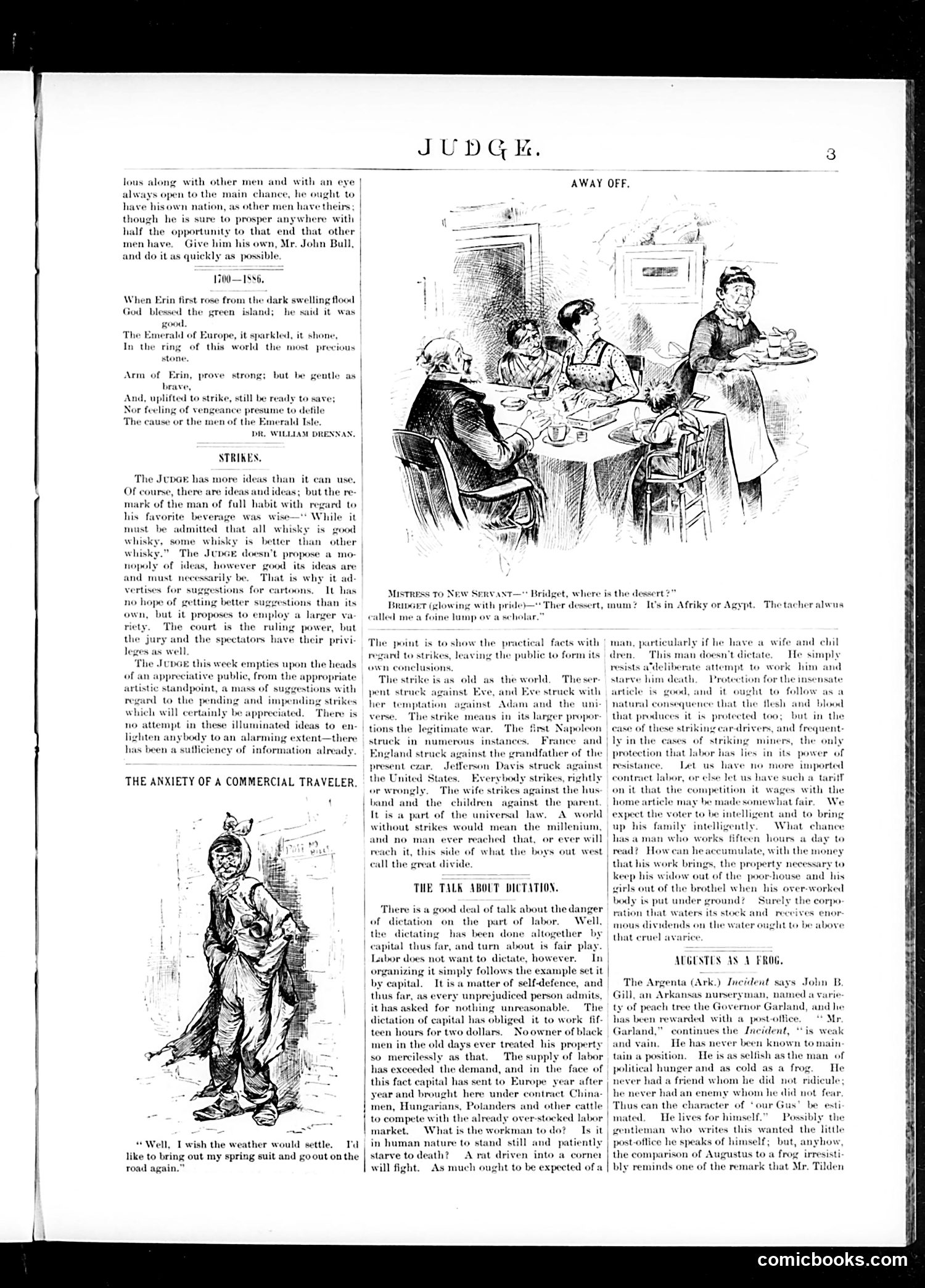
This page contains multiple satirical pieces criticizing labor conditions and strikes in Gilded Age America. **"Away Off"** (top cartoon): Depicts a wealthy family dismissing a servant's concerns about wages and working conditions, illustrating class indifference to worker hardship. **"Strikes"** section: Defends labor's right to strike as self-defense against exploitation. It argues workers aren't "dictating" but responding to desperate circumstances—comparing their position to a cornered rat forced to fight. The text criticizes capitalists for importing foreign contract laborers to undercut American wages, and calls for protective tariffs to level competition. **"The Talk About Dictation"**: Counters accusations that strikers are tyrannically dictating terms. Instead, it frames strikes as workers' only recourse against inhumane conditions (15-hour days for $2) and wage-suppressing immigrant labor competition. **Other pieces** ("Anxiety of a Commercial Traveler," "Augustus as a Frog"): Minor satirical vignettes on unrelated topics. The overall message: Judge advocates for labor protections and tariffs against imported workers, framing strikes as justified resistance rather than unreasonable demands.
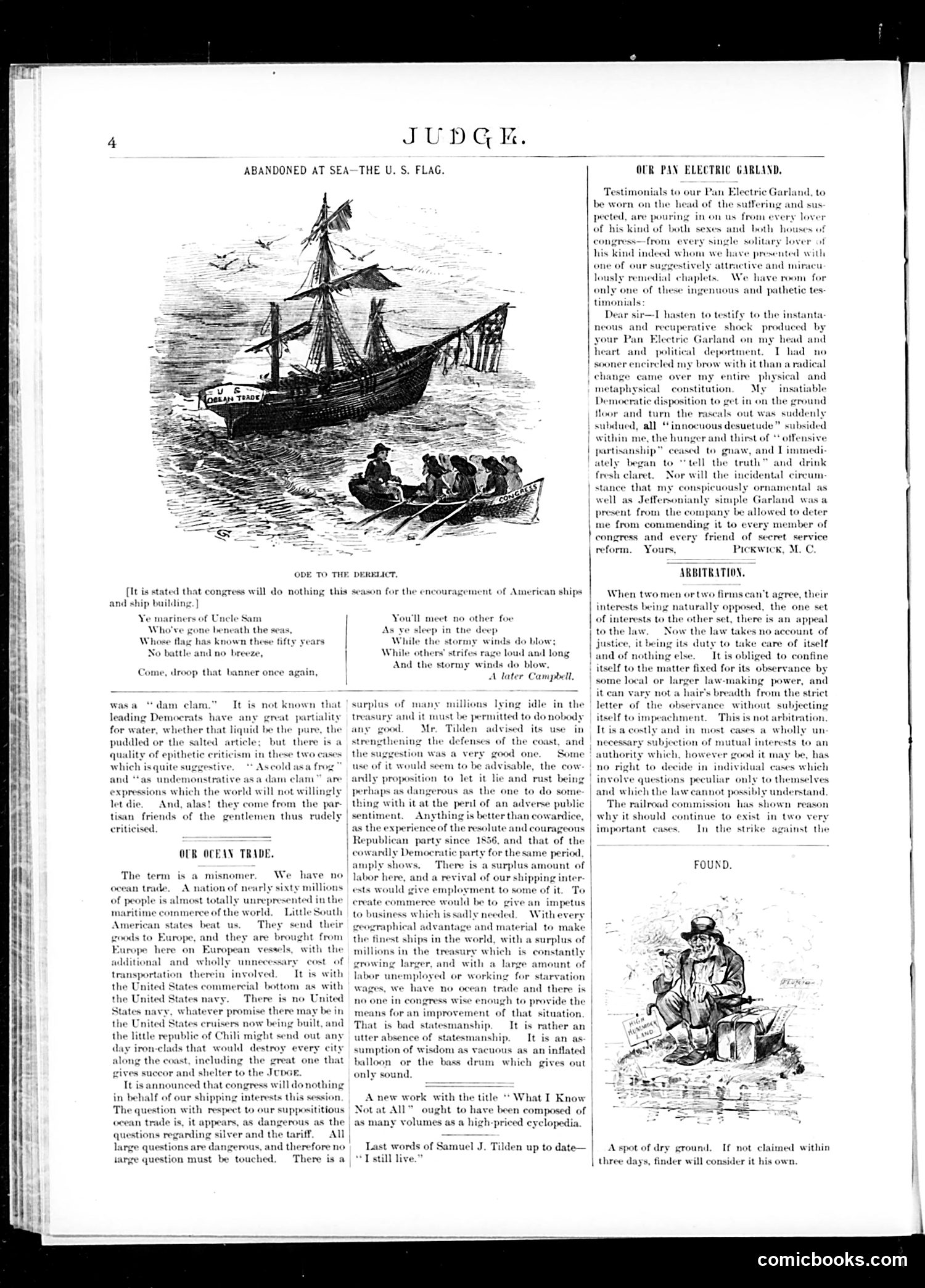
This page contains three distinct satirical pieces from *Judge* magazine: **"Abandoned at Sea"** (top left): A nautical engraving criticizes Congress for neglecting American shipping interests. The accompanying poem laments that U.S. maritime power has declined—ships are being abandoned while other nations' vessels thrive. This reflects late-19th-century anxieties about American naval/commercial competitiveness. **"Our Pan Electric Garland"** (right): A mock testimonial from "Pickwick, M.C." (a congressman) praising a "Pan Electric Garland"—apparently a therapeutic headpiece. The satire targets Democratic politicians, suggesting the device magically cured the writer's partisan zeal and desire to "turn the rascals out," transforming him into a compliant moderate. This ridicules political flip-flopping. **"Our Ocean Trade"** and **"Arbitration"** (lower sections): These articles debate tariff policy, ocean commerce, and railroad regulation—issues central to Gilded Age political debate between protectionists and free-traders. The cartoons mock both political parties' hypocrisy and industrial-era governance challenges.
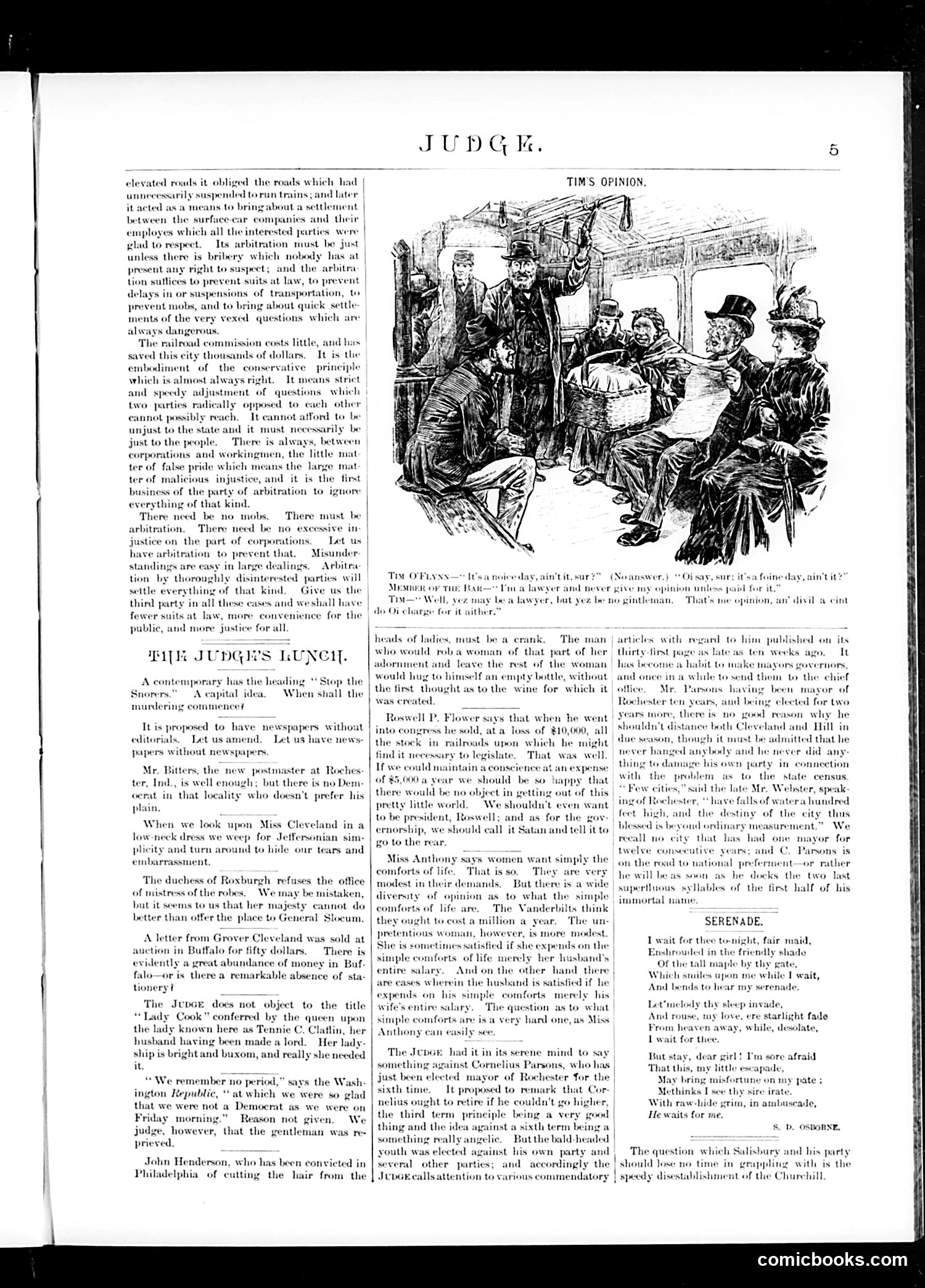
This page from *Judge* contains political commentary and social satire typical of the late 19th-century magazine. **"Tim's Opinion" (main cartoon):** The sketch depicts a street-level conversation, likely satirizing working-class Irish immigrants (suggested by "Tim O'Flynn"). The dialogue humorously captures dialect humor popular in the era, with Tim claiming he gives legal opinions without charging—a jab at unqualified advisors in urban politics. **Political targets in the text include:** - **Roswell P. Flower** (congressman/governor candidate): Mocked for claiming financial loss while in office, suggesting political hypocrisy about wealth and public service. - **Susan B. Anthony**: Satirized for women's demands, with the author arguing women want simple comforts but disagree on what constitutes them—a dismissive critique of women's suffrage arguments. - **Grover Cleveland's daughter**: Criticized for her clothing choices and role as "mistress of the robes." The satire reflects *Judge*'s conservative editorial stance, defending business interests and mocking reform movements, immigrant populations, and women's rights advocates.
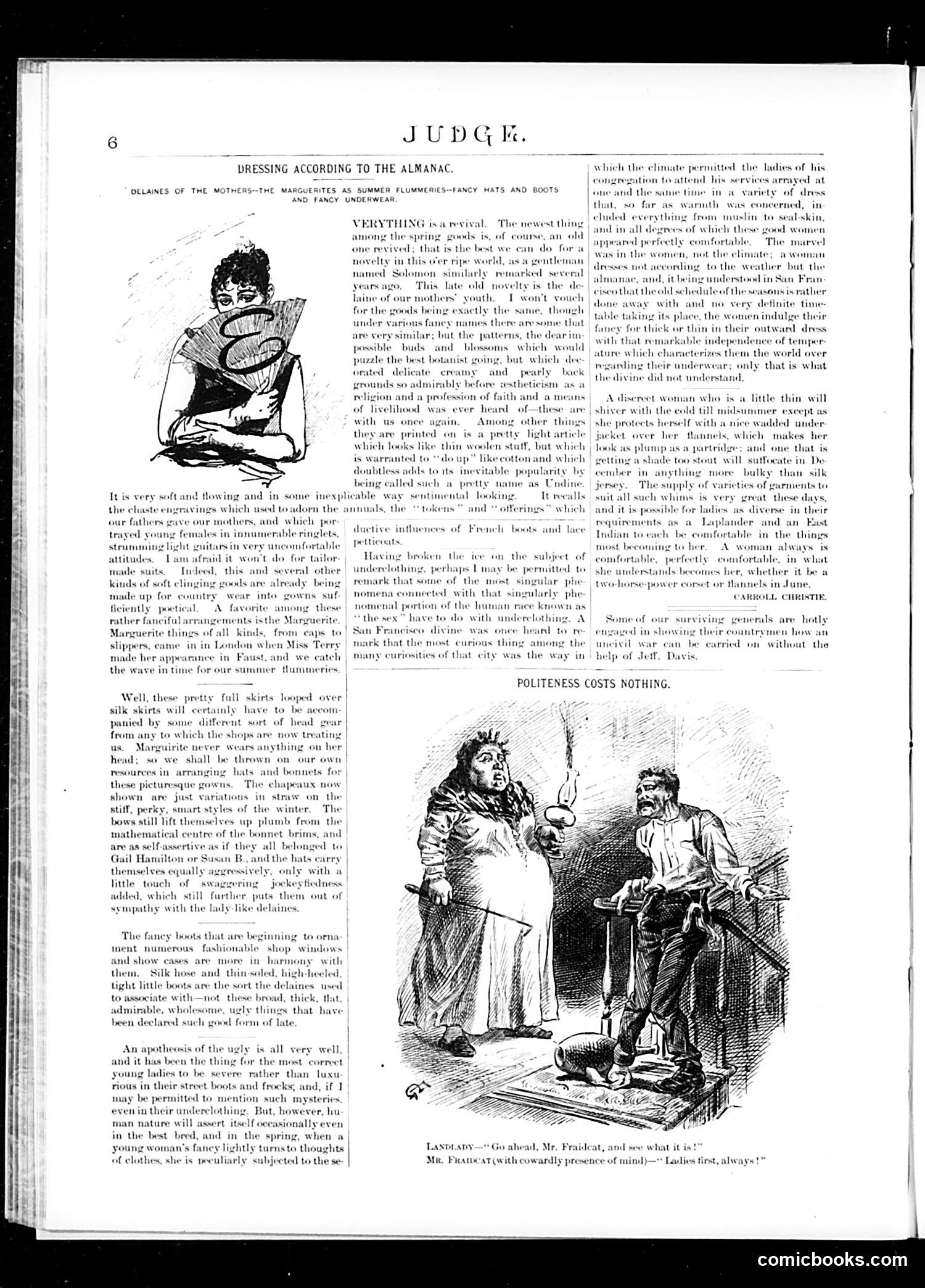
This page contains two distinct articles about women's fashion and social behavior from the 1880s-90s era. **"Dressing According to the Almanac"** discusses summer fashions, particularly the "Marguerite" style (named after actress Ellen Terry's costume in *Faust*). The article mocks women's impractical adherence to seasonal fashion trends—elaborate looped skirts, perky bonnets with assertive bows, and dainty boots—despite practical concerns like warmth. The satire targets women's obsessive, sometimes contradictory fashion choices and their willingness to follow trends regardless of comfort or logic. **"Politeness Costs Nothing"** (lower cartoon) depicts a domestic scene where "Mr. Fraidcat" cowardly sends his wife to investigate an unknown noise, invoking "ladies first, always!"—sarcastically suggesting that men hide behind outdated courtesy conventions to avoid danger themselves. Both pieces satirize gender roles and social conventions of the era, mocking both women's fashion obsessions and men's use of politeness as an excuse for cowardice.
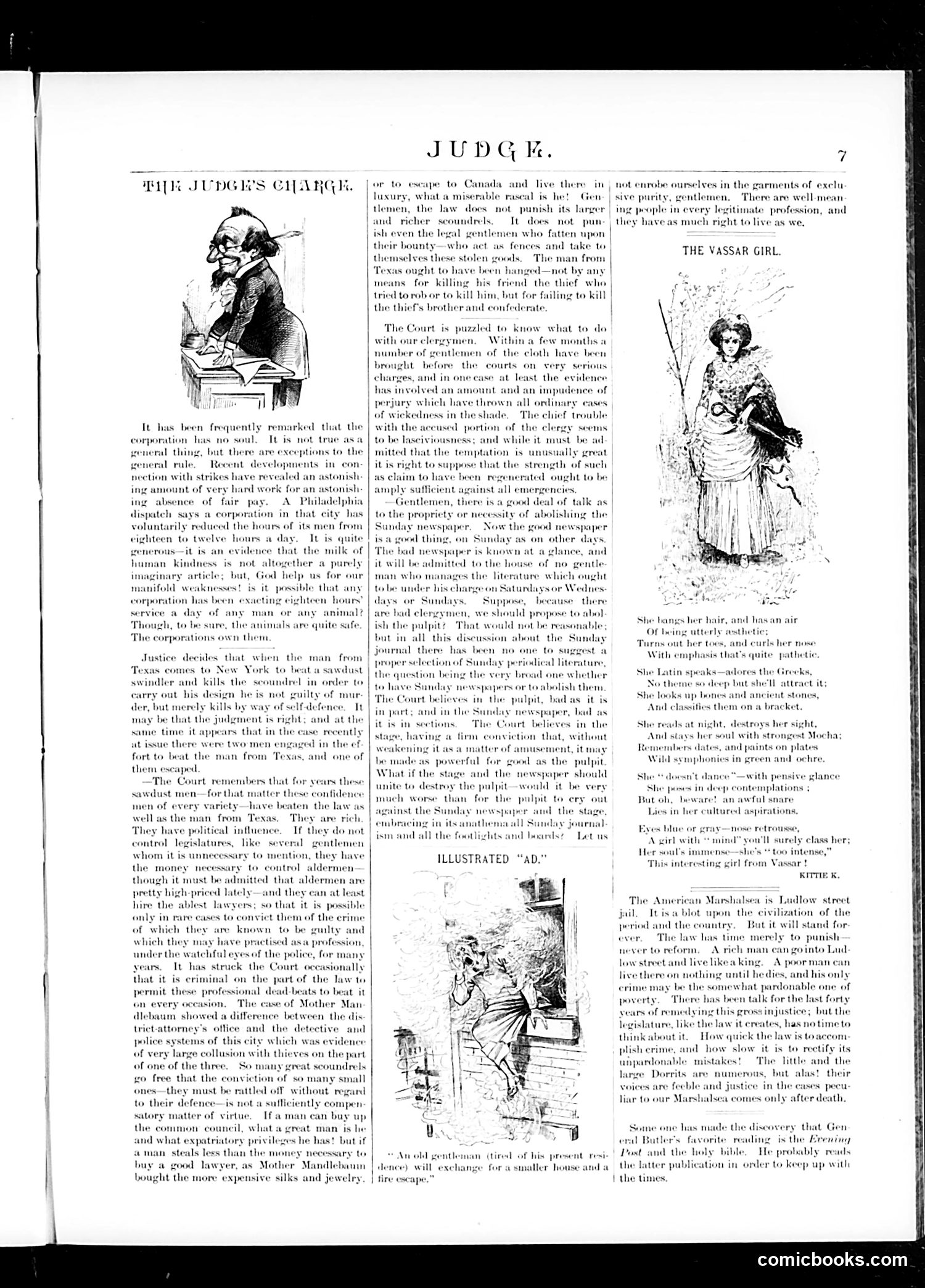
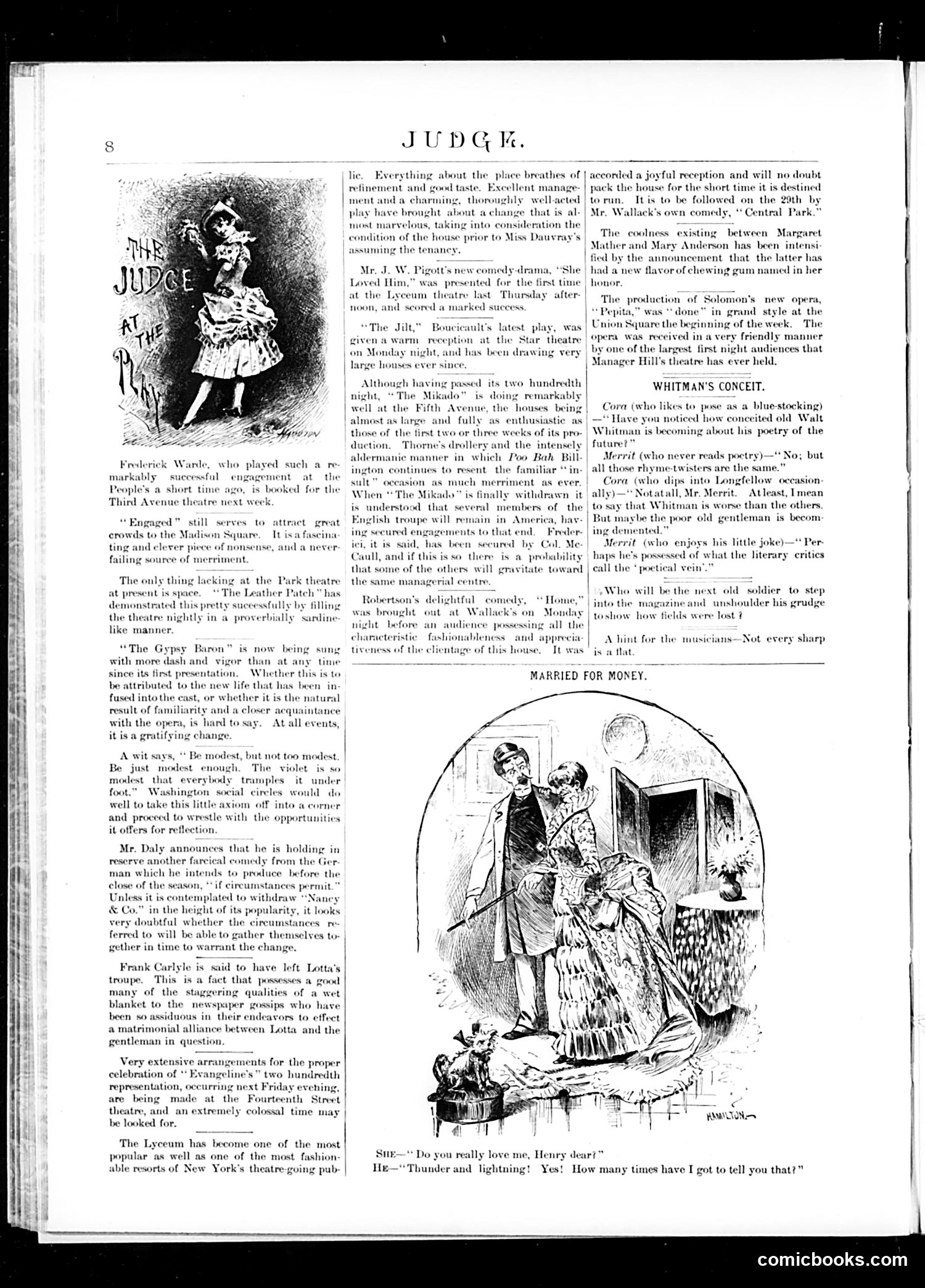
This page contains theater reviews and theatrical gossip typical of Judge's entertainment coverage. The main cartoon, titled "Married for Money," depicts a couple in what appears to be a transactional relationship—a common satirical subject of the era. The woman asks "Do you really love me, Henry dear?" while the man responds "Thunder and lightning! Yes! How many times have I got to tell you that?"—suggesting his exasperated patience with repeated questions about affection in a marriage motivated by financial rather than romantic considerations. The surrounding text reviews contemporary theatrical productions ("The Mikado," "The Gypsy Baron," etc.) and gossip about theater personalities. A sidebar titled "Whitman's Conceit" mocks poet Walt Whitman's confidence in his work, with characters dismissing his "poetry of the future" as pretentious. The satire assumes readers' familiarity with New York's theater scene and cultural figures of the period.
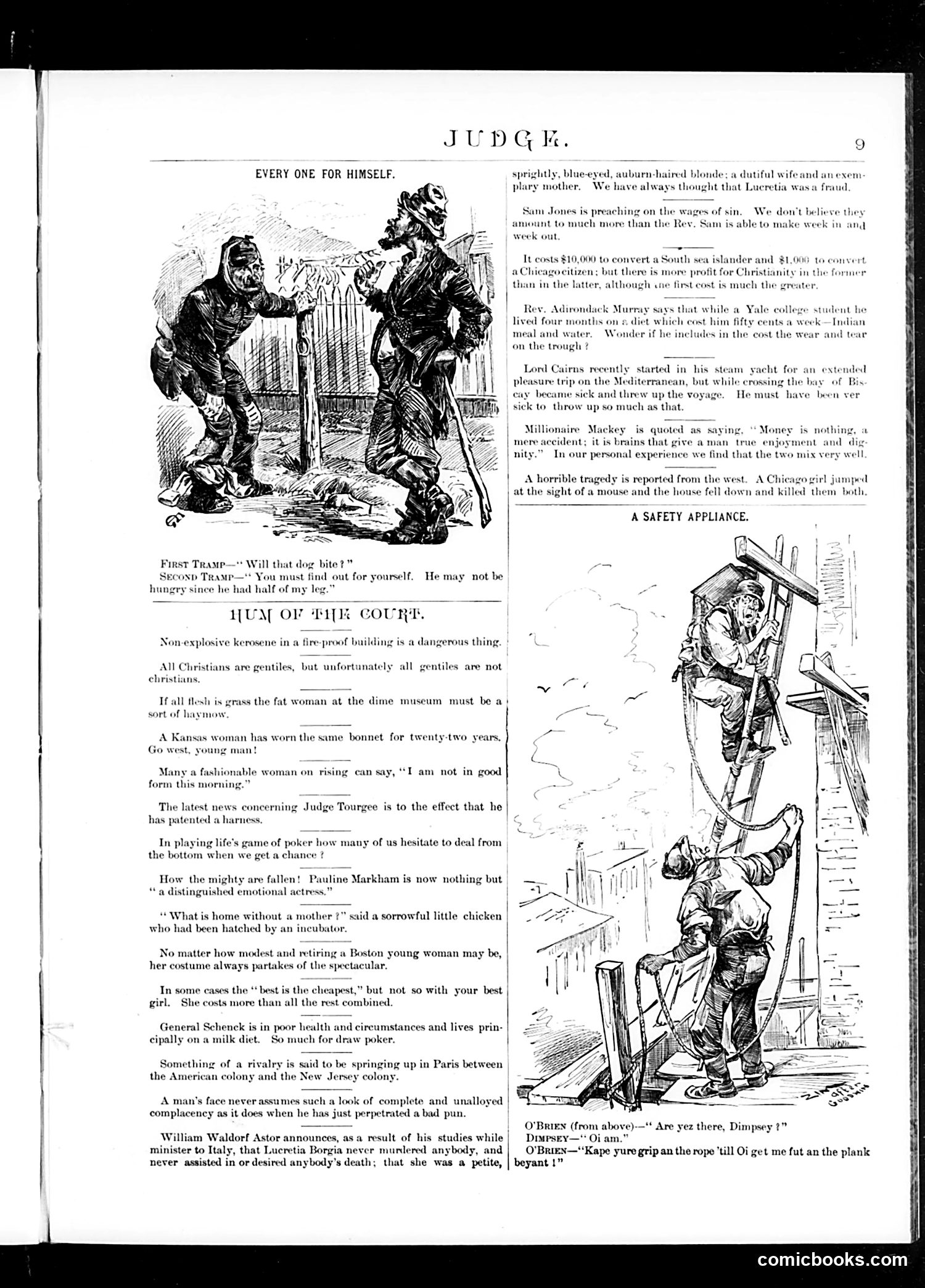
This page contains multiple short satirical items typical of Judge's format. The main cartoon "Every One for Himself" depicts two tramps discussing a dog that has bitten one of them—dark humor about poverty and danger. The accompanying text offers social commentary on various figures and issues: - **Sam Jones** (a real evangelist) is mocked for his modest wages - **Lord Cairns** allegedly became seasick on a Mediterranean yacht - **Millionaire Mackey** is quoted on money's insignificance - A Chicago tragedy about a girl frightened by a mouse is presented as absurdist news - **Judge Tourgee** (likely Albion Tourgee, a Reconstruction-era figure) supposedly patented a harness - **Pauline Markham** (likely the actress) is noted as having fallen to "distinguished emotional actress" status - **General Schenck** is mocked for living on milk diet (possibly referencing financial losses from gambling) - **William Waldorf Astor** is satirized for defending Lucretia Borgia's reputation "A Safety Appliance" cartoon shows sailors in rigging—likely depicting a maritime mishap. The humor relies on recognizing contemporary celebrities and public figures.
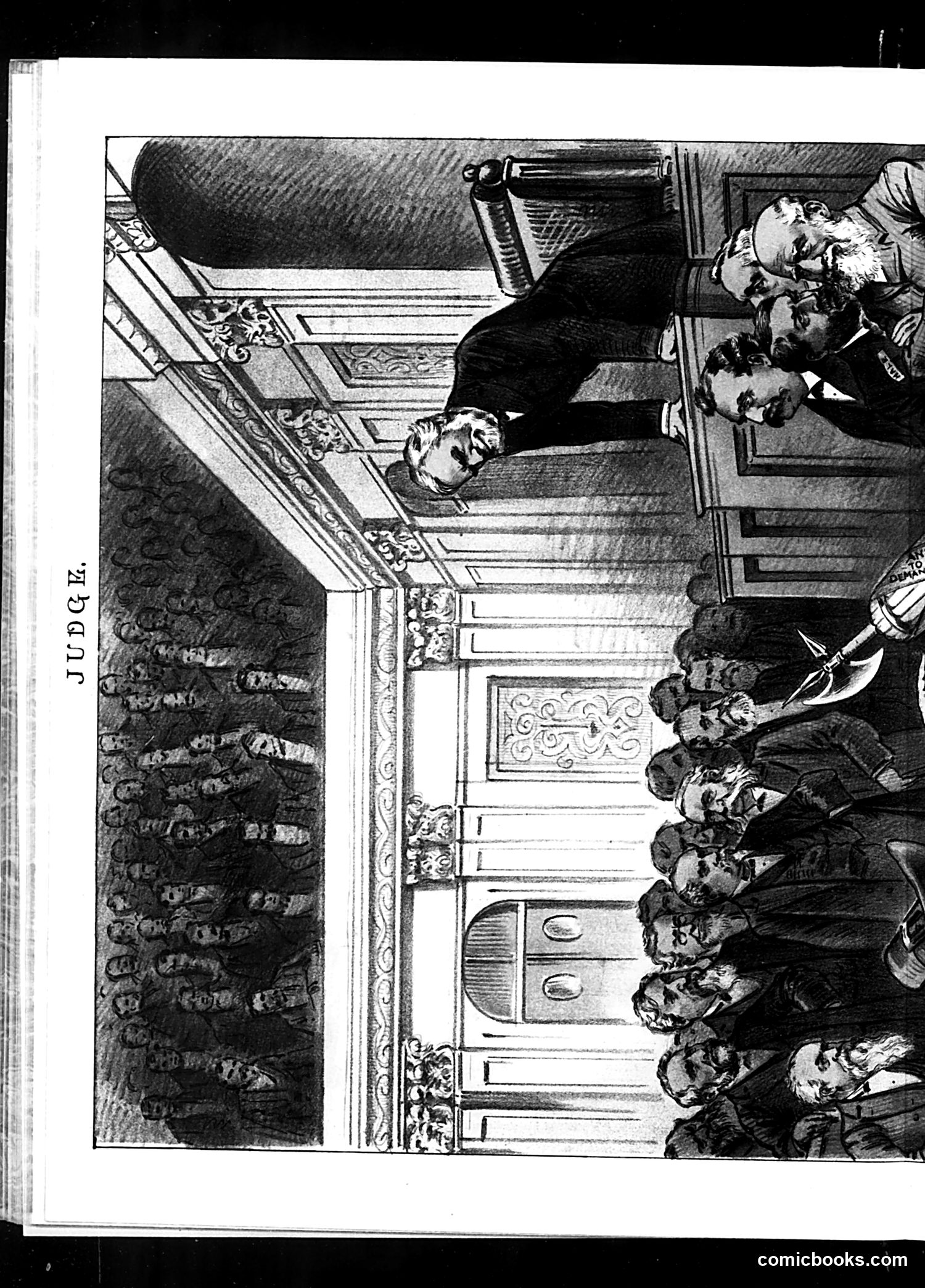
I can see this is a black and white illustration from *Judge* magazine (indicated by the text "JUDGE" on the left margin), but the OCR text provided only contains "comicbooks.com," which doesn't help identify the cartoon's content. The image appears to show an interior scene with multiple figures in period clothing arranged in what looks like a formal or official setting, with decorative architectural details visible. However, without legible text identifying the specific figures, political figures being caricatured, or the historical event being referenced, I cannot reliably explain what satire or political commentary this cartoon conveys to a modern reader. To properly explain this cartoon's meaning, I would need clearer OCR text or additional context about the publication date and issue.
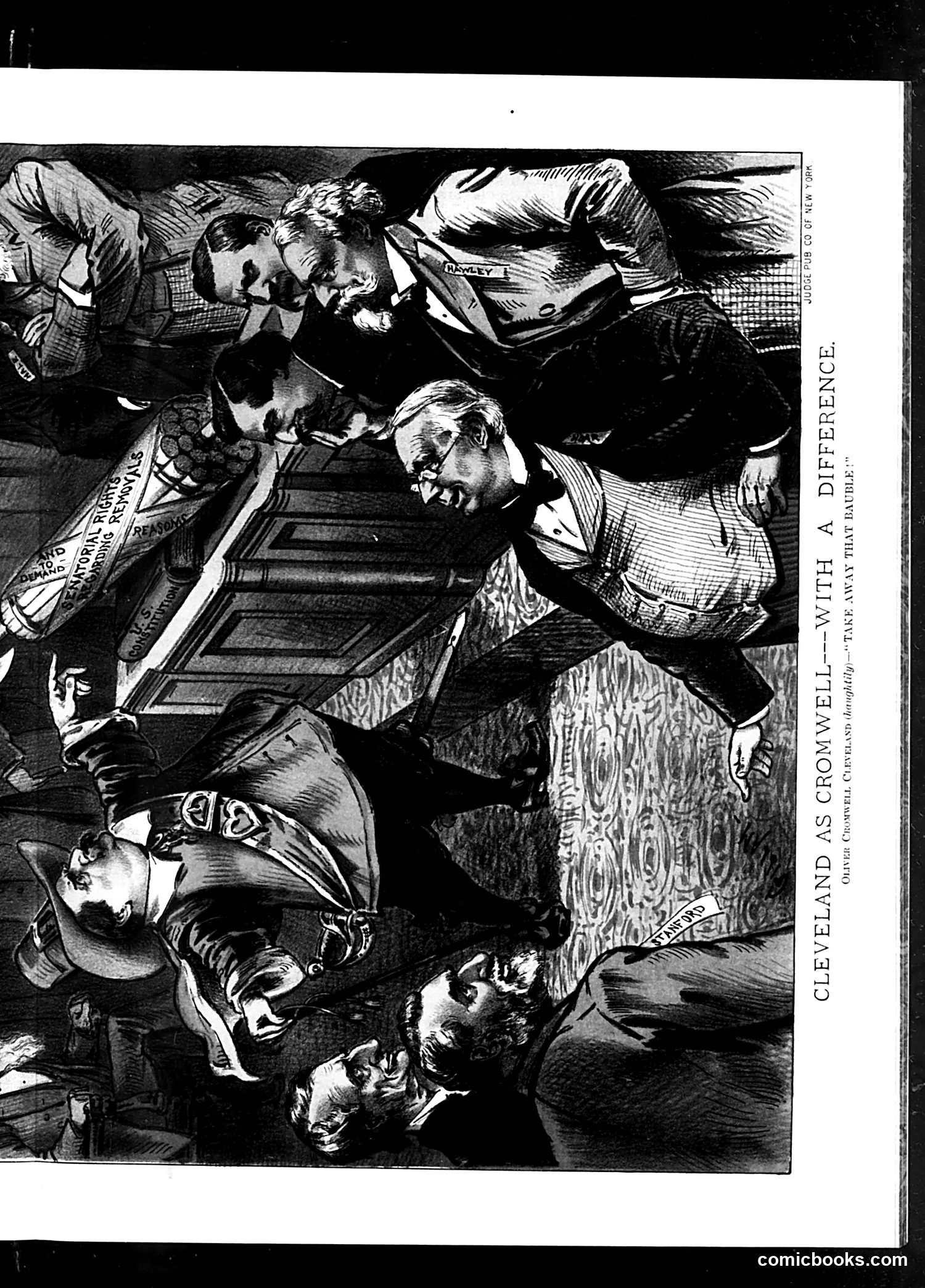
The OCR text is largely corrupted and illegible, making it impossible to verify specific references from the printed content. However, the image shows what appears to be a political cartoon depicting several men gathered around a coffin or casket. The caption reads "CLEVELAND AS CROWWELL—WITH A DIFFERENCE," suggesting this references President Grover Cleveland and Oliver Cromwell, likely critiquing Cleveland's policies or leadership style through historical comparison. The figures appear to be mourning or examining the coffin's contents, but without legible OCR text identifying the specific individuals or the exact satirical point, I cannot definitively explain the cartoon's political message to a modern reader. The Cromwell comparison suggests criticism of authoritarian or controversial governance, but the specific context and targets remain unclear.
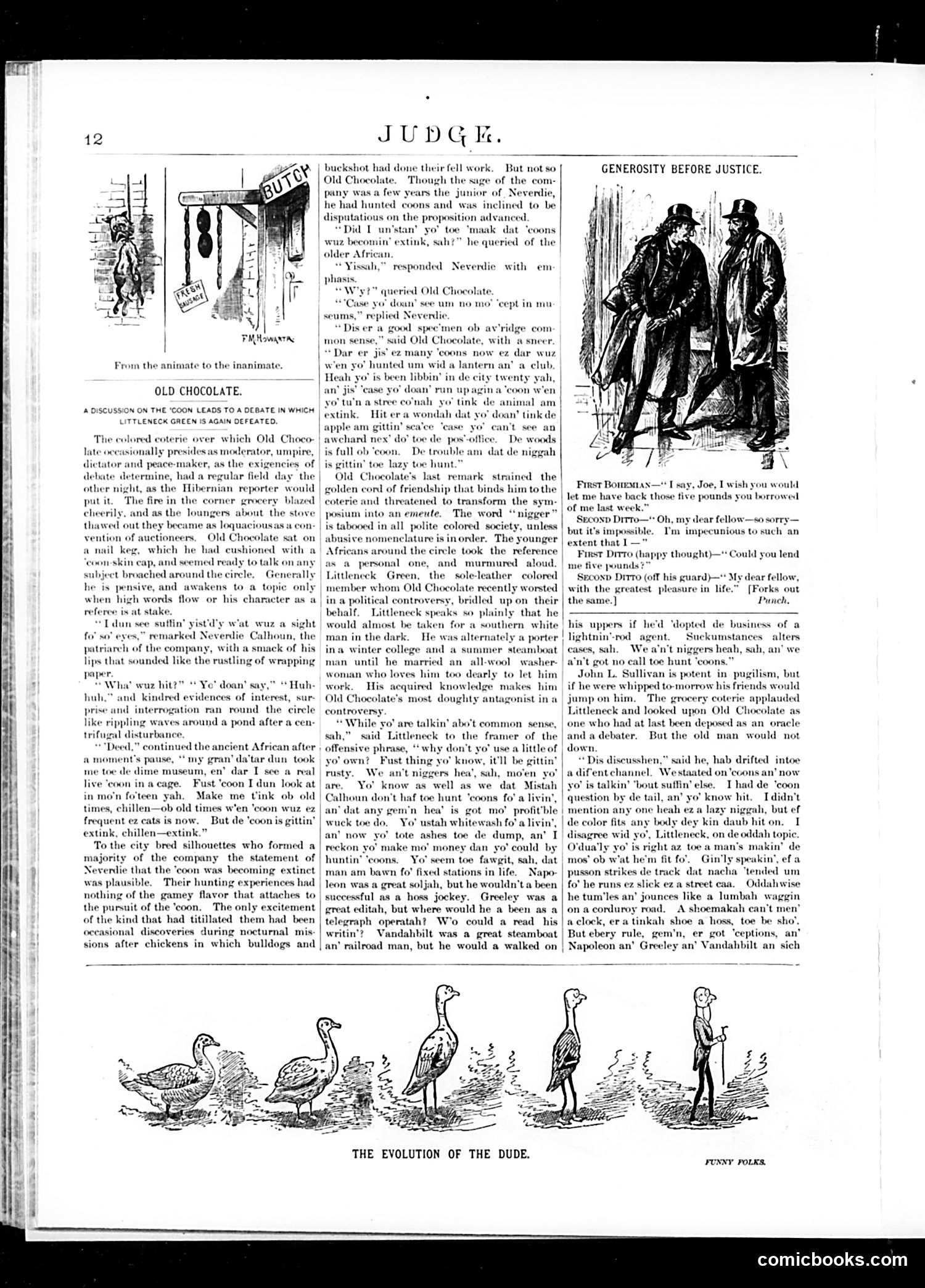
This page from *Judge* magazine features dialect humor centered on African American characters debating whether raccoons are becoming extinct. The piece titled "Old Chocolate" presents a conversation between older and younger Black men using heavy stereotypical dialect and racial slurs common to 19th-century American satire. The satire appears to mock both the characters' pretensions to knowledge and their use of formal debate structures around trivial topics. The illustration "Generosity Before Justice" above depicts well-dressed figures, likely contrasting with the working-class "coon hunters" below. The bottom feature, "The Evolution of the Dude," uses bird illustrations to satirize changing fashions or social pretensions. The entire page relies on deeply racist caricature typical of the era's "humor," reducing Black characters to dialect comedy while potentially mocking educated aspirations within their community.
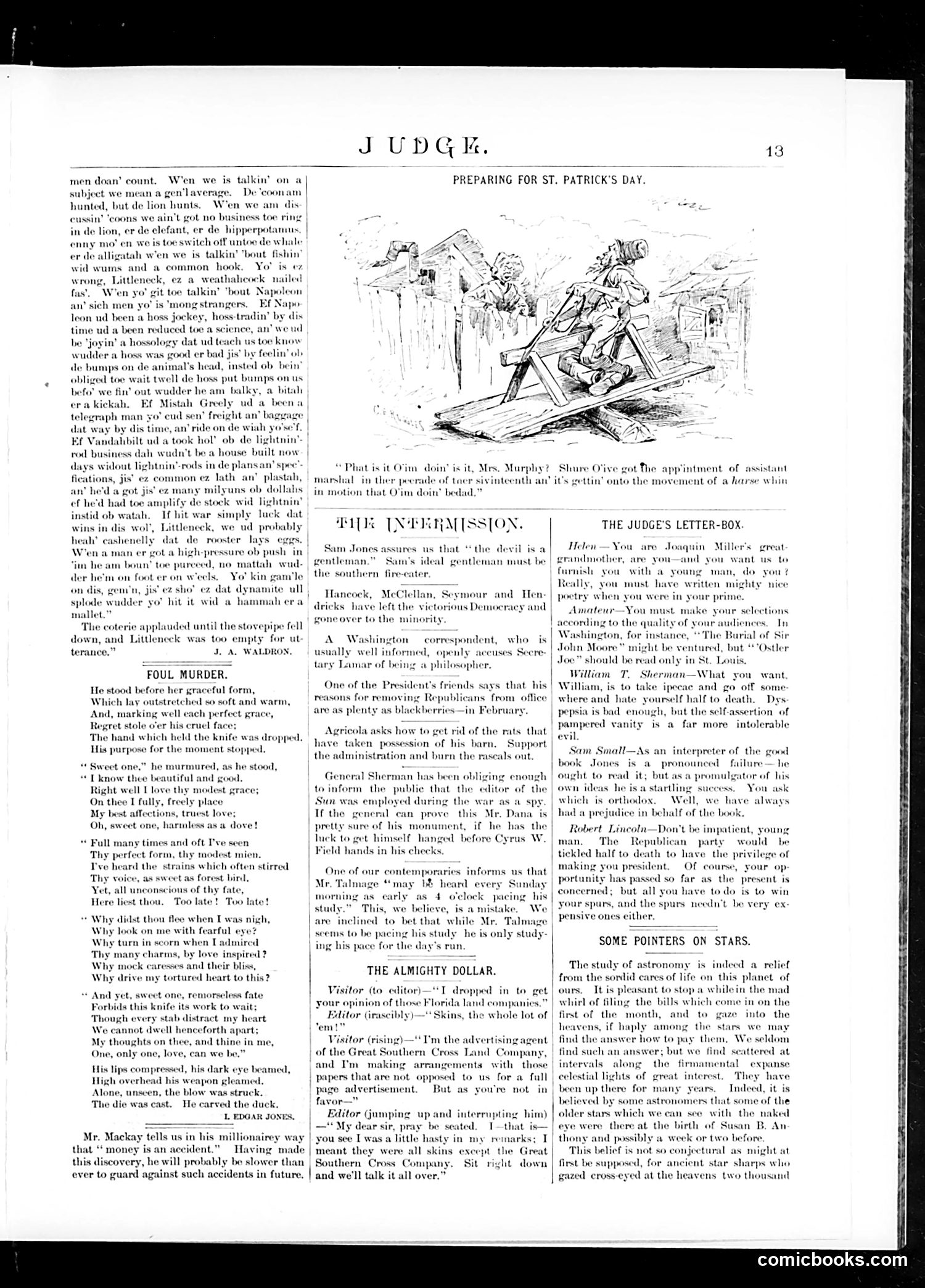
This page from *Judge* magazine contains satirical commentary and humor typical of the late 19th century. The main cartoon, titled "Preparing for St. Patrick's Day," depicts Irish Americans preparing for the holiday parade. The figures speak in heavy dialect ("O'im doin'," "bedad"), reflecting the period's crude ethnic stereotyping of Irish immigrants—a common target of American satirical magazines. The text sections include various humorous columns and letters. "The Intermission" mocks Republican politicians (Hancock, McClellan, Seymour, Hendricks) who lost power, suggesting they've become irrelevant. "The Judge's Letter-Box" contains reader submissions with satirical responses about poetry, interpretation, and morality. Other pieces like "Foul Murder" and "The Almighty Dollar" use dark humor and irony typical of *Judge's* style. The overall tone reflects 1880s-era American prejudices while targeting political figures and social follies.
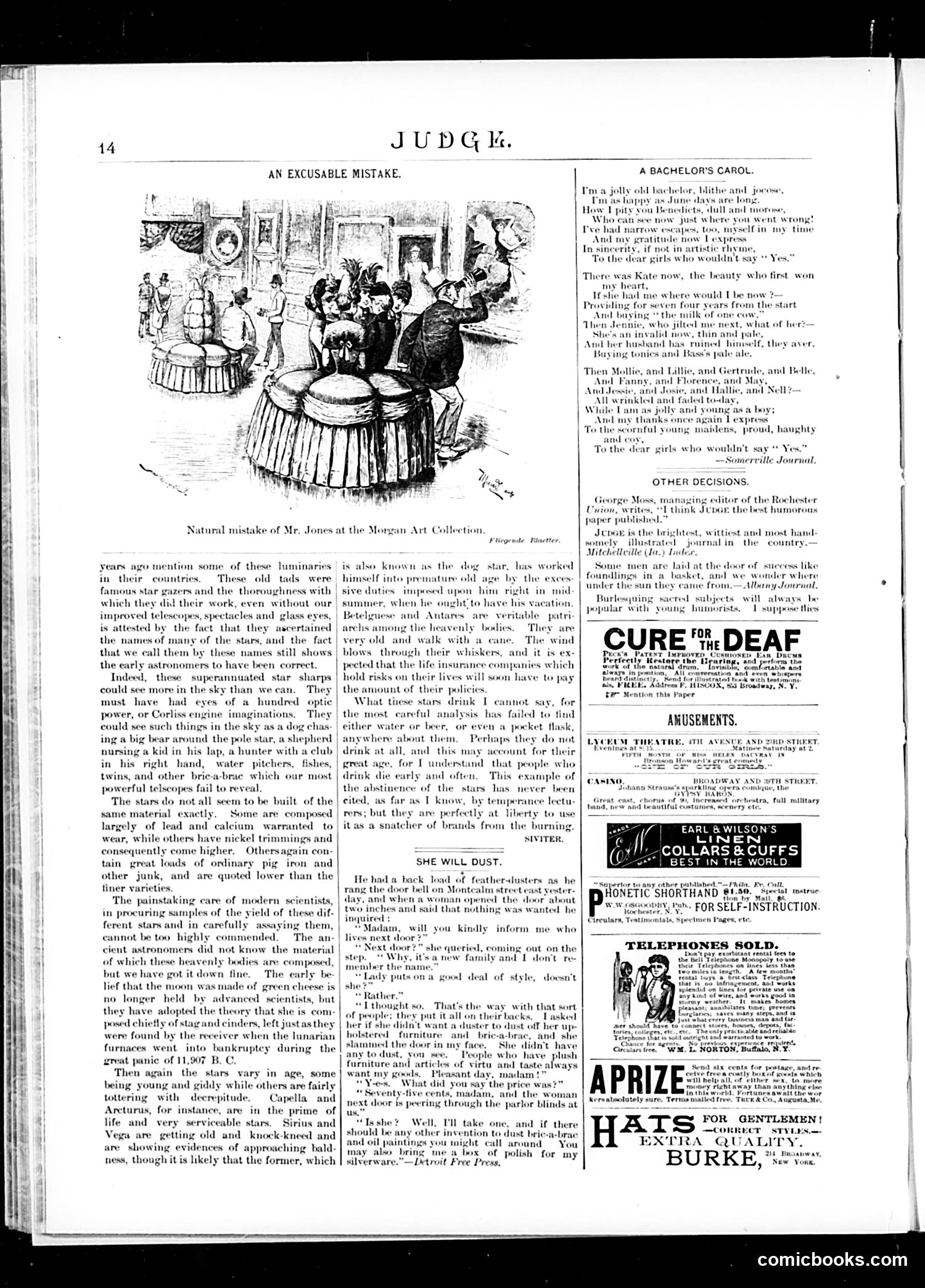
**"An Excusable Mistake"** (left): A humorous essay mocking pseudo-scientific astronomy. The author ridicules both ancient astronomers (who saw bears and hunters in star patterns) and modern scientists claiming to analyze stellar composition. The satire targets pretentious scientific claims—the notion that researchers can determine whether stars are made of lead, iron, or nickel is presented as absurd. The piece appears to critique both historical superstition and contemporary scientific overconfidence. **"She Will Dust"** (bottom): A brief comedic dialogue mocking a working-class woman's assumptions about new wealthy neighbors. When a new family moves in with ostentatious displays, the woman assumes they're putting on airs ("it's all on their backs"). She offers unsolicited domestic services, presuming they'll need help maintaining their pretentious lifestyle. The joke satirizes both class pretension and working-class presumptuousness. Both pieces use humor to critique human vanity and false claims to superiority.
This is primarily a **magazine/advertising page** rather than a coherent satirical composition. The main content is the magazine's **$100 reward offer** for the "most original idea for a colored cartoon"—a contest aimed at readers, to be illustrated by notable cartoonist **Mr. Gillam** (Bernard Gillam, a prominent Judge contributor). The page includes multiple **product advertisements** (breakfast cocoa, cream balm, safes, tailors' services) typical of 19th-century periodicals, along with excerpts of **positive press reviews** praising Judge's political cartoons and wit. A brief humorous anecdote appears at bottom ("Played It Too Well") about a man avoiding creditors by using handcuffs as a disguise—a light joke about social embarrassment rather than political satire. The page demonstrates Judge's self-promotion, its reliance on advertising revenue, and its positioning as America's premier satirical publication for illustrators and humorists. No specific political figures or events are identifiable from this scan.
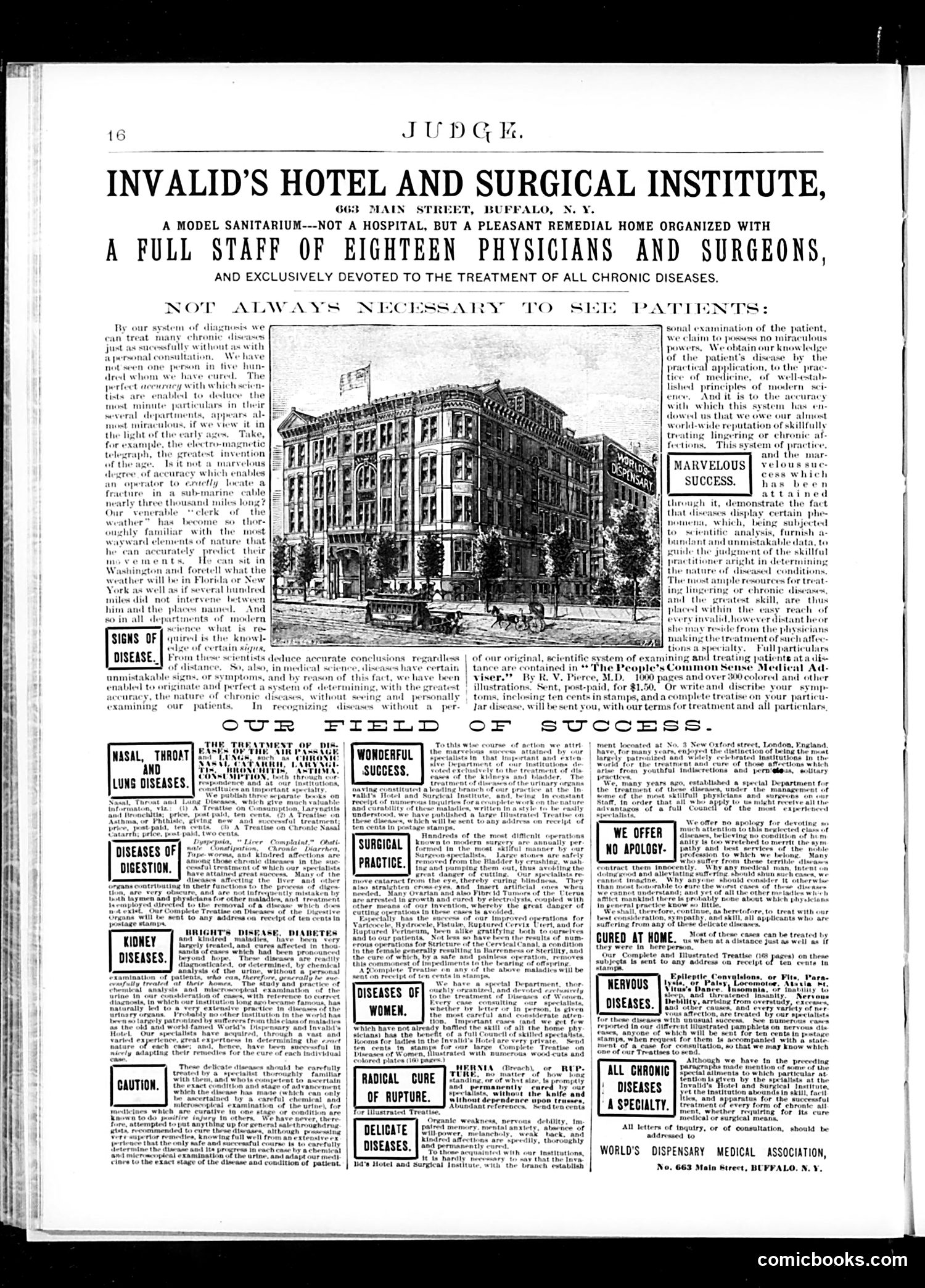
This page is primarily a full-page advertisement—not a cartoon. The Invalid's Hotel and Surgical Institute in Buffalo, New York advertises its services for treating chronic diseases through a sanitarium model rather than traditional hospitality. The ad emphasizes the institute's ability to diagnose and treat patients remotely without requiring them to visit in person. It highlights eighteen physicians and surgeons on staff and claims expertise across numerous conditions: diseases of digestion, kidneys, throat, lungs, women's ailments, nervous disorders, and rupture. The language promises "marvelous success" and claims diagnostic accuracy from distance, while carefully avoiding claims of "miraculous powers." Multiple boxed sections detail specialized treatments available. This represents late-19th-century medical entrepreneurship—offering mail-order medical consultation and treatment, a practice that became increasingly common and controversial during this period.
This page is primarily **advertising**, featuring commercial notices for late-19th-century businesses (perfumes, printing services, lithography, paper goods, inks, and flour sacks). The advertisements dominate the layout. Embedded within the ads are **three brief humorous anecdotes**: 1. A story about James playing a sheriff in what appears to be a theatrical performance—he over-acts the role, and his props end up in water ("in soak"). 2. A repeated refrain titled "Solid Sense Every Time," cataloging everyday moral failings (borrowing newspapers, refusing to hire moral employees, speaking unkindly, hiring dishonest workers). 3. Two short jokes about social embarrassment: one about a neighbor who "went west" after Indian troubles, and another about a woman creating a disturbance at what appears to be a theater by wearing a rustling new cloak. These are light, domestic humor pieces typical of Judge's satirical but genteel approach—poking fun at ordinary people's vanities and social awkwardness rather than engaging in sharp political commentary. The page reflects the magazine's mixed format of advertising and entertainment.
This page is primarily **advertising, not satirical content**. It's a full-page testimonial ad from A.W. Ehle of Canajoharie, New York, promoting his monument and chapel business. The ad's opening claim—"30 PER CENT. SAVED"—is Ehle's sales pitch: he undercuts competitors by not maintaining large inventory, thus avoiding interest charges that get passed to customers. He works on a "ten per cent basis" instead. The bulk of the ad catalogs his services: he's building granite chapels ($3,000-$25,000 range), has 5,000 designs for chapels, vaults, and tombstones, controls New York output for Hurricane Granite Works (Maine) and Esperanza Marble Works (Vermont), and offers to send photographs nationwide. The layout—with "ELEGANT GRANITE CHAPELS" and "VAULTS, TOMBSTONES, ETC." flanking the text—suggests this is a *Judge* magazine advertisement rather than satirical editorial content, likely from the late 19th century based on the typography and business model described.
This page is primarily **advertisements** with one embedded political cartoon titled "A Dark Head: A Dark Register of Deeds, in Fact." The cartoon satirizes **President Chester Arthur** (identifiable from context clues about "the president" and the White House setting). The scene depicts Arthur at his desk, surrounded by papers and petitioners seeking government positions. The joke centers on a "dark register of deeds"—a pun on the Office of Deeds records—suggesting Arthur's appointment decisions lack transparency or ethical grounding. The dialogue mocks Arthur's imperious management style and his willingness to appoint unqualified candidates based on political loyalty rather than merit. A secretary proposes various applicants; Arthur dismissively demands obedience without regard to qualifications, ultimately appointing "a colored gentleman from New York to fill a local position" apparently as a political favor. The satire criticizes **Gilded Age patronage politics**—the spoils system where government jobs went to political allies rather than qualified candidates. The "dark" register implies corruption or moral shadiness in Arthur's administrative practices.
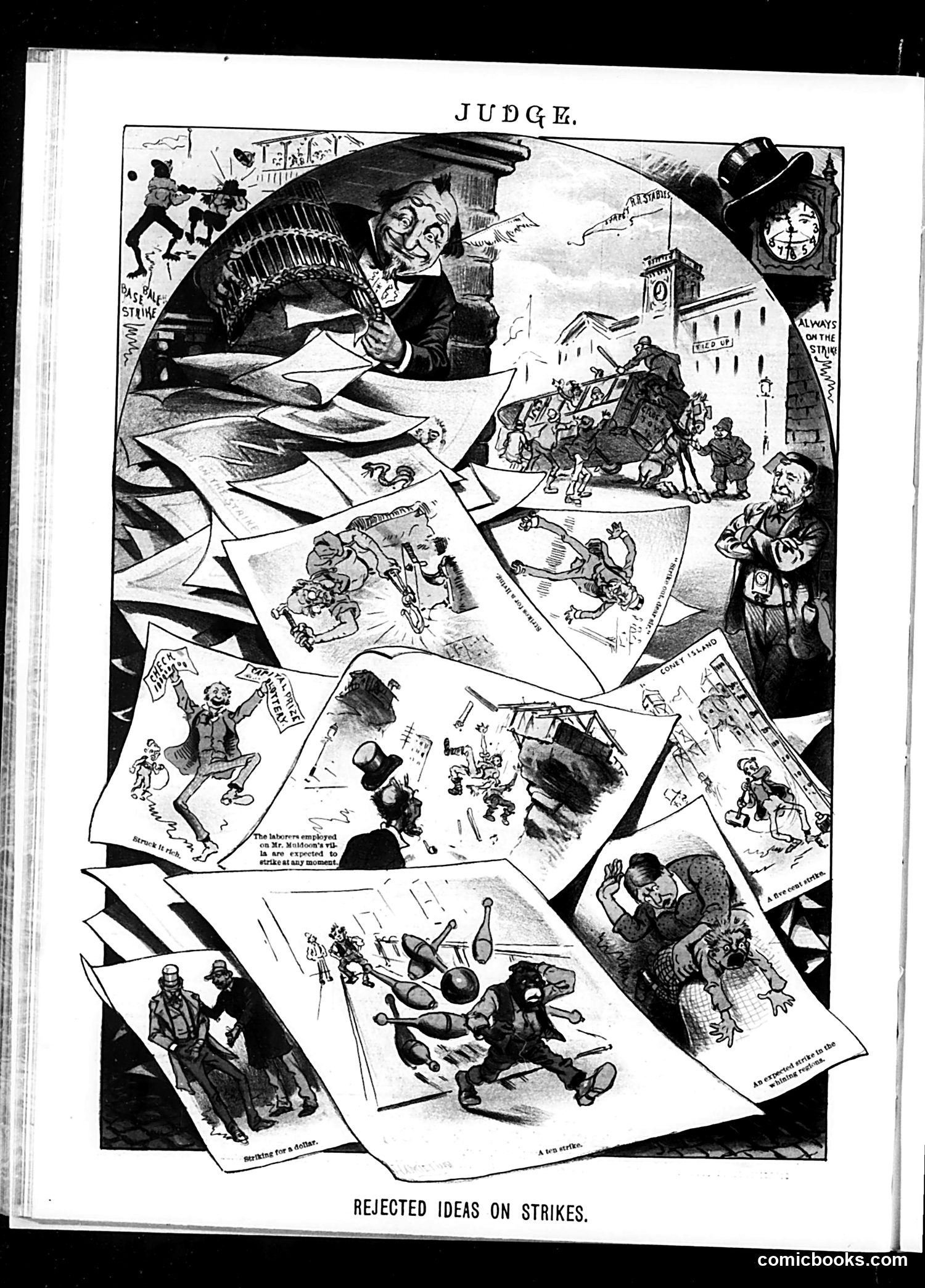
This Judge magazine cartoon satirizes a judge (depicted as an old man with an umbrella) reviewing various proposed solutions to labor strikes. The scattered papers before him show different schemes—some appear to depict violent suppression, others comical or absurd remedies involving kitchen implements, juggling, or slapstick scenarios. The satire targets judicial indifference or incompetence in handling strike disputes. By presenting increasingly ridiculous "rejected ideas," the cartoon mocks both the proposals actually being considered by authorities AND the judges' inability to address labor unrest seriously. The clock marked "Always on the Bench" suggests judges remain detached from real-world labor problems while cases languish unresolved. This reflects early 20th-century labor tensions when strikes were frequent and official responses ranged from inadequate to brutal.