
Judge, 1886-03-20 · page 5 of 20
Judge — March 20, 1886 — page 5: what you’re looking at
What you’re looking at
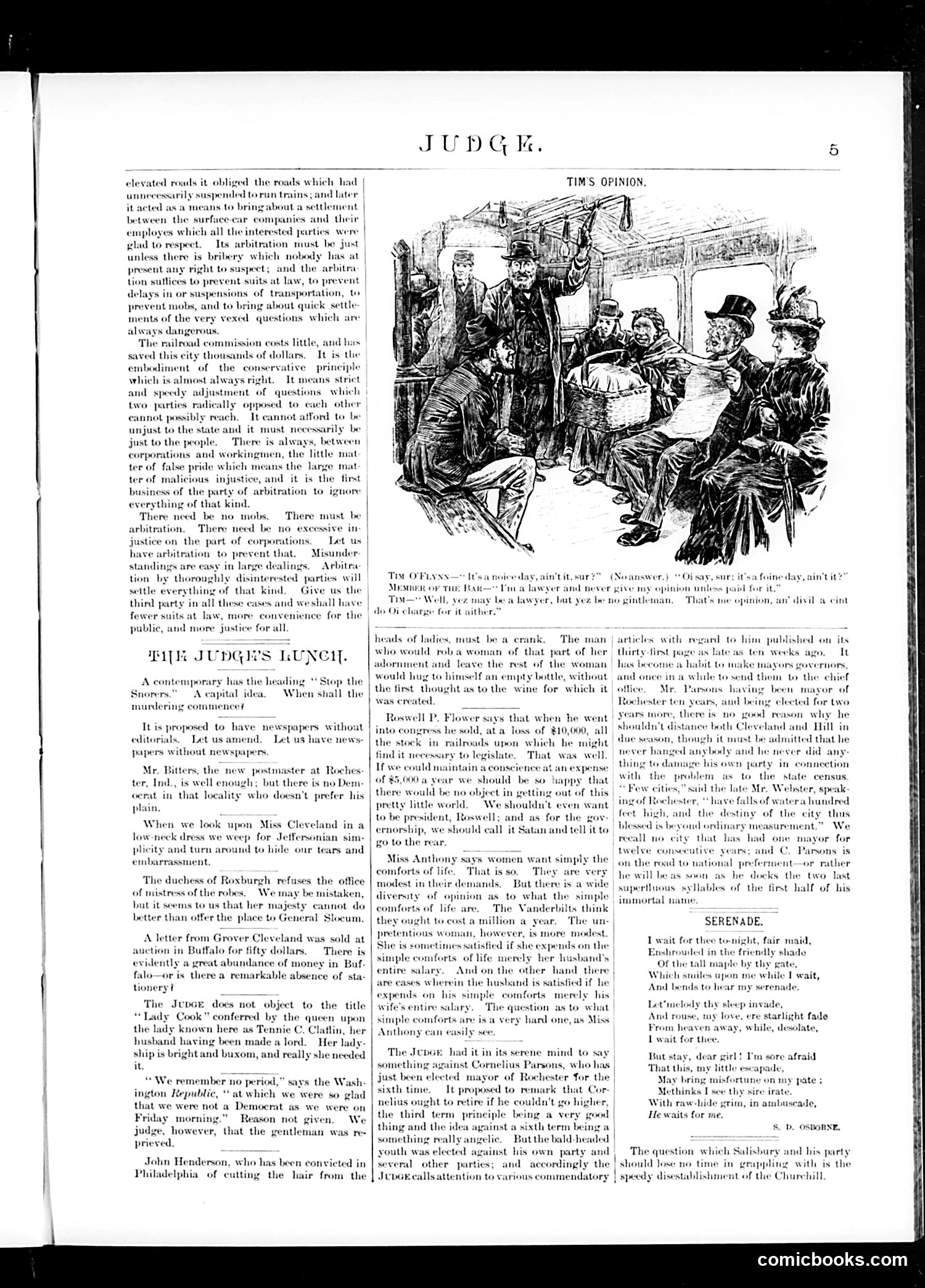
This page from *Judge* contains political commentary and social satire typical of the late 19th-century magazine. **"Tim's Opinion" (main cartoon):** The sketch depicts a street-level conversation, likely satirizing working-class Irish immigrants (suggested by "Tim O'Flynn"). The dialogue humorously captures dialect humor popular in the era, with Tim claiming he gives legal opinions without charging—a jab at unqualified advisors in urban politics. **Political targets in the text include:** - **Roswell P. Flower** (congressman/governor candidate): Mocked for claiming financial loss while in office, suggesting political hypocrisy about wealth and public service. - **Susan B. Anthony**: Satirized for women's demands, with the author arguing women want simple comforts but disagree on what constitutes them—a dismissive critique of women's suffrage arguments. - **Grover Cleveland's daughter**: Criticized for her clothing choices and role as "mistress of the robes." The satire reflects *Judge*'s conservative editorial stance, defending business interests and mocking reform movements, immigrant populations, and women's rights advocates.
📄 Transcribed text from this page (OCR, searchable)
Machine-transcribed from the original scan — historical spelling and the odd misread are preserved.
it acted as a means to bri between the surfi car companies the interested parties w Its arbitration must be just unless there is bribe glad to respect present any right to suspect; and the to prevent suits at law, to prev delays in or suspensions of transpe . te prevent mobs, and to bring about quick settle ments of the ve ed questions which are always dangerous tion sultics and has It is th principle The railroad commission costs little saved this city thousands of dollar embodiment of the conservati which is almost always right. Itu and speedy adjustm two parties radically nnot possibly reach it of questions wl opposed to cach other It cannot afford to be unjust to the state and it must necessarily be just to the people. There is always, between corporations workingmen, the little n ter of false pride which means the 1 ter of malicious. injustic business of the party of arbitration to ig everything of that kind. ere need be no mobs. arbitration. There need be no excessive in stice on the part of corporations. n to prevent t sy in large dealings, Misunder Arbitre lily disinterested parties will Mf that kind standings are tion by thorou settle everythi third party in fewer suits at public, and more justice Give us the Ww, more. ec TL JUNQMsS LUNE I. A contempora Snorers.” has the heading “Stop the When shall the al idea, murlerin paced It is proposed to have newspapers without editorials, Let us amend, Let us hav papers without newspapers news: ches: Mr. Bitters, the new postmaster at R ter, Ind., is well enough; but there is no Dem ccrat in that locality who doesn't prefer his plain, When we look upon Miss Cleveland in a low-nes plicity emt k dress we w for Jeffersonian sim- nd turn aro’ rrassment of mistress of the robes. but it seems to us that her m: better than offer the place to General Slocum, A letter from Grover Cleveland was sold at dollars, There is y a great abundance of money in Buf. falo—or is there a remarkable absence of sta. tion y “Lady Cook” conferred by the queen upon the lady known here as Tennie C. Claflin, her husband having been made a lord. Her lady- and really she needed ship is bright and buxor it “We remember no period,” says the Wash ington Republic, * at which we were so glad that we were not a Democrat as we were on ‘riday morning.” Reason not given. We however, that the gentleman was re- in elphia of cutting the hair from the There must be | Let us | does not object to the title | | simple comfort | nelius oug JUDGE. TIM Tim O'PLYNN—* It's Mespen or Tin Tim—" Well, vez Oi charge for it aither.” Tina lawyer and 1 The ¥ 1 roba woman of that part of adornment and leave the rest of the wor would hug to himself an empty bottle, with the first thought as to the wine for whicl was created. heads of ladies, must be a erank. who w Roswell P, Flower siys that when he went into ec ress he sold, at a loss of $10,000 the stock in railroads upon whieh he 1 to legislate, Th tain find it necessa If we could y of $5,000 a yea science d puld be there would be no object it pretty little world. “We to be president, Roswell tan expe houldn’t even w ernorship, we should call it go to the rear Miss Anthony says women want simply comforts of life, That is so. They are v modest in their de diversity of opinion as to what the sin comforts of life are. The V a million a y anderbilts th The un, however, ism satisfied if sh mforts of life merely he entire salary, Andon the other hand th are cases wherein the hush expends on his simple unforts merely wife's entire salary, ‘The question as tow Anthony asily see: The Jupce had it in its serene mind to something against Cornelius Parsons, wl ted mayor of Rochester for It proposed to remark that € it to retire if he couldn't go high the third term principle being a very g thing and the idea against a sixth term bein something really angelic. But the bald. youth was elected against his own party several other parties; and accordingly just been sixth tin JUDGE calls attention to various commendat viceday,ain'tit. sur?” (Noanswer.) * ay bea lawyer, but yez be no gintleman, t was well ppy that nds. But there is a wide nd is satisfied if he ure is a very hand one, as Miss o S OPINION. Oisay, sur: it’s ie That's me opi vine day, ain'tit?” Hever give My opinion unle it.” nan’ divil a cint nan les with regard to him published on its her thirty-first p It nan | hus become a governors, as late as ten weeks vit te mak ¢ ina while to send t rout lh it + chie or of n years, and being elected for two is no good reason why he both Cleveland never did any thing to damage his own party with the problem Few cities,” said th of Rochester, high, and t blessed is beyond ordinary onse 1 connection nsus late Mr, Webster, speak have falls of w ralundred stiny of the city thus vent.” We * mayor for ant recall no city that hy, twelve consecutive years; and C. Parsons is the on the road tor ent—or rs she decks the two last superfluous syllables of the first half of his immortal name TY he will be as soon ple ink un- SERENADE. jest I wait for thee to-night, fair ny Enshrouded in the friendly sh Of the tall maple by thy gat Which smiles upon And bends to I wait, rmy serenade. his hiat Lot'melody thy sleep invade, And rouse, rl From heaven away, while, dese L wait for the y love, ere si ht fade pay: But stay, dear girl! I'm sore afraid has That this, my little ade th May bring misfortune on ce Methinks I see thy sire ira her, With raw-hic romnd He waits for me. + S. D. OSBORNE. ad) The question whieh Salisbury and his party the | should lose no time in grappling with is the ory | speedy disestablishment of the Churchill pate ; ‘im, in ambuseade, comicbooks.com