
Judge, 1886-03-20 · page 8 of 20
Judge — March 20, 1886 — page 8: what you’re looking at
What you’re looking at
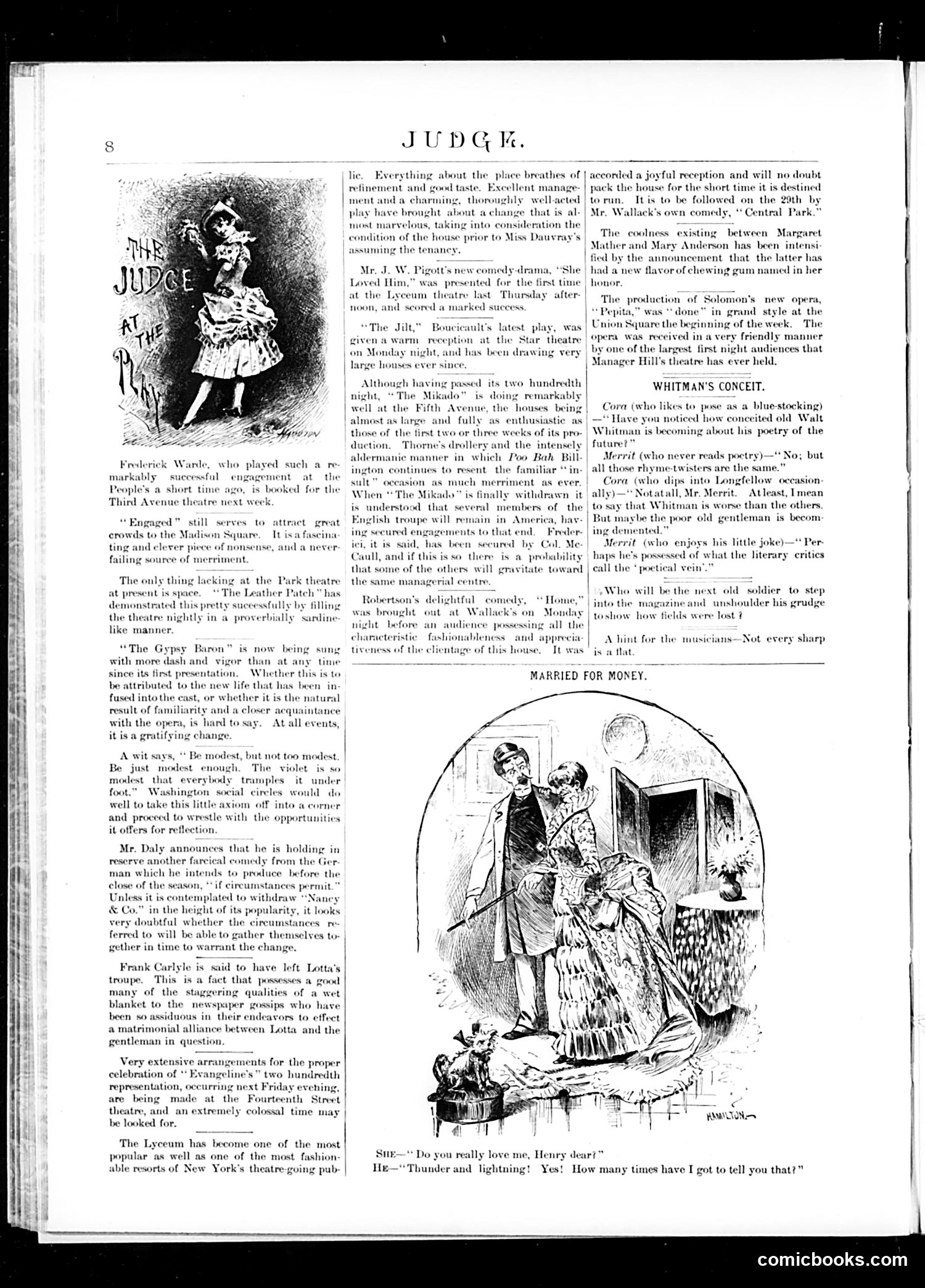
This page contains theater reviews and theatrical gossip typical of Judge's entertainment coverage. The main cartoon, titled "Married for Money," depicts a couple in what appears to be a transactional relationship—a common satirical subject of the era. The woman asks "Do you really love me, Henry dear?" while the man responds "Thunder and lightning! Yes! How many times have I got to tell you that?"—suggesting his exasperated patience with repeated questions about affection in a marriage motivated by financial rather than romantic considerations. The surrounding text reviews contemporary theatrical productions ("The Mikado," "The Gypsy Baron," etc.) and gossip about theater personalities. A sidebar titled "Whitman's Conceit" mocks poet Walt Whitman's confidence in his work, with characters dismissing his "poetry of the future" as pretentious. The satire assumes readers' familiarity with New York's theater scene and cultural figures of the period.
📄 Transcribed text from this page (OCR, searchable)
Machine-transcribed from the original scan — historical spelling and the odd misread are preserved.
such a re ment at the still serves to attra crowds to the Madison It is: ting and clever piece of nonsense, and a never: faili f merriment. zat the Park theatre Leather Patch” has ated this pretty suceessfully by filling tre nightly in a proverbially sardine The only thing lacki Saas at present is sp: “The Gypsy with more ¢ nd vigor than at an. since its first presentation. Whether tl be attributed to the new life that has been fused into the cast, or whether it is the natural result of familiarity and a closer acquaintance with the opera, is hard to say, At all events, it is a gratifying change. Baron” is now being sung sh time A wit says, “' Be modest, but not too modest Be just modest enough. The violet is so modest that everybody foot. Washington soci well to take this little axiom off into a corner 1d proceed to wrestle with the opportunities it offers for reflection. s it under s would do Mr. Daly announces that he is holding in ther farcical comedy from the Ger. Is to produce before the “if circumstances permit.” Unless it is contemplated to withdraw "Nancy & Co.” in the height of its popularity, it looks -y doubtful whether the circumstances rv ferred to will be gather themselves to: gether in time to warrant the change. Frank Carlyle is said to have left Lotta’s troupe. This is a f many of the st blanket to the r been so assiduous in their end a matrimonial alliance between Lotta and the gentleman in questic t that possesses a good qualities of a wet Wspaper gossips who have Very extensive arrangements for the proper celebration of Evangeline’s” two hundredth representation, occurring next F are be made at the Fourte theatre, and an extre be looked for. Street ely colossal time may | The Lyceum has become one of the most popular as well as one of the most fashion able resorts of New York's theatre-going pub- JUDG. » breathes of lic. Everything about the refinement yful reception and will no doubt use for the short time it is destined torun. Itis to be followed on the 29th b; tis al- | Mr. Wallack’s own comedy, ‘* Central Park. isideration the ment and. brought about us, taki ndition of the house pr play ha Tost mary Ss existing between Margaret to Miss Dauvray’s ry Anderson has been intensi = | fied by the uncement that the | Mr. J. W. Pigott’s new comedy-drama, “She had a new flavor of chewing gum named in her Loved Him,” was presented for the first time | honor. at the Lyceum theatre last’ Thursday after: | qy noon, and scored a marked success. ming the te Janey ter has. production of Solomon's new opera, ppita,” was “done” in grand style at the juare the beginning of the week. The Ss received in avi friendly n er . ofthe largest first night audiences that , Manager Hill's theatre has ever held. “The Jilt,” icault’s latest. p given a warm mat the on Monday night, and has been drawing very arge houses ever since. ) having passed its two hundredth WHITMAN'S CONCEIT. xe Mikado” is doing remarkably | Fifth Avenue, the houses being Cora (who likes to pose as a blue-stocking) and fully enthusiastic as | —‘* Have you n «1 how conceited old Walt those of the tirst two or three weeks of its pro- | Whitman is becoming about his poetry of the duction. Thorne’s drollery and the intensely | future?” dermanie manner in which Poo Bah Bill it (who rads poctry)—* wntinues to resent the familiar “in- | all those rhyme-twisters are the same.” ch merriment as ever.) Cora (who dips into Long’ “The Mik: is finally withdrawn it ally) 1, Mr. Merrit. Atleast, I is understood that several members of the | to say that Whitman is worse than the English troupe will remain in America, hav-| But maybe the poor old gentleman is becom rents to that end. Freder- | ing demented.” asm s his little joke)—" Per what the literary critics all the ‘ poetical vein’. ici, it is said, has been secured by Col. Me Merrit (who er Caull, and if this isso there is a probability that some of the others will gra the same managerial centre. Robertson's delightful comed ‘at Wallack's 0 an audience possess 6 he's possess toward xt old soldier to step 1 unshoulder his grudge lost? fashionableness and appreeia- | hint for the lientage Not every sharp f this house, Tt was js a that MARRIED FOR MONEY. . Henry d SiE—* Do you really love Thunder and lightning! Yes! How many times have I got to tell you that?” comicbooks.com