
A complete issue · 16 pages · 1886
Judge — March 13, 1886
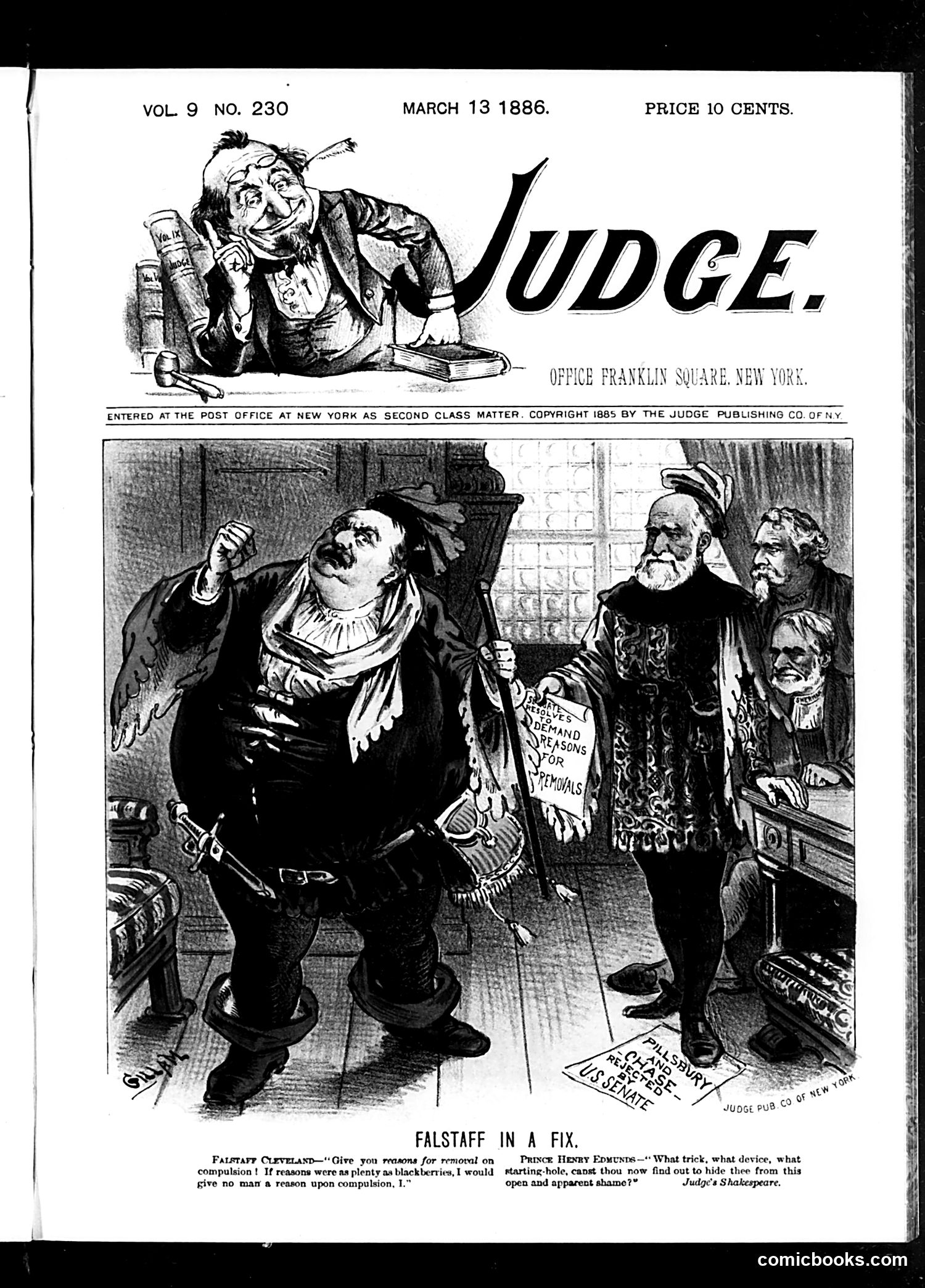
This political cartoon references the Shakespearean character Falstaff, a blustering character known for making excuses. The central figure, labeled "Falstaff Cleveland," appears to be President Grover Cleveland. He's depicted caught in an awkward situation with other figures holding a document labeled "Reasons for Removal" or similar demands. The satire criticizes Cleveland for making excuses regarding political removals or appointments—likely referring to controversies over federal patronage decisions. The Shakespeare quote about "what trick, what device" suggests Cleveland is caught in contradiction or deception regarding his stated reasons for actions. The cartoon mocks Cleveland as a bloviating character unable to convincingly justify his political decisions, comparing his evasions to Falstaff's famous excuse-making.
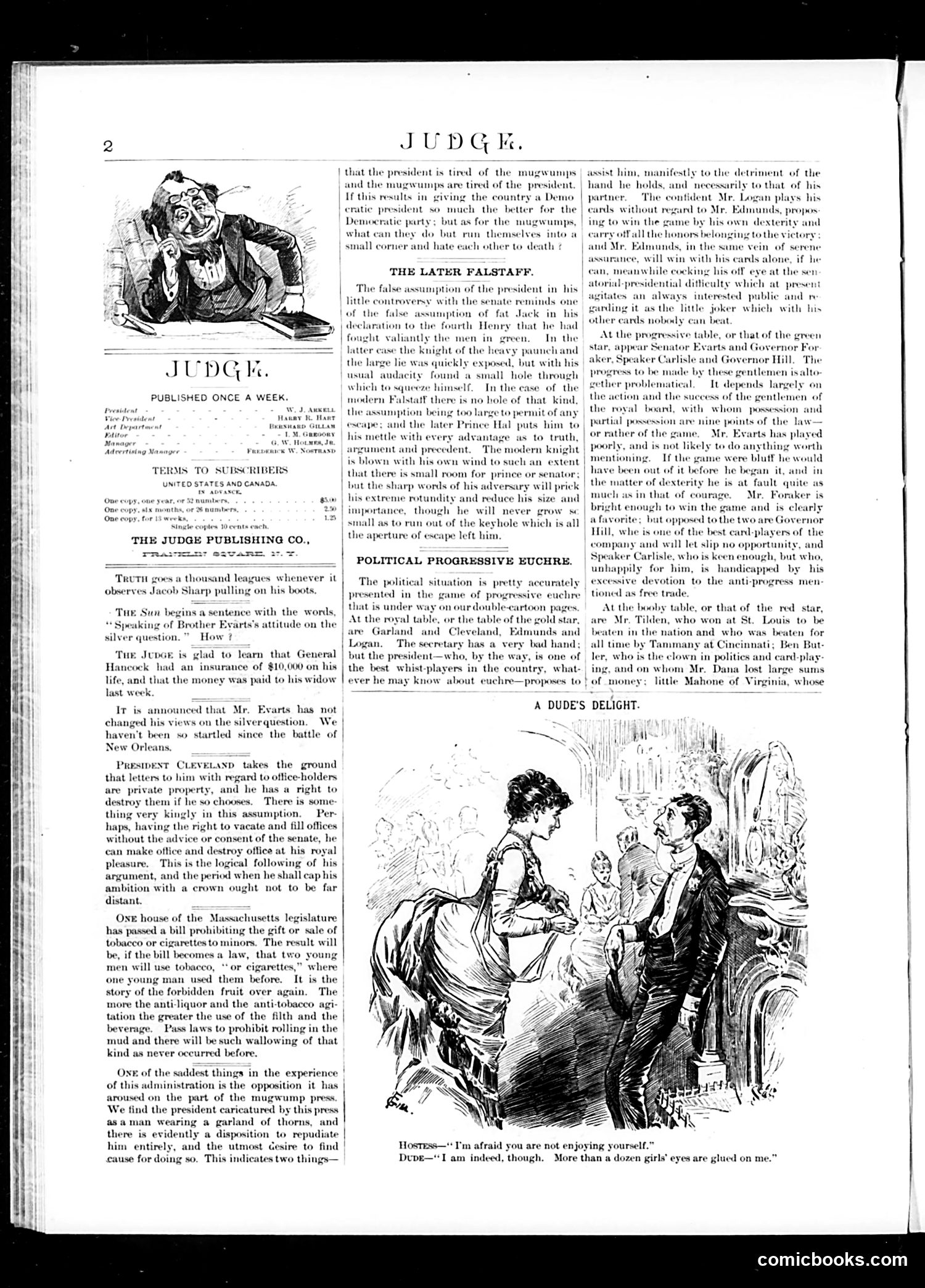
This page contains three distinct items: 1. **"Judge" masthead cartoon** (top): A caricatured figure in exaggerated dress, though context for the specific satire is unclear from the image alone. 2. **"The Later Falstaff"** (center): Political commentary on presidential authority, referencing the president's "false assumption" regarding Senate power and a character "Jack." The text discusses debates over executive versus legislative power, invoking Shakespearean allusions to Falstaff. 3. **"A Dude's Delight"** (bottom): A social cartoon showing a woman and man in conversation, with the caption about the woman not enjoying herself while "a dozen girls' eyes are glued on me." This satirizes vanity and gender dynamics of courtship among the wealthy leisure class. The page primarily targets political overreach and social pretension typical of Gilded Age satirical commentary.
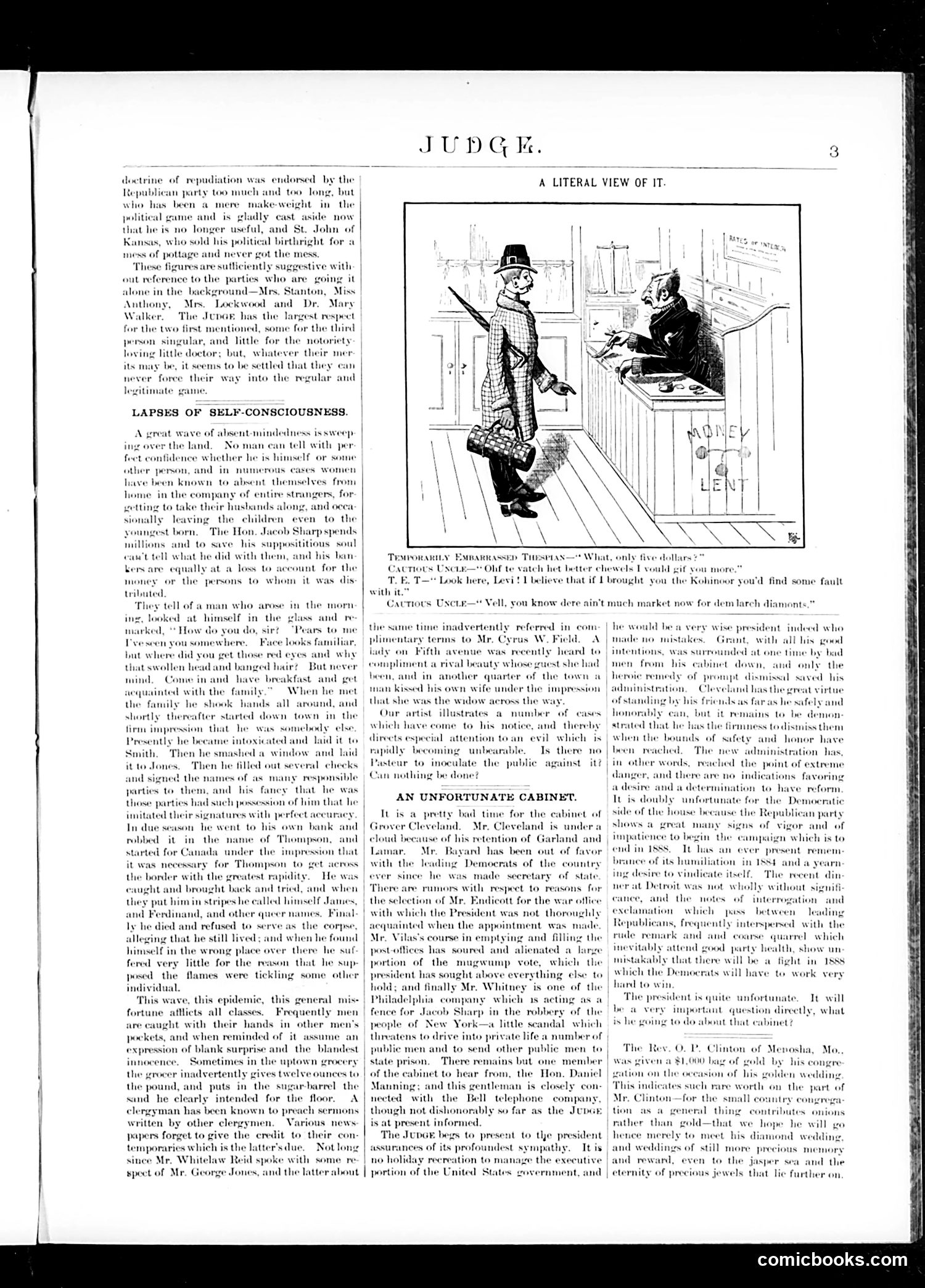
This page contains two distinct satirical pieces: **"A Literal View of It"** (main cartoon): Shows a jewelry merchant reluctantly negotiating with a customer over diamond prices. The "Temporary Embarrassed Thespian" (likely a struggling actor) offers $5 for jewelry; the "Cautious Uncle" (Jewish merchant stereotype) insists he could get more elsewhere. The satire mocks both the haggling customer's desperation and the merchant's perpetual dissatisfaction—a common antisemitic caricature of Jewish businessmen as obsessed with profit. **"An Unfortunate Cabinet"** (article): Discusses Cleveland's cabinet appointments, expressing concern that the Democratic administration retains unpopular figures like Secretary Lamar and judges poorly. The criticism centers on Cleveland's alleged weakness in managing his executive team and inability to remove problematic officials. Both pieces use characteristic Judge-era stereotypes and political commentary targeting Democratic leadership competence and institutional weakness during the Cleveland administration.
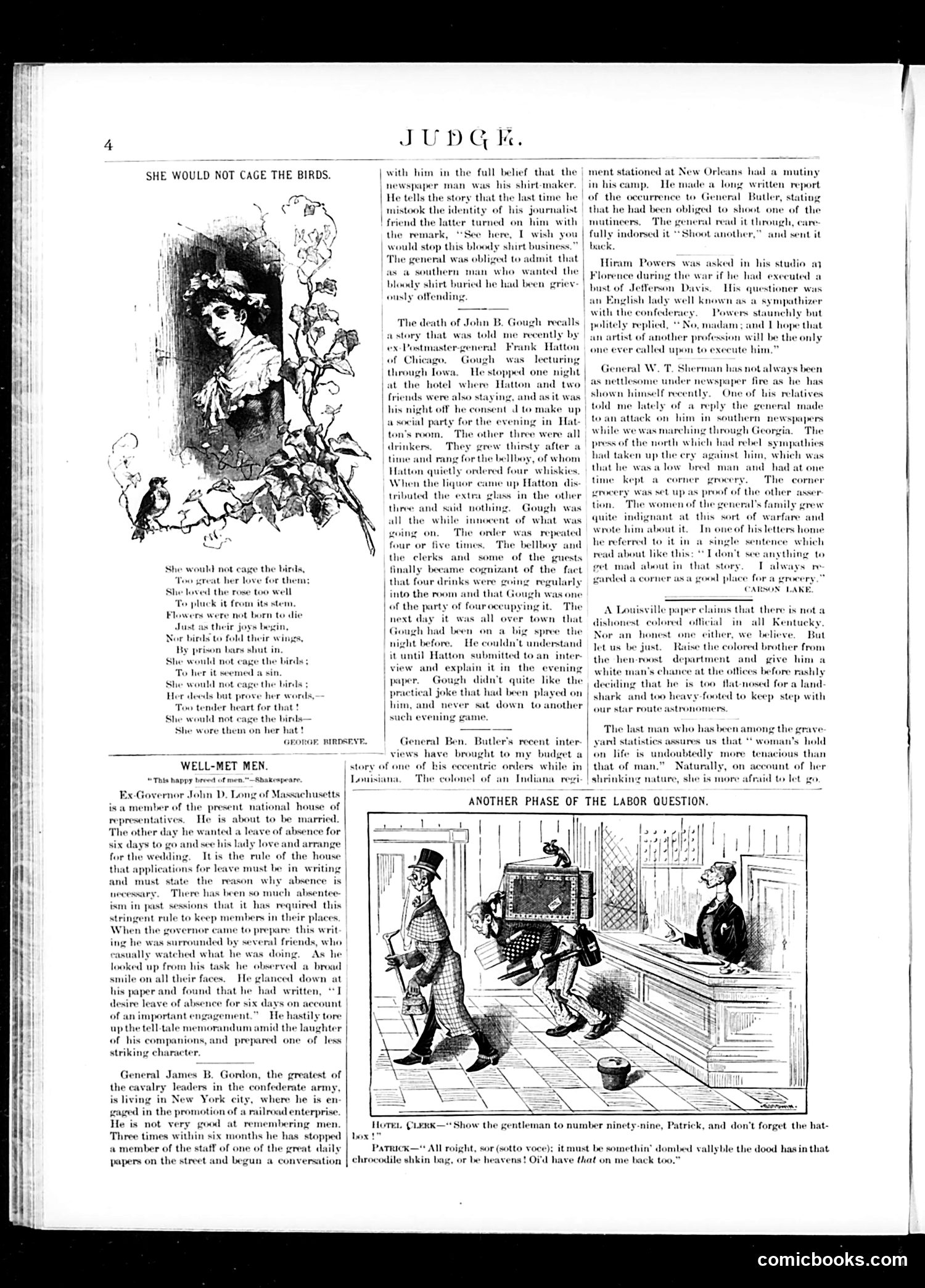
This page contains two satirical pieces: **"She Would Not Cage the Birds"** (top left): A sentimental poem with illustration about a woman who refuses to wear dead birds on her hat. This references the contemporary controversy over women's fashion using real bird plumage, which decimated bird populations. The satire appears gentle—mocking excessive sentimentality rather than the practice itself. **"Well-Met Men"** (main text): Anecdotes about notable Civil War-era figures (Ex-Governor John D. Long, General James B. Gordon, John B. Gough). The pieces satirize their behavior and inconsistencies—particularly Gordon's inability to remember staff members despite his prominence, and Gough's uncomfortable encounter with a "shirt maker" who objects to Gough's continued political attacks on the South (the "bloody shirt" metaphor). **"Another Phase of the Labor Question"** (bottom): A cartoon showing a hotel clerk and porter dealing with a demanding guest, satirizing labor disputes and worker treatment during this industrial period. The overall tone critiques notable public figures' pretensions and hypocrisy.
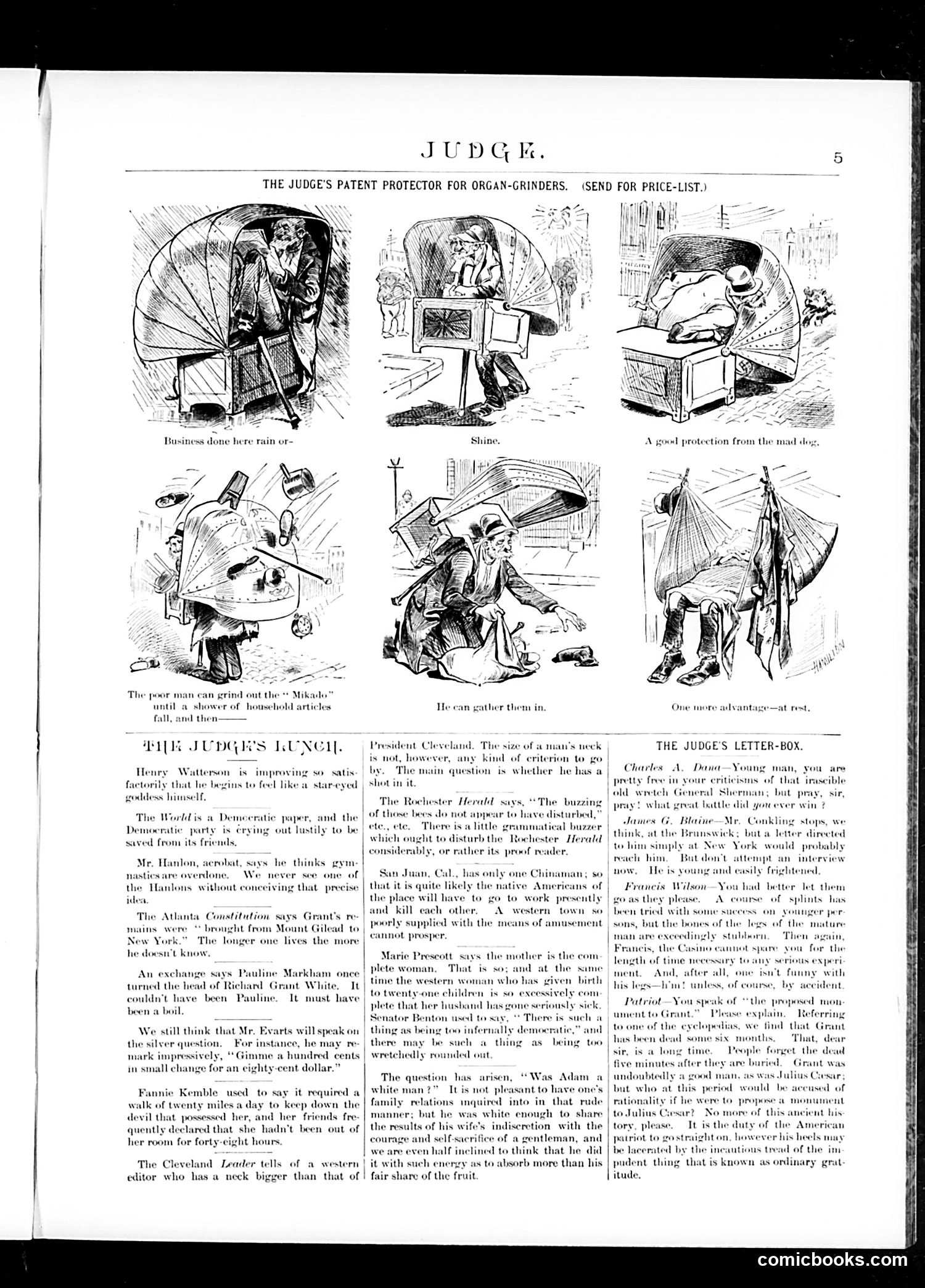
This page satirizes poverty and urban street musicians in the Gilded Age. The six cartoon panels mock a fictional "protector" device—essentially an umbrella-like contraption—designed to shield organ-grinders (poor musicians who played mechanical street instruments for coins) from rain, hail, and other street hazards while they worked. The satire targets both the grinding poverty of these street performers and the absurdity of "solutions" to their plight. The captions ("Business done here rain or shine," "He can gather them in") suggest the device allows the musician to continue performing in any weather while collecting coins, implying their desperation to earn money regardless of conditions. The lower section contains unrelated gossip and commentary, typical of Judge's "Letters" section, discussing figures like President Cleveland, General Sherman, and various newspaper editors—standard satirical fare for the 1880s-90s era.
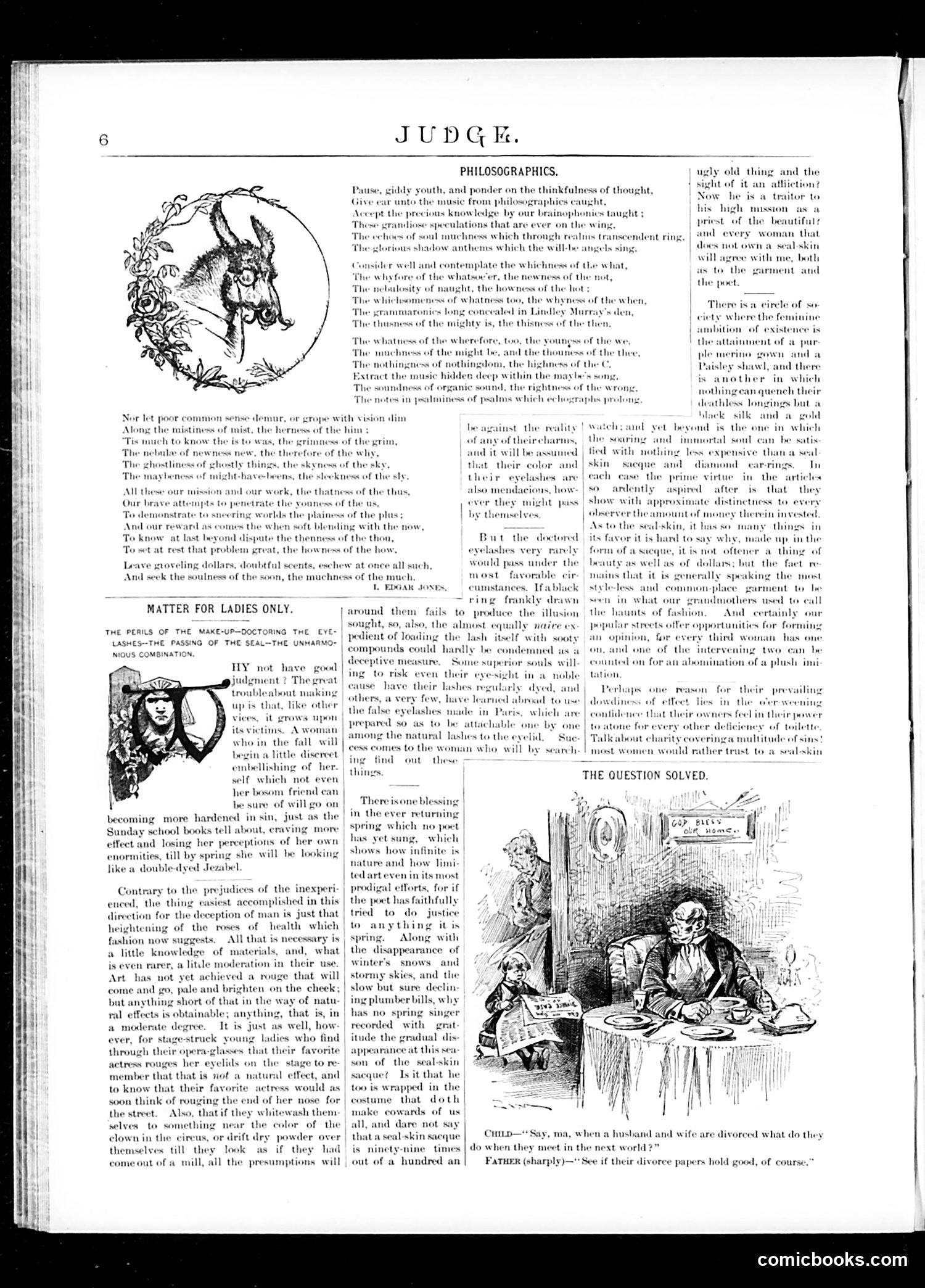
This page from *Judge* magazine contains two distinct sections: **Top: "Philosographics"** — A satirical poem mocking verbose philosophical writing. It ridicules pseudo-intellectual jargon by endlessly repeating meaningless phrases ("the thinkfulness of thought," "the whichness of the what"). The satire targets flowery, pretentious language that obscures rather than clarifies meaning—common among 19th-century academics and writers. **Bottom: "Matter for Ladies Only"** — An article critiquing women's use of cosmetics and makeup. The accompanying cartoon shows a woman applying rouge or makeup. The text argues that theatrical makeup creates artificial beauty and warns that cosmetic use corrupts morality, comparing it to sin. The article patronizingly advises women on "proper" makeup application while simultaneously condemning the practice. It reflects Victorian anxieties about women's appearance, respectability, and morality. Both sections employ *Judge*'s characteristic satirical tone to mock pretension—whether intellectual or social.
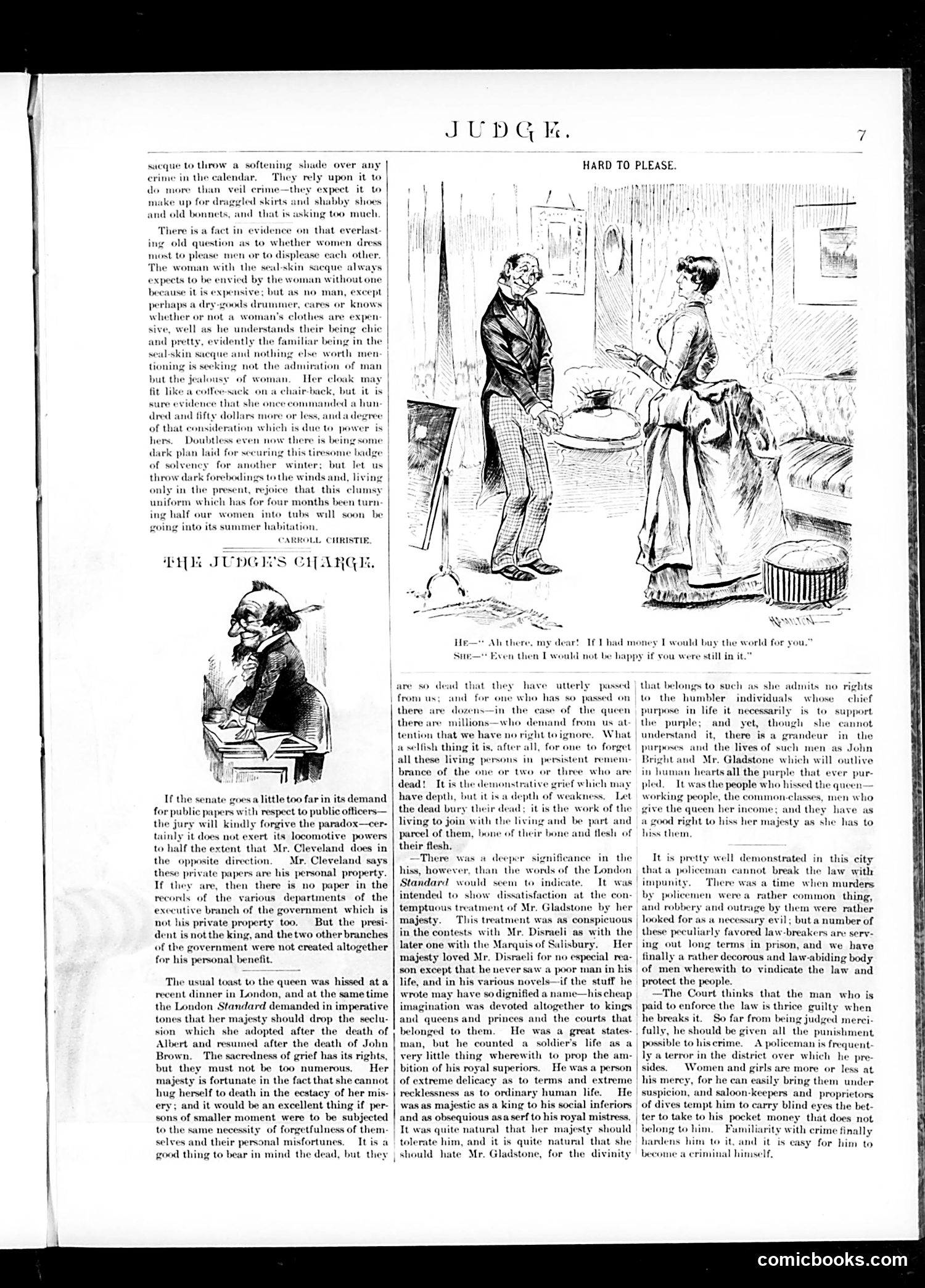
This cartoon depicts a domestic scene where a man presents something (likely a gift or financial proposal) to a woman, who appears dismissive or unimpressed—hence "Hard to Please." The accompanying text discusses women's fashion, particularly the "sealskin sacque" (expensive fur garment), suggesting the cartoon satirizes the financial burden of women's expensive clothing demands on working men. The man's plea—"Ah there, my dear! If I had money I would lay the world for you"—illustrates the economic tension: women desire luxury goods, yet men cannot afford them. The lengthy editorial commentary critiques both gender relations and political figures. It mentions Queen Victoria's seclusion after Albert's death and suggests criticism of Mr. Gladstone and Mr. Disraeli's political legacies. The text argues that excessive mourning is impractical and that living people deserve attention as much as the dead. The satire targets both unrealistic female consumer expectations and broader social hypocrisies about grief and duty.
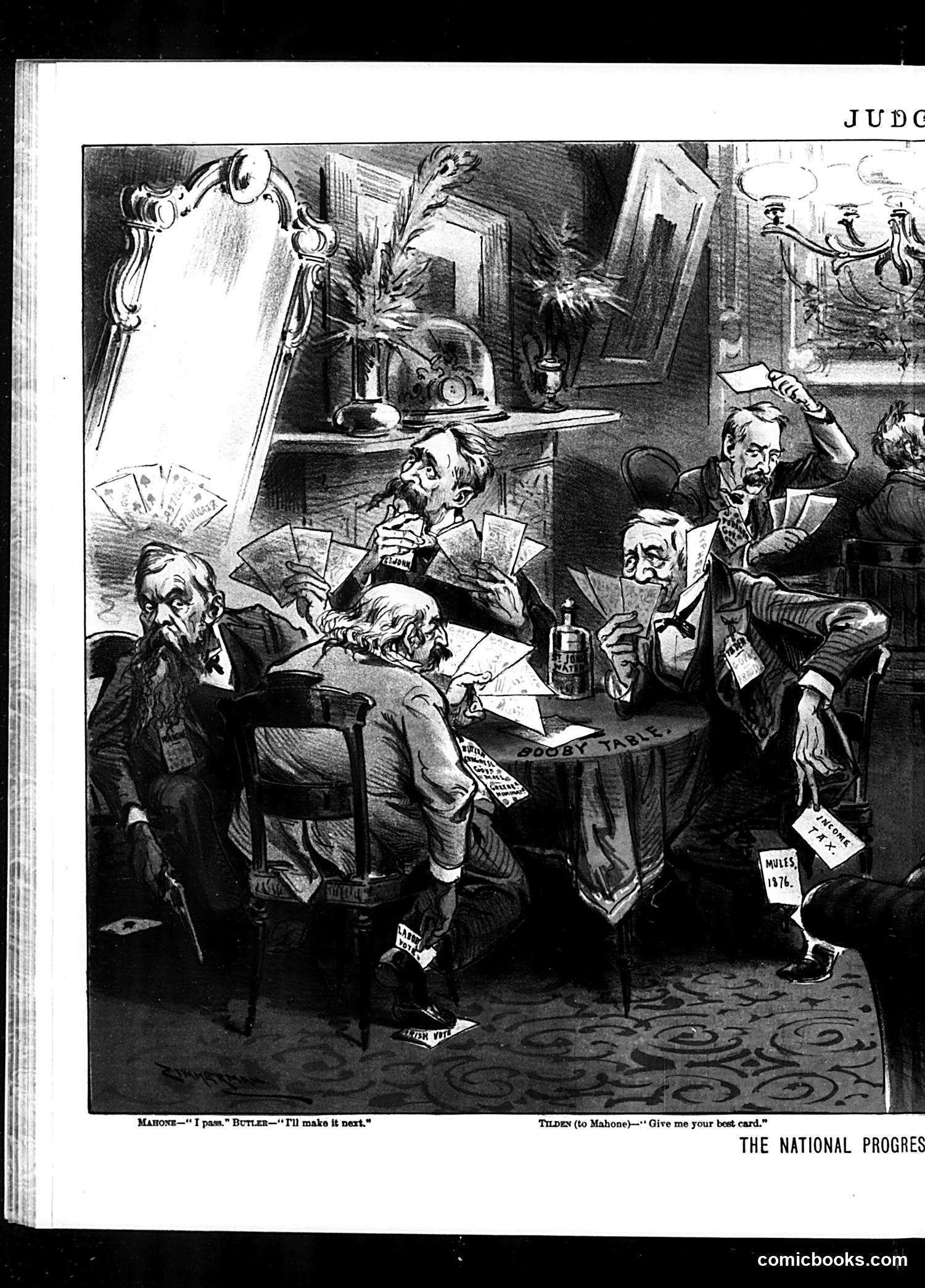
This Judge magazine cartoon depicts a poker game featuring prominent political figures from the 1870s-80s era. The caption identifies **Tilden** (Samuel J. Tilden, Democratic presidential candidate) and **Mahone** (William Mahone, Virginia politician), with **Butler** also referenced in the dialogue. The satire shows these politicians engaged in card-playing—a metaphor for political maneuvering and deal-making. Tilden demands Mahone's "best card," suggesting political bargaining and strategic alliances. The scattered money and cards on the table reinforce themes of self-interest and political corruption. The cartoon mocks these figures as gambling politicians prioritizing personal gain over honest governance, reflecting contemporary anxieties about cronyism and backroom political deals during the Reconstruction and Gilded Age era.
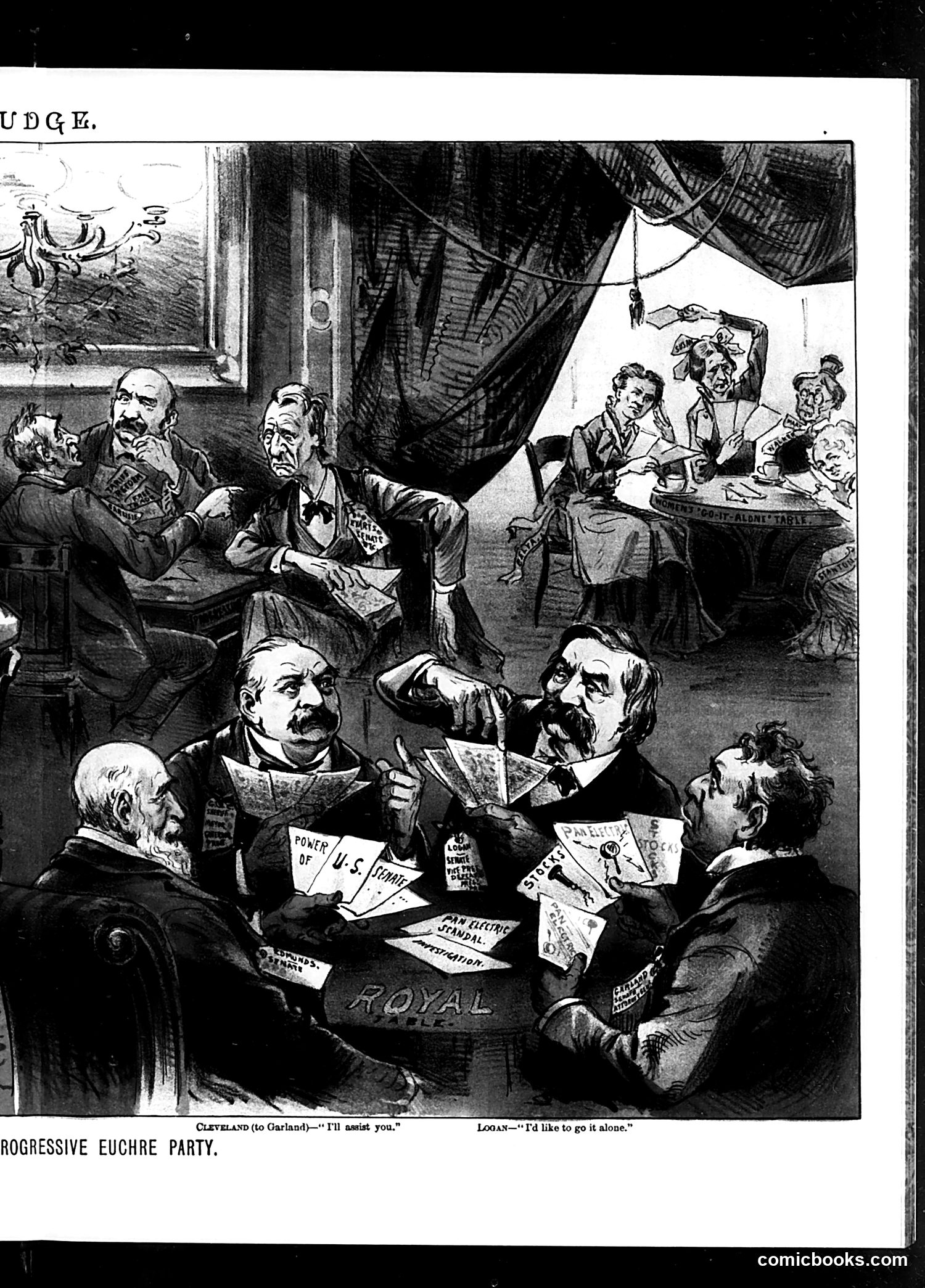
This political cartoon satirizes a card game metaphor for politics. The title references "euchre," a trick-taking card game, suggesting political maneuvering. The figures appear to represent President Cleveland and Attorney General Garland (based on the speech bubbles), along with other political figures seated around a table playing cards. The cards visible include labels like "Power of U.S. Senate," "Patronage," and "Legislation"—representing political prizes being "dealt" and contested. The satire suggests political leaders are treating governance like a game, with various factions competing for control of governmental powers and resources. The "progressive" label likely references contemporary political divisions. The conversation between Cleveland and Garland—one offering assistance, the other preferring independence—indicates tension or competing agendas among political allies.
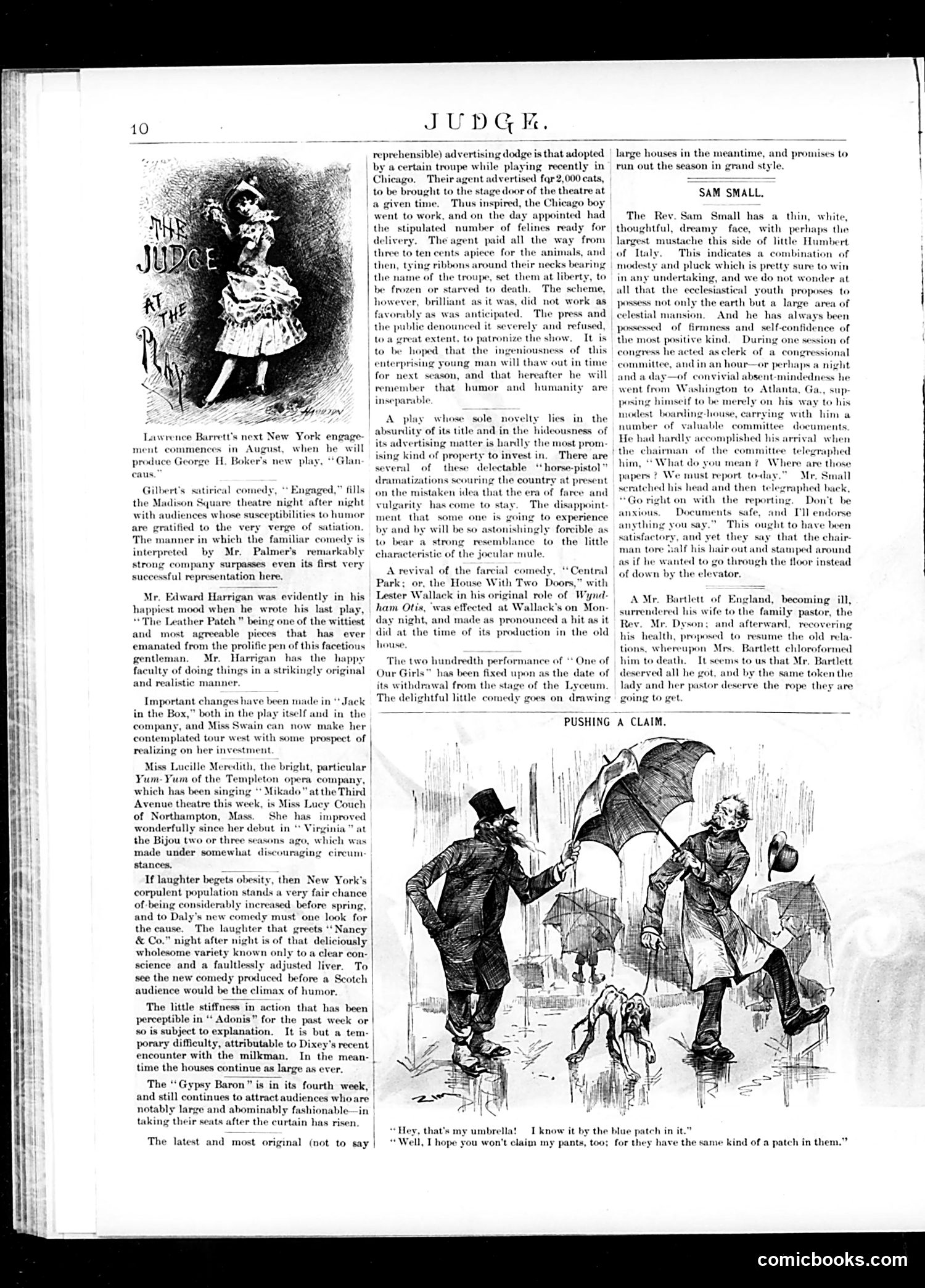
This page discusses several theatrical productions and includes one significant satire about advertising ethics. **The Main Satire:** A theater company advertised by promising to deliver 2,000 cats to the stage door, each wearing ribbons with the troupe's name. The scheme backfired when the public and press condemned it—not because it was absurd, but because the cats would be "frozen or starved to death" after being released. The text criticizes this "reprehensible advertising dodge," arguing that while humor is acceptable, cruelty to animals crosses a moral line. The satire targets both the theatrical company's callousness and the broader problem of sensationalist advertising in theater. **Other Content:** The page reviews various Broadway productions (Lawrence Barrett's upcoming play, Edward Harrigan's "The Leather Patch," "Adonis," "The Gypsy Baron"), offering theatrical criticism typical of Judge's lighter coverage. **The Cartoon** ("Pushing a Claim") depicts a dispute over a damaged umbrella—a visual joke about petty urban conflicts, unrelated to the theater discussion.
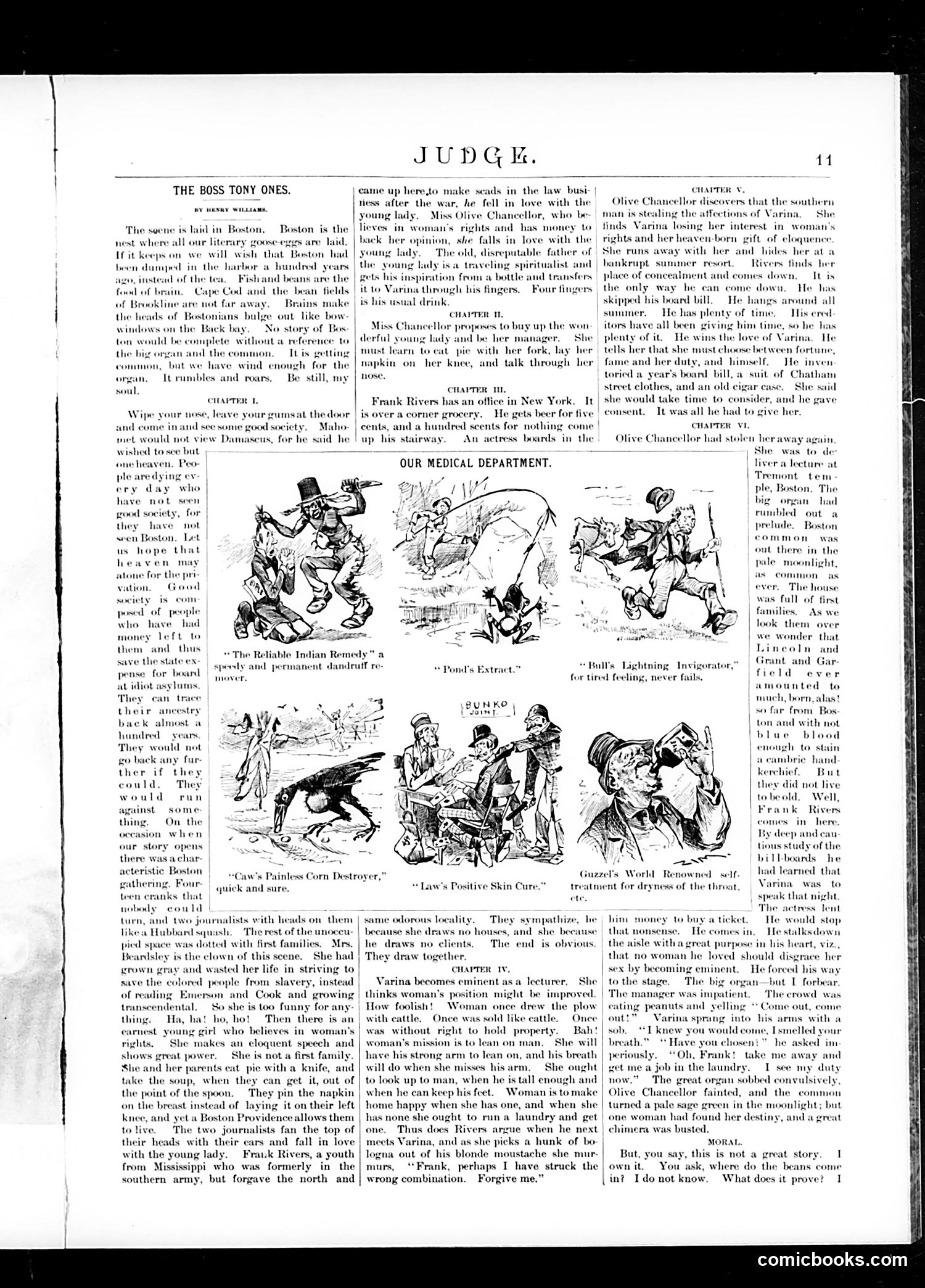
This page from *Judge* satirizes Boston's self-regard and intellectual pretension through a melodramatic serial story. The narrative mocks Bostonians as snobbish descendants of colonial wealth ("money left to them at odd") who disdain outsiders while pretending cultural superiority. The story's central satire targets 1880s-era feminism and women's suffrage activism. Varina, the "eminent" female lecturer, advocates for women's rights and independence, while Frank Rivers (a Southerner—adding regional mockery) argues women belong in domestic roles or laundries. The satire suggests both positions are equally absurd. **"Our Medical Department"** section parodies patent medicine advertisements with fabricated products ("Reliable Indian Remedy," "Painless Corn Destroyer"), ridiculing the era's predatory medical quackery. The cartoons depict physical comedy and social chaos. The overall tone is dismissive of Boston's pretensions, feminist activism, and contemporary commercial hucksterism.
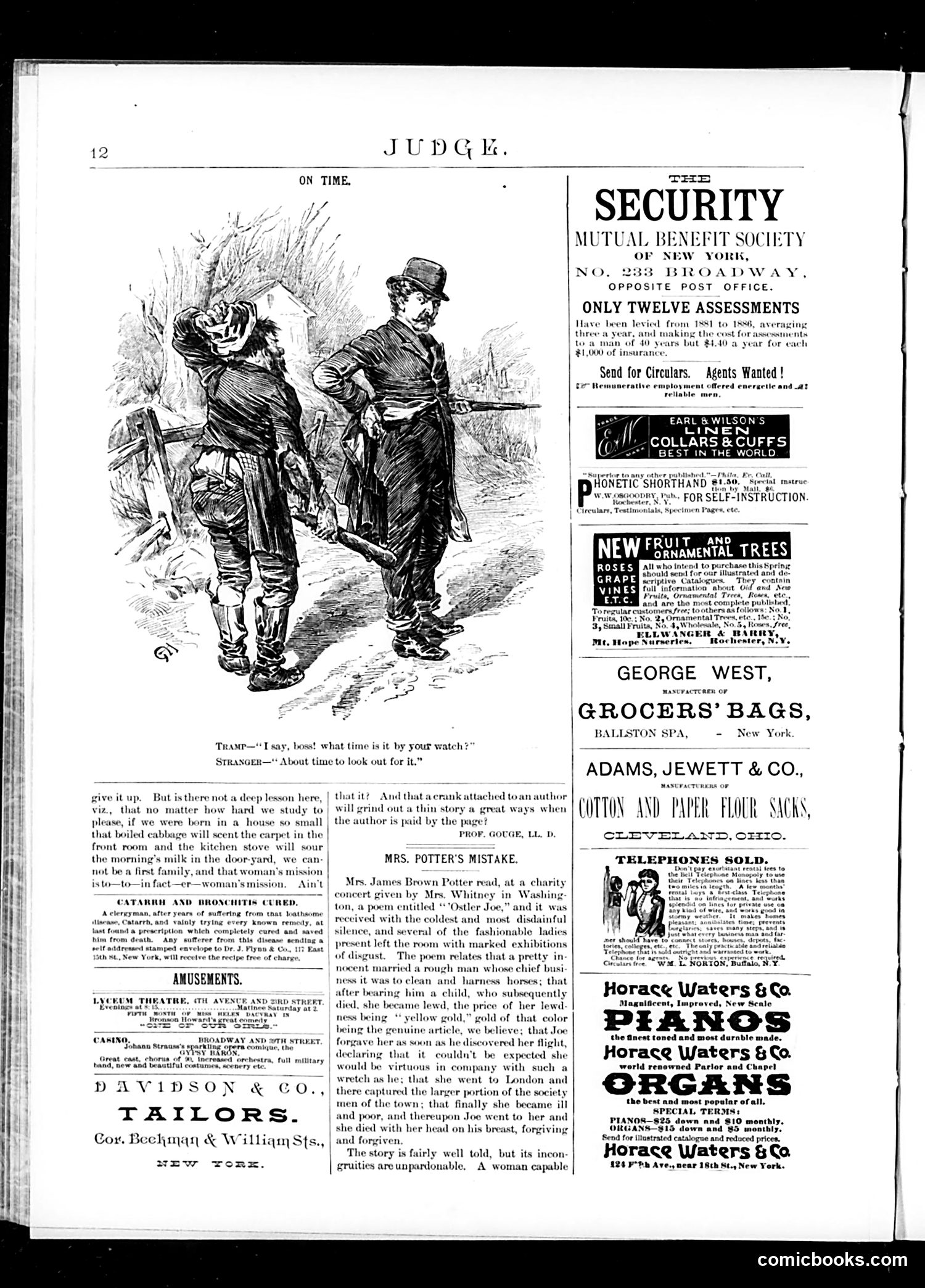
This page's main cartoon satirizes street-level class anxiety and petty crime. A well-dressed stranger questions a shabby tramp about the time, and the tramp warns him to "look out for it"—meaning his own watch will be stolen. The joke plays on period stereotypes: the tramp represents the urban poor and criminal underclass, while his cynical warning reflects the era's widespread anxiety about pickpocketing and street theft in cities. The satire targets both figures: the tramp's assumption that theft is inevitable, and the stranger's naive obliviousness to urban danger. It's dark humor about class divisions and crime in Gilded Age cities, suggesting that theft is so common among the desperate poor that even a tramp considers it unremarkable advice. The rest of the page consists primarily of advertisements and an unrelated article about "Mrs. Potter's Mistake"—a poem recitation that offended society by romanticizing a woman who married beneath her station.
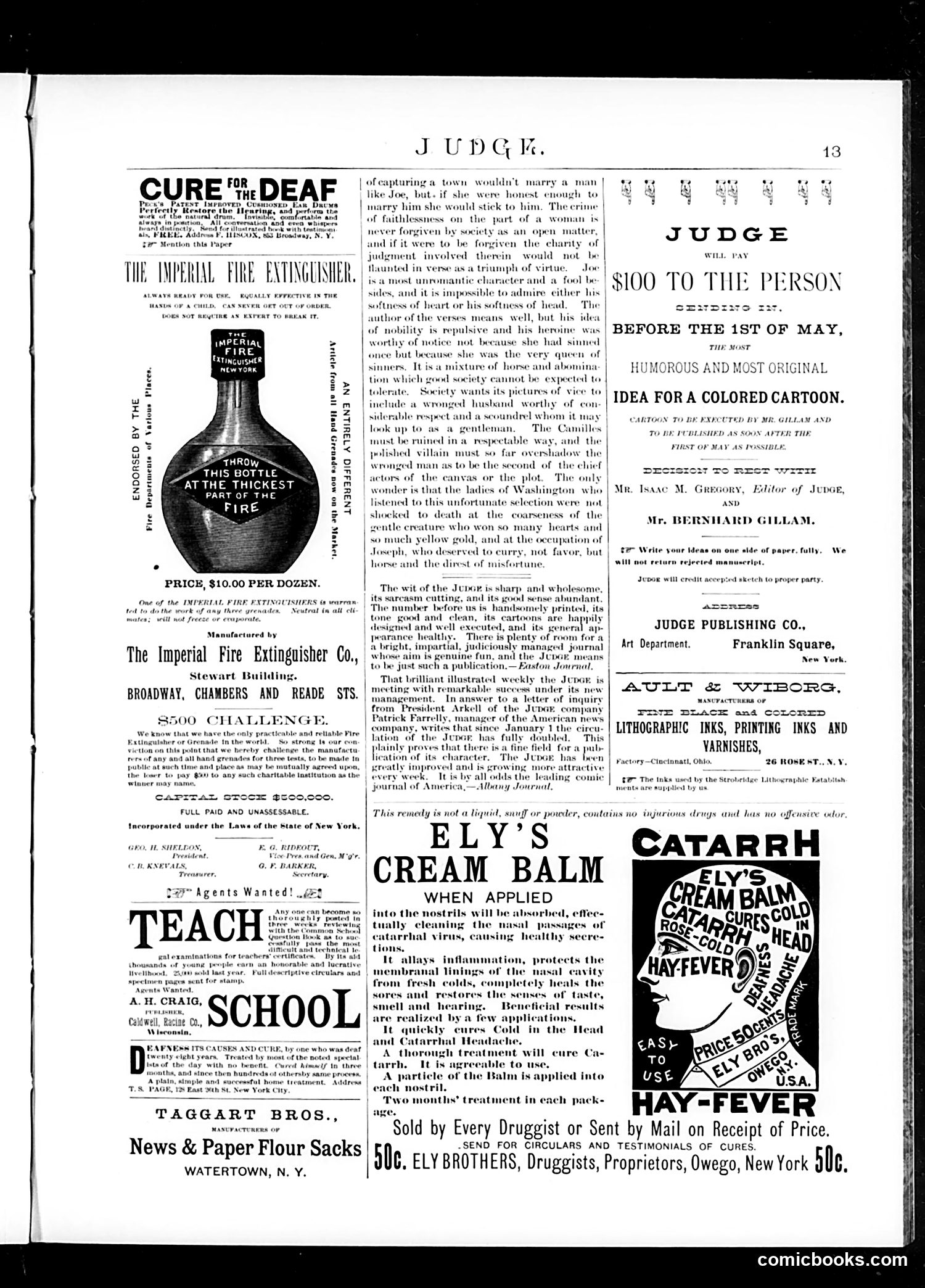
This page is primarily **advertising and publishing announcements** rather than satirical cartoons. It's from Judge magazine's business/back section. The main content includes: 1. **Fire safety ads** - The Imperial Fire Extinguisher company dominates the left side, advertising a throwable bottle device. This was early fire-safety technology. 2. **Judge's contest announcement** - The magazine offers **$100 for the best "colored cartoon" idea**, to be illustrated by artist **Bernard Gillam**. The announcement discusses a literary dispute about a female character (likely referencing a contemporary novel), but the actual cartoon hasn't been published yet—submissions are due before May 1st. 3. **Miscellaneous ads** - For teacher training, flour sacks, and patent medicines (Ely's Catarrh Cream Balm, hay-fever treatments). The tone is commercial rather than satirical. The cartoon content mentioned appears to be a future publication, not visible on this page. The literary debate referenced seems to involve questions of morality and female virtue—typical Judge magazine concerns—but lacks enough context for modern readers to identify the specific work or figures referenced.
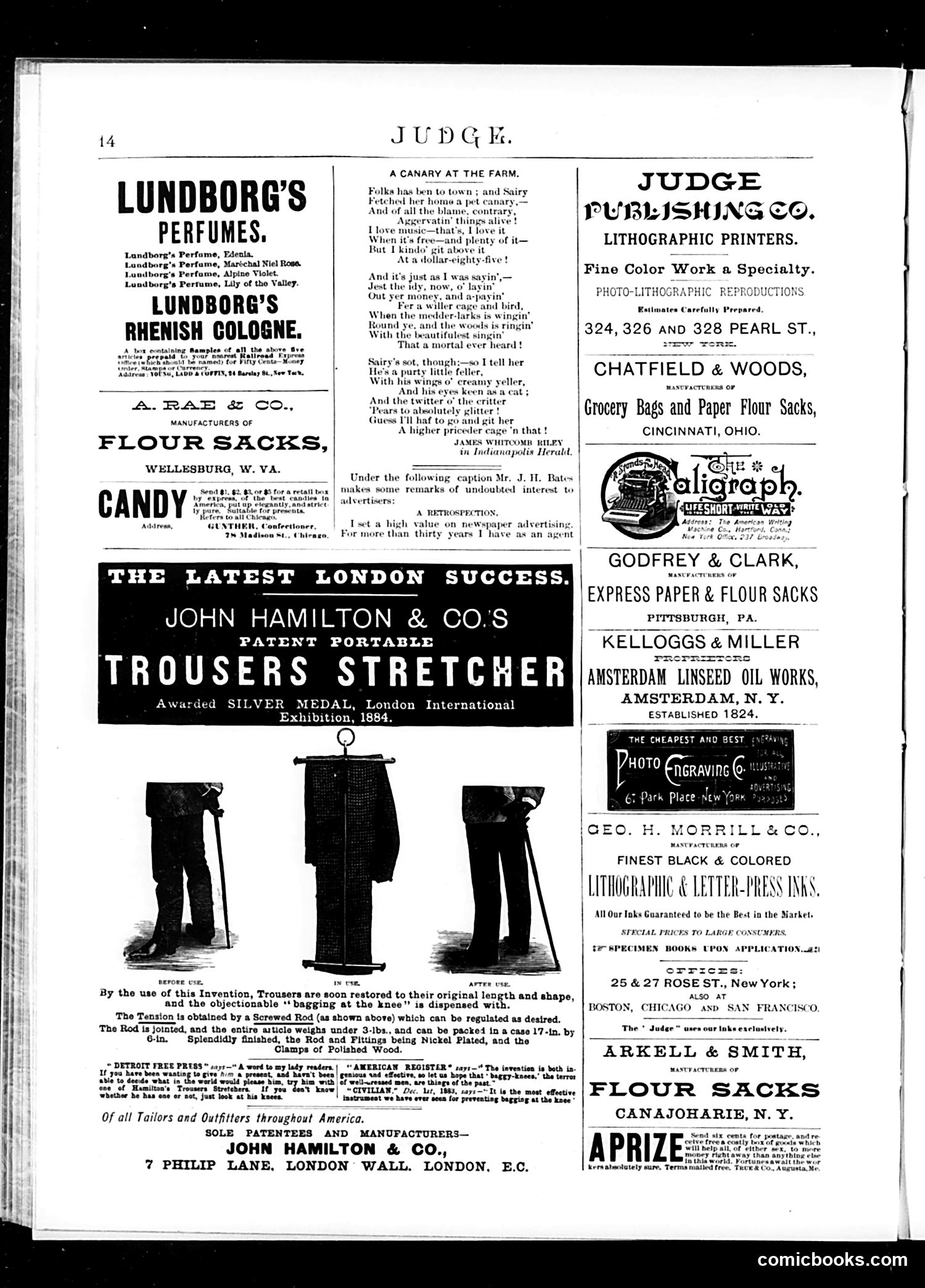
This page is **primarily advertising**, not editorial content or cartoons. The dominant feature is a large advertisement for John Hamilton & Co.'s "Patent Portable Trousers Stretcher," a Victorian-era device designed to restore the shape of men's trousers and eliminate knee-bagging—a common complaint about worn pants. The advertisement includes before/after illustrations showing how the mechanical stretcher, tension-adjusted by a screwed rod and nickel-plated fittings, could restore trousers to their original length and shape. Supporting quotes from publications like the *Detroit Free Press* and *American Register* attest to the invention's effectiveness. The surrounding content consists entirely of commercial advertisements for perfumes, printing services, paper sacks, inks, and other products—typical of Judge magazine's revenue model. There are no political cartoons or satirical commentary visible on this page.
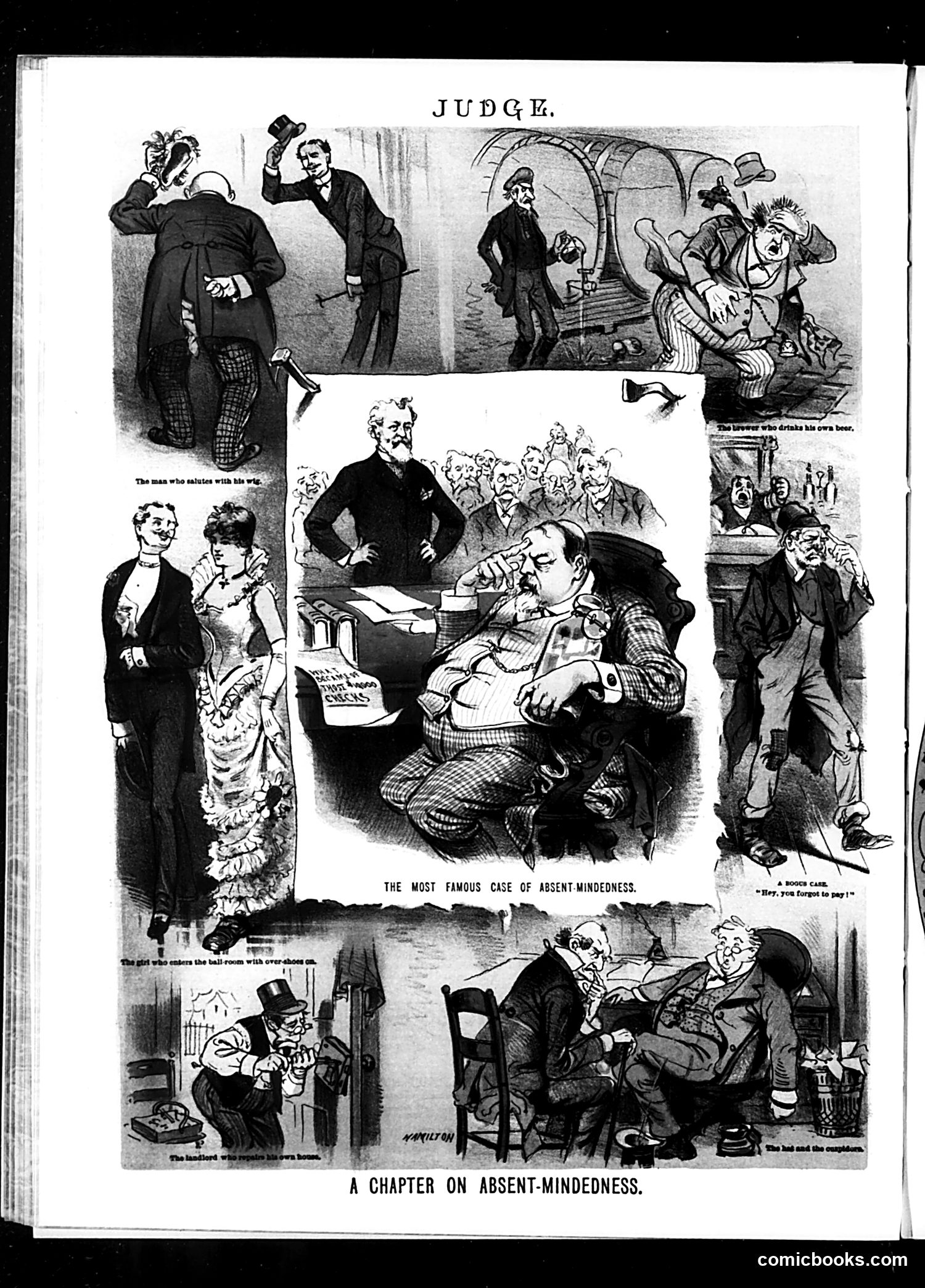
This satirical page from *Judge* magazine uses multiple comic vignettes to mock absentmindedness in Victorian-era society. The central panel, titled "The Most Famous Case of Absent Mindedness," depicts a distracted man in a courtroom setting while a judge presides. The surrounding scenes illustrate various humorous consequences of forgetfulness: a woman catching her husband's inattention, domestic squabbles, a man forgetting to pay his bill at an inn, and someone neglecting household responsibilities. One caption reads "The landlord who inspires his own house." The humor relies on recognizable middle and upper-class situations—legal proceedings, social gatherings, domestic life—where such lapses cause embarrassment or practical difficulties. The exaggerated facial expressions and body language typical of period satirical illustration emphasize the comic absurdity of these absent-minded moments.