
Judge, 1886-03-13 · page 7 of 16
Judge — March 13, 1886 — page 7: what you’re looking at
What you’re looking at
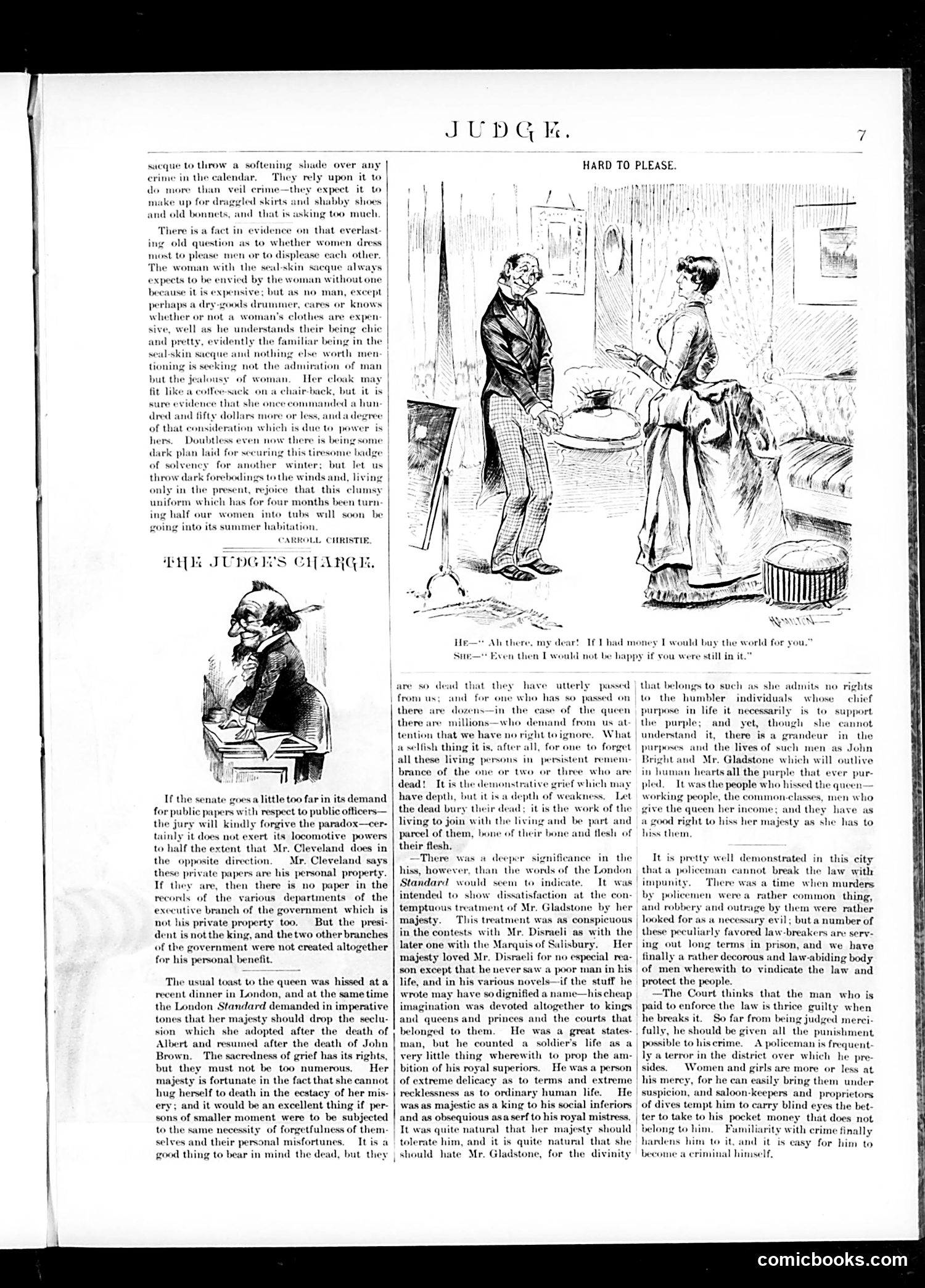
This cartoon depicts a domestic scene where a man presents something (likely a gift or financial proposal) to a woman, who appears dismissive or unimpressed—hence "Hard to Please." The accompanying text discusses women's fashion, particularly the "sealskin sacque" (expensive fur garment), suggesting the cartoon satirizes the financial burden of women's expensive clothing demands on working men. The man's plea—"Ah there, my dear! If I had money I would lay the world for you"—illustrates the economic tension: women desire luxury goods, yet men cannot afford them. The lengthy editorial commentary critiques both gender relations and political figures. It mentions Queen Victoria's seclusion after Albert's death and suggests criticism of Mr. Gladstone and Mr. Disraeli's political legacies. The text argues that excessive mourning is impractical and that living people deserve attention as much as the dead. The satire targets both unrealistic female consumer expectations and broader social hypocrisies about grief and duty.
📄 Transcribed text from this page (OCR, searchable)
Machine-transcribed from the original scan — historical spelling and the odd misread are preserved.
sucque to throw a sof in the ning shade over calendar. They rely upon it to n veil crime—they expect it to up for draggled skirts and shabby shoes and old bonnets, and that is asking too much 1 on dress men « ach other n with the sealskin sacque 1 by the we pensi ere is a fact in » th old question as to whether w most to p The wom expects to be envie ast ase to displease lways wan Without one: because it is ¢ but as no ma perhaps whether ¢ vods drum not a woman's are expen sive, well as he understands their bei and pretty, evidently the fa Iskin sueque and nothin; tioning is seeking not the but the jea of w fit like a cotfee-sick on sure hat she dred and fifty dollars mc of that consi hers. Doubtless even now there is bei dark plan laid fc of solvency fe throw ¢ sy Her cloak may kK, but it is Jed a hun bac mm videnec ation which is due to powe securing this tireson but another win the present, rejoice that this clumsy uniform which has for four months been turn ing half our women into tubs will soon be tie nto its summer | YL CHRISTIE, CALANG little too far in its demand respect to public officers— jury will kindly forgive the paradox—cer- tainly it does not exert its locomotive powers to half the extent that Mr. Cleveland does in the opposite direction. Mr. Cleveland says these private papers are his personal property If they are, then there is no paper in the reconls of the various departments of the executive branch of the government which is not his private property too. But the presi- dent is not the king, and the two other branches of the government were not created altogether for his personal benefit. The usual toast to the queen was hissed at a recent dinner in London, and at the same time the London Standard demanded in imperative tones that her majesty should drop the seclu- sion which she adopted after the death of Albert and resumed after the death of John Brown, The sacredness of grief has its rights, but th must not be too numerous, Her majesty is fortunate in the fact that she cannot hug herself to death in the ecstacy of her mis- ery; and it would be an excellent thing if per- sons of smaller moment were to be subjected | to the same necessity of forgetfulness of them: selves and their personal misfortunes, It is a good thing to bear in mind the dead, but they rk forebodings tothe winds and, living | | are | from us | have depth, | ; should hate Mr. Gladstone, for the di JUDGE. HARD TO PLEASE. Ah there, my dear! so dead that they have utterly me who I nth re millions—who passed sso passed on there are ¢ there of the queen 1 from us at tention that we have no nore, What a selfish thing it » to forget all these living persons in persistent. remem: brance of the one or two or three who are dead! It is the demonstrative which may tit pth of weakness, Let the dead bury their dead; it is the work of the living to join with the living and be part and parcel of them, bone of their bone and flesh of their flesh, —There was a deeper significance in the hiss, how than the words of the London Standard would seem to indic: It was intended to show dissatisfaction at the con- temptuous treatment of Mr. Gladstone by her majesty. This treatment was as conspicuous in the contests with Mr. Disraeli as with the later one with the Marquis of Salisbury. Her majesty loved Mr. Disraeli for no especial rea- son except that he never saw a poor man in his life, and in his various novels—if the stuff he wrote may have so dignified a name—his cheap imagination was devoted altogether to kings and queens and princes and the courts that ed to them. He was a great man, but he counted a soldier's life very little thing wherewith to prop the am- bition of his royal superiors. He was a person of extreme delicacy as to terms and extreme recklessness as to ordinary human life. He was as majestic as a king to his social inferiors It was quite natural t iy tolerate him, and it is quite natural th | sides. iy} Ht If Thad money I would buy the world for you.” ven then [would not be happy if vou were still in it.” that belongs to such as she admits no rights to the humbler individu: pur in life it necessarily is the purple; and yet, thou 2 cannot understand it, there is a grandeur in the purposes and the lives of such men as John Bright and Mr. Gladstone which will outlive in human hearts all the purple that ever pur- It was the people who hissed the queen working people, the comme ive the queen her incom a good ri Is whose pled classes, men who and they have as ly pt to hiss her m she has to Hiss them. It is pretty well demonstrated in this city that a policeman cannot break the law with impunity. There was a time when murders by policemen were and robbery and outra looked for as a necessi these pecu rather common thing, e by them were rather evil; buta number of arly favored law-breakers are sery- ing out long terms in prison, and we have fi ather decorous and law-abiding body of men wherewith to vindicate the law and protect the people. —The Court thinks that the man who is paid to enforce the law is thrice guilty when he breaks it. So far from being judged merei fully, he should be given all the punishment possible to hiserime. A polic is frequent. terror in the district over which he pre- Women and girls are more or less at his mercy, for he can easily bring them under suspicion, and saloon-keepers and_ proprietors of dives tempt him to carry blind eyes the bet- ter to take to his pocket money belong to him. Fumi hardens him to it, a y¥ with crime finally it is casy for him to become a criminal himself, comicbooks.com