
Judge, 1886-03-13 · page 4 of 16
Judge — March 13, 1886 — page 4: what you’re looking at
What you’re looking at
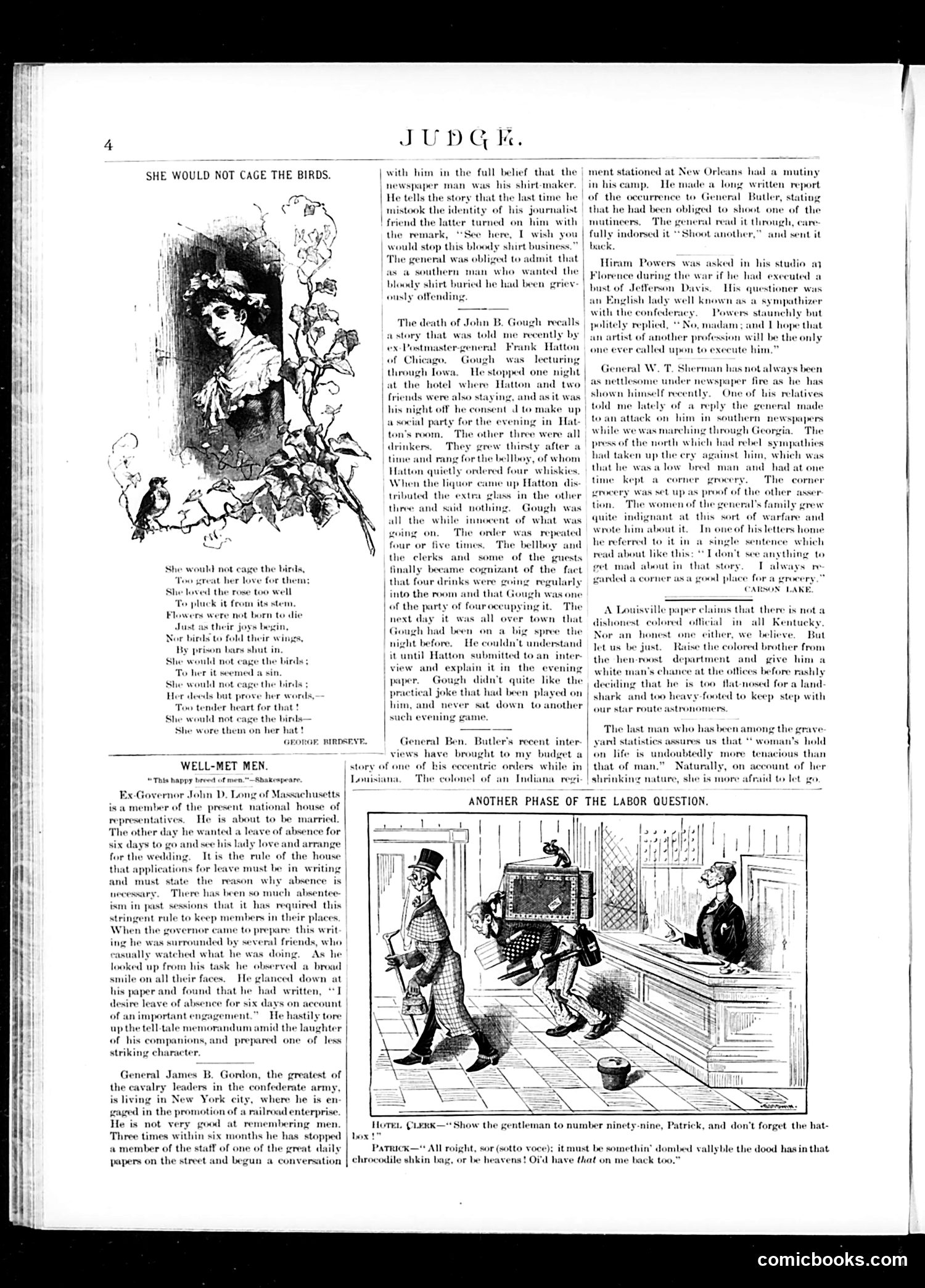
This page contains two satirical pieces: **"She Would Not Cage the Birds"** (top left): A sentimental poem with illustration about a woman who refuses to wear dead birds on her hat. This references the contemporary controversy over women's fashion using real bird plumage, which decimated bird populations. The satire appears gentle—mocking excessive sentimentality rather than the practice itself. **"Well-Met Men"** (main text): Anecdotes about notable Civil War-era figures (Ex-Governor John D. Long, General James B. Gordon, John B. Gough). The pieces satirize their behavior and inconsistencies—particularly Gordon's inability to remember staff members despite his prominence, and Gough's uncomfortable encounter with a "shirt maker" who objects to Gough's continued political attacks on the South (the "bloody shirt" metaphor). **"Another Phase of the Labor Question"** (bottom): A cartoon showing a hotel clerk and porter dealing with a demanding guest, satirizing labor disputes and worker treatment during this industrial period. The overall tone critiques notable public figures' pretensions and hypocrisy.
📄 Transcribed text from this page (OCR, searchable)
Machine-transcribed from the original scan — historical spelling and the odd misread are preserved.
EE EF RE 5 = ee ee SS SES SHE WOULD NOT CAGE THE BIRDS. She loved the re To pluck it Flowers wer well not born to die ‘ as their joys begin, Nor birds to fold their wings, By prison bars shut in To her it see She would not « Her deeds but p tender She would not « She wore them birds— p her hat! GROROR, RIRDSEYE. WELL-MET MEN. {f men."—Shakeapeare, | ssachusetts niber of th 1 house of representatives pout to be married psence for The other day he w . and see nd arrange | for the wedding. Itis the rule of the hou: that applications for leave must be in. writ! and must st. the reason why absence is ssary. There has been som nis lady love ch_absentee- quired this ir places »prepare this writ friends, who bserved a broad iam in past sessions that it has r stringent rule to ke When the governo he was surrounded by sé Hy watched what he was dc Lup from his task h I their faces. He his paper and found that he h: desire leave of ab p members int anced down at writter for six days on ac of an important engagement.” He hastily upthe tell-tale memorandum amid the lau, of his companions, and prepared one of less striking character. General James B. Gordon, the greatest of leaders in the confederate army, k where he is en railroad enterprise. good at remembering men Three times within six months h a member of the staff of one of the great daily papers on the street and begun a conversition JU j with him newspaper | He tells th mistook tl | friend the would st The g The di of Chie: through To the | his night of p the tributed tl three and going on. four or fiv | into the room | of the part next day Gough had night before. He couldn't understand it until Ha view w paper, Gi prac ul such ev peral views hav y of bi he ¢ story Louisiana. the remark, as a southern man who wanted the | bloody shirt buried he had been griev ously offending. th of John B. Gough recalls a social part all the while clerks a DG in the full behef that the ce ntity of his alto admit that ment stationed man was his shirtmaker, in his story that the last time he | of the « ralist | that he atter turned on him with matin “See here, I wish you | fully indorsed it “Shoot anotl this bloody shirt business.” | back, with the confed politely replied, **) ad be Hiram Powers was asked in his studio Florence during the war if he had executed a f Jefferson Davis y well known as a sympath vehly but y-madam ; and [hope that t was told me recently by | an artist of anoth nk Hatton was lecturing wa. He stopped one 1 | where sit was tf uur whiskies, | Ut ap Hatton dis je extra glass in the other liquor « sid not Gough was innocent of what was he order was © times, re « regularly and that Gou y of fouroceupying it. r town th: fe spree the it was all o' A been ation submitted toan inter the xplain it in the evening 1 didn't quite like the her ng £ brought to my budge ntric orders while in | th olonel of an Indiana t sh ANOTHER PHASE OF THE LABOR QUESTION. Hatton and two | as nettle shown himself rv told me lately of a reply the to an attack on him in southern ne while we wi } press of the 1 had taken up the ery time quit whol decid ake that had been played on shark him, and never sat down te aj on life tof man.” nking nature one ever called upon to execute him,” ait | General W. T. he was a low kept a corr ricery Was Set Up as proof of t The women of the in aunt he referred to it in asin ut like this some of the guests Hy became cognizant of the fact get mad about i t four drinks were raed a corne A Louisville paper claims that ther Jored official ran honest one Tet us be just h white n n-toost. depart that he — The last man who has bee Ben. Butler's recent inter. | yard statistics assures us th ul n obli; rs, The ge r profession will be the herman lies ni pas he ha One of his relatives marching thro mainst him, wh ed man and hi; mn about it f his letters hon Iways pr asa good place fora CARSON LAKE the offices before is too flat-nosed for nd too heavy-footed t our star route astronomers an’s chance i box!" Patrick— chrocodile shkin ba, 1. CLERK—* Show the gentleman to number ninety- or be heavens! Of'd have that on All roight, sor (sotto voce); it must be somethin’ dombed vallyble the dood hi ne back too.” Sew Orleans had a mutiny written report Butler, stating ed to shoot one of the read it through, cane * and sent it u was, ly Iways been reral made Spapers: th which had rebel sympathies hh was e Which ng to rocery.” is nota But colored brother from. him a ly land cop step with mong the grave n’s hold vious th: nt of I afraid to let in that comicbooks.com