
A complete issue · 16 pages · 1886
Judge — March 6, 1886
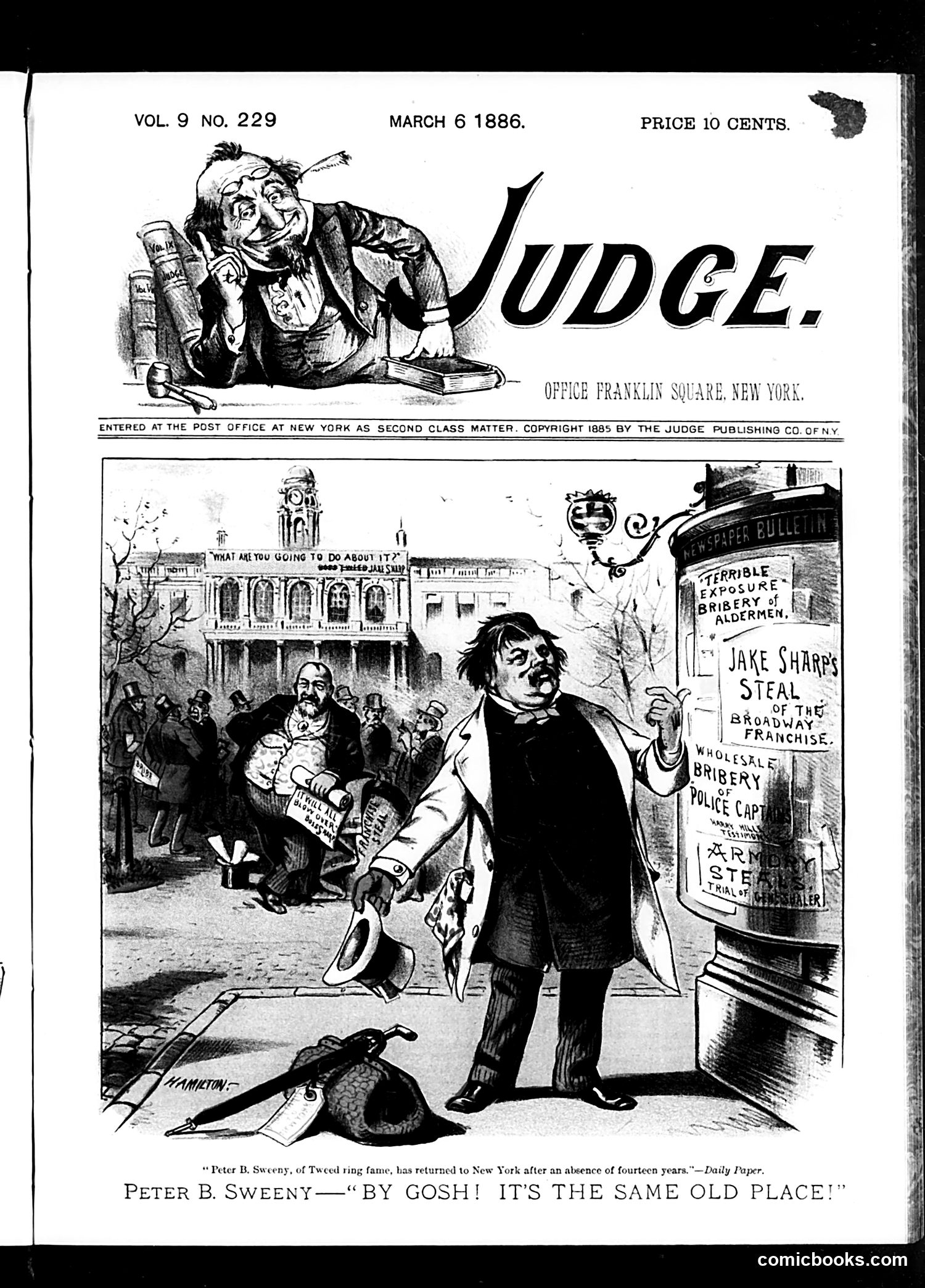
This satirical cartoon depicts **Peter B. Sweeny**, a notorious Tammany Hall politician, returning to New York after a 14-year absence. The cartoon mocks his arrival, showing him gesturing dramatically while surrounded by corruption signage reading "Terrible Exposure," "Bribery & Aldermen," "Jake Sharps Steal of the Broadway Franchise," and "Wholesale Bribery." The humor lies in the ironic contrast: Sweeny exclaims "By gosh! It's the same old place!"—suggesting New York's political corruption hasn't changed during his time away. The satire implies that Tammany Hall's corrupt practices were so institutionalized they persisted unchanged, and Sweeny's return symbolizes the recurring nature of urban machine politics and graft in Gilded Age New York.
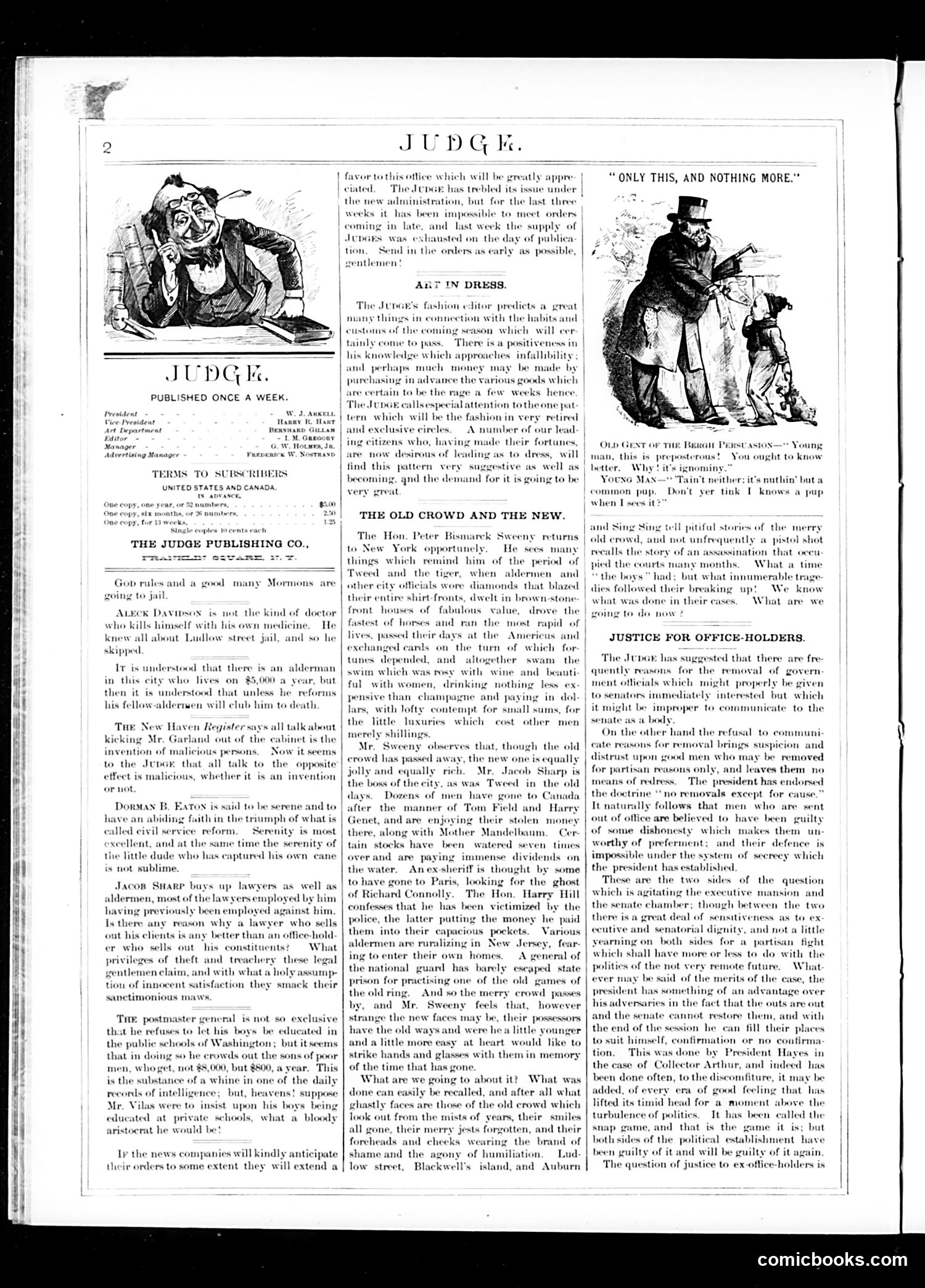
This page contains political commentary and satirical articles rather than traditional cartoons. The main illustrated pieces show caricatured figures in 19th-century dress, though their specific identities aren't entirely clear from the image alone. The text discusses several topics: Mormons facing legal trouble, a man "killing himself with his own medicine" (likely a metaphor for political self-destruction), and commentary on Postmaster General issues regarding removals and appointments. One section titled "The Old Crowd and the New" references Hon. Peter Bismarck Sweeny returning to New York, discussing old versus new money and social dynamics. The overall tone is critical of political figures and institutional corruption, typical of Judge's satirical approach to Gilded Age politics and society.
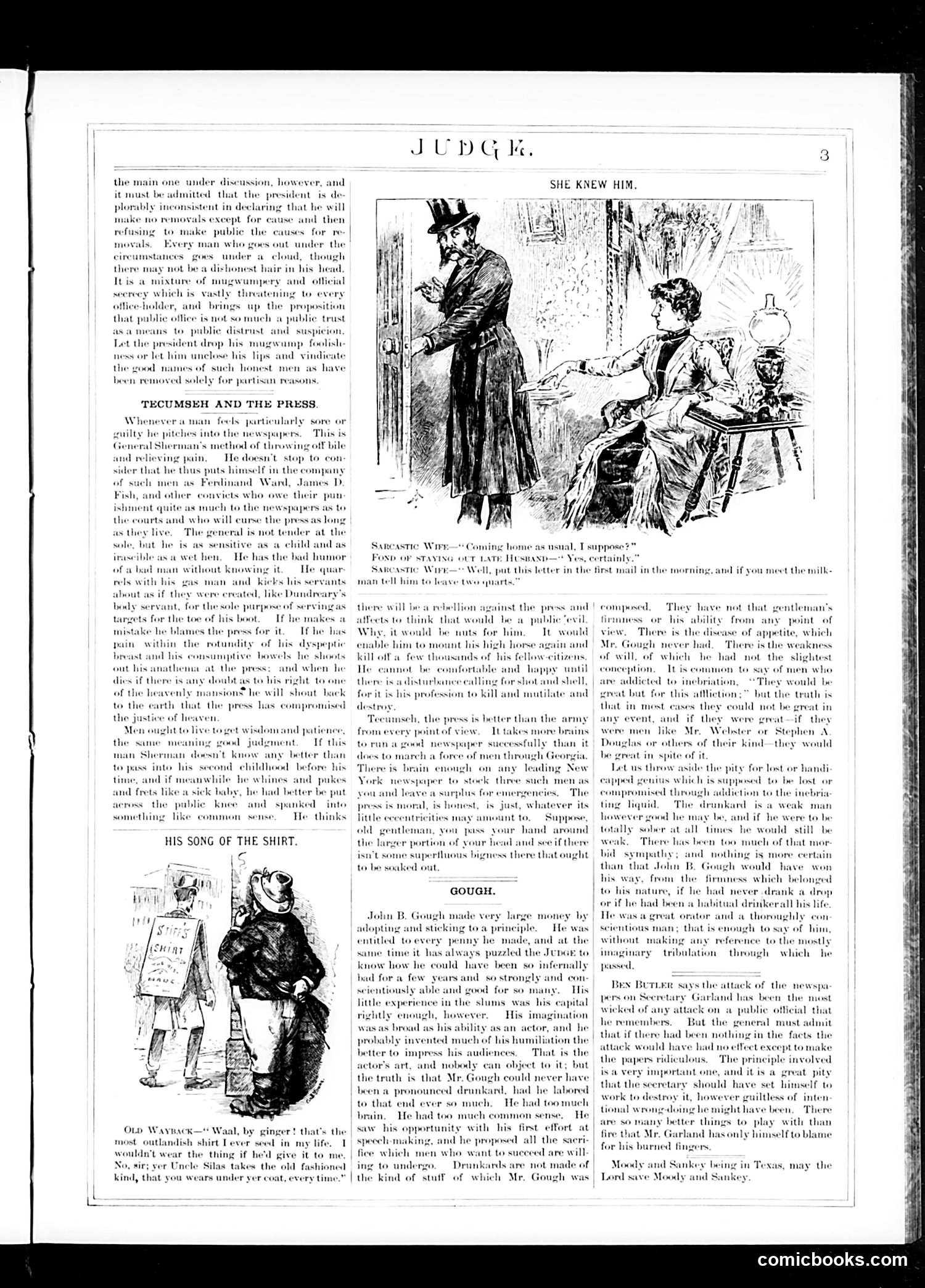
This page contains three separate satirical pieces about prominent 19th-century figures: **"Tecumseh and the Press"** attacks General William Tecumseh Sherman for publicly criticizing newspapers after removals from his administration. The satire argues Sherman hypocritically blames the press while using removals "for cause" inconsistently—a form of political cowardice masked as principle. **"She Knew Him"** (top illustration) depicts a sarcastic domestic scene where a woman pretends ignorance about her husband's affairs, likely mocking marital hypocrisy or infidelity. **"His Song of the Shirt"** and the "Gough" section discuss John B. Gough, a famous temperance lecturer who made money advocating sobriety while allegedly struggling with alcoholism himself. The satire highlights the contradiction between his public messaging and private behavior. The overall theme: powerful men who publicly condemn vices or institutions they privately depend upon or engage with—a classic target of satirical magazines attacking public hypocrisy.
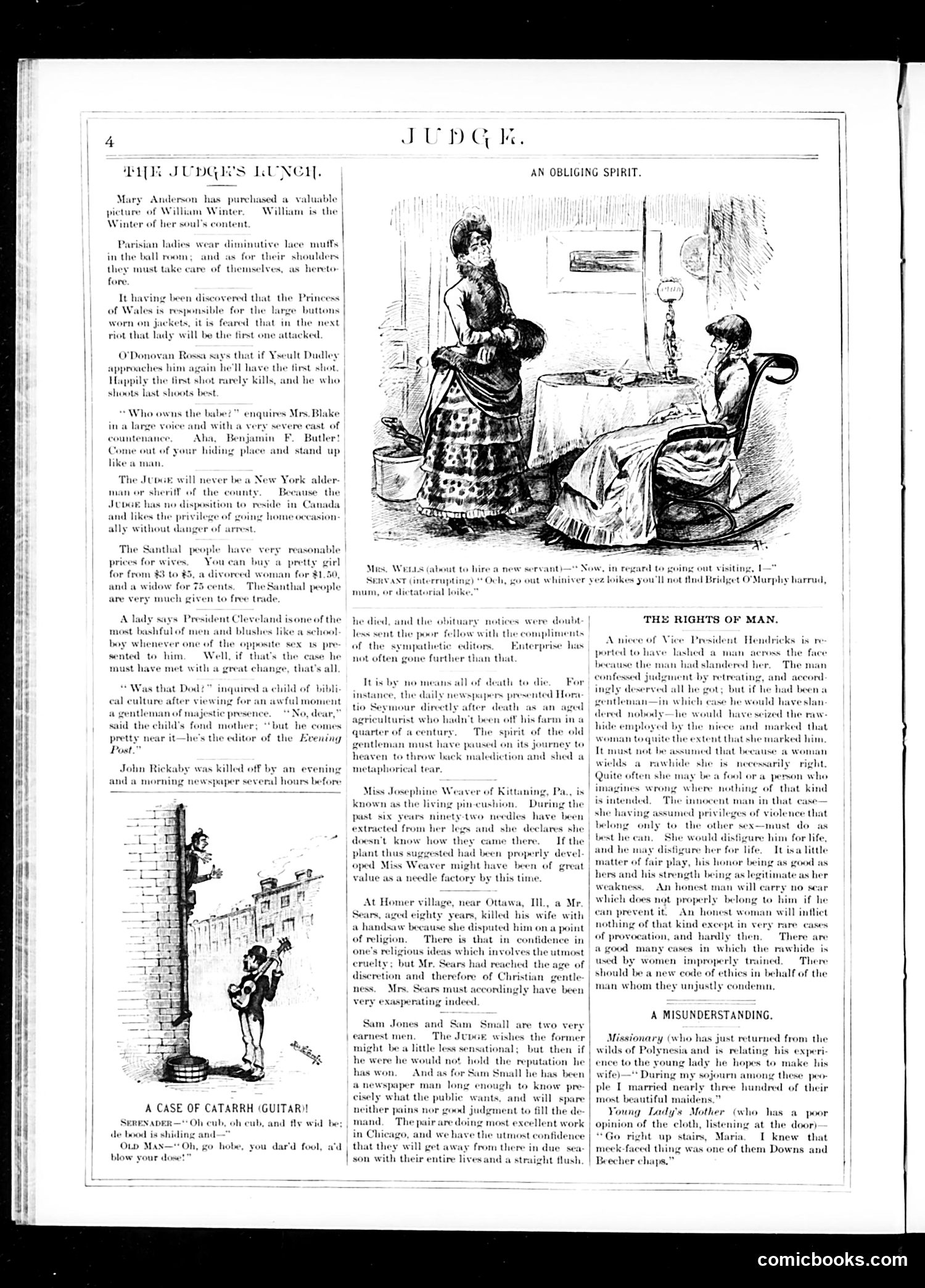
This page from *Judge* contains several satirical pieces typical of the 1880s-90s era: **"The Judge's Lunch"** column presents brief social commentary, including jokes about fashion (Parisian ladies' decorative muffs), Irish-American politics (O'Donovan Rossa), and contemporary figures like President Cleveland, mocking his bashfulness around women. **"An Obliging Spirit"** cartoon depicts a woman hiring a servant, with dialogue about the servant's willingness to follow orders without complaint—satirizing either servant-class deference or possibly class anxieties of the era. **"A Case of Catarrh (Guitar)"** shows a street musician, punning on the throat condition "catarrh" to suggest musical annoyance. **"The Rights of Man"** column discusses Vice President Hendricks allegedly slandering a woman, debating whether an innocent man should defend himself violently—addressing contemporary debates about honor, masculinity, and legal justice. The overall tone is lighthearted domestic and political satire aimed at middle-class readers, mixing humor with mild social criticism typical of *Judge* magazine's satirical mission.
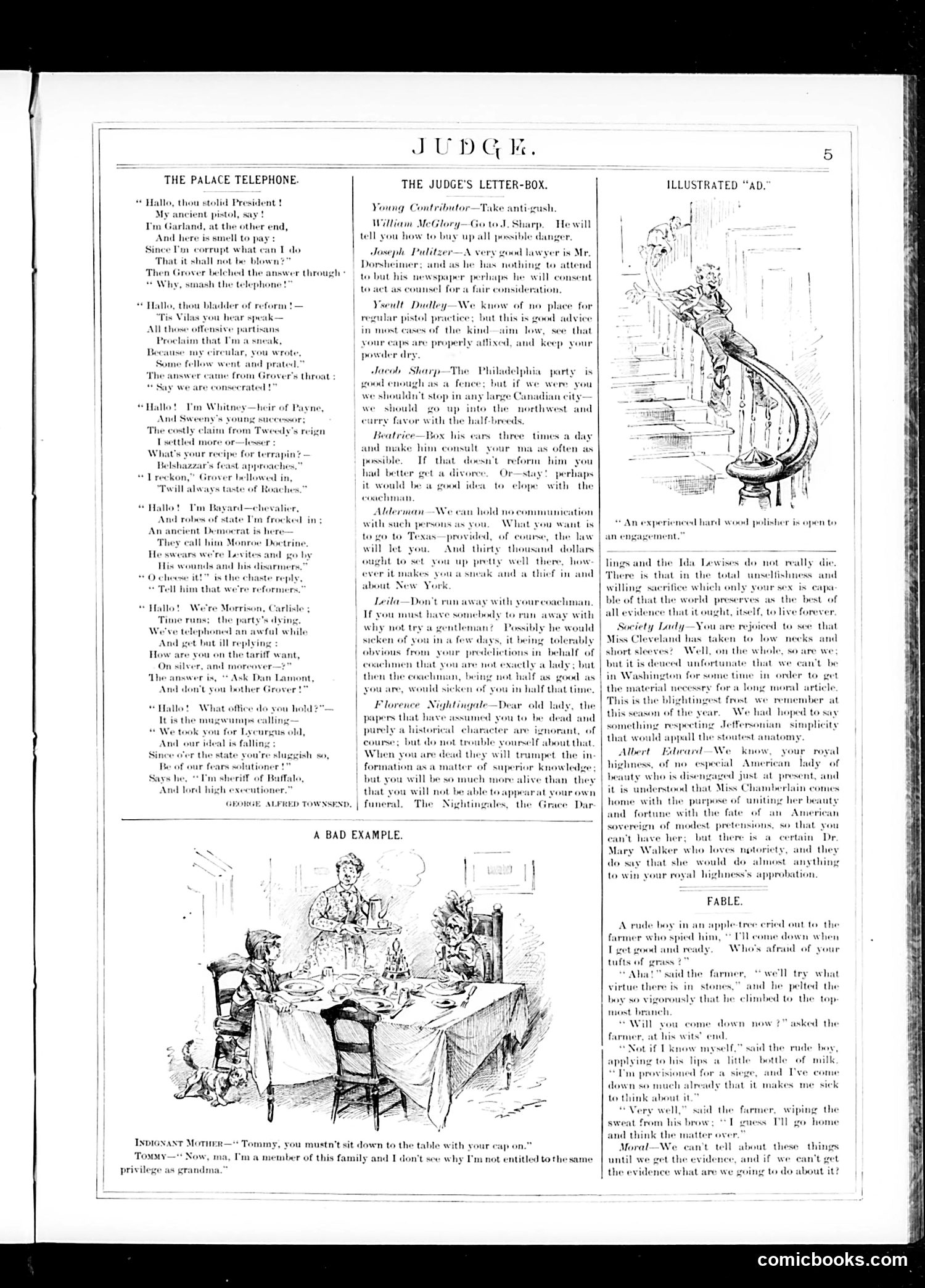
This page from *Judge* contains political satire from the Cleveland administration era (likely 1880s-90s, based on references to Grover Cleveland and tariff debates). **"The Palace Telephone"** sketch ridicules President Cleveland's cabinet and advisors as unable to answer basic questions. References include Secretary of State Thomas Bayard ("chevalier"), Postmaster General William Vilas, and debates over tariff policy and civil service reform—contemporary political hot-button issues. **"A Bad Example"** depicts a mother scolding her son for bad table manners, warning he shouldn't behave like "grandma"—a domestic humor piece rather than political satire. **"The Judge's Letter-Box"** and **"Illustrated Ad"** sections contain advice column parodies and social commentary mocking contemporary figures like newspaper publisher Joseph Pulitzer and Miss Cleveland (the President's daughter), satirizing American pretension and social climbing. The overall tone targets Democratic administration incompetence, newspaper sensationalism, and social hypocrisy—typical *Judge* fare of this period.
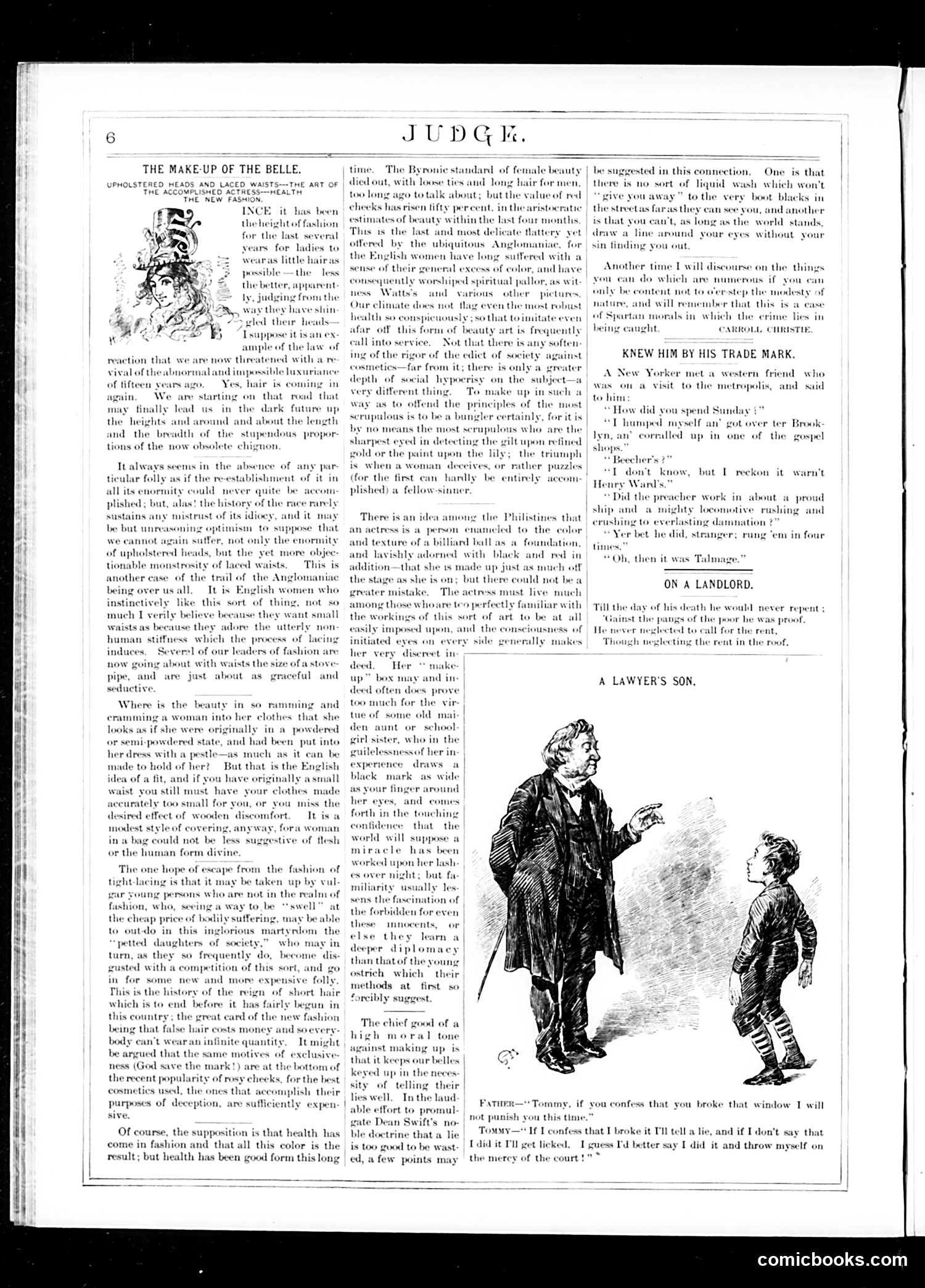
This page satirizes 1870s-80s women's fashion and beauty standards. The main article, "The Make-Up of the Belle," critiques the contradiction between women pursuing artificial beauty—tight corsets, excessive makeup, false hair—while claiming to value health. The cartoonist's central point: fashionable women are "upholstered" and artificially constructed rather than naturally beautiful. The author attacks the hypocrisy of English society, which worships a pale, spiritual ideal of beauty (the "Byron standard") yet encourages women to wear paint and padding to achieve it. The satirical target extends to women's competitive obsession with fashion trends—short hair was now yielding to elaborate false hairpieces—suggesting women undergo these uncomfortable, health-damaging transformations merely to outdo rivals socially. The accompanying cartoon "A Lawyer's Son" (bottom) depicts a father confronting a boy about breaking a window, illustrating separate moral themes about honesty and consequences for the young.
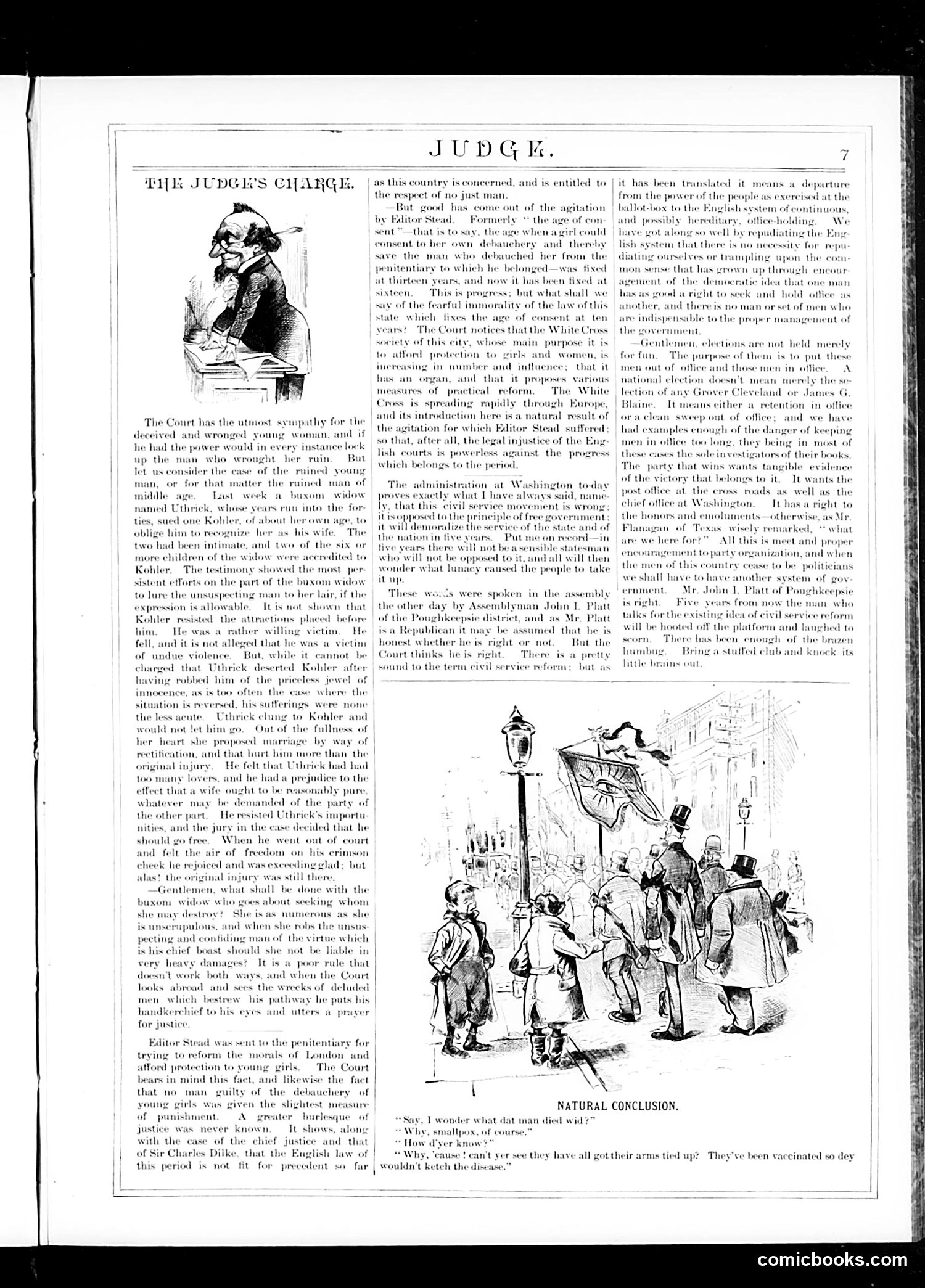
This page contains two distinct elements: an article titled "The Judge's Charge" and a political cartoon labeled "Natural Conclusion." **The Main Article** discusses judicial reform and civil service, critiquing what appears to be turn-of-the-century government inefficiency. It references Editor Steed's legal advocacy and debates about protecting young women from urban dangers. **The Cartoon** ("Natural Conclusion") depicts street-level social commentary. It shows several figures, including what appears to be working-class or street people, with a dialogue about vaccination and disease. The humor appears to satirize public health concerns of the era—possibly referencing vaccination debates or disease prevention policies—suggesting that despite vaccinations, citizens remain vulnerable or unprotected from societal problems. The exact political figures or specific events referenced remain unclear without additional historical context.
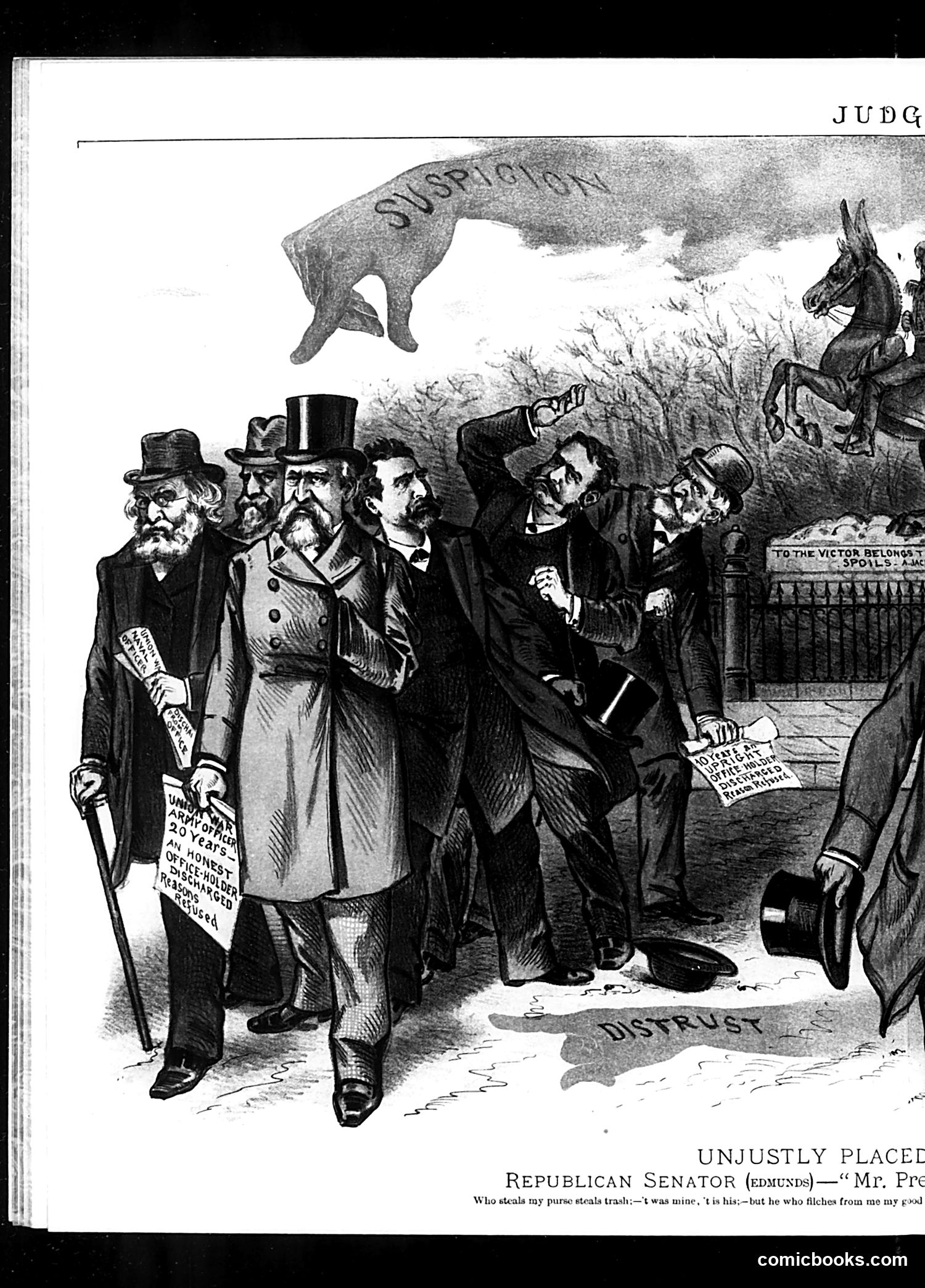
This Judge magazine cartoon satirizes a Republican Senator (identified as Edmunds in the OCR) over corruption or bribery involving "spoils"—likely referencing the patronage system where political positions were given as rewards. The cartoon shows well-dressed gentlemen examining documents labeled "spoils" and "distrust," with a suspended figure above labeled "supervision." The Shakespeare quote ("Who steals my purse steals trash...") suggests the Senator is hypocritically claiming moral high ground while engaging in corrupt practices himself. The visual of horses and officials appears to reference political machine operations. The satire criticizes Republican politicians for participating in the very spoils system and corruption they publicly condemned—a common Gilded Age critique of political hypocrisy and the distribution of government positions based on party loyalty rather than merit.
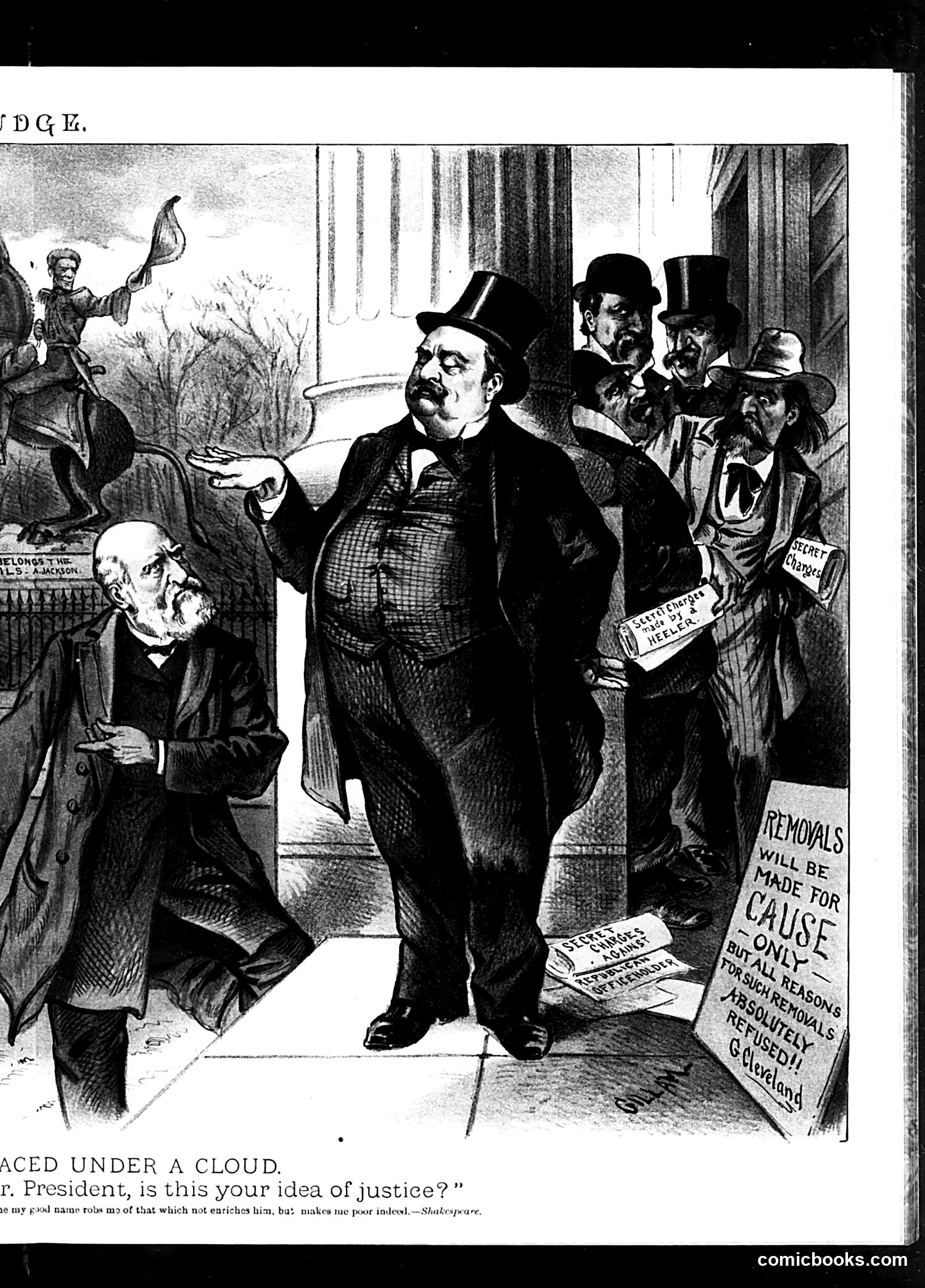
This Judge magazine cartoon satirizes a presidential administration facing scandal and removal threats. A portly central figure (appearing to represent a president) stands confronted by men carrying signs reading "REMOVALS" and "SECRET REMOVALS"—referencing forced political dismissals or firings. The Shakespeare quote about theft of reputation suggests the cartoon criticizes unjust removals damaging officials' good names. A sign visible in the image mentions Cleveland, indicating this likely critiques President Grover Cleveland's administration, possibly his controversial removal of Republican appointees. The "cloud" in the title suggests shadowy, questionable justice practices. The surrounding figures appear to be political operatives or hostile parties pressuring the president, framing administrative removals as politically motivated rather than merit-based.
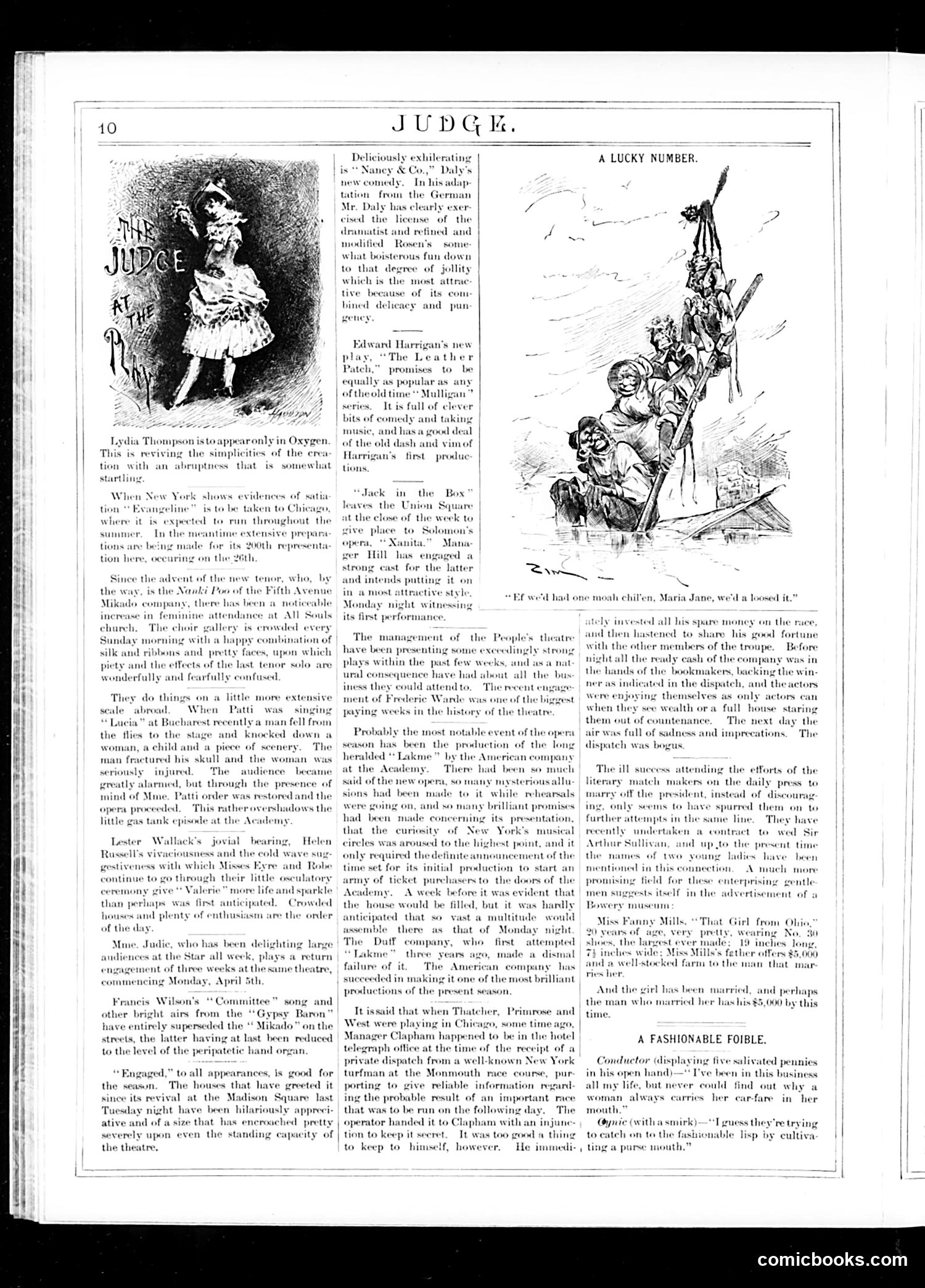
This page from **Judge** magazine contains theatrical reviews and social commentary typical of 1880s American satire. The main cartoon "A Lucky Number" depicts a man at a racetrack surrounded by figures climbing a pole—likely representing gamblers pursuing wealth through betting. The caption suggests reckless financial speculation and lost fortunes. The text discusses theater productions, including Edward Harrigan's new play "The Leather Patch" and commentary on New York's musical and theatrical scenes. There's satirical observation about a tenor at the Fifth Avenue church attracting female attendance—mocking both the performer's celebrity and women's shallow motivations. "A Fashionable Foible" critiques wealthy women's obsession with fashionable accessories, particularly expensive carriage items. The overall tone reflects Judge's typical stance: mocking pretension, excess, and foolish financial behavior among the upper classes and nouveau riche, while commenting on popular entertainment and social trends of the era.
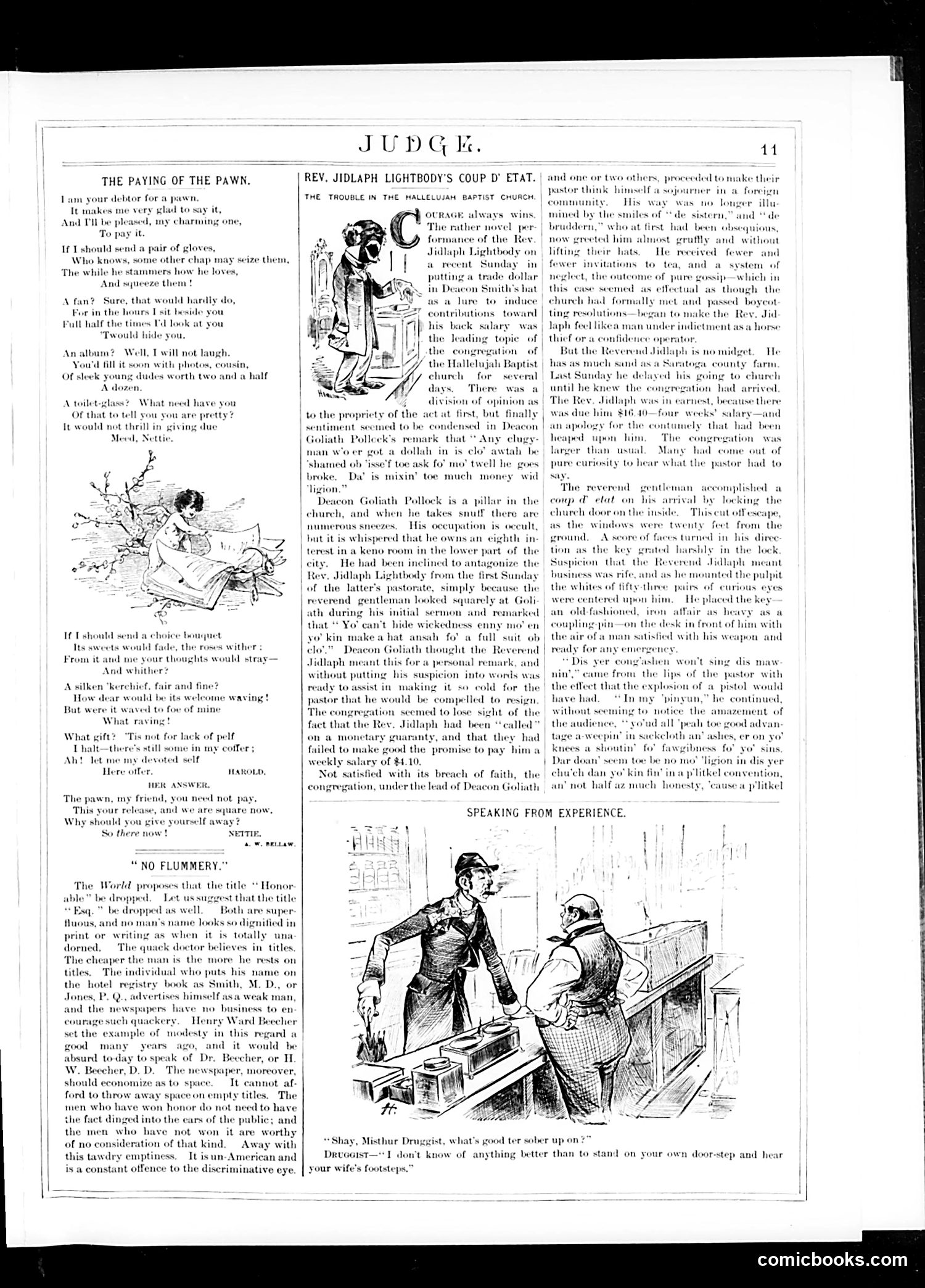
This page contains two distinct pieces of social satire from an American humor magazine: **"The Paying of the Pawn"** (top): A romantic dialogue poem where Harold proposes giving his sweetheart Nettie a pawn (pledge/token) instead of a physical gift. The joke plays on the double meaning—he offers himself ("my devoted self") as the pawn, avoiding expense while appearing romantic. Nettie's response accepts this sentimental gesture. **"Rev. Jidlaph Lightbody's Coup d'Etat"** (bottom): Satirizes church financial struggles and congregational politics. Reverend Lightbody attempts to stimulate donations by placing a trade dollar (cheap coin) in the collection plate—a trick to shame Deacon Smith into matching it. The scheme backfires when the congregation, led by the penny-pinching Deacon Goliath, boycotts the church. The satire mocks both the pastor's financial desperation and the deacon's stingy resistance to supporting their minister's salary. Both pieces use humor to comment on economic pressures and human nature—romance on a budget and religious hypocrisy regarding charitable giving.
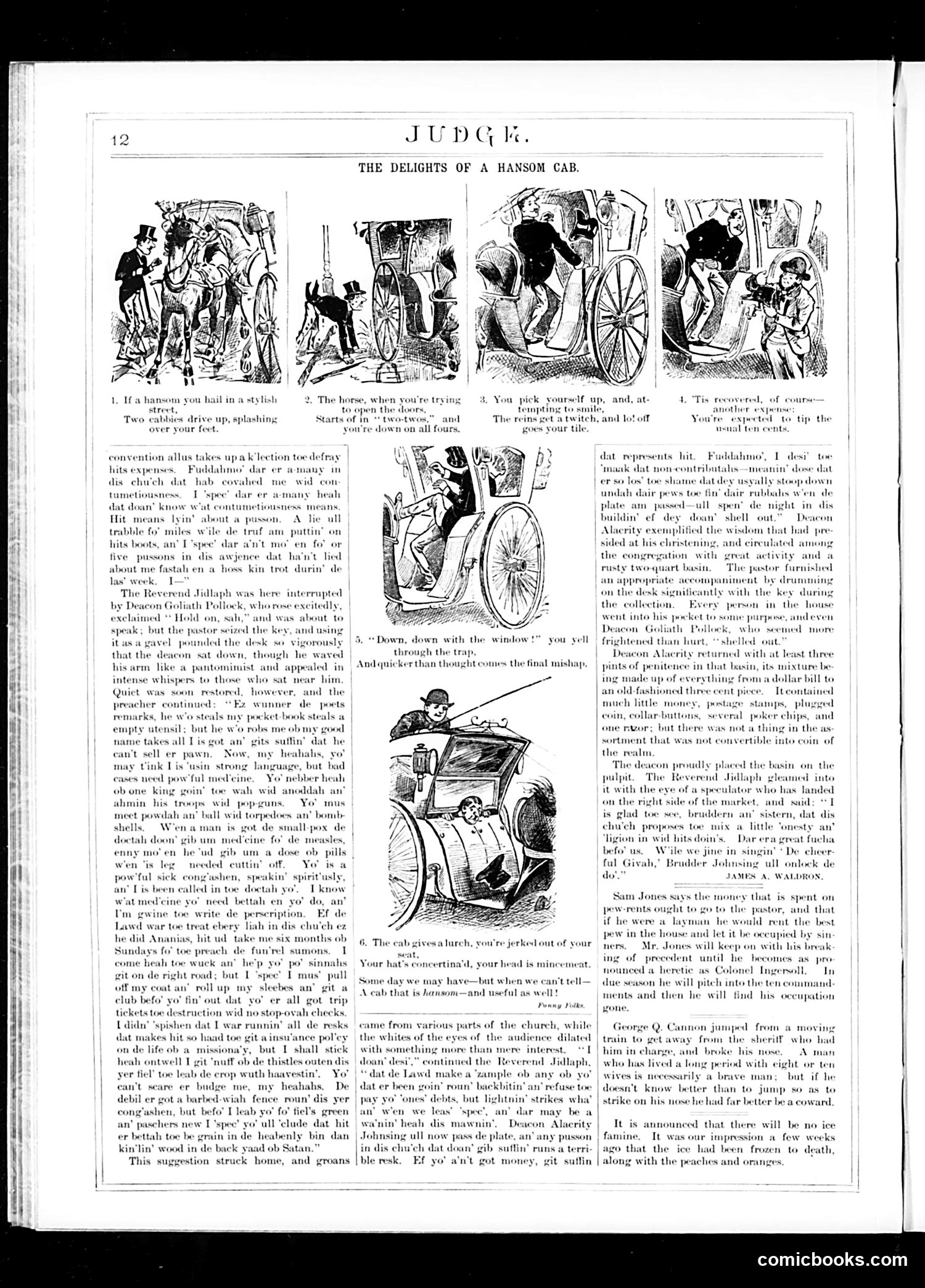
This multi-panel comic strip depicts the hazards of traveling by hansom cab (a horse-drawn taxi popular in 19th-century cities). Each panel shows a mishap: splashing pedestrians, the cab lurching suddenly, passengers tumbling about, and windows malfunctioning—capturing the chaotic, often dangerous experience of urban transportation. The accompanying text features a sermon by "Reverend Jidlap," a Black preacher (rendered in heavy dialect), discussing dishonesty and theft. He uses exaggerated examples, including a deacon who steals a collection plate. The "Sam Jones" reference at bottom appears unrelated commentary on church finances. The satire targets both the unreliability of hansom cabs as transportation and, through the sermon segment, critiques hypocrisy and moral failings—whether in religious institutions or everyday urban life. The crude dialect representation reflects the unfortunate racial stereotyping common in Judge magazine of this era.
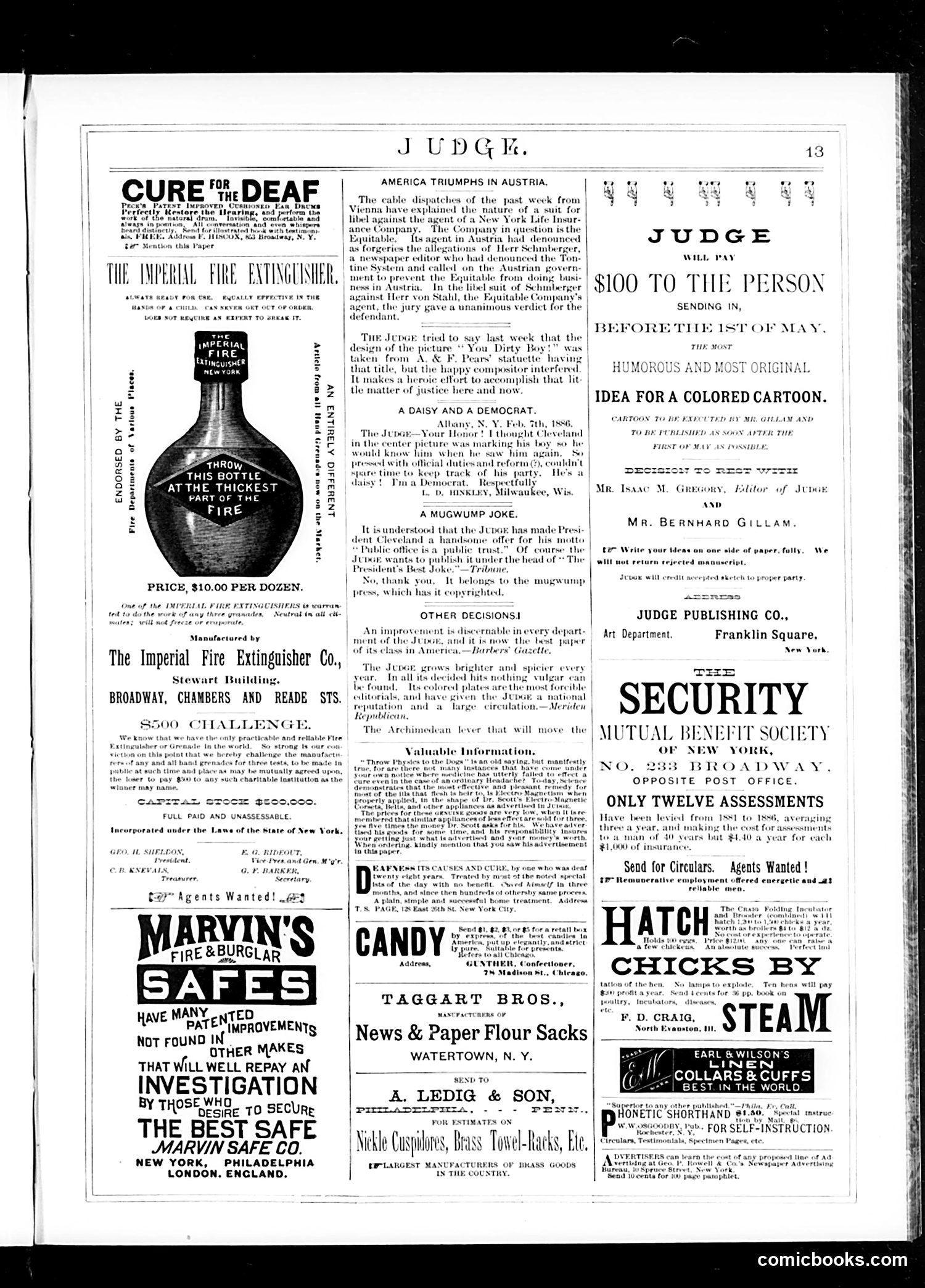
This is primarily an **advertising and announcements page** from Judge magazine, with minimal editorial satire content. The notable editorial items are brief: 1. **"America Triumphs in Austria"** references a legal victory for the Equitable Company against Austrian restrictions—a business triumph presented as American success. 2. **"A Daisy and a Democrat"** is a short joke mocking a Democrat for losing track of time while performing official duties, typical of the era's partisan humor. 3. **"A Mugwump Joke"** satirizes President Cleveland's motto "Public office is a public trust," suggesting it's unoriginal (belonging to "mugwumps"—reform-minded Republicans who defected). The joke implies Cleveland is taking credit for others' ideas. The page is dominated by period advertisements for fire extinguishers, safes, candy, flour sacks, and mutual benefit societies—typical commercial content filling space in 19th-century magazines. The call for cartoon submissions suggests Judge actively solicited reader ideas for political satire.
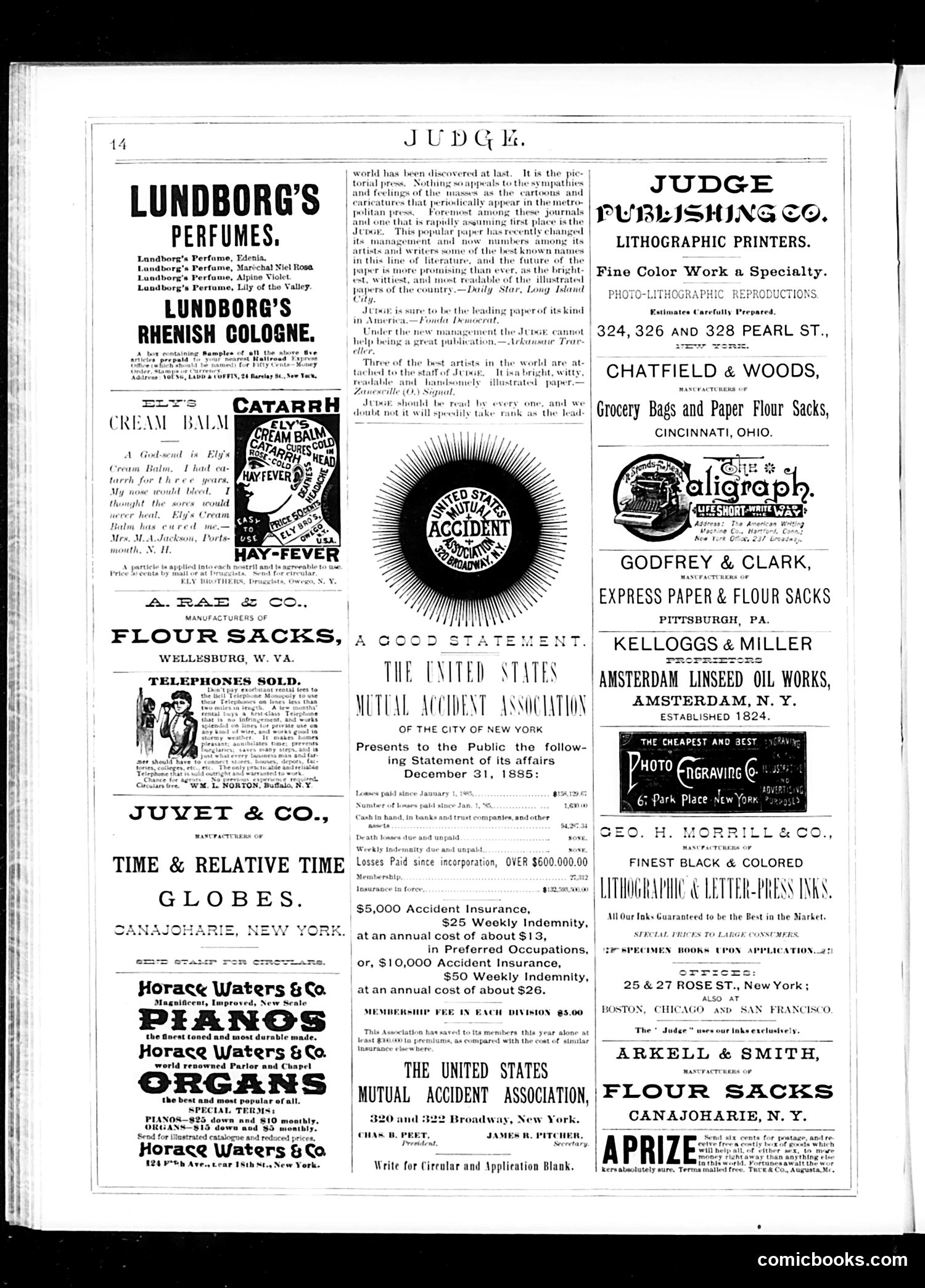
This page is **primarily advertisements**, not satirical content. It represents a common monetization strategy for 19th-century magazines: selling ad space to various manufacturers. The central image—a circular badge labeled "UNITED STATES MUTUAL ACCIDENT ASSOCIATION"—is the main editorial content. It accompanies text presenting the organization's 1885 financial statement, detailing accident insurance offerings at different price points ($13-$26 annually for various coverage levels). The surrounding ads promote consumer goods typical of the era: Lundborg's perfumes and cologne, Horace Waters & Co. pianos and organs, flour sacks, printing services, and inks. These ads reflect what middle-to-upper-class readers and businesses of the period valued. The accident insurance advertisement itself represents early American casualty insurance—a relatively new financial product gaining traction in the 1880s, marketed as protection against workplace injuries and accidents. The page demonstrates how 19th-century satirical magazines relied heavily on advertising revenue to sustain operations.
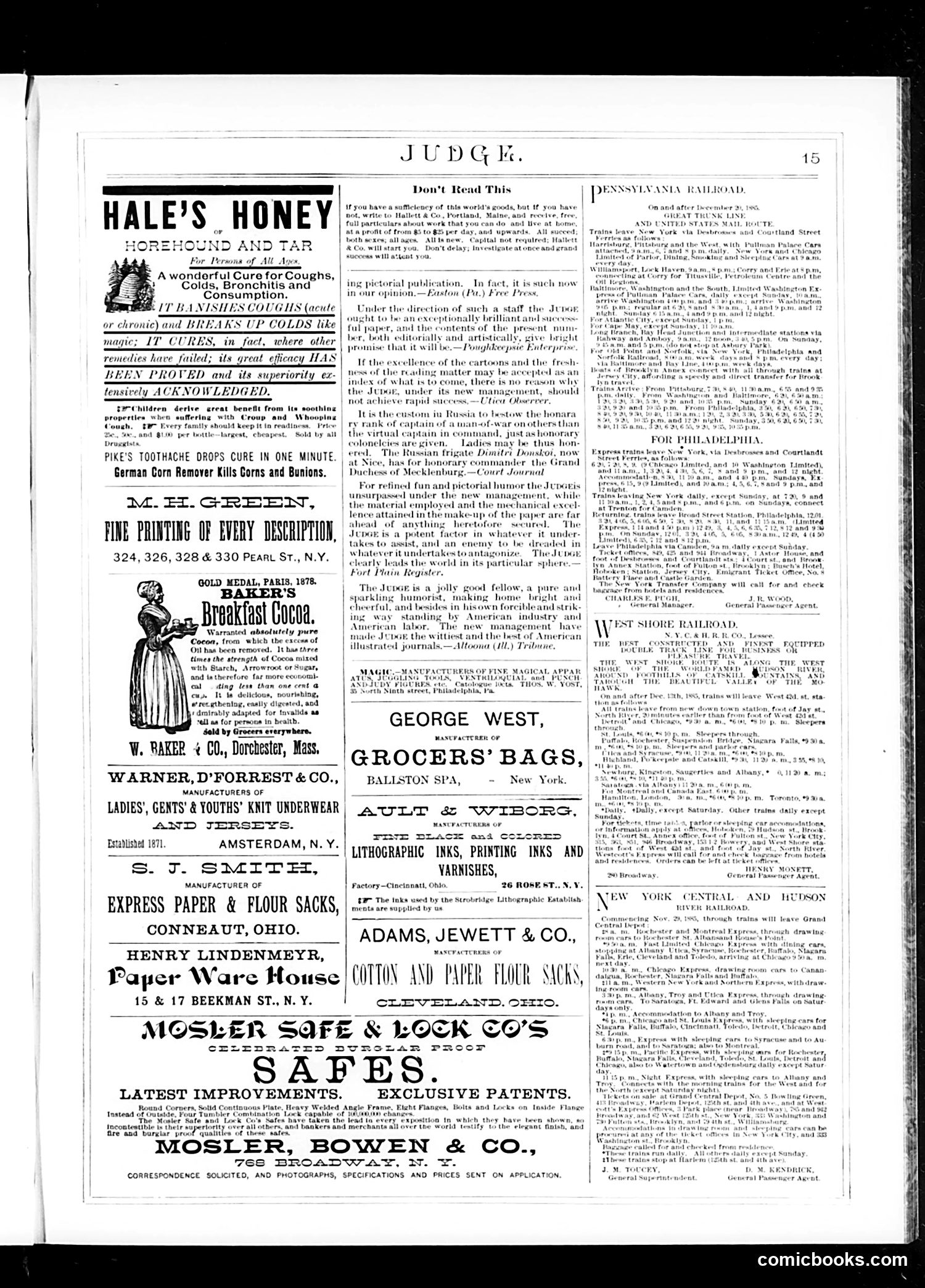
This is primarily an **advertising page** from Judge magazine, not a political cartoon page. The layout consists almost entirely of commercial advertisements for late-19th-century products and services. Notable ads include: - **Hale's Honey and Tar** (cough remedy) - **Pike's Toothache Drops** and a corn remover - **Baker's Breakfast Cocoa** - **Mosler Safe & Lock Company** safes - Various manufacturers of paper goods, underwear, and printing services The only editorial content visible is a brief section titled **"Don't Read This"** at top right, which appears to be satirical commentary—possibly mocking the magazine's own advertising-heavy format or critiquing editorial practices. The text references "pictorial publication" and discusses editorial quality, but the full context is unclear from this partial OCR. The page reflects Judge's business model: a satirical magazine sustained largely through advertising revenue, with editorial content mixed among commercial notices.
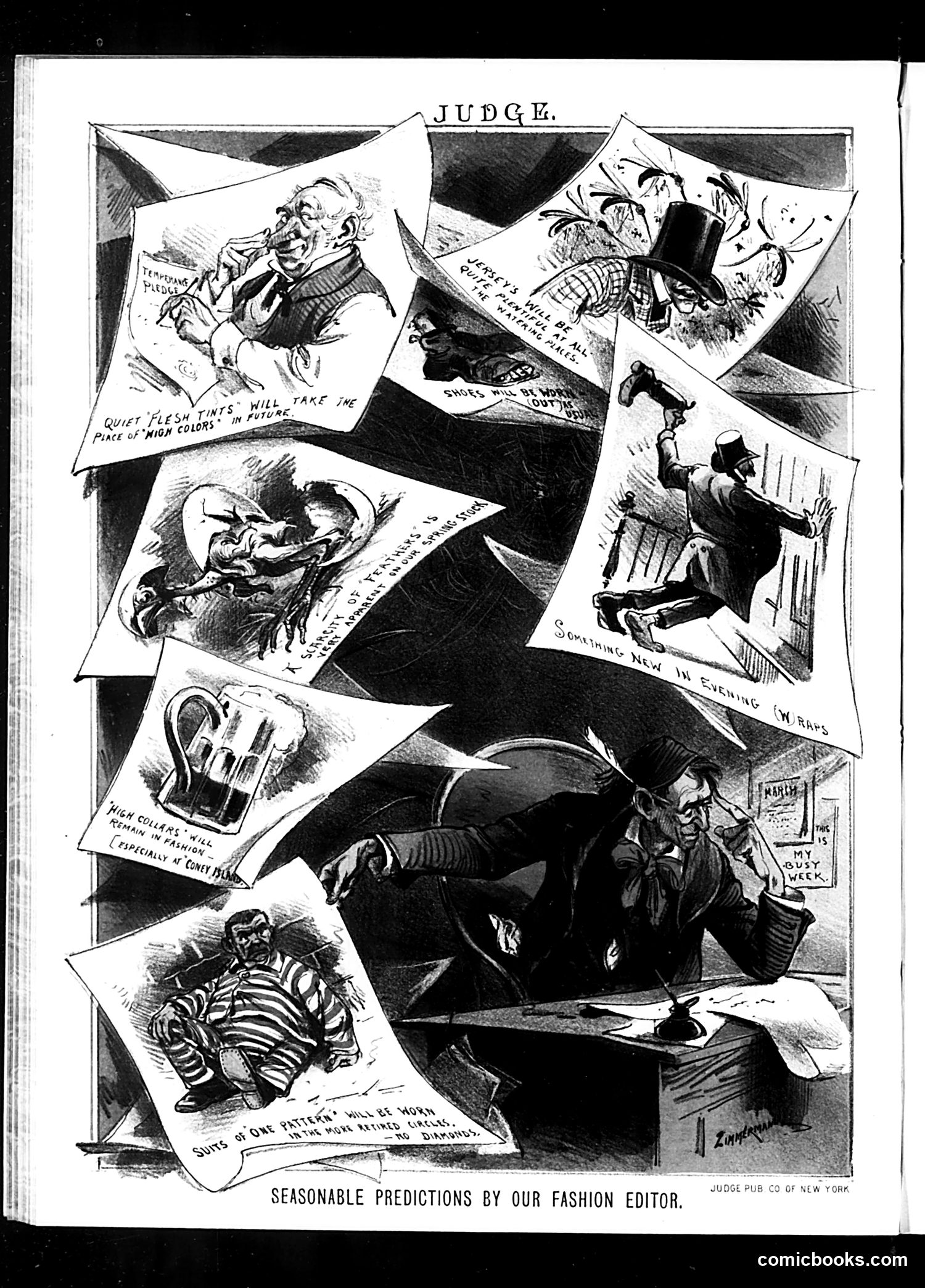
This is a satirical fashion commentary page from *Judge* magazine. The title promises "seasonable predictions," but the scattered sketches mock exaggerated or absurd fashion trends rather than predict them seriously. The cartoons show caricatured figures in various outlandish outfits and situations—including what appears to be skeletal imagery, formal wear, and comedic poses. The satire targets both the pretensions of high fashion and the fashion industry's tendency to promote ridiculous or impractical styles to consumers. The crude OCR suggests illegible caption text, but the visual joke is clear: the "Fashion Editor" is presenting obviously foolish or grotesque predictions as if they're serious fashion forecasts. This reflects period skepticism toward elite fashion arbiters who promoted costly or uncomfortable trends to the public.