
A complete issue · 16 pages · 1886
Judge — February 27, 1886
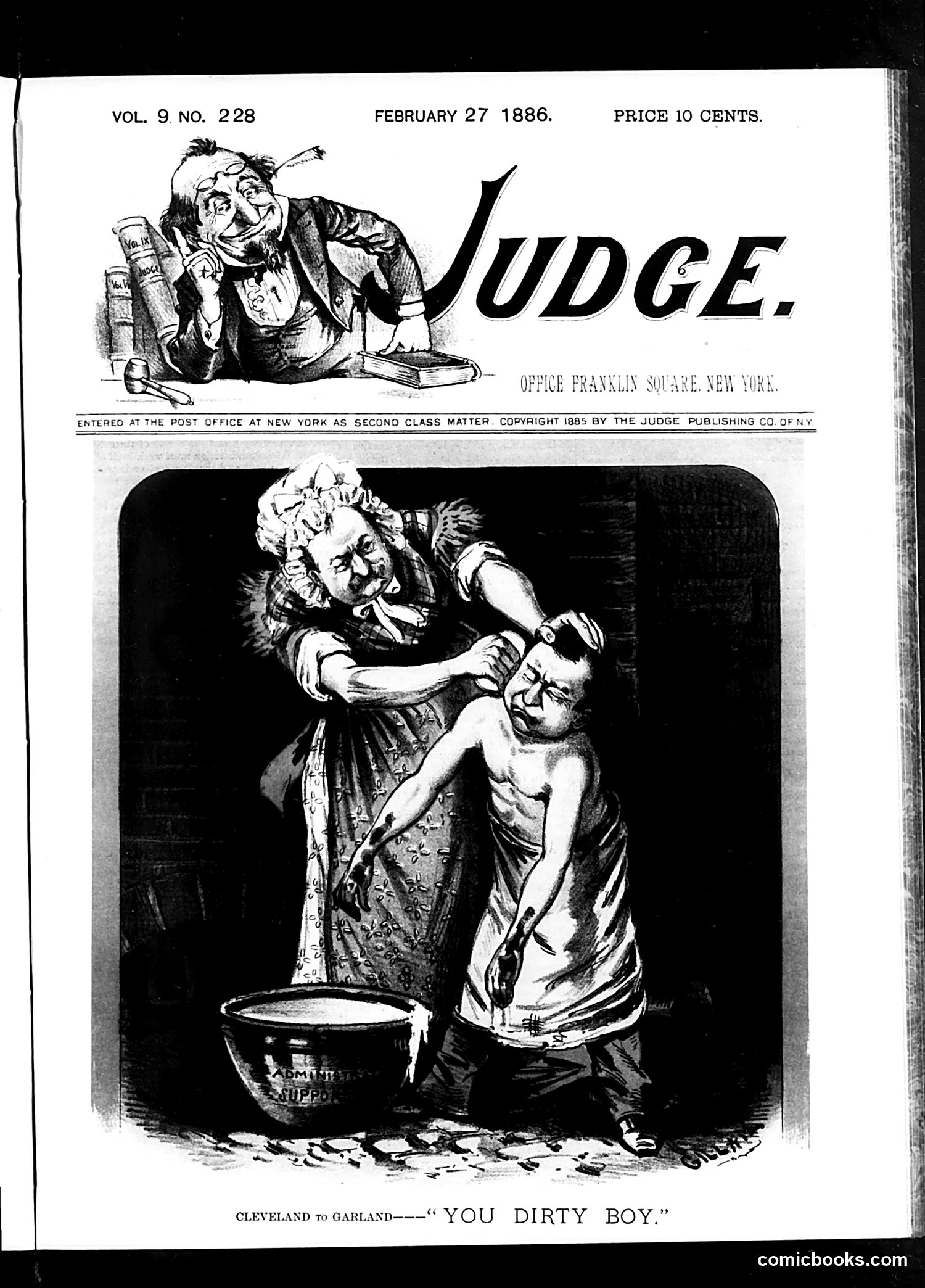
This political cartoon satirizes President Grover Cleveland, depicted as a woman scrubbing a young boy (likely representing a political opponent or the nation). The title "You Dirty Boy" suggests Cleveland is disciplining or correcting someone through harsh treatment. The caption "Cleveland to Garland" references Cleveland's relationship with Attorney General A.H. Garland. The cartoon appears to mock Cleveland's aggressive political tactics or prosecution strategies during his administration. The imagery—a maternal/domestic figure administering punishment—satirizes Cleveland's approach to governance as excessive or inappropriately harsh. Judge magazine was Republican-leaning, so this likely criticizes Democratic leadership. The bowl visible contains what appears to be cleaning implements, emphasizing the degrading nature of the depicted action.
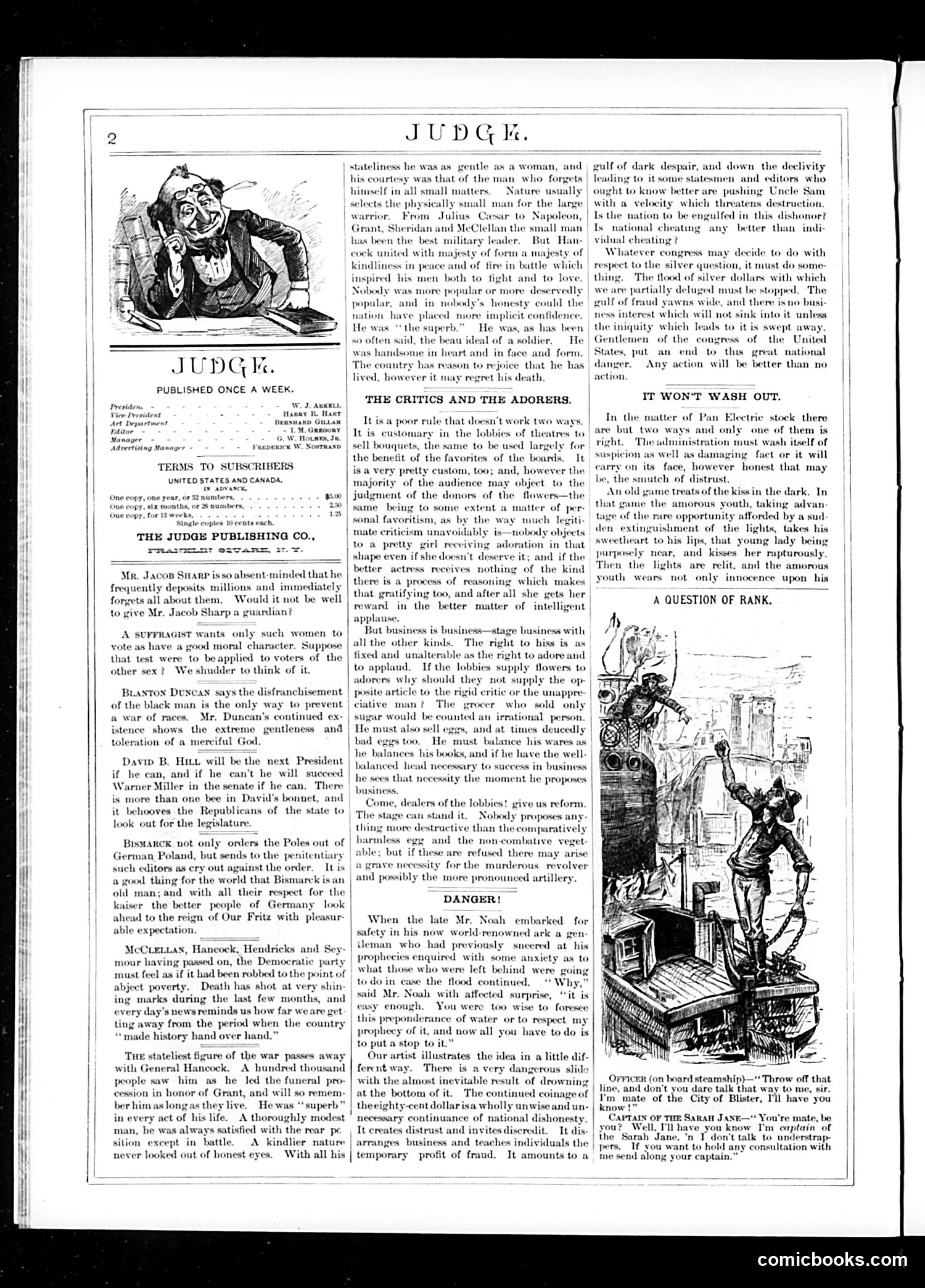
This page contains editorial commentary rather than political cartoons. The main illustration titled "A Question of Rank" depicts a steamship scene where officers interact with passengers, satirizing class distinctions aboard vessels. The text discusses several topics: criticism of Congress members depositing millions while the nation struggles; defense of Republican legislative action; commentary on General Hancock and Democratic politics; and debate over theatrical critics versus theater patrons—arguing that business interests (represented by "lobby" dealers) manipulate both simultaneously. The bottom section, "DANGER!", addresses religious prophecy regarding Noah's ark and flood safety, appearing to satirize superstitious public concerns mixed with contemporary anxieties about maritime disasters and fraud. The page reflects late 19th-century preoccupations with class, political corruption, and public morality rather than a single unified satirical target.
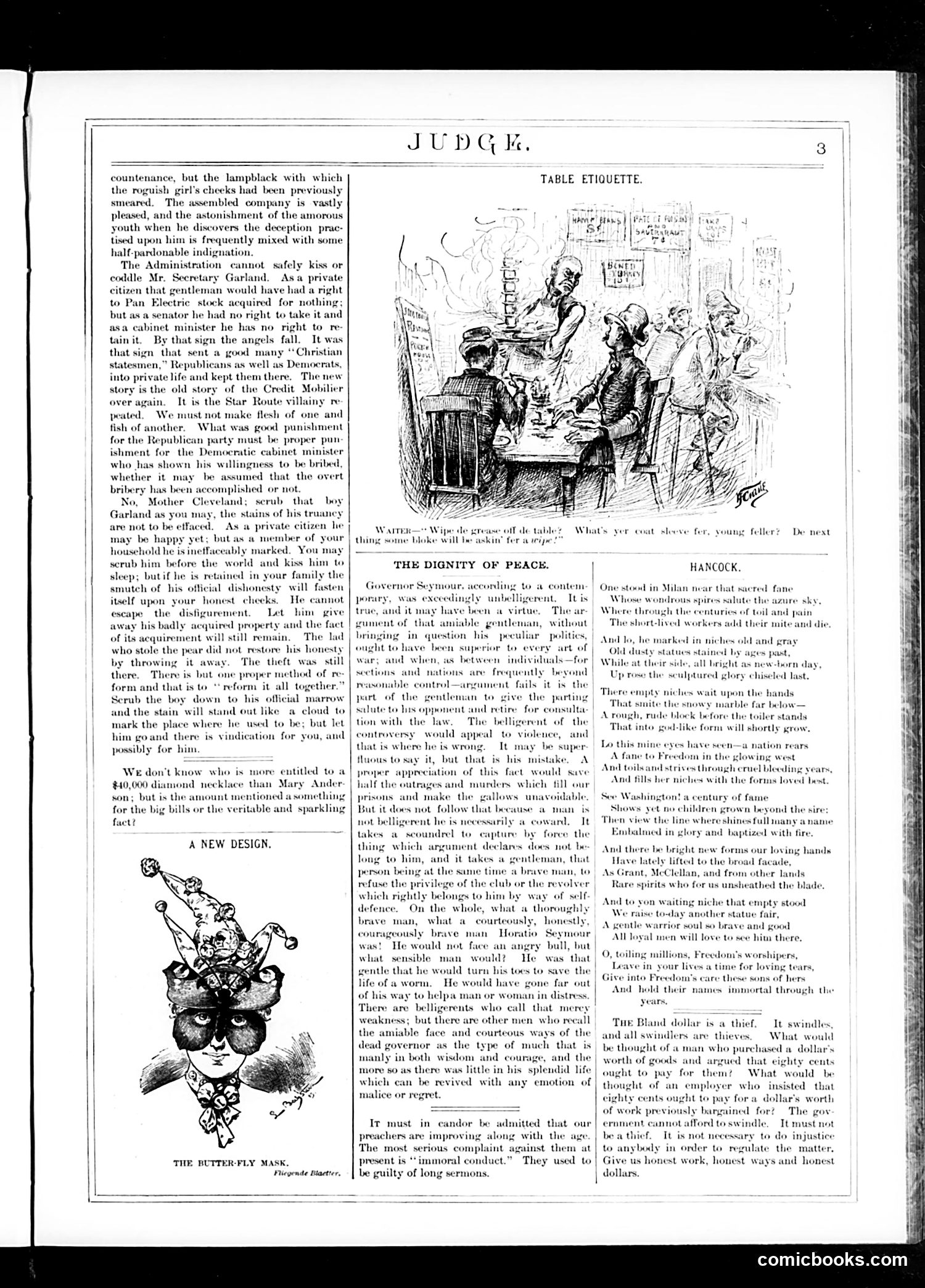
This page contains political commentary and illustrations from Judge, a late-19th-century satirical magazine. **Main Political Content:** The lead article criticizes Secretary of the Interior (appears to be A.H. Garland, referenced in text) for alleged corruption and bribery. The satire compares him to a child with "lampblack" on his cheeks—his dishonesty cannot be washed away. The piece invokes past scandals ("Credit Mobilier," "Star Route") to argue Democratic officials deserve the same punishment Republicans received. **Other Content:** - "Table Etiquette" cartoon: Shows a servant teaching proper dining behavior, likely mocking working-class social pretensions. - "The Dignity of Peace": Essay praising politician Horatio Seymour for refusing to duel—contrasting "amiable" peacefulness with masculine honor codes. - "The Butter-Fly Mask": An ornate jewelry design advertisement or illustration. The page exemplifies Judge's mix of political attack, social mockery, and miscellaneous commentary typical of Gilded Age satirical publications.
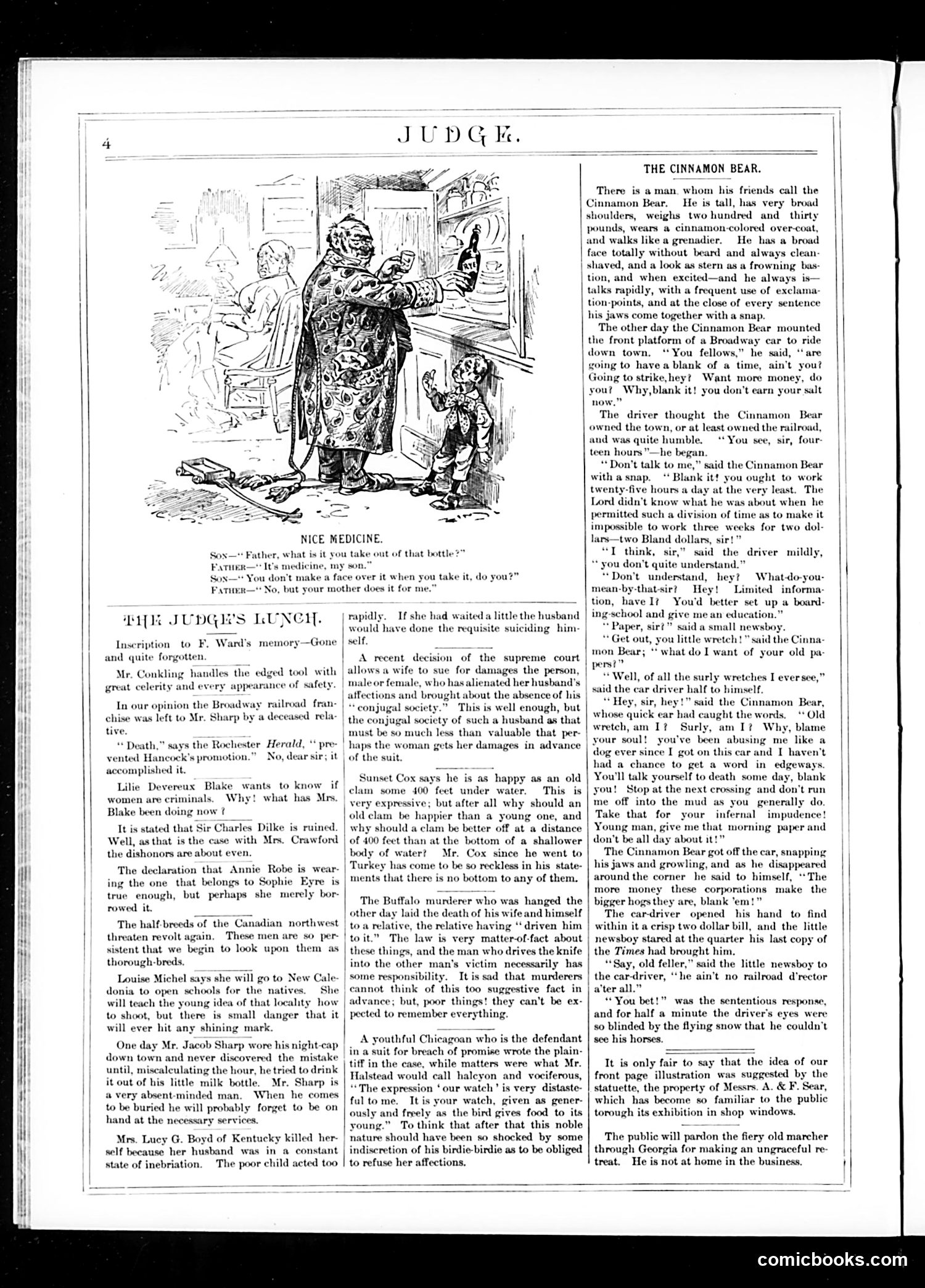
This page from Judge contains several short satirical items typical of 1880s American humor: **"Nice Medicine"** cartoon shows a father giving his son medicine the boy refuses—the joke being the mother takes it instead, implying she drinks for medicinal purposes (alcohol). **"The Judge's Lunch"** section includes brief gossip-style jabs at public figures: - References to Roscoe Conkling (political figure) and General Hancock - Mocking Sir Charles Dilke's scandal involving Mrs. Crawford - Jokes about Canadian half-breeds, Louise Michel, and politician "Sunset Cox" **"The Cinnamon Bear"** article (right column) appears to be a longer satirical story about a tall, broad-shouldered man known by that nickname, depicting his interactions with a Broadway streetcar driver in humorous dialogue about wages and working hours. The humor relies on contemporary scandal knowledge and political gossip most modern readers would miss without historical context.
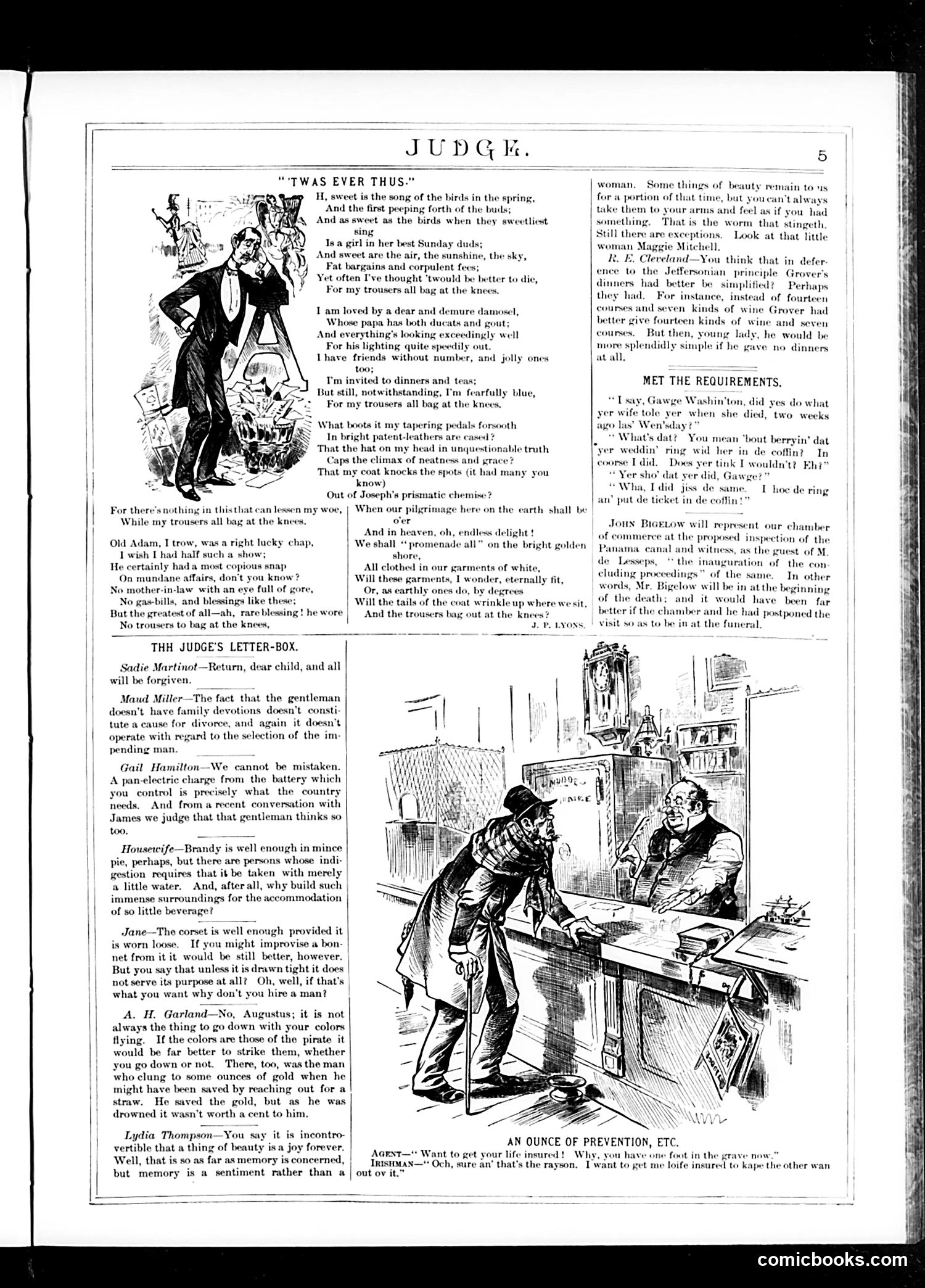
This page contains a humorous poem titled "'Twas Ever Thus" mocking a well-dressed gentleman whose only complaint is that his trousers bag at the knees—a trivial tailoring problem that undermines his otherwise perfect appearance and romantic prospects. The satirical point is that even those with wealth, friends, and romantic success can obsess over minor imperfections. The accompanying cartoon "An Ounce of Prevention, Etc." shows an insurance agent pitching life insurance to an Irishman, with the agent noting he has "one foot in the grave already," suggesting the man's poor health or occupation makes him an unsuitable insurance risk—a dark joke about the insurance industry's cherry-picking of clients. The "Judge's Letter-Box" section contains satirical responses to reader questions, offering absurd or contradictory advice on relationships, domestic matters, and public figures, typical of the magazine's humor style. The references to "Grover" (likely President Cleveland) and dining customs reflect late 19th-century social concerns.
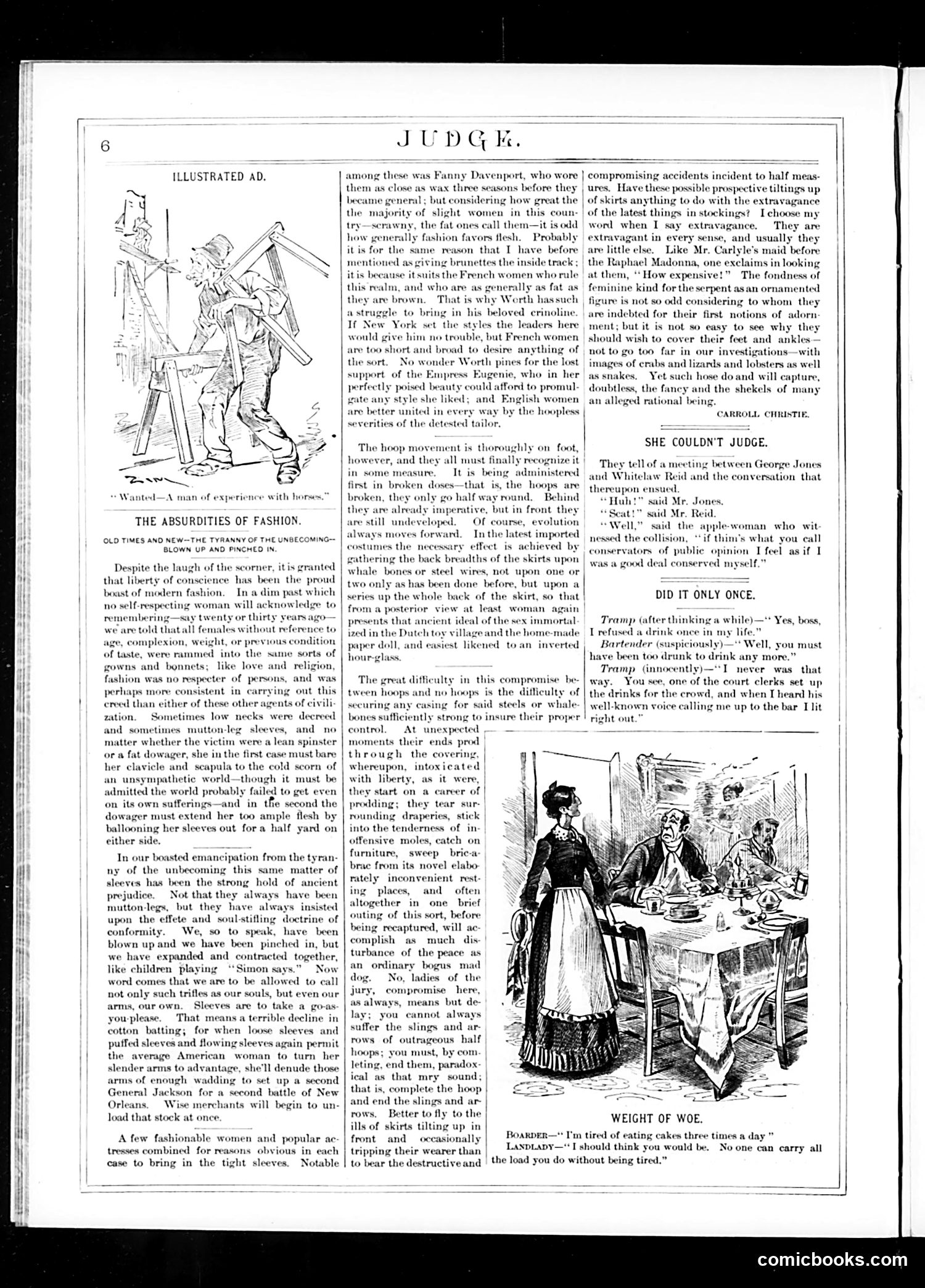
This page satirizes **the tyranny of fashion's contradictions**, particularly regarding women's clothing silhouettes and the tyranny of conformity to uncomfortable styles. **Main Satire:** The article critiques how fashion claims to offer freedom and individuality to modern women, yet still forces them into absurd, body-distorting garments. It specifically mocks the **return of tight sleeves and elaborate hooping systems** that constrain the female form—ironically reversing the supposed "emancipation" from past fashion tyranny. **Key Targets:** - **Worth** (the famous French couturier) and French fashion dictates, blamed for imposing uncomfortable styles on women - The contradictions of American women who adopt these styles while lacking the body type they supposedly suit - Merchants profiting from the cycle of absurd fashion trends **The Cartoon:** The "Weight of Woe" illustration shows a woman at a social gathering, visibly exhausted, with dialogue about the physical burden of fashion. **Modern Relevance:** This presages modern critiques of beauty standards—how fashion industries market "liberation" while imposing restrictive, uncomfortable, and often unhealthy body ideals on women.
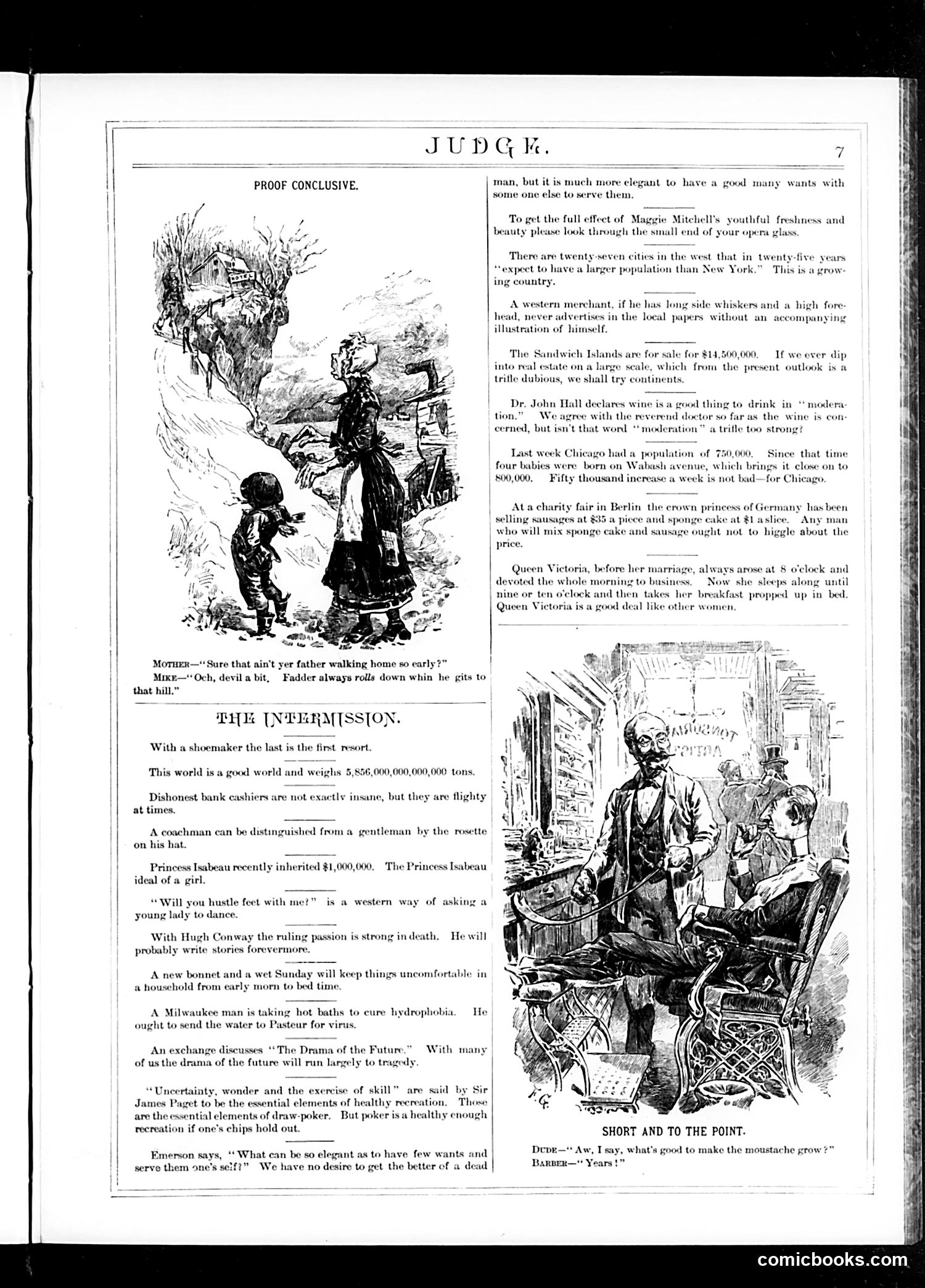
This page from Judge contains satirical commentary and jokes typical of 19th-century American humor magazines. **"Proof Conclusive"** (top cartoon): Shows a father and child on a hillside. The joke plays on Irish dialect humor: the mother asks why father comes home so early; the child responds that "Fadder always rolls down whin he gits to that hill"—suggesting the drunk father literally tumbles downhill, making early arrival inevitable. This relies on period ethnic stereotyping common to the era. **"The Intermission"** section contains brief satirical observations about contemporary figures and events: Dr. John Hall's moderation in wine-drinking, Chicago's rapid population growth (humorously attributing growth to four babies), Princess Isabeau's inheritance, and references to writers like Hugh Conway. **"Short and to the Point"** (bottom cartoon): A barber-shop scene where a customer asks what makes mustaches grow; the barber replies "Years!"—a simple joke about aging. The page emphasizes social satire, puns, and observational humor rather than explicit political commentary.
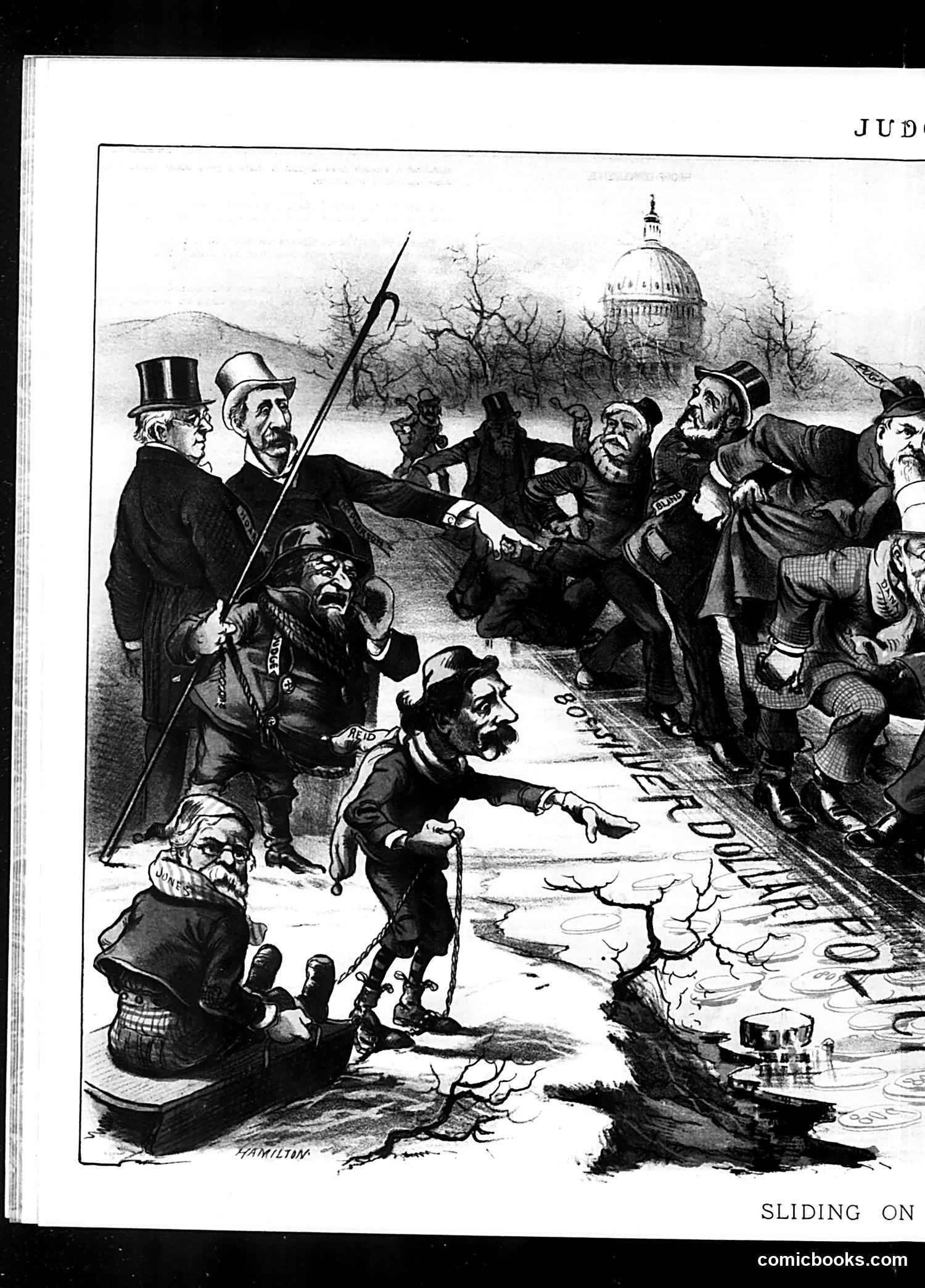
This Judge magazine cartoon depicts politicians and dignitaries literally sliding on ice near the Capitol Building, suggesting political instability or loss of control. The well-dressed figures in top hats—representing government officials—are shown slipping and struggling to maintain their footing on an icy surface. The cartoon's title "Sliding On" appears to be a pun on political precariousness. The artist (Hamilton, visible in signature) likely critiques how political leaders are figuratively "on thin ice"—losing their grip on power or dealing with controversial policies. The bare winter trees and frozen landscape reinforce this sense of harsh political climate. Without the magazine's date, the specific crisis or scandal referenced remains unclear, but the satire suggests government instability during a particular political moment.
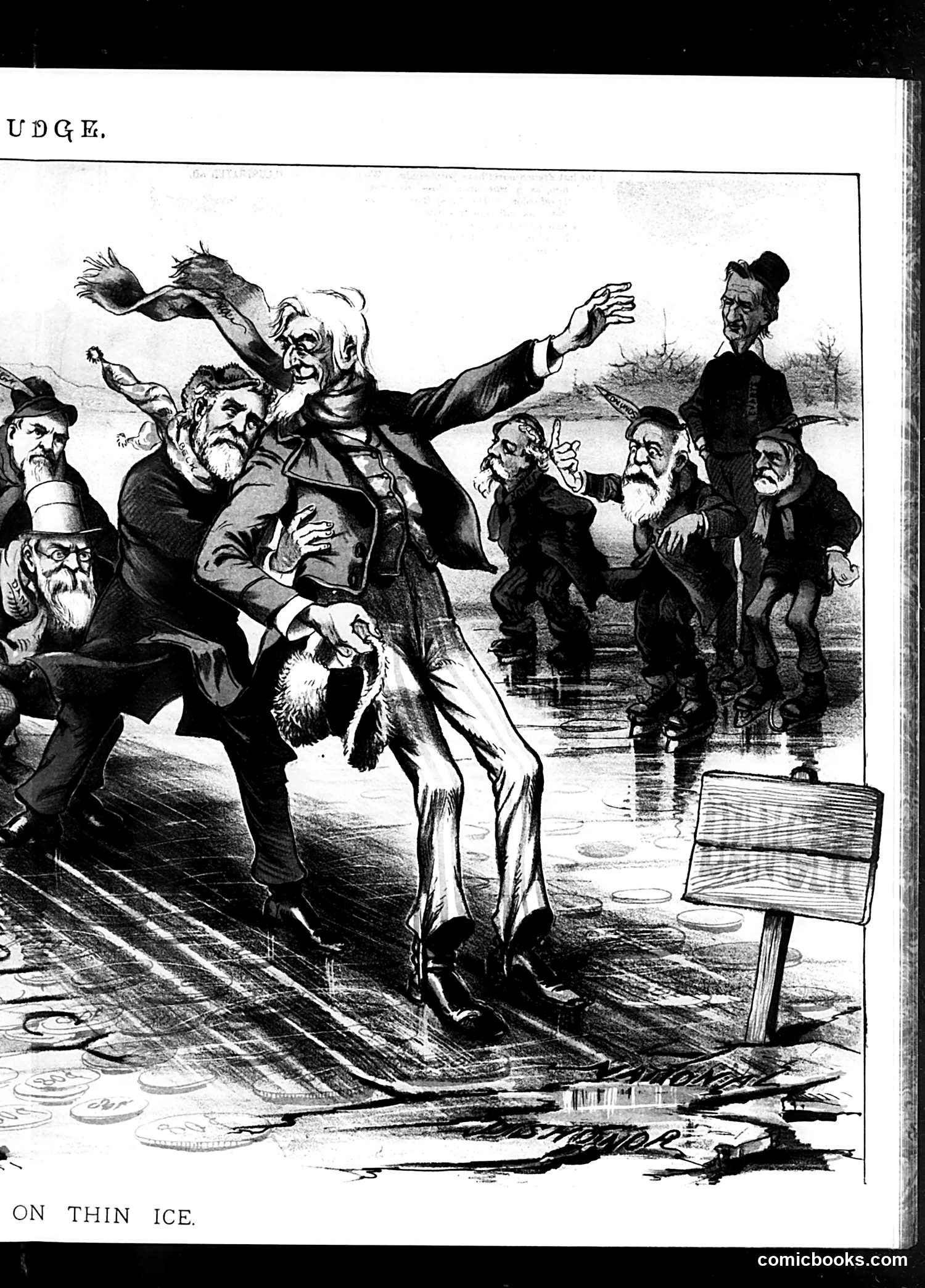
This Judge magazine cartoon depicts several bearded men (likely political figures or leaders) standing on thin ice over water, in a precarious situation. One central figure gestures dramatically while others appear anxious or arguing. A sign is visible in the background. The title "On Thin Ice" is a metaphor for political instability or danger. The cartoon likely satirizes a specific political crisis or diplomatic tension—possibly involving international relations or domestic political conflict—where leaders' positions are unstable and failure imminent. Without clearer identification of the specific figures or date, the precise political situation remains unclear, but the visual metaphor effectively communicates that these political figures face collapse or catastrophe if circumstances change.
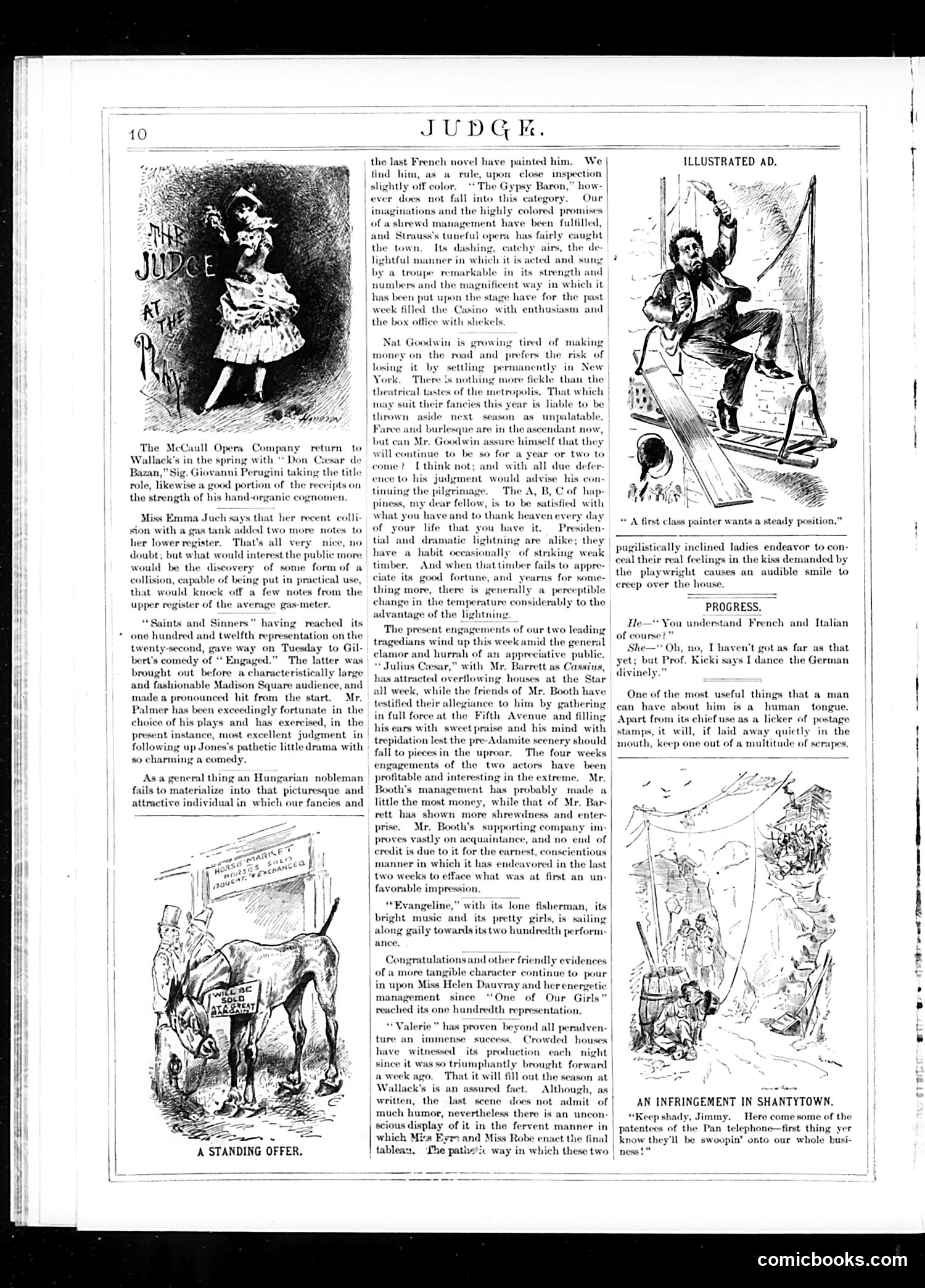
This page from *Judge* magazine contains theatrical reviews and satirical commentary on New York performances circa the 1880s-1890s. **Main Content:** The text discusses several theatrical productions: "The Gypsy Baron" (praised for its music and staging), and reviews of Nat Goodwin's career decisions, Emma Juch's singing, and performances of "Julius Caesar" and other plays at venues like the Casino and Star Theatre. **Cartoons:** - "A Standing Offer" (bottom left): Shows a man with a donkey labeled with theatrical notices—satirizing the difficulty of promoting theatrical productions or perhaps the stubborn nature of theatrical management. - "A First Class Painter Wants a Steady Position" and "An Infringement in Shantytown": Appear to be unrelated comic vignettes typical of *Judge's* miscellaneous humor. **The Satire:** The page mixes theater criticism with gentle mockery of performers' pretensions and financial concerns. The humor is primarily theatrical—poking fun at actors' decisions and management follies rather than serious political commentary. The "Progress" dialogue at bottom right is a simple, mild joke about language learning.
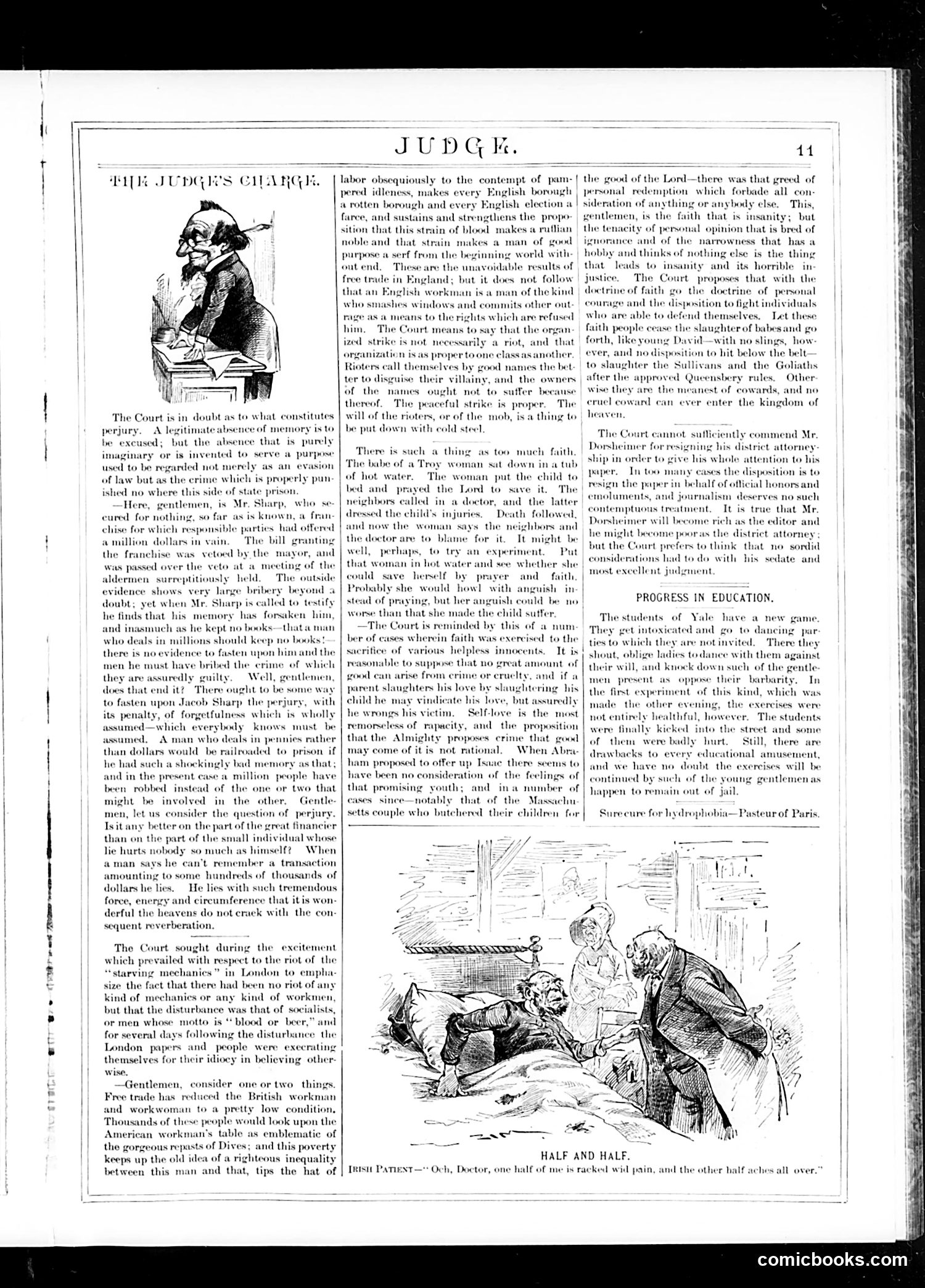
This page contains two distinct satirical pieces: **"The Judges' Charge"** (left): A scathing commentary on the Jacob Sharp perjury trial. Sharp, a wealthy financier, was accused of bribing aldermen regarding a streetcar franchise. The satire attacks the court's acceptance of Sharp's claim that he simply couldn't "remember" transactions involving hundreds of thousands of dollars. The piece argues this selective memory—excused because of his wealth and status—represents a profound injustice: a poor man claiming forgetfulness over petty amounts would be imprisoned, yet the millionaire escapes consequences. The cartoon mocks the absurdity that a financier "keeps no books" and thus leaves no evidence to prosecute. **"Half and Half"** (bottom): A medical illustration satirizing class disparities in healthcare, showing a poor patient suffering while wealthy patients receive better treatment. The page criticizes wealth-based inequality in both law and society, a common Progressive Era Judge theme. The Sharp case appears to be a real historical scandal about Tammany Hall corruption in New York.
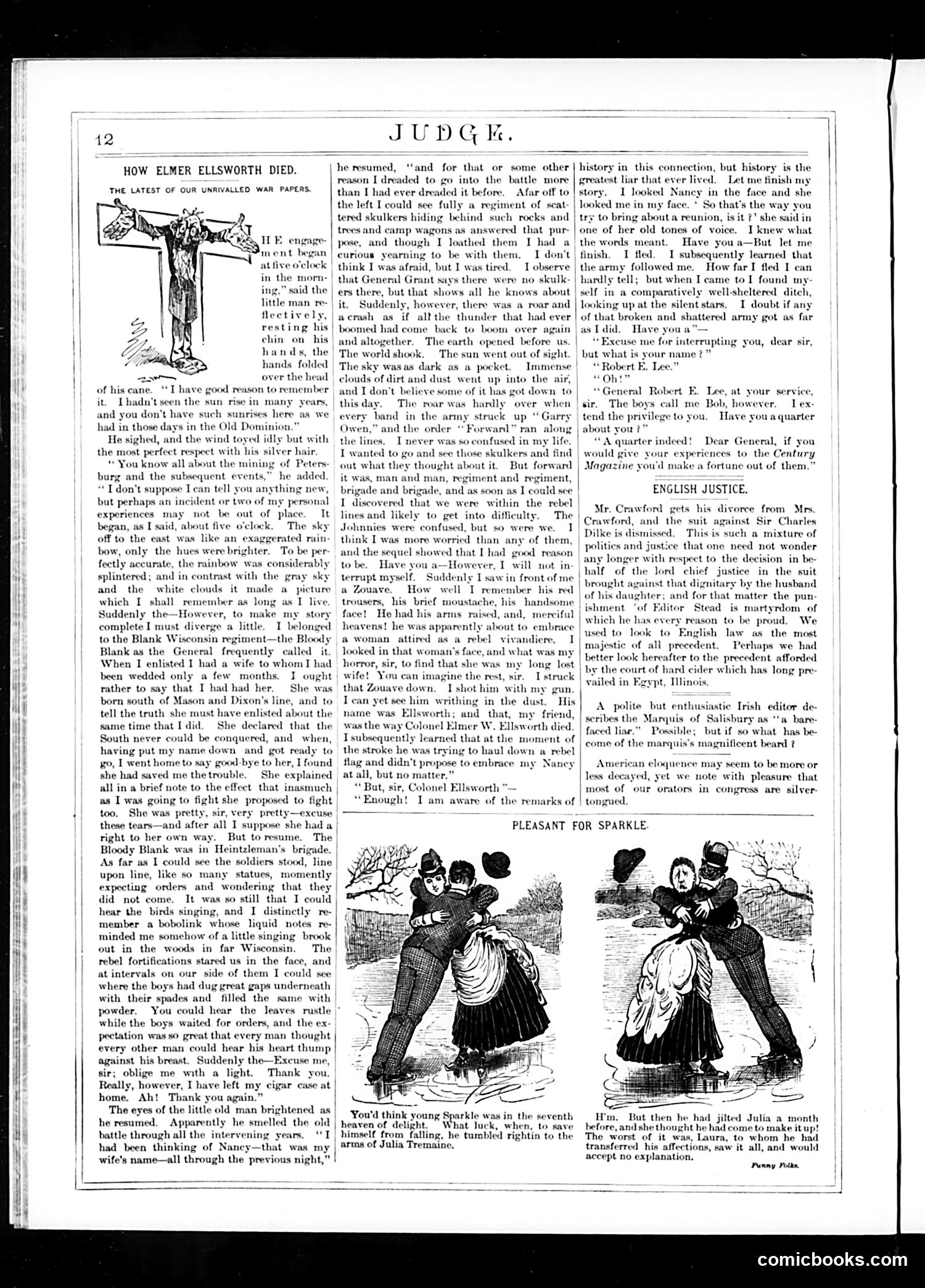
This page from *Judge* magazine features a Civil War narrative titled "How Elmer Ellsworth Died," presented as a first-person veteran's account. The text appears to be a lengthy anecdote about the speaker's military experience, likely referencing **Colonel Elmer Ellsworth**, a famous Union officer killed early in the Civil War (1861). The satire appears to mock verbose war narratives and unreliable narrators—the old man constantly digresses, loses his train of thought, and asks for cigars and lights. His rambling, self-important recollection of battle (mentioning General Grant and specific regiments) satirizes how Civil War veterans embellished or dramatized their experiences for audiences. The lower section, "PLEASANT FOR SPARKLE," contains an illustrated joke about romantic complications, likely satirizing courtship customs. The overall point: *Judge* ridicules both inflated war stories and the cultural obsession with them.
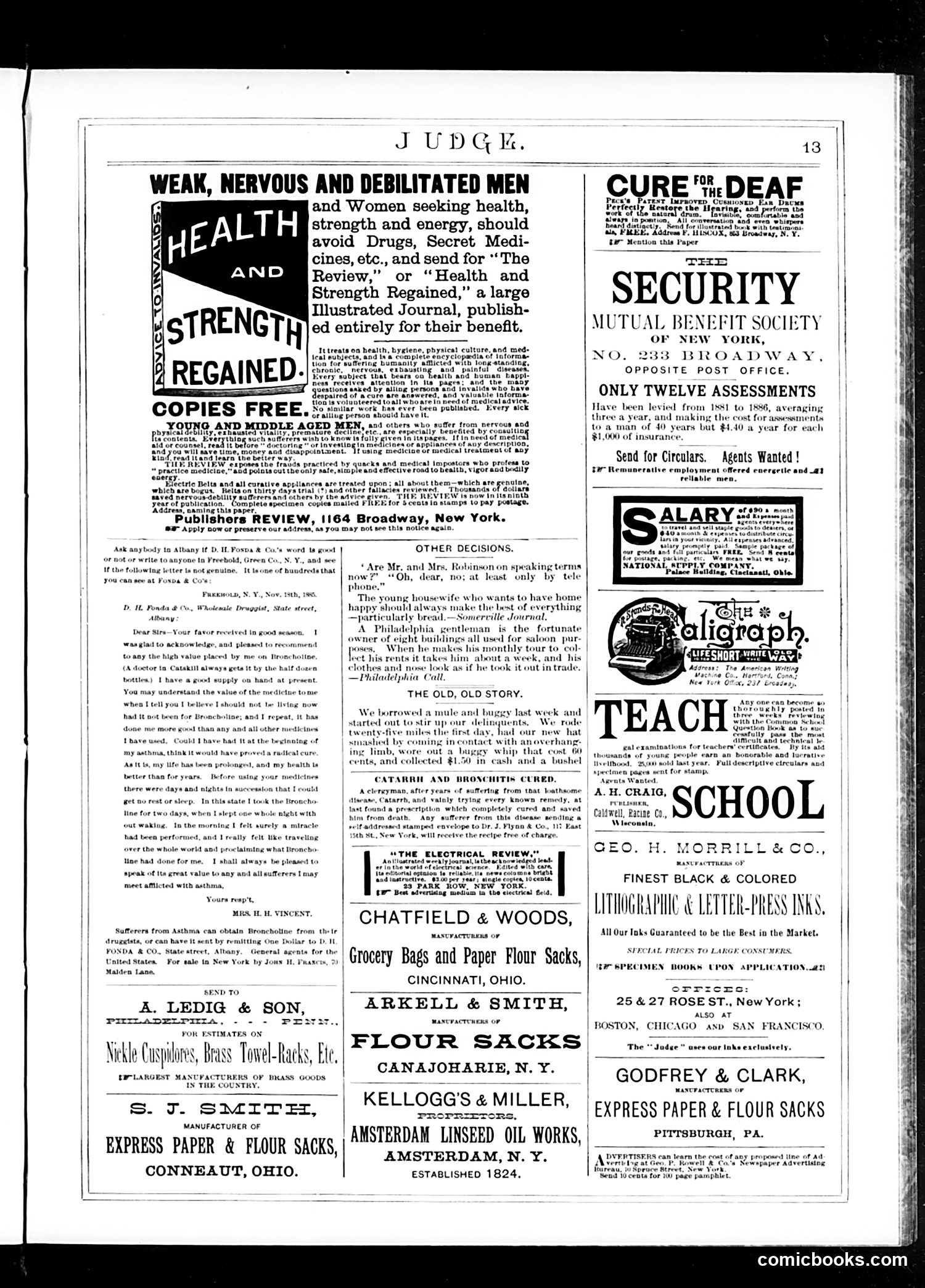
This page is primarily advertisements and testimonials, not political cartoons. It's typical Judge magazine filler from what appears to be the 1880s-1890s. The content reflects period health anxieties: ads target "weak, nervous and debilitated men" with medical "journals," electric belts, and patent remedies—common scams targeting male sexual dysfunction (then called "nervous debility"). One testimonial claims a clergy member cured asthma with a mysterious recipe from "Dr. J. Flynn." The "Old, Old Story" section mocks people who claim miraculous cures after using products—satirizing gullible consumers and fraudulent health claims endemic to the era. The remaining content is straightforward business advertising: paper sack manufacturers, printing companies, insurance societies, and office supplies. No political figures or satirical cartoons are visible here; the page mocks pseudoscientific medicine rather than politics.
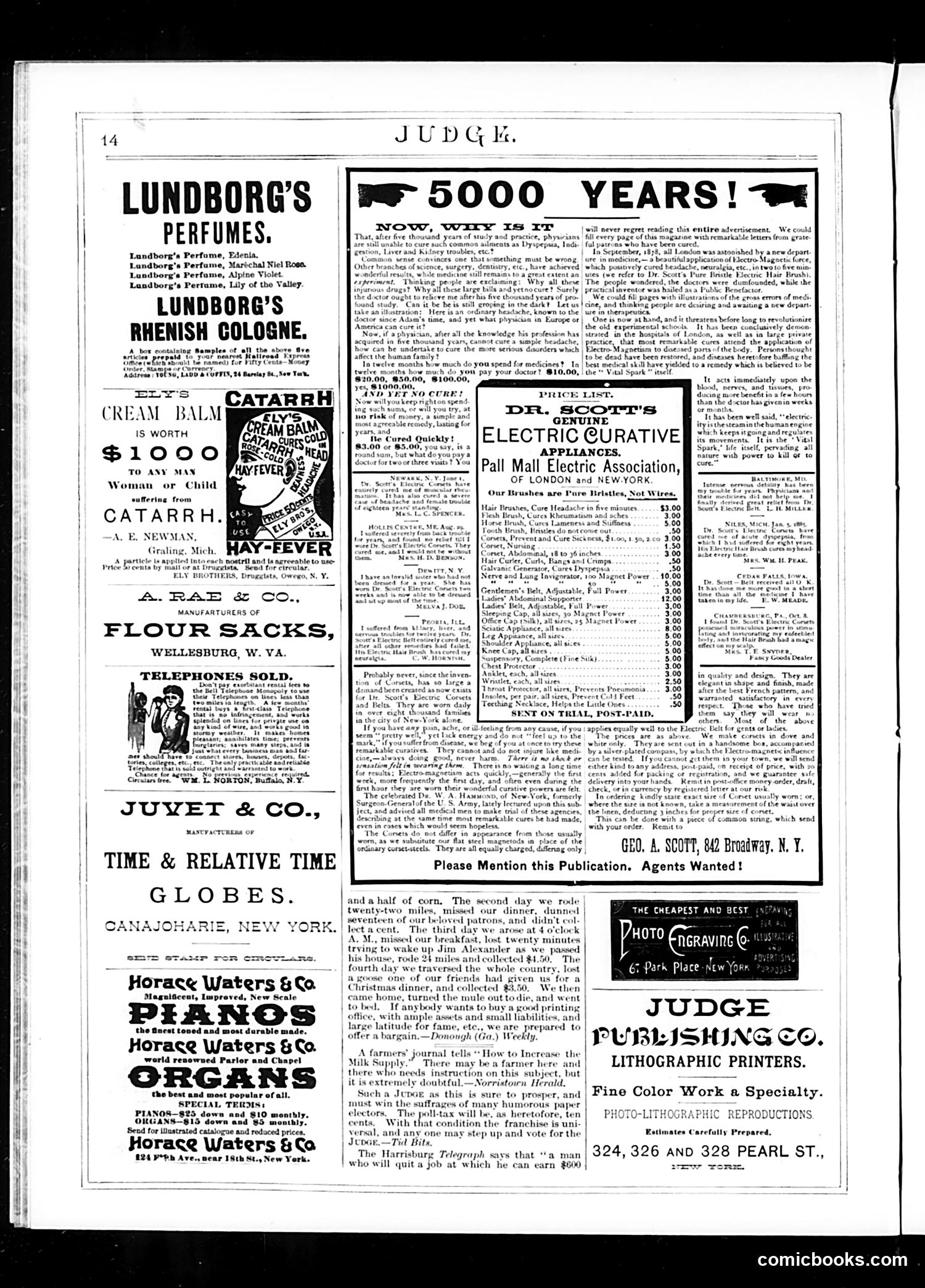
This page is primarily **advertising**, not political satire. It contains multiple product advertisements typical of late 19th-century American magazines. The dominant feature is a large advertisement for **Dr. Scott's Genuine Electric Curative Appliances** from London and New York. This represents a common medical fraud of the era: pseudo-scientific "electro-magnetic" devices claiming to cure various ailments including catarrh, hair loss, and general pain. The ad uses pseudo-intellectual reasoning ("after 5000 years of experiment") and testimonials to convince readers that electricity could heal diseases. These were widespread quack remedies that exploited public fascination with electricity. The page also advertises legitimate products (Lundborg's perfumes, pianos, organs) and services (telephone sales, lithographic printing). **For modern readers:** This illustrates how 19th-century consumers were marketed to with pseudoscientific claims, predating modern medical regulation and FDA oversight.
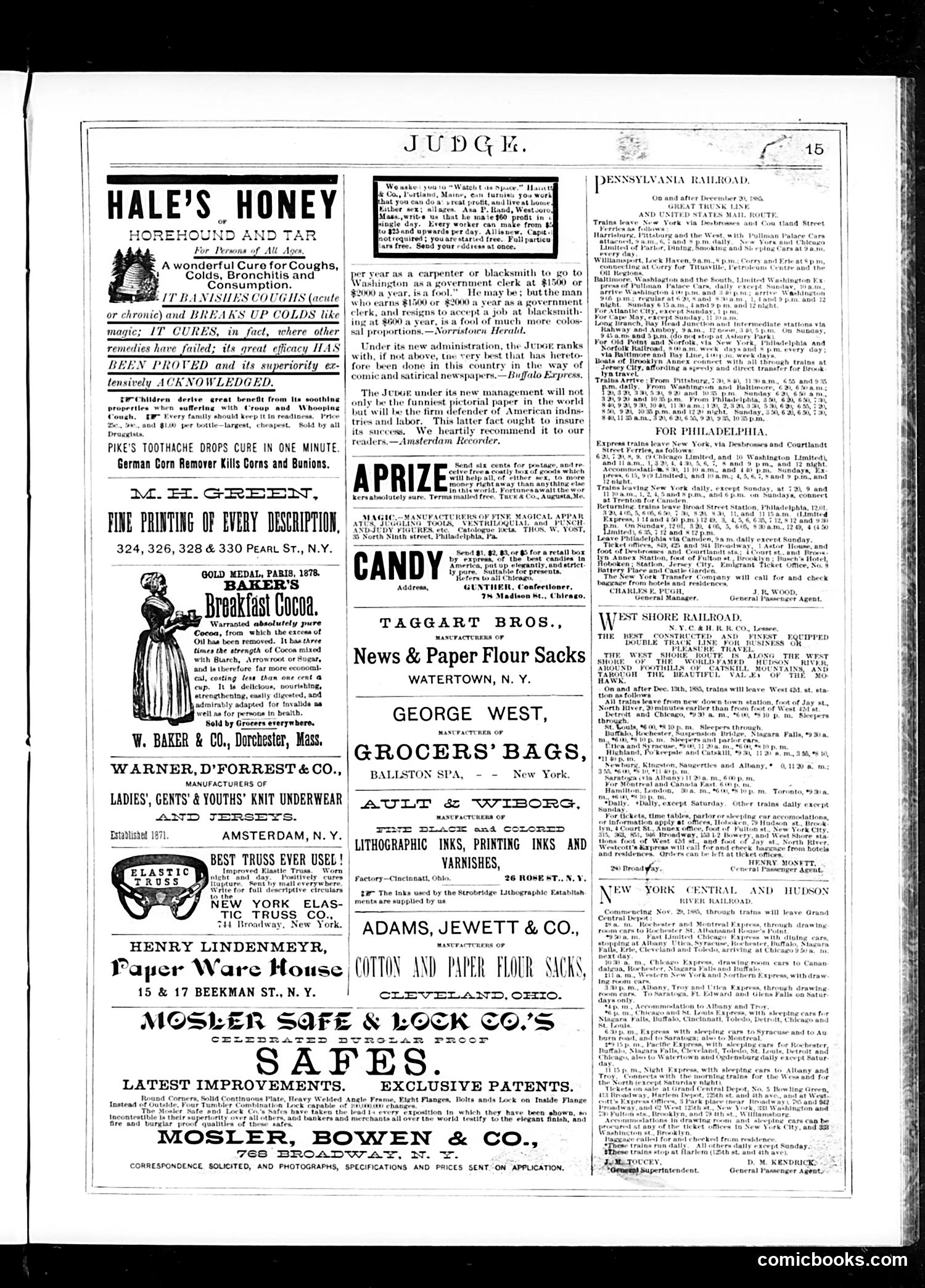
This is primarily an **advertising page** from Judge magazine, with no discernible political cartoons or satirical content visible in the image. The page consists almost entirely of **commercial advertisements** for late 19th-century products and services, including: - Patent medicines (Hale's Honey for coughs, Pike's Toothache Drops) - Food products (Baker's Cocoa, Breakfast Cocoa) - Industrial goods (safes, trusses, printing inks, flour sacks) - Railroad schedules (Pennsylvania Railroad, West Shore Railroad, New York Central) - Clothing manufacturers and other businesses The advertisements use period-typical marketing language emphasizing miraculous cures and superiority. There is one brief mention that Judge itself is "the funniest pictorial paper in the world," but no actual cartoon content is visible on this particular page. This appears to be a back or interior page dedicated to revenue-generating advertisements rather than editorial content.
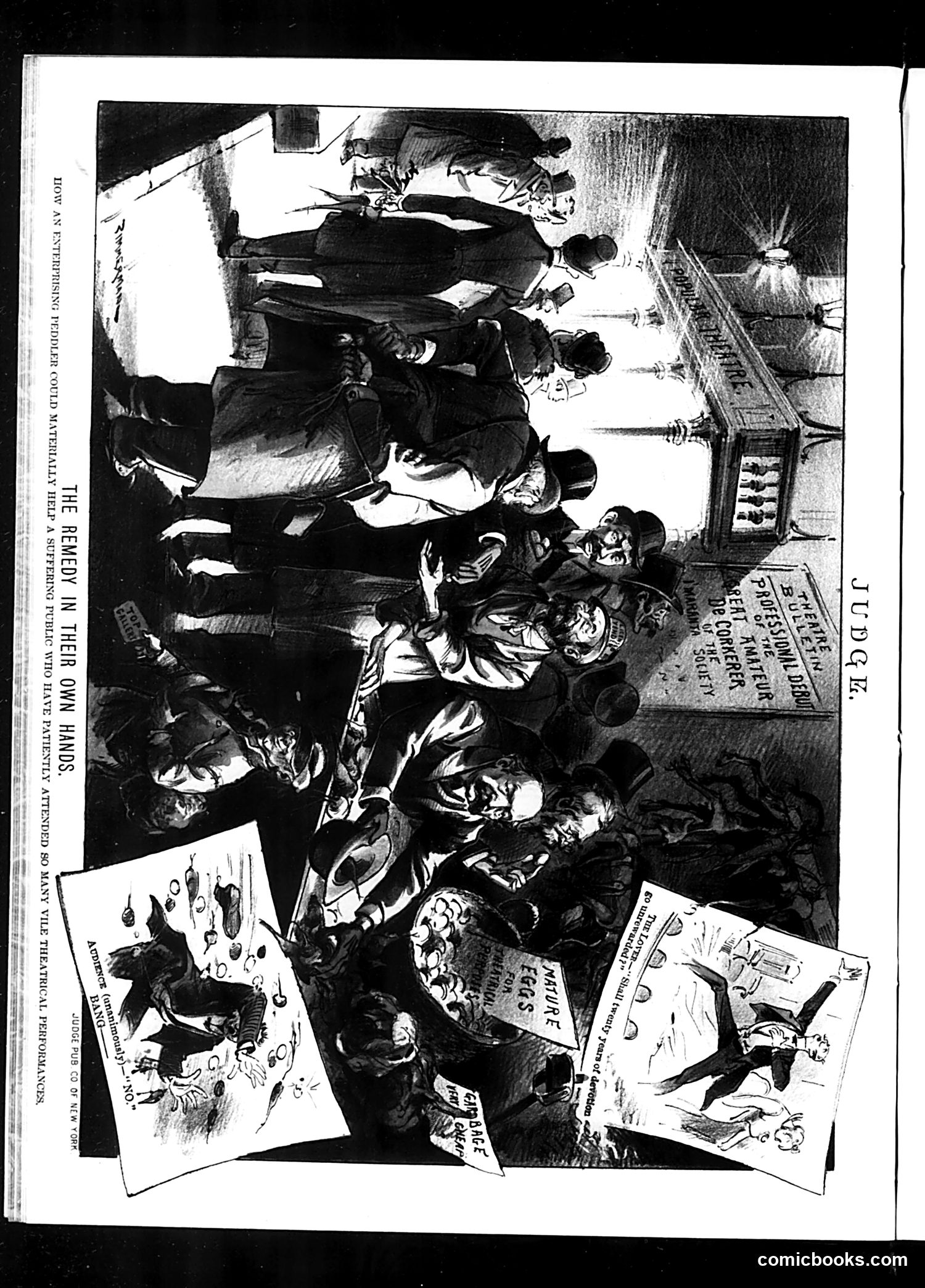
This page appears to show political cartoons in Judge magazine's satirical style. The visible OCR text reads "THE REMEDY IN THEIR OWN HANDS," suggesting commentary on citizens' power to effect change. The image quality and rotation make specific identification of figures and details difficult. However, the layout shows multiple cartoon panels with dramatic scenes featuring groups of people, suggesting social or political commentary typical of Judge's satirical approach. Without clearer visibility of individual captions, specific character identifications, or publication date, I cannot reliably identify which political figures or events are referenced. The overall composition suggests commentary on public action or democratic participation, but the specific historical context remains unclear from this reproduction.