
Judge, 1886-02-27 · page 4 of 16
Judge — February 27, 1886 — page 4: what you’re looking at
What you’re looking at
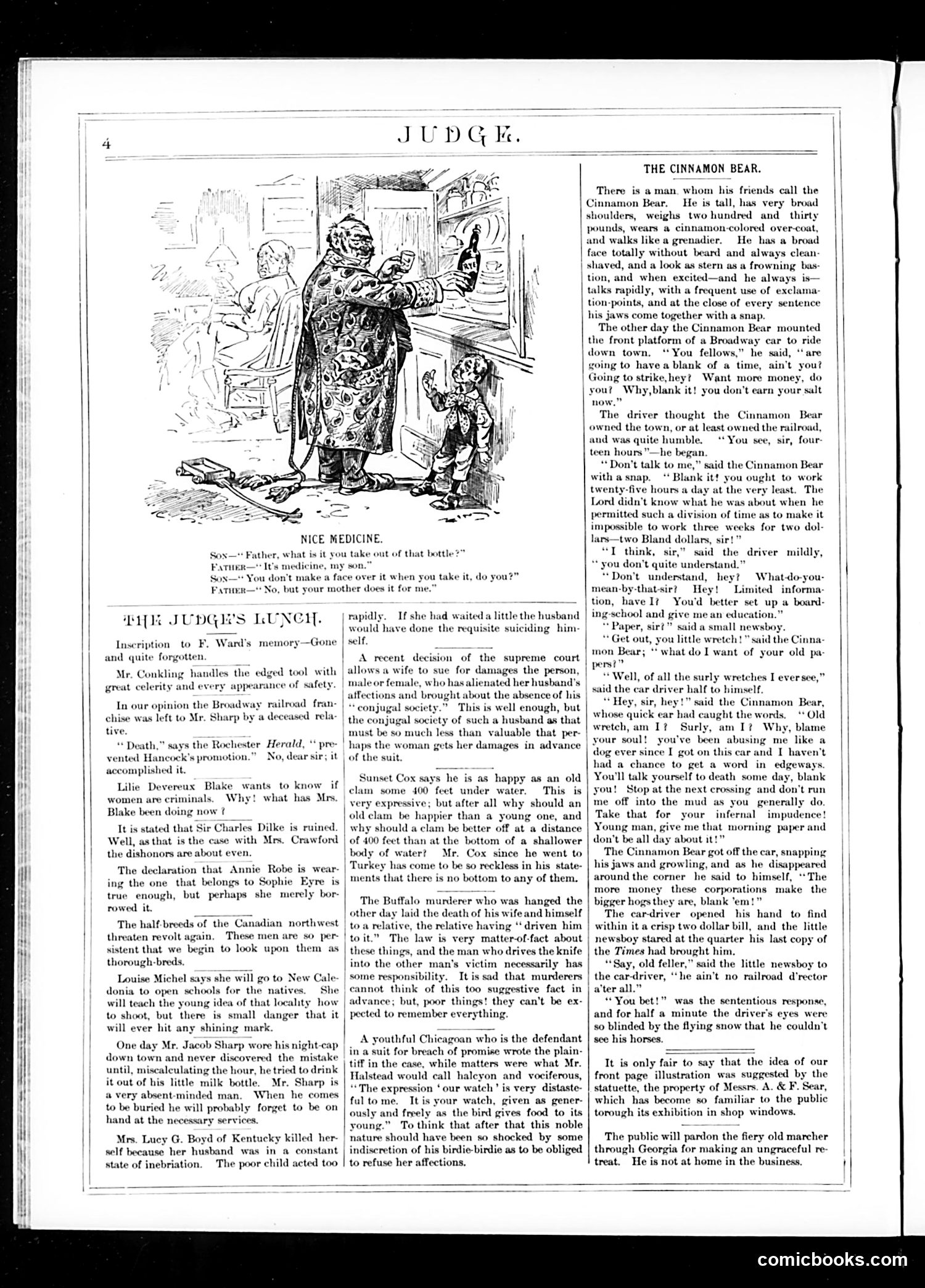
This page from Judge contains several short satirical items typical of 1880s American humor: **"Nice Medicine"** cartoon shows a father giving his son medicine the boy refuses—the joke being the mother takes it instead, implying she drinks for medicinal purposes (alcohol). **"The Judge's Lunch"** section includes brief gossip-style jabs at public figures: - References to Roscoe Conkling (political figure) and General Hancock - Mocking Sir Charles Dilke's scandal involving Mrs. Crawford - Jokes about Canadian half-breeds, Louise Michel, and politician "Sunset Cox" **"The Cinnamon Bear"** article (right column) appears to be a longer satirical story about a tall, broad-shouldered man known by that nickname, depicting his interactions with a Broadway streetcar driver in humorous dialogue about wages and working hours. The humor relies on contemporary scandal knowledge and political gossip most modern readers would miss without historical context.
📄 Transcribed text from this page (OCR, searchable)
Machine-transcribed from the original scan — historical spelling and the odd misread are preserved.
NICE MEDICINE. Fatuer—" It’s medicine, “You don't mak ut of that bottle 7” my son.” a fa ver it when ake it, do you? Xo, but your mother does it for me.” PPK JUDGI’S bUNE I. Inscription to F, Ward's memory—Gone and quite forgotten Mr. Conkling handles the e great celerity and every appeara dd tool with nee of safety. In our opinion the Broadway railroad. fran- chise was left to Mr. tive. “ Death,” vented Hancock's promotion.” accomplished it, Lilie Devereux Bla! women are criminals. Blake been doing now ? arp by a deceased rela. says the Rochester Herald, pre- No, dear sir; it e wants to know if Why! what has Mrs. It is stated that Sir Charles Dilke is ruined. Well, as that is the case with Mrs, Crawford the dishonors are about even. The declaration that Annie Robe is wear- ing the one that belongs to Sophie Eyre true enough, but perhaps she merely bor- rowed it. The half-breeds of the Canadian northwest | threaten revolt again, These men are so per- sistent that we begin to look upon them as thorough-breds. is Louise Michel says she will go to New Cale. donia to open schools for the natives. She will teach the young idea of that | ity how to shoot, but there is small danger that it will ever hit any shining mark. arp wore his night-cap r discovered the mi: jating the hour, he tried todrink it out of his little milk bottle. Mr. Sharp is ave bsent-minded man. When he comes to be buried he will probably forget to be on hand at the necessary services. Mrs. Lucy G. Boyd of Kentucky killed her- self because her husband was in a constant state of inebriation. ‘The poor child acted too rapidly. If she had waited a little the husband would have done the requisite suiciding him self. A recent decision of the supreme court | allows a wife to sue for damages the person, male or female, who has alienated her husband's aifections and brought about the absence of his * conjugal socie This is well enough, but the conjugal society of such a husband as that must be so much less than valuable that per- haps the woman gets her damages in advance of the suit. Sunset Cox says he is as happy as an old clam some 400 feet under water. This is ry expressive; but after all why should an J oldclam be happier than a young one, and why should a clam be better off at a distance | of 400 feet than at the bottom of a shallower | body of water? Mr. Cox since he went to | Turkey has come to be so reckless in his state- | ments that there is no bottom to any of them. Buffalo murderer who was hanged the laid the death of his wife toa rela | to it.” The law is very matter-of-fact about these things, and the man who drives the knife | into the other man’s victim necessarily has some responsibility. It is sad that murderers cannot think of this too suggestive fact in advance; but, poor things! they can't be ex- pected to remember everything. A youthful Chicagoan who is the defendant in a suit for breach of promise wrote the plain- tiff in the case, while matters were what Mr. Halstead would call haleyon and vociferous, “The expression ‘our watch’ is very distaste- fultome. It is your watch, given as gener- as the bird gives food to its To think that after that this noble ture should have been so shocked by some indiscretion of his birdie-birdie as to be obliged to refuse her affections. and himself | ve, the relative having “driven him | THE CI CINNAMON BEAR. There is aman. whom his friends call the Cinnamon Bear, He is tall, has very broad shoulders, weighs two hundred and thirty pounds, wears cinnamon-colored over-coat, and walks like a grenadier. He has a broad e totally without be and alw: clean- | shaved, and a look as stern as a frowning bas- tion, and when excited—and he always is— talks rapidly, with a frequent use of exclama- tion-points, and at the close of every sentence his jaws come together with a snap. The other day the Cinnamon Bear mounted the front platform of a Broadway car to ride down town. ‘You fellows,” he said, “are going to have a blank of a time, ain't you? Going to strike,hey? Want more money, do you?’ Why,blank it! you don’t earn your salt now.” The driver thought the owned the town, or at least o and was quite humble. teen hours”—he began “Don't talk to me,” said the Cinnamon B with asnap. ‘‘ Blank it! you ought to work twenty-five hours a day at the very least. The Lord didn’t know what he v bout when he permitted such a division of time as to make it impossible to work three weeks for two dol- lars—two Bland dollars, sir! “T think, sir,” said the you don’t quite understand.” “Don't understand, hi What-do-you- mean-by-that-sir? Hey Limited informa- tion, hi It You'd better set up a board- ing-school and give me an education.” * Paper, sir?” said a small newsboy ** Get out, you little wretch!” said the Cinna- mon Be what do I want of your old pa perst” Cinnamon Bear ned the railroad, “You see, sir, four driver mildly, “Well, of all the surly wretches I ever see,” said the car driver half to himself. "said the Cinnamon Bear, “Old Vhy, blame ver since I got on this had a chance to get a word in edgeways. You'll talk yourself to death some day, blank you! Stop at the next crossing and don’t run me off into the mud as you generally do. Take that for your infernal ! impudence! | Young man, give me that morning paper and don’t be all da: bout it!” The Cinnamon Bear got off the car, snapping his jaws and growling, and as he disappeared around the corner he said to himself, ‘The more money these corporations make the bigger hogs they are, blank em!” The car-driver opened his hand to find within it a crisp two dollar bill, and the little newsboy stared at the quarter his last copy of the Times had brought him. “Say, old feller,” said the little newsboy to the car-driver, ‘he ain't no railroad d'rector a'ter all.” “You bet!” was the sententious response, and for half a minute the driver's eyes were so blinded by the flying snow that he couldn't see his horses. It is only fair to say that the idea of our front page illustration was suggested by the statuette, the property of Messrs. A. & F. Se: which has become so familiar to the public torough its exhibition in shop windows. The public will pardon the fiery old marcher through Georgia for making an ungraceful re- treat. He is not at home in the business. comicbooks.com