
Judge, 1886-02-27 · page 12 of 16
Judge — February 27, 1886 — page 12: what you’re looking at
What you’re looking at
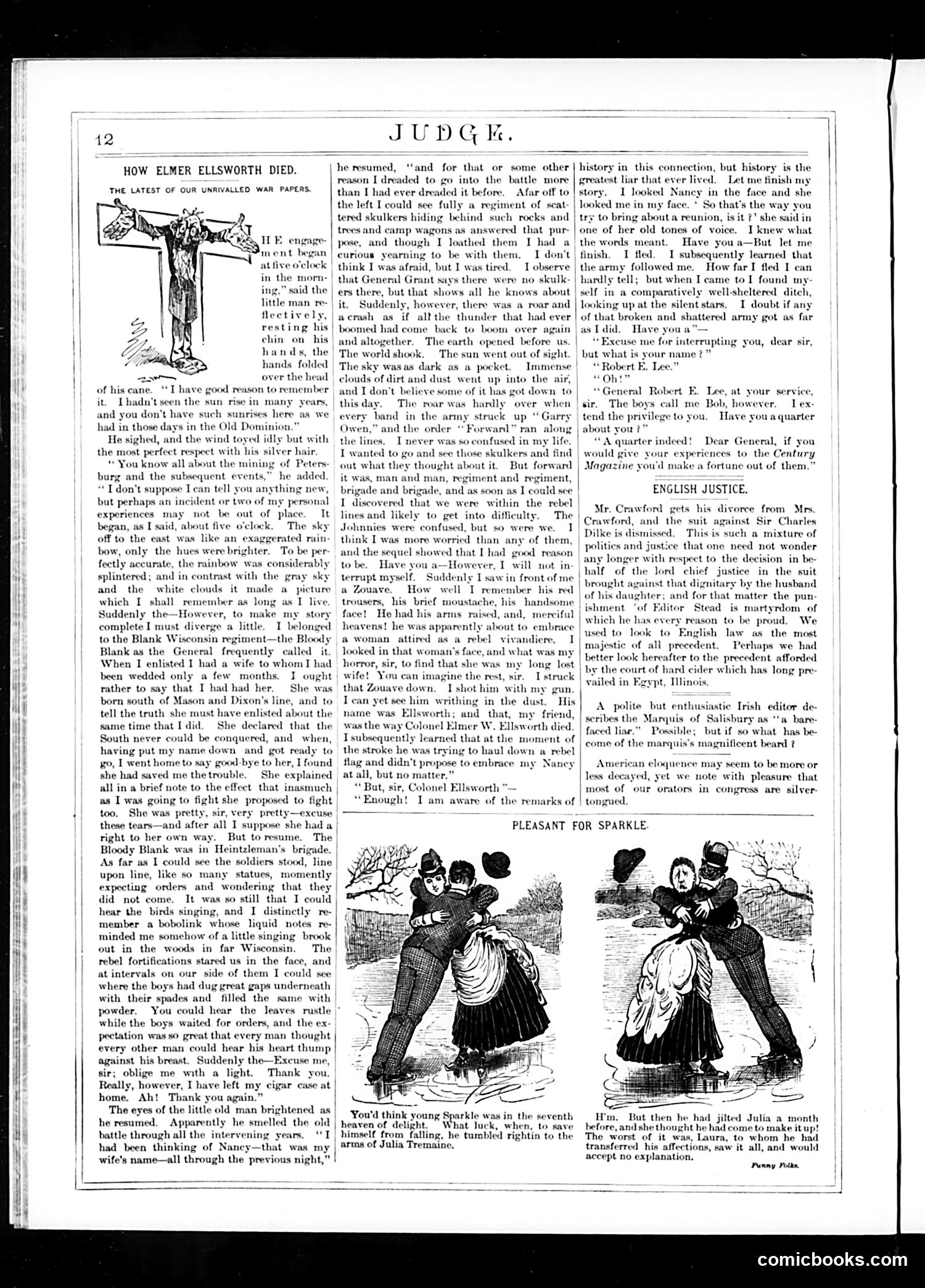
This page from *Judge* magazine features a Civil War narrative titled "How Elmer Ellsworth Died," presented as a first-person veteran's account. The text appears to be a lengthy anecdote about the speaker's military experience, likely referencing **Colonel Elmer Ellsworth**, a famous Union officer killed early in the Civil War (1861). The satire appears to mock verbose war narratives and unreliable narrators—the old man constantly digresses, loses his train of thought, and asks for cigars and lights. His rambling, self-important recollection of battle (mentioning General Grant and specific regiments) satirizes how Civil War veterans embellished or dramatized their experiences for audiences. The lower section, "PLEASANT FOR SPARKLE," contains an illustrated joke about romantic complications, likely satirizing courtship customs. The overall point: *Judge* ridicules both inflated war stories and the cultural obsession with them.
📄 Transcribed text from this page (OCR, searchable)
Machine-transcribed from the original scan — historical spelling and the odd misread are preserved.
12 HOW ELMER ELLSWORTH DIED. THE LATEST OF OUR UNRIVALLED WAR PAPERS. | tered skul | pose, atfive¢ in the morn- little man re- flectively, resting his| chin on his hands, the hands folded over the head of his cane. ‘I have good reason to remember it. Ihadn'tseen the sun rise in man, and you don’t have such sunrises here had in those days in the Old Don He sighed, and the wind toyed idly but with the most perfect respect with his silver “ You know all about the min burg and the subsequent event ded. T don’t suppose Ican tell you anything new, but perhaps an incident or two of my personal experiences not be out of ph It began, as I : sky off to the years, swe ms The splintered; and in contrast with t and the white clouds it which I shall remember as long Suddenly the—However, to. maki complete I must diverg to the Blank Wisconsin regiment—the Bloody Blank as the General frequently called it When I enlisted I had a wife to whomI had been wedded only a few months, I ought rather to sa I had had her. She was born south of Mason and Dixon's line, and to tell the truth she must have enlisted about the same time that I did. She declared that the South never could be conqu and when, having put my name down and ‘got ready to go, I went home to say good-bye to her, I found she had saved me thetrouble. She explained all in a brief note to the effect that inasmuch as I was going to fight she proposed to fight he was pretty, sir, very pretty—excuse ars—and after all I suppose she had a right to her own But to resume. The Bloody Blank was in Heintzleman’s brigade. As far as I could see the soldiers stood, line upon line, like so many statues, momently expecting orders and wondering that they did not come. It was so still that I could hear the birds singing, and I distinctly re- member a bobolink whose liquid notes re- minded me somehow of a little singing brook out in the woods in far Wisconsin. The rebel fortifications stared us in the face, and at intervals on our side of them I could see where the boys had dug great gaps underneath with their spades and filled the same with powder. You could hear the leay while the boys waited for orders, and the ex- pectation so great that every man thought every other man could hear his heart thump against his breast. Suddenly the—Excuse me, sir; oblige me with light. Thank you. Really, however, I have left my cigar case at | home. Ah! Thank you again.” | The eyes of the little old man brightened as he resumed. Apparently he smelled the old battle through all the interv rs. 1 t was my made a picture as I live JUDGE. “and for that or some other led to go into the battle more er dreaded it before. the left I could see fully a regiment of scat hiding behind such rocks and he resumed, re: trees and camp wagons and though I loathed them curious yearning to be with them, I don't think I was afraid, but I was tired. I observe that General Grant says there were no skulk- ers there, but that shows all he knows about it. Suddenly, however, there was a roar and acrash if alfthe thunder that had ever boomed come back to boom over again and altogether. Th th opened before us. The world shook. The sun went out of sight. wasas dark as a pocket. Immense clouds of dirt and dust went up into the air, and I don't believe some of it has wh to, thisday, The roar was hardly ¢ when band in the army struck up ‘Garry Owen,” and the order * Forward” ran ony the lines. I never was so confused in my lif I wanted to go and see those skulkers and find out what they thought about it. But forward it was, man and man, regiment and brigade and brigade, and as soon : 1 discovered that we lines and like Johnnies w think I w Thad a as every T could see were within the rebel : to get into difficulty. The confused, but so were we. I s more worried than any of them, ad the sequel showed that Thad good reason tobe. Have you a—However, I will not in terrupt myself a Zouave. How trousers, his brief mc He had his ens! he was MM “ 1 remember his red stache, his handson nd, merciful embrace a rebel vivandiere, n’s face, and what was my | was my long lost imagine the rest, sir, I struck that Zouavedown, Ishothim with my gun. Ican yet see him writhing in the dust. His name was Ellsworth; and that, my friend, was the wa, Elmer W. Ellsworth died I subsequently learned that at the moment of the stroke he was trying to haul down a rebel flag and didn’t propose to embrace my Naney 1, but no matter,” But, sir, Colonel Ellsworth * he a wor looked in horror, sir, t¢ Afar off to | | looked me in my face. aswered that pur | one of her old tones of voi | Maga ment, | Suddenly I saw in front of me | T am aware of the séimatkn dt history in this connection, but history is the greatest liar that ever lived. Let me finish my story. I looked Nancy in the face and she So that’s the way you try to bring about a reunion, is it ?’ she said in I knew what the words meant. Have you a—But let me finish. I fled. I subsequently learned that the army followed m How far I fled I can hardly tell; but whe: ‘ame tol found my self in a comparativ -sheltered dite looking up at the silent stars. T doub) but what is your na “Robert E. Le “ont” “General Robert E. sir, The boys call me tend the privilege to you. about you 7” “A quarter in would give at your. servic Lex Have you a quarter however. 1! Dear General, if you periences to the Century oud make a fortune out of them.” your ¢ ENGLISH JUSTICE. Mr. Crawford gets his divorce ford, and the suit s dismissed. from Mrs. inst Sir Charles This is such a mixture of ics and justice that one need not wonder y longer with respect to the decision. in be- f of the lord chief justice in the suit brought against that dignitary by the husband of his daughter; and for that er the pun ishment ‘of Editor Stead is martyrdom of which he has every reason to be proud. We used to look to English law as the most | majestic of all precedent. Perhaps we had better look hereafter to the precedent afforded by the court of hard cider which has long pre- vailed in Egypt, Mlinois A polite but enthusiastic Irish editor de- scribes the Marquis of Salisbury as ‘a bare. faced liar.” but if at has be- come of the marquis’s magnificent beard ¢ Possible; Americ ys leas dex n eloquence 1 rem to be more or , yet we note with pleasure that our orators in congress are silver ye most of tongued. PLEASANT FOR SPARKLE rustle * ‘You'd think young Spa “ | heaven of delight. What luck, when, to save himself from falling, he tumbled rightin to the arms of Julia Tremain H'm. But then he had jilted Julia a month before, and she thought he had come to make itup! The t of it was, L to whom he had transferred his affections, saw it all, and would accept no explanation, Panny Potts comicbooks.com