
A complete issue · 16 pages · 1886
Judge — February 13, 1886
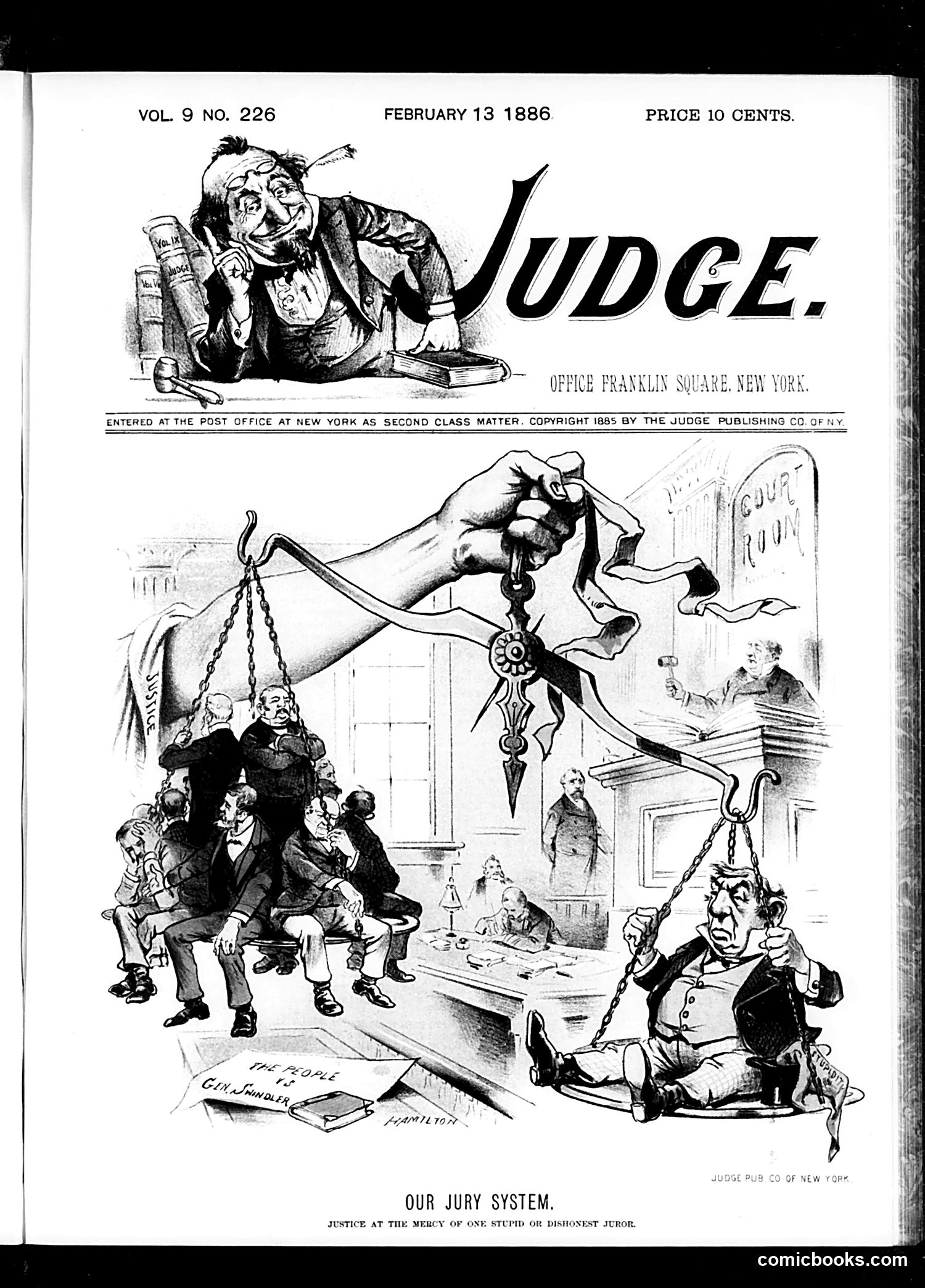
This cartoon satirizes the American jury system as fundamentally flawed. The image depicts a large hand holding a caricatured, apparently drunk or disreputable figure suspended above a courtroom scene. Below, a group of jurors sit together while documents labeled "The People," "Gin & Whiskey," and "Hamilton" lie scattered on the floor. The satire suggests that justice depends on the whim of a single "stupid or dishonest juror" (as the caption states), with the implication that jurors—depicted as disreputable or intoxicated—cannot be trusted to deliver fair verdicts. The scattered documents suggest the case materials are being ignored. The cartoon criticizes both jury competence and the system's vulnerability to bias or corruption during the Gilded Age.
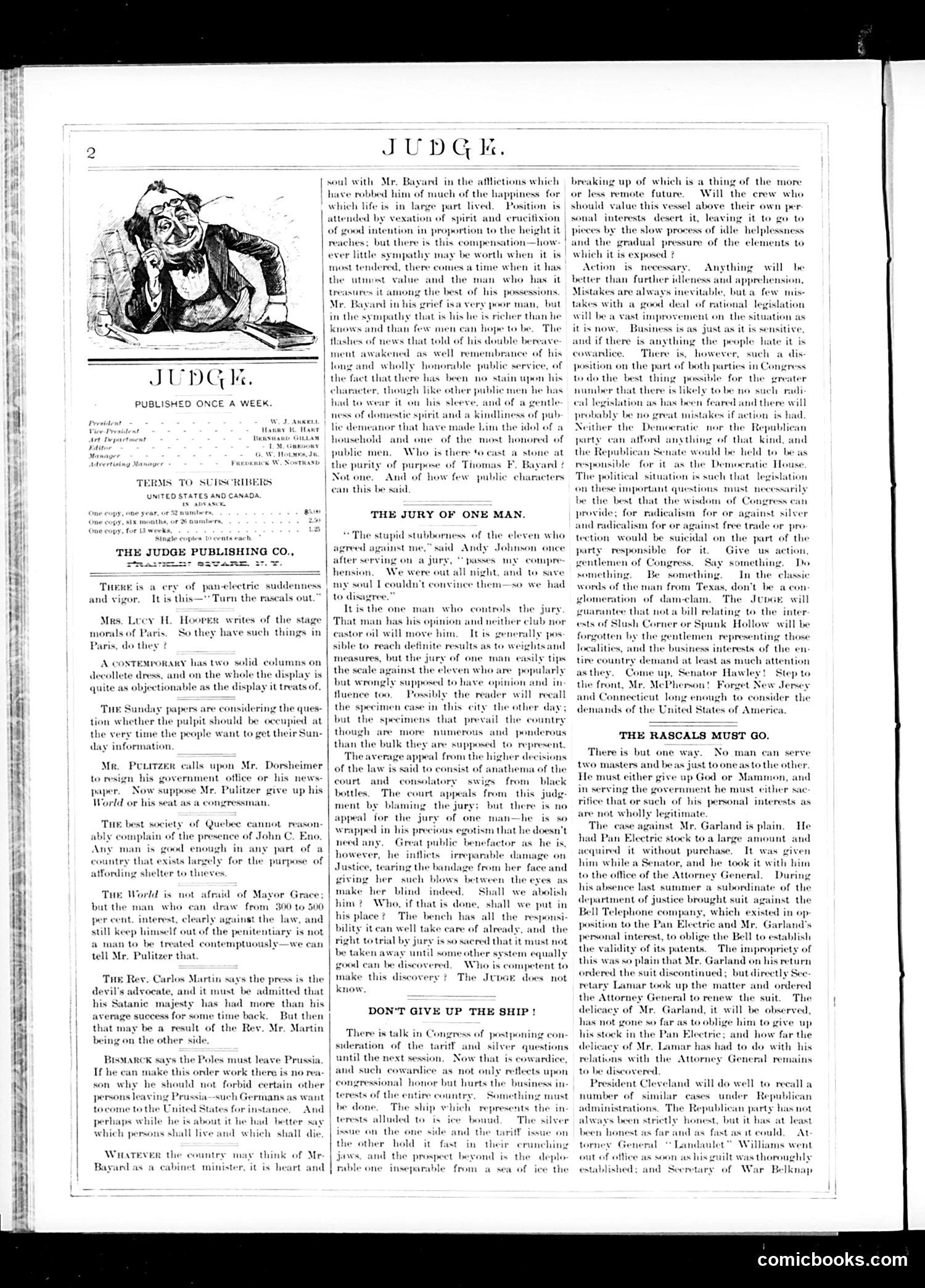
The main illustration depicts a rotund, disheveled figure labeled "JUDGE" - the magazine's mascot representing satirical commentary itself. The figure appears to be in a state of exhaustion or distress. The text discusses "The Jury of One Man," critiquing the concentration of power in judicial decisions, and "Don't Give Up the Ship," addressing tariff and silver currency debates in Congress. These appear to be late 19th-century political issues under Republican administration. The satire targets political stalemate: Congress remains deadlocked over economic policy while the nation's interests suffer. Judge advocates for decisive action rather than endless partisan debate over monetary standards and trade protections. The mascot's disheveled appearance visually reinforces the magazine's message—the political system itself is worn down by indecision.
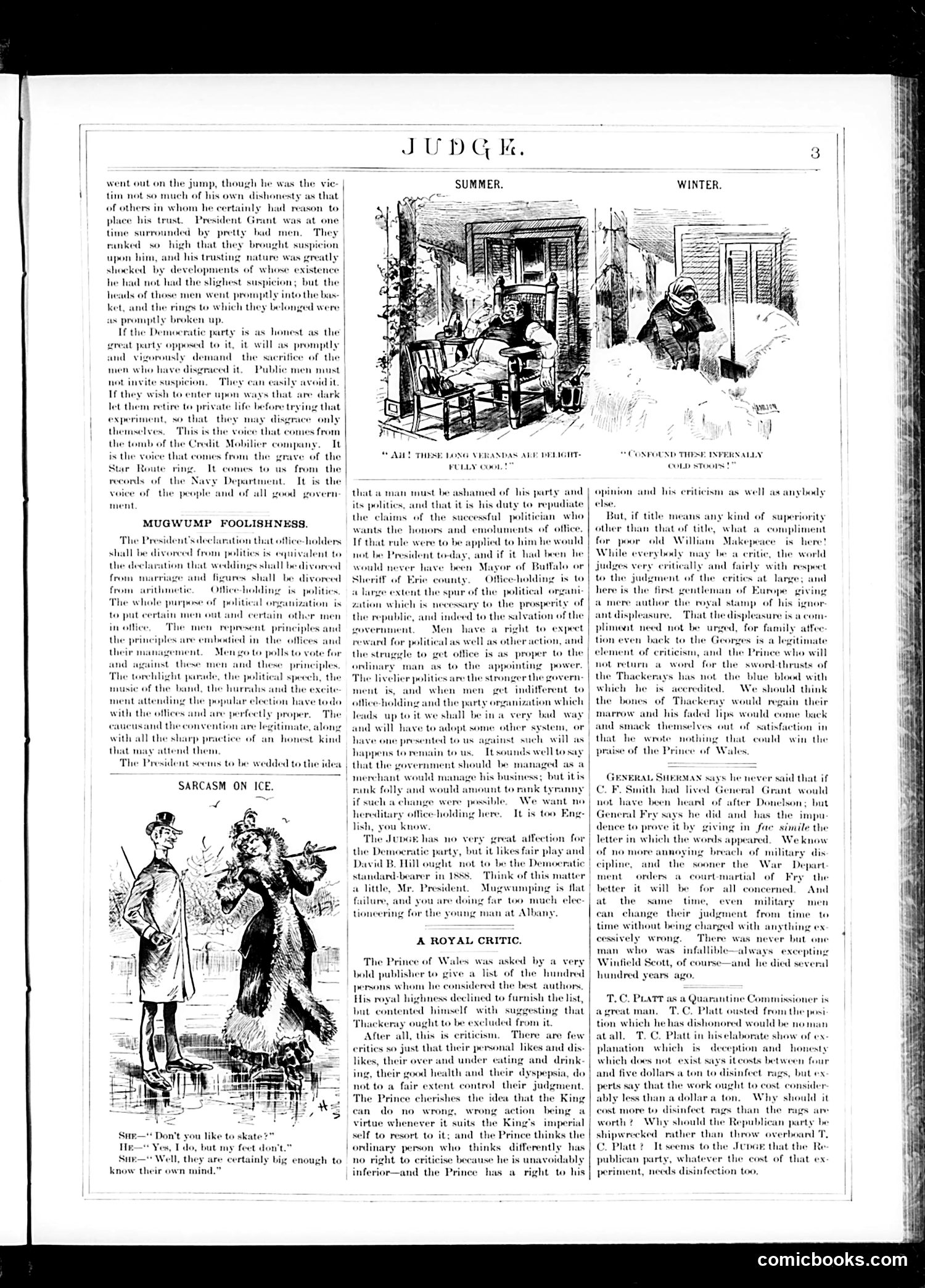
This page contains several distinct satirical pieces criticizing political corruption and hypocrisy in the Gilded Age: **"Mugwump Foolishness"** attacks President Cleveland's claim that office-holders should be divorced from politics. Judge argues this is naive—politics inherently involves patronage and organization. The piece mocks "Mugwumps" (independent reformers) for expecting politicians to act against their own interests. **"Sarcasm on Ice"** (bottom left cartoon) depicts two figures ice-skating, likely criticizing Republican and Democratic parties for their slippery, unprincipled behavior during winter (political "cold"). **"A Royal Critic"** discusses the Prince of Wales's refusal to publicly critique literature, arguing he hides behind royal privilege. The satire suggests aristocratic pretension—that rank grants immunity from fair criticism that ordinary people face. The seasonal illustrations (Summer/Winter) appear decorative rather than satirical. Overall, the page lambastes political corruption, reform hypocrisy, and aristocratic superiority with typical Gilded Age Judge sensibilities.
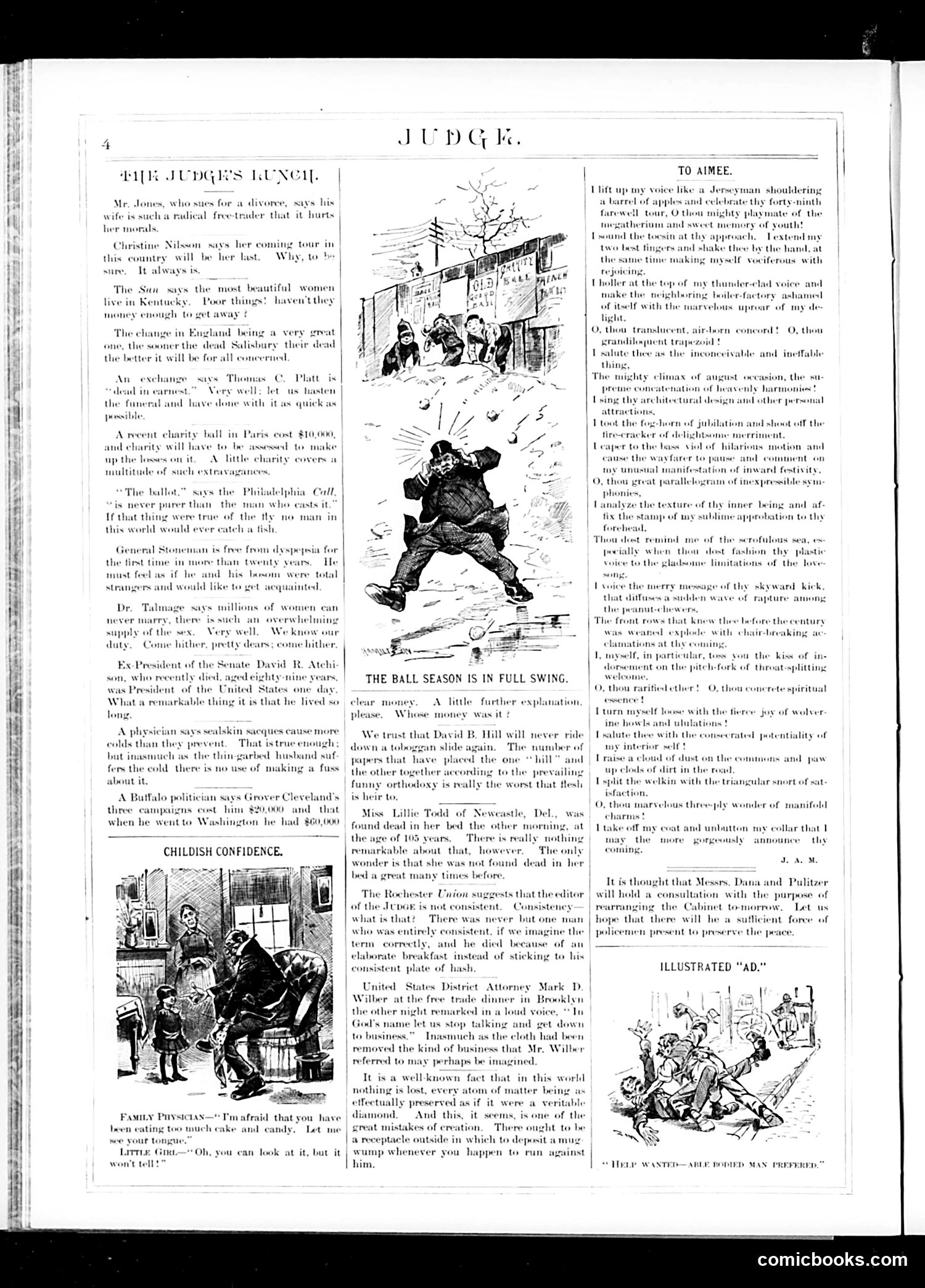
This page from *Judge* contains several brief satirical items mocking public figures and social absurdities of the era: **"The Judge's Lunch"** section includes gossip-style jabs: Christine Nilsson (a Swedish opera singer) touring America one final time; commentary on women's value in Kentucky; and General Stoneman's health improving after years of dyspepsia. **The main cartoons** depict baseball season scenes with humorous captions about rowdy fan behavior. **"To Aimee"** is a mock-reverential poem addressing Aimee Semple McPherson (or similar religious/theatrical figure), deliberately overwrought and absurd, parodying effusive admiration through increasingly ridiculous metaphors ("grandilejuent trapezoid," "concrete spiritual clamor"). **"Childish Confidence"** cartoon depicts what appears to be domestic foolishness—possibly commentary on naive family behavior. The satire targets celebrity culture, political figures' personal lives, and American social pretensions through exaggeration and mockery typical of *Judge*'s editorial approach.
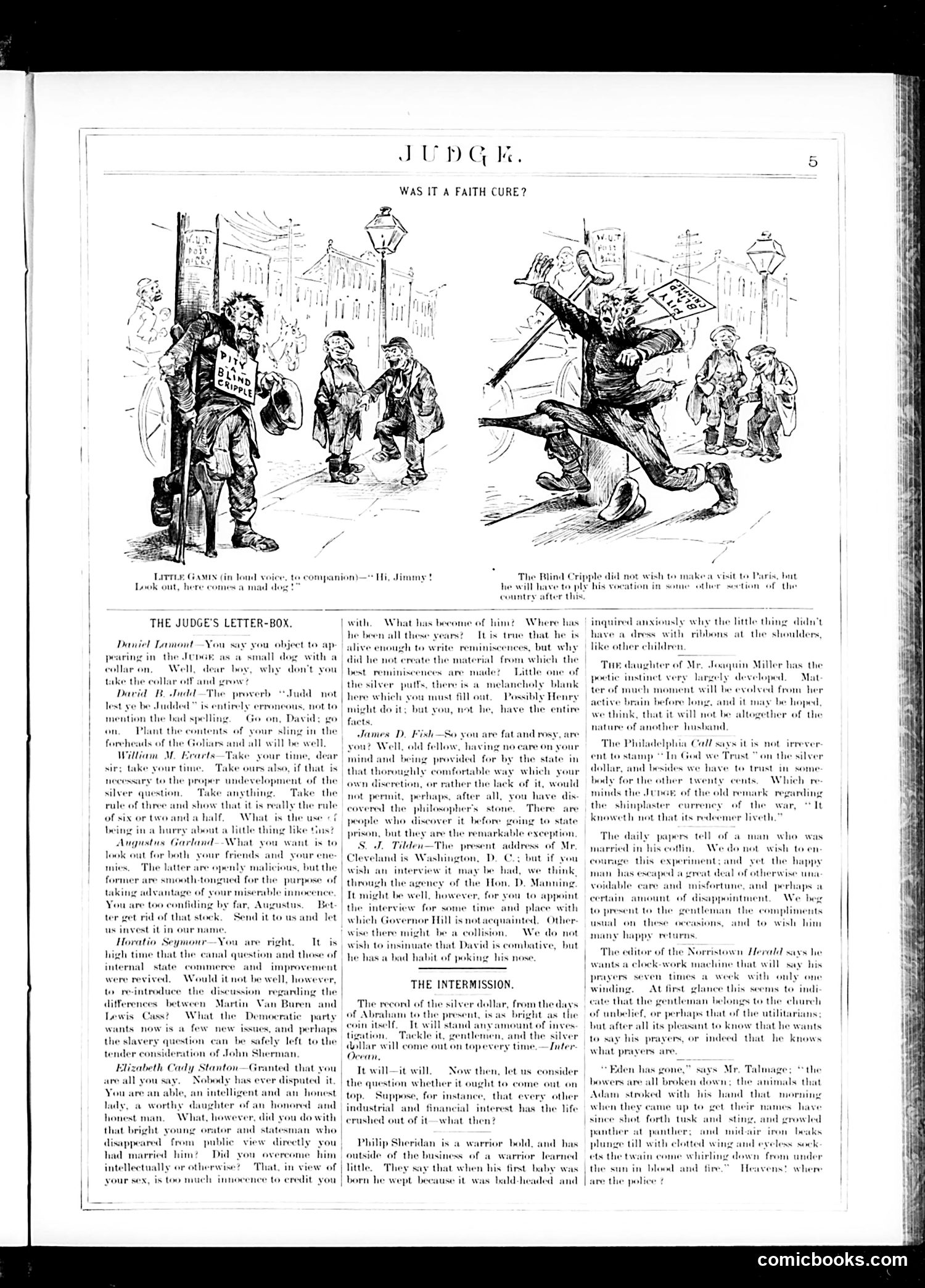
This page from *Judge* magazine contains satirical letters and two cartoons mocking various public figures and issues of the era. **Top cartoons**: "Was It a Faith Cure?" shows street scenes with figures in comedic distress—likely satirizing claims of miraculous healings or faith-based remedies popular at the time. **The "Judge's Letter-Box"**: A humor column where readers submit complaints to which editors respond with jokes. Notable targets include: - **Daniel Lamont** (likely a political figure): mocked for wanting to write reminiscences - **James D. Fish**: criticized for being "fat and lazy" - **Augustus Garland**: warned he's too trusting - **Elizabeth Cady Stanton**: granted her point about women's rights but challenged on personal conduct - **Philip Sheridan** (Civil War general): joked about his baby being bald-headed **The Intermission section** discusses the silver dollar's history from Abraham onward, debating whether it should continue circulating—reflecting 1880s-90s currency debates. The overall tone is light ridicule of politicians, reformers, and public debates of the period.
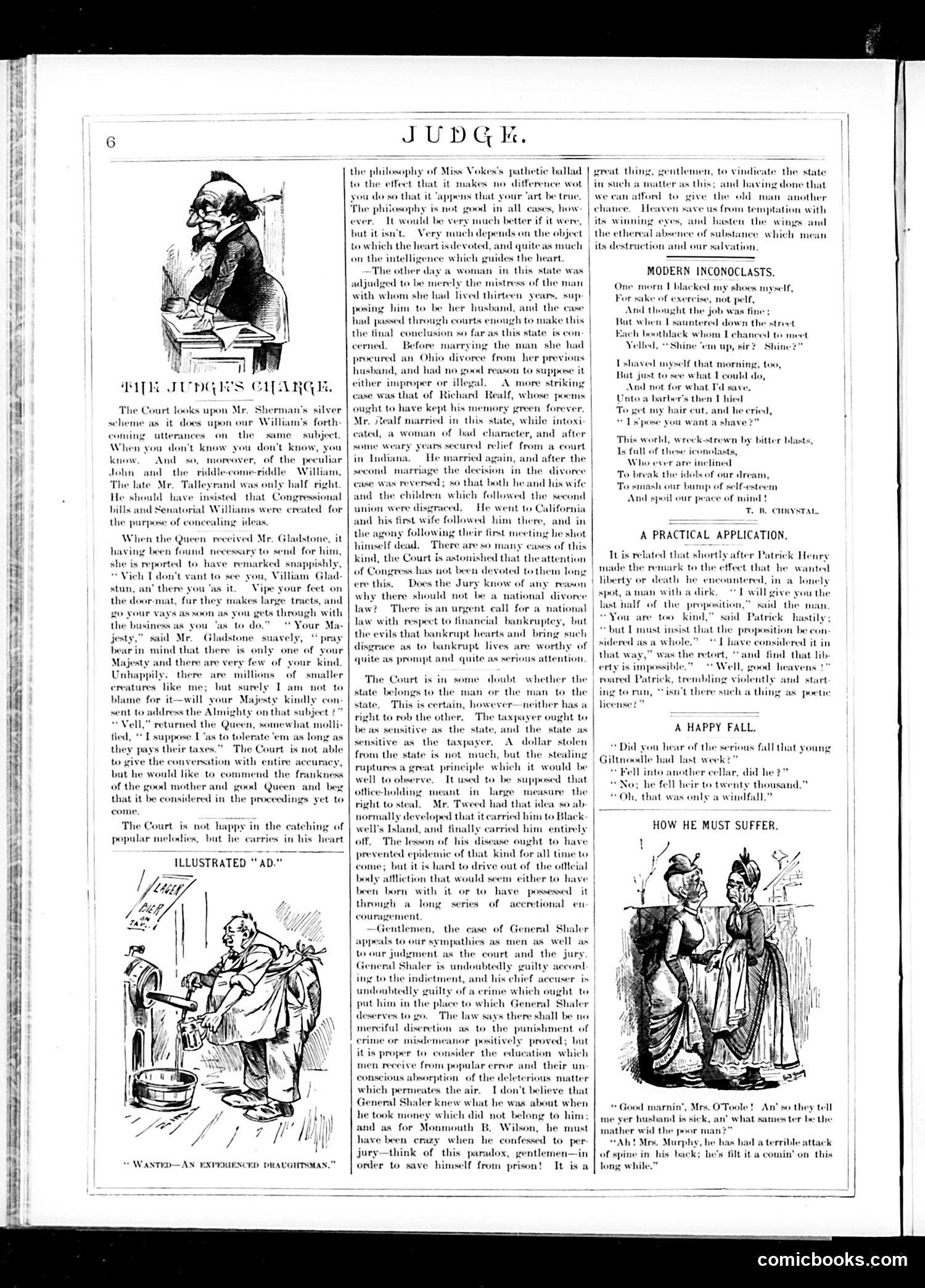
This page from *Judge* magazine contains legal and social commentary mixed with satirical illustrations. The main editorial discusses divorce law inconsistencies across American states, using real cases (including Richard Realf's complicated multiple marriages and a man's divorce reversal) to argue for uniform national divorce legislation. The cartoons illustrate related themes: one shows a well-dressed judge or legal figure, while another depicts working-class characters in an "illustrated ad" section. The page references Sherman (likely Secretary of State John Sherman) and political figures' statements on policy matters. The satire critiques how state-by-state divorce laws create injustice and family disgrace, arguing courts should address this as seriously as bankruptcy law. The overall tone suggests *Judge* advocated for legal reform to prevent the social chaos created by conflicting state statutes. The specific cases mentioned appear designed to demonstrate the absurdity of the current system.
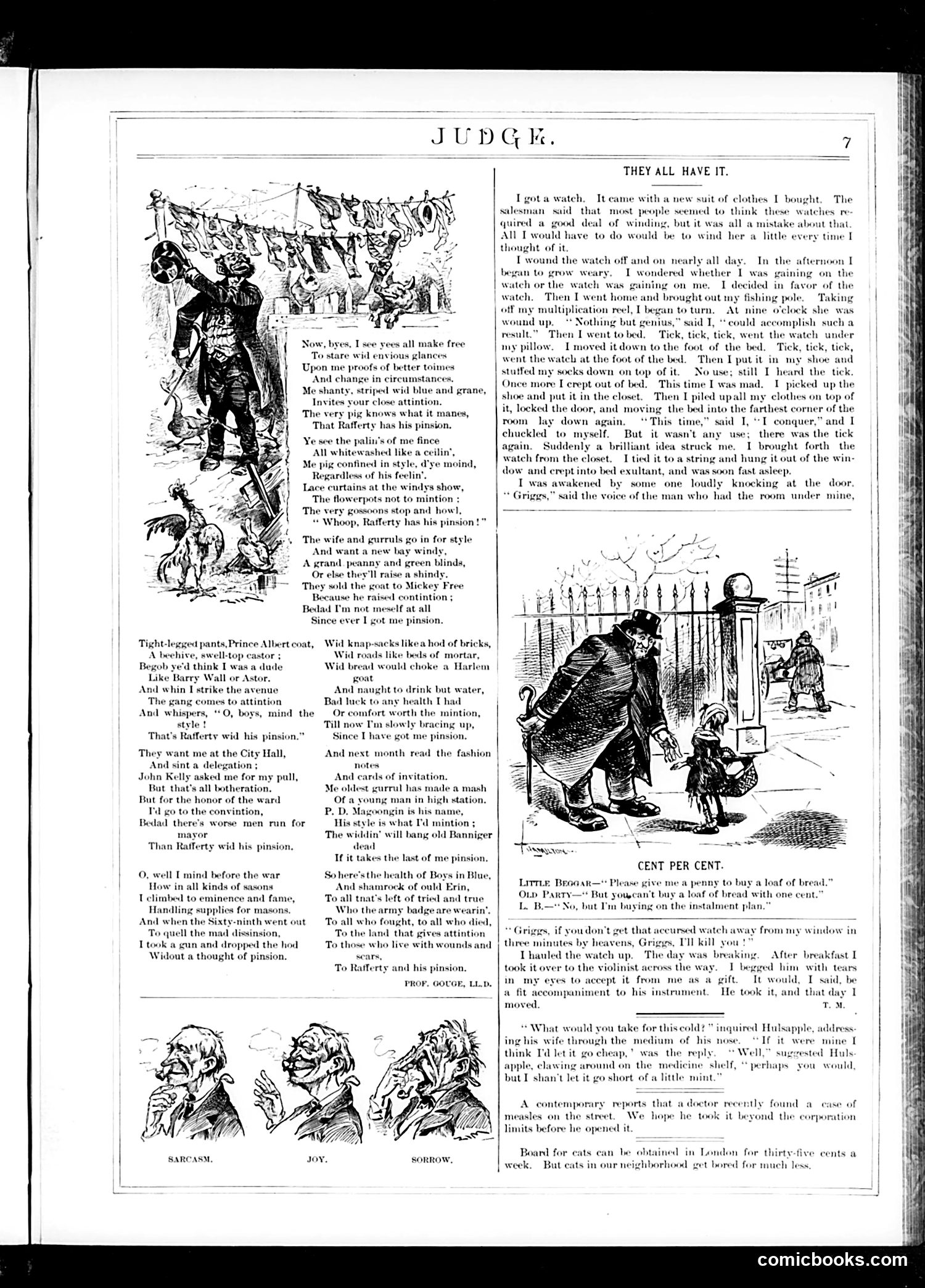
This page contains two distinct pieces of social satire: **"Rafferty and His Pension"** (left): An Irish-immigrant character boasts in dialect about his newfound respectability after receiving a Civil War veteran's pension. The satire mocks how a modest pension transforms Rafferty's social standing—he now attracts political delegations, gets marriage proposals for his daughter, and becomes neighborhood celebrity. The poem ridicules both the vanity of the newly-comfortable working class and political opportunism (politicians suddenly courting him for votes). **"They All Have It"** (right): A humorous anecdote about a man driven to distraction by a new watch that won't stop ticking, no matter where he hides it—ultimately hanging it outside his window. The joke satirizes modern consumer goods and their unexpected complications, poking fun at mechanical "progress." Both pieces use exaggeration to critique contemporary American social anxieties: economic mobility, political corruption, and technological disruption.
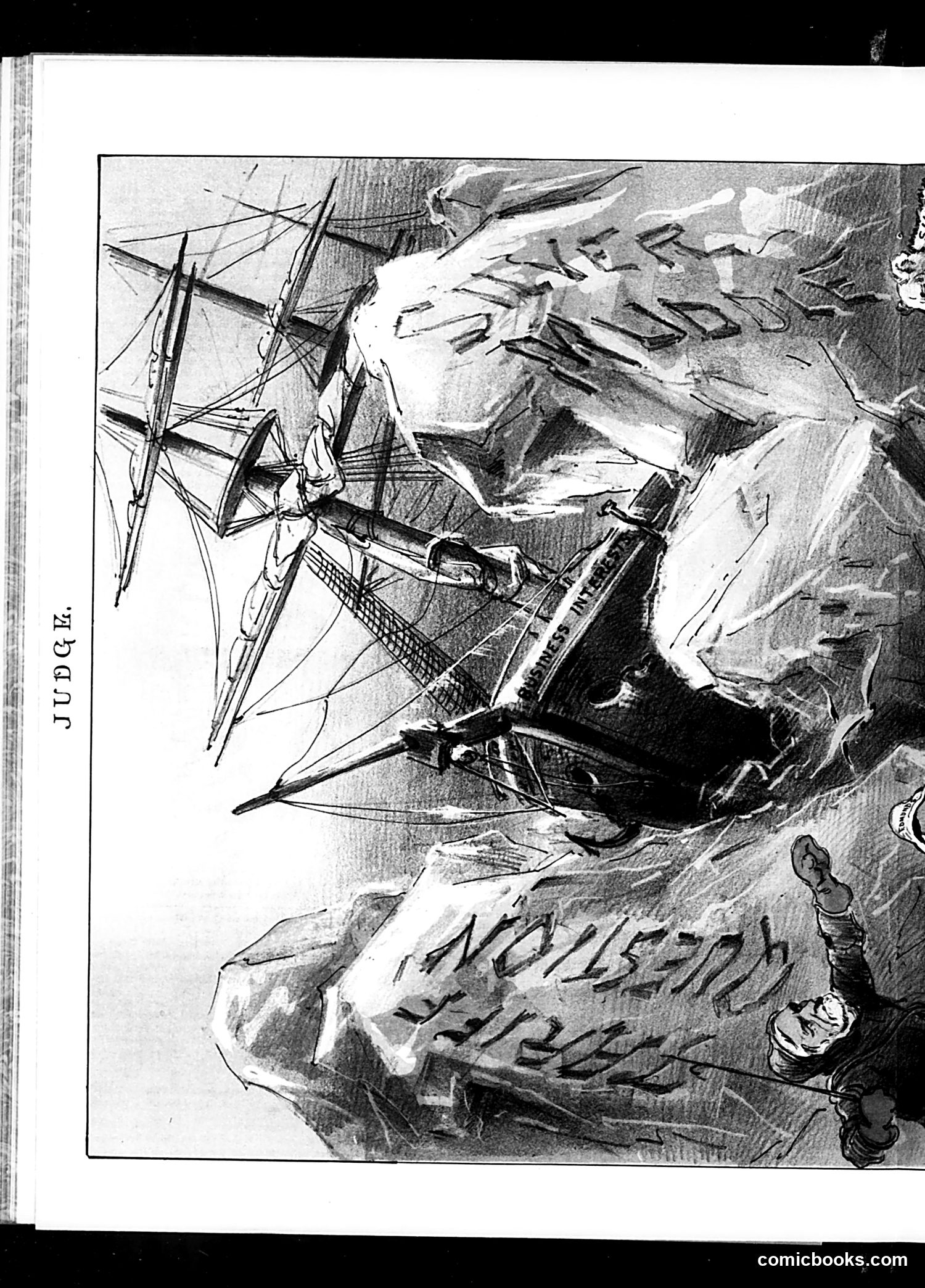
I can see this is a page from Judge magazine, but the image quality and orientation make it difficult to read the specific text and identify particular figures with confidence. The illustration appears to show a satirical scene with multiple figures in what looks like a dramatic or chaotic arrangement, with some handwritten or sketched elements. There are what appear to be captions or labels, but they're not legible enough for me to confidently identify the specific political figures, events, or social commentary being satirized. Without being able to read the text clearly or identify the specific individuals depicted, I cannot accurately explain what this particular cartoon is meant to convey to a modern reader.
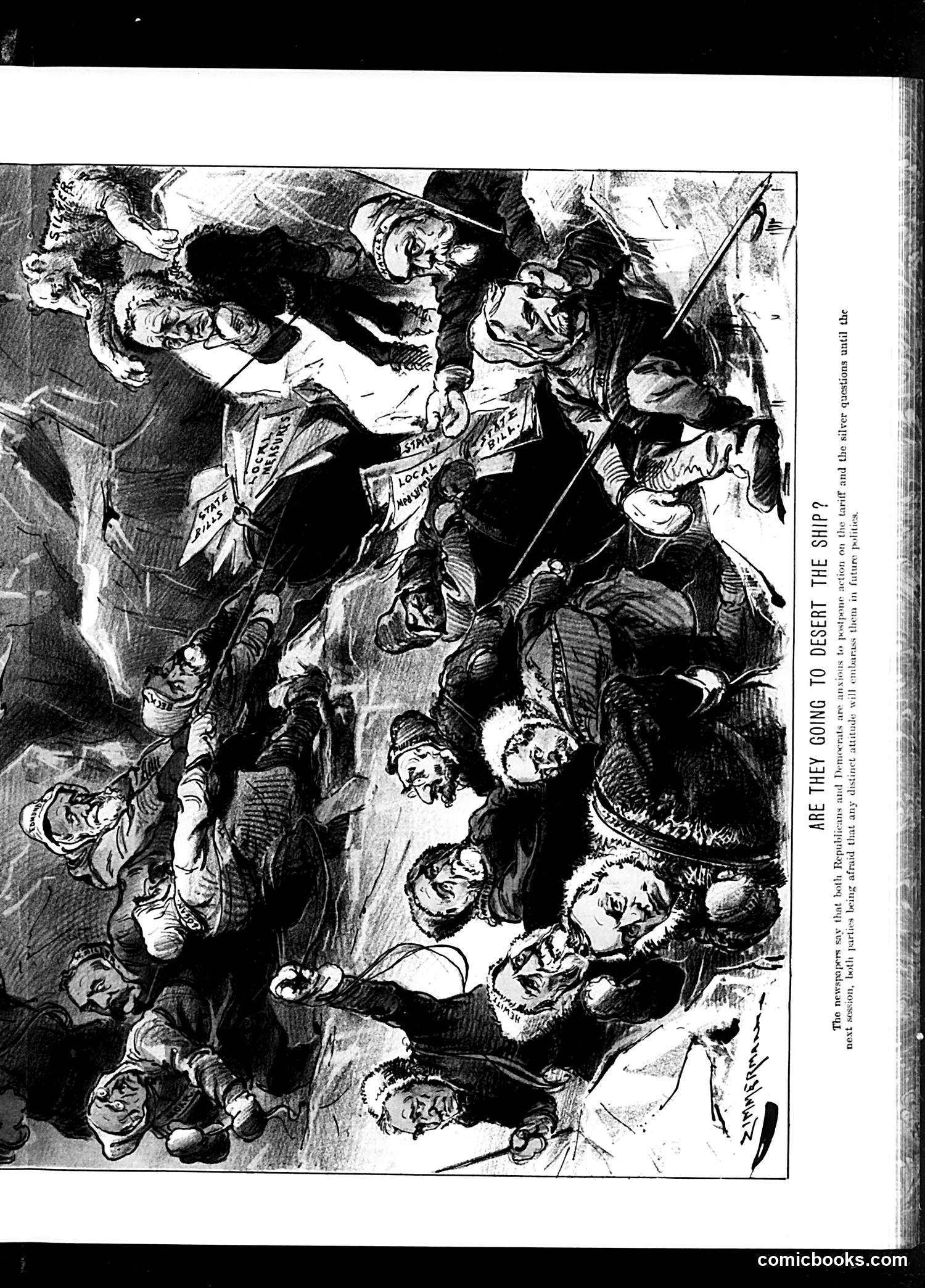
This political cartoon depicts multiple military or naval officers in distress, apparently abandoning or considering abandonment of their positions. The figures wear formal military dress with elaborate uniforms and insignia, shown in exaggerated, caricatured style typical of Judge magazine's satire. The title's question—whether these leaders will "desert the ship"—suggests commentary on military leadership during a crisis, likely wartime. The crowded, chaotic composition and the officers' expressions convey panic or moral failing. Without clear date context, the specific historical event remains uncertain, though the naval metaphor and military focus suggest criticism of command decisions or leadership integrity during a period of national strain.
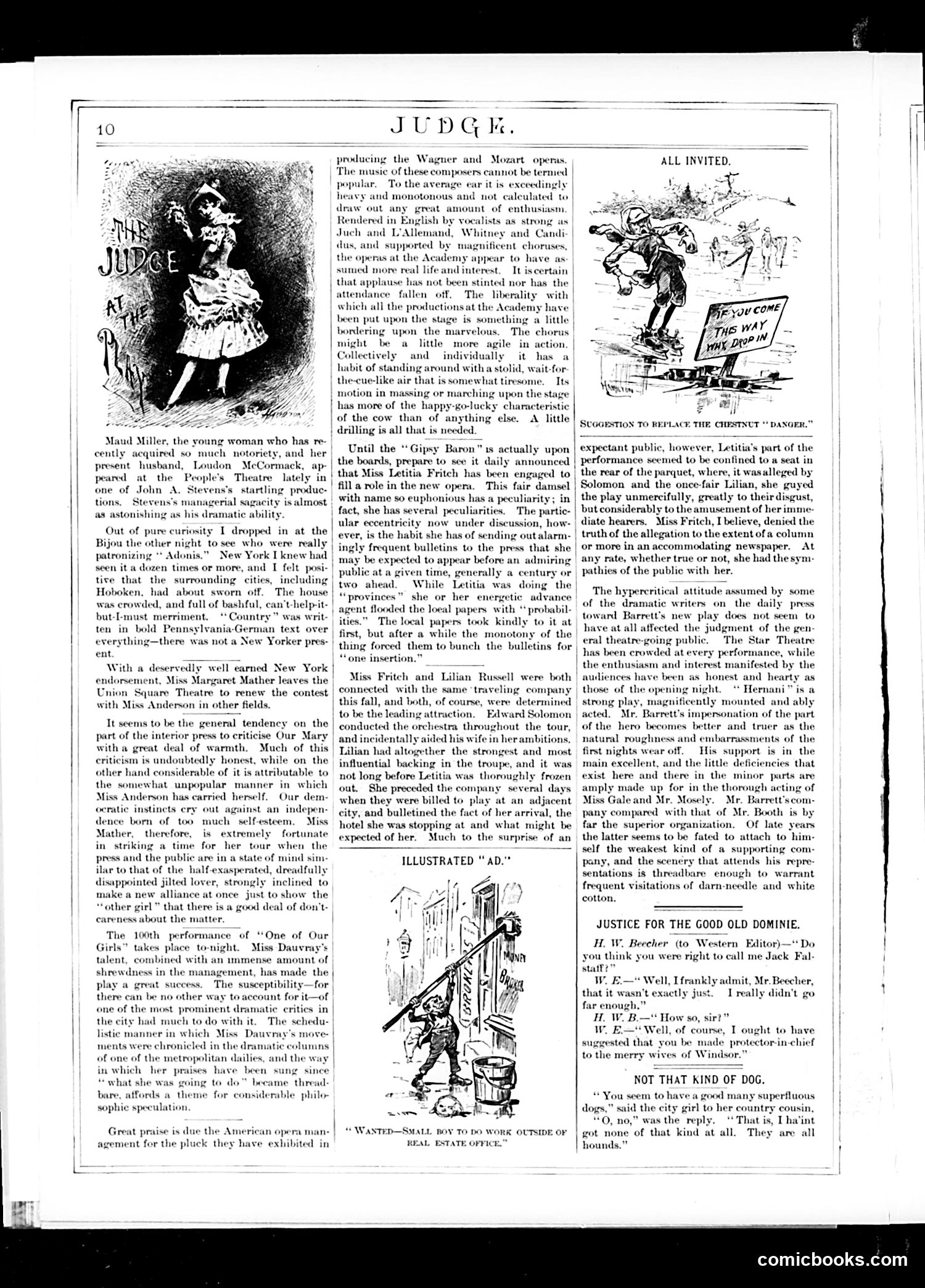
This page contains theatrical criticism and social commentary from *Judge*, a prominent American satirical magazine. **Main Content:** The left column discusses actress **Maria Mather**, noting her recent notoriety and performances at the People's Theatre. The critic expresses democratic skepticism toward her independence and self-esteem, suggesting the public may be predisposed to support her partly out of spite toward rival actress **Mary Anderson**. The right column satirizes **Letitia Fritch**, an opera singer for the upcoming "Gipsy Baron" production. The satire targets her habit of constantly issuing press bulletins claiming she's about to be cast in roles. The joke mocks both her self-promotion and the complicity of local papers in printing unverified "probabilities" about her employment. **Context for Modern Readers:** This reflects 19th-century theatrical culture where performers actively courted press attention. The satire ridicules manufactured celebrity hype and the blurred line between legitimate news and promotional puffery—issues that resonate today.
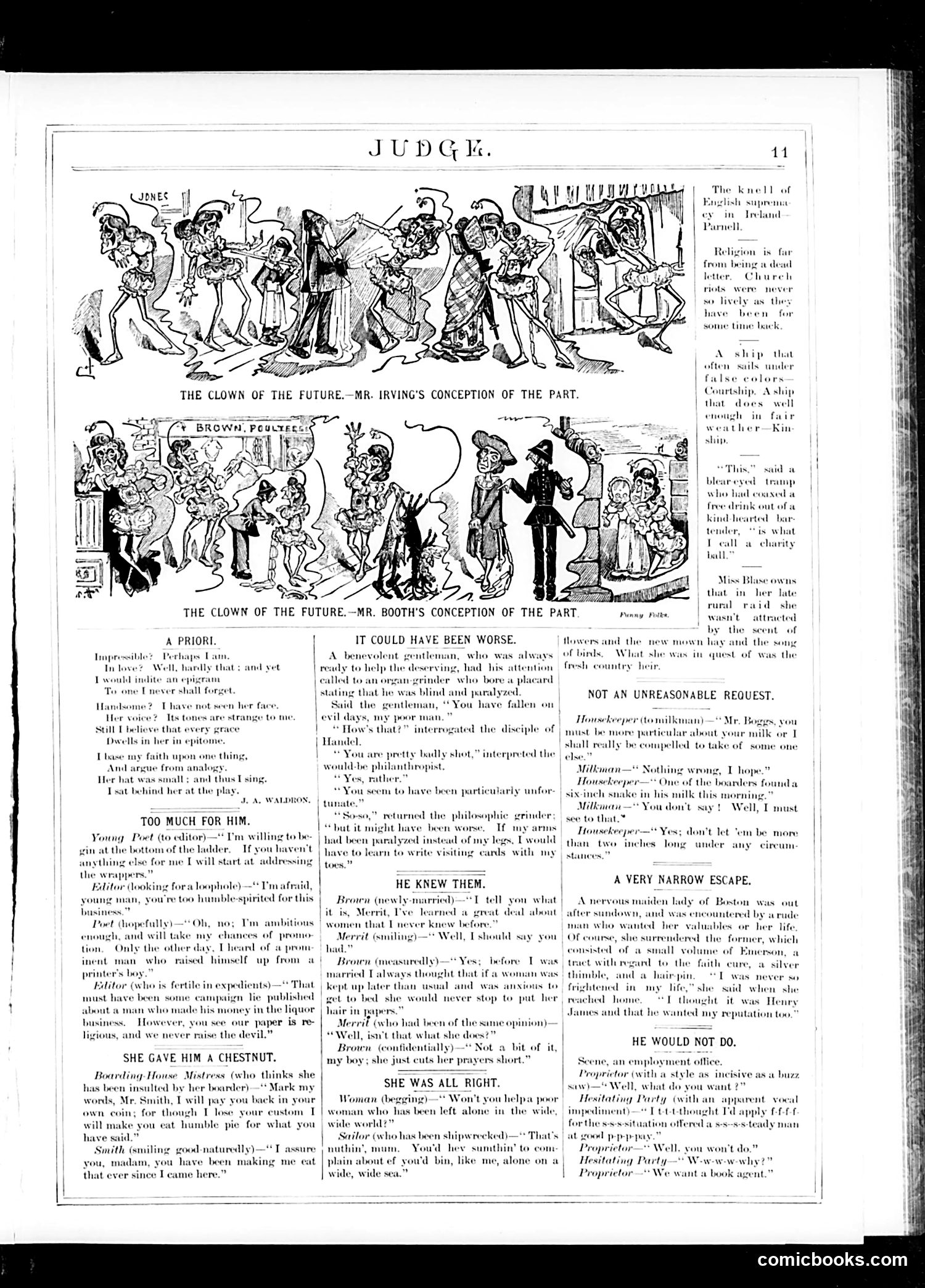
This page contains multiple short satirical pieces typical of Judge magazine's humor: **"The Clown of the Future"** shows two contrasting visions of theatrical performance—Irving's versus Booth's conceptions—likely referencing rival actors Henry Irving and Edwin Booth, prominent in the late 19th century. **Various short comedic dialogues** mock social pretension and economic struggle: a young poet's humble ambitions, a landlady demanding payment, a philandering gentleman making excuses to a poor man, and boarding house disputes over milk delivery standards. **"She Was All Right"** satirizes rural courtship, where a woman's romantic interest lies not in flowers and sentiment but in securing a "fresh country heir"—mocking mercenary marriage motivations. **"He Would Not Do"** depicts a stammering job applicant rejected because he's insufficiently qualified as a book agent—gentle humor about employment mismatches. The page reflects period concerns: class anxiety, economic hardship, changing courtship values, and theatrical celebrity culture. Most humor targets pretension and social hypocrisy rather than specific political figures.
This page is primarily **advertising**, not editorial or satirical content. It comprises commercial notices for various late-19th-century products: perfumes, cosmetics, flour sacks, pianos for rent, a camera, insurance, and other goods. The only apparent satirical content is a brief story titled **"The Chocolate Girl,"** which appears to be a romantic anecdote about a Viennese chocolate server and a German nobleman. The narrative—typical of Judge's light humor—plays on European romantic sentiment and nostalgia. It describes how the nobleman's portrait of this "pretty chocolate girl" remains a treasured possession, blending sentiment with mild mockery of sentimental European culture. The remainder of the page consists of standard commercial advertisements with minimal satirical intent, suggesting this is likely a filler page in the magazine designed to generate advertising revenue rather than deliver Judge's characteristic political or social commentary.
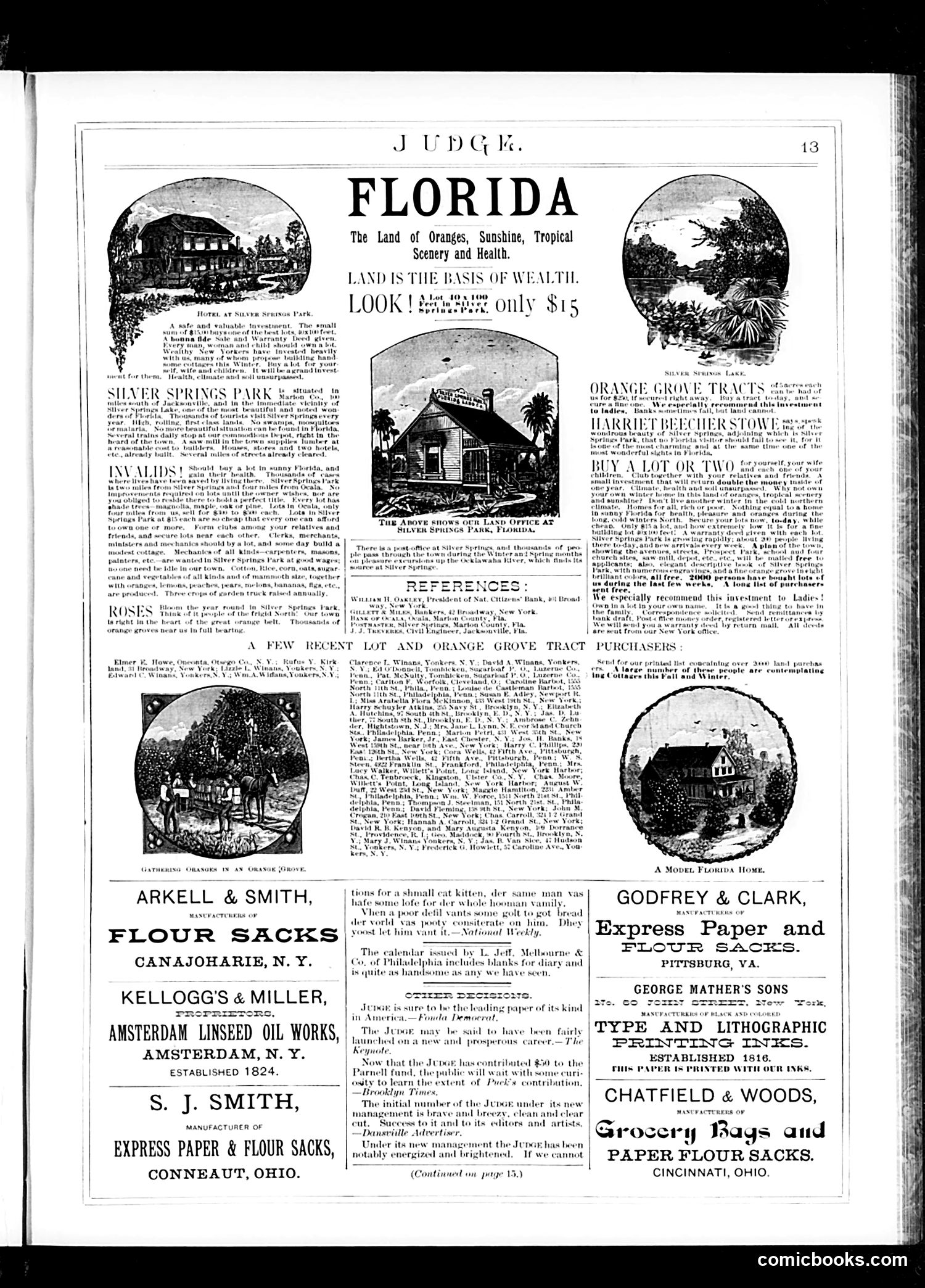
This is primarily a **real estate advertisement page**, not a political cartoon. The page promotes Florida land investment, particularly orange groves, to Northern readers. The headline promises "$15" land in "The Land of Oranges, Sunshine, Tropical Scenery and Health." The illustrations show idealized Florida scenes: a house at Silver Springs Park, orange groves being harvested, a modest cottage, and scenic lake views. These romanticized images were designed to attract Northern investors and settlers during Florida's late-19th-century land boom. The satire (if present) is implicit rather than explicit: the too-good-to-be-true pricing and pastoral imagery likely mocked the exaggerated claims Florida promoters made to lure capital North. The page is surrounded by **legitimate business advertisements**—paper sack manufacturers, printing companies, and oil works—typical of Judge magazine's revenue model. This represents the speculative real estate fever that characterized the Gilded Age.
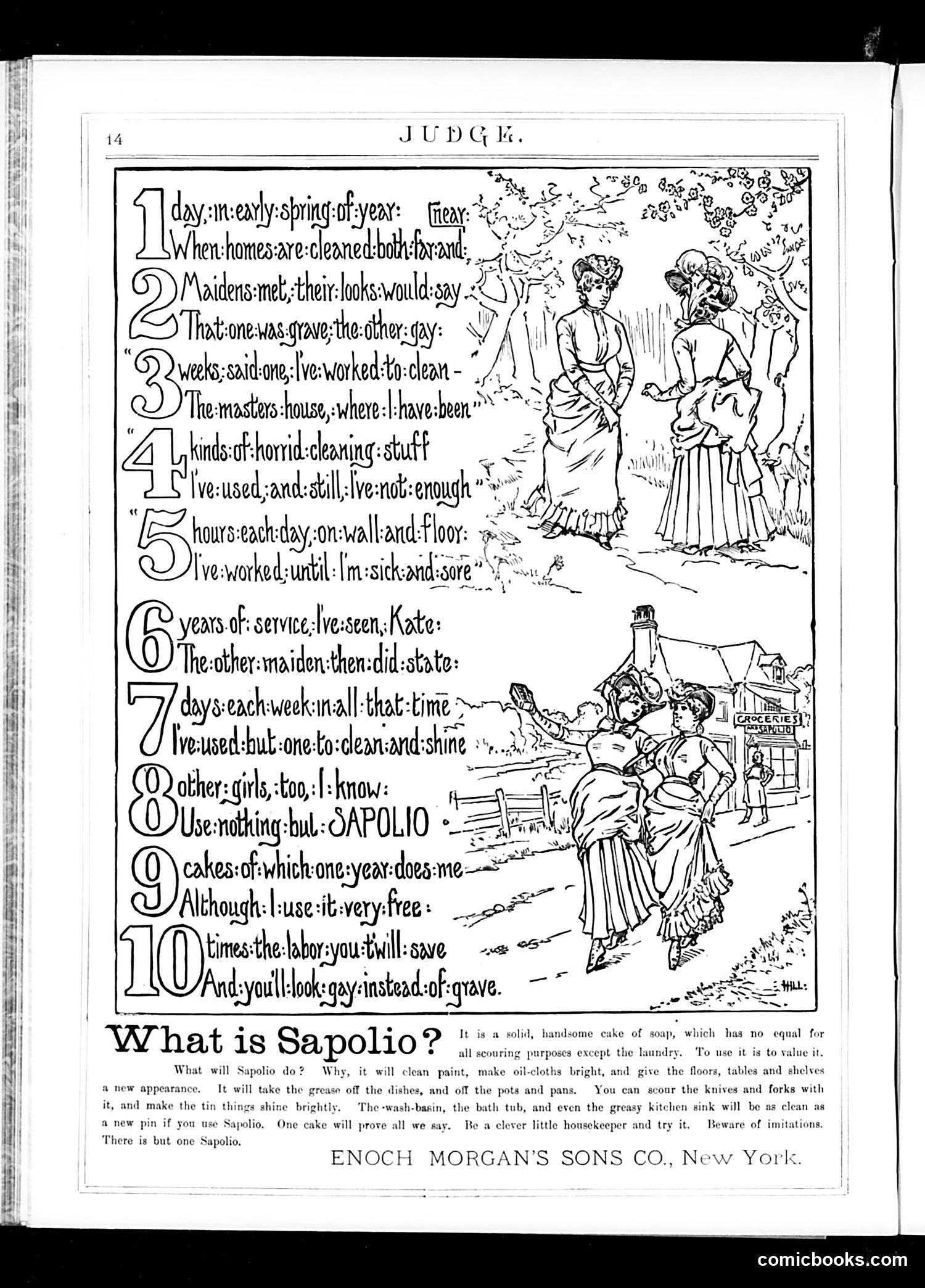
This is a **product advertisement** for Sapolio, a solid cleaning soap made by Enoch Morgan's Sons. The comic narrative—presented as numbered verse with accompanying illustrations—depicts two domestic servants discussing spring cleaning. The first maid complains she's exhausted after weeks of arduous cleaning with conventional materials. The second maid boasts that she accomplishes the same work using only Sapolio cakes, which she's used for six years of service. The implicit message: Sapolio makes cleaning easier and faster, saving labor and time. The accompanying text emphasizes Sapolio's versatility—it cleans paint, brightens oil-cloth, polishes floors, scours dishes, and scrubs various household surfaces. The advertisement warns against imitations, positioning this as the superior, authentic product. The period illustrations show well-dressed young women in domestic scenes, appealing to the female household manager as the target consumer during this era of domestic labor.
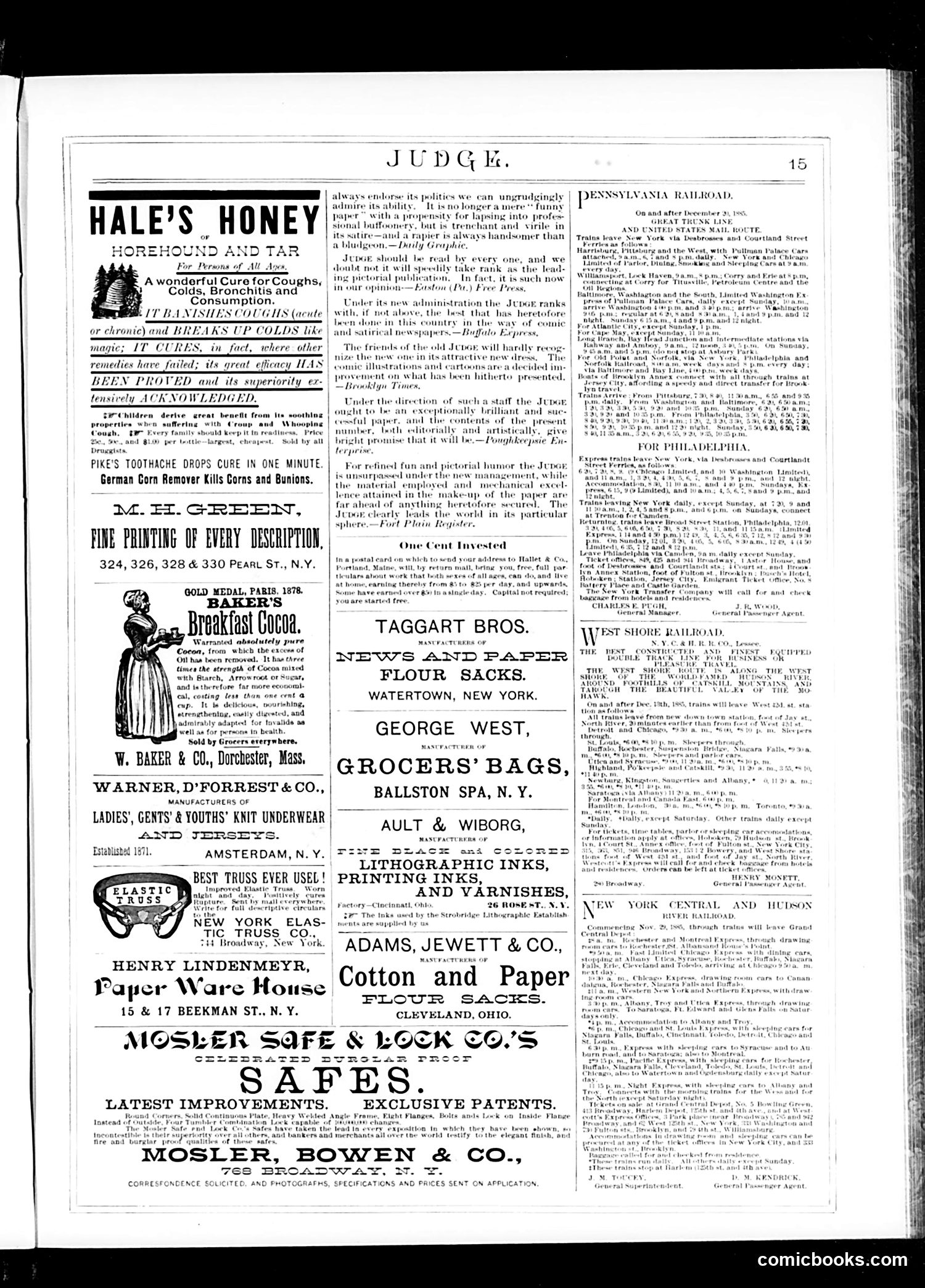
This page is primarily **advertising**, not editorial content or political satire. It's page 15 of *Judge*, a satirical magazine, but this particular spread consists almost entirely of commercial advertisements for various 19th-century products and services. The ads include patent medicines (Hale's Honey for coughs, Pike's Toothache Drops, German Corn Remover), food products (Baker's Breakfast Cocoa), railroad services (Pennsylvania Railroad, New York Central), manufacturing goods (flour sacks, paper ware, safes, printing supplies), and clothing (underwear). There is no visible political cartoon or satirical commentary on this page. The only illustration appears to be decorative branding imagery for products like Baker's Cocoa (showing a woman). The page demonstrates how 19th-century magazines supported themselves through paid advertisements rather than relying solely on editorial content.
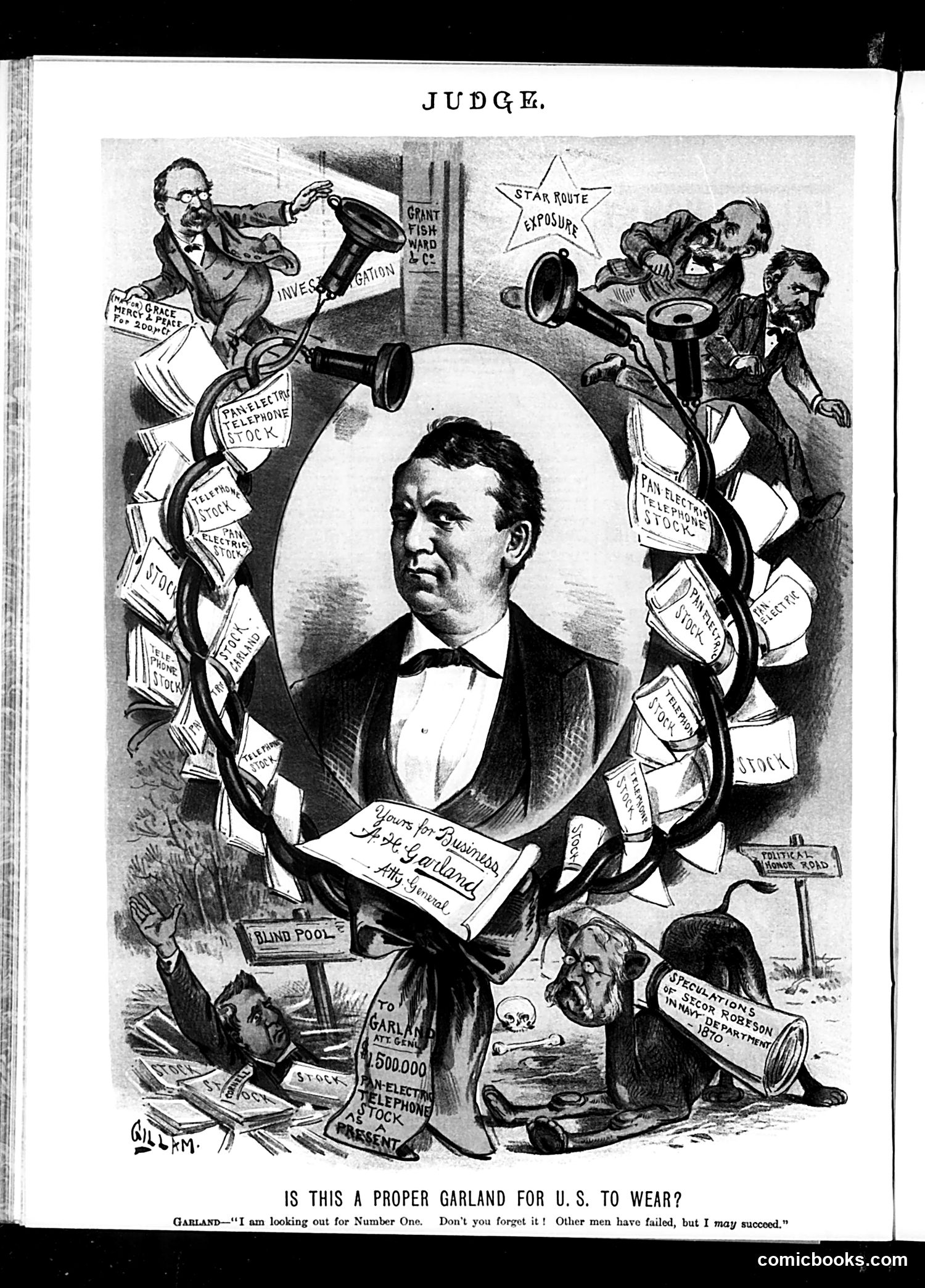
This cartoon satirizes **Jay Gould**, a controversial railroad magnate and financier of the Gilded Age. The central portrait is surrounded by a "garland" of scandals and failed ventures—stock manipulation, the Grant Fish Wand Company, Pan Electric Telegraph stock, and other dubious schemes labeled as investigations and stock frauds. The title questions whether Gould represents proper American leadership. His quoted statement ("I am looking out for Number One") emphasizes ruthless self-interest. The small figures at top represent competing industrialists using megaphones and telescopes—suggesting the cutthroat competitive environment. The cartoon critiques how wealthy speculators accumulated fortunes through fraud rather than legitimate enterprise, questioning whether such figures should be celebrated or held up as American ideals.