
Judge, 1886-02-13 · page 10 of 16
Judge — February 13, 1886 — page 10: what you’re looking at
What you’re looking at
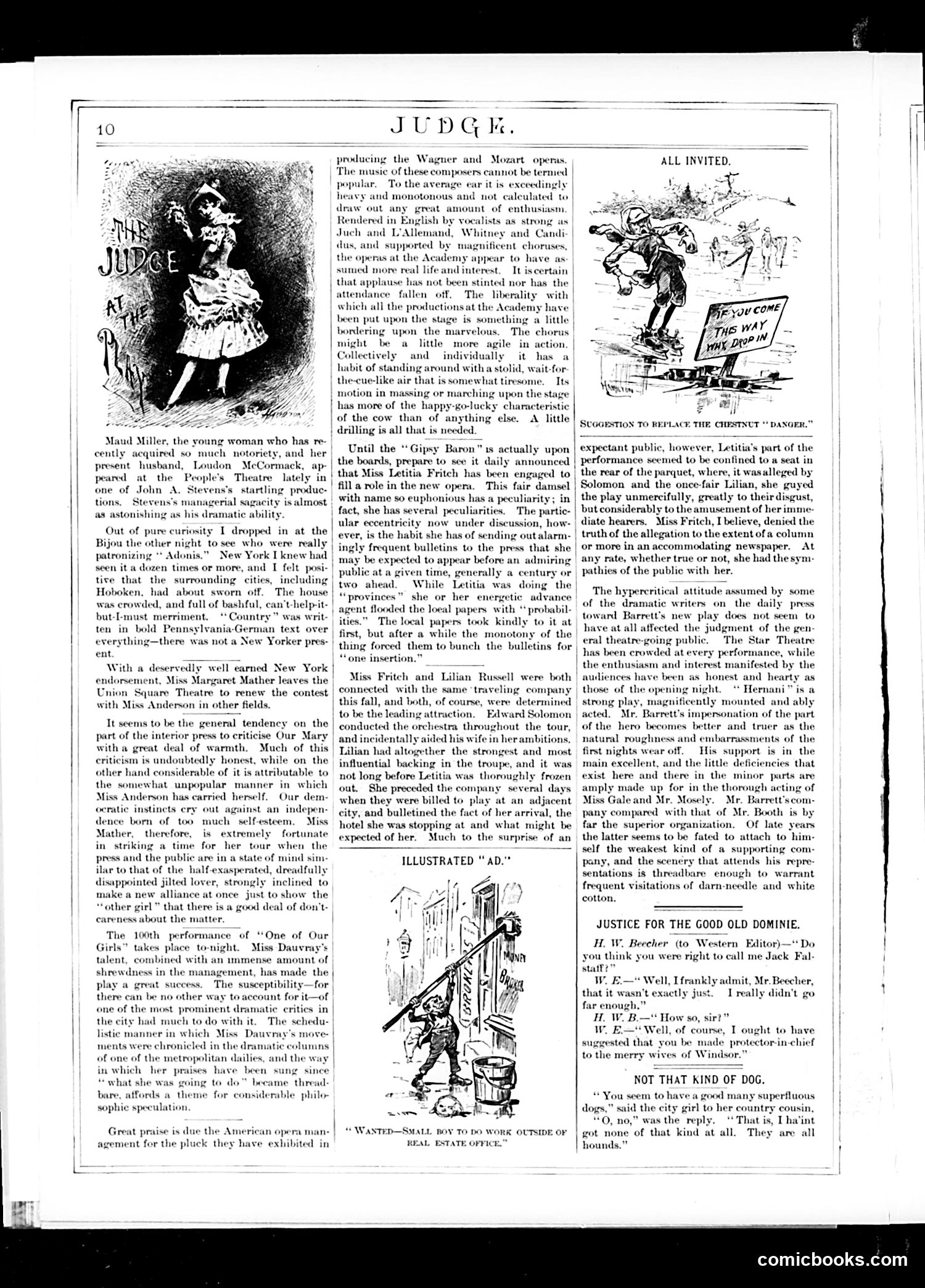
This page contains theatrical criticism and social commentary from *Judge*, a prominent American satirical magazine. **Main Content:** The left column discusses actress **Maria Mather**, noting her recent notoriety and performances at the People's Theatre. The critic expresses democratic skepticism toward her independence and self-esteem, suggesting the public may be predisposed to support her partly out of spite toward rival actress **Mary Anderson**. The right column satirizes **Letitia Fritch**, an opera singer for the upcoming "Gipsy Baron" production. The satire targets her habit of constantly issuing press bulletins claiming she's about to be cast in roles. The joke mocks both her self-promotion and the complicity of local papers in printing unverified "probabilities" about her employment. **Context for Modern Readers:** This reflects 19th-century theatrical culture where performers actively courted press attention. The satire ridicules manufactured celebrity hype and the blurred line between legitimate news and promotional puffery—issues that resonate today.
📄 Transcribed text from this page (OCR, searchable)
Machine-transcribed from the original scan — historical spelling and the odd misread are preserved.
cently acquired so much notoriety present husband, Loudon MeCorn peared at the People’s Theatre one of John A. startling produe- tions. Y ial saga almost tonishing as his dramatic Out of pure curiosity Bijou the other night to see who were really patronizing * Adonis.” : York I knew had seen it a dozen times or more, tive that the surrounding cities, including E en, had about sworn off. The house | nd full of bashful, can’t-l but-I-must merriment. ten in bold Pennsylvanis e was crowded, Ip-it- pantry s writ- German text over erything—there was not a New Yorker pres- ent With a deservedly well earned New York | endorse . Miss Margaret Mather leaves the | Union Square Theatre to renew the contest with Miss Anderson in other fields. j dency on the | interior press to criticise Our Mary al of warmth. Much of this criticism is undoubtedly honest, while on the other hand considerable of it is attributable to the somewhat unpopular manner in which Miss Anderson has carried herself. Our dem- oeratic instincts ery out against an indepen- It seems to be the general te part of tl with a gre dence born of too much self-esteem, Miss Mather, therefore, is extremely fortunate in’ stri for hi tour when the nd the public are in a state that of the half-exaspe disappointed jilted lover, strongly inclined to make a new alliance at once just to show the “other girl” that there is a good deal of don't- careness about the matter. of mind sim- dreadfully ed, The 100th performance of “One of Our irls” takes place to-night. Miss Dauvray' talent, combined with an ummense amount of shrewdness in the management, has made the | The susceptibility—for punt for it—of most prominent dramat had much to do with it critics in The schedu- of one of the metropolitan in which her p “what she was ¢ a became thread- bare. rds a theme msiderable philo- sophic speculation Great praise is due th nt for the pluck they } | bordering upon the marvelous T dropped in at the | ” and T felt posi-| 5 | to be the leadin; JUDGE, producing the Wagner and Mozart operas. The music of these composers cannot be termed popular, To the av rit is exceedingly heavy and monotonous and not calculated to draw out any great amount of enthusiasm Rendered in English by vocalists as strong as Juch and L’Allemand, Whi y and Candi dus, and supported by magnificent choruses, the operas at the Academy appear to sumed more real life and interest. It ise that applause has not been stinted nor h attendance fallen otf. The liberali which all the productions at the Ac: been put upon the stage is something a little The chorus more agile in action. individually it little and might be a Collectively t-for the-cue-like air that is somewhat tiresome. Its motion in massing or marching upon the stage teristic A little of the cow than of anything else. drilling is all that is needed Until the “Gipsy Baron” 1s actually upon the boands, prepare to see it daily announced | that Miss Letitia Fritch has been engaged to fill a role in the new opera. This fair damsel with name so euphonious has a peculiarity; in fact, she has several peculiarities. ‘The partic- now under discussion, how- ever, is the habit she has of sending out alarm- ingly frequent bulletins to the press that she Sf pected to appear before an admiring t a given time, century or os While Letitia was doing the “ prov: * she or her e etic advance agent flooded the loeal papers. with “ probabil- ities.” The local papers took kindly to it at first, but after a while the monotony of the thing forced them to bunch the bulletins for “one insertion.” Miss Fritch and Lilian Russell were both connected with the same ‘traveling company this fall, and both, of course, were determined attraction, Edward Solomon conducted the orchestra throughout the tour, and incidentally aided his wif Lilian had altogether the stre influential backing in the troupe, and it was not long before Let was thoroughly frozen out. She preceded the company seve: when they were billed to play at an adj city, and bulletined the fact of her art h herambitions. stand most 1, the tel she was stopping at and what might be pected of her. Much to the surprise of an ILLUSTRATED “ AD."* “ WASTED—SMALL BOY TO DO WORK OUTSIDE OF REAL ESTATE OFFI | SUGGESTION TO REPLACE THE CHESTNUT * DANGER.” , Letitia’s part of the | performance seemed to be confined to a seat in the rear of the parquet, where, it wasalleged by Solomon and the once-fair Lilian, she guyed the play unmercifully, greatly to theirdisgust, | but considerably to the amusement of her imme- diate hearers. Miss Fritch, I believe, denied the truth of the allegation to the extent of a column or more in an accommodating newspaper. At any rate, whether true or not, she had the s: pathies of the public with her. | expectant public, howeve The hypereritical attitude assumed by some of the dramatic writers on the daily press toward Barrett's new play does not seem to have at all affected the judgment of the gen eral theatre-going public. The Star Theatre | has been crowded at every performance, while | the enthusiasm and interest manifested by the | audiences have been as honest and he those of the opening night.‘ Hern: strong play, magnificently mounted and a acted. Mr. Barrett's impersonation of the | of the hero bec . and truer as th natural rough rassments of th first nights we: His support is in th main excellent. iciencies th: ist here amply made up for in the thorough a Miss Gale and Mr. Mosely. pany compared with t far the superior organization. Of late y the latter seems to be fated to attach to him- | self the weakest kind of a supporting com- | | pany, and the scenery that attends his repre- sentations is threadbare enough to warrant frequent visitations of darn-needle and white cotton, y as ni isa ff, and the little d nd there in the minor parts are ur cting of Mr. Barrett's of Mr. Booth JUSTICE FOR THE GOOD OLD DOMINIE. H.W. Beecher (to Western Editor)—" Do | you think you were right to call me Jack Fal- 1 H. W. B.— How so, sir?” W. E.— Well, of course, I ought to h suggested that you be ector-in-chief | to the merry w | NOT THAT KIND OF DOG. | You seem to have a good many superfluous | | dogs,” said the city girl to her country cousin, | “0, no,” was the reply. ‘That is, [ha’int | got none of that kind at all. They are all hounds.” 1 comicbooks.com