
A complete issue · 16 pages · 1884
Judge — November 22, 1884
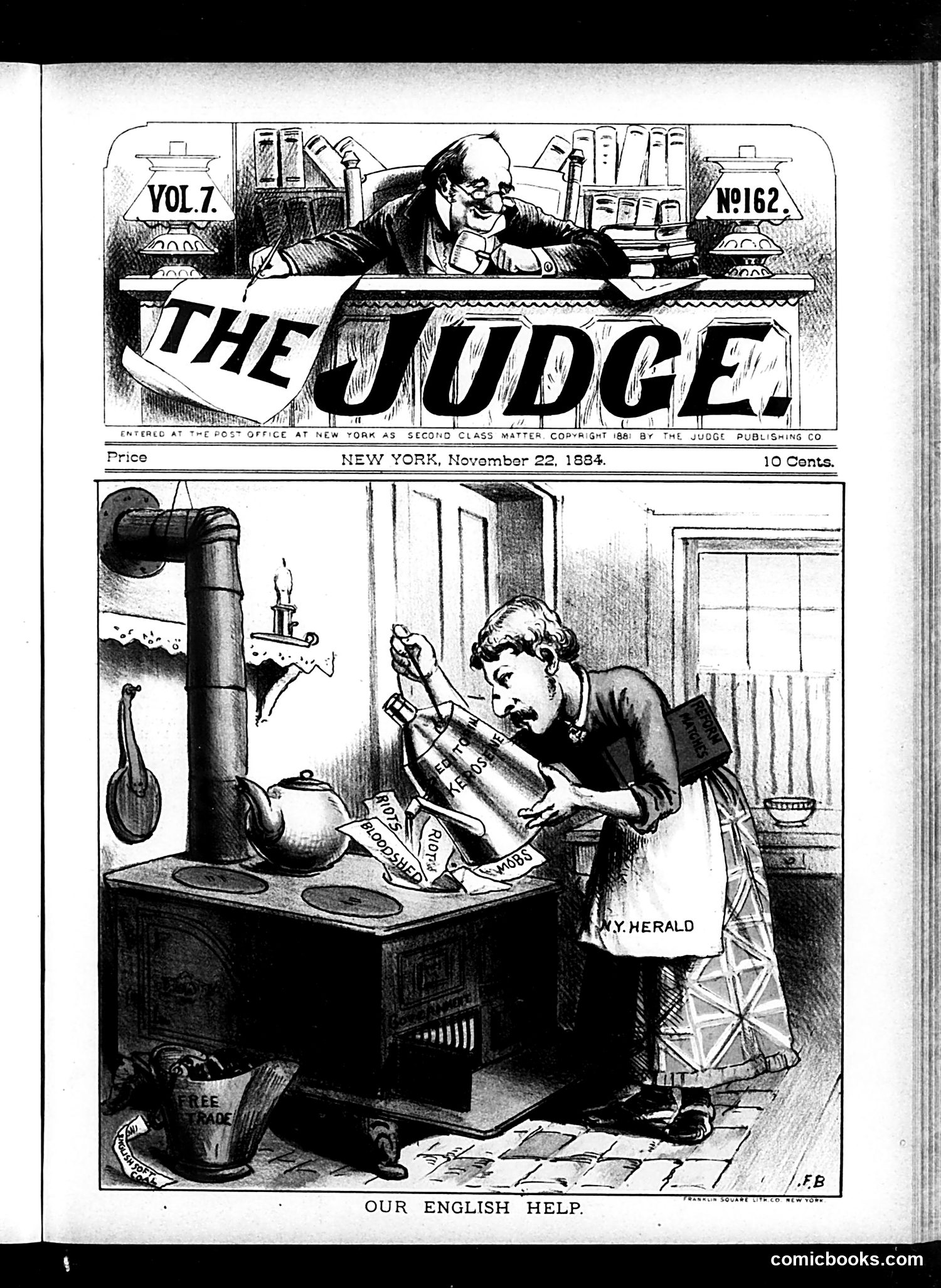
This political cartoon satirizes British involvement in American affairs, likely referencing trade or diplomatic tensions during the 1884 election period. The image depicts a woman (representing America or American interests) at a stove, struggling to manage a large pot while holding what appears to be a British-labeled container. The chaos—scattered papers labeled "FREE TRADE" and "TARIFF," a teapot, and scattered items—suggests economic confusion or mismanagement. The title "Our English Help" is sarcastic: the cartoon suggests that British interference or influence in American economic policy (particularly regarding free trade vs. tariffs) is unhelpful and creates domestic disorder. The woman's stressed expression emphasizes that foreign meddling complicates American self-governance. This reflects 1880s debates over protectionist tariffs versus free trade advocacy, where Britain's interests and influence were perceived as unwelcome by American industrialists and nationalists.
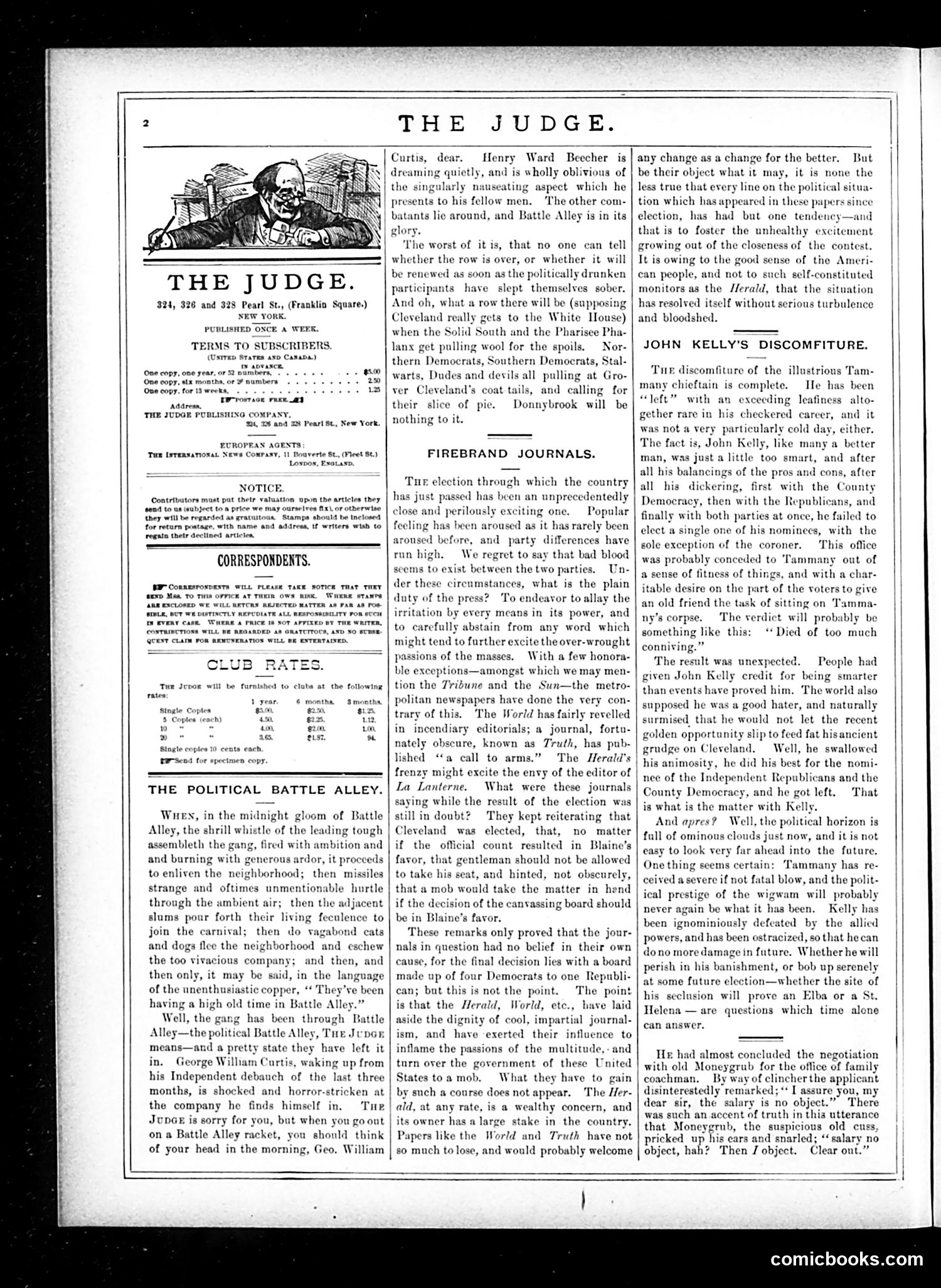
This satirical piece compares American politics after a recent election to a violent street brawl in a rough neighborhood called "Battle Alley." The cartoon mocks prominent political figures for their conduct: **George William Curtis** (Independent reformer) is "shocked and horror-stricken" at the political company he finds himself among. **Henry Ward Beecher** (famous minister and political commentator) remains obliviously dreaming through the chaos. The satire warns that if Cleveland wins the presidency and gains control of federal patronage ("spoils"), the resulting conflict between Northern and Southern Democrats, "Stalwarts," and other factions will make the current chaos look tame—"Donnybrook will be nothing to it." The accompanying article criticizes sensationalist newspapers (the *World*, *Herald*, and obscure *Truth*) for inflaming political passions rather than calming them, comparing their inflammatory rhetoric to revolutionary French journalism.
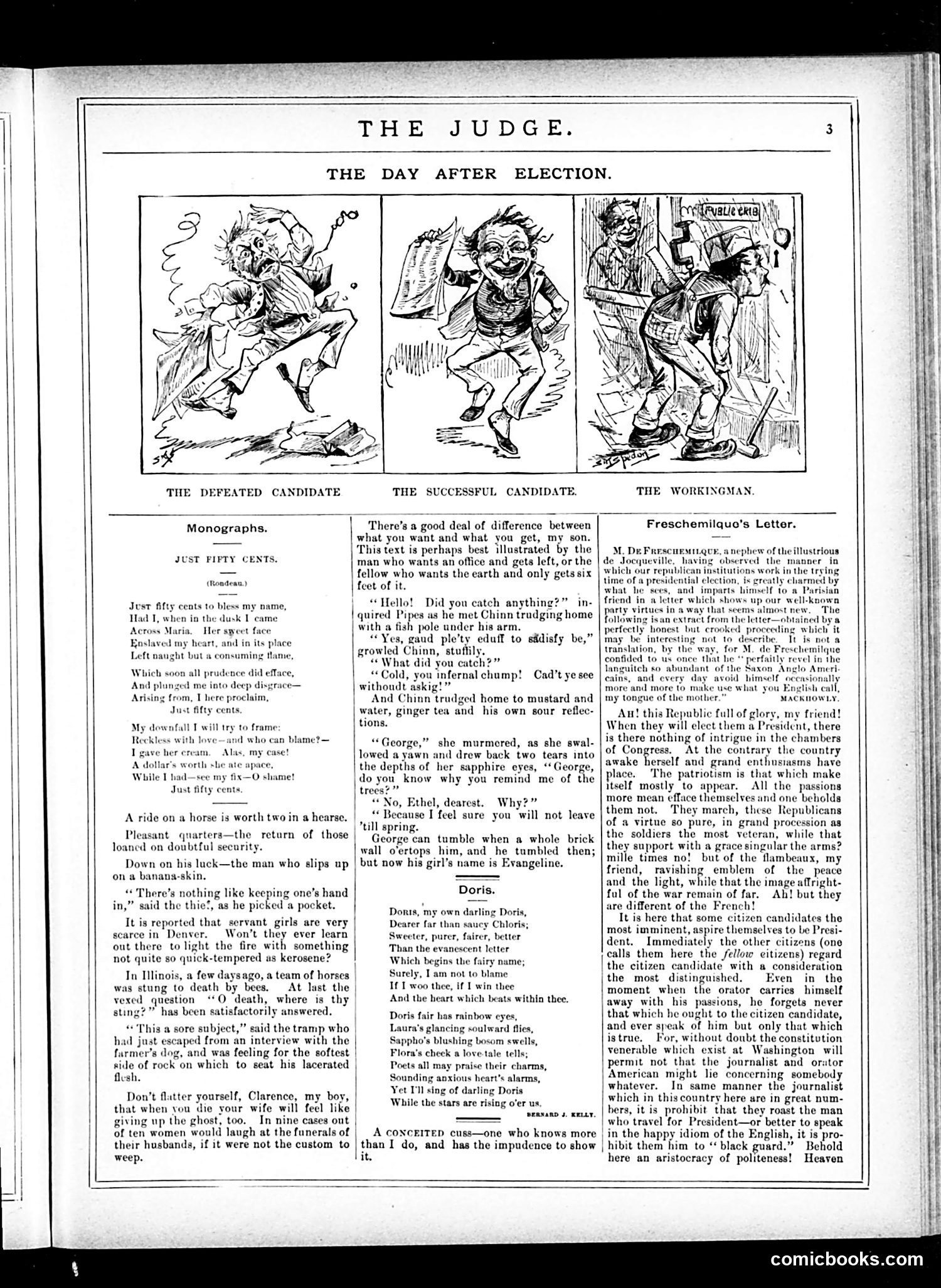
This satirical page depicts the immediate aftermath of an American election with three cartoon panels: **The three main figures** represent stock election-day characters: a defeated candidate (wild, disheveled), a successful candidate (jubilant, triumphant), and a workingman (ordinary citizen). **The satire's point**: The contrast shows how differently people experience election outcomes—politicians celebrate or despair while common workers remain largely unaffected by political results. **Supporting content** includes humorous short pieces ("Monographs") and poems on unrelated topics, typical of Judge's format. One notable item is "Freschemilquo's Letter," apparently mocking a foreign observer's commentary on American republican institutions, using pseudo-intellectual language to lampoon both the foreigner and American politics. **The overall message**: Election fever grips politicians intensely, but ordinary citizens and institutions persist unchanged—a critique of political theater's limited real-world impact.
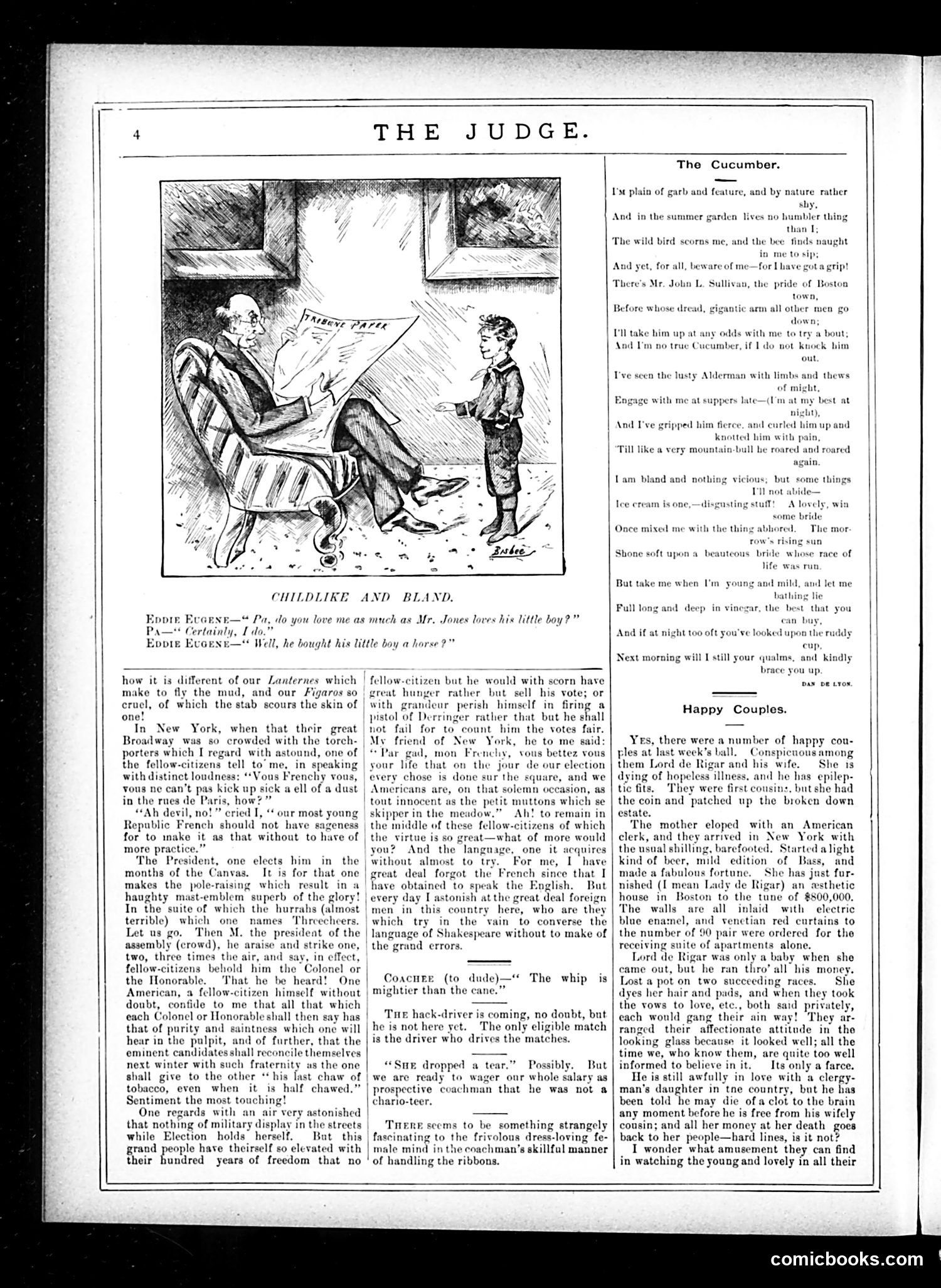
This page satirizes a French visitor's bemused observations of American democracy and manners. The main cartoon depicts an adult reading a newspaper while a child asks naive questions, illustrating the contrast between American pretension and actual behavior. The accompanying text uses a French speaker's fractured English to mock American electoral practices and social customs. Key targets include: - **Election spectacle**: Americans' self-congratulatory displays during elections, despite vote-buying and corruption - **Campaign rhetoric**: Politicians' inflated moral language masking self-interest - **American exceptionalism**: The smugness about "hundred years of freedom" while engaging in petty corruption - **Language pretension**: Americans attempting Shakespeare while committing "grand errors" The satire suggests Americans present themselves as innocent and noble during elections while actually being quite corrupt—hence "childlike" naivety paired with "bland" hypocrisy. The French observer's outsider perspective highlights this gap between American ideals and reality.
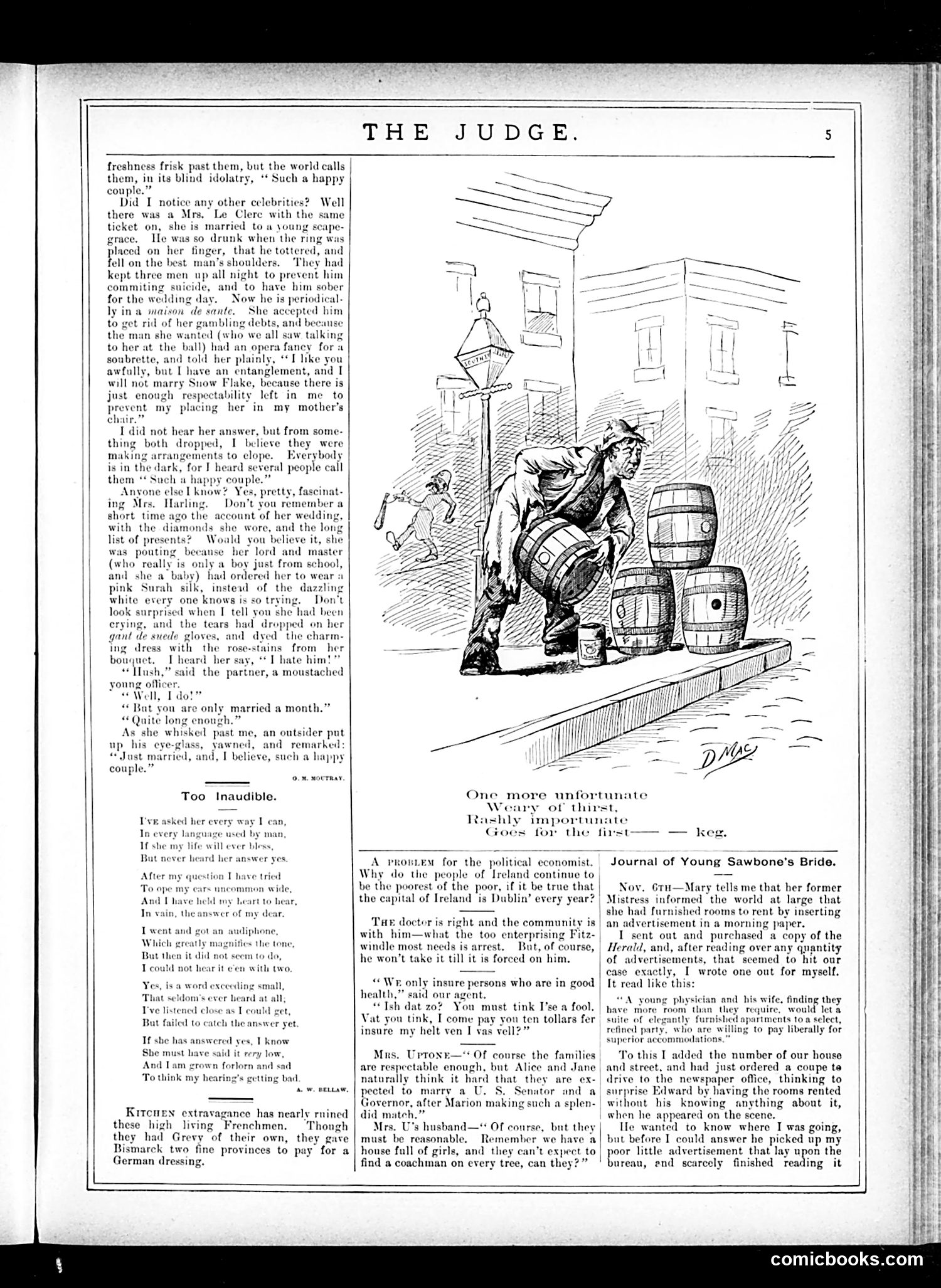
This Judge magazine page contains multiple satirical pieces mocking high society and social pretension circa the 1880s-1890s. The main cartoon depicts a porter or worker moving barrels/kegs at what appears to be a street or dock, illustrating the accompanying verse about an "unfortunate" woman of "doubtful repute." The satire critiques society's treatment of marginalized individuals. The surrounding text mocks wealthy couples' marriages: one woman married a drunk who required three men to prevent his suicide before the wedding; another bride cried because her new husband (barely more than a schoolboy) ordered her to wear pink instead of white. Both marriages are described as miserable within days. A poem titled "Too Inaudible" humorously depicts a man desperately trying to hear a woman's answer to a marriage proposal—using an "audiphone"—but cannot catch her "yes" because it's spoken too softly. Other items satirize: Irish economic poverty despite Dublin's wealth, French extravagance, insurance companies, and social-climbing families expecting their daughters to marry senators and governors. The overall theme: wealthy society is shallow, hypocritical, and unhappy despite—or because of—its pretensions.
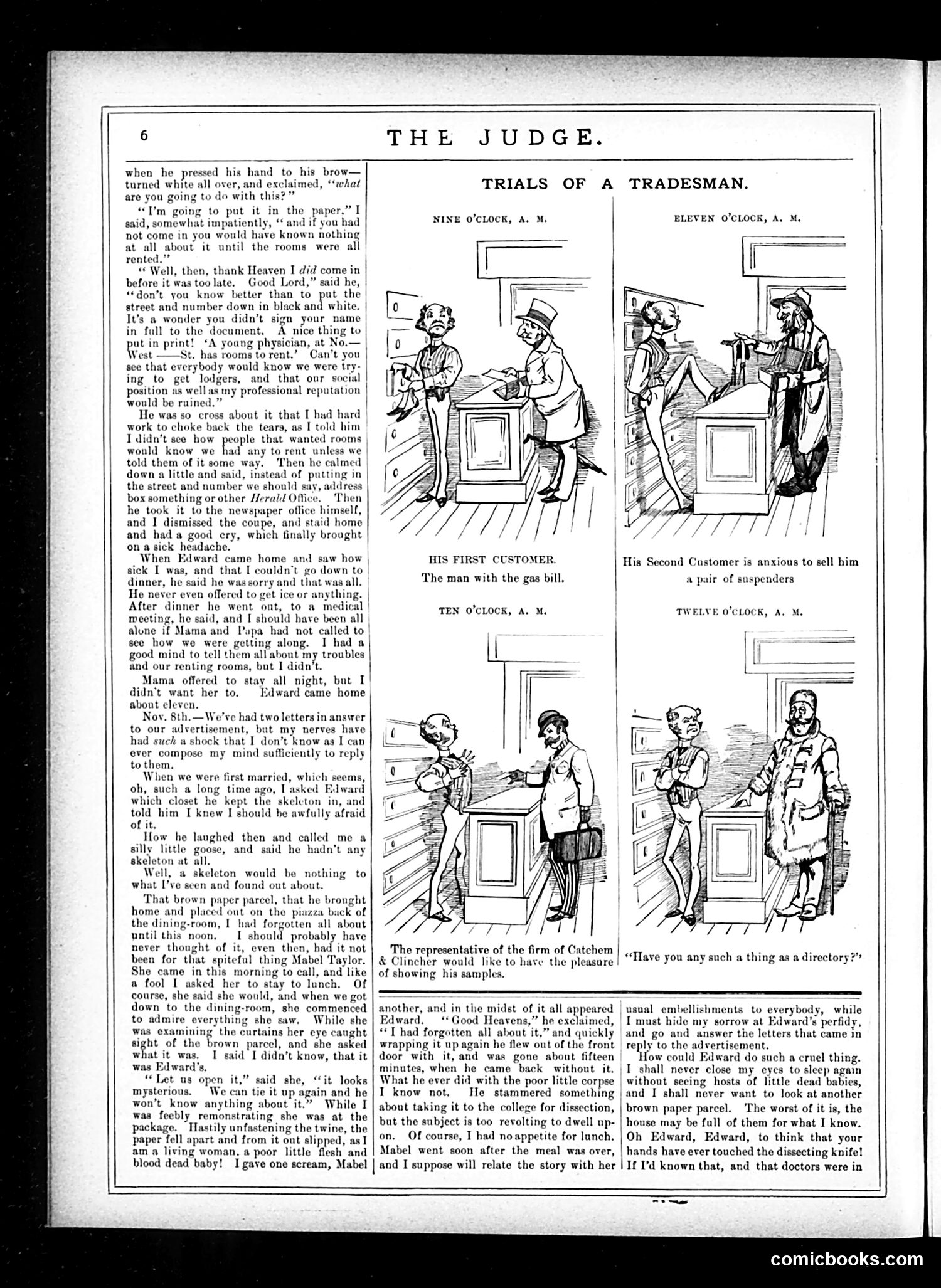
This page contains two distinct pieces: a serialized domestic drama and a visual comic strip about a young tradesman's difficult day. **The Text Story** depicts a neurotic physician's wife managing rental advertisements and discovering a mysterious dead baby in a parcel—a melodramatic narrative likely satirizing Victorian anxieties about propriety, class status, and women's nervous dispositions. The humor targets her excessive worry over social reputation and her husband's callous indifference. **The Visual Comic** shows a tradesman (likely a gas company representative or salesman) enduring increasingly difficult customer interactions throughout his morning—from 9 AM through noon. Each panel depicts a potential customer presenting obstacles: one has a gas bill complaint, another seeks suspenders, a third asks if he carries a directory. The satire mocks both the tradesman's persistent frustration and customers' petty demands and evasions. The repeated caption structure emphasizes the monotonous, grueling nature of door-to-door sales work in this era.
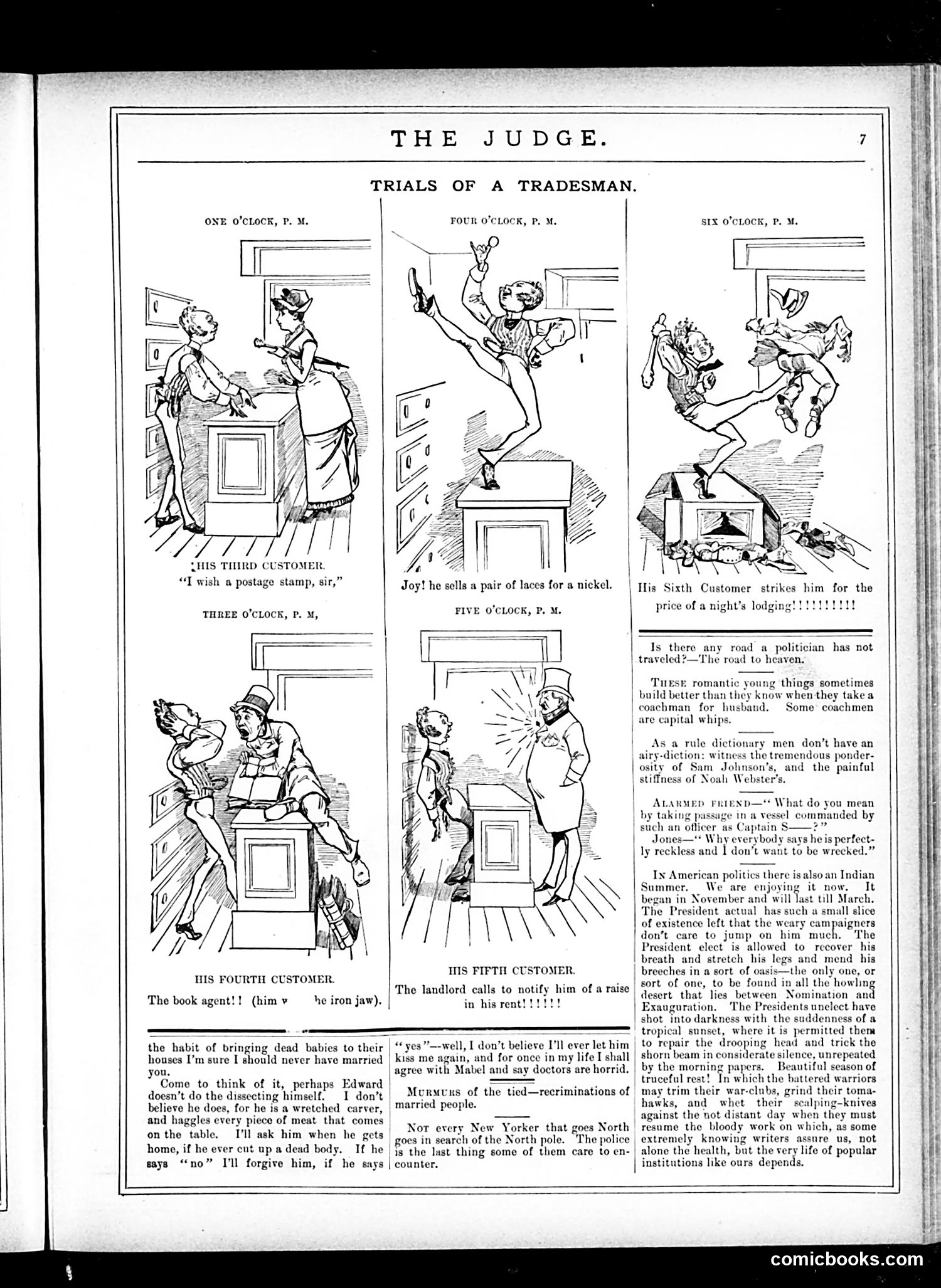
This satirical comic strip depicts a shopkeeper's increasingly frustrating day as he deals with five different customers between 1 and 6 P.M. Each panel shows a different type of annoying client: a customer wanting a single postage stamp, a pushy book agent, a woman buying cheap laces, a landlord demanding rent increases, and finally a customer striking him over lodging costs. The humor targets the indignities of retail work and working-class hardship in what appears to be late 19th-century America. The accompanying text includes unrelated social commentary—jokes about doctors, coachmen, and American politics (likely referencing the post-election period between November and March, when defeated candidates supposedly rest before campaigning resumes). The satire mocks both petty customer complaints and the exhausting cycle of urban commerce and class tensions.
This political cartoon depicts a courtroom scene titled "THE JUDGE." A robed judicial figure presides from an elevated bench while a figure below appears to be answering to charges. Various documents and papers labeled with references to financial matters or legal issues are scattered throughout the courtroom setting. The specific targets and satirical points are unclear from the visible text alone. The cartoon appears to critique some aspect of the judicial system or a particular legal proceeding, likely from the early-to-mid 20th century based on the artistic style. Without legible labels on the documents or clearer context about contemporary events referenced, the precise political or social commentary cannot be reliably determined.
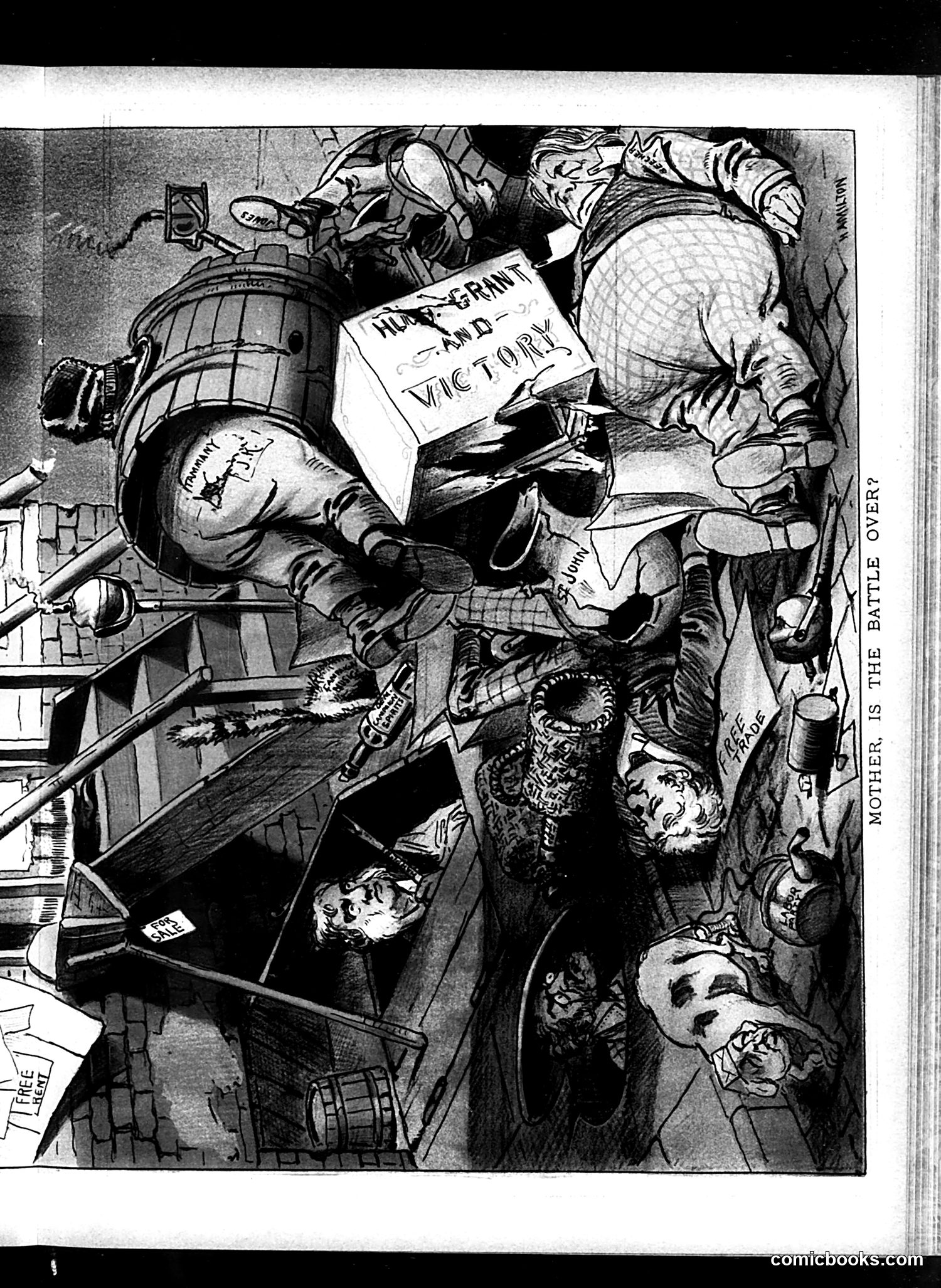
This is a WWI-era satirical cartoon titled "Mother: Is the Battle Over" depicting Germany as a wounded, defeated soldier being attended to by what appears to be a physician or caretaker figure. The central figure holds a banner reading "GERMANY—AND VICTORY," suggesting ironic commentary on Germany's failed war aspirations. The cartoon uses the metaphor of illness/injury to represent Germany's military collapse. Multiple figures surround the prone German soldier, likely representing Allied nations or forces overseeing Germany's defeat. The architectural elements and domestic setting suggest the home front impact of the war. The satire mocks Germany's optimistic pre-war rhetoric about victory while depicting the actual devastating consequences of their military defeat. This appears to reflect American perspective during or immediately after WWI's conclusion.
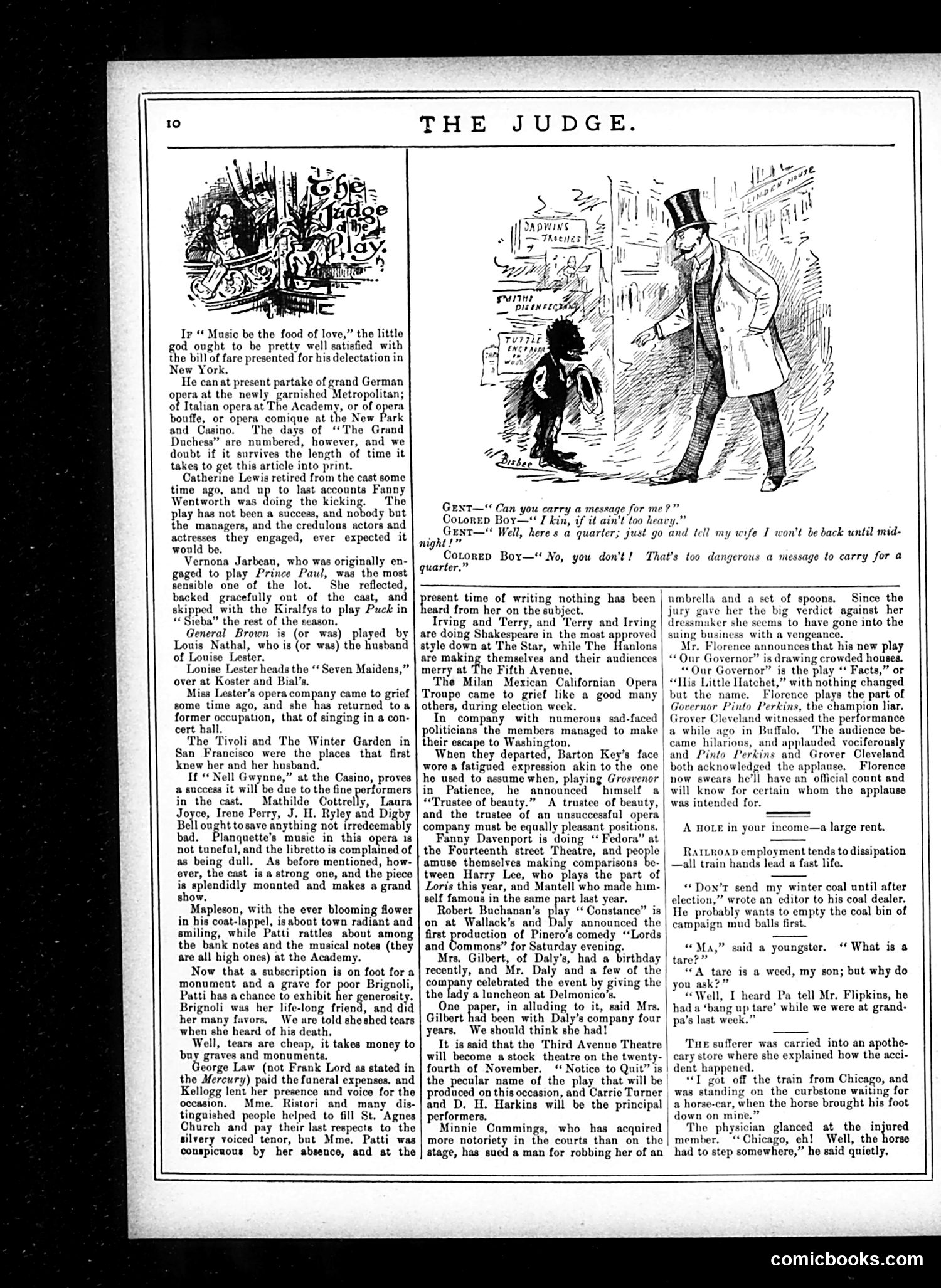
This page from *Judge* magazine contains theater criticism and a single cartoon. **The Cartoon:** A well-dressed gentleman asks a Black child to deliver a message to his wife saying he won't be home until midnight. The boy refuses, calling it "too dangerous a message to carry for a quarter." The joke relies on a racist stereotype: the implication that a message about infidelity could provoke a violent spousal response, and that a Black child would face danger delivering it—playing on both period anxieties about domestic discord and dehumanizing racial attitudes. **The Text:** The article reviews New York theater offerings—German opera at the Metropolitan, Italian opera at The Academy, and various theatrical productions. It discusses performers like Adelina Patti (a famous soprano), discusses failed productions like "The Grand Duchess," and mentions stage personalities like Mapleson. The writing is gossipy theatrical criticism typical of the era's entertainment journalism. The page reflects 1870s New York's vibrant opera and theater culture while the cartoon exemplifies the casual racism embedded in period humor.
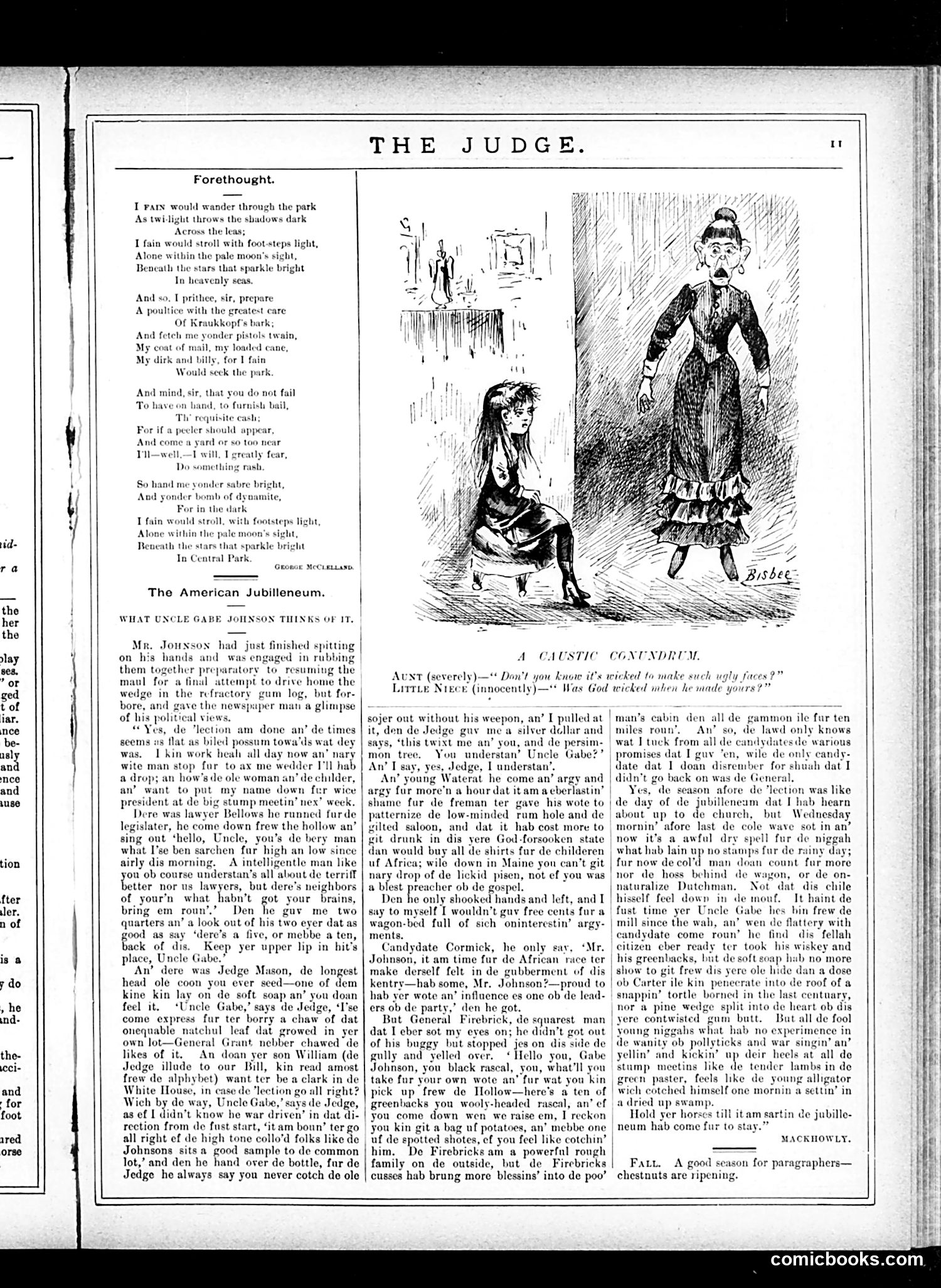
This page contains a racist caricature cartoon titled "A Caustic Conundrum" (by artist Bisbee) depicting an interaction between an "Aunt" and "Little Nicey," a Black child. The aunt scolds the child for making "ugly faces," with the caption sarcastically suggesting the child's facial expression is "wicked." The accompanying text describes Uncle Gabe Johnson's experiences during an election cycle, where white politicians (a lawyer and a judge) attempt to buy his vote and manipulate him through flattery and gifts—illustrating the corruption of Black voters during the Reconstruction/Gilded Age era. The satire targets both the grotesque racist stereotyping of Black Americans and the condescending political manipulation they faced. The magazine appears to critique electoral corruption, though the execution relies heavily on offensive racial caricature typical of late 19th-century American journalism.
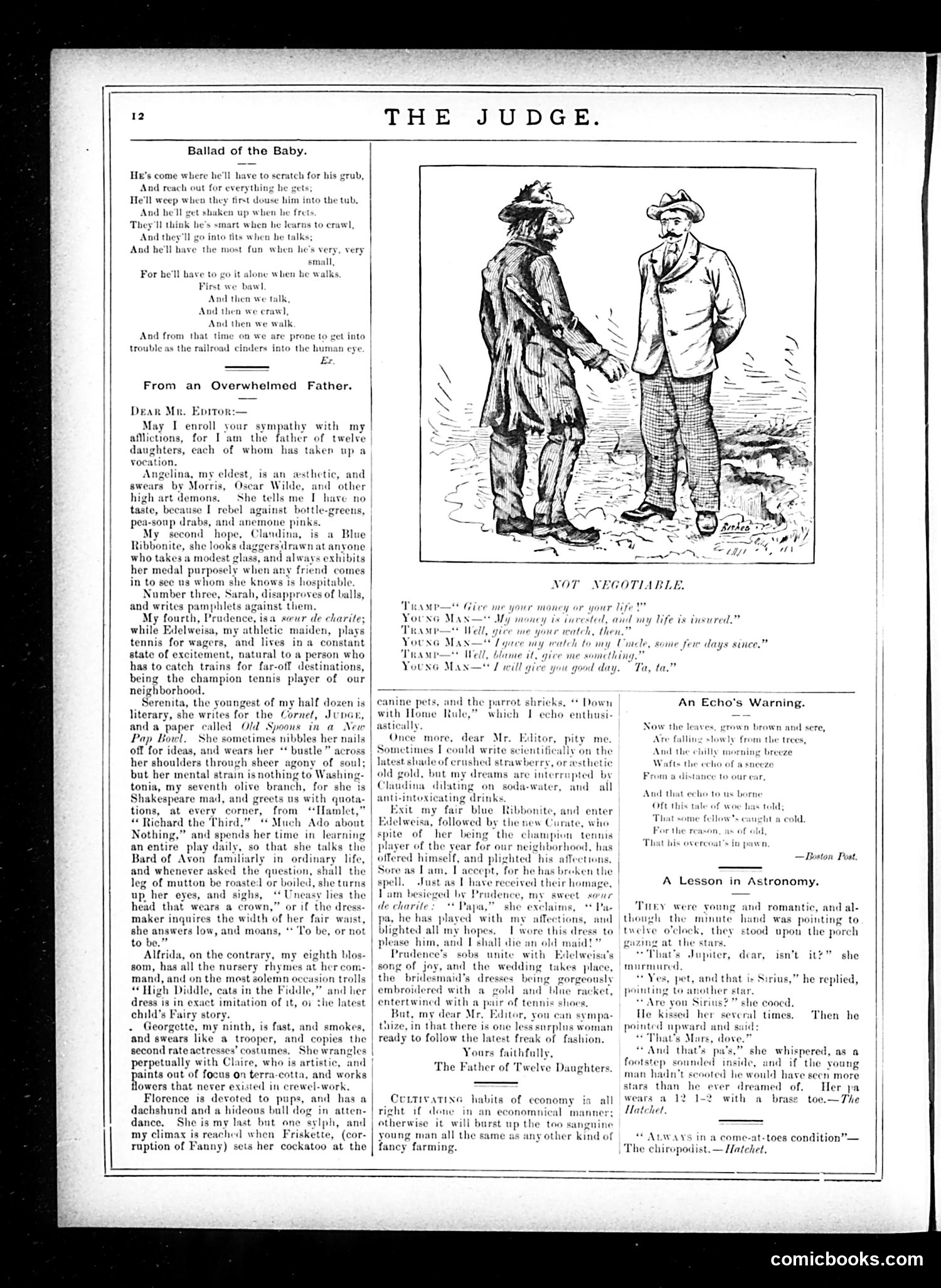
The main cartoon shows two men in conversation labeled "NOT NEGOTIABLE." A tramp attempts to rob a young man, demanding progressively: money, a watch, and "something." The young man refuses each request, citing that his money is invested, his watch was loaned to an uncle, and he has nothing else. The joke satirizes modern financial arrangements—the young man is so financially tied up in investments and loans that he literally has nothing a robber can steal. It's social commentary on urban poverty and the absurdity of wealth that exists only on paper. The "Ballad of the Baby" and letter from "An Overwhelmed Father" humorously catalog the afflictions of having twelve daughters, each pursuing fashionable but exhausting pursuits: aestheticism, temperance activism, athletic pursuits, charity work, and literary ambitions. The satire targets late-Victorian women's newfound independence and progressive causes, portraying them as sources of paternal exasperation rather than genuine concern.
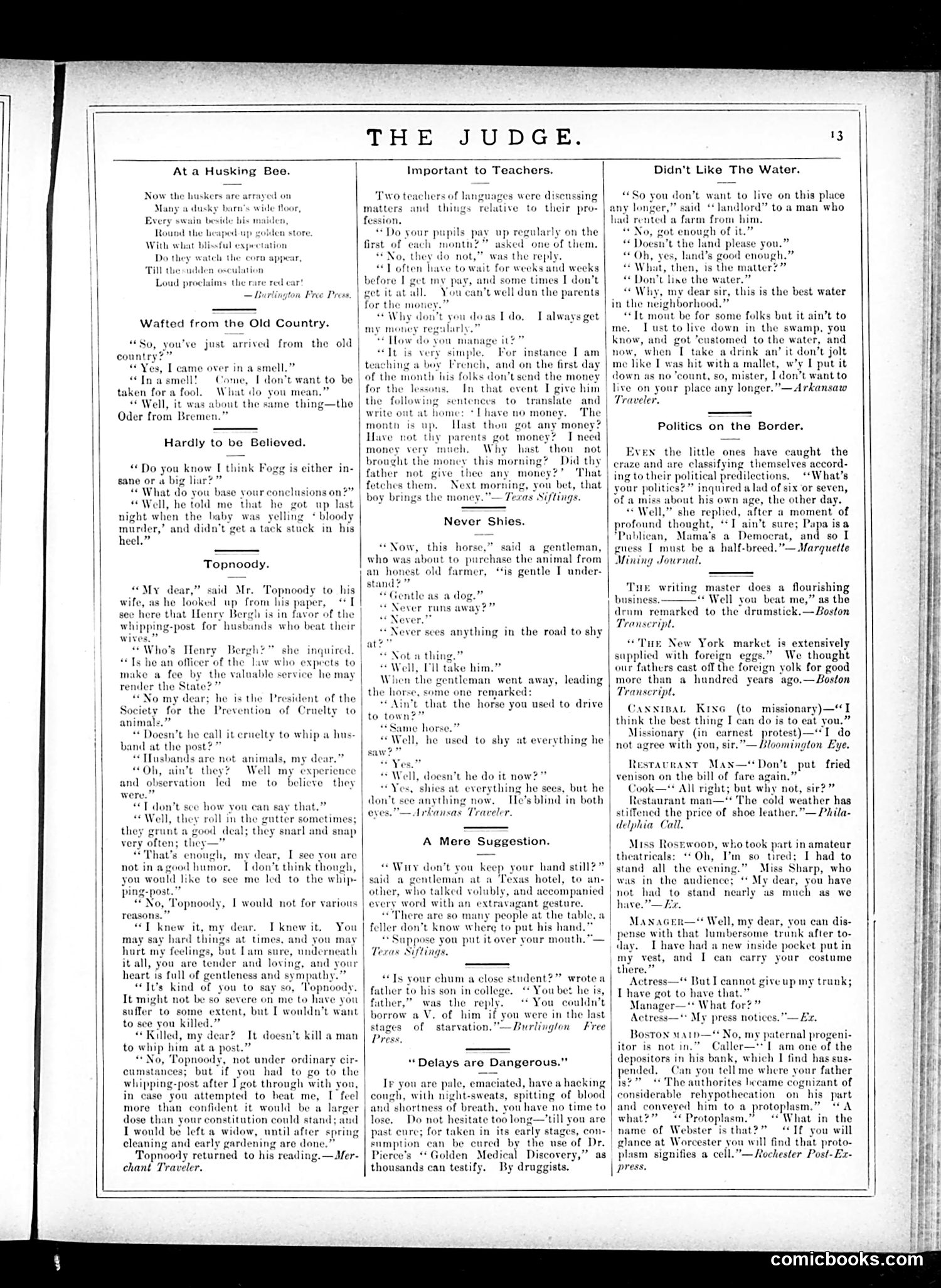
This page from Judge magazine contains six separate humorous anecdotes rather than political cartoons. The pieces satirize various aspects of American life: **"At a Husking Bee"** and **"Wafted from the Old Country"** depict rural/immigrant life comedically. **"Important to Teachers"** mocks underpaid teachers who resort to creative methods (assigning French sentences about poverty) to pressure students' families into paying tuition—commentary on economic hardship in education. **"Hardly to be Believed"** and **"Topnoody"** use domestic humor, with wives making pointed observations about husbands' animal-like behavior, satirizing gender relations. **"Never Shies"** and remaining pieces are light anecdotal humor about everyday situations. The overall tone reflects Judge's role as a satirical weekly addressing social conditions—underpaid workers, class anxieties, rural life, and domestic tensions—through comedy rather than explicit political commentary. The magazine targeted educated, middle-class readers who appreciated witty observation of contemporary American society.
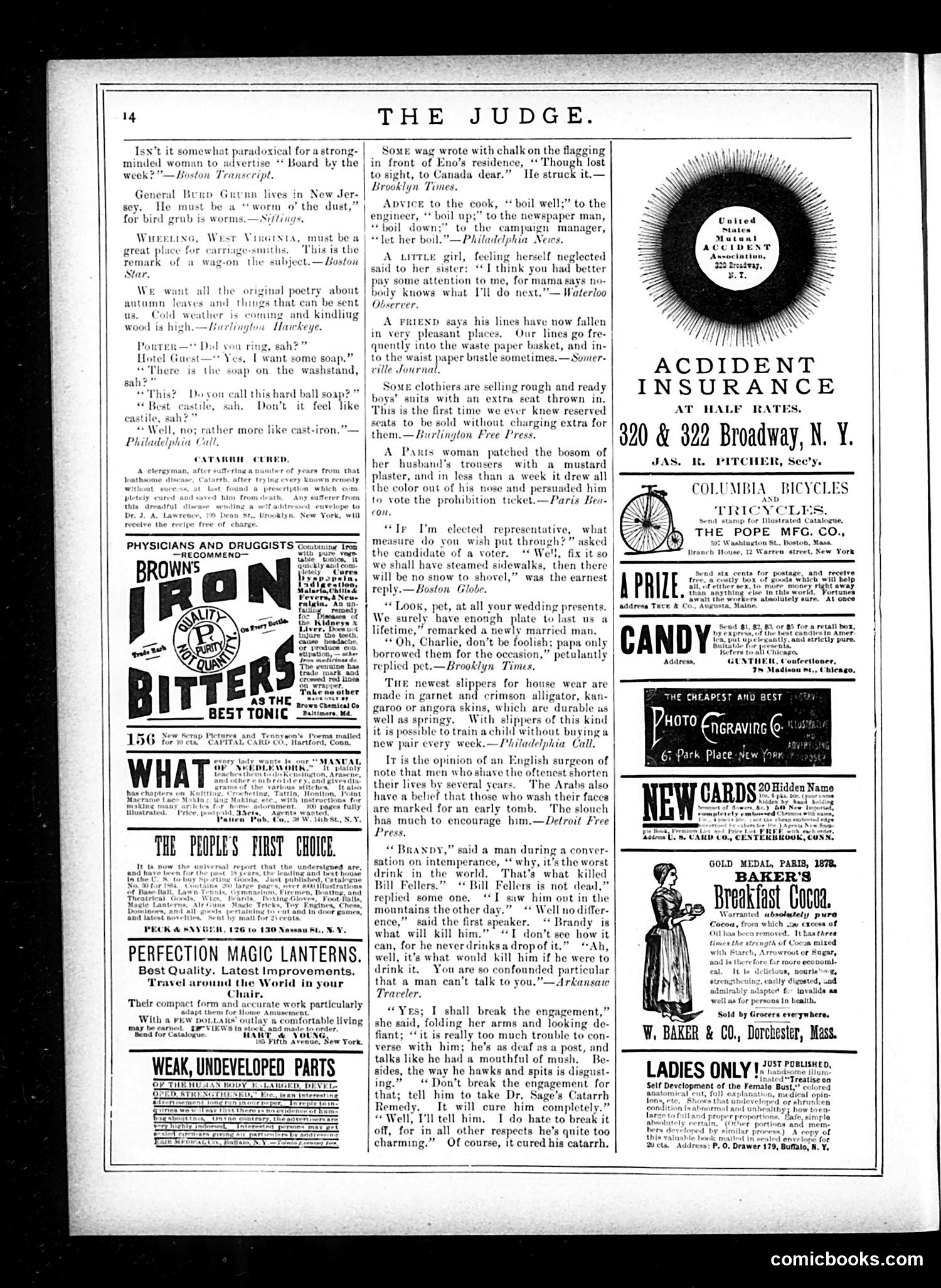
This page is primarily **advertisements and filler humor** rather than political cartoons. The content consists of: **Humorous anecdotes** (the main text): Short jokes and witty remarks on various topics—marriage, politics, clothing, temperance—typical of Judge's satirical style. These include a quip about General Burp Greene being "a worm of the dust," wordplay on "carriage-smiths" and "wagon," and a lengthy anecdote mocking a man's illogical claim that brandy will kill someone even if they never drink it. **Advertisements**: Prominent ads for Brown's Iron Bitters, magic lanterns, bicycles, cocoa, photograph engraving services, and patent medicines—reflecting late-19th-century consumer culture. **Visual element**: A circular seal for "United States Mutual Accident Association" appears prominent. The humor reflects Victorian-era concerns: temperance debates, marriage dynamics, gender roles, and the absurdity of everyday logic. No specific political figures are clearly identifiable on this page. The content is representative of Judge's general satirical approach to American social life.
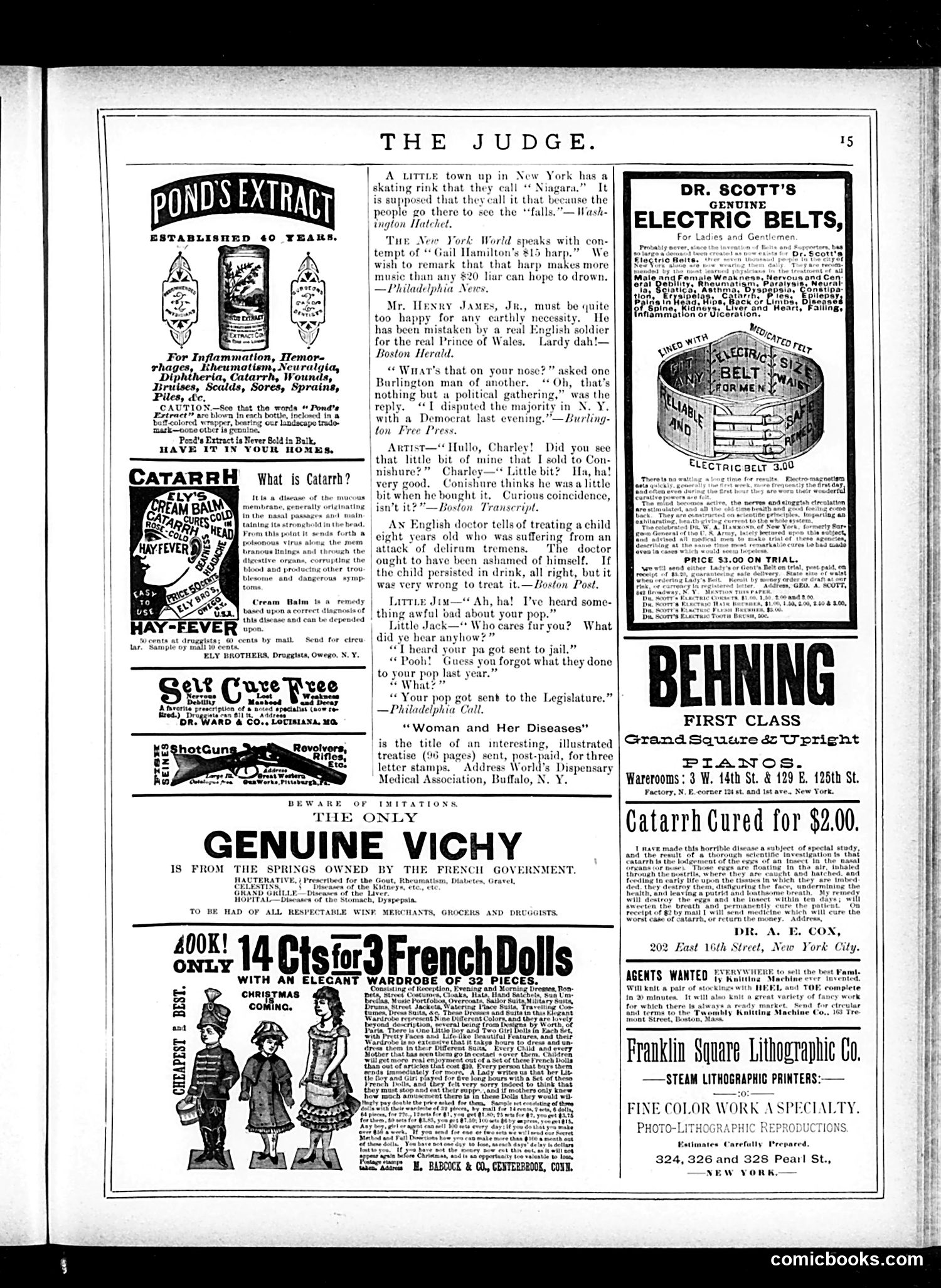
This page is primarily **advertising**, with only brief satirical commentary interspersed. The main content consists of patent medicine and commercial advertisements typical of the era. The satirical snippets are brief jokes about contemporary topics: - A jab at the **New York World newspaper** for criticizing Gail Hamilton's harp, suggesting the World itself is full of lies ("liars") - A dig at **Henry James Jr.**, implying he's socially confused or pretentious - Political humor about **Democrats vs. Republicans**, with a joke equating political disputes to physical fights - A joke about **legislative corruption**, comparing being "sent to the Legislature" unfavorably to jail The advertisements showcase period remedies: Pond's Extract (for various ailments), hay fever cream, Vichy water (French spring water), Dr. Scott's "Electric Belts" (pseudoscientific devices claiming to cure ailments), and Behning pianos. These ads reflect how 19th-century magazines monetized readers' credulity about medical "cures." The page lacks a coherent political cartoon; instead, it's a typical Judge issue mixing light social commentary with aggressive marketing.
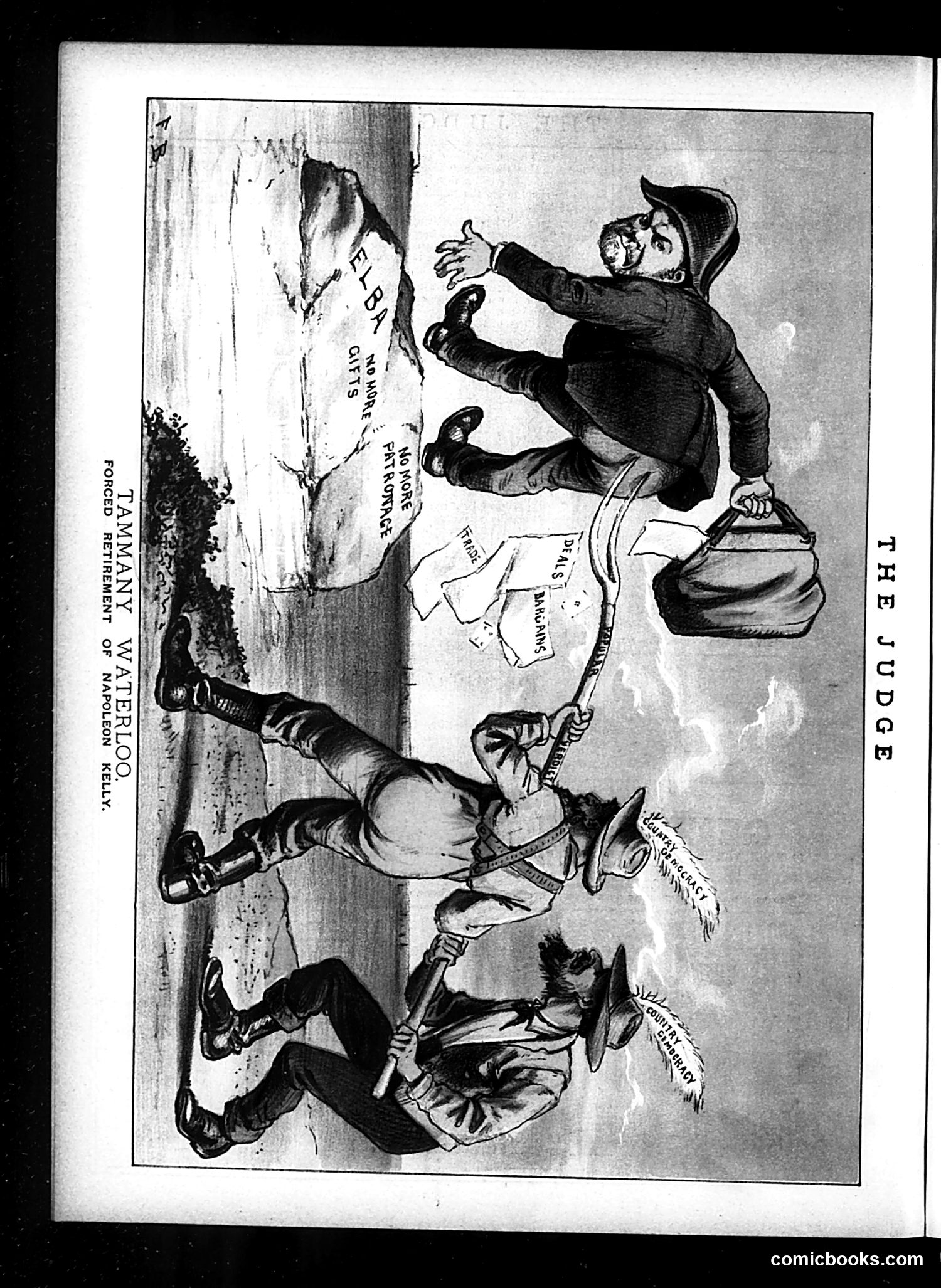
This political cartoon satirizes the forced retirement of a figure called "Napoleon Kelly" from Tammany Hall, the powerful Democratic political machine that controlled New York City politics. The image depicts Kelly as Napoleon Bonaparte, comically fleeing defeat—his "Waterloo" moment. He's shown in exaggerated distress, being ejected or forced out, with labels referencing political "patronage" and "wires" (backroom dealings). The caricature compares Kelly's fall from Tammany power to Napoleon's ultimate military defeat. The satire mocks both Kelly's inflated self-importance (positioning himself as a great military leader) and Tammany Hall's corrupt patronage system. The cartoon celebrates his removal from influence, suggesting the political machine's grip on power was finally breaking. Without the publication date visible, the specific historical context of Kelly's retirement remains unclear.