
A complete issue · 16 pages · 1884
Judge — October 25, 1884
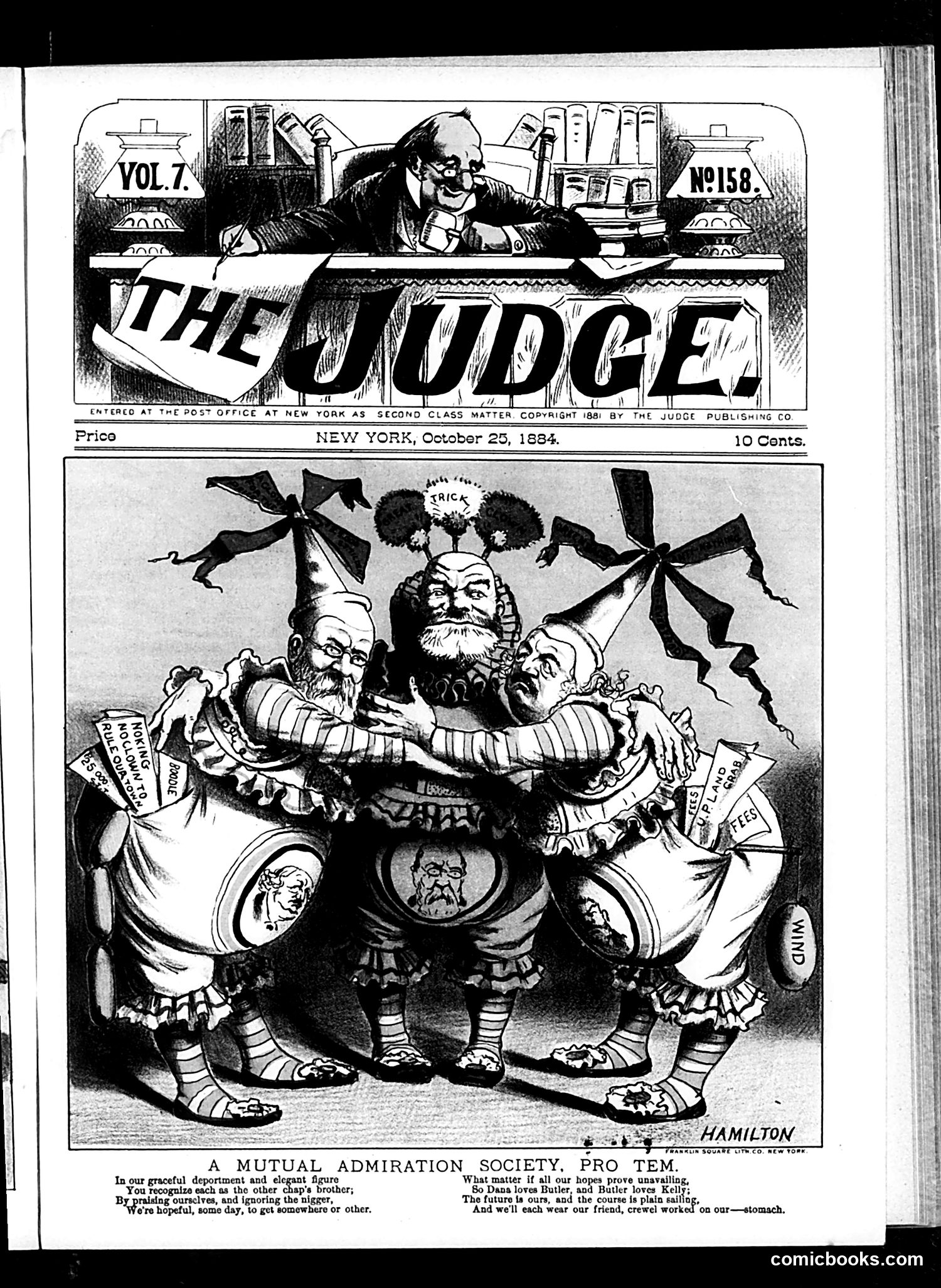
This October 1884 cartoon satirizes political rivals displaying false friendship. The three caricatured figures with exaggerated features embrace while wearing decorative ribbons and bows, suggesting performative celebration. The text beneath mocks their insincere admiration: politicians praising each other publicly while harboring private contempt. The references to "Dana loves Butler, and Butler loves Kelly" and "The love is mutual, we'll swear" indicate these are likely prominent political figures of the 1884 election period. The stomach medallions showing additional faces suggest the hypocrisy runs deeper—hidden agendas beneath surface cordiality. The artist (Hamilton, signed lower right) critiques the performative nature of political alliances, where rivals temporarily embrace for tactical advantage during campaign season, then presumably return to opposition.
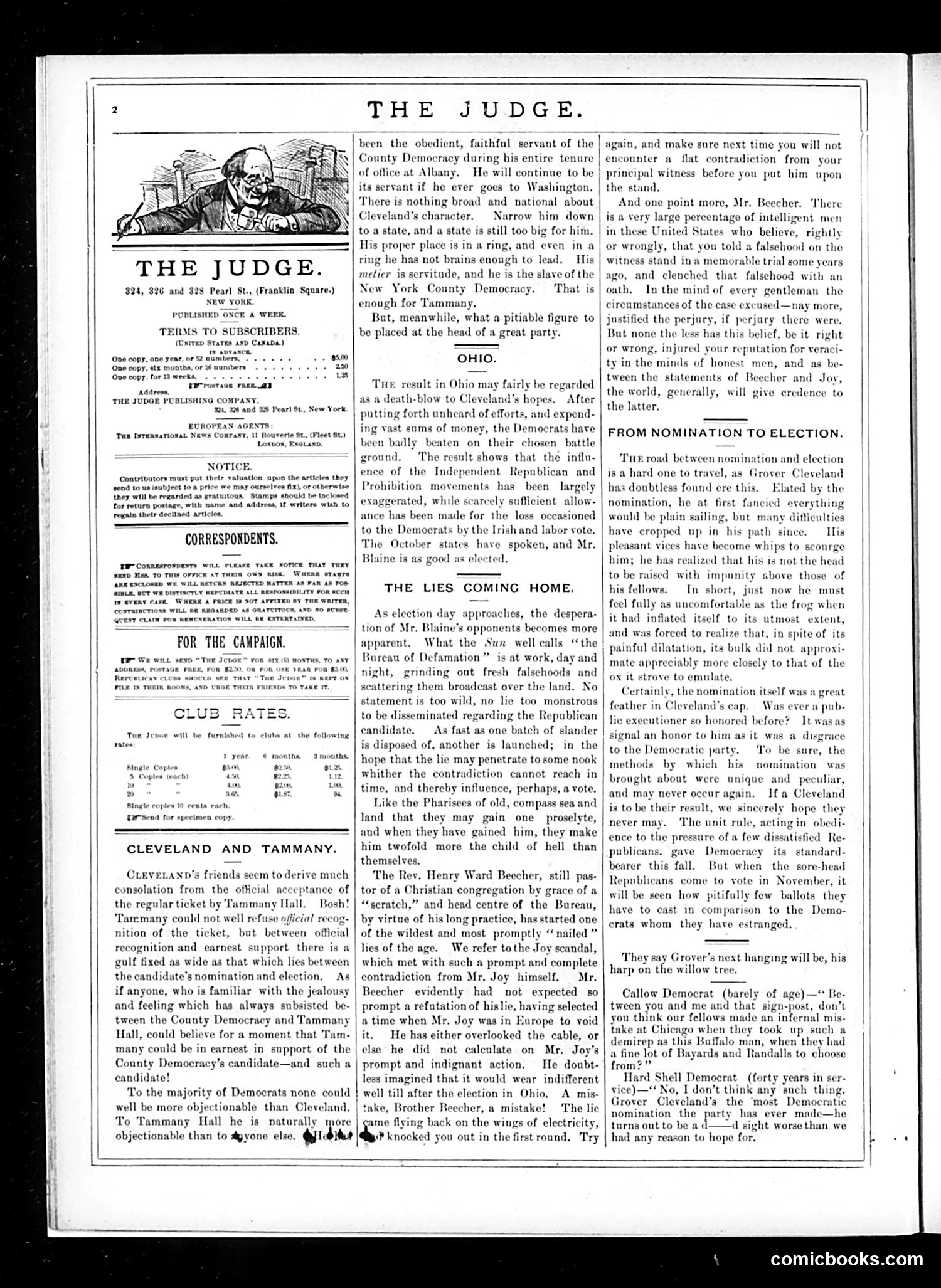
This page is primarily **editorial and administrative content** rather than a political cartoon. The masthead cartoon (top left) shows a judge figure but serves only as the magazine's logo. The substantive content consists of **three opinion pieces** supporting the Republican ticket (Blaine/Logan) against Democrat Cleveland: 1. **"The Judge"** attacks Cleveland as a narrow, local politician unfit for national office—merely a servant of New York's Tammany Hall machine. 2. **"Ohio"** celebrates Republican victory in Ohio as a "death-blow to Cleveland's hopes," suggesting Blaine's election is assured. 3. **"The Lies Coming Home"** accuses Democrats of spreading false propaganda through what the Sun called the "Bureau of Defamation." The **context**: This appears to be from the 1884 presidential campaign. Judge magazine was Republican-leaning and actively campaigned for Blaine against Cleveland, whom they portrayed as a tool of corrupt urban Democratic machines rather than an independent reformer.
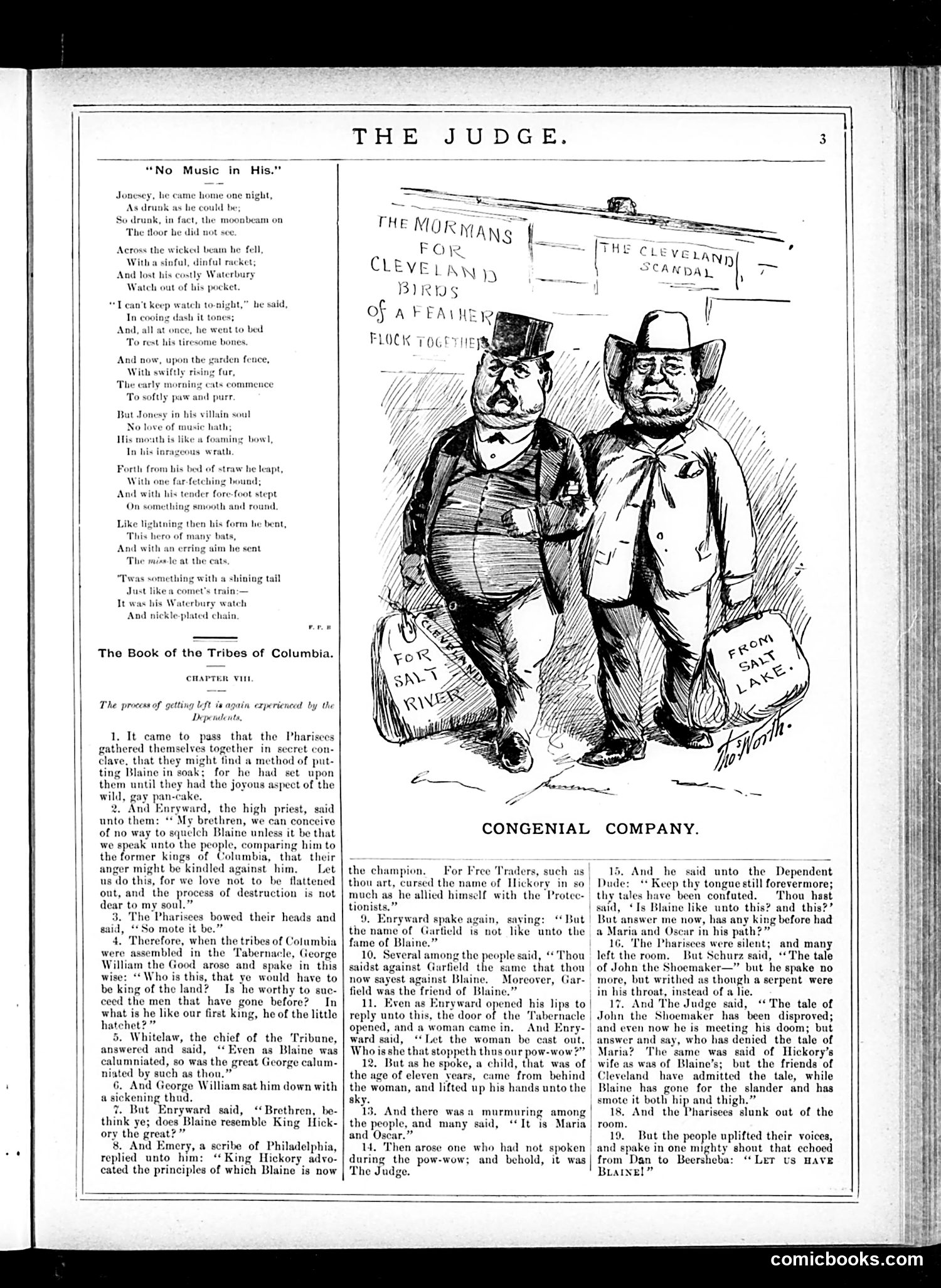
This 1884 Judge magazine page contains political satire about the presidential election, likely between James G. Blaine (Republican) and Grover Cleveland (Democrat). **The Main Cartoon** ("Congenial Company") depicts two men labeled for Salt River and Great Lake, representing Mormons and Cleveland scandal supporters—groups mocked as politically aligned. The text references "The Mormans for Cleveland" and "The Cleveland Scandal," suggesting satire about Cleveland's supporters. **The Parody Text** ("Book of the Tribes of Columbia") uses biblical language to mock Democratic politicians debating how to defeat Blaine. "Pharisees" represents Democratic operatives; Whitelaw (likely Whitelaw Reid), Enryward, and Schurz are real political figures. The punchline references "Maria and Oscar"—Cleveland's illegitimate child scandal—which haunted his campaign. The Judge argues this damaging fact cannot be countered by comparisons to previous presidents. The satire ridicules Democrats' inability to defend their candidate against personal misconduct allegations.
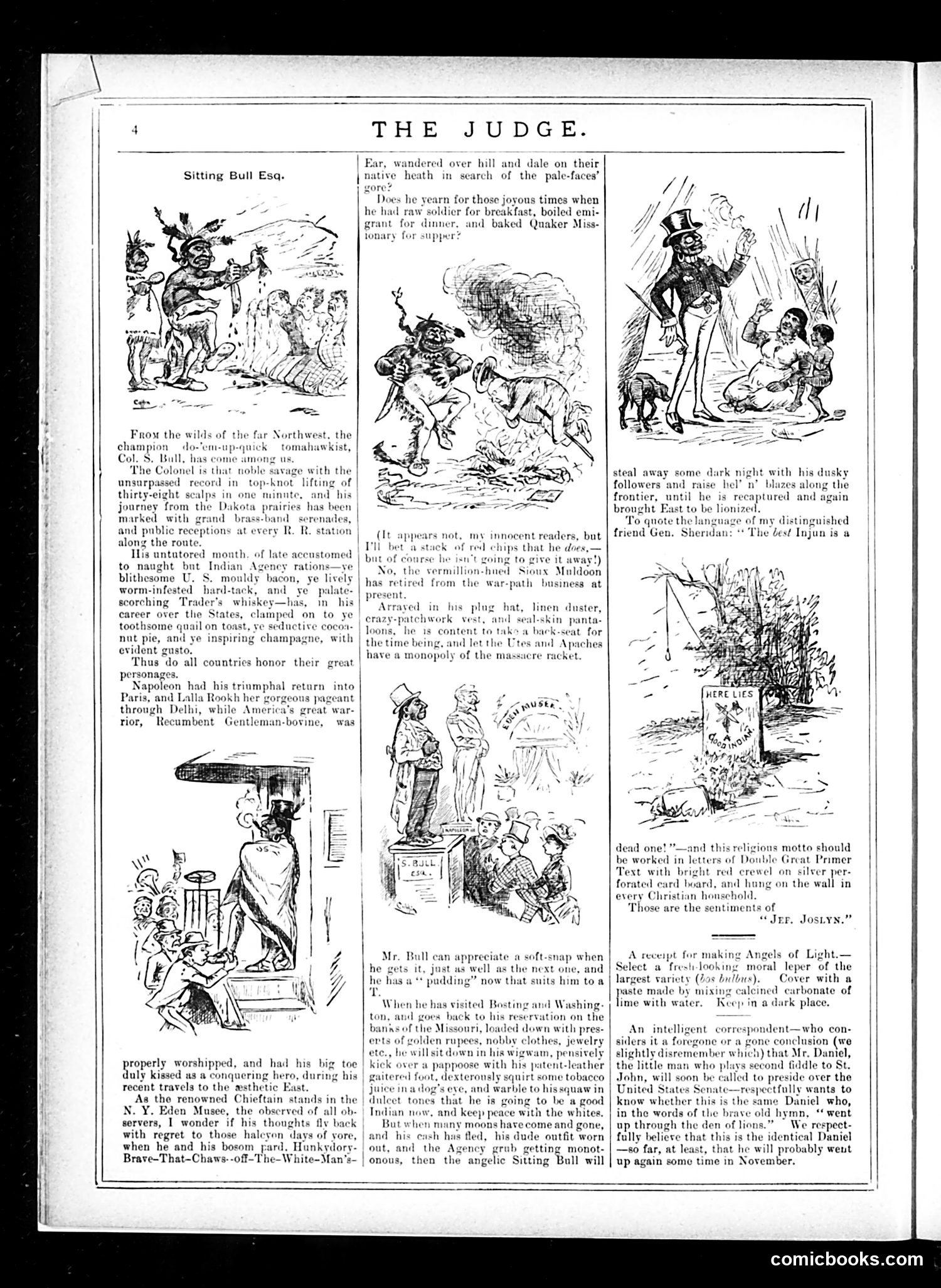
This page mocks **Sitting Bull**, the Lakota leader, following his capture and exhibition in America (likely his 1885 tour). The satire presents him as a "civilized" guest being feted across the US—compared ironically to Napoleon's triumphal returns—while implying his reformation is temporary theater. The cartoons depict Sitting Bull's transformation: dressed in fine clothes, enjoying refined foods (quail, champagne) instead of "army rations," and being lionized in museums like Eden Musée. However, the text sarcastically suggests this is performative. Once his money runs out and "Agency grub" becomes monotonous, the writer predicts he'll inevitably return to frontier violence. The satire hinges on the period's racial contempt: Native Americans are inherently savage and cannot genuinely assimilate, regardless of surface civility. General Sheridan's quote—"The best Injun is a dead one"—reflects the genocidal ideology underlying the "joke." The secondary items are editorial filler typical of Judge's format.
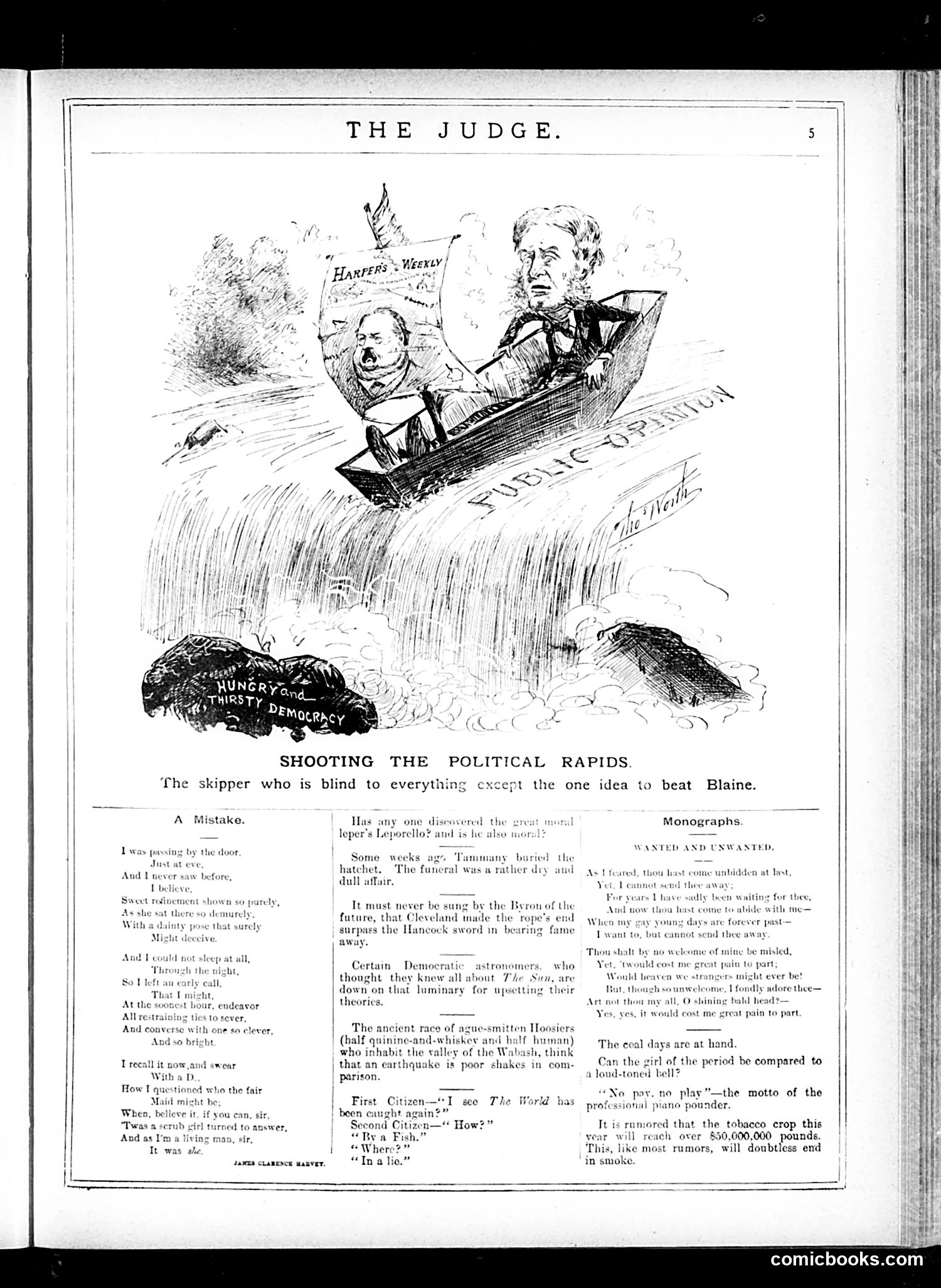
This Judge cartoon satirizes the 1884 presidential election, depicting two figures in a boat labeled "Public Opinion" plunging over rapids labeled "The North." The "skipper" appears to be a political operative blindly fixated on one goal: defeating James G. Blaine, the Republican presidential candidate. The satire targets Democratic single-mindedness—the cartoon suggests that in their obsession with beating Blaine, Democratic leaders ignore broader political consequences and public welfare (represented by the dangerous rapids). References to Cleveland, Hancock, and The Sun indicate this reflects the contentious 1884 campaign. The accompanying poems and miscellaneous pieces are typical Judge filler content. The cartoon's central argument: partisan tunnel vision causes reckless political navigation.
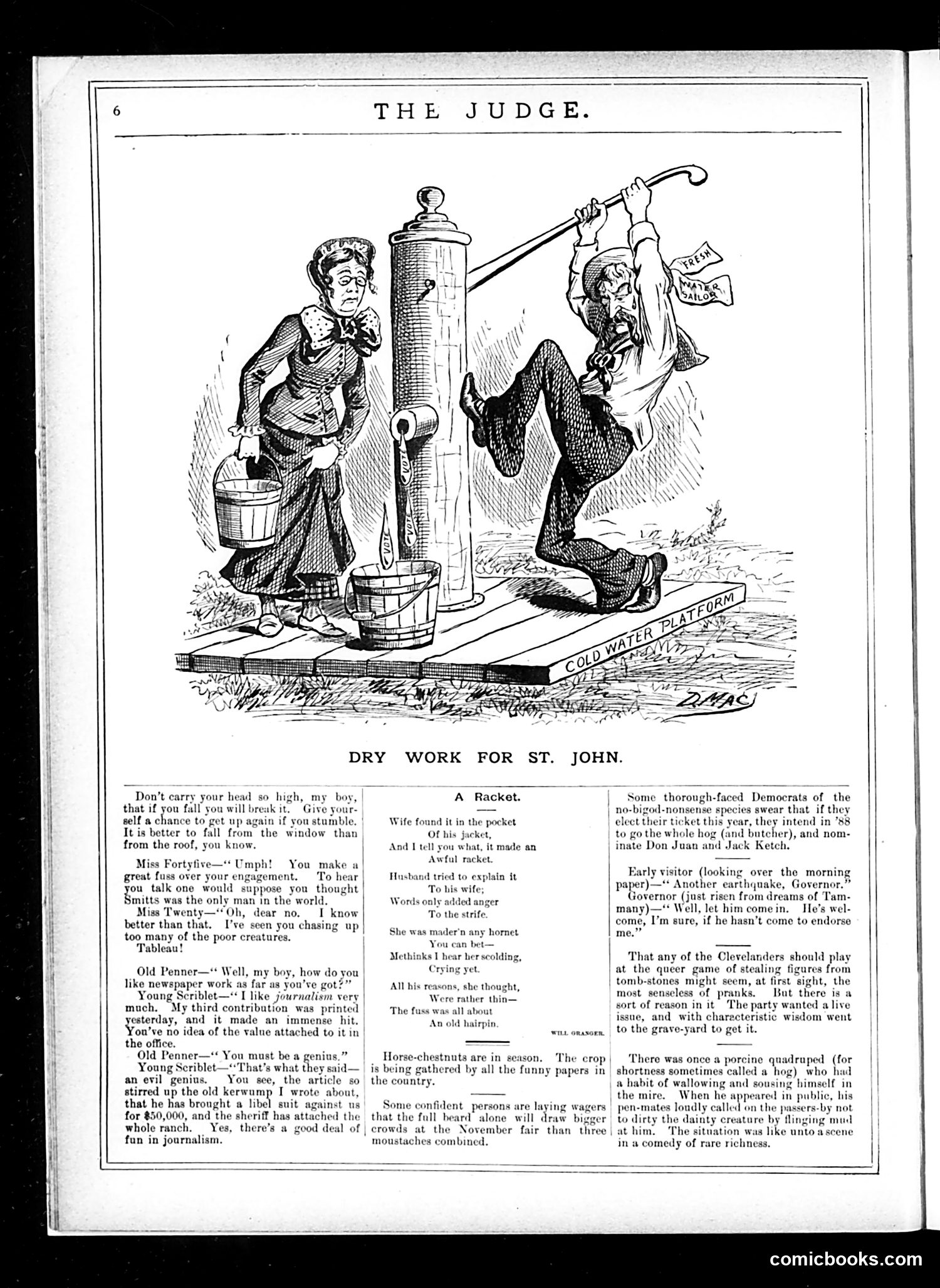
This satirical page contains multiple short humor pieces typical of 1880s Judge magazine: **Main Cartoon ("Dry Work for St. John"):** Depicts a woman operating a pump labeled "Cold Water Platform" on a man, likely referencing St. John (possibly a political figure associated with temperance or prohibition). The "cold water" is satirical—the cartoon mocks reformers' methods. **Short Jokes:** The page includes social commentary: - A jab at newspaper journalism's frivolity (a libel suit over a trivial article) - Domestic humor about a suspicious hairpin in a jacket pocket - Political mockery of Democratic candidates proposing radical figures ("Don Juan and Jack Ketch") **The Hog Allegory:** The final lengthy anecdote about a pig wallowing in mud appears to mock Cleveland Democrats—suggesting they deliberately create scandals to have political "issues" to fight, comparing it to people complaining about the pig's dirtiness rather than simply leaving it alone. The overall tone is typical late-19th-century partisan American satire, mixing domestic humor with political commentary.
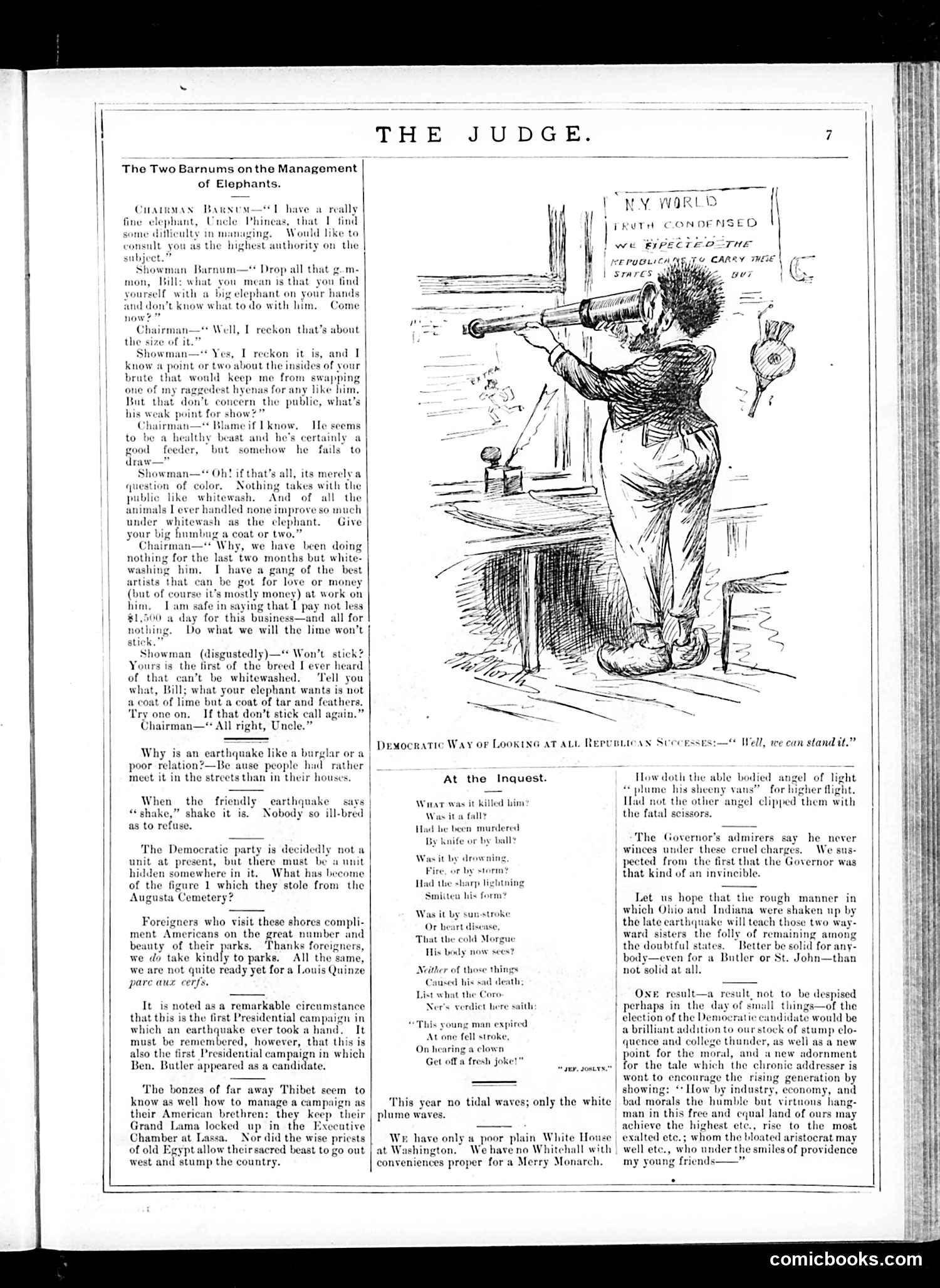
This page from *Judge* magazine contains political satire on multiple topics: **"The Two Barnums on the Management of Elephants"**: A dialogue between two showmen (likely P.T. Barnum and a relative) about managing an elephant. The joke hinges on the metaphor—the "elephant" represents a political problem (appears to be a Democratic Party reference). The repeated failures of whitewashing (covering up problems) satirizes political attempts to hide scandals or weaknesses. The punchline suggests only tar-and-feathers will work, implying harsh public accountability is needed. **"At the Inquest"**: A mock-serious poem about a death caused by "hearing a clown / Get off a fresh joke"—satirizing poor-quality political humor or Democratic campaign rhetoric, suggesting it's literally killing public enthusiasm. **Other brief items** mock Democratic Party disunity and criticize American foreign policy toward Egypt and India. The overall tone ridicules Democratic Party management and credibility during what appears to be an election period.
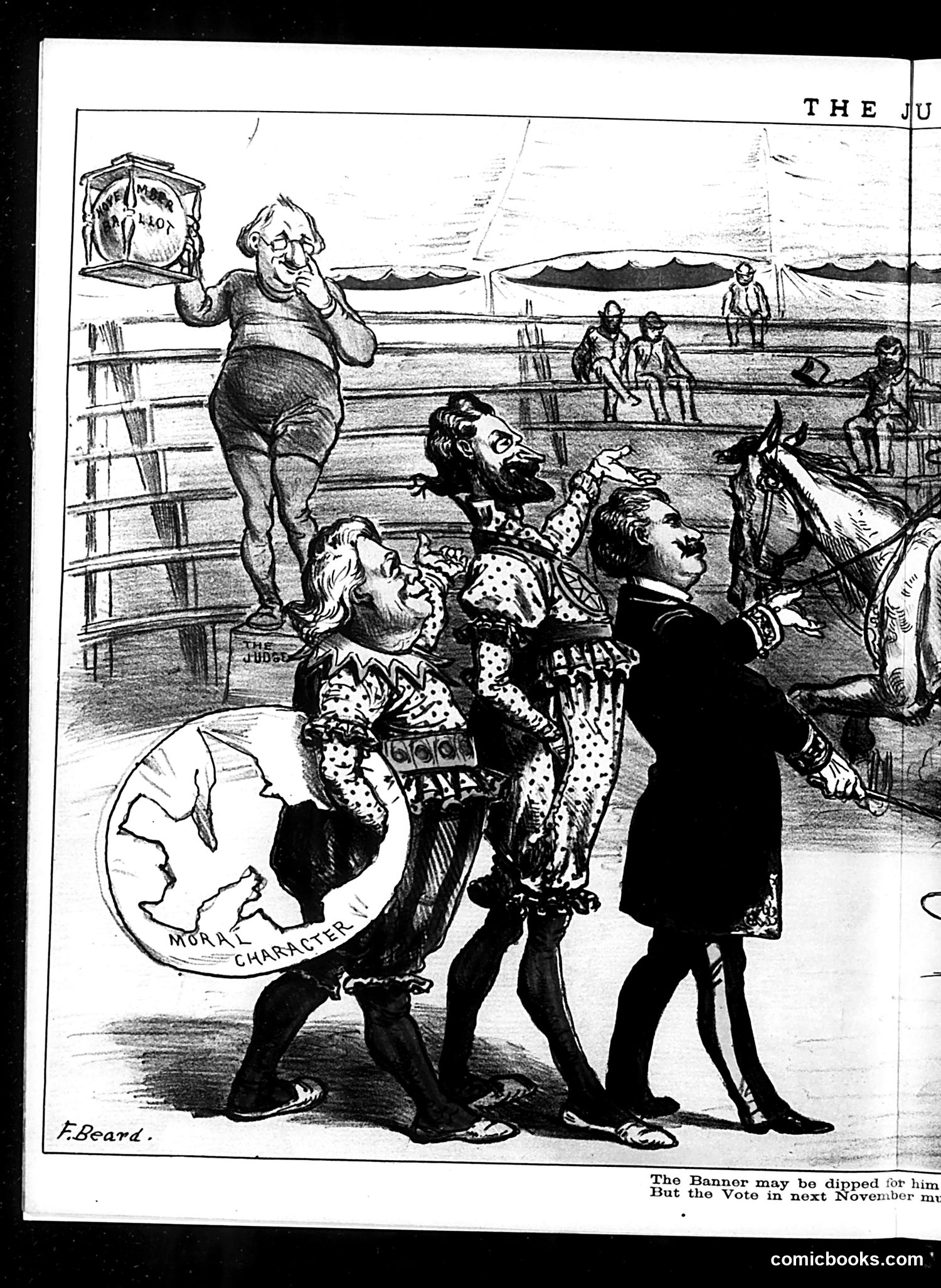
This is a satirical cartoon by F. Beard depicting what appears to be a political figure (caricatured with exaggerated features) being paraded or displayed before spectators at what looks like a fair or public event. The figure labeled "MORAL CHARACTER" is being presented like a carnival attraction or sideshow. The caption's incomplete text references a "Banner" being "dipped" and voting in "next November," suggesting this is election-related satire. The cartoon mocks a political candidate, implying that while supporters may wave banners and show public support, the actual vote outcome in the upcoming election remains uncertain—playing on the gap between public display and genuine electoral support. The rural/fair setting emphasizes the performative nature of political campaigning.
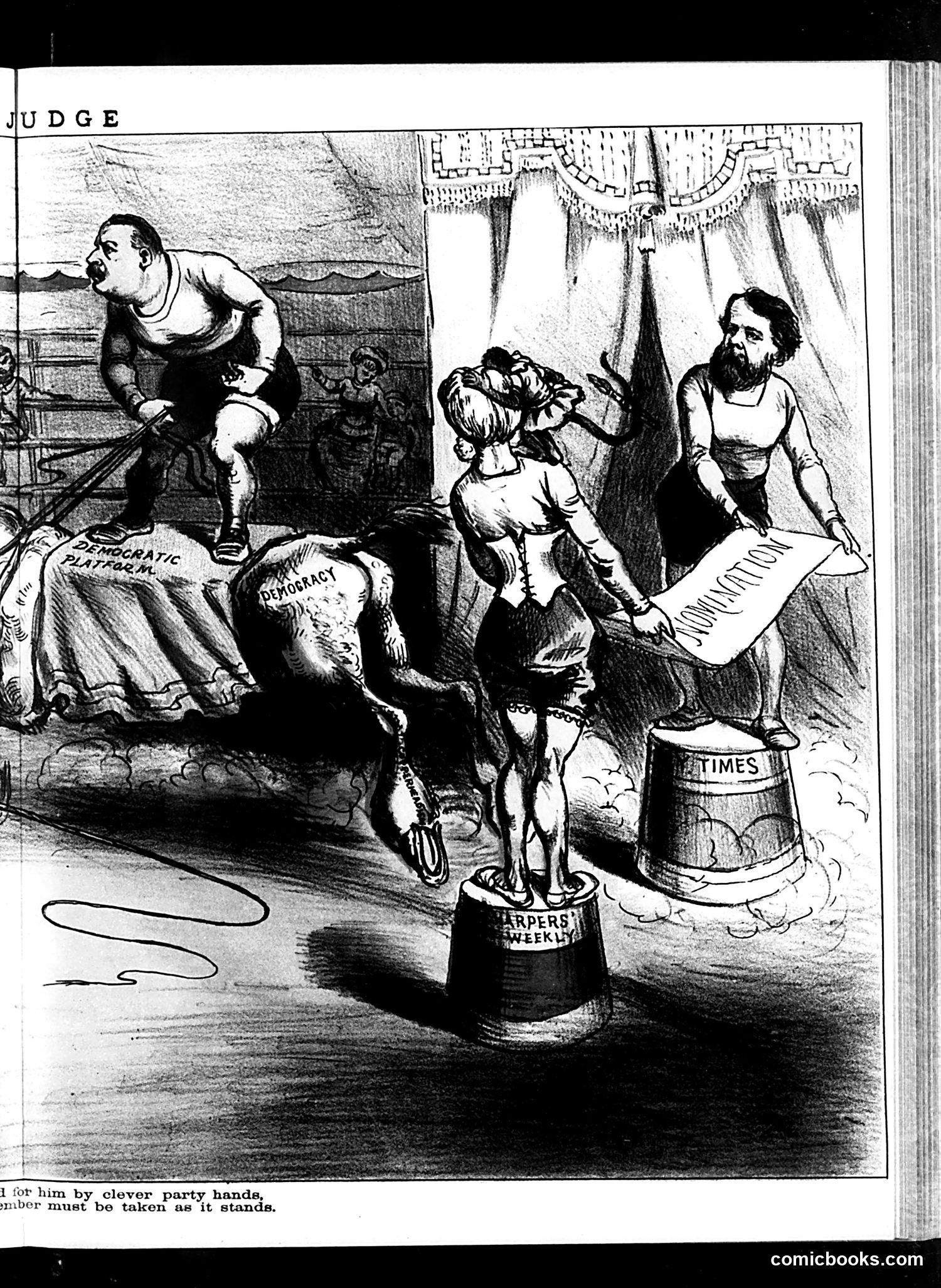
This political cartoon depicts a circus-like scene labeled "JUDGE" at the top. A portly figure stands on a platform labeled "DEMOCRATIC PLATFORM," while below, a child figure stands on "HARPER'S WEEKLY" (a competing publication). Two women represent "DEMOCRACY" and "TIMES," appearing to be manipulating or controlling the scene like circus performers. The satire critiques Democratic Party politics as theatrical spectacle, suggesting party handlers ("clever party hands," per the OCR text) manipulate proceedings artificially. The competing publication Harper's Weekly is mocked as equally complicit in this performance. The overall message attacks the artificiality of party politics and media coverage during what appears to be a 19th-century election period, treating serious democratic processes as mere entertainment or circus acts controlled by unseen powers.
This page from *Judge* contains theatrical reviews and gossip rather than political cartoons. The small illustrated header shows "The Judge of the Day" observing theatrical scenes. The content critiques New York's opera and theater scene circa the 1880s-90s. Key figures mentioned include: - **Dr. Leopold Damrosch**: A conductor arriving to direct the Metropolitan Opera House, expected to implement high prices and "high Dutch" standards - **Mapleson**: A perpetually financially troubled opera manager - **Patti and Nilsson**: Famous prima donnas whose potential appearance is discussed The satire mocks the pretentiousness of high society opera culture—expensive ticket prices, elaborate decorations, and temperamental stars. There's particular humor about the "Milan Grand Italian Opera Company" from Mexico recycling the same old operas (*Trovatore*, *Rigoletto*) at cheaper prices, suggesting elite opera's disconnect from actual artistic merit. References to "climate proof" singers and other absurdities lampoon theatrical self-importance. The tone is generally satirical toward both opera management's greed and society's snobbish devotion to expensive entertainment.
This page contains political satire centered on **Benjamin Butler**, a controversial Civil War general and politician. The main article describes a scene where a traveler arrives at a Maine inn and identifies himself as Ben Butler after the locals express enthusiastic support for him as a potential presidential candidate. The joke satirizes **gullibility**—the locals had sworn to support Butler, mortgage their farms, and celebrate his candidacy, but flee quietly once confronted with the actual man. The closing editorial question explicitly mocks Curtis and Beecher (prominent public figures) for believing Morril Lepper fit for president, questioning whether this requires more gullibility than the public believing Curtis and Beecher themselves believe it. The satire targets Butler's political appeal and voter naiveté during what appears to be an election period, while questioning the judgment of influential contemporary intellectuals.
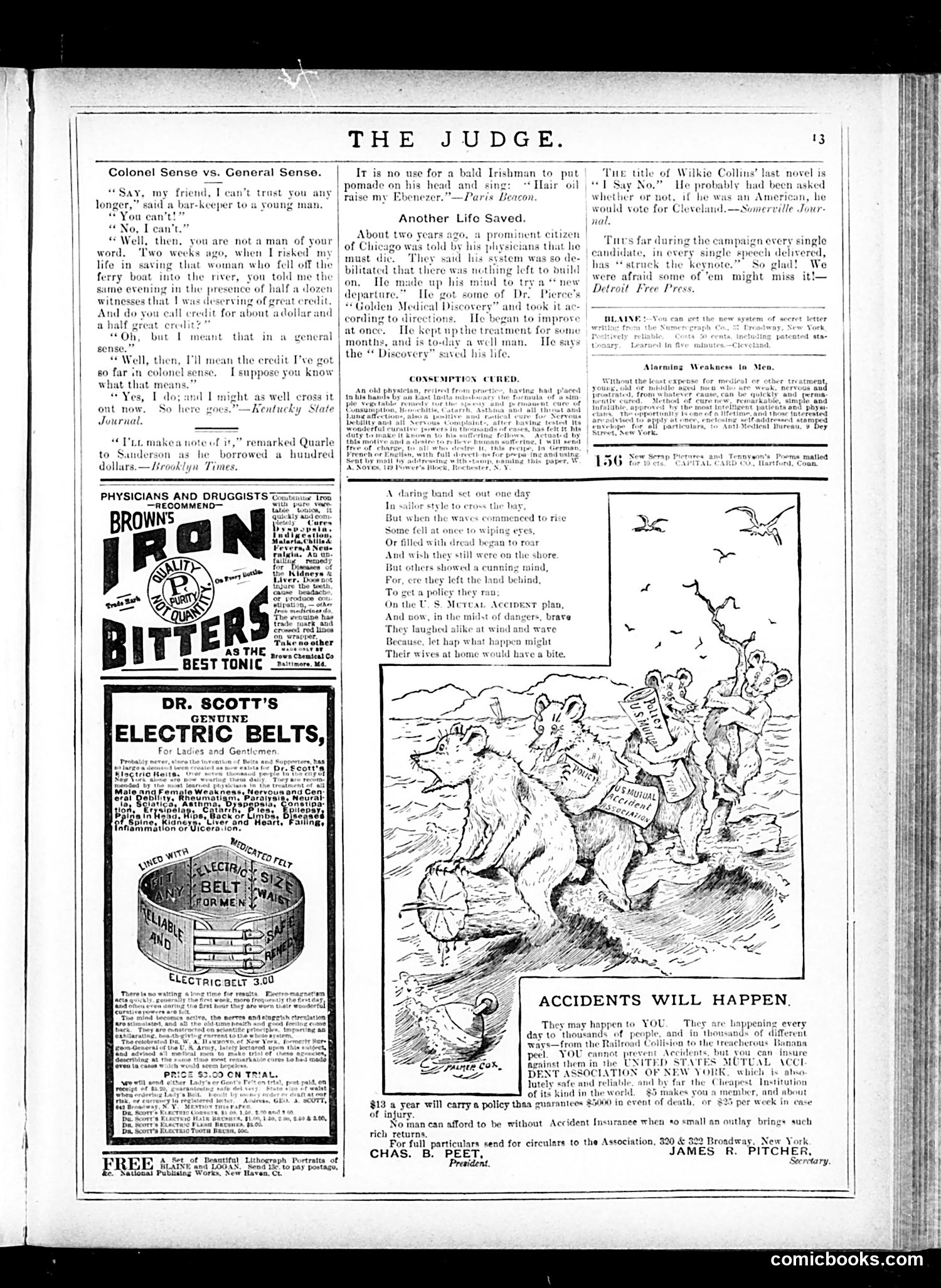
This page from Judge magazine contains several satirical pieces and advertisements typical of late 19th-century American humor: **The Cartoons:** The main illustrated cartoon depicts bears attempting to cross water to obtain life insurance policies—a darkly humorous commentary on accident insurance. The accompanying verse mocks people rushing to insure themselves against disasters, suggesting the absurdity of seeking financial protection through insurance rather than prevention. **The Anecdotes:** Brief satirical stories mock human behavior: "Colonel Sense vs. General Sense" ridicules Irish stereotypes; "Another Life Saved" parodies patent medicine testimonials (likely Dr. Pierce's "Golden Medical Discovery," a popular nostrum of the era). **The Advertisements:** Dr. Scott's Electric Belts and Browne's Iron Bitters represent period quack medicine—devices and tonics marketed with exaggerated health claims typical of the age. **Overall Message:** The page satirizes American gullibility regarding dubious medical products and insurance schemes, reflecting late 19th-century anxieties about sudden death and injury during America's industrial expansion.
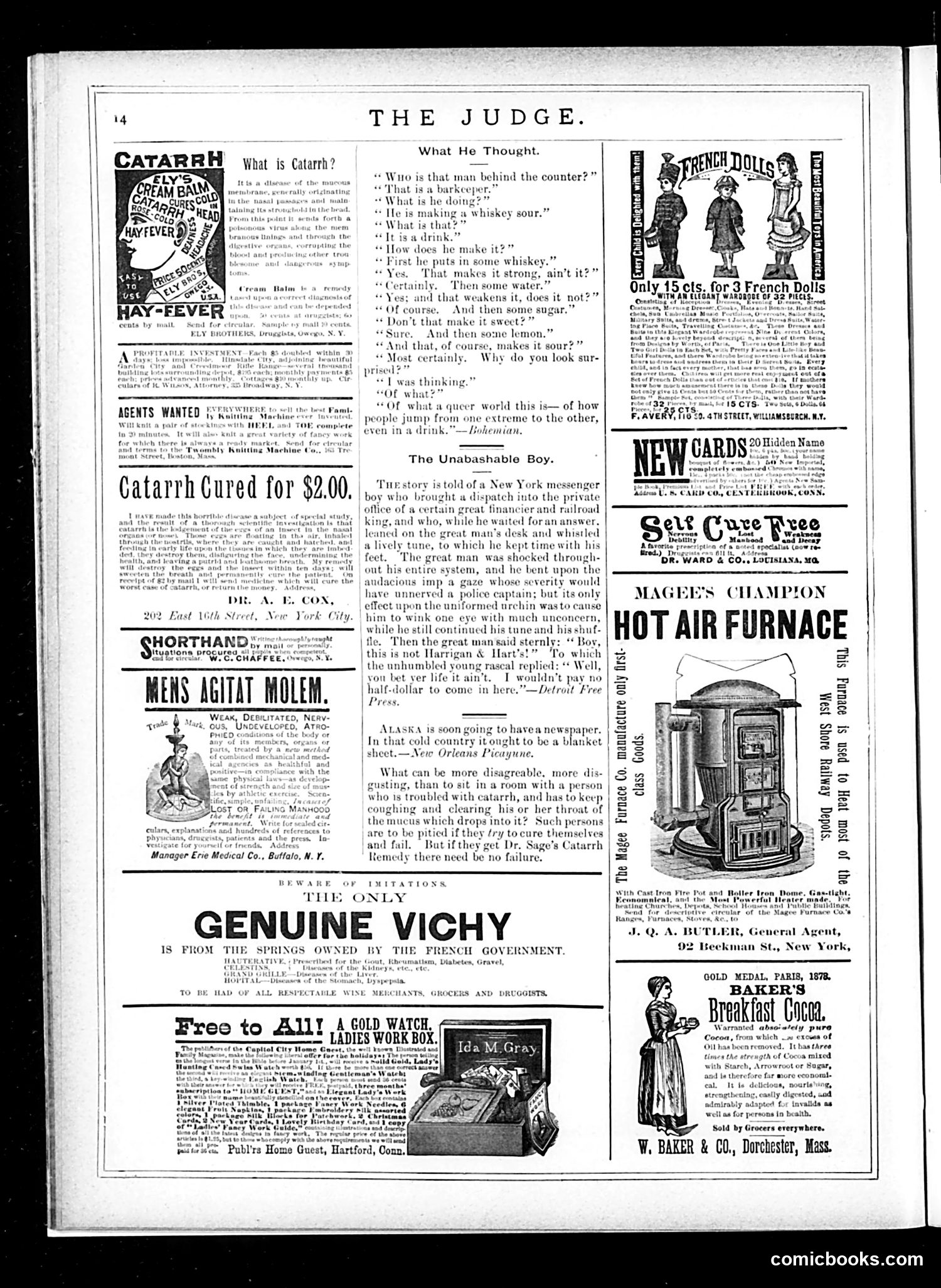
This cartoon satirizes the contradictory nature of cheap whiskey production. A child asks a bartender how he makes whiskey "sour," and the barkeep explains his process: he adds whiskey first (to make it "strong"), then water (which weakens it), then sugar (making it sweet), and finally more elements that make it sour. The joke's point: the bartender is creating a deliberately balanced mixture of opposing qualities—strong yet weak, sweet yet sour—essentially admitting he's masking poor-quality whiskey with additives. The child's final observation ("what a queer world this is—of how people jump from one extreme to the other, even in a drink") exposes the absurdity: legitimate whiskey shouldn't require such chemical gymnastics. This reflects turn-of-the-century concerns about adulterated spirits and questionable bartending practices, presented through innocent-child-questions-authority humor typical of *Judge* magazine's satirical approach.
This page is primarily **advertising** with minimal editorial content. The small humorous snippets at the top are typical Judge filler jokes—brief, topical quips rather than sustained political satire. The few jokes present reflect late-19th-century American concerns: - **Political commentary**: A reference to Cleveland's election producing "general paralysis"—likely a partisan jab at Grover Cleveland's presidency or policies. - **Class humor**: Jokes about wealthy employers (a millionaire hiring a coachman) and working-class absurdities reflect Judge's satirical approach to social hierarchy. - **Local color**: References to Austin street cars and Brooklyn suggest urban American settings where Judge's readership lived. The dominant feature is **The Chicago Globe's investment advertisement**, promoting loans at 4% interest with premium offers—typical of the financial schemes that filled period magazines. The remainder comprises product advertisements (pianos, bicycles, candy, magic lanterns) representative of 1890s consumer culture. This is **not a particularly satirical or politically significant page**—mostly a commercial vehicle with light humor filler.
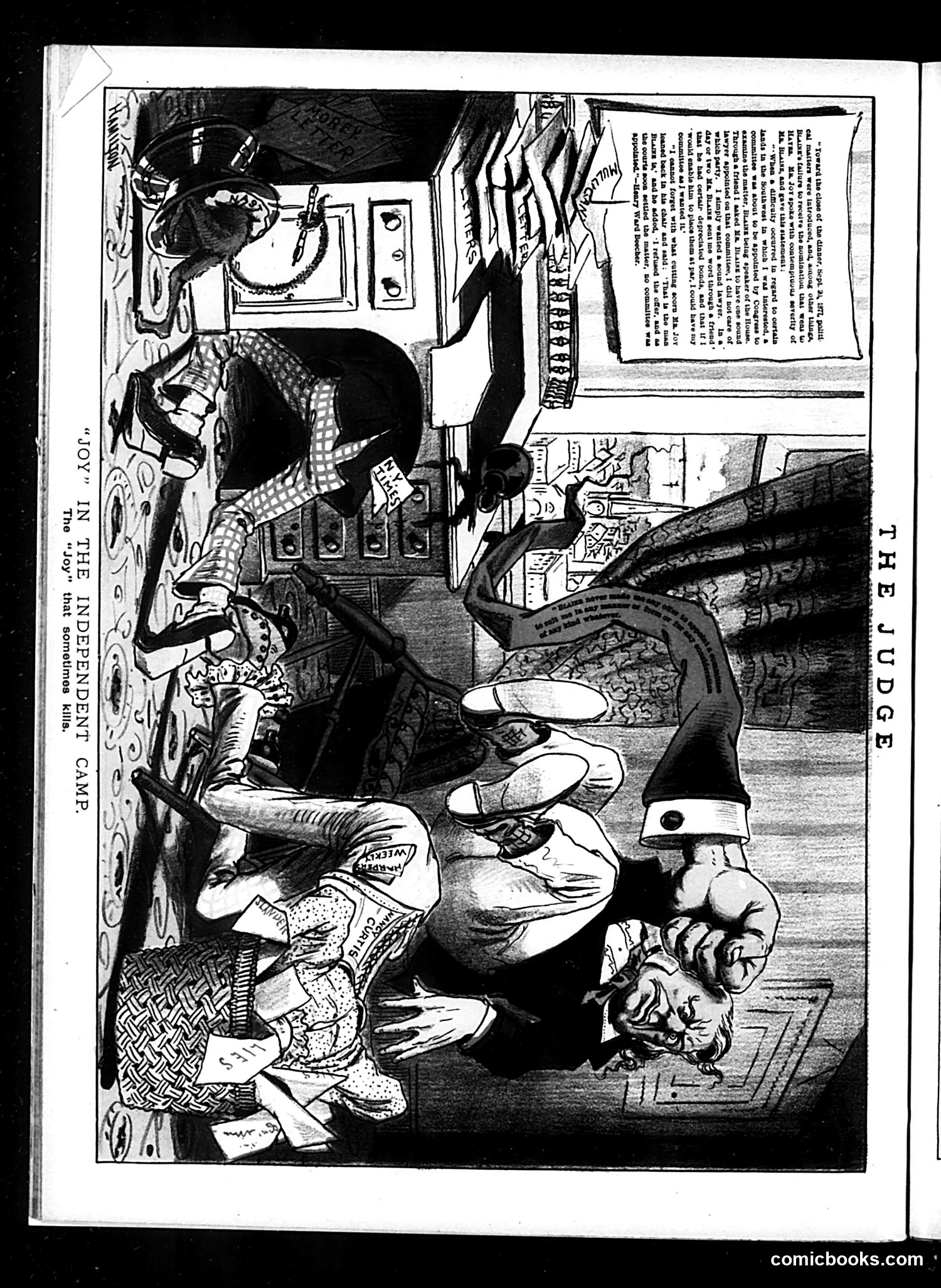
This appears to be a political cartoon titled "In the Independent Camp" with the subtitle "The 'Joy' that sometimes kills." The image shows a figure lying on the ground in what appears to be a domestic interior. The cartoon satirizes the "Independent" political movement—likely referring to independent voters or politicians operating outside major party structures during the early 20th century. The phrase "joy that sometimes kills" suggests the cartoon mocks the consequences or contradictions of political independence, possibly depicting it as reckless or destructive. The prone figure appears to represent someone harmed by their independent political stance or decisions. Without clearer visibility of specific caricatured features or additional context text, the exact political figures or events referenced remain unclear, though this was clearly meant as sharp contemporary political satire.