
A complete issue · 16 pages · 1884
Judge — August 9, 1884
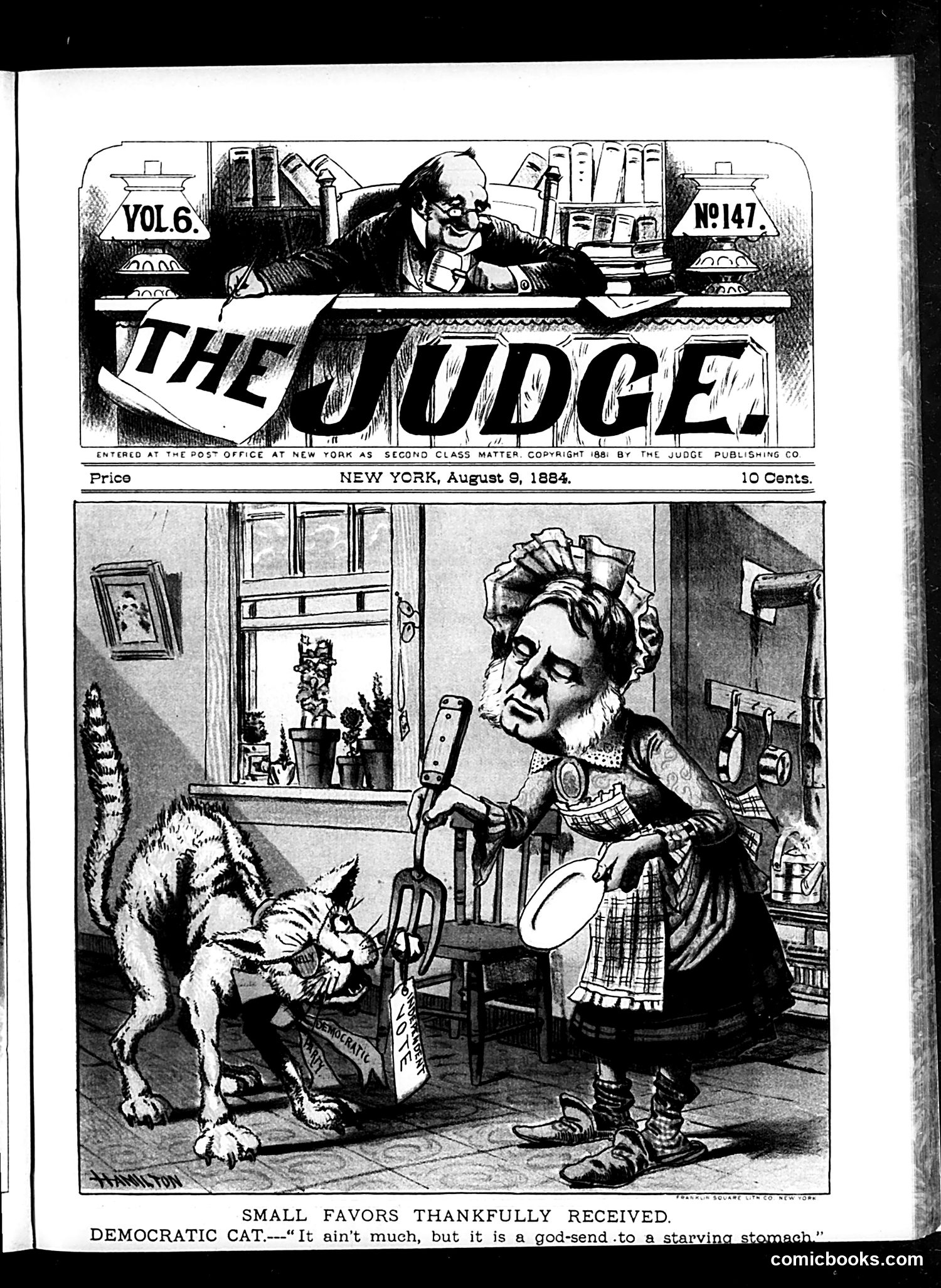
This August 9, 1884 *Judge* cartoon satirizes the Democratic Party during the presidential election season. The caption identifies a "Democratic Cat" receiving scraps from a woman (likely representing the Democratic Party or its leadership). The cat, appearing starved and desperate, eagerly accepts meager leftovers—a bone and small food scraps. The satire suggests Democrats were reduced to accepting whatever minimal support they could gather, implying weakness or desperation in their political position. The anthropomorphized cat emphasizes the party's degraded status. The artwork's style and the 1884 election context indicate this is Republican *Judge* magazine mocking Democratic prospects, portraying them as pathetic and undernourished compared to Republican strength.
This page from *Judge* magazine promotes the **1884 presidential campaign**, specifically backing Republican James G. Blaine and running mate John Logan against Democrat Grover Cleveland. The central article discusses the **National Irish-American Republican League**, which broke with traditional Democratic voting patterns. The piece argues Irish-Americans should abandon Cleveland because: (1) Democrats historically denied Irish immigrants full citizenship; (2) Democrats were the "slavery party"; (3) Democrats favor free trade, aligning them with England—Ireland's historical enemy; (4) Cleveland himself opposed labor interests and favored monopolies. The satire targets Cleveland as hostile to working-class and Irish interests. By framing Republican support as a patriotic Irish issue, *Judge* attempts to fracture the "Solid South" Democratic coalition that had dominated since Reconstruction. **Context**: This reflects 1880s nativist tensions, labor disputes, and the strategic realignment of ethnic voting blocs—a significant moment when Irish-Americans considered switching parties.
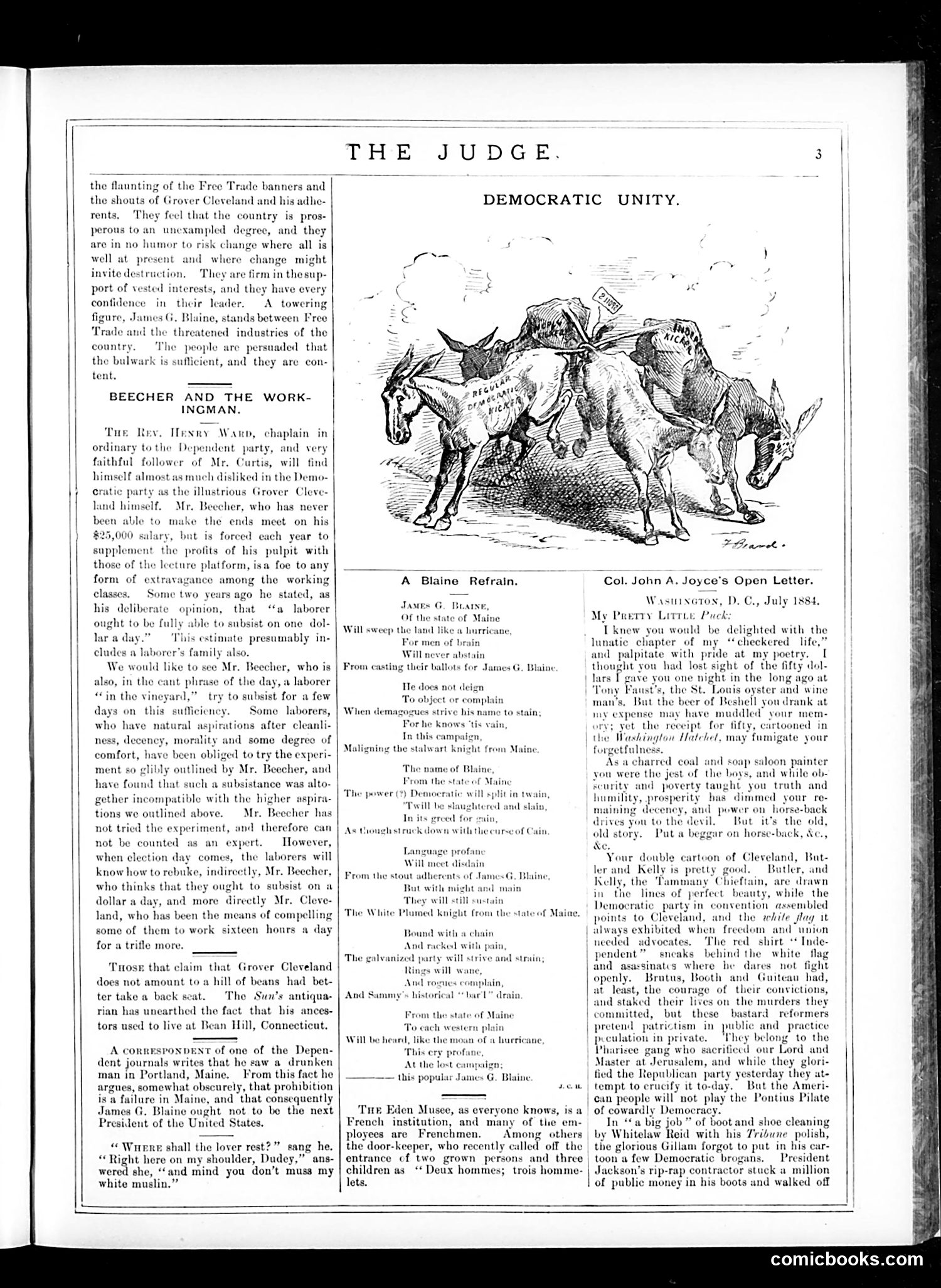
This Judge magazine page satirizes the 1884 presidential election, featuring a cartoon titled "Democratic Unity" depicting a donkey (the Democratic Party symbol) being pulled apart by multiple figures — likely representing competing Democratic factions over the tariff issue and candidate James G. Blaine of Maine. The text attacks Democratic and Republican figures: Rev. Henry Ward Beecher is mocked for claiming laborers can subsist on one dollar daily while earning $25,000 himself — a hypocrisy the article argues working-class voters will punish at the ballot. The repeated "Blaine Refrain" poem sarcastically celebrates Blaine as Maine's "White Plumed knight," while ironically predicting Democratic collapse and the party being "slaughtered." The overall message: Democratic disunity over economic policy (Free Trade vs. protection) makes them vulnerable, while both parties' leaders are disconnected from working-class realities.
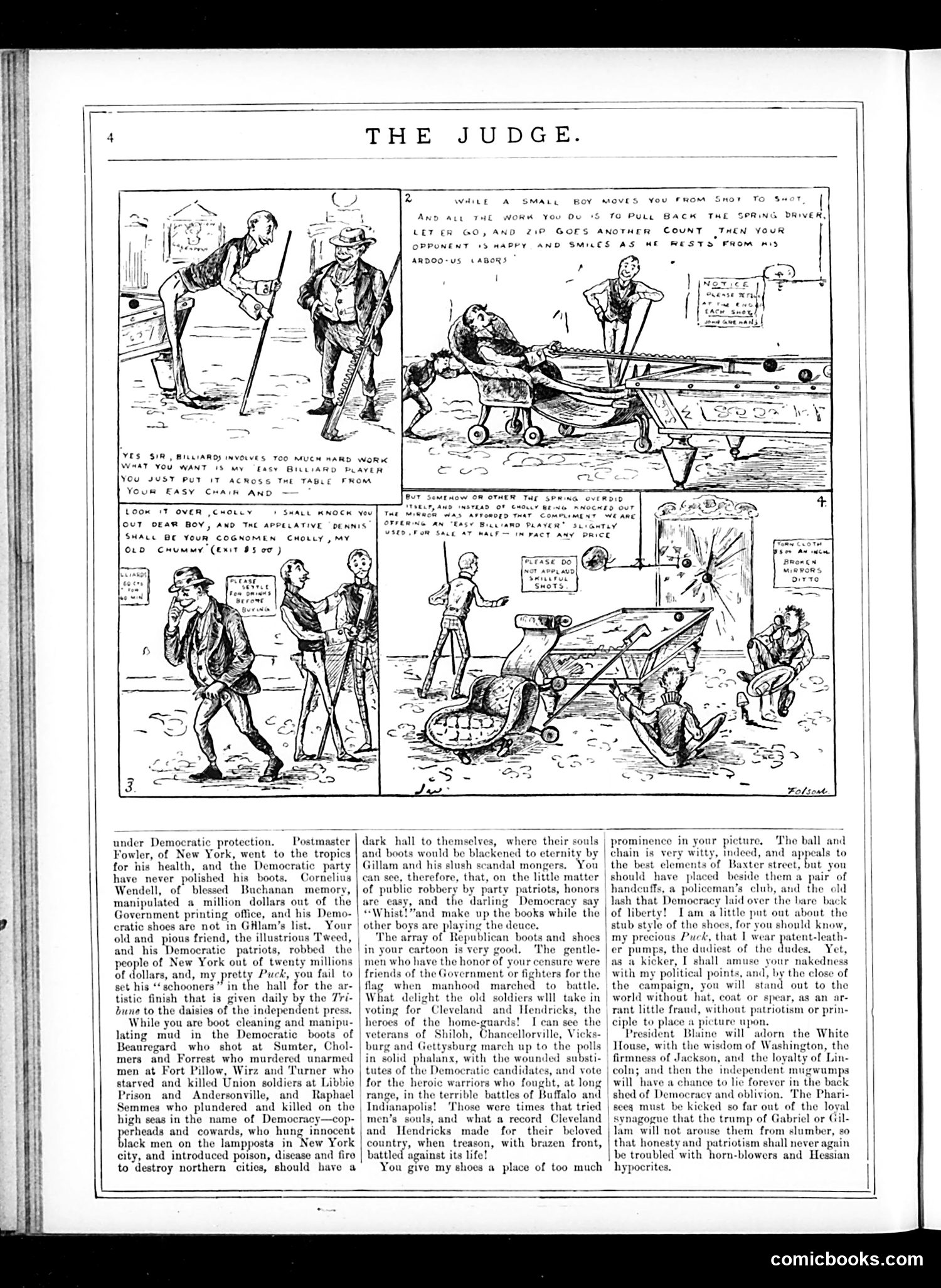
This page from *Judge* magazine contains satirical commentary attacking Democratic politicians while defending Republicans during what appears to be the 1884 presidential campaign (references to Cleveland and Hendricks). The top comic strip mocks billiards as an "easy" game requiring minimal effort—a metaphor for Democratic governance portrayed as lazy and corrupt. The lengthy letter below attacks Democratic "boot-cleaning," using shoes as a metaphor for moral corruption. It accuses Democrats of ignoring scandals by party members (Postmaster Fowler, Tweed, Beauregard) while hypocritically censuring Republicans. The writer sarcastically suggests Democrats' "souls and boots would be blackened to eternity." The author defends Republicans as "friends of the Government or fighters for the flag," invoking Civil War service as moral credential. He criticizes Democrats for aligning with wartime enemies and Confederate figures. This represents *Judge's* partisan Republican stance, using elaborate metaphors and Civil War nostalgia to delegitimize Democratic candidates through character attacks rather than policy discussion.
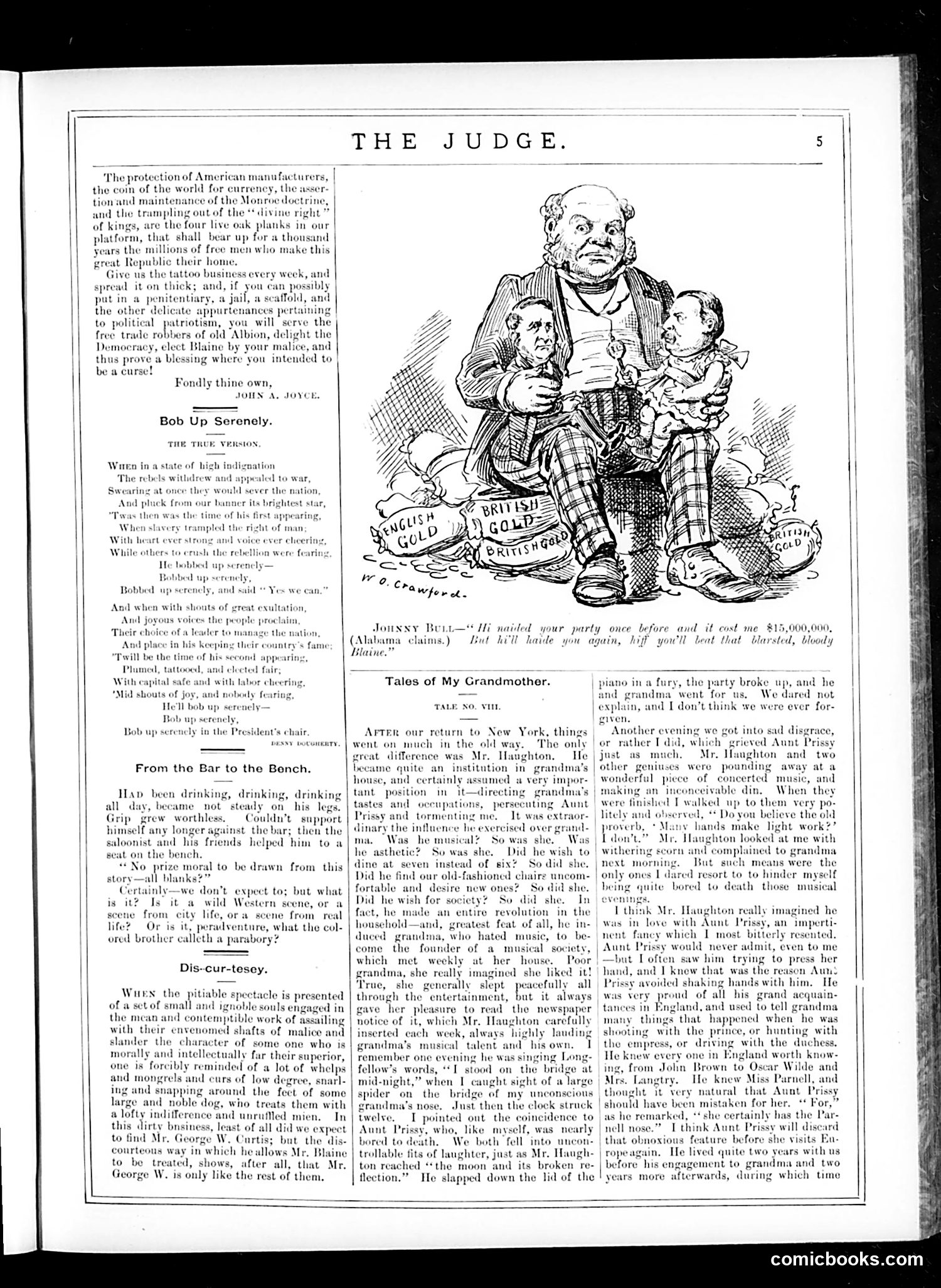
This page contains multiple satirical pieces criticizing American politics and society, likely from the 1880s based on references to "elect Blaine" (James G. Blaine, 1884 presidential candidate). **Main Cartoon:** The large illustration depicts a man (appears to be a politician or wealthy figure) holding two small children labeled with "British Gold," satirizing the accusation that American politicians were corrupted by British financial interests. The caption references a $15,000,000 bribe, mocking claims of foreign influence in American elections. **Text Pieces:** - "Bob Up Serenely" mocks political resilience despite scandal - "From the Bar to the Bench" satirizes judicial corruption - "Tales of My Grandmother" uses gossipy narrative to critique social pretension and musical snobbery among the wealthy The overall theme attacks political corruption, foreign influence peddling, and elite hypocrisy—common Judge magazine targets during the Gilded Age.
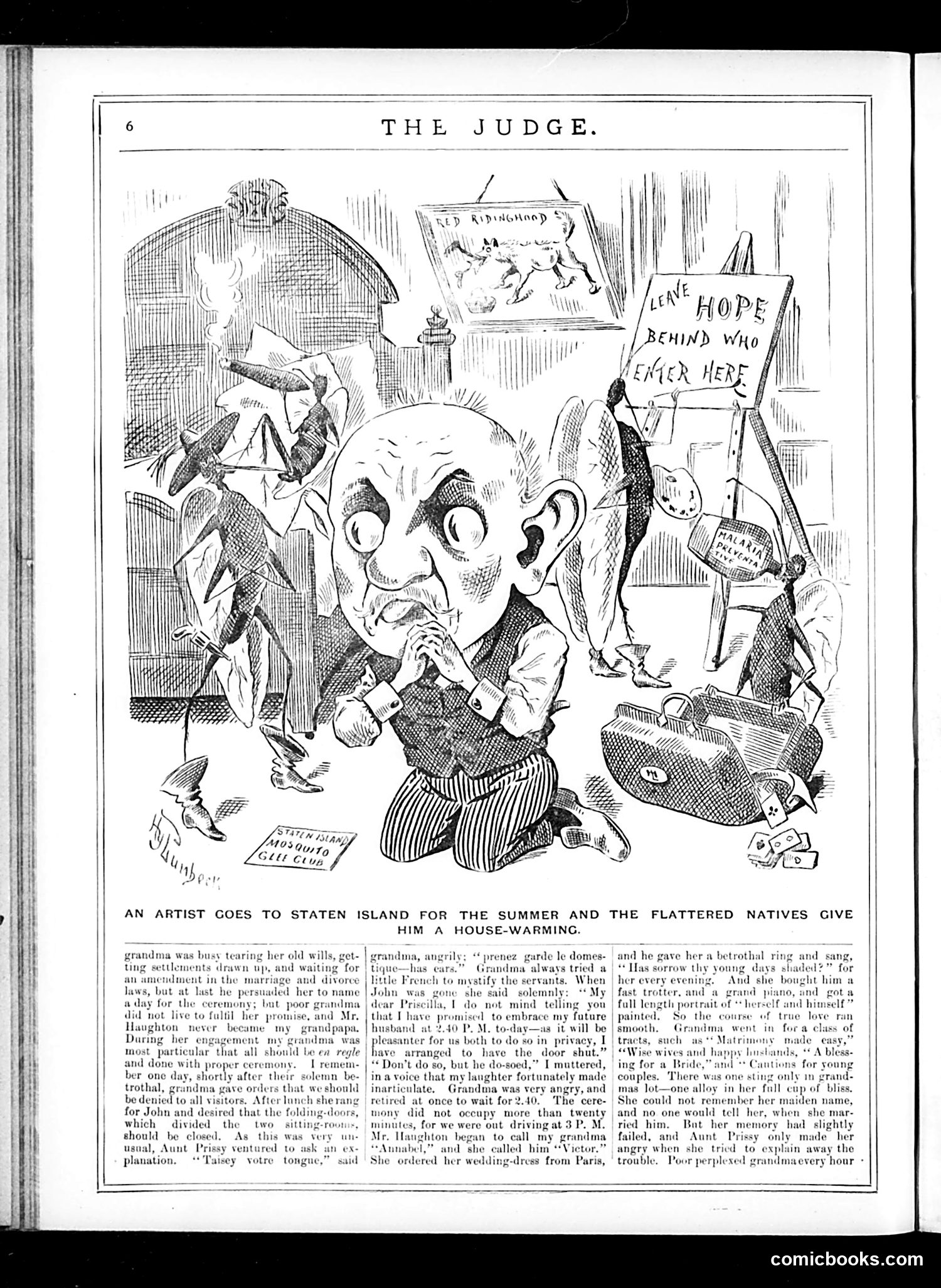
This page satirizes the social pretensions of wealthy Americans seeking status through European travel and culture. The central caricature—a bald, grotesque figure on his knees—depicts an artist visiting Staten Island for summer who receives a "house-warming" from local residents, depicted as exaggerated Native Americans or working-class "natives." The satire mocks the artist's desperation for social acceptance and the absurdity of treating modest locals as exotic hosts worthy of elaborate ceremony. The sign reading "LEAVE HOPE BEHIND WHO ENTER HERE" inverts Dante's famous inscription, suggesting the artist's pretensions are futile. The accompanying story text (partially legible) appears to recount anecdotes about overly formal social rituals among the wealthy—focusing on an grandmother's obsessive ceremonial behavior around marriage and propriety. Together, the cartoon and text ridicule American upper-class affectation, excessive formality, and the hunger for cultural validation through travel and social performance.
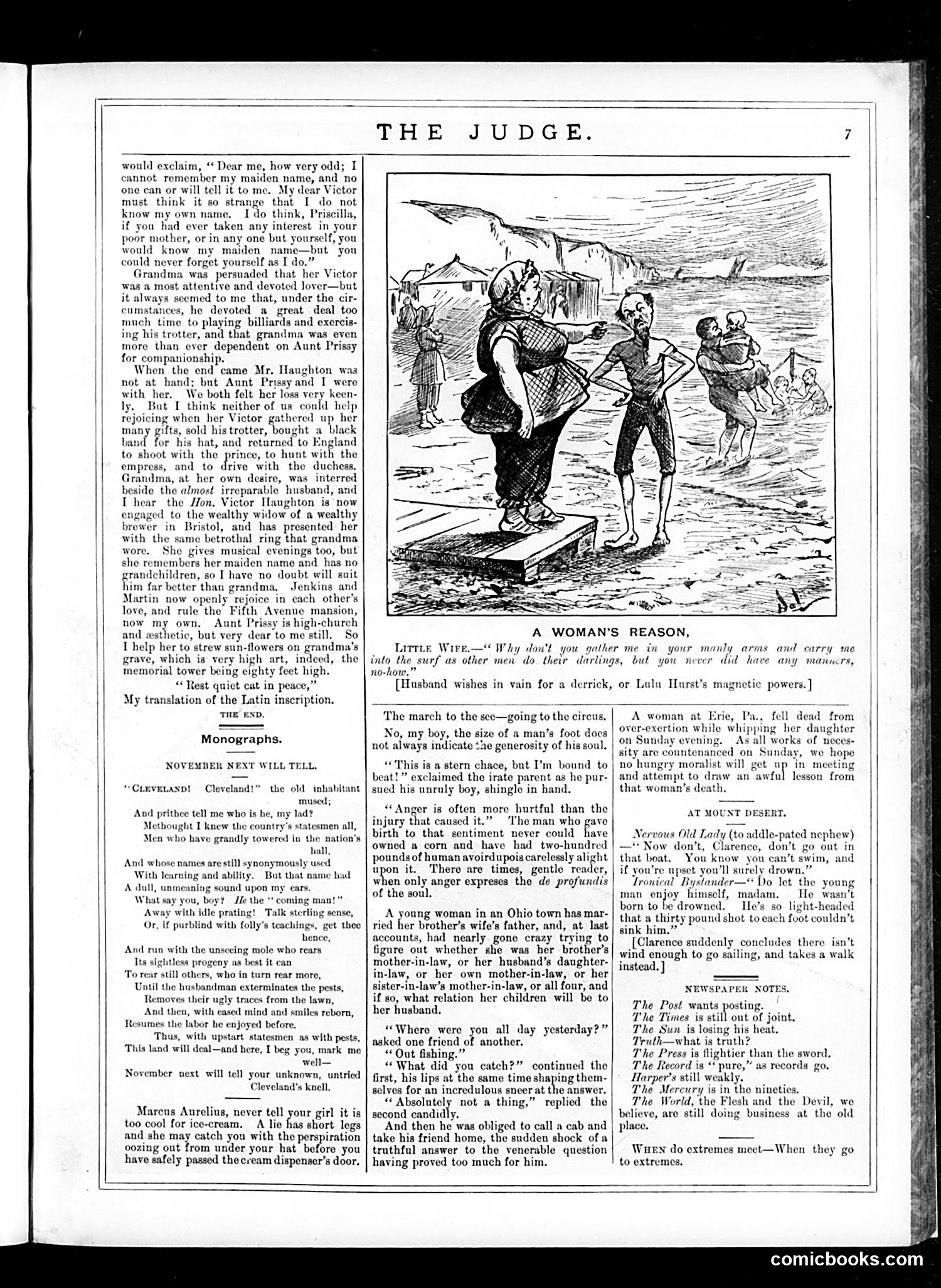
This page from *Judge* contains several satirical pieces typical of the magazine's style: **Main Cartoon ("A Woman's Reason"):** Shows a woman on a beach rejecting her husband's modest attempts at romance, comparing him unfavorably to other men who sweep their partners into the surf. The satire mocks both the wife's unrealistic romantic expectations and the husband's inadequacy—the caption notes he'd need "a derrick, or Lulu Hurst's magnetic powers" (Hurst was a famous strongwoman of the era) to accomplish the task. The joke targets contemporary gender relations and marital dissatisfaction. **"Monographs" Section:** Contains a poem mocking an unknown politician named "Cleveland" as an unfit, unproven candidate. This appears to reference Grover Cleveland's 1884 presidential campaign, portraying him as a pest requiring electoral extermination. **Minor Items:** Brief humorous anecdotes about fishing, newspaper masthead jokes, and Marcus Aurelius's quip about ice cream and dishonesty round out the page. The overall tone reflects *Judge's* conservative Republican stance criticizing Democratic leadership.
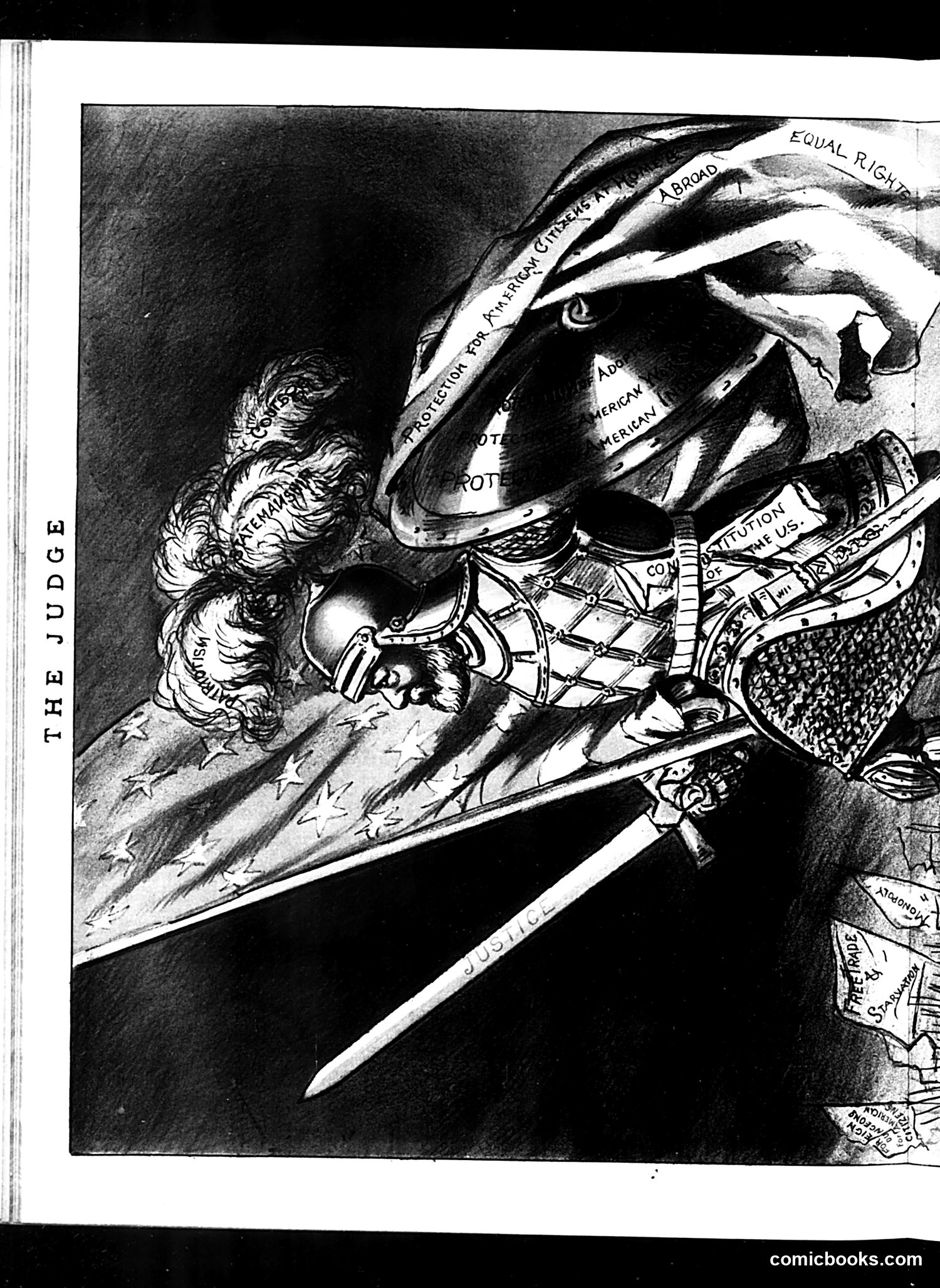
This political cartoon depicts a figure labeled "THE JUDGE" on the left margin. The main image shows an armored knight or warrior figure holding a sword labeled "JUSTICE," wielding various constitutional documents and rights. Visible text on the armor includes references to "EQUAL RIGHTS," "PROTECTION FOR ALL CITIZENS AT BROAD," "AMERICAN OATH," and "CONSTITUTION OF THE U.S." The satire appears to criticize judicial authority or a specific judge's interpretation of constitutional rights. The heavily armored, aggressive posturing suggests the cartoon is questioning whether the judge is truly defending constitutional protections or acting as an overzealous enforcer. The combination of legal documents with militaristic imagery implies tension between law enforcement and civil liberties—a common satirical theme in Judge magazine during debates over judicial power and constitutional interpretation.
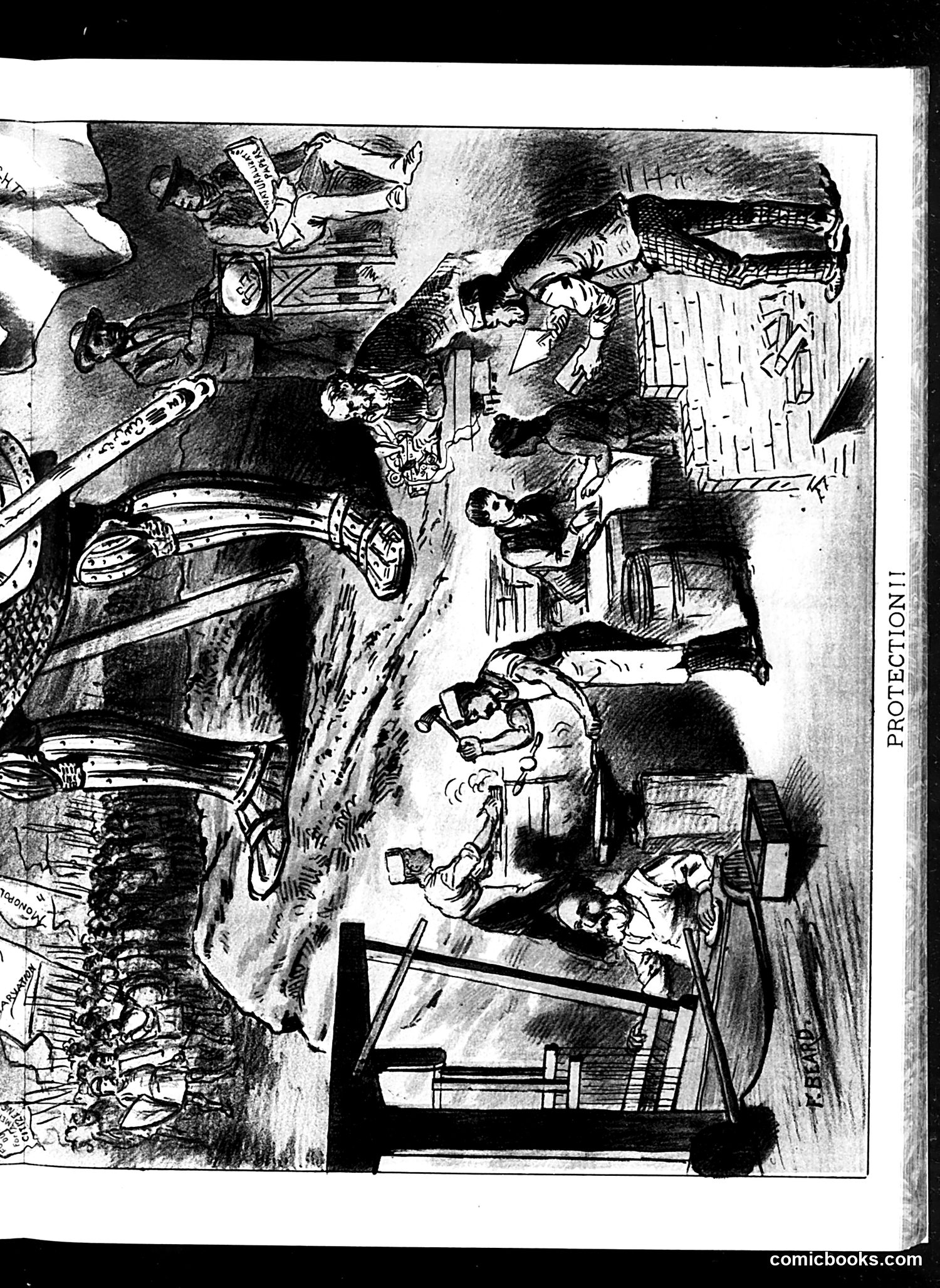
This cartoon titled "Protection!" appears to satirize American tariff and protectionist trade policies. The image depicts what seems to be a large protective structure or umbrella shielding American interests (likely represented by industrial or commercial figures) from external forces or competition. The cartoon uses the visual metaphor of "protection" — both literal (the umbrella/shelter structure) and ironic — to critique protectionist economic policies. Judge magazine frequently lampooned debates over tariffs versus free trade that dominated late 19th and early 20th-century American politics. Without clearer text identifying specific political figures or dates visible on this page, I cannot specify which tariff debate or administration this targets, but the theme clearly concerns economic policy and its effects on American workers or industries.
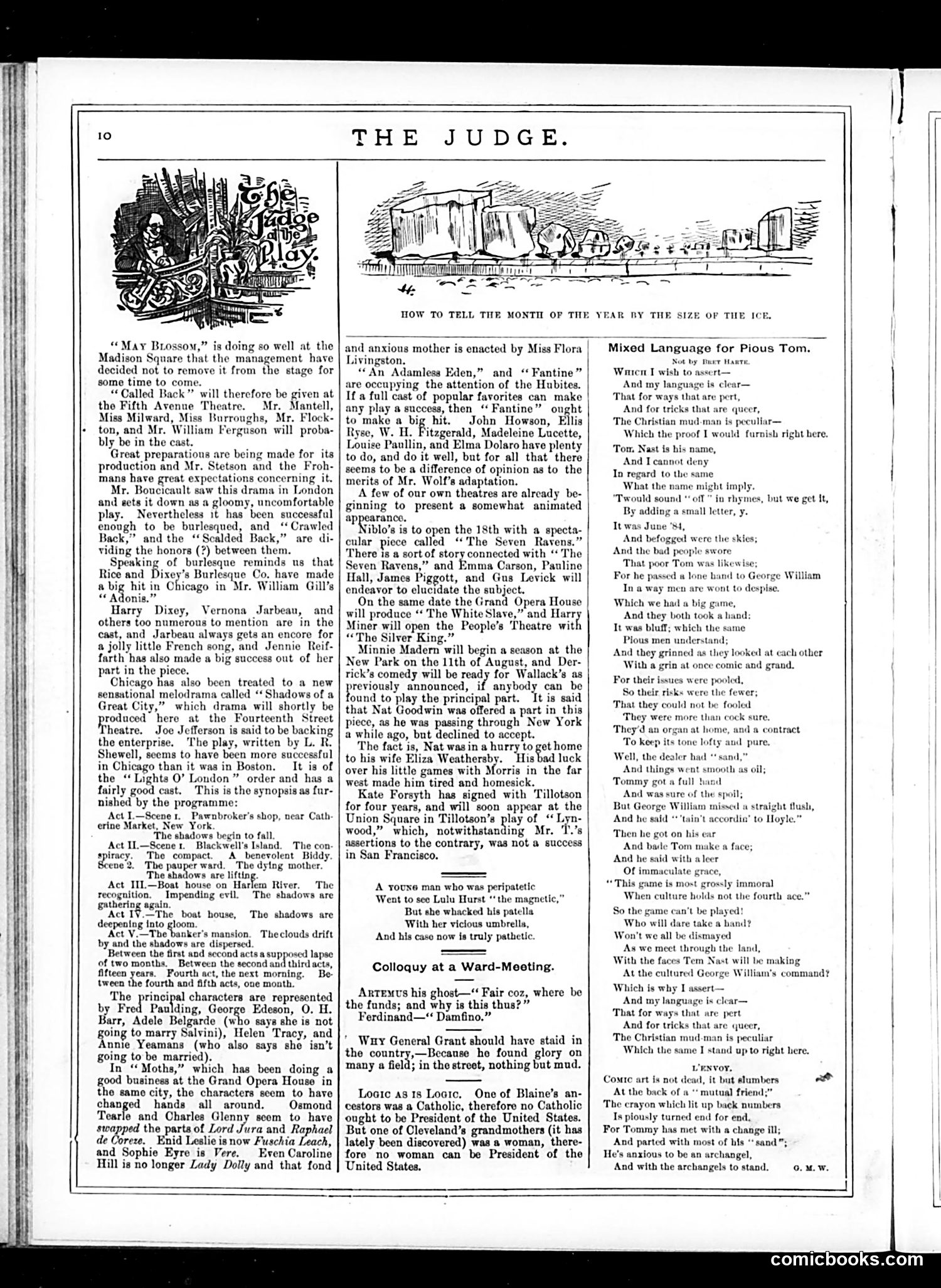
This page contains theater reviews and gossip from Judge magazine, not political cartoons. The small illustrations are decorative vignettes rather than satirical commentary. The content discusses 1880s theatrical productions: "May Blossom" at Madison Square Theatre, upcoming plays like "Called Back," and burlesque performances of "Adonis" in Chicago. It mentions performers like Harry Dixey and Vernona Jarbeau. The humor is theatrical insider-gossip rather than political satire—noting cast changes in "Moths," actresses who claim they won't marry (Helen Tracy, Annie Yeamans), and the comparative success of melodramas in different cities. The small cartoon showing icebergs with the caption "How to Tell the Month of the Year by the Size of the Ice" appears to be a lighthearted seasonal joke unrelated to the theater reviews. This page represents Judge's coverage of popular entertainment rather than its satirical political commentary.
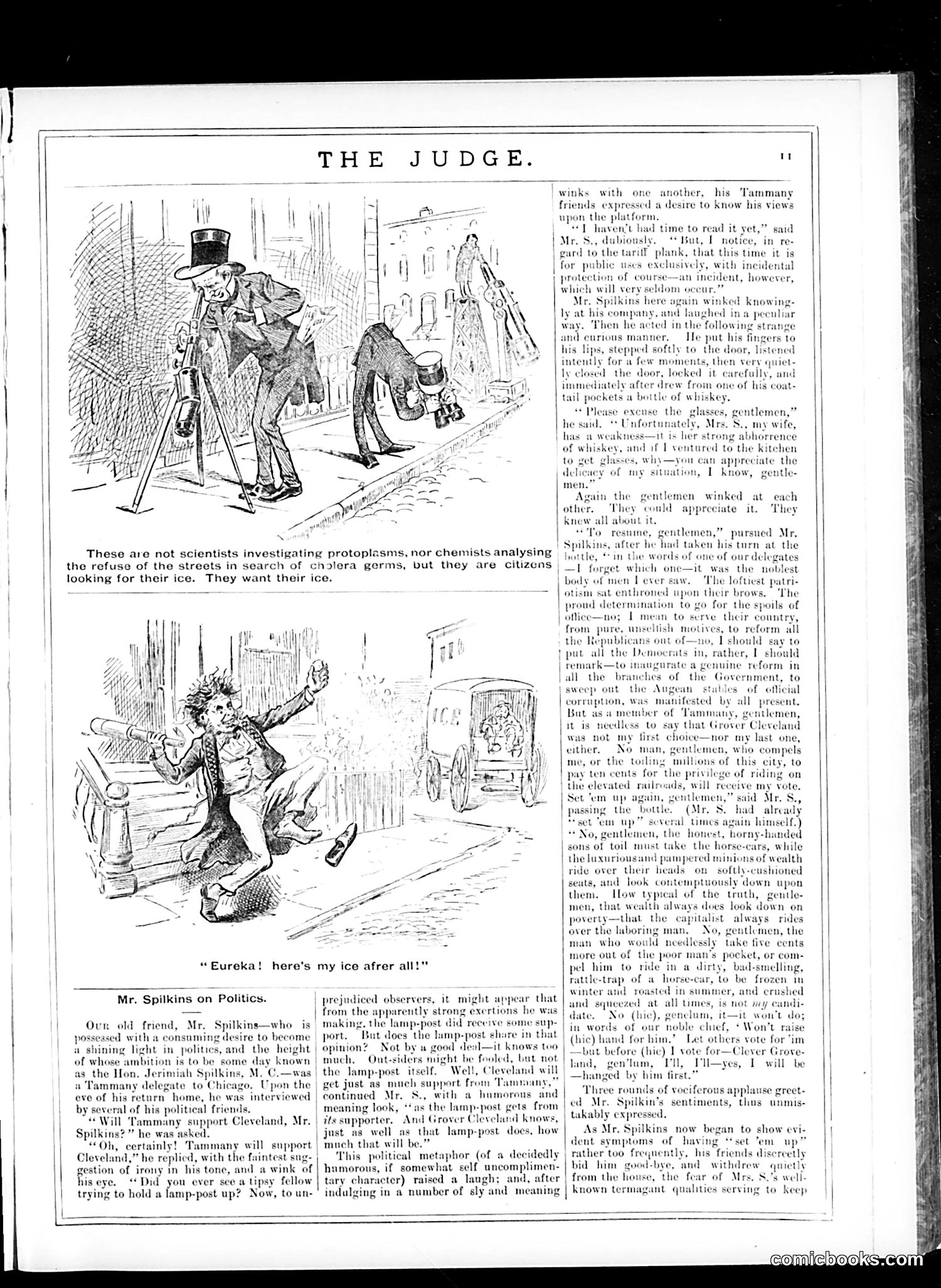
This page satirizes a Tammany Hall politician (Mr. Spilkins, identified as "Hon. Jeremiah Spilkins, N.C.") and his hypocritical political rhetoric. **The Satire:** Spilkins claims the Democratic Party seeks "genuine reform" and to "sweep out the Augean stables of official corruption," yet admits his actual loyalty is to Grover Cleveland and Democratic machine politics—not principle. His excuse for supporting Democrats over Republicans is absurdly self-serving: he must protect his wife's "strong abhorrence of whiskey" (implying Republican temperance policies threaten his drinking). **The Metaphor:** The repeated "lamp-post" joke (illustrated below) mocks the circularity of machine politics: a man trying to hold up a lamp-post gets no support from it, just as Cleveland receives no genuine support from Tammany's stated principles. The metaphor suggests these politicians are propping up a corrupt system while pretending to reform it. **Context:** Judge targets Tammany Hall's notorious corruption and the hypocrisy of Democratic political rhetoric during the Gilded Age—when "reform" candidates like Cleveland faced skepticism from urban machine politicians.
This page contains several humorous short stories and anecdotes rather than political cartoons. The content reflects Victorian-era middle-class domestic humor: **"Little Tommy"** series mocks childhood linguistic confusion—a boy who misunderstands arithmetic ("two are four, three tums two are six") and gets kept after school for spelling errors. The humor relies on phonetic misspellings and innocent malapropisms typical of period children's literature. **"Thomas Shows Grover the Field"** appears to reference the 1884 presidential campaign. References to "Grover," "Blaine," "Black Jack" (likely General Logan), and "Tammany John" suggest this is political satire about competing candidates and party operatives. The military metaphor ("fight we must") treats the election as warfare. **"On a Tombstone"** uses dark humor about a woman who married for money but was left a widow—common satirical subject matter. The overall tone is genteel Victorian satire aimed at educated readers familiar with classical allusions and contemporary political figures.
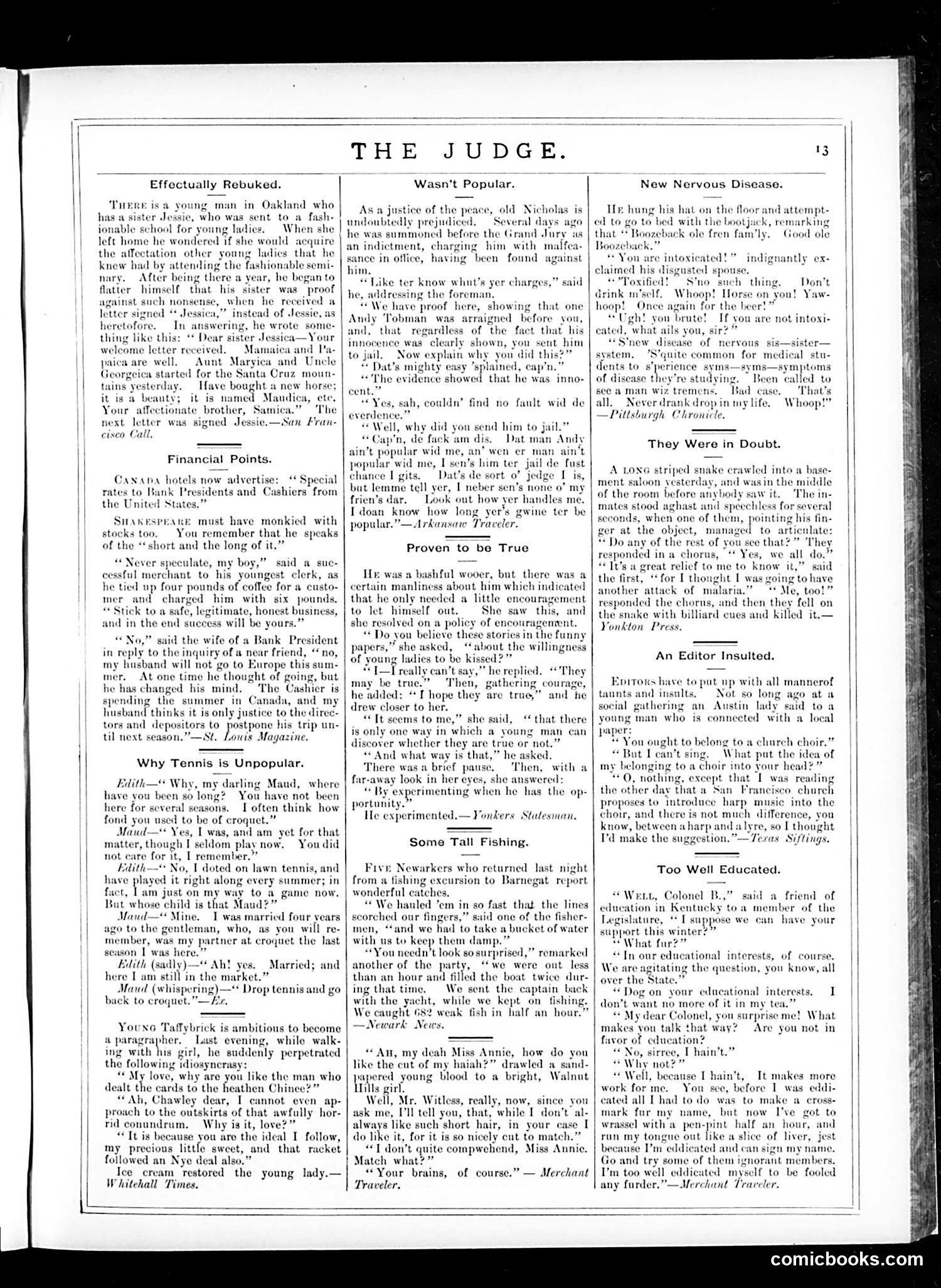
This page from the satirical magazine *Judge* contains several short humor pieces mocking social pretensions and hypocrisy: **"Effectually Rebuked"** satirizes affectation—a young man attending a fashionable seminary adopts exaggerated speech patterns, adding "-ica" suffixes to names (writing "Samica," "Mandica"), until his sister firmly corrects him by reverting to plain spelling. **"Wasn't Popular"** depicts a corrupt judge who admits to the Grand Jury that he imprisoned an innocent man (Andy Tobman) simply because the defendant was "unpopular" with him—a direct jab at judicial bias and abuse of power. **"Financial Points"** offers brief, cynical observations about banker behavior and self-dealing. The remaining sections ("Why Tennis is Unpopular," "Proven to be True," etc.) are light romantic or domestic humor pieces typical of period magazines. The overall tone targets pretension, corruption, and social hypocrisy—core themes of *Judge's* satirical mission.
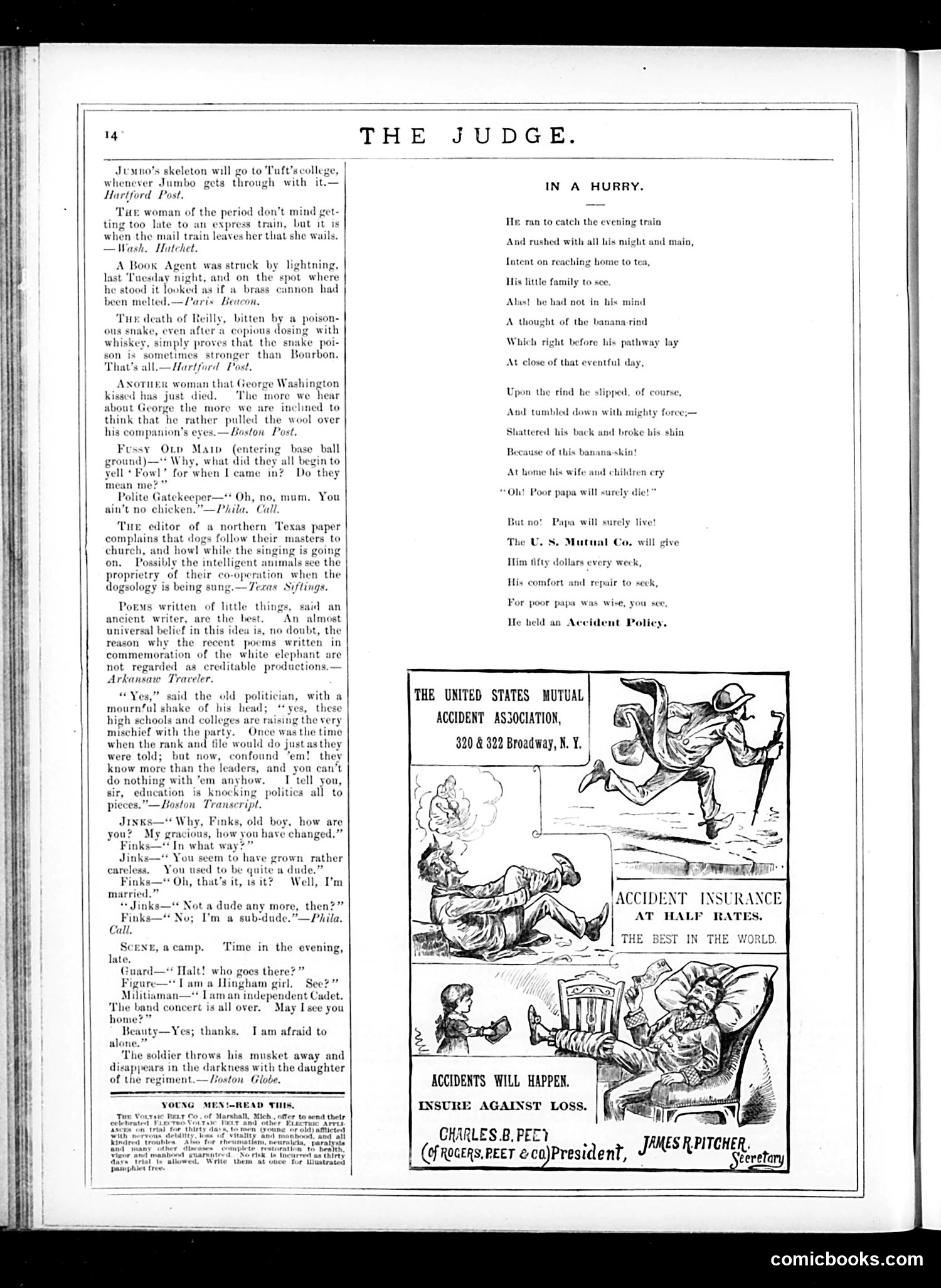
This page combines satirical short items with a substantial advertisement. The main content is a humorous poem about a man rushing home for tea who slips on a banana peel, injuring himself seriously. The poem's twist: rather than tragedy, his U.S. Mutual Accident Association insurance policy saves him—paying fifty dollars weekly for recovery. The satire targets the emerging accident insurance industry. By pairing slapstick (the banana-peel slip, a Victorian comedy cliché) with insurance salvation, Judge mocks how insurance companies marketed themselves as solutions to everyday mishaps. The poem's cheerful resolution—Papa will "surely live!"—satirizes the reassuring promises insurers made to anxious middle-class families. The surrounding brief jokes are typical Judge filler content: puns, anecdotes, and social commentary on topics like women missing trains and dogs howling in church. The advertisement occupies roughly half the page, indicating insurance advertising's commercial importance to the magazine.
This page is primarily **advertising and satirical humor pieces**, not a unified political cartoon. The main content consists of brief humorous quips on contemporary life—many poking fun at **Blaine's political record** (George W. Curtis allegedly spends little time editing Harper's Weekly because he's busy finding flaws in Blaine's past). Other jokes mock dating etiquette, marriage negotiations, lawyers' moral character, and marital disputes—typical American social satire of the era. The **advertising dominates**: piano manufacturers, bicycles, playing cards, root beer, and a hay fever remedy occupy half the page. One notable reference: **"Cleveland and Hendricks"** mentions the 1884 Democratic presidential ticket, confirming this is from that election period. The humor assumes readers recognize contemporary political figures. The **playing cards advertisement** prominently features "Sportsman's and Army and Navy" cards, marketed as superior products—standard period marketing. Overall, this is a typical Judge issue: light social commentary mixed with commercial advertising, aimed at middle-class urban readers.
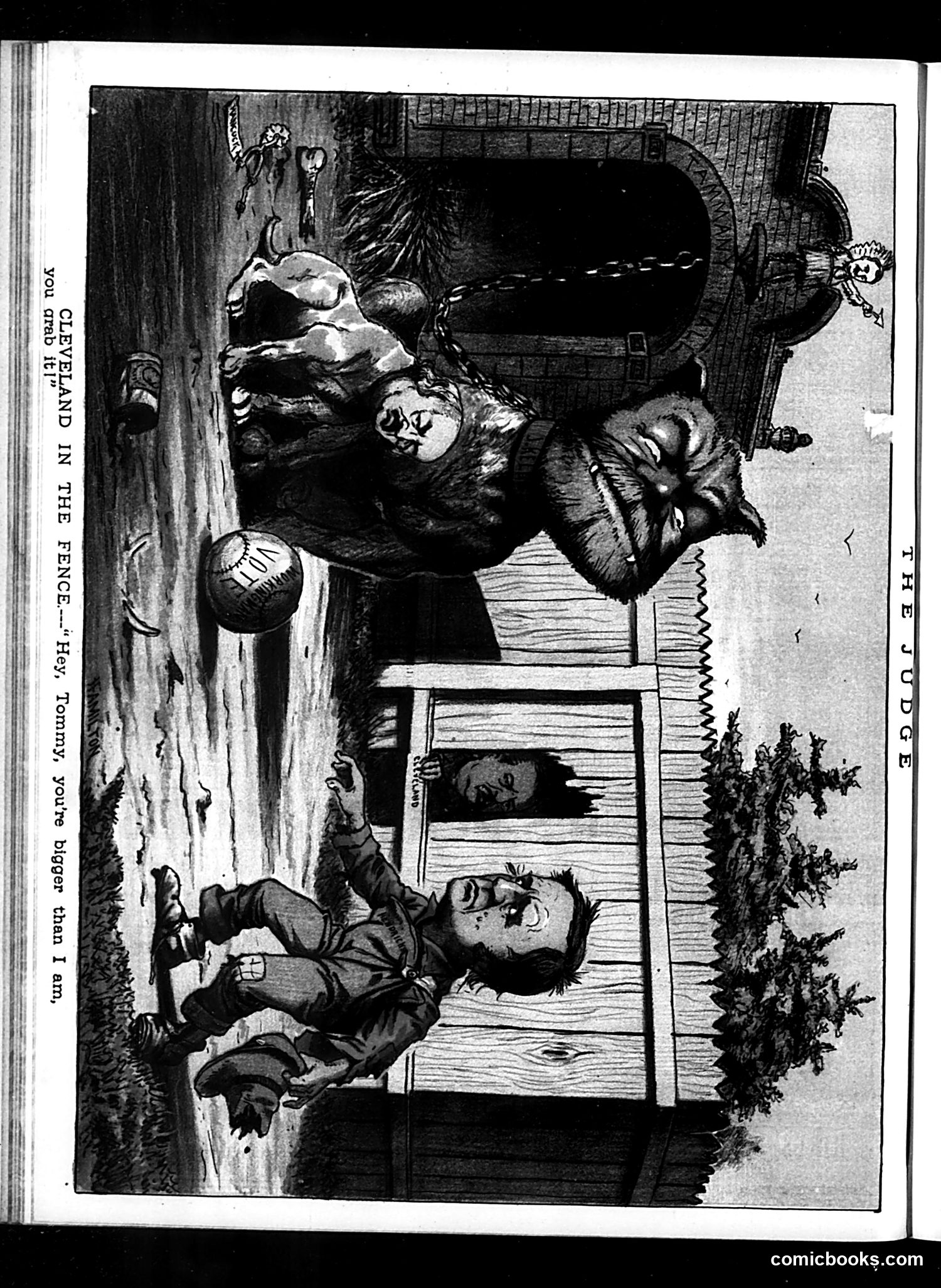
This political cartoon depicts President Grover Cleveland as a child stuck in a fence, calling to another boy ("Tommy," likely representing Congress or another political figure) to help extract him because he's larger and stronger. The satire mocks Cleveland's political predicament—he appears trapped or stuck, unable to extricate himself from a difficult situation without outside help. The "fence" likely represents legislative gridlock or a policy impasse during his presidency. The joke relies on the absurdity of portraying the nation's chief executive as a helpless child, suggesting his political weakness or inability to act independently. The cartoon critiques either Cleveland's ineffectiveness or his dependence on Congressional support to resolve disputes.