
Judge, 1884-08-09 · page 2 of 16
Judge — August 9, 1884 — page 2: what you’re looking at
What you’re looking at
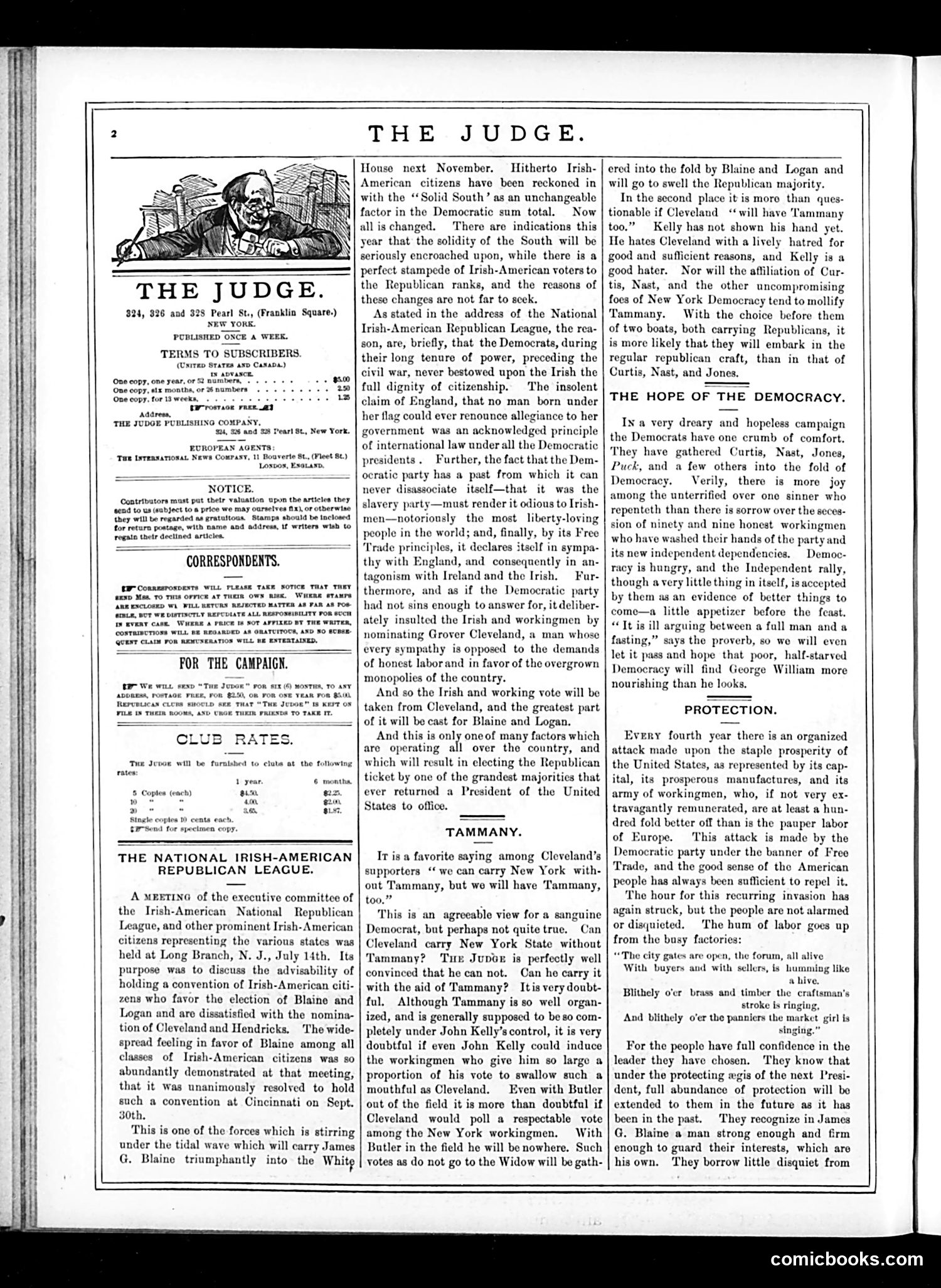
This page from *Judge* magazine promotes the **1884 presidential campaign**, specifically backing Republican James G. Blaine and running mate John Logan against Democrat Grover Cleveland. The central article discusses the **National Irish-American Republican League**, which broke with traditional Democratic voting patterns. The piece argues Irish-Americans should abandon Cleveland because: (1) Democrats historically denied Irish immigrants full citizenship; (2) Democrats were the "slavery party"; (3) Democrats favor free trade, aligning them with England—Ireland's historical enemy; (4) Cleveland himself opposed labor interests and favored monopolies. The satire targets Cleveland as hostile to working-class and Irish interests. By framing Republican support as a patriotic Irish issue, *Judge* attempts to fracture the "Solid South" Democratic coalition that had dominated since Reconstruction. **Context**: This reflects 1880s nativist tensions, labor disputes, and the strategic realignment of ethnic voting blocs—a significant moment when Irish-Americans considered switching parties.
📄 Transcribed text from this page (OCR, searchable)
Machine-transcribed from the original scan — historical spelling and the odd misread are preserved.
THE JUDGE. THE JUDGE. 824, 326 and 328 Pearl St., (Franklin Square.) NEW YORK. PUBLISHED ONCE A WEEK. TERMS TO SUBSCRIBERS. ‘One copy, one year, orf One copy, alx months, of 38 numbers One copy. for 13 weeks, Brrromion race ad Address, ‘THE JUDGE PUBLISHING COMPAXY, St, 28 and 82 Pearl 8t, New York. rerte St, (Fleet 8.) Loxvos, EsaLaxp. Contributors mast pat thelr valuation upun the articles they tend to us (subject to @ price we may ourselves fx) or otberwise they will be regarded as gratuitoas. Stamps should be inclosed for return postage, with name and address, if writers wish to regain thelr declined articles. CORRESPONDENTS, exsp Maa To Tis OFFICR AY TIER OWN RIEK. ARR ESCLOGED WL FILL RETCRN REJECTED MATTER AB FAR AS FOS: {EI0LE, BUT WE DIFTINCTLY REFODIATE ALL REATOSEIBILITY FOR SCC I EVERY Cask, WHERE 4 PRICE [6 SOT AFFIXED BY THE WRITER, CONTRIBUTIONS WILL RE REGARDED AS OMATCITOCR, AND NO ECBEE- QUENT CLAIM FOR REXUNERATION WILL BE ENTERTAINED, FOR THE CAMPAIGN. Tux Jevor will be furnished to cluls at the following rates: 1 year. ren ‘sen, 6 montha les 10 cents each, THE NATIONAL IRISH-AMERICAN REPUBLICAN LEAGUE. A MEETING of the executive committee of the Irish-American National Republican League, and other prominent Irish-American citizens representing the various states was held at Long Branch, N. J., July 14th. Its purpose was to discuss the advisability of holding a convention of Irish-American citi- zens who favor the election of Blaine and Logan and are dissatisfied with the nomina- tion of Cleveland and Hendricks, The wide- spread feeling in favor of Blaine among all classes of Irish-American citizens was so abundantly demonstrated at that meeting, that it was unanimously resolved to hold such a convention at Cincinnati on Sept. 30th, This is one of the forces which is stirring under the tidal wave which will carry James G. Blaine triumphantly into the White House next November. Hitherto Irish- American citizens have been reckoned in with the ‘Solid South’ as an unchangeable factor in the Democratic sum total. Now all is changed. There are indications this year that the solidity of the South will be seriously encroached upon, while there is a perfect stampede of Irish-American voters to the Republican ranks, and the reasons of these changes are not far to seek. As stated in the address of the National Irish-American Republican League, the rea- son, are, briefly, that the Democrats, during their long tenure of power, preceding the civil war, never bestowed upon the Irish the full dignity of citizenship. The insolent claim of England, that no man born under her flag could ever renounce allegiance to her government was an acknowledged principle of international law under all the Democratic presidents. Further, the fact that the Dem- ocratic party has a past from which it can never disassociate itself—that it was the slavery party—must render it odious to Irish- men—notorionsly the most liberty-loving people in the world; and, finally, by its ‘Trade principles, it declares itself in sympa- thy with England, and consequently in an- tagonism with Ireland and the Irish, Fur- thermore, and as if the Democratic party had not sins enough to answer for, it deliber- ately insulted the Irish and workingmen by nominating Grover Cleveland, a man whose every sympathy is opposed to the demands of honest labor and in favor of the overgrown monopolies of the country. And so the Irish and working vote will be taken from Cleveland, and the greatest part of it will be cast for Blaine and Logan. And this is only oneof many factors which are operating all over the country, and which will result in electing the Republican ticket by one of the grandest majorities that ever returned a President of the United States to oflice. TAMMANY. Ir is a favorite saying among Cleveland’s supporters ‘ we can carry New York with- out Tammany, but we will have Tammany, too.” : This is an agreeable view for a sanguine Democrat, but perhaps not quite true. Can Cleveland carry New York State without Tammany? Tue JupGe is perfectly well convinced that he can not. Can he carry it with the aid of Tammany? Itis very doubt- ful. Although Tammany is so well organ- ized, and is generally supposed to be so com- pletely under John Kelly’s control, it is very doubtful if even John Kelly could induce the workingmen who give him so large a proportion of his vote to swallow such a mouthful as Cleveland. Even with Butler out of the field it is more than doubtful if Cleveland would poll a respectable vote among the New York workingmen. With Butler in the field he will be nowhere. Such votes as do not go to the Widow will be gath- cred into the fold by Blaine and Logan and will go to swell the Republican majority. In the second place it is more than ques- tionable if Cleveland “will have ‘Tammany too.” Kelly has not shown his hand yet. He hates Cleveland with a lively hatred’ for good and sufficient reasons, and Kelly is a good hater. Nor will the affiliation of Cur- tis, Nast, and the other uncompromising foes of New York Democracy tend to mollify Tammany. With the choice before them of two boats, both carrying Republicans, it is more likely that they will embark in the regular republican craft, than in that of Curtis, Nast, and Jone: THE HOPE OF THE DEMOCRACY. Iv a very dreary and hopeless campaign the Democrats have one crumb of comfort. ‘They have gathered Curtis, Nast, Jones, Puck, and a few others into the fold of Democracy. Verily, there is more joy among the unterrified over one sinner who repenteth than there is sorrow over the seces- sion of ninety and nine honest workingmen who have washed their hands of the party and its new independent dependencies. Democ- racy is hungry, and the Independent rally, though a very little thing in itself, is accepted by them as an evidence of better things to come—a little appetizer before the feast. “Tt is ill arguing between a full man and a fasting,” says the proverb, so we will even let it pass and hope that poor, half-starved Democracy will find George William more nourishing than he looks. PROTECTION. Every fourth year there is an organized attack made upon the staple prosperity of the United States, as represented by its cap- ital, its prosperous manufactures, and its army of workingmen, who, if not very ex- travagantly remunerated, are at least a hun- dred fold better off than is the pauper labor of Europ This attack is made by the Democratic party under the banner of Free Trade, and the good sense of the American people has always been suflicient to repel it. ‘The hour for this recurring invasion has again struck, but the people are not alarmed or disquicted. The hum of labor goes up from the busy factories: “The city gates are open, the forum, all alive With buyers and with sellers, is bi ting like ahi Blithely o'er brass and timber the craftsman's stroke is ringing, And blithely o'er the panniers the market girl is singing.” For the people have full confidence in the leader they have chosen. They know that under the protecting wgis of the next Presi- dent, full abundance of protection will be extended to them in the future as it has been in the past. They recognize in James G. Blaine a man strong enough and firm enough to guard their interests, which are his own. They borrow little disquiet from a ee) ——eeTeTfTfeTeTNFNeeeeeeee comicbooks.com