
A complete issue · 16 pages · 1884
Judge — February 16, 1884
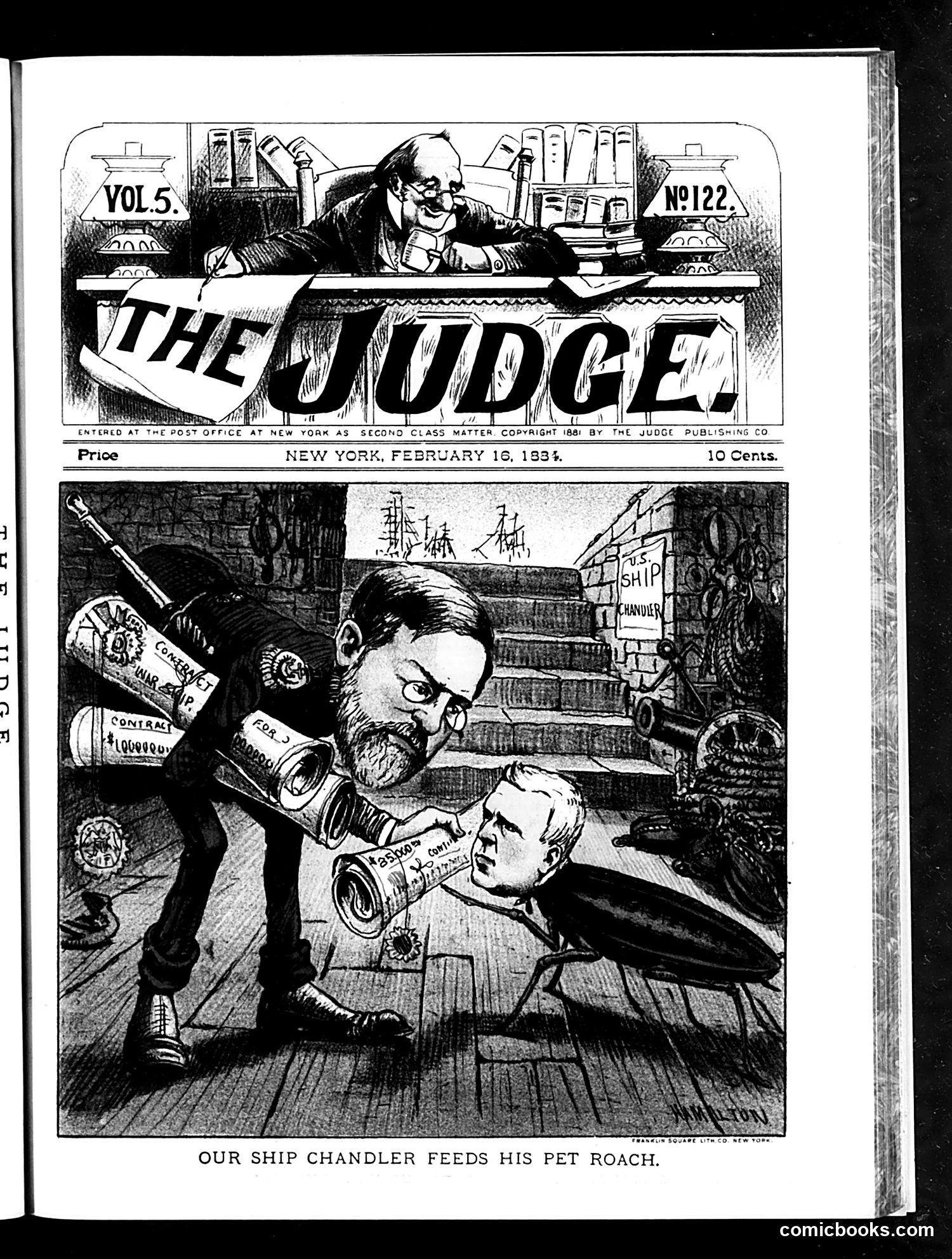
This satirical illustration depicts a ship chandler (supplier of provisions) feeding bottles to a large cockroach, captioned "Our Ship Chandler Feeds His Pet Roach." The cartoon appears to be commentary on corrupt commercial practices—likely suggesting that a ship supplier was adulterating or selling contaminated goods (represented by the bottles) that ended up infesting ships with pests. The figure's exaggerated facial features and glasses suggest he's a specific individual being mocked for dishonest business practices. The harbor setting and ship's chandler detail the maritime context. The humor relies on the absurdity of treating a cockroach as a "pet" while implying the vendor knowingly perpetuated the pest problem through his supplied goods. This reflects 1880s concerns about food safety and commercial fraud.
This page contains two main satirical pieces: **"Chandler and Roach"** attacks Secretary of the Navy William E. Chandler and defense contractor John Roach. The satire alleges that Roach, as a ship-builder, profits enormously from naval contracts while delivering poor vessels—described as failures existing "mainly on paper." The author suggests Chandler enables this corrupt arrangement, allowing Roach to grow fat while the U.S. Navy remains weak and unable to protect American interests abroad or dignity against smaller nations. **"Valentine's Day"** is lighter satire about romantic customs, joking that birds supposedly select mates on Valentine's Day according to tradition, while humans awkwardly imitate them in matters of love. The piece humorously suggests the comparison between bird and human courtship behavior is imperfect. Both pieces exemplify Judge's role mocking government inefficiency, corruption, and social pretense in Gilded Age America.
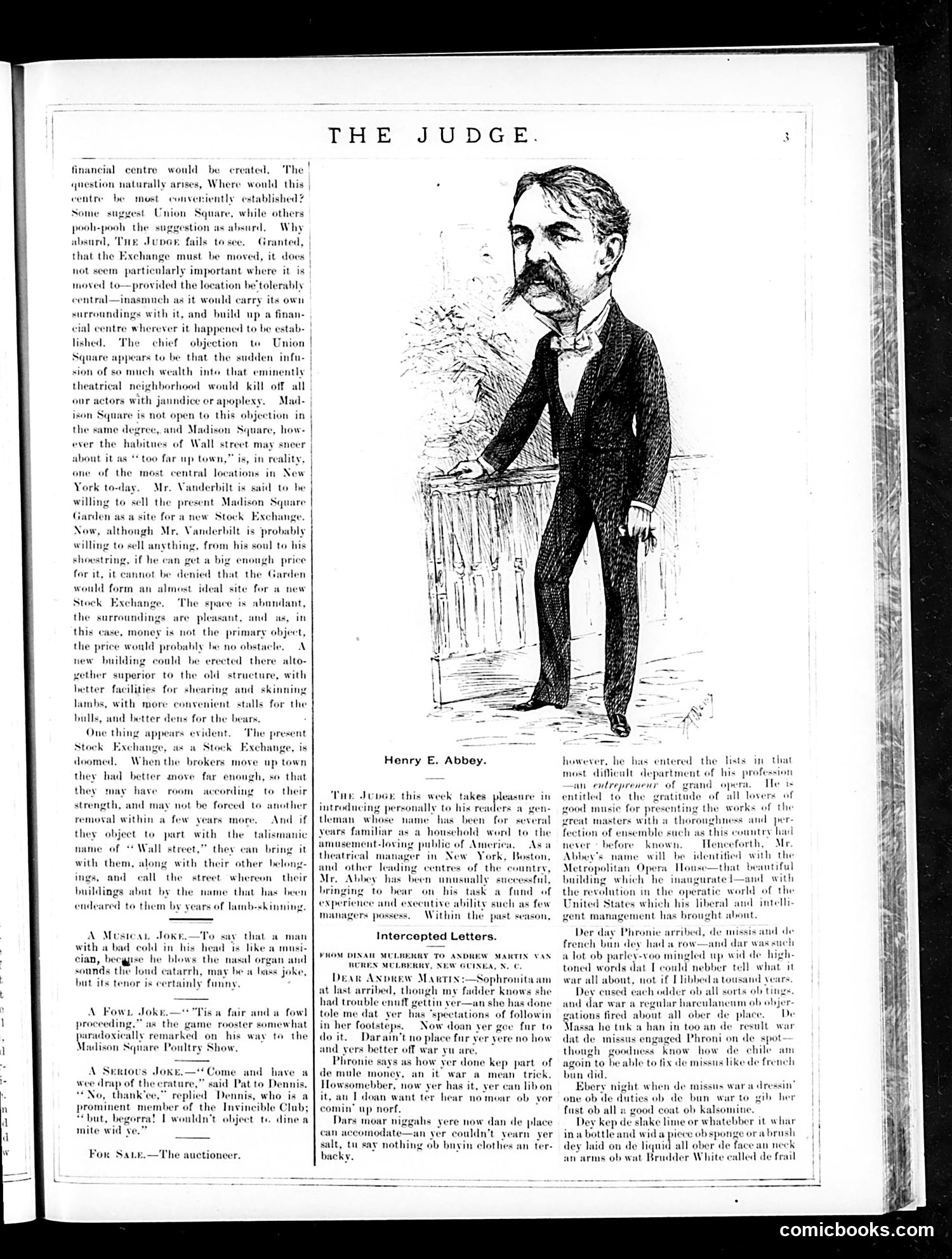
This Judge magazine page contains two distinct sections: **"The Judge" (main article with portrait):** Introduces Henry E. Abbey, a prominent theatrical manager in New York. The accompanying engraving shows a well-dressed gentleman. The text praises Abbey's successful management of theaters in New York, Boston, and other cities, and his recent introduction of grand opera to American audiences with "thoroughness and perfection of ensemble" previously unknown in the country. **"Intercepted Letters" (humor section):** A satirical piece written in exaggerated dialect presenting fictional letters between people in New Guinea. The crude phonetic spelling and racial stereotypes reflect 19th-century American humor conventions (now considered offensive). The joke appears to be about colonial/frontier life and romantic entanglements, relying on dialect comedy typical of the era. The page also contains brief joke entries ("Musical Joke," "Fowl Joke," "Serious Joke," "For Sale") using puns and wordplay common to period satirical magazines.
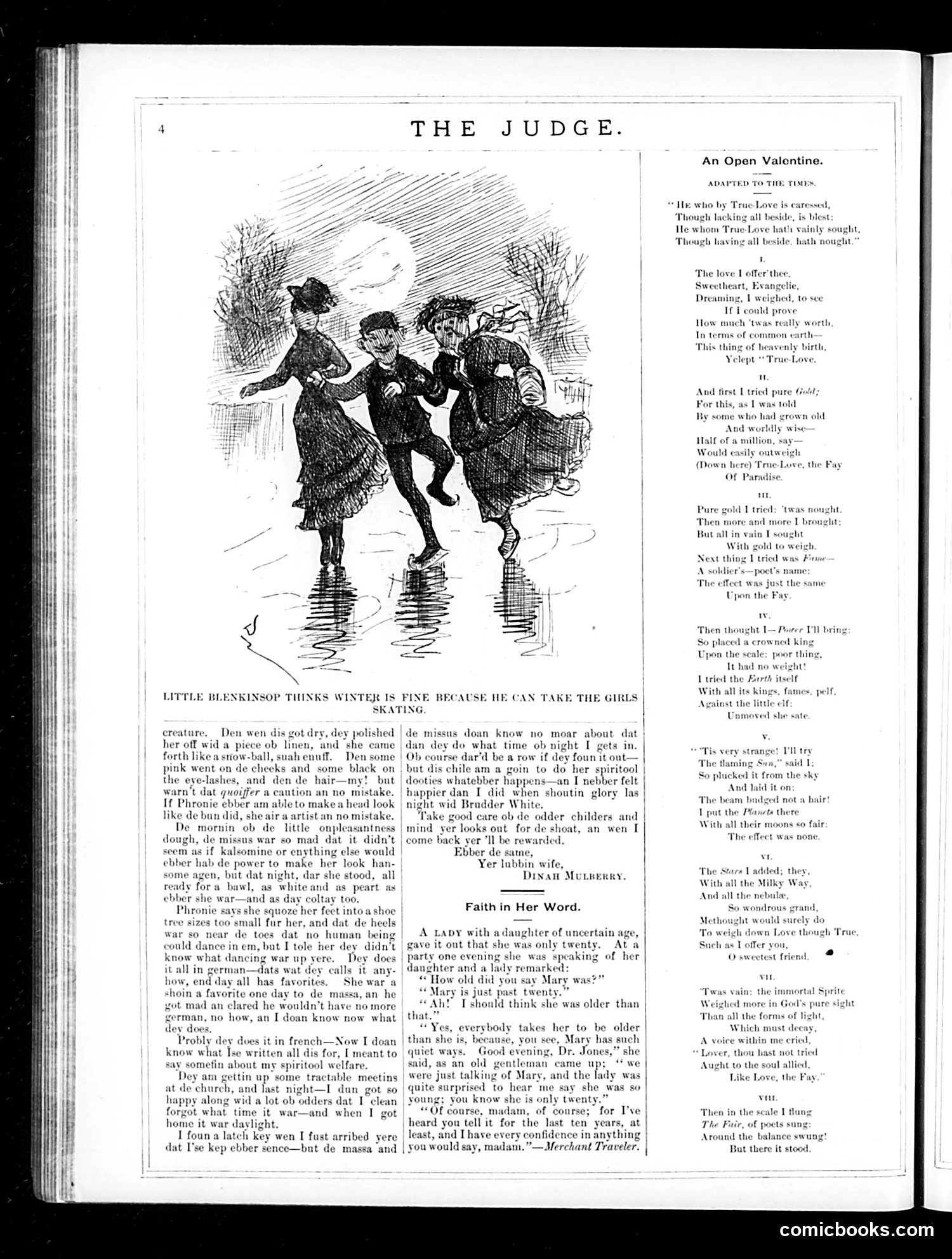
This page contains two distinct pieces of Victorian-era satirical content: **The Main Cartoon** depicts a character named "Little Bledsinsop" thinking winter is fine because he can take girls ice skating. The accompanying text is a first-person narrative (apparently in African American dialect) about a man's domestic life—describing his wife's preparations for social activities, his church attendance, and his casual deception about his late-night whereabouts. The humor relies on the contrast between the man's pious religious claims and his actual behavior, typical of Judge's social satire mocking hypocrisy. **"Faith in Her Word"** jokes about a lady claiming her daughter is twenty when she's actually older, and everyone politely accepting this obvious fiction for ten years. **"An Open Valentine"** is a poem satirizing romantic idealism, suggesting that true love cannot be weighed or measured against material wealth or even cosmic forces—a sentimental parody of Victorian poetry conventions. The page reflects Judge's focus on satirizing middle-class pretense, domestic life, and sentimentality.
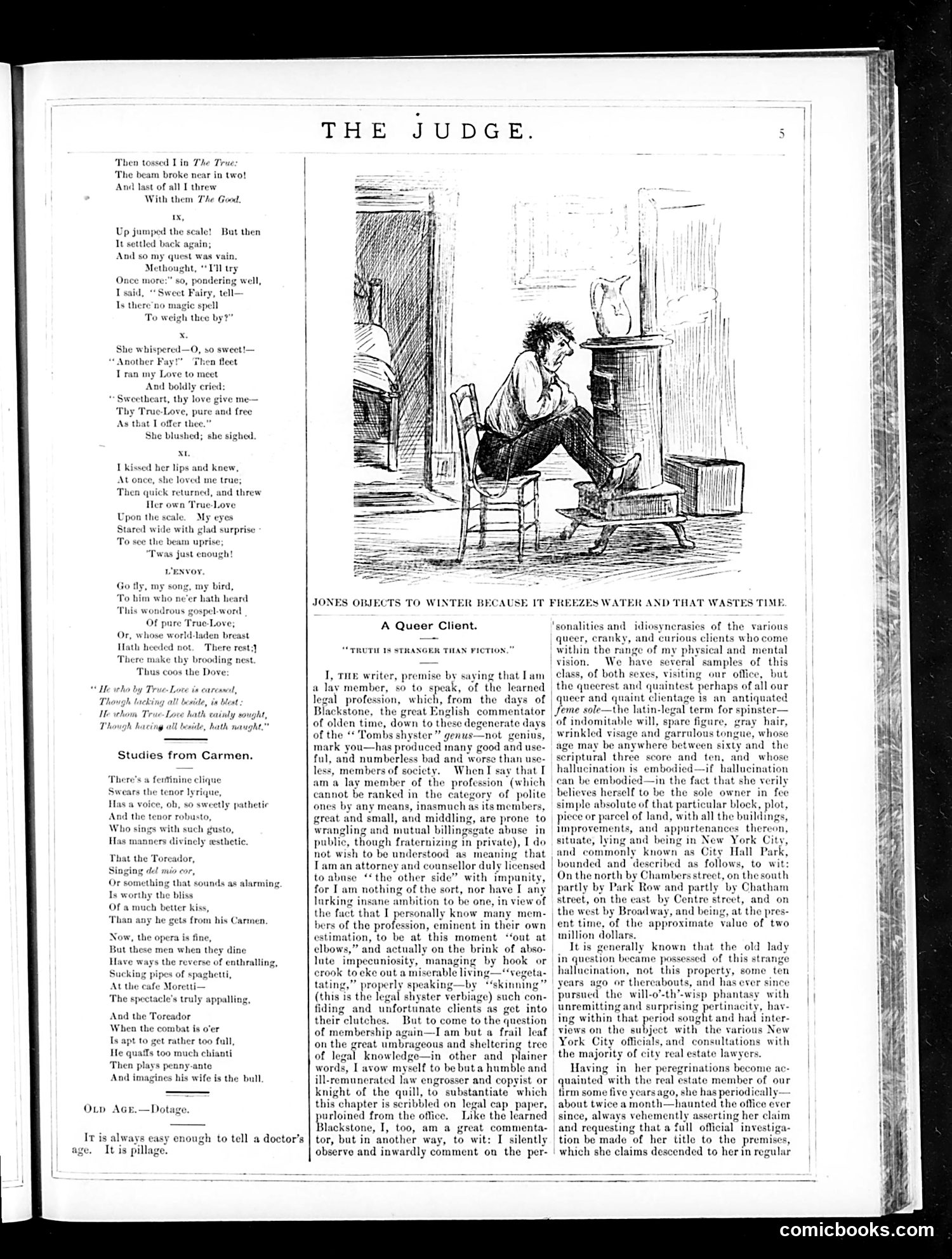
This page satirizes an eccentric female client visiting a law office. The illustration shows a thin, elderly woman with wild hair sitting rigidly in a chair—the "queer client" referenced in the title. The accompanying text, written from a lawyer's perspective, mocks this woman's delusional belief that she owns valuable real estate in New York City (mentioning Fifth Avenue, Chambers Street, and Broadway locations). The lawyer describes her as a "feme sole" (unmarried woman) with "indomitable will" who periodically visits demanding that an official investigation prove her property claims. The satire targets both the woman's obvious mental instability and the legal profession itself—the writer portrays himself as a cynical law clerk who observes such "queer" clients while working on trivial copying tasks in the office. The joke relies on period attitudes toward eccentric elderly women and mental illness, presenting her delusion as absurd entertainment rather than a genuine concern.
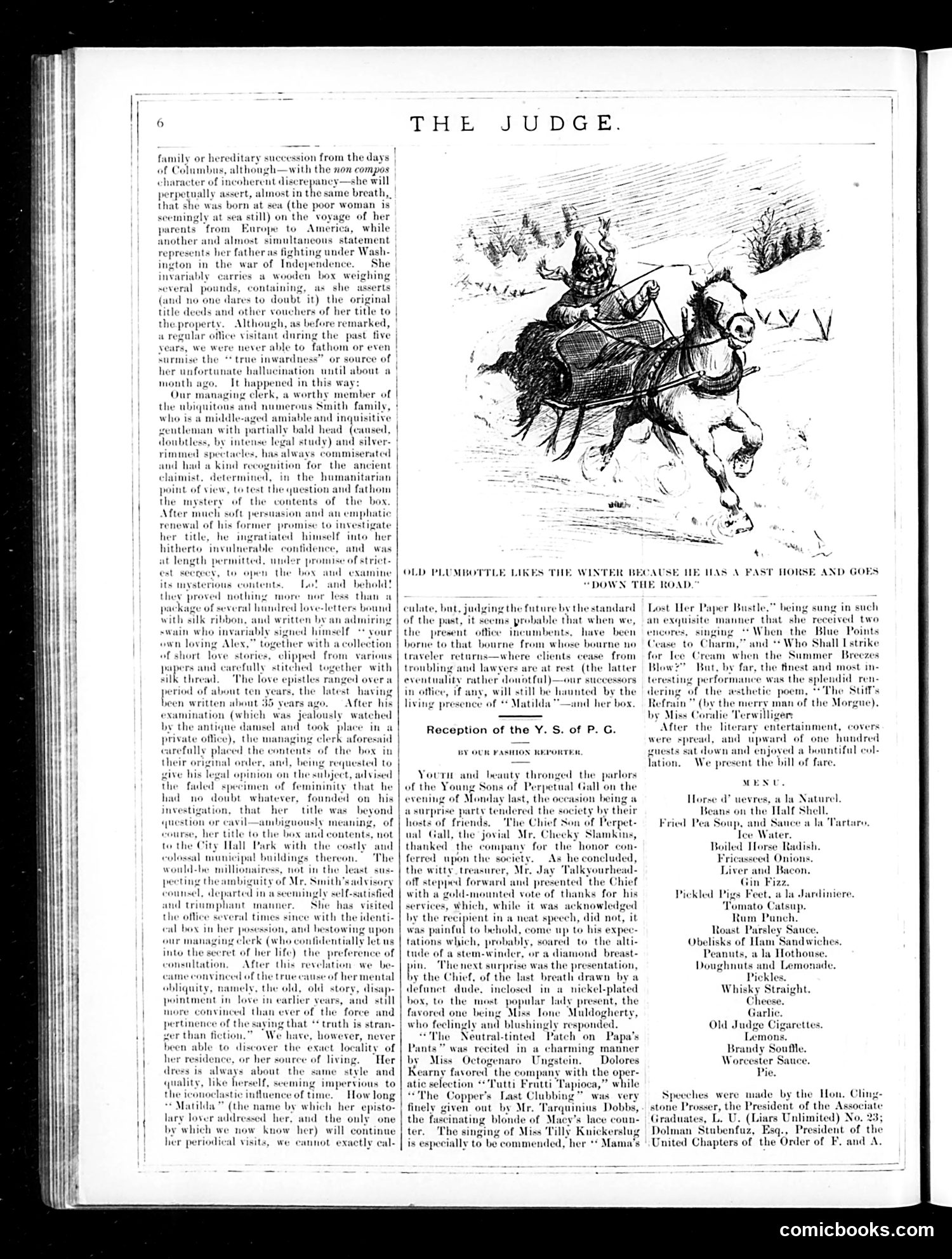
This page features a satirical cartoon depicting a character named "Old Plumbottle" riding recklessly on horseback down a winter road. The humor targets someone—likely a recognizable public figure of the era—who apparently enjoys winter specifically because it allows him to ride fast horses dangerously. The exaggerated, energetic illustration emphasizes the recklessness of the ride. The surrounding text discusses various social matters: a woman's disputed claim to property (the "Matilda" story), and a reception held by the "Young Sons of Perpetual Gall" featuring humorous entertainment and dining. Without clearer identification of "Old Plumbottle," the specific satirical target remains unclear, though the cartoon mocks someone's winter riding habits as foolish or characteristic behavior worth ridicule.
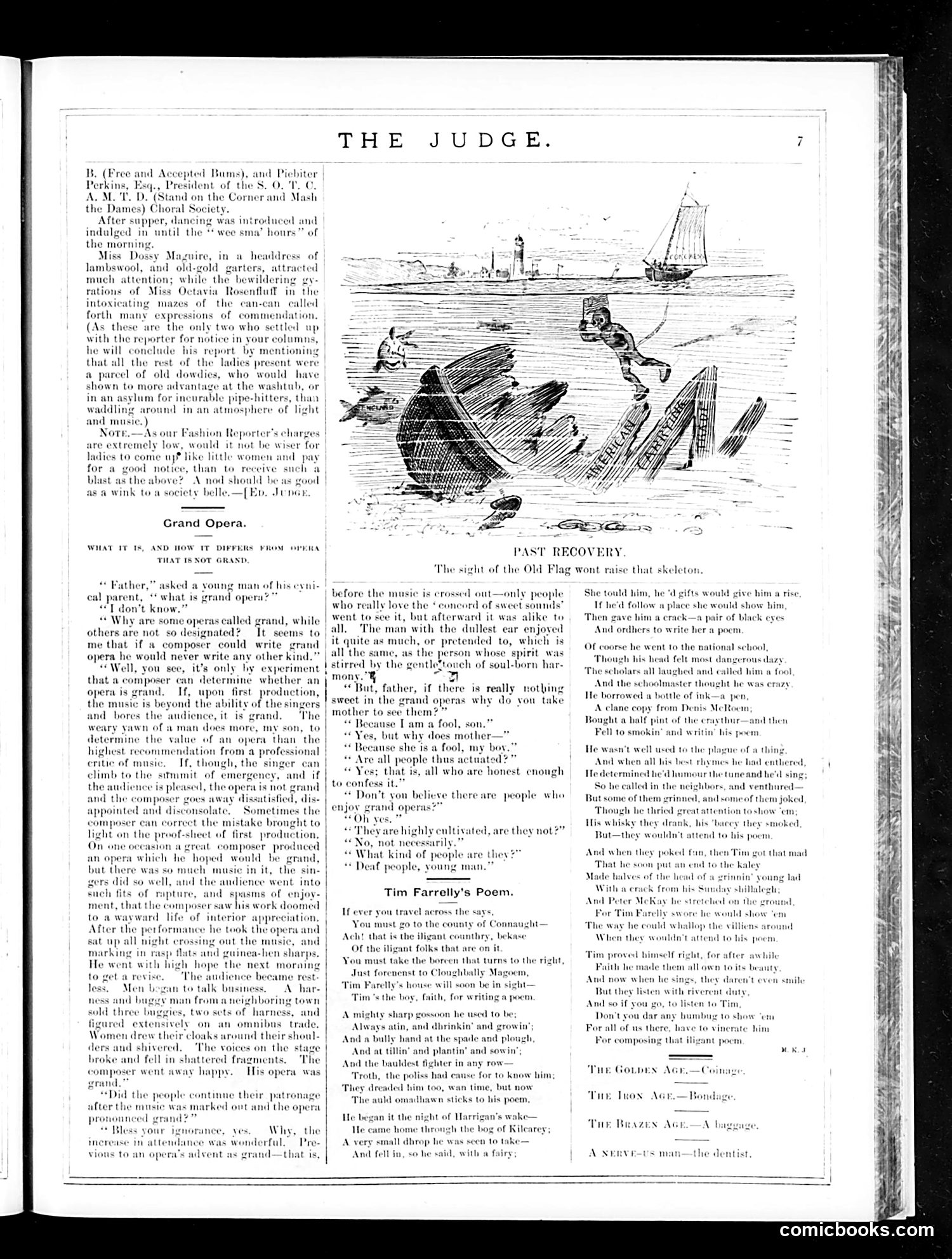
This page contains a satirical cartoon titled "Past Recovery" depicting a skeletal ship or vessel on a beach, with the caption "The sight of the Old Flag wont raise that skeleton." **What it means:** The cartoon appears to reference American naval or maritime decline, likely from the late 19th century. The "skeleton" of an old ship represents a deteriorated vessel of national importance, while the "Old Flag" suggests American patriotism or naval power. The satire suggests that patriotic sentiment alone cannot restore decayed national institutions or military capabilities—the damage is irreversible ("past recovery"). **The social commentary:** Judge magazine was satirizing the gap between nostalgic appeals to American glory and the actual state of the nation's infrastructure or military readiness. The skeleton imagery emphasizes that no amount of flag-waving will resurrect what has genuinely deteriorated. The surrounding text discusses Grand Opera, which appears unrelated to the cartoon's political commentary.
This appears to be a single satirical cartoon titled "THE JUDGE" (visible on the left margin). The image is rotated 90 degrees, showing what seems to be a courtroom or legal proceeding scene with multiple figures in period dress (appearing to be 19th century based on style). The OCR text is largely illegible/corrupted, making it difficult to identify specific references. However, the cartoon likely satirizes the judicial system, possibly depicting corruption, absurd legal proceedings, or commentary on specific judges or court cases contemporary to Judge magazine's publication. Without clearer text or additional context about the specific date and issue, I cannot confidently identify which political or social event this references. The artistic style and setting suggest legal/governmental satire typical of Judge's content.
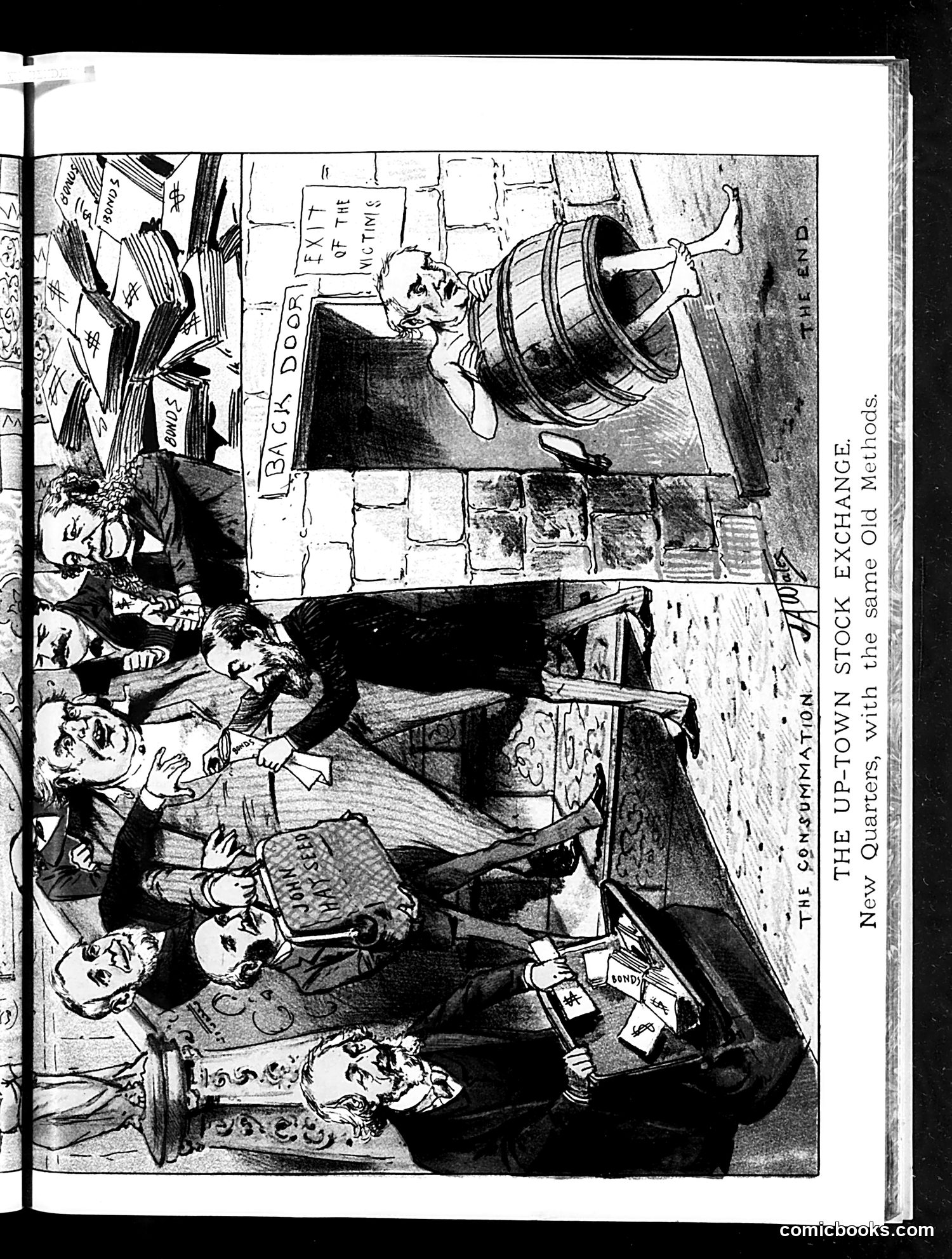
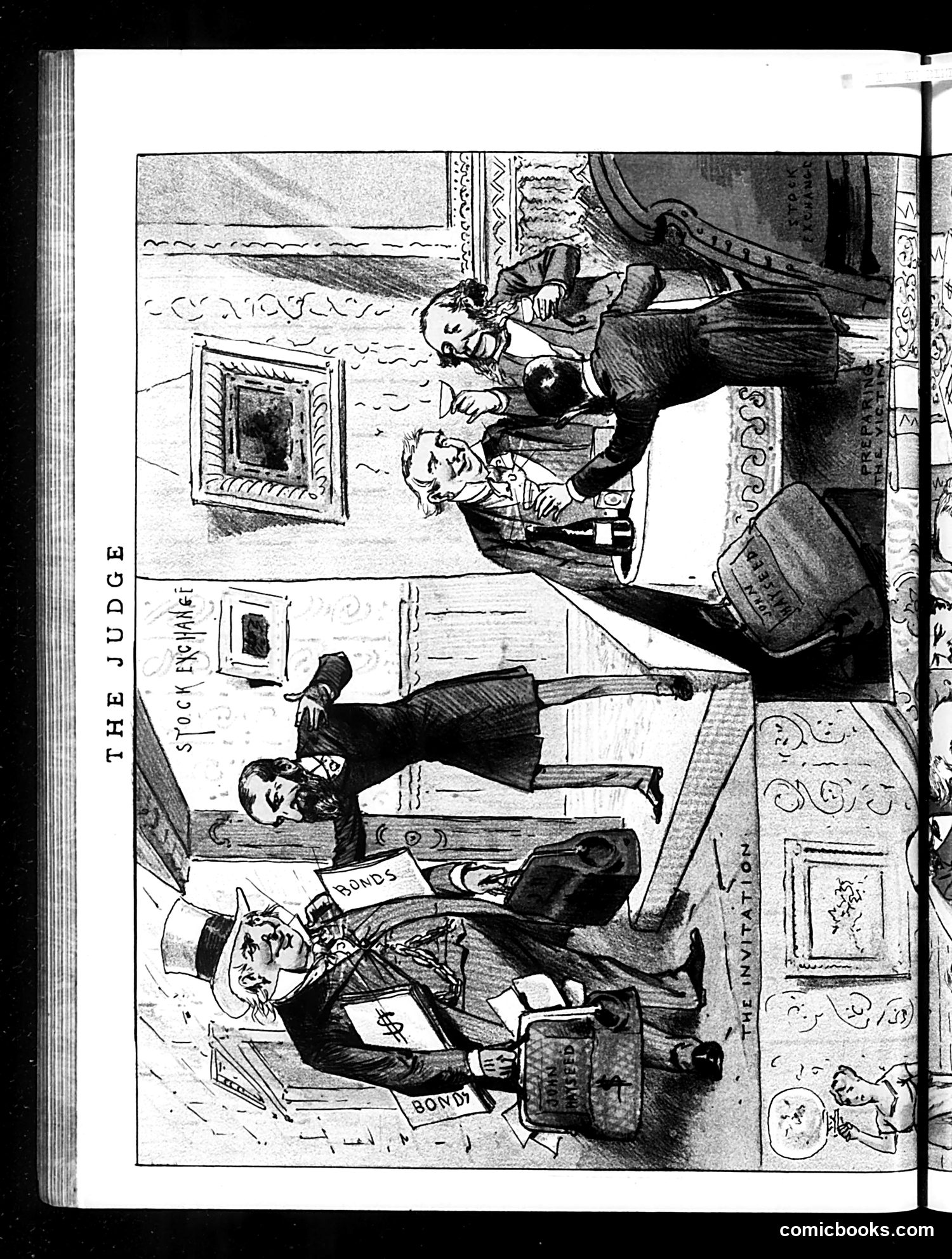
This cartoon satirizes the relocation of the stock exchange to new quarters uptown. The image shows various figures engaged in trading and speculation in the new building, labeled "BRICK DOOR" and "BRCK DODGE." The satire's point appears to be that despite moving to a fancier, modern facility, the fundamental nature of stock market activity—characterized by chaos, frenzied dealing, and questionable practices—remains unchanged. The crowded, disorderly scene suggests that new physical surroundings don't reform the behavior of speculators and traders. The cartoon mocks the notion that a move to improved accommodations would somehow elevate or legitimize stock exchange operations. It's social commentary on institutional corruption: gilded new quarters mask the same "old methods" underneath.
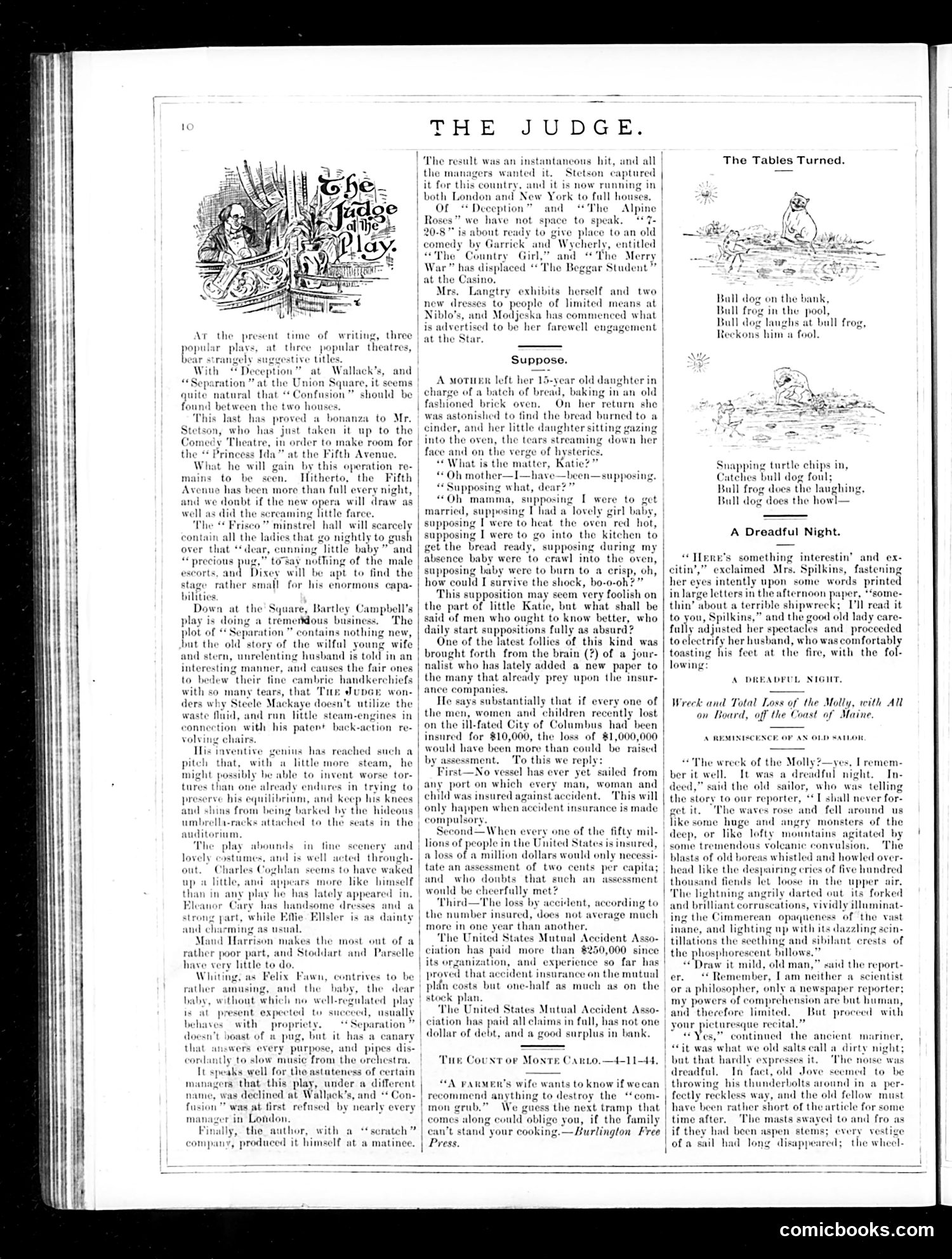
This page from *Judge* contains theater reviews and social commentary. The main cartoon (upper left) depicts "The Judge" character presiding over theatrical matters—a recurring mascot for the magazine's satirical critiques. The text discusses three popular plays: "Deception," "Separation," and "Confusion" at various theaters, with commentary on their success and the performers involved (Stetson, Eleanor Cary, Charles Coghlan). The author uses theater as a vehicle for social satire. The "Suppose" section mocks women's irrational anxiety through a mother-daughter dialogue about imagined domestic disasters—a common Victorian-era stereotype portraying women as prone to hysteria and excessive worry. The section on insurance fraud exposes a contemporary scheme: a journalist supposedly calculated that insuring passengers on the ill-fated *City of Columbus* at $10,000 each would have recovered more than the actual loss—satire targeting both insurance manipulation and sensationalist journalism exploiting tragedy.
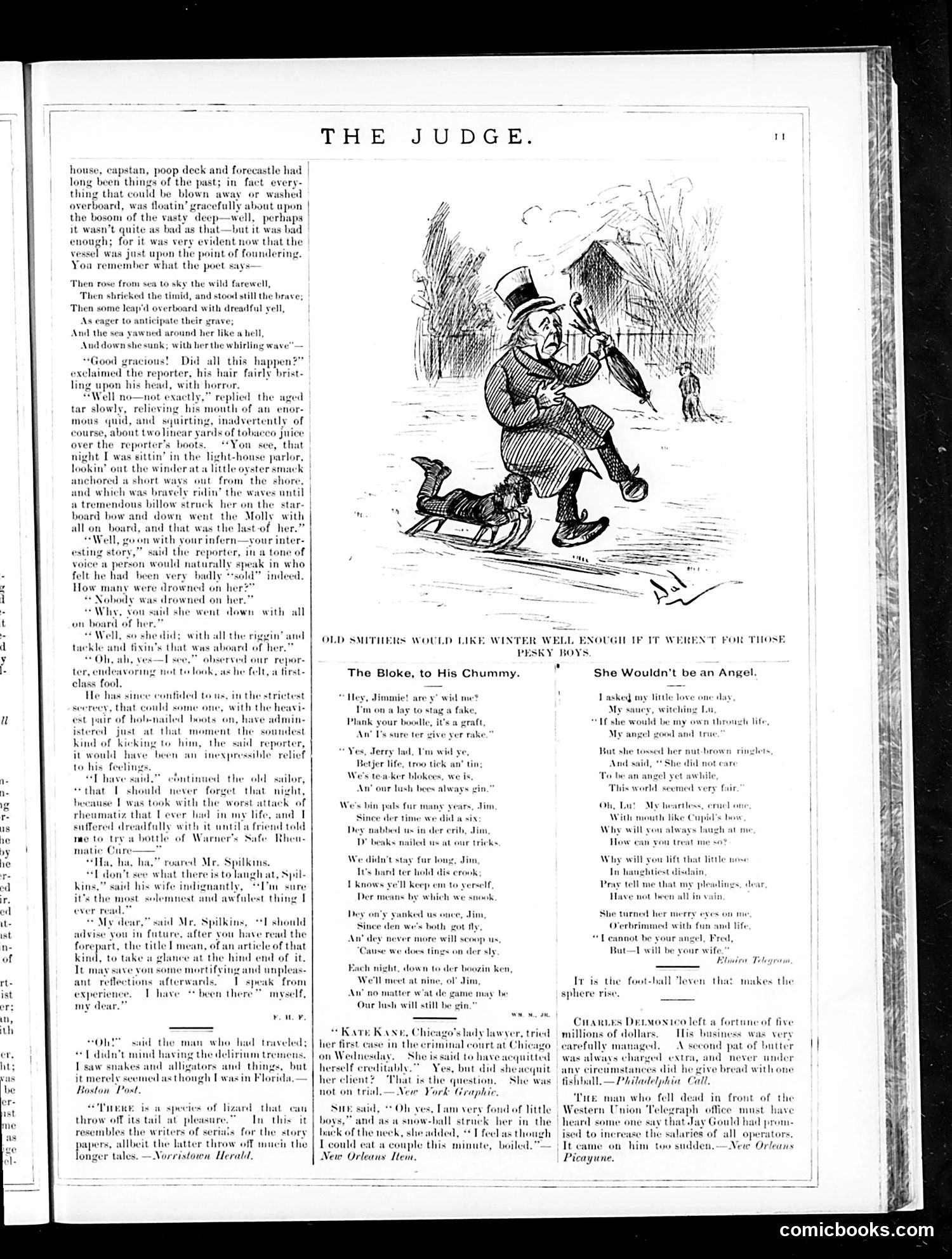
This page contains multiple satirical pieces typical of late-19th-century Judge magazine: **Main Cartoon**: Shows an old sailor man sledding downhill in winter, captioned "Old Smithers Would Like Winter Well Enough If It Weren't For Those Pesky Boys." The satire targets street urchins who apparently harass winter travelers. **Text Stories**: Include dialect-heavy narratives—"The Bloke, to His Chummy" depicting working-class criminals in exaggerated speech, and a lengthy yarn about a shipwreck, mocking both tall tales and gullible reporters who transcribe them. **Verse**: "She Wouldn't be an Angel" appears to be sentimental romantic poetry, likely included for satirical contrast with cruder material. **Advertising**: Disguised advertisements appear throughout (Warner's Safe Rheumatic Cure, various products), presented as editorial content—common Judge practice. The overall tone reflects Judge's working-class mockery: crude dialect humor, urban crime references, and gentle ridicule of sentimentality. No specific political figures are identifiable.
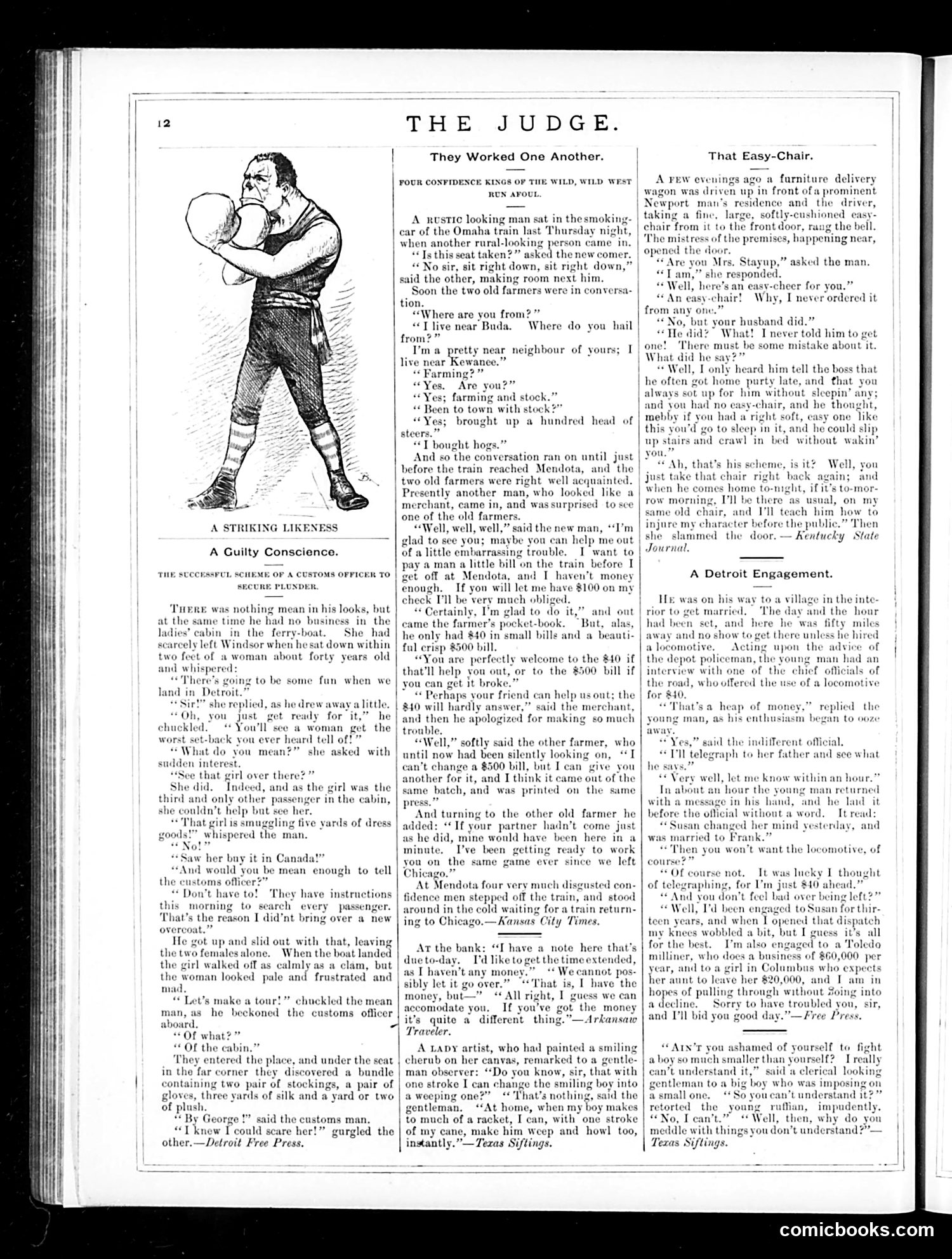
The page contains two separate satirical stories illustrating con schemes and moral comeuppance. **"A Guilty Conscience"** depicts a man who intimidates a woman on a ferry-boat into revealing she smuggled goods from Canada, then tips off customs officers—hoping to claim her contraband for himself. The joke: his scheme backfires when the woman plants her own smuggled items under his seat, causing his arrest instead. **"They Worked One Another"** shows two rural con-men on a train who befriend each other, then attempt to bilk a third man (a merchant) by producing a counterfeit $500 bill. The irony: they discover they're both con-artists working the same scheme, foiling each other's plans. Both stories mock dishonesty through ironic reversals—the guilty parties are caught by their own schemes. The rural/frontier setting ("wild west con men") and the emphasis on financial trickery reflect Gilded Age anxieties about fraud and untrustworthy strangers.
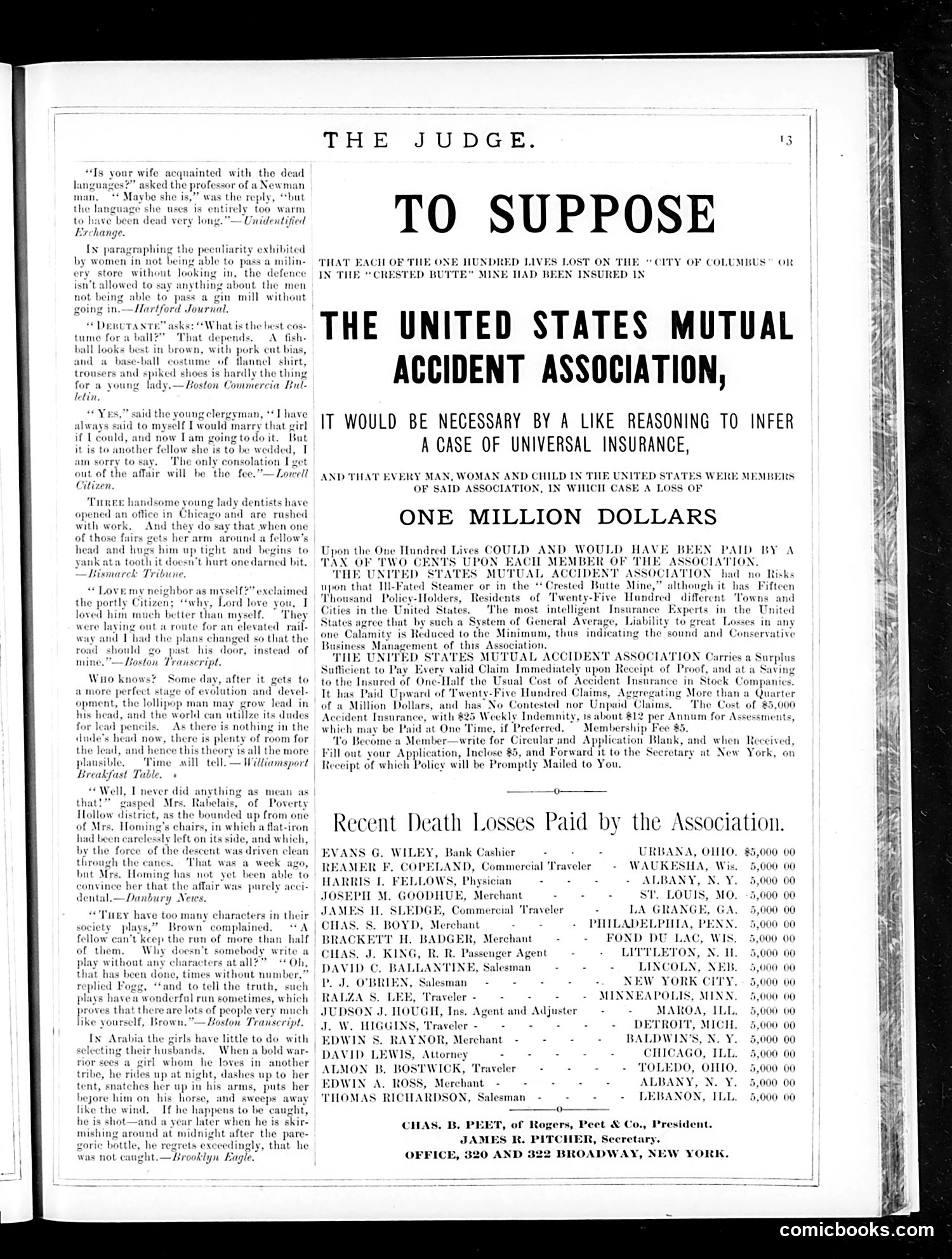
This page is primarily **advertising content** for the United States Mutual Accident Association, not a satirical cartoon. The large central advertisement presents a hypothetical scenario about the "City of Columbus" disaster—apparently a maritime incident resulting in one hundred deaths. The ad argues that IF each victim had been insured by their association, universal membership would theoretically prevent catastrophic losses totaling one million dollars. The satire lies in the absurdist logic: the advertisement essentially mocks the idea of universal insurance by showing its reductio ad absurdum—if everyone were forced into such a scheme, the math becomes ridiculous. This critiques insurance industry practices or perhaps argues against the feasibility of comprehensive coverage schemes. The bottom section lists actual death claims the association paid out (ranging from $5,000 per person), seemingly as proof of legitimacy. The scattered quotations and short humor pieces in margins appear unrelated to the main advertisement—typical filler content for the magazine.
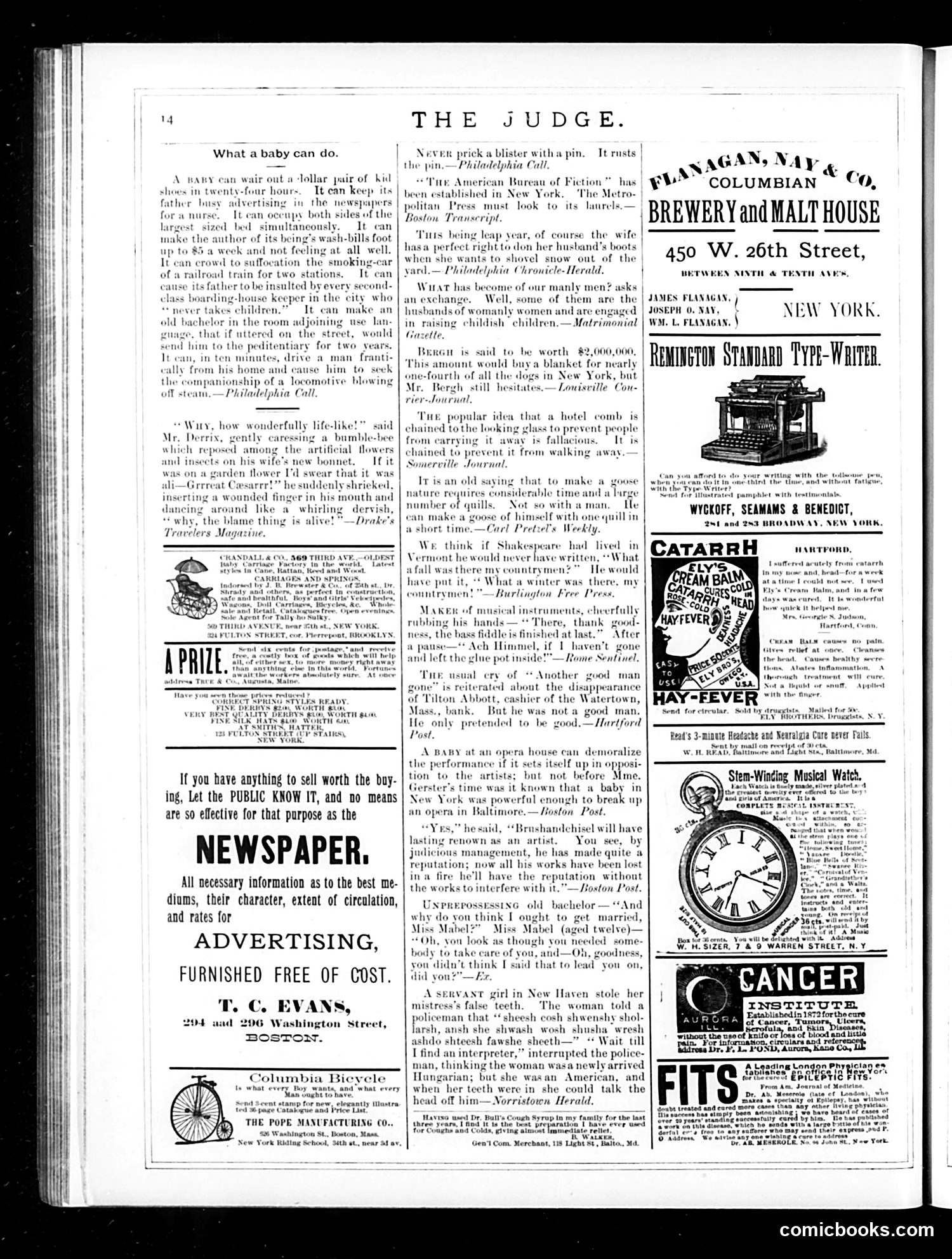
This page is primarily **advertising and filler content** rather than satirical cartoons. The visible content includes: **Advertisements:** - Flanagan, Nay & Co. Brewery and Malt House (New York) - Remington Standard Type-Writer - Catarrh and Hay-Fever remedies - Stem-Winding Musical Watch - Cancer cure advertisement - Fits (epilepsy) treatment ad - Columbia Bicycle - Various other patent medicines and products **Editorial Content:** Brief humorous anecdotes titled "What a baby can do" and miscellaneous jokes about domestic life, opera, and bachelor life—typical light satirical fare. The page demonstrates Judge magazine's business model: combining light humor with profitable advertising space, particularly for patent medicines and mechanical products popular in the 1890s era.
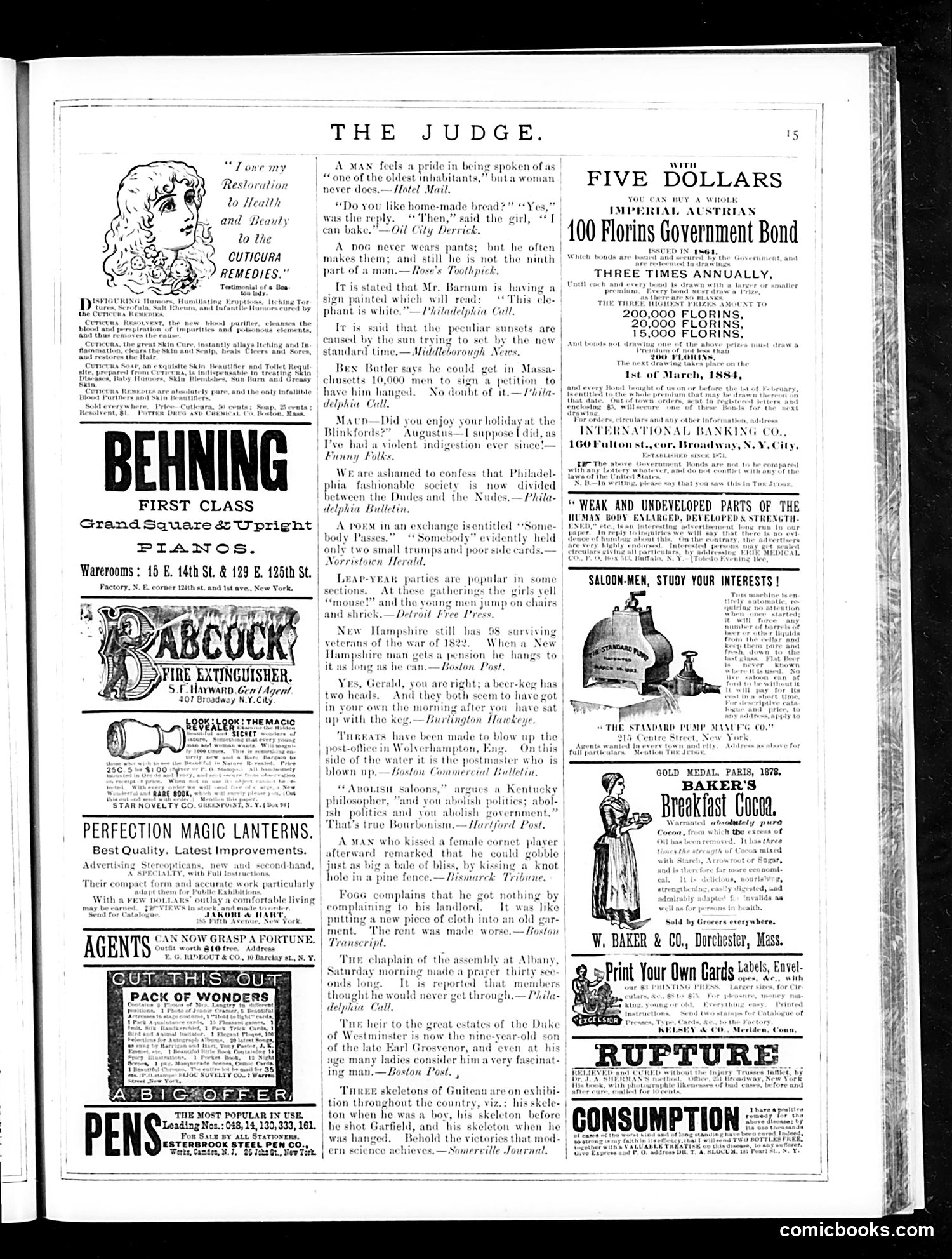
This page is primarily **advertisements and filler content** rather than political satire. The masthead reads "THE JUDGE," a well-known satirical magazine, but the visible material consists mostly of small advertisements (pianos, fire extinguishers, pens, banking bonds) and brief humorous anecdotes. The few jokes included are mild social observations: a man preferring homemade bread, someone enjoying holiday food too much, Philadelphia society divided between "Dudes and Nubes," and various quips about saloons, cornet players, and aristocratic heirs. The most substantive political reference appears to be a joke about "Abolish saloons" and "abolish politics," but context is unclear. There's also mention of "Ben Butler" and Massachusetts, but the full reference is incomplete. Overall, this reads as a typical **interior page of a period magazine**—mixing light humor, advertisements, and filler rather than focused editorial cartooning or sustained political commentary.
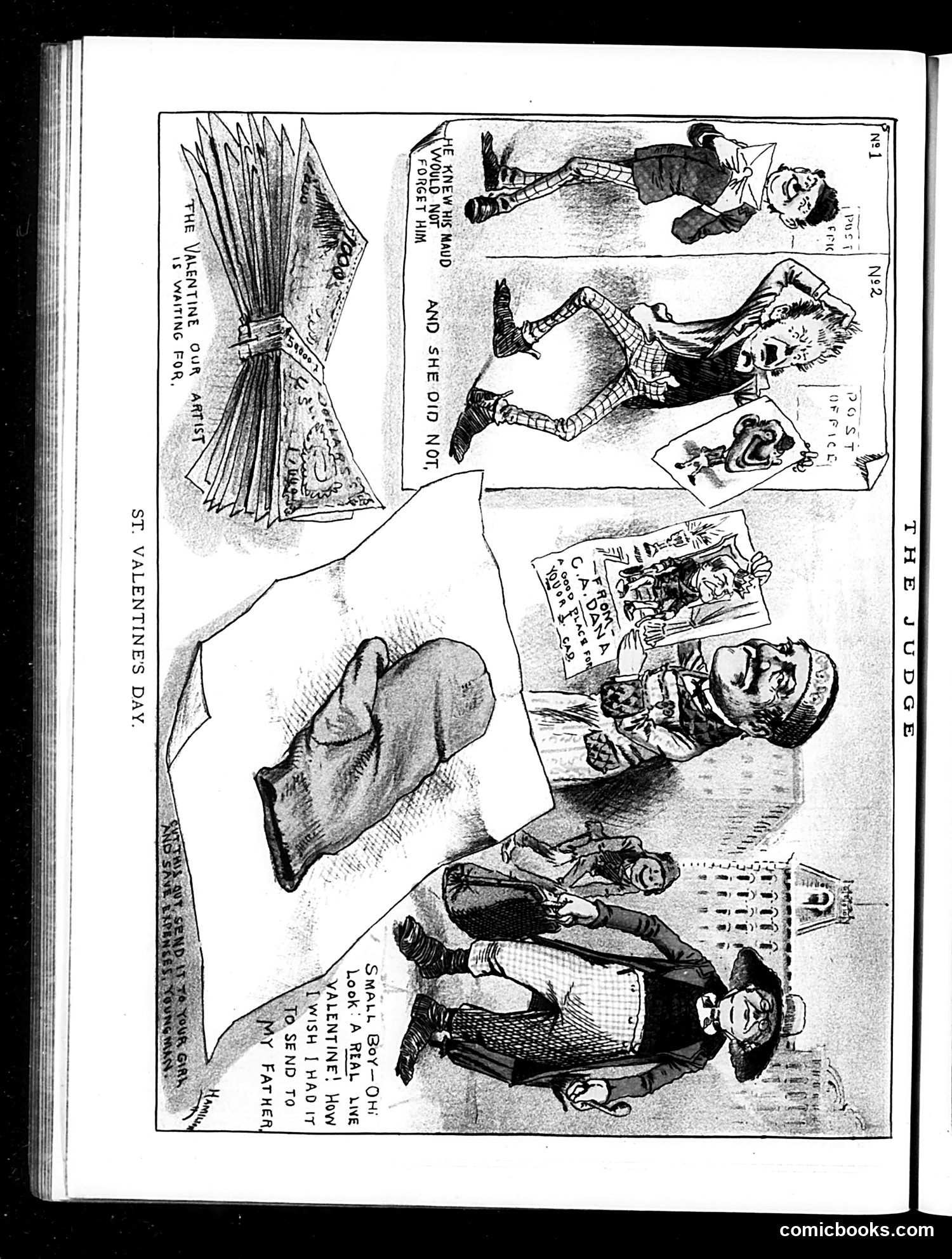
This appears to be a Valentine's Day-themed page from Judge magazine featuring satirical illustrations about romance and courtship. The main cartoon shows a large Valentine's card or envelope as the central image, with smaller vignettes around it depicting various romantic scenarios and characters. The text references "St. Valentine's Day" and includes dialogue about valentines and romantic wishes. One figure appears to comment on a "real live Valentine," suggesting commentary on romantic idealization versus reality—a common Judge satirical theme. The smaller illustrations show what appear to be period-appropriate romantic or courtship situations, likely poking fun at contemporary dating customs and sentimental Valentine's traditions. Without clearer visibility of all text and specific caricature details, the exact satirical targets remain somewhat unclear, but the overall tone critiques romantic sentimentality.