
A complete issue · 16 pages · 1883
Judge — December 22, 1883
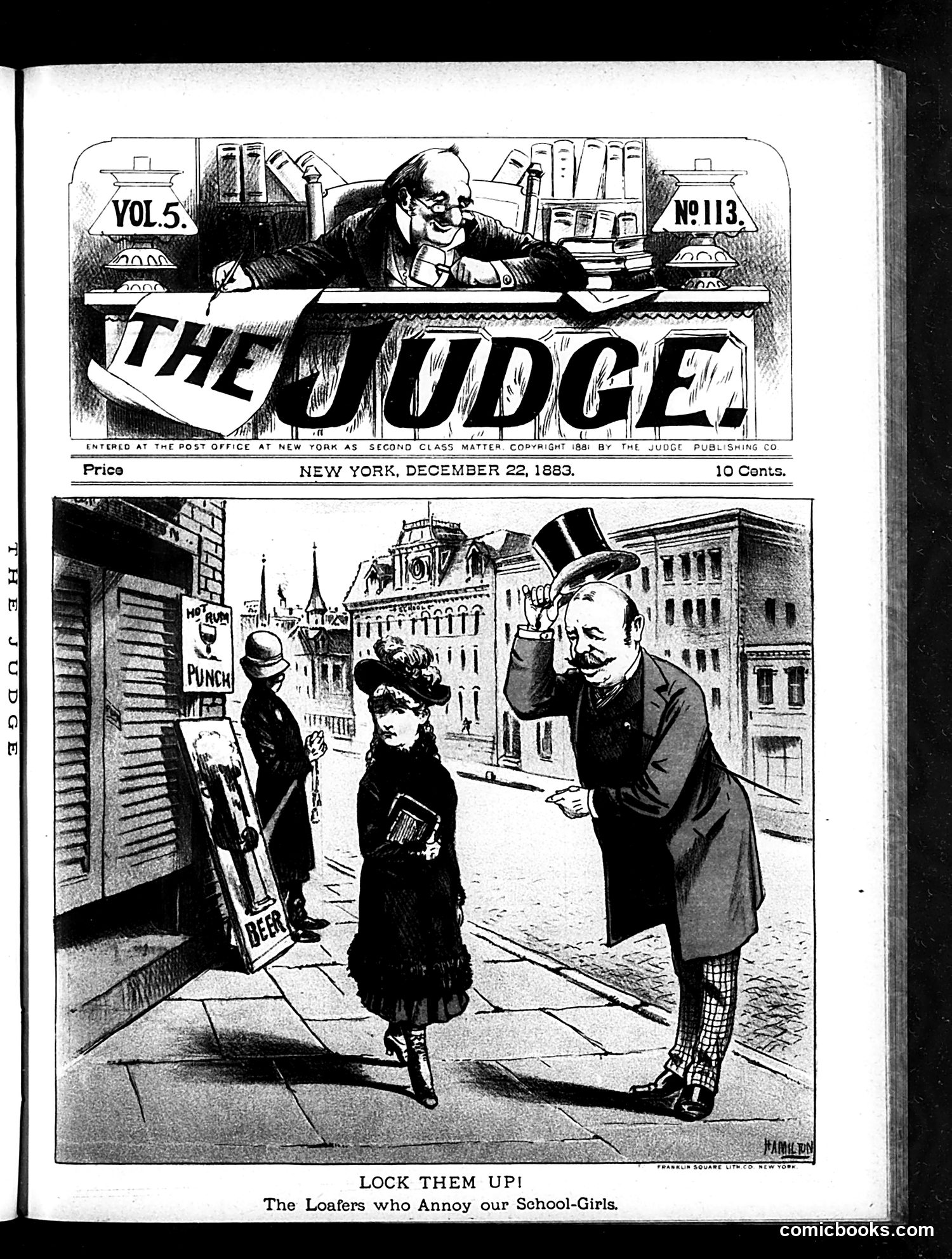
This 1883 *Judge* cartoon satirizes street harassment of young women. The main illustration depicts a well-dressed man in a top hat accosting a schoolgirl on a city street, while two other men loiter nearby with dubious intentions—one posting what appears to be a notice or advertisement. The satire targets "loafers": idle men who congregated on streets to harass and intimidate young female students. The cartoon advocates for legal action ("lock them up") against these harassers, framing their behavior as a public nuisance requiring intervention. The social concern reflects late 19th-century anxieties about women's safety and independence, particularly as more girls attended school unaccompanied. The cartoon uses satirical outrage to support protective measures against street harassment.
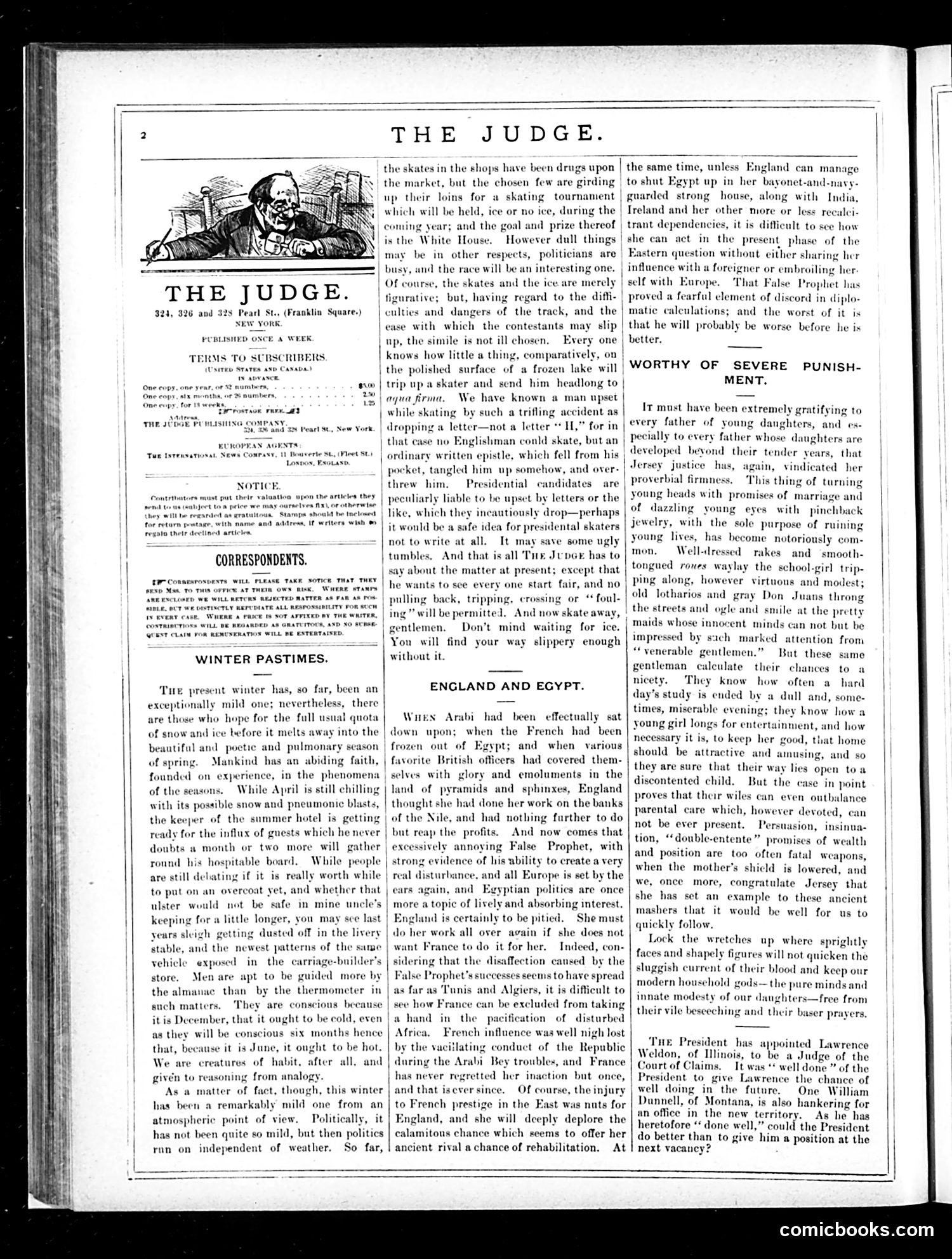
This page from Judge magazine contains editorial commentary on American politics and winter activities, circa late 19th century. **The Cartoon:** The masthead features a small sketch of a judge or magistrate figure—likely the magazine's namesake mascot. **Political Content:** The main satire concerns the 1880 U.S. presidential race, comparing it to a skating tournament where "the goal and prize thereof is the White House." Politicians are "girding up their loins," and even minor missteps could send candidates "headlong" into failure—the joke being that presidential campaigns are as precarious as ice-skating. **"England and Egypt" Section:** This discusses British imperial policy, particularly England's control of Egypt and ongoing Eastern Question tensions. The text criticizes some unnamed figure ("False Prophet") for creating diplomatic discord, likely referencing a controversial British politician's foreign policy stance. **"Worthy of Severe Punishment":** This section addresses parental discipline and moral education of daughters, reflecting period concerns about young women's propriety. The page is primarily text-driven opinion rather than visual satire.
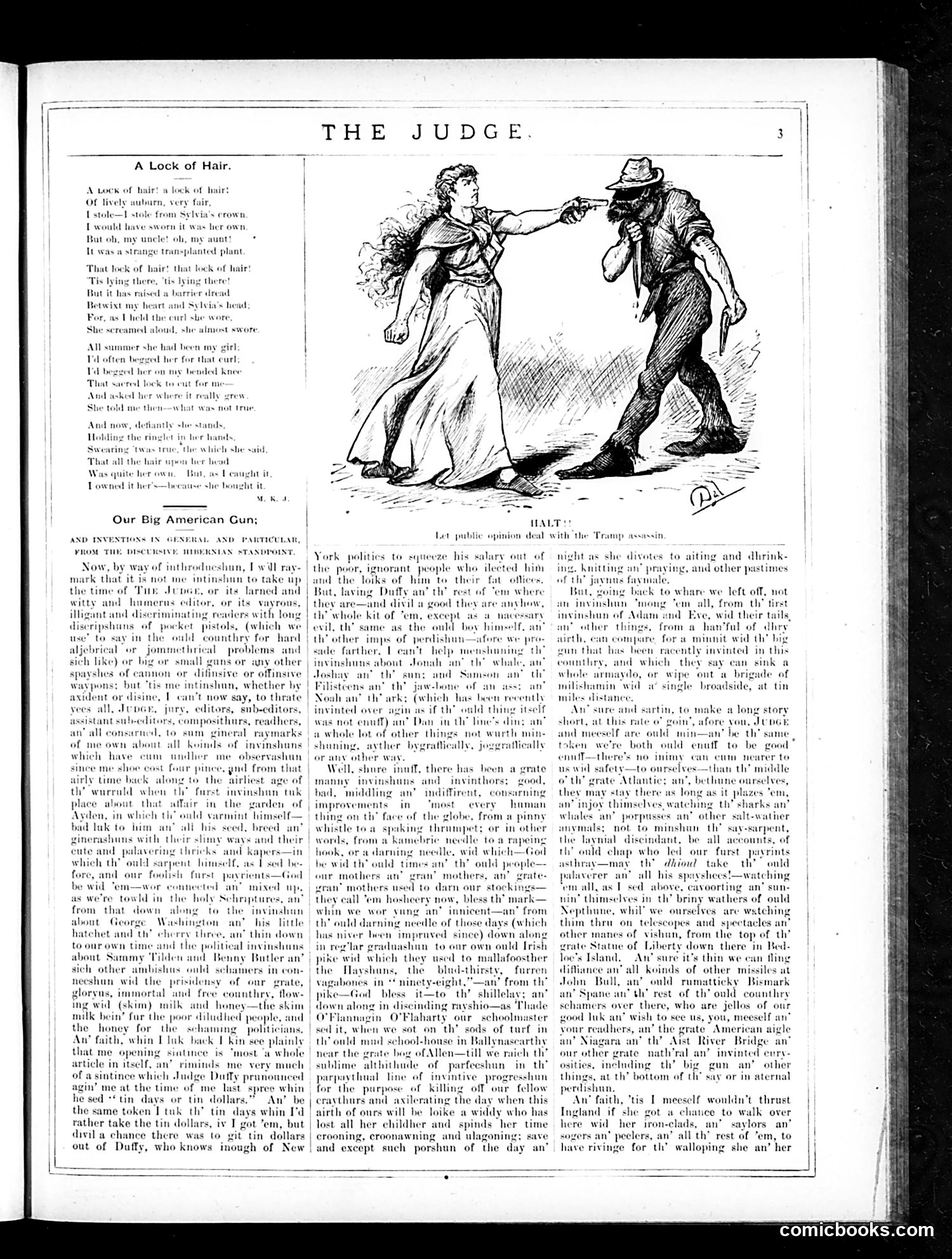
**The Cartoon:** The illustrated scene shows a woman handing a lock of hair to a man in a hat. The poem "A Lock of Hair" is romantic/sentimental verse about a stolen keepsake. **The Political Content:** The second piece, "Halt," directly addresses New York politics and concerns a "Tramp assassin." The text discusses how politicians (appearing to reference figures like Tilden and Butler) squeeze money from poor voters who elected them. The commentary suggests public opinion should "deal with" this "Tramp assassin" through vigilante justice rather than legal proceedings—mentioning the figure should face "knitting an' praying, and other pastimes of the genuine fanatic." **The Satire:** This appears to be Judge magazine's commentary on urban political corruption and vigilantism, using Irish-inflected dialect for comedic effect while making serious points about electoral fraud and politician malfeasance. The "Tramp" likely refers to a vagrant or criminal element exploited in political discourse of the era.
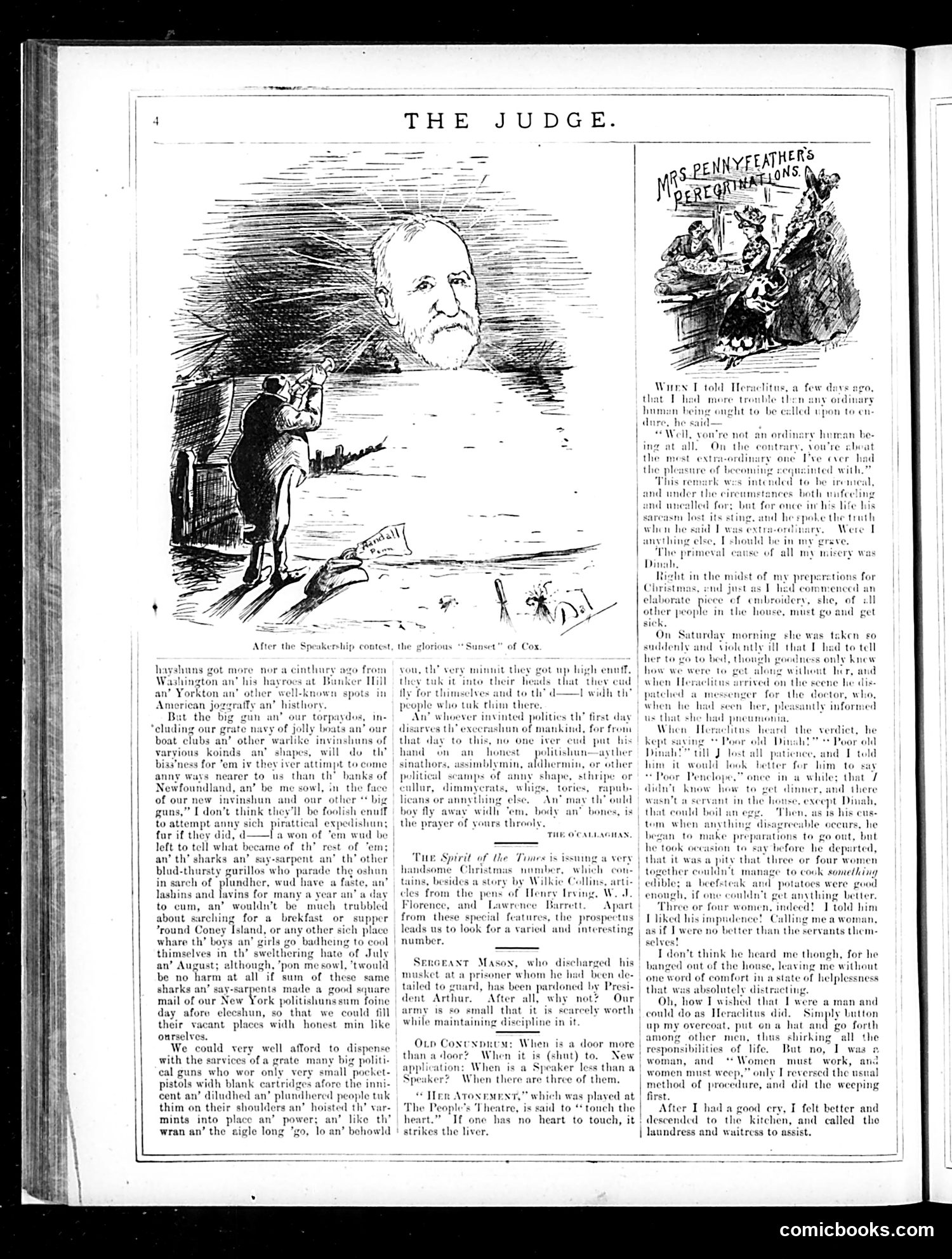
**Main Cartoon:** The large illustration depicts a figure (appears to be a political leader, likely Speaker of the House based on the caption) gaunt and diminished after the "Speakership contest." The caption's reference to Cox's "sunset" suggests this satirizes a recent political struggle—possibly the 1869 Speaker election. The cartoon mocks the exhaustion and diminishment of political ambition through the withered figure. **Text Content:** The page features humorous dialect-heavy narrative about domestic troubles and Irish-American perspectives on American politics and military matters. The satirical commentary criticizes politicians generally ("politishuns"), suggesting they're as disruptive as sharks and serpents, and questions military discipline. **Social Commentary:** The scattered references mock small-scale military matters (Sergeant Mason's pardon), Christmas entertainments, and contemporary social figures. The overall tone is irreverent toward political and military authority, typical of *Judge* magazine's satirical mission. The page mixes visual and textual satire characteristic of 1870s American humor journalism.
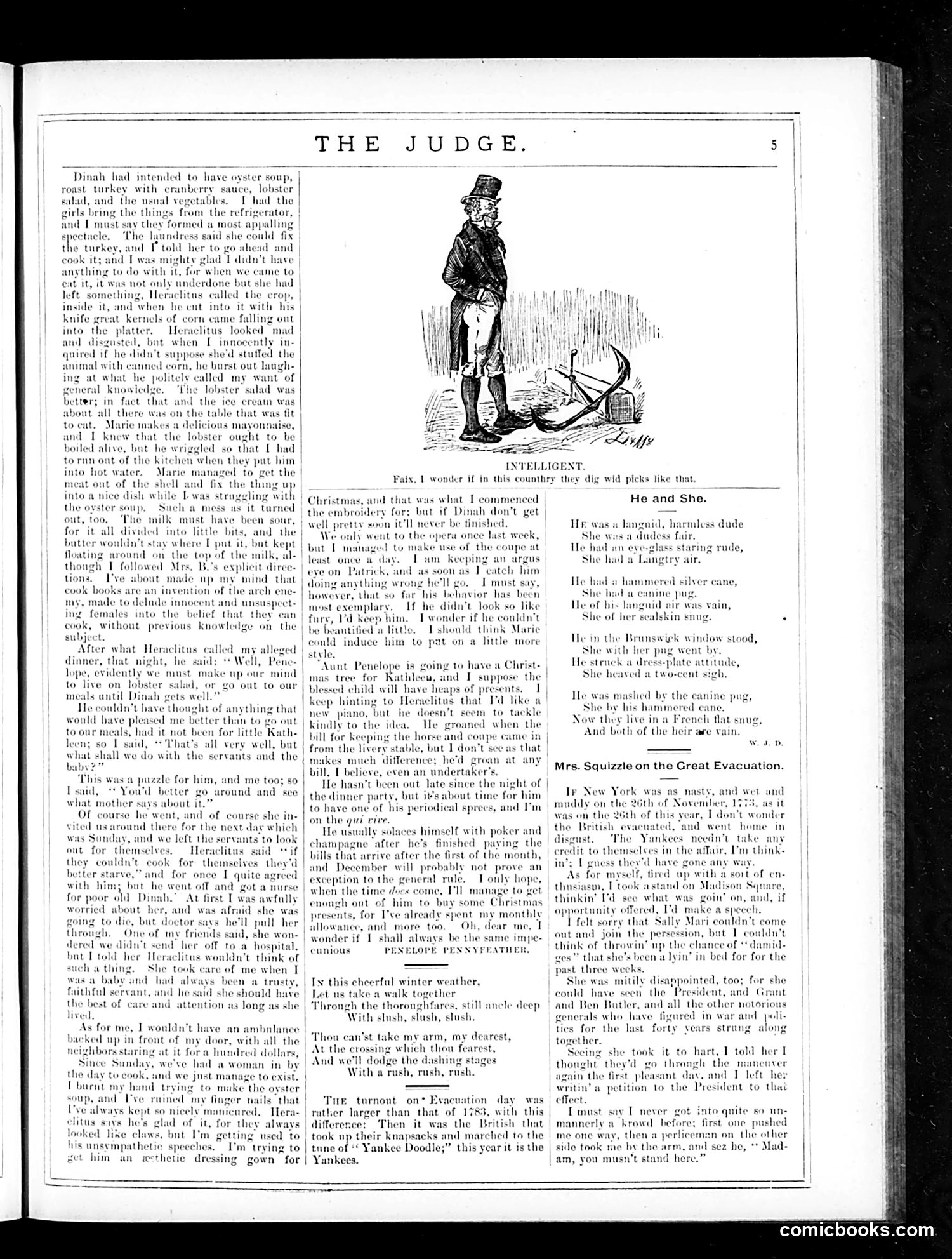
This page contains domestic humor typical of 1880s-90s American magazines. The main cartoon, titled "Intelligent," depicts a well-dressed gentleman observing a woman struggling with farm equipment or a plow, with the caption sarcastically questioning whether "in this country they dig wid picks like that." The accompanying text is a humorous essay about a household disaster: the author's cook Dinah becomes ill, forcing the family to manage meals themselves. The narrative satirizes domestic incompetence—the laundress stuffs the turkey with corn still in the cob, the lobster preparation is comically messy, and the author burns her hand attempting cooking. The piece mocks both servants' incompetence and the upper-class lady's complete inability to manage basic household tasks. The secondary article discusses the "Great Evacuation" (likely the 1783 British evacuation of New York during the Revolution), contrasting historical significance with contemporary domestic trivialities. The satire targets genteel pretension: educated, refined people utterly helpless without servants.
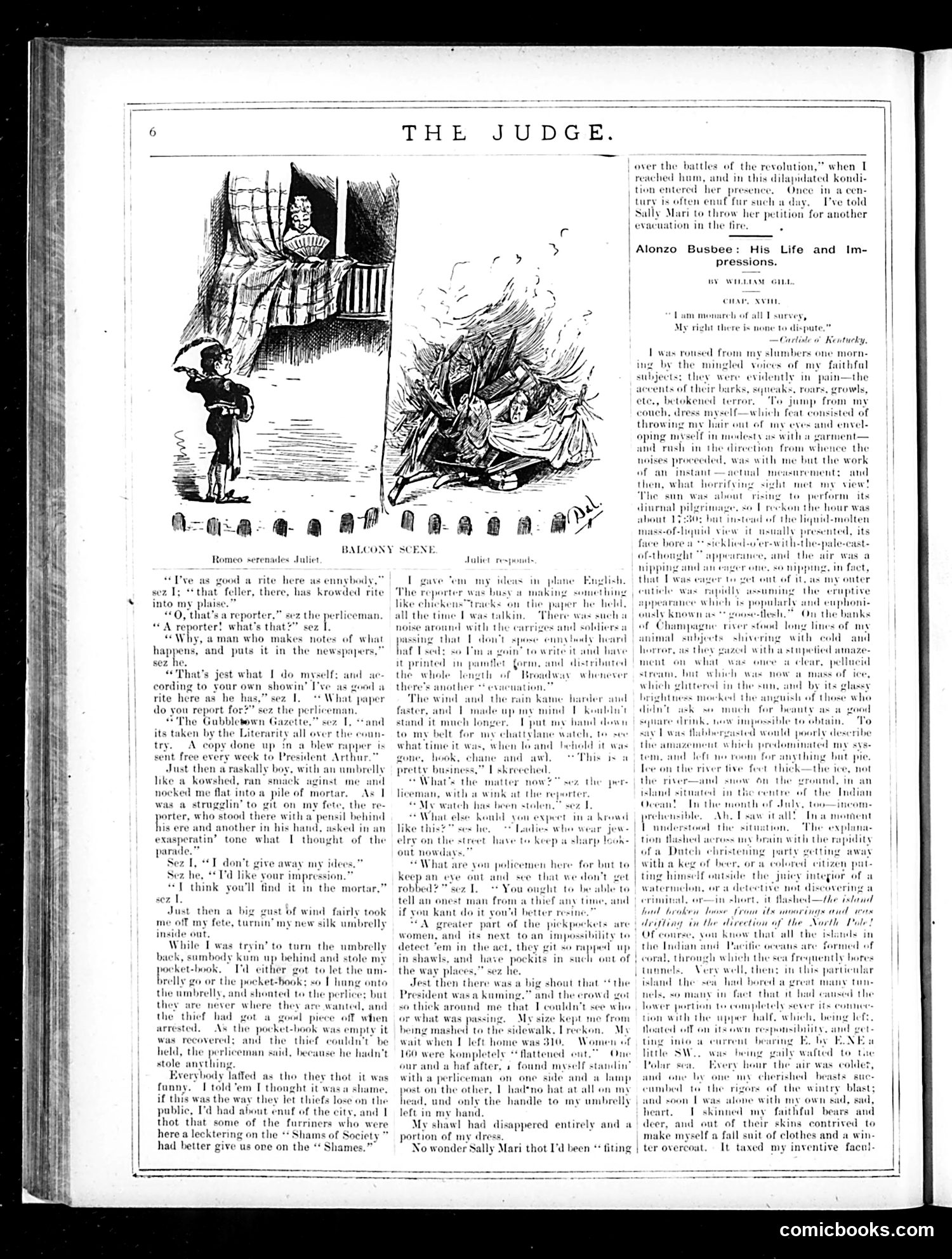
This page contains two satirical pieces typical of Judge magazine's social commentary. **"Balcony Scene"** (top) is a humorous narrative mocking New York City's incompetent police force. A citizen encounters a policeman who can't distinguish between reporters and criminals, then suffers a series of indignities—theft, lost umbrella, stolen pocket watch—while the officer proves utterly useless. The satire targets police inefficiency and the general lawlessness of the city. The "Romeo serenades Juliet" framing is ironic; instead of romance, we get urban chaos. **"Alonzo Busbee: His Life and Impressions"** (bottom) appears to be a serialized character sketch. The visible excerpt describes someone waking to animal noises and rushing outdoors, only to encounter freezing weather and apparent mishap. It's written in colloquial dialect typical of Judge's humorous character pieces. Both pieces exemplify Judge's focus on urban American life, bureaucratic incompetence, and working-class experience rendered through exaggerated dialect and comedic misadventure.
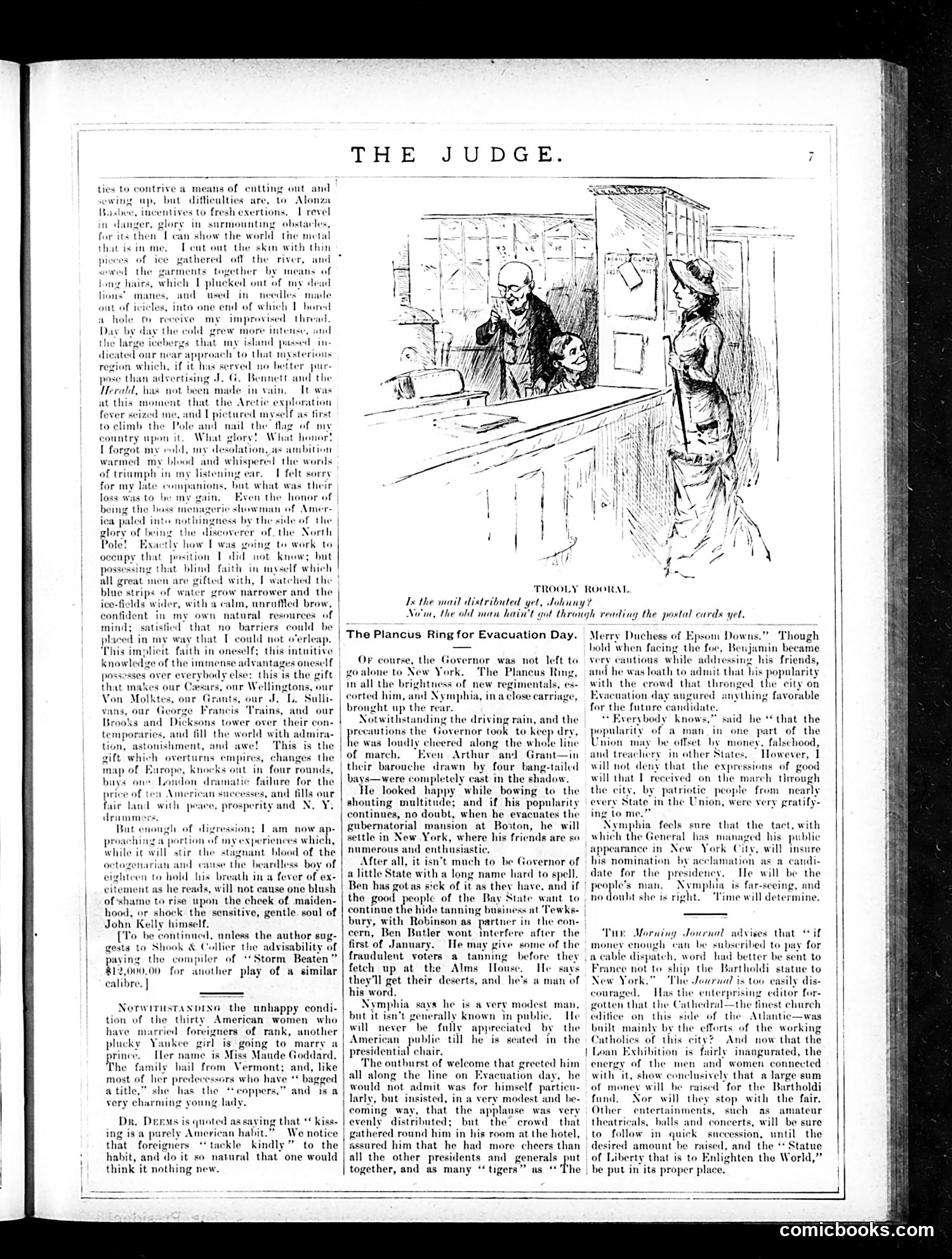
This page from *Judge* satirizes Benjamin Butler, a controversial Union general and Massachusetts governor, during an "Evacuation Day" parade in Boston. The cartoon depicts Butler (identifiable by his distinctive appearance) receiving enthusiastic public acclaim while departing his gubernatorial office. The satire mocks his popularity despite his widely criticized record. The accompanying text suggests Butler sought the presidency, implying his parade was a political calculation rather than genuine civic service. The piece ridicules Butler's inflated self-importance—comparing him unfavorably to actual military figures like Grant and Sherman. References to "hide tanning" allude to his notoriously corrupt administration. A secondary item mocks upper-class American women marrying European nobility, criticizing this as undignified national behavior. The humor relies on readers' familiarity with Butler's controversial reputation and political ambitions circa the 1880s.
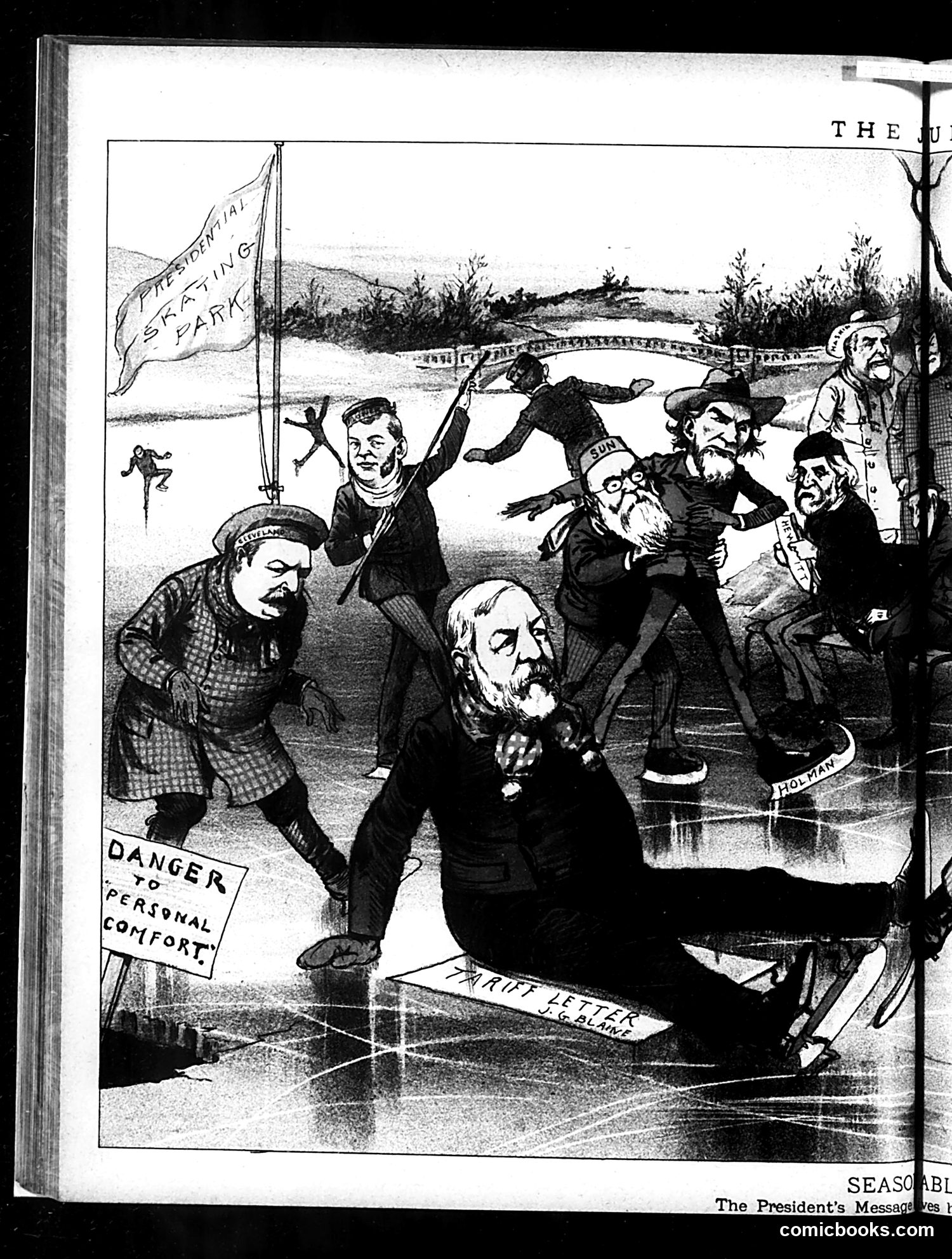
This appears to be a satirical cartoon from *Judge* magazine depicting a scene at a presidential park or recreational area. A bearded central figure (likely representing a political opponent or critic) stands on thin ice marked "STRICT LETTER" while surrounded by other figures celebrating under a "PRESIDENTIAL SAFETY PARK" flag. A sign warns of "DANGER / TO PERSONAL COMFORT," suggesting the cartoon mocks someone's precarious political position despite claims of safety or protection. The thin ice is the key visual metaphor—indicating instability beneath an official facade. The exact historical context, specific individuals, and political dispute are unclear from the visible text alone. The page appears incomplete or cropped, making full interpretation difficult.
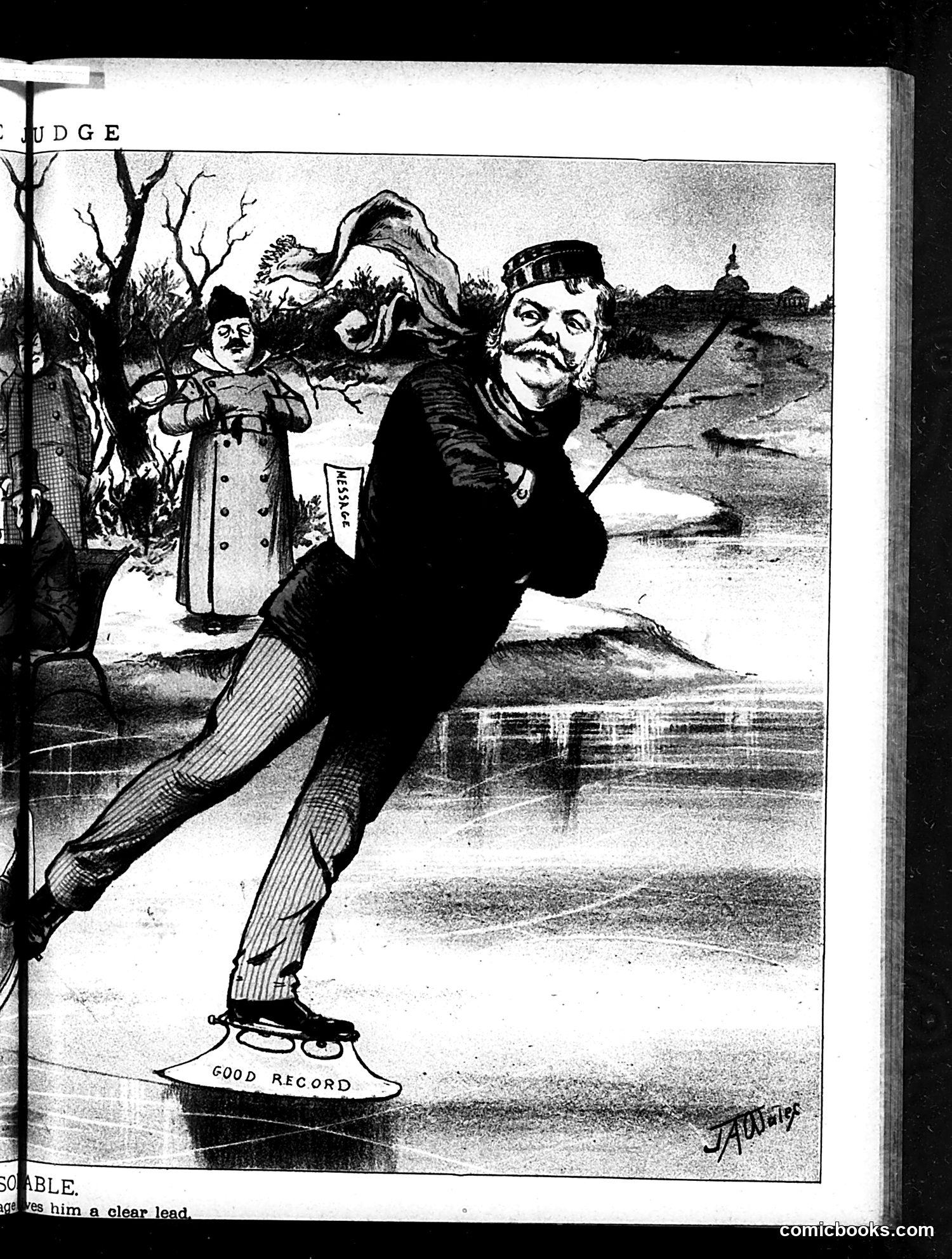
This appears to be a political cartoon from **Judge** magazine satirizing ice skating performance. The central figure is a man with an exaggerated mustache skating on frozen water, labeled "GOOD RECORD" beneath his skates. Behind him stands a woman holding what appears to be a child, observing his performance. The cartoon's satirical point likely concerns someone's public accomplishments or "record"—the skating metaphor suggests maintaining a performance or appearance while others watch. Without clearer context about the specific historical moment or identified figure, the exact target of satire remains unclear, though the caricatured features and domestic witness suggest commentary on public versus private conduct or reputation management.
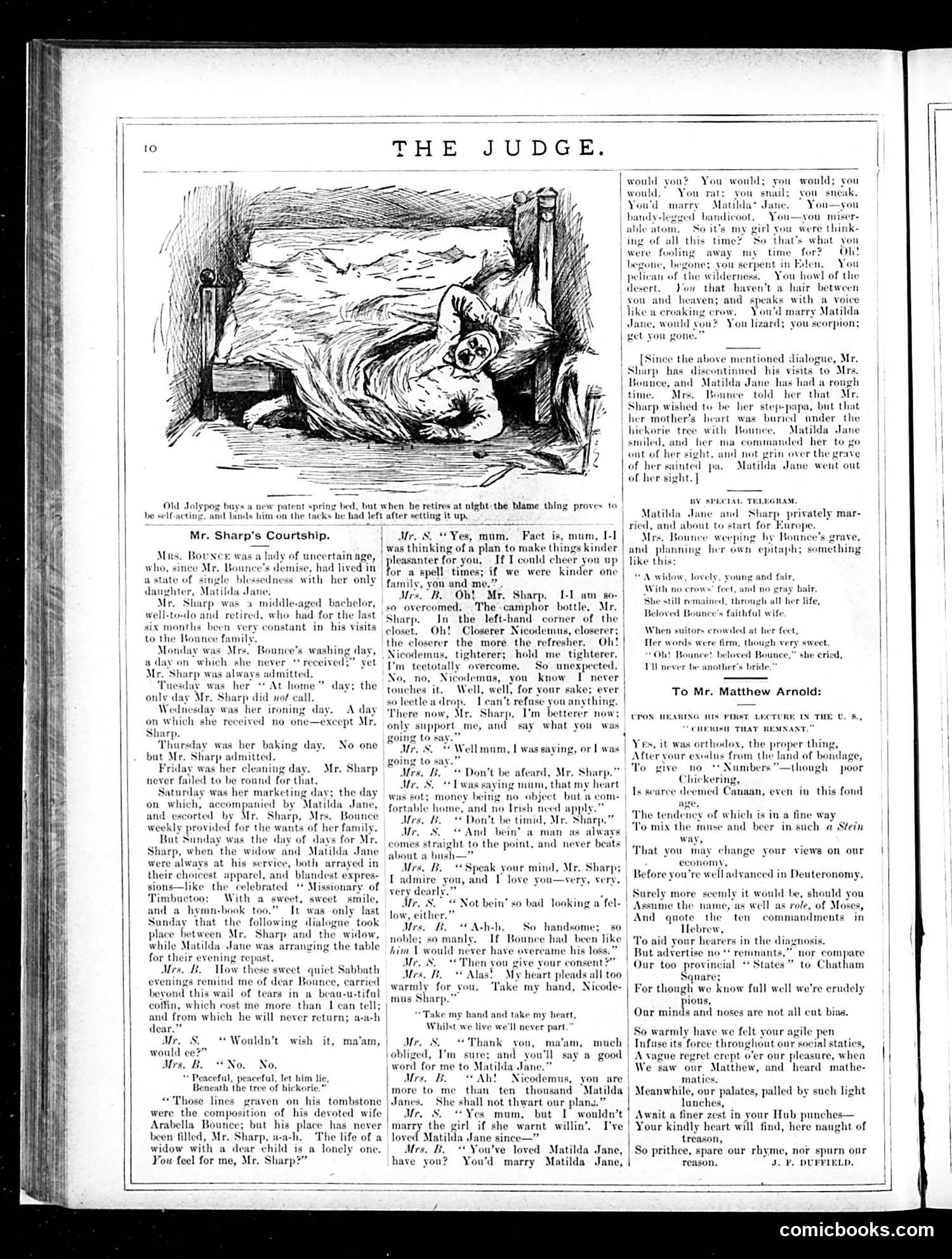
This page presents a Victorian-era romantic comedy serial about a persistent suitor named Mr. Sharp courting the widow Mrs. Bounce while secretly also pursuing her daughter, Matilda Jane. **The Setup:** Mr. Sharp has established a routine of visiting Mrs. Bounce on every day of the week, adjusting his schedule to her domestic activities (washing day, ironing day, baking day, etc.). The large illustration shows him proposing to the widow in sentimental terms. **The Joke:** The text reveals Mr. Sharp's true motivation—he confesses to Mrs. Bounce that he actually loves *her daughter* Matilda Jane. Upon learning this deception, Mrs. Bounce erupts into fury, calling him a "serpent," "scoundrel," and various other insults. **The Satire:** This mocks Victorian courtship conventions and male duplicity—the obsequious suitor who manipulates a lonely widow by feigning devotion to her, when his real target is the younger woman. The exaggerated dialect and melodramatic language amplify the humor of the social awkwardness and emotional manipulation involved.
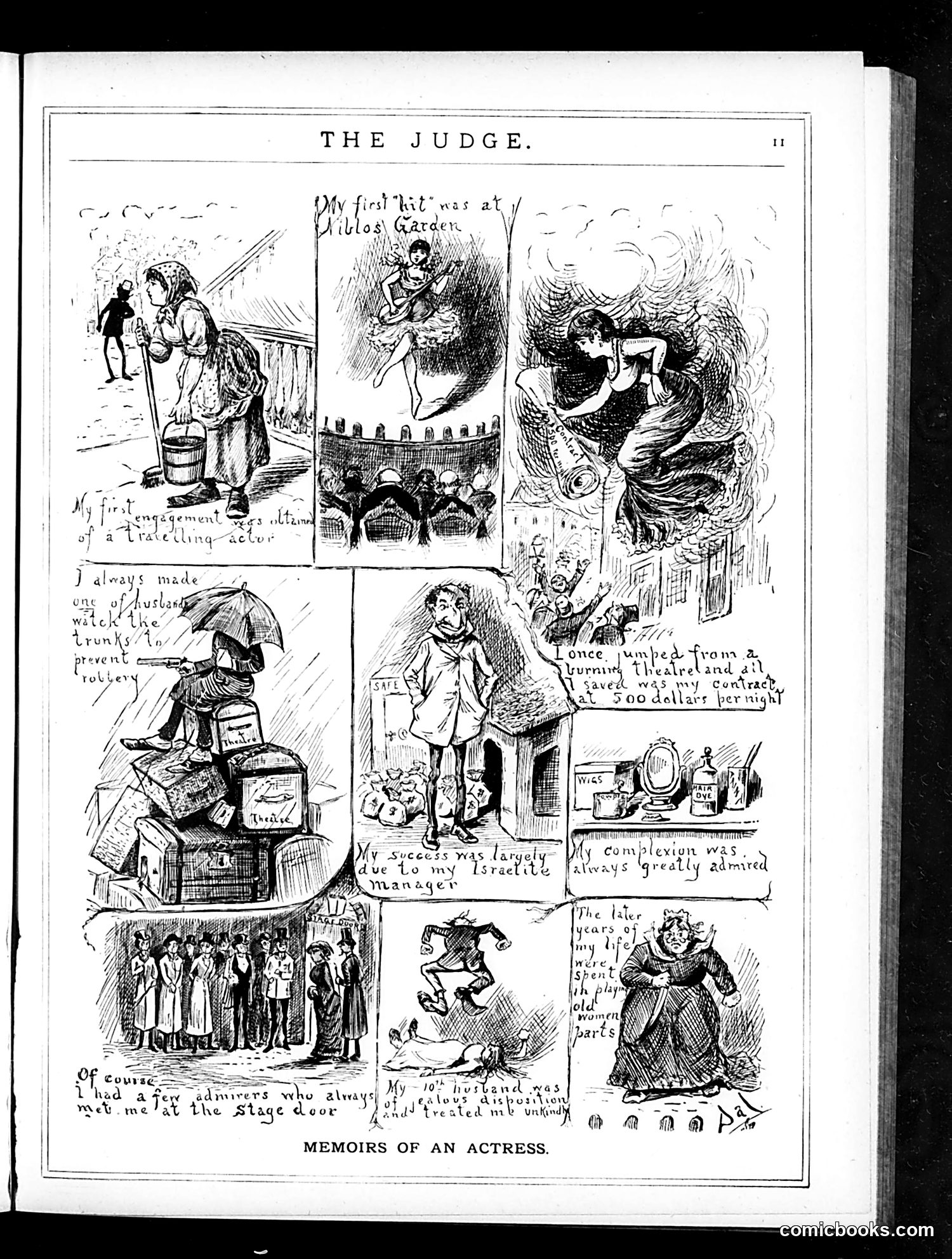
This is a satirical comic strip illustrating the self-aggrandizing reminiscences of a former actress. The narrative follows her career trajectory through multiple panels, showing her claiming credit for various accomplishments: performing at Philos Garden, theatrical success allegedly due to her "Israelite manager," earning $300 nightly, and attributing her complexion's admiration to her own merits. The satire targets vanity and self-delusion—the actress retroactively inflates her importance while conveniently blaming external figures (her manager) or circumstances for difficulties. The final panels suggest her later decline into obscurity and difficult roles. The joke is that her "memoirs" reveal her unreliable narrator status; readers understand her success resulted from luck, connections, and management rather than talent alone. This mocks both theatrical pretension and the genre of celebrity autobiography.
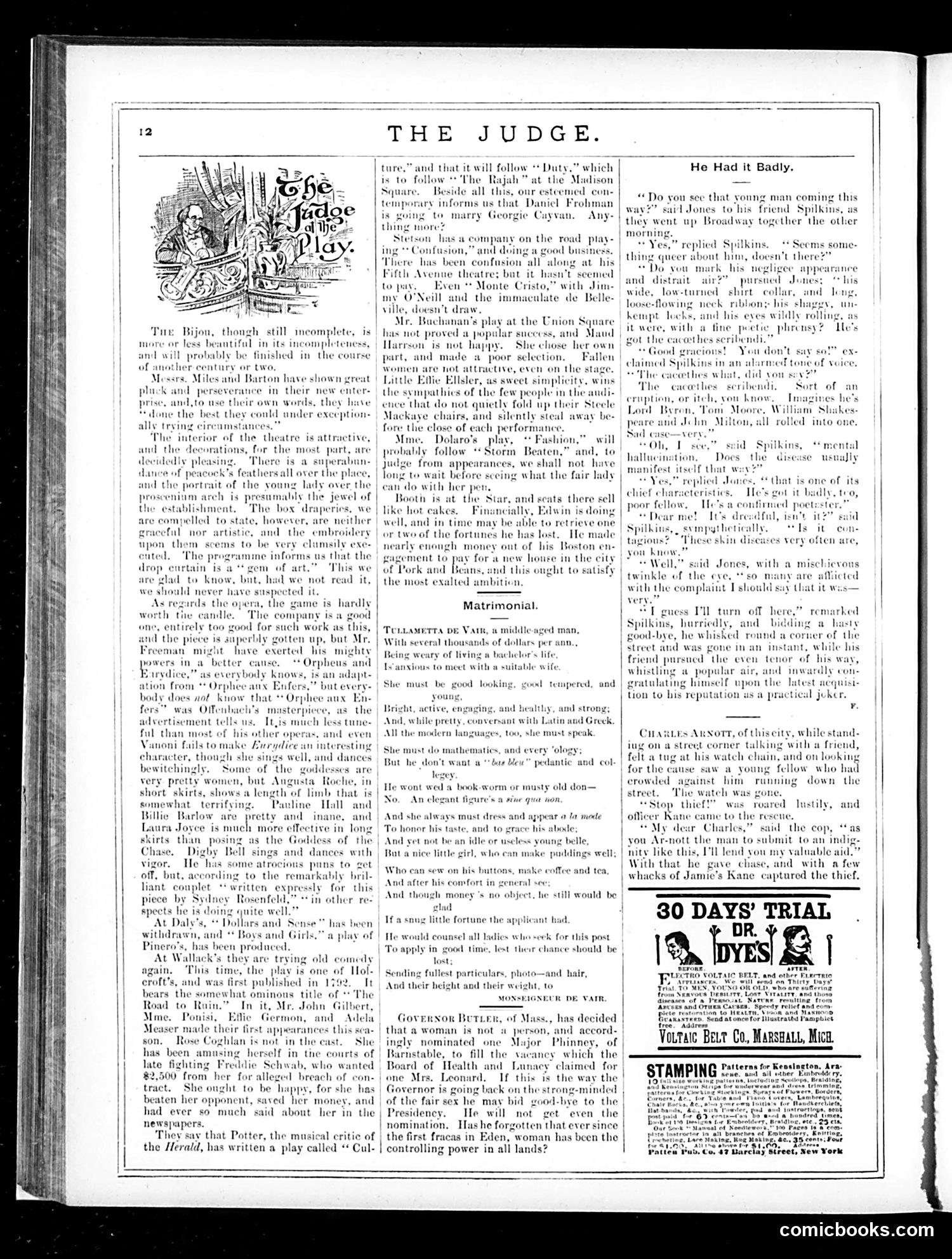
This page from *Judge* magazine contains theater criticism and matrimonial satire typical of late 19th-century American humor. ## Theater Criticism Section The main article reviews theatrical productions, mentioning specific performers and venues (Fifth Avenue Theatre, Union Square, the Star). The critic evaluates actresses like "Little Edie Ellsler" and discusses Daniel Frohman's company. The tone is gossipy and sometimes cattily dismissive—noting that one actress "chose her own part, and made a poor selection" and that another performer "doesn't draw" audiences. ## "Matrimonial" Section This satirical piece presents a matrimonial advertisement from "Tullametta de Vain," a middle-aged bachelor seeking a wife. The humor lies in the detailed, often contradictory requirements he lists: she must be educated in mathematics and languages, dress fashionably, do housework, and possess both intellect and domestic skills—yet not be "a book-worm." The satire mocks the unrealistic expectations bachelors placed on potential wives while offering only wealth as their own qualification. The advertisements below (Dr. Dyes, stamping patterns) are period commercial notices.
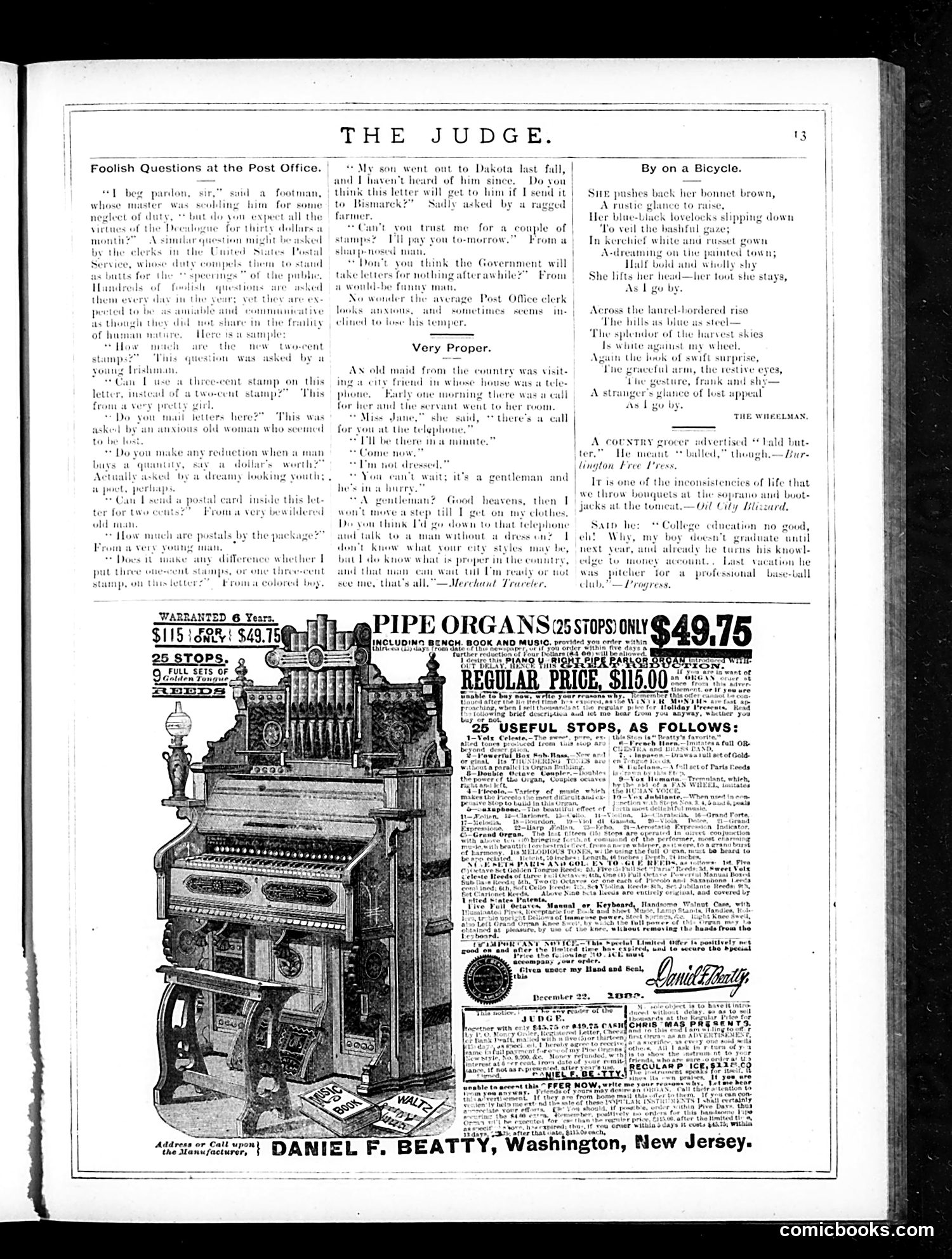
This page from *Judge* contains three distinct sections: **"Foolish Questions at the Post Office"** presents humorous anecdotes about customers asking ridiculous questions of postal clerks—such as whether a three-cent stamp works instead of two cents, or if the government will deliver letters for free. The satire mocks both the foolish public and the patience required of postal workers. **"Very Proper"** depicts a country-visiting old maid who refuses to use a telephone because it's improper for a woman to speak to a man (even a servant) without proper dress and introduction—satirizing rigid Victorian propriety that conflicts with modern conveniences. **"By on a Bicycle"** is a sentimental poem about a young woman on a bicycle, romanticizing the figure. The bulk of the page is dominated by an advertisement for a **pipe organ** (25 stops, $49.75) from Daniel F. Beatty in Washington, New Jersey—the main commercial content, not editorial satire.
This page is primarily **advertising**, featuring department store notices and product promotions typical of late 19th-century American magazines. The left side contains humorous **brief anecdotes and jokes** (the "Judge" column): - A romantic story about a woman at a window whose false teeth break—suggesting Victorian anxieties about artifice versus nature - Jokes about the Washington Monument, steam whistles, and Salt Lake City sidewalks—mostly light social commentary without deep political meaning - References to "Salt Lake City" and polygamy ("couples when going to his funeral") reflect anti-Mormon sentiment common in this era - A joke about a Detroit man recovering stolen money reflects 19th-century urban crime concerns The right side displays **commercial advertisements**: carpets, grain trading, bicycles, and rupture cures (a common advertisement of the period). Overall, this is a **social/commercial hybrid page**—mixing light humor with commercial messaging. The jokes are topical but not politically charged; they reflect ordinary urban life, technology, and social habits rather than partisan politics or serious satire.
This page is primarily **advertising**, not political satire. The layout consists mainly of commercial notices for pianos, sewing machines, black goods, fire extinguishers, and patent medicines. The small text column labeled "THE JUDGE" contains brief satirical quips about contemporary society—mostly light humor about courtship, railroads, preachers' salaries, and social behavior. These are disconnected one-liners rather than unified cartoons. Notable items include jokes about: - A "dude" seeking respectability - A minister marrying a woman of mixed race (presented as noteworthy) - A woman searching for her lost son - Tennessee preachers' low wages There is **no clear political cartoon** visible on this page. The illustrated header showing a classical female profile labeled "I owe my... Restoration to Health" is a decorative advertisement element for Behning pianos, not political commentary. The page reflects late 19th-century American attitudes and advertising practices rather than substantive political satire.
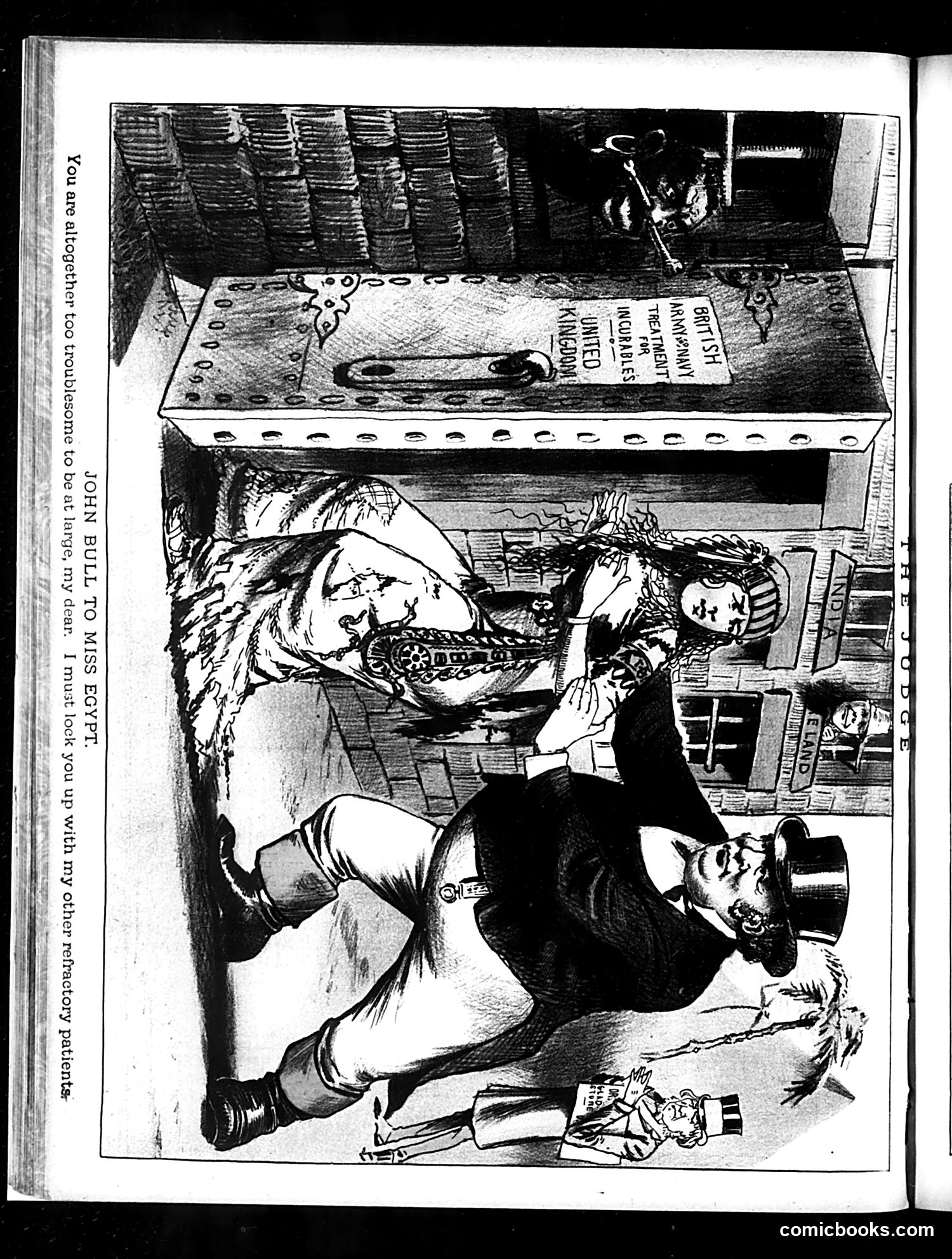
The OCR text is largely illegible, but the image shows a satirical cartoon with two figures: a well-dressed man in a top hat (appearing to be a businessman or politician) and a disheveled figure in tattered clothing representing poverty or the working class. The cartoon appears to critique economic inequality or labor exploitation, a common theme in Gilded Age satire. The contrast between the prosperous gentleman and the impoverished figure suggests commentary on the relationship between capital and labor—likely criticizing either capitalist indifference to worker suffering or political hypocrisy about addressing poverty. The household/domestic setting (visible furnishings, shelving) may indicate this concerns housing conditions or economic disparities within the home sphere, though without clearer text or context, the specific political target remains unclear.