
A complete issue · 16 pages · 1883
Judge — November 17, 1883
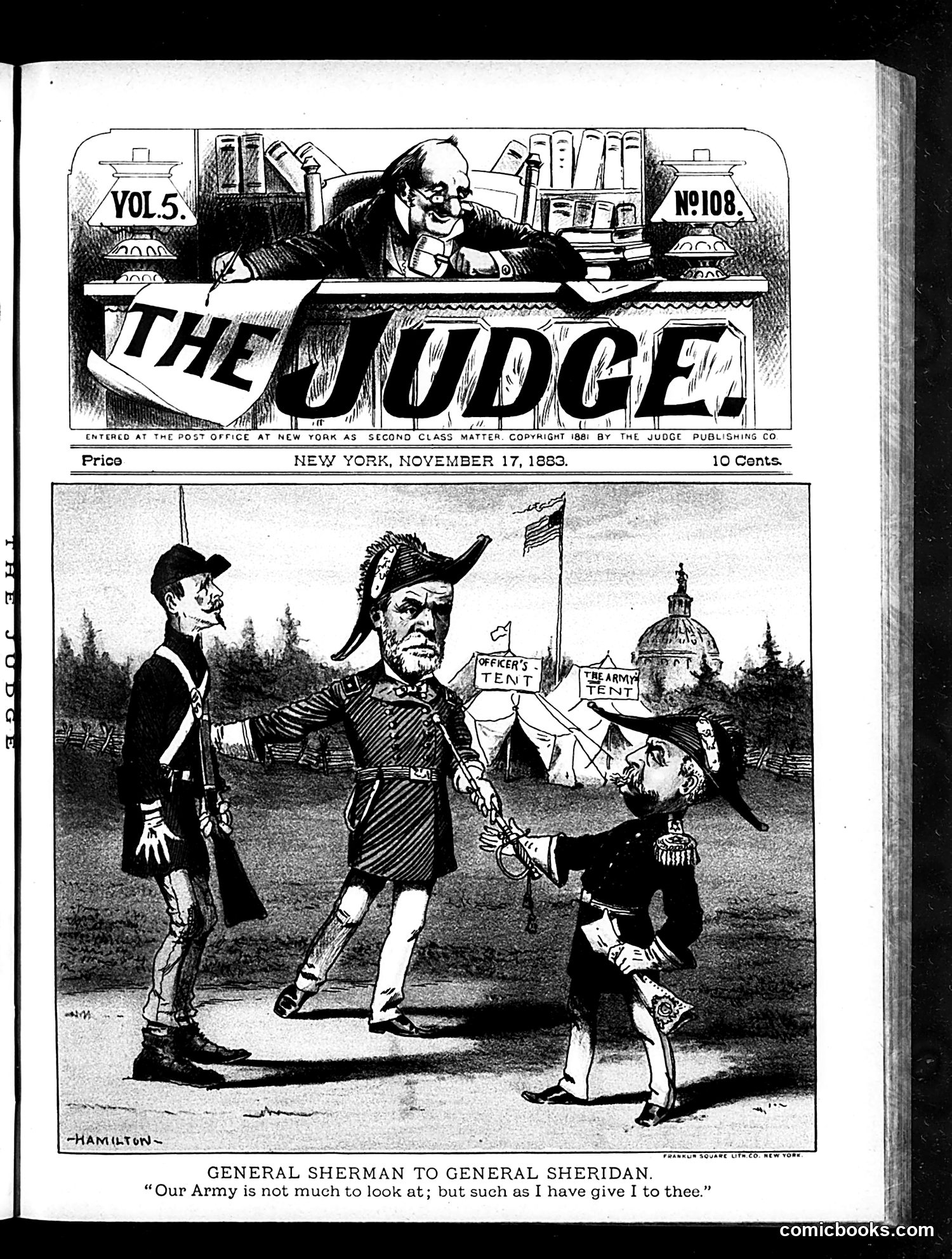
The main cartoon depicts **General Sherman addressing General Sheridan** during what appears to be a military encampment, with the caption: "Our Army is not much to look at; but such as I have give I to thee." This references the **post-Civil War U.S. Army** and its condition in the 1880s. Sherman and Sheridan were prominent Union generals. The satire likely critiques the state of the American military during peacetime—suggesting it was poorly maintained or underfunded despite these generals' prominence. The exaggerated caricatures and theatrical poses amplify the satirical tone, mocking either military leadership or Congressional neglect of armed forces readiness during this period of relative peace following Reconstruction.
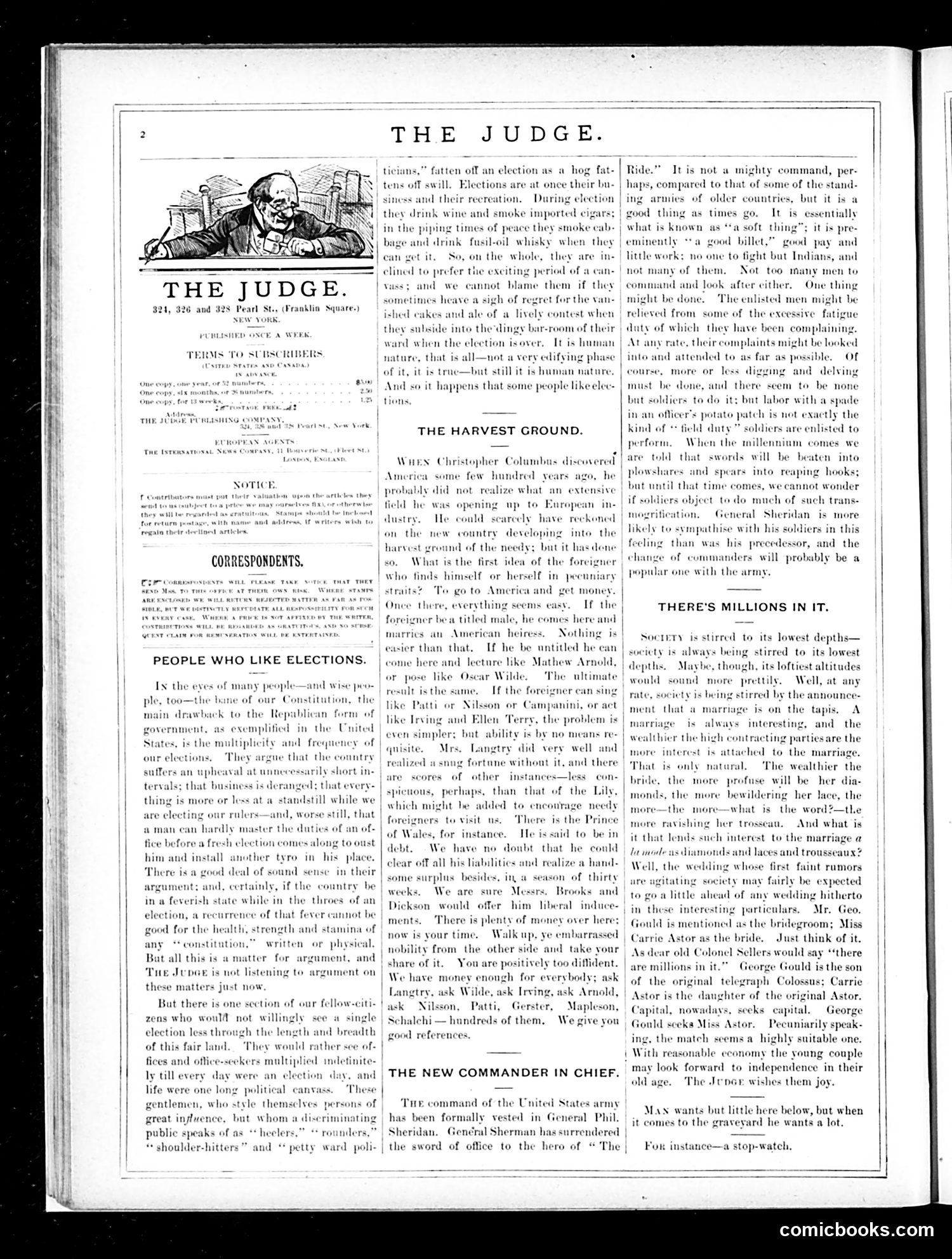
This *Judge* magazine page contains three satirical pieces attacking American political culture: **"People Who Like Elections"** ridicules the frequency of U.S. elections. The article argues that while elections disrupt business and national stability, certain working-class figures—described as "shoulder-hitters," "wheelers," and "rounders" (ward politicians and street operatives)—actually *prefer* constant electioneering because it's their livelihood and entertainment. The satire mocks both the chaos of frequent elections and the corrupt political machine operators who profit from them. **"The Harvest Ground"** sarcastically welcomes foreign fortune-seekers to America, suggesting the country is now simply a place where titled Europeans marry American heiresses, or singers/performers profit from American audiences. This reflects Gilded Age anxiety about wealthy foreign aristocrats exploiting American wealth. **"The New Commander in Chief"** appears to reference General Philip Sheridan's assumption of military command, though the text is cut off. The cartoon at top-left depicts a scheming political operator—likely representing the corrupt ward politician type discussed in the main article.
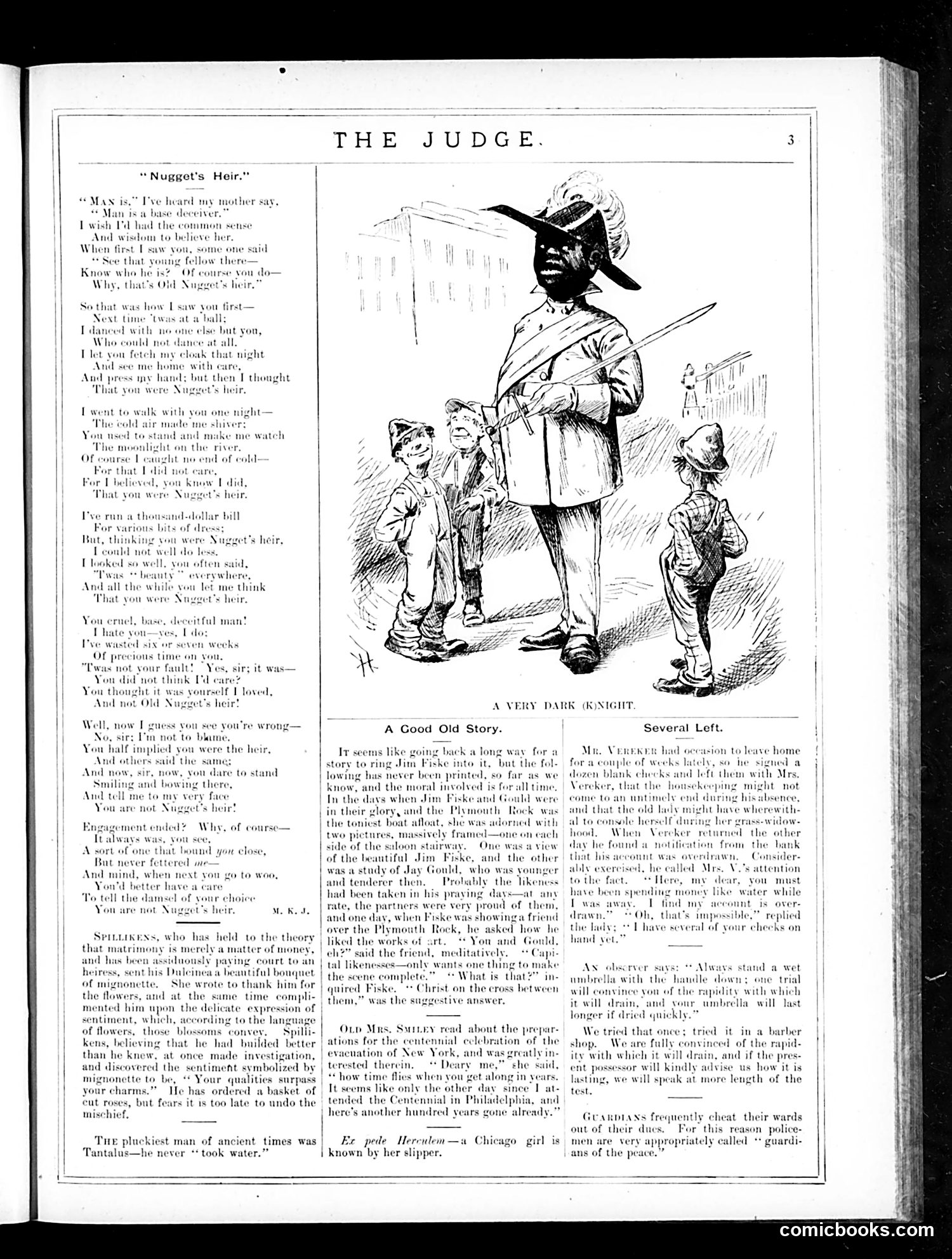
This page from *Judge* contains three distinct satirical pieces: **"Nugget's Heir"** (main poem with illustration): A woman confronts a man who courted her only because he believed she was the heir to "Old Nugget's" fortune. When she reveals she isn't the heiress, he abandons her. The satire targets fortune-hunting suitors and critiques mercenary marriage practices among the wealthy. **"A Good Old Story"**: Anecdote mocking the vanity of Gilded Age tycoons Jim Fiske and Jay Gould, whose portraits hung prominently on their yacht. A visitor jokes that a crucifix between them would complete the scene—sarcastically suggesting these robber barons needed religious redemption. **"Several Left"**: A domestic humor piece about a husband who leaves blank checks with his wife during absence; she overdrafts the account. The brief exchanges mock both spousal financial conflicts and umbrella preservation advice. The page reflects *Judge's* focus on satirizing wealth, social pretension, and marital dynamics among the American upper classes.
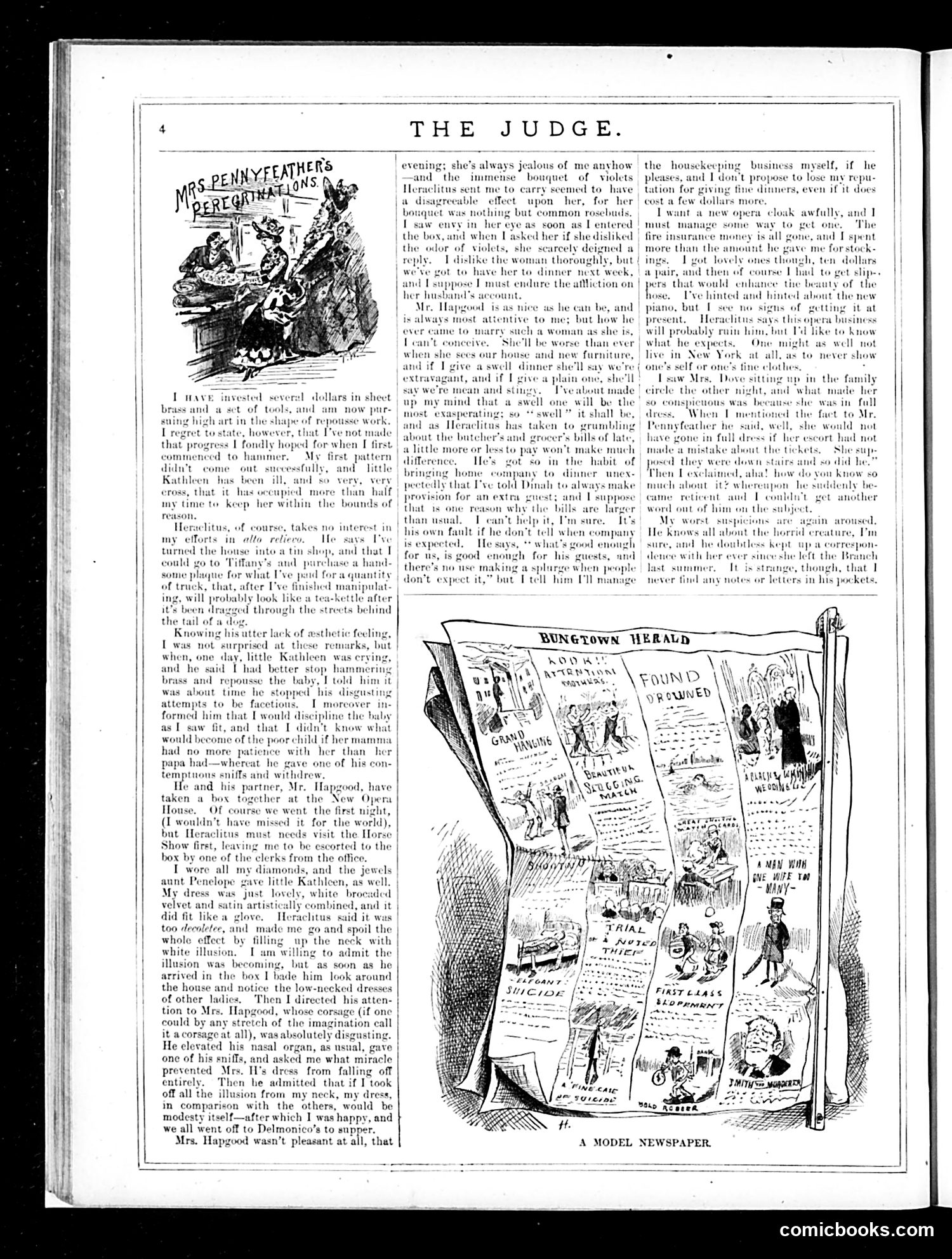
This page from the satirical magazine *Judge* contains two distinct elements: **Left side:** A lengthy first-person narrative titled "Mrs. Pennyfeather's Peregrinations," a domestic humor piece about an upper-middle-class woman managing household finances and social obligations. She describes conflicts with her husband Heraclitus over spending on entertaining, fashion, and furnishings—depicting the tension between maintaining social appearances and controlling household expenses. The humor derives from her rationalization of extravagant purchases and her husband's penny-pinching objections. **Right side:** "A Model Newspaper," an illustrated cartoon satirizing sensationalist newspaper layout and content. The folded newspaper depicted shows exaggerated headlines about crime, scandals, and melodramatic stories ("Found Drowned," "Trial," "First Class Execution"), mocking the era's yellow journalism and its appeal to readers' prurient interests. Both pieces target middle-class social pretensions and consumer culture typical of *Judge's* satirical focus.
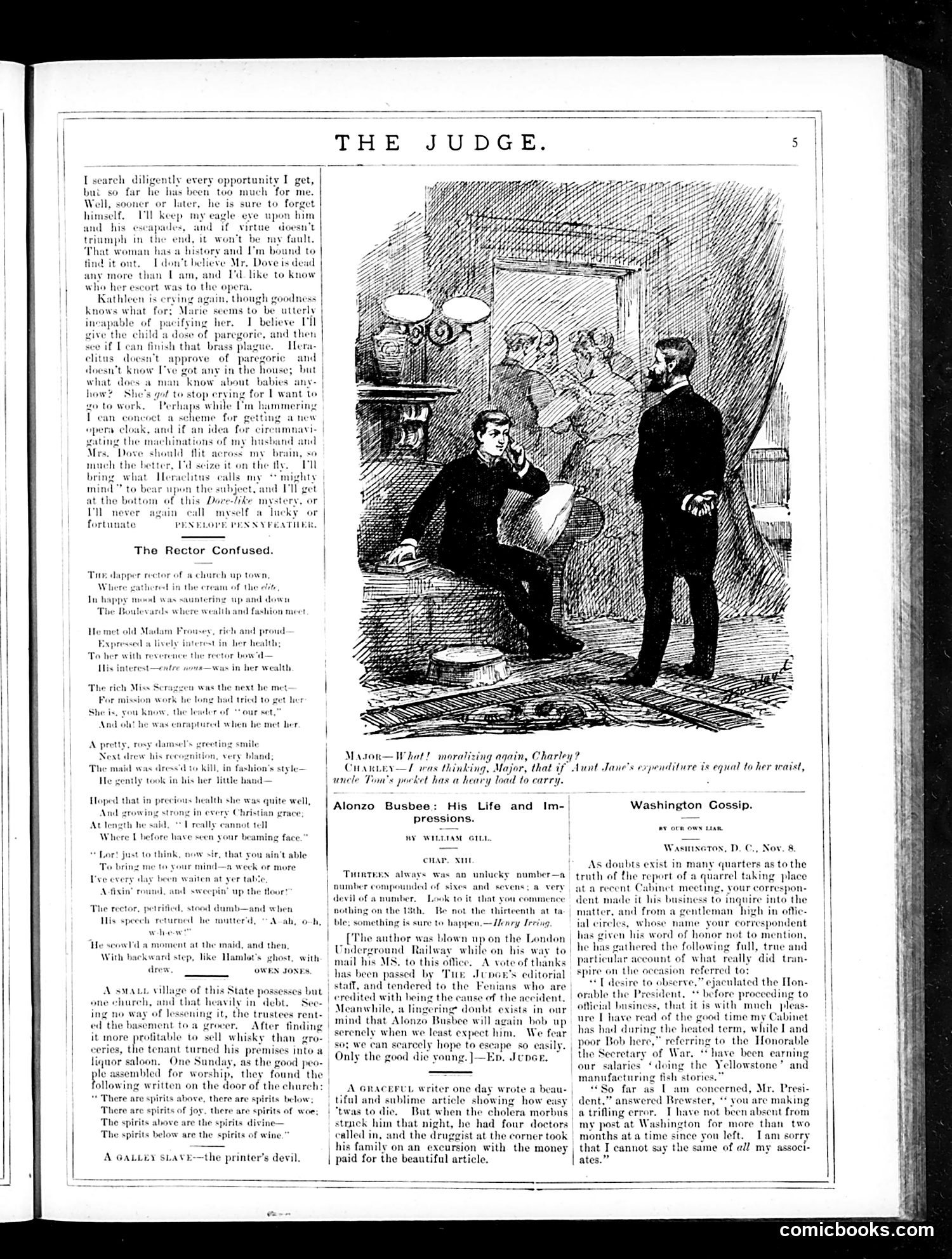
This page contains three satirical pieces typical of Gilded Age American humor: **"The Rector Confused"** (main cartoon): A clergyman encounters multiple wealthy parishioners and becomes flustered, unable to recall where he's seen them. The punchline reveals he recognizes them from secular settings—he finally remembers a maid from when she worked as a servant. The satire mocks both the rector's social awkwardness and the pretensions of wealthy congregants who expect clergy to remember them from their elevated status alone. **"Alonzo Busbee" section**: A humorous biographical sketch playing on superstitions about the number 13. It describes his narrow escapes from various disasters, satirizing both coincidence-prone lives and period anxieties about luck. **"Washington Gossip"**: A brief political anecdote where an unnamed government official (appearing to reference a Cabinet member) defends his presence in Washington while humorously suggesting his associates are absent more frequently. This likely comments on absenteeism among appointed officials during this era. All pieces employ Judge's characteristic mix of social observation and light ridicule of contemporary figures and behaviors.
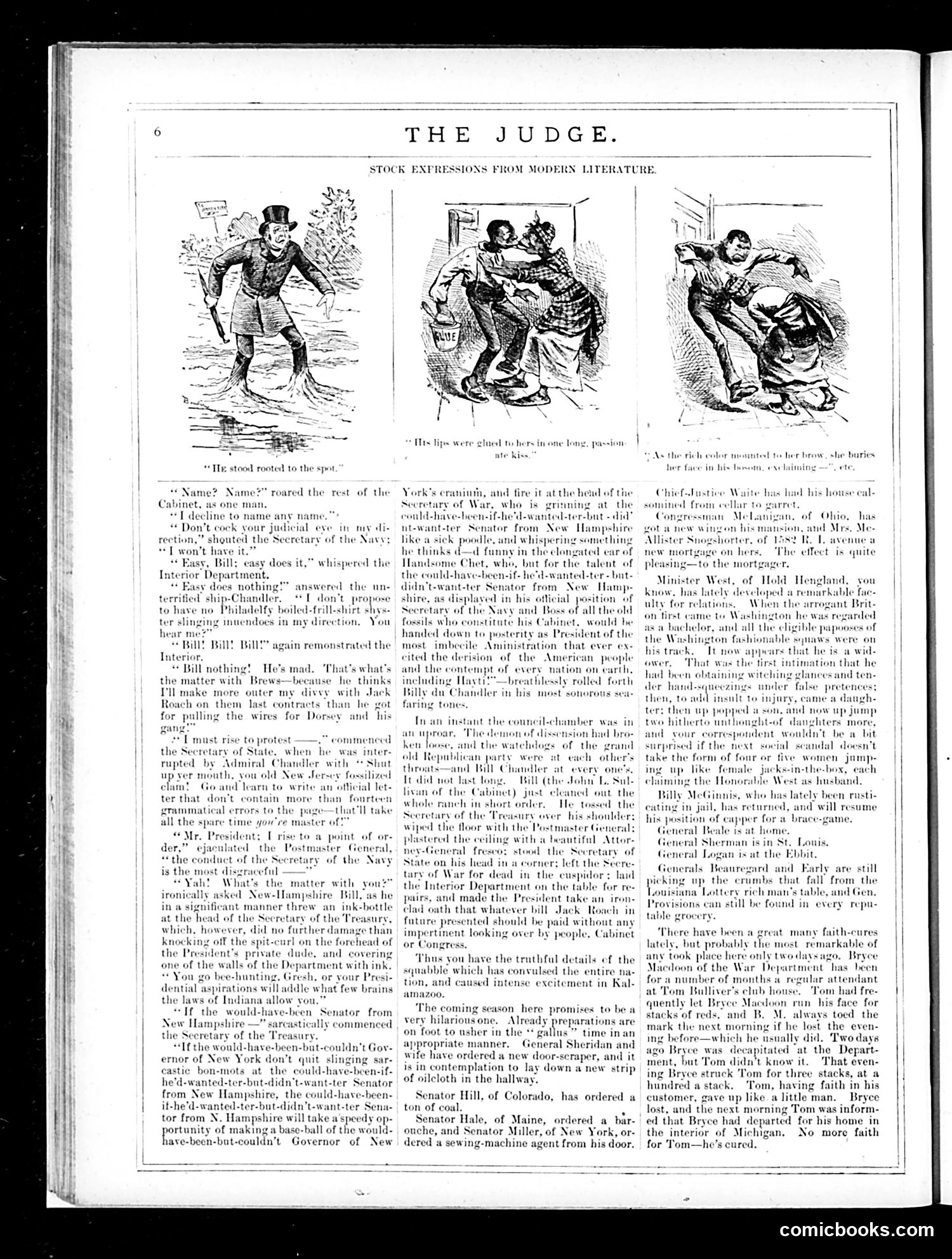
This Judge page satirizes the Lincoln administration's cabinet dysfunction through exaggerated dialogue. The cartoons depict physical chaos in the Cabinet room—men fighting, throwing objects, and brawling—illustrating the text's absurdist narrative of cabinet members quarreling over contracts and administrative incompetence. The satire targets specific figures: Admiral Chandler, Secretary of War (appears to reference the contentious military leadership), and various Senators including those from New Hampshire and Colorado. The piece ridicules both their petty disputes and grandiose self-importance through juxtaposition—the "truthful details" of violent cabinet chaos contrasted sharply with the final items about senators ordering mundane goods (coal, carriages), deflating their significance. The overall message: the administration is comically dysfunctional, with officials more interested in personal gain than governance.
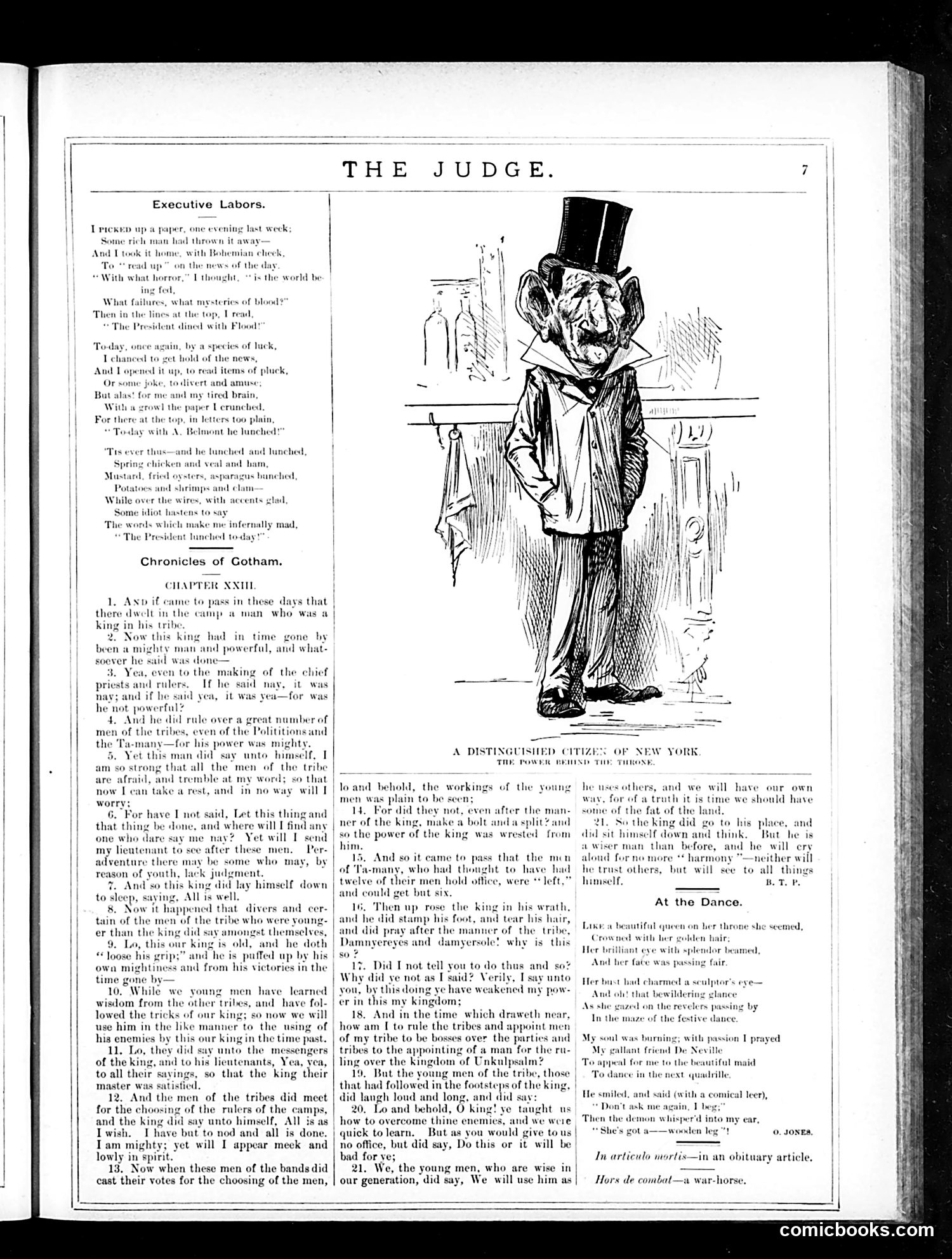
This page satirizes President **Chester Arthur's** social activities and perceived idleness during his term. The cartoon depicts a well-dressed gentleman (Arthur) in top hat and formal attire—captioned "A Distinguished Citizen of New York: The Power Behind the Throne"—suggesting he's controlled by wealthy interests rather than wielding genuine executive authority. The poem "Executive Labors" mocks Arthur for spending his time dining with wealthy socialites like A. Belmont and Flood, implying presidential duties are neglected for leisure. The accompanying biblical allegory ("Chronicles of Gotham") reinforces this critique: a powerful king who acts "meek and lowly" while dining lavishly finds his influence undermined when young men learn his true nature. The satire targets **Gilded Age corruption**—how presidents catered to wealthy elites and failed to exercise independent power, instead becoming figureheads manipulated by money and special interests. Judge criticizes both Arthur's apparent laziness and the structural weakness of executive authority when captured by wealth.
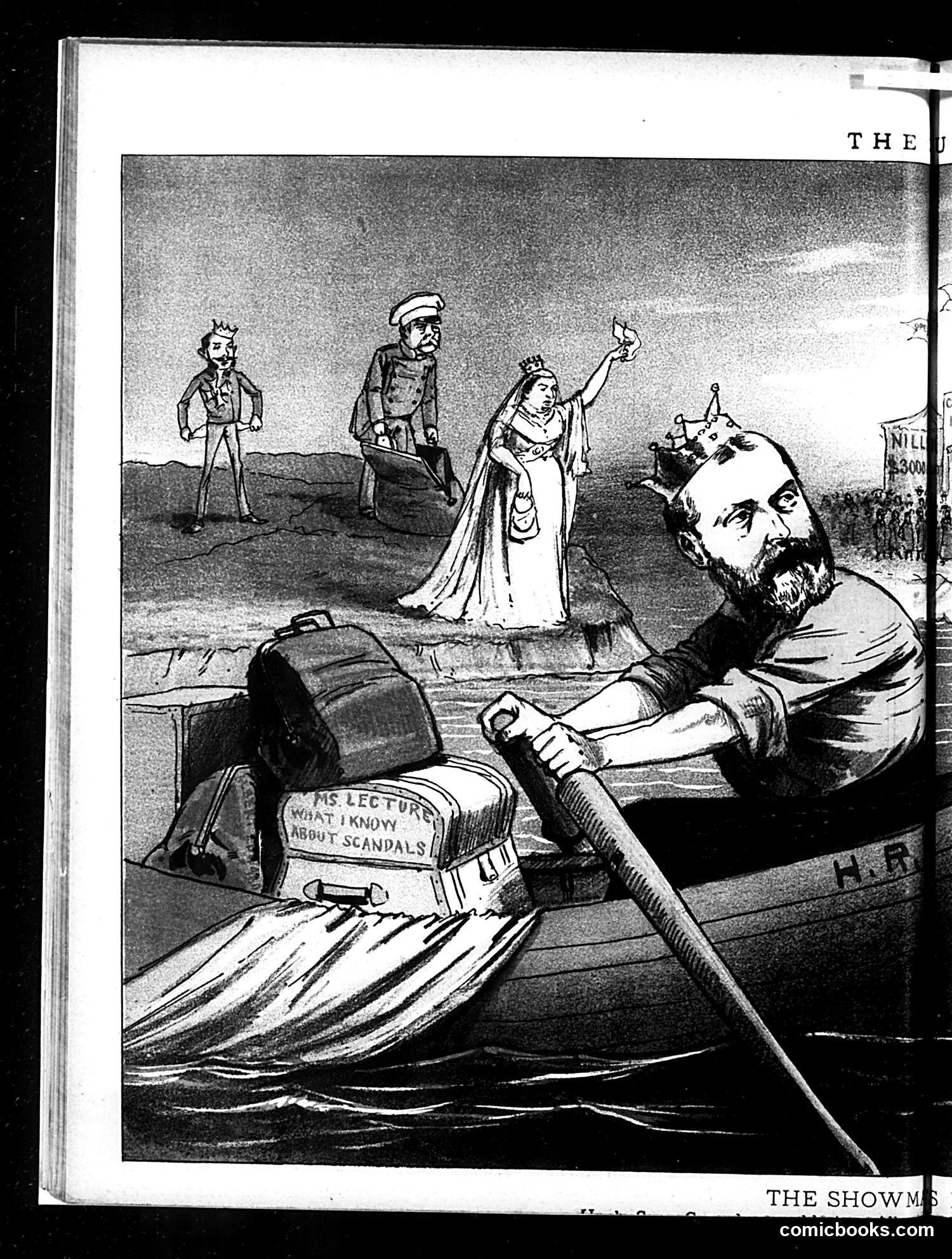
This political cartoon depicts a bearded man in a boat labeled "Ms. Lecture: What I Know About Scandals," rowing across water while an audience of figures (including what appears to be royalty or nobility) watches from shore. The satire targets someone who is profiting from or promoting themselves through sensationalized discussion of scandals. The "Ms. Lecture" label suggests this person is touring or performing, monetizing scandal stories for public consumption. The boat's precarious position in water symbolizes the instability of a reputation built on scandalous revelations. The bearded figure's self-satisfied expression contrasts with the absurdity of his enterprise—literally floating on tales of others' misdeeds. Without the magazine's date or clearer text, the specific scandal referenced remains **unclear**, but the cartoon criticizes public figures who capitalize on controversy.
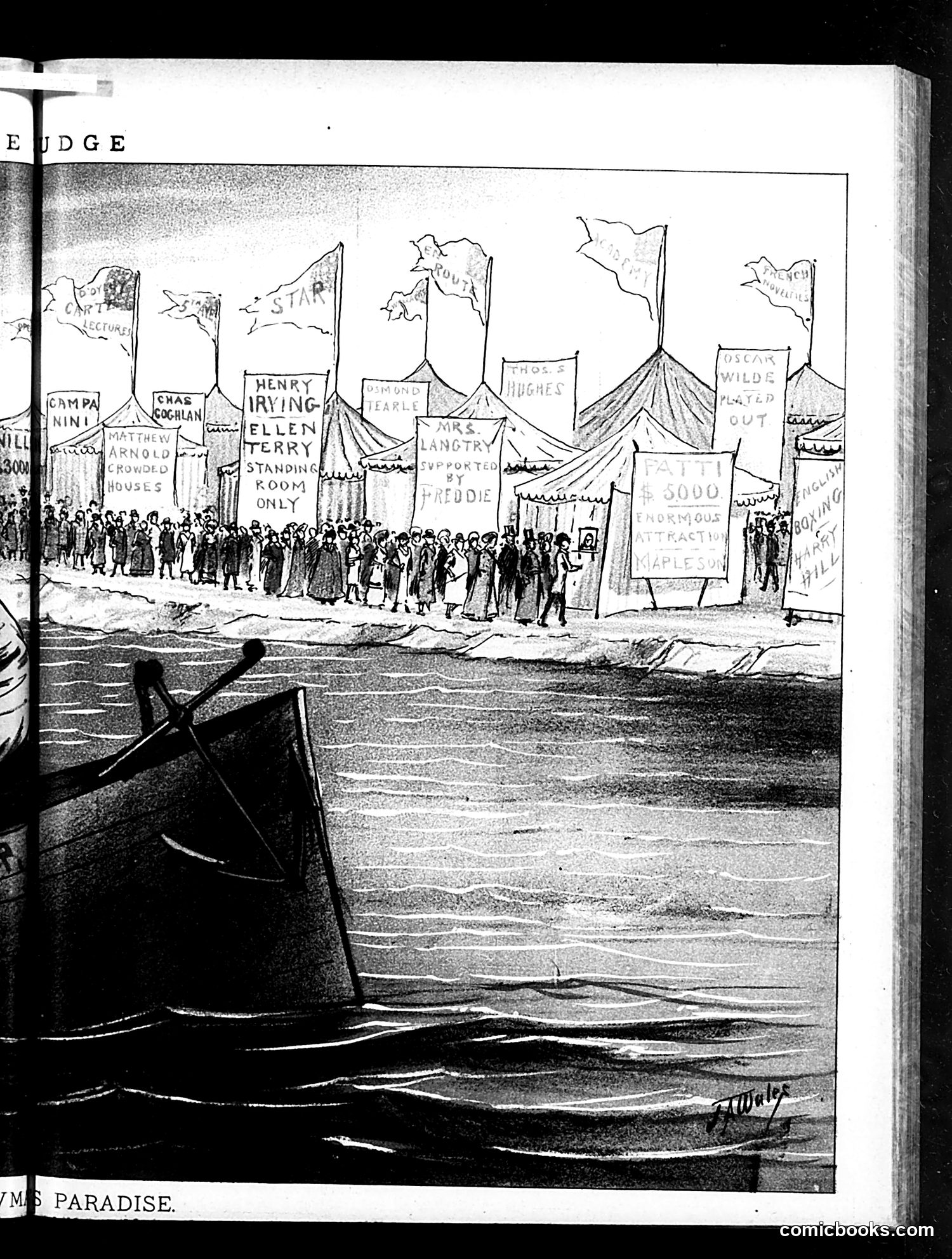
This is a satirical cartoon depicting a waterfront scene with numerous large tents displaying names of prominent figures—appearing to reference Henry Irving, Ellen Terry, Thomas Hughes, Oscar Wilde, and others. Crowds of people gather before these structures like a makeshift settlement or shantytown. The caption "Paradise" is clearly ironic. The satire likely mocks either: (1) a theatrical or artistic community's pretensions to greatness, or (2) a social/political movement these figures represented. The tent-city imagery suggests temporary shelter or displacement, contrasting with the subjects' actual prominence or self-importance. Without clearer context of Judge's publication date, the specific target remains uncertain—whether this critiques aestheticism, theatrical culture, or another contemporary movement these Victorian-era figures embodied. The humor relies on the gap between these figures' status and their depiction in humble circumstances.
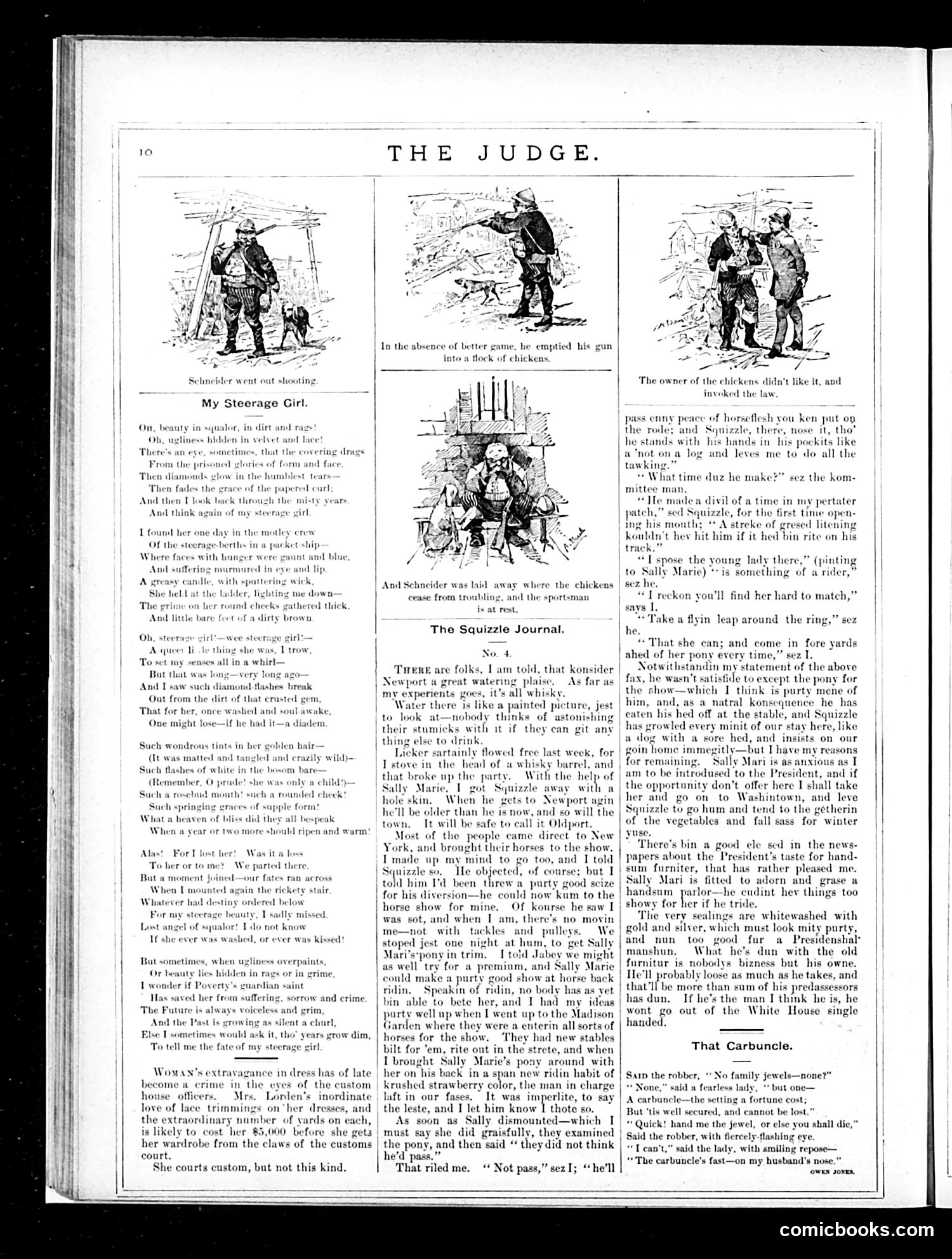
This page contains three distinct pieces of satirical content: **"My Steerage Girl"** — A sentimental poem about a poor immigrant woman encountered on a ship, reflecting 19th-century romantic idealization of working-class suffering. The satire likely targets overwrought sentimentality about poverty rather than actual social critique. **"The Squizzle Journal"** — A humorous rural dialect piece narrating mishaps at a horse show and whisky barrel incident. The rustic character's malapropisms and exaggerated "country speak" are the joke itself—standard period humor mocking rural vernacular. **"That Carbuncle"** — A brief anecdote about a fortune-teller's jewel curse, appearing to be a short comic filler story. The page also includes illustrations of characters in period dress. Overall, this represents *Judge* magazine's typical mix of sentimental verse, dialect humor, and light comic tales—popular Victorian entertainment rather than sharp political satire. The humor relies on language comedy and melodramatic sentiment rather than contemporary references requiring historical context.
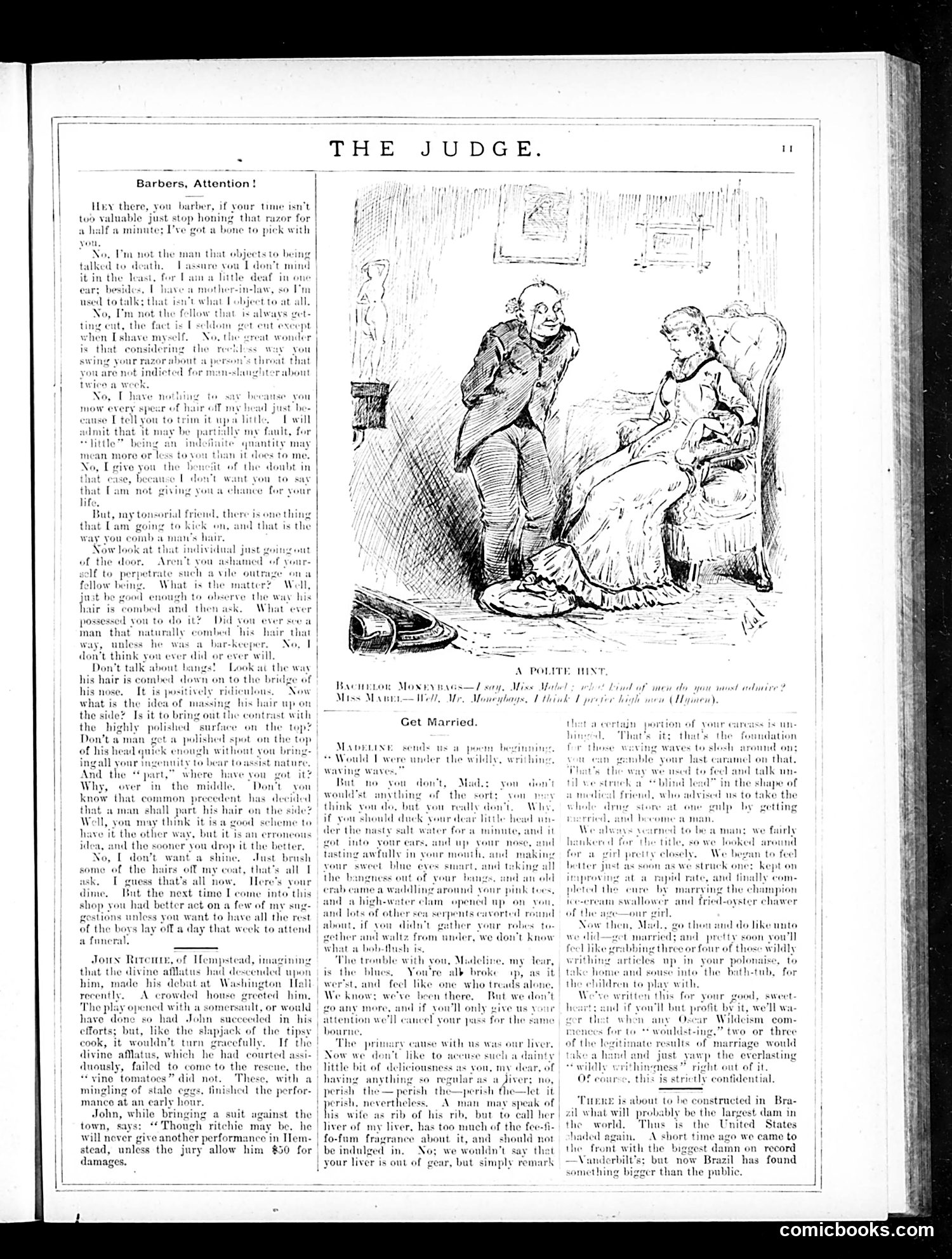
This page from the satirical magazine *Judge* contains three separate pieces of social commentary: 1. **"Barbers, Attention!"** — A humorously exasperated monologue by a customer complaining about barbers' incompetence. He objects to unflattering hairstyles (bangs, side-parting, middle parts) and criticizes barbers for poor technique and presumption. The satire mocks barbers' pretentiousness while ridiculing men's vanity about hair grooming. 2. **"A Polite Hint"** — A comedic exchange between Hamilton Monteyards and "Miss Mabel," wherein he proposes marriage by describing marriage as involving unromantic domestic realities (salt water, sea serpents, spousal annoyances). The satire deflates romantic courtship by emphasizing marriage's mundane disappointments. 3. **Brazilian dam reference** — A brief closing quip comparing American and Brazilian engineering projects, suggesting Brazil has constructed something impressively large. The illustrations depict a barber shop scene and what appears to be a romantic conversation, rendered in period sketch style typical of *Judge's* satirical approach to American social customs and gender relations.
This page from Judge magazine contains theatrical gossip and satirical commentary on 1880s New York entertainment, rather than a single political cartoon. The main content includes: **"Town Talk"** section discusses rival opera houses (Mapleson's and the Metropolitan), noting competition between singers Patti and others. It mocks the elaborate stagecraft and mentions the new Standard Theatre production "In the Ranks." **Theater commentary** critiques various actors and productions: Irving and Ellen Terry at different venues, Carrie Turner abandoning "Young Mrs. Winthrop," and various performers at the Casino and Thalia theatres. The tone is gossipy and mildly mocking. **"The Romance of a Poor Young Man"** is a satirical poem about Lord Augustus de Lacy, a supposedly aristocratic young man ("blood of the Caesars") courting a French woman. The page also includes brief humorous items about a barber's close shave and a widow's remarriage. The satire targets theatrical pretension, actors' ego conflicts, and social climbing—characteristic Judge magazine fare of the era.
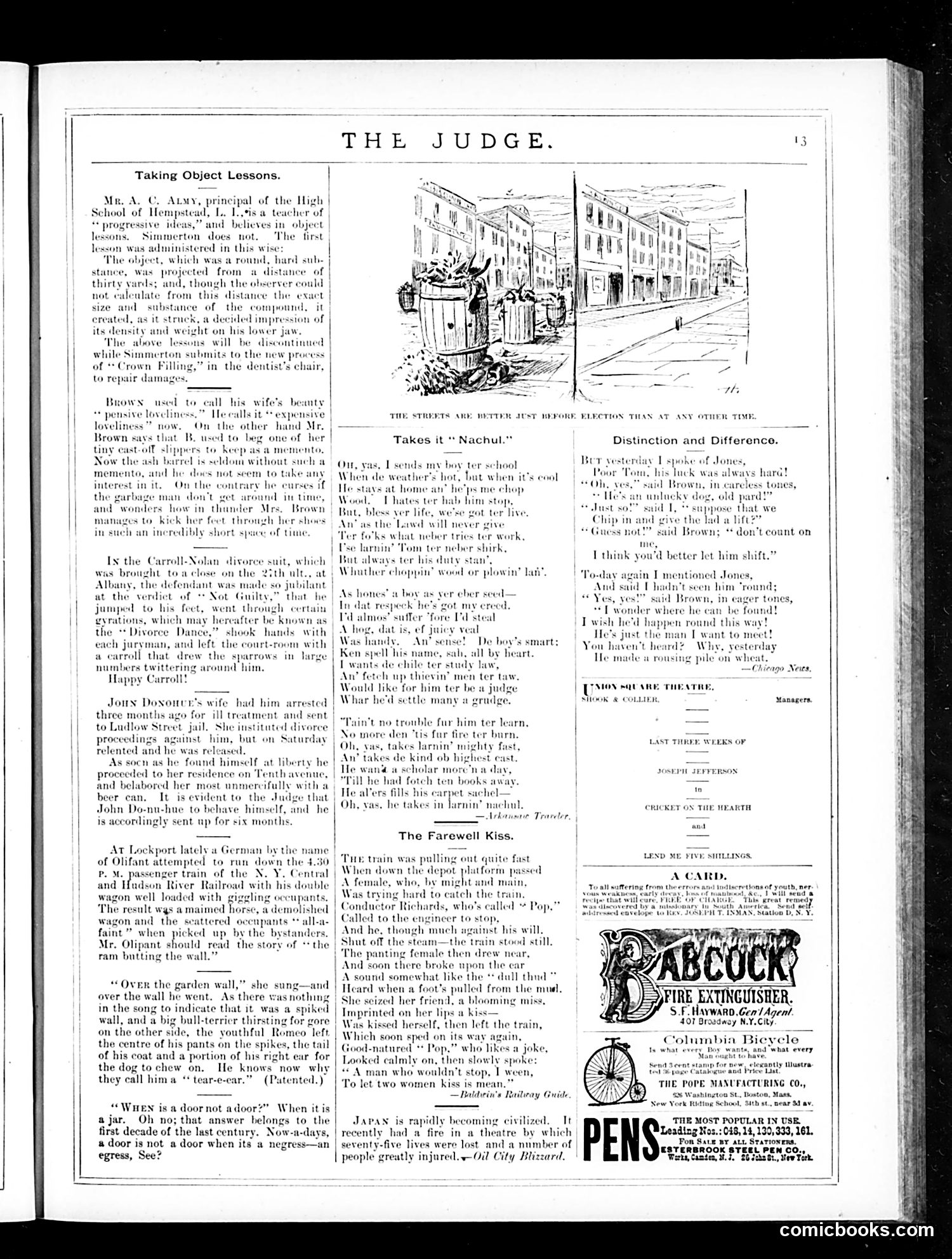
This page contains several satirical pieces typical of Judge magazine's social commentary: **"Taking Object Lessons"** mocks a progressive educator (Mr. A.C. Almy) who uses object lessons, describing how he threw a hard object at a student's jaw to teach about density—injuring the boy. The satire targets educational fads and their absurd practical consequences. **"The Farewell Kiss"** appears to be a sentimental poem about a female passenger rushing to kiss a departing train conductor named "Pop," with the train stopping for the embrace. It's likely satirizing overly romantic or melodramatic railroad scenes popular in period literature. **Other brief anecdotes** include marital humor (the "Carroll-Nolan divorce"), a man arrested for domestic violence, and a German immigrant attempting to stop a train with his wagon—all presented as humorous cautionary tales reflecting period attitudes about marriage, class, and immigrant behavior. The page exemplifies Judge's blend of social satire, domestic humor, and gentle mockery of contemporary institutions and human folly.
This page features a comedic dialogue between a young female writer and a dismissive "horse reporter" (a journalist covering horse racing). The satire mocks: **The Joke:** The aspiring author submits a romantic story. The reporter—distracted and uninterested—barely reads it, instead asking crude plot questions like "Does Vivian finally corral another horse?" He misinterprets the narrative as being literally about horses rather than human romance, suggesting the writer either wrote poorly or the reporter is deliberately obtuse. **The Target:** This satirizes both struggling writers seeking validation from indifferent gatekeepers AND newspaper critics who dismiss literary work. The "horse reporter" represents the contemptuous, dismissive editor who won't seriously engage with submissions. **Period Context:** Late 19th-century periodicals relied on staff like horse reporters (covering sporting events). The satire suggests such "lowbrow" journalists were dismissive of literary ambitions, reflecting class tensions between popular sports coverage and literary fiction. The rest of the page consists of advertisements for grain, carpets, and magic lanterns—typical Judge magazine content.
This is a humorous narrative story (not a political cartoon) presented as a dialogue between a smith and a woman. The story satirizes frontier life and marriage attitudes in late 19th-century America. The unnamed woman recounts how she rejected marriage proposals after her husband died, despite multiple suitors appearing. She describes the various men's attempts to win her—one offering land and swill, another claiming to own property. The punchline reveals her skepticism: she watched these same men frantically chase after livestock around her property, proving their claims of wealth were false. The satire targets both the desperation of frontier bachelors and women's wariness of deceptive suitors. The smith's final comment—"Well, I guess you don't want to marry"—humorously underscores her justified caution. The page itself is primarily advertising for various patent medicines (Cuticura, Mrs. Cobb's Pixy Curled Hair, opium tonics) and merchandise, typical of Judge's revenue model.
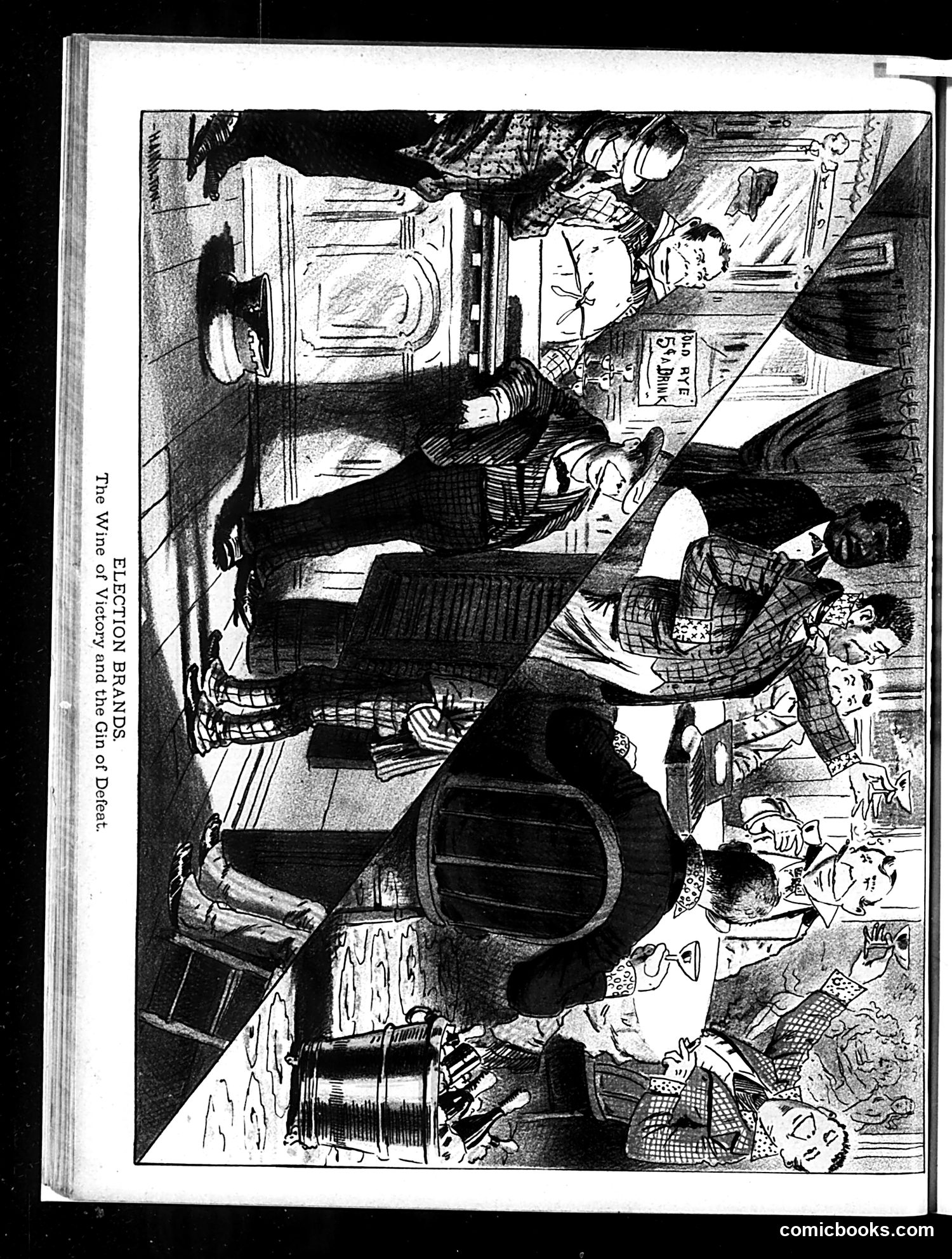
This appears to be a political cartoon from *Judge* magazine satirizing an election outcome. The caption "The Wine of Victory and the Gin of Defeat" uses alcohol imagery to contrast the winners' celebration with the losers' consolation. The image shows what appears to be a domestic scene with multiple figures, though the exact identities and specific election referenced are unclear from the visible text alone. The cartoon likely mocks either the pretensions of victorious politicians or the desperate drinking habits of the defeated—a common satirical theme in Gilded Age American humor. The specific election and figures depicted cannot be confidently identified without additional context or visible dates on the page.