
A complete issue · 16 pages · 1883
Judge — September 15, 1883
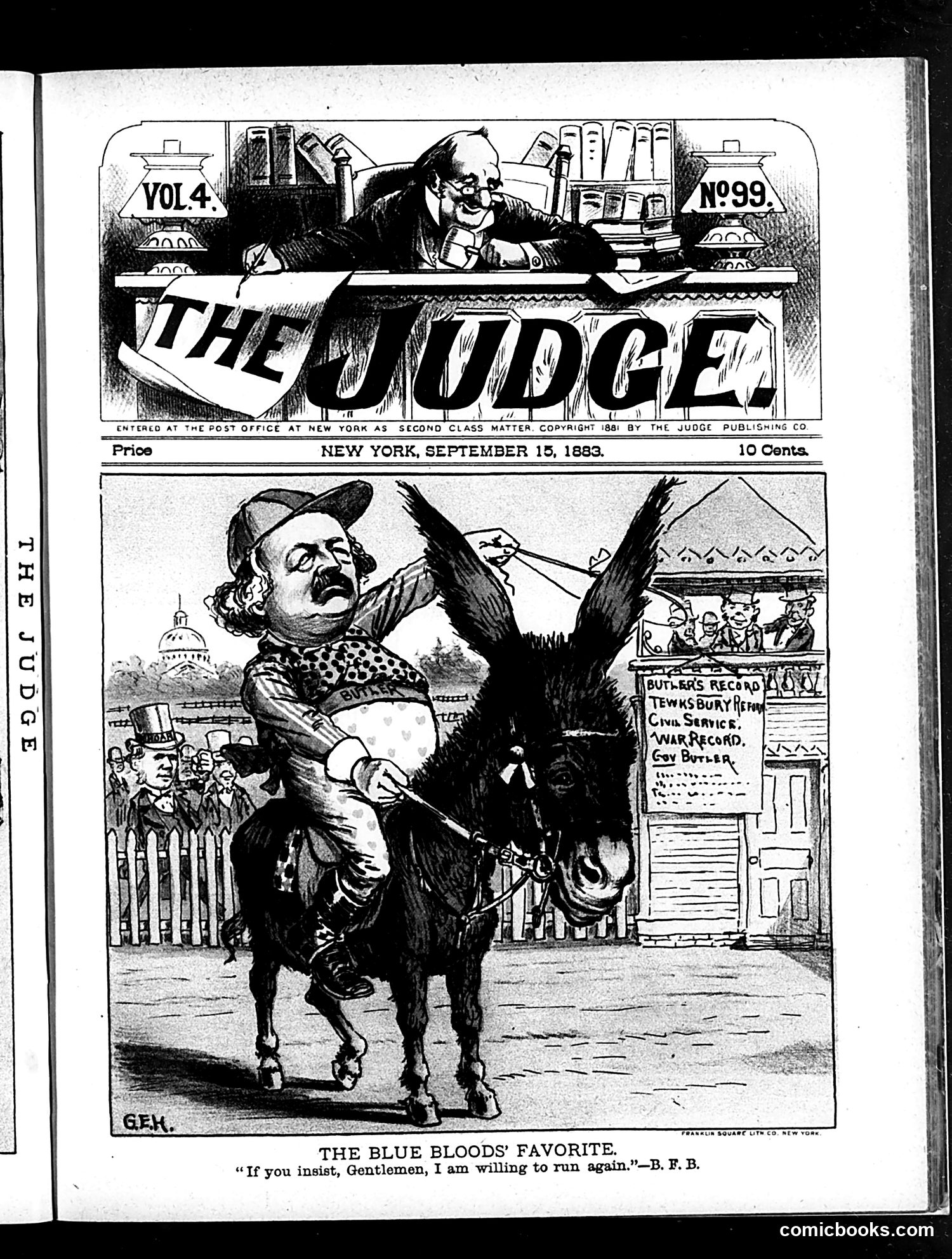
This September 15, 1883 *Judge* cover cartoon satirizes aristocratic horse-racing culture. A caricatured figure with exaggerated features sits astride a bucking horse labeled with a "Butcher's Record" sign, suggesting dubious credentials. The Capitol building appears in the background, indicating political relevance. The caption quotes "B.F.B." (likely a politician): "If you insist, Gentlemen, I am willing to run again"—suggesting someone unwilling but pressured into a political race. The "blue bloods" reference mocks the elite class's horse-racing obsessions and their political influence. The cartoon satirizes how wealthy, aristocratic figures dominate both racing circles and politics, despite questionable qualifications, much to public frustration.
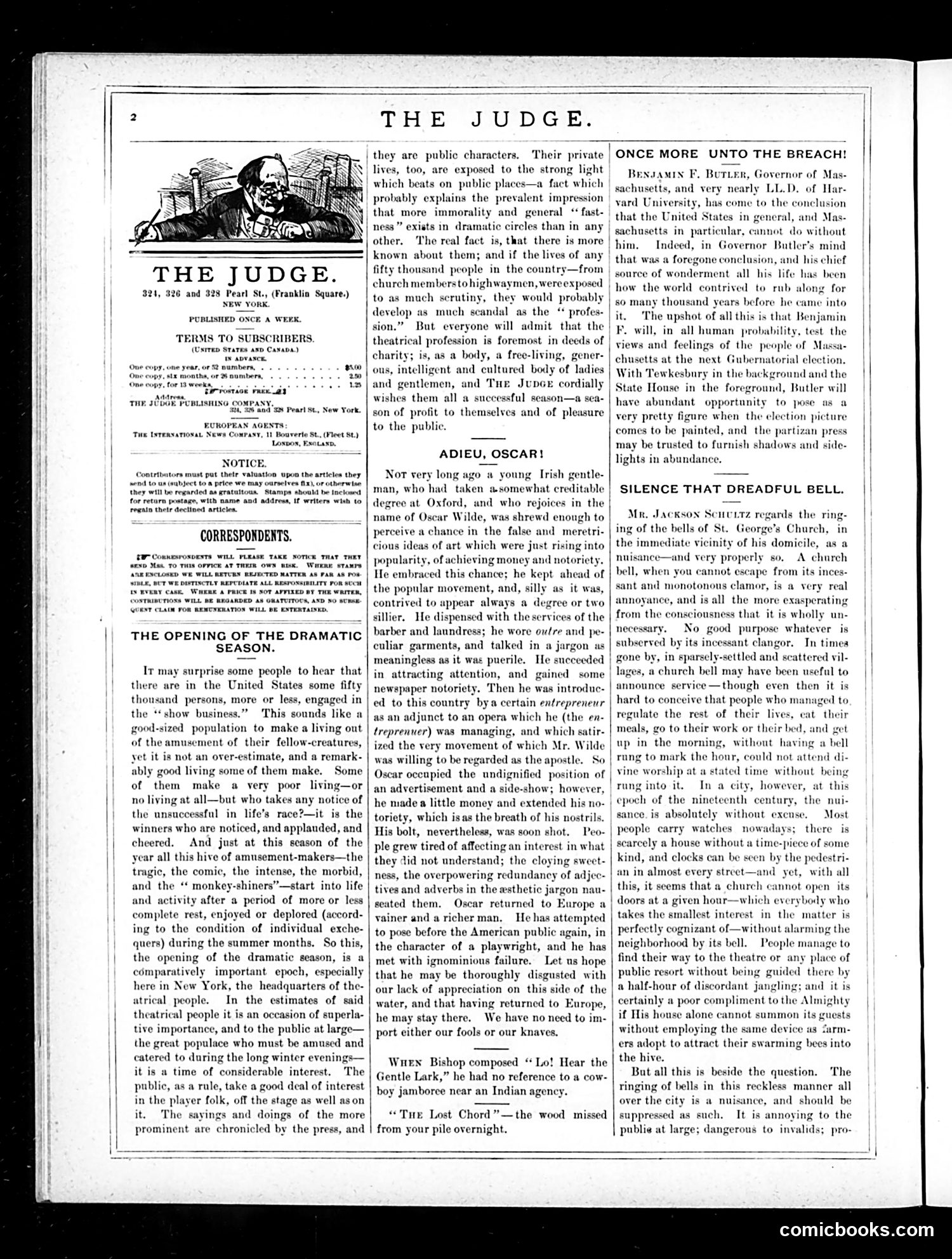
This page contains three distinct pieces of satirical commentary rather than traditional political cartoons. **"Once More Unto the Breach"** discusses Benjamin F. Butler, Governor of Massachusetts, apparently criticizing his return to public prominence. The piece suggests Butler will dominate the upcoming election season in Massachusetts. **"Adieu, Oscar!"** mocks Oscar Wilde's failed attempt to establish himself in American theater. The satire ridicules his affectations, pretentious manner, and financial struggles, ultimately celebrating his departure from the United States. **"Silence That Dreadful Bell"** complains about church bells ringing excessively in urban areas, calling them a nuisance that disturbs residents and should be regulated. The page reflects Judge's typical blend of political commentary, celebrity mockery, and social complaints targeting urban American life in the late 19th century.
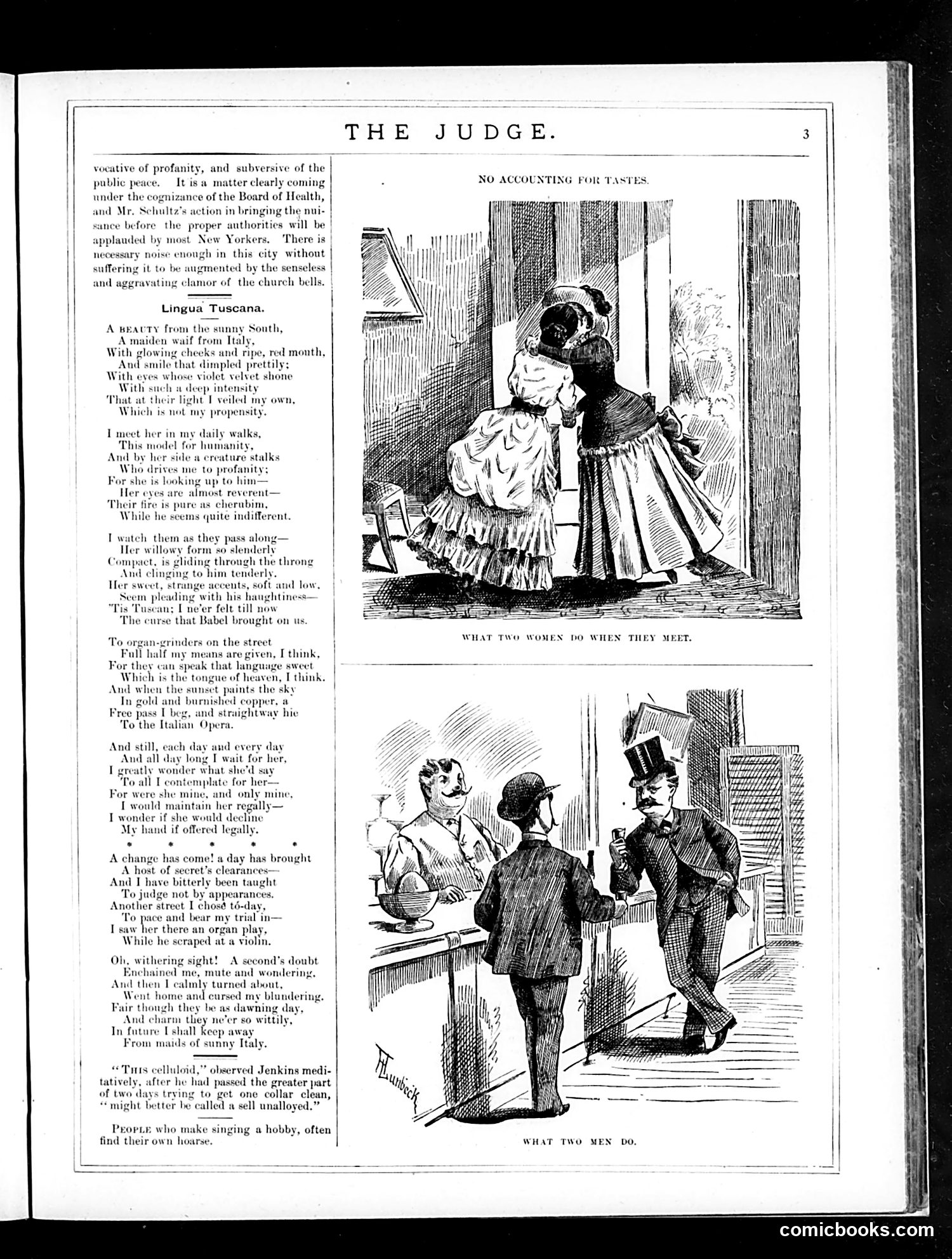
This page contains two satirical cartoons mocking social pretension and romantic delusion. **"No Accounting for Tastes"** (top): Shows two women meeting on the street—one appears fashionably dressed, the other plainly so—illustrating the title's point that aesthetic preferences are inexplicable. **"What Two Men Do"** (bottom): Depicts a well-dressed gentleman encountering a street musician and organ grinder. The accompanying poem "Lingua Tuscana" reveals the satire: the narrator romanticizes an Italian woman he sees daily, imagining her refinement and beauty, only to discover she's actually a street performer accompanying a common organ grinder. The "twist" mocks naive sentimentality and class-based assumptions—the narrator's idealized "Italian beauty" was merely a working-class musician all along. The humor targets romantic fantasy colliding with unglamorous reality, and implicit class prejudices about who deserves admiration based on appearance rather than profession.
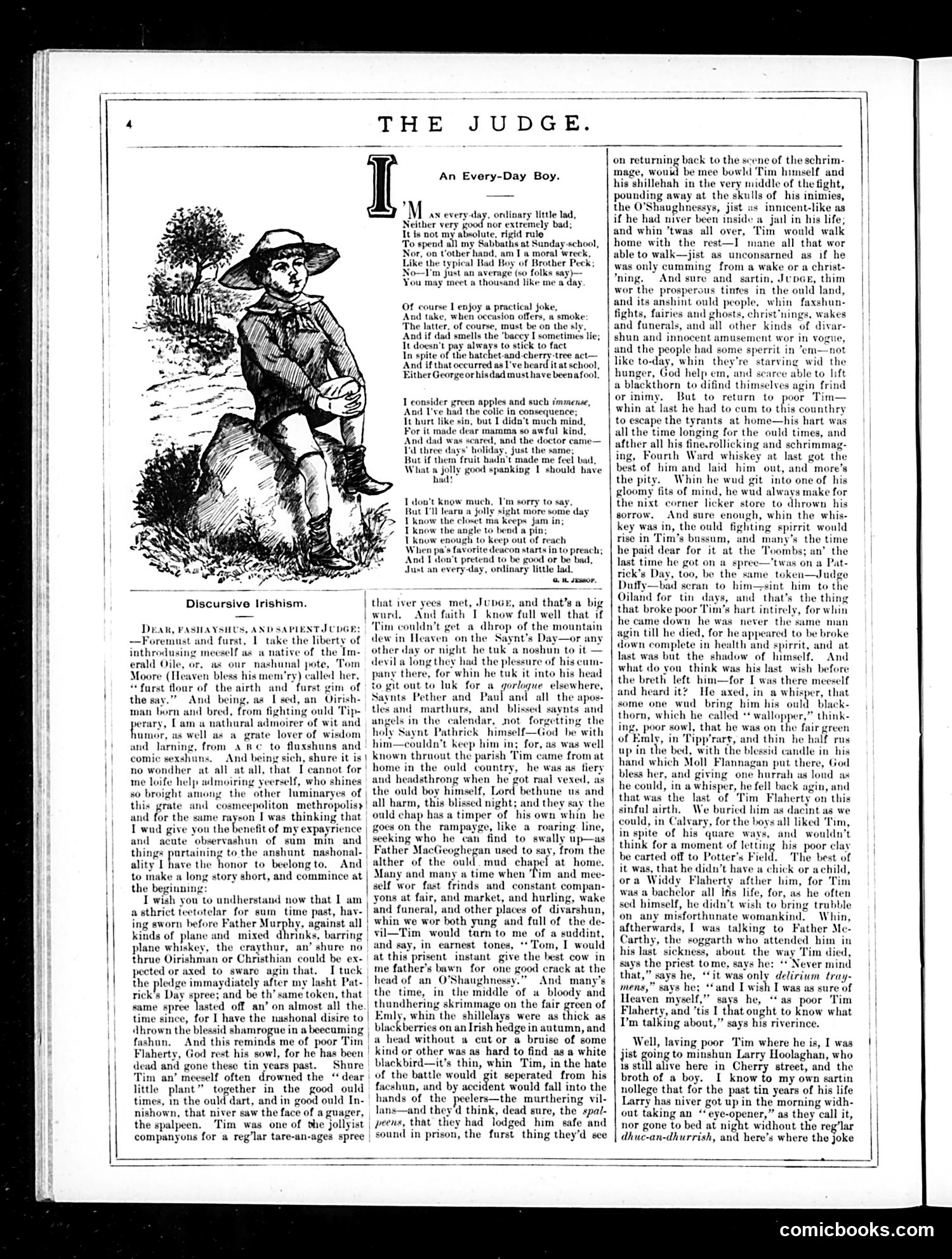
This page contains two distinct pieces of satirical content: **"Discursive Irishism"** (left): A letter to Judge's editor written in exaggerated Irish-American dialect, mocking both Irish immigrant speech patterns and temperance movements. The author, claiming to be a recent Irish immigrant and teetotaler, delivers his observations in deliberately butchered English ("inthrodusing," "Oile" for Ireland). The satire targets Irish-American stereotypes—heavy drinking, malapropisms, and verbose storytelling—while ironically portraying an Irishman who claims sobriety yet constantly discusses whiskey and drinking companions like "poor Tim Flaherty." This reflects period prejudice against Irish immigrants. **"An Every-Day Boy"** (right): A poem describing an ordinary, mischievous boy who smokes, lies occasionally, eats green apples, and avoids church—presented as representative of average American boyhood. The satire gently mocks sanctimonious morality tales (referencing the Washington-cherry-tree legend) while celebrating realistic, imperfect youth. Together, these pieces demonstrate Judge's dual satirical approach: harsh ethnic caricature and gentler social commentary on American life.
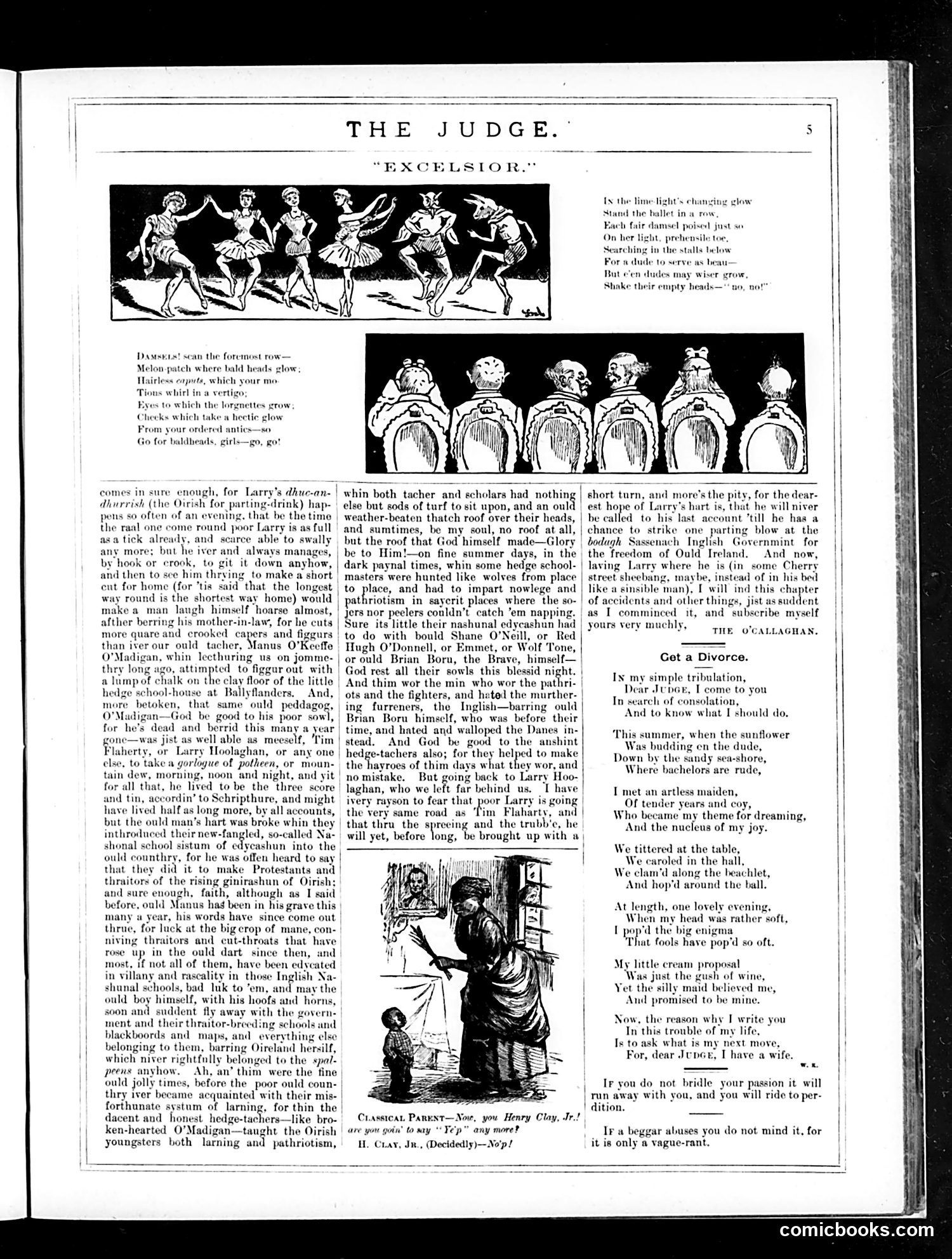
This page from *Judge* magazine satirizes Irish-American identity and education through dialect-heavy narrative. The main text, written in exaggerated Irish brogue, presents a nostalgic critique of traditional Irish hedge schools versus modern National Schools introduced by the British government. The narrator (appearing to be an Irish immigrant or Irish-American) laments that the old system—despite its hardships (outdoor classes, no roofs)—produced Irish patriots like Shane O'Neill, Red Hugh O'Donnell, Emmet, and Wolfe Tone. He argues that modern English-style schooling corrupts Irish youth into "conniving traitors and cut-throats." The decorative illustrations (dancers and bald heads) appear unrelated to the main text—likely filler or separate content. **The satire targets**: Irish-American nostalgia for pre-colonial Ireland; anti-British sentiment; suspicion of formal education as a tool of cultural erasure. The exaggerated dialect itself was a common (and often demeaning) comedic device in 19th-century American humor.
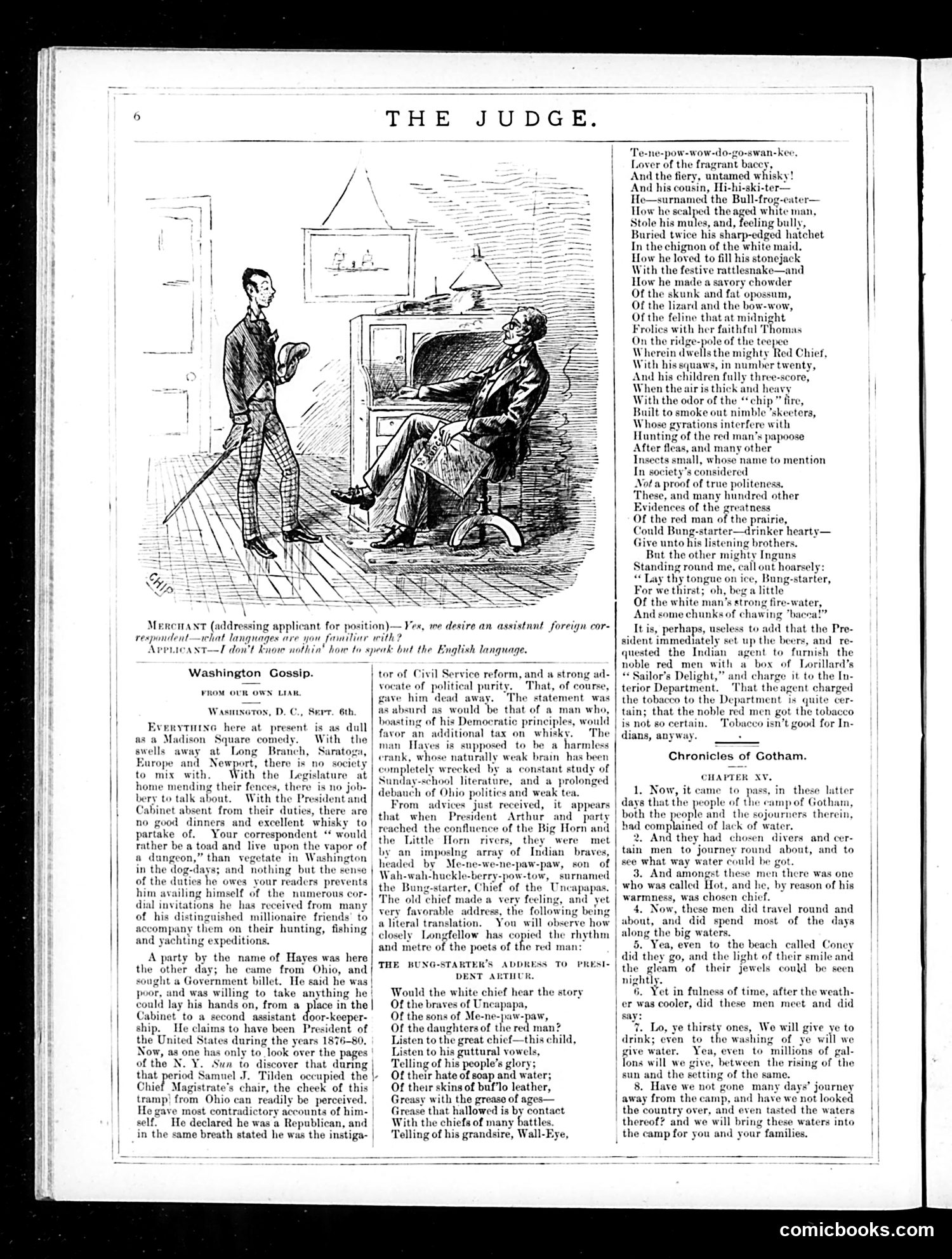
This page contains two satirical pieces mocking President Rutherford B. Hayes, who served 1877-1881. **Top cartoon:** A merchant interviews a job applicant who only speaks English, rejecting him for a foreign correspondent position. This satirizes Hayes's perceived incompetence—the joke being the applicant's monolingualism mirrors Hayes's supposed intellectual limitations. **"Washington Gossip":** The text viciously attacks Hayes as a failed Ohio politician and opportunist. It references his disputed 1876 election victory, calling him a "tramp from Ohio" who contradicts himself about his Republican credentials and Civil Service reform. The author mocks his weak intellect and suggests he was installed through dishonest means. **"Bung-Starter's Address":** A mock-poetic narrative mocking Native Americans and Hayes's western tour, where he apparently met Sioux leaders. The heavily stereotyped "Indian" dialect and caricatured speech were contemporary satirical conventions attacking both Native Americans and Hayes's diplomatic efforts. The overall message: Hayes was an incompetent fraud unfit for office.
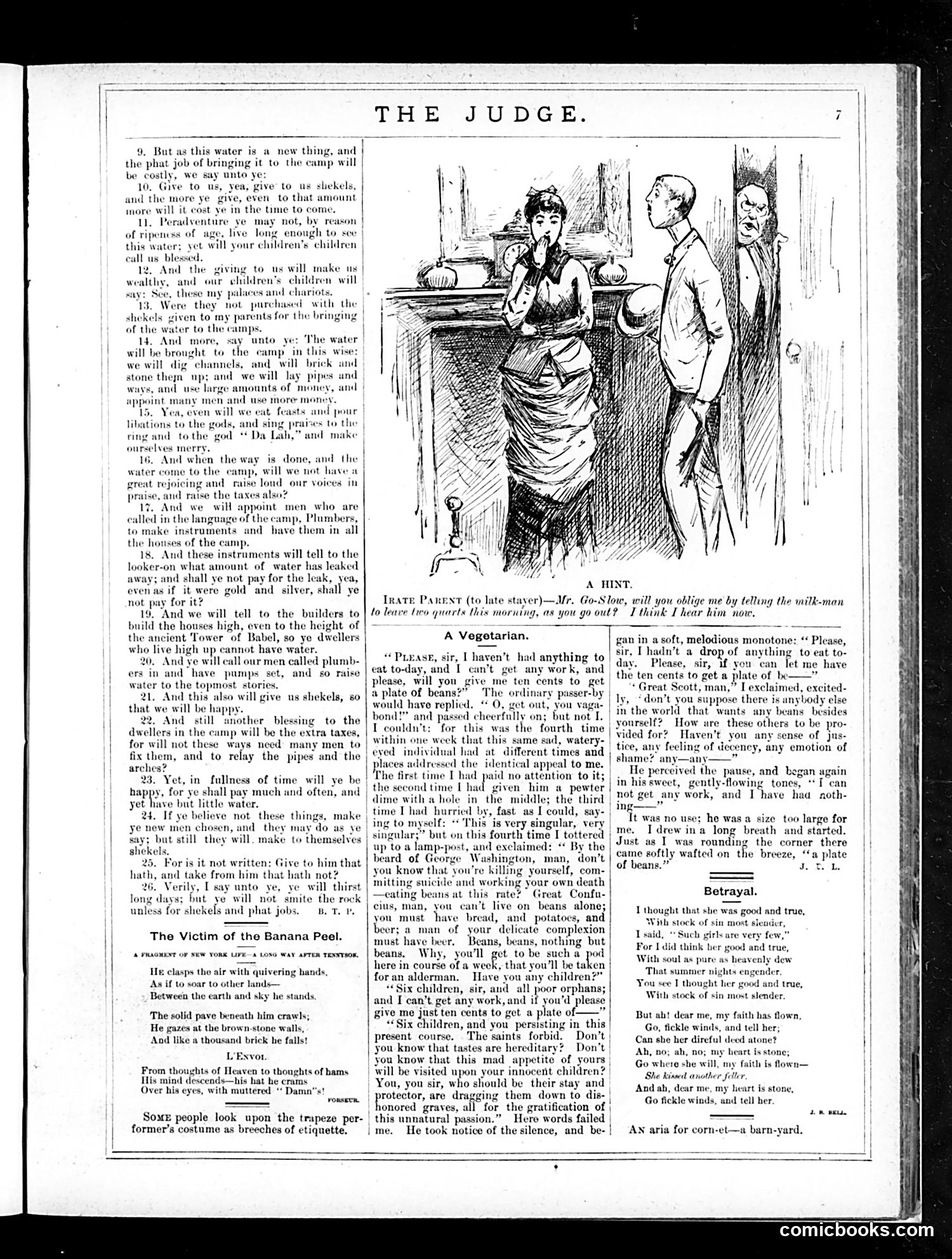
This page from the satirical magazine *Judge* contains multiple pieces of social commentary: **Main Cartoon ("A Hint")**: Shows an irate woman instructing a departing man (labeled "Go-Slow") to tell the milkman to leave extra milk. The satire mocks husbands who linger at home, delaying their departure, forcing wives to give domestic instructions as they leave. **"A Vegetarian" dialogue**: A poor man repeatedly asks a well-dressed gentleman for ten cents to buy beans. The gentleman's frustration—that the same beggar has asked him multiple times in different locations—satirizes either the persistence of vagrants or the gentleman's hypocrisy in refusing help while acknowledging the man's desperation. **Left column biblical parody**: Mock-biblical language mocking municipal water infrastructure projects, criticizing how public works contracts enrich connected contractors and city officials while ordinary citizens bear costs through taxes and poor service. **"Banana Peel" poem**: Humorous verse about someone slipping on a banana peel—a classic slapstick scenario, treated with mock-serious poetic language. The page reflects late 19th-century concerns: municipal corruption, poverty, domestic life, and class dynamics.
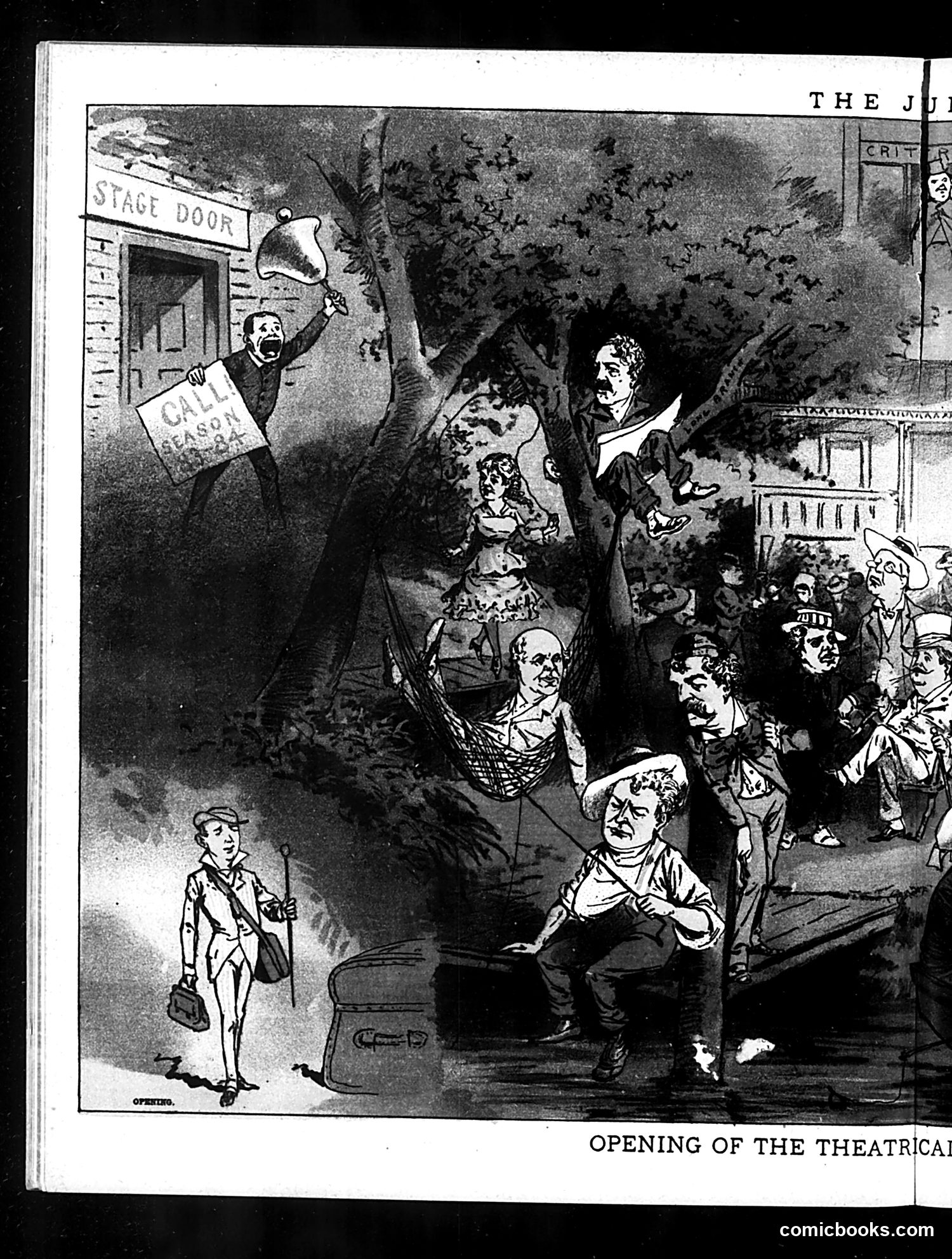
This satirical cartoon depicts the chaos of a theater's opening night. A man at the stage door (left) frantically waves a "Call Season" notice, while above, theatrical figures—likely representing producers, managers, or performers—are tangled in a tree like acrobats or fools. The crowd of well-dressed gentlemen and various characters (some appearing caricatured, possibly representing different ethnic stereotypes common to 1890s-era Judge magazine) mill about in confusion below. The satire mocks the theatrical world's opening season as inherently chaotic, pretentious, and absurd—with managers and performers operating as bumbling fools disconnected from reality. The composition emphasizes disorder and the circus-like atmosphere of theater industry business during this era.
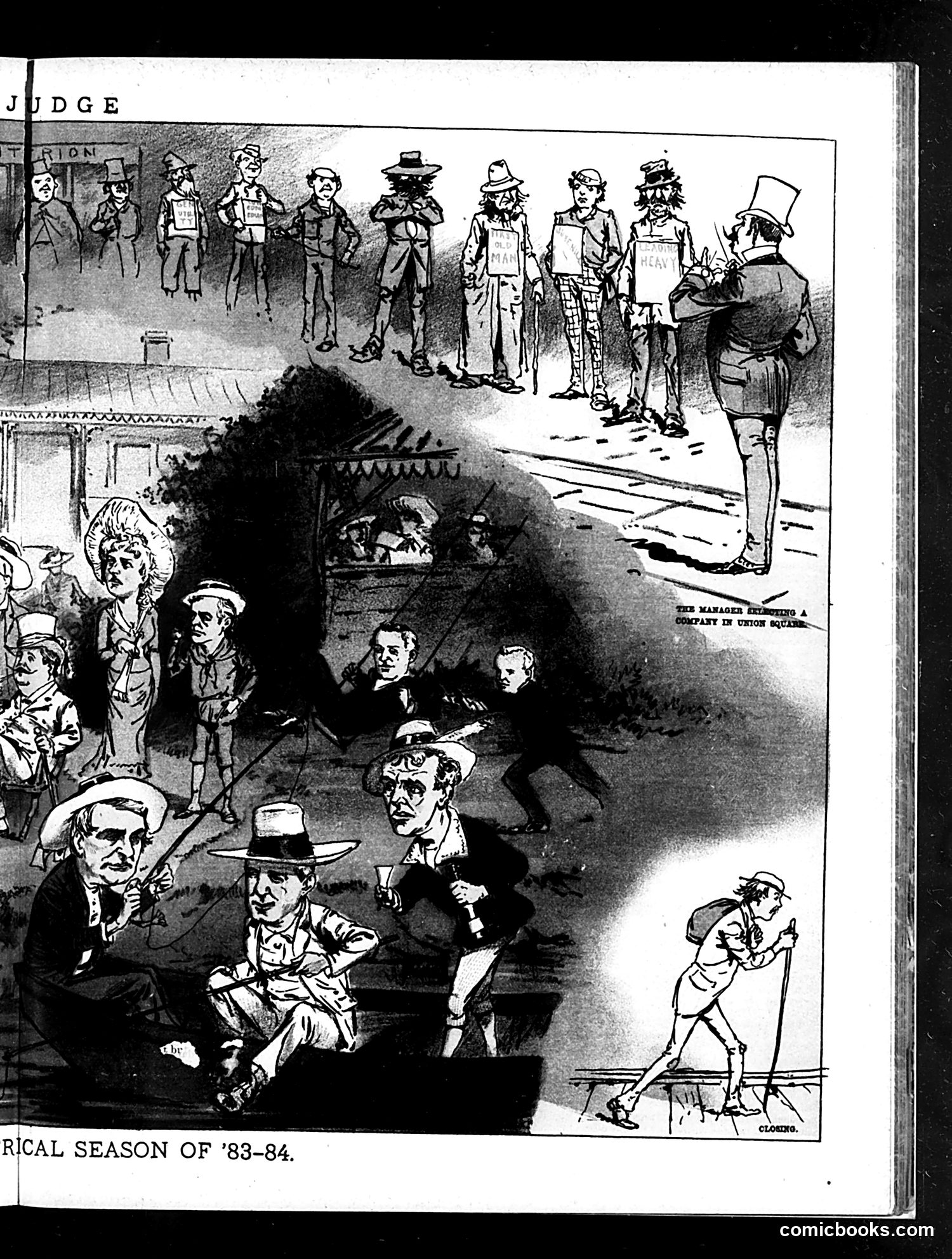
This political cartoon from the 1883-84 theatrical season satirizes the American theater world. The upper panel shows a figure (likely a theater manager or producer) presenting a line of performers wearing sandwich boards labeled "MEAN" to an audience—a joke about the quality or undesirability of available theatrical talent that season. The lower panel depicts the theater's backstage chaos: various performers, managers, and possibly investors argue and scheme amid dramatic shadows. The scene suggests behind-the-scenes corruption, incompetence, or financial struggle in theatrical production. The bottom right shows a figure labeled "CLOSER" in an athletic pose, possibly referencing a specific performer or satirizing theatrical pretension. Overall, the cartoon mocks the theatrical industry's poor quality, internal dysfunction, and mercenary nature during this period.
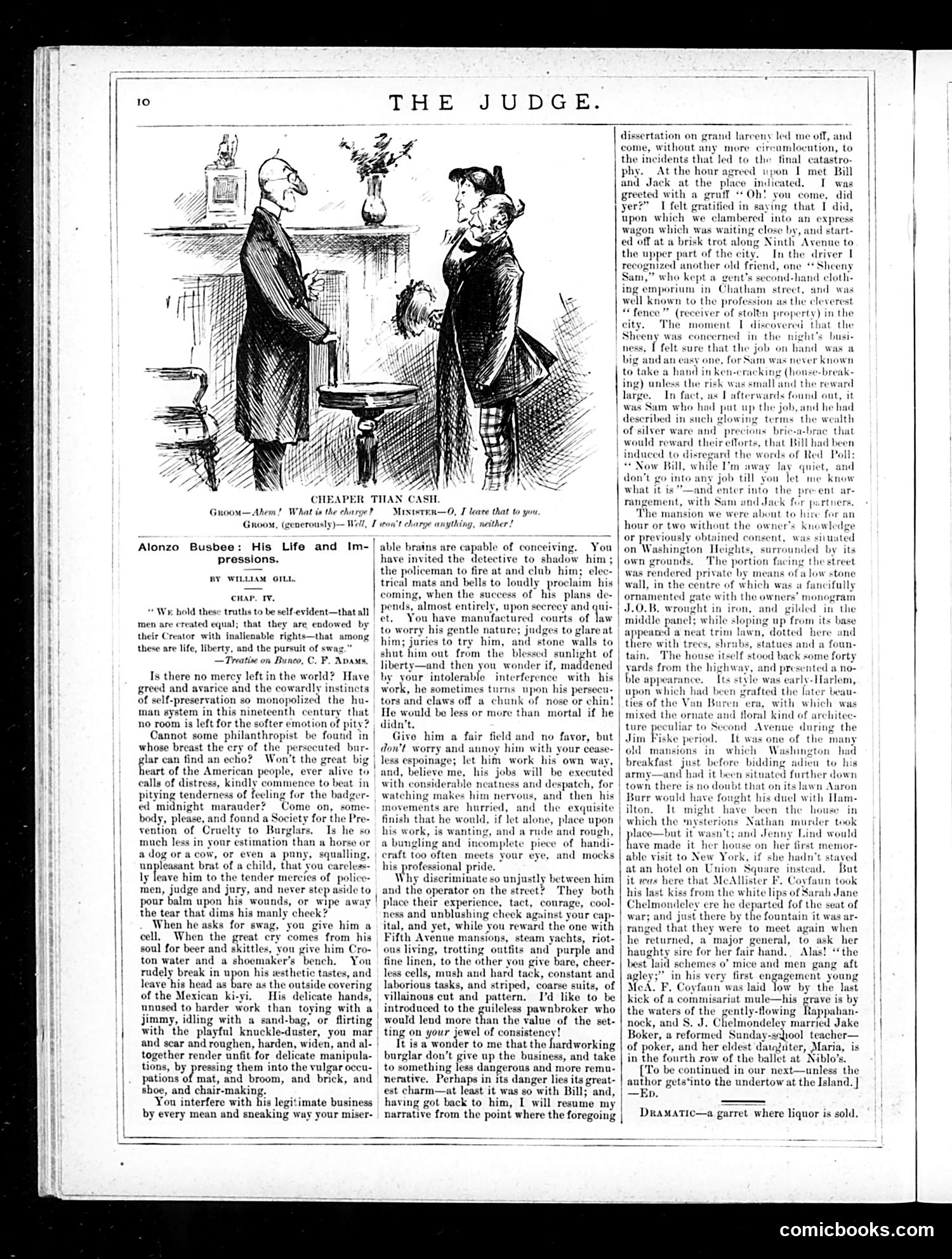
This satirical piece is a mock-serious defense of burglars, titled "Alonzo Busbee: His Life and Impressions." The cartoon shows a well-dressed man (apparently a burglar or criminal) conversing with what appears to be a police officer or judge. The satire works through absurd inversion: the author argues society unfairly persecutes burglars while rewarding legitimate businessmen. He champions "burglary" as honest "work" deserving fair conditions, claiming police interference disrupts the burglar's craft and that imprisonment damages his "delicate hands" unsuited for manual labor. The joke is that Judge presents criminal arguments with the earnest language of social justice movements (referencing the Declaration of Independence, and contemporary societies for animal protection). By applying reform rhetoric to criminal enterprise—suggesting burglars deserve fair wages and decent working conditions—the magazine mocks both excessive sympathy for criminals and flowery humanitarian rhetoric of the era. The dialogue caption reads: "Groom: Ahem! What is the charge? / Minister: O, I leave that to you... Well, I won't charge anything, neither!"—a pun on "charge" (accusation versus fee).
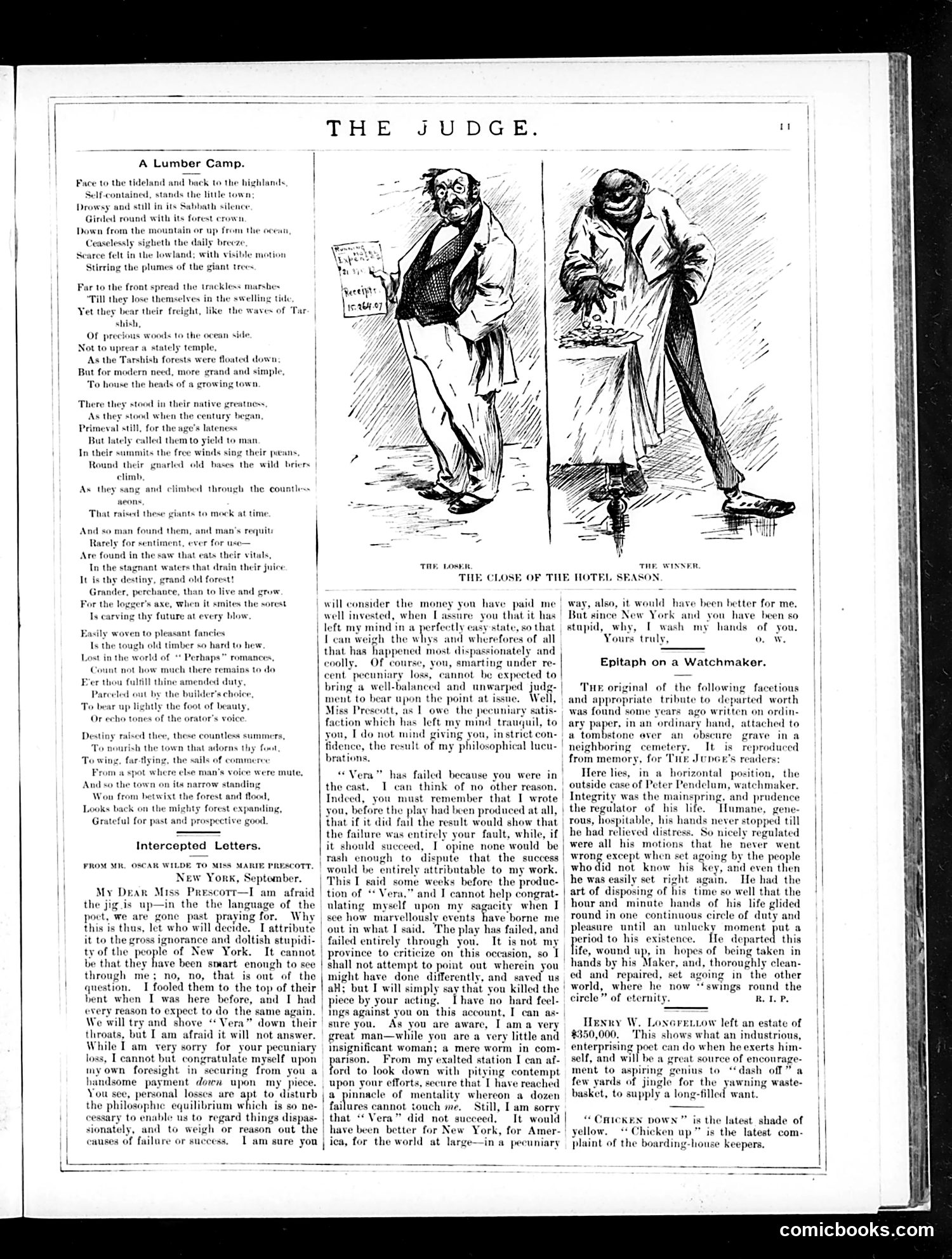
This page contains two distinct pieces of satire: **"A Lumber Camp"** (left side with illustration): A poem mocking sentimental romanticism about nature. It contrasts nineteenth-century reverence for primeval forests with modern capitalism's view of trees as timber to be harvested for profit. The illustrated loggers represent industrial progress destroying wilderness. **"Intercepted Letters"** (bottom): A fictional correspondence where a theater producer defends his failed play "Vera" to its author. He blames the playwright's direction while claiming he (the producer) invested money wisely. The satire mocks his self-serving logic and refusal to accept responsibility—a common target of Judge's humor about business incompetence and deflected blame. **"Epitaph on a Watchmaker"** (right side): A humorous gravestone poem for "Peter Pendelum" (a pun on pendulums), celebrating a watchmaker's precision and reliability. The satire gently jokes about occupational virtue and the irony of marking time through death.
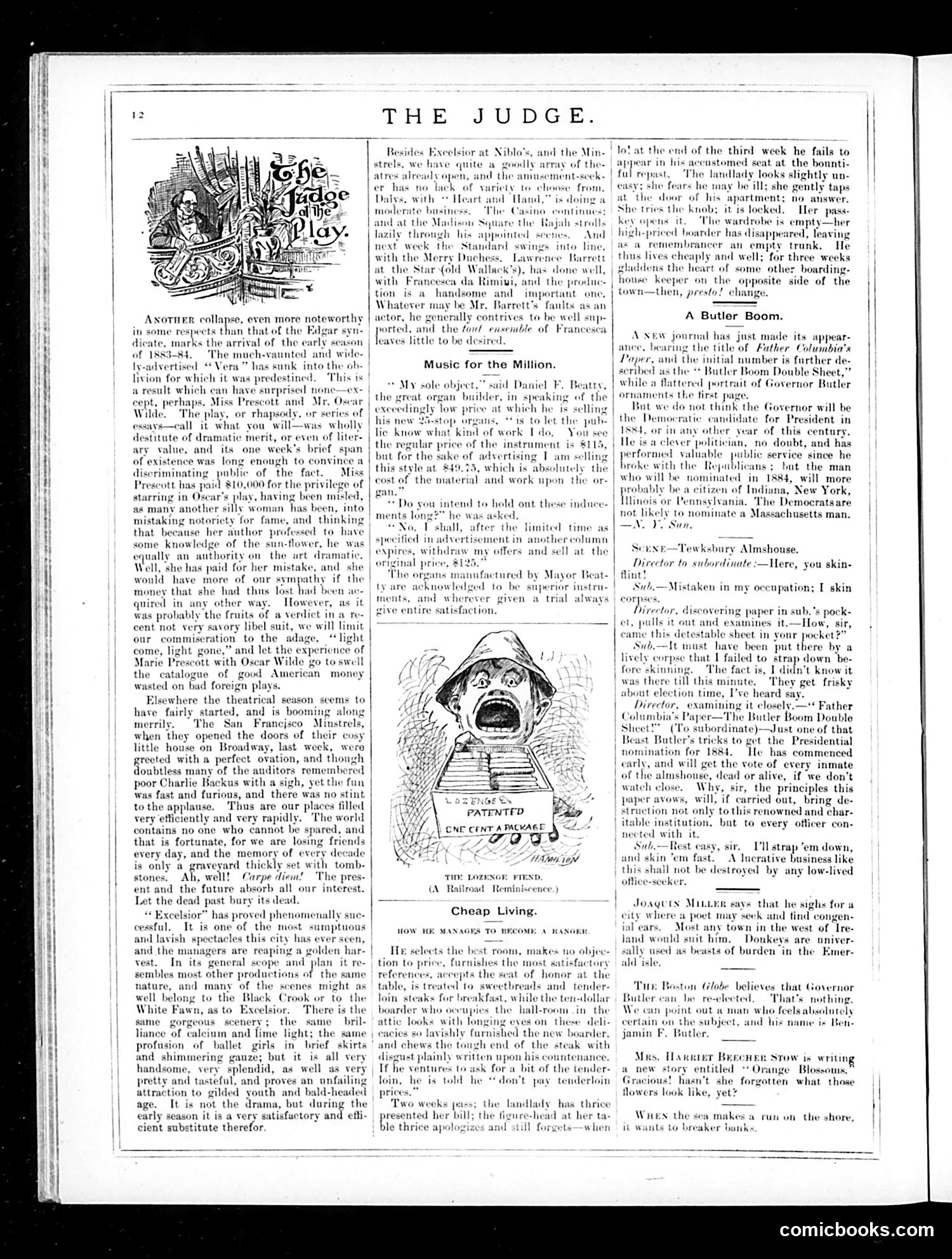
This page from Judge (circa 1883-84) contains theatrical reviews and satirical commentary on New York's entertainment scene. **Main Content:** The page discusses several theatrical productions, including Oscar Wilde's play (likely "Vera"), which is mocked as pretentious and artistically worthless. Marie Prescott, who starred in it, is satirized for wasting $10,000 on what the critic calls a failed production—deriding her for confusing notoriety with legitimate fame. **The Cartoon:** The illustration labeled "THE LONESOME FIEND" (A Railroad Reminiscence) shows a grotesquely drawn figure emerging from what appears to be a "patented" device or compartment. The cartoon likely mocks patent absurdities or railroad safety innovations of the era—common Judge targets. **Social Satire:** Judge uses the theatrical reviews to criticize wealthy patrons (particularly women) for poor cultural judgment and the entertainment industry for importing mediocre foreign productions. The tone is cynical about both artistic merit and financial waste among the gilded classes. The page reflects Judge's role as satirist of 1880s New York society, targeting artistic pretension and commercial excess.
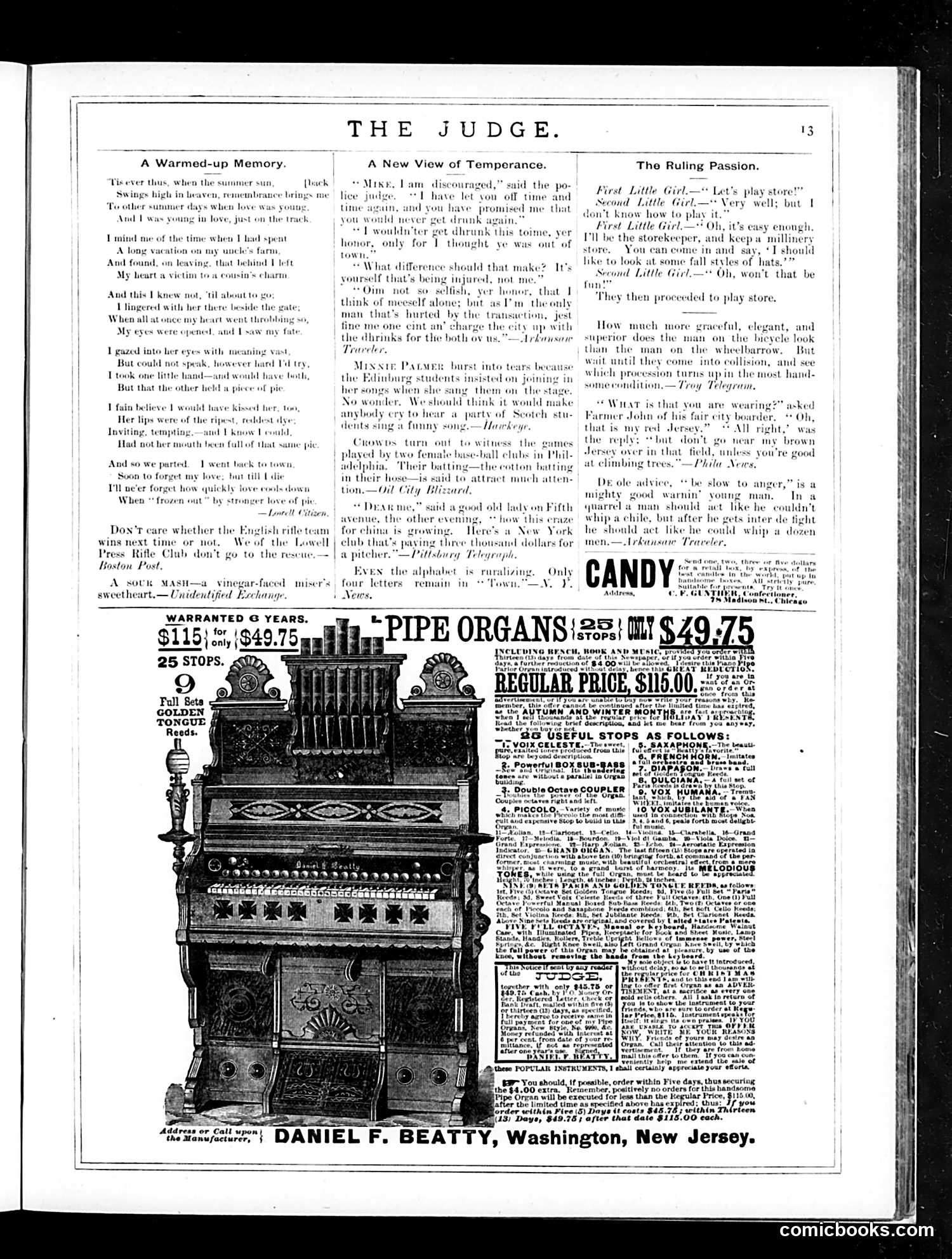
This page from *Judge* magazine contains primarily **literary content and advertising** rather than political cartoons. The upper portion features three humorous short pieces in *Judge*'s typical satirical style: 1. **"A Warmed-up Memory"** – A sentimental poem mocking romantic nostalgia, where a man recalls a summer romance interrupted by the woman eating pie. 2. **"A New View of Temperance"** – A dialogue satirizing Irish immigrants and temperance debates, featuring stereotypical dialect humor about drinking. 3. **"The Ruling Passion"** – Brief jokes about women's shopping interests, particularly millinery (hat) shopping. These pieces employ period-typical ethnic stereotyping and sentimental parody common to 1880s-90s humor magazines. **The dominant feature** is a large advertisement for **pipe organs by Daniel F. Beatty** of Washington, New Jersey—offering a 25-stop organ for $29.75 (regular price $115), "warranted 6 years." The ad emphasizes various mechanical stops and musical capabilities. The page reflects *Judge*'s mixed content model: satirical literature combined with substantial advertising revenue.
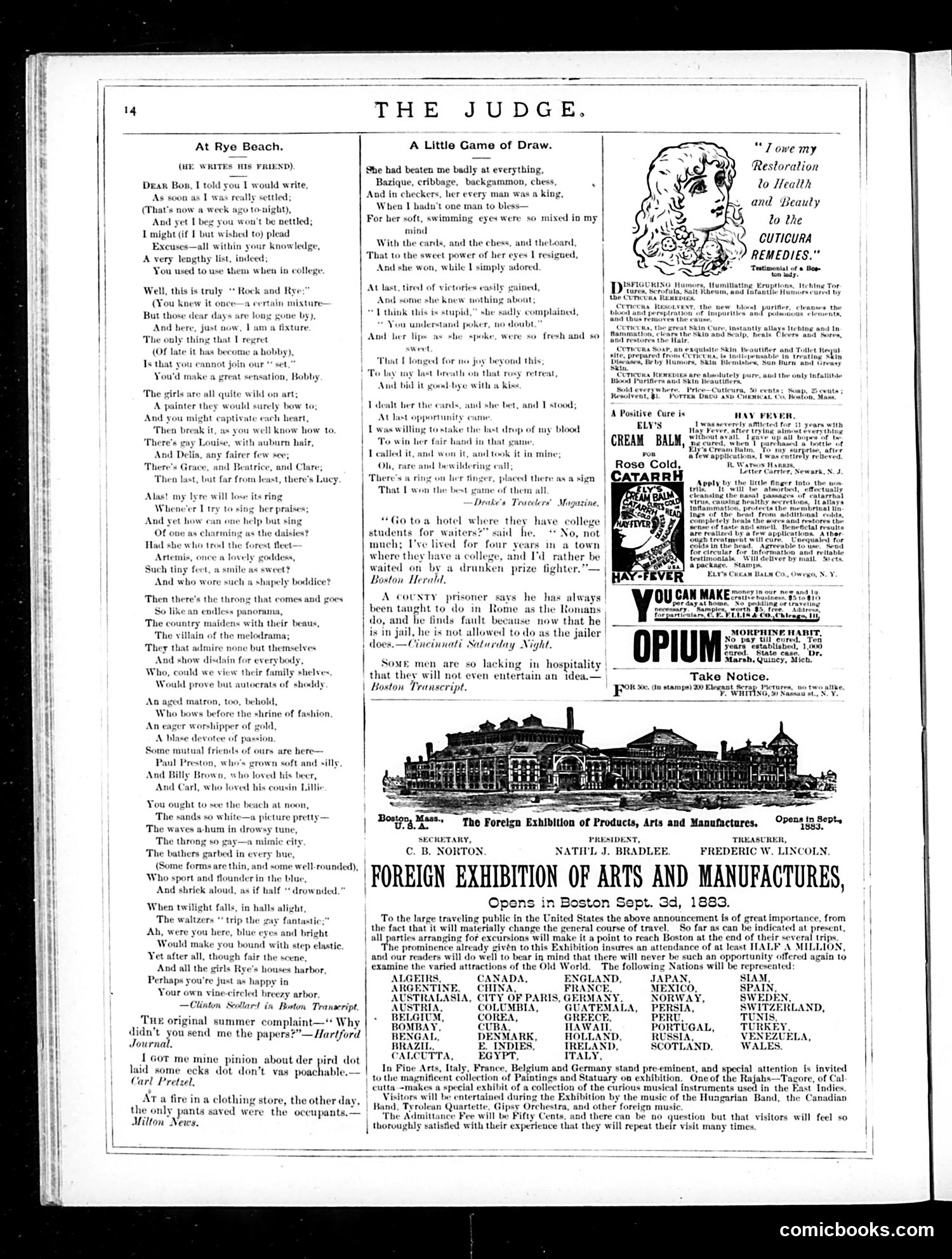
This page contains **poems and light social satire** rather than political cartoons. **"At Rye Beach"** is a romantic narrative poem about a man writing to a friend, describing fashionable young women and social activities at a New England beach resort. The satire is gentle—mocking the superficiality of leisure-class courtship and the predictable behavior of "aged matrons" devoted to fashion. **"A Little Game of Draw"** is a flirtation poem where a man, repeatedly beaten at card games by a woman, finally wins her heart through romance rather than skill. The page is primarily filled with **period advertisements** for patent medicines (Cuticura Remedies, opium products) and an announcement for the 1883 Foreign Exhibition of Arts and Manufactures opening in Boston—typical commercial content for the era. **Historical context**: These lighthearted social verses reflect Gilded Age concerns with courtship rituals, leisure, and femininity. The advertising reveals contemporary attitudes toward medicine and consumption.
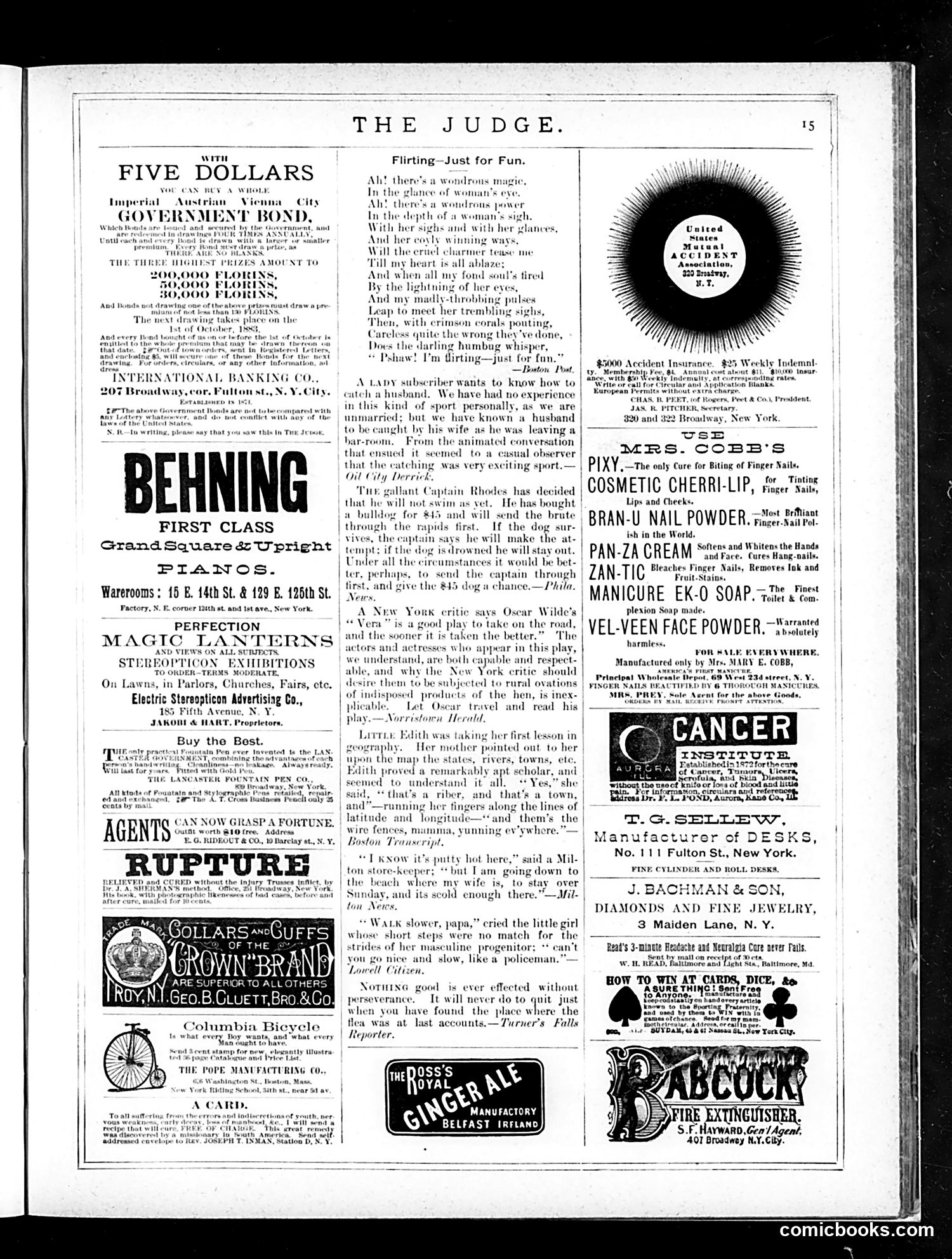
This page is primarily **advertising, not editorial content or cartoons**. The small humor pieces ("Flirting—Just for Fun," "A lady subscriber wants to know how to catch a husband," etc.) are brief comic anecdotes scattered between ads—typical of Judge's format. The jokes are generic domestic humor: a Captain Rhodes testing a bulldog in rapids before swimming them himself; a child confusing geographic terms ("that's a river," "that's a town"); complaints about summer heat and walking slowly. The page consists almost entirely of period commercial advertisements (pianos, bicycles, cosmetics, jewelry, ginger ale). There is **no political satire or caricature visible**. This appears to be a standard advertising page from Judge magazine, where satirical content was mixed with paid advertising to fund the publication.
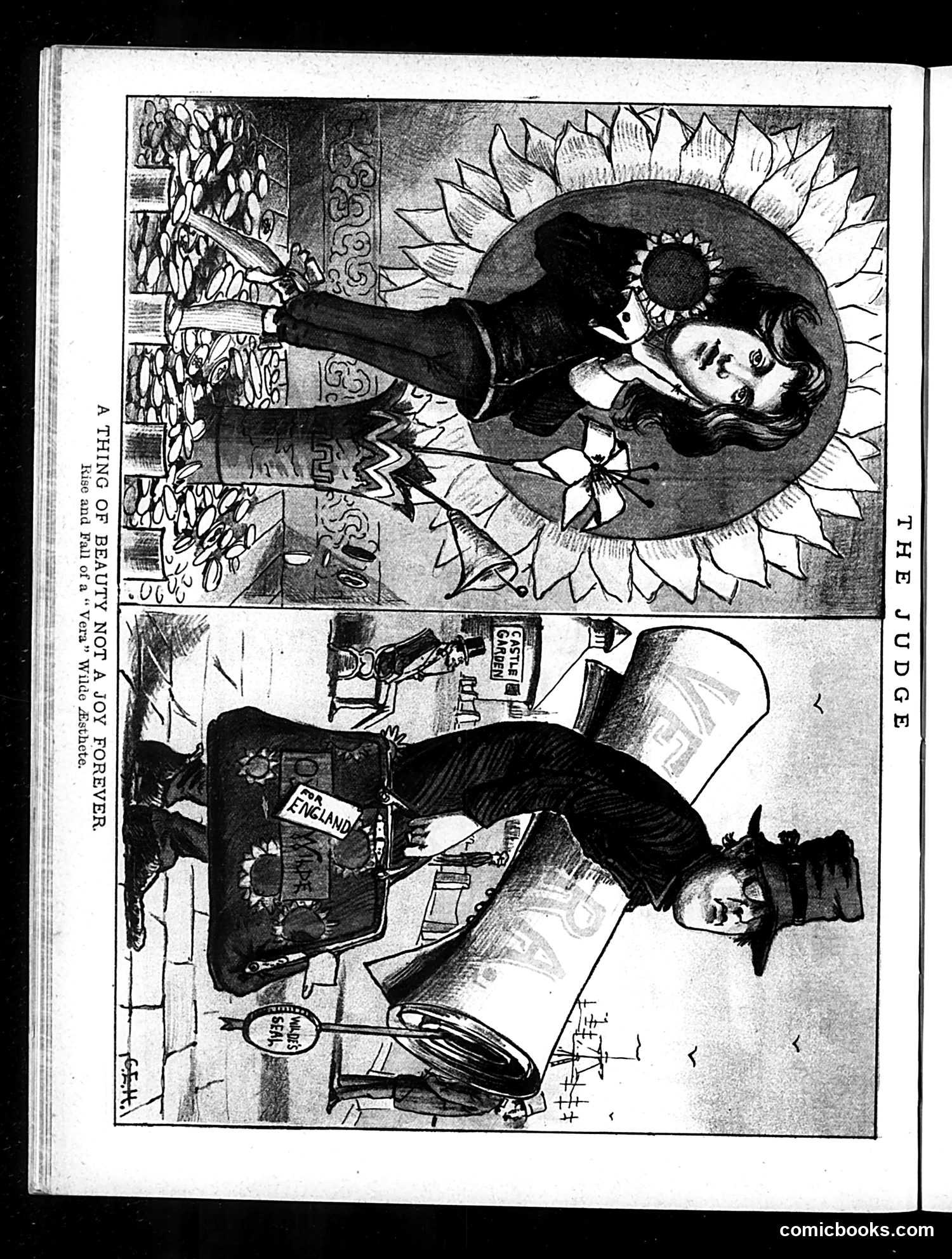
This page from *Judge* satirizes Oscar Wilde, the famous Irish playwright and aesthete. The title "A Thing of Beauty Not a Joy Forever" mocks Wilde's famous aesthetic philosophy. The top panel shows a fashionable figure surrounded by sunflowers (referencing Wilde's association with the "aesthetic movement" and sunflower symbolism). The bottom panel depicts the figure's downfall—likely referencing Wilde's 1895 trial and imprisonment for "gross indecency" related to his homosexuality. The cartoon's trajectory from celebrated aesthete to disgraced prisoner reflects Wilde's dramatic fall from fame. The satire critiques both Wilde's flamboyant aesthetic ideology and the social scandal that destroyed his reputation, suggesting his "beauty" and philosophy provided no lasting protection or happiness.