
Judge, 1883-09-15 · page 3 of 16
Judge — September 15, 1883 — page 3: what you’re looking at
What you’re looking at
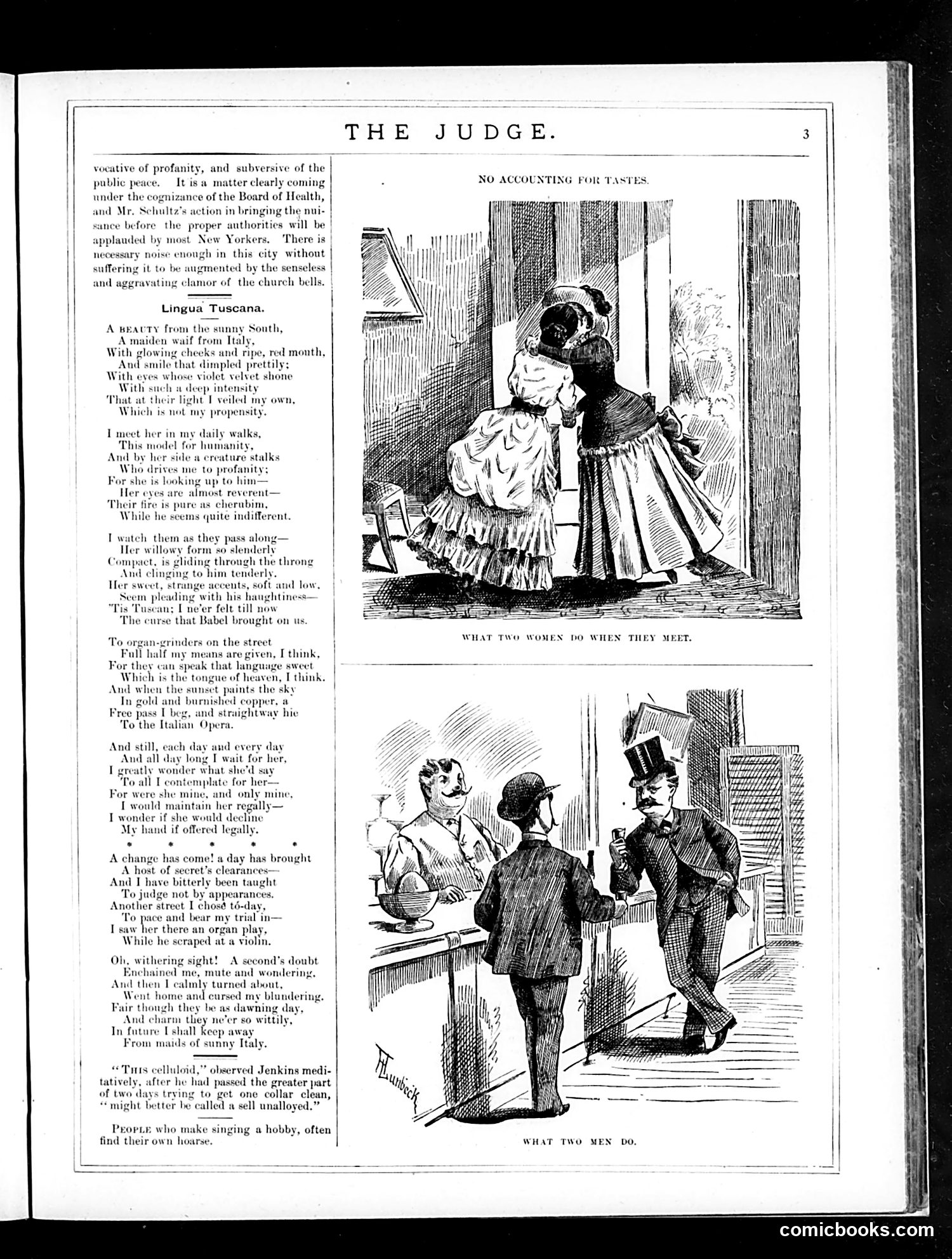
This page contains two satirical cartoons mocking social pretension and romantic delusion. **"No Accounting for Tastes"** (top): Shows two women meeting on the street—one appears fashionably dressed, the other plainly so—illustrating the title's point that aesthetic preferences are inexplicable. **"What Two Men Do"** (bottom): Depicts a well-dressed gentleman encountering a street musician and organ grinder. The accompanying poem "Lingua Tuscana" reveals the satire: the narrator romanticizes an Italian woman he sees daily, imagining her refinement and beauty, only to discover she's actually a street performer accompanying a common organ grinder. The "twist" mocks naive sentimentality and class-based assumptions—the narrator's idealized "Italian beauty" was merely a working-class musician all along. The humor targets romantic fantasy colliding with unglamorous reality, and implicit class prejudices about who deserves admiration based on appearance rather than profession.
📄 Transcribed text from this page (OCR, searchable)
Machine-transcribed from the original scan — historical spelling and the odd misread are preserved.
THE JUDGE. vocative of profanity, and subversive of the public pe: It is a matter clearly coming - NO ACCOUNTING FOR TASTES. under the zt of the Board of 1 h, and Mr. $ *s action in bringing the nui- | xefore the proper authorities will be | applauded by most New Yorkers. There is necessary noise enough in this city without suffering it to be augmented by the senseless | and aggravating clamor of the church bells. Lingua Tuscana. A BEAUTY from th y South, th A maiden waif fi i {| i With glowing cheeks and rip ‘ it Hy il i! i ‘lil \y} ‘Nh And smile that dimpled prettily | With eyes whose violet velvet shone With such a deep intensity "That at r light I veiled own, Which is not my prope Tmcet her in my daily walks, This model for humanity, And by her ture stalks Who drives me Their fire is pure as cherubim, While he seems quite indifferent. ery T watch them as they pass along— Her willowy form so slenderly Compact, is gliding through the throng | And clinging to him tenderly. Her swe cents, soft and low, Seem pl ith his haughtiness— "Tis Tus er felt till now w I think, For they can spe: f Which is the tongue of heaven, I think. And when the sunset paints the sky In gold and burnished copper. Free pass I beg, and straightway hie To the Ita Opera. And still, each day and every day And all day long T wait eatly wonder what sh all T contempla ‘or were she mi I would maintain her I wonder if she would de: My hand if offered | . . * A change has come! a day A host of et’s clearanc And I have bitterly been taught To judge not by appearances. Another street I chosé té-day, ‘9 pace and bear my trial in— I saw se there an organ play, While he scraped at a violin, withering sight! A second’s doubt hained me, mute and wondering, And then TL calmly turned about, Went home and cursed my blunder ‘ ing day, > wittily, sunny Italy, “Tits celluloid,” observed Jenkins medi- tatively, the greater part of two days trying to get one collar clean, “might better be called a sell unalloyed.” Prorie who make singing a hobby, often find their own hoarse. WHAT TWO MEN comicbooks.com