
A complete issue · 16 pages · 1883
Judge — August 11, 1883
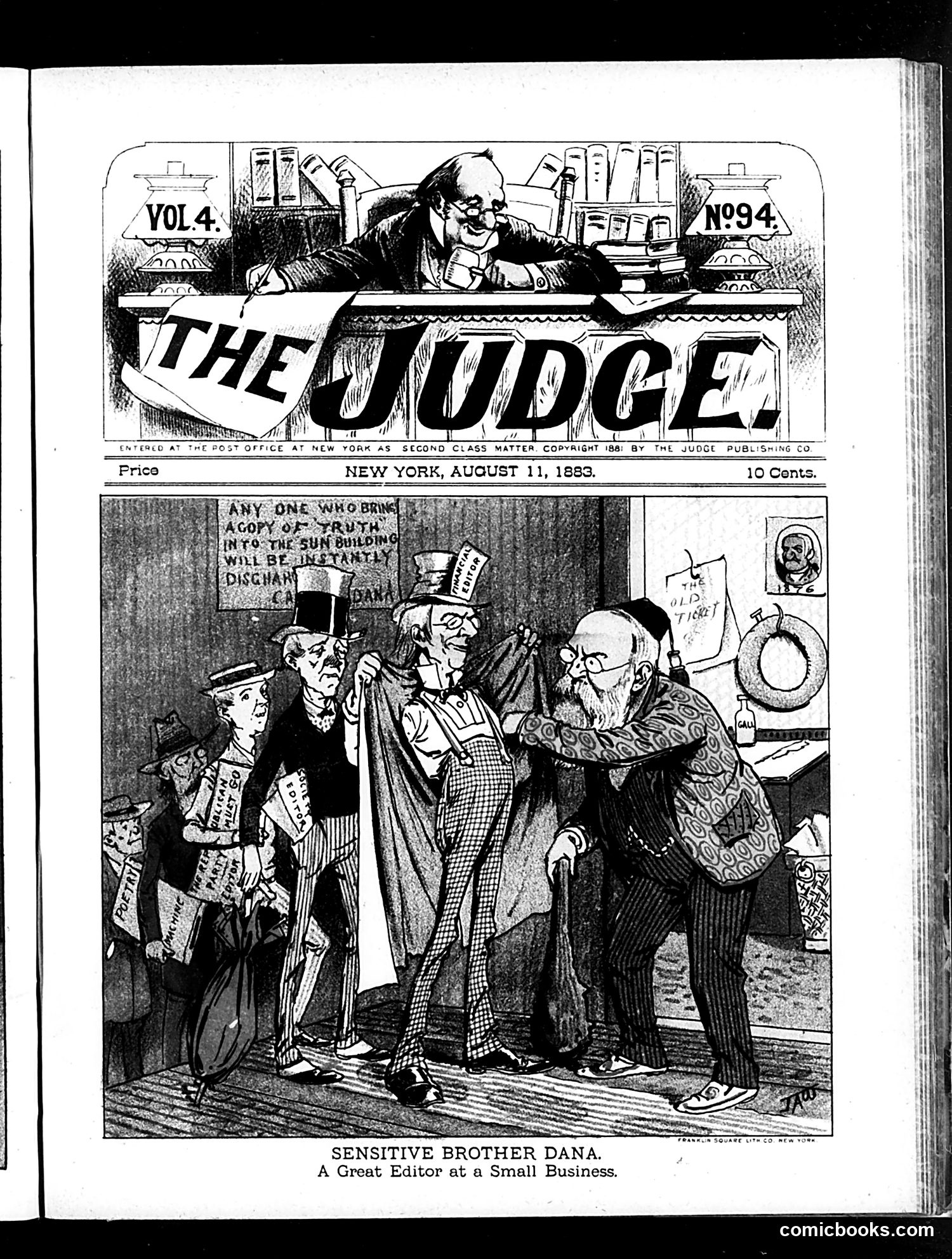
This cartoon satirizes what appears to be a dispute involving an editor named Dana (likely Charles A. Dana of the New York Sun newspaper). The caption describes him as "A Great Editor at a Small Business." The scene depicts Dana being confronted by several figures holding papers and signs near the Sun Building. The satire suggests Dana is engaging in petty, undignified behavior unbecoming a major newspaper editor—hence "small business." The figures appear to be creditors or rivals presenting claims or complaints. The cartoon's humor relies on the contrast between Dana's prominent editorial position and his apparent involvement in trivial disputes or financial matters. Without additional historical context, the specific incident remains unclear, but the satire mocks Dana's dignity and editorial standing.
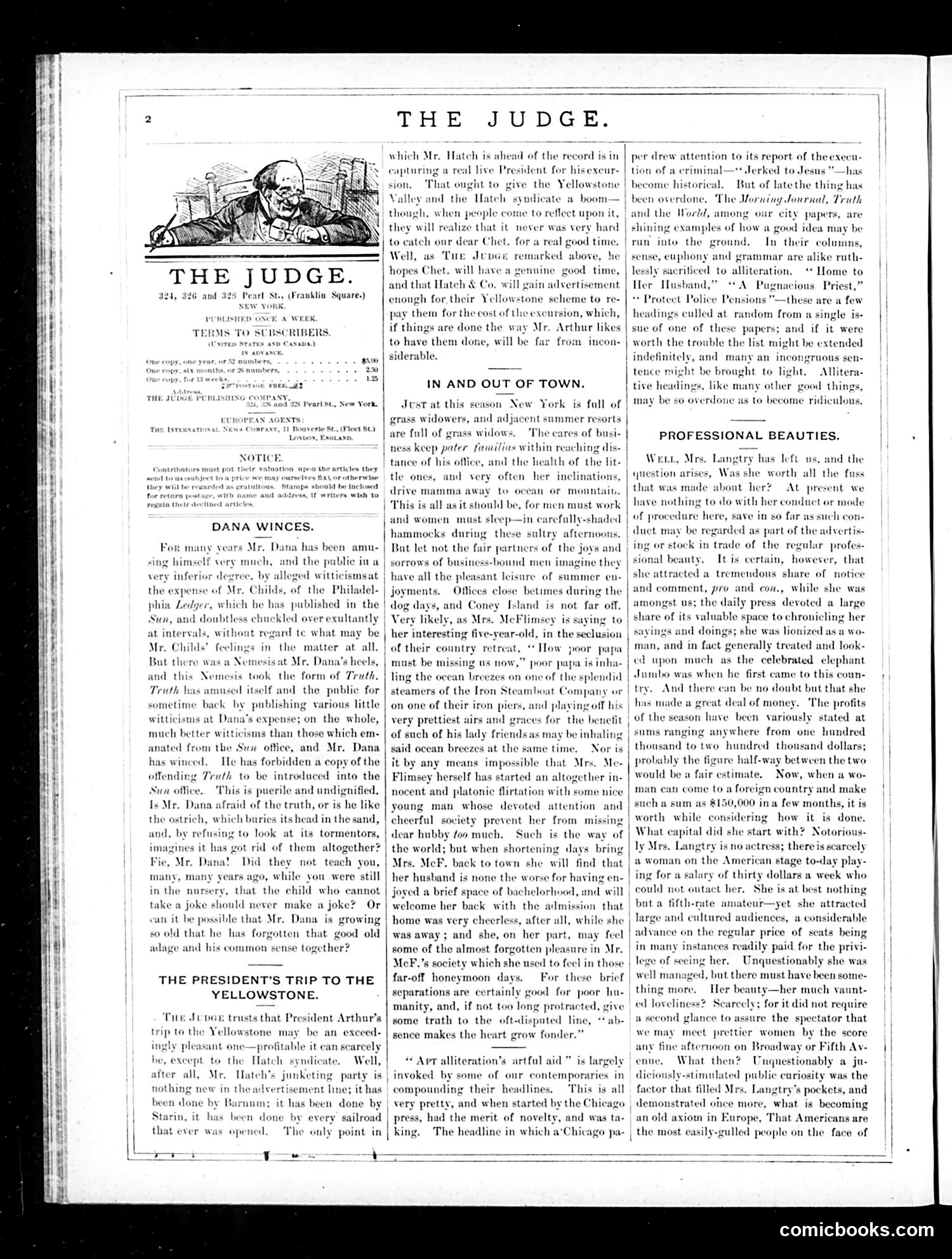
The page contains two main satirical pieces. **"Dana Winces"** mocks Charles Dana, editor of the *New York Sun*, for banning the magazine *Truth* from his office after it published witticisms about him. Judge ridicules Dana's hypocritical stance—he himself regularly published jokes about others but cannot tolerate being targeted. The piece sarcastically suggests Dana is burying his head like an ostrich rather than facing criticism. **"The President's Trip to the Yellowstone"** critiques President Chester Arthur's planned excursion, suggesting it's merely a publicity stunt benefiting the Hatch syndicate (likely a railroad or tourism company). Judge implies such junkets are nothing new—previous railroads and entrepreneurs have done similar trips. **"In and Out of Town"** humorously discusses "grass widowers" (husbands left behind) and the social dynamics of wives summering elsewhere while husbands work in the city—a common upper-class practice. The page blends political satire with social commentary typical of Judge's irreverent approach to contemporary affairs.
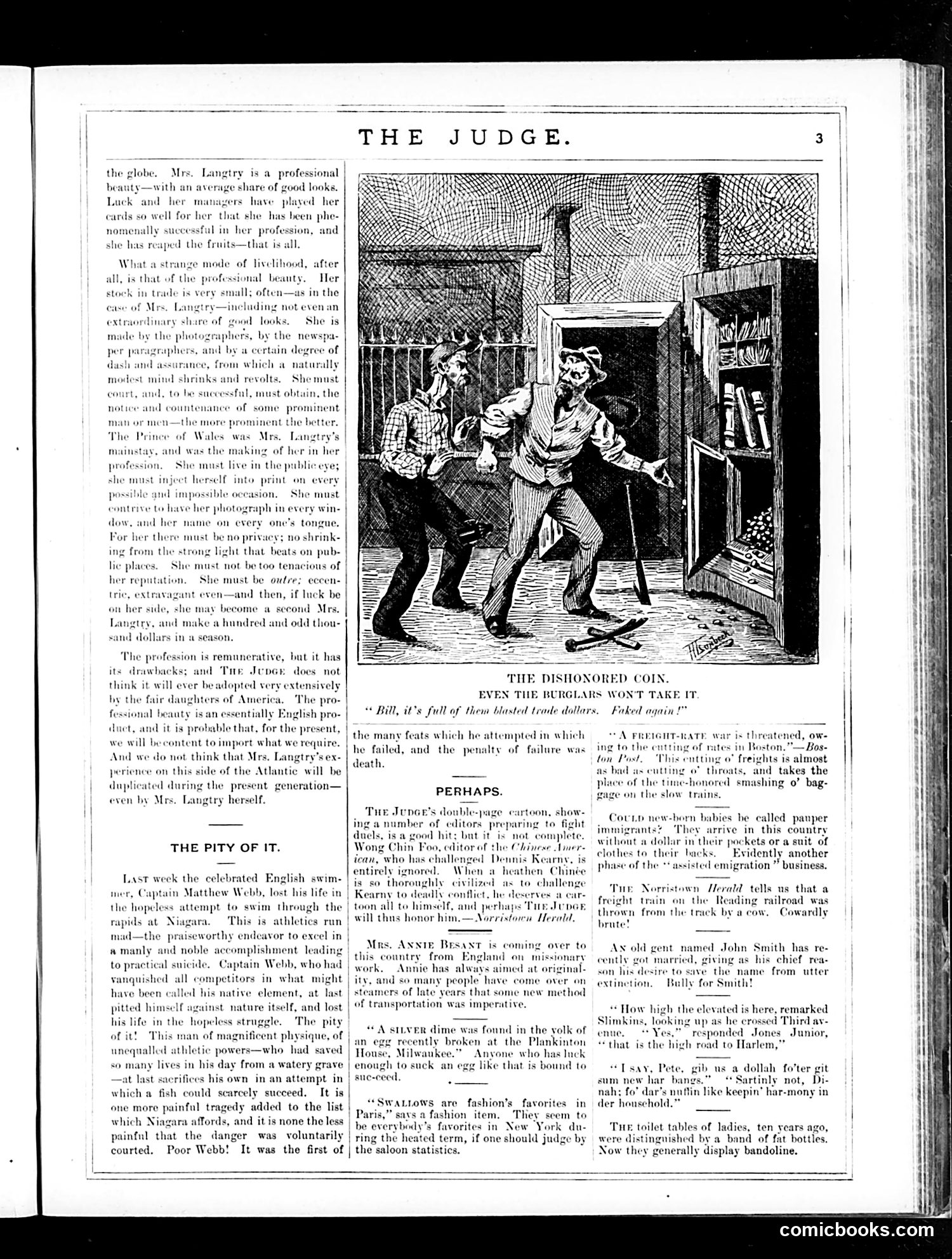
The main cartoon on this page, titled "The Dishonored Coin," depicts two burglars examining stolen currency. One complains the bag contains "blasted trade dollars" that are "faked again"—suggesting they're worthless. This satirizes the **trade dollar crisis of the 1870s-80s**. The U.S. trade dollar, minted to compete with Spanish dollars in Asian markets, had become debased and unreliable. By the time this Judge issue was published, trade dollars were being counterfeited extensively and had lost public trust. The joke: even criminals won't accept them as payment. The cartoon mocks both the failed currency and the broader financial instability it represented. It's a sharp commentary on how thoroughly the trade dollar had been discredited—rejected by thieves and honest citizens alike.
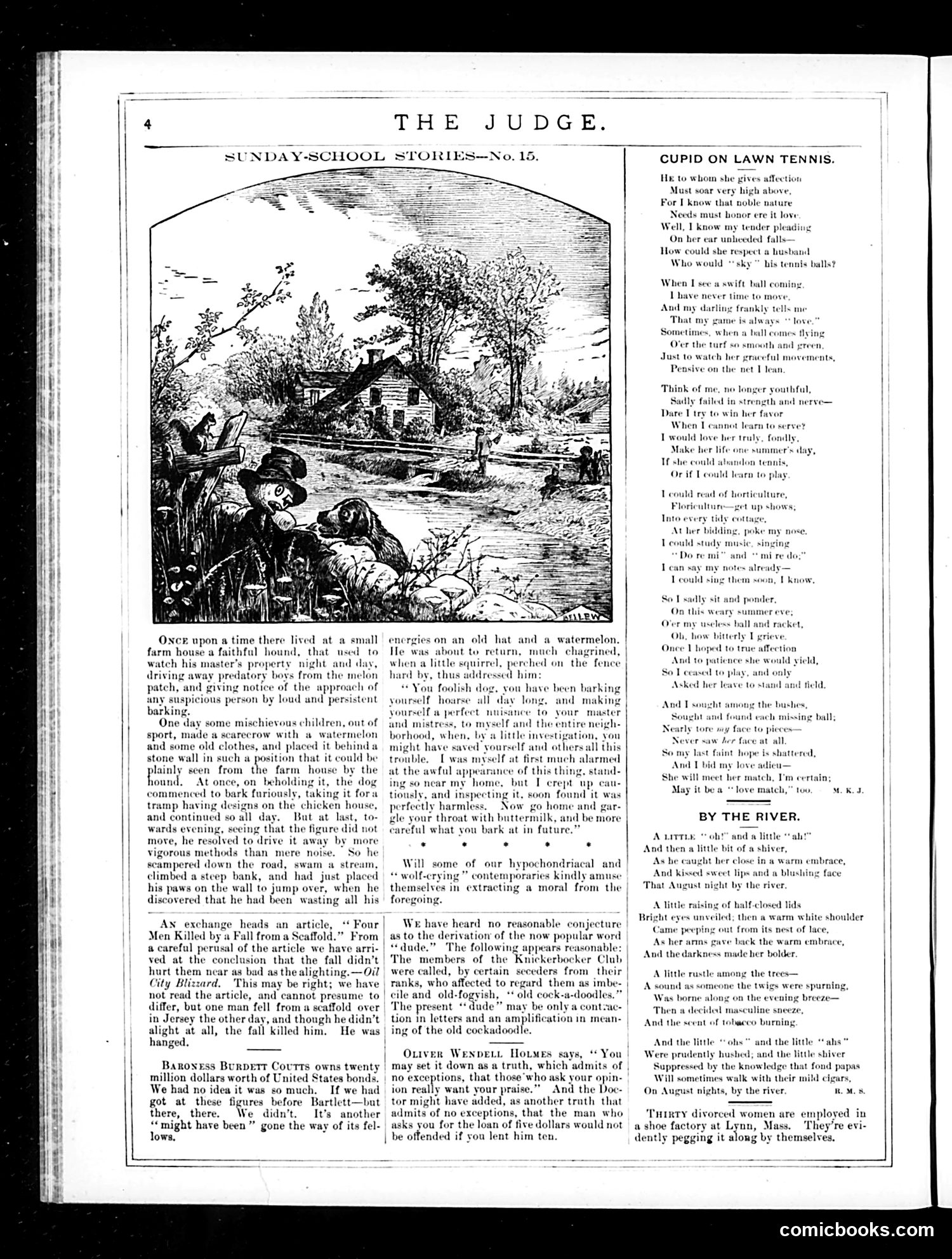
This page contains three distinct satirical pieces: **"Sunday-School Stories No. 15"** (main illustration): A fable about a dog who wastes energy barking at a scarecrow dressed with old clothes and a watermelon. A squirrel mocks the dog's foolishness, suggesting he investigate before raising alarms. The moral applies to contemporary "hypochondriacal" newspapers that cry wolf—likely referencing sensationalist press of the era. **Short items**: Brief jabs at newspaper absurdities (a scaffold accident report) and wealthy figures (Baroness Burdett Coutts's bond holdings). **Etymology joke**: A playful explanation that "dude" derives from "cock-a-doodles," the mocking term Knickerbocker Club outsiders used for members they considered old-fashioned. **"Cupid on Lawn Tennis"** (poem, right side): Light romantic verse criticizing men who hit weak tennis serves as unmanly, thus unworthy of feminine respect—reflecting Victorian associations between athletic prowess and courtship viability. The page targets press sensationalism, social pretension, and gender expectations through humor.
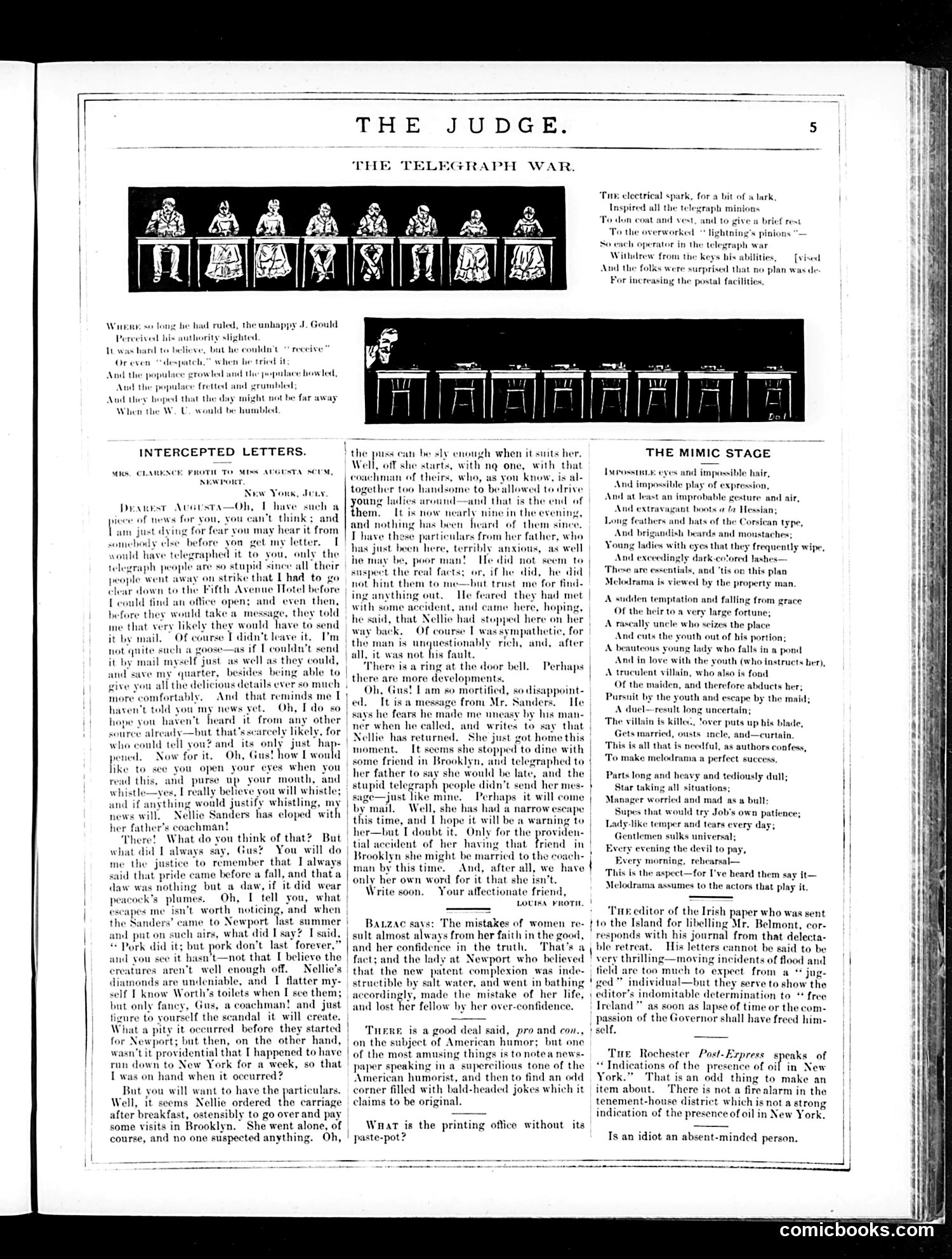
This satirical piece mocks a telegraph operators' strike that has paralyzed communications in New York. The top cartoon shows telegraph operators and their empty workstations, depicting the disruption caused when they "receive" nothing—a visual pun on their inability to receive telegrams. The accompanying verse ridicules the "unhappy J. Gould" (likely Jay Gould, a railroad and telegraph magnate), whose authority is "slighted" as the public grows impatient without telegraph service. The popular demand for restoration is evident. The "Intercepted Letters" section satirizes how people now resort to long, gossipy letters instead of quick telegrams—ironic since the accompanying story about Nellie Sanders' elopement would have been transmitted instantly by telegraph before the strike. The humor lies in showing society's dependence on instant communication and the absurdity of reverting to slower methods, complete with breathless details a lady would normally telegraph urgently.
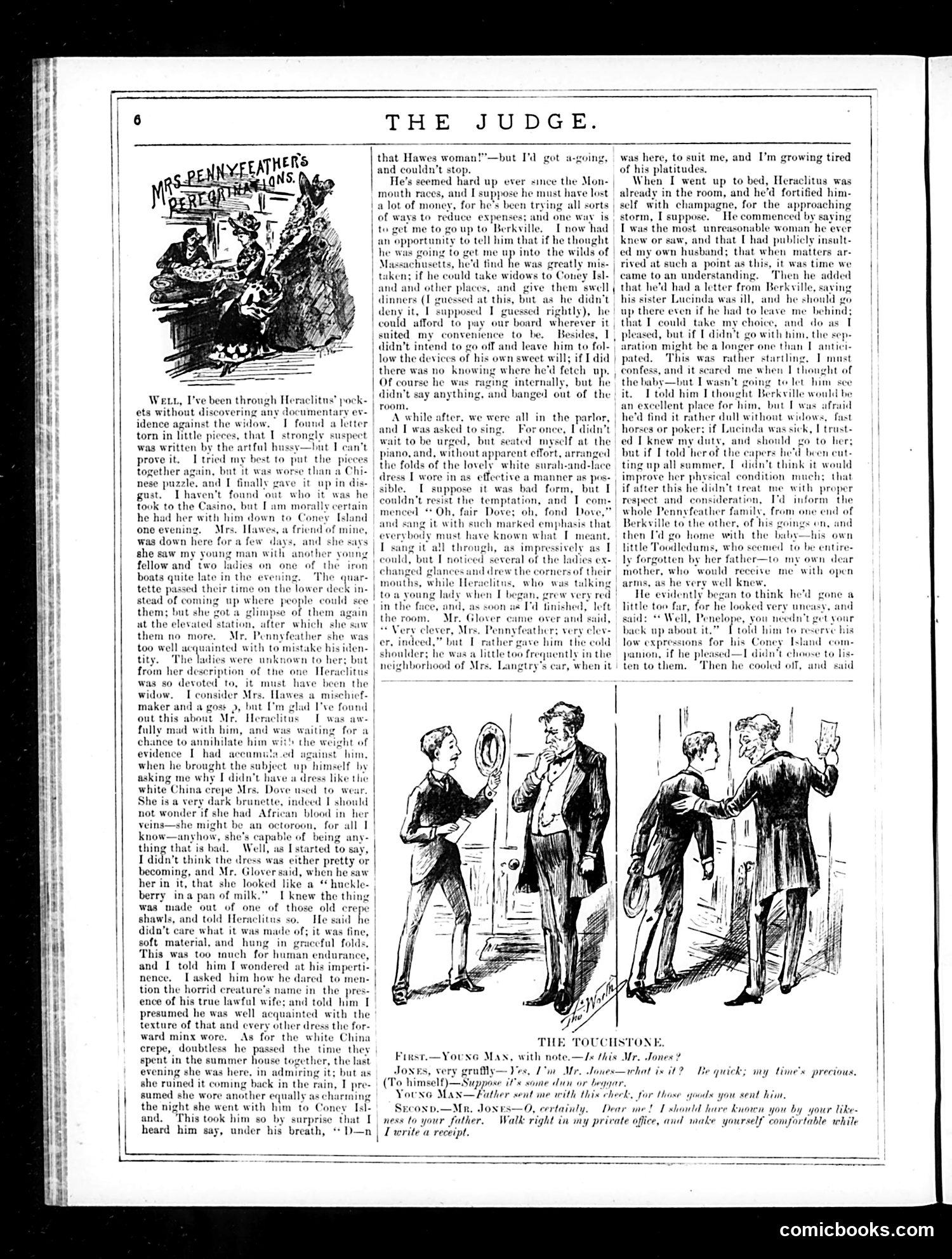
This page from *Judge* magazine contains a serialized domestic comedy story titled "The Touchstone." The main narrative describes a wife's suspicions about her husband's infidelity with a widow named Mrs. Hawes. The wife discovers evidence (a torn letter) and confronts her husband's financial irresponsibility and wandering attention. The illustrated scene at bottom shows a social interaction where the husband appears caught between his wife and other acquaintances, with dialogue about goods and receipts—apparently depicting the moment of awkward social exposure. The satire targets Victorian-era marital dynamics: the scheming widow as social predator, the husband's weakness for flattery and expensive diversions, and the wife's clever detective work and public humiliation of her spouse. It's domestic comedy relying on period-specific anxieties about women's independence, male infidelity, and social reputation—themes *Judge* audiences found entertaining as serialized gossip-magazine entertainment.
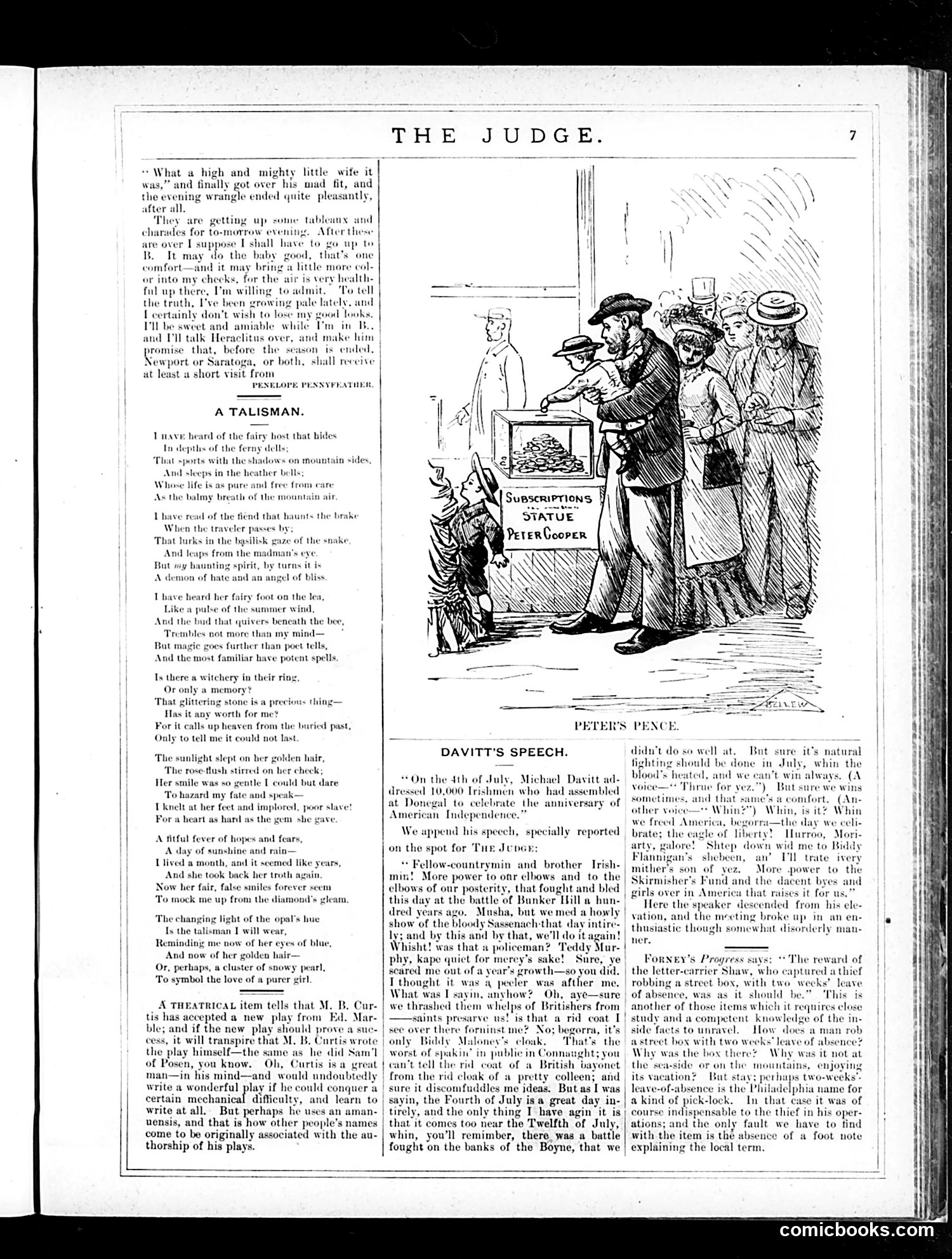
This page contains two satirical pieces targeting Irish-American political figures: **"Peter's Pence" (cartoon):** The illustration shows people depositing money into a statue labeled "Subscriptions / Statue / Peter Cooper," referencing the public fundraising campaign for a statue of the philanthropist. The satire likely mocks either the fundraising effort itself or those participating in it. **"Davitt's Speech" (text satire):** This is a mock-Irish speech attributed to Michael Davitt, the Irish nationalist leader, addressing 10,000 Irishmen on July 4th celebrating American Independence. The satire employs heavy Irish dialect and stereotypes—malapropisms, references to British "peelers" (police), confusion between July 4th and July 12th (the Orange Order's commemoration of the Battle of the Boyne), and mock-patriotic rambling. The joke targets Irish-American political oratory, presenting it as buffoonish and contradictory, while poking fun at Irish-British historical grievances. The humor relies on ethnic stereotyping common to 19th-century American satire.
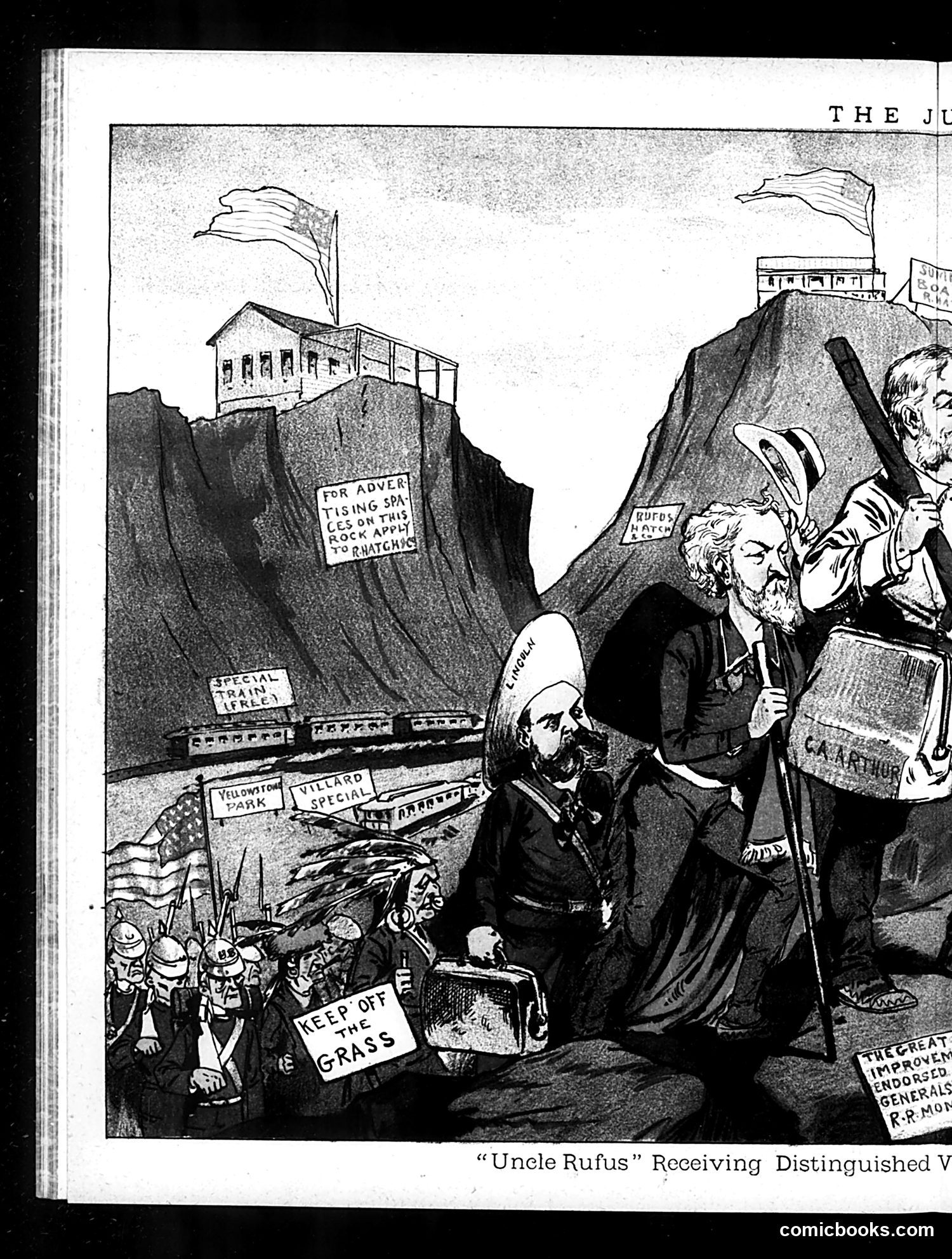
This Judge magazine cartoon depicts "Uncle Rufus" (likely representing Uncle Sam or American authority) receiving distinguished visitors at what appears to be Yellowstone Park or a similar national monument. The cartoon satirizes commercialization of natural wonders through visible signs advertising ("FOR ADVERTISING SPACE ON THIS ROCK $2 EACH"). Caricatured figures on the right, labeled with signs like "GRAFT" and "THE GREAT IMPROPER," appear to represent corrupt politicians or business interests. Small uniformed figures at bottom hold a "KEEP OFF GRASS" sign, suggesting the tension between public access and preservation. The satire criticizes how American natural treasures were being exploited for profit and corrupt gain during what appears to be the Progressive Era. The cartoon advocates for protecting public lands from commercial and political exploitation.
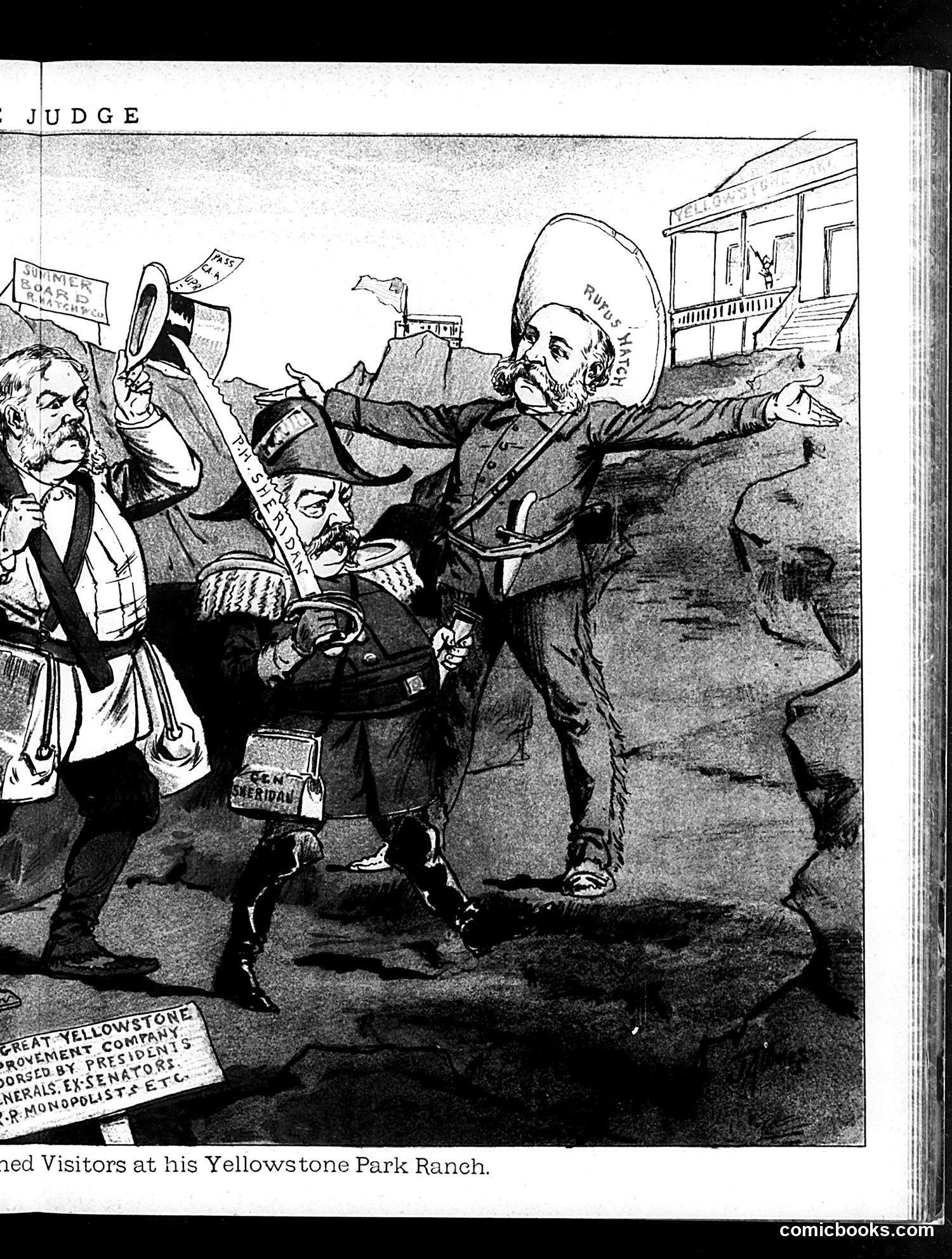
This Judge magazine cartoon satirizes what appears to be a prominent figure's management of Yellowstone Park Ranch, depicted as a judicial proceeding ("JUDGE" header). The central figure wearing a large chef's hat labeled "RULE THE ROOST" gestures dramatically, suggesting authority or control. Multiple caricatured men surround him—some labeled with what appear to be political positions or roles ("SHERIDAN" visible on one figure). The scene includes signs referencing "Yellowstone Park" and mentions of "Presidents," "Generals," and "Senators/Monopolists." The satire likely critiques how a particular individual controlled or exploited Yellowstone resources, treating distinguished visitors and government officials as subordinates. The theatrical staging and exaggerated features suggest mockery of that person's pretensions to authority over what should be public or national property. Without clearer labels, specific identities remain unclear, though the subject appears to be a wealthy businessman or politician with controversial Yellowstone Park involvement.
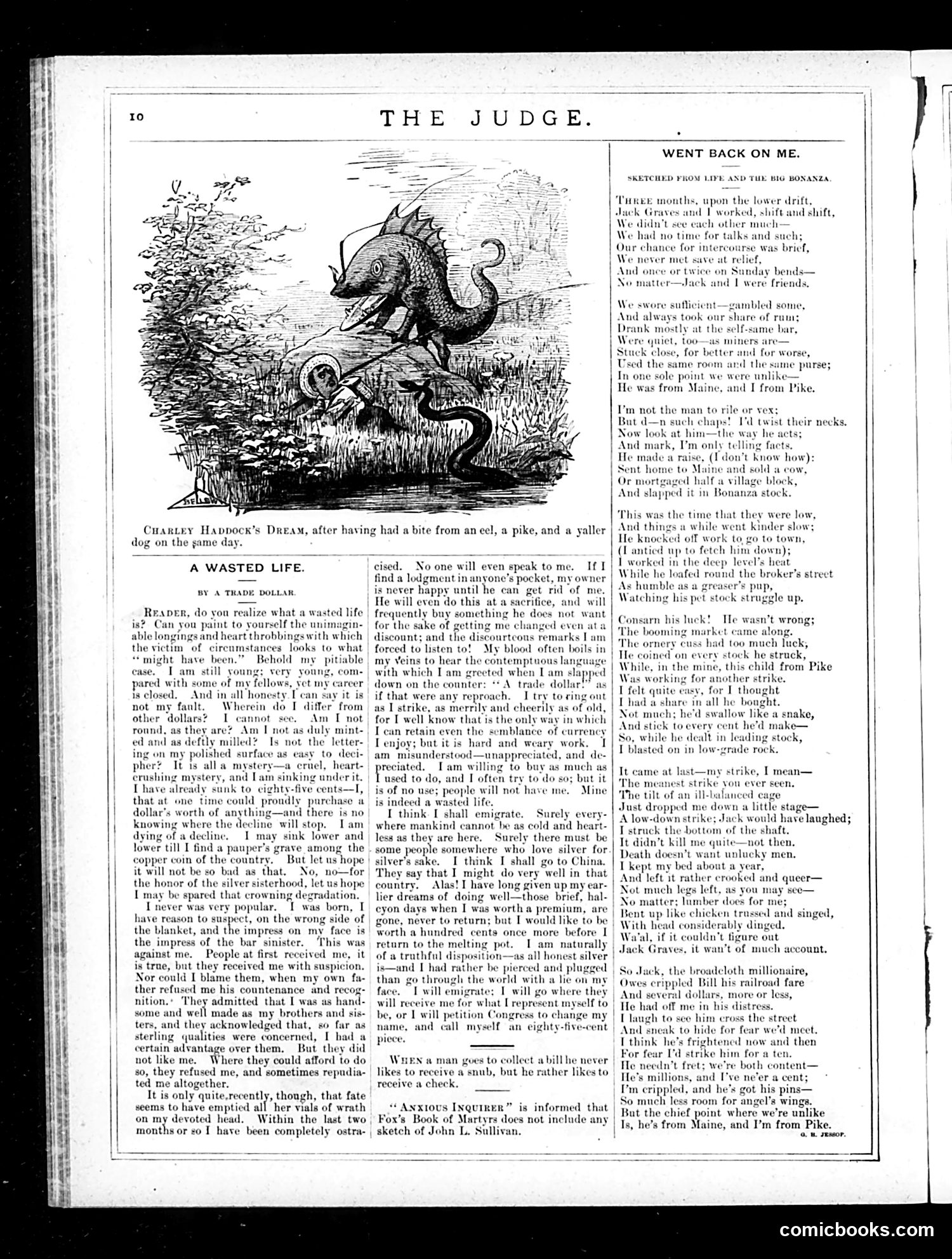
This Judge magazine page contains two distinct pieces of social satire: **"A Wasted Life" (left)**: A bitter monologue by a trade dollar—U.S. currency that was devalued and rejected internationally in the 1870s-80s. The dollar personifies economic anxiety of the era, complaining it was once valuable but has been systematically debased and rejected by society. It plans to emigrate to China or petition Congress. This satirizes real economic anxieties about currency stability and worker displacement. **"Went Back on Me" (top right)**: A poem about two miners—one from Maine, one from Pike (likely Pike County, Kentucky)—who were friends until the Pike man struck it rich in Bonanza stock while the Maine man labored honestly. The Maine speaker feels betrayed by his friend's luck and dishonest profit, contrasting honest work against speculative wealth-making. Both pieces critique 1880s economic inequality: one through monetary anxiety, the other through the visible gap between hardworking laborers and lucky speculators.
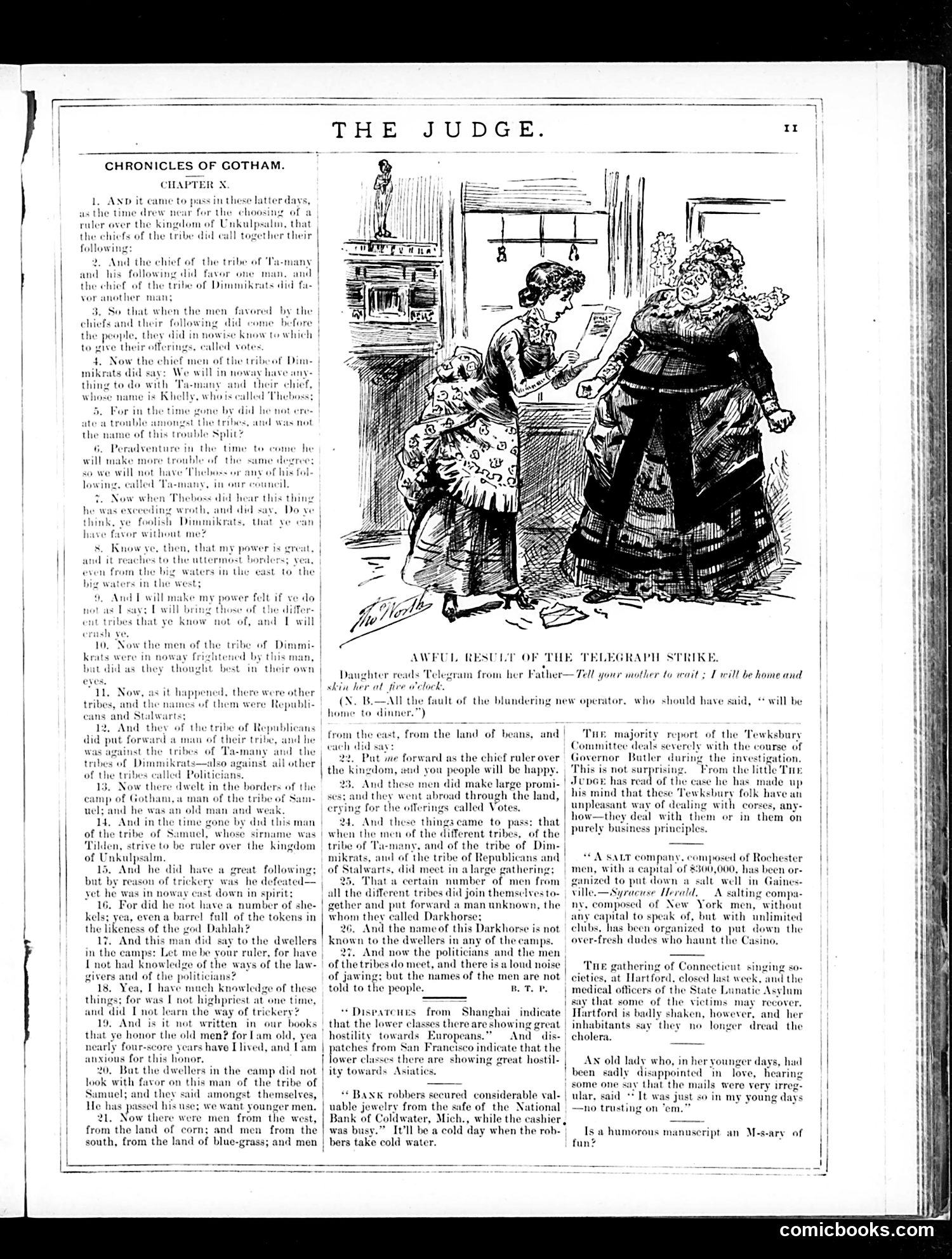
This page satirizes late-19th-century American politics through a faux-biblical narrative ("Chronicles of Gotham"). The main cartoon depicts a **telegraph strike's domestic consequences**: a daughter receives a garbled telegram from her father that reads "Tell your mother to wait; I will be home and skin her at five o'clock" instead of the intended message about dining. The joke targets the **incompetence of strike-replacement operators**, showing how labor disruption creates chaos. The accompanying text discusses the Tewksbury Committee's investigation of Governor Butler, criticizing his handling of institutional affairs. Other brief news items mock various contemporary issues: a salt-well venture in New York, Connecticut's singing societies, and various minor scandals. The "Chronicles" framework mocks political factionalism by presenting Tammany Hall Democrats, Republicans, and political figures as warring biblical tribes, reducing their disputes to absurd tribal squabbles. The satire emphasizes corruption, backroom dealing, and the foolishness of partisan politics.
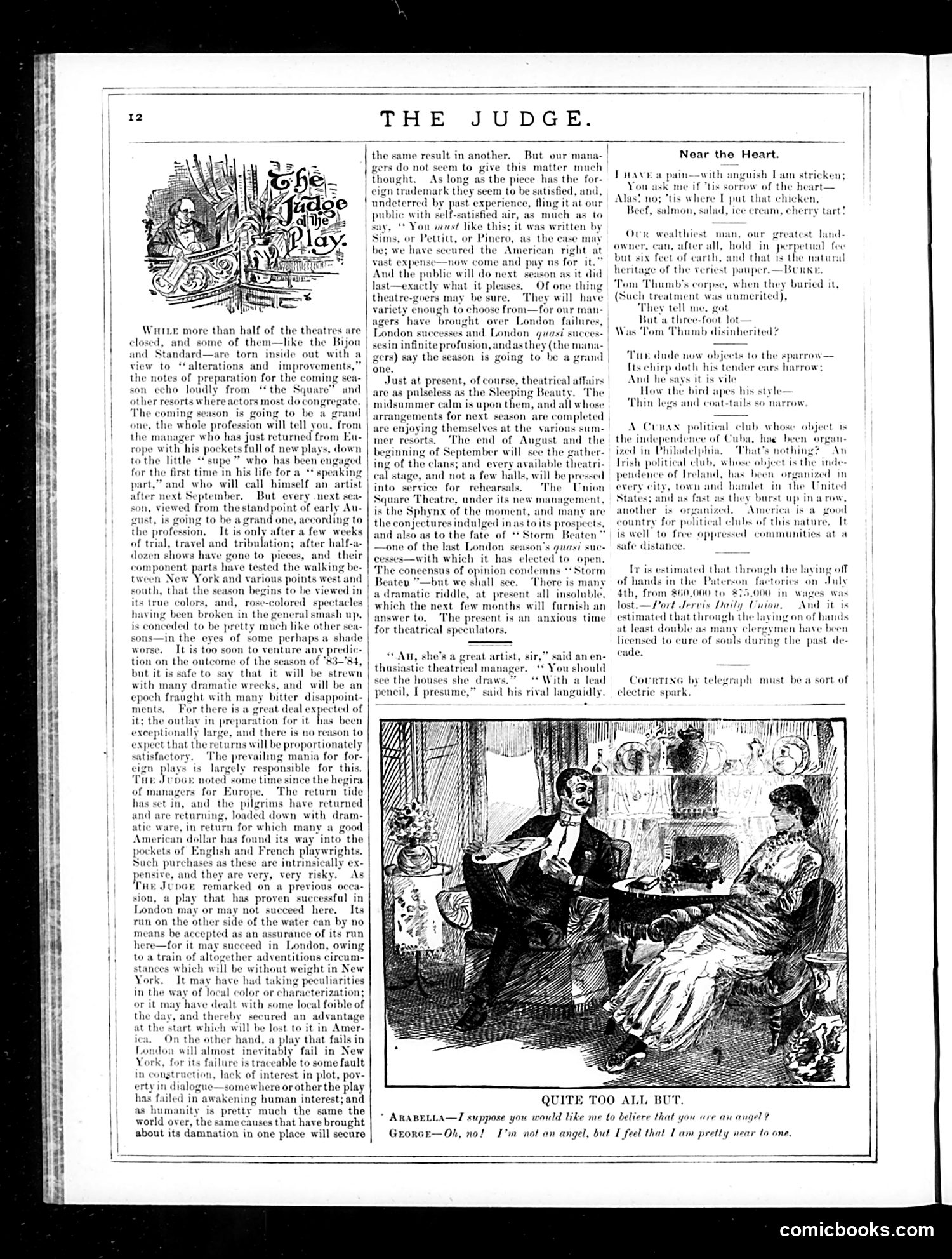
This page discusses the **1883-84 theatrical season** in America. The main editorial criticizes theater managers' practice of importing expensive plays from London and France without recognizing that success abroad doesn't guarantee American success. The writer argues that plays fail due to fundamental flaws in construction, plot, or dialogue—problems that will manifest regardless of geography. The **bottom cartoon**, titled "Quite Too All But," depicts a social scene where a woman (Arabella) suggests to a man (George) that he resembles an angel, and he responds that he's "not an angel, but I feel that I am pretty near to one." This appears to be satirizing pretentious or self-satisfied social posturing—a common Judge theme mocking vanity and affected behavior among the upper classes. The cartoons and editorial together represent Judge's dual mission: sophisticated criticism of theatrical commerce alongside humor targeting social pretension and vanity among affluent Americans.
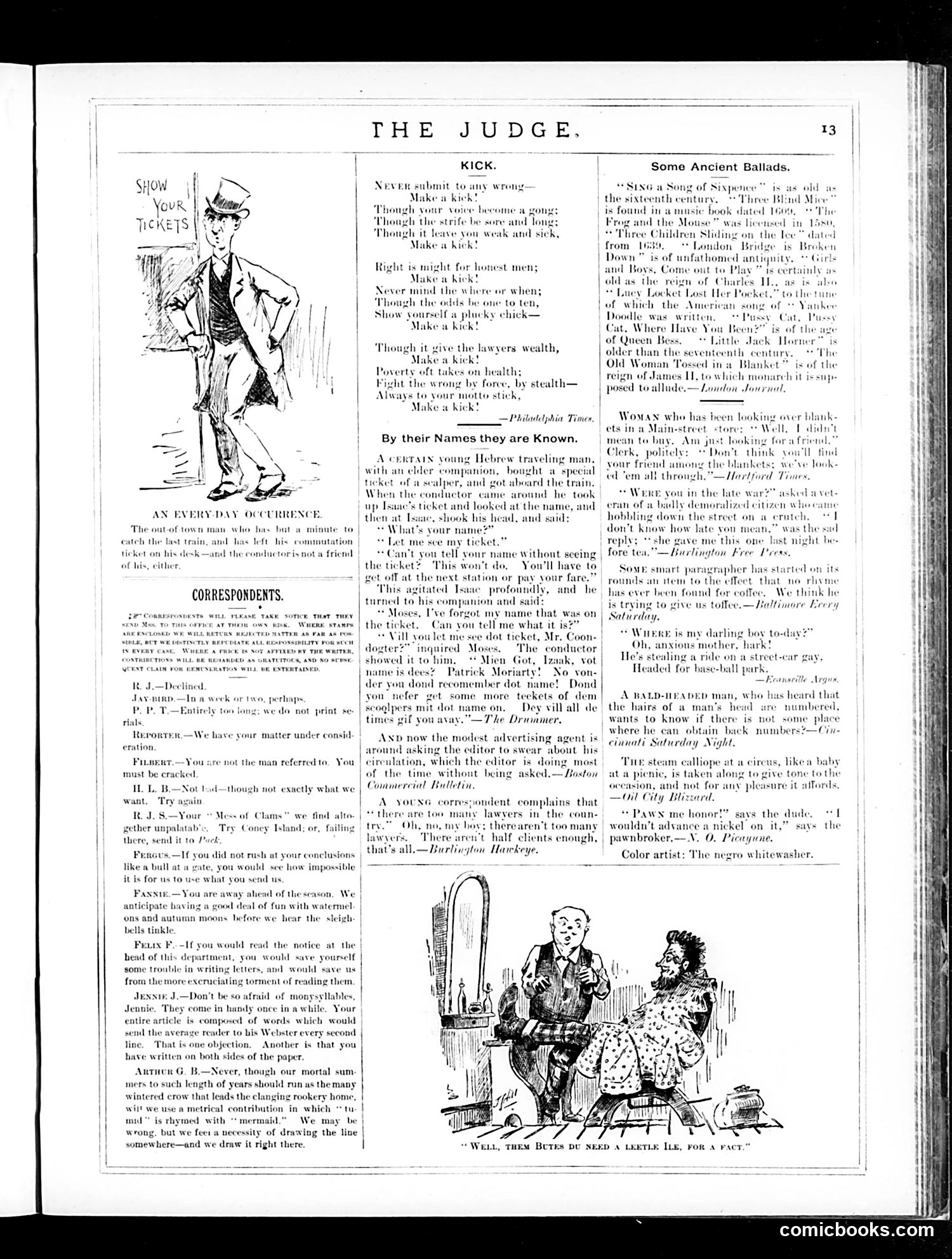
This page from Judge magazine contains several humorous items satirizing everyday American life: **"An Every-Day Occurrence"** (top left cartoon): Depicts the common frustration of train travelers who barely catch departing trains. The visual joke shows the rushed chaos of missing connections. **"Kick" poem**: A moralizing verse encouraging people to "make a kick"—to protest and fight against injustice, dishonesty, and wrongdoing, even when odds are unfavorable. This reflects Progressive Era ideals about civic activism. **"By Their Names They Are Known"**: A comedic anecdote about a Hebrew traveling salesman and conductor discussing a ticket name mix-up, playing on period stereotypes and miscommunication humor. **Correspondence section**: Editors humorously reject reader submissions—too long, too obscure, derivative, or poorly written. This satirizes amateur writers bombarding publications. **Bottom cartoon**: A couple discussing color artists, with the punchline that "the negro whitewasher" is the color artist—a crude period joke. The page reflects Judge's mix of social commentary, immigrant stereotypes, and genteel humor typical of early 20th-century American satire.
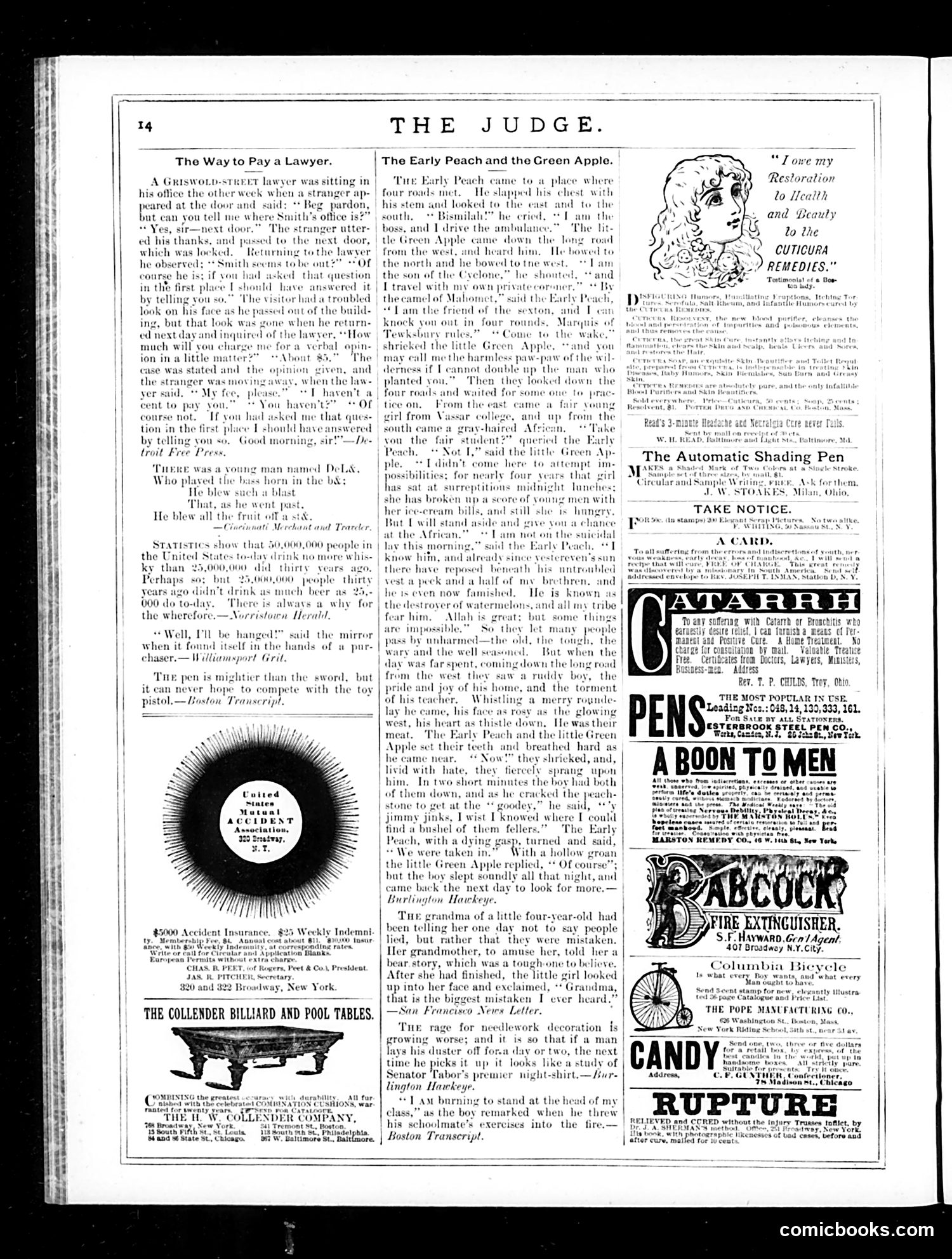
This is primarily a **humor/joke page** rather than political satire. The page contains several short comic anecdotes: **"The Way to Pay a Lawyer"** mocks lawyers' fee structures—a client asks upfront costs but is told to ask the lawyer directly, only to be charged extra for the consultation itself. **"The Early Peach and the Green Apple"** is an allegorical fable where two boastful fruits meet a boy at a crossroads. Each brags about their connections and toughness, but the boy simply eats them and takes their "goodies" (pits/seeds), proving their arrogance meaningless. The page also includes brief quips about **statistics on drinking**, **pen vs. sword**, and a story about a grandmother's euphemism backfiring when a child calls her tale "the biggest mistaken." **Bottom half**: Mostly **advertisements** for billiard tables, pens, insurance, fire extinguishers, and other products typical of the era. The humor targets universal human folly—legal profession greed, prideful boasting, and parental miscommunication—rather than specific political figures or events.
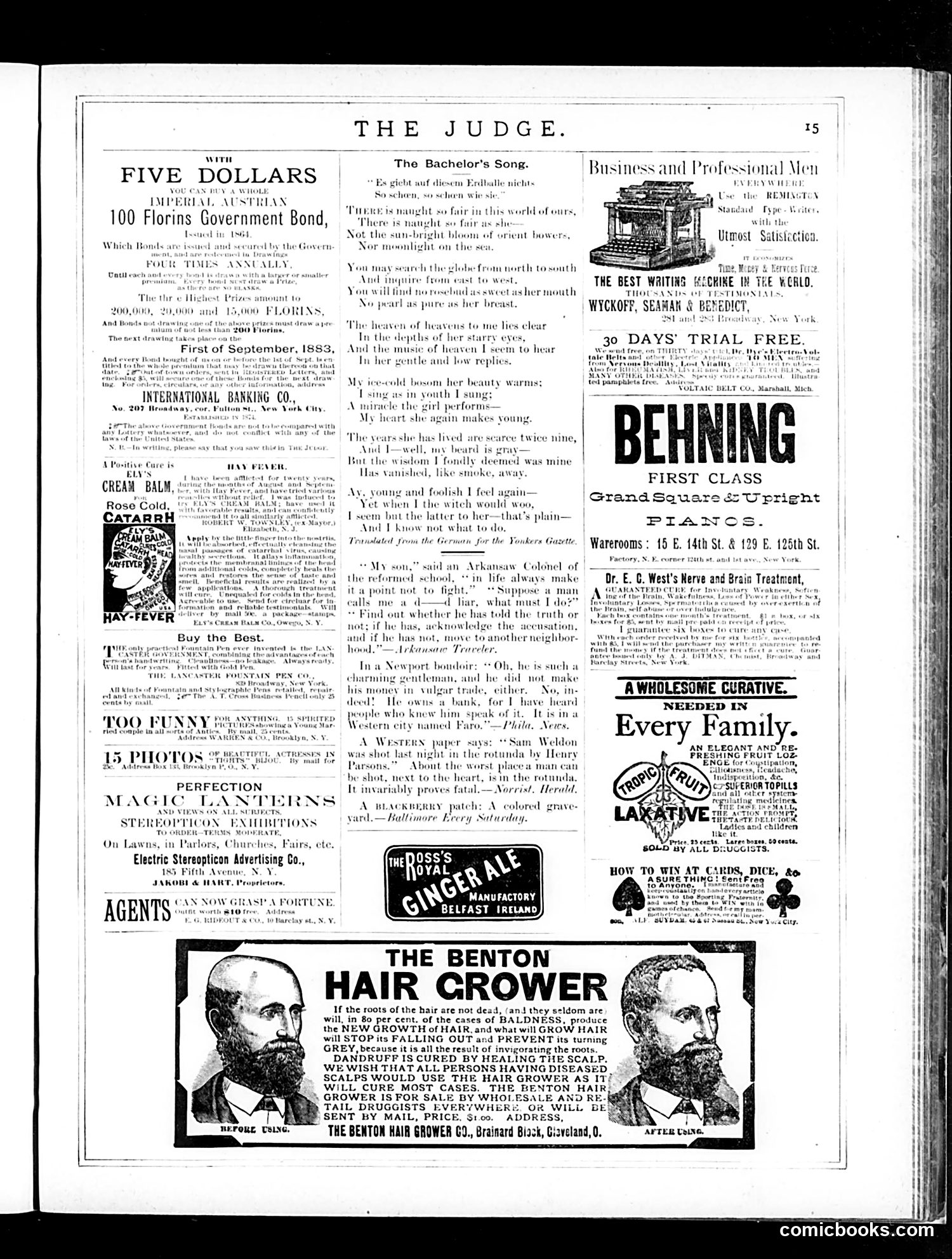
This page is primarily **advertising** with minimal editorial content. The notable cartoon is **"The Benton Hair Grower"** at the bottom—a common late-19th-century patent medicine ad featuring before/after portraits of a bearded man. The hair-growth product advertisement reflects the era's preoccupation with baldness remedies and the proliferation of unregulated health products. The claims (stopping hair loss, preventing graying, curing dandruff) are typical of such ads—exaggerated promises with no scientific backing. Other ads include government bonds, writing machines (Remington), pianos, a laxative called "Fruit-a-tives," and ginger ale. The page includes "The Bachelor's Song," a translated German poem about lost youth and romantic yearning—light satirical content typical of Judge's humor. The overall page represents how satirical magazines subsidized themselves through advertising, mixing editorial content with commercial pitches for dubious remedies.
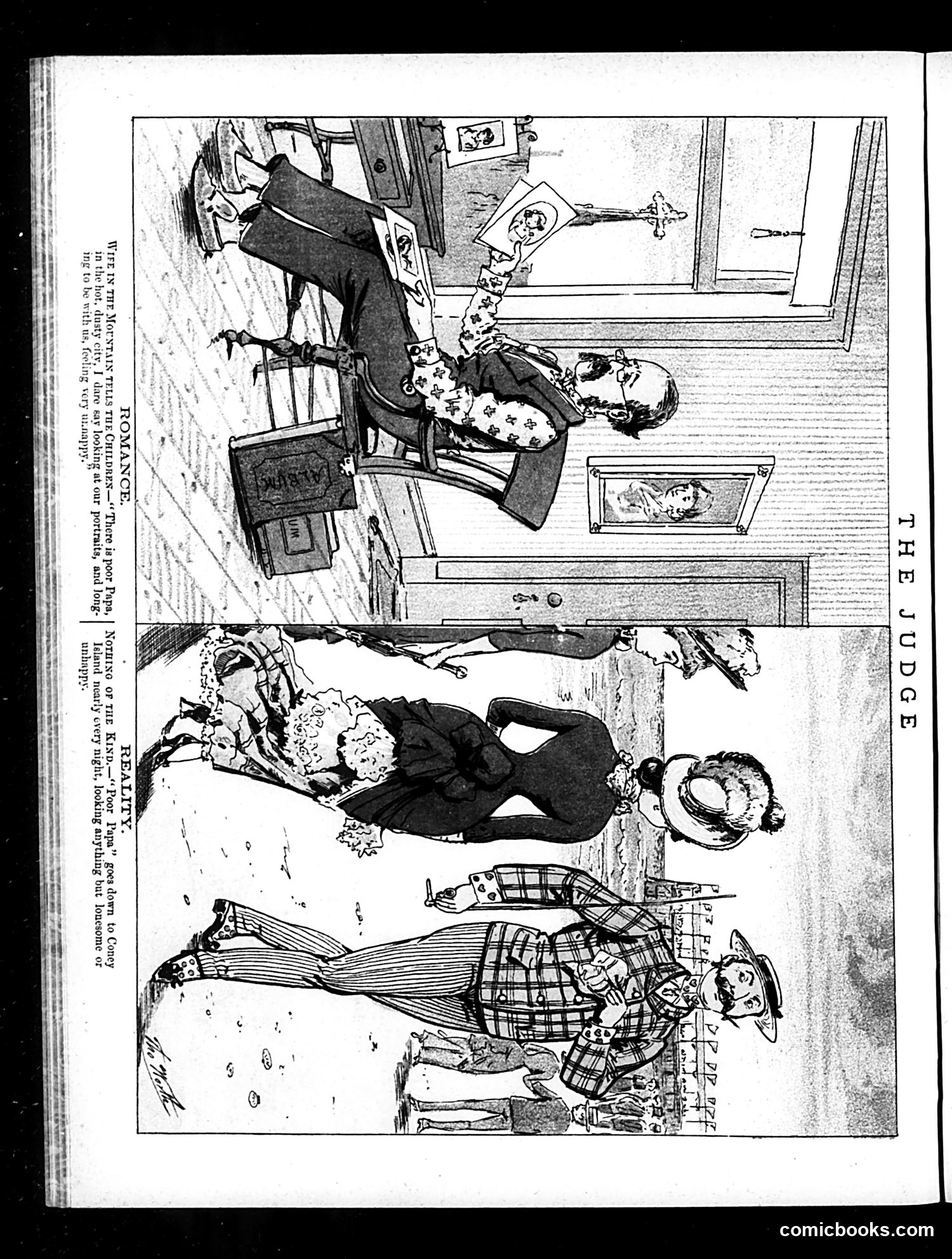
This page from *Judge* magazine contains three cartoon panels satirizing a man's behavior—likely depicting marital infidelity or hypocrisy. The top panel shows a man at home with family portraits on the wall, while the caption indicates he's supposedly going to Coney Island alone ("poor Papa"). The lower panels appear to show the man at Coney Island (a popular amusement destination) in the company of women, appearing anything but lonely despite his claim to the family that he'd be solitary. The satire mocks the contradiction between his pretended domestic devotion and his actual behavior—he tells his children to admire his portrait while secretly enjoying himself with female companions. This reflects era-typical satirical treatment of male duplicity and infidelity.