
A complete issue · 16 pages · 1883
Judge — April 28, 1883
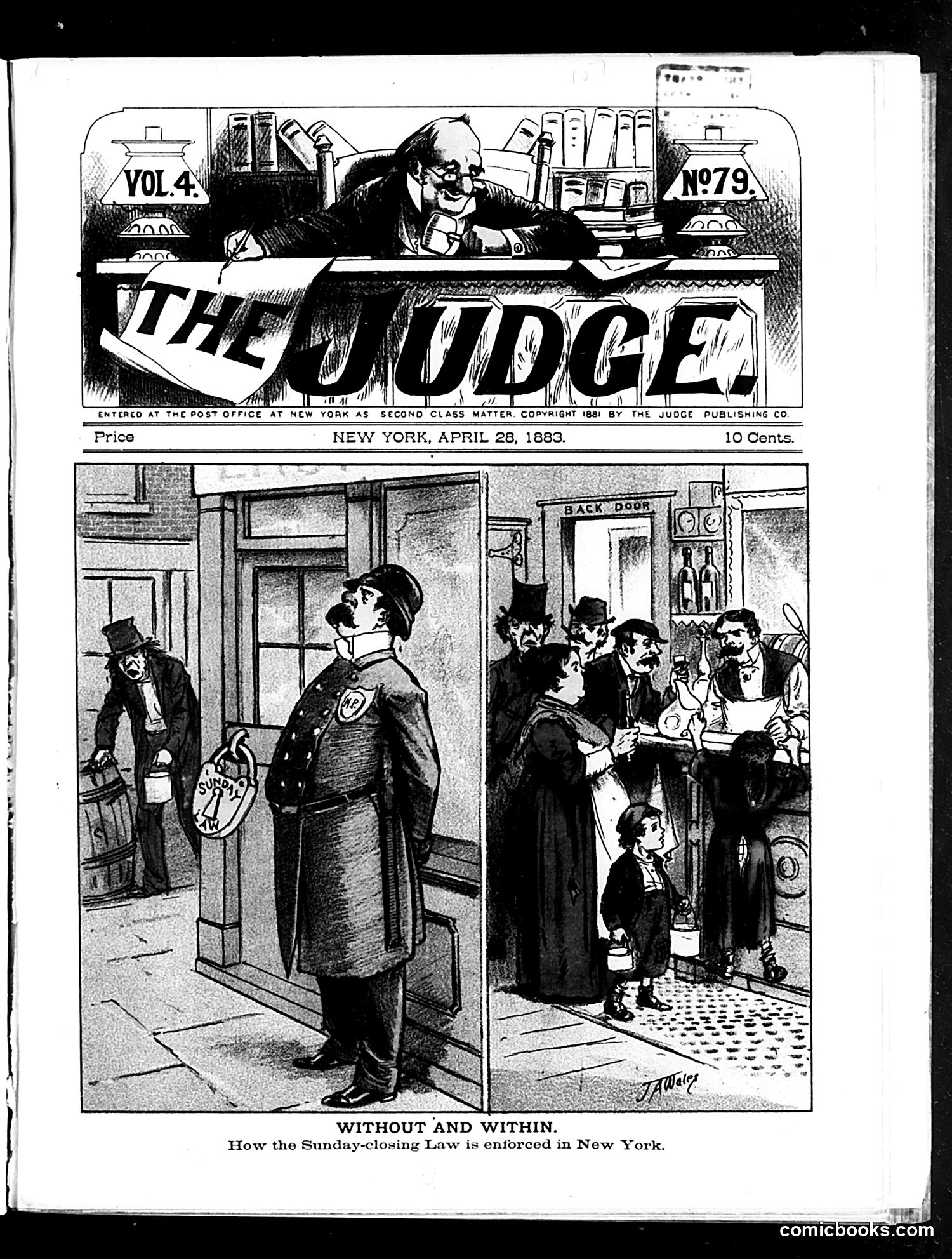
This cartoon contrasts two approaches to New York's Sunday-closing law. The left panel shows a police officer standing outside a bar marked "SUNDAY," enforcing the law publicly and visibly. The right panel depicts the same establishment's back door, where numerous patrons—including women and children—enter freely, suggesting the law is easily circumvented through back entrances. The satire critiques the ineffectiveness of prohibition enforcement: while authorities maintain a facade of law enforcement at the front, illegal activity flourishes behind the scenes. The title "Without and Within" emphasizes this hypocrisy—the law appears enforced externally but fails internally. This reflects broader 19th-century debates over sumptuary laws and their practical enforceability.
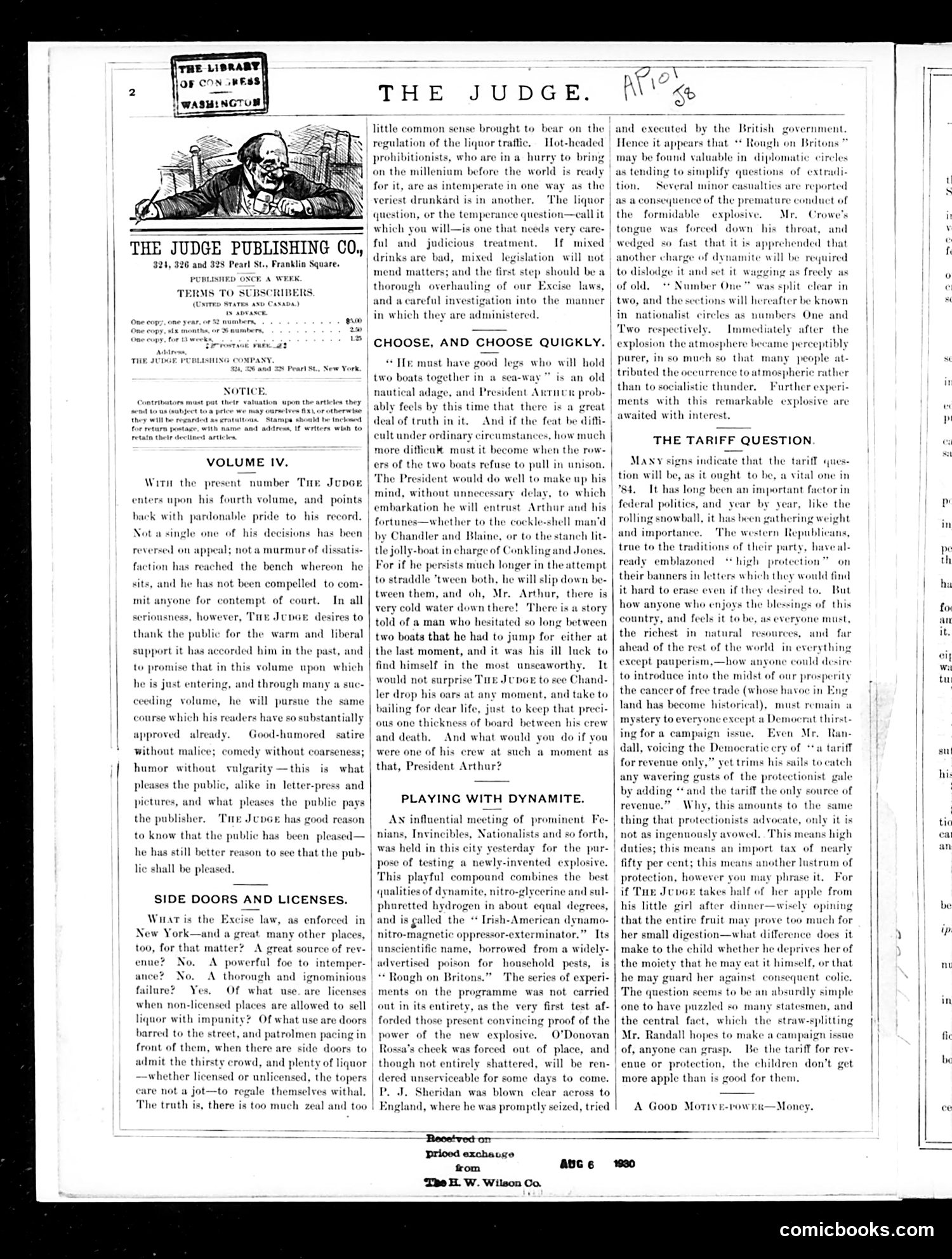
This page contains editorial commentary on three issues: liquor regulation, dynamite explosions, and the tariff question. The main cartoon (top left) depicts a disheveled figure, likely representing a prohibition advocate or intemperate politician. The satire criticizes those pushing extreme positions on liquor regulation without practical judgment. The "Playing with Dynamite" section references recent dynamite incidents, apparently involving a figure named Sheridan and O'Donovan in England. The satire uses these explosions as metaphor for reckless political behavior—likely alluding to President Arthur's difficulty managing rival Republican factions (Chandler, Blaine, Conkling, Jones mentioned). The "Tariff Question" section discusses upcoming 1884 election politics, noting Western Republicans' commitment to protectionism, while expressing skepticism about whether tariff will become the dominant campaign issue. The overall tone is skeptical of political extremism and incompetence across multiple policy areas.
This page from *Judge* magazine contains political satire centered on the 1884 U.S. presidential election. The main dialogue piece "On Our Avenues" mocks political speculation and gambling on election outcomes. Two men discuss a "combination" involving numbers—specifically referencing the presidential term (four years) and the number 84 (likely 1884). A street observer overhears them and attempts to extract the "hint" to play it as a lottery number, revealing how ordinary citizens were drawn into political wagering. The satire targets the shallow engagement with politics: citizens reduce serious elections to gambling games, politicians merely "feel the popular pulse" through press manipulation rather than principle, and the entire process is presented as morally equivalent to a "skin game" (confidence scheme). The piece suggests cynicism about both political operators and public participation in the democratic process during the Gilded Age.
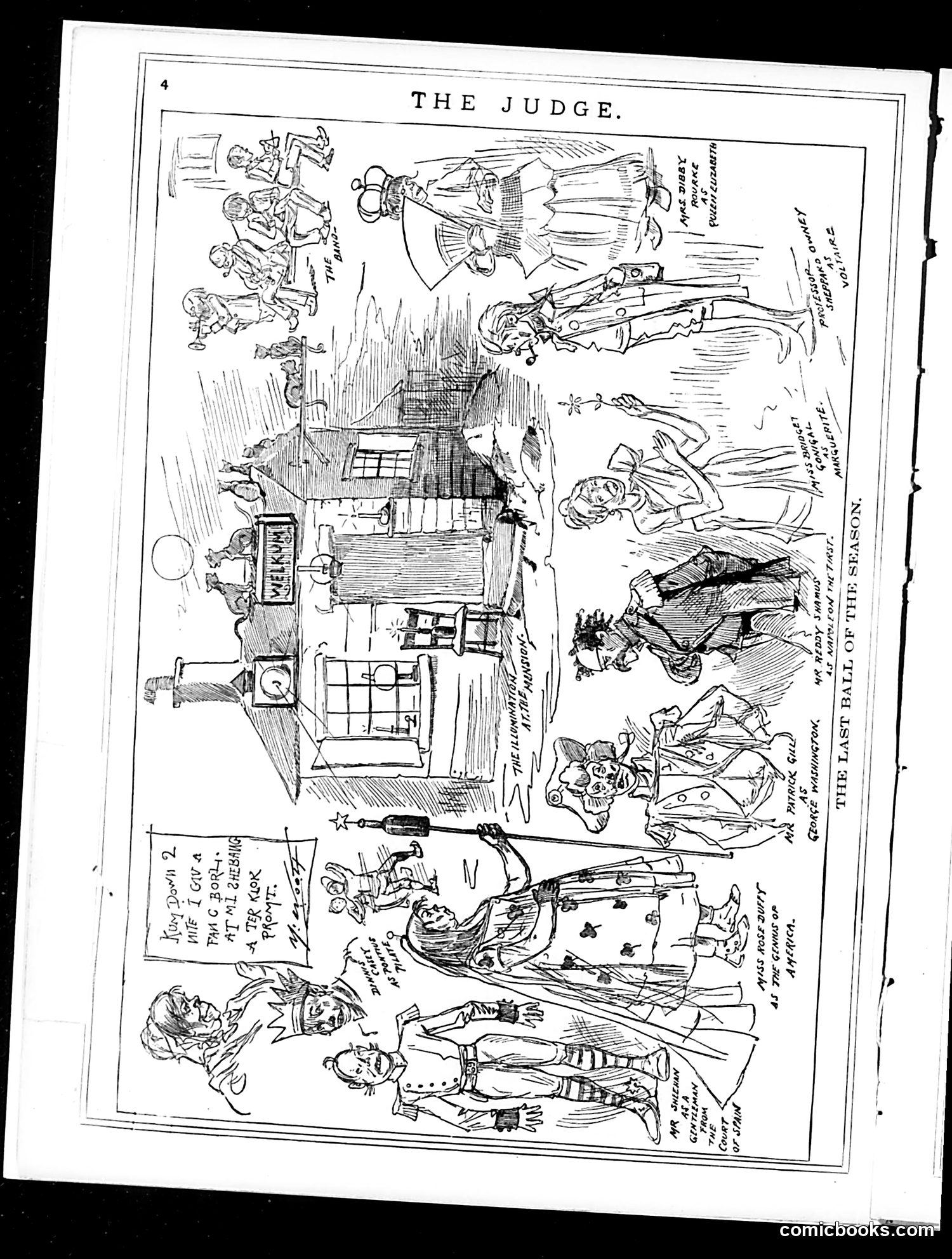
I cannot reliably read the OCR text on this page—the transcription appears heavily corrupted and illegible. From the IMAGE alone, I can see this is titled "THE JUDGE" and depicts a courtroom scene with a judge presiding, various figures in period dress (appears to be late 19th century), and multiple characters arranged around a central judicial bench. The style and composition suggest social or political satire typical of Judge magazine's content. However, without legible text labels or captions identifying the specific figures, the particular case being tried, or the political/social issue being satirized, I cannot accurately explain what this cartoon means to a modern reader. The corrupted OCR prevents me from determining the cartoon's actual subject matter or satirical point. To properly explain this, I would need either clearer source text or additional context about the publication date and issue.
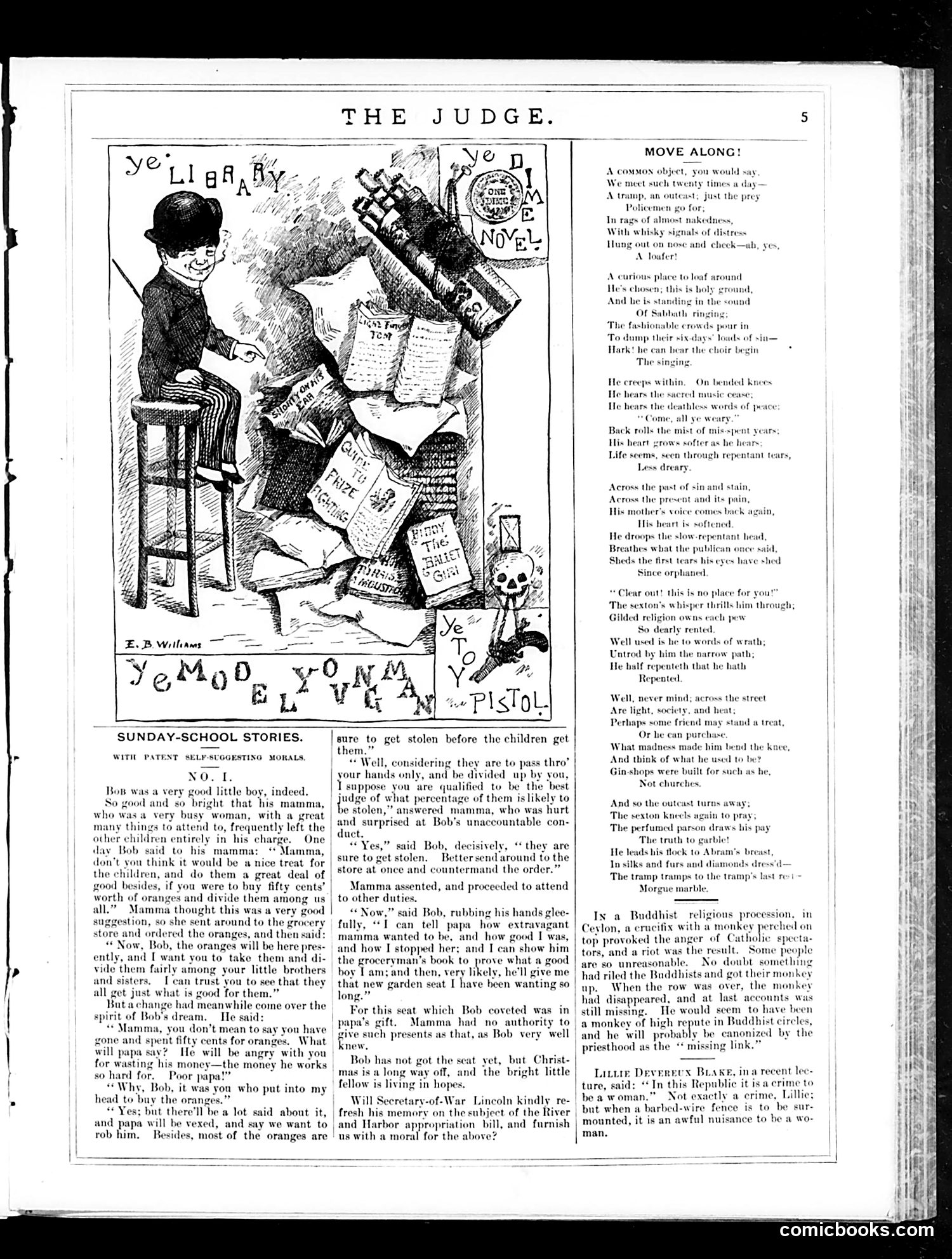
This Judge page contains two distinct pieces: **"Ye Model Young'un" (cartoon & story):** A Sunday-school moral tale satirizing hypocrisy. Young Bob manipulates his mother into giving him fifty cents for oranges, claiming charitable distribution to children. His actual plan: prove to his father (via the grocer's book) what a "good boy" he is to earn a garden seat—essentially using false virtue for personal gain. The satire mocks both Bob's transparent scheming and the sentimental morality tales that teach children. **"Move Along!" (poem with illustration):** Depicts a tramp finding temporary spiritual solace in a church, moved by hymns and Christian message—only to be ejected by the sexton. The poem's irony critiques Christian charity: the church welcomes the "perfumed" wealthy in "silks and furs" while rejecting the actually needy. The tramp returns to gin-shops, his brief hope extinguished. Both pieces satirize Victorian hypocrisy—false morality, selective charity, and the gap between stated Christian values and actual treatment of the poor.
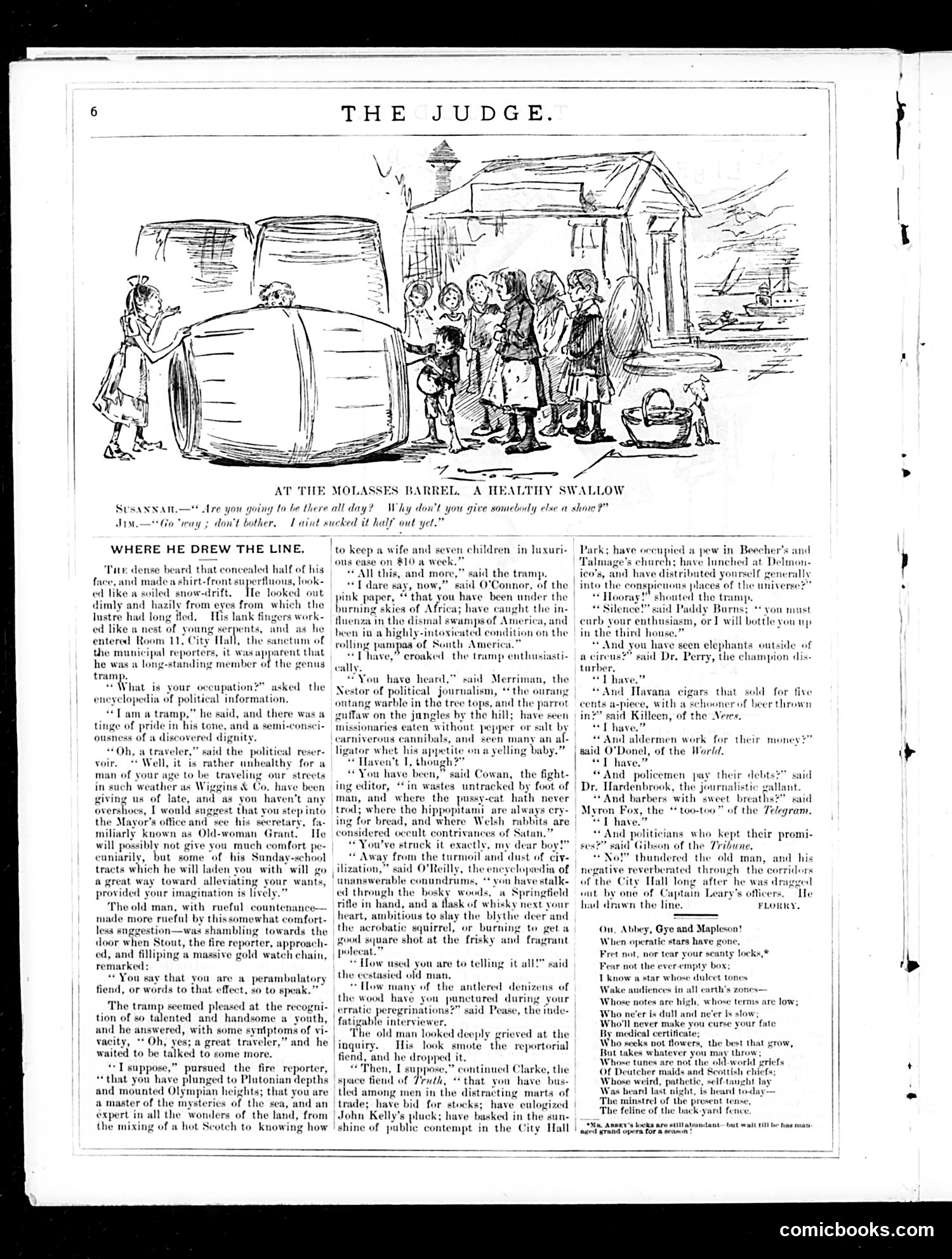
This cartoon satirizes a vagrant's braggadocio and the press's obsession with sensationalism. A bearded tramp claims extensive world travels—African safaris, jungle encounters with cannibals, hunting expeditions—boasting to various reporters (identifiable by their professions: fire reporter Stout, political journalist Merriman, editor O'Connor). The joke is the punchline: when asked if he's attended church, frequented saloons, or participated in respectable New York civic life, the tramp suddenly refuses. His "line" is drawn at the mundane reality of urban society, not at fantastical adventures. The satire targets both the tramp's transparent dishonesty and journalists' gullible appetite for exotic tales. By contrast, he rejects verifiable local activities—suggesting how newspapers exploit sensational claims while ignoring accessible truth. It's commentary on the credibility gap between what sells papers and what's actually verifiable.
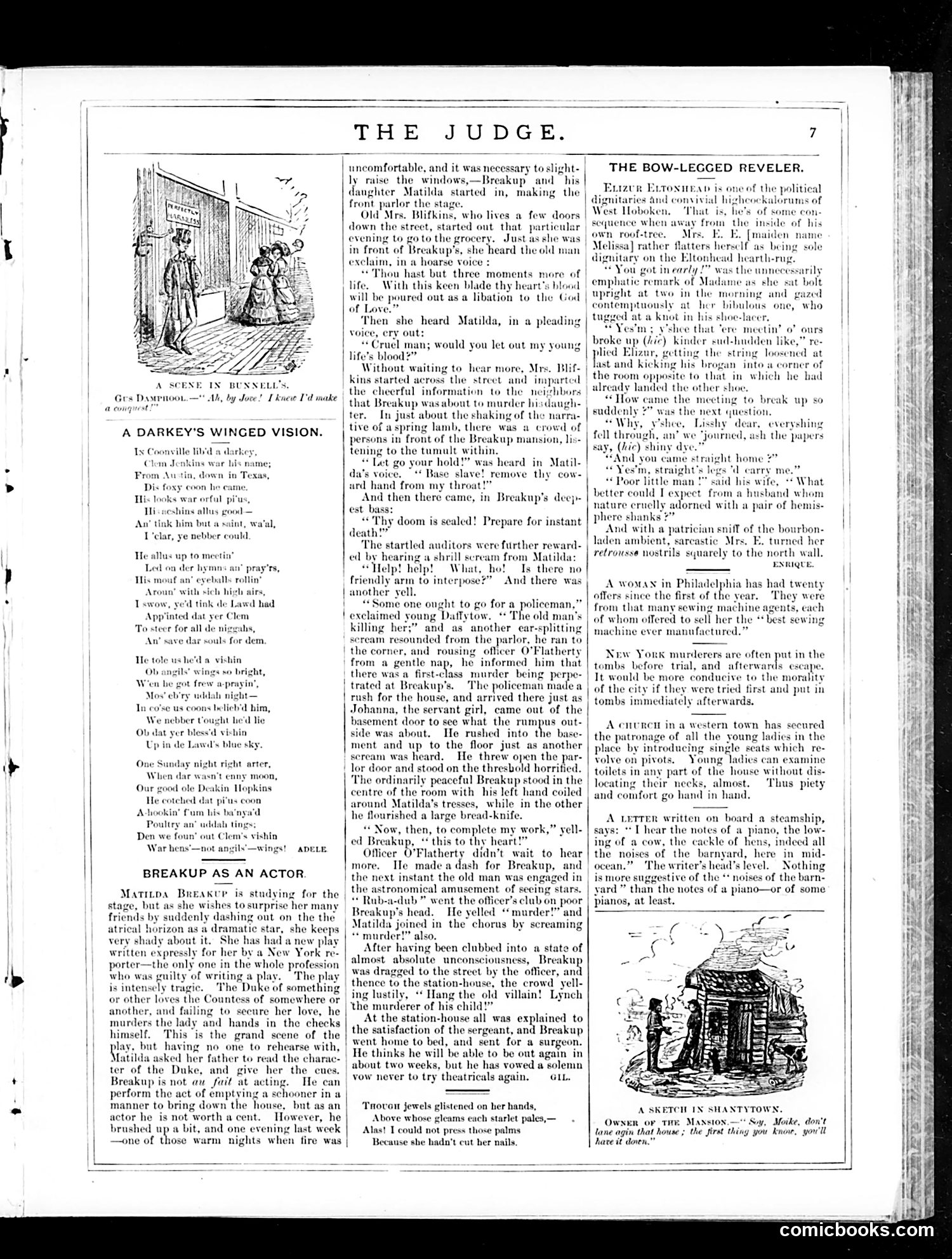
This page contains racist caricature content typical of late 19th-century American satire. The main cartoon, "A Darkey's Winged Vision," employs offensive dialect and stereotypes to mock an African American character named Clem. The "joke" involves Clem claiming a religious vision but being caught stealing chickens—playing on racist tropes about dishonesty and hypocrisy among Black people. The "Breakup as an Actor" section describes a theatrical mishap where an amateur actor performing a dramatic murder scene causes genuine panic among neighbors, who call police believing an actual crime is occurring. This satirizes both overwrought melodramatic acting and the gullibility of audiences. Both pieces represent Judge's typical approach: exaggerated humor through ethnic stereotyping and absurdist social commentary, reflecting attitudes acceptable to its educated, white readership of the era but deeply offensive by modern standards.
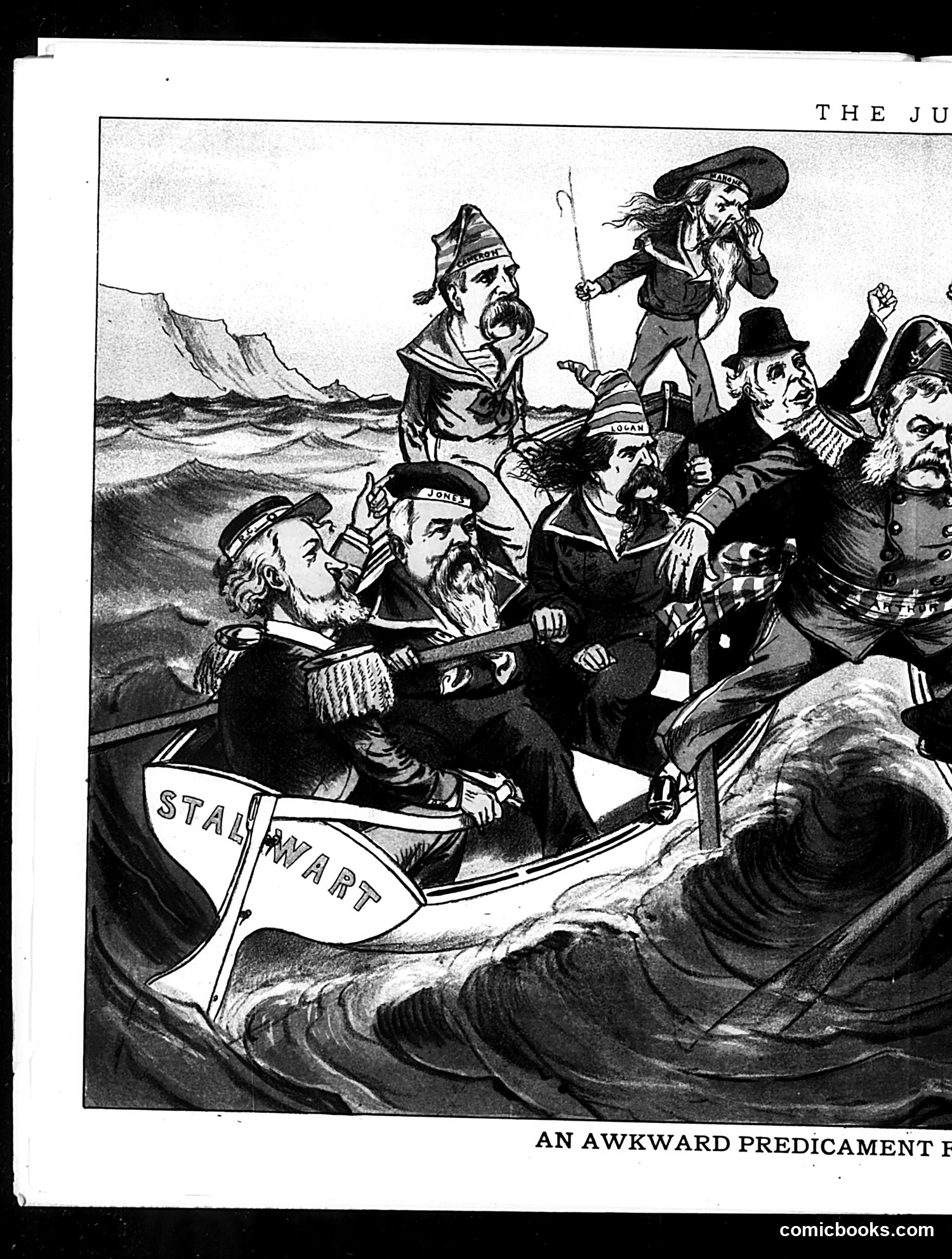
This political cartoon from *Judge* magazine depicts a boat labeled "STALEMATE" carrying multiple military and political figures in naval uniforms. The caption reads "AN AWKWARD PREDICAMENT." The cartoon appears to satirize a diplomatic or military stalemate involving multiple national powers. The crowded boat with figures in various uniforms suggests competing interests or nations stuck in an untenable situation. The men's expressions show concern and discomfort—appropriate to the "awkward predicament" of the title. Without a visible date or clearer text, the specific historical event remains unclear. However, this likely references a major international crisis or naval conflict where multiple powers found themselves deadlocked, possibly involving European imperial rivalries in the late 19th or early 20th century. The satire mocks the inability of these leaders to move forward or resolve their differences.
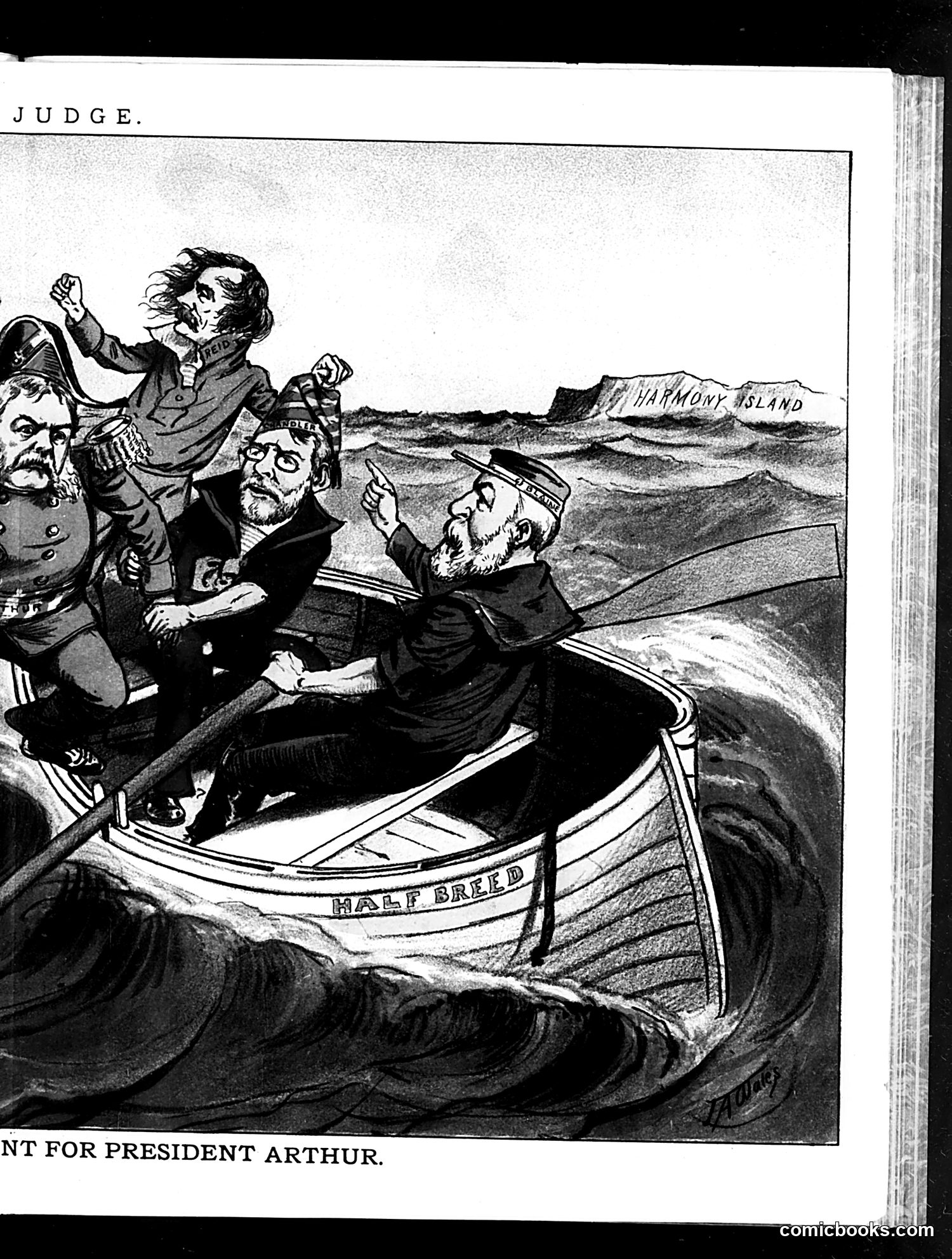
This Judge magazine cartoon satirizes support for President Chester Arthur's candidacy. The image shows military or political figures in a small boat labeled "Half Breed" (referring to the Half-Breed faction of the Republican Party) on turbulent waters near "Harmony Island." The cartoon mocks Arthur's presidential ambitions by depicting his supporters as adrift and struggling. The "Half Breed" label references the Republican Party's internal split between the Half-Breeds (reform-minded) and Stalwarts (patronage-focused). The chaotic boat scene suggests Arthur's campaign is unstable or ill-fated. The partial text "NT FOR PRESIDENT ARTHUR" confirms this concerns Arthur's presidential bid, likely during the 1884 election cycle when his nomination faced significant opposition within his own party.
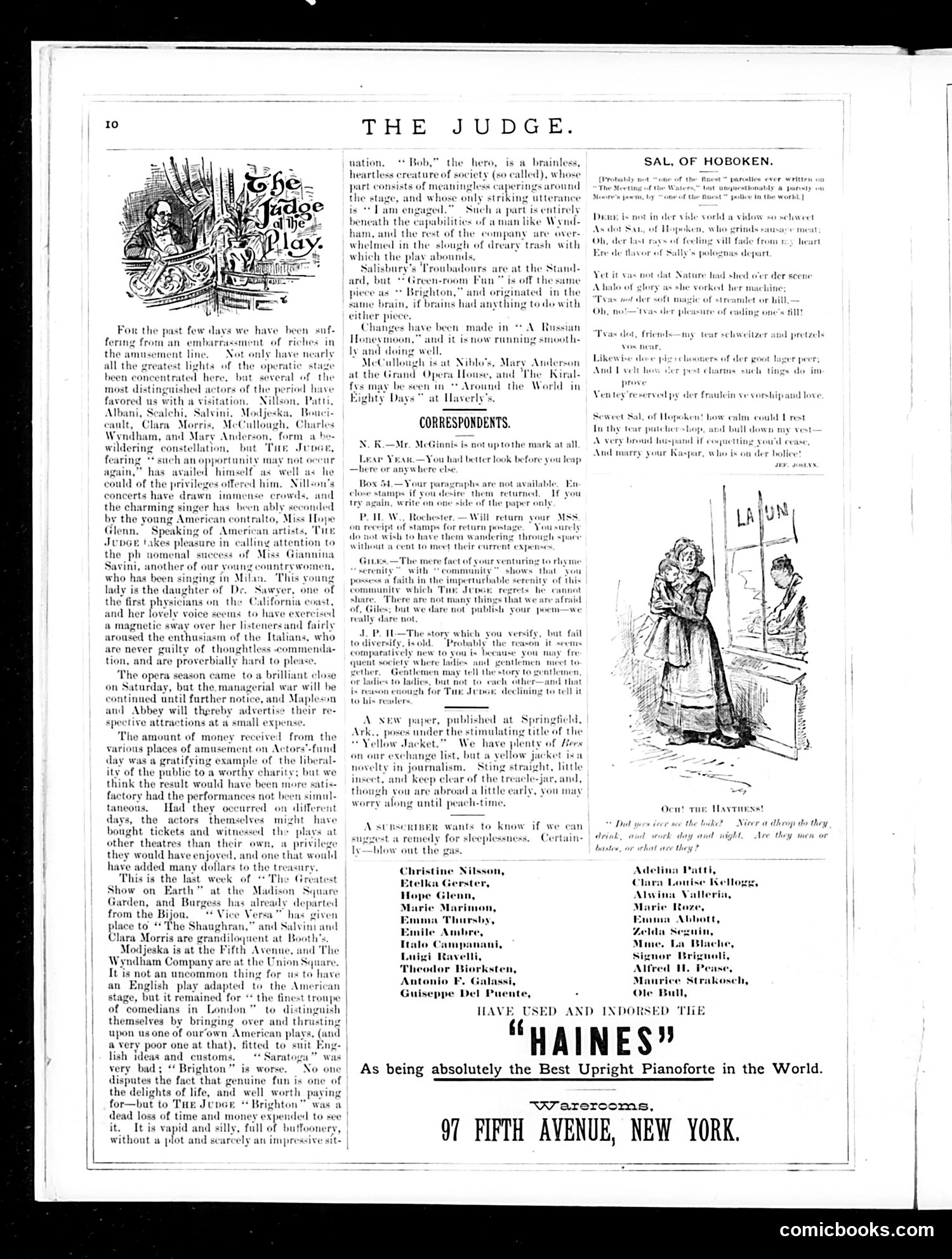
This page from *Judge* primarily contains **theater criticism and reader correspondence**, with an advertisement at bottom. The main **cartoon** (upper right) depicts a domestic scene: a woman at a window addresses a man outside, asking "Had you ever see the baby? Nary a sheep do they feed, and such day and night. No they own no horse, or what are they?" This appears to satirize **nouveau-riche social pretension**—mocking someone boasting of possessions while having none worth mentioning. The **text** extensively critiques recent theatrical productions, particularly attacking "*Brighton*" as "vapid and silly, full of buffoonery" when performed by English actors. The author argues the play is beneath the talents of American star Charles Wyndham. The page also lists prominent opera singers and performers who visited New York (Nilsson, Patti, etc.), celebrating their contributions to American culture. An advertisement for "Haines" pianofortes occupies the lower section, claiming it's "absolutely the Best Upright Pianoforte in the World."
This is primarily an **advertising page** from Judge magazine, not a satirical cartoon page. The layout contains numerous commercial advertisements typical of late 19th-century publications. Notable ads include: - **Mining/Investment schemes** (New England and Colorado Mining Company) promising "$500 for $100" returns — these were common speculative ventures targeting readers - **Piano manufacturers** (Weber, Behning) — luxury goods for middle/upper-class consumers - **Patent medicines** (catarrh cure, "Cure Fits" treatments) — exploitative health claims common to the era - **Consumer goods** (Baker's Chocolates, books, bicycles, cards) The small text snippets scattered throughout appear to be humor columns or brief satirical items rather than political cartoons — they joke about collecting coins, fashion trends in pill shapes, and other mundane topics. **The satire here is implicit**: Judge's advertising revenue came from these questionable patent medicines and investment schemes, reflecting the magazine's complicity in the commercial hucksterism it may have satirized elsewhere in its pages.
This page is primarily **advertising**, not satirical content. It's from Judge magazine but consists almost entirely of patent medicine and product ads typical of late 19th-century publications. The small editorial content visible includes brief humorous observations: a Scottish clergyman's sermon about "nine muses" in base ball; a joke about taxi drivers overcharging; and a quip about colored boarding house keepers' arithmetic skills. The advertisements promote dubious remedies now recognized as fraudulent or harmful: Sanford's Radical Cure (catarrh treatment), Horehound & Tar (consumption "cure"), Ely's Cream Balm, Hill's Hair Dye, and various other tonics and drops. These reflect the era's unregulated patent medicine market. There's also a large farm giveaway promotion promising "$150,000 given away" and "$10,000 farm" prizes—typical of speculative schemes that preyed on readers. The page documents how Judge balanced satire with aggressive advertising to fund publication.
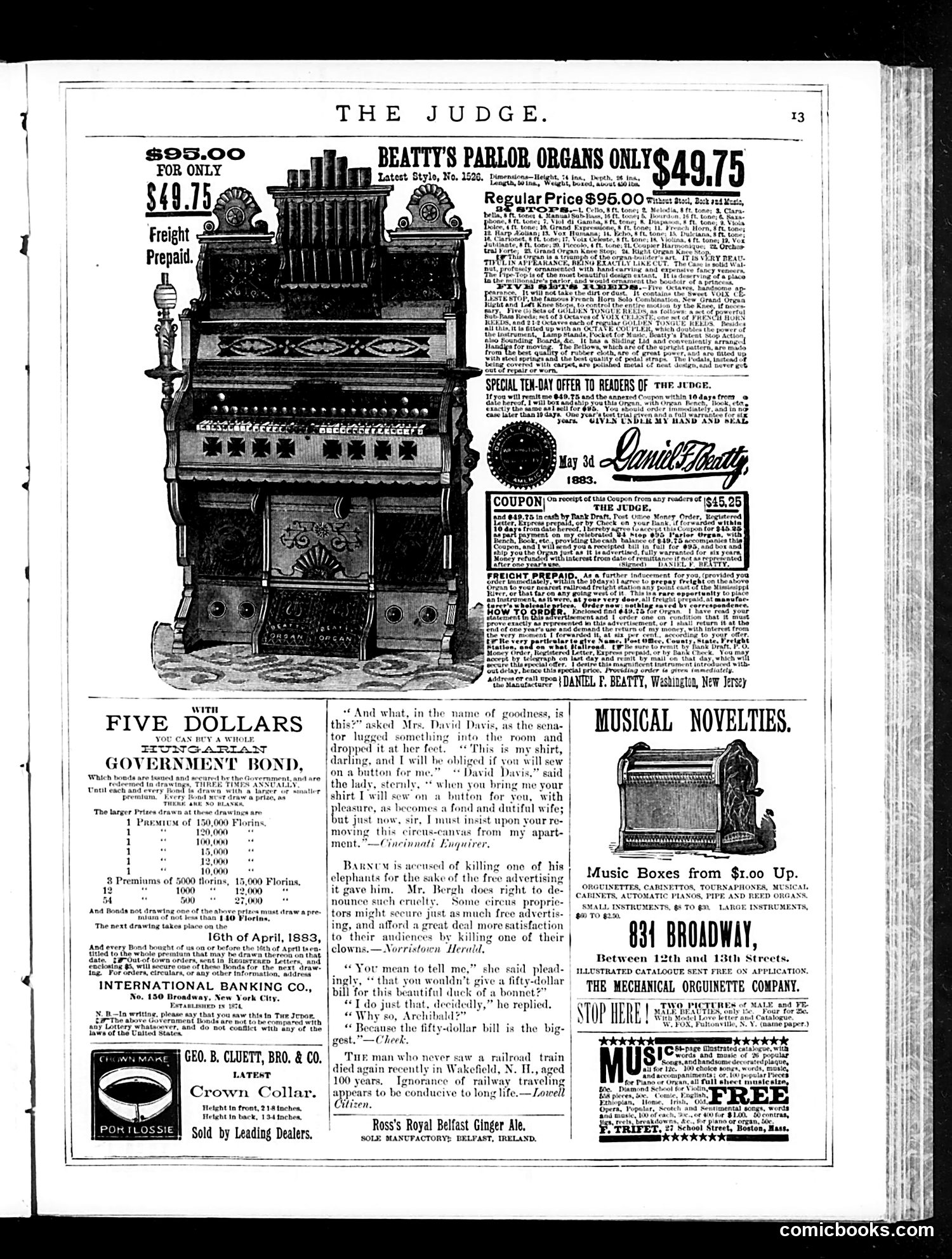
This is primarily an **advertising page** with minimal editorial content. The dominant feature is a large engraving of **Beatty's Parlor Organ** (a home musical instrument), offered at a discounted price of $49.75—a significant markdown from its regular $95 price. The page includes several brief humorous anecdotes typical of *Judge* magazine's satirical filler: 1. A domestic comedy sketch about a wife refusing to sew a button on her husband's shirt, invoking her right to remove circus canvas from their apartment 2. A joke about circus owner Barnum allegedly killing an elephant for publicity; the satire suggests killing a clown would be equally effective promotion 3. A brief exchange about refusing a fifty-dollar bill as payment for a bonnet 4. An anecdote about a 100-year-old man who'd never seen a railroad train The remaining space features **period advertisements** for government bonds, musical instruments, and other consumer goods—typical of 1880s magazine content. There is **no political cartoon** visible on this page.
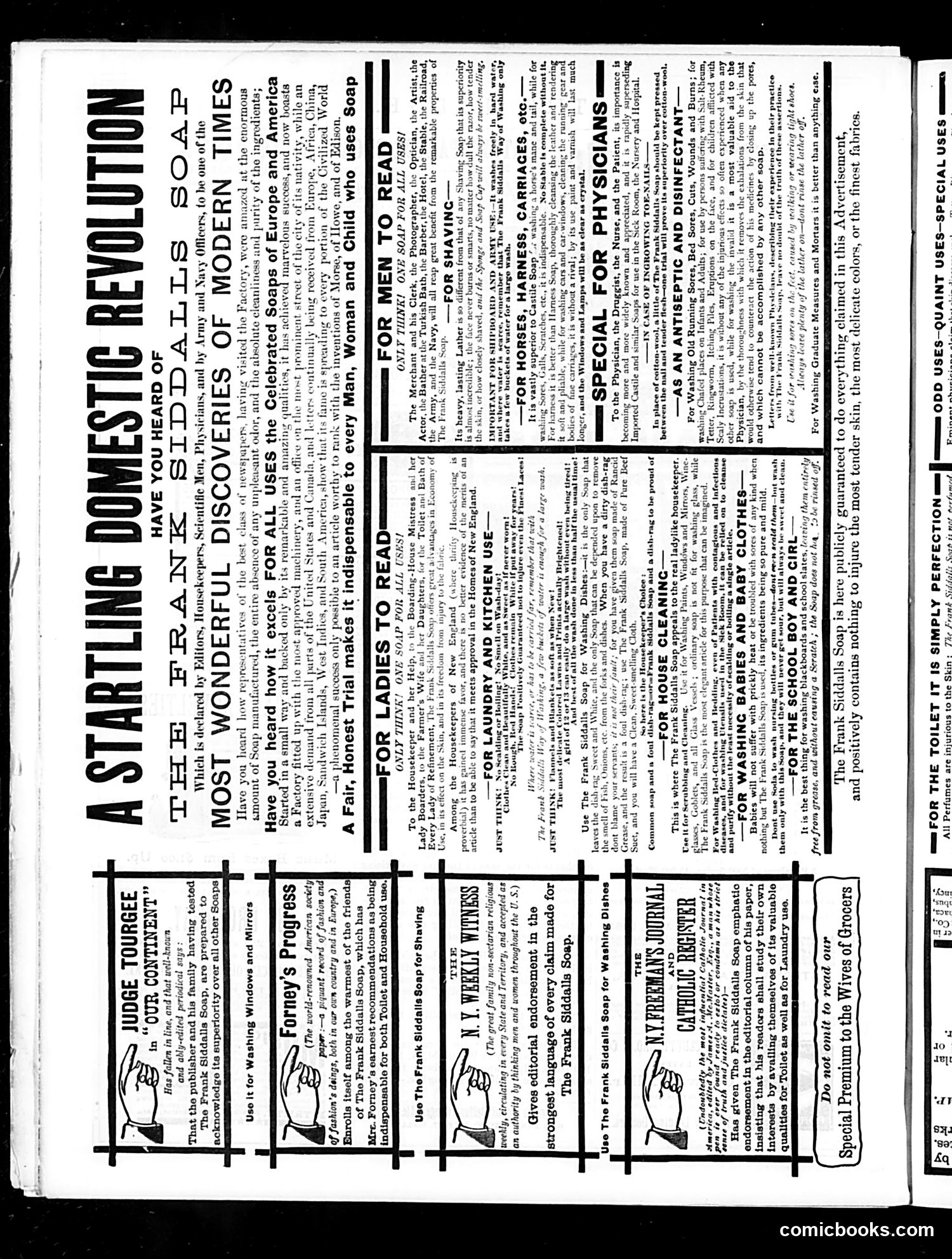
This appears to be a satirical advertisement/editorial page from *Judge* magazine promoting domestic labor-saving devices and social change for women. The OCR is heavily degraded, but the visible header "A STARTING DOMESTIC REVOLUTION" and references to "MOST WONDERFUL DISCOVERIES OF MODERN TIMES" suggest the page celebrates new household technologies. The repeated hand illustrations likely accompany endorsements from different women (possibly labeled "FOR MEN TO READ," "FOR LADIES TO READ," "FOR PEOPLE FOR PHYSICIANS") advocating these innovations. Given the era's context, this appears to mock both the genuine enthusiasm for labor-saving appliances and contemporary anxieties about women's changing domestic roles. The satire likely targets how such devices were marketed as solutions to "the woman problem" while preserving traditional gender expectations—freeing women from drudgery just enough to remain confined to household work.
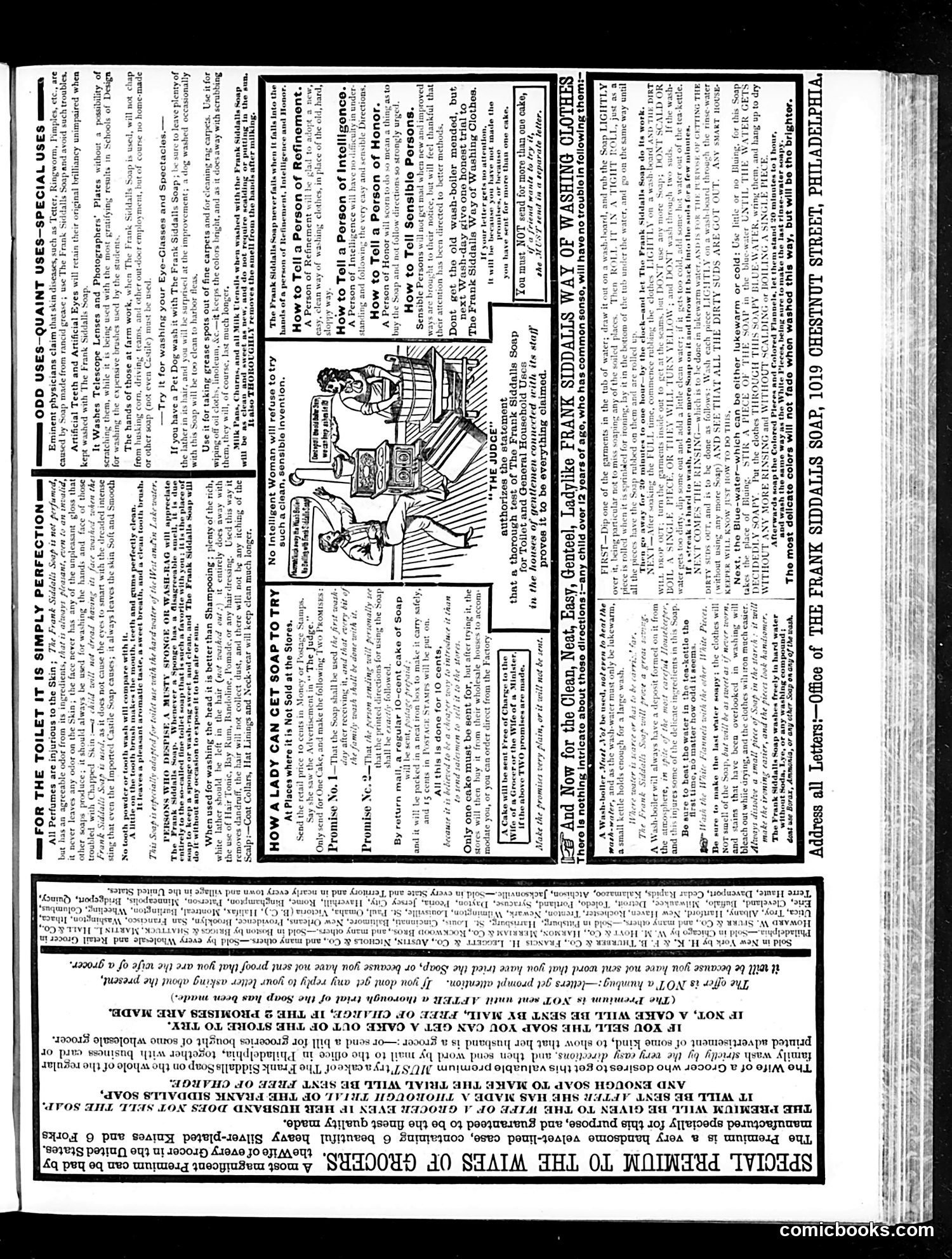
This page appears to be heavily degraded OCR from a Judge magazine issue, making precise analysis difficult. The text is largely illegible due to scanning errors and poor quality reproduction. What is visible includes: - **Section headers** referencing "GOD USES QUAINT USES" and "HOW CANDY GETS SPOOFED" (though exact context is unclear) - **Multiple small illustrations** appear present, including what looks like domestic or social scenes - **Advertising content** for various products - **Text blocks** discussing contemporary issues, though specific political figures or events cannot be reliably identified due to OCR corruption The magazine format and layout suggest this contains typical Judge content: satirical commentary on American life, politics, and social customs from the early 20th century. However, **without legible text or clearer images, I cannot responsibly identify specific political targets, caricatured figures, or the particular satire's point.** A higher-quality scan would be necessary for accurate historical interpretation.
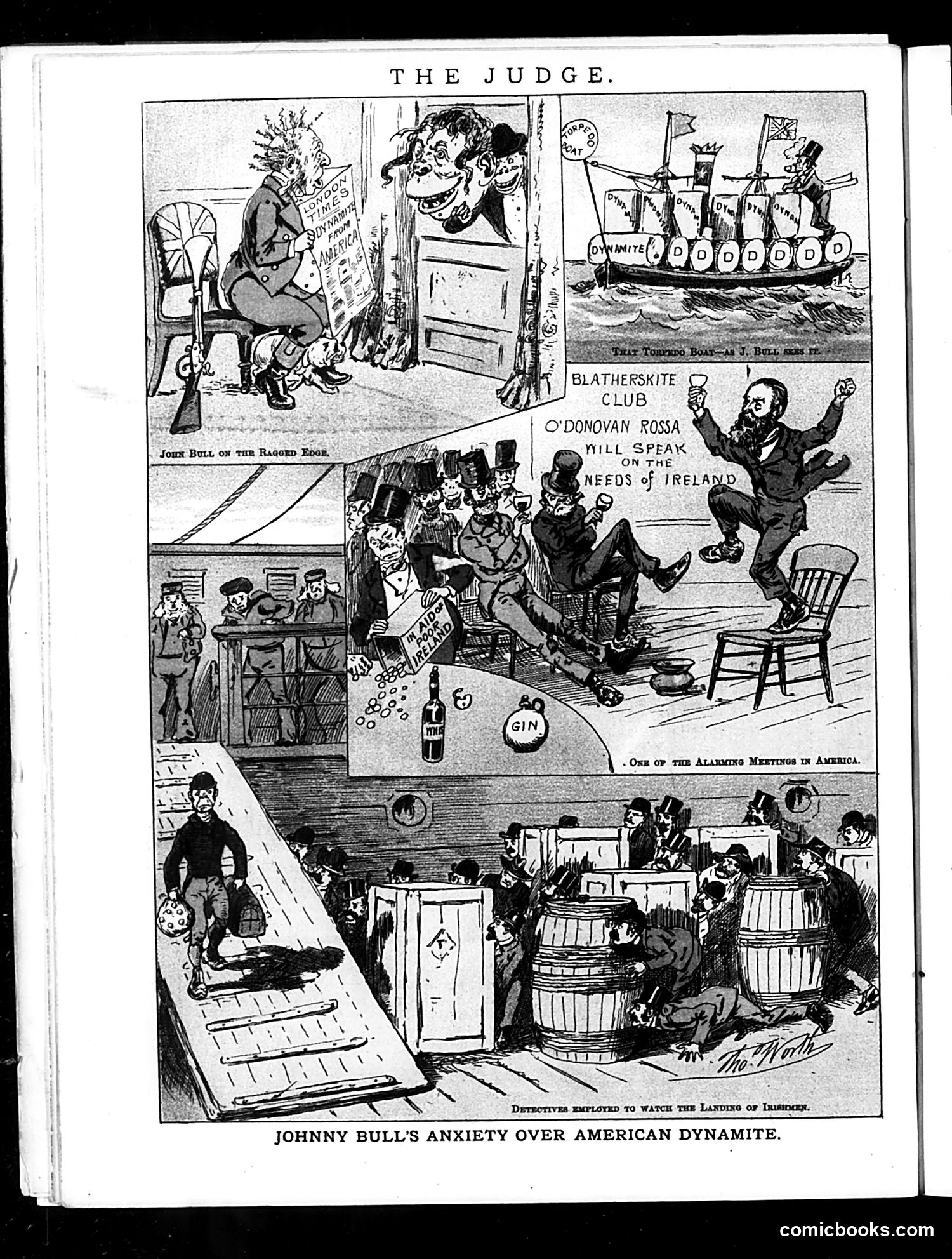
This page satirizes British fears about Irish-American dynamite shipments to Ireland. "Johnny Bull" (personification of Britain) anxiously monitors Irish rebels, particularly referencing O'Donovan Rossa, a prominent Irish-American nationalist. The cartoons mock British paranoia: they show surveillance of ships, the "Blatherskite Club" (Irish-Americans discussing Irish independence), and detectives watching for dynamite smuggling. The satire targets both British overreaction to Irish-American support for independence movements and the real historical tension around explosives funding Irish rebellion. Judge magazine, typically conservative, appears to mock British anxiety while implying Irish-Americans were genuinely engaged in suspicious activities—presenting the situation as absurd paranoia while simultaneously suggesting the threat was real.