
A complete issue · 16 pages · 1883
Judge — March 3, 1883
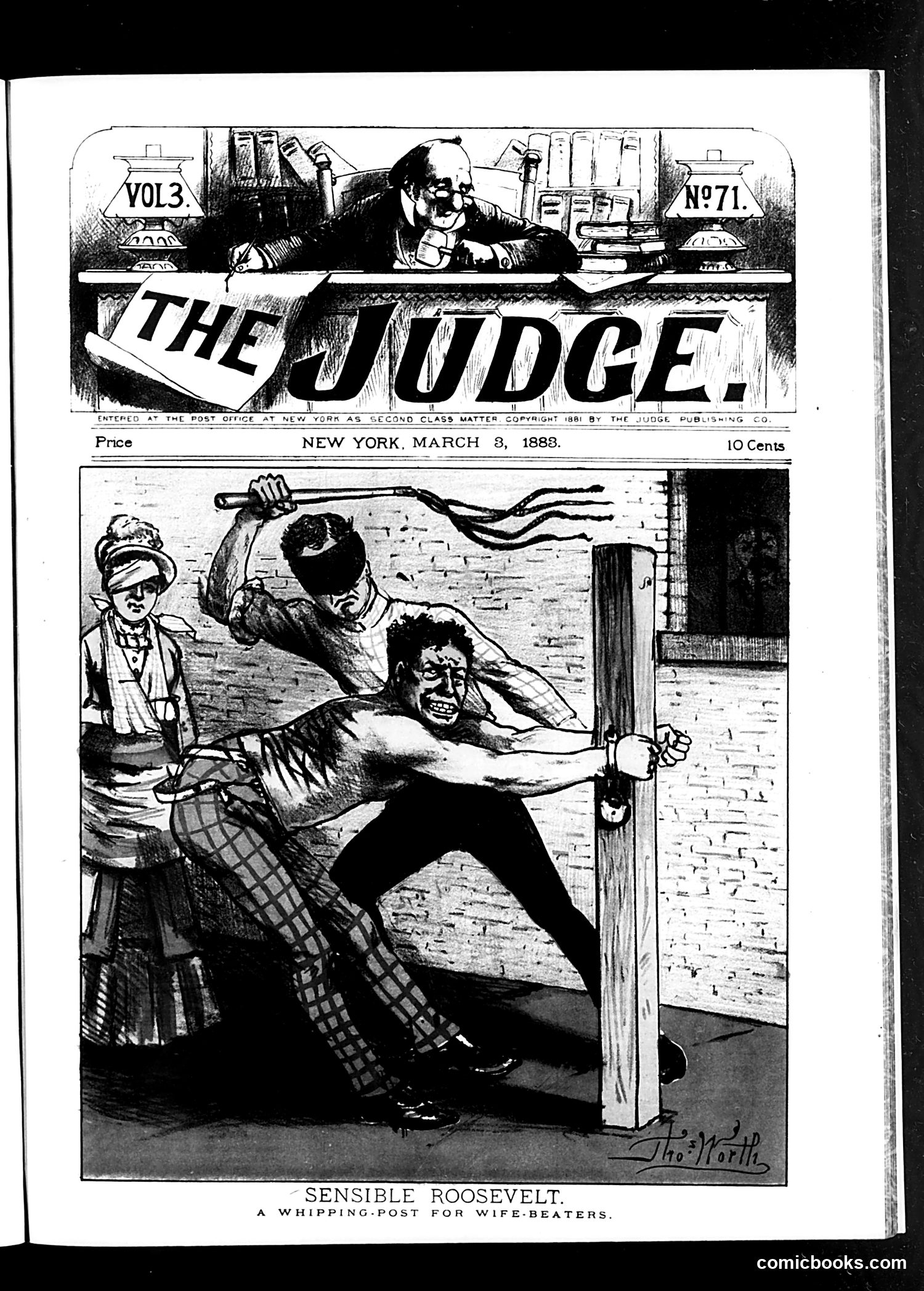
This satirical cartoon attacks Theodore Roosevelt's proposal for a "whipping-post for wife-beaters." The illustration shows a man being beaten by two women with sticks and whips while a third figure watches, suggesting the cartoon mocks Roosevelt's reform as creating vigilante justice rather than legal punishment. The satire implies that Roosevelt's idea would simply invite women to take violent revenge rather than establish proper judicial processes. The title "Sensible Roosevelt" is sarcastic—the cartoonist argues the proposal is impractical and dangerous. This reflects 1880s resistance to domestic violence reforms. While Roosevelt championed protecting women from abuse, critics worried about uncontrolled mob justice and challenged whether such measures were actually "sensible" or enforceable.
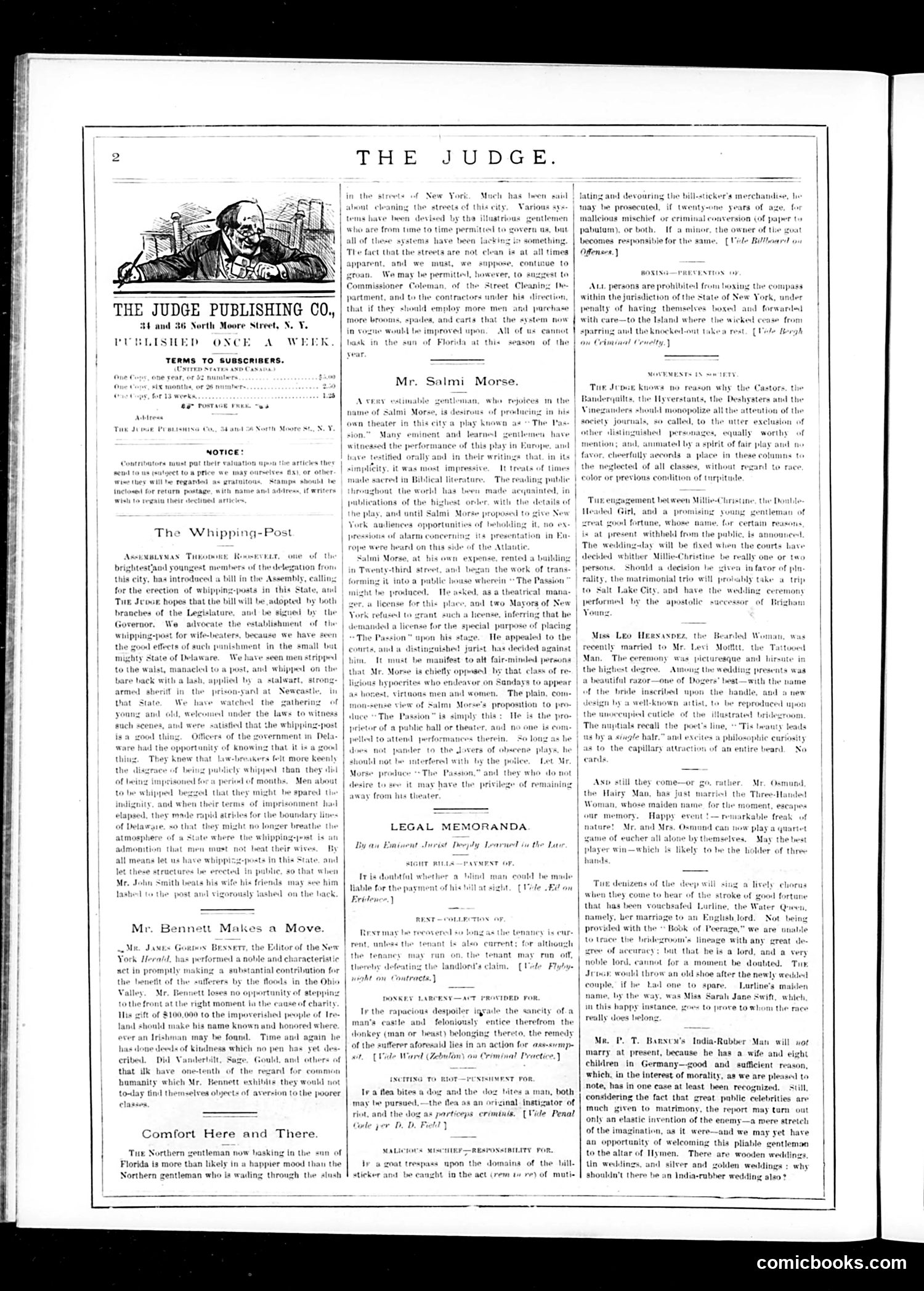
This page from Judge magazine contains several satirical pieces on 1880s social issues: **"The Whipping-Post"** criticizes Delaware's retention of public whipping as punishment, noting that observers witnessed such brutality with satisfaction. The satire implies this is barbaric and unfit for a civilized state. **"Mr. Salmi Morse"** addresses controversy over Morse's theatrical production of "The Passion" (a biblical play). Religious opposition and police resistance blocked its performance. The satire defends artistic freedom against what it views as prudish censorship by "virtuous" citizens who oppose Sunday theatrical performances. **"Mr. Bennett Makes a Move"** praises James Gordon Bennett Jr. (New York Herald editor) for charitable donations, contrasting his generosity with wealthy robber barons like Vanderbilt and Sage who lack similar compassion. **"Comfort Here and There"** briefly notes a Northern gentleman enjoying Florida's warm climate while another endures harsh Northern weather—light social observation rather than political satire. The magazine advocates progressive positions: abolishing corporal punishment, defending artistic expression, and praising philanthropic responsibility among the wealthy.
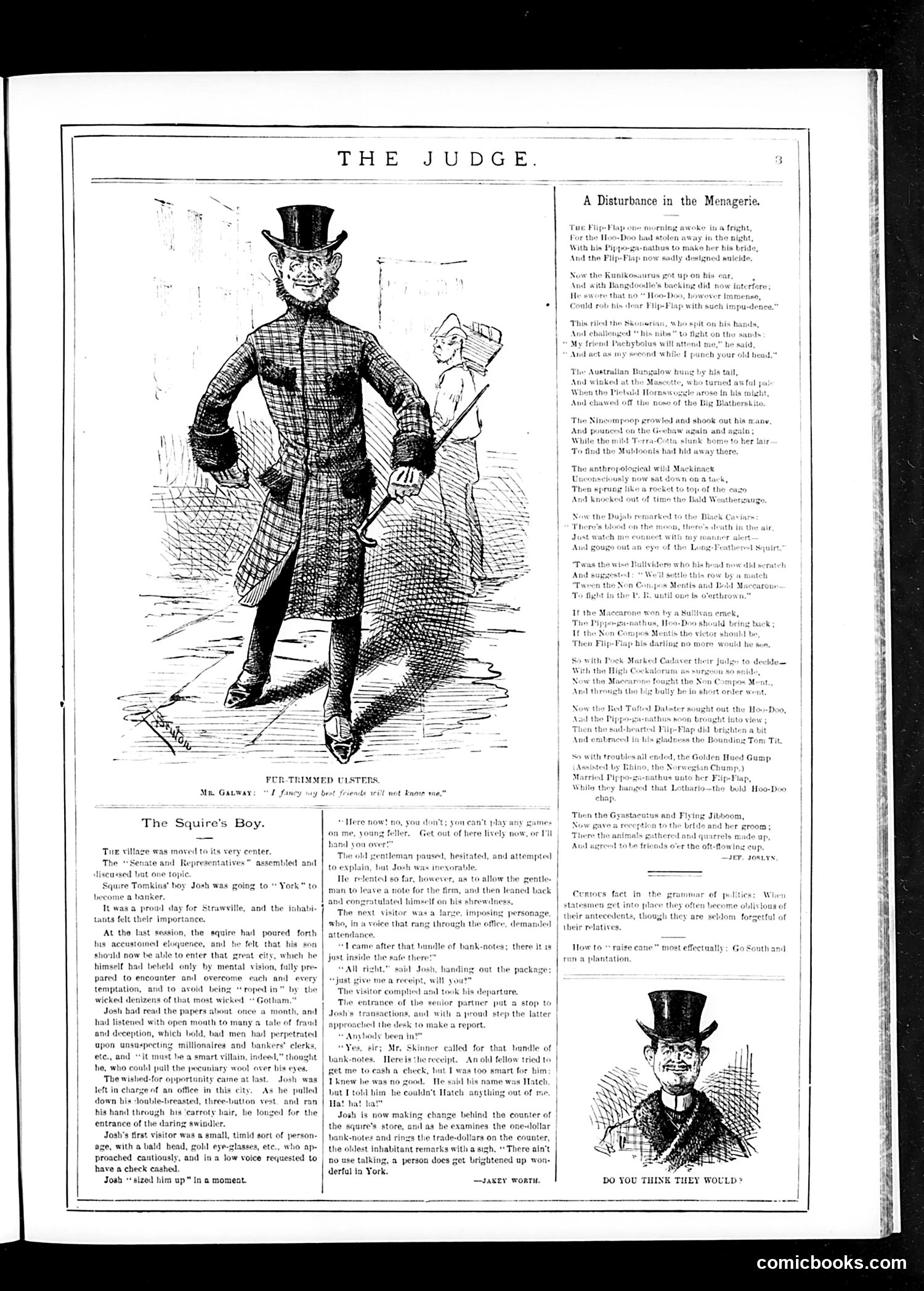
This page contains two distinct pieces of satire: **"Fur-Trimmed Ulsters"** (main cartoon): A cautionary tale mocking rural naïveté. Josh, a country boy arriving in New York City, believes he's cleverly outsmarting a confidence man trying to cash a suspicious check. However, the twist reveals Josh himself was the mark—he's been duped into exchanging legitimate bank notes for a worthless receipt. The satire targets both rural innocence and false confidence in one's own shrewdness. **"A Disturbance in the Menagerie"** (right column): A nonsensical animal poem-story using invented creature names (Hoo-Doo, Flip-Flap, Runikonurus, etc.). This appears to be absurdist humor rather than political satire—domestic chaos among fantastical beings, likely satirizing sensationalist or melodramatic narrative styles popular in the period. Both pieces reflect Judge's typical blend of social commentary and whimsical humor targeting urban vs. rural America and literary pretension.
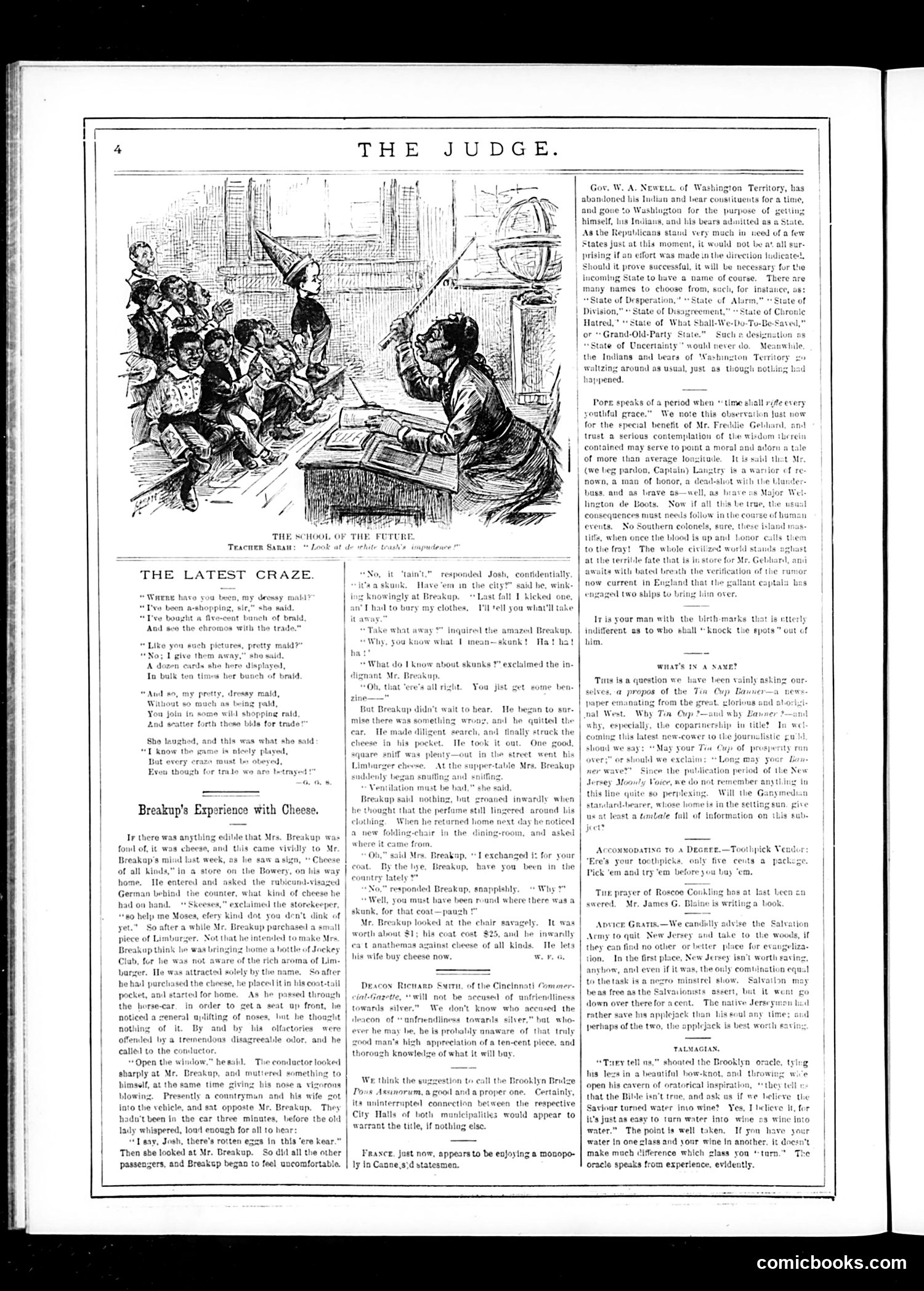
This page contains two main satirical pieces: **"The School of the Future"** (top): A cartoon mocking aesthetic/artistic pretensions, showing what appears to be an instructor with students. The dialogue suggests satire of fashionable but frivolous pursuits—trading pictures and braids rather than receiving serious education. **"Breakup's Experience with Cheese"** (bottom): A longer comic narrative about Mr. Breakup's misadventure purchasing Limburger cheese from a German shopkeeper on the Bowery. The humor relies on the infamously pungent odor of Limburger cheese, which causes passenger outrage on a streetcar and ruins his furniture. A country man's suggestion to use a skunk to mask the smell adds absurdist comedy. The piece satirizes both urban pretension (Breakup's attempt to impress) and immigrant stereotypes (the German cheese-seller's dialect). The page also includes brief political notes referencing Governor W.A. Newell of Washington Territory and comments on Brooklyn Bridge nomenclature and French politics.
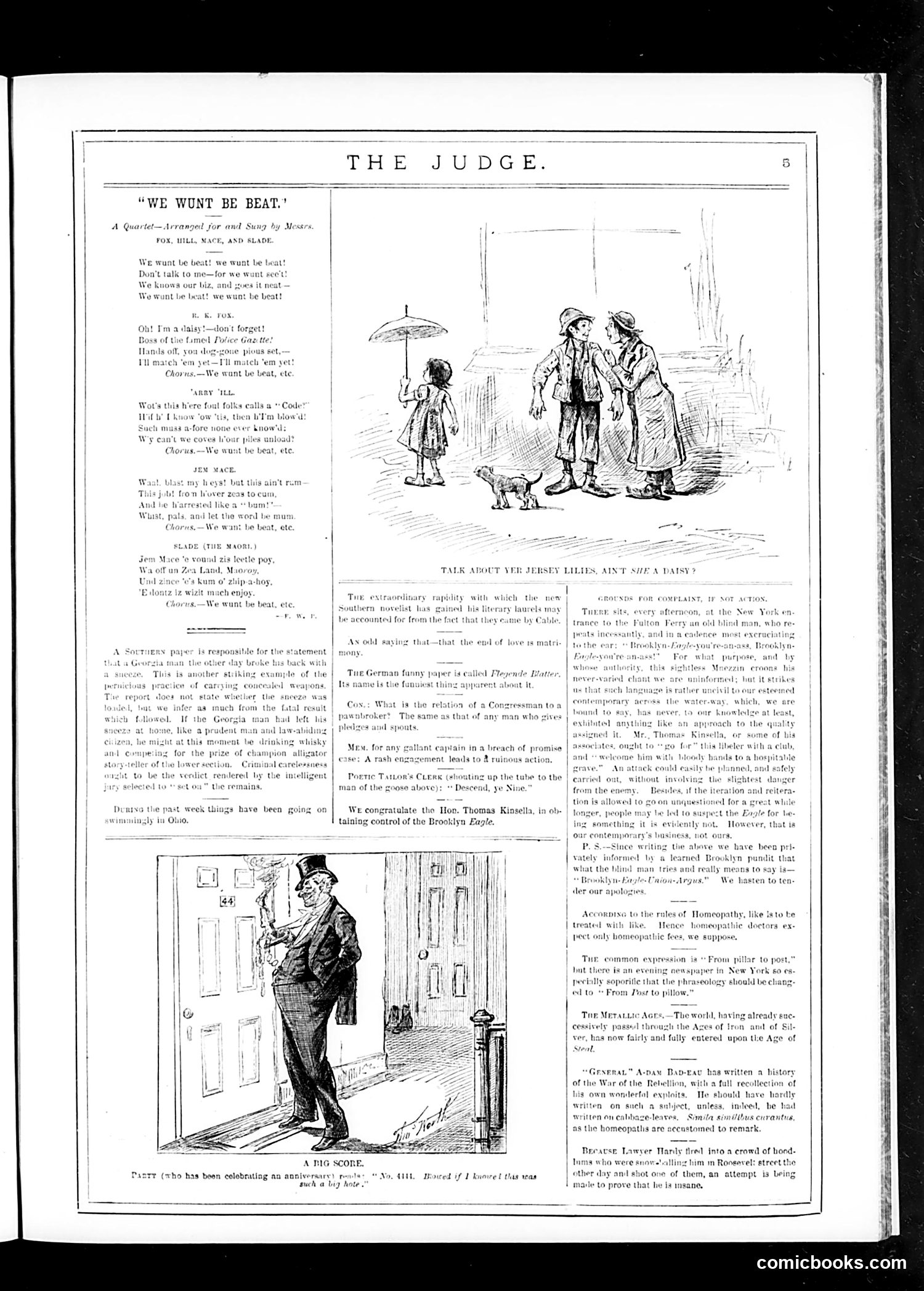
This page satirizes several contemporary figures and issues, likely from the 1880s based on references. **"We Wunt Be Beat"** is a musical quartet featuring boxers/prizefighters: Jemm Mace, Will (likely a boxer), and Slade (identified as "The Maori"). The song mockingly captures their working-class dialect and boastful attitudes about boxing prowess—a popular but controversial sport at the time. **"Talk About Yer Jersey Lilies, Ain't She a Daisy?"** references the top illustration showing figures discussing a woman, likely alluding to a contemporary scandal or notable person (Jersey Lilies were a famous reference to Lillie Langtry, a celebrated actress/courtesan). **The lower cartoon** titled "A Big Score" depicts a man at a doorway, likely satirizing some social or political figure's dealings or scandals. The page generally mocks prizefighters' pretensions, contemporary gossip about society women, and various public figures through crude caricature and vernacular speech typical of Judge's satirical approach.
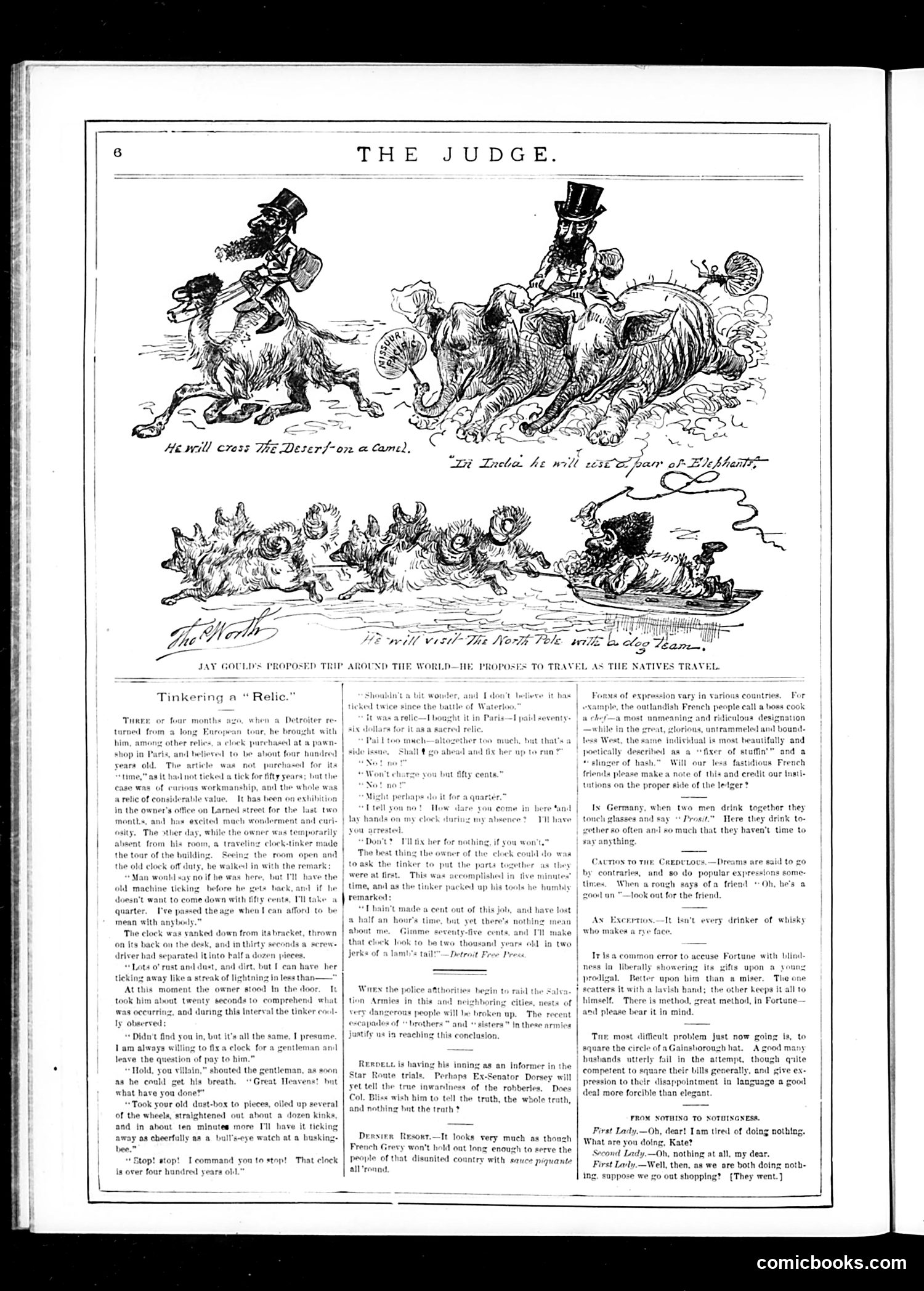
This page from *Judge* magazine contains three satirical pieces: **"The Judge" (top cartoons):** Two panels show a figure in top hat (likely representing judicial authority or a political leader) attempting to control unruly dogs wearing hats and collars—appearing to represent contentious factions or nations. The captions reference crossing deserts on camels and traveling to Elephant Land, suggesting commentary on imperial overreach or difficult diplomatic/colonial ventures. **"Tinkering a 'Relic'" (left column):** A humorous anecdote about a Parisian clockmaker attempting to repair a 400-year-old inherited clock. The joke satirizes the pretensions of European artisans and the futility of "fixing" old things—likely metaphorically commenting on European politics or institutions that resist genuine reform. **"Jay Gould's Proposed Trip Around the World":** References the famous industrialist Jay Gould's travel plans, with text discussing European cultural matters (French cuisine, German drinking customs, British fashion). The page uses animals, metaphorical journeys, and mechanical breakdowns to satirize contemporary politics, imperialism, and American business figures.
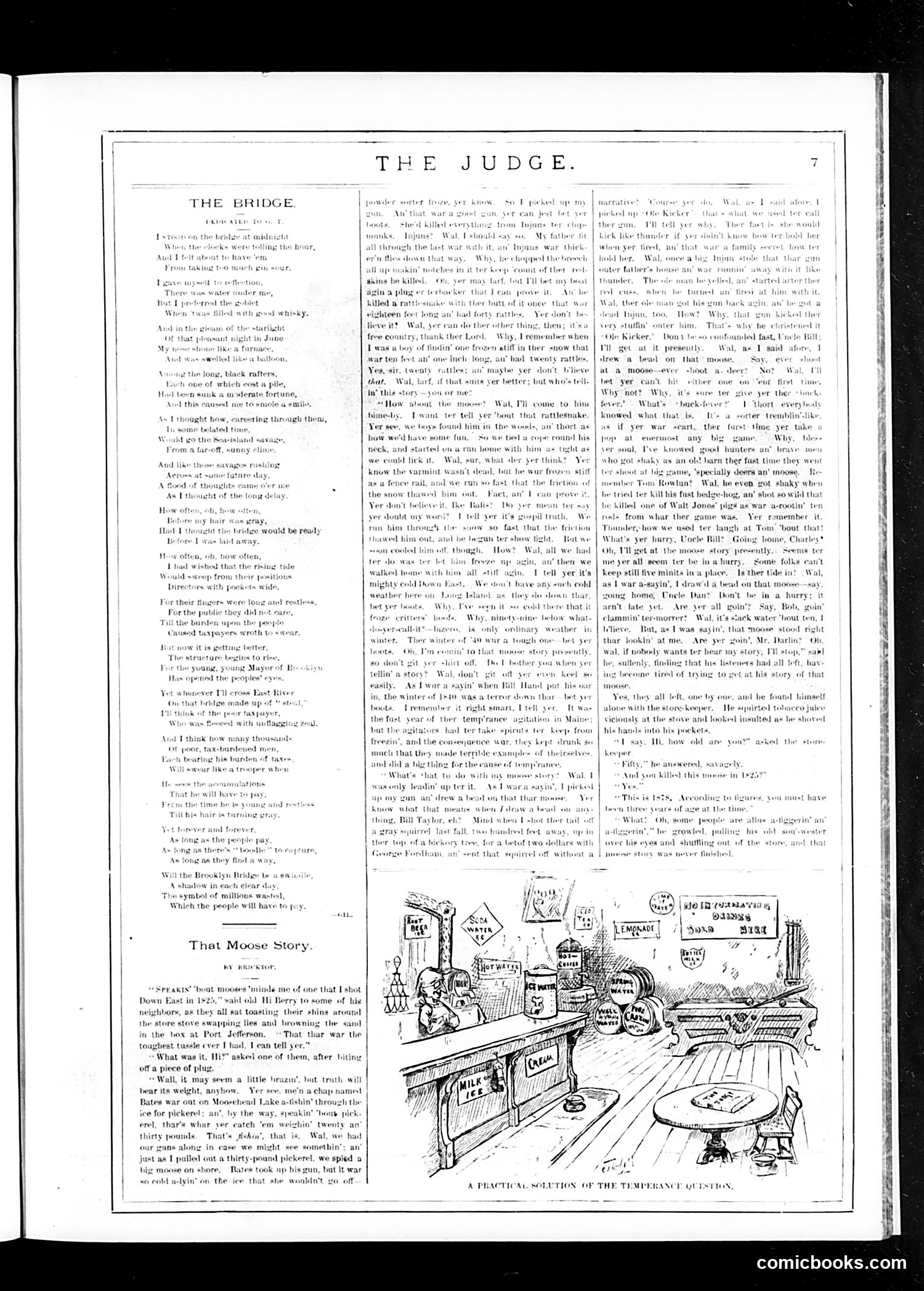
This page contains two distinct pieces: **"The Bridge"** (poem, left): A satirical critique of public spending on infrastructure projects. The poem mocks taxpayers' concerns about funding a bridge, suggesting they'll perpetually bear costs ("As long as there's 'bridge' to explore, / Will the people have to pay"). It's social commentary on government extravagance and citizens' powerlessness against taxation. **"That Moose Story"** (center-right): A tall tale in dialect featuring rural characters discussing hunting exploits. The humor derives from exaggerated claims—a frozen rattlesnake creating friction-heat, absurd animal encounters—typical of 19th-century American folk humor. The accompanying cartoon titled "A Practical Solution of the Temperance Question" (bottom) shows bottles and drinking implements, suggesting the story itself may be a humorous commentary on questionable accounts told by intoxicated characters. Both pieces employ satire: one targeting government waste, the other mocking unreliable rural narratives, likely those embellished by alcohol consumption.
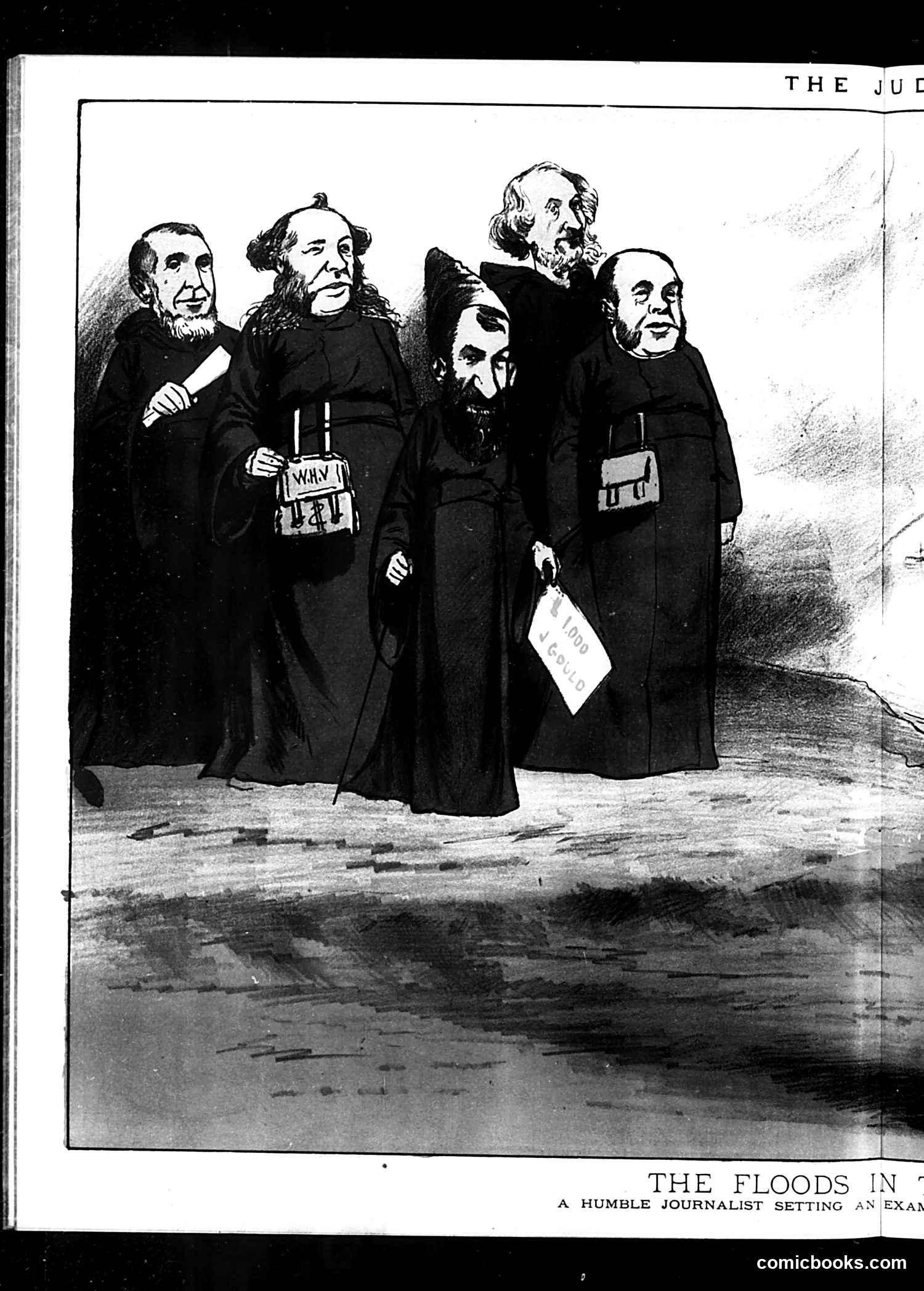
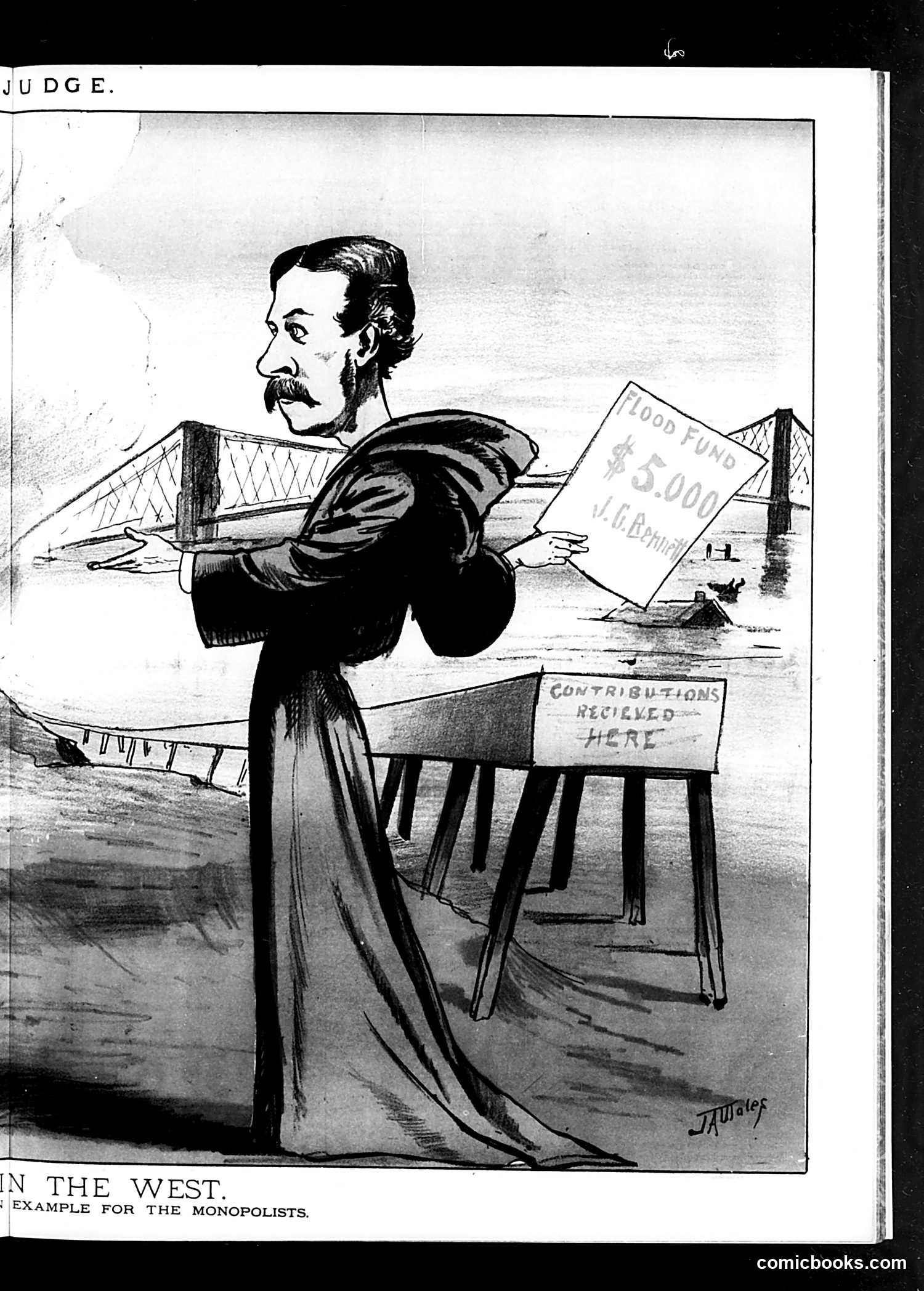
This Judge magazine cartoon satirizes a wealthy judge or businessman in the American West who is collecting contributions for a "Flood Fund" of $5,000 (attributed to "J.G. Bennie"). The figure, depicted with exaggerated features, holds oversized boxing gloves labeled "CONTRIBUTIONS RECEIVED HERE," suggesting he's aggressively extracting donations. The cartoon's subtitle—"AN EXAMPLE FOR THE MONOPOLISTS"—indicates this is criticizing monopolistic practices and corrupt wealth concentration. The bridge and Western landscape in the background emphasize the regional setting. The satire suggests that powerful figures exploit public disasters (the flood) to enrich themselves while posing as charitable, using strongarm tactics (the boxing gloves) to solicit funds. This reflects late-19th/early-20th-century Progressive Era criticism of robber barons and monopolists.
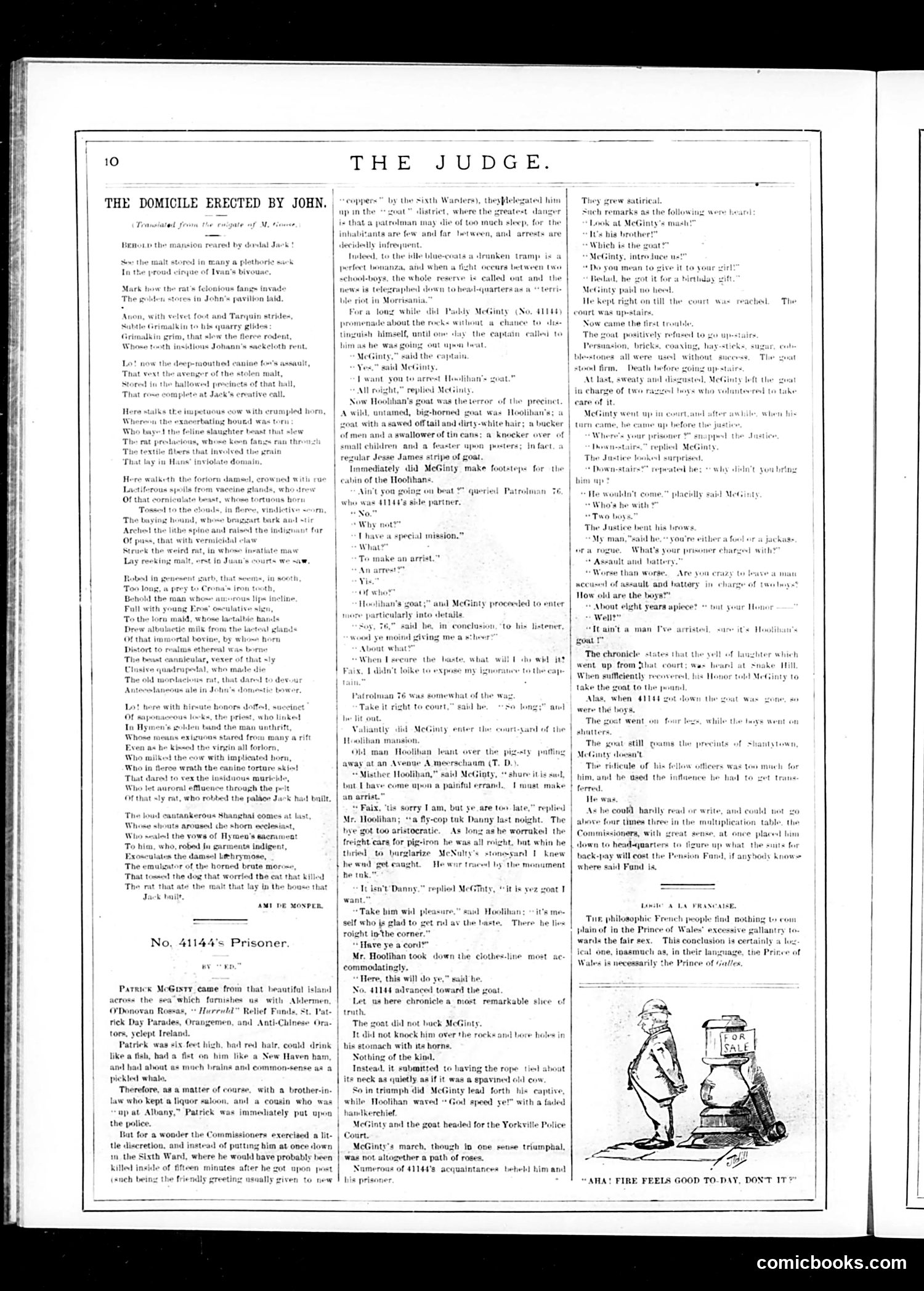
This Judge page contains two unrelated pieces: **"The Domicile Erected by John"** is a mock-heroic parody of the nursery rhyme "The House That Jack Built," rendered in absurdly pompous, classical language. It humorously inflates a simple children's story into grandiose poetry—the cow becomes "that Immortal bovine," the maid is "crowned with rue," etc. The satire mocks pretentious literary styles by applying them to trivial subject matter. **"No. 41144's Prisoner"** tells of Patrick McGinty, an Irish immigrant character stereotypically portrayed as large, dim-witted, and prone to trouble (references to his brother-in-law's liquor saloon, cousin in Albany, Irish policemen). The story involves McGinty being ordered to arrest Hoolihan's goat, which appears to be causing problems. The piece satirizes Irish immigrant stereotypes and police incompetence in 1890s New York through broad comedy. The illustration shows a figure with what appears to be a scale, likely weighing something.
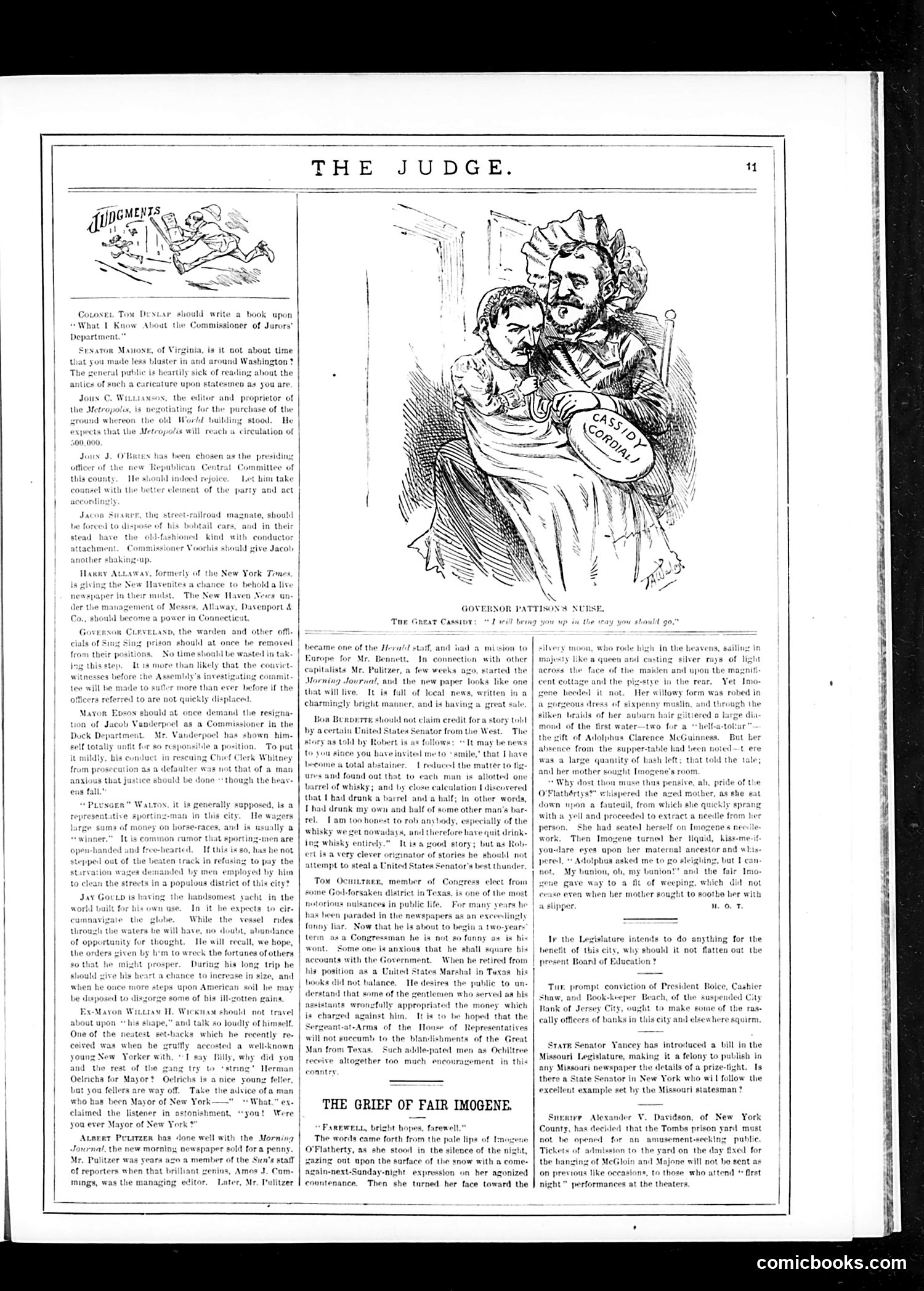
This page contains a satirical column addressing various New York political figures and a separate short story titled "The Grief of Fair Imogene" (visible at bottom). **The Column ("The Judge"):** Judge magazine's editorial voice criticizes several figures: Colonel Tom Dunlap (regarding judicial administration), Senator Mahone of Virginia (excessive political bluster), John J. O'Brien (newly chosen Republican officer), and various city officials including those at Sing Sing prison and the Dock Department. The critiques focus on incompetence, corruption, and unfitness for office. **The Cartoon:** Shows a caricatured figure labeled "Governor Patterson's Nurse" with caption "I will bring you up in the way you should go"—satirizing political interference or manipulation of the governor. **"The Grief of Fair Imogene":** A sentimental story fragment about a young woman (Imogene) bidding farewell to "bright hopes," suggesting romantic disappointment or tragedy. The page exemplifies Judge's formula: mixing political satire with literary content and social commentary on late 19th-century New York governance and society.
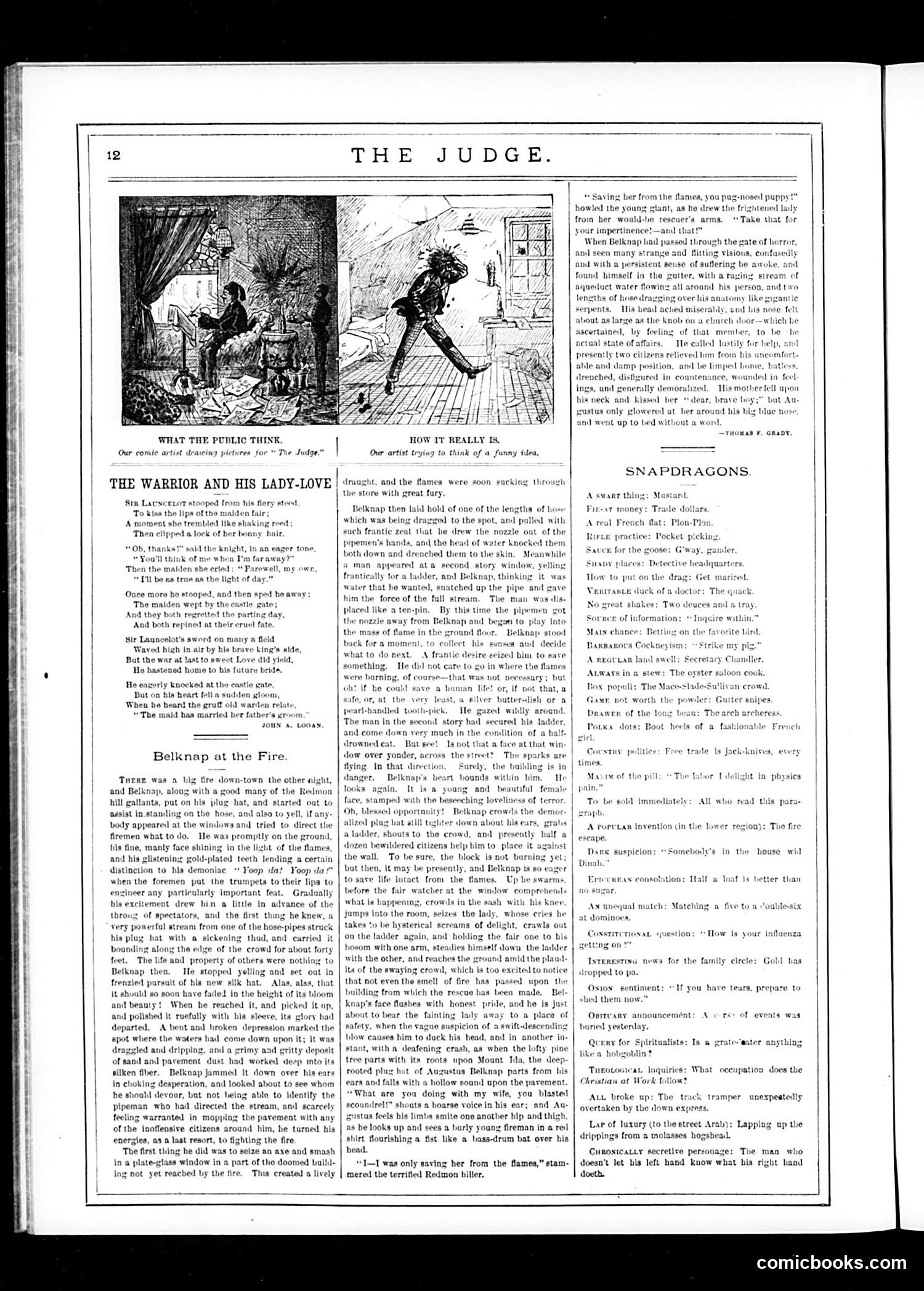
This page satirizes a figure named Belknap, likely a public official or prominent citizen, who attempts to help during a downtown fire but causes chaos through bumbling self-importance. The cartoon shows Belknap arriving in formal dress (plug hat) to "assist," then becoming more concerned with retrieving his ruined hat than actually helping. He interferes with professional firefighters—yanking a hose from their hands, directing water at them instead of flames, and smashing a window that worsens the fire's spread. The satire targets both Belknap's incompetence and his vanity: his expensive hat matters more than lives. The juxtaposition of the poem "The Warrior and His Lady-Love" (about a knight distracted by sentiment) reinforces the theme of self-absorbed distraction during crisis. Judge uses this to mock wealthy or politically-connected men who insert themselves into serious situations for public glory while actually hindering professional work.
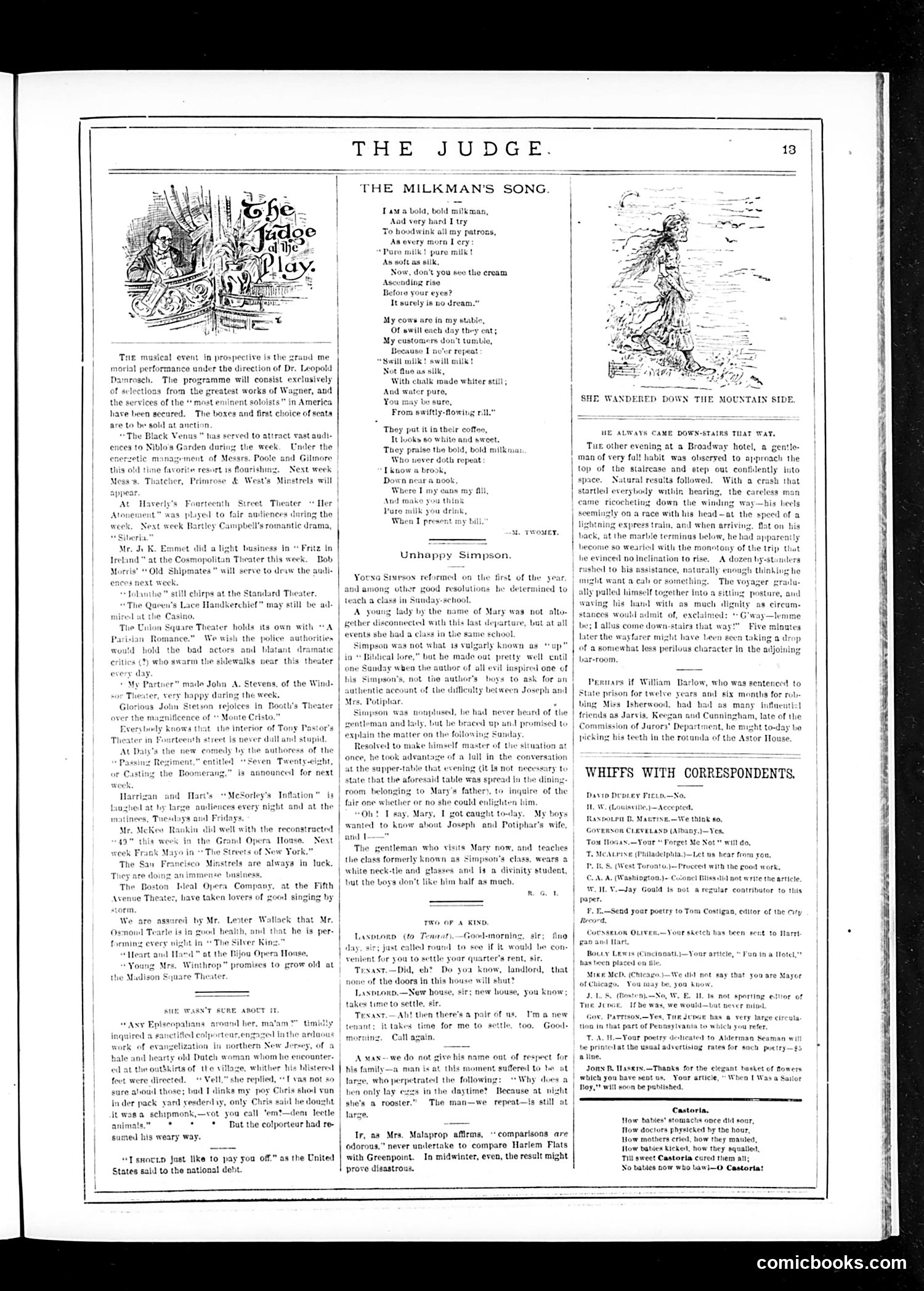
This page from the satirical magazine *Judge* contains theater reviews and humorous anecdotes rather than political cartoons. **Main Content:** The "Milkman's Song" mocks a common urban fraud: milkmen who dilute milk with water and skim cream, deceiving customers about product quality. The song's repeated refrain about "bold, bold milkman" satirizes their brazen dishonesty—they openly cheat ("hoodwink") patrons while claiming purity. **"Unhappy Simpson"** recounts a comedic anecdote about a man who reforms on New Year's but struggles with biblical knowledge when asked about Joseph and Potiphar's wife (a biblical reference to temptation). The humor lies in his embarrassment over this gap in education. **Context for Modern Readers:** This reflects late-19th-century urban concerns: food adulteration was rampant and largely unregulated before FDA oversight. Milk dilution was notoriously common. The satire targets both the dishonest vendors and consumers' gullibility. The Simpson piece reflects period attitudes about working-class education and moral self-improvement movements popular in the era.
This is primarily an **advertising page** from Judge magazine, not a political cartoon section. The page is dominated by commercial advertisements for consumer goods typical of the late 19th century: hats (Knox), pianos (Weber), music boxes, toothache drops, honey-tar cough remedy, soap, and cocoa. The only editorial content appears to be brief snippets scattered among ads—fragmentary references to President Arthur and mentions of a New York correspondent discussing congressional matters and Washington society. These appear to be filler material or humor notes rather than coherent satire. **What we can determine:** This represents Judge's business model: a satirical magazine whose pages heavily subsidized editorial content through advertising revenue. The scattered political references (Arthur, Washington) suggest mild social commentary, but the page's primary purpose was commercial—selling products to the magazine's middle-class readership during the Gilded Age.
This is primarily an **advertising page** from Judge magazine, not a satirical cartoon page. The page is dominated by commercial advertisements for products and services typical of the late 19th century. Key advertisements include: - **Behning Pianos** - promoting musical instruments - **Swayne's Pills** - claiming to "purify the blood" and act as a "heart corrector," a common medical claim of the era - **Sanford's Radical Cure** - for catarrh (nasal/respiratory illness) - **Various other products** - book binding, shorthand instruction, playing cards The small text snippets embedded between ads appear to be brief humorous anecdotes or jokes typical of Judge's satirical style, but they're fragmentary and difficult to parse from the OCR. This represents Judge's hybrid model: a satirical magazine funded substantially by advertising revenue, mixing humor with commercial pitches—many for patent medicines making dubious health claims, reflecting the unregulated medical marketplace of that era.
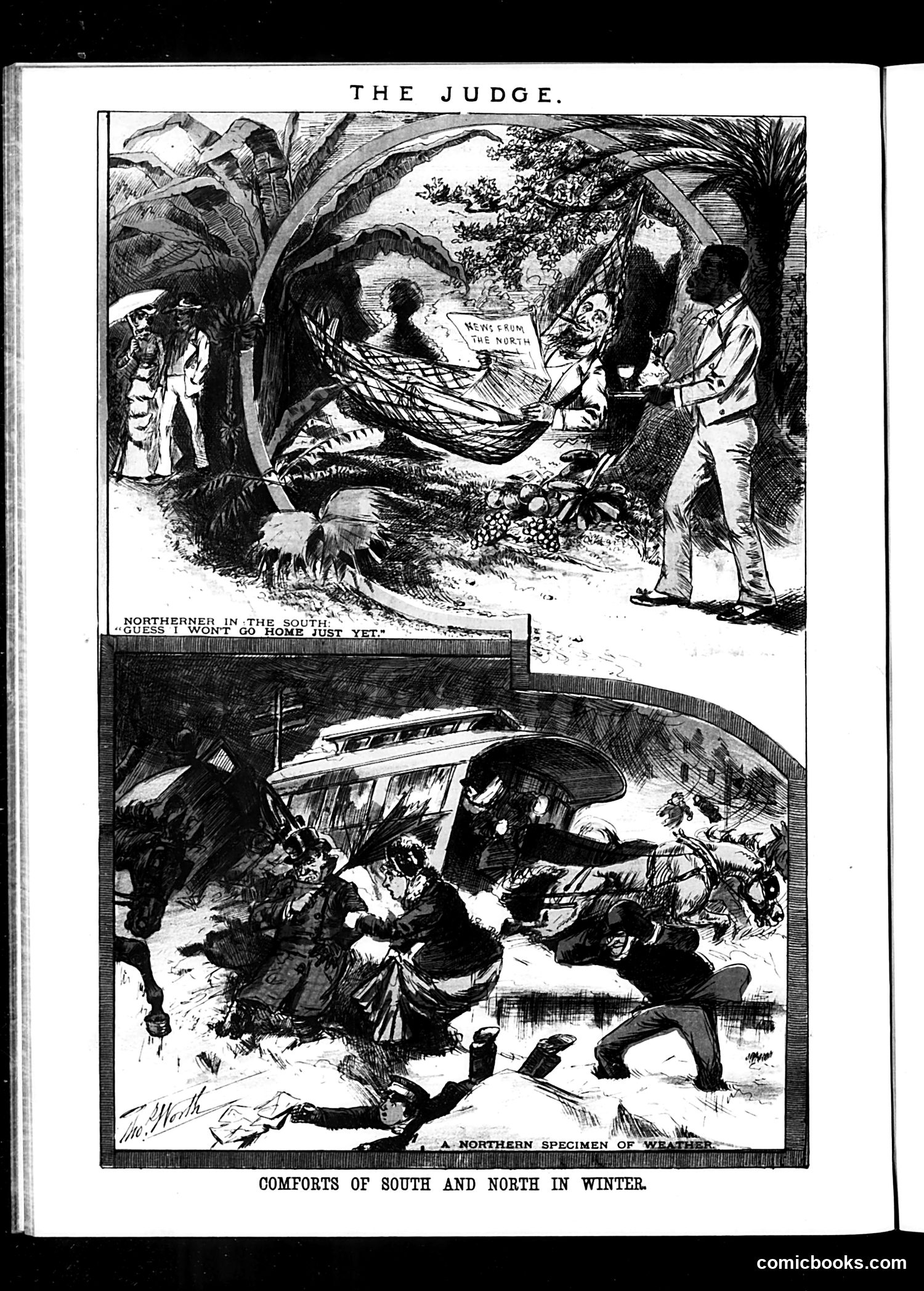
This page contains two satirical panels contrasting regional comfort levels during winter, titled "Comforts of South and North in Winter." The **top panel** shows a Northerner in the South, lounging comfortably in a hammock beneath tropical vegetation, remarking he won't go home yet—suggesting the South's warm climate is more pleasant. The **bottom panel** depicts "Northern Specials," showing Northerners huddled miserably in harsh winter conditions, packed together for warmth, traveling by coach through snow and cold. The satire appears to mock Northern winters' severity while suggesting the South's climate superiority. This likely dates to post-Civil War era when sectional tensions remained high. The cartoon uses climate contrast as gentle social commentary on regional differences, playing on period anxieties about relocation and lifestyle.