
A complete issue · 16 pages · 1883
Judge — February 17, 1883
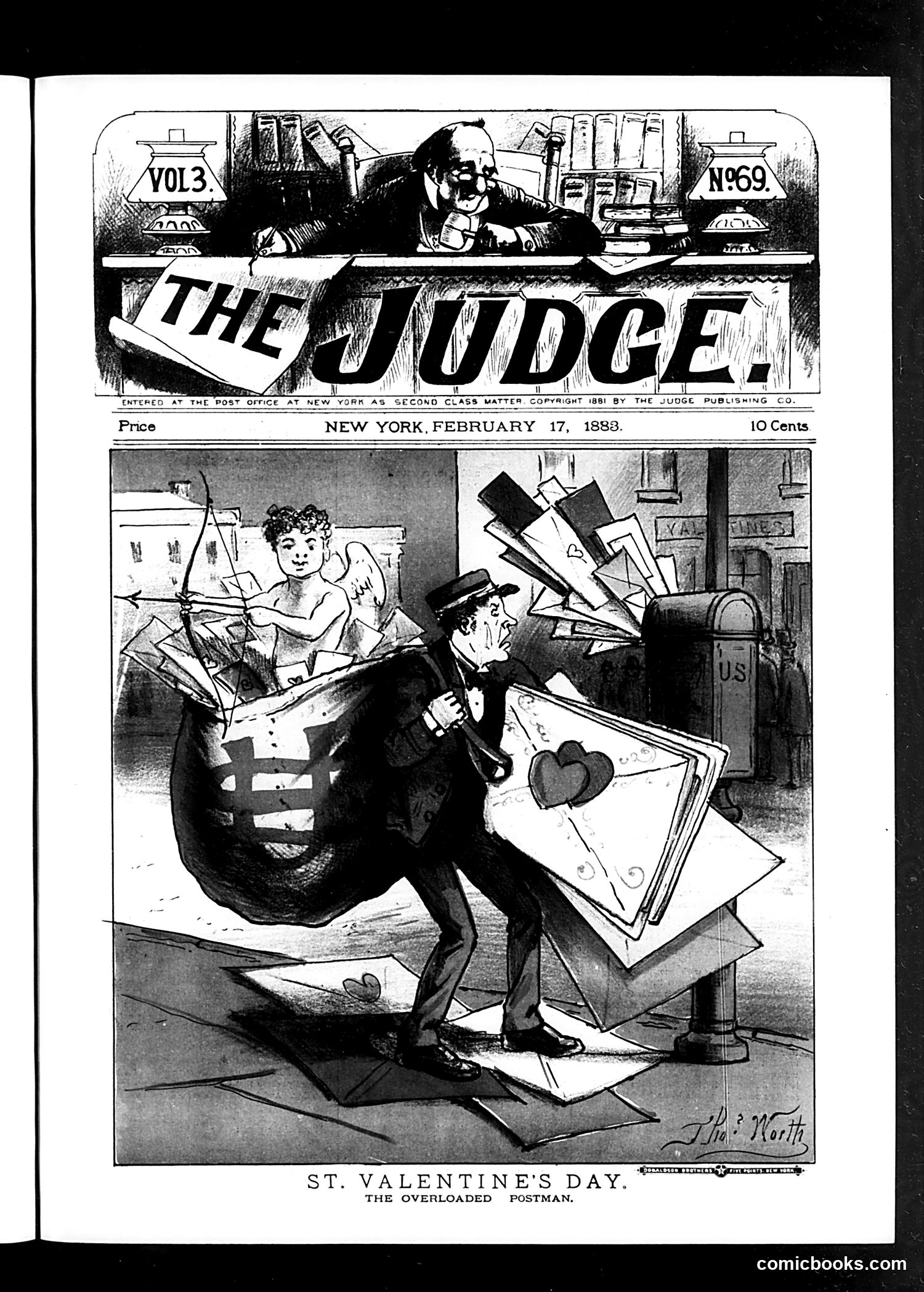
This cartoon satirizes the volume of Valentine's Day mail that postal carriers had to handle. The central figure is a postman, overwhelmed and struggling under an enormous sack of letters and cards. Cupid appears above, cheerfully shooting arrows that transform into more mail. The joke plays on the postal system's burden during Valentine's season—the "overloaded postman" literally cannot manage the deluge of romantic correspondence flooding through the mail. The heart symbols on various letters reinforce the Valentine's theme. This reflects a genuine infrastructure challenge of the 1880s: the postal system struggled with seasonal mail surges, particularly around holidays like Valentine's Day when Americans exchanged romantic cards and letters in unprecedented quantities.
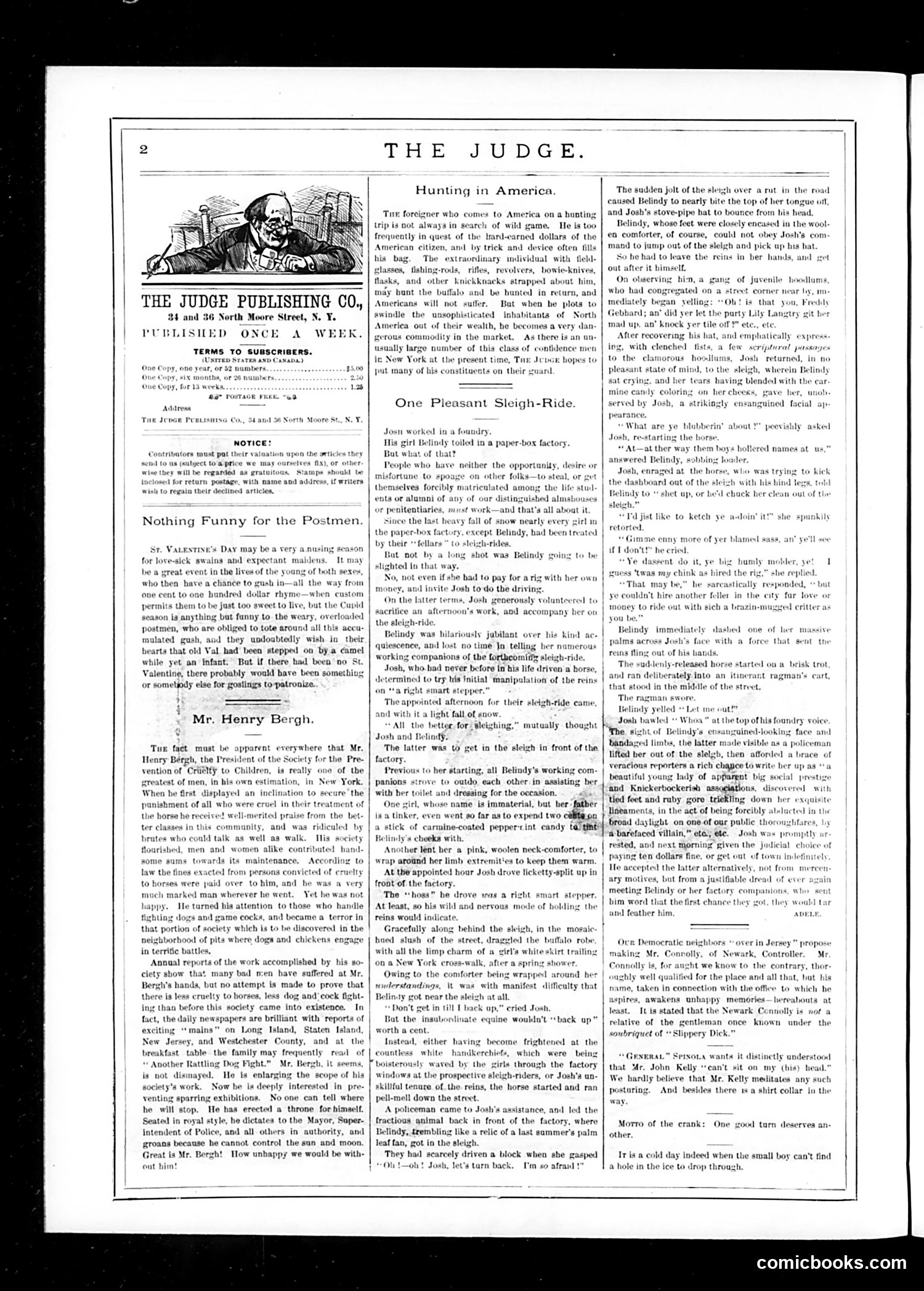
This Judge magazine page contains several satirical pieces about American society issues: **"Mr. Henry Bergh"** mocks the animal-rights activist and founder of the ASPCA. The satire criticizes how Bergh has become self-aggrandizing and dictatorial—positioning himself as morally superior while flexing authority over city officials. The joke is that he's expanded from genuinely preventing animal cruelty into overreach, opposing cockfighting and sparring exhibitions with zealous control, making him ridiculous rather than admirable. **"Hunting in America"** satirizes foreign hunters who come to America pretending to hunt game but actually scheme to swindle unsophisticated Americans out of money through tricks and deception. The piece warns citizens to be on guard against these con-artist foreigners. **"One Pleasant Sleigh-Ride"** (partially visible) appears to be a humorous story about characters named Josh and Belindy. The page also includes publisher notices and advertisements. The overall tone is typical 19th-century satirical journalism targeting specific public figures and social types.
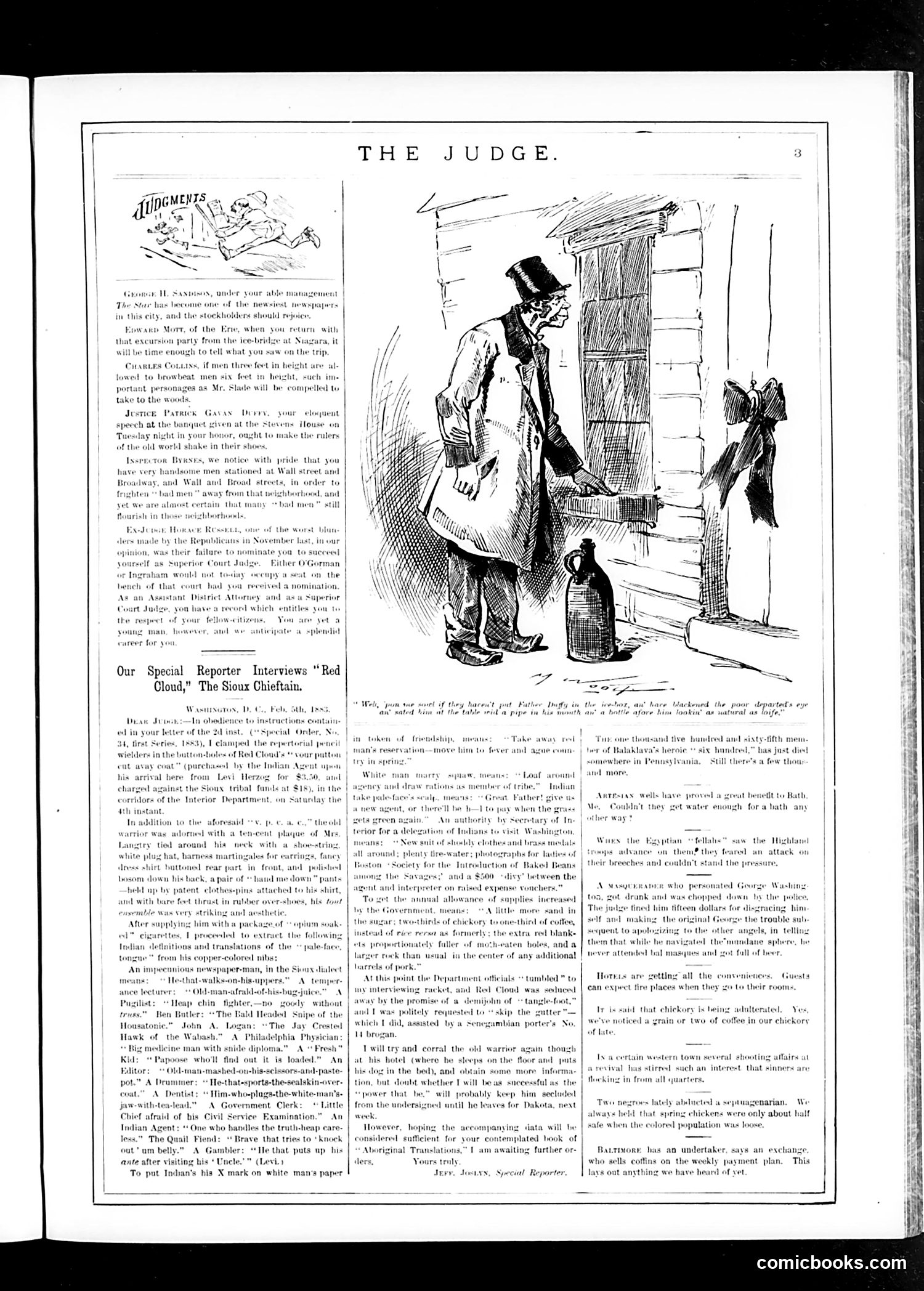
This page from Judge magazine (appears to be early 1880s based on OCR date references) contains a satirical interview titled "Our Special Reporter Interviews 'Red Cloud,' The Sioux Chieftain." **The Satire:** The piece mocks a supposed interview with Red Cloud, the famous Lakota leader, presenting him as complaining about various trivial American grievances—fancy coats, government supplies, interior department officials—in a voice that reduces Native American concerns to petty complaints. **The Political Context:** This represents late 19th-century American racism and Indian policy critique. The satire appears aimed at Republican corruption in Indian affairs (referenced in the text), though it does so through deeply offensive caricature rather than substantive critique. **The Cartoon:** The illustration shows a Native American figure in period dress at a doorway, likely depicting this "Red Cloud" interview scenario. The piece exemplifies how even supposedly satirical publications of the era routinely used racist stereotyping, viewing Indigenous voices as inherently comic rather than legitimate.
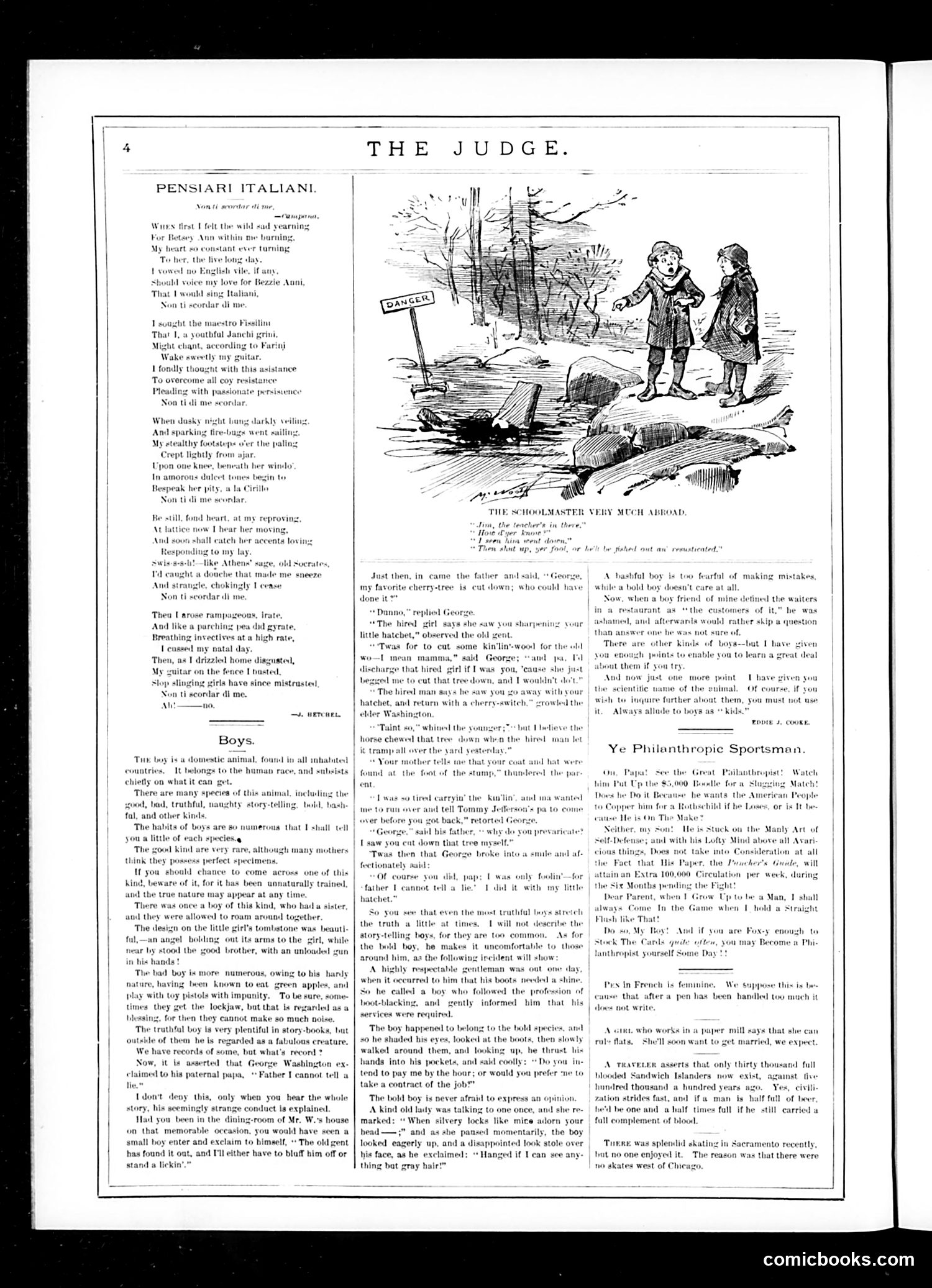
This page contains two distinct pieces of satirical content: **"Pensiari Italiani" (Italian Thoughts):** A comedic poem mocking romantic Italian stereotypes. A lovesick young man attempts to woo "Bezzie Anni" by learning Italian love songs from a maestro, only to be rejected. The satire targets both Italian romantic excess and the pretentiousness of Americans adopting European affectations for courtship. **"The Schoolmaster Very Much Abroard":** The illustrated cartoon depicts a domestic conflict. A boy is caught having chopped down a tree; when confronted by his father, he lies, claiming the teacher did it. The father summons the schoolmaster to confront him. The satire ridicules both the boy's transparent dishonesty and the father's willingness to blame an innocent third party rather than discipline his own child. **"Boys":** An essay cataloging different "types" of boys—truthful, lying, mischievous—as naturalist specimens. This is social commentary on childhood behavior and parental discipline. The page reflects late-19th-century American concerns about honesty, parental responsibility, and ethnic stereotypes.
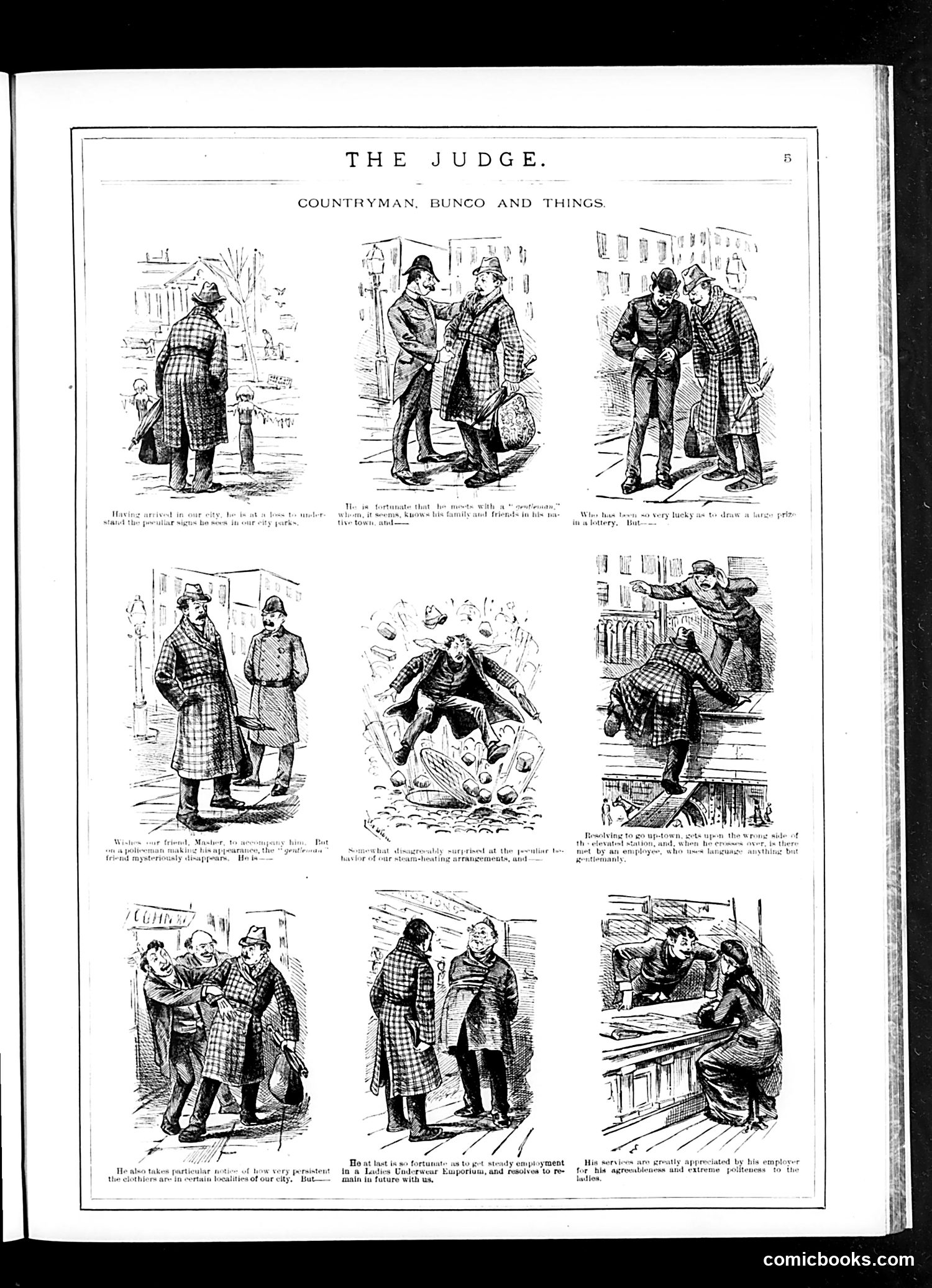
This satirical page depicts a rural man in plaid clothing repeatedly victimized by con artists and swindlers in the city. The series shows a "countryman" encountering various schemes: being approached by suspicious characters offering deals, getting trapped in fraudulent arrangements, and generally being taken advantage of through "bunco" (confidence game fraud). The satire targets the vulnerability of rural visitors to urban con artists. Each panel illustrates different con scenarios—from street hustles to false business opportunities—showing how city sophistication exploits rural naiveté. The protagonist's checkered suit marks him as an outsider, emphasizing the class and culture divide between countryside and city. This reflects late 19th-century American anxiety about rapid urbanization and the dangers facing unsophisticated travelers in increasingly complex cities.
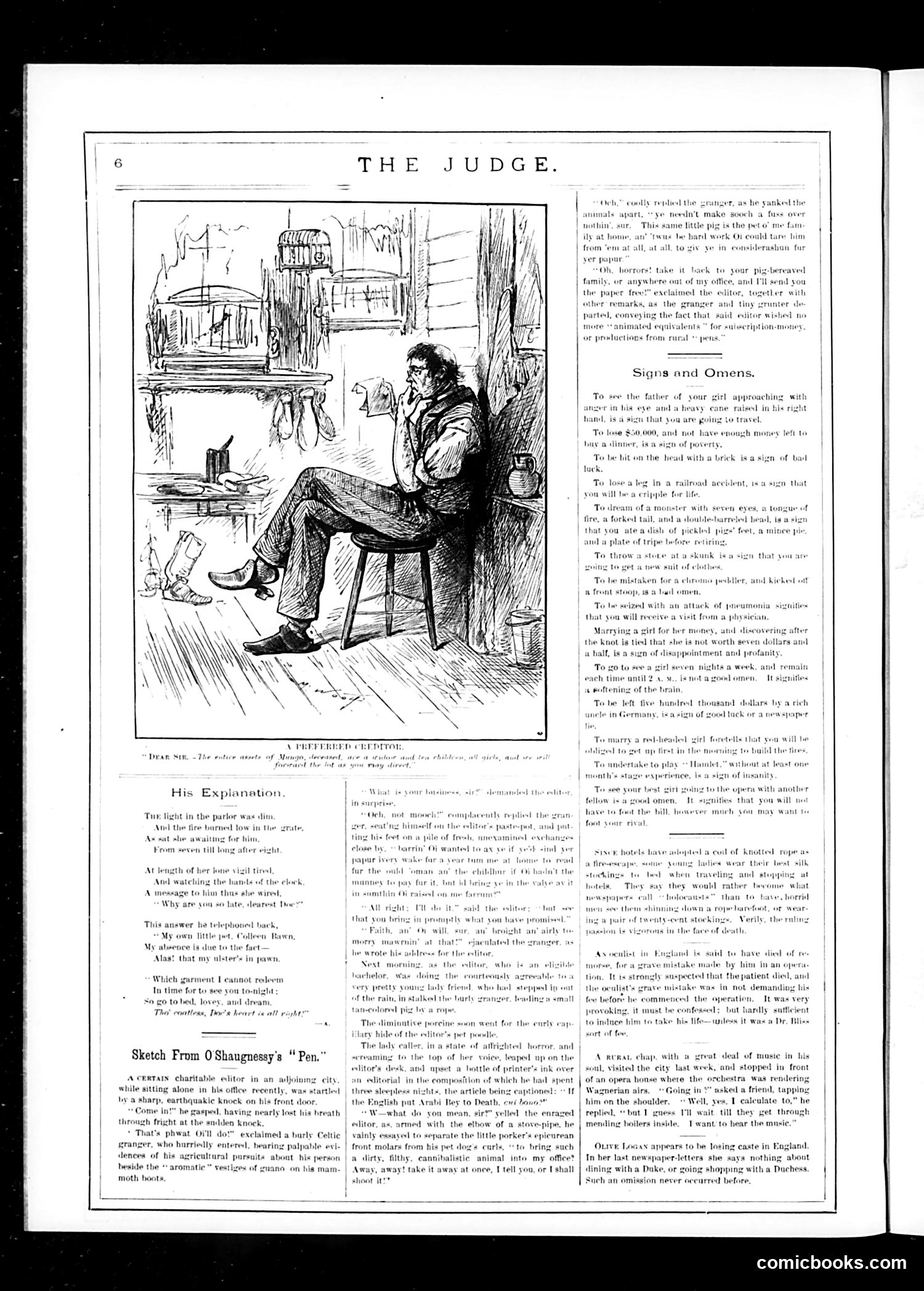
This page from *Judge* magazine contains two distinct pieces: **"The Judge" (main cartoon):** A sketch depicting an editor in his office confronted by an Irish immigrant (identifiable by dialect and caricature) attempting to place a pig in the editor's care. The exchange satirizes both the editor's pretensions and Irish stereotypes—the Irishman speaks in exaggerated brogue, the editor is fastidious and dismissive. The joke targets class attitudes and immigrant marginalization in Gilded Age America. **"Signs and Omens":** A humorous superstition column listing absurd omens (being hit with a brick = bad luck; inheriting money from a rich uncle = good luck). The final items mock society gossip, particularly high-society scandals involving nobility. Both pieces employ the era's common satirical tools: ethnic caricature, class commentary, and social mockery. The overall tone reflects *Judge*'s conservative, middle-class readership perspective on immigrants and lower classes.
This page from *Judge* magazine contains two pieces of satirical content: **"The Bartender"** (left column with illustration): A poem satirizing bartenders as corruptive figures who enable and profit from drunkenness. The repeated refrain "forever" emphasizes their permanent role in perpetuating alcohol consumption and social vice. The bartender claims credit for creating "swelled heads" and planning "drunks," suggesting bars deliberately intoxicate customers for financial gain. **"A Lay Sermon"** (right column): A moralistic essay using the nursery rhyme "Jack Sprat could eat no fat" as a text for social commentary. It appears to contrast domestic harmony (the Sprats sharing their meal peacefully) with real-world domestic conflict. The sermon suggests that marital peace requires careful compromise and that people should learn simplicity and mutual respect from this children's tale. Both pieces reflect *Judge's* typical late 19th/early 20th-century moralistic tone, criticizing social vices (alcohol) and promoting domestic virtue.
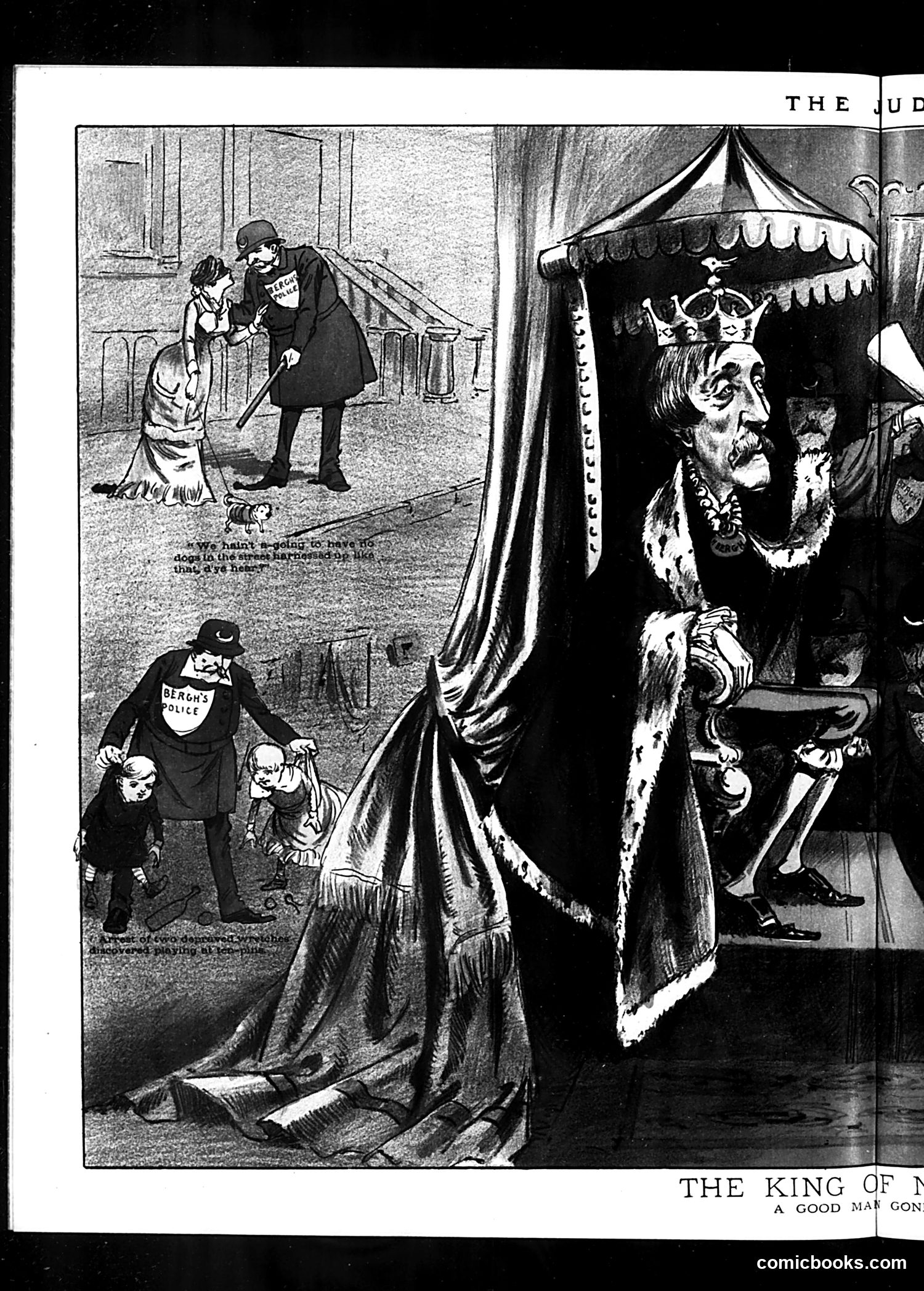
This page appears to show two contrasting scenes from a serialized story or comic strip titled "The King of..." (full title cut off). The left panel depicts a domestic drama: a woman kneels before a standing man in formal dress, while below, a police officer escorts two children away from the scene. The caption references broken promises. The right panel shows an ornate throne room with a crowned, bearded king in royal regalia—clearly a fantasy or historical scene contrasting with the mundane modern setting above. The satire appears to juxtapose idealized monarchy with failed real-world relationships, suggesting ironic commentary on how men fail as husbands and fathers despite aspirations to "kingship" in their homes. The visual contrast between the domestic tragedy and royal grandeur underscores the joke about masculine authority and responsibility.
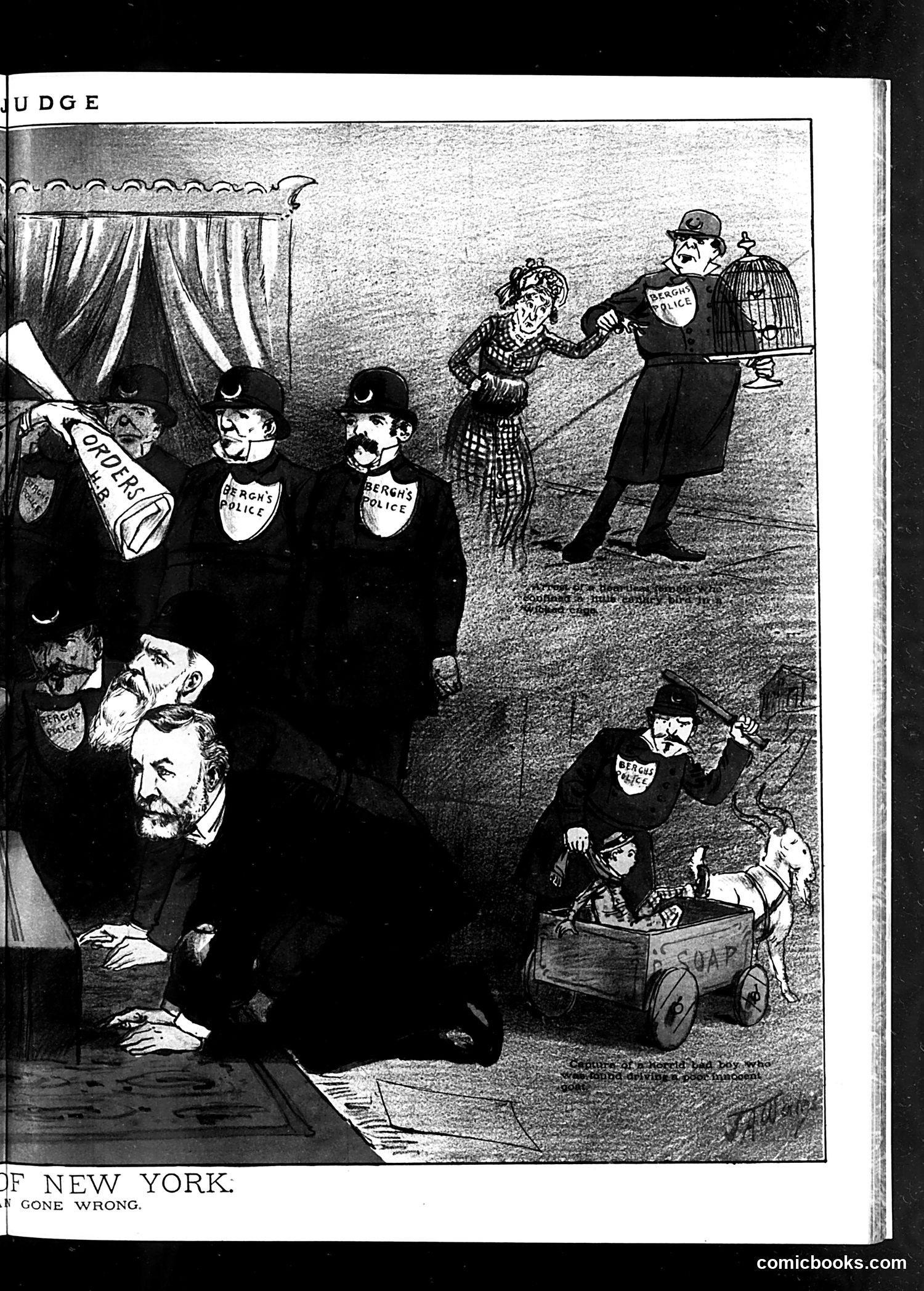
This political cartoon critiques New York City governance and police corruption. On the left, seated judges appear complicit with crime—their heads are literally replaced with criminal faces, suggesting judicial corruption or that judges are indistinguishable from criminals. On the right, "Bergen's Police" officers (marked on their uniforms) oversee a chaotic street scene: a woman with a birdcage, a child in a soap cart, and general disorder. The cartoon satirizes the failure of law enforcement and the judiciary to maintain order. The title "Gone Wrong" suggests systemic breakdown where both judges and police are corrupted or incompetent, unable to protect the city. This appears to be commentary on turn-of-the-century New York political corruption and institutional failure.
This page contains two distinct pieces from *Judge* magazine: 1. **"Theological Advice"** (left column): A dialect poem in racist "plantation speak," featuring a Black preacher dispensing moral lessons to his congregation. The stereotypical language and caricatured voice reflect the deeply offensive racial attitudes of the era. The satire appears directed at hypocrisy—those who preach morality but don't practice it. 2. **"Cinderella" (revised edition)** (main text): A comedic parody of the classic fairy tale that mocks both the original story and contemporary society. It uses exaggerated, grotesque physical descriptions of Cinderella and satirizes the materialism of high society (the ball, the Prince). The humor relies on sarcasm and absurdist descriptions rather than plot twists. Both pieces exemplify *Judge*'s satirical approach, though the first is marred by racist conventions typical of 19th-century American humor that modern readers should recognize as offensive.
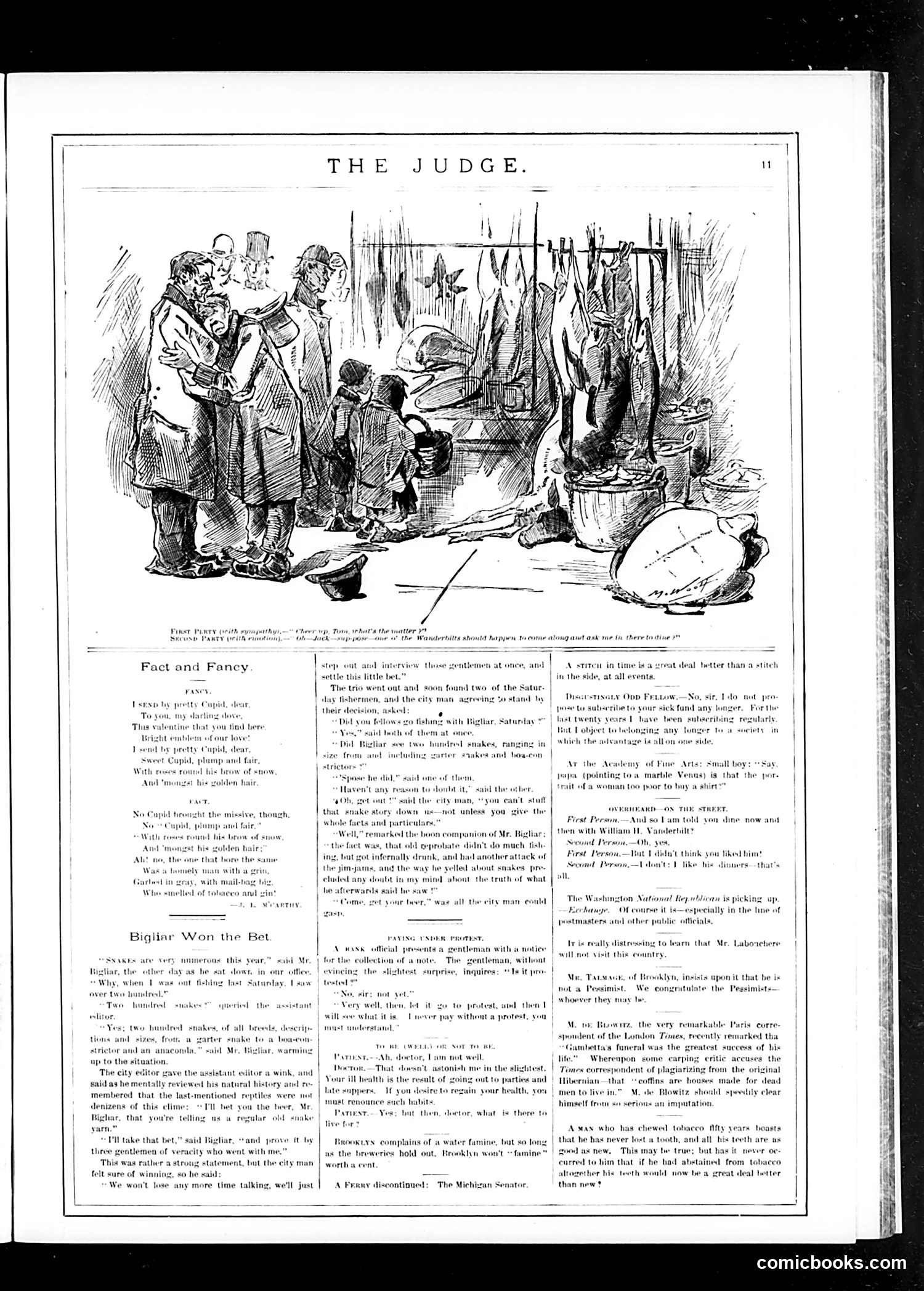
This page from Judge magazine contains three distinct satirical pieces: **"Fact and Fancy"** presents humorous poetry about Cupid, using romantic clichés as setup for mild jokes. **"Bigliar Won the Bet"** satirizes urban/rural differences through a tall-tale anecdote: a city man bets a rural guide that he didn't actually see 200 snakes while fishing. The guide produces witnesses, but they're drunk and unreliable—the joke being that the "proof" undermines rather than supports his credibility. **"Paving Under Protest"** and brief items mock medical advice (a doctor telling a patient to give up suppers to live longer), Brooklyn's water shortage, and social pretensions (discussing a marble Venus sculpture as depicting a poor woman). The overall tone is light domestic humor typical of Judge's era—playing on class differences, exaggeration, and everyday absurdities rather than pointed political commentary. The central joke mocks rural boasting and urban skepticism meeting head-on.
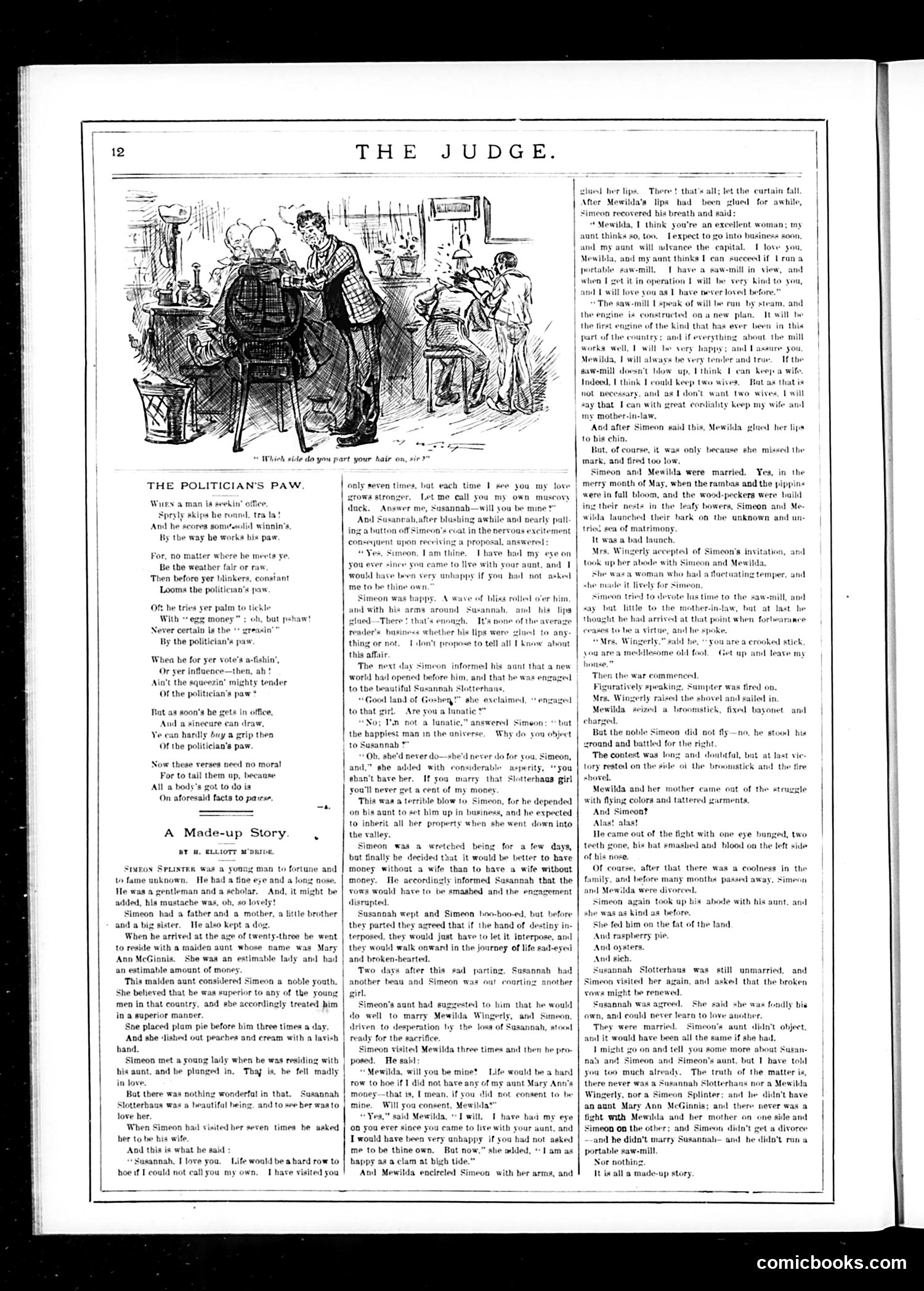
This satirical cartoon critiques political manipulation during election seasons. "The Politician's Paw" refers to how politicians use physical contact—pressing palms, shaking hands—to charm and manipulate voters into supporting them or granting favors. The imagery shows a politician (center, bald) surrounded by common citizens in what appears to be a public space. The cartoon mocks the insincere glad-handing typical of politicians seeking votes or influence. The accompanying verses emphasize the repetitive, calculated nature of these encounters: "every time I see you my love grows stronger," yet the politician's affection is purely transactional. The satire suggests politicians view their constituents as marks to be worked, using practiced charm and empty promises. The "paw" metaphor reduces political engagement to base animal behavior—grasping, manipulative contact stripped of genuine regard. This reflects late-19th-century American anxiety about machine politics and political corruption.
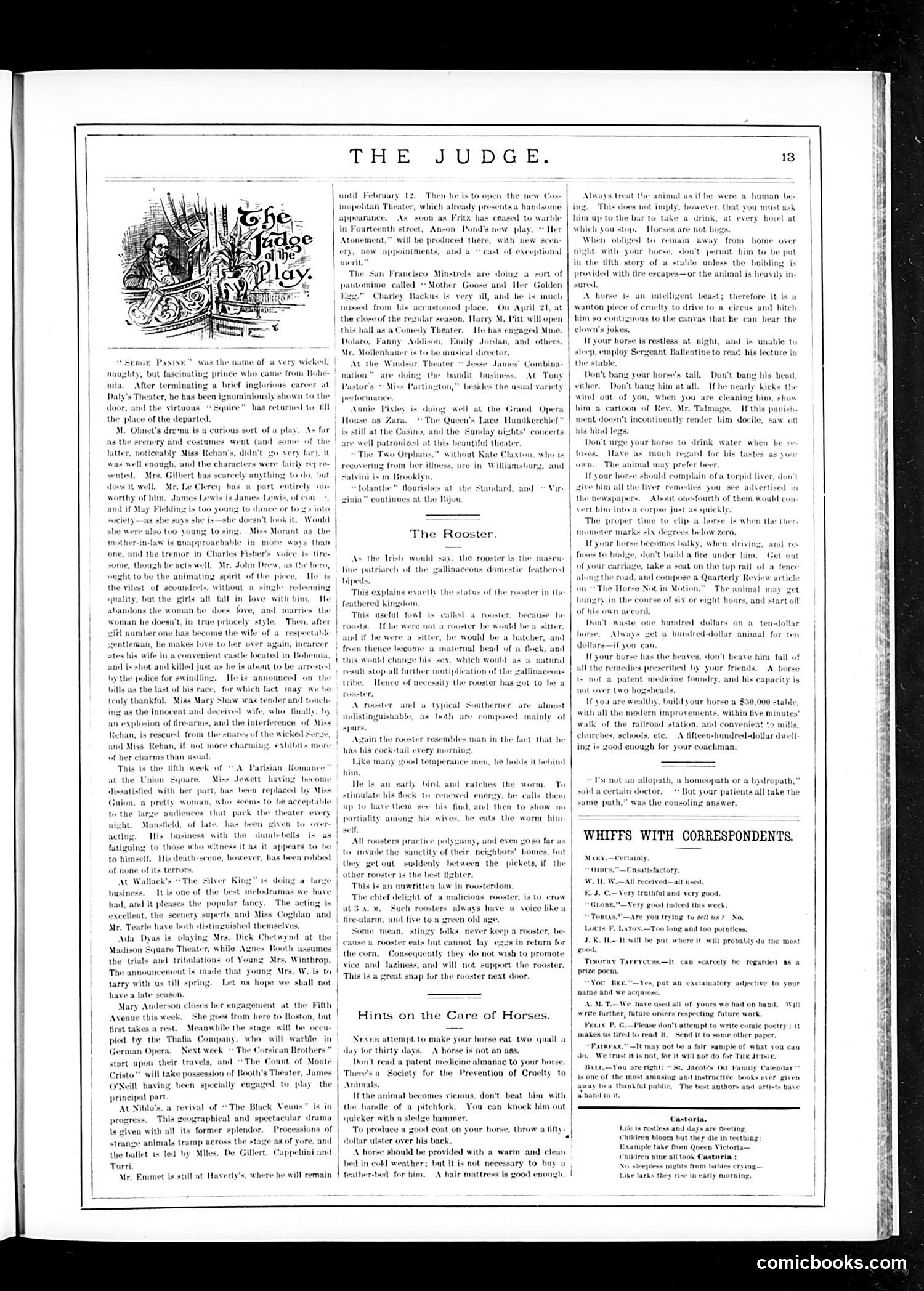
This page contains theater reviews rather than political cartoons. The main illustration shows "The Judge of the Nile"—a decorative header for theater criticism—not a political cartoon. The content reviews contemporary Broadway productions from the 1880s, including plays at Daly's Theater, Madison Square Theater, and Niblo's Garden. Notable performers mentioned include Ada Rehan, James Lewis, and Mary Anderson. The reviews discuss plots, acting quality, and staging of period dramas and melodramas popular at the time. One recurring theme is moral disapproval—reviewers note characters' "wickedness" and appreciate virtuous heroines. The "Hints on the Care of Horses" section offers practical advice about horse management. This reflects Judge's dual nature: satirical commentary on politics and society, plus entertainment coverage for 1880s readers interested in theater and horses.
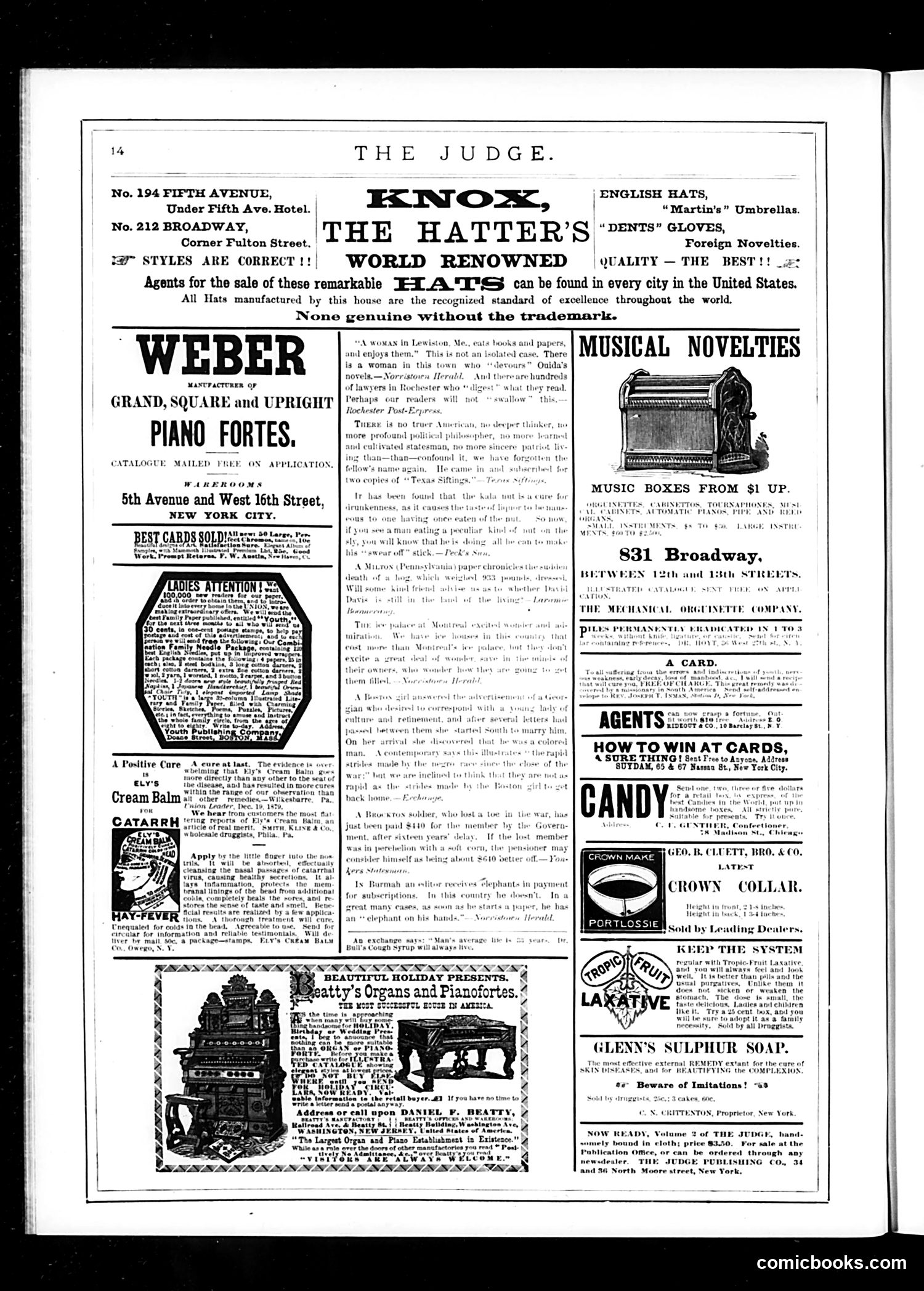
This is primarily an **advertising page** from Judge magazine, not a satirical cartoon section. The page is dominated by commercial advertisements for the era's consumer goods and services. The visible content includes ads for: - **Knox hats** (prominently featured at top) - **Piano fortes** and musical instruments - **Music boxes** - **Playing cards** and card-playing guides - **Clothing items** (collars, gloves) - **Soap and toiletries** There are some brief **editorial vignettes** or short humorous pieces embedded among the ads—small anecdotal stories about human behavior typical of Judge's satirical approach—but these are fragmentary and difficult to read clearly in the OCR'd text. The page reflects late 19th-century American consumer culture and advertising practices, where Judge mixed commercial content with humor. The specific satirical messages are not clearly discernible from this reproduction, making detailed interpretation of intended social commentary impossible.
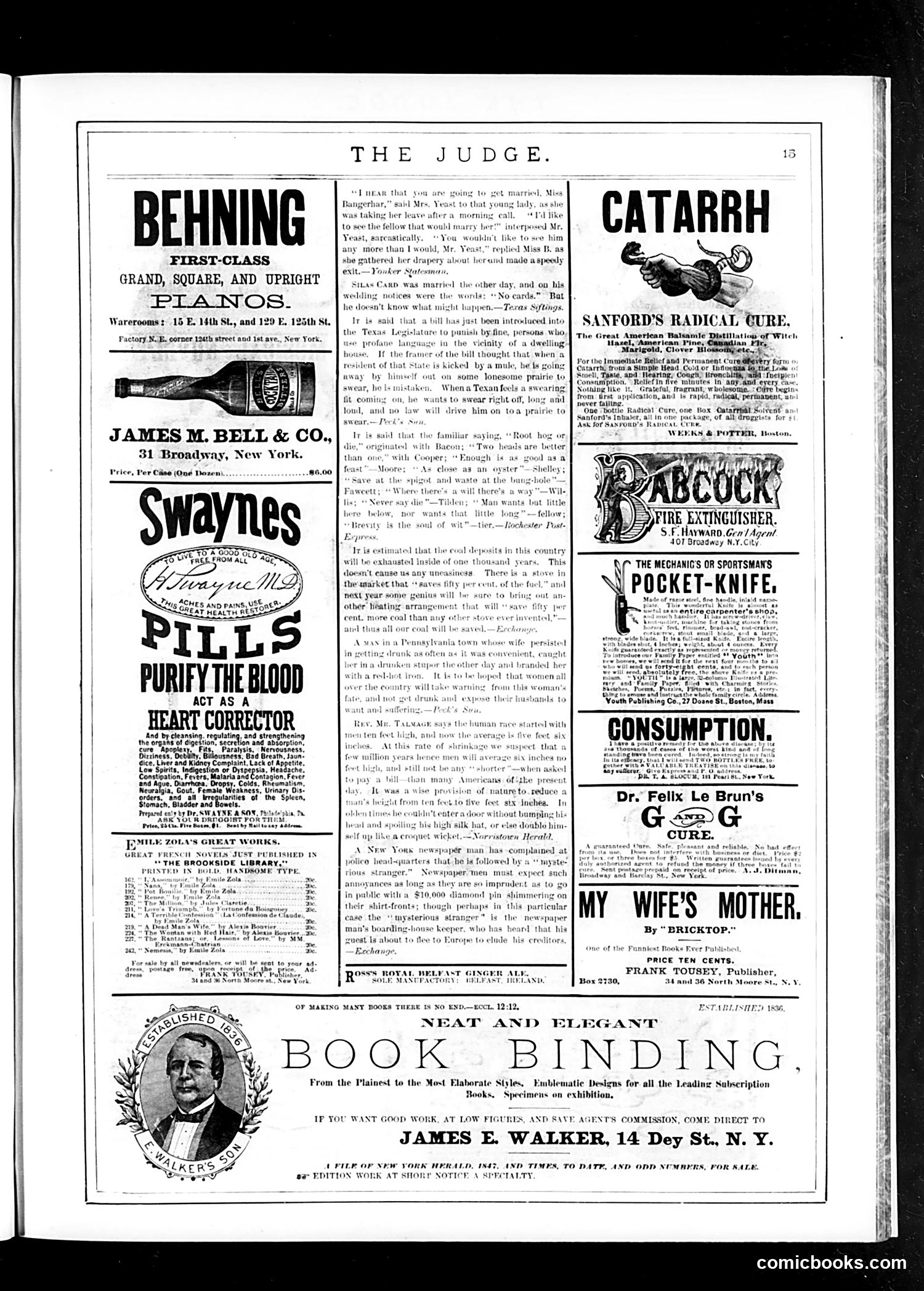
This page is primarily **advertisements and notices** with minimal political cartooning. The main textual content consists of short humorous anecdotes rather than topical satire. The visible jokes target: 1. **Unmarriageable women**: A sarcastic exchange mocking an unattractive woman ("Miss Dangerbar") whom no one would marry—typical period humor about female desirability. 2. **Texas frontier culture**: A jab at proposed legislation punishing profanity near dwellings, mocking the idea that Texans could actually restrain their swearing when kicked by mules—stereotyping frontier roughness. 3. **Male financial irresponsibility**: A quip about men avoiding bill payment, suggesting Americans lack sense with money. The **advertisements** dominate (Behning pianos, Swayne's Pills, patent medicines like Sanford's Radical Cure). This reflects Judge's business model of combining satirical content with revenue from patent medicine and product ads—common in late-19th-century magazines. No specific political figures or events appear identifiable on this page.
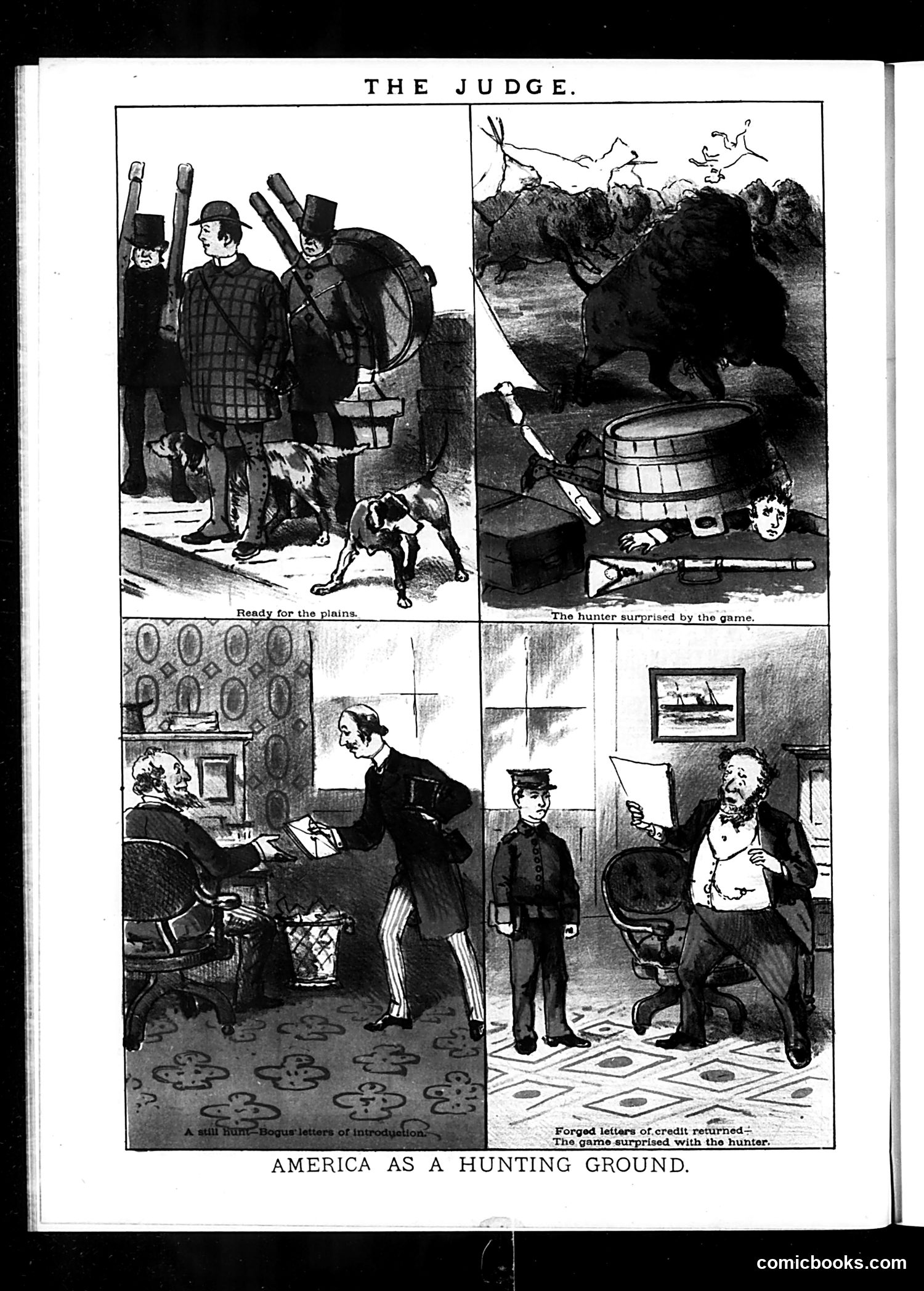
This satirical cartoon critiques fraudulent schemes targeting immigrants in America. The four-panel narrative shows: **Panel 1:** "Ready for the plains" — hunters prepare with dogs and equipment. **Panel 2:** "The hunter surprised by the game" — a large bear (representing dangerous criminals or con artists) emerges unexpectedly. **Panel 3:** "A still hunt—Bogue letters of introduction" — indoor scene depicting forged credentials being used to deceive victims. **Panel 4:** "Forged letters of credit returned—The game surprised with the hunter" — the scheme unravels as fake documents are exposed. The title "America as a Hunting Ground" suggests that America itself becomes a dangerous territory where con artists hunt naive immigrants using forged letters of introduction and credit. The cartoon satirizes the vulnerability of newcomers to systematic fraud and deception.