
A complete issue · 16 pages · 1883
Judge — January 20, 1883
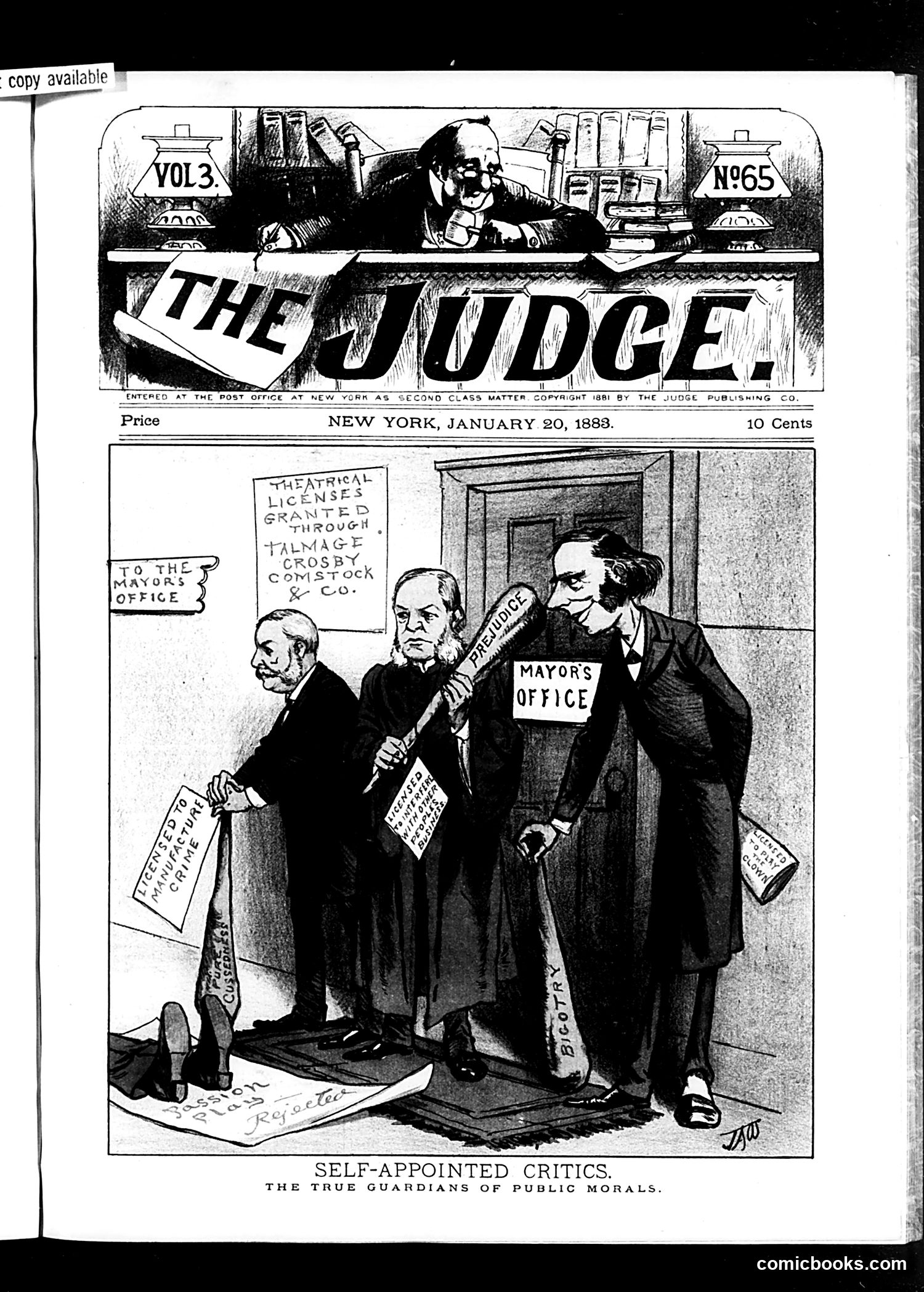
This 1888 *Judge* cartoon satirizes theatrical censors operating outside official authority. Four men in dark coats stand at the Mayor's Office door, wielding a club labeled "PRUDENCE" as a weapon. Signs reference "Theatrical License Granted" through various theatrical companies (Talmage, Crosby, Comstock & Co.). Papers on the ground appear to be rejected works or petitions. The satire targets self-appointed moral guardians—likely including Anthony Comstock, the famous anti-obscenity crusader—who pressured city officials to suppress theatrical productions they deemed immoral. The cartoon criticizes their extrajudicial power: these private citizens, lacking official standing, effectively controlled what New Yorkers could see on stage by threatening productions and terrorizing producers, positioning themselves as society's moral police.
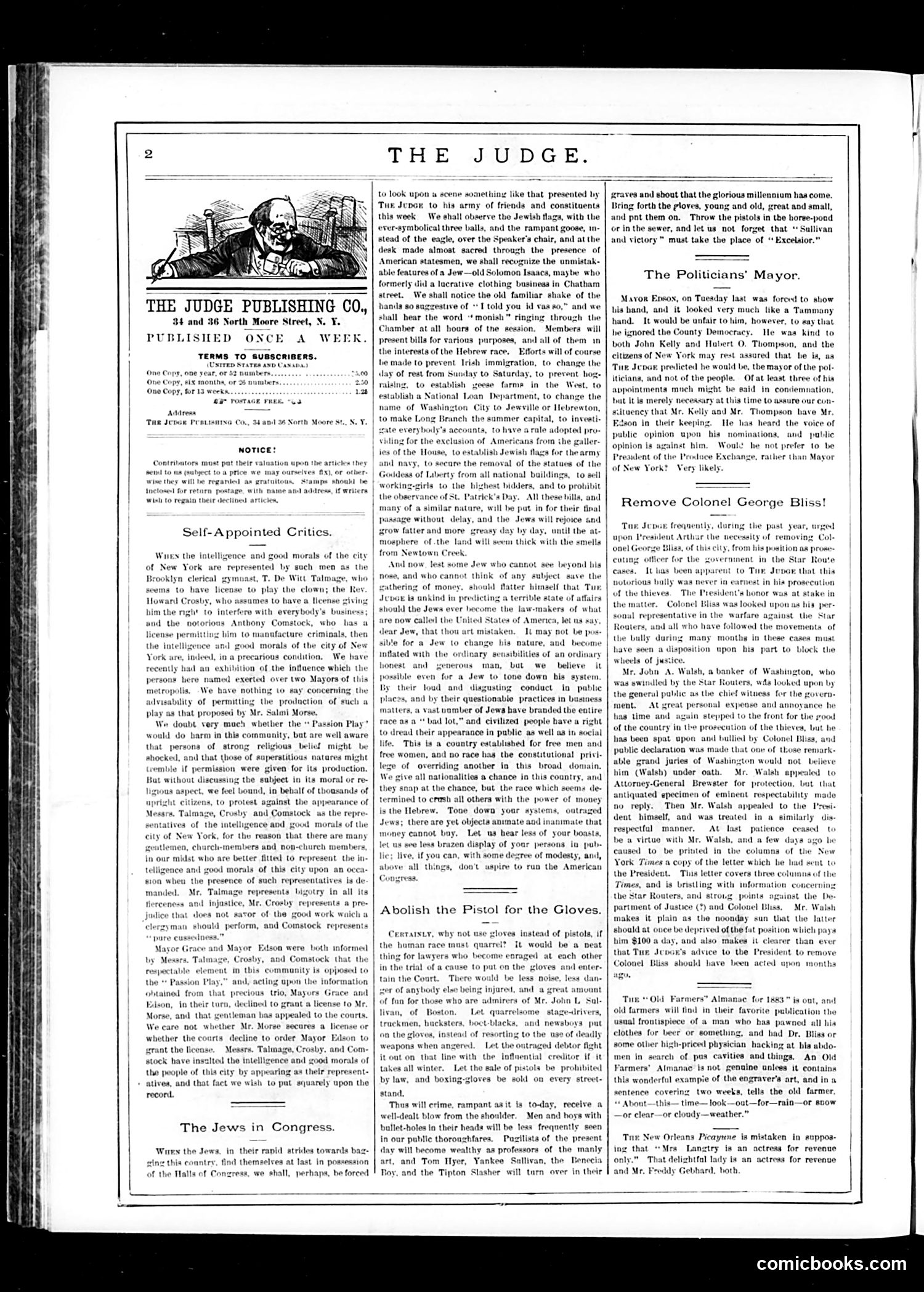
This page from Judge magazine contains satirical commentary on several contemporary issues, though the exact date is unclear from the OCR. **"Self-Appointed Critics"** attacks prominent New York moral crusaders—specifically clergymen T. De Witt Talmage and Howard Crosby, plus Anthony Comstock (the notorious anti-vice activist)—for opposing a "Passion Play" production. Judge argues these men don't represent the city's actual intelligence or morality, and sarcastically suggests their interference demonstrates "bigotry." **"The Jews in Congress"** employs crude antisemitic caricature, mocking the supposed rise of Jewish political influence. It uses offensive stereotypes (three-ball pawnbroker imagery, Yiddish dialect) to ridicule the imagined prospect of Jews controlling Congress, suggesting they'd replace American symbols and conduct with Jewish ones. **"Remove Colonel George Bliss!"** and other sections discuss municipal politics and patronage disputes. The page reveals Judge's era as one where antisemitism was considered acceptable satire alongside critiques of actual public figures like Comstock.
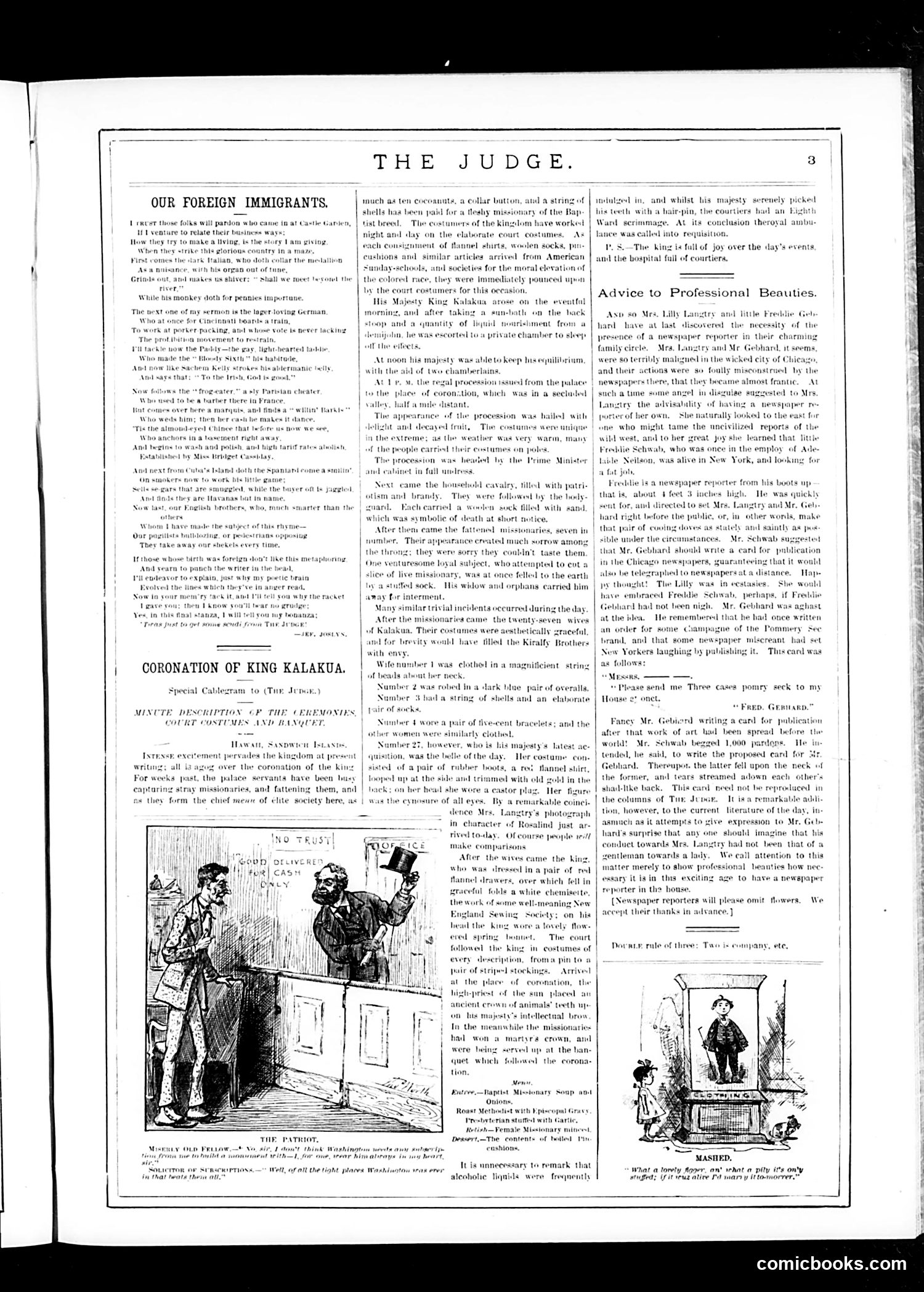
This page contains two distinct satirical pieces: **"Our Foreign Immigrants"** mocks various immigrant groups arriving at Castle Garden (the immigration processing center). The verses ridicule Italian organ-grinders, Chinese laborers, Irish immigrants, and English workers—a common Judge theme targeting the era's xenophobic anxieties about foreign workers and their perceived threat to American jobs and values. **"Coronation of King Kalakua"** satirizes the 1883 Hawaiian coronation of King Kalakaua. The piece offers mock-reverent "descriptions" of the ceremonies while making racist jokes about Hawaiian customs, foods (coconuts), and the supposed primitiveness of Hawaiian court life. The accompanying illustration shows figures in exaggerated dress, reinforcing period stereotypes. Both pieces reflect late-19th-century Judge editorial positions: nativist anxiety about immigration and racial condescension toward non-white populations. The humor relies on ethnic caricature and assumed reader prejudices now recognized as deeply offensive.
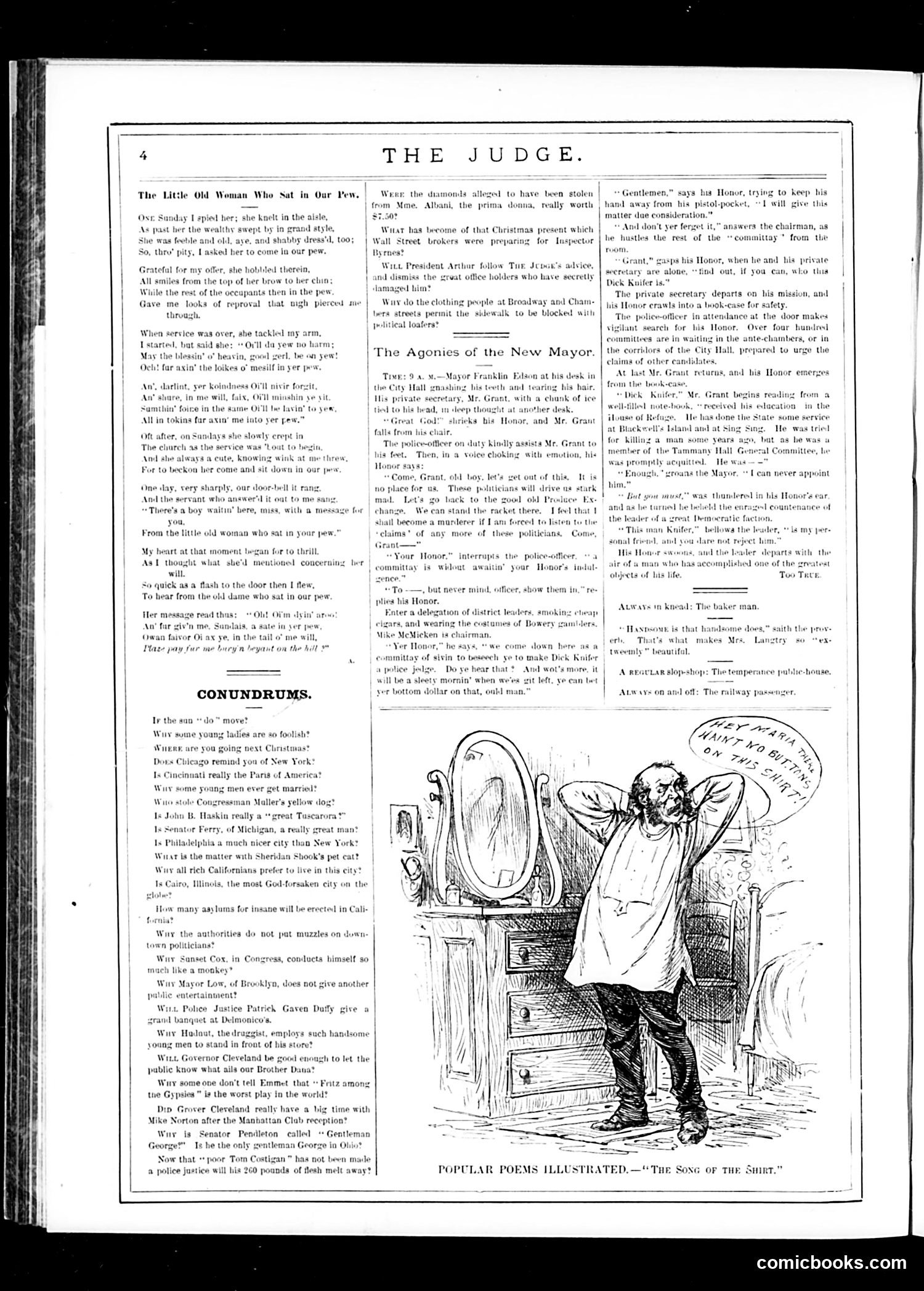
This page satirizes **political corruption and nepotism in New York City government**, circa the early 1880s. The main cartoon illustrates a story about Mayor **Franklin Edson** (identifiable from text references to "City Hall" and the mayor's desk scene). The narrative depicts Edson's private secretary frantically trying to wake the sleeping mayor to address urgent city business—a visual joke about administrative incompetence or negligence. The "Conundrums" section—a series of rhetorical questions—mocks various political figures and situations: Senator Pendleton, Congressman Mather, Mayor Low of Brooklyn, Justice Patrick, and Governor Cleveland. These target perceived failures in governance, public works management (blocked sidewalks), and judicial corruption ("police judge"). The sentiment throughout reflects **Progressive Era skepticism** toward urban machine politics and the capacity of elected officials to serve the public interest rather than personal or partisan advantage. The Irish-accented servant's poem opening the page adds period-specific ethnic humor.
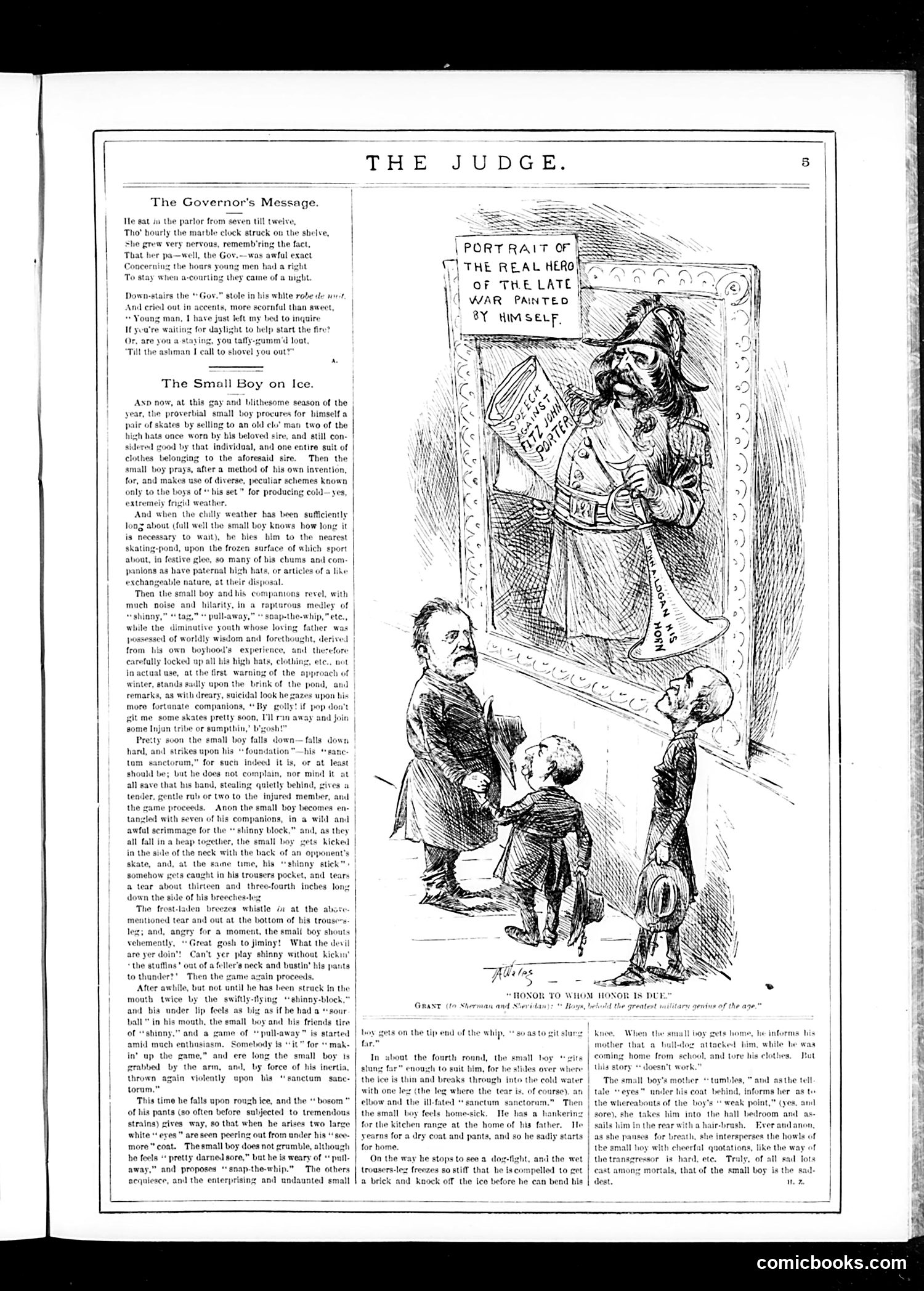
This *Judge* page contains two satirical stories about American life, illustrated with sketches. **"The Governor's Message"** appears to satirize political long-windedness—a man sits through tedious evening hours listening to what seems to be a verbose governor's speech or message, with the impatient narrator finally threatening to have him removed. **"The Small Boy on Ice"** is a humorous narrative about working-class childhood in winter. A poor boy trades his father's old clothes and hats to buy skates, then spends the day at a frozen pond playing rough games like "shinny" (ice hockey) and "snap-the-whip." The satire lies in depicting the boy's cheerful endurance of constant physical punishment—kicked, knocked down, his pants torn—without complaint. The piece gently mocks both the boy's resilience and the father's parsimonious nature (keeping old clothes locked away). It's affectionate social commentary on urban working-class childhood.
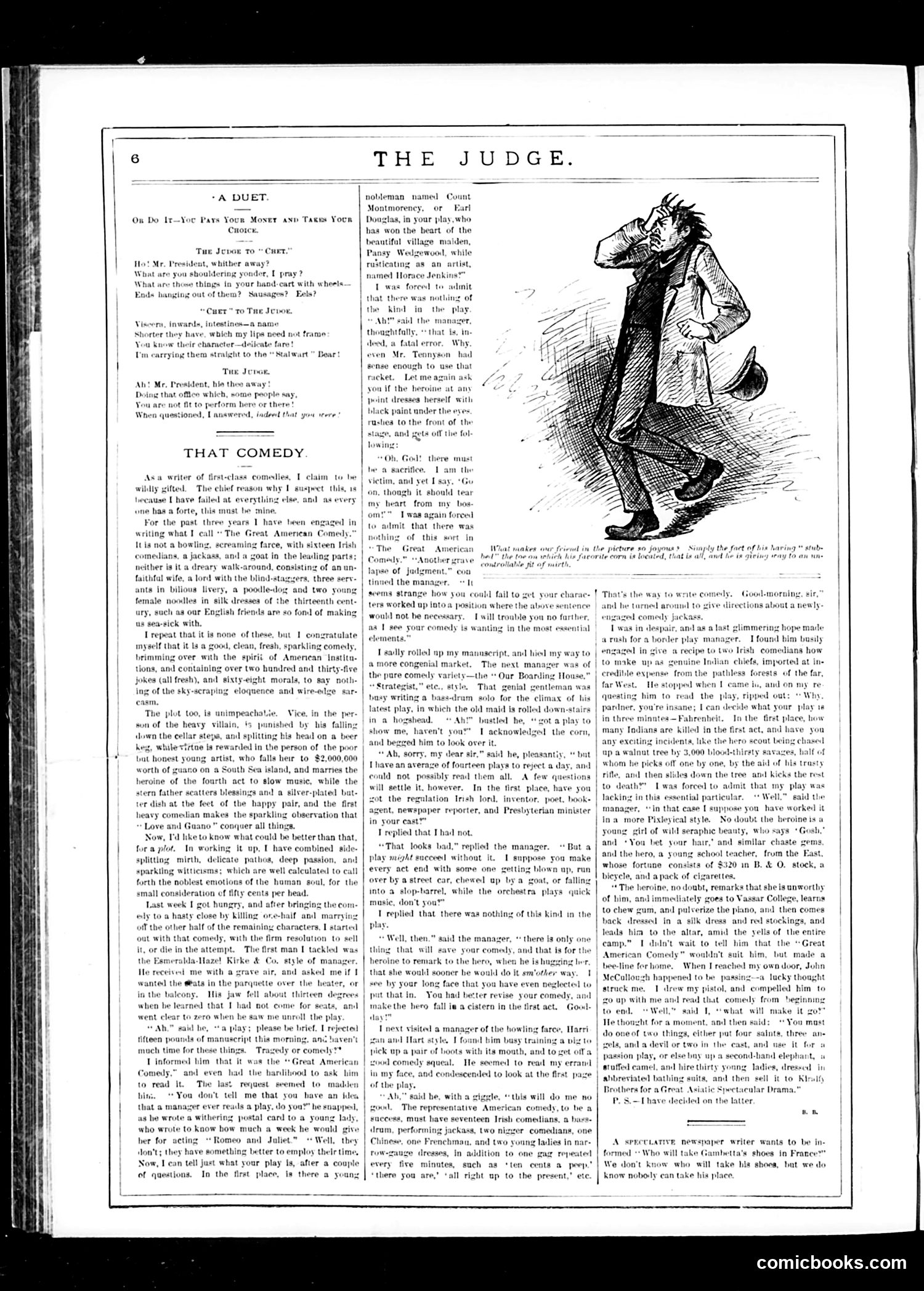
This page from *Judge* satirizes theatrical comedy writing through two pieces: ## "A Duet" A comedic exchange between a Judge editor and a cart-driver carrying animal intestines. The editor mocks someone for literally transporting sausage casings, misunderstanding them as theatrical props—a joke about the absurdity of poorly-written comedies relying on crude physical humor. ## "That Comedy" The main article critiques American stage comedies of the era. The author (appearing to be a playwright) describes pitching his "fresh, sparkling" Irish comedy to theater managers, only to face rejection for lacking the required crude elements: multiple Irish characters, physical slapstick, and ridiculous stereotypes (like Native American impersonations). **The Satire's Point**: *Judge* mocks both the low standards of American theater audiences who demanded broad ethnic stereotypes and slapstick, and the theater managers who rejected more sophisticated comedy. The piece satirizes the gap between genuinely clever writing and what entertainment industry gatekeepers believed would sell. The cartoon illustrates a disheveled theatrical figure, likely representing the struggling playwright's frustration.
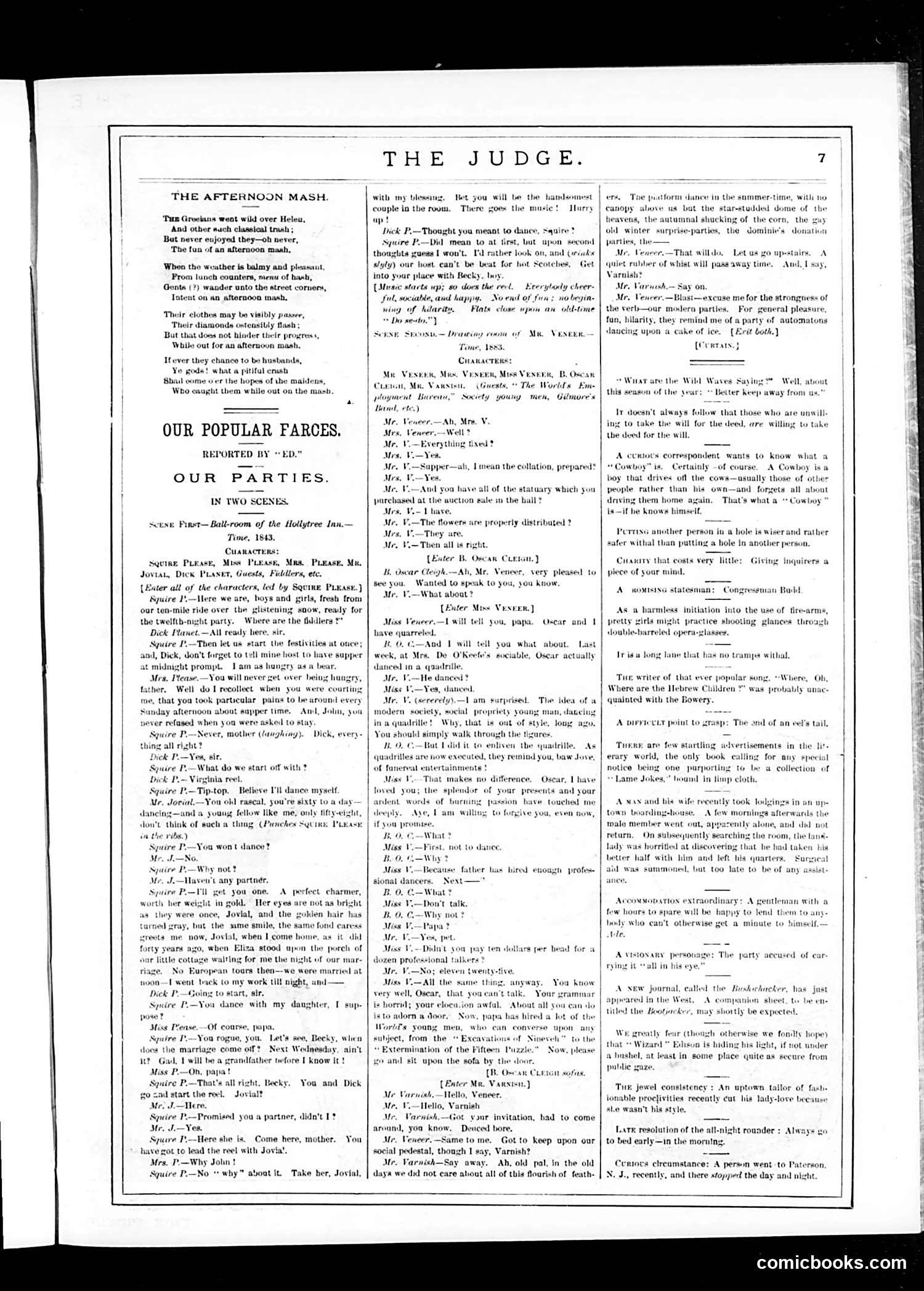
This page contains two separate pieces of satirical content from the late 19th century: **"The Afternoon Mash"** (top): A poem mocking the social pretensions of middle-class New Yorkers who parade through the city trying to appear wealthy and sophisticated despite their humble origins. "Mash" refers to flirtation or showing off. **"Our Popular Farces"** (bottom): A two-act play script satirizing artificial drawing-room society. The characters—Mr. and Mrs. Veneer, B. Oscar Cleigh—have names suggesting superficiality ("veneer" = fake surface). The dialogue ridicules how upper-class social gatherings consist of hollow pleasantries, gossip about servants, and pretentious behavior masking empty lives. Both pieces target the same target: newly wealthy or aspiring middle-class Americans obsessed with social status and etiquette while lacking genuine substance or breeding. The satire suggests that "society" is merely performance—exhausting theater without authenticity.
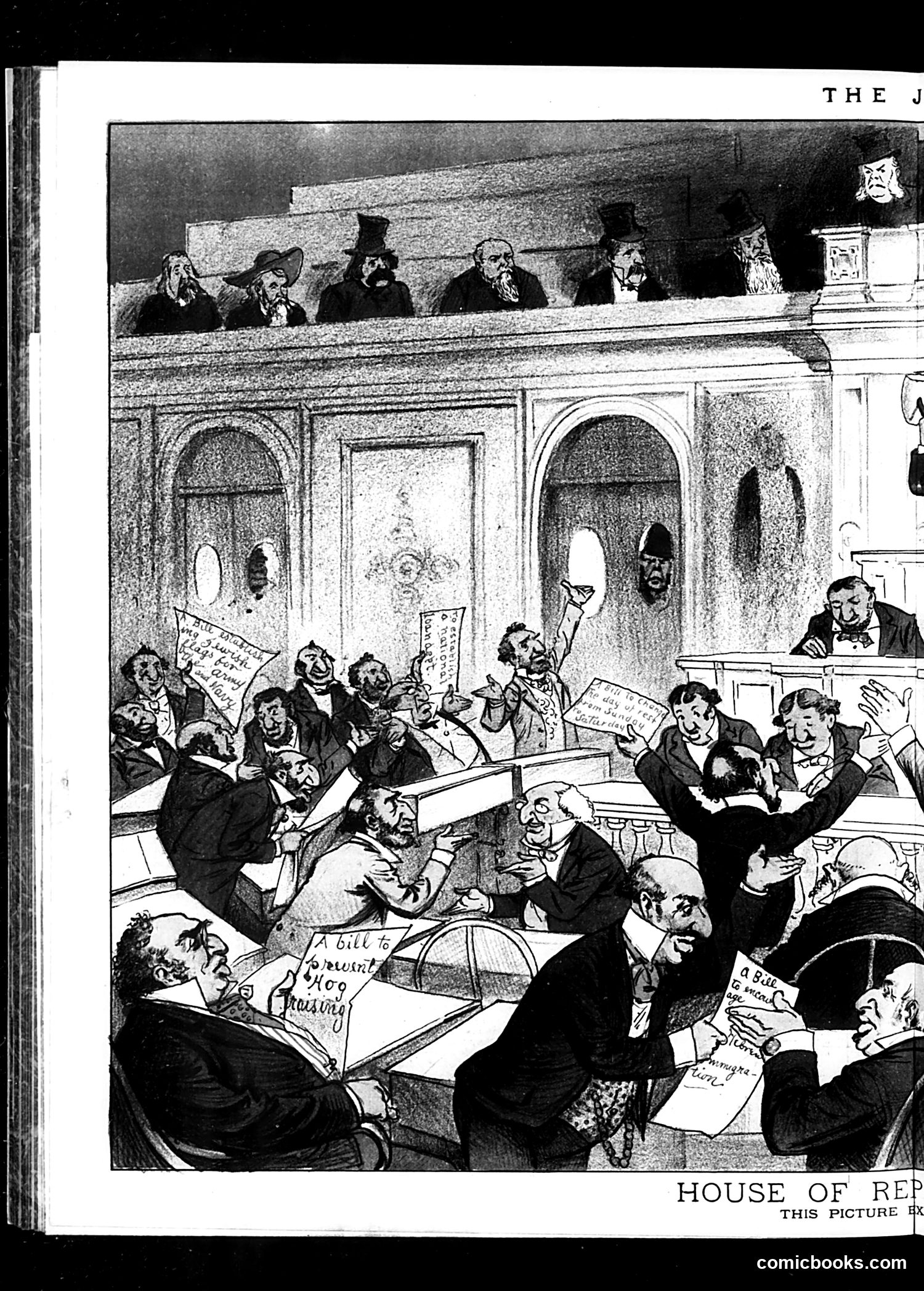
This appears to be a satirical cartoon depicting the House of Representatives in chaotic session. The image shows legislators engaged in animated debate, with several holding documents labeled "a bill to" (text partially visible). The composition emphasizes disorder—figures are gesticulating wildly, some appearing to speak simultaneously, creating an impression of legislative bedlam. The satire criticizes Congressional dysfunction and inefficiency. Caricatured representatives are drawn with exaggerated features typical of period political cartooning. Observers in the gallery above watch the commotion, seemingly bemused or alarmed. Without clearer text or visible date, the specific bill or political moment remains unclear, but the cartoon's general point is evident: mocking legislators for prioritizing theatrical argumentation over productive lawmaking. This was a recurring theme in Judge magazine's political commentary.
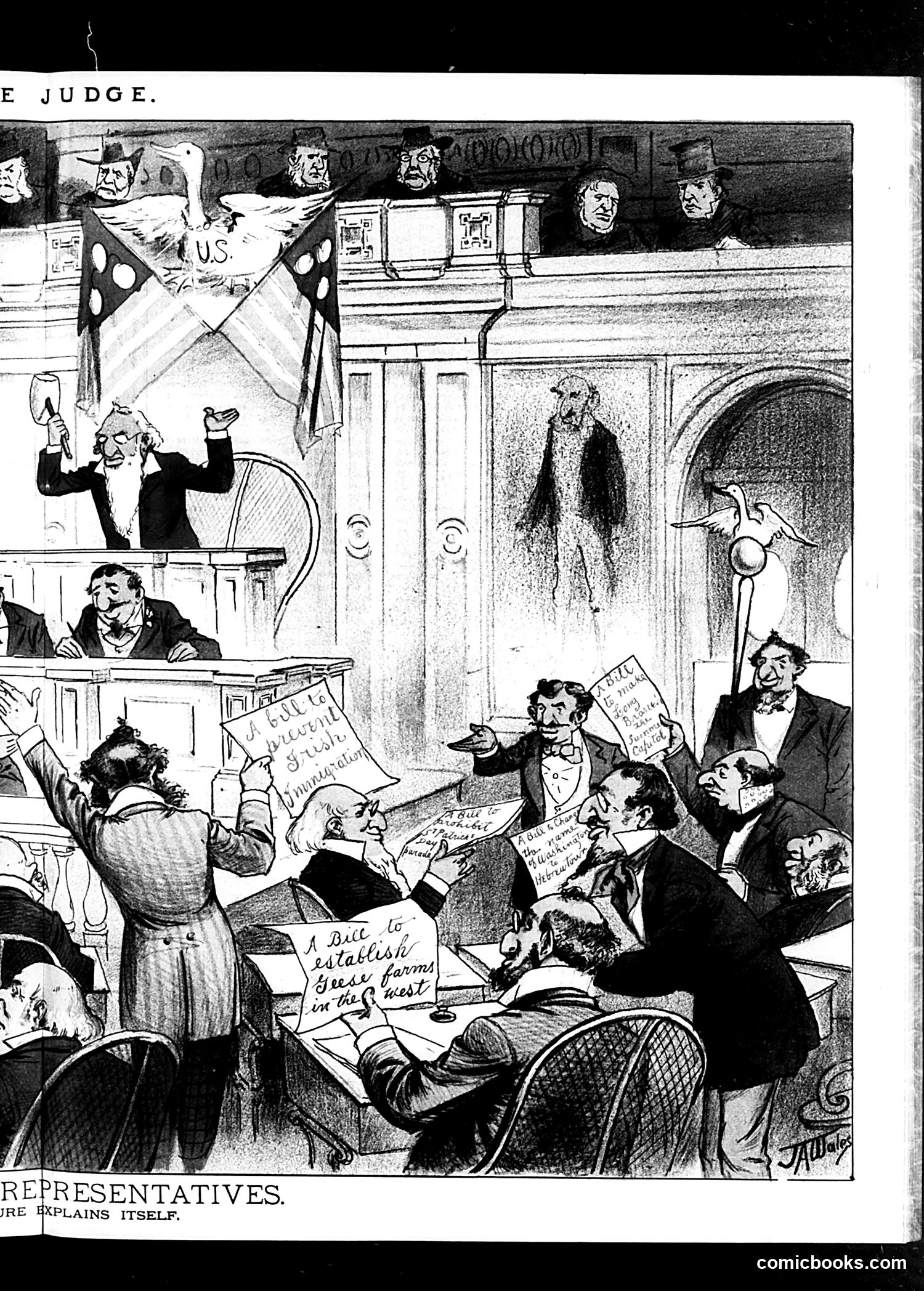
This Judge magazine cartoon satirizes congressional debate, likely from the early 20th century. The scene depicts a courtroom-style proceeding where representatives present various bills and proposals (visible on papers they're holding). The judge presides from an elevated bench while politicians gesture dramatically below, suggesting theatrical posturing over substantive lawmaking. The cartoon mocks the performative nature of Congress—representatives appear more interested in grandstanding and self-promotion than serious legislative work. The caption "PICTURE EXPLAINS ITSELF" suggests the absurdity is self-evident. The American eagle shield visible in the courtroom emphasizes that this chaotic scene supposedly represents U.S. governance. The satire targets congressional inefficiency and the tendency of politicians to prioritize showmanship over actual governing.
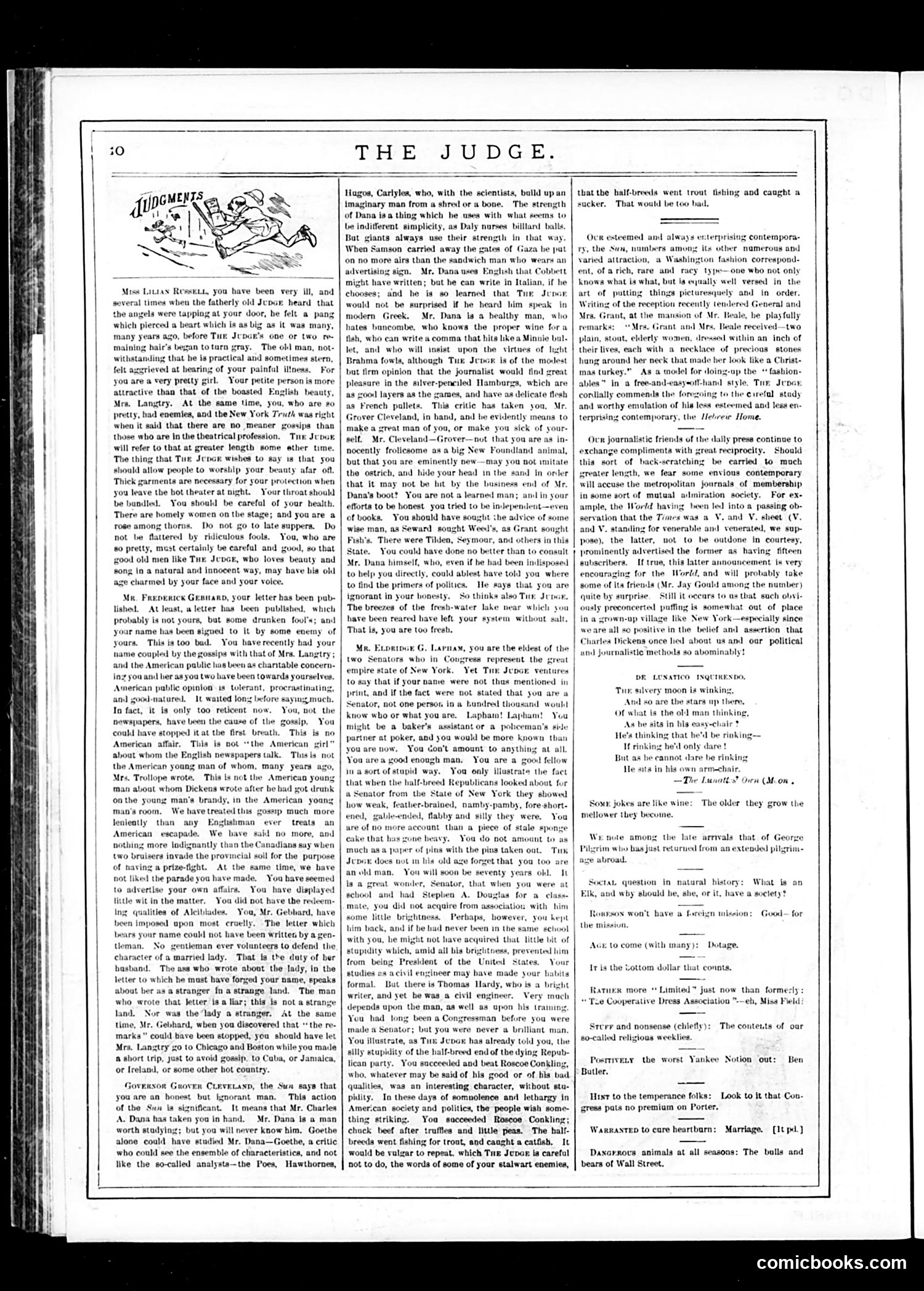
This page from *Judge* magazine contains **editorial commentary rather than political cartoons**. The small illustration at top-left appears to show a figure in motion, but is secondary to the text. The main content addresses **three contemporaries**: Miss Lillie Russell (actress), Frederick Gebhard (her escort), and Mrs. Langtry (the famous "Jersey Lily"). The editors are responding to a scandal involving Russell's illness and the gossip surrounding her public association with Gebhard. *Judge's* stance is moralistic but surprisingly sympathetic: they praise Russell's beauty while warning her to dress modestly and avoid late suppers, scold Gebhard for being manipulated into publishing a defensive letter that was likely forged by an enemy, and criticize both for the "parade" of their affair. The magazine distinguishes this American scandal from European gossip, suggesting Americans have been unusually tolerant of their behavior. The satire targets **public figures who invite scandal through indiscretion** rather than critiquing any political position.
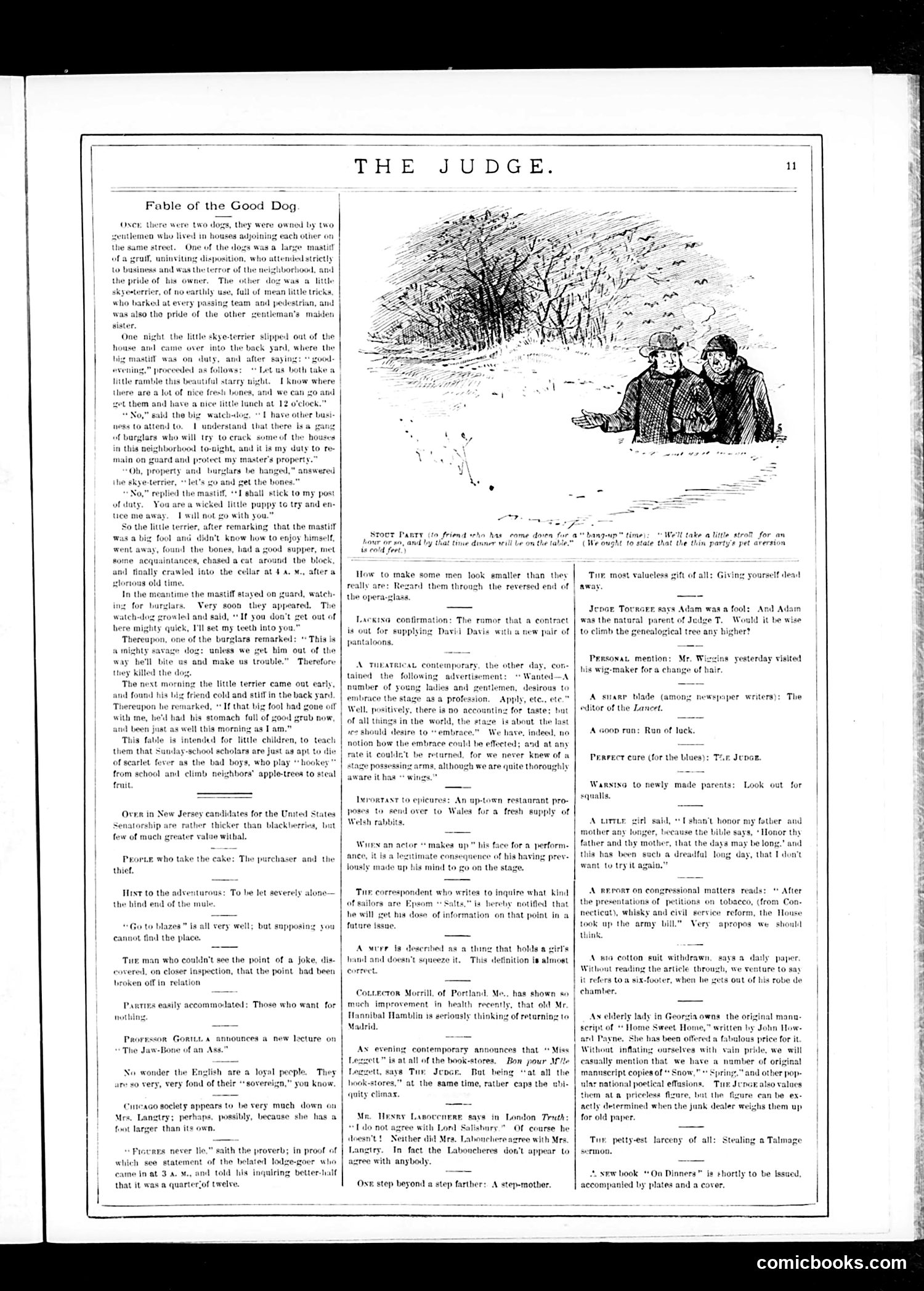
This page presents a moral fable warning against abandoning duty for pleasure. A large mastiff guard dog refuses a small skye-terrier's invitation to abandon his post for stolen bones and fun. The mastiff stays vigilant while the terrier enjoys himself. That night, burglars kill the unguarded mastiff. The satire's moral explicitly targets "little children" and Sunday-school scholars: it argues that dutiful "bad boys" who skip school and steal apples live longer than obedient children—inverting conventional morality. The joke critiques Victorian piety and discipline by suggesting that responsibility and virtue offer no real advantage. The surrounding miscellaneous items are typical Judge magazine filler: political notes about New Jersey Senate candidates, wordplay, and brief social commentary. The cartoon illustrates the moral tale with a sketch of two dogs meeting in a yard at night.
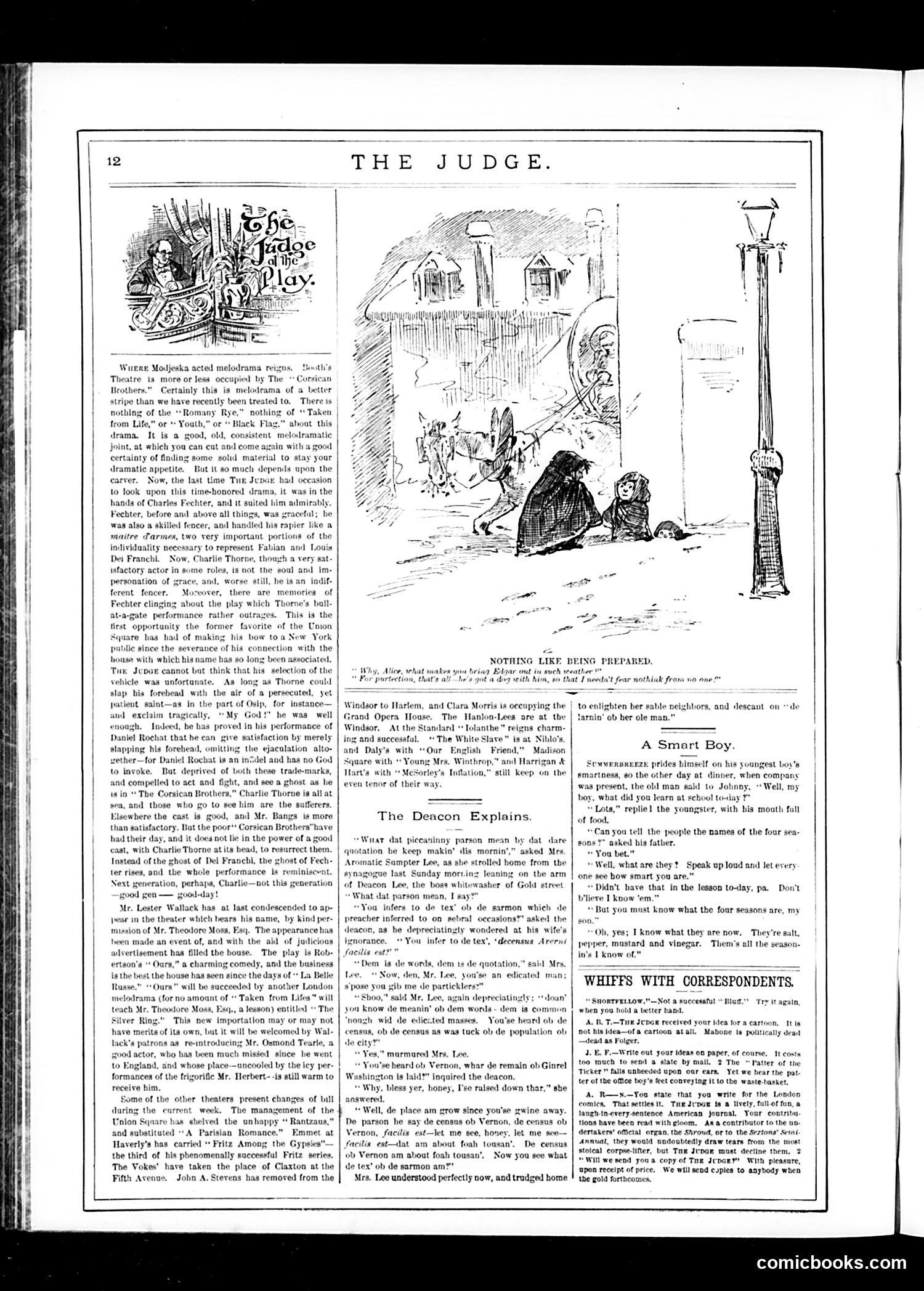
This page reviews recent theatrical productions, focusing on a production of *The Corsican Brothers* at the Union Square Theatre. **Main Critique:** The review condemns actor Charlie Thorne's performance in this melodrama, arguing he lacks the grace and swordsmanship essential to the role. The critic favorably compares the late Charles Fechter's interpretation, noting Thorne relies on tired theatrical tricks (forehead-slapping, exclamations) that don't work here. The verdict: Thorne is ill-suited to this particular vehicle despite being adequate in other roles. **Secondary Notes:** The page also mentions Lester Wallack's appearance at his namesake theater in Robertson's comedy *Ours*, and discusses upcoming productions at rival theaters, including *A Parisian Romance* at Union Square and *Fritz Among the Gypsies* at Haverly's. The satire targets not politics but theatrical performance itself—mocking Thorne's limitations as a dramatic actor and suggesting the play's revival was a poor choice for his talents.
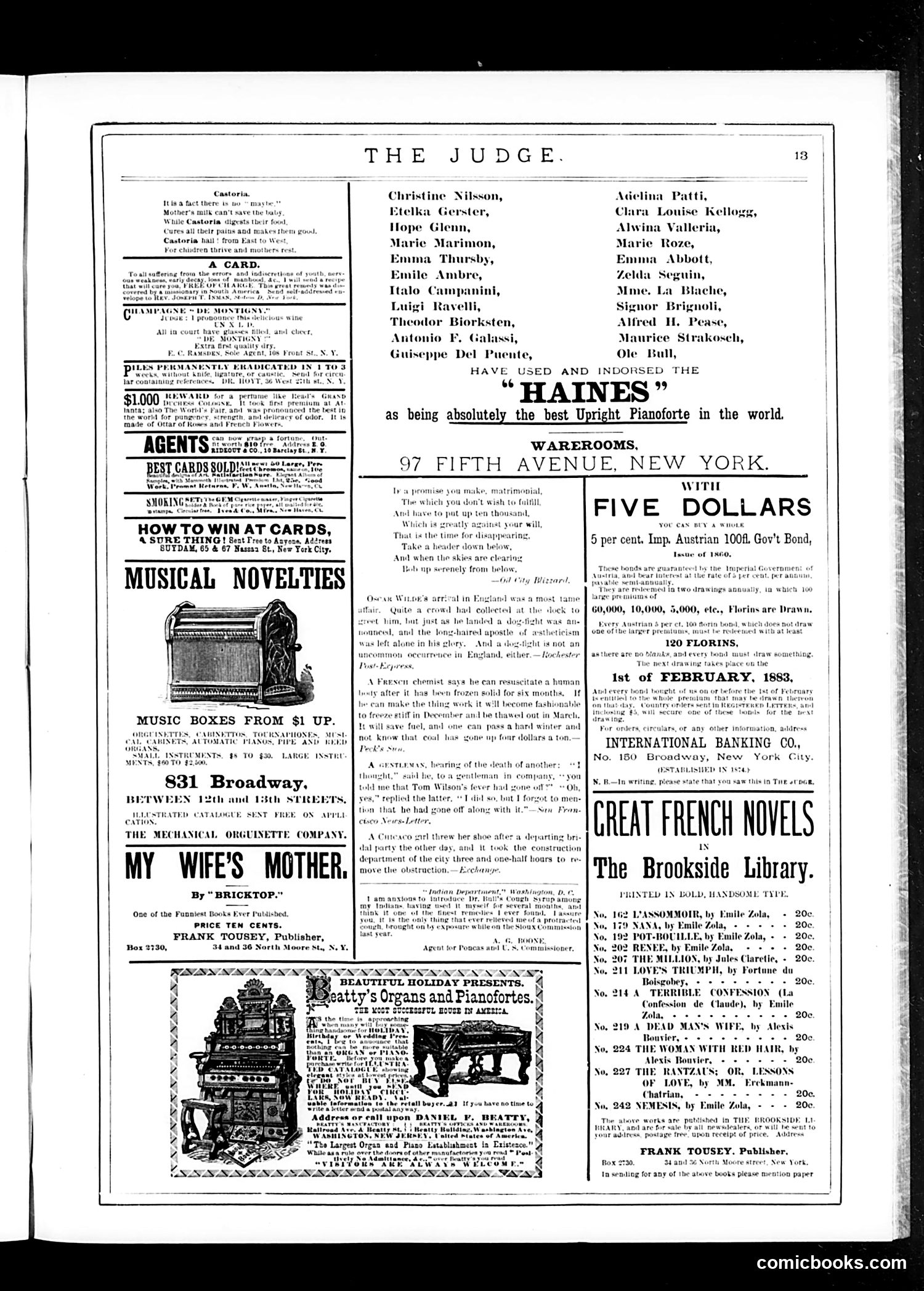
This page is primarily **advertising and endorsements** rather than editorial cartoon content. The main feature is a celebrity endorsement section listing famous opera singers and performers (Adelina Patti, Clara Louise Kellogg, etc.) who claim to have "used and indorsed" Haines Upright Pianofortes as "absolutely the best" in the world. The page is dominated by various commercial advertisements: music boxes, a book titled "My Wife's Mother" (apparently comedy), organs and pianofortes, Austrian government bonds, and the "Brookside Library" of French novels. There is a small satirical story or anecdote visible in fragments, but the text is too OCR-corrupted to clearly identify its subject or point. **The satire appears to be:** celebrity endorsements (a practice as old as advertising itself), where famous performers lend their names to commercial products—a common target of Judge's humor throughout its run.
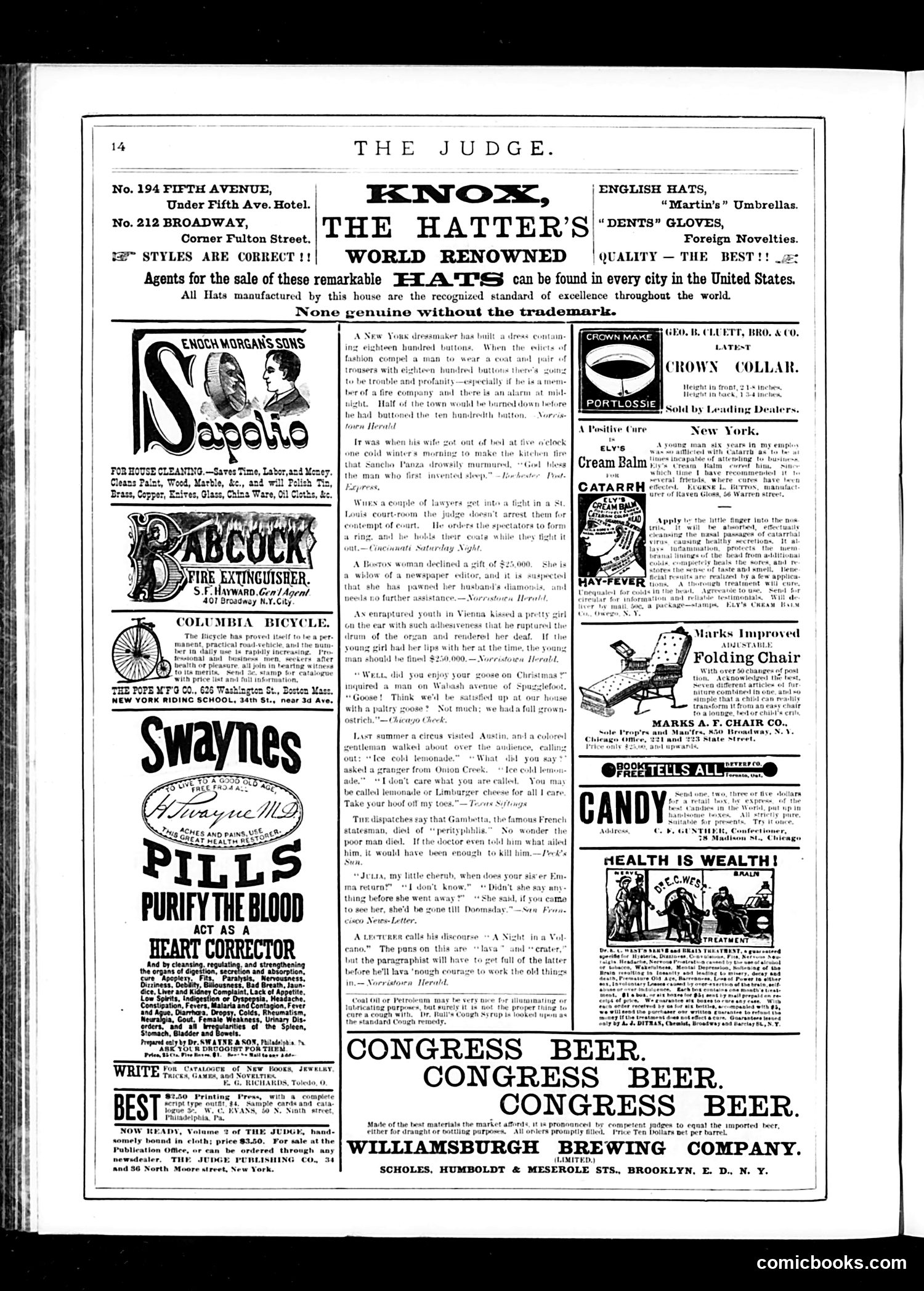
This page is predominantly filled with late 19th-century advertisements rather than editorial cartoons or satire. The layout includes promotional material for Knox hats, Enoch Morgan's Sons cleaning products, Babcock fire extinguishers, Columbia bicycles, Swaynes Pills (a patent medicine claiming to "purify the blood"), Marks Improved folding chairs, candy, health treatments, and Congress Beer. The small text snippets interspersed appear to be humorous anecdotes or jokes typical of Judge's satirical format—brief stories mocking various social situations (a woman building a dress with 18 buttons, questions about Christmas geese, etc.)—but these are difficult to parse clearly and appear secondary to the advertising content. The page functions primarily as a commercial vehicle rather than delivering pointed political or social satire. It reflects how Judge, like most publications of its era, relied heavily on paid advertisements to fund operations.
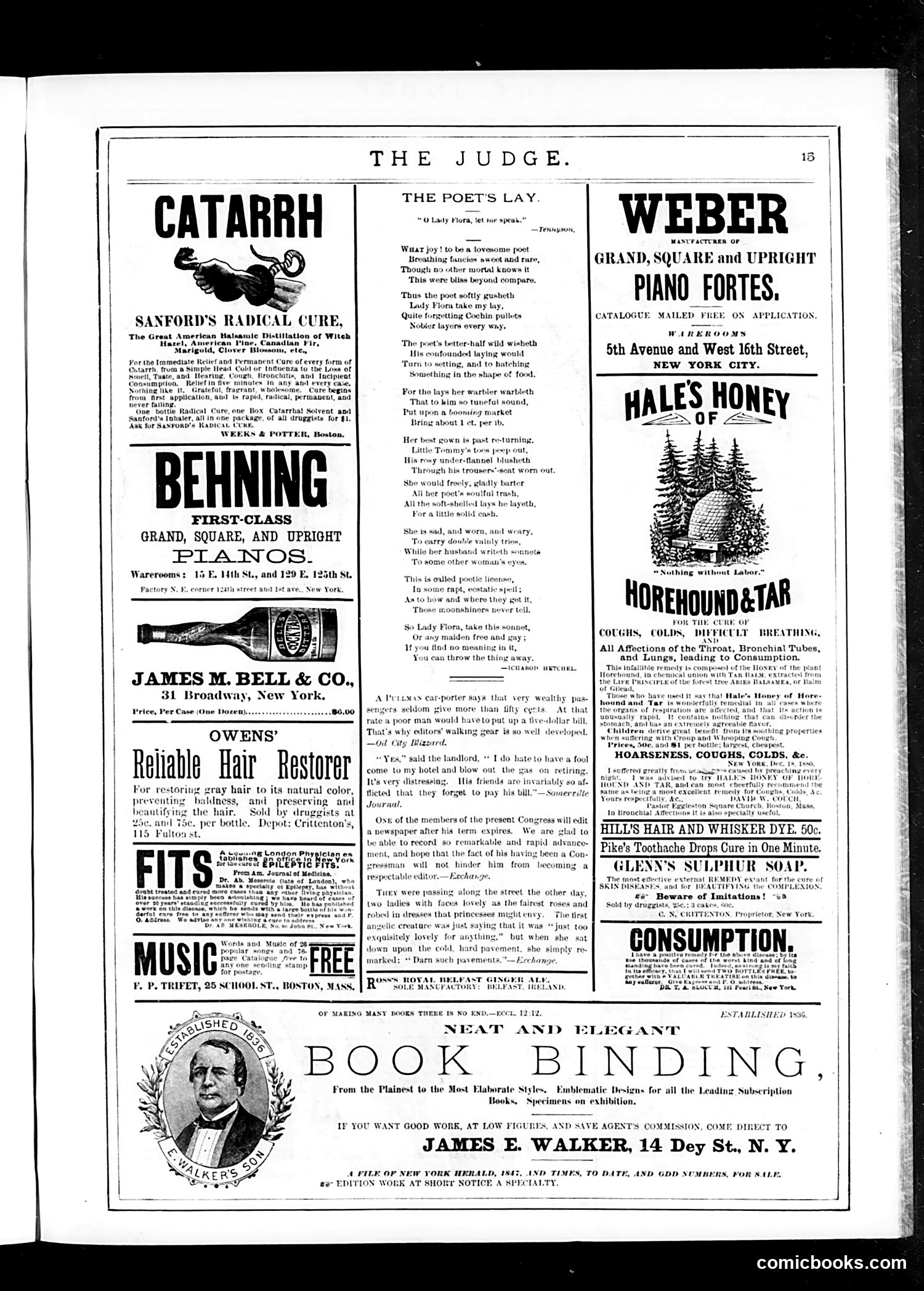
This page is predominantly **advertisements** for patent medicines and consumer goods typical of the late 19th century, interspersed with one satirical poem. ## The Satirical Content **"The Poet's Lay"** is the only editorial content, a humorous poem mocking impoverished poets. It parodies Tennyson's romantic style while depicting a starving writer whose landlord demands payment and whose literary efforts go unpublished. The satire contrasts the poet's flowery language about "fancies sweet and rare" with his actual desperate poverty—he cannot pay rent and must pawn his clothes. The joke culminates when he tears up his work in frustration, with the editorial note that editors prefer wealthy contributors whose checks don't bounce. ## The Advertisements The bulk of the page advertises remedies (catarrh cures, hair restorer, consumption treatments) and luxury goods (pianos, book binding services)—typical of Gilded Age magazines. These ads are not satirical but genuinely commercial, reflecting the era's patent medicine industry before FDA regulation. The page overall demonstrates how 19th-century satirical magazines funded themselves through advertising while maintaining editorial commentary on contemporary life.
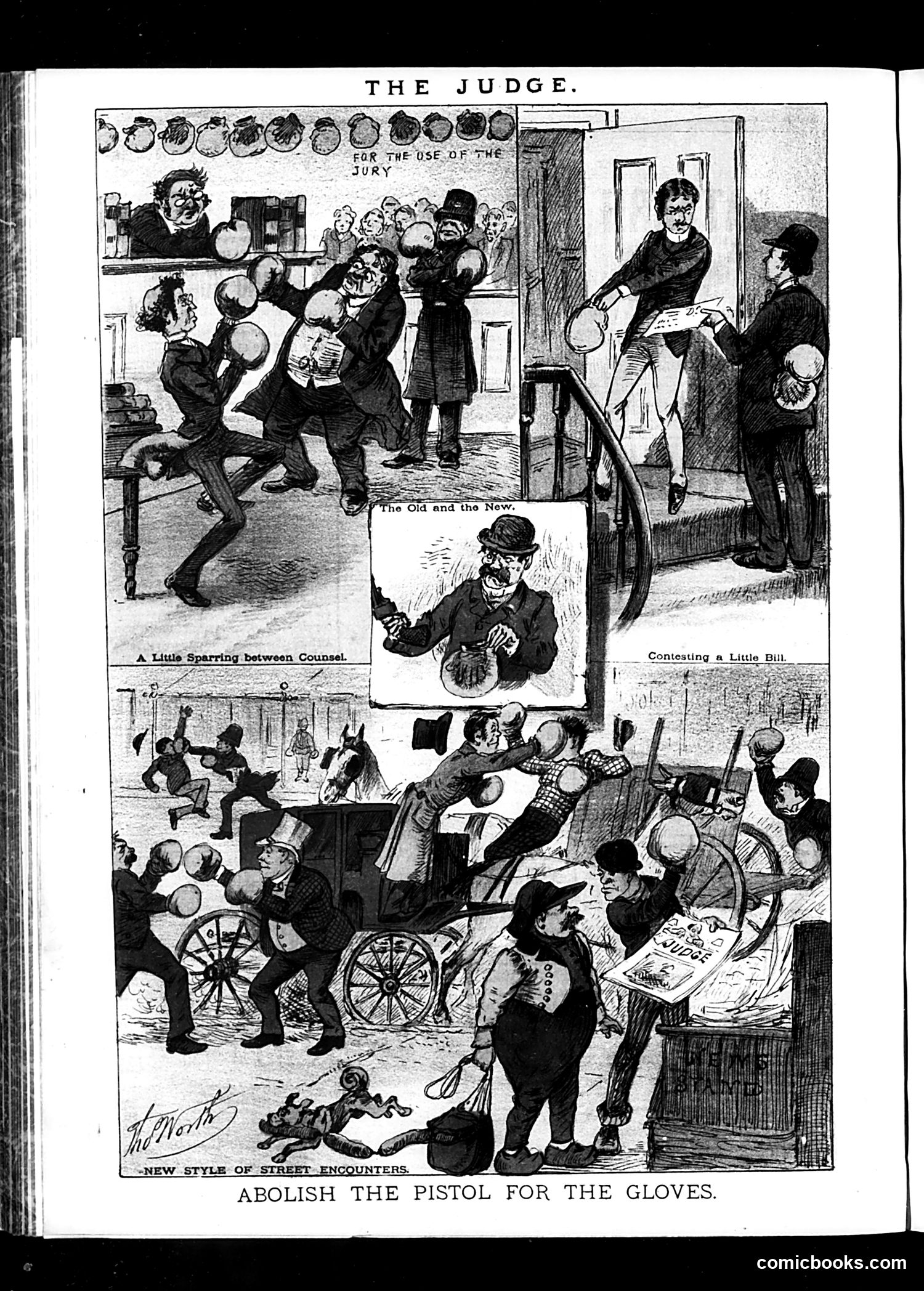
This satirical cartoon advocates for replacing pistols with boxing gloves in street fights—a humorous call to make dueling or street violence "safer" by substituting one weapon for another. The page shows multiple scenes of courtroom and street chaos: judges presiding over disputes, men engaged in physical altercations, and civilians brawling with oversized boxing gloves and wheels/bicycles as improvised weapons. The central inset labeled "The Old and the New" contrasts traditional and contemporary conflict methods. The satire mocks both ineffective legal proceedings ("For the Use of the Jury") and the absurdity of street violence generally. By suggesting gloves replace pistols, the cartoon ridicules the notion that such superficial reforms address violence's root causes. It's social commentary on urban disorder and inadequate solutions to public safety issues in the Gilded Age.